Optimization
Yuval Emek
Technion - Israel Institute of Technology, Haifa, Israel [email protected]
Noga Harlev
Technion - Israel Institute of Technology, Haifa, Israel [email protected]
Taisuke Izumi
Nagoya Institute of Technology, Japan [email protected]
Abstract
Theweighted vertex cover problem is concerned with selecting a subset of the vertices that covers a target set of edges with the objective of minimizing the total cost of the selected vertices. We consider a variant of this classic combinatorial optimization problem where the target edge set is not fully known; rather, it is characterized by a probability distribution. Adhering to the model of two-stage stochastic optimization, the execution is divided into two stages so that in the first stage, the decision maker selects some of the vertices based on the probabilistic forecast of the target edge set. Then, in the second stage, the edges in the target set are revealed and in order to cover them, the decision maker can augment the vertex subset selected in the first stage with additional vertices. However, in the second stage, the vertex cost increases by some inflation factor, so the second stage selection becomes more expensive.
The current paper studies the two-stage stochastic vertex cover problem in the realm ofdistributed graph algorithms, where the decision making process (in both stages) is distributed among the vertices of the graph. By combining the stochastic optimization toolbox with recent advances in distributed algorithms for weighted vertex cover, we develop an algorithm that runs in timeO(log(∆)/ε), sends
O(m) messages in total, and guarantees to approximate the optimal solution within a (3 +ε)-ratio, where m is the number of edges in the graph, ∆ is its maximum degree, and 0 < ε < 1 is a performance parameter.
2012 ACM Subject Classification Theory of computation→Distributed computing models Keywords and phrases weighted vertex cover, distributed graph algorithms, two-stage stochastic optimization, primal-dual
Digital Object Identifier 10.4230/LIPIcs.OPODIS.2019.32
Funding Yuval Emek: This work has been funded in part by an Israeli Ministry of Science and Technology grant number 3-13565.
Taisuke Izumi: This work was supported by JST SICORP Grant Number JPMJSC1606 and JSPS KAKENHI Grant Number JP19K11824, Japan.
1
Introduction
Distributed computing models are adversarial in nature: if the future bears any kind of uncertainty, then we better prepare for the worst. While this approach is sensible in some situations, e.g., when dealing with faults in critical systems, it seems to be exaggerated in others: Should we still aim for the worst even if we hold reliable forecasts that point to more optimistic outcomes? Is it not a little bit paranoid to assume that the future is always determined by a malicious adversary?
© Yuval Emek, Noga Harlev, and Taisuke Izumi; licensed under Creative Commons License CC-BY
With this motivation in mind, the current paper adopts the two-stage stochastic op-timization model, where the future uncertainty is resolved by nature’s coin tosses rather than by a malicious adversary. This popular model is adjusted to the realm ofdistributed graph algorithms and applied to the weighted vertex cover problem. The adaptation of weighted vertex cover to the distributed stochastic setting makes it applicable to many real-life scenarios, especially in the context of network applications. For example, a distributed construction of a minimum vertex cover could come in handy for tasks such as monitoring traffic over high demand links. More often than not, the set of high demand links is not fully known in advance and decisions regarding the placement of monitors must be made based on probabilistic forecasts.
1.1
Distributed Two-Stage Stochastic Vertex Cover
The problem considered in this paper is a distributed version of thetwo-stage stochastic vertex cover (2SVC)problem. In its centralized version, the 2SVC problem is defined over an undirected graphG= (V, E) and a vertexcost functionc:V →R≥0. Given a target edge
subsetT ⊆E, the goal is to purchase a vertex subsetX⊆V thatcoversT in the sense that every edge inT has at least one endpoint inX.
The crux of the 2SVC problem is that the targetT is not known explicitly; rather, it is drawn from a probability distributionπover 2E. A 2SVC algorithm Algconstructs the covering vertex subsetX in twostages: In the first stage, Algconstructs a vertex subset
X1⊆V based onπ, but without knowing the realized targetT. Then, in the second stage,
T is revealed and AlgaugmentsX1 with a vertex subsetX2 ⊆V −X1 to obtain a valid coverX =X1∪X2 forT, but the vertices are now costlier: each vertexv∈X2 costsσ·c(v), where σ >1 is an inflation factor specified with the problem instance (together with G,
c, and π). The objective is to minimize Alg’s total cost c(X1) +σ·c(X2) in expectation,
wherec(V0) =P
v∈V0c(v) for everyV0⊆V and the expectation is taken over the probability
distributionπfrom which the targetT is drawn and the random coin tosses of the algorithm (if any).
In the current paper, we adapt the 2SVC problem to the distributed setting where there is no centralized decision maker. Adhering to the standard assumptions in the domain of distributed graph algorithms (cf. [32]), the computation in both the first and second stages is distributed among the vertices in V that are identified with processing units that operate in synchronousrounds and can communicate with each other by exchanging messages of bounded size over the edges in E (referred to as the CONGEST model in [32]). This means that at the beginning of the first stage, the vertices hold no knowledge of the global topology of G. Moreover, we assume that π is a product distribution, so thatπ(T) = (Q
e∈Tπ(e))·( Q
e∈E−T(1−π(e))), and that it is provided to the vertices in
a distributed manner: at the beginning of the first stage, vertexv ∈ V is aware of the individual edge probabilityπ(e) if and only ifeis incident onv.
Theapproximation ratioof a distributed 2SVC algorithmAlgis the minimumρsuch that for every graphG= (V, E), cost functionc:V →R≥0, target (product) distributionπover
2E, and inflation factorσ >1, it is guaranteed that the expected cost paid byAlgis at most
ρ× min X1⊆V c(X1) + X T⊆E π(T)· min X2⊆V:X1∪X2coversT σ·c(X2) .
In other words, the performance ofAlgis measured in comparison to an optimal (omnipotent) centralized benchmark.
1.2
Our Contribution
In this paper, we design a distributed algorithm, referred to asAlg, that for any 0< ε <1, outputs a (3 +ε)-approximation for the 2SVC problem. Denoting the number of vertices in G by n and its maximum degree by ∆ and assuming that the vertex costs c(v) and performance parameterεcan be encoded usingO(logn) bits,Algcompletes the first stage in
O(log(∆)/ε) rounds and the second stage inO(1) rounds, sending a total ofO(1) messages per edge, each of size O(logn). We assume for simplicity that the vertices are equipped with unique IDs (encoded usingO(logn) bits), but these can be easily replaced by any local symmetry breaking oracle (e.g., an arbitrary edge orientation). Beyond that, the vertices are not assumed to hold any global knowledge of the graph, including the parametersnand ∆.
Two-stage (and more generally, multi-stage) stochastic optimization is an important research domain (see Sec. 1.3) that, to the best of our knowledge, has not been studied yet in the context of distributed graph algorithms. We hope that the first step that the current paper makes into the interface between these fascinating research domains will ignite further exploration of distributed algorithms for stochastic graph theoretic problems.
1.3
Related Work
The field of stochastic optimization dates back to the mid-fifties with the seminal papers of Dantzig [12] and Beale [8] on stochastic linear programming and is studied extensively since then. Comprehensive accounts of stochastic programming under both continuous and discrete models can be found in [35, 27, 10].
Initiated in the paper of Dye, Stougie, and Tomasgard [14], the study of approximation algorithms for stochastic optimization problems has recently gained a lot of attention [21, 13, 34, 15, 19, 3]. Much of this literature deals with the finite scenario model, where the scenarios that may occur in the second stage are listed explicitly as part of the input. A different approach, sometimes called the black-box model, relies on sampling access to a probability distribution that is not necessarily provided explicitly. Shmoys and Swamy obtained approximation algorithms in this model for problems in the framework of two-stage [36] and multi-two-stage [38] stochastic optimization. They also wrote a broad survey on approximation algorithms for a large class of two-stage stochastic linear and integer programs in both the finite scenario and black-box models [39].
Among other methods, Shmoys and Swamy [38] used the sample average approximation
approach that reduces many problems in the black-box model to their finite scenario counter-part. This approach essentially feeds the finite scenario algorithm with samples taken from the (implicit) probability distribution. We remark that although this approach has proven to be very successful for centralized algorithms [36, 38, 37], it seems to be less suitable for distributed settings.
As discussed later on, our work builds upon the (centralized) framework of Gupta et al. [18] for general stochastic optimization problems. This is a generic framework that given an approximation algorithm with certain desired properties for (the deterministic version) of a combinatorial optimization problemP, yields an approximation algorithm for the two-stage (and multi-stage) stochastic versions ofP. Among other combinatorial optimization problems,
Gupta et al. applied their framework to weighted vertex cover, obtaining a (centralized) 3-approximation 2SVC algorithm. This has been improved to a (2 +ε)-approximation by Srinivasan [37] using the sample average approximation approach.
In its deterministic version, vertex cover is a classic combinatorial optimization problem, listed among the 21 NP-hard problems in Karp’s seminal paper [24]. The unweighted version of this problem can be approximated within a factor of 2 simply by finding a maximal
matching (see, e.g., [11]). A 2-approximation polynomial-time algorithm for the weighted version of vertex cover was introduced by Nemhauser and Trotter [30]. Bar-Yehuda and Even [5] presented the first linear-time 2-approximation algorithm using the primal-dual technique and later on [6], repeated this result to demonstrate their local ratio technique. The currently best known approximation for weighted vertex cover problem is (2−Θ(1/√logn)) due to Karakostas [23]. Assuming the unique games conjecture, this cannot be improved much further as Khot and Regev [25] established a lower bound of 2−εfor any constant
ε >0.
In the distributed setting, there is a long line of work on approximation algorithms for unweighted vertex cover and on the related maximal matching problem [22, 20, 31, 1, 33, 7, 16]. For the weighted version of vertex cover, Khuller et al. [26] present a (2 +ε)-approximation algorithm that runs inO(logε−1logn) rounds. The algorithm of Kuhn et al. [29] obtains
the same approximation ratio with anO(ε−4log ∆) run-time. Åstrand and Suomela [2]
designed a 2-approximation algorithm whose run-time isO(∆ + log∗W), whereW is the maximum weight. A randomized 2-approximation algorithm that runs inO(logn+ logW) was presented by Grandoni et al. [17]. This has been improved to a run-time ofO(logn) by Koufogiannakis and Young [28].
Building upon the classic local ratio technique, Bar-Yehuda et al. [4] have recently devised a deterministic (2 +ε)-approximation algorithm for weighted vertex cover with
Oε·log log ∆log ∆ run-time. This algorithm has been improved by Ben-Basat et el. [9] to obtain a run-time whose dependency on 1/ε is logarithmic rather than linear. With the right choice of the performance parameterε, this leads to a deterministic 2-approximation algorithm for weighted vertex cover whose run-time isOloglogn2·log ∆log ∆
. As discussed further in the sequel, the approach behind the algorithms of [4, 9] inspires the main algorithmic building block of our 2SVC approximation algorithm.
1.4
Organization of the Paper
The remainder of this paper is organized as follows. Following some preliminary definitions presented in Sec. 2, we discuss in Sec. 3 the technical challenges that had to be overcome en route to developing our distributed 2SVC approximation algorithm. The algorithm is then developed in Sec. 4 and analyzed in Sec. 5. We conclude in Sec. 6 with some further discussion and open questions.
2
Preliminaries
Relaxed Vertex Cover. We now define a slightly different version of the 2SVC problem, calledrelaxed 2SVC (r2SVC). In this version we are allowed to make partial payments for the vertices in each of the two stages based on the notion of apayment functionp:V →R≥0.
We say that a payment function p covers the edge subset F ⊆ E if the vertex subset
Xp={v∈V |p(v)≥c(v)}is a cover forF.
An algorithmAlgrel for the r2SVC problem constructs the payment functionsp1:V → R≥0 andp2: V →R≥0 in the first and second stages, respectively, with the requirement
that the functionp1+p2, defined so that (p1+p2)(v) = p1(v) +p2(v), covers the target
edge subsetT. The cost paid byAlgrel isc(p1) +σ·c(p2), where the costc(p) of a payment functionp:V →R≥0 is defined to bec(p) =Pv∈V p(v).
By definition, any 2SVC algorithm can be transformed into a r2SVC algorithm with the same cost by settingpi(v) =c(v) ifv ∈Xi andpi(v) = 0 otherwise for i= 1,2. Gupta et al. [18] established the converse direction: any r2SVC algorithm can be transformed into
a 2SVC algorithm with the same expected cost. Although their proof aims at centralized algorithms, it is straightforward to see that it holds also for the distributed version of the (r)2SVC problem, yielding the following lemma (a proof is added for completeness).
ILemma 2.1. Any distributed r2SVC algorithmAlgrel can be transformed into a distributed 2SVC algorithm Algwith the same expected cost.
Proof. Letp1andp2 be the payment functions constructed byAlgrel in the first and second
stages, respectively. We construct the 2SVC algorithmAlgas follows. In the first stageAlg
includes vertexv∈V in the vertex subsetX1with probability min{1, p1(v)/c(v)}. In the second stage,Algincludes vin the vertex subsetX2ifv∈Xp1+p2 and it was not already
selected in the first stage. By the linearity of expectation, the expected payment made by
Algin each stage is up-bounded by the payment made byAlgrel in the same stage. J Following Lem. 2.1, we focus hereafter on designing a distributed algorithm for the r2SVC problem.
The Framework of [18]. Our distributed algorithm for the r2SVC problem is based on the (centralized)boosted-sampling algorithm of Gupta et al. [18] for that problem.1 This is
a randomized algorithm that is compiled from two algorithmic building blocks. The first building block is acovering payment algorithm, referred to as Algpay, that given an edge subsetF ⊆E, constructs a payment functionp:V →R≥0 that coversF.2 We say that
Algpayis anα-approximationcovering payment algorithm if the cost of the payment function
pconstructed byAlgpay is guaranteed to satisfyc(p)≤α·c(Opt(F)), whereOpt(F) is an optimal cover forF.
The second building block of the boosted-sampling algorithm is anaugmentation algorithm, referred to as Algaug, that given two edge subsets F, F0 ⊆ E and a payment function
p:V →R≥0 that coversF, constructs a payment functionp0 so thatp+p0 coversF0.
In the first stage, the boosted-sampling algorithm creates a random edge subsetS by sampling each edgee∈E with probability min{1, σπ(e)}. Following that, it invokesAlgpay
onS to obtain a payment functionp1that coversS. In the second stage, when the actual edge subsetT is revealed, the boosted-sampling algorithm invokes Algaug on (S, T, p1) to
construct the payment functionp2so thatp1+p2 coversT.
An essential ingredient in the analysis of the boosted-sampling algorithm is the notion of
cost-sharing functions. These functions provide a useful way to bound the overall cost by allocating it to the edges that need to be covered. Formally, a functionξ: 2E×E→
R≥0
is said to be acost-sharing function if it satisfies the following two properties for any edge subsetF ⊆E:
P1. ξ(F, e) = 0 for any edgee∈E−F; and
P2. X e∈F
ξ(F, e)≤c(Opt(F)).
The cost-sharing functionξis said to beβ-unistrictwith respect to Algpay andAlgaug
if it satisfies the following property for any edge subsetF ⊂Eand edge e∈E−F:
P3. β·ξ(F∪ {e}, e)≥c(Algaug(F,{e},Algpay(F))).
1 As mentioned in Sec. 1.3, Gupta et al. develop a generic framework and the boosted-sampling algorithm
is actually suitable for many different combinatorial optimization problems. Since our focus in the current paper is restricted to weighted vertex cover, we present an adaptation of this algorithm to that specific problem.
2 We assume that the underlying graphG= (V, E) and the vertex cost functioncare fixed and do not
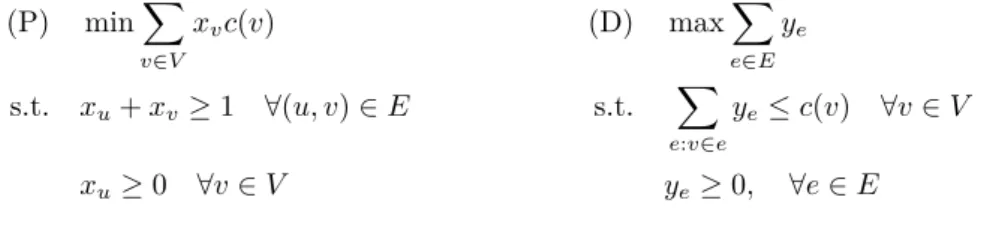
(P) minX v∈V xvc(v) (D) maxX e∈E ye s.t. xu+xv≥1 ∀(u, v)∈E s.t. X e:v∈e ye≤c(v) ∀v∈V xu≥0 ∀v∈V ye≥0, ∀e∈E
Figure 1The linear program relaxation of weighted vertex cover (P) and its dual program (D),
which is actually the linear program relaxation of theb-matchingproblem.
In other words, the cost of augmenting the payment functionpconstructed by Algpayfor coveringF to a payment functionp+p0 that coverseas well, is at mostβ·ξ(F∪ {e}, e).
ITheorem 2.2 ([18]). Given anα-approximation covering payment algorithm Algpay, an augmentation algorithm Algaugand a cost-sharing function that isβ-unistrict with respect to Algpay and Algaug, the boosted-sampling algorithm provides an (α+β)-approximation algorithm for the r2SVC problem.
Additional Notation. Throughout, we denote the number of vertices and the number of edges in the underlying graphG= (V, E) byn=|V|and m=|E|, respectively. Let deg(v) be the degree of vertexv in Gand let ∆ = maxv∈V deg(v) be the maximum degree.
3
Technical Challenges
In their centralized 2SVC algorithm, Gupta et al. [18] construct the first-stage solution using the following classic (centralized) primal-dual algorithm for weighted vertex cover (refer to Fig. 1 for the weighted vertex cover linear program relaxation and its dual program): The algorithm continuously raises the dual variables associated with the edges, concurrently for all of them, until a dual constraint associated with some vertexvbecomes tight; at this point,
vjoins the vertex cover and the edges incident onv arefrozenso that their dual variables will not be raised any further. The algorithm terminates when all edges are frozen.
A key ingredient in the analysis of Gupta et al. is that the dual variables can serve as a 1-unistrict cost-sharing function. This powerful observation utilizes theidentical runs
property stating that for anyF ⊂E ande∈E−F, the runs of the algorithm onF and on
F∪ {e} are identical (with respect to the dual variables of the edges inF) up to the point when the dual variable ofebecomes frozen.
The recent weighted vertex cover algorithm of Bar-Yehuda et al. [4] (see also the algorithm of Ben-Basat et al. [9]) can be viewed as a distributed implementation of this primal-dual approach.3 They cleverly replace the centralized method of continuously (and concurrently)
increasing the dual variables by a stepwise increase based on arequest-response iterative process. An inherent property of the algorithms of [4, 9] is that in each step of the iterative process, the amount requested by vertexv from an adjacent vertexu, and hence also the amount responded byutov’s request, depend on the number of edges incident onv that have not been frozen yet. Consequently, the runs of the algorithm onF ⊂E and onF∪ {e},
for somee∈E−F, may differ from each other already at the early stages of the execution. As the amounts of responses sent over edgee= (u, v) determine the value of the dual variable associated withe, this distributed algorithm does not satisfy the aforementioned identical runs property.
To overcome this obstacle, we develop a variant of [4]’s algorithm that does satisfy the identical runs property. This is done by grouping the iterative process’ steps intophases
so that vertexv requests the same amount throughout all steps of the phase. The crucial point here is that this amount is now fixed in advance and in particular, does not depend on the number of unfrozen edges incident onv. At the same time, our algorithm preserves the primal-dual structure in a way that allows us to efficiently combine it with an augmentation (second stage) algorithm. The main challenge is then to show that the dual variables serve as a (1 +ε)-unistrict cost-sharing function. We prove that our algorithm is onlyO(log log ∆) factor slower than the original algorithm of [4] (whose run-time is optimal as a function of ∆). Moreover, our algorithm has a message complexity ofO(m), an improvement over the algorithm of [4] that sendsOε·mlog log ∆log ∆ messages.
4
A Distributed Algorithm for 2SVC
In this section, we present our distributed 2SVC algorithm Alg. As mentioned in Sec. 2, we actually present an algorithm for the r2SVC problem (Lem. 2.1 ensures that it can be transformed into a 2SVC algorithm) that can be viewed as a distributed implementation of the boosted-sampling algorithm of [18].
Similarly to the centralized version of the boosted-sampling algorithm, our distributed algorithm also constructs the random edge subset S by sampling each edge e ∈ E with probability min{1, σπ(e)}, only that now this sampling is done in a decentralized manner by one ofe’s endpoints (say, the one with the smaller ID). Following this sampling process, the vertices know which of their incident edges are included inS.
The first stage is then completed by running the distributed covering payment algorithm
Algpaypresented in Sec. 4.1 on S, generating a payment functionp1that coversS. In the second stage when the target edge subsetT ⊆E is revealed, the vertices run the distributed augmentation algorithmAlgaugpresented in Sec. 4.2 onS, T, andp1 to obtain a payment functionp2 so thatp1+p2 coversT. For clarity of the exposition, we first implement our
algorithms so that they may send messages over each edge in every round without taking the message size into account. Then, in Sec. 4.3, we explain howAlgpay andAlgaug can be modified to sendO(m) messages in total, each of size O(logn).
4.1
A Distributed Covering Payment Algorithm
Our distributed covering payment algorithmAlgpaygets as input an edge setF and constructs a payment functionpthat coversF. Fix some sufficiently small performance parameterε >0 (the relation of the performance parameter εfixed here to the guaranteed approximation ratio is revealed later on). Algpayworks in phases, each consisting of 3· d2/εerounds that are divided intod2/εecontiguous round triples referred to assteps. Each step begins with a
requestround followed by a responseround, in which the vertices exchange messages referred to asrequestsandresponses, respectively. The last (third) round in the step is astatusround in which the vertices report whether they remain active(initially, all vertices are active). Every active vertexv∈V maintains aweightvariablew(v) which is initialized withc(v) and is monotonically non-increasing throughout the steps of the algorithm. In addition, vertexv
Consider some active vertexv∈V. We use (j, i) to denote stepi= 0,1, . . . ,d2/εe −1 of phasej. In the request round of step (j, i), vertexv sends to each active neighboru∈A(v) the message
requestj,i(v, u) = 2
j· εc(v)
deg(v),
where recall that deg(v) denotes the degree ofv in the underlying graphG. In the following response round,v processes the request messages received from its active neighbors one-by-one (in an arbitrary order). For each request messagerequestj,i(u, v),vsends a response message
responsej,i(v, u) = minrequestj,i(u, v), w(v)−εc(v)
and subtractsresponsej,i(v, u) fromw(v). We say that the requestrequestj,i(u, v) isfully
responded ifresponsej,i(v, u) =requestj,i(u, v). Notice that this update rule ensures that
w(v)≥εc(v) throughout the response round.
In the status round,v updates the weight variablew(v) by subtractingresponsej,i(u, v) from w(v) for each response message received from an active neighbor u∈ A(v). Upon completion of this update process, ifw(v)≤εc(v), thenvbecomes inactive, sends a designated
inactivemessage to its active neighbors, and marks itself as acovering vertex (the role of the covering vertices is revealed soon). A vertex whose active neighbor set is empty also becomes inactive. We usewinact(v) to denote the remaining weight ofv when it becomes inactive.
The payment functionp:V →R≥0constructed by Algpay is defined by setting
p(v) = min
c(v)−winact(v)
1−ε , c(v)
. (1)
This means thatp(v) is always up-bounded byc(v) and thatp(v) =c(v) if and only ifvends up as a covering vertex. Refer to Pseudocode 1 for a pseudocode description ofAlgpay.
4.2
A Distributed Augmentation Algorithm
Our distributed augmentation algorithmAlgaug gets as input two edge subsetsF, F0 ⊆E
and a payment functionp: V →R≥0 that coversF, and constructs a payment function p0:V →R≥0so thatp+p0coversF0 as follows. Define thereducedcost of each vertexv∈V
to bec(v)−p(v).For each edge (va, vb)∈F0,Algaugselects the endpointvi,i∈ {a, b}, with the smaller reduced costc(vi)−p(vi), breaking ties arbitrarily (say, by the vertex IDs). The payment functionp0 is then defined by setting
p0(v) =
(
c(v)−p(v), ifv is selected byAlgaug
0, otherwise .
This means that
c(Algaug(F, F0, p)) ≤ X (va,vb)∈F0
Algorithm 1A covering payment algorithm, code for vertexv.
1: forj = 0,1, ...do
2: fori= 0 tod2/εe −1do Request Round 3: for eachu∈A(v)do
4: requestj,i(v, u)←2j·deg(v)εc(v)
5: Sendrequestj,i(v, u) tou
Response Round 6: for eachu∈A(v)do 7: responsej,i(v, u)←min
requestj,i(u, v), w(v)−εc(v)
8: w(v)←w(v)−responsej,i(v, u)
9: Sendresponsej,i(v, u) tou
Status Round 10: for eachu∈A(v)do
11: w(v)←w(v)−responsej,i(u, v)
12: if w(v)≤εc(v)then
13: Sendinactiveto all neighbors
14: returnp(v)←c(v) . vis marked as a covering vertex
15: for eachinactivemessage received fromu∈A(v)do 16: A(v)←A(v)− {u}
17: if A(v) =∅then
18: returnp(v)← 1
1−ε(c(v)−w(v))
4.3
Fewer and Smaller Messages
While Algaug requires a single round of communication and hence, does not send more thanO(m) messages in total, the aforementioned implementation ofAlgpaydictates sending messages over each edge in every step which sums up to Ω(mlog(∆)/ε) messages. Here we show that Algpay can be modified to sendO(1) messages over each edge throughout the execution, which accounts for a total ofO(m) messages as well. We then explain how the message size (of bothAlgpay andAlgaug) can be bounded byO(logn).
The modified Algpaystarts with ahandshake round in which each vertexv∈V sends its costc(v) and degree deg(v) to all its neighbors. The next messages thatv is certain to send are theinactivemessages sent whenv becomes inactive. Consider some neighboruof v
and suppose that it still did not receive aninactivemessage fromv. Using the handshake information, vertex ucan compute the value of each request message requestj,i(v, u) = 2j ·εc(v)/deg(v) without actually receiving it from v. Moreover, as long as u does not hear otherwise from v, it infers that v fully responds to its own requests, namely, that
responsej,i(v, u) = requestj,i(u, v), again, without actually receiving v’s response. If v
cannot fully respond to u’s request in some step (j, i), thenv sends the partial response
responsej,i(v, u) as in the original implementation ofAlgpay, but notice that this will happen at most once asv must become inactive in step (j, i).
With this modification, a vertex v ∈V sends messages over an incident edge (v, u) in three occasions: (1) a message encodingc(v) and deg(v) during the designated handshake round ofAlgpay; (2) a message encoding a partial response torequestj,i(u, v) during the
ofv during the execution of Algaugin the second stage. The message sent in occasion (1) is of sizeO(logn) by the assumption on the vertex costs. To ensure that the messages sent during occasions (2) and (3) are also of sizeO(logn), we round down their numeric content to the next power of 1 +ε. This affects the approximation ratio analyzed in Sec. 5 by a factor of at most 1 +ε.
5
Analysis
In this section, we analyze the distributed implementation Alg of the boosted-sampling algorithm presented in Sec. 4, establishing the following theorem.
ITheorem 5.1. For any sufficiently smallε >0,Algcompletes the first stage inO(log(∆)/ε)
rounds and the second stage inO(1) rounds and guarantees to return a(3 +O(ε)) -approxi-mation for the r2SVC problem.
To obtain an approximation ratio of (3 +ε0) for some 0< ε0 <1 (as promised in Sec. 1), one merely has to set the performance parameterεused by Algso that ε←ε0/κfor the appropriate constantκhidden in theO-notation in the statement of Thm. 5.1. We start the analysis by proving thatAlgpay constructs a covering payment function.
I Lemma 5.2. When invoked on an edge subset F ⊆ E, Algpay constructs a payment functionpthat covers F.
Proof. When a vertexv∈V becomes inactive, either (1) its active neighbor set is empty; or (2) its weight variablew(v) satisfies w(v)≤εc(v). In the latter case,v is a covering vertex withp(v) =c(v). The assertion follows by the design ofAlgpay ensuring that if (u, v)∈F, then it cannot be the case that bothuandv become inactive due to the former reason. J Letwj(v) andAj(v) denote the weight and active neighbor set ofv at the beginning of
phasej, respectively, and let degAj(v) denote the size ofAj(v). The following two lemmas
play a crucial role in proving thatAlgpayis a (2 +O(ε))-approximation covering payment algorithm.
ILemma 5.3. For every phase j in the run of Algpay and for every vertexv ∈V that is active at the beginning of phase j, it holds thatdegAj(v)≤deg(v)/2j.
Proof. Consider some vertexv ∈ V and recall that degA0(v) is the degree ofv in (V, F). Since degA0(v) is up-bounded by deg(v), the assertion holds for phase j = 0. Assume by contradiction that degAj(v)>deg(v)/2j for some phase j >0 wherev is still active. This
means thatvhad more than deg(v)/2j active neighbors throughout phasej−1 and in each of thed2/εesteps of that phase, more than deg(v)/2j requests ofv were fully responded. Since
requestj−1,i(v, u) = 2j−1·εc(v)/deg(v) for every u∈A
j−1(v) andi= 0,1, . . . ,d2/εe −1, it follows that wj(v) < wj−1(v)− d2/εe · deg(v) 2j ·2 j−1· εc(v) deg(v) ≤ wj−1(v)−c(v) ≤ 0.
Ergo,vmust become inactive by the beginning of phasej, in contradiction to the assumption.
J I Lemma 5.4. For every vertex v ∈ V, the weight variable w(v) remains non-negative throughout the run of Algpay.
Proof. Since the weight ofv does not decrease oncevbecomes inactive, it suffices to show that w(v) remains non-negative as long as v is active. In each step the weight of v can decrease only during the response round and the status round. Recall thatw(v)≥εc(v) throughout every response round, therefore we are left to show that in every status round, the amount decreased fromw(v) is not larger thanεc(v).
Consider some step (j, i). Each response message responsej,i(u, v) that v processes during this step is not larger thanrequestj,i(v, u) = 2j·εc(v)/deg(v). Therefore, it remains
to show thatv receives at most deg(v)/2j response messages in this step. As the number of active neighbors is monotonically non-increasing, this follows from Lem. 5.3 ensuring thatv
has at most deg(v)/2j active neighbors at the beginning of phasej.
J
For the purpose of further analysis, we define the functions yj,i: 2E×E →R≥0 and y: 2E×E→
R≥0as follows. Consider a run ofAlgpayon an edge subsetF ⊆E. For each step
(j, i) in this run and edgee= (u, v)∈E, letyj,i(F, e) =responsej,i(u, v) +responsej,i(v, u)
and let
y(F, e) = X
j=0,1,..., i=0,1,...,d2/εe−1
yj,i(F, e).
We generalize the last definition from single edges e to edge subsets J ⊆ E, defining
y(F, J) = P
e∈Jy(J, e). In addition, let F(v) = {e ∈F :v ∈ e} denote the set of edges
inF incident on vertexv ∈ V. Notice that for every vertexv ∈V, the sum of response messages sent over edges inF(v) equals the total amount decreased from w(v) throughout the execution, which yields the following observation.
IObservation 5.5. For every vertex v ∈ V, the function y satisfies y(F, F(v)) = c(v)− winact(v).
This facilitates approximatingp(v) byy(F, F(v)).
I Lemma 5.6. When invoked on an edge subset F ⊆ E, Algpay constructs a payment function pthat satisfies
(1−ε)·p(v) ≤ y(F, F(v)) ≤ p(v)
for every vertex v∈V.
Proof. Recall thatp(v) = min 1
1−ε(c(v)−winact(v)), c(v) (see (1)). If 1
1−ε(c(v)−winact(v))≤ c(v), then the assertion holds by Obs. 5.5 implying that p(v) = 1
1−ε ·y(F, F(v)). So,
consider the case where 1−1ε(c(v)−winact(v))> c(v) which means that winact(v)< ε·c(v). Lem. 5.4 ensures thatwinact(v)≥0, thus by combining it with Obs. 5.5 we conclude that
(1−ε)·c(v)< y(F, F(v))≤c(v). The assertion follows as p(v) =c(v) in this case. J Employing Obs. 5.5 we can establish also the following lemma.
ILemma 5.7. The function y: 2E×E→
R≥0 satisfiesy(F, F)≤c(Opt(F)).
Proof. For every vertexv∈V, Lem. 5.4 guarantees thatwinact(v)≥0, hence, in conjunction with Obs. 5.5, we get that y(F, F(v)) ≤c(v). It follows then that the variables y(F, e),
e∈F, constitute a feasible solution for the dual program of the linear program relaxation of weighted vertex cover on graph (V, F) with cost function c(·) (refer to Fig. 1 for that
program). The assertion follows as a consequence of weak duality. J
ILemma 5.8. Algpay is a(2 +O(ε))-approximation covering payment algorithm.
Proof. The payment functionpconstructed by Algpay satisfies
X
v∈V
p(v) ≤ (1 +O(ε))X
v∈V
y(F, F(v)) = 2·(1 +O(ε))·y(F, F) ≤ (2 +O(ε))·c(Opt(F)),
where the first transition is due to Lem. 5.6 and the last transition follows from Lem. 5.7. J It follows directly from the design ofAlgaug that given two edge subsetsF, F0⊆E and a payment functionp:V → R≥0 that covers F, the payment function p0 constructed by
Algaugwhen invoked on (F, F0, p) augmentspso that p+p0 coversF0. So,Algaugis a valid augmentation algorithm (that runs inO(1) rounds). The desired bound on the approximation ratio ofAlgcan now be established by identifying a proper cost-sharing function.
ILemma 5.9. The functiony: 2E×E→R≥0 is a(1 +O(ε))-unistrict cost-sharing function
with respect toAlgpay andAlgaug.
Proof. We need to show thatysatisfies properties P1–P3 (see Sec. 2) with respect toAlgpay
andAlgaug. WhenAlgpay is invoked on an edge subsetF ⊆E, no messages are sent over edges that are not inF, so property P1 clearly holds. Moreover, Lem. 5.7 ensures that
P
e∈Fy(F, e)≤c(Opt(F)), thus property P2 holds as well.
For property P3, we fix someF ⊂E ande∈E−F and show that
c(Algaug(F,{e},Algpay(F)))≤(1 +O(ε))·y(F∪ {e}, e).
To that end, we define the following additional notation: Given an edge subset J⊆F and a step (j, i), let y<(j,i)(F, J) = X (j0,i0)<(j,i) X e∈J yj0,i0(F, e),
where we use the relation<to denote the lexicographic order, and let
y≤(j,i)(F, J) = y<(j,i)(F, J) + X
e∈J
yj,i(F, e).
Consider two runs ofAlgpay: runR1 onF and runR2onF∪ {e}. Let (j, i) be the first step in which an endpoint ofebecomes inactive duringR2. LetR1
j,iandR2j,idenote the runsR1
andR2 up to the beginning of step (j, i), respectively. Observe thatR1
j,iandR2j,iare identical in the sense thaty<(j,i)(F, J) =y<(j,i)(F∪ {e}, J)
for anyJ ⊆F. In other words, the same response messages are sent over every edgee0∈F throughoutR1
j,iandR2j,i. This is due to the fact that the request messages that (an active)
vertexv∈V sends in every step (j0, i0) do not depend on the input ofAlgpay, but only on deg(v) andj0. Since both endpoints of edgee0 are active throughoutRj,i2 , it follows that the request messages sent over every edge inF are the same inR1
j,iandR2j,i, hence so are the
response messages.
Let u be the endpoint of e that becomes inactive in step (j, i) of run R2 (if both
endpoints ofebecome inactive in this step, then takeuto be one of them) and recall that
uis marked as a covering vertex. We argue that for each edge e0 ∈ F(u), it holds that
yj,i(F ∪ {e}, e0)≤yj,i(F, e0). This follows from the fact that in step (j, i) of runR2, once w(u) reaches theε·c(u) threshold, it starts sending response messages with 0 amount over the edges inF(u), while in step (j, i) ofR1,umay still send response messages with positive
At the end of step (j, i) ofR2 we know thatuis inactive andw(u)≤εc(u), so the total amount decreased fromw(u) throughout this run is at least (1−ε)·c(u). Therefore, the amount decreased fromw(u) throughoutR2 due to messages sent over edges other thaneis
at least (1−ε)·c(u)−y(F∪ {e}, e), hence
y≤(j,i)(F, F(u)) ≥ y≤(j,i)(F∪ {e}, F(u)) ≥ (1−ε)·c(u)−y(F∪ {e}, e).
Consequently, the total amount decreased fromw(u) throughoutR1is at least (1−ε)·c(u)− y(F∪ {e}, e), thus, at the end ofR1
winact(u) ≤ c(u)−((1−ε)·c(u)−y(F∪ {e}, e)) = εc(u) +y(F∪ {e}, e). (3) Let p be the payment function constructed by Algpay(F) and let p0 be the payment function constructed by Algaug(F,{e = (u, v)}, p). As p is a covering payment function for F, the bound in (2) implies that c(p0)≤ min{c(u)−p(u), c(v)−p(v)} ≤c(u)−p(u). Recalling the definition ofp(1), if p(u) =c(u), then c(p0) = 0 and the assertion trivially holds. Otherwise,p(u) =c(u)−winact(u)1−ε which means that
c(p0) ≤ c(u)−p(u) = c(u)−c(u)−winact(u)
1−ε =
winact(u)−εc(u)
1−ε .
Combined with (3), we conclude that
c(p0) ≤ y(F∪ {e}, e)
1−ε = (1 +O(ε))·y(F∪ {e}, e),
thus establishing the assertion. J
Combining Lem. 5.8 and 5.9 with Thm. 2.2, we conclude thatAlgreturns a (3 +O(ε ))-approximation for the r2SVC problem, as promised in Thm. 5.1. It remains to analyzeAlg’s run-time.
ILemma 5.10. Algcompletes the first stage in O(log(∆)/ε) rounds.
Proof. The edge sampling performed at the beginning of the first stage takesO(1) rounds, so it is left to bound the run-time of Algpay. For every vertexv∈V, Lem. 5.3 ensures that after O(log degA0(v)) = O(log deg(v)) phases, the neighbor set ofv must be empty which
means thatv must become inactive. Since each phase consists of 3· d2/εerounds, vertexv
completes the execution inO(log(deg(v))/ε) =O(log(∆)/ε) rounds. J
The second stage includes only the execution of Algaug, that requires a single round of communication. By that we complete the run-time analysis of Alg, thus establishing Thm. 5.1.
6
Discussion and Open Questions
In this paper, we restrict our attention to the case where the target edge setT is drawn from a product distribution, which means that the edge sampling events are independent. The more general case, that allows the edges to exhibit complicated dependencies, is studied extensively in the centralized two-stage stochastic optimization literature and it will be interesting to come up with a distributed method that supports it. This requires overcoming the following obstacle though: it is not clear how to sample the target edge set T in a distributed fashion if the eventse∈T ande0∈T depend on each other for edgeseande0 that are far away in the graph.
A related open question is concerned with developing a meaningful notion of a finite scenario model for distributed two-stage stochastic optimization. Here too it is not clear how the vertices can select a target edge set in a correlated manner. Overcoming this obstacle may also be the first step towards a distributed sample average approximation approach.
It would be interesting to extend our results to thek-stagestochastic optimization model as well. In this model, the vertex cover is constructed ink(that may be larger than 2) stages so that in each stage, the probability distribution gets refined, but the inflation factor is increased. Another interesting extension would be a model where the revelation of the target edge set is not necessarily done for all vertices at once, but rather, different vertices may receive their local image of the target edge set’s realization in different rounds.
Besides that, we would like to examine whether the run-time complexity of our algorithm can be improved. Specifically, reducing the dependency onε from linear to logarithmic would yield a distributed 3-approximation algorithm for the 2SVC problem whose run-time is polylogarithmic (cf. [9]), although we have yet to find a way to do so. Finally, we believe that there are great opportunities in adapting other graph theoretic optimization problems to the distributed stochastic setting.
References
1 Matti Åstrand, Patrik Floréen, Valentin Polishchuk, Joel Rybicki, Jukka Suomela, and Jara Uitto. A local 2-approximation algorithm for the vertex cover problem. InInternational Symposium on Distributed Computing, pages 191–205. Springer, 2009.
2 Matti Åstrand and Jukka Suomela. Fast distributed approximation algorithms for vertex cover and set cover in anonymous networks. InProceedings of the twenty-second annual ACM symposium on Parallelism in algorithms and architectures, pages 294–302. ACM, 2010. 3 Ilke Bakir, Natashia Boland, Brian Dandurand, and Alan Erera. Scenario set partition dual
bounds for multistage stochastic programming: A hierarchy of bounds and a partition sampling approach. Optimization Online, 2016.
4 Reuven Bar-Yehuda, Keren Censor-Hillel, and Gregory Schwartzman. A Distributed (2+
ε)-Approximation for Vertex Cover in O (log ∆/εlog log ∆) Rounds.Journal of the ACM (JACM), 64(3):23, 2017.
5 Reuven Bar-Yehuda and Shimon Even. A linear-time approximation algorithm for the weighted vertex cover problem. Journal of Algorithms, 2(2):198–203, 1981.
6 Reuven Bar-Yehuda and Shimon Even. A Local-Ratio Theorem for Approximating the Weighted Vertex Cover Problem. InNorth-Holland Mathematics Studies, volume 109, pages 27–45. Elsevier, 1985.
7 Leonid Barenboim, Michael Elkin, Seth Pettie, and Johannes Schneider. The locality of distributed symmetry breaking. Journal of the ACM (JACM), 63(3):20, 2016.
8 Evelyn ML Beale. On minimizing a convex function subject to linear inequalities. Journal of the Royal Statistical Society. Series B (Methodological), pages 173–184, 1955.
9 Ran Ben-Basat, Guy Even, Ken-ichi Kawarabayashi, and Gregory Schwartzman. A Determ-inistic Distributed 2-Approximation for Weighted Vertex Cover in O(\log N\log \varDelta /\log ˆ2\log \varDelta ) Rounds. InInternational Colloquium on Structural Information and Communication Complexity, pages 226–236. Springer, 2018.
10 John R Birge and Francois Louveaux. Introduction to stochastic programming. Springer Science & Business Media, 2011.
11 Thomas H Cormen, Charles E Leiserson, Ronald L Rivest, and Clifford Stein. Introduction to algorithms. MIT press, 2009.
13 Kedar Dhamdhere, Vineet Goyal, R Ravi, and Mohit Singh. How to pay, come what may: Approximation algorithms for demand-robust covering problems. InFoundations of Computer Science, 2005. FOCS 2005. 46th Annual IEEE Symposium on, pages 367–376. IEEE, 2005. 14 Shane Dye, Leen Stougie, and Asgeir Tomasgard. The stochastic single resource
service-provision problem. Naval Research Logistics (NRL), 50(8):869–887, 2003.
15 Uriel Feige, Kamal Jain, Mohammad Mahdian, and Vahab Mirrokni. Robust combinatorial optimization with exponential scenarios. InInternational Conference on Integer Programming and Combinatorial Optimization, pages 439–453. Springer, 2007.
16 Manuela Fischer. Improved Deterministic Distributed Matching via Rounding. In 31st International Symposium on Distributed Computing, DISC, pages 17:1–17:15, 2017.
17 Fabrizio Grandoni, Jochen Könemann, and Alessandro Panconesi. Distributed weighted vertex cover via maximal matchings. ACM Transactions on Algorithms (TALG), 5(1):6, 2008. 18 Anupam Gupta, Martin Pál, R Ravi, and Amitabh Sinha. Sampling and cost-sharing:
Approximation algorithms for stochastic optimization problems. SIAM Journal on Computing, 40(5):1361–1401, 2011.
19 Anupam Gupta, R Ravi, and Amitabh Sinha. LP rounding approximation algorithms for stochastic network design. Mathematics of Operations Research, 32(2):345–364, 2007. 20 Michal Hanckowiak, Michal Karonski, and Alessandro Panconesi. On the distributed complexity
of computing maximal matchings. SIAM Journal on Discrete Mathematics, 15(1):41–57, 2001. 21 Nicole Immorlica, David Karger, Maria Minkoff, and Vahab S Mirrokni. On the costs and
benefits of procrastination: Approximation algorithms for stochastic combinatorial optimization problems. InProceedings of the fifteenth annual ACM-SIAM symposium on Discrete algorithms, pages 691–700. Society for Industrial and Applied Mathematics, 2004.
22 Amos Israeli and Alon Itai. A Fast and Simple Randomized Parallel Algorithm for Maximal Matching. Inf. Process. Lett., 22(2):77–80, 1986.
23 George Karakostas. A better approximation ratio for the vertex cover problem. ACM Transactions on Algorithms (TALG), 5(4):41, 2009.
24 Richard M Karp. Reducibility among combinatorial problems. InComplexity of computer computations, pages 85–103. Springer, 1972.
25 Subhash Khot and Oded Regev. Vertex cover might be hard to approximate to within 2-epsilon. J. Comput. Syst. Sci., 74(3):335–349, 2008.
26 Samir Khuller, Uzi Vishkin, and Neal Young. A primal-dual parallel approximation technique applied to weighted set and vertex covers. Journal of Algorithms, 17(2):280–289, 1994. 27 Willem K Klein Haneveld and Maarten H van der Vlerk. Stochastic integer programming:
General models and algorithms. Annals of Operations Research, 85:39–57, 1999.
28 Christos Koufogiannakis and Neal E Young. Distributed algorithms for covering, packing and maximum weighted matching. Distributed Computing, 24(1):45–63, 2011.
29 Fabian Kuhn, Thomas Moscibroda, and Roger Wattenhofer. The price of being near-sighted. InProceedings of the seventeenth annual ACM-SIAM symposium on Discrete algorithm, pages 980–989. Society for Industrial and Applied Mathematics, 2006.
30 George L Nemhauser and Leslie Earl Trotter. Vertex packings: structural properties and algorithms. Mathematical Programming, 8(1):232–248, 1975.
31 Alessandro Panconesi and Romeo Rizzi. Some simple distributed algorithms for sparse networks. Distributed computing, 14(2):97–100, 2001.
32 David Peleg. Distributed Computing: A Locality-Sensitive Approach. Discrete Mathematics and Applications. Society for Industrial and Applied Mathematics, 2000. URL: https: //books.google.co.il/books?id=T1hFWuDi1CsC.
33 Valentin Polishchuk and Jukka Suomela. A simple local 3-approximation algorithm for vertex cover. Information Processing Letters, 109(12):642–645, 2009.
34 R Ravi and Amitabh Sinha. Hedging uncertainty: Approximation algorithms for stochastic optimization problems. Mathematical Programming, 108(1):97–114, 2006.
35 Rüdiger Schultz, Leen Stougie, and Maarten H van der Vlerk. Two-stage stochastic integer programming: a survey. Statistica Neerlandica, 50(3):404–416, 1996.
36 David B Shmoys and Chaitanya Swamy. An approximation scheme for stochastic linear programming and its application to stochastic integer programs. Journal of the ACM (JACM), 53(6):978–1012, 2006.
37 Aravind Srinivasan. Approximation algorithms for stochastic and risk-averse optimization. In Proceedings of the Eighteenth Annual ACM-SIAM Symposium on Discrete Algorithms, SODA, pages 1305–1313, 2007.
38 Chaitanya Swamy and David B Shmoys. Sampling-based approximation algorithms for multi-stage stochastic optimization. InFoundations of Computer Science, 2005. FOCS 2005. 46th Annual IEEE Symposium on, pages 357–366. IEEE, 2005.
39 Chaitanya Swamy and David B Shmoys. Approximation algorithms for 2-stage stochastic optimization problems. ACM SIGACT News, 37(1):33–46, 2006.