University of Kentucky University of Kentucky
UKnowledge
UKnowledge
DNP Projects College of Nursing
2016
Text Messaging Appointment Reminders to Reduce No-Shows: A
Text Messaging Appointment Reminders to Reduce No-Shows: A
Pilot Study
Pilot Study
Cameron M. Stephenson
University of Kentucky, [email protected]
Follow this and additional works at: https://uknowledge.uky.edu/dnp_etds
Part of the Communication Technology and New Media Commons, Health Communication Commons, and the Health Information Technology Commons
Right click to open a feedback form in a new tab to let us know how this document benefits you. Right click to open a feedback form in a new tab to let us know how this document benefits you. Recommended Citation
Recommended Citation
Stephenson, Cameron M., "Text Messaging Appointment Reminders to Reduce No-Shows: A Pilot Study" (2016). DNP Projects. 82.
STUDENT AGREEMENT: STUDENT AGREEMENT:
I represent that my DNP Project is my original work. Proper attribution has been given to all outside sources. I understand that I am solely responsible for obtaining any needed copyright permissions. I have obtained and attached hereto needed written permission statements(s) from the owner(s) of each third‐party copyrighted matter to be included in my work, allowing electronic distribution (if such use is not permitted by the fair use doctrine).
I hereby grant to The University of Kentucky and its agents a royalty-free, non-exclusive and irrevocable license to archive and make accessible my work in whole or in part in all forms of media, now or hereafter known. I agree that the document mentioned above may be made available immediately for worldwide access unless a preapproved embargo applies. I also authorize that the bibliographic information of the document be accessible for harvesting and reuse by third-party discovery tools such as search engines and indexing services in order to maximize the online discoverability of the document. I retain all other ownership rights to the copyright of my work. I also retain the right to use in future works (such as articles or books) all or part of my work. I understand that I am free to register the copyright to my work.
REVIEW, APPROVAL AND ACCEPTANCE REVIEW, APPROVAL AND ACCEPTANCE
The document mentioned above has been reviewed and accepted by the student’s advisor, on behalf of the advisory committee, and by the Assistant Dean for MSN and DNP Studies, on behalf of the program; we verify that this is the final, approved version of the student's DNP Project including all changes required by the advisory committee. The undersigned agree to abide by the statements above.
Final DNP Project Report
Text Messaging Appointment Reminders to Reduce No-Show Rates: A Pilot Study
Cameron M. Stephenson
University of Kentucky College of Nursing
April 20, 2016
Dedication
This work and the completion of my DNP is dedicated to my wife and children who have
stood by my side throughout all the years of schooling. Their loving support, encouragement
Acknowledgements
The culmination of this work would not have been possible without the guidance and
mentorship of Dr. Nora Warshawsky; I owe more thanks to her than is possible to express in
writing. To Dr. Dianna Inman who gave valuable input, advice and consulting on this project, I
owe my thanks. The 577 text messages sent out would not have been possible without the magic
fingers of Lauren Johnson who spent many hours sending appointment reminders. Special
thanks to Dr. Joel Knight for allowing me to access his clinic and conduct my project over the
past few months, I hope this report will be of value to him and the staff at Bluegrass Pediatrics &
Internal Medicine. This project was funded by the Delta Psi Chapter of Sigma Theta Tau
Table of Contents Acknowledgements………....iii List of Figures/Tables………iv Introduction/Literature Review………..1 Objectives………...4 Methods....………..5 Results..………..6 Discussion………..8 Limitations………...9
Recommendations and Conclusion..………....10
List of Figures/Tables
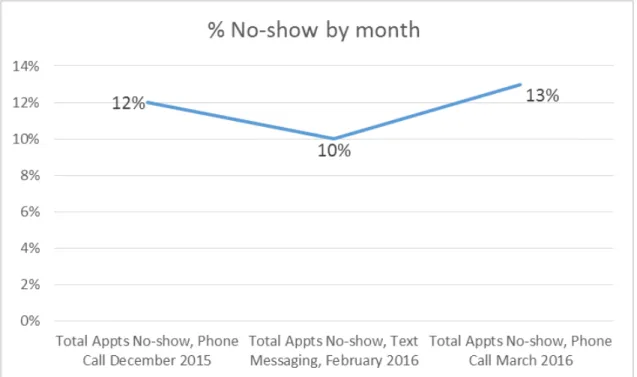
Figure 1 - % No-show by month………11
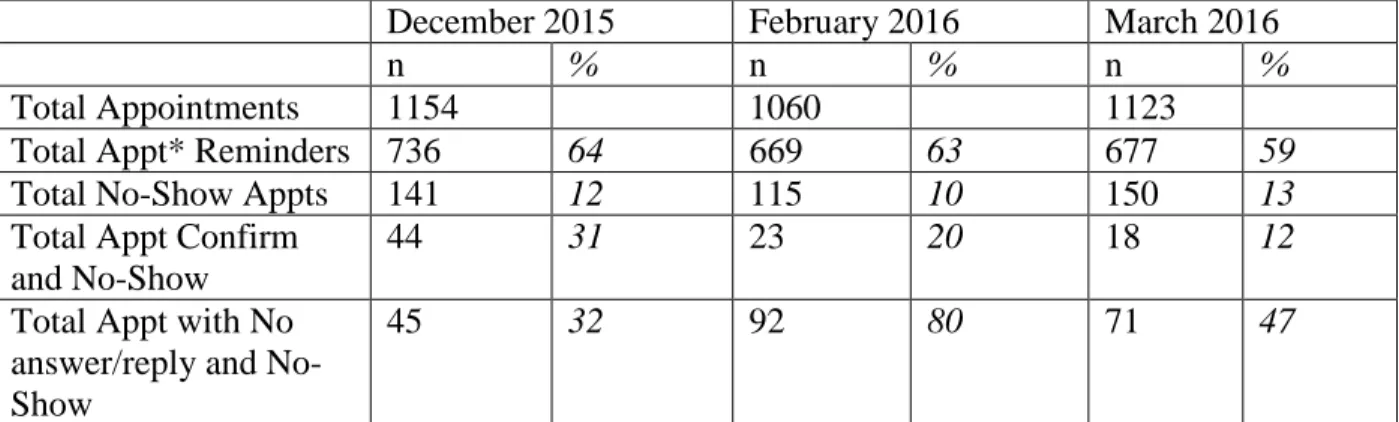
Table 1 - Monthly comparison………...12
Text Messaging Appointment Reminders to Reduce No-Show Rates: A Pilot Study
Hospital and outpatient clinic no-show, did not cancel or did not attend rates are a
problem inherent in the United States healthcare system, international healthcare as well as
locally. No-shows are costly to the organization; are burdensome on organizational productivity,
the healthcare system and the needs of other patients; they are also a missed opportunity for the
patient to receive care, scheduled immunizations and preventive screenings; and, they reduce
access to care (Perez et al., 2014).
Bluegrass Pediatrics and Internal Medicine (BPIM), located in Georgetown, KY is no
exception to patient no-show events. The clinic has four providers comprised of three physicians
and one pediatric nurse practitioner. From June to December 2014 there were approximately
1400 no-show appointments that could have been used or reallocated for another patient. In
addition to wasting the appointment time, an unfilled appointment becomes wasted productivity
time for the provider, a missed opportunity for provider/patient maintenance of care, and is
financially burdensome on the organization. The average charge of routine priority exams
during this time period was $100 with approximately $40-50 paid by the insured and the insurer.
This has the potential to be $56,000-70,000 in losses based on payment or $140,000 in charges
(R. Davis, personal communication, April 3, 2015).
In addition to the burdens mentioned above and the financial costs, other intangible
results and poor patient outcomes occur. No-show appointments without proper cancellation
reduces clinic efficiency and misuses medical and administrative resources. Continuity of care,
face-to-face interaction, preventive screenings and immunizations are missed when no-show
appointments occur (Gurol-Urganci et al., 2013). Medication management for chronic problems
often sought elsewhere at a less than ideal location such as urgent care centers whose staff have
suboptimal pediatric care knowledge and are not up-to-date on pediatric clinical practice
guidelines (Perron et al. 2010). Additionally, many chronic diseases that are treated at urgent
care centers are simply temporary fixes and follow-up with a primary care provider is often
delayed or not sought. These problems can lead to misdiagnosis and poor medication
management (Perez et al., 2014 & Perron et al., 2010).
BPIM uses administrative staff to place appointment reminder calls to routine priority
appointments (i.e. well, routine and established appointments) one to two days prior to the
appointment. According to Perez et al., (2014) there are several problems inherent with this
method: staff time commitment; staff not completing this responsibility due to other time
constraints; inability to make contact; patients screening calls and choosing whether or not to
answer; or, leaving a message and not being able to verify if it was received. These problems
often lead to unnecessary financial burdens; staff frustration by using a time consuming and
ineffective phone reminder process; and, neglect of other essential job responsibilities.
Recent systematic reviews by Gurol-Urganci, de Jongh, Vodopivec-Jamsek, Atun, and
Car (2013); Hasvold and Wootton (2011); and, Guy et al. (2012) reviewed eight, twenty-nine
and, eighteen studies respectfully evaluating the effect text messaging appointment reminders
had on reduction in no-show rates. Each systematic review graded the reviewed studies on a
scale of one, indicating strong supporting evidence, to five indicating low supporting evidence
on the efficacy of text messaging. Cumulatively the strength of the evidence ranged from
moderate (3 on a scale of 1-5) to low (5 on a scale of 1-5) supporting the use of text messaging
reminders to reduce clinic no-show rates. In addition, in his systematic review that evaluated
Househ (2014) concurred with previous systematic reviews that the literature contained moderate
(3 on a scale of 1-5) to low (5 on a scale of 1-5) evidence based on study type in support of text
messaging to reduce no-show rates. Perron et al. (2010) conducted a randomized control trial
and found a nearly three percent more reduction in the no-show rate with text messaging
reminders when compared to phone call or postal reminders during their three month study
period (p < 0.005). As well, a quasi-experimental pilot study by Branson, Clemmey, and
Mukherjee (2013) realized a 64.9% appointment attendance rate in the experimental group that
received text message reminders compared to a 49.3% (p < .05) attendance rate in the control
group that did not receive the reminder.
The studies evaluated above found that text messaging was effective in reducing no-show
rates, however the authors also recognized that the literature contained several limitations and
gaps. The most important gaps in the literature are that there are few randomized control trials
(RCTs) or well-designed RCTs; studies contained information and data that was not applicable
or beyond the scope of reminder systems; or, they were simply poor quality and questionably
peer-reviewed (Gurol-Urganci et al., 2013; Guy et al., 2012; Hasvold & Wootton, 2011;
Househ, 2014).
The lack of strong experimental design is likely related to difficulty in blinding given the
interaction inherent in text messaging. This introduces a potential for study bias and decreases
study strength (Gurol-Urganci et al., 2013). Additionally, Gurol-Urganci et al. (2013) suggest
that the risk of harm due to the potential for misinterpretation of text messaging; transmitting
inaccurate messages; loss of verbal and non-verbal cues; potential privacy disclosures or
violations; and, delays in message delivery may be a contributing factor in why study authors
interventions. Authors in each study call for more well-designed RCTs to be conducted not only
to further strengthen the body of evidence in reducing no-show appointments, but to also study
health outcome variables impacted as a result of attending or missing an appointment
(Gurol-Urganci et al., 2013; Guy et al., 2012; Hasvold & Wootton, 2011; Househ, 2014).
Ellis and Jenkins (2012); and, Daggy et al,. (2010) also studied and suggest that factors in
addition to health outcomes and the efficacy of text messaging appointment reminders be further
explored. Factors such as marital status, insurance status, gender, age and race had variable
effects on no-show rates. For example, Daggy et al., (2010) found that younger (<50), single,
privately insured adults were more likely to no-show an appointment compared to older (>50),
married, publicly (government) insured adults (p < 0.0001). These factors can lend valuable
information and insight into potential reasons why patients no-show an appointment.
Objectives
The overall goal of this quality improvement project is to implement a text messaging
appointment reminder system to reduce the no-show rate of BPIM by two percent and evaluate
additional factors associated with no-show appointments. For this evaluation of the quality
improvement project, the following objectives have been established:
1. to determine what effect text messaging has on appointment attendance, annual
well/physical exams, routine and established appointment types will be messaged
24 hours prior to appointment time; and,
2. to evaluate the cost-benefit and utility text messaging has on overall clinic
Methods
The project included three components, a three week pre-intervention evaluation, a three
week pilot intervention and a three week post-intervention analysis. The sample was obtained
from the patient panel at Blue Grass Pediatrics and Internal Medicine, Georgetown, KY which
included all ages, male and female, ethnically diverse and those having priority routine
appointments (i.e. well, routine or established appointments). Other participants included acute
visits that were scheduled more than 24 hours prior to appointment time. Appointments
scheduled within 24 hours of their appointment whether priority routine appointments or acute
appointments were excluded from the project.
Participants that had appointments scheduled prior to 24 hours of their appointment time
were identified in the clinic electronic medical record (EMR) daily schedule. Cellphone
numbers were obtained and a text message was sent informing the patient of their appointment
time, requesting to reply ‘C’ to confirm their appointment or to call the clinic to cancel or
reschedule their appointment; no cancellations or reschedules were accepted via text message.
Those phone numbers that were identified as landlines rather than cellphones were contacted
through the usual standard of practice of a voice call. One student intern and the principal
investigator manually sent text message reminders with the use of AT&T Go phones.
Data was collected for fifteen business or clinic days (Monday through Friday) for a total
of three clinic weeks during December 2015 to evaluate pre-intervention appointments and
no-shows. Data was collected for fifteen clinic days during February 2016 to evaluate the
intervention; and, data was collected for fifteen clinic days during March 2016 to evaluate
post-intervention appointments and no-shows. The clinic EMR was accessed daily to track the total
kept their appointment; the number of text messages sent with no reply confirmation and the
number of those that kept their appointment; the number of text messages sent with appointment
confirmation and the number of those appointments not kept; and, the number of messages sent
with no appointment confirmation and the number of those appointments not kept. This project
protocol was reviewed by the Institutional Review Board at the University of Kentucky and was
determined to be a quality improvement project.
Results Impact on Appointment Attendance
The overall percentage of no-show appointments for December 2015, February 2016 and
March 2016 was 12%, 10% and 13%, respectively (Figure 1). This shows a 2% reduction in the
no-show appointment rate during the text messaging intervention period compared to the
previous evaluation period. Following the text messaging intervention when appointment
reminders returned to phone call reminders, an increase of 3% over the study period is noted
with a 1% increase over the pre-intervention period.
Out of 736 appointments during December 2015 that were eligible to receive an
appointment reminder, 141 no-showed their appointment. Of the 141 no-show appointments
32% of those verbally confirmed their appointments, 32% did not answer, 21% were left a
voicemail, 10% had no documentation in the EMR that a reminder was attempted; and 5% had a
disconnected or unreachable phone number. Total aggregate (including sick/acute visits)
appointments was 1,154 with an overall 12% no-show rate.
During the February 2016 text messaging intervention period, 600 appointments were
eligible to receive an appointment reminder via text. Of those appointments eligible to receive a
user sending text messages. Ninety-three appointments eligible to receive a reminder but did not
have text message capability received the standard phone call reminder. Total appointment
attendance during the project period was 68% with the other 32% either no-showing their
appointment, canceling or rescheduling. Out of 577 appointments eligible to receive a text
message, 39% replied confirming their appointment, while 61% did not reply to the text
message. Of those who confirmed their appointment, 82% attended their appointment; 18%
replied to the text message confirming their appointment but did not attend their appointment
either no-showing or later canceling over the phone with office staff. 58% of those sent a text
message and did not confirm their appointment, actually did attend their appointment; 42% of
those sent a text message and did not confirm their appointment, also did not attend their
appointment. Total aggregate no-shows including all appointments during the month of
February 2016 was 115 out of 1,060 total appointments or 10%.
Following the text messaging study period, appointment reminders returned to the
standard phone call and three clinical weeks were evaluated during March 2016. Of 677 phone
call reminders, 13% did not attend their appointment; 3% confirmed their appointments and then
did not attend while 10% did not confirm and did not attend. Total appointments during the 3
week post-intervention period numbered 1,123 with 150 no-shows for an overall no-show rate of
13% (Table 1).
Financial Impact
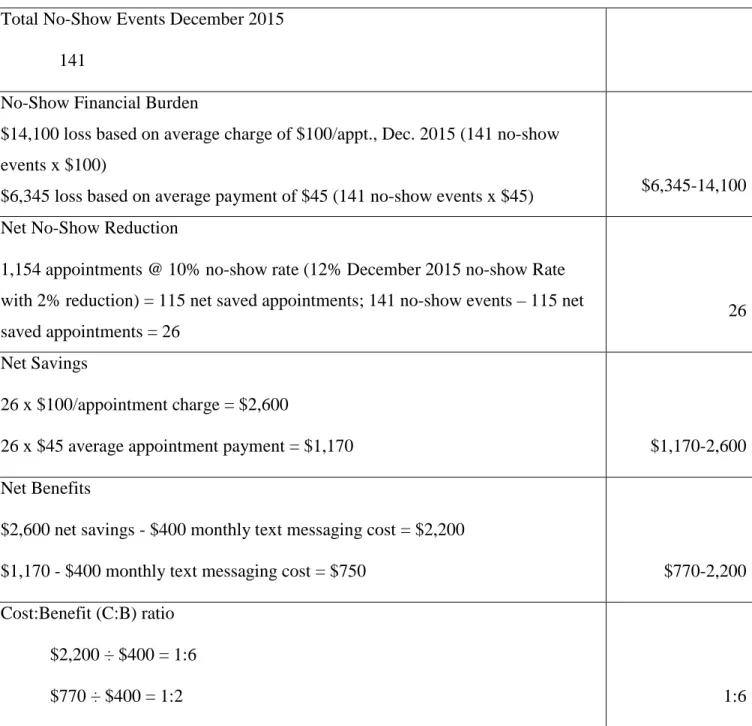
The financial impact and cost-benefit of the text messaging project is evident when
applying the no-show rate reduction goal of the project (2%) to December 2015 data. When
applying this 2% no-show rate reduction to December 2015, there would have be a net of 115
would provide a net no-show reduction of 26 appointments. The average charge of $100 per
appointment multiplied by 26 net no-shows produces $2,600 in net savings. However, the
average payment of $45 actually received when applied would produce $1,170 in net savings.
The cost of monthly text messaging systems can range between $100-400. Subtracting this
amount of $400 from the net savings produces a net benefit increase between $770-2,200. The
cost-benefit is found when the net benefit increase is divided by the total amount of the text
messaging service. At its lowest, the cost-benefit is 1:2, or for every $1 spent, $2 is saved; at its
highest, the cost benefit is 1:6-for every $1 spent, $6 is saved (Table 2).
Discussion
The effectiveness of text messaging in reducing appointment no-shows is evident in the
overall reduction (2%) between the pre-intervention and intervention period. It is further
supported when after the discontinuation of text messaging, the no-show rate increased to 3%
above the study period.
Text messaging offers a simple, automatic reminder and even without a reply
confirmation it was shown that a high percentage still attended their appointments. Of those who
confirmed their appointments 82% attended while another 58% who received a text message but
did not confirm, still attended their appointment. This can lead to the interpretation that a large
majority of those receiving text messages, whether they replied or not, actually saw the text
message and were reminded of their appointment. Patients who receive phone calls reminders
often screen their calls and choose not to answer for one of several reasons or are unable to
answer their phone. With text messaging, it is an instant message pop-up on the phone screen
As previously discussed, no-show appointments are costly and burdensome on the
organization, providers and staff. This reduction of 2% can lead to a potential increase of $2,600
in charges billed, and payments received from $1,170 to $2,200. Overtime this adds up to a
significant cost-benefit to BPIM.
This project utilized one paid student intern and the principal investigator to manually
enter each cellphone number and send the appointment reminder. At 577 text messages, this was
a time consuming task equaling approximately 20 total hours spent sending appointment
reminders. However, the cost of this process was a mere .04-.05% of the overall potential
increase with the reduction in no-show appointments. Admittedly this is not the best use of staff
and resources for long term text messaging use but was necessary at this time to complete the
project. Most text messaging systems are completely automated and are easily integrated into
the current EMR and require little staff time and monitoring. Quality text messaging services
with EMR integration cost on average from $100 to $400 per month depending on the desired
depth of services. Again, this is a cost that is easily absorbed with a cost-benefit ratio of up to
1:6 when the no-show rate reduces. Keep in mind that this cost-benefit uses the most costly of
text messaging services; the cost benefit would be increased several fold when using a more
economic, less-expensive service. Finally, the EMR that BPIM uses already has text messaging
functional capability, so adding a standalone, costly text messaging software package would be
unnecessary
Limitations
This project had some limitations. While current evidence-based research lacks
well-designed randomized control trials and recommends that more be conducted, this was unfeasible
to send text messages inevitably can lead to potential errors or mistakes such as 23 eligible
appointments not receiving a text message. Two days during the February 2016 project period
were noted as severe weather days which could have led to fewer total appointments and an
increased no-show or cancellation rate. Additionally one clinic afternoon was cancelled due to
severe weather; this has the potential to skew the data but this would be expected to only affect
the outcome by a small fraction. Finally, there is no way to be certain that those who did not
respond to the text message ever received the text message reminder in the first place causing
some uncertainty in data validity.
Recommendations and Conclusion
Text messaging is an effective technological advancement that has been shown to be
effective in reducing no-show appointments. Staff time and resources can be used more
effectively on other necessary tasks when an automated text messaging system is utilized.
Relying on staff members to call and remind patients of their appointments is an inefficient use
of staff time. Sickness, days off or vacation days severely reduces the number of appointment
phone reminders that are placed, particularly if other staff members do not pick up the extra
work. BPIM should consider implementing a fully automated text messaging system to reduce
their no-show rate over the long-term. The potential cost-benefit ($6 returned for $1 spent)
realized during the project period and that could be realized over the long term will more than
Table 1. Monthly comparison
December 2015 February 2016 March 2016
n % n % n %
Total Appointments 1154 1060 1123
Total Appt* Reminders 736 64 669 63 677 59
Total No-Show Appts 141 12 115 10 150 13
Total Appt Confirm and No-Show
44 31 23 20 18 12
Total Appt with No answer/reply and No-Show
45 32 92 80 71 47
Comparison of appointments, attendance and no-shows.
*Appt=Appointment
Cost-Benefit/Goal: Reduce No-show Rate by 2%
Total No-Show Events December 2015
141
No-Show Financial Burden
$14,100 loss based on average charge of $100/appt., Dec. 2015 (141 no-show events x $100)
$6,345 loss based on average payment of $45 (141 no-show events x $45) $6,345-14,100 Net No-Show Reduction
1,154 appointments @ 10% no-show rate (12% December 2015 no-show Rate with 2% reduction) = 115 net saved appointments; 141 no-show events – 115 net saved appointments = 26
26
Net Savings
26 x $100/appointment charge = $2,600
26 x $45 average appointment payment = $1,170 $1,170-2,600
Net Benefits
$2,600 net savings - $400 monthly text messaging cost = $2,200
$1,170 - $400 monthly text messaging cost = $750 $770-2,200
Cost:Benefit (C:B) ratio
$2,200 ÷ $400 = 1:6
$770 ÷ $400 = 1:2 1:6
Cost-benefit potential of $6 returned for every $1 spent.
References
Branson, C. E., Clemmey, P., & Mukherjee, P. (2013). Text message reminders to improve outpatient therapy attendance among adolescents: a pilot study. Psychol Serv, 10(3), 298-303. doi: 10.1037/a0026693
Daggy, J., Lawley, M., Willis, D., Thayer, D., Suelzer, C., Po-Ching, D.,…Sands, L. (2010). Using no-show modeling to improve clinic performance. Health Informatics J. 16(4), 246-259. doi: 10.1177/1460458210380521
Ellis, D.A., & Jenkins, R. (2012). Weekday affects attendance rate for medical appointments: Large-scale data analysis and implications. Plos One, 7(12): e51365. doi:
10.1371/journal.pone.0051365
Gurol-Urganci, I., de Jongh, T., Vodopivec-Jamsek, V., Atun, R., & Car, J. (2013). Mobile phone messaging reminders for attendance at healthcare appointments. Cochrane Database of Systematic Reviews, (12). Retrieved from
doi:10.1002/14651858.CD007458.pub3
Guy, R., Hocking, J., Wand, H., Stott, S., Ali, H., & Kaldor, J. (2012). How effective are short message service reminders at increasing clinic attendance? A meta-analysis and
systematic review. Health Serv Res, 47(2), 614-632. doi: 10.1111/j.1475-6773.2011.01342.x
Hasvold, P. E., & Wootton, R. (2011). Use of telephone and SMS reminders to improve attendance at hospital appointments: a systematic review. Journal of Telemedicine and Telecare, 17(7), 358-364. doi: 10.1258/jtt.2011.110707
Househ, M. (2014). The role of short messaging service in supporting the delivery of healthcare: An umbrella systematic review. Health Informatics J. doi: 10.1177/1460458214540908 Perez, F. D., Xie, J., Sin, A., Tsai, R., Sanders, L., Cox, K., . . . Park, K. T. (2014).
Characteristics and Direct Costs of Academic Pediatric Subspecialty Outpatient No-Show Events. Journal for Healthcare Quality, 36(4), 32-42. doi: 10.1111/jhq.12007
Perron, N. J., Dao, M. D., Kossovsky, M. P., Miserez, V., Chuard, C., Calmy, A., & Gaspoz, J. M. (2010). Reduction of missed appointments at an urban primary care clinic: A