IMPROVE ECONOMICAL PERFORMANCE USING
KNOWLEDGE MANAGEMENT
GabrielRAICU1 , AlexandraNITA2
1
Lecturer PhD. Eng. Constanta Maritime University, Mircea cel Batran Street, No. 104, Constanta, Romania, Tel: +40723614043, Fax: +40241617260
Asist univ. eng. Constanta Maritime University, Mircea cel Batran Street, No. 104, Constanta, Romania, Tel: +40722605508, Fax: +40241617260
ABSTRACT
Knowledge Management programs are typically tied to organisational objectives such as improved performance, competitive advantage, innovation, developmental processes; lessons learnt transfer and the general development of collaborative practices. The paper presents the modern to techniques improve economical performance of using knowledge management. The social computing tools, such as blogs and wikis have developed to provide a more unstructured, self-governing approach to the transfer, capture and creation of knowledge through the development of new forms of community, network or matrix. These tools face challenges in distilling meaningful re-usable knowledge and intelligible information and ensuring that their content is transmissible through diverse channels, platforms and forums.
Keywords: Knowledge Management, Technology, Economical Performance
1. INTRODUCTION
The purpose of this exploratory study through the use of narratives, is to understand and develop a conceptual framework for the use of knowledge as a generator of economic performance in the enterprise development, and then study on the nature of this knowledge to entrepreneurs, and the characterization of this knowledge in order to establish how this contributes to economic performance of businesses.
Knowledge Management comprises a range of practices used by organizations to identify, create, represent, distribute and enable adoption of what it knows, and how it knows it. Knowledge Management is frequently linked and related to what has become known as the learning organization, lifelong learning and continuous improvement. Knowledge Management may be distinguished from Organizational Learning by a greater focus on the management of knowledge as an asset and the development and cultivation of the channels through which knowledge, information and signal flow.
Knowledge may be accessed at three stages: before, during, or after knowledge-related activities. Some people would argue that there is a life cycle to knowledge use. Starting with capture or creation, moving on to use and reuse with the ultimate goal of enriching an organization’s capability. In counter to this many would state that such a life cycle view is too linear in nature and reflects an information centric view (Wiki, 2008).
For example, individuals undertaking a new project for an organization might access information resources to identify lessons learned for similar projects, access relevant information again during the project implementation to seek advice on issues encountered, and access relevant information afterwards for advice on after-project actions and review activities. Knowledge management practitioners offer systems, repositories, and corporate processes to encourage and formalize these activities with varying degrees of success.
Similarly, knowledge may be accessed before the project implementation, for example as the project team learns lessons during the initial project analysis. Similarly, lessons learned during the project operation may be recorded, and after-action reviews may lead to further insights and lessons being recorded for future access.
Different organizations have tried various knowledge capture incentives, including making content submission mandatory and incorporating rewards into performance measurement plans. There is considerable
controversy over whether incentives work or not in this field and no firm consensus has emerged (Aranson, 2001).
2. KNOWLEDGE MANAGEMENT AND INNOVATION
A problem with linking organizational forms to economic performance is that it is difficult to develop valid and reliable indicators both for organizational forms and for economic performance. One way to overcome this problem is to link to each other innovation, learning and knowledge creation. Innovation represents something new and therefore adds to existing knowledge.
Knowledge and innovation played an important role in the development of society. The transformation from an agrarian society to the information society has largely been brought about as a result of accumulation of knowledge through the centuries. Knowledge by its very nature depends on other knowledge to build on. Knowledge creation is, in fact, a process of value addition to previous knowledge through innovation. This also implies that the more knowledge we already possess the more we will be in a position to create and transfer to others. The key to economic success is always linked to the advances in knowledge creation and the ability of a nation in translating knowledge into products and services. But while knowledge existed since the existence of mankind, it is only recently that it has been recognized as a factor of production. Many people have recognized that knowledge is the only meaningful economic resource in the knowledge society. It has been now recognized as the driver of productivity and economic growth, leading to a new focus on the role of information, technology and learning in economic performance. The term “knowledge-based economy” stems from this recognition of the place of knowledge and technology in modern economies (Bell, 2001).
Knowledge creates knowledge and in the process brings competitive advantage and leads to wealth creation. Prusak (1999) pointed out that due to the abstract nature of knowledge, traditional economics and general scholastic research in the past did not really focus on it. He added that knowledge was treated as a “black box” which enabled the transformation of inputs to outputs. Davenport and Prusak stated:
“Knowledge is a fluid mix of framed experience, values, contextual information, and expert insight that provides a framework for evaluating and incorporating new experiences and information. It originates and is applied in the minds of knower. In organizations, it often becomes embedded not only in documents or repositories but also in organizational routines, processes, practices, and norms.” (Davenport & Prusak, 1998)
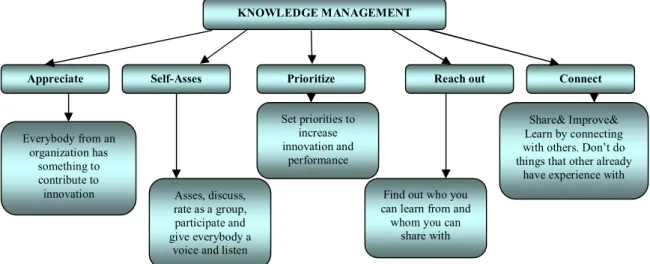
Figure 1: Knowledge management and innovation
The knowledge management activities comprise the construction of information management systems, artificial intelligence, data mining and other enabling technologies. In this case knowledge can be treated as objects that can be identified and handled in an information system. The core knowledge management activities encompass assessing, changing and improving human individual skills and behavior. It is a complex set of dynamic skills and know-how that is constantly changing.
More than a decade ago we introduced a different set of distinctions (Lundvall and Johnson, 1994): • Know-what,
Appreciate Self-Asses Prioritize Reach out Connect
Everybody from an organization has something to contribute to innovation Share& Improve& Learn by connecting with others. Don’t do things that other already
have experience with Asses, discuss,
rate as a group, participate and give everybody a
voice and listen
Find out who you can learn from and whom you can
share with Set priorities to increase innovation and performance KNOWLEDGE MANAGEMENT
• Know-why, • Know-how, • Know-who.
Know-what refers to knowledge about “facts”. How many people live in New York, what are the ingredients in pancakes and when the battle of Waterloo was, are examples of this kind of knowledge. Here, knowledge is close to what is normally called information - it can be broken down into bits.
Know-why refers to knowledge about principles and laws of motion in nature, in the human mind and in society. This kind of knowledge has been extremely important for technological development in certain science-based areas such as for example chemical and electric/electronic industries. To have access to this kind of knowledge will often make advances in technology more rapid and reduce the frequency of errors in procedures of trial and error.
Know-how refers to skills - i.e. the capability to do something. It might relate to the skills of manual workers. But actually it plays a key role in all activities in the economic sphere. The businessman judging the market prospects for a new product or the personnel manager selecting and training the staff have to use their know-how. It would also be misleading to characterize know-why as science-related and know-how as being for practical people. One of the most interesting and profound analyses of the role know-how is actually about the how the advanced scientist makes research on the basis of personal skills.
The know-who becomes increasingly important. The general trend towards a more composite knowledge base where a new product typically combines many technologies and each technology is rooted in several different scientific disciplines, together with the speed up of change, makes it crucial to have access to many different sources of knowledge. Know-who involves information about who knows what and who knows to do what. But it also involves the social capability to co-operate and communicate with different kinds of people and ex
3. KNOWLEDGE MANAGEMENT AND TECHNOLOGY
Technology plays an important role in knowledge management, although knowledge management is not about technology. Technology facilitates the process of transmitting and exchanging information. It can be used to manage uncertainty and complexity, where information is more factual and a high degree of interaction is not required.
Technology enables individuals to coordinate the logistics of face-to-face meetings. It can also be used to catalogue expertise of organizational members and as a result facilitating access to the right people and enhancing knowledge sharing. Computer-mediated communication such as electronic mail or computer-conferences can help to maintain continuity and connection between conversations, especially for those in different locations.
One of the key technologies that is driving knowledge management is collaborative technology. Collaboration tools enable a company's professionals to work together and work virtually regardless of the geographical location. Web technology allows organizations to build Web and knowledge portals that can handle substantial amount of information and made it accessible to users anywhere anytime.
Information management tools allow organizations to generate, access, store, and analyze data, usually in the form of facts and figures. Information management tools enable the manipulation of information but do not capture the complexity of context and the richness of knowledge. While knowledge management systems may include tools that also handle data and information, data and information management tools are not robust enough to truly facilitate knowledge management (Bushko, 1998).
But the most important reason is that the widened use of ICT speeds up change and the acceleration makes it less meaningful and attractive to engage in the development of codification and information systems. ICT speeds up change through different mechanisms. First the rate of innovation within ICT is high and its diffusion to all sectors of the economy imposes change on these sectors. Second ICT has become an important tool in speeding up innovation in several sectors including drug design in pharmaceuticals and physical design in most other sectors. Third it makes it easier to communicate over long distances and hereby it fuels the globalization of the world economy.
4. KNOWLEDGE MANAGEMENT AND ECONOMY
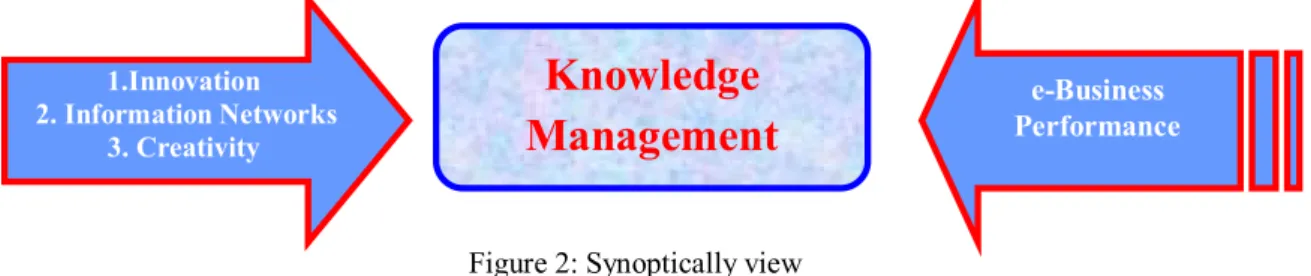
The learning economy concept signals that the most important change is, not the more intensive use of knowledge in the economy, but rather that knowledge becomes obsolete more rapidly than before. Therefore it is imperative that firms engage in organizational learning and those workers constantly develop new competencies (Grant, 1996). A learning economy is thus one in which the ability to attain new competencies is crucial for the success of individuals and for the performance of firms, regions and countries. The background for the crucial importance of learning is that the combination of globalization, information technology and deregulation of formerly protected markets leads to more intense competition and to more rapid transformation and change, figure 2.
Figure 2: Synoptically view
The transition to a learning economy confronts individuals and companies with new challenges. We see the growing emphasis on new organization forms and networking as a response to the challenges posed by the learning economy. In a rapidly changing environment it is not efficient to operate a hierarchical organization with many vertical layers and with departments and functions operating separately within the firm. In a rapidly changing environment it takes too long to respond when the information obtained at the lower levels has to be transmitted to the top and back down to the bottom of the pyramid. This is why we see a drive toward flat organizations with strong focus on decentralization and horizontal communication. In many instances relational contracting and networking enhance functional flexibility since it gives access to complementary external competence that it would take too long to build in-house (Gray, 1998).
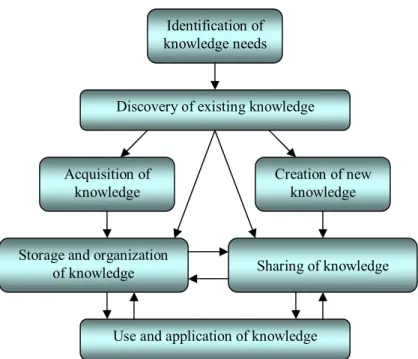
The cycle of knowledge management is not complete or successful if no efforts are made to ensure the use of stored and shared knowledge. On the other hand, the success of a project is achieved when the preservation and the retrieval of information is guaranteed while the success of a knowledge management program ultimately depends on the sharing of knowledge, figure 3.
Knowledge
Management
1.Innovation 2. Information Networks 3. Creativity e-Business PerformanceFigure 3: Knowledge Management Processes
5. KNOWLEDGE MANAGEMENT SYSTEMS
Knowledge management strategy focuses on the acquisition, communication and exploitation of knowledge through transformation and learning. Knowledge management systems therefore, should focus on improving the processes to transform tacit knowledge into explicit knowledge (King, 2001).
A knowledge management system should have processes in place to manage it. Gupta, Iyer & Aronson (1999) defined these processes to consist of: (1) knowledge creation through learning; (2) knowledge capture and explication; (3) knowledge sharing and collaborative communication; (4) knowledge access; (5) knowledge use and reuse; and (6) knowledge archiving. Structure is added to knowledge through its capture, cataloguing, preserving and disseminating. The discrimination of knowledge creates organizational memory. Therefore, the objective of a knowledge management system is to convert tacit knowledge into explicit knowledge.
To assess the usefulness of a knowledge management system, there must be a means to measure the effectiveness of the knowledge transfer process within an organization. Verkasalo, & Lappalainen (1998) defined knowledge utilization within an organization in terms of six distinct phases. Phase 1 is knowledge acquisition, which refers to the separation of a piece of knowledge from the provider's knowledge domain. Phase 2, knowledge documentation shifts information and their linkages onto the knowledge transfer medium. Phase 3 is the information and knowledge transmission. In this phase, receiver has the documented information and knowledge available. Phase 4 is information retrieval, which is the first step in understanding the information by the receiver. Phase 5 is knowledge perception, which is the indication that the receiver has understood the knowledge and its links. Phase 6 is decision-making: the use of the knowledge in conjunction with the receivers’ existing knowledge. Decision-making is the measure of benefit of the knowledge management process of the organization. If the knowledge does not add either short-term or long-term benefit to the organization, then it is of no use. A measure of knowledge transfer efficiency was developed based upon process delay (D); process width (W); and effort (E). The scaled use of these variables is used to create an efficiency index. The efficiency index can be used to compare the transfer rate of knowledge by different systems. Within the six-phase utilization process, several limitations were noted. Knowledge documentation is one the most significant problem areas. Knowledge experts, who frequently do not have the time, nor see the benefit to completing it, should complete the documentation. In addition, keeping the documentation up to date, as new knowledge is acquired can be a difficult task. They provide an empirical method for evaluating the efficiency of knowledge management systems across dissimilar industry groups.
Identification of knowledge needs
Discovery of existing knowledge
Acquisition of knowledge
Creation of new knowledge
Storage and organization
of knowledge Sharing of knowledge
King (1999) defined three criteria that are essential to the successful implementation of knowledge management within an organization: focus, relevance and timeliness. To achieve all three requires a system that enables inputs, outputs and communication to be related to specific goals and to specific users who will act upon the knowledge in a timely and cost effective manner.
Five critical success factors were identified by King (1999). The first is to avoid doing it the easy way by merely making existing reports accessible through a company intranet. This serves to lower the user’s expectations for what can be gained through the implementation of a knowledge management system. The second critical success factor is to avoid focusing on software. The key is to focus on high-value added areas of application and not worry about specific systems immediately. The third critical success factor is to incorporate people into the system. The fourth critical success factor is to motivate people to use the system. A corollary is to obtain senior management participation. Others in the organization will respond to senior management use of the system. Edgar (1999) extend this concept pointing out that a knowledge management system will have less likelihood of success if it is driven entirely by IT departments or senior management. It is the combination of the two that provides the greatest probability of success. Innovation, adaptability, and receptiveness to new ideas were stronger when the knowledge management system was cosponsored by senior management and IT. Mason & Mitroff (1973) concluded that managers need information that is geared towards their psychology, and a method of generating evidence geared towards their problems not those of the designers. Finally, the last critical success factor is to document system performance. This will serve as a means to promote the use of the knowledge management system throughout an organization.
6. KNOWLEDGE MANAGEMENT IN MARITIME EDUCATION AND TRAINING
Every European Maritime University must have a department which aims to provide practice-oriented technological information management and application-oriented research for making use of information systems in the field of naval and mechanical engineering.
Appling knowledge management in maritime universities is important because:
The purpose of knowledge management is to harness, develop and direct the expertise of the organization and to apply it effectively to achieve strategic objectives;
Knowledge management is purpose is also to encourage learning and innovation as sources of competitive advantage;
Knowledge management permits vision and gap analysis, identifies new sources of technology and ideas;
Knowledge management explores creativity, innovation and idea mapping.
In the maritime education and training(MET) area, Knowledge Management can be defined as a systematic process that creates, captures, shares, and analyzes knowledge in ways that directly improve performance. KM is about helping people communicate and share information. The goal of Knowledge Management is to improve the creation, dissemination, and exploitation of knowledge for the purpose of building competitive advantage. It can be interpreted as the ability to get the right information to the right people at the right time, and in the right place, so that an organization can be operated smoothly and efficiently.
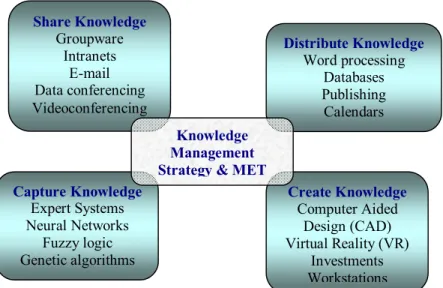
The Information Age demands increased focus on the management of information in institutions. Capturing and distributing intelligence, knowledge, leadership, collaboration, and group decision-making have become vital to institutional innovation and sustaining competitive advantage. Accordingly, increasing numbers of software applications and tools are now available to foster these objectives and support new kinds of management decision making by individuals and groups. In the figure 4, KM is organized in four parts to indicate four technical domains for it, and the tools listed in the four technical domains can be used to help maritime institutions share, distribute, capture and create knowledge better.
Figure 4: Technical domain for Knowledge Management
The international work to improve maritime education and training has identified lack of access to quality learning material and tutors in many countries. It is assumed that increased use of information and communication technologies will be one major component for future quality improvement of maritime education and training. Since the introduction of computer based training (CBT) in some shipping companies since a decade, the use of internet has increased tremendously.
The main project objective is to co-ordinate the development of a maritime flexible learning system. The new and modern techniques are the flexible learning courses, the production of learning demonstrators and testing of those by maritime students and officers.
7. CONCLUSIONS
Technology and knowledge are now the key factors of production. With increased mobility of information and the global work force, knowledge and expertise can be transported instantaneously around the world, and any advantage gained by one company can be eliminated by competitive improvements overnight. The only comparative advantage a company will enjoy will be its process of innovation, combining market and technology know-how with the creative talents of knowledge workers to solve a constant stream of competitive problems and its ability to derive value from information. We are now an information society in a knowledge economy where knowledge management is essential.
A focus on knowledge as “a set of assets” may be too static in the rapidly changing world we have indicated by the concept “the learning economy”. Here the key to long-term competitiveness is the learning capability of the firm rather than what it already knows. Therefore a key element of knowledge management is to enhancing the learning capacity of the firm. One way to do so is to build a learning organization. This is more related to designing organizational procedures and routines than it is to managing assets.
8. REFERENCES
Anonymous. (1995). The rise of the knowledge worker. Civilization, 2(1), Jan/Feb. 19.
Aronson, J. E. (2001). Knowledge management. In (Chapter 9) E. Turban, E. McLean, & J. Wetherbe.
Information Technology for Management: Making Connections for Strategic Advantage. 3rd Ed., NY: Wiley.
Bell D. K., and Jackson, L. A. (2001). Knowledge management: Understanding theory and developing strategy. Competitiveness Review, 11(1), 1-11.
Bushko, D., and Raynor, M. (1998). Knowledge management: New directions for IT (and other) consultants.
Journal of Management Consulting, 10(2), November, 67-68.
Davenport, T., Delong, D., and Beers, M. (1998). Successful knowledge management projects. Sloan Management Review, 39(2), Winter, 43-57.
Share Knowledge Groupware Intranets E-mail Data conferencing Videoconferencing Capture Knowledge Expert Systems Neural Networks Fuzzy logic Genetic algorithms Create Knowledge Computer Aided Design (CAD) Virtual Reality (VR) Investments Workstations Distribute Knowledge Word processing Databases Publishing Calendars Knowledge Management Strategy & MET
Davenport, T., and Prusak, L. (1998). Working Knowledge: How Organizations Manage What They Know. Cambridge, MA: Harvard Business School Press.
Drucker, P. (1993). Tomorrow’s manager. Success, 40(8), October, 8.
Edgar, S. (1999). Knowledge management: has it changed my working life? Will it change yours? Business Information Review, September, 122-127.
Grant, R. M. (1996). Toward a knowledge-based theory of the firm. Strategic Management Journal, 17
(Special Issue), Winter, 109-122.
Gray, P. (1999). Knowledge management. Proceedings of the Fifth Americas Conference on Information Systems, 13-15 August 1999, Milwaukee, WI.
Greengard, S. (1998). Will your culture support KM? Workforce, 77(10), October, 93-94.
Gupta, B., Iyer, L., and Aronson, J. (1999). An exploration of knowledge management techniques.
Proceedings of the Fifth Americas Conference on Information Systems, 13-15 August 1999Milwaukee, WI.
Hansen, M., (1999). What’s your strategy for managing knowledge? Harvard Business Review, 77(2), Mar/ Apr
King, W. (1999). Integrating knowledge management strategy into IS strategy, Information Systems Management, 16(4), Fall, 70-72.
http://en.wikipedia.org/wiki/Knowledge_management, 25.07.2008 http://informationr.net/ir/8-1/paper143.html, 26.07.2008
All this considerations are developed in partnership with Academy of Economic Studies from Bucharest as lead of the knowledge management project-MECIMM.