c
MATHEMATICAL MATURITY FOR ENGINEERING STUDENTS
BY
BRIAN FAULKNER
DISSERTATION
Submitted in partial fulfillment of the requirements
for the degree of Doctor of Philosophy in Electrical and Computer Engineering in the Graduate College of the
University of Illinois at Urbana-Champaign, 2018
Urbana, Illinois
Doctoral Committee:
Assistant Professor Lara Waldrop, Chair Professor Michael Loui
Associate Professor Jennifer Cromley
Assistant Teaching Professor Geoffrey Herman Professor Paul Scott Carney, University of Rochester
ABSTRACT
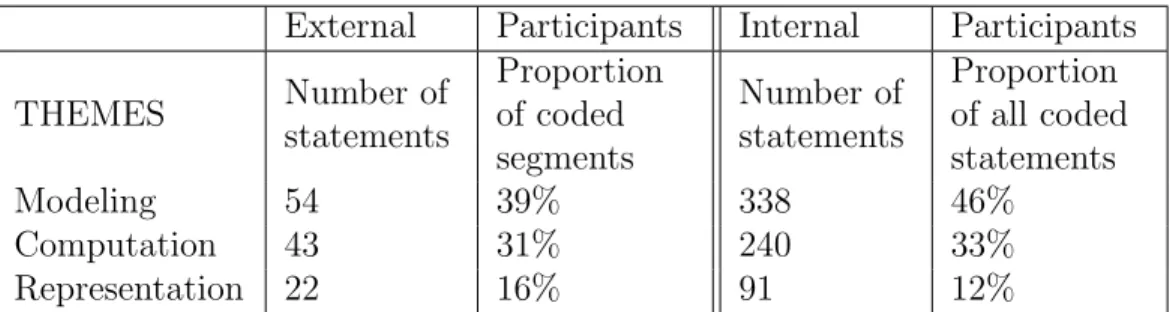
This dissertation presents four studies on the mathematical education of en-gineering students. The first study is a qualitative analysis of the beliefs of engineering faculty at a single institution regarding what constitutes “math-ematical maturity” for engineering students. Faculty emphasized the need for mathematical modeling skills, fluent symbolic representation skills, and a combination of effortless algebraic fluency and ability to use computational tools. The second study is an analysis of the beliefs of engineering faculty at a variety of institutions. These faculty also emphasized modeling, repre-sentation, and computation, corroborating the results of the first study. The third study is an analysis of the mathematical content of engineering circuits and statics homework problems. Just 8% of statics problems and 20% of circuits problems use calculus, and in a much more limited way than what is taught in calculus. The fourth study presents a quantitative survey of en-gineering sophomores’ perceptions of the relevance of mathematics to their engineering studies. The students have somewhat favorable views of the rele-vance of mathematics, but some high-performing students view mathematics as irrelevant.
To David Pierce, for starting me on the path to becoming an educator. And to Caitlin McGuire, for helping me complete that journey.
ACKNOWLEDGMENTS
To David Pierce: Your friendship and mentoring are invaluable, and I would not be an educator if not for meeting you that day in the library.
To my advisor Geoffrey Herman: You are so unfailingly dutiful, supportive, generous with your time, and a thousand more adjectives. Every graduate student deserves to have an advisor like you, and I am lucky enough to have been one who actually did.
To my advisor Michael Loui: Your high standards keep me working to perform, and you support me when I’m stumbling and struggling. You are such a solid and ethical role model.
To my parents, Ed and Tammy Faulkner: I love both of you. Thank you for always encouraging my education and telling me I could do more and do better.
To Kelly Cross for your great patience with me and a your admirable courage.
To David Bahr for showing me what good mentoring was.
To Jennifer Cromley for being the most amazingly well read statistics nerd with a sharp critical eye and a willingness to help.
To my undergraduate professors, in no particular order: Ralph Neuhaus for keeping me under your wing, Thomas ‘Doc’ Bitterwolf for your inspiring enthusiasm I seek to always emulate, F. Marty Ytreberg for support with my project-turned-journal paper, Mark Nielsen for your commitment to im-provement, Dave McIlroy for igniting my love of E&M, John Schneider for advice on graduate school selection, Christine Berven for the physics wisdom Bervenisms, Jason Barnes for your excitement both in class and at our SPS meetings.
To my sister Samantha: By being my student you taught me so much about being a teacher.
educa-tional research and would not be writing this.
To Lara Waldrop and Paul Scott Carney for your service on my committee. To the ECE110 team David Varodayan, Chris Schmitz, and Serge Minin for letting me into your classroom to do educational research.
To the staff at the UIUC writing center, for helping upgrade my terrible writing and your patience with my inside-out sentences, total lack of conci-sion, and awful transitions.
To Nicole Johnson for help with my writing and bouncing ideas off each other.
To my partner Caitlin: You support and encourage me to be the best version of myself. You helped edit my work and encouraged me to go to the writing center. If not for you I wouldn’t be finishing this now. You encourage me when I need encouragement. Thank you so much for all your love, dedication and help.
TABLE OF CONTENTS
LIST OF TABLES . . . viii
LIST OF FIGURES . . . x
LIST OF ABBREVIATIONS . . . xii
CHAPTER 1 INTRODUCTION . . . 1
1.1 Study A . . . 1
1.2 Study B . . . 2
1.3 Study C . . . 2
1.4 Study D . . . 3
CHAPTER 2 STUDY A: INTERVIEWS WITH ILLINOIS EN-GINEERING FACULTY . . . 4 2.1 Introduction . . . 4 2.2 Background . . . 7 2.3 Methods . . . 12 2.4 Results . . . 21 2.5 Theme 3 . . . 30 2.6 Discussion . . . 32 2.7 Conclusions . . . 38
CHAPTER 3 STUDY B: INTERVIEWS WITH NON-ILLINOIS ENGINEERING FACULTY . . . 39
3.1 Introduction . . . 39
3.2 Background . . . 39
3.3 Purpose of this study . . . 42
3.4 Methods . . . 42
3.5 Results . . . 48
3.6 Discussion and Limitations . . . 54
3.7 Conclusions . . . 56
CHAPTER 4 STUDY C: ANALYSIS OF ENGINEERING HOME-WORK PROBLEMS . . . 57
4.2 Methods . . . 61
4.3 Results . . . 68
4.4 Discussion . . . 69
4.5 Conclusions . . . 83
CHAPTER 5 STUDY D: SURVEY OF ENGINEERING STU-DENTS BELIEFS . . . 84 5.1 Introduction . . . 84 5.2 Background . . . 84 5.3 Methods . . . 86 5.4 Results . . . 87 5.5 Discussion . . . 92 5.6 Conclusions . . . 94
CHAPTER 6 SCHOLARLY AMBITIONS AND FUTURE WORK . 95 6.1 Expansion Studies (Next Two Years) . . . 95
6.2 Medium Term Studies (Next 5 Years) . . . 97
6.3 Long Term Studies (Next 10 years) . . . 98
APPENDIX A INTERVIEW PROTOCOL . . . 100
APPENDIX B CODEBOOK . . . 103
APPENDIX C SURVEY INSTRUMENT . . . 112
APPENDIX D CONCEPTUAL MEASURE OF CALCULUS KNOWL-EDGE . . . 114
LIST OF TABLES
2.1 Documented immature epistemic beliefs. . . 10 2.2 The KOM competencies and short definitions . . . 11 2.3 The elements of symbol sense and brief definitions . . . 13 2.4 The three themes and each of their largest constituent
codes. Modeling competency is the largest constituent code for theme 1. The total number of coded segments corresponding to each theme in the data are included to show presence in the data, and the percentage of partici-pants mentioning that code or that theme is included to
demonstrate representativeness. . . 22 3.1 Institutional demographics of sample. . . 46 3.2 Codes were sorted into three themes. The percentage of
coded segments that were in each theme (code group) is shown. Some coded segments aligned with multiple themes
or with none of them, so percentages may not total to 100%. . 48 3.3 Students need to see mathematics as related to the real world. 49 3.4 Students need to engage in sense-making with mathematics. . 50 3.5 Applications of mathematics are distant in time from when
students learn mathematical content. . . 50 3.6 Perceived lack of application demotivates students. . . 51 3.7 Students need mathematical intuition to interpret the
out-put of comout-putational tools. . . 51 3.8 Students need fast fundamentals to help them focus on
understanding problems. . . 52 3.9 Engineering courses need algebra more than calculus. . . 52 3.10 Students need to be able to generalize symbolic knowledge
away from canonical representations. . . 53 3.11 Students need to know when to move between representations. 53
4.1 The resultant table contribution for the example mathematics-in-use problem. An • indicates the skill is used along the instructor suggested problem pathway, and a ◦ that the skill could be used on an alternative pathway. In this case, the problem does not use calculus along the
instructor-selected pathway. . . 65 4.2 Calculus concepts and skills in Statics. A concept or skill
from calculus (row) in a statics lesson (column) is indicated
by a • on the instructor path or a ◦on an alternative path. . . 70 4.3 Calculus concepts and skills in Circuits. A concept or skill
from calculus (row) in a statics lesson (column) is indicated
by a • on the instructor path or a ◦on an alternative path. . . 71 4.4 Mismatches in how the Derivative concept is taught in
Cal-culus and applied in Circuits and Statics. . . 72 4.5 Mismatches in how the Integral concept is taught in
Cal-culus and applied in Circuits and Statics. . . 72 4.6 Mismatches in how the Fundamental Theorem of Calculus
concept is taught in Calculus and applied in Circuits and Statics. The usages of the concept overlap very little in the
two courses. . . 73 4.7 Mismatches in how the Limit concept is taught in Calculus
and applied in Circuits and Statics. . . 73 4.8 Mismatches in how the Continuity concept is taught in
Calculus and applied in Circuits and Statics. The fact that different physical quantities have different continuity
constraints is a key feature in both courses. . . 74 4.9 A mock-up of the consequences of several curricular cases,
using the prerequisite chain from Calculus I to Statics to Dynamics as an example. (Dynamics was not analyzed in
this study; this table is merely a discussion aid.) . . . 75 5.1 Cronbach α data for items from Flegg et al. . . 88 5.2 Cronbach’s α data for the additional survey items.
Elimi-nating items that did not contribute to reliability (struckthrough) yields reliability ofα= 0.76, indicating good agreement for those items. The derogatory wording of “plug and chug”
LIST OF FIGURES
2.1 Thematic map. Codes are arranged and connected to-gether from centralizing ideas to smaller, less central ideas. Nodes with many arrows leaving them are more important, more central ideas within the data, have suspected causal influence on those they point to, or contain in some way the objects they point to. The initial thematic map is con-densed and refined to better display the narrative structure inherent in the data, by considering co-occurrence of codes within a particular passage and within interviews. Codes whose presence in the theme cannot be firmly justified are removed from the map, and connections between codes are
arranged to align with the narrative of the theme. . . 19 4.1 The prerequisite relationships at our institution leading to
one particular required junior-year course in aerospace en-gineering. Failing any of the prerequisite courses delays
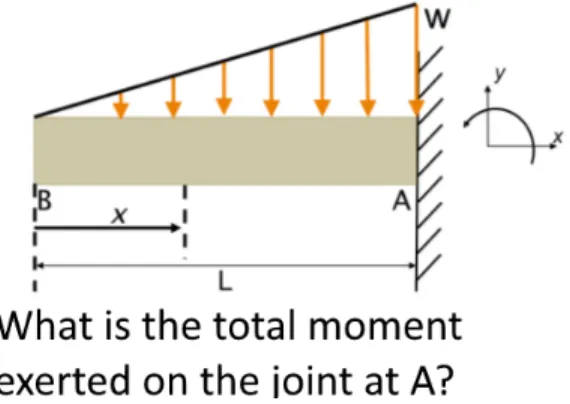
entry into the required course. . . 58 4.2 An example problem prompt from statics for the
mathematics-in-use analysis. Analysis of this problem can proceed via two common paths, “the calculus way”, and “the algebra way” which makes use of centroids as the instructor
solu-tion presents. . . 62 4.3 An example mathematics-in-use matrix . . . 66 4.4 Typical functions from Circuits (left) and Statics (right)
from the instructor solutions. Piecewise functions
contain-ing quadratic or linear segments are the norm. . . 79 5.1 Student survey responses to Likert scale items copied from
Flegg et al.(after inconsistent items removed). . . 89 5.2 Student survey responses to new Likert scale items (after
5.3 Descriptive statistics (difficulty and discrimination) for items in the conceptual measure of calculus knowledge. Most items had acceptable discrimination. There were multiple items with very high difficulty but also high discrimination above 0.4. Two of these items are mathematical theory questions about fundamental theorems, which only very
few high-scoring students answered correctly. . . 90 5.4 Plot of the average of the Likert scale items (after removal
of low consistency items). The median score on the concep-tual measure of calculus knowledge is 72%, and the median relevance rating is 3 (slightly agree that math is relevant). Belief in relevance and score are loosely correlated (Pearson correlation 0.42). The slope of the trendline is 0.07. This slope means a student answering items with one more point of relevance on average does about 7% better on the con-cept test. So a student answering 2 (neutral on whether mathematics is relevant) scores an expected 62% on the as-sessment, but one answering a 3 (slightly agree that math-ematics is relevant) scores a 69%. Neither the relevance beliefs nor the relevance beliefs are homoscedastic (vari-ance on the left is visibly higher); the linear regression is presented only as a rough magnitude of effect. A
LIST OF ABBREVIATIONS
ASEE The American Society for Engineering Education
KOM Dutch abbreviation, translated as “Competencies and Mathe-matical Learning”
MEA Model Eliciting Activity
MWG Mathematics Working Group, a subsection of the European Society for Engineering Education
CHAPTER 1
INTRODUCTION
This work examines the mathematical needs of engineering students from multiple angles of approach and using multiple research methods. In this chapter, I summarize each of the four studies that compose this dissertation, the methods used, and the contribution to the existing literature.
1.1
Study A
In Study A, I present a qualitative thematic analysis of interviews with en-gineering faculty to determine their expectations of what mathematics their students need to succeed in their engineering courses. This study was moti-vated by asking what “mathematical maturity” for engineering students is. I conducted semistructured interviews with 27 engineering faculty in many disciplines from the University of Illinois at Urbana Champaign. Participants were generally most concerned about their students’ abilities to apply math-ematics to physical reasoning, to represent and communicate engineering ideas using mathematics as the language. Faculty expected that students have a balance of quick, fluent mathematical skills for very simple prob-lems with an ability to prudently use computational tools for more complex problems. This work corroborates existing literature on the mathematical needs of engineering students by applying a more rigorous qualitative re-search methodology. This work was submitted to the International Journal of Research in Undergraduate Mathematics Education, and accepted with major revisions which have been included here. The three researchers who worked on this study were Brian Faulkner (research design, data collection, analysis, interpretation, writing), Katherine Earl (analysis), and Geoffrey Herman (research design, interpretation, writing).
1.2
Study B
In Study B, I present a second qualitative thematic analysis of interviews with engineering faculty. This replication study uses the same protocol as that of Study A, but the pool of subjects is drawn from many different types of institution to increase the generalizability of the results. The purpose of this study is to examine whether the results from Study A are still found in other institutional settings. The findings of this study are nearly iden-tical to those of Study A, indicating that the themes likely generalize well to the nation at large. This work has been submitted to the International Journal of Engineering Education and is under review. The three researchers who worked on this study were Brian Faulkner (research design, data col-lection, analysis, interpretation, writing), Nicole Johnson-Glauch (analysis), and Geoffrey Herman (research design, interpretation, writing).
1.3
Study C
In Study C, I present a curricular matchup analysis of two engineering courses, Circuits and Statics, and compare the content of each against the calculus course which they list as a prerequisite. The full corpus of homework problems for one semester in each of these courses is taken as the sample, and analyzed with the mathematics-in-use technique [1]. Overall, very few of the assigned problems use any calculus at all, just 8% in statics and 20% in circuits. Of the problems that do use calculus, they apply just a tiny fraction of the preparatory mathematics taught in calculus. Applications of this finding to curriculum design and longitudinal reinforcement are pre-sented. This work expands the existing literature by combining rigorous analysis of engineering assessments (avoiding the accuracy problems of self report) with a curriculum level scope (greater than that of previous assess-ment analyses). We plan to submit this study to the Journal of Engineering Education. The four researchers who contributed to this work were Brian Faulkner (research design, data collection, analysis, interpretation, writing), Nicole Johnson-Glauch (analysis), D.S. Choi (analysis), and Geoffrey Her-man (research design, interpretation, writing).
1.4
Study D
In Study D, I present a preliminary quantitative analysis of engineering stu-dent attitudes towards the relevance of mathematics to their engineering studies. I used a previously applied survey instrument [2] to assess the at-titudes of engineering students towards the relevance of their mathematics coursework. This replication study samples students at a different point in their mathematical education than previous studies; our subjects were sopho-mores in circuits or statics. Additionally, a conceptual evaluation of calculus skills was administered to evaluate whether attitudes toward mathematics were related to how much mathematics was remembered. Overall, students had mildly positive opinions of how relevant their mathematics coursework was to their engineering studies. This work has been submitted to the IEEE Frontiers in Education conference and is under review. The two researchers involved in this work were Brian Faulkner (research design, data collection, analysis, interpretation, writing) and Geoffrey Herman (interpretation, writ-ing).
CHAPTER 2
STUDY A: INTERVIEWS WITH ILLINOIS
ENGINEERING FACULTY
2.1
Introduction
It is to be hoped that these new [differential equations] courses will be taught by mathematicians rather than by engineers: the budget of any mathematics department is entirely dependent on the number of engineering students enrolled in our elementary courses. Were it not for these courses, which engineers generously defer to mathematicians, our mathematics departments would be doomed to extinction.
Gian-Carlo Rota, MAA invited address, 1997 [3]
Engineering departments are becoming increasingly concerned about re-tention and graduation rates as industry in the United States demands more engineering graduates to meet expected engineering job growth in coming decades [4]. However, since many students drop out of engineering, too few engineering students graduate to join industry [5]. More specifically, many students drop out of engineering not because they failed an engineering course, but because they failed a mathematics course [6, 7, 8]. Some pro-grams blame mathematics courses for as many as a third of their dropouts [5, 9] . Most engineering programs require a standard “calculus sequence” of Calculus I, Calculus II, Calculus III, Linear Algebra, and Differential Equa-tions. Students must pass prerequisite mathematics courses from the calcu-lus sequence to continue into core engineering coursework [10, 11, 12]. The strictness of this prerequisite chain can particularly hamper students who are already disadvantaged due to disability or lack of access to high school calculus [13]. Students who do not start calculus-ready or fail a course in the calculus sequence may struggle to complete an engineering degree before financial aid runs out.
Because the calculus sequence has such a strong impact on engineering graduation, engineering departments are increasingly scrutinizing whether these high-failure courses are worth the investment. As Gian-Carlo Rota feared, engineering departments’ dissatisfaction with the outcomes of calculus [14] has been used to justify drastic curricular change, such as that pursued by the Wright State program [15]. At Wright State, all engineering students take a special engineering mathematics course their first semester, which teaches all mathematics in the context of engineering problems and covers different topics from a typical first-semester calculus course. At other institutions like University of Louisville, the College of Engineering teaches all of the calculus sequence with its own faculty outside of a mathematics department. While it is not clear that the Mathematics Departments were actually at fault for poor student outcomes, the engineering faculty at these institutions clearly believed that to be the case and acted accordingly. Many hold the belief that engineering mathematics should be taught by engineers [16]. Having a better understanding of the mathematical outcomes expected by engineering faculty may help mathematics departments avoid these drastic options.
When asked why these courses are required, engineering faculty have re-sponded that calculus is a prerequisite, in the words of one Operations Re-search instructor, “for mathematical maturity more than just the actual cal-culus” because “the way [the engineering course] is taught, you can do it without calculus” [17, p 49]). This idea begs the question, What is mathe-matical maturity according to engineering faculty?
Prior efforts have attempted to answer this question by promoting dialogue between mathematics and engineering faculty. For example, the Curriculum Renewal Across the First Two Years (CRAFTY) project led by the Mathe-matical Association of America [18] gathered 35 engineering faculty together with mathematics faculty members to generate a list of what engineering fac-ulty expected students to know from their mathematics courses. Similarly, Ferguson [17] convened meetings between 12 engineering faculty members and 9 mathematicians to develop tasks that would indicate that a student had mastered calculus knowledge. These dialogues led to a consensus that more mathematical modeling, applied mathematics, and computational tools are needed than are in the current mathematics curriculum. In addition to these specific technical expectations, other subtler qualities like “life long learner, learning to think, mental discipline, and learning the mathematical
thought process” [18] were proposed, though they were not well defined. These prior efforts were selective and used time-intensive methods: multi-day or week-long workshops for the communities to build consensus. These prior efforts may bias findings toward over-representing the opinions of engi-neers who are willing to take such large amounts of time to discuss mathe-matics and are willing to work cooperatively with mathemathe-matics faculty. Ad-ditionally, these findings may over-represent opinions that both engineering and mathematics faculty found acceptable, downplaying expectations that engineering faculty might have that do not align with priorities of math-ematicians. The process of dialogue changes the beliefs and knowledge of the participants as they learn to communicate across disciplinary boundaries [17]. Consequently, these opinions may not reflect the expectations of the engineering faculty who are most directly affected by students’ preparation from the calculus sequence and may be vocal about their dissatisfaction. The opinions of these faculty may in part lead to the drastic curricular changes that mathematics departments seek to avoid.
To complement this prior work, we interviewed 27 engineering faculty from 11 disciplines to document their beliefs about what constitutes “mathemati-cal maturity” for an engineering student. To fill the aforementioned gaps left by the previous efforts, we prioritized sampling faculty who taught courses that required courses in the calculus sequence as direct prerequisites. Addi-tionally, while CRAFTY relied on faculty to articulate mathematical matu-rity in their own words, we seek in this study to situate and describe faculty members’ beliefs within the context of prior mathematics education research to potentially reveal research-based avenues for addressing these faculty con-cerns. We analyzed these faculty interviews using thematic analysis in light of prior research on epistemic beliefs, symbol sense, and competencies to answer the following two research questions.
Research Question 1)What is “mathematical maturity” for engineering students, according to engineering faculty members?
Research Question 2) To what extent do engineering faculty perceive their students to possess mathematical maturity?
2.2
Background
Since “Mathematical maturity is not a coherent, single entity, but an amor-phous mix of diverse characteristics, each supported by special talent and special interests” [19, p 107], we cannot expect that any single construct will provide a complete view of mathematical maturity. As we seek to define what mathematical maturity means to engineering faculty, we draw on three constructs from the mathematics education research literature as possible starting points: epistemic beliefs [20], competencies [21] and symbol sense [22].
Epistemic beliefs provide a framework to formalize the everyday notion of how students conceive of what mathematics is, what mathematics is for, and what activities count as mathematics. Epistemic beliefs were chosen as a construct for this study because they may capture the subtle qualities such as “learning to think” that have been left mostly undefined in previous efforts [18, 17]. From now on in this work, we will use “epistemic beliefs” to refer to the personal beliefs that students hold about the nature of mathematical knowledge and its relation to engineering, not to the students’ philosophy of knowledge in general, nor the philosophy of knowledge held by the faculty [23].
Mathematical competencies from the Dutch KOM project [21] were chosen to capture skill-based aspects of mathematical maturity, and to see if engi-neers placed greater emphasis on one subset of competencies than others. Basic mechanical skills are needed, and the KOM competencies cast a wide net over many possible types of mathematical abilities. The KOM compe-tencies are a general and broad framework of mathematical ability. Such a broad framework should capture any unexpected themes not well described by the other frameworks.
Symbol sense [22] was chosen to see if symbolic representation of math-ematical ideas might be preventing students from being able to recognize the mathematical knowledge when it occurs in engineering courses. Since much of the mathematics done in engineering is in the symbolic domain, symbol sense was chosen rather than a more general construct like repre-sentational fluency. Symbol sense emphasizes recognizing common patterns and maintaining multiple simultaneous perspectives on an expression. This context-agnostic perspective may be part of the “learning to think” aspect
mentioned in previous literature.
In summary, if a student has no mathematical capabilities (KOM com-petencies), one cannot hope to have the mathematical maturity to apply mathematics in engineering courses. If a student does not believe that math-ematics applies (epistemic beliefs), they will not attempt to apply it when there is opportunity. If a student cannot recognize familiar mathematical structures (symbol sense), they cannot have the mathematical maturity to apply that knowledge in engineering. These three constructs provide ade-quate coverage to explore what engineering faculty believe constitutes math-ematical maturity for their students, and their perception of the extent to which their students possess mathematical maturity.
2.2.1
Epistemic beliefs
When engineering faculty say things like “learning the mathematical thought process,” it is reminiscent of epistemic beliefs: beliefs about knowledge and knowing [20]. For example, Gainsburg described the mathematical thought process of veteran structural engineers with the epistemic belief of “skeptical reverence,” valuing mathematics while always double-checking the outcome of calculations [24, 25]. However, the connection between engineering faculty expectations and students’ personal mathematical epistemic beliefs has not been explored in the research literature. Epistemic beliefs vary by discipline; for example, a student might believe mathematics knowledge is certain and fixed, but history knowledge is uncertain and contextual [26]. Epistemic be-liefs also vary by context; a student might express one belief about knowledge when preparing for an exam and another belief when explaining knowledge to a friend [27]. At the same time, a student may have beliefs about knowledge that are contrary to an expert’s beliefs. A student’s possession of expert-like epistemic beliefs may compose part of ‘mathematical maturity’ for engineer-ing students.
Epistemic beliefs about mathematics have been shown to impact engineer-ing problem solvengineer-ing [28]. For example, in one study, a student’s belief that he should trust mathematical calculation over physical intuition rendered him unable to resolve a sign error in his calculation [29]. Epistemic barriers sepa-rate formal mathematics from the informal, intuitive mathematics demanded
in engineering. For example, students believe that intuitive, graphical, and informal reasoning is improper in engineering and avoid using such methods for fear of being marked wrong [28, 20, 27].
The typical epistemic beliefs of college freshmen toward mathematics are well documented (see Table 2.1). These beliefs include include the belief that mathematics is irrelevant outside the mathematics classroom (practical irrel-evance), and that all mathematics problems have exactly one solution proce-dure (orderly process) [20, 26]. These epistemic beliefs can hinder students from learning mathematics or applying it to new contexts. For example, or-derly process beliefs hinder students from solving the open-ended “realistic” problems that are important to engineering [29, 30]. These epistemic beliefs about mathematics, unlike other disciplines, are formed almost entirely by the student’s experiences in school [20]. For example, these beliefs may form because the typical calculus curriculum emphasizes easy-to-test calculations [31]. Consequently, it is likely that the existence of these epistemic beliefs will manifest in engineering contexts. We used these epistemic beliefs to guide the construction of our interview protocol and included each of these beliefs in our coding scheme (see section 2.3).
2.2.2
Competencies
As described earlier, the CRAFTY project identified a set of mathematical skills (rather than beliefs) that engineering students needed. To parallel these findings, we incorporated the KOM competencies (translated from Dutch as “Competencies and Mathematical Learning”) [21]. The KOM project sought to explore the many facets of mathematical competency at all levels of education, though it did not focus on university-level mathematics. In contrast with the focus on epistemologies, KOM lists students’ abilities, not beliefs. A list of proposed competencies from KOM can be found in Table 2.2. We chose the KOM because it aligns with some findings from the CRAFTY project and Ferguson’s [17] study, such as their finding about the importance of mathematical modeling.
The KOM competencies are also an appropriate framework to use in this study because they have been used in the context of engineering education. For example, Alpers documented the degree of coverage each competency
Table 2.1: The documented immature epistemic beliefs about mathematics and examples of negative associated student behaviors observed in previous literature [20, 32].
Belief Definition Associated Negative
Behaviors Innate Ability Belief that mathematical ability is
un-changing.
Poor study strategies [32].
Quick Learning Belief that learning and problem solv-ing are quick processes.
Giving up on problems taking more than 10 minutes. [32]
Orderly Pro-cess
Belief that mathematical knowledge and problem solving do not involve un-certainty or failure.
Greater difficulty solv-ing open-ended “realis-tic” engineering prob-lems [29, 30].
Simple Knowl-edge
Belief that mathematical knowledge is disconnected and isolated, and that in-formation gained in one lesson has no bearing on knowledge in future or past lessons.
Greater difficulty with transfer, reduced comprehension and metacognition [32, 26] Certain
Knowledge
Belief that mathematical knowledge is perfect and certain.
Oversimplified conclu-sions about a problem [32].
Omniscient Authority
Belief that mathematical authority (textbook or instructor) forms the ba-sis for truth.
Giving more incoher-ent and incorrect defi-nitions of the limit in calculus [33].
Practical Irrel-evance
Belief that school mathematics has no bearing outside the classroom and that formal mathematics is not connected to common sense.
Reduced attempts at sensemaking [34, 29].
Solitary Math-ematics
Belief that mathematics is done by in-dividuals alone and does not need to be communicated to others.
Reduced mathematical communication skill [20].
may require in engineering coursework [35]. Other researchers [36, 37, 38, 39] have examined how mathematical competencies developed in school may not align with those needed in industry.
Because mathematical modeling has been described as important, we briefly define this competency. The modeling cycle [40] involves mathematizing a verbal or pictorial description of the system, solving the resulting mathe-matical equations, then interpreting the solution in terms of the original situation.
Table 2.2: The KOM competencies and short definitions of them [21]. The competencies are overlapping, and some competencies might be more important to engineers than to mathematicians.
Competency Definition
Thinking The student can pose questions like “Is there a. . . ?” or “Is it possible that. . . ?” and has insight into answers. This student understands scope of statements, and statement types (definition, theorem, phenomenon).
Problem Tackling The student can formulate and solve non-routine prob-lems.
Modeling The student can de-mathematize and interpret models, and actively create and criticize mathematical models. Reasoning The student can follow and assess formal reasoning and
proof.
Representing The student can apply algebraic, visual, graphical, tabu-lar, verbal, geometric, diagrammatic and material objects as representations of mathematical truth, switching rep-resentation as needed.
Symbol & Formal-ism
The student can decode and translate symbols, use sym-bols, and has insight into rules for using symbols.
Communicating The student is adept at reading and writing mathematics, with words, pictures, and equations.
Tools/Aids The student knows powers and limitations of calculators, special paper, computer algebra systems, computational simulations, and physical props.
2.2.3
Symbol sense
One challenge for students as they transfer from mathematics to engineering contexts lies in differences in notational standards and conventions. For ex-ample, while the derivative of ywith respect toxin mathematics is typically
represented with dydx or y0, some engineering disciplines use the ˙y notation. Similarly, mathematicians and physicists use the imaginary number conven-tion for waves ekx−iωt where most engineers use the notation e−kx+jωt.
To account for these disciplinary differences in notational standards and conventions, we used “symbol sense” (see Table 2.3) to inform the design of our interviews and included it in our analysis code book. Symbol sense broadly describes a student’s tendencies when using symbols and notation [22]. As students progress from high school to college, the load on their sym-bolic reasoning ability rises sharply [41]. For example, new types of symbols appear such as vector and matrix valued quantities, complex numbers, and operators that act on functions. Many new symbols are introduced, and old symbols gain new meanings. Simultaneously, notation between and within disciplines begins to fragment [42]. Many students lack the ability to extract what type of object a symbol represents by looking at its place in the equa-tion. Additionally, students have great difficulty with symbolic form answers [43] and struggle with the notational nuances of the object/process duality of derivatives [44].
Thus, the ability to use symbols flexibly, create and discard notation, and use symbols to reduce effort may be a part of mathematical maturity [19]. As mentioned by Arcavi [22], much of symbol sense may be epistemic in nature. For example, students do not see the point of problems with answers that are expressions of letters rather than single numbers [17]. Students do not know when to back out and try a new approach when the analytic representation is unproductive or reformulate the problem so that its symbolic form is more malleable [45].
2.3
Methods
Since the CRAFTY project and Ferguson’s prior studies both relied on time-intensive, dialogue-based methods to encourage engineering and mathematics faculty to come to consensus about how to align the mathematics and engi-neering curricula, we emphasize the perspectives of engiengi-neering faculty who have not been as engaged in these inter-disciplinary discussions. To find faculty who were most directly impacted by the mathematics curriculum, we prioritized sampling faculty who taught courses that required courses in
Table 2.3: The elements of symbol sense and brief definitions [22]. Symbol Sense Definition
Quantitative Reasoning with Symbols
Scanning an algebraic expression to make rough estimates of the patterns that would emerge in numeric or graphic
representation and can make informed comparisons of orders of magnitude for functions with rules of the form n, n2, n3
and nk Selecting a
Symbol
Understanding how and when symbols can and should be used in order to display relationships, generalizations, and proofs which otherwise are hidden and invisible
Abandoning Symbols
Knowing when to abandon symbols in favor of alternative approaches in order to find an easier or more elegant solution or representation
Manipulating Symbols
Handling symbols quickly and efficiently, detaching oneself from their referents
Reading Meaning from Symbols
Being aware of the constant need to check symbol meanings while solving a problem, and comparing and contrasting those meanings with one’s own intuitions or with the expected outcome of that problem
Symbols in Context
Sensing the different roles symbols can play in different contexts; One symbol may be bound to two different ideas. “Variables” and “parameters” permit different types of manipulations
Engineering (Designing) Symbolic Relationships
the calculus sequence as direct prerequisites. If students lack the desired “mathematical maturity” entering these follow-on courses, engineering fac-ulty can easily construct an argument for drastic options such as teaching mathematics courses themselves. While the views of these faculty should not be taken as empirical fact, these perceptions do represent the constructed reality upon which these engineering faculty will act. Our study therefore takes a constructivist approach [46], seeking to document the opinions and beliefs of engineering faculty have constructed, apart from mathematicians. Mathematics faculty may actually be preparing engineering students better than engineering faculty realize or could do themselves, but perceptions of reality are the basis for decisions of individuals rather than objective reality. An understanding of these perceptions will help mathematics departments more clearly understand the wants and needs of engineering as a whole, to avoid undue influence from a single motivated person or department when negotiating and collaborating with their engineering college.
To document these perceptions, we chose to take a qualitative approach, conducting open-ended interviews that would encourage engineering faculty to fully explain their individual positions. The goal of our qualitative research is to richly document the perspectives of participants, presenting findings that represent the perspectives of our research population (internal valid-ity) while acknowledging that our data does not provide evidence about the extent to which engineering faculty at large hold these views (external gener-alizability) [47]. We will discuss this consideration further in our limitations sections.
We chose to do interviews over surveys, because surveys do not easily permit follow-up questions to explore unexpected perceptions, limiting the richness of our descriptions. Since previous research [17, 18] showed it took a long time for faculty to uncover their expectations about what it really meant to understand calculus and there were numerous disagreements due to vocabulary and word use, we chose one-on-one interviews to allow for deeper conversations that can adapt to the vocabulary and expectations that are idiosyncratic to the individual or discipline.
To get sufficient breadth of observations, we chose to interview faculty from a variety of engineering disciplines. To allow sufficient time to explore each participant’s perspective, we scheduled one-hour interviews but allowed them to go longer if the participants had more to say.
Consistent with our Constructivist approach, we chose to use thematic analysis [48] to document the expectations of the faculty interviewees. A thematic analysis interview method was not used in previous work [17]. The-matic analysis provides a robust and flexible way to analyze qualitative data that allows the perspectives of participants to emerge from the data. The-matic analysis is a data-driven approach that finds patterns and common-alities among participant’s statements, enabling the researchers to describe participants’ perspectives with their own words. This approach also lets the researchers build on prior theory without being constrained by it, thereby not forcing the researchers to conform their themes to existing theories so that prior work can enrich interpretation but not restrict it.
We chose a semi-open coding scheme with a priori codes in order to ground the research firmly in the existing mathematics education research, while remaining responsive to unexpected perceptions from the participants. We sought to ground our analysis in the existing research literature because these findings have been robust in understanding mathematical maturity in other contexts. However, it is possible that the constructs we selected may not span the entire range of the perceptions of engineering faculty. We therefore permitted additional codes to emerge during analysis.
2.3.1
Participant selection
We interviewed engineering faculty members about their experience teaching core engineering courses and the mathematical abilities of their students. We selected participants who had taught any engineering course that requires at least one course from the calculus sequence (Calculus I, Calculus II, Calculus III, Linear Algebra and Differential Equations) as either a direct prerequi-site or corequiprerequi-site. These faculty members had taught such an engineering course during the previous academic year, and 60 such faculty were identified. Faculty members who have taught these courses recently have their experi-ences fresh in their minds. Faculty members who teach immediate follow-up courses are the most strongly affected by mathematics preparation issues and are the group most likely to be involved in negotiations with mathematics departments during curricular decisions. We solicited participants by email and they were entered into a lottery for a $200 gift card as compensation.
We interviewed all 24 of these faculty members who volunteered. The partic-ipants varied from untenured assistant professors to senior faculty who had been teaching for 20 years.
The institutional context is a large, elite, American research-intensive insti-tution with a student population of ˜40,000 students. The elite institution has very mathematically prepared students; the lower quartile of accepted stu-dents’ ACT math standardized test score corresponds to the 95th percentile of the general population. The institution has a very high international un-dergraduate population of ˜20%, and programs within engineering generally have 10-30% female students.
If any participant personally recommended a peer as an excellent can-didate for the study given their knowledge of students and mathematics, that peer was also sought out and interviewed. Three such additional fac-ulty members were interviewed. These additional facfac-ulty were developing disciplinary mathematics courses within their departments. They possessed uniquely refined knowledge of mathematics needs inside their discipline and provided insight into their departments’ dissatisfaction with mathematical preparation.
The sample of faculty included members from 12 of the 13 engineering departments on our campus: Industrial, Electrical, Mechanical, Civil, Nu-clear, Agricultural, Chemical, Physics, Computer Science, Bioengineering, and Materials, but not Aerospace.
2.3.2
Interview procedure
We conducted semi-structured interviews with an initial interview protocol that allowed for asking off-script questions to explore the views of the par-ticipant when pertinent to the research question. The interview questions were designed to explore constructs we hypothesized were the roots of math-ematical maturity (i.e., symbol sense, epistemic beliefs, and competencies). If the interviewed faculty member did not mention “mathematical maturity” or describe a similar concept with different words independently, then they were asked at the end of the interview if the term “mathematical maturity” meant anything to them. Interviews lasted for approximately one hour and participants were not sent the interview protocol in advance.
Example protocol questions included
• “What mathematical skills, abilities, or attitudes are essential to suc-ceed in your course?” (general)
• “Do you encourage graphical/intuitive reasoning or analytic/formal reasoning?” (KOM competencies: representing competency)
• Do students perceive the “real life” applications of the math they have been taught? (Epistemic beliefs: practical irrelevance)
• How do your students manipulate and work with symbols abstractly? (Symbol sense: manipulating symbols)
2.3.3
Data analysis
Because the protocol was derived by two researchers who both had extensive backgrounds in mathematics and engineering, we added a third researcher who had minimal background with collegiate-level mathematics and no expe-rience with engineering but with expeexpe-rience in qualitative research who could challenge the lead researcher’s assumptions about the interplay between en-gineering and mathematics. This pair of researchers analyzed the interview data using thematic analysis. First, the team transcribed the interviews ver-batim and agreed on a unit of analysis. The unit of analysis defines what statement or collection of statements can be assigned a code from the code-book. The team defined the unit of analysis as “an uninterrupted passage of participant speech between interviewer prompts.” This unit of analysis is unambiguous and allows for full arguments on a topic by the faculty member to be considered as a single unit.
Second, the team constructed an a priori codebook to anchor the study to previous literature in mathematics education. The initial a priori codebook was constructed from documented immature epistemic beliefs, the KOM competencies, and symbol sense (Tables 2.1, 2.2 and 2.3).
Third, to ensure that both researchers agreed on the definition and in-terpretation of each code in the code book, the research team iteratively developed and refined the codebook. The team analyzed a random selec-tion of three interviews, looking for perspectives not covered by the initial
coding scheme. Each researcher coded these interviews independently, label-ing each unit of analysis with a code (or multiple codes) that the researcher thought sufficiently described that participant’s perspective. Interviews were coded independently to encourage the researcher with minimal mathematics background to inject their perspective into the analysis. After independent analysis, the two researchers conferred and resolved disagreements, refining the codebook by adding new codes and rewording definitions for each code. The team repeated this process two more times once with a second set of three randomly selected interviews and once more with another random se-lection of ten interviews.
Fourth, after analyzing these initial interviews, the team finalized the list of codes and their definitions. The team then independently analyzed the remaining eleven interviews using this finalized coding scheme (see Appendix B). The team compared which codes were applied to each unit of analysis, tallying agreements and disagreements. An inter-rater reliability of 81% was reached, indicating good agreement [49].
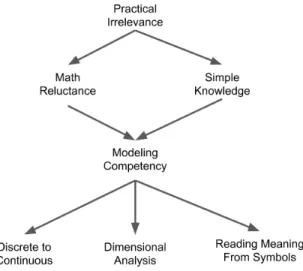
Fifth, we developed themes that connected the codes in the data together. The codes were sorted into themes, gathering codes together based on how often they co-occurred in the same unit of analysis or nearby in the same interview. These groups of codes suggest that the codes in the group are related to one another and have a sort of narrative structure. Each theme was held to the standard that it should be more than the sum of its component codes. We then reviewed these themes by generating a “thematic map” [48] of the analysis. These thematic maps (see Figure 2.1) relate multiple codes together into a more cohesive whole. After refining these themes through repeated discussion, we defined and named each theme.
After groups of related codes were assembled together, codes were arranged into an ordered structure that expresses containment, suspected causality, and centrality relationships. If the researchers believed such a narrative structure could be constructed, this code group was promoted to a candidate theme and a thematic map [48] for the candidate theme was generated. A thematic map forces the researchers to explicate the narrative structure of the theme. This explicit structure enables systematic and skeptical critique of the relationships between codes such as examination of co-occurrences or adjacent occurrences of codes in the data. This critique can lead to new codes being brought into the theme, or more often, codes with weaker supporting
evidence being cut from the prospective theme. After refining the theme, a final thematic map is generated. This map was used to define and name the theme.
Figure 2.1: Thematic map. Codes are arranged and connected together from centralizing ideas to smaller, less central ideas. Nodes with many arrows leaving them are more important, more central ideas within the data, have suspected causal influence on those they point to, or contain in some way the objects they point to. The initial thematic map is condensed and refined to better display the narrative structure inherent in the data, by considering co-occurrence of codes within a particular passage and within interviews. Codes whose presence in the theme cannot be firmly justified are removed from the map, and connections between codes are arranged to align with the narrative of the theme.
2.3.4
Trustworthiness
The first coder (also the interviewer) had an undergraduate background in physics and mathematics, and graduate training in electrical engineering.
Participants were selected because they had taught an engineering course that used the calculus sequence as a prerequisite. The interviewer had never taught any of the engineering courses, and so had little disciplinary bias to favor one participant’s expectations over another.
statistics for social scientists. The use of two coders helps reduce the like-lihood that the results are a single researcher’s opinion projected onto the data. The presence of a mathematical outsider keeps the preconceptions of the more mathematically entrenched first coder in check, since perceptions of the importance of ideas must be fully justified. We did not perform member checking on the results. When a faculty member said something very similar to previous participants and was informed of previous participants’ ideas at the end of the interview, they did often comment that they felt good that they were not the only ones who felt that way about the topic. As will be seen later in this document, the results strongly corroborate other findings on engineering mathematics by other authors and by different methodologies.
2.3.5
Limitations
This study has a few limitations of this study that should be explicitly dis-cussed, which are in addition to the limitations of all qualitative research.
• Our study focuses on describing engineering faculty’s perceptions on what mathematical maturity students need to be successful. As we argue from our constructivist perspective, these perceptions may not accurately describe the reality of what mathematical skills and beliefs students actually need to be successful.
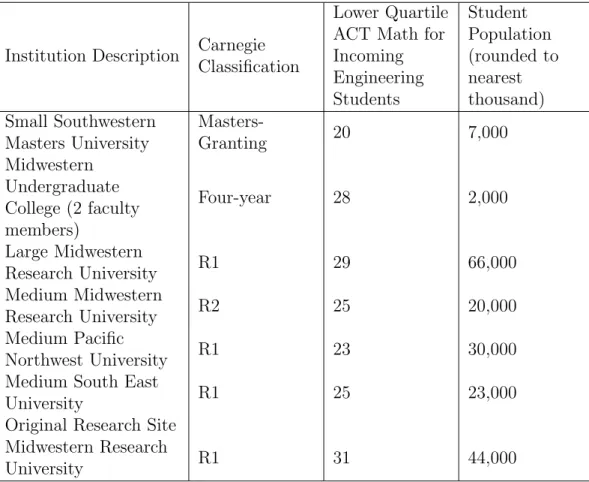
• The sample was drawn from a large, PhD-granting research institution with elite students with median ACT math scores of 31 as compared to the nationwide median of 24-26, who are more mathematically prepared than the typical undergraduate. The elite status of the institution may skew the findings, as these faculty may have higher expectations of their students than is typical nationwide. The faculty may also overempha-size mathematical skills that are useful for research rather than indus-trial practice, given the research-intensive nature of the institution. For example, the emphasis on computational tools or the dismissal of some skills as trivial may reflect the elite status of the institution but not the mathematical skills that engineering students at other institutions might need.
are not independent and may develop a local culture regarding what engineering mathematics should be that varies from the population of engineering instructors at large. Further work will examine these beliefs with engineering faculty members from a variety of different institutions.
• The interviewer specifically discussed epistemic belief and symbol sense issues during the interviews. Participants’ responses are influenced by prompting, and the symbol/representation theme may be over-represented. No similar theme emerged in previous studies by CRAFTY, Moore or Ferguson [18, 40, 17]. This bias is difficult to resolve and must be taken into consideration while examining the results.
• The interview questions included linguistic features that may trigger conformity to widespread views of the role of mathematics in engineer-ing, such as “applicationism” [23].
• These interviews were single, isolated, one-hour events. The short time scale and lack of prior reflection may have led to shallow interview responses.
• The engineering faculty expectations were within the context of the typical lecture and exam assessment structure of most institutions of higher education in the United States. Participants gave their expec-tations within this framework.
• In addition, the first coder has his own biases as a researcher and as a practitioner of mathematics. The second coder has no college-level mathematics experience. This lack of experience helps mitigate this bias somewhat, since the first coder must explain views explicitly.
2.4
Results
In this section, we present the results of the thematic analysis. We claim that the following three themes are representative of the most common and important beliefs of the engineering faculty in our study.
• Theme 1: A mathematically mature student uses and interprets math-ematical models.
• Theme 2: A mathematically mature student chooses and manipulates symbolic and graphical expressions.
• Theme 3: Computational tools reshape “what needs to be known” to be mathematically mature.
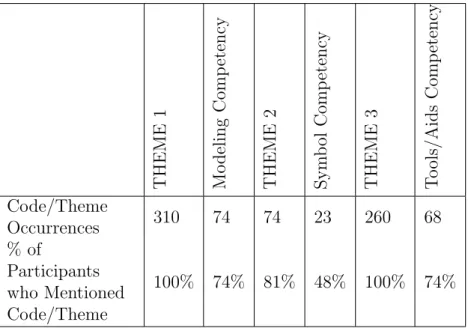
To demonstrate this generalizability within the sample, we present fre-quency counts [47] in Table 2.4 to illustrate how often each theme (and an associated representative code) appeared across all interviews and each par-ticipant.
Table 2.4: The three themes and each of their largest constituent codes. Modeling competency is the largest constituent code for theme 1. The total number of coded segments corresponding to each theme in the data are included to show presence in the data, and the percentage of participants mentioning that code or that theme is included to demonstrate
representativeness. THEME 1 Mo deling Comp ete ncy THEME 2 Sym b ol Comp etency THEME 3 T o ols/Aid s Comp etency Code/Theme Occurrences 310 74 74 23 260 68 % of Participants who Mentioned Code/Theme 100% 74% 81% 48% 100% 74%
2.4.1
Theme 1
“A mathematically mature student uses and interprets mathemat-ical models.”
This theme is supported by two beliefs expressed by the participants: En-gineering faculty asserted that mathematical modeling skills are the most important skill for engineering students and these faculty believed that poor epistemic beliefs undermine students’ ability to develop these modeling skills. It is worth noting that the aspects of modeling that engineering faculty referred to did not span the entirety of the mathematical modeling cycle. Participants often referred to only two steps, the “mathematizing” step and the “interpreting” step. This finding is previously found in the literature [50], where engineering homework problems use only some of the mathematical modeling cycle, which could be called merely “application” rather than the more encompassing “modeling.”
Strong modeling skills
Participants described that a mathematically mature engineering student is adept at modeling engineering problems and also believes mathematics is rel-evant to engineering. Of the KOM competencies, the modeling competency was the most important to participants: Participants’ statements were coded as modeling competency 74 times, and 74% of participants had statements that were coded as modeling competency (the median KOM competency was coded 9 times). Similarly, all participants had at least one statement that was coded as part of this first theme. They described a mathematically mature student as able to translate from mathematical to physical representations of situations and to interpret the physical meaning of a mathematical result.
[I want students to] take a statement in plain English, describing how a system works, turn it into an algebraic equation, and then do the operations to solve the algebraic equation.
—Physics Faculty Member
According to participants, a mathematically mature student is expected to be able to set up integrals and derivatives to describe physical situations. For example, to participants’ dismay, students struggle to set up control volumes for the flow of water or to sum up small differential elements of charge to find total charge, despite participants’ expectations that these skills should be the primary outcome of finishing calculus. Faculty stated a mathematically
mature student should be able to use units to solve problems and examine answers; however, they observed their students’ ignorance of dimensional analysis. While students can manipulate simple algebra, they are unable to connect the mathematical meaning of those manipulations to any physical meaning. A faculty member describes the lack of mathematical maturity she observed in the classroom:
And sometimes they have problems understanding that the mini-mum in energy means that the force is zero. Again, because they may be able to do drd, but maybe they don’t really know what it means physically. So many of them just set the energy to0. They don’t get it that there’s a minimum in the energy curve, it means the force is zero.
– Materials Science Faculty Member
Participants stressed that mathematically mature students should already have the ability to extract mathematical meaning to set up a problem as well as perform algebraic/calculus manipulations. Participants highlighted their expectation for students to be able to set up an integral or derivative to describe a situation. A faculty member described his experience with his students struggling with these competencies.
The word problems are not saying solve the integral of this, it’s here’s a situation, translate which variables are known and which variables are unknown. Then set up the problem to solve it. It requires reasoning to set it up. I don’t know how they don’t know. – Civil Engineering Faculty Member
As can be seen from these data, engineering faculty members expect their students to have solid modeling skills as a result of their previous mathe-matical experience. The expectations are mismatched with the realities of completing calculus. This mismatch between the expectations of outgoing students of mathematics and incoming students of engineering has been pre-viously observed by Ferguson [17].
Unfortunately, faculty voiced their discontent with students’ modeling competency. They noticed that students believe that mathematics is not
relevant to engineering; without the mathematically mature belief that math-ematics is relevant, students struggle with their modeling skills. Mathemat-ical maturity entails not only the ability to use mathematics to make sense of the physical world, but also the belief that one should. This belief was captured with the code “Practical Irrelevance” 78 times whereas the median epistemological belief was coded only 19 times.
Not only can this irrelevance belief influence students’ learning in pure mathematics courses, but it can extend to mathematics-heavy engineering courses. One materials engineering faculty member recalled her students commenting on her sophomore theory class: “This isn’t really [materials en-gineering]. This is just math or not really relevant to our major.” A civil engineering faculty member commented on his students’ struggles with math-ematics in the absence of relevant engineering examples, stating “You’re go-ing to be a junior before you see any application of anythgo-ing, so you better hold on tight!” Although students’ skills and abilities in mathematics may be admittedly poor, a deeper problem resides in their belief about mathe-matics. A physics faculty member said that students “view calculus a, just equations and math in general as a calculating device,” rather than the more mature perspective as a “concise way of capturing the underlying physical principles.”
The belief that mathematics is irrelevant and painful shapes student choices. Many participants emphasized that this distaste for mathematics was a result of the lack of application in the early mathematics courses. A bioengineering faculty member stated, “They take [bioengineering] because they thought it would be less math. The attitude of fear of math because it was disconnected [sic].”
Faculty members claimed that the student attitude that mathematics is irrelevant results from the abstract, application-starved presentation of intro-ductory mathematics courses. This abstract presentation cultivates student beliefs that mathematics is not relevant outside the mathematics classroom. Faculty felt that they must convince students that mathematics they have learned in the past does provide useful techniques to understand the engineer-ing systems they currently study. This bioengineerengineer-ing faculty member spoke about his struggle with convincing students of the relevance of previously learned mathematics.
As soon as you make the transition into the physiology domain, the problem is convincing students that what they did learn is applicable still, and that a plug and chug problem does provide useful information to physiological systems.
—Bioengineering Faculty Member
This bioengineering faculty member’s challenge was not correcting their lack of mathematics skill, but correcting their beliefs about mathematics itself. His challenge was to convince students, that is, to change their beliefs. Stu-dents do not search for connections that they do not believe exist. For students to become skilled at finding connections, they must first be guided to believe that these connections are there to be found.
I think it’s that they don’t recognize that what we’re talking about in my class is the same mathematical operation as what they learned to do in a methods of integration unit.
– Physics Faculty Member
Engineering faculty expect students to have attained these mathemati-cally mature modeling skills as a result of their mathematics coursework. Due to this mismatch of expectations, students struggle in their subsequent engineering coursework. These findings align with previous literature, where modeling skills consistently dominate discussion of mathematical skills for engineers [17, 51, 18].
2.4.2
Theme 2
“A mathematically mature student chooses and manipulates sym-bolic and graphical expressions.”
This theme was supported by the disproportionate application of two sym-bol sense codes, Reading Meaning from Symsym-bols and Symsym-bols in Context, applied 32 and 25 times respectively compared to a median application of 6 for symbol sense codes. The Symbol/Formalism competency was mentioned by 48% of participants, and 81% of participants mentioned something from the second theme.
The participants’ definition of “reading meaning from symbols” was specif-ically concerned about students’ ability to extract physical meaning from
symbols as opposed to including ideas like searching for structural simplifi-cations as in Arcavi’s definition of reading meaning from symbols[22].
The participants’ definition of “Symbols in Context” was more conso-nant with Arcavi’s definition, describing a mathematically mature student as someone who recognizes that symbol meanings vary by context. For example, one agricultural engineering faculty member commented on how frequency is sometimes treated as a variable in the frequency domain, but is treated as a constant when performing the integrals that compute the Fourier transform into the frequency domain. A mathematically mature student must keep track of the changing roles symbols play in different contexts. A mechanical engineering faculty member commented:
I hammer it into them, what means what, what is varying, what is constant. When we do power spectral density, there the variable is actually frequency not time. I make sure that they understand what is integrated with respect to what. That notation is, needs to be explained and emphasized all the time.[sic]
-— Mechanical Engineering Faculty Member
Participants expressed dissatisfaction with many of their students’ sym-bolic skills. Students could not transfer their mathematical knowledge be-tween two phenomena with isomorphic symbolic form, such as inability to handle the notational difficulties arising from similar equations for shear forces and tensile forces.
Representational Fluency
Not surprisingly, participants stated that students’ skills were weak at trans-lating between different representations of a problem. For example, students struggle to, or did not attempt to transform an algebraic representation of an object to a graphical expression of that same object. According to partici-pants, students do not emerge from their mathematics courses understanding that no one representation is the reality of the object; there are many repre-sentations that express different truths about the underlying object. The lack of mathematically mature representation skills becomes particularly worri-some in the context of linear algebra and the change of basis.
Objects that are doing things, linear in nature, but you can use numbers to represent them. But the numbers aren’t the objects, they only represent them... And you can switch basis, but it’s still the same object. I suspect that’s true of the way they teach it here. That you emphasize that these are invariant objects that have a meaning in and of themselves, independently of the numbers that you chose to ascribe to them. And then you learn how to translate between different representations. I don’t know whether the students get that or not, but that’s an important aspect. – Mechanical Engineering Faculty Member
Students tend to be attached to a single, canonical representation of a sys-tem; they struggle when they’re presented with an alternate representation. Changing even a single letter can completely obscure their understanding of the system at hand. In particular, students are attached to using the letterx as the independent variable in all situations, as this physics faculty member points out:
Part of the problem may be confronting symbolic expressions and generaliz[ing] from them. They may have derivative of ln(x) in calculus, but when they get the derivative of a bunch of symbolic constants in front of ln(r), it looks like a different problem to them.
–Physics Faculty Member
Participants also complained about students’ difficulties with the dummy variable of integration, saying that students frequently fail to recognize a dummy variable or when to use one. This lack of proper conceptual knowl-edge of dummy variables causes problems with later important concepts like convolution that depend strongly on dummy variables.
Participants said that students are attached not only to canonical symbolic representations of phenomena, but also to algebraic representations in gen-eral. Participants observed that their students are reluctant to use graphical representations to solve problems. A mathematically mature student uses simple graphical interpretations rather than sticking to the algebraic repre-sentation ill-suited to the problem at hand. One said:
[I wish students were good at] graphical solutions to problems. Be-ing able to make a plot to solve a problem. Without me tellBe-ing them plot these. Just being able to do graphical solutions to prob-lems, being able to immediately resort to that technique.
– Materials Engineering Faculty Member
The above participant commented that it is her students’ inclination to-ward algebraic representation that causes problems, not necessarily their ability to use graphs as a means of approaching a problem. Participants stated that students do not view notation and representation as a flexible tool for solving problems. Participants expressed a desire for students to show mathematical maturity by moving fluently between mathematical rep-resentations.
Symbols and Substitution
Within the algebraic representation, participants particularly wished that students understood substitution as a tool to gain insight into how a sys-tem works. Participants reported that students view substitution rules as meaningless tricks to reach the end of problems rather than flexible ways to change how one thinks about a problem. For example, when computing the integrals that describe the electric fields around a sphere, the arising trigono-metric substitutions correspond to physical angles within the system. These correspondences can be used to help check and interpret the resulting inte-gral. The participants teaching upper division courses (or computer science at any level) most emphasized the importance of flexible and incisive use of substitution compared to other participants.
Substitution rules are seen as just tricks. Maybe why they’re not recalled as well I suspect. But I don’t know I’m speculating. Some classes may very well put a lot of emphasis on this. The way I learned integration as a student was not by understanding invari-ance. It was by “Here’s a bunch of rules you can apply to evaluate the integral.” It was understood as evaluating the integral. [em-phasis original]
![Table 2.1: The documented immature epistemic beliefs about mathematics and examples of negative associated student behaviors observed in previous literature [20, 32].](https://thumb-us.123doks.com/thumbv2/123dok_us/10271288.2933659/23.918.163.803.290.994/documented-immature-epistemic-mathematics-examples-associated-behaviors-literature.webp)
![Table 2.2: The KOM competencies and short definitions of them [21]. The competencies are overlapping, and some competencies might be more important to engineers than to mathematicians.](https://thumb-us.123doks.com/thumbv2/123dok_us/10271288.2933659/24.918.169.807.406.898/competencies-definitions-competencies-overlapping-competencies-important-engineers-mathematicians.webp)
![Table 2.3: The elements of symbol sense and brief definitions [22].](https://thumb-us.123doks.com/thumbv2/123dok_us/10271288.2933659/26.918.166.790.323.898/table-elements-symbol-sense-brief-definitions.webp)