DEVELOPMENT RESILIENCE ESTIMATION: THEORY AND APPLICATIONS
A Dissertation
Presented to the Faculty of the Graduate School of Cornell University
in Partial Fulfillment of the Requirements for the Degree of Doctor of Philosophy
by
Jennifer Denno Cisse August 2017
DEVELOPMENT RESILIENCE ESTIMATION: THEORY AND APPLICATIONS Jennifer Denno Cisse, Ph.D.
Cornell University 2017
The past five to ten years has seen the emergence of a new term on the humanitarian and development economics landscapes, resilience. While this term holds considerable promise, international development practitioners and the academic community have yet to reach consensus on a consistent definition of resilience and few, if any, theory-based methods for estimating resilience in a development context have been developed. This dissertation introduces an econometric strategy for estimating individual or household-level development resilience from panel data and applies this strategy to two different contexts. The first, more theoretical, paper proposes a conditional moments-based approach to development resilience estimation and illustrates the method empirically using household panel data from pastoralist communities in northern Kenya. The results demonstrate not only the method and its potential as a targeting tool for resilience-building interventions, but also help explain the behavioral paradox of apparent herd overstocking in pastoral communities.
The second paper of the dissertation applies the development resilience approach to evaluate the impact of an index insurance product on resilience. Taking advantage of an
experimental, multi-round, household panel dataset, the paper employs an instrumental variable approach to evaluate the impact of an index-based livestock insurance product in Northern Kenya on development resilience in terms of both household herd size, the primary productive asset in the region, and child health. The results indicate that index-based livestock insurance increases household resilience to drought in terms of household livestock holdings. Insurance is
also associated will substantially higher nutritional resilience in the children of drought-affected households.
The final paper of the dissertation evaluates the empirical relationship between livelihood diversification—both on-farm crop diversification and income diversification—and well-being, measured as monthly household expenditures per adult equivalent, in rural Uganda. Results indicate that income diversification is negatively associated with resilience. Crop diversification is associated with increased resilience, but only when considering poverty thresholds above the rural absolute poverty line. Diversification into cash crops and non-farm income does not increase resilience. These results indicate that crop diversification (although not diversification into cash crops) should be considered in similar contexts as a tool for increasing resilience, although not necessarily for the poorest households. More generally, it demonstrates the
importance of applying a development resilience approach when evaluating the potential benefits of risk management strategies and resilience-building activities.
BIOGRAPHICAL SKETCH
Jennifer Denno Cisse is a development economist and aid worker, currently serving as the Senior Risk Advisor in the Bureau for Food Security at the US International Development Agency. Prior to completing her Ph.D., Dr. Cisse worked for Catholic Relief Services, managing development projects and writing grant proposals for activities in Africa and Asia. She holds a B.A. in Mathematics from Smith College and an M.A. in International Relations from the Johns Hopkins School of Advanced International Studies (SAIS). Dr. Cisse served as a Peace Corps Volunteer in Guinea.
DEDICATION
To my husband and children,
Thank you for joining me on this adventure. I would be lost without you.
ACKNOWLEDGEMENTS
I would like to thank Christopher B. Barrett, Mark A. Constas, and Shanjun Li for their comments, guidance and support. I would also like to thank participants in several Cornell University seminars and academic conference presentations for comments on various drafts of this research. This dissertation uses two primary sources of data: 1) data collected by a
consortium led by the International Livestock Research Institute, funded by the UK Department for International Development through FSD Trust Grant SWD/Weather/ 43/2009, the United States Agency for International Development grant No: EDH-A-00-06-0003-00 and the World Bank’s Trust Fund for Environmentally and Socially Sustainable Development and 2) data collected by the World Bank Living Standard Measurement Study—Integrated Surveys on Agriculture (LSMS-ISA) program.
I am grateful for financial support from the USAID BASIS Research Program at the University of California at Davis, the USAID-funded Technical Consortium for Building Resilience to Drought in the Horn of Africa, a CGIAR project, and the African Development Bank.
Finally, I would like to thank my husband and children for their love and patience on this journey; my parents for their love and support; my committee for their guidance and
collaboration; and my friends, particularly JBR and the indomitable ladies of 410 Warren Hall, for their strength and infinite emotional support. Without you this would not have been possible.
Any opinions, findings, and conclusions or recommendations expressed in this material are those of the authors and do not necessarily reflect the views of the supporting agencies. All errors are my own.
TABLE OF CONTENTS
BIOGRAPHICAL SKETCH ... v
DEDICATION ... vi
ACKNOWLEDGEMENTS ... vii
TABLE OF CONTENTS ... viii
PREFACE ... x
I.Introduction ... x
II.Literature Review ... xi
III.Synthesis and Contribution ... xvii
IV.Dissertation Papers ... xviii
References ... xxii
CHAPTER 1 ... 1
I.Introduction ... 1
II.Development Resilience Estimation ... 3
III.Development Resilience Aggregation ... 11
IV.An Empirical Example ... 14
V.Conclusions and Policy Implications ... 26
References ... 28 Tables ... 34 Figures ... 37 Appendix ... 41 CHAPTER 2 ... 48 I.Introduction ... 48
II.Risk, Insurance, and Resilience ... 50
III.Context and Project Background ... 56
IV.Empirical Approach to Development Resilience Estimation ... 60
V.Impact of Insurance on Development Resilience ... 62
VI.Conclusion ... 77
Tables ... 81
Figures ... 92
Appendix ... 105
CHAPTER 3 ... 114
I.Introduction ... 114
II.Risk Management and Livelihood Diversification ... 116
III.Data and Context ... 117
IV.Empirical Model ... 122 V. Results ... 125 VI.Conclusion ... 130 Tables ... 133 Figures ... 138 References ... 142 Appendix ... 145
PREFACE
I. Introduction
Over the past twenty years, scholars have made considerable progress in understanding poverty and its counterpart, well-being. In economics, seminal contributions include theoretical explanations for persistent poverty; approaches to understanding the interplay between risk, vulnerability, and poverty; and methods for calculating intertemporal and multidimensional poverty. Despite the richness of the poverty dynamics/traps and vulnerability literatures, the past five to ten years has seen the emergence of a new term on the development economics landscape, resilience. While this term holds considerable promise, much of the economic literature on development resilience to date has failed to incorporate many of the poverty and vulnerability measurement lessons of the past twenty years.
The goal of this dissertation summary is threefold; 1) to critically examine the poverty dynamics and vulnerability literatures in order to identify both critical elements and central issues; 2) to build a consistent lexicon for the economics of development resilience that highlights the conceptual foundations of development resilience and a resilience approach to well-being estimation; and 3) to clarify the contribution of my dissertation to these literatures. This document is organized as follows: The second section contains the literature review, which is organized conceptually around the three topics mentioned above and is focused on the
theoretical insights they provide. The third section highlights how I bring together the strengths of these various research fields and discusses my general contribution to the literature. Finally, the fourth section briefly summarizes each of the three chapters of my dissertation.
II. Literature Review
Our current understanding of how poverty evolves over time, particularly in the face of shocks, comes from three distinct but related literatures: the poverty dynamics and traps, vulnerability, and resilience literatures. The following section works through each of these literatures, with an eye to highlighting the key strengths and lessons of each.
Poverty dynamics and traps
While the literature on economic growth and poverty reduction is vast, I will focus here on theoretical micro-economic contributions from the past twenty or so years, with a particular emphasis on models that incorporate dynamics and/or risk explicitly. Although a bit older, Loury (1981) describes the potential theoretical impacts on human capital investment of stochastic income and incomplete credit markets for educational loans. Rosenzweig and Binswanger (1993) provide the first, as far as I am aware, empirical study of farmer risk aversion in the context of incomplete insurance markets and informal idiosyncratic risk sharing, finding that utility-maximizing farmers with higher levels of risk exposure self-insure against covariate weather shocks through the selection of lower mean production, lower variance portfolios. The authors examine ex ante behavior during a single period only. Building on this, Banerjee and Newman (1994) outline perhaps the first micro-economic model of poverty traps resulting from (credit) market failures and demonstrate that, in a simple two period model, poor households pass on poverty to their children. Similarly, Barham (1995) describes a three period model in which liquidity constraints among poor households (also a form of credit market failure) limit human capital investments and therefore trap future generations in poverty.
In his seminal paper, Dasgupta (1997) explores how nutrition and income are mutually (and deterministically) reinforcing, and describes the possibility of two distinct stable equilibria:
adequate nutrition to sustainably meet needs through economic participation and perpetual malnutrition. Dasgupta argues that these “lock-in effects” may be found even without credit market failures, although he acknowledges that market imperfections certainly exacerbate poverty traps. Dercon (1998) proposes a model of asset accumulation in the face of credit constraints and risk, and implements it empirically using a very small panel (80 households) in rural Tanzania. He theorizes that credit market imperfections and the indivisibility of livestock assets cause barriers to entry into animal rearing (which he considers a high-return investment), causing poorer households to continue low return, low risk non-farm activities and eventually leading to growing inequality.
Baulch and Hoddinott (2000), in their introduction to a special issue of the Journal of Development Studies, describe the multiple “dimensions” of economic mobility and poverty: 1) metrics of interest, 2) temporal concerns, and 3) additionality. They highlight problems, in a stochastic world, with cross-sectional poverty measures that fail to differentiate between the “sometimes poor” and the “always poor” although they point out that even with multiple rounds of data 1) measurement error leads to an overstatement of the number of transitorily poor households and 2) the heterogeneity of the transitorily poor may hide important distinctions in terms of welfare, suggesting a permanent income approach may be more appropriate in some circumstances. Further, Naschold and Barrett (2011) demonstrate that much of the empirical evidence on transitory poverty is overstated due to the relatively short windows between rounds in many panel datasets. With regards to measures, Baulch and Hoddinott (2000) emphasize that different welfare measures may lead to very different conclusions about the magnitude of chronic or transitory poverty. They differentiate between short term poverty dynamics and long
term economic mobility, the latter of which they argue also must incorporate initial conditions, shocks, macroeconomic conditions, the impact of asset stocks on welfare.
Carter and May (2001) expand the standard single-period poverty line intertemporally using a formula for discounted present value and classify households as dynamically poor if the “maximal discounted stream of [the household’s] future livelihoods” (p. 1989) given its initial asset endowment is below the multiperiod poverty line. Although the authors do not include measures of shocks specifically, they do include a stochastic component which allows them to classify families as either stochastically or structurally poor (or non-poor). Zimmerman and Carter (2003) explore a dynamic, stochastic model with subsistence constraints and revitalize Lipton’s (1993) concept of a Micawber threshold around which asset dynamics bifurcate between asset accumulation and decumulation. The authors demonstrate that poor but rational actors will alter consumption patterns to smooth assets in response to shocks (and with missing insurance markets). Lybbert et al. (2004) study stochastic well-being dynamics among Ethiopian pastoralists, building on the hypothesis that “history dependence” may drive poverty dynamics in situations of multiple equilibria, they offer an empirical estimation of multiple dynamic wealth (in terms of livestock assets) equilibria using a non-parametric approach which is able to capture non-linearities in asset dynamics. On the other hand, Kraay and McKenzie (2014) argue that, despite the value and advancement of the literature, there is a lack of evidence for the existence of poverty traps in practice—remote rural areas, such as the one studied by Lybbert et al., perhaps being the primary exception.
Prior to 2006, the poverty dynamics and measurement literatures were focused on ex post
poverty measurement, identifying who was poor in the past. Carter and Barrett (2006) pull together the previous literatures on asset accumulation and stochastic versus structural poverty,
laying the groundwork for a “forward-looking” (ex ante) poverty measure that builds on the strengths of the vulnerability literature (discussed below) as well. Hoddinott (2006) furthers the literature on poverty dynamics and asset accumulation, pointing out that the previous literature inadequately examined intra-household aspects of poverty dynamics. He also recasts the consumption versus asset smoothing debate by noting that households simply decide which capitals (including between human capital and physical assets or between the human capital of children and adults) to conserve and which to draw down in response to shocks.
Vulnerability
Although much has been written on vulnerability in recent years, the literature primarily began as a series of (sometimes still unpublished) working papers responding to critics that the poverty measurement literature was too backward-looking and that the poor themselves consider vulnerability to be an important aspect of poverty (Kanbur & Squire 1999). One of the earliest of these was Pritchett, Suryahadi and Sumarto (2000), who propose, as far as I am aware, the first probabilistic measure of vulnerability. The authors define vulnerability as the probability (or risk) that a household will fall below the poverty line in the future (three years). This focus on the near future distinguishes the vulnerability literature from much of the poverty dynamics literature. While the authors do construct a headcount measure, they do not examine depth of vulnerability per se. Christiaensen and Boisvert (2000) highlight that the well-being can be measured using a variety of “focal variables,” a probability distribution, a well-being threshold, and a probabilistic vulnerability threshold. They also suggest an FGT-type aggregator can be used to measure the depth of vulnerability. Chaudhuri, Jalan, and Suryahadi (2002) also consider vulnerability as the probabilistic interpretation of a stochasitic process. Although they suggest a framework for measuring vulnerability, their reliance on cross-sectional data means that the
estimates are actually ex post estimates of the probability of a household being in poverty and cross-sectional variation is assumed to resemble variation over time.
The pieces above can all be grouped into one approach to vulnerability measurement, which Hoddinott and Quisumbing (2003) refer to as the vulnerability as expected poverty (or VEP) approach. The VEP approach has multiple strengths, particularly its forward-looking nature and explicit focus on risk and shocks. Hoddinott and Quisumbing (2003) identify two other approaches to vulnerability measurement in their review, vulnerability as low expected utility (VEU) and vulnerability as uninsured exposure to risk (VER). Gisele and Morduch (2002) are perhaps the earliest proponents of the VEU approach. Their framework uses Monte Carlo simulations combined with bootstrapping to nonparametrically generate a household’s future well-being distribution. In general, the VEU and VER approaches to vulnerability measurement are further removed from the poverty measurement literature, and my work builds primarily on the VEP approach.
Resilience
As the vulnerability literature was developing in the early 2000s, the concept of
resilience—previously a concept in the ecology and ecosystems literature (Holling 1996)—began to draw the attention of researchers working on social problems, from socioecological systems (Carpenter et al. 2001, Folke 2006), including pastoral systems (Robinson and Berkes 2010), to planning (Davoudi 2012). As cyclical shocks, disaster risk reduction, and climate change became more of a focus of the international development and humanitarian communities, the concept of resilience became increasingly central in donor thinking (e.g., USAID 2012). Some argued that the focus on resilience risked to leave vulnerable populations behind by ignoring the power dynamics that contributed to poverty and vulnerability (Cannon & Müller-Mahn 2010), while
others argued that the concept of resilience allowed development actors to refocus on the most vulnerable populations (Levine 2014).
Despite significant focus in the past five years, the development community has still not reached a consensus on the definition of resilience, how it relates to vulnerability, whether resilience should be considered an attribute or an outcome, and whether resilience is a latent concept or is measured by observable well-being outcomes. Important work in this direction has been carried out by the Resilience Measurement Technical Working Group, who proposed a set of resilience measurement principles, including connections between resilience and vulnerability (Constas, Frankenburger, & Hoddinott 2014). Constas provides a convenient framework for thinking about different definitions (or interpretations) of resilience: resilience as a
multidimensional construct, resilience as a predictor, resilience as a property, and resilience as a paradigm (Constas (2016) as cited in d’Errico, Garbero, and Constas (2016)).
In terms of empirical applications, Béné et al. (2014) provide a review of the early application of resilience to the field of international development, and begin to develop the concept of resilience as a set of capacities. The view that resilience was about agency and quite separate from vulnerability was further developed by Béné et al. (2016). Barrett and Constas (2014), on the other hand, view resilience as an outcome and emphasize the need for a resilience measure that allows for nonlinear well-being dynamics.
Recent empirical papers, most of which are focused on the Horn of Africa or the Sahel, have used latent variable techniques to construct food security resilience indices (Alinovi, Mane, & Romano 2010; FAO 2015), principal component analysis to construct vectors of resilience capacities (Smith et al. 2015), household welfare dynamics to measure resilience (Vaitla et al. 2012), imputed counterfactual measures to categorize households based on predicted
consumption (Alfani et al. 2015), classifications of households by the speed to which they bounce back from shock (Tesso, Emana, & Ketema 2012), and developed a methodology for using panel precipitation data to examine the effects of climate shocks on Ethiopian households (Vollenweider 2015). Yet despite the view that that resilience must be based around shocks (Régibeau & Rockett 2012), few of these empirical papers integrate shocks into their analysis.
III. Synthesis and Contribution
The key contribution of my dissertation is a pulling together of these three literatures into an empirical framework that acknowledges the importance of assets, path dynamics, and
stochasticity—as highlighted in the poverty dynamics literature—together with probabilistic well-being measurement and prediction. A probabilistic, moments-based approach explicitly models mean, variance, and potentially even higher order moments of well-being, much as proposed by supporters of vulnerability approaches. This is particularly important as
development actors increasingly focus on activities that promote resilience by helping farmers manage risk. Assessing the impact of these activities on mean well-being without an
understanding of the conditional variance of well-being limits our ability to understand the risks vulnerable populations face and how best to address these risks.
At the same time, incorporating lagged well-being acknowledges the importance of initial asset or well-being conditions. Higher order polynomial lagged well-being terms allow for nonlinearities in these path dynamics, as emphasized in the poverty traps literature. Finally, the probabilistic development resilience approach I develop in my dissertation, building on the VEP approach discussed above, allows researchers and policy-makers to predict out over time, making the resilience approach a potentially powerful targeting tool. At the same time, the
approach explicitly controls for observed shocks and climactic stress, which is necessary to assess resilience in the face of shocks.
IV. Dissertation Papers
Paper 1 – Estimating Development Resilience: A Conditional Moments-Based Approach For the first paper of my dissertation, Chris Barrett and I develop an empirical strategy for estimating resilience based on theoretical work by Barrett and Constas (2014). The issue of resilience measurement involves two distinct but related tasks: development resilience estimation and aggregation. Resilience estimation is the process by which researchers identify who is
resilient and who is not. Several methodologies have been proposed in the literature on resilience measurement and we review desirable resilience model characteristics, such as stochasticity and nonlinearity, as discussed above.
This dissertation chapter demonstrates how to empirically implement the moments-based approach proposed by Barrett and Constas (2014), which allows us to identify who in a given population is resilient and who is not, as well as how specific interventions impact resilience or how certain characteristics are correlated with household resilience. Although individual- or household-level resilience scores are necessary for understanding the micro impacts of policies and behaviors, it is useful to be able to aggregate these various household level scores into an overall resilience index that is decomposable (and comparable) across subgroups.
The second part of the paper tackles the resilience aggregation issue, building on the seminal poverty measurement work of Foster, Greer, and Thorbecke (1984). As in the first section, the aggregation section begins by laying out desirable characteristics for an aggregate measure and then demonstrates how an appropriate resilience index can be constructed. Finally,
we describe how we can predict resilience in order identify targetable characteristic for
interventions aimed at boosting the resilience of vulnerable households. We conclude the paper with an example of resilience estimation and aggregation using data on livestock holdings from Northern Kenya, demonstrating how the empirical strategy discussed in the paper can be carried out in practice.
Paper 2 – The Impacts of Index Insurance On Resilience In Northern Kenya
In this paper with Munenobu Ikegami, we implement the empirical strategy discussed in Paper 1 (above) to evaluate the impact of a livestock insurance program in Northern Kenya on participant well-being. Taking advantage of five rounds of panel data from Kenya, including a 2011 insurance payout following extreme drought, we evaluate the impact of livestock insurance on household well-being and resilience in Marsabit.
The East African context is a particularly interesting setting in which to implement an empirical analysis of resilience, given that stochastic poverty traps have been discussed in the East African pastoral context for over a decade (e.g., McPeak & Barrett 2001). In order to dampen the alarming impacts of drought on livestock-dependent households, an index-based livestock insurance (IBLI) program was piloted in Marsabit District (Northern Kenya) beginning in January 2010. Households in the IBLI program area decide whether or not to purchase the product, as well as how many animals to insure. Should drought cause the normalized difference vegetation index (NDVI) to fall below a certain level — a level associated with high animal mortality (Chantarat et al. 2013) — the insurance holder receives a payout. IBLI can therefore be considered a resilience-building program because it aims to protect against catastrophic livestock mortality by allowing households to insure their most important assets against shock.
Building on previous work by Barrett and Constas (2014), we propose a third order polynomial parametric regression model of stochastic well-being in order to evaluate the impact of the insurance product on resilience. The well-being dependent variables of interest are child anthropometry (in terms of mid-upper arm circumference) and household livestock holdings (in terms of tropical livestock units ). The dynamic model describes current well-being as a function of lagged well-being and a series of explanatory variables. Since the insurance uptake decision is likely endogenous to any measure of household welfare, we exploit the random distribution of coupons, which in this context can serve as an exogenous shifter of insurance demand, as an instrument for insurance participation. We also use predicted catastrophic livestock mortality data as a proxy for weather shocks.
We find that insurance in the previous season increases a household’s resilience in terms of livestock holdings, whether a drought occurred or not. We explore how changing the well-being threshold impacts the results and find that the positive impacts of past season insurance on TLU resilience are statistically significant for thresholds of 20 TLU and above. Shifting the well-being threshold allows us to determine that IBLI it does not effectively increase the resilience of the poorest households with the smallest initial herds. It does, however, dramatically increase the resilience of slightly better-off households and appears to allow them to invest more in their herds while avoiding protective over-stocking.
Given the small sample size of young children and the survey design, we are not able to exploit the instrumental variable for our analysis of the impact of insurance on child health. We do however see a positive association between insurance and child health resilience during droughts. There appears to be no relationship between past season’s IBLI coverage and probabilities of subsequently becoming severely acutely malnourished in non-drought years.
Paper 3 –Livelihood Diversification and Well-Being in Uganda: A Development Resilience Approach
In this final paper, I use a large-scale, nationally representative household survey to explore the relationship between livelihood diversification and development resilience in terms of household per adult equivalent expenditures in rural Uganda. Despite the fact that
diversification is often cited as an important risk management strategy with potential for increasing resilience, this paper provides one of the first empirical assessments of the relationship between crop and income diversification and resilience in the face of shocks.
I begin by reviewing the literature on diversification, including theories about whether farming households are pulled into diversification as they enter into higher return activities, or whether they are pushed into diversification as a strategy for managing risks and coping with shock. I briefly discuss various measures of diversification used in the literature, before proposing a transformed Herfindahl index to measure crop and income diversification at the household level.
Holding total income, as well as shares of wage and self-employment income, constant, I find that income diversification is negatively associated with increased resilience. For the least resilient households, crop diversification is also negatively associated with resilience. Once the poverty threshold is increased, however, crop diversification is positively and statistically significantly associated with increases in resilience. This is not as a result of diversification into cash crops, which are associated with decreases in conditional mean expenditures and with decreased resilience, as well.
References
Adato, Michelle, Michael R. Carter, and Julian May. 2006. “Exploring Poverty Traps and Social Exclusion in South Africa using Qualitative and Quantitative Data.” Journal of
Development Studies 42(2): 226–47.
Alfani, Federica, Andrew Dabalen, Peter Fisker, and Vasco Molini. 2015. “Can We Measure Resilience? A Proposed Method and Evidence from Countries in the Sahel.” Policy Research Working Paper #7170, World Bank Group – Poverty Global Practice Group. Alinovi, Luca, Erdgin Mane, and Donato Romano. 2010. “Measuring Household Resilience to
Food Insecurity: Application to Palestinian Households.” In Agricultural Survey Methods, edited by Roberto Benedetti, Marco Bee, Giuseppe Espa, and Federica Piersimoni. Chichester, U.K.: John Wiley & Sons.
Banerjee, Abhijit V. and Andrew F. Newman. 1994. “Poverty, Incentives, and Development.” The American Economic Review, Papers and Proceedings of the Hundred and Sixth Annual Meeting of the American Economic Association, 84(2): 211-5.
Barham, Vicky. 1995. “Education and the Poverty Trap,” European Economic Review, 39(7): 1257-75.
Barrett, Christopher B. and Mark A. Constas. 2014. “Toward a Theory of Resilience for International Development Applications.” Proceedings of the National Academy of Sciences 40(111): 14625–14630.
Baulch, Bob, and John Hoddinott. 2000. “Economic Mobility and Poverty Dynamics in Developing Countries.” Journal of Development Economics Special issue: 1–24. Béné , Christophe, Derek Headey, Lawrence Haddad, and Klaus von Grebmer. 2016. “Is
Some conceptual and practical considerations.” Food Security 8(1): 123-38. doi:10.1007/s12571-015-0526-x
Béné, Christophe, Andrew Newsham, Mark Davies, Martina Ulrichs, and Rachel Godfrey-Wood. 2014. “Review Article: Resilience, Poverty and Development.” Journal of International Development 26: 598-623.
Cannon, Terry and Detlef Müller-Mahn. 2010. “Vulnerability, resilience and development discourses in context of climate change.” Natural Hazards 55(3): 621-35. doi: 10.1007/s11069-010-9499-4
Carpenter, Steve, Brian Walker, J. Marty Anderies, and Nick Abel. 2001. “From Metaphor to Measurement: Resilience of What to What?” Ecosystems 4: 765-81.
Carter, Michael R. and Chistopher B. Barrett. 2006. “The economics of poverty traps and persistent poverty: An asset-based approach.” Journal of Development Studies 42(2): 178-199.
Carter, Michael R. and J. May. 2001. “One Kind of Freedom: Poverty Dynamics in Postapartheid South Africa.” World Development 29(12): 1987-2006.
Chantarat, Sommarat, Andrew G. Mude, Christopher B. Barrett, and Michael R. Carteret. 2013. “Designing Index-Based Livestock Insurance for Managing Asset Risk in Northern Kenya.” Journal of Risk and Insurance 80: 205–237. doi:
10.1111/j.1539-6975.2012.01463.x
Chaudhuri, Shubham, Jyotsna Jalan, and Asep Suryahadi. 2002. “Assessing Household Vulnerability to Poverty from Cross-sectional Data: a Methodology and Estimates for Indonesia.” Discussion Paper Series No. 0102-52, Department of Economics, Columbia University, New York.
Christiaensen, Luc J. and Richard N. Boisvert. 2000. “On Measuring Household Food
Vulnerability: Case Evidence from Northern Mali.” Cornell University Department of Economics Working Paper. WP 2000-05.
Constas, Mark A. 2016. “The four versions of resilience for development: Implications for programming and measurement.” Unpublished manuscript.
Constas, Mark A., Timothy R. Frankenburger, and John Hoddinott. 2014. “Resilience
Measurement Principles: Toward an Agenda for Measurement Design.” Published by the Food and Agriculture Organization and the World Food Program under the Food Security and Information Network as Technical Series No. 1.
Dasgupta, P. 1997. “Nutritional status, the capacity for work, and poverty traps,” Journal of Econometrics 77: 5-37.
Davoudi, Simin. 2012. “Resilience: A Bridging Concept or a Dead End?” Planning Theory & Practice 13(2): 299-333.
Dercon, S. 1998. "Wealth, risk and activity choice: cattle in Western Tanzania." Journal of Development Economics 55: 1-42.
d’Errico, Marco, Alessandra Garbero, and Mark A. Constas. 2016. “Quantitative Analyses for Resilience Measurement: Guidance for constructing variables and exploring relationships among variables.” Published by the Food and Agriculture Organization and the World Food Program under the Food Security and Information Network as Technical Series No. 7.
Folke, Carl. 2006. “Resilience: The emergence of a perspective for social–ecological systems analyses.” Global Environmental Change 16: 253-67.
Food and Agriculture Organization. 2015. “Resilience Analysis in Senegal 2005.” FAO
Resilience Analysis Team, Agricultural Development Economics Division (ESA), FAO Resilience Analysis No. 1.
Foster, James, Joel Greer, and Erik Thorbecke. 1984. “A Class of Decomposable Poverty Measures.” Econometrica 52(3): 761-66.
Gisele, Kamanou and Jonathan Morduch. 2002. “Measuring vulnerability to poverty.” World Institute for Development Economics, WIDER Discussion Paper No 2002/58.
Hoddinott, John and Agnes Quisumbing. 2003. “Methods for Microeconomic Risk and
Vulnerability Assessments.” World Bank Social Protection Discussion Paper Series No. 0324.
Hoddinott, John. 2006. “Shocks and their Consequences Across and Within Households in Rural Zimbabwe.” Journal of Development Studies, 42(2): 301-21.
Hoddinott, John. 2014. “Understanding Resilience for Food and Nutrition Security.” International Food Policy Research Institute, 2020 Conference Paper.
Holling, C.S. 1996. “Surprise for Science, Resilience for Ecosystems, and Incentives for People.” Ecological Applications 6(3): 733-5.
Kanbur, Ravi, and Lyn Squire. 2001. “The evolution of thinking about poverty: exploring the interactions.” Frontiers of Development Economics The Future Perspective. 183-226. Kraay, Aart and David McKenzie. 2014. “Do Poverty Traps Exist? Assessing the Evidence.”
Journal of Economic Perspectives 28(3): 127-48.
Levine, Simon. 2014. “Assessing resilience: why quantification misses the point.” Overseas Development Institute, Humanitarian Policy Group Working Paper.
Lipton, Michael, 1994. “Growing points in poverty research: Labour issues.” Institute of Development Studies, Sussex University.
Loury, Glenn C. 1981. “Intergenerational Transfers and the Distribution of Earnings.” Econometrica 49(4): 843-67.
Lybbert, Travis, Christopher Barrett, Solomon Desta, and D. Layne Coppock. 2004. “Stochastic Wealth Dynamics and Risk Management among a Poor Population.” Economic Journal 114(498): 750–77.
McPeak, John and Christopher B. Barrett. 2001. “Differential Risk Exposure and Stochastic Poverty Traps among East African Pastoralists.” American Journal of Agricultural Economics, 83(3): 674-679.
Naschold, Felix and Christopher B. Barrett. 2011. “Do Short-Term Observed Income Changes Overstate Structural Economic Mobility?” Oxford Bulletin of Economics & Statistics 73(5): 705-17.
Pritchett, Lant, Asep Suryahadi and Sudarno Sumarto. 2000. “Quantifying Vulnerability to Poverty: A Proposed Measure, Applied to Indonesia.” World Bank, Policy Research Working Paper 2437
Régibeau, Pierre and Katharine Rockett. 2012. “Economic Analysis of Resilience: A Framework for Local Policy Response Based on New Case Studies.” Centre for Research in
Economic Sociology and Innovation (CRESI) Working Paper 2012-01, University of Essex: Colchester.
Robinson, Lance W. and Fikret Berkes. 2010. “Applying Resilience Thinking to Questions of Policy for Pastoralist Systems: Lessons from the Gabra of Northern Kenya.” Human Ecology 38:335-50. doi: 10.1007/s10745-010-9327-1
Rosenzweig, M. R. and H. P. Binswanger .1993. “Wealth, Weather Risk and the Composition and Profitability of Agricultural Investments.” Economic Journal 103(416): 56-78. Smith, Lisa, Tim Frankenberger, Ben Langworthy, Stephanie Martin, Tom Spangler, Suzanne
Nelson, and Jeanne Downen. 2015. Ethiopia Pastoralist Areas Resilience Improvement and Market Expansion (PRIME) Project Impact Evaluation: Baseline Survey Report. Prepared for USAID’s Feed the Future FEEDBACK project.
Tesso, Gutu, Bezabih Emana, and Mengistu Ketema. 2012. “Analysis of vulnerability and resilience to climate change induced shocks in North Shewa, Ethiopia.” Agricultural Sciences 3(6): 871-88. doi:10.4236/as.2012.36106
US Agency for International Development. 2012. “Building Resilience to Recurrent Crisis: USAID Policy and Program Guidance.”
Vaitla, Bapu, Girmay Tesfay, Megan Rounseville, and Daniel Maxwell. 2012. “Resilience and livelihoods change in Tigray, Ethiopia.” Somerville, MA: Tufts University, Feinstein International Center.
Vollenweider, Xavier. 2015. “Measuring Climate Resilience and Vulnerability: A Case Study from Ethiopia.” Final Report prepared for the Famine Early Warning Systems Network (FEWS NET) Technical Support Contract (TSC), Kimetrica LLC.
Zimmerman, Frederick J. and Michael R. Carter. 2003. “Asset smoothing, consumption smoothing and the reproduction of inequality under risk and subsistence constraints.” Journal of Development Economics, 71: 233-60.
CHAPTER 1
ESTIMATING DEVELOPMENT RESILIENCE: A CONDITIONAL MOMENTS-BASED APPROACH
Jennifer Denno Cissé and Christopher B. Barrett
I. Introduction
Over the past several years, natural disasters, food price and macroeconomic shocks, and conflict have prompted recurring humanitarian emergencies in many of the world’s lowest income countries. In direct response, international development and relief agencies have become preoccupied with the concept of resilience, committing increasingly large amounts of funding, programming, and research toward “building resilience.” They struggle, however, to develop methods to implement the concept empirically so as to guide policy and project design, measure progress, and evaluate interventions. At the same time, the concept of development resilience has the potential to draw together the strengths of several distinct economics literatures on the
estimation of stochastic well-being dynamics. The opportunity is thus ripe for methodological contributions to help advance both operational and research agendas.
In his seminal work on poverty measurement, Sen (1979) discusses the need for both poverty “identification” (i.e., determining who is poor) and “aggregation” (i.e., establishing how characteristics of the poor can be combined into an aggregate indicator) to guide policy. The emergent development resilience agenda has similar measurement needs. Toward that end, we introduce an econometric strategy to estimate individual or household-level development resilience, so as to identify the targetable characteristics of those who are (and are not) resilient, and then demonstrate how to aggregate those micro-level estimates into policy-relevant measures
useful for targeting and impact evaluation purposes. This approach usefully synthesizes the distinct poverty dynamics, risk, and vulnerability literatures active within economics more broadly.
We follow the Barrett and Constas (2014, p.14626, hereafter BC) conceptualization of development resilience1 as “the capacity over time of a person, household or other aggregate unit to avoid poverty in the face of various stressors and in the wake of myriad shocks. If and only if that capacity is and remains high over time, then the unit is resilient.” By couching resilience in terms of stochastic well-being dynamics, BC point towards a definition that can be implemented empirically. To do so, we draw on the risk literature to estimate multiple conditional moments of a welfare function specified, following the poverty traps literature, to include potentially
nonlinear path dynamics. Like the vulnerability literature, the aim is a forward-looking,
probabilistic measure of well-being that can be used for targeting and program evaluation. Then, like the poverty measurement literature, we demonstrate how the individual-specific estimates can be aggregated into a decomposable measure useful for policy and operational purposes, such as targeting scarce resources or evaluating the potentially-heterogeneous impacts of policies and programs on different sub-populations.
We close by illustrating the method with an empirical example using household panel data from pastoralist communities in northern Kenya. The results demonstrate the method’s potential for identifying who is and is not resilient and when, as well as for generating aggregate measures of development resilience. We also briefly discuss prospective extensions of this approach to impact evaluation, multidimensional well-being measures, more sophisticated
1 Although the term is the same, different fields employ different concepts of ‘resilience.’ See Folke (2006) for a nice review of the concept in the ecology and engineering literatures and Barrett and Constas (2014) for a discussion of why that concept must be adapted for international development or broader economic applications.
estimation of the underlying conditional moments, and the data needs to permit more widespread empirical implementation of such methods.
II. Development Resilience Estimation
Despite a growing, primarily non-economic, recent literature on development resilience (e.g., Cannon & Müller-Mahn 2010, Robinson & Berkes 2010, Davoudi 2012, BC, Béné et al. 2014, Levine 2014), no peer-reviewed measures2 have been proposed and applied empirically in the development context. The BC approach suggests a path forward based on integration of several distinct empirical literatures in economics. BC explicitly motivate their approach from the poverty dynamics and traps literatures that emphasize the possibility of nonlinear well-being dynamics and asset-based poverty traps (Carter & May 2001; Lybbert et al. 2004; Carter & Barrett 2006; Barrett & Carter 2013; McKay & Perge 2013). However, that literature focuses largely on ex post analysis of well-being. The vulnerability literature (e.g., Christiaensen & Boisvert 2000; Chaudhuri, Jalan, & Suryahadi 2002; Hoddinott & Quisumbing 2003), on the other hand, emphasizes probabilistic ex ante measures, although it overlooks the prospective importance of nonlinear path dynamics. But it is unnecessary to forsake dynamics in order to generate forward-looking estimates. BC’s definition implies that an economic measure of development resilience ought to be both probabilistic (building on the vulnerability literature) and allow for the possibility of nonlinear well-being dynamics (as per the poverty traps literature). By tapping established methods for estimating conditional moment functions, as developed in the empirical risk literature (Just & Pope 1979, Antle 1983), we offer an approach to estimating probabilistic ex ante well-being dynamics. Then by adapting the seminal work of
2 Several empirical papers have emerged in the grey literature, for example, Alinovi, Mane, & Romano (2010), Smith et al. (2015), Vaitla et al. (2012), Alfani et al. (2015), and Vollenweider (2015).
Foster, Greer & Thorbecke (1984, hereafter FGT), we can turn the individual estimates into aggregate measures decomposable into subgroups that naturally lend themselves to targeting for policy and project interventions. We emphasize that none of the component methods we use are original; the novelty of the method arises from their integration into implementable, theory-based measures of development resilience.
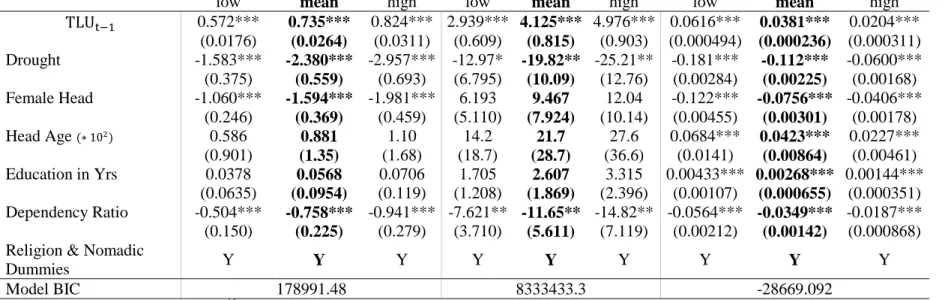
BC represent development resilience using a conditional moment function for well-being, specifically 𝑚𝑖𝑘(𝑊𝑖,𝑡+𝑠|𝑊𝑖𝑡, 𝑿𝑖,𝑡+𝑠, 𝜖𝑖,𝑡+𝑠), where 𝑚𝑖𝑘 is the kth moment of individual i’s well-being, W, in period t+s (for s>0), a function of well-being in period t, a set of individual-, household- and community-level covariates, X, and random disturbances, ϵ. An individual’s well-being is therefore considered a random variable, with its own distribution in each period. One might use any of a host of well-being measures, depending on the context, from stock measures such as asset holdings or anthropometric indicators of health status to flow measures such as expenditures or income. The convention in the empirical poverty traps literature is to estimate only the first moment, the expected path dynamics of well-being, but to allow for potentially nonlinear path dynamics, as reflected either in a high-order polynomial in W_t (Lokshin & Ravallion 2004, Barrett et al. 2006, Antman & McKenzie 2007) or nonparametric or semiparametric estimation of a first-order Markov process (Lybbert et al., 2004; Adato, Carter, & May 2006; Naschold 2013). That literature to date has largely ignored heteroscedasticity and other non-constant higher-order central moments in the estimated path dynamics.
The standard approach in the vulnerability literature, by contrast, is to estimate both the conditional mean and the conditional variance but to ignore prospective nonlinearity in the path dynamics by assuming, at best, a linear first-order autoregressive process. The development and humanitarian agencies’ current focus on resilience originates in the intersection of vulnerability
to shocks and the apparent existence of poverty traps among the remote (commonly drylands pastoralist) populations on which much of the resilience discourse focuses. So it seems sensible to take an approach to measurement that integrates the distinct strengths of each of these two literatures, as BC’s theory allows.
We model the mean (indicated by the M subscript) stochastic well-being of individual or household i (household hereafter because in our empirical illustration we use a household-level indicator of well-being) in period t (𝑊𝑖𝑡) parametrically as a polynomial function (𝑔) of lagged well-being (𝑊𝑖,𝑡−1), and a vector of household characteristics, 𝑿𝒊𝒕, including shocks directly experienced by i or risks to which i is exposed:
(1) 𝑊𝑖𝑡 = 𝑔𝑀(𝑊𝑖,𝑡−1, 𝑿𝒊𝒕, 𝛽𝑀) + 𝜹𝐌𝑿𝒊𝒕+ 𝑢𝑀𝑖𝑡.
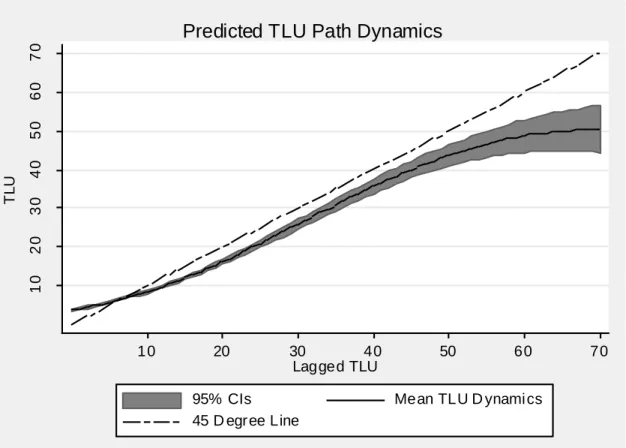
We assume a first-order Markov process for both conceptual and practical reasons. Conceptually, a lag is necessary to allow for persistence in the impact of previous period well-being on the future. At the same time, well-being (like wealth) is a state variable which summarizes all prior states, meaning only one lag is necessary. Empirically, incorporating a second lag would decrease the number of rounds of panel data available for analysis; the use of a single lag is economical while also addressing possible autocorrelation in the errors of the panel data. A cubic specification would be the most parsimonious parametric specification that allows for the S-shaped dynamics typical of systems characterized by multiple equilibria poverty traps (Barrett et al. 2006), although higher order polynomials may be used.
Using E to represent the expectation operator, a caret (^) to represent predicted values, and assuming that the random error term 𝑢𝑀𝑖𝑡 is mean zero (𝐸[𝑢𝑀𝑖𝑡] = 0), the conditional mean for household i at time t (𝜇1𝑖𝑡) can be written
(2) Conditional Mean: 𝜇̂1𝑖𝑡≡ 𝐸̂[𝑊𝑖𝑡|𝑊𝑖,𝑡−1, 𝑿𝒊𝒕] = 𝑔𝑀(𝑊𝑖,𝑡−1, 𝑿𝒊𝒕, 𝛽̂𝑀) + 𝜹̂𝐌𝑿𝒊𝒕.
Following Just & Pope (1979) and Antle (1983), and using a subscript V to indicate variance, the population second central moment can be expressed:
(3) 𝜎𝑖𝑡2 = 𝑔𝑉(𝑊𝑖,𝑡−1, 𝑿𝒊𝒕, 𝛽𝑉) + 𝜹𝐕𝑿𝒊𝒕+ 𝑢𝑉𝑖𝑡.
We can then use the mean zero squared residuals from equation (1), 𝑢̂𝑀𝑖𝑡, to estimate the second central moment equation. Under the standard assumption that 𝐸[𝑢𝑉𝑖𝑡] = 0, we can estimate the conditional variance for household i at time t (𝜇̂2𝑖𝑡) as:
(4) Conditional Variance: 𝜇̂2𝑖𝑡 = 𝜎̂𝑖𝑡2 = 𝑔𝑉(𝑊𝑖,𝑡−1, 𝑿𝒊𝒕, 𝛽̂𝑉) + 𝜹̂𝐕𝑿𝒊𝒕.
The empirical strategy, discussed below, should take into consideration that the conditional variance must be non-negative. One can accommodate this either by using the log of 𝜎̂𝑖𝑡2 as the dependent variable in (4) or by making particular distributional assumptions that impose non-negativity.
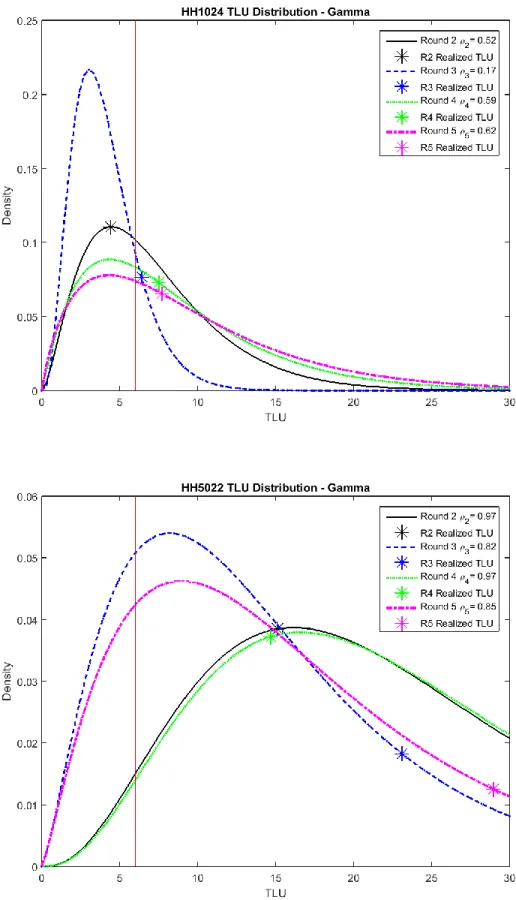
If one is prepared to make the strong assumption that 𝑊𝑖,𝑡−1 is distributed normally, lognormally, or gamma, these two predicted conditional moment estimates, {𝜇̂1𝑖𝑡, 𝜇̂2𝑖𝑡} suffice to describe household i’s conditional well-being distribution at time t. It would be relatively
straightforward to relax the distributional assumption and compute higher-order central
conditional moments, such as skewness (𝜇3𝑖𝑡) or kurtosis (𝜇4𝑖𝑡), to accommodate asymmetries or peakedness, respectively, in a more general distribution. Accommodating more moments is somewhat more demanding computationally, but tractable for a range of distributions. For example, a generalized (four-parameter) beta distribution is a highly-flexible, unimodal
distribution that could be estimated off of four estimated conditional central moments. In order to identify the household-specific distribution parameters, one could then use the method of
moments, as described by Bury (1999). In the interests of brevity we impose a gamma and a lognormal distribution in the empirical illustration below and leave extension to higher-order moments to future work.
The assumed distribution functional form and the estimated moments jointly enable estimation of the household-and-period-specific conditional well-being probability density function and associated complementary cumulative density function (ccdf).3 Once we have estimated the household-and-period-specific ccdf, we can use it to estimate the probability of household i reaching some normative minimum standard of well-being in time t. We follow the BC framework, defining development resilience as the probability that household i will have well-being in period t above some normative threshold, W. For the time series defined by s ≥ 0, we can therefore define a household’s development resilience as the estimated complementary cumulative probability based on the sequence of estimated probabilities: (𝜌̂𝑖)𝑠=1𝑇 where
(5) 𝜌̂𝑖𝑠 ≡ 𝑃(𝑊𝑖,𝑠≥ 𝑊|𝑊𝑖,𝑠−1, 𝑿𝑖,𝑠) = 𝐹̅𝑊𝑖,𝑠(𝑊; 𝜇̂1𝑖,𝑠(𝑊𝑖,𝑠, 𝑿𝒊,𝒔), 𝜇̂2𝑖,𝑠(𝑊𝑖,𝑠, 𝑿𝒊,𝒔)),
and 𝐹̅(∙) is the assumed ccdf.
3 An alternative approach would be to use moment generating functions (MGF) to identify the underlying
conditional distribution functions, without assuming a particular distribution function. But while the MGF approach holds appeal in theory because it is less restrictive, in practice it can be difficult to identify a distribution function of unspecified form without a very large data set. In small data sets, the MGF approach often results in imprecise measures of the tails of the distribution, which are of particular concern in our case, as we explain below. To avoid these challenges, we assume a functional form for the underlying well-being distribution.
We can use this estimate to evaluate the impact of specific characteristics or programs today on the development resilience of households (or other units, such as individuals) at time t:
𝜕𝜌̂𝑖𝑡/𝜕𝑋𝑖𝑡. We empirically estimate this derivative as follows, using a subscript R to indicate resilience:
(6) 𝜌̂𝑖𝑡 = 𝑔𝑅(𝑊𝑖,𝑡−1, 𝑿𝒊𝒕, 𝛽𝑅) + 𝜹𝐑𝑿𝒊𝒕+ 𝑢𝑅𝑖𝑡,
where 𝜌̂𝑖𝑡 indicates the estimated probability of household i meeting or exceeding the normative well-being threshold W at time t.
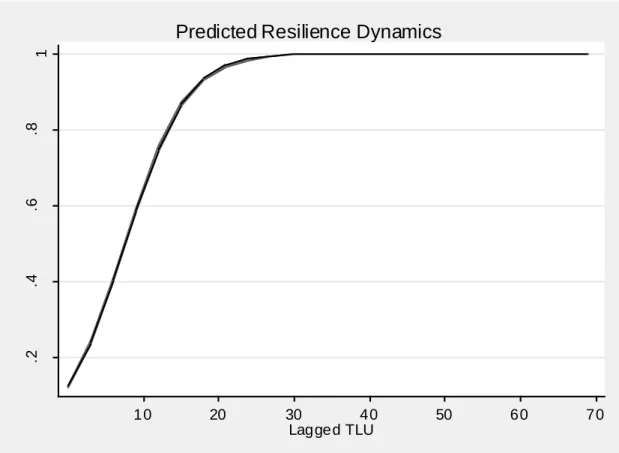
Although same-period household development resilience can be calculated as described in (5), it is also possible to forecast household development resilience forward by computing it recursively. This computation replaces the lag with current period (realized) well-being 𝑊𝑖𝑡, employs the estimated coefficients 𝛽̂ from (2) and (4) above and requires making only a few assumptions on the progression over time of household characteristics and shocks (𝑿̈):
(7) 𝜌̂𝑖,𝑡+1 ≡ 𝑃(𝑊𝑖,𝑡+1 ≥ 𝑊|𝑊𝑖𝑡, 𝑿𝑖,𝑡+1) = 𝐹̅𝑊𝑖,𝑡+1(𝑊; 𝜇̂1𝑖,𝑡+1, 𝜇̂2𝑖,𝑡+1)
where 𝜇̂1𝑖,𝑡+1= 𝑔𝑀(𝑊𝑖𝑡, 𝑿̈𝒊,𝒕+𝟏, 𝛽̂𝑀) + 𝜹̂𝐌𝑿̈𝒊,𝒕+𝟏 and 𝜇̂2𝑖,𝑡+1 = 𝑔𝑉(𝑊𝑖𝑡, 𝑿̈𝒊,𝒕+𝟏, 𝛽̂𝑉) + 𝜹̂𝐕𝑿̈𝒊,𝒕+𝟏. For periods beyond t + 1, the household’s lagged well-being should be drawn at random from
the previous period’s well-being distribution. This approach could also be used to simulate resilience responses to shocks by including various simulated shocks in 𝑿̈.
The continuous measure, 𝜌̂𝑖𝑡, can also be used to categorize a household as resilient or not resilient with reference to some normative minimal threshold probability, P, at/under which we consider a household’s probability of reaching or surpassing W (the minimum adequate
well-being level) intolerably low. If and only if 𝜌̂𝑖𝑡 ≥ 𝑃 then we classify household i as development resilient in period t. Then the 𝜌̂𝑖𝑡 estimates can be turned into a dichotomous variable, 𝜃𝑖𝑡, that takes value one if the household is deemed resilient and zero if it is not. That is,
(8) 𝜃𝑖𝑡 ≡ 1 𝑖𝑓 𝜌̂𝑖𝑡 ≥ 𝑃
0 𝑜𝑡ℎ𝑒𝑟𝑤𝑖𝑠𝑒.
The 𝜃𝑖𝑡 variable can be analyzed in the same way as binary poverty or other indicator variables. A number of extensions to this approach follow reasonably directly. First, one could use interval criteria defined by two normative cut-offs in W space, as might be appropriate, for example, for an indicator such as body mass index for which values beneath one critical value (i.e., underweight) or above a different critical value (i.e., overweight) both signal an undesirable state of well-being. For such criteria, one simply replaces the ccdf in equation (5) with difference in the cumulative densities between the two thresholds.
Second, we can extend this approach to multidimensional well-being by joint estimation of equations (1) and (3), so as to enjoy efficiency gains in the estimation of each well-being metric’s conditional moments. Then one would need to determine whether the normative criterion for a j-dimensional measure requires satisfaction of the minimum standard in each
dimension j (i.e., 𝜌̂𝑖𝑡𝑗 ≥ 𝑃𝑗 ∀ 𝑗) – the intersection of the unidimensional criteria – or just in any
dimension (i.e., 𝜌̂𝑖𝑡𝑗 ≥ 𝑃𝑗 𝑓𝑜𝑟 𝑠𝑜𝑚𝑒 𝑗) – the union of the unidimensional criteria.
There are multiple prospective practical uses of the sequence (𝜌𝑖)𝑠=0𝑇 in support of operational efforts to build resilience. First, if an element of the X vector is plausibly exogenous (e.g., a weather shock, a randomized policy intervention), then one can identify associated
as causal and rigorously evaluate claims of “resilience building” using established inferential methods. We illustrate such inferential uses of this approach in the empirical example below.
Second, operational agencies routinely need to target interventions, whether by recipient characteristic, seasonal or geographical characteristics, or some other covariate. For this purpose, the associations in the 𝜹𝐑 vector can prove useful even if they cannot be interpreted as causal because the relevant elements of the X vector are potentially endogenous. Indeed, the ability to generate s-period-ahead estimates, 𝜌̂𝑖𝑡+𝑠, enables one to establish which period t (i.e., current) covariates are most strongly and statistically significantly correlated with that forward-looking measure. Moreover, this approach offers the possibility to improve prediction if there are
predictable intertemporal patterns such as arise from path dynamics in the underlying well-being variable. Relative to the prevailing approach of assuming current (i.e., period t) values will equal future values in the absence of intervention – equivalent to assuming a random walk process in the W variable – to predict s-period-ahead values, this new method may achieve significant forecasting gains. Moreover, by adjusting P an operational agency can choose which sort of targeting errors it favors, errors of exclusion or of inclusion, as we demonstrate below. The prevailing approach does not allow that sort of tailoring of targeting strategies.
Third, using appropriate discount rates, the sequence (𝜌𝑖)𝑠=0𝑇 might be added up over time, providing a discounted, intertemporal measure of resilience similar to Calvo & Dercon’s (2007) measure of chronic poverty. By aggregating our development resilience measure over time, one could assess the long-run impacts of shocks or policies. This type of intertemporal measure could also be used as a state variable in a dynamical system, allowing for development resilience analysis in coupled human-natural systems.
Finally, these measures can be used to identify development resilience indicators at more aggregated scales of analysis. We now turn to this task of development resilience aggregation, to follow Sen’s (1979) term, which represents a straightforward adaptation of today’s workhorse FGT class of decomposable poverty measures to the individual measures just introduced.
III. Development Resilience Aggregation
Sen describes the aggregation process as “some method of combining deprivations of different people into some over-all indicator” (Sen 1979, p.288). While the approach discussed in Section II allows us to identify the level of development resilience of a specific unit (such as an individual or household), we would also like to summarize the development resilience of the micro units into one overall sub-population or population-level resilience measure, the aggregate resilience index R.
Even before Foster, Greer, & Thorbecke (1984) proposed a class of decomposable poverty measures, now known simply as the FGT poverty measures, certain desirable attributes for poverty measures had been discussed in the literature. Sen (1976) highlights some of the shortcomings of the headcount ratio, such as its violation of the monotonicity and transfer axioms.4 Sen proposed a poverty measure that meets additional desirable characteristics he sets out, including “relative equity,”5
and conveniently lies between 0 and 1. Sen also argues that a
4 The Monotonicity Axiom states: “Given other things, a reduction in income of a person below the poverty line must increase the poverty measure” (Sen 1976, p.219). The Transfer Axiom states: “Given other things, a pure transfer of income from a person below the poverty line to anyone who is richer must increase the poverty measure” (Sen 1976, p.219).
5 Relative Equity requires “that if person i is accepted to be worse off than person j in a given income configuration
y, then the weight vi on the income short-fall gi of the worse-off person i should be greater than the weight vj on the
poverty measure would ideally combine “considerations of absolute and relative deprivation even after a set of minimum needs and a poverty line have been fixed” (Sen 1979, p.293).
Another desirable feature of any aggregate measure is the ability to attribute shares of the overall development resilience indicator to various subgroups. The population-weighted sum of the subgroup measures would therefore equal the measure for the whole group. While the measure proposed by Sen is not decomposable in this way, FGT (1984) proposed an entire class of decomposable poverty measures and illustrated how the measures meet Sen’s (1976, 1979) various axioms. The FGT (1984) poverty measures serve as a logical jumping off point in the search for an additive development resilience measure that meets Sen’s axiomatic requirements.
As a quick refresher, for a vector of household incomes, y, ordered from lowest to highest, poverty line z > 0, and income gap 𝑔𝑖 ≡ 𝑧 − 𝑦𝑖, there are q households in a population of size n at or below the poverty line. FGT (1984) proposed the measure 𝑃𝛼(𝑦; 𝑧) =𝑛1∑ (𝑔𝑧𝑖) 𝛼 𝑞
𝑖=1 ,
which meets the Sen criteria and is additively decomposable with population share weights for different subpopulations of n. When 𝛼 = 0 this is equivalent to the headcount ratio, when 𝛼 =
1 this is equivalent to the poverty gap index, and when 𝛼 = 2 it is the poverty severity index, also known as the squared poverty gap index (Haughton & Khandker 2009). By weighting each household’s poverty gap by its proportion of the gap, the squared index not only considers absolute deprivation (by focusing on those below the poverty line z), but also relative deprivation (placing higher weights on those further below the poverty line).
Following FGT (1984), we propose a decomposable development resilience indicator that aggregates the individual- or household-specific development resilience probabilities, 𝜌̂𝑖𝑡,
developed in Section II across the population into a single economy-wide measure that is also decomposable to describe distinct sub-populations. Just as with the FGT family of measures
from which the development resilience index is adapted, this measure meets the monotonicity, transfer, and relative equity axioms proposed by Sen in addition to being additively
decomposable among groups. A demonstration of how this measure satisfies the various axioms set forth by Sen (1976, 1979) and FGT can be found in Appendix A.
Assume a normative resilience probability threshold of P (1 ≥ 𝑃 ≥ 0), as discussed above, at/under which we consider a household’s probability of reaching or surpassing W (the normative threshold well-being level discussed in Section II) to be intolerably low. The resilience analyst must therefore select two normative thresholds, W and P, which may be context specific. Suppressing time period subscripts for now, we generate a vector of household development resilience measures in time period t + s ordered from lowest to highest values, 𝝆 = (𝜌̂1, 𝜌̂2, 𝜌̂3, … , 𝜌̂𝑛; 𝑊) for a total number of n households. With this information we can count the number of non-resilient households, q, for which the household resilience
probability falls at or below the resilience probability threshold 𝑞 = 𝑞(𝝆; 𝑃), as well as the resilience shortfall (measured in probabilities) for those households 𝑔𝑖 = 𝑃 − 𝜌̂𝑖. In the index, this gap is then weighted by α, a distribution sensitivity parameter that FGT refer to as the measure of poverty aversion.
The sum of the weighted gaps is subtracted from one to ensure that larger numbers signify increased resilience. The decomposable resilience index is therefore defined for period t + s as
(9) 𝑅𝛼,𝑡+𝑠(𝝆𝒕+𝒔; 𝑊, 𝑃) ≡ 1 − [1𝑛∑ (𝑔𝑖,𝑡+𝑠𝑃 ) 𝛼 𝑞𝑡+𝑠
and the sequence of resilience indices, (𝑅𝛼,𝑡+𝑠)𝑠=0𝑇 , would represent aggregate resilience over time to horizon period T. The measure necessarily lies on the closed interval [0,1], with R = 0 if each household in the population has a development resilience probability estimate 𝜌̂𝑖 < 𝑃 ∀ 𝑖 ∈
𝑛, and R = 1 if 𝜌̂𝑖 ≥ 𝑃 ∀ 𝑖 ∈ 𝑛, implying q = 0. This approach allows us to calculate the population share deemed resilient (i.e., development resilience headcount ratio) when 𝛼 = 0 (𝐻𝑅 ≡𝑛−𝑞𝑛 ), mean development resilience of non-resilient household (𝜌̅𝑞 =
∑𝑞𝑖=1𝜌̂𝑖
𝑞 ), as well as the resilience-gap ratio (𝐺 ≡ ∑𝑞𝑖=1𝑞𝑃𝑔𝑖). It is therefore well suited for situations in which resilience indices would be useful for targeting or for policy/project evaluation. Given that the poor are the least economically resilient by the BC definition, and for any measure based on a poverty-related welfare indicator, W, the measure is inherently pro-poor.
IV. An Empirical Example
To illustrate this method, we now employ the development resilience estimation and aggregation techniques discussed above using household data from northern Kenya. The Horn of Africa is a particularly relevant context for the implementation of a resilience measure, as the 2011 drought in the region was one of the main drivers of governmental and non-governmental organization interest in resilience. In northern Kenya, pastoralist communities —considered to be some of the poorest and most vulnerable in the country—rely heavily on livestock (especially cattle, although also camels, goats, and sheep to a lesser extent) to generate most or all of their income. Few other livelihoods are viable given agroecological conditions and meager modern infrastructure (McPeak, Little, & Doss 2012). These households are incredibly vulnerable to weather shocks, such as drought, which can decimate herds. Prior research in the area has established, in multiple data sets, that multiple equilibrium poverty traps exist in livestock
holdings, and that drought risk is a key driver of households’ collapse into persistent poverty (Lybbert et al. 2004, Barrett et al. 2006, Santos and Barrett 2011).
To help pastoral and agro-pastoral populations manage drought-related livestock mortality, an index-based livestock insurance (IBLI) product was piloted in northern Kenya beginning in January 2010 (Chantarat et al. 2013). Rainfall in Northern Kenya is bimodal, so the insurance product was designed to be marketed and sold twice annually, although each insurance contract protects the insured for an entire calendar year. The IBLI product uses normalized difference vegetation index (NDVI) estimates derived from satellite data to predict livestock mortality. When predicted livestock mortality due to drought, as reflected in low NDVI values, reaches catastrophic levels (contractually defined as 15% estimated area average loss), the insurance policy pays out. The benefit of an index-based insurance product is that premiums are much lower than for indemnity products, especially in remote locations. They also avoid moral hazard concerns that might prevent the development (or increase the price) of a traditional insurance product. During the five rounds of data, a catastrophic drought occurred once, between rounds two and three.
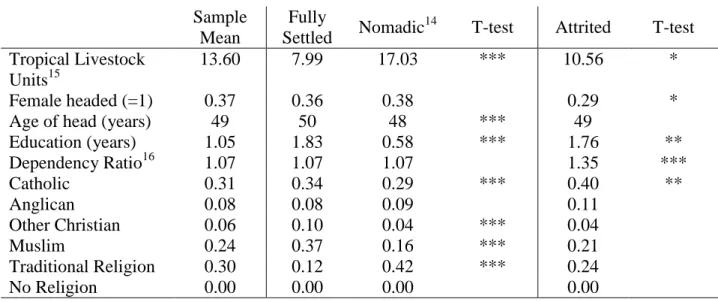
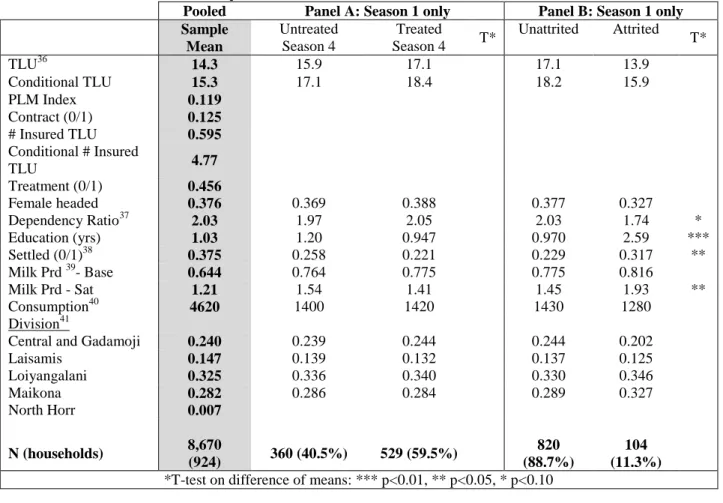
The data used in this example were collected to evaluate the impact of the insurance program by a consortium led by the International Livestock Research Institute (ILRI), in collaboration with private insurance providers, using a multi-year impact evaluation strategy (ILRI 2013). The household surveys gathered information from 924 randomly selected households from sixteen sublocations6 in Marsabit County, including general demographic
6 All administrative divisions in Marsabit were included. The sublocations vary in terms of pastoral system, ethnic group makeup, agro-ecology and market accessibility. The number of households from each sublocation was determined by proportional allocation within set minimum and maximum bounds. For more information see the survey codebook (ILRI 2013).