1
Project description
Markus Laursen, 01.10.2015
Project value creation
Introduction
In the recent years, value creation has been introduced as an important concept to the project management field (Ahola et al., 2008; Andersen, 2014; Pang et al., 2014; Smyrk and Zwikael, 2011; Winter et al., 2006b; Winter and Szczepanek, 2008) and this PhD project will contribute to this research by examining project value creation. The value creation approach to projects may be considered an enhancement of the traditional product creation approach to projects (Winter et al., 2006a), thus current concepts and theories are not abolished but subject to further development. The focus on value creation will imply a focus on the concept of value, which is often reduced to monetary value in private organizations (Ward and Daniel, 2012), while public organizations tend to address value much more widely (Moore, 2000), as they are expected to deliver public services with increasing expectations for the output (Cole and Parston, 2006).
It is recognized that the focus should not be on the management of single projects, but rather on the management of project as pointed out by Morris (1994). In line with this focus the research will also draw upon value creation in program and portfolio management (Martinsuo and Killen, 2014).
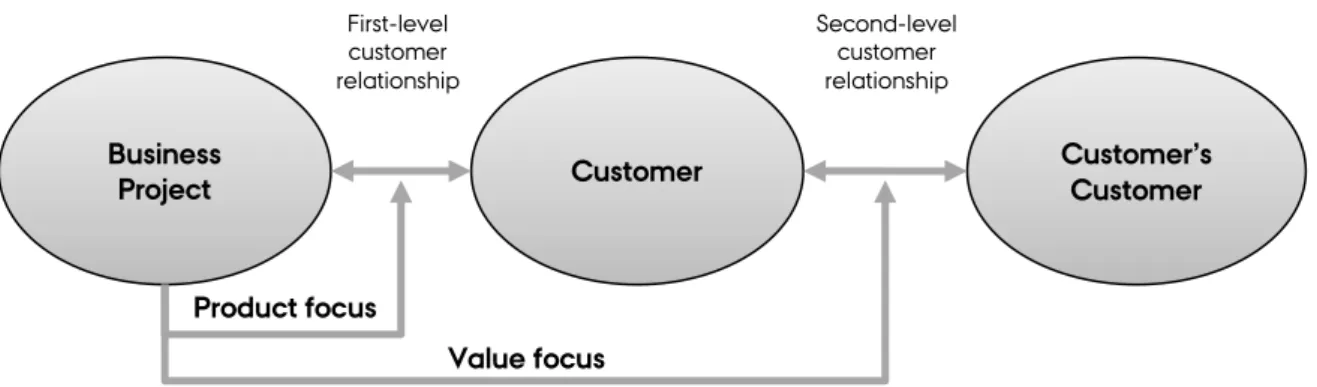
A core concept in project value creation is the focus beyond the first level customer relationship, which is traditionally product focused. Instead, the focus is on the second level, which has a value focus. Thus value creation concerns delivering value to the customer’s customer as put by Winter et al. (2006a: 702) adapted from Normann (2001), which Figure 1 illustrates.
Figure 1. Projects and Programmes as Value-Creating Systems.
The customer focus of value creation illustrated in Figure 1 share the focus on applications of products with the Service-dominant logic (Lusch and Vargo, 2014; Vargo and Lusch, 2004) developed in the field of marketing. In this understanding, the offering of a company is a service of which products form part.
Rather than pointing to gaps in the literature, this PhD project challenges the traditional assumptions about value in projects contexts through problematization as suggested by Alvesson and Sandberg (2011). This is done by applying a holistic approach to project value, which embrace all types of value
Business
Project Customer Customer’s Customer
Product focus Value focus First-level customer relationship Second-level customer relationship
2 and suggest that economic value is not the only important outcome of projects. Furthermore, the value creation literature among others suggest that value management should be applied as a holistic concept in which both benefits, costs and value is considered, instead of being a concept primarily related to optimization and costs (Laursen and Svejvig). This lead to the development of the following research problem and research questions on project value creation:
How is project value creation conceptualized and enacted in organizations?
Research questions:
How is value creation conceptualized in project contexts?
How is project value creation practiced in organizations and how is the concept applied in public project work?
How is value created in value constellations?
Justification
In the project management field we find calls for studies on project management practices (Svejvig and Andersen, 2015; Winter et al., 2006b) and Breese (2012) emphasize the need for academic focus on the application of value creation theories in complex environments and Breese further argues that the methods and practices do not comprehend the complexity surrounding projects today, see also Cooke-Davies et al. (2007).
Similarly, research on how value is created and captured in projects environments is not receiving much attention, yet it has been studied in fields such as strategic management and marketing
(Bowman and Ambrosini, 2010; Lepak et al., 2007; Mizik and Jacobson, 2003). With benefits and value being important measures of project success (Atkinson, 1999; Shenhar et al., 2001), it may be argued that this creation process and conceptualization of value should be investigated further.
Theoretical foundation
Value creation is a central concept to the management and organizational research fields, and it has been argued that “[s]trategy is the art of creating value” (Normann and Ramirez, 1993: 65). However, value creation is not an unambiguous concept, as it is used differently by many scholars in various research fields such as strategic management, marketing, and corporate finance (Barney, 2013; Della Corte and Del Gaudio, 2014; Lepak et al., 2007). Furthermore, the process of value creation may be divided into value creation and value capture (Bowman and Ambrosini, 2000, 2010) and thus emphasizing the potential divide between the creators of value and the beneficiaries.
For this research the definition of value creation suggested by Lepak et al. (2007: 182) is applied: [V]alue creation depends on the relative amount of value that is subjectively realized by a target user (or buyer) who is the focus of value creation – whether individual, organization or society – and that this subjective value realization must at least translate into the user’s willingness to exchange a monetary amount for the value received.
The definition draws upon the general understanding that there is use value and exchange value. Use value is perceived by the user while the exchange value is the monetary value aid for the use value created (Bowman and Ambrosini, 2000: 13).
3 The definition of value applied follows Morris (2013: 83) who defines value as “the quotient of
function/cost or quality/cost, [or] performance/resources or similar”, and it is recognized that “[v]alue
is not absolute, but relative, and may be viewed differently by different parties in differing situations”
(European Standard 12973-2000, 2000: 12).
Core concepts for project value creation are explained in Table 1. The logic of the table is that from strategy projects follow and therefrom the output, outcomes and benefit, and value. This leads to value creations at the very end.
Table 1. Core concepts in project value creation. Concept Explanation
Strategy Project value creation is highly linked to strategic management, and strategy could be seen as the art of creating value (Normann and Ramirez, 1993: 65). The strategy is enacted through portfolio management, programme management and project management (Meskendahl, 2010; Winter and Szczepanek, 2008).
Project Project might comprise a single project or a collection of projects in the sense of a temporary organization (Bakker, 2010; Packendorff, 1995) that enable value creation (Winter and Szczepanek, 2008).
Output Output is product creation which means “the temporary production, development, or improvement of a physical product, system or facility – and monitored and controlled against specification (quality), cost and time” (Winter et al., 2006b: 642)
Outcome /
Change Outcome is the resulting change in the organization derived from using the projects output (Office of Government Commerce, 2009: 21-22) Benefit Benefit is the improvement resulting from a change (outcome) that is perceived
positive by one or more stakeholders (adapted from Bradley, 2010: xiii; Office of Government Commerce, 2009: 21-22).
Value 𝑉𝑎𝑙𝑢𝑒 α 𝐵𝑒𝑛𝑒𝑓𝑖𝑡𝑠
𝐶𝑜𝑠𝑡𝑠 The Greek alpha sign (α) is used instead of equal sign (=), which
signifies that it is not a quantitative quotient between benefits and costs, but only a representation. Value is relative and viewed different by different stakeholders representation (adopted from Morris, 2013: 83; Quartermain, 2002: 44-45 - 44-46) Value
creation
Value creation depends on the relative amount of value that is subjectively realized by a target user (or buyer) who is the focus of value creation – whether individual, organization or society (Lepak et al., 2007: 182)
We define value in Table 1 as a representation of benefits and costs and we may elaborate further on the concept through the value framework suggested by den Ouden (2012). The framework suggests four levels of value; Society, Ecosystem, Organisation and User and also four perspectives on value; Economy, Psycology, Sociology, and Ecology. The ecosystem may be considered a value constellation as it goes across organizations and the three non-economic perspectives may provide essential insight for a public project setting.
Value management is a final and central concept, which today is primarily related to the optimization of resource usage and cost reductions following the tradition of value engineering (Morris, 2013; Quartermain, 2002). Yet following the definition of value, value management should incorporate both benefits and costs in the pursuit of maximizing value, similar to the thought of Male et al. (2007) and Martinsuo and Killen (2014).
4
Research design
Research setting is organizations oriented towards public value as the European Capital of Culture (ECoC) in Aarhus in 2017 is the overall setting for the research. By public value a focus on services and hence qualitative benefits is understood (Cole and Parston, 2006).
The Aarhus 2017 ECoC is organized by a program organization commonly referred to as the Aarhus 2017 organization, and one part of the empirical study will take place in this organization. In order to perform research on practices related to project value creation; project management, portfolio management and strategy as well as handling the complexity in project environments at multiple organizational levels the research is also carried out in two selected projects in the portfolio of the ECoC.
The first round of interviews were carried out in 2014 and the first half of 2015, and a second round of interviews in the management team of Aarhus 2017 is in planning for Q4 of 2015.
The two projects are Rethink Urban Habitats and Campus Bindslevs Plads (connected to Aarhus 2017 through Rethink Learning). Rethink Urban Habitats seeks to enhance the biodiversity in Aarhus and essentially in Denmark through events and by consulting on the development on new urban areas. Observation and interviews have been started. Campus Bindslevs Plads is the construction of a new common building and campus for seven organizations in Silkeborg around the old marketplace Bindslevs Plads. The first round of interviews was conducted in September 2015 and followed up by observation during week 38 (Læringslaboratorium 2) and further interviews are in planning for Q4 of 2015.
Interviews have been conducted as semi-structured and further interviews are planned to follow the same method.
Methodology: The initial part of this PhD project was a literature review applying structured methods (Tranfield et al., 2003; Webster and Watson, 2002; Wolfswinkel et al., 2011), to investigate the subject area in greater detail than the initial project proposal. The review focused on project value creation by searching for benefits management, benefit realization, business value, organizational performance and value creation combined with projects. This literature reviews is both part of answering the first research question, and it serves as input to the overall research approach by providing research opportunities in the field of project value creation, such as governance of projects, and value capture. Qualitative methods are ideal for understanding people and their actions (Creswell, 2013; Myers, 2009), and as the research questions reveal, this research inquiry concerns exploration and understanding people as well as their organizations in relation to value creation practices. A case study approach is applied (Myers, 2009), with interviews (Kvale and Brinkmann, 2009) and document studies (Creswell, 2013) being applied as the primary research methods while observation is also applied for detailed studies of practice and it further provides another data source allowing for comparing empirical data for triangulation (Angrosino, 2007).
For the initial conceptualization a workshop on value creation was conducted, in a collaborative manner (Adler et al., 2004), to advance the discussions on practices of value creation and potentially start a process developing new theories for practice. One or two workshops may follow to enhance discussions on the most prominent topics arising during the empirical research in the cases.
5
Preliminary results
The literature review has provided good insights to the conceptualization of value creation and how to study the phenomena empirically in organizations. A relation to project success has been identified in the literature, while it is also very clear that value and success are bound by the context i.e. they will vary with stakeholders and over time.
The initial studies suggest that value is already the focus of the Aarhus 2017 program organization, yet the concepts and wordings vary very much from the jargon used in project management research. Furthermore, it is very difficult to address value as it is subjectively perceived by each individual, and therefore harder measures are often pursued even for cultural projects and events.
Project overview
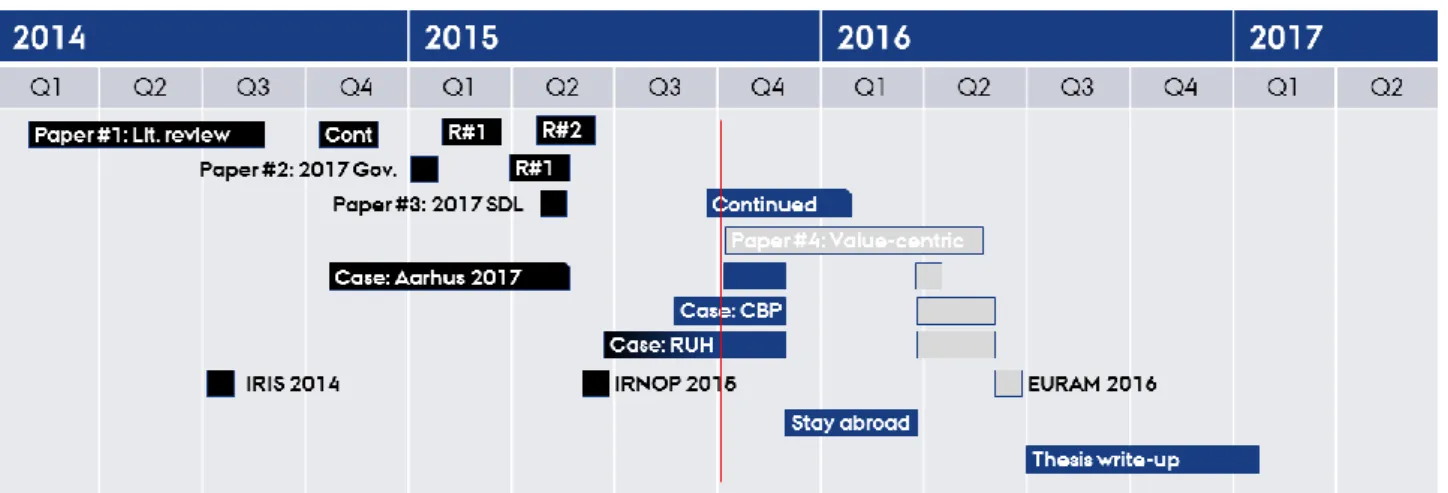
The plan for the three-year PhD project is illustrated using a high level overview highlighting the main research activities. The red line in Figure 2 marks time of this document, and black boxes represent prior activities, blue boxes certain/planned activities and light grey illustrate anticipated and unplanned activities.
Figure 2. Project schedule.
As is the case of any project, planning is an ongoing activity and thus the plan is a changing document. Besides the obvious dependency for papers on data collection, the timing of these activities are to be seen as very flexible and the boxes show no indication of the time allocated per week to each activity.
Bibliography
Adler, N., Shani, A.B., Styhre, A., 2004. Collaborative research in organizations : foundations for learning, change, and theoretical development. Sage Publications, Thousand Oaks, Calif. Ahola, T., Laitinen, E., Kujala, J., Wikström, K., 2008. Purchasing strategies and value creation in
industrial turnkey projects. International Journal of Project Management, 26, 87-94.
Alvesson, M., Sandberg, J., 2011. Generating research questions through problematization. Academy of Management Review, 36, 247-271.
Andersen, E.S., 2014. Value creation using the mission breakdown structure. International Journal of Project Management, 32, 885-892.
Angrosino, M., 2007. Doing Ethnographic and Observational Research. SAGE publications, London. Atkinson, R., 1999. Project management: cost, time and quality, two best guesses and a phenomenon,
its time to accept other success criteria. International Journal of Project Management, 17, 337-342.
Barney, M., 2013. Leading Value Creation: Organizational Science, Bioinspiration, and the Cue See Model. Palgrave Macmillan.
6 Bowman, C., Ambrosini, V., 2000. Value creation versus value capture: Towards a coherent definition
of value in strategy. British Journal of Management, 11, 1-15.
Bowman, C., Ambrosini, V., 2010. How value is created, captured and destroyed. European Business Review, 22, 479-495.
Bradley, G., 2010. Benefit Realisation Management, 2nd ed. Gower, Farnham.
Breese, R., 2012. Benefits realisation management: Panacea or false dawn? International Journal of Project Management, 30, 341-351.
Cole, M., Parston, G., 2006. Unocking Public Value: A New Model For Achieving High Performance In Public Service Organizations. John Wiley & Sons, Hoboken, NJ.
Cooke-Davies, T., Cicmil, S., Crawford, L., Richardson, K., 2007. We'er not in Kansas anymore, Toto: Mapping the strange landscape of complexity theory, and its relationship to project
management. Project Management Journal, 38, 50-61.
Creswell, J.W., 2013. Qualitative inquiry and research design : choosing among five approaches, 3. ed. ed. SAGE Publications, Los Angeles.
Della Corte, V., Del Gaudio, G., 2014. A Literature Review on Value Creation and Value Capturing in Strategic Management Studies. Corporate Ownership & Control, 11, 328-346.
den Ouden, E., 2012. Innovation design: Creating value for people, organizations and society. Springer-Verlag London, London, United Kingdom.
European Standard 12973-2000, 2000. Value Management.
Kvale, S., Brinkmann, S., 2009. Interviews: Learning the craft of qualitative research interviewing. Sage Publications, Incorporated.
Laursen, M., Svejvig, P., Taking stock of project value creation: A structured literature review with future directions for research and practice. International Journal of Project Management. Lepak, D.P., Smith, K.G., Taylor, S.M., 2007. Value creation and value capture: A multilevel perspective.
Academy of Management Review, 32, 180-194.
Lusch, R.F., Vargo, S.L., 2014. Service-Dominant Logic: Premises, Perspectives, Possibilities. Cambridge University Press, Cambridge, United Kingdom.
Male, S., Kelly, J., Gronqvist, M., Graham, D., 2007. Managing value as a management style for projects. International Journal of Project Management, 25, 107-114.
Martinsuo, M., Killen, C.P., 2014. Value Management in Project Portfolios: Identifying and Assessing Strategic Value. Project Management Journal, 45, 56-70.
Meskendahl, S., 2010. The influence of business strategy on project portfolio management and its success - A conceptual framework. International Journal of Project Management, 28, 807-818. Mizik, N., Jacobson, R., 2003. Trading off between value creation and value appropriation: The financial
implications of shifts in strategic emphasis. Journal of Marketing, 67, 63-76.
Moore, M.H., 2000. Managing for Value: Organizational Strategy in For-Profit, Nonprofit, and Governmental Organizations. Nonprofit and Voluntary Sector Quarterly, 29, 183-208. Morris, P., 2013. Reconstructing Project Management. Wiley Blackwell, Chichester, West Sussex, UK. Morris, P.W.G., 1994. The Management of Projects. Thomas Telford, Londond.
Myers, M.D., 2009. Qualitative research in business and management. SAGE, Los Angeles.
Normann, R., 2001. Reframing business : When the map changes the landscape. Wiley, Chichester. Normann, R., Ramirez, R., 1993. From value chain to value constellation: Designing interactive
strategy. Harvard Business Review, 71, 65-77.
Office of Government Commerce, 2009. Managing successful projects with PRINCE2. TSO, London. Pang, M.-S., Lee, G., DeLone, W.H., 2014. IT resources, organizational capabilities, and value creation in
public-sector organizations: a public-value management perspective. J Inf technol, 29, 187-205. Quartermain, M., 2002. Value engineering, in: Management, A.f.P. (Ed.), Project Management Pathways.
Association for Project Management, Buckinghamshire, pp. 44-41 - 44-20.
Shenhar, A.J., Dvir, D., Levy, O., Maltz, A.C., 2001. Project success: A multidimensional strategic concept. Long Range Planning, 34, 699-725.
Smyrk, J., Zwikael, O., 2011. Project management for the creation of organisational value. Springer. Springer London.
Svejvig, P., Andersen, P., 2015. Rethinking project management: A structured literature review with a critical look at the brave new world. International Journal of Project Management, 33, 278-290.
7 Tranfield, D., Denyer, D., Smart, P., 2003. Towards a methodology for developing evidence-informed
management knowledge by means of systematic review. British Journal of Management, 14, 207-222.
Vargo, S.L., Lusch, R.F., 2004. Evolving to a New Dominant Logic for Marketing. Journal of Marketing, 68, 1-17.
Ward, J., Daniel, E., 2012. Benefits Management - How to Increase the Business Value of Your IT Projects. John Wiley & Sons, West Sussex.
Webster, J., Watson, R.T., 2002. Analyzing the Past to Prepare for the Future: Writing a Literature Review. MIS Quarterly, 26, xiii-xxiii.
Winter, M., Andersen, E.S., Elvin, R., Levene, R., 2006a. Focusing on business projects as an area for future research: An exploratory discussion of four different perspectives. International Journal of Project Management, 24, 699-709.
Winter, M., Smith, C., Morris, P., Cicmil, S., 2006b. Directions for future research in project
management: The main findings of a UK government-funded research network. International Journal of Project Management, 24, 638-649.
Winter, M., Szczepanek, T., 2008. Projects and programmes as value creation processes: A new
perspective and some practical implications. International Journal of Project Management, 26, 95-103.
Wolfswinkel, J.F., Furtmueller, E., Wilderom, C.P.M., 2011. Using grounded theory as a method for rigorously reviewing literature. European Journal of Information Systems, 22, 45-55.