U n i v e r s i t y o f H e i d e l b e r g
DiscussionPaperSeries No.448 DepartmentofEconomics
Ambiguity
Jürgen Eichberger David Kelsey
The Oxford Handbook of Rational and Social Choice
edited by
Paul Anand, Prasanta Pattanaik, and Clemens Puppe
C
HAPTER
V: A
MBIGUITY
Jürgen Eichberger David Kelsey
Department of Economics, School of Business and Economics Universität Heidelberg, Germany University of Exeter, England
January 2007
This version: July 2, 2007
Abstract
Ambiguity refers to a decision situation under uncertainty when there is incomplete information about the likelihood of events. Different formal models of this notion have been developed with differing implications about the representation of ambiguity and ambiguity aversion.
Adress for Correspondence:
Jürgen Eichberger
Department of Economics, University of Heidelberg Grabengasse 14, D-69117 HEIDELBERG, GERMANY
1 Introduction
Most economic decisions are made under uncertainty. Decision makers are often aware of vari-ables which will influence the outcomes of their actions, but which are beyond their control. The quality of their decisions depends, however, on predicting these variables as correctly as possible. Long-term investment decisions provide typical examples, since their success is also determined by uncertain political, environmental and technological developments over the life-time of the investment. In this chapter we review recent work on decision makers’ behaviour in the face of such risks and the implications of these choices for economics and public policy. Over the past fifty years decision making under uncertainty was mostly viewed as choice over a number of prospects each of which gives rise to specified outcomes with known probabilities. Actions of decision makers were assumed to lead to well-defined probability distributions over outcomes. Hence, choices of actions could be identified with choices of probability distribu-tions. The expected-utility paradigm (seeChapter 2) provides a strong foundation for ranking probability distributions over outcomes while taking into account a decision-maker’s subjec-tive risk preference. Describing uncertainty by probability distributions, expected utility theory could also use the powerful methods of statistics. Indeed, many of the theoretical achievements in economics over the past five decades were due to the successful application of the expected-utility approach to economic problems in finance and information economics.
At the same time, criticism of the expected utility model has risen on two accounts. On the one hand, following Allais (1953)’s seminal article, more and more experimental evidence was accumulated contradicting the expected utility decision criterion, even in the case were subjects had to choose among prospects with controlled probabilities (compareChapter 3andChapter 4). On the other hand, in practice for many economic decisions the probabilities of the relevant events are not obviously clear. This chapter deals with decision-making when some or all of the relevant probabilities are unknown.
where probabilities are known are relatively rare and confined to the following cases:
1. Gambling: Gambling devices, such as dice, coin-tossing, roulette wheels, etc., are often symmetric which means that probabilities can be calculated from relative frequencies with a reasonable degree of accuracy1.
2. Insurance: Insurance companies usually have access to actuarial tables which give them fairly good estimates of the relevant probabilities2.
3. Laboratory experiments:Researchers have artificially created choices with known probabil-ities in laboratories.
Many current policy questions concern ambiguous risks. For instance, how to respond to threats from terrorism and rogue states and the likely impact of new technologies. Many environmental risks are ambiguous due to limited knowledge of the relevant science and because outcomes will only be seen many decades from now. The effects of global warming and the environmental impact of genetically modified crops are two examples. The hurricanes which hit Florida in 2004 and the Tsunami of 2004 can also be seen as ambiguous risks. Although these events are outside human control, one can ask whether the economic system can or should share these risks among individuals.
Even if probabilities of events are unknown, this observation does not preclude that individual decision makers may hold beliefs about these events which can be represented by a subjective probability distribution. In a path-breaking contribution to the theory of decision-making under uncertainty, Savage (1954) showed that one can deduce a unique subjective probability distri-bution over events with unknown probabilities from a decision maker’s choice behaviour if it satisfies certain axioms. Moreover, this decision maker’s choices maximise an expected utility functional of state-contingent outcomes, where the expectation is taken with respect to this sub-jective probability distribution. Savage (1954)’sSubjective Expected Utility (SEU)theory offers an attractive way to continue working with the expected-utility approach even if the probabilities 1
The fact that most people prefer to bet on symmetric devices is itself evidence for ambiguity aversion.
2
However it should be noted that many insurance contracts contain an‘act of God’clause declaring the contract void if an ambiguous event happens. This indicates some doubts about the accuracy of the probability distributions gleaned from the actuarial data.
of events are unknown. SEU can be seen as a decision model under uncertainty with unknown probabilities of events where, nevertheless, agents whose behaviour satisfies the Savage axioms can be modelled as expected-utility maximisers with a subjective probability distribution over events. Using the SEU hypothesis in economics raises, however, some difficult questions about the consistency of subjective probability distributions across different agents. Moreover, the behavioural assumptions necessary for a subjective probability distribution are not supported by evidence as the following section will show.
Before proceeding, we shall define terms. The distinction of risk and uncertainty can be at-tributed to Knight (1921). The notion ofambiguity,however, is probably due to Ellsberg (1961). He associates it with the lack of information about relative likelihoods in situations which are characterised neither by risk nor by complete uncertainty. In this chapter, uncertaintywill be used as a generic term to describe all states of information about probabilities. The term risk
will be used when the relevant probabilities are known. Ambiguitywill refer to situations where some or all of the relevant information about probabilities is missing. Choices are said to be
ambiguousif they are influenced by events whose probabilities are unknown or difficult to de-termine.
2 Experimental evidence
There is strong evidence which indicates that, in general, people do not have subjective proba-bilities in situations involving uncertainty. The best-known examples are the experiments of the
Ellsberg Paradox3.
Example 2.1 (Ellsberg (1961))Ellsberg paradox I: three-colour-urn experiment
There is an urn which contains 90 balls. The urn contains 30 red balls (R), and the remainder
are known to be either black (B) or yellow (Y), but the number of balls which have each of
these two colours is unknown. One ball will be drawn at random.
Consider the following bets: (a) "Win 100 if a red ball is drawn", (b) "Win 100 if a black ball 3
Notice that these experiments provide evidence not just against SEU but against all theories which model beliefs as additive probabilities.
is drawn", (c) "Win 100 if a red or yellow ball is drawn", (d) "Win 100 if a black or yellow ball
is drawn". This experiment may be summarised in the table below.
30 60
R B Y
Choice 1: "Choose either a 100 0 0
betaor betb". b 0 100 0
Choice 2: "Choose either c 100 0 100
betcor betd". d 0 100 100
Ellsberg (1961) offered several colleagues these choices. When faced with them most subjects stated that they preferatobanddtoc.
It is easy to check algebraically that there is no subjective probability, which is capable of representing the stated choices as maximising the expected value of any utility function. In order to see this, suppose to the contrary, that the decision-maker does indeed have a subjective probability distribution. Then since (s)he prefers a to b (s)he must have a higher subjective
probability for a red ball being drawn than for a black ball. But the fact that (s)he prefersdto cimplies that (s)he has a higher subjective probability for a black ball being drawn than for a
red ball. These two deductions are contradictory.
It is easy to come up with hypotheses which might explain this behaviour. It seems that the subjects are choosing gambles where the probabilities are "better known". Ellsberg (1961) (on page 657) suggests the following interpretation:
"Responses from confessed violators indicate that the difference is not to be found in terms of the two factors commonly used to determine a choice situation, the relative desirability of the possible pay-offs and the relative likelihood of the events affecting them, but in a third dimension of the problem of choice: the nature of one’s information concerning the relative likelihood of events. What is at issue might be called theambiguityof information, a quality depending on the amount, type, reliability and "unanimity" of information, and giving rise to one’s degree of ’confidence’ in an estimate of relative likelihoods."
The Ellsberg experiments seem to suggest that subjects avoid the options with unknown prob-abilities. Experimental studies confirm a preference for betting on events with information about probabilities. Camerer and Weber (1992) provide a comprehensive survey of the litera-ture on experimental studies of decision-making under uncertainty with unknown probabilities of events. Based on this literature, Camerer and Weber (1992) view ambiguity as "uncertainty
about probability, created by missing information that is relevant and could be known" (Camerer and Weber (1992), page 330).
The concept of the weight of evidence, advanced by Keynes (1921) in order to distinguish the probability of an event from the evidence supporting it, appears closely related to the notion of ambiguity arising fromknown-to-be-missing information(Camerer (1995), p. 645). As Keynes (1921) wrote: "New evidence will sometimes decrease the probability of an argument, but it will always increase its weight." The greater the weight of evidence, the less ambiguity a decision maker experiences.
If ambiguity arises from missing information or lack of evidence, then it appears natural to assume that decision makers will dislike ambiguity. One may call such attitudes ambiguity-averse. Indeed, as Camerer and Weber (1992) summarise their findings, "ambiguity aversion is found consistently in variants of the Ellsberg problems..." (page 340).
There is a second experiment supporting the Ellsberg paradox which sheds additional light on the sources of ambiguity.
Example 2.2 (Ellsberg (1961))Ellsberg paradox II: two-urn experiment
There are two urns which contain 100 black (B) or red (R) balls. Urn 1 contains 50 black balls
and 50 red balls. For Urn 2 no information is available. From both urns one ball will be drawn at random.
Consider the following bets: (a) "Win 100 if a black ball is drawn from Urn 1", (b) "Win 100
if a red ball is drawn from Urn 1", (c) "Win 100 if a black ball is drawn from Urn 2", (d) "Win
100 if a red ball is drawn from Urn 2". This experiment may be summarised in the table below.
Urn 1 Urn 2 50 50 B R a 100 0 b 0 100 100 B R c 100 0 d 0 100
Faced with the choices"Choose either bet a or bet c" (Choice 1) and "Choose either betb
As in Example 2.1, it is easy to check that there is no subjective probability which is capable of representing the stated choices as maximising expected utility.
Example 2.2 also confirms the preference of decision makers for known probabilities. The psychological literature (Tversky and Fox (1995)) tends to interpret the observed behaviour in the Ellsberg two-urn experiment as evidence "that people’s preference depend not only on their degree of uncertainty but also on the source of uncertainty" (Tversky and Wakker (1995), p. 1270). In the Ellsberg two-urn experiment subjects preferred any bet on the urn with known proportions of black and red balls, the first source of uncertainty, to the equivalent bet on the urn where this information is not available, the second source of uncertainty. More generally people prefer to bet on a better known source.
Sources of uncertainty are sets of events which belong to the same context. Tversky and Fox (1995), e.g., compare bets on a random device with bets on the Dow-Jones index, on football and basketball results, or temperatures in different cities. In contrast to the Ellsberg observations in Example 2.2, Heath and Tversky (1991) report a preference for betting on events with unknown probabilities compared to betting on the random devices for which the probabilities of events were known. Heath and Tversky (1991) and Tversky and Fox (1995) attribute this ambiguity preferenceto thecompetencewhich the subjects felt towards the source of the ambiguity. In the study by Tversky and Fox (1995) basketball fans were significantly more often willing to bet on basketball outcomes than on chance devices and San Francisco residents preferred to bet on San Francisco temperature rather than on a random device with known probabilities.
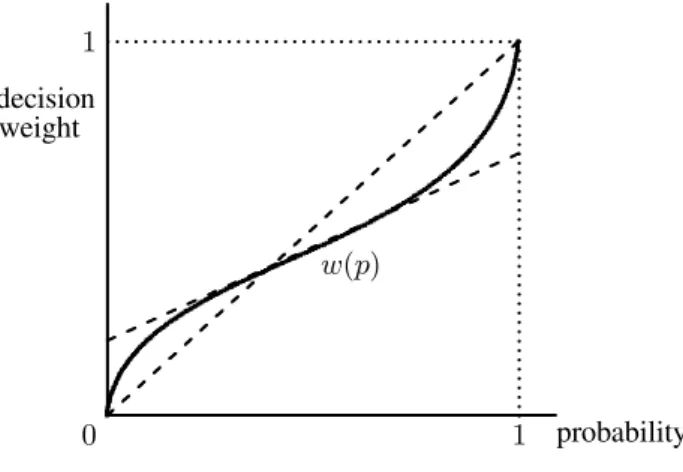
Whether subjects felt a preference for or an aversion against betting on the events with un-known probabilities, the experimental results indicate a systematic difference between the de-cision weights revealed in choice behaviour and the assessed probabilities of events. There is a substantial body of experimental evidence that deviations are of the form illustrated in Fig-ure 1. If the decision weights of an event would coincide with the assessed probability of this event as SEU suggests, then the functionw(p)depicted in Figure 1 should equal the
iden-... probability 0 .. .. .. .. .. .. .. .. .. .. .. .. .. .. .. .. .. .. .. .. . 1 1 w(p) decision weight
Figure 1. Probability weighting function
tity. Tversky and Fox (1995) and others4observe consistently that decision weights exceed the probabilities of unlikely events and fall short of the probabilities near certainty. This S-shaped weighting function reflects the distinction between certainty and possibility which was noted by Kahneman and Tversky (1979). While the decision weights are almost linear for events which are possible but neither certain nor impossible, they deviate substantially for small-probability events.
Decision weights can be observed in experiments. They reflect a decision maker’s ranking of events in terms of the willingness to bet on the event. In general, they do not coincide, however, with the decision maker’s assessment of the probability of the event. Decision weights capture both a decision maker’s perceived ambiguity and the attitude towards it. Wakker (2001) inter-prets the fact that small probabilities are over-weighted withoptimismand the underweighting of almost certain probabilities as pessimism. The extent of these deviations reflects thedegree of ambiguityheld with respect to a subjectively assessed probability.
The experimental evidence collected on decision-making under ambiguity documents consis-tent differences between betting behaviour and reported or elicited probabilities of events. While people seem to prefer risk over ambiguity if they feel unfamiliar with a source, this preference can be reversed if they feel competent about the source. Hence, we may expect to see more optimistic behaviour in situations of ambiguity, where the source is familiar and 4
pessimistic otherwise.
Actual economic behaviour shows a similar pattern. Faced with Ellsberg-type decision prob-lems, where an obvious lack of information cannot be overcome by personal confidence, most people seem to exhibit ambiguity aversion and choose among bets in a pessimistic way. In other situations, where the rewards are very uncertain, such as entering a career or setting up a small business, people may feel competent enough to make choices with an optimistic attitude. De-pending on the source of ambiguity, the same person may be ambiguity-averse in one context and ambiguity-loving in an another.
3 Models of ambiguity
The leading model of choice under uncertainty, subjective expected utility theory (SEU), is due to Savage (1954). In this theory, decision makers know that the outcomes of their actions will depend on circumstances beyond their control, which are represented by a set of states of nature S. The states are mutually exclusive and provide complete descriptions of the circumstances determining the outcomes of the actions. Once a state becomes known, all uncertainty will be resolved and the outcome of the action chosen will be realised. Ex ante it is not known, however, which will be the true state. Ex post precisely one state will be revealed to be true. An acta assigns an outcomea(s)∈Xto each state of natures∈S. It assumed that the decision-maker has preferencesover all possible acts. This provides a way of describing uncertainty without specifying probabilities.
If preferences over acts satisfy some axioms, which attempt to capture reasonable behaviour under uncertainty, then, as Savage (1954) shows, the decision-maker will have a utility function over outcomes and a subjective probability distribution over the states of nature. Moreover (s)he will choose so as to maximise the expected value of his/her utility with respect to his/her sub-jective probability. SEU implies that individuals have beliefs about the likelihood of states that can be represented by subjective probabilities. Savage (1954) can be, and has been, misunder-stood as transforming decision making under ambiguity into decision under risk. Note however
that beliefs, though represented by a probability distribution, are purely subjective. Formally, people whose preference ordersatisfies the axioms of SEU can be described by a probability distribution over states inSand a utility functionuover outcomes such that
ab⇔
u(a(s))dp(s)
u(b(s))dp(s).
SEU describes a decision maker who behaves like an expected-utility maximiser whose uncer-tainty can be condensed into a subjective probability distribution, even if there is no known probability distribution over states. Taking up an example by Savage (1954), an individual sat-isfying the SEU axioms would be able to assign an exact number, such as 0.42 to the event described by the proposition "The next president of the United States will be a Democrat". There are good reasons, however, for believing that SEU does not provide an adequate model of decision-making under ambiguity. It seems unreasonable to assume that the presence or absence of probability information will not affect behaviour. In unfamiliar circumstances, when there is little evidence concerning the relevant variables, subjective certainty about the probabilities of states appears a questionable assumption. Moreover, as the Ellsberg paradox and the literature in Section 2 make abundantly clear, SEU is not supported by the experimental evidence5. This section surveys some of the leading theories of ambiguity and discusses the relations be-tween them. The two most prominent approaches are Choquet expected utility (CEU) and the multiple prior model (MP). CEU has the advantage of having a rigorous axiomatic foundation. MP does not have an overall axiomatic foundation although some special cases of it have been axiomatised.
3.1
Multiple Priors
If decision makers do not know the true probabilities of events is seems plausible to assume that they might consider several probability distributions. The multiple prior approach suggests a model of ambiguity based on this intuition. Suppose an individual considers a set Pof prob-ability distributions as possible. If there is no information at all, the set P may comprise all probability distributions. More generally, the setP may reflect partial information. For
exam-5
ple, in the Ellsberg three-urn example P may be the set of all probability distributions where the probability of a red ball being drawn equals 13. For technical reasons P is assumed to be closed and convex.
An ambiguity-averse decision maker may be modelled by preferences which evaluate an am-biguous act by the worst expected utility possible given the set of probability distributions P. i.e., a b⇔min p∈P u(a(s))dp(s)min p∈P u(b(s))dp(s).
These preferences provide an intuitive way to model a decision maker with a pessimistic attitude towards ambiguity.They are axiomatised in Gilboa and Schmeidler (1989). Similarly, one can model an ambiguity-loving decision maker by a preference order, which evaluates acts by the most optimistic expected utility possible with the given set of probability distributionsP,
ab ⇔max p∈P u(a(s))dp(s)max p∈P u(b(s))dp(s).
Preferences represented in this way are only capable of representing optimistic or pessimistic attitudes towards ambiguity (ambiguity aversion or ambiguity preference). Attitudes towards ambiguity which are optimistic for low-probability events and at the same time pessimistic for high-probability events are precluded in these cases. The following modified version, however, is capable of modelling ambiguity preference as well as ambiguity aversion.
A preference relation on the set of acts is said to model multiple priors(henceforthMP) if there exists a closed an convex set of probability distributionsPonSsuch that:
a b⇔ αmin p∈P u(a(s))dp(s) + (1−α) max p∈P u(a(s))dp(s) αmin p∈P u(b(s))dp(s) + (1−α) max p∈P u(b(s))dp(s).
These preferences provide an intuitive way to model a decision maker whose reaction to ambi-guity displays a mixture of optimism and pessimism. It is natural to associate the set of prob-ability distributionsP with the decision maker’s information about the probabilities of events and the parameter α with the attitude towards ambiguity. Forα = 1,respectivelyα = 0, the
reaction is pessimistic (respectively optimistic), since the decision maker evaluates any given act by the least (respectively, most) favourable probability distribution.
3.2
Choquet integral and capacities
A second related way of modelling ambiguity is to assume that individuals do have subjec-tive beliefs, but that these beliefs, however, do not satisfy all the mathematical properties of a probability distribution. In this case, decision weights may be defined by a capacity, a kind of non-additive subjective probability distribution. Choquet (1953) has proposed a definition of an expected value with respect to a capacity, which coincides with the usual definition of an expected value when the capacity is additive6.
For simplicity, assume that the set of statesSis finite. AcapacityonSis a real-valued function ν on the subsets of S such that A ⊆ B implies ν(A) ν(B). Moreover, one normalises ν(∅) = 0andν(S) = 1.If, in addition, ν(A∪B) = ν(A) +ν(B)for disjoint eventsA, B holds, then the capacity is a probability distribution. Probability distributions are, therefore, special cases of capacities. Another important example of a capacity is thecomplete-uncertainty capacitydefined byν(A) = 0for allA S.
IfS is finite, then one can order the outcomes of any act afrom lowest to highest,a1 < a2 <
... < am−1 < am. The Choquet expected utility (CEU) of an action a with respect to the
capacityν is given by the following formula, u(a)dν = m r=1 u(ar) [ν({s|a(s)≥ar})−ν({s|a(s)≥ar+1})],
where we put{s|a(s)≥am+1}=∅for notational convenience.
It is easy to check that for an additive capacity, i.e., a probability distribution, one hasν({s|a(s)≥ar}) = ν({s|a(s) =ar})+ν({s|a(s)≥ar+1})for allr.Hence, CEU coincides with the expected
util-ity of the act. For the complete-uncertainty capacity, the Choquet expected utility equals the utility of the worst outcome of this act, u(a)dν = min
s∈Su(a(s)).
6
The theory and properties of capacities and the Choquet integral have been extensively studied. We will present here only a simple version of the general theory, suitable for our discussion of ambiguity and ambiguity attitude. For excellent surveys of the more formal theory, see Chateauneuf and Cohen (2000) and Denneberg (2000).
Preferences over acts for which there is a unique capacityνand a utility functionusuch that a b ⇔ u(a)dν ≥ u(b)dν
will be referred to as Choquet expected utility (CEU). This representation has been derived axiomatically by Schmeidler (1989), Gilboa (1987) and Sarin and Wakker (1992). It is easy to see that the Ellsberg paradox can be explained by the CEU hypothesis.
3.3
Choquet expected utility (CEU) and multiple priors (MP)
CEU preferences do not coincide with MP preferences. These preference systems have, how-ever, an important intersection characterised byconvex capacitiesand thecore of a capacity. A capacity is said to beconvexifν(A∪B)ν(A) +ν(B)−ν(A∩B)holds for any events A, B in S.In particular, if two events are mutually exclusive, i.e., A∩B = ∅, then the sum of the decision weights attached to the events A and B does not exceed the decision weight associated with their unionA∪B.
For any capacityν onS,one can define a set of probability distributions called thecoreof the capacityν,core (ν).The core of a capacityνis the set of probability distributions which yield a higher probability for each event than the capacityν,
core (ν) ={p∈∆(S)|p(A)ν(A) for allA⊆S},
where we write∆(S)for the set of all probability distributions onS andp(A)fors∈Ap(s).
If the capacity satisfiesν(A∪B) =ν(A) +ν(B)−ν(A∩B)for all eventsAandB,then it is a probability distribution and the core consists of only this probability distribution.
If the core of a capacity is non-empty, then it defines a set of probability distributions associated with the capacity. The capacity may be viewed as a set of constraints on the set of probability distributions which a decision maker considers possible. These constraints may arise from the decision maker’s information about the probability of events. If a decision maker faces no ambiguity, the capacity will be additive, i.e., a probability distribution, and the core will consist of this single probability distribution.
capacityνdefined by ν(E) = 1 3 if {R} ⊆E 2 3 if {B, Y} ⊆E 0 otherwise
for any eventE =S.This capacityνis convex and its core is the set of probability distributions
pwithp(R) = 1
3,core (ν) ={p∈∆(S)|p(R) = 1 3}.
It is natural to ask when a capacity will define a set of priors such that the representations of CEU and MP coincide. Schmeidler (1989) proved that for a convex capacity, the Choquet integral for any actais equal to the minimum of the expected utility ofa,where the minimum is taken over the probabilities in the core. Ifν is an convex capacity onS,then
u(a)dν = min p∈core(ν)
u(a(s))dp(s).
Since the core of a convex capacity is never empty, this result provides a partial answer to our question. It shows that the MP-preference representation equals the CEU-preference represen-tation ifα= 1holds and if the capacityνis convex.
Jaffray and Philippe (1997) show a more general relationship between MP-preferences and CEU-preferences7. Letµbe a convex capacity onSand for anyα∈[0,1]define the capacity
ν(A) :=αµ(A) + (1−α) [1−µ(S\A)],
which we will call JP-capacity. JP-capacities allow preferences to be represented in both the MP and CEU forms. Forα∈[0,1]and a convex capacityµ,letνbe the associated JP-capacity, then one obtains
u(a)dν =α min p∈core(µ) u(a(s))dp(s) + (1−α) max p∈core(µ) u(a(s))dp(s).
The CEU-preferences with respect to the JP-capacity, ν, coincide with the MP-preferences, where the set of priors is the core of the convex capacityµon which the JP-capacity depends, 7
Recently, Ghirardato, Maccheroni, and Marinacci (2004) have axiomatised a representation
V(f) =α(f) min p∈P u(a(s))dp(s) + (1−α(f)) max p∈P u(a(s))dp(s),
where the set of probability distributions P is determined endogenously and where the weightsα(f) depend on the act.
Nehring (2007) axiomatises a representation where the set of priors can be determined partially exogenously and partially endogenously.
P = core (µ). As in the case of MP-preferences, it is natural to interpret α as a parameter related to the ambiguity attitude and the core ofµ,the set of priors, as describing the ambiguity of the decision maker.
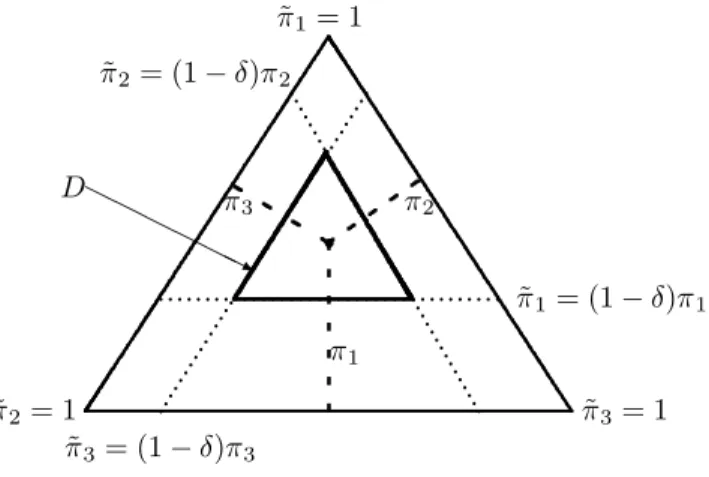
A special case of a JP-capacity, which illustrates how a capacity constrains the set of probability distributions in the core is theneo-additive capacity8. A neo-additive capacity is a JP-capacity with a convex capacityµdefined byµ(E) = (1−δ)π(E)for all eventsE = S,whereπ is a probability distribution onS.In this case,
P = core (µ) ={p∈∆ (S−i)|p(E)≥(1−δ)π(E)}
is the set of priors. A decision maker with beliefs represented by a neo-additive capacity may be viewed as holding ambiguous beliefs about an additive probability distributionπ.The parameter δ determines the size of the neighbourhood of probabilities aroundπ and can be interpreted as a measure of the decision maker’s ambiguity. Figure 2 illustrates the core of a neo-additive capacity. π1 .... .... .... .... .... .... .... .... .... .... .. ... ... ... ... ... ... ... ... ...... ...... ..... ... π2 π3 ˜ π1= (1−δ)π1 ˜ π2= (1−δ)π2 ˜ π3= (1−δ)π3 D ˜ π2= 1 π˜3= 1 ˜ π1= 1
Figure 2. Core of a neo-additive capacity
The special case of neo-additive capacities withδ = 1yields the well-known Hurwicz-capacity.
4 Ambiguity and ambiguity attitude
A central, yet so far still not completely resolved problem in modelling ambiguity concerns the 8
separation of ambiguity and ambiguity attitude. As discussed in Section 2, early experiments, e.g., Ellsberg (1961), suggested an aversion of decision makers against ambiguity arising from the lack of information about the probability of events. The negative attitude towards ambiguity seems not to hold in to situations where the decision maker has no information about the prob-abilities of events, but feels competent about the situation. Experimental evidence suggests that a decision maker who feels as expert in an ambiguous situation is likely to prefer an ambiguous act to an unambiguous one, e.g., Tversky and Fox (1995).
Separating ambiguity and ambiguity attitude is important for economic models because atti-tudes towards ambiguity of a decision maker may be seen as stable personal characteristics, whereas the experienced ambiguity varies with the information about the environment. Here, information should not be understood in the Bayesian sense of evidence which allows one to condition a given probability distribution. Information refers to evidence which in the deci-sion maker’s opinion may have some impact on the likelihood of decideci-sion-relevant events. For example, one may reasonably assume that an entrepreneur who undertakes a new investment project feels ambiguity about the chances of success. Observing success and failure of other entrepreneurs with similar, but different projects is likely to affect ambiguity. Information about the success of a competitor’s investment may reduce ambiguity, while failure of it may have the opposite effect. Hence, the entrepreneur’s degree of ambiguity may change with such informa-tion. In contrast, it seems reasonable to assume that optimism or pessimism, understood as the underlying propensity to take on uncertain risks, are a more permanent feature of the decision maker’s personality.
Achieving such a separation is complicated by two additional desiderata.
(i) In the spirit of Savage (1954), one would like to derive all decision-relevant concepts purely from assumptions about the preferences over acts.
(ii) The distinction of ambiguity and ambiguity attitude should be compatible with the notion of risk attitudes in cases of decision making under risk.
in SEU andrank-dependent expected utility (RDEU)9, as introduced by Quiggin (1982). The three approaches outlined here differ in these respects. Ultimately, the answer to the ques-tion how to separate ambiguity from ambiguity attitude may determine the choice among the different models of decision making under ambiguity discussed in Section 3.
4.1
Ambiguity aversion and convexity
The Ellsberg paradox suggests that people dislike the ambiguity of not knowing the probability distribution over states, e.g., the proportions of balls in the urn. In an effort to find preference representations, which are compatible with the behaviour observed in this paradox, most of the early research assumed ambiguity aversion and attributed all deviations between decision weights and probabilities to the ambiguity experienced by the decision maker.
Denote by A the set of acts. Schmeidler (1989) and Gilboa and Schmeidler (1989) assume that acts yield lotteries as outcomes10. Hence, for constant acts, decision makers choose among lotteries. In this framework, one can define (pointwise) convex combinations of acts. An act with such a convex combination of lotteries as outcomes can be interpreted as a reduction in ambiguity, because there is a state-wise diversification of lottery risks. A decision maker is called ambiguity averse if a convex combination of two acts is always considered better than the worst of the two acts, formally,
for all actsa, b∈ A, with a∼b implies 12a+ 12bb. (Ambiguity aversion)
For preferences satisfying ambiguity aversion, Schmeidler (1989) shows that the capacity of the CEU representation must be convex. For the MEU representation, Gilboa and Schmeidler (1989) ambiguity aversion is part of the axioms.
In a recent article, Ghirardato, Maccheroni, and Marinacci (2004) provide a useful exposition of the axiomatic relationship among representations. Five standard assumptions11on the pref-erence orderon Acharacterise a representation by a positively homogeneous and constant-9
Chapters 3 and 4 of this Handbook deal with rank-dependent expected utility and other non-expected utility theories.
10
Anscombe and Aumann (1963) introduced this notion of an act in order to simplify the derivation of SEU.
11
The five axioms areweak order, certainty independence, Archimedian axiom,monotonicity, and nondegeneracy. For more details, compare Ghirardato, Maccheroni, and Marinacci (2004), p.141.
additive functionalI :A →Rand a non-constant affine functionu:X→Rsuch that, for any actsa, b∈ A,
ab⇐⇒I(u(a))≥I(u(b)).
If the preference order satisfies in additionambiguity aversion, then there is auniquenon-empty, compact, convex set of probabilitiesPsuch that
I(u(a)) = min p∈P
u(a(s))dp(s). (Pessimistic MEU(α= 1)) The CEU and SEU representations can now be obtained by extending the independence axiom to larger classes of acts.
(i) CEU: If the preference order satisfies in additioncomonotonic independence,i.e., for allcomonotonic12actsa, b∈ A with a ∼b holds 1
2 a+ 1 2 b ∼b, (Comonotonic Independence) then there is aconvex capacityν onSsuch that
I(u(a)) =
u(a)dν. (CEU)
(ii) SEU: If the preference order satisfiesindependence, i.e.,
for all actsa, b∈ A with a∼b holds 12a+ 12b∼b, (Independence)
then there is a probability distributionπonS such that I(u(a)) =
u(a(s))dπ(s). (SEU)
Given ambiguity aversion, the CEU model is more restrictive than the pessimistic MEU model, since it requires also comonotonic independence. As explained in Subsection 3.3, for convex capacities, the core is non-empty and represents the set of priors. Imposing independence for all pairs of acts makes SEU the most restrictive model. In this case, strict ambiguity aversion is ruled out. Only the limiting case of a unique additive probability distributionπremains, which coincides with the capacity in CEU and forms the trivial set of priorsP ={π}for MEU. A priori, this approach allows only for a negative attitude towards ambiguity. Any deviation from expected utility can, therefore, be interpreted as ambiguity. Hence, absence of ambiguity 12
Two actsa, b ∈ F are comonotonic, if there exists nos, s′ ∈
S such thata(s) ≻ a(s′)
and
b(s′)≻
coincides with SEU preferences.
4.2
Comparative ambiguity aversion
In the context of decision making under risk, Yaari (1969) defines a decision maker A asmore risk aversethan decision maker B, if A ranks a certain outcome higher than a lottery whenever B prefers the certain outcome over this lottery. If one defines a decision makers risk-neutral
who rank lotteries according to their expected value, then one can classify decision makers as risk-averse and risk-loving according to whether they are more, respectively less, risk-averse than a risk-neutral decision maker. Note that the reference case of risk-neutrality is arbitrarily chosen.
In the spirit of Yaari (1969), a group of articles13propose comparative notions of "more ambigu-ity averse". Epstein (1999) defines a decision maker A asmore ambiguity averse14than decision maker B, if A prefers an unambiguous act over another arbitrary act whenever B ranks these acts in this way. For this definition the notion of an "unambiguous act" has to be introduced. Epstein (1999) assumes that there is a set ofunambiguous eventsfor which decision makers can assign probabilities. Acts which are measurable with regard to these unambiguous events are calledunambiguous acts.
Epstein uses probabilistically sophisticated preferences as the benchmark to define ambiguity neutrality. Probabilistically sophisticated decision makers assign a unique probability distribu-tion to all events such that they can rank all acts by ranking the induced lotteries over outcomes, see Machina and Schmeidler (1992). SEU decision makers are probabilistically sophisticated, but there are other non-SEU preferences which are also probabilistically sophisticated15. Decision makers areambiguity averse,respectivelyambiguity loving, if they are more,
respec-13
Kelsey and Nandeibam (1996), Epstein (1999), Ghirardato and Marinacci (2002), and Grant and Quiggin (2005) use the comparative approach for separating ambiguity and ambiguity attitude.
14
Epstein (1999) calls such a relation "more uncertainty averse". Since we use uncertainty as a generic term, which covers also the case where a decision maker is probabilistically sophisticated, we prefer the dubbing of Ghirardato and Marinacci (2002).
15
Probabilistical sophisticationis a concept introduced by Machina and Schmeidler (1992) in order to accommodate experimentally observed deviations from expected utility in the context of choice over lotteries. A typical case of probabilistically sophisticated preferences are rank-dependent expected utility (RDEU)proposed by Quiggin (1982) for choice when the probabilities are known.
tively less, ambiguity averse than a probabilistically sophisticated decision maker. Hence, am-biguity neutraldecision makers are probabilistically sophisticated. Ambiguity neutral decision makers do not experience ambiguity. Though they may not know the probability of events, their beliefs can be represented by a subjective probability distribution.
If a decision maker has pessimistic MEU preferences and if all prior probability distributions coincide on the unambiguous events, then the decision maker is ambiguity averse in the sense of Epstein (1999). A CEU preference order is ambiguity averse if there is an additive proba-bility distribution in the core of the capacity with respect to which the decision maker is prob-abilistically sophisticated for unambiguous acts. Hence, convexity of the capacity is neither a necessary nor a sufficient condition for ambiguity aversion in the sense of Epstein (1999). Am-biguity neutrality coincides with the absence of perceived amAm-biguity since an amAm-biguity neutral decision maker has a subjective probability distribution over all events. Hence, risk preferences reflected by the von Neumann-Morgenstern utility in the case of SEU are independent of the ambiguity attitude. A disadvantage of Epstein (1999)’s approach is, however, the assumption that there is an exogenously given set of unambiguous events16.
Ghirardato and Marinacci (2002) also suggest a comparative notion of ambiguity aversion. They call a decision maker Amore ambiguity averse than decision maker B if A prefers a constant act over another act whenever B ranks these acts in this way. In contrast to Epstein (1999), Ghirardato and Marinacci (2002) use constant acts, rather than unambiguous acts, in order to define the relation "more ambiguity averse". The obvious advantage is that they do not need to assume the existence of unambiguous acts. The disadvantage lies in the fact that this comparison does not distinguish between attitudes towards risk and attitudes towards ambiguity. Hence, for two decision makers with SEU preferences holding the same beliefs, i.e., the Yaari case, A will be considered more ambiguity averse than B simply because A has a more concave von Neumann-Morgenstern utility function than B. A disadvantage of this theory is that it implies that the usual preferences in the Allais paradox exhibit ambiguity-aversion. However most 16
In Epstein and Zhang (2001), unambiguous events are defined based purely on behavioural assumptions. See, however, Nehring (2006b) who raises some questions about the purely behavioural approach.
researchers do not consider ambiguity to be a significant factor in the Allias Paradox.
Ghirardato and Marinacci (2002), therefore, restrict attention to preference orders which allow for a CEU representation over binary acts. They dub such preferences "biseparable". The class of biseparable preferences comprises SEU, CEU, and MEU and is characterised by a well-defined von Neumann-Morgenstern utility function. In this context it is possible to control for risk preferences as reflected in the von Neumann-Morgenstern utility functions. Biseparable preferences which have the (up to an affine transformation) same von Neumann-Morgenstern utility function are calledcardinally symmetric.
As the reference case ofambiguity neutrality,Ghirardato and Marinacci (2002) take cardinally symmetric SEU decision makers. Hence, decision makers are ambiguity averse(respectively,
ambiguity loving) if they have cardinally symmetric biseparable preferences and if they are more (respectively, less) ambiguity averse than a SEU decision maker.
Ghirardato and Marinacci (2002) show that CEU decision makers are ambiguity averse if and only if the core of the capacity characterizing them is non-empty. In contrast to Epstein (1999), convexity of the preference order is sufficient for ambiguity aversion but not necessary. Pes-simistic MEU individuals with α = 1 are ambiguity averse in the sense of Ghirardato and Marinacci (2002).
Characterising ambiguity attitude by a comparative notion as in Epstein (1999) and Ghirardato and Marinacci (2002) it is necessary to identify (i) acts as more or less ambiguous and (ii) a preference order as ambiguity neutral. In the case of Epstein (1999), unambiguous acts, i.e., acts measurable with respect to unambiguous events, are considered less ambiguous than other acts and probabilistically sophisticated preferences were suggested as ambiguity neutral. For Ghirardato and Marinacci (2002) constant acts are less ambiguous than other acts and SEU preferences are ambiguity neutral.
It is possible to provide other comparative notions of ambiguity by either varying the notion of the less ambiguous acts or the type of reference preferences which are considered ambiguity neutral. Grant and Quiggin (2005) suggest a concept of "more uncertain" acts. For ease of
exposition, assume that acts map states into utilities. Comparing two acts aand b, consider a partition the state space in two events, Ba and Wa such that a(s) a(t)for all s ∈ Ba and
all t ∈ Wa. Then Grant and Quiggin (2005) call act b an elementary increase in uncertainty
of act aif there are positive numbers α andβ such thatb(s) = a(s) +α for alls ∈ Ba and b(s) = a(s)−β for all s ∈ Waf.Act b has outcomes which are by a constant αhigher than
those of actafor states yielding high outcomes and outcomes which are byβlower than those of act a for states with low outcomes. In this sense, exposure to ambiguity is higher for actb than for acta. A decision maker A is at least as uncertainty averseas decision maker B if A prefers an actaover actbwheneverbis an elementary increase in uncertainty ofaand B prefers aoverb.For the reference case of uncertainty neutrality they use SEU preferences.
In contrast to Ghirardato and Marinacci (2002), Grant and Quiggin (2005) do not control for risk preferences reflected by the von Neumann-Morgenstern utility function. Hence, a SEU decision maker A is more uncertainty averse than another SEU decision maker B if both have the same beliefs, represented by an additive probability distribution over states and if A’s von Neumann-Morgenstern utility function is a concave transformation of B’s von Neumann-Neumann-Morgenstern utility function. Using concepts introduced by Chateauneuf, Cohen, and Meilijson (2005), Grant and Quiggin (2005) characterise more uncertainty averse CEU decision makers by a pessimism index exceeding an index of relative concavity of the von Neumann-Morgenstern utility functions.
4.3
Optimism and pessimism
Inspired by the Allais paradox, Wakker (2001) suggests a notion of optimism and pessimism
based on choice behaviour over acts. These notions do not depend on a specific form of rep-resentation. The appeal of this approach lies in its immediate testability in experiments and its link to properties of capacities in the CEU model. For the CEU representation, Wakker (2001) shows that optimism corresponds to concavity and pessimism to convexity of a capac-ity. Moreover, Wakker (2001) provides a method to behaviourally characterise decision makers
who overweight events with extreme outcomes, a fact which is often observed in experiments17. For ease of exposition, assume again that acts associate real numbers with states. Consider the following four acts a1, a2, a3, a4 defined on a partition of the state space {H, A, I, L}with
outcomesM > m >0. H A I L a1 m m 0 0 a2 M 0 0 0 a3 m m m 0 a4 M 0 m 0
For givenM and0,assume thatmis chosen such that the decision maker is indifferent between actsa1anda2,i.e.,a1 ∼a2.Wakker (2001) calls a decision makerpessimisticifa3 is preferred
toa4,i.e.,a3 a4,andoptimisticif the opposite preference is revealed, i.e.,a3 a4.
The intuition is as follows. Conditional on the events H or A occurring, m is the certainty equivalent to the partial act yieldingM onH and0onA.In actsa3 anda4the outcome on the
"irrelevant" eventI has been increased from0to m.Of course, a SEU decision maker will be indifferent also between acts a3 anda4.For a pessimistic decision maker, the increase in the
outcome on the event I makes the partial certainty equivalent more attractive. In contrast, an optimistic decision maker will now prefer the acta4, because the increase in the outcome on the
eventI makes the partial actM onHand0onAmore attractive.
A key result of Wakker (2001) shows that for CEU preferences, pessimism implies a convex capacity and optimism a concave capacity. Moreover, for CEU preferences, one can define a weak order on events, which orders any two events as one being revealed more likelythan the other. This order allows one to define intervals of events. It is possible to restrict optimism or pessimism to non-degenerate intervals of events. Hence, if there is an event E such that the decision maker is optimistic for all events, which are revealed less likely thanEand pessimistic for all events, which are revealed more likely thanE,then this decision maker will overweight events with extreme outcomes. For a CEU decision maker, in this case, the capacity will be partially concave and partially convex.
17
One may be inclined to think that a decision maker who is both pessimistic and optimistic, i.e., with a3 ∼ a4, will have SEU preferences. this is, however, not true. For example, a CEU
decision maker with preferences represented by the capacityν(E) = (1−δ)π(E)for allE =S, whereπ is an additive probability distribution onS andδ ∈(0,1),will rank acts according to
u(a)dν = δ·min
s∈Su(a(s)) + (1−δ)·
u(a)dπ.Hence, straightforward computations show that u(a1)dν =
u(a2)dνholds if and only ifπ(H∪A)·u(m) =π(H)·u(M) +π(A)·u(0).
Thus, u(a3)dν− u(a4)dν = (1−δ) [π(H∪A)·u(m)−π(H)·u(M)−π(A)·u(0)] = 0.
This CEU decision maker behaves like a SEU decision makeras long as the minimum of acts remains unchanged. For acts with varying worst outcome, however, the behaviour would be quite distinct. It is easy to check that the capacityν is convex18. Hence, a decision maker who evaluates actsa3 anda4 as indifferent, need not have SEU preferences.
5 Economic applications
Important economic insights depend on the way in which decision making under uncertainty is modelled. Despite the obvious discrepancies between choice behaviour predicted based on SEU preferences and actual behaviour in controlled laboratory experiments, SEU has become the most commonly applied model in economics. SEU decision makers behave like Bayesian statisticians. They update beliefs according to Bayes’ rule and behave consistently with underly-ing probability distributions. In particular, in financial economics where investors are modelled who choose portfolios and in contract theory where agents design contracts suitable to share risks and to deal with information problems important results depend on this assumption. Nevertheless, in both financial economics and contract theory, there are phenomena which are hard or impossible to reconcile with SEU preferences. Therefore, there is a growing research in the implications of alternative models of decision making under uncertainty. Applications range 18
Note, however, that the capacity does not satisfy the solvability condition imposed by Wakker (2001) (assumption 5.1, p. 1047) which is required for the full characterisations in Theorems 5.2 and 5.4.
from auctions, bargaining, and contract theory to liability rules. There are several surveys of economic applications, e.g., Chateauneuf and Cohen (2000), Mukerji (2000), and Mukerji and Tallon (2004). We will describe here only two results of general economic importance relating to financial economics and risk sharing.
(i) Financial Economics
If ambiguity-aversion is assumed then CEU and MP preferences have a kink at points of certain consumption. Thus they are not even locally risk neutral. The model of financial markets of Dow and Werlang (1992) shows that SEU yields the paradoxical result that an individual should either buy or short-sell every asset. This follows from local risk neutrality. Apart form the knife edge case where all assets have the same expected return, every asset either offers positive expected returns in which cases it should be purchased, or it offers negative expected returns in which case it should be short sold. Assuming CEU preferences and ambiguity aversion, Dow and Werlang (1992) show that there is a range of asset prices for which an investor may not be induced to trade. In particular, ambiguity averse investors will not turn from investing into assets to short-sales by a marginal change of asset prices as SEU models predict. Kelsey and Milne (1995) study asset pricing with CEU preferences and show that many conventional asset pricing results may be generalised to this context.
Epstein and Wang (1994) extend the Dow-Werlang result to multiple time periods. They show that there is a continuum of possible values of asset prices in a financial market equilibrium. Thus, ambiguity causes prices to be no longer determinate. They argue that this is a formal model of Keynes’ intuition that ambiguity would causes asset prices to depend on a conventional valuation rather than market fundamentals.
In a related paper Epstein (2001) shows that differences in the perception of ambiguity can explain the consumption home bias paradox. This paradox refers to the fact that domestic con-sumption is more correlated with domestic income than theory would predict. Epstein (2001) explains this by arguing the individual perceive foreign income to be more ambiguous.
through diversified portfolios. There are securities which could, in principle, allow risk to be shared. However, markets are incomplete and each security carries some idiosyncratic risk. If this idiosyncratic risk is perceived as sufficiently ambiguous, it is possible that ambiguity aversion may deter people from trading it. The authors show that ambiguous risks cannot be diversified in the same way as standard risks. This has the implication that firms as well as individuals may be ambiguity averse.
(ii) Sharing Ambiguous Risks
Consider an economy with one physical commodity and multiple states of nature. If all individ-uals have SEU preferences and if there is no aggregate uncertainty, then in a market equilibrium each individual has certain consumption. An individual’s consumption is proportional to the ex-pected value of his/her endowment. If there is aggregate uncertainty, then risk is shared between all individuals as an increasing function of their risk tolerance. Individuals’ consumptions are comonotonic with one another and with the aggregate endowment.
Chateauneuf, Dana, and Tallon (2000) consider risk-sharing when individuals have CEU pref-erences. In the case where all individuals have beliefs represented bythe sameconvex capacity, they show that the equilibrium is the same, that would be obtained if all individuals had SEU preferences and beliefs represented by a particular additive probability distribution. The rea-son for this is that in an economy with one good, no production and aggregate uncertainty all Pareto optimal allocations are comonotonic. CEU preferences evaluate comonotonic acts with the same set of decision weights. These decision weights can be treated as if they are a prob-ability distribution. Hence, any competitive equilibrium coincides with an equilibrium of the economy where SEU decision makers have a probability distribution equal to these decision weights. In such an equilibrium the optimal degree of risk sharing obtains.
Dana (2004) extends this result by investigating the comparative statics of changes in the en-dowment. She shows that while any given equilibrium is similar to an equilibrium without ambiguity, the comparative statics of changes in the endowment is different in an economy with ambiguity. In the presence of ambiguity small changes in the endowment can cause large
changes in equilibrium prices. The price ratio is always significantly higher in states in which the endowment is relatively scarce. As a consequence individuals who have larger endowments in such states get higher utility.
6 Concluding remarks
In this chapter, our focus has been on purely behavioural approaches to decision making under ambiguity. In particular, we have reviewed the literature which takes the Savage, or Anscombe-Aumann, framework as the basis of the analysis. Hence, ambiguity and ambiguity attitudes of a decision maker have to be inferred from choices based on preferences over acts alone. We have seen that such a separation has not been achieved so far. The difficulty derives from the fact that choice behaviour over acts reveals the decision weights of a decision maker. It does not reveal, however, how much of the decision weight has to be attributed to ambiguity and how much to ambiguity attitude. In this concluding remarks, we would like to mention two other approaches, which start from different premises, in order to obtain a separation of ambiguity and ambiguity attitude. We will also point out another unresolved issue, which is related to the distinction of ambiguity and ambiguity attitude.
A separation of ambiguity and ambiguity attitude can be achieved if one allows for additional a priori information. Klibanoff, Marinacci, and Mukerji (2005) take two types of actsandtwo preference ordersas primitives. The representation over second-order acts is assumed to model ambiguity and ambiguity attitude. Here, exogenously specified preferences achieve the sepa-ration of ambiguity and ambiguity attitude. It is not clear, however, whether one can identify these two types of preference orders from the observed choices over acts.
Nehring (2006a) considers partial information about probabilities which characterise a set of probability distributions consistent with this information. If a decision maker’s preferences over acts are compatible with this information, then one can obtain a multiple prior representation with this set of probability distributions. If one takes this set of priors as representing the ambiguity, a decision maker’s ambiguity attitude may be derived from the decision weights.
Finally, we would like to point out a problem which is related to the issue of separating am-biguity from amam-biguity attitude. If beliefs of a decision maker are modelled by capacities or sets of probability distributions, it is no longer clear what is an appropriate support notion. This problem becomes important if one considers games where players experience ambiguity about the strategy choice of their opponent. Dow and Werlang (1994), Lo (1996), Marinacci (2000), and Eichberger and Kelsey (2000) study games with players who hold ambiguous beliefs about their opponent’s behaviour. Eichberger, Kelsey, and Schipper (2007) provide experimental evi-dence for ambiguity-aversion of players in a game. This extends previous research by showing that ambiguity-aversion could also be present in games.
An equilibrium of a game, understood as a situation in which players have no incentives to deviate unilaterally from their strategy choices, the information generated by the equilibrium behaviour of the players must be consistent with their beliefs. In traditional game-theoretic analysis, where players’ beliefs about their opponents’ behaviour was modelled by probability distributions, such consistency was guaranteed by a Nash equilibrium in mixed strategies. In a mixed-strategy Nash equilibrium, the support of the equilibrium mixed strategies contains only best-reply strategies.
With ambiguity, there is no obvious support notion. For capacities or sets of probability distrib-utions, there are many support concepts19. If one assumes that players play best reply strategies given some ambiguity about the opponents’ strategy choice, then the support notion should
re-flect a player’s perceived ambiguity. In contrast, a player’s attitude towards ambiguity appears more as a personal characteristic.
References
ALLAIS, M. (1953): “The So-Called Allais Paradox and Rational Decision under Uncertainty,”
Econometrica, 21, 503–546.
ANSCOMBE, F. J.,ANDR. J. AUMANN(1963): “A Definition of Subjective Probability,”Annals of
Mathematical Statistics, 34, 199–205.
CAMERER, C. (1995): “Individual Decision Making,” in The Handbook of Experimental
Eco-19
Ryan (2002) provides epistemic conditions for support notions if decision makers are uncertainty-averse. Haller (2000) studies implications of different support concepts for equilibria in games.
nomics, ed. by J. H. Kagel, andA. E. Roth, chap. 8, pp. 587–703. Princeton University Press,
Princeton, New Jersey.
CAMERER, C., ANDM. WEBER (1992): “Recent Developments in Modelling Preferences:
Uncer-tainty and Ambiguity,”Journal of Risk and Uncertainty, 5, 325–370.
CHATEAUNEUF, A.,ANDM. COHEN(2000): “Choquet Expected Utility Model: A New approach to
Individual Behavior under Uncertainty and Social Welfare,” in Fuzzy Measures and Integrals, ed. by M. Grabisch, T. Murofushi,andM. Sugeno, pp. 289–313. Physica-Verlag.
CHATEAUNEUF, A., M. COHEN, ANDI. MEILIJSON(2005): “More Pessimism than Greediness: A
Characterization of Monotone Risk Aversion in the Rank-dependent Expected Utility Model,”
Economic Theory, 25(3).
CHATEAUNEUF, A., R.-A. DANA, AND J.-M. TALLON (2000): “Optimal Risk-Sharing Rules and
Equilibria with Choquet Expected Utility,”Journal of Mathematical Economics, 34, 191–214.
CHATEAUNEUF, A., J. EICHBERGER, ANDS. GRANT(2006): “Choice under Uncertainty with the
Best and Worst in Mind: Neo-Addditive Capacities,”Journal of Economic Theory, p. forthcom-ing.
CHOQUET, G. (1953): “Theory of Capacities,”Annales Institut Fourier, 5, 131–295.
DANA, R.-A. (2004): “Ambiguity, Uncertainty-Aversion and Equilibrium Welfare,”Economic The-ory, 23, 569–588.
DENNEBERG, D. (2000): “Non-additive Measure and Integral, Basic Concepts and Their Role
for Applications,” in Fuzzy Measures and Integrals, ed. by M. Grabisch, T. Murofushi, and
M. Sugeno, pp. 289–313. Physica-Verlag.
DOW, J., ANDS. R. C. WERLANG(1992): “Uncertainty Aversion, Risk Aversion, and the Optimal Choice of Portfolio,”Econometrica, 60, 197–204.
DOW, J., ANDS. R. C. WERLANG(1994): “Nash Equilibrium under Uncertainty: Breaking Down Backward Induction,”Journal of Economic Theory, 64, 305–324.
EICHBERGER, J.,ANDD. KELSEY(2000): “Non-Additive Beliefs and Strategic Equilibria,”Games
and Economic Behavior, 30, 183–215.
EICHBERGER, J., D. KELSEY, ANDB. SCHIPPER (2007): “Granny versus Game Theorist:
Ambi-guity in Experimental Games,”Theory and Decision, p. forthcoming.
ELLSBERG, D. (1961): “Risk, Ambiguity, and the Savage Axioms,” Quarterly Journal of
Eco-nomics, 75, 643–669.
EPSTEIN, L. (2001): “Sharing Ambiguity,”American Economic Review, Papers and Proceedings, 45–50.
EPSTEIN, L., AND J.-K. ZHANG (2001): “Subjective Probabilities on Subjectively Unambiguous Events,”Econometrica, 69, 265–306.
EPSTEIN, L. G. (1999): “A Definition of Uncertainty Aversion,”Review of Economic Studies, 66(3), 579–608.
EPSTEIN, L. G.,ANDT. WANG(1994): “Intertemporal Asset Pricing under Knightian Uncertainty,”
Econometrica, 62, 283–322.
GHIRARDATO, P., F. MACCHERONI, ANDM. MARINACCI(2004): “Differentiating Ambiguity and
Ambiguity Attitude,”Journal of Economic Theory, 118, 133–173.
Foun-dation,”Journal of Economic Theory, 102, 251–289.
GILBOA, I. (1987): “Expected Utility with Purely Subjective Non-Additive Probabilities,”Journal of Mathematical Economics, 16, 65–88.
GILBOA, I., AND D. SCHMEIDLER (1989): “Maxmin Expected Utility with a Non-Unique Prior,”
Journal of Mathematical Economics, 18, 141–153.
GONZALEZ, R., ANDG. WU (1999): “On the Shape of the Probability Weighting Function,” Cog-nitive Psychology, 38, 129–166.
GRANT, S., ANDJ. QUIGGIN (2005): “Increasing Uncertainty: A Definition,”Mathematical Social
Sciences, 49(2), 117–141.
HALLER, H. (2000): “Non-Additive Beliefs in Solvable Games,” Theory and Decision, 49, 313– 338.
HEATH, C., AND A. TVERSKY (1991): “Preference and Belief: Ambiguity and Competence in Choice under Uncertainty,”Journal of Risk and Uncertainty, 4, 5–28.
JAFFRAY, J.-Y.,ANDF. PHILIPPE(1997): “On the Existence of Subjective Upper and Lower Prob-abilities,”Mathematics of Operations Research, 22, 165–185.
KAHNEMAN, D., AND A. TVERSKY (1979): “Prospect Theory: An Analysis of Decision under
Risk,”Econometrica, 47, 263–291.
KELSEY, D., ANDF. MILNE(1995): “Arbitrage Pricing Theorem with Non-Expected Utility Prefer-ences,”Journal of Economic Theory, 65, 557–574.
KELSEY, D.,ANDS. NANDEIBAM(1996): “On the Measurement of Uncertainty Aversion,”
Univer-sity of Birmingham Discussion Paper.
KEYNES, J. M. (1921):A Treatise on Probability. Dover Publications, New York, 2004 edn.
KLIBANOFF, P., M. MARINACCI, ANDS. MUKERJI(2005): “A Smooth Model of Decision Making
Under Ambiguity,”Econometrica, 73(6), 1849–1892.
KNIGHT, F. H. (1921): Risk, Uncertainty, and Profit. Houghton Mifflin, New York.
LO, K. C. (1996): “Equilibrium in Beliefs under Uncertainty,” Journal of Economic Theory, 71, 443–484.
MACHINA, M., ANDD. SCHMEIDLER(1992): “A More Robust Definition of Subjective
Probabil-ity,”Econometrica, 60, 745–780.
MARINACCI, M. (2000): “Ambiguous Games,”Games and Economic Behavior, 31, 191–219.
MUKERJI, S. (2000): “A Survey of Some Applications of the Idea of Ambiguity Aversion in Eco-nomics,”International Journal of Approximate Reasoning, 24, 221–234.
MUKERJI, S., AND J.-M. TALLON (2001): “Ambiguity Aversion and Incompleteness of Financial
Markets,”Review of Economic Studies, 68, 883–908.
(2004): “An Overview of Economic Applications of David Schmeidler’s Models of Deci-sion Making under Uncertainty,” inUncertainty in Economic Theory: A Collection of Essays in Honor of David Schmeidler’s 65th Birthday,, ed. by I. G. et al. Routledge Publishers.
NEHRING, K. (2006a): “Decision-Making in the Context of Imprecise Probabilistic Beliefs,” Work-ing Paper.
(2006b): “Is it Possible to Define Subjective Probabilities in Purely Behavioral Terms? A Comment on Epstein-Zhang (2001),”Working Paper.
(2007): “Imprecise Probabilistic Beliefs as a Context for Decisison-making under Ambi-guity,”Working Paper.
QUIGGIN, J. (1982): “A Theory of Anticipated Utility,” Journal of Economic Behavior and Orga-nization, 3, 323–334.
RYAN, M. J. (2002): “What Do Uncertainty-Averse Decision-Makers Believe?,”Economic Theory, 20, 47–65.
SARIN, R.,ANDP. WAKKER(1992): “A Simple Axiomatization of Non-Additive Expected Utility,”
Econometrica, 60, 1255–1272.
SAVAGE, L. J. (1954): Foundations of Statistics. Wiley, New York.
SCHMEIDLER, D. (1989): “Subjective Probability and Expected Utility without Additivity,”
Econo-metrica, 57, 571–587.
TVERSKY, A., AND C. R. FOX (1995): “Weighting Risk and Uncertainty,” Psychological Review, 102, 269–283.
TVERSKY, A.,ANDP. WAKKER(1995): “Risk Attitudes and Decision Weights,”Econometrica, 63, 1255–1280.
WAKKER, P. (2001): “Testing and Characterizing Properties of Nonadditive Measures Through
Violations of the Sure Thing Principle,”Econometrica, 69, 1039–1060.
YAARI, M. (1969): “Some Remarks on Measures of Risk Aversion And their Uses,” Journal of Economic Theory, 1, 315–322.