MISA 4.0 Method for Engineering Learning Systems:
Presentation
Version 1.0 November 2000
Developed by the LICEF "Method Team"
Gilbert Paquette
Michel Léonard
Ileana de la Teja
Marie-Paule Dessaint
As Télé-université’s research centre, LICEF is dedicated to cognitive informatics and training environments. Its team comprises some sixty researchers, research assistants, analysts, programmers, technicians, and students specialized in the fields of cognitive informatics, telecommunications, computational linguistics, cognitive psychology, education and communication. This dynamic team participates in the development of tele-learning system design methods, production and delivery tools. For more information about LICEF, our research, expertise, projects and products, please visit our Web site or contact us at the e-mail address indicated below:
http://www.licef.teluq.uquebec.ca/ [email protected]
© 2000- LICEF Research Centre Télé-université
4750 Henri-Julien, Suite 100 Montreal, Quebec
. DE-Based Progression General Orientation Principles Progression Principles R R Phase-Based Progression Build LS
Welcome to MISA - 4.0
S Learning System (LS) I/P Axis-Based Progression Axes Coordination Principles R Develop LS Specifications C S S Specifications and Models I/P Phase records I/P Documentation Elements (DE) S S Customization Principles R LS Specifications I/PMISA 4.0. Method Presentation
List of Figures
Figure 1. Method Overview ...e
Figure 2 Learning System Components ...4
Figure 3. Phase-Based Design of a LS...5
Figure 4. DEs Broken Down by Axis and Phase ...10
Figure 5. Relationship Between MISA and Its External Processes ...11
Figure 6. Axis-Based LS Specifications ...24
Figure 7. Knowledge and Competency Specification Components...29
Figure 8. Instructional Specification Components ...31
Figure 9. Media Specification Components...33
Figure 10. Delivery Specification Components ...35
Figure 11. Phase-Based LS Specifications...40
Figure 12 Phase 1. Define the Training Problem and Customize MISA ...43
Figure 13. Phase 2 Define a Preliminary Solution ...47
Figure 14. Phase 3 Build the LS Architecture...51
Figure 15. Phase 4 Design the Instructional Materials...54
Figure 16. Phase 5 Produce and Validate the Materials...56
List of Tables
List of Figures ... i
List of Tables ... iii
Introduction...1
Structure and Content... 2
I. Concepts and Structure of MISA 4.0...3
1. Engineering Learning Systems (LS) ... 3
What is a learning system (LS)? ...3
Engineering Approach ...4
2. Documentation Elements (DE) ... 6
Identifying DEs ...7
Expanding DEs...7
Breakdown of DEs by Axis and Phase...7
3. MISA and Its External Processes... 11
Production of Materials...11
LS Engineering Project Management ...12
Delivery Management...12
II. MISA and MOT: For Learning System Designers ...13
1. The MISA 4.0 Method for Engineering Learning Systems ... 13
MISA's Evolution Since 1987...13
An Outstanding, Practical, Comprehensive, Open Method ...15
2. MOT and Object-oriented Modeling... 16
3. MISA's General Orientation Principles... 18
III. Advice on Managing a LS Engineering Project...20
1. DE-Based Management ... 20
Planning ...20
Team Coordination...20
2. Required Teams for Engineering Projects ... 21
Assessment Team...21
Architecture and Design Team...21
Development Team ...22
IV. Axis-Based Progression Through MISA...24
1. The Four Models... 25
Knowledge Model...25
The Corner Stone of the LS...25
Instructional Model ...26
Learning Material Models...26
Delivery Models...26
Relative Importance of Each Model...27
2. Axis Specifications... 27
Axis 1. Knowledge and Competency Specifications ...29
Axis 3. Media Specification ... 32
Axis 4. Delivery Specifications... 34
4. Axis Coordination Principles ... 37
Knowledge and Competency Model ... 37
Instructional Model ... 37
Learning Material Model... 37
Delivery Model... 37
Independent Yet Coordinated Axes... 37
Timing Is Everything... 38
V. Phase-Based Progression Through MISA... 40
Phase 1 Define the Training Problem and Customize MISA... 42
Phase 2 Define a Preliminary Solution... 44
Phase 3 Build the LS Architecture ... 49
Phase 4 Design the Instructional Materials ... 52
Phase 5 Produce and Validate the Materials ... 55
Phase 6 Prepare the Delivery of the LS... 57
VI. Customization and Phase Progression Principles ... 61
1. Customization Principles... 61
Instructional Approach ... 61
Delivery Model... 61
Scope and Complexity of the LS... 62
Prototype Production... 62
2. Phase Progression Principles... 63
Iterative Spiral Development... 63
Multiple Delivery Development... 64
Progressive Definition of the LS Orientation Principles and Rules ... 65
Conclusion... 66
Introduction
MISA 4.0. Method Presentation is the first in a series of eight documents dedicated to MISA, a learning system design method and to MOT +, a model editor essential to the application of the method described herein. LICEF’s Method Team designed this documentation to make it easier and simpler for new users of MISA and MOT to design learning systems.
MISA and MOT were specifically developed for content experts, instructional designers, media designers, teachers and instructors, learning project assessment experts, managers and experts of non-instructional content, who must work closely with a design team and/or production teams. MOT makes the entire process of instructional design and team communication run more smoothly, consistently and efficiently.
Both the Method and the modeling software were developed by LICEF, Télé-université's research centre.
Besides this document, MISA’s documentation includes a glossary of the Method's main concepts, the description of its 35 documentation elements (DE) and the MOT modeling software user’s guide. In addition to these basic documents, there are four guides explaining the Method's four techniques, i.e. knowledge and competency modeling, instructional strategy specification design, Learning Material Model design and delivery model design.
MISA 4.0: Method Documents and Tools
´
Method Presentation´
Concepts and Examples´
Description of the Documentation Elements´
MOT Software User's Guide´
MISA Techniques:Knowledge and Competency Modeling Technique Instructional Specification Design
Learning Material Specification Design Delivery Specification Design
Structure and Content
MISA 4.0 Method Presentation is divided into six parts. Part I
To make the most out of the MISA Method and MOT software, we suggest to get familiar with its terminology and basic concepts. We therefore propose to begin with these since they will make it easier for you to understand whatever follows, particularly the four documents dealing with modeling and design techniques. It is also in this first part that we will be presenting the 35 documentation elements that, as a whole, make up the MISA 4.0 product.
Part II
In Part II, we discuss the characteristics of the MISA 4.0 Method and MOT software, the fruit of many years of research and development carried out by LICEF's team of experts. We explain among other features what makes this comprehensive Method so outstanding, flexible, practical and open.
Part III
In Part III, we give a few advice on how to manage an instructional design process using some of MISA's documentation elements. We also describe the roles and responsibilities of the various teams involved in the production of learning systems. Part IV
There are three ways to apply the MISA 4.0 Method: using a DE-based approach, an based approach or a phase-based approach. In Part IV, we will explain the axis-based progression and the principles governing axis coordination.
Parts V and VI
Part V details phase-based production of LS specifications, and Part VI discusses customization and phase progression principles.
I. Concepts and Structure of MISA 4.0
The terminology used in Version 4.0 of the Method for Engineering Learning Systems (MISA or Méthode d’Ingénierie de Systèmes d’Apprentissage) is somewhat different from that you may already use in your own "instructional/training design" projects. This could sometimes prove confusing for a first time user. In an effort to make the Method easier to understand and thus hasten the entire design process, this Part I defines and explains some its concepts, documentation elements (DE) and learning system (LS) specifications.
MISA 4.0: Concepts and Examples (glossary)
The terms marked by an asterisk (*) are defined in MISA 4.0. Concepts and Examples.
1. Engineering Learning Systems (LS)
MISA 4.0 is a Method for Engineering Learning Systems. The term “method” is probably familiar to you, however, Learning System Design or Learning System Engineering might not be.
What is a learning system (LS)?
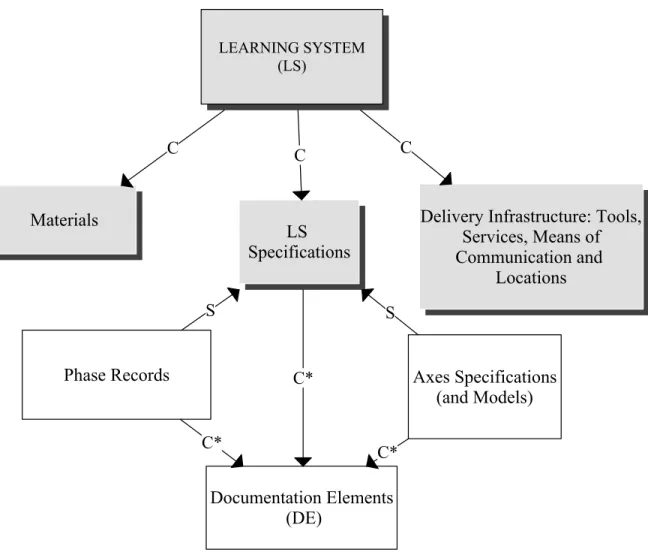
As shown in Figure 1 on page 4, a learning system (course, module, instructional activity, program, etc.) has three components:
The LS specifications produced with the MISA Method. LS specifications are made up of a series of selected documentation elements (DE). These can be grouped in phase records or in axis specifications (see p. 7 on this subject) The materials intended for the LS actors (program, course, activities). LS actors include learners, instructors, content experts and/or managers. LS materials are produced according user-defined LS specifications.
The delivery infrastructure. The delivery infrastructure defines the tools, services, means of communication and locations required to deliver the LS.
LEARNING SYSTEM (LS)
Materials
LS
Specifications
Delivery Infrastructure: Tools,
Services, Means of
Communication and
Locations
Phase Records
Documentation Elements
(DE)
C C CAxes Specifications
(and Models)
C* C* C* S SFigure 2 Learning System Components
Engineering Approach
The Learning System (LS) engineering process covers all the LS's design activities, from identifying the learning and training needs to implementing the final product that will enable learners to acquire the knowledge sought.
The instructional design approach makes it possible for the various people involved in producing a LS to work effectively together and make the right decisions throughout the development process. The MISA Method enables the actors to rely on structured activities, to define milestones for tracking the project's progress and to create more and more concrete representations of the LS.
Delivery Management LS Engineering Project Management
Learning System
Engineering
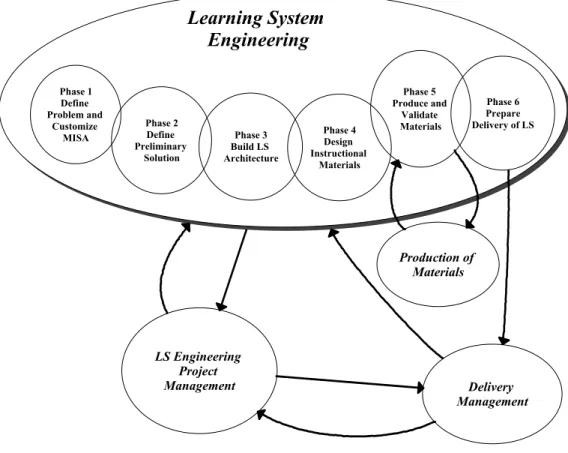
Phase 4 Design Instructional Materials Phase 5 Produce and Validate Materials Phase 6 Prepare Delivery of LS Phase 3 Build LS Architecture Phase 1 Define Problem and Customize MISA Phase 2 Define Preliminary Solution Production of MaterialsFigure 3. Phase-Based Design of a LS
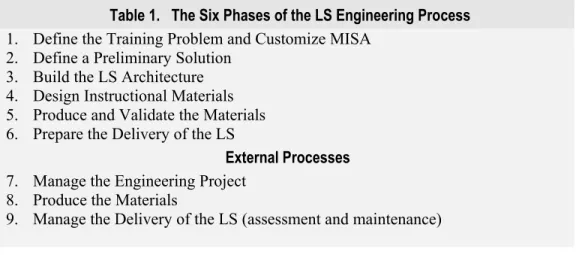
As shown in Figure 3, the LS engineering process includes six phases related to three external processes. The Method's external processes manage the engineering project, produce the materials and manage the implementation and delivery of the LS, especially in terms of monitoring the results and maintaining quality. As we will see later, data are exchanged bilaterally between MISA 4.0 and these external processes. Besides phase-based progression through MISA 4.0, LS designers have two other independent or complimentary ways of developing an LS, i.e. using axis-based progression and/or DE-based progression.
Three Independent or Complimentary Ways of Progressing through the MISA 4.0 Method
DE-based progression (documentation elements) (see p. 6) Axis-based progression (see p. 24)
Table 1. The Six Phases of the LS Engineering Process
1. Define the Training Problem and Customize MISA 2. Define a Preliminary Solution
3. Build the LS Architecture 4. Design Instructional Materials 5. Produce and Validate the Materials 6. Prepare the Delivery of the LS
External Processes
7. Manage the Engineering Project 8. Produce the Materials
9. Manage the Delivery of the LS (assessment and maintenance)
2. Documentation Elements (DE)
Documentation elements (DE) are the product of various MISA 4.0 development steps. They describe the knowledge and competencies targeted by the LS, its learning events, the instructional materials, tools and means of communication used as well as its delivery services and locations.
Some of the DEs can be grouped in the axis specifications should the designers choose the axis-based approach of progressing through MISA or in the phase records should the phase-based approach be adopted (see p.40).
The designer could also use the direct approach, progressing from one documentation element to the next. This choice will be based on the customization principles described on page 61.
DEs are produced using graphic models or form-type templates.
The graphic models, especially knowledge models, learning event networks, instructional scenarios, material development models and delivery models, show the relationships linking LS components.
Forms describe the properties of objects mentioned in the Method or graphic models.
Identifying DEs
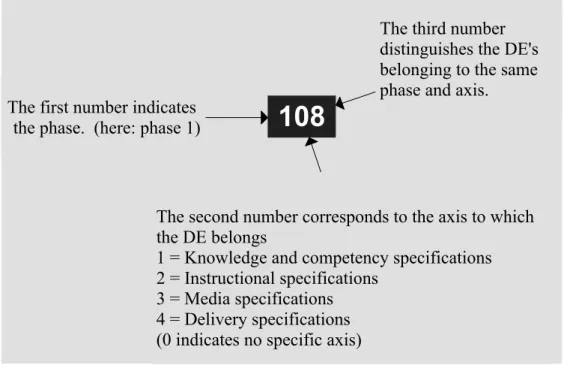
Each documentation element is identified by a three-digit ID that indicates its relative position within the approach.
108
The third number distinguishes the DE's belonging to the same phase and axis.
The first number indicates the phase. (here: phase 1)
The second number corresponds to the axis to which the DE belongs
1 = Knowledge and competency specifications 2 = Instructional specifications
3 = Media specifications 4 = Delivery specifications (0 indicates no specific axis)
Expanding DEs
Certain DEs are termed expanding DEs because they may be completed or modified in later phases. When such is the case, the phase number is added to distinguish the DEs in various stages of completion. For example, the Knowledge Model (DE 212) is produced in Phase 2. Subsequently, the production in Phase 3 of sub-models associated to the learning units (DE 310: Learning Unit Content) may make it necessary to revise the previously created Knowledge Model. It then becomes DE 212-3.
Breakdown of DEs by Axis and Phase
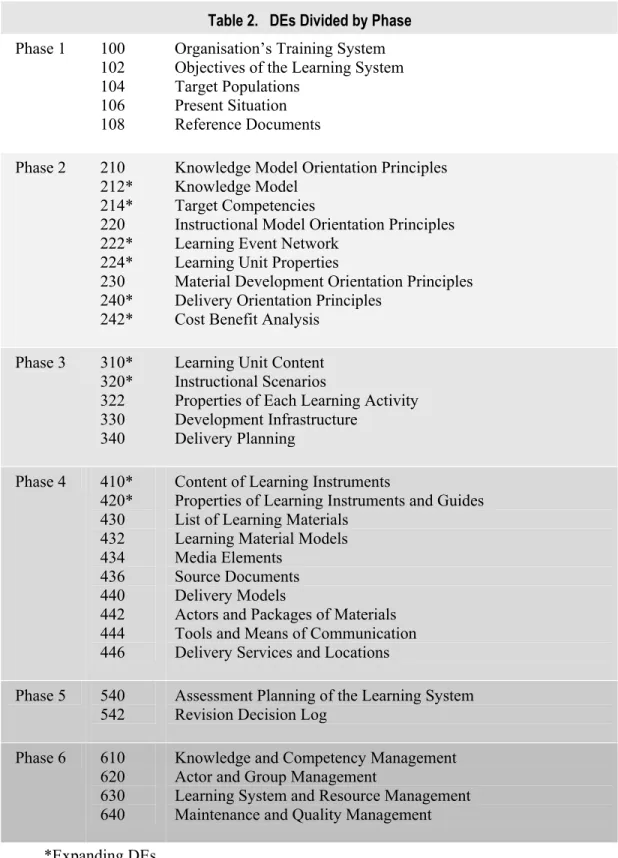
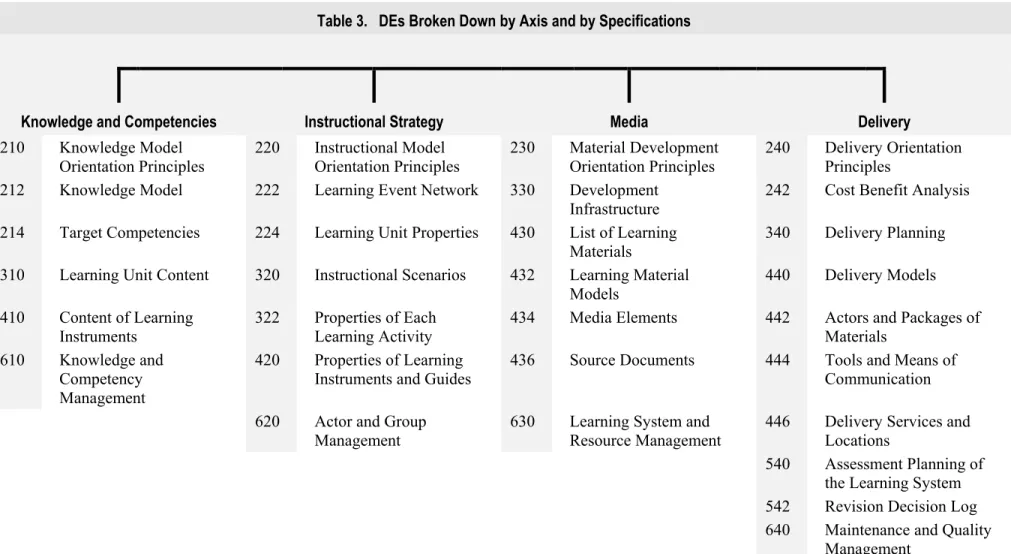
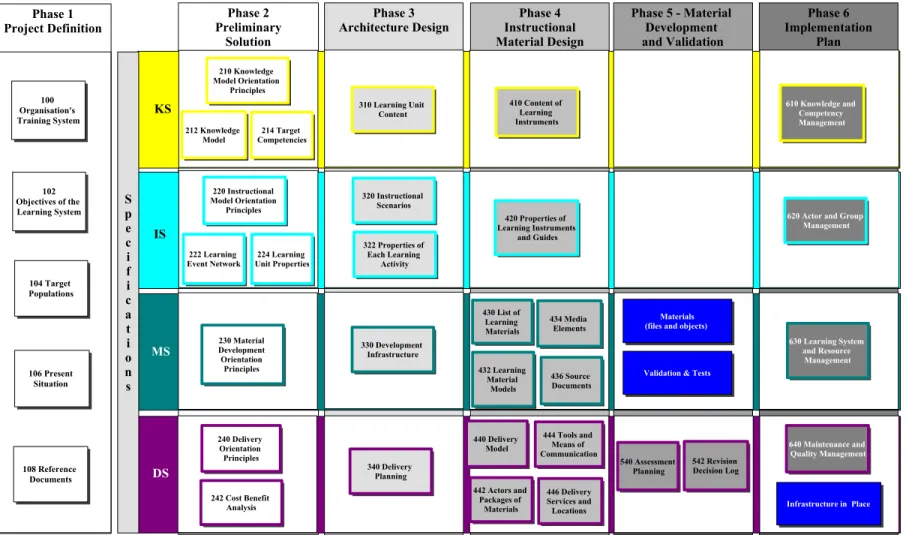
Table 2 shows the DEs broken down by phase, and table 3 by axis. Figure 4 shows the DEs by phase (columns) and axis (rows).
Axis-based progression through MISA 4.0 is discussed in Part IV (p.24) and phase-based progression, in Part V (p.40).
Table 2. DEs Divided by Phase Phase 1 100 102 104 106 108
Organisation’s Training System Objectives of the Learning System Target Populations Present Situation Reference Documents Phase 2 210 212* 214* 220 222* 224* 230 240* 242*
Knowledge Model Orientation Principles Knowledge Model
Target Competencies
Instructional Model Orientation Principles Learning Event Network
Learning Unit Properties
Material Development Orientation Principles Delivery Orientation Principles
Cost Benefit Analysis Phase 3 310*
320* 322 330 340
Learning Unit Content Instructional Scenarios
Properties of Each Learning Activity Development Infrastructure Delivery Planning Phase 4 410* 420* 430 432 434 436 440 442 444 446
Content of Learning Instruments
Properties of Learning Instruments and Guides List of Learning Materials
Learning Material Models Media Elements
Source Documents Delivery Models
Actors and Packages of Materials Tools and Means of Communication Delivery Services and Locations Phase 5 540
542
Assessment Planning of the Learning System Revision Decision Log
Phase 6 610 620 630 640
Knowledge and Competency Management Actor and Group Management
Learning System and Resource Management Maintenance and Quality Management
Table 3. DEs Broken Down by Axis and by Specifications
Knowledge and Competencies Instructional Strategy Media Delivery
210 Knowledge Model Orientation Principles 220 Instructional Model Orientation Principles 230 Material Development Orientation Principles 240 Delivery Orientation Principles
212 Knowledge Model 222 Learning Event Network 330 Development Infrastructure
242 Cost Benefit Analysis 214 Target Competencies 224 Learning Unit Properties 430 List of Learning
Materials
340 Delivery Planning 310 Learning Unit Content 320 Instructional Scenarios 432 Learning Material
Models 440 Delivery Models 410 Content of Learning Instruments 322 Properties of Each Learning Activity
434 Media Elements 442 Actors and Packages of Materials
610 Knowledge and Competency Management
420 Properties of Learning Instruments and Guides
436 Source Documents 444 Tools and Means of Communication 620 Actor and Group
Management
630 Learning System and Resource Management
446 Delivery Services and Locations
540 Assessment Planning of the Learning System 542 Revision Decision Log 640 Maintenance and Quality
Phase 5 - Material Development and Validation Phase 6 Implementation Plan Phase 4 Instructional Material Design Phase 3 Architecture Design Phase 2 Preliminary Solution IS KS MS DS S p e c i f i c a t i o n s Phase 1 Project Definition 442 Actors and Packages of Materials 446 Delivery Services and Locations 212 Knowledge
Model Competencies214 Target
220 Instructional Model Orientation Principles 222 Learning Event Network 240 Delivery Orientation Principles 230 Material Development Orientation Principles 242 Cost Benefit Analysis 340 Delivery Planning 444 Tools and Means of Communication 310 Learning Unit Content 410 Content of Learning Instruments 420 Properties of Learning Instruments and Guides 432 Learning Material Models 434 Media Elements 540 Assessment Planning 440 Delivery Model 436 Source Documents 330 Development Infrastructure 542 Revision Decision Log Materials (files and objects)
Infrastructure in Place 210 Knowledge Model Orientation Principles 322 Properties of Each Learning Activity 430 List of Learning Materials 640 Maintenance and Quality Management 224 Learning Unit Properties 630 Learning System and Resource Management 620 Actor and Group
Management 610 Knowledge and
Competency Management
Validation & Tests
320 Instructional Scenarios 106 Present Situation 102 Objectives of the Learning System 100 Organisation's Training System 108 Reference Documents 104 Target Populations
KS = knowledge and competency specifications, IS = instructional specifications, MP = media specifications, DS = delivery specifications
3. MISA and Its External Processes
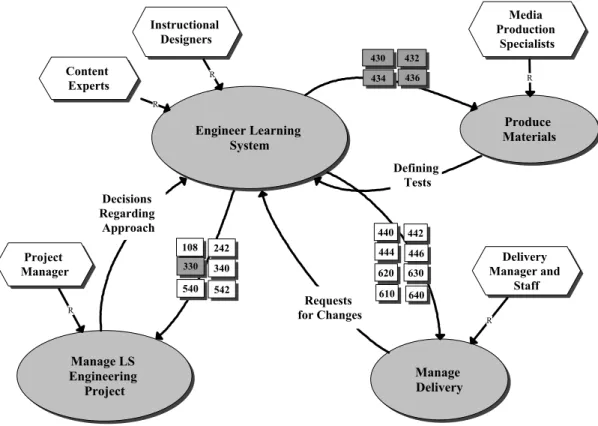
To complete this overview of MISA 4.0, we will set its boundaries by establishing the relationship with the three external processes shown in Figure 3. Figure 5 illustrates these relationships and points out the various actors* responsible for each process (R links*). Engineer Learning System Manage LS Engineering Project Manage Delivery Produce Materials 430 434 432 436 Project Manager R Content Experts Instructional Designers Media Production Specialists Delivery Manager and Staff R R R R 630 620 440 444 442 446 Decisions Regarding Approach Requests for Changes Defining Tests 640 610 340 108 330 542 540 242
Figure 5. Relationship Between MISA and Its External Processes
One or more actors called instructional designers or content experts are responsible for engineering the learning system. These are the principal users for which this method was developed. They provide the specifications (including one or more documentation elements) to other actors responsible for the three external processes: LS Engineering Project Management, Production of Materials, and Delivery Management. In return, designers receive data serving as instructional design input.
Production of Materials
The MISA 4.0 Method does not produce the LS materials but it does provide the graphic designers, programmers and media production team with the necessary specifications to produce or adapt the required materials (DE 430, 432, 434 and 436). Once the materials are produced, the method then provides for their validation and, when necessary, revision (DE 540 and 542), prior to preparing for their distribution.
LS Engineering Project Management
The MISA 4.0 Method is not a project management method but it does provide design project managers with the data required to manage a team endeavouring to design a learning system.
Documentation elements numbered 108, 242, 330, 340, 540 and 542 serve to define indispensable project management input. In return, the project manager, alone or in conjunction with the design team, will make decisions that will direct the instructional design activities and, ultimately, the production of materials for the LS.
Delivery Management
The MISA 4.0 Method stops where LS delivery begins, but among its most important tasks is to plan the implementation and delivery of the LS. The delivery specifications mostly contain a description of the delivery model(s) (distance education, classroom, self-paced learning, etc.) and their principal components: roles of the delivery actors; the packages of materials, tools and means of communication used; the support services provided; and the locations where these actors will be working (DE 440, 442, 444 and 446).
MISA's last phase is entirely dedicated to preparing the LS's delivery. It summarizes the design team's suggestions to make it easier to manage knowledge units and competencies, actors, learners and facilitators, LSs and their materials and finally LS assessment and quality maintenance (DE 610, 620, 630 and 640).
In return, the delivery manager and staff will gather requests for changes to be made to the LS. These requests will be sent to the instructional designers and content experts so they may begin another instructional design cycle using the MISA Method.
Skills and Terminology to Be Mastered!
MISA 4.0 users must develop a certain skill with modeling typed objects. Some of the Method's concepts require a little getting used to. Other somewhat better known concepts do need to be clarified. If you do not devote enough time to this step, it may take you more time to understand the MISA Method.
The method designers developed a certain terminology over several years of research in the field of instructional design and engineering. This terminology ensures consistency throughout the various documentation elements. Most of all, it enables everyone participating in the production of a LS to understand one another and speak the same language! You will find MISA 4.0. Concepts and Examples an invaluable tool in this regard.
The next Section discusses in greater detail the MISA 4.0 Method and MOT software.
II. MISA and MOT: For Learning System Designers
Part II reviews the features of the MISA 4.0 Method for Engineering Learning Systems and the MOT model editor for modeling and building several learning system specification components. We also present some of MISA 4.0's general orientation principles. These principles define the Method's fundamental theoretical approaches.
1. The MISA 4.0 Method for Engineering Learning Systems
MISA 4.0 (Méthode d'Ingénierie de Systèmes d'Apprentissage) intends to enhance the field of instructional design by integrating cognitive science concepts and processes. This Method stems from many advanced research projects in the field of instructional design and engineering. As generic processes common to several fields, design issues have indeed been the focus of numerous cognitive engineering research projects. The problems encountered by an architect, a physical systems engineer or a learning system designer do have some similarities. When designing their systems, each must take into account a number of constraints that are ill defined at the outset but become more clear once they are analyzed and as the design process progresses. By observing these experts solving design issues, it is possible to identify common strategic knowledge indicating the complexity of the problems faced.
MISA 4.0 is innovative in that it applies its research to defining operating principles governing the management of instructional design processes and instantiating these principles into thirty-five primary tasks and approximately one hundred and fifty secondary tasks.
MISA 4.0 also breaks new ground by using cognitive modeling techniques to present the learning system's knowledge units, instructional processing, media processing and delivery services.
MISA's Evolution Since 1987
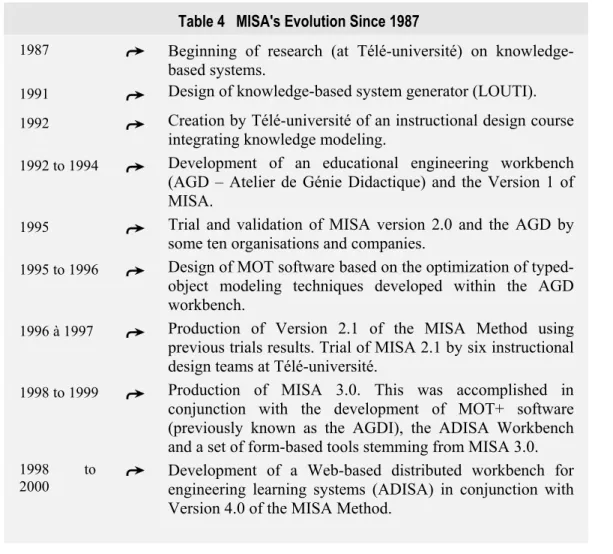
Version 4.0 of MISA is the end result of the Method's application to the development of learning services and products. Over the years, it has been perfected through a number of trials and validations. Table 4 MISA's Evolution Since 1987 on page 14 reviews the advances that have been accomplished thanks to various research and development projects.
Eight years of research has resulted in the development of a Method for Engineering Learning Systems (MISA – Méthode d'Ingénierie de Systèmes d'Apprentissage) and a set of support tools.
ADISA (Atelier Distribué d'Ingénierie de Systèmes d'Apprentissage) is a distributed workbench for engineering Learning Systems based on the MISA Method. ADISA includes fully integrated graphic editing (MOT) and form generation tools. This workbench is intended for LS designers, most specifically those making regular- use of multimedia and tele-learning technology. ADISA also includes high-performance tools that reduce both the time and cost of instructional design while ensuring consistency and quality control of the LS's various components.
ADISA is a distributed workbench in that the method and the tools are accessible using an Internet browser. Thus, many can work on the same project, at the same time or individually, using a networked or stand-alone workstation.
Table 4 MISA's Evolution Since 1987
1987
µ
Beginning of research (at Télé-université) on knowledge-based systems.1991
µ
Design of knowledge-based system generator (LOUTI). 1992µ
Creation by Télé-université of an instructional design courseintegrating knowledge modeling.
1992 to 1994
µ
Development of an educational engineering workbench (AGD – Atelier de Génie Didactique) and the Version 1 of MISA.1995
µ
Trial and validation of MISA version 2.0 and the AGD by some ten organisations and companies.1995 to 1996
µ
Design of MOT software based on the optimization of typed-object modeling techniques developed within the AGD workbench.1996 à 1997
µ
Production of Version 2.1 of the MISA Method using previous trials results. Trial of MISA 2.1 by six instructional design teams at Télé-université.1998 to 1999
µ
Production of MISA 3.0. This was accomplished in conjunction with the development of MOT+ software (previously known as the AGDI), the ADISA Workbench and a set of form-based tools stemming from MISA 3.0. 1998 to2000
µ
Development of a Web-based distributed workbench for engineering learning systems (ADISA) in conjunction with Version 4.0 of the MISA Method.An Outstanding, Practical, Comprehensive, Open Method
We have already mentioned that MISA 4.0 makes the engineering process easier to understand and more consistent while facilitating communication between the learning system (LS) production team members. This LS Design method provides many other advantages. Here are the main advantages with regard to selection of learning systems (types, instructional materials and strategies, target populations), to LS engineering and engineering process management.
Supports a Wide Range of Learning Systems
MISA 4.0 can process any field of knowledge as well as the learning of techniques or development of attitudes. For example, it could be used in a variety of environments: educational, industrial, commercial, etc.
This method makes it possible to deliver the LS face-to-face in a classroom, at a distance in a collaborative group or self-paced learning format.
The same LS project can support different target populations and learning scenarios* can be customized according to the category of learner.
MISA 4.0 adapts well to a variety of instructional materials, tools and means of communication as well as delivery services and locations.
Learning System Engineering
MISA 4.0 covers all LS development activities, from analyzing needs to preparing for implementation.
Although it rationalizes the approach to LS engineering, MISA 4.0 does not interfere with the designers' creativity, especially with regard to development of material production and instructional strategy.
MISA's four groups of principles afford flexibility and consistency. (See p. 18). The Method does not progress in a linear but an iterative pattern, i.e. it
frequently "returns" to previous work.
MISA 4.0 is used to its best advantage when designing complex LSs. It represents and organises information into a coherent system through graphic modeling.
Engineering Process Management
The MISA 4.0 structure maintains continuous control on the quality of the processes and the resulting products.
Many LS specification components created by MISA 4.0 may be easily reused from one project to the next, representing a major saving in terms of effort, cost and resources.
All LS documentation may be collated into a single modular, flexible record. This record can include phase records, specifications, axes or various
2. MOT and Object-oriented Modeling
Cognitive science research has made it possible to distinguish certain types of knowledge units* and links*. Links are defined based on the rules governing the relationships between the knowledge units. MOT (Modélisation par Objets Typés), like its more advanced version MOT+, is a sophisticated model builder equipped with a toolbox of specific shapes for each type of knowledge and link. MOT also comprises a grammar all its own to govern the relationships between the various types of knowledge.
Used in conjunction with MISA 4.0 or integrated with ADISA, MOT highlights the nature and structure of the four axes of the LS design method. The particular knowledge in each of the axes as well as the relationships between them are graphically illustrated in a format making the designer's ideas easier to understand and communicate (See Figure 6, p.24 ).
MISA 4.0's Four Axes
Knowledge and Competency Axis Instructional Axis
Media Axis Delivery Axis
Axis-based progression through MISA 4.0 is presented on page 24.
The MOT editor also enables you to perform the following tasks:
Add, if applicable, a sub-model (drill-down model) detailing each of the knowledge units.
Expand a domain model to as many levels as the LS designer may require to make the model clear.
Filter the knowledge units or links displayed in a model.
Generate a vicinity model of a knowledge unit. MOT reviews all the sub-models where the knowledge unit is used. It then builds into the same graphic
representation the models illustrating the relationships between the selected knowledge unit and all the other units in the sub-models.
Create OLE* links to associate various documents to a knowledge unit, e.g. texts, slide presentation, Web browser, electronic spreadsheet, databases, etc.
MOT is particularly suited to LS engineering as this requires that the content of the learning domain, the various types of knowledge and the types of models be clearly identified in order to provide the right focus for the instructional and media specifications as well as the LS implementation plan.
In MISA 4.0, the MOT editor helps to produce three other types of models in addition to the knowledge model:
The LS Instructional Model (learning event network and instructional scenarios).
The Learning Material Model (media component structure and transition actions).
The Delivery Model (delivery actors, their roles, and interaction among themselves and with infrastructure resources).
The MOT editor can be used in fields other than LS engineering. It is also suited to the following tasks:
Producing a graphic summary of a long document. Reengineering processes based on their previous models.
Designing methods by modeling ideas before producing their related documents. Experience with the MOT editor has also demonstrated that modeling promotes a cognitive re-organisation of ideas and their inter-relationships. It has also shown that MOT models make it easier for the designer to communicate his ideas to whoever reads his model.
This is how the MISA Method came to be devised. It is entirely modeled using MOT. The model guarantees consistency and helps to visualize MISA's various processes.
MOT Software User's Guide
To learn more about MOT software and discover its many useful functions, see MOT Software User's Guide.
3. MISA's General Orientation Principles
MISA 4.0 can be customized to suit the needs of the LS designer whatever the size of the organisation, the type or scope of the LS to be designed or the available human, material and financial resources. The designers do not have to produce all the DEs, go through all the steps, develop all the axes or perform all the Method's tasks. The flexibility and consistency of the design approach offered by MISA 4.0 is largely based on four groups of principles.
Four Groups of Principles at the Basis of MISA 4.0
General orientation principles
Axes coordination principles (see p. 37) Customization principles (see p. 61) Phase progression principles (see p. 63)
The general orientation principles define the theoretical approaches (rationale) behind MISA 4.0. These principles make it possible to vary the instructional approaches used to build the LS as well as its delivery mode and support media.
Diversity of Instructional Approaches
Learning is processing information and building knowledge by one-self. MISA 4.0 promotes this cognitive and constructive approach to learning, and consequently the creation of learning activities based on problem solving and carrying out complex projects or tasks.
Cognitive and constructive principles can sometimes translate into a variety of instructional approaches and strategies. The MISA design approach affords the instructional designer much freedom in this regard. It can therefore be used to design learning systems using a reception/exercise approach—one strategy among many—that will call upon a mere fraction of the mechanisms provided by the Method.
Diversity of Delivery Modes
With MISA 4.0, the LSs you design can be delivered in various ways: Face-to-face or at a distance;
With or without the use of information and communication technology; In a self-paced or group learning environment;
With or without collaborative activities.
When defining the delivery orientation principles and, indeed, throughout the engineering process, the LS designer must take into account the selected delivery mode.
Diversity and Seamless System Integration of Support Media
A learning system can consist of a package of materials available on various support media or integrated into an interactive multimedia CD, Web site or a combination of both (CD/Web). This is termed a stand-alone LS.
On the other hand, the LS can be integrated into a computer-based production support system, it then becomes a computer-assisted performance system. It could also be integrated into a complex technological infrastructure for the purposes of distance education and collaborative learning. MISA's goal is to make the design task easier. That is why many of its documentation elements can be written based on the host system's specifications.
The integration of the LS into another system requires special care be taken when coordinating its development tasks with computer development and/or technological implementation tasks. It is up to the project manager to ensure the seamless integration of related LS projects to ensure the availability of the content, hardware and test schedules of the computer systems.
MISA 4.0 covers all LS development activities, from analyzing needs to preparing for implementation.
MISA innovates by applying the findings of advanced instructional design and engineering research to the definition of operating principles governing instructional design process management. MISA 4.0 also breaks new ground by using cognitive modeling techniques to represent knowledge units as well as instructional, media and delivery specifications.
MISA is supported by leading-edge computer tools.
ADISA (Atelier Distribué d'Ingénierie de Systèmes d'Apprentissage) is a distributed workbench supporting the instructional design tasks based on the MISA Method. It includes related graphical editing (MOT) and templates.
MOT (Modélisation par Objets Typés) is a sophisticated model builder. Used in conjunction with MISA 4.0 or integrated with ADISA, MOT highlights the nature and structure of the four axes of the MISA LS design method making the designers' ideas easier to understand and communicate.
MISA, ADISA and MOT result from over a decade of research, testing and validation that was conducted by LICEF.
The next part gives advice on managing a LS engineering project.
III. Advice on Managing a LS Engineering Project
Part III gives some advice on how to manage an engineering process using the documentation elements and how to organise the assessment, architecture and development teams to ensure the success of your learning system engineering projects.
1. DE-Based Management
MISA 4.0 does not include specific project management techniques. However, certain of its documentation elements (DE) were designed to support project management, especially with regards to training project planning and team coordination.
Planning
The five DEs in Phase 1 enable you to define the training problem and customize MISA by selecting the tasks and their related aspects that will be developed during the other phases.
DE 100. Organisation’s Training System DE 102. Objectives of the Learning System DE 104. Target Populations
DE 106. Present Situation DE 108. Reference Documents
In the other phases, the goal of planning activities is to produce work plans. The planning is repeated several times during the project (it is iterative), providing at the end the necessary plans for implementing the LS. On-going planning enables the project manager to direct the LS's development.
Team Coordination
The following DE's provide the principal elements needed to coordinate the teams and manage the development of learning materials during the development of the LS.
DE 242. Cost-Benefit Analysis DE 330. Development Infrastructure DE 340. Delivery Planning
DE 540. Assessment Planning of the Learning System DE 542. Revision Decision Log
Planning development based on delivery leads to forming teams based on the products to be produced instead of on the roles played by the team members. The teams are generally multidisciplinary.
In collaboration with team mates, each team member is assigned a specific role in the delivery of the product for which the team is responsible. The distribution of roles, tasks and responsibilities is clearly stated so that each team member knows what must be done and in how much time. This distribution also (and especially) avoids task duplication.
2. Required Teams for Engineering Projects
In major projects, many teams may work together. An assessment team.
An architecture and design team. A development team.
An administrative and management support team.
All design projects should include at least three of these teams, i.e. an assessment team, an architecture team and a development team.
Assessment Team
This team represents the client organisation and ensures the project satisfies the client's needs and priorities. It generally includes learners, instructors, supervisors, managers and anyone else for whom the LS is being created.
Principal Responsibilities of the Assessment Team
Obtain data and information necessary for the development of the LS, for example, the expected number of learners, the characteristics of the target populations or information on organisational culture.
Design, document and schedule LS trials. Conduct trials and check results.
Obtain information for writing the reports. Prepare and coordinate the LS implementation.
Architecture and Design Team
This team comprises a number of experts and a team leader also called the system architect. When a major LS is planned, five or six full-time team members may be required. These are MISA's main users. Depending on the type and complexity of LS to be created, the team may include instructional experts, computer and technology infrastructure experts, media specialists, and organisational development or human resource experts.
Principal Responsibilities of the Architecture and Design Team
Participate in the preliminary analysis and design of the LS as well as the creation of its architecture to ensure consistent design at all levels. Develop one or more preliminary solutions to the training problem by defining the orientation principles of the four models making up the LS: the Knowledge Model, the Instructional Model, the Learning Material Model and the Delivery Model.
Develop and maintain all the products resulting from the LS architecture. Define the development team's mandate and assist in launching the process. Participate in meetings related to requests for change.
Ensure the consistency and efficiency of the products delivered by the development team.
Development Team
This team includes a team leader and a number of human resources that vary depending on the type of LS to be designed (classroom, distance, computer-based) and the type of instructional materials to be produced (print, Web site, tutorial, simulation tool, etc.). There may be instructional technologists, system ergonomics analysts, instructional designers, programmers, technical writers, multimedia designers, art director, etc.
Principal Responsibilities of the development team
Develop the instructional materials for a delivery.
Provide support to those in charge of trials and the departments responsible for implementing the LS.
Revise the instructional materials according to the requests for changes and the trials conducted: instructional trials, content trials or functional trials. Code the software components, provide technical support to those in charge of functional trials, and implement the LS infrastructure (Programmers). Draw up the plans for the instructional instruments, describe the learning unit scenarios for a delivery, revise materials (instructional content and
description of organisational infrastructure). (Instructional designers). Ensure the media quality of the materials (validation and revision), edit texts and graphics, produce audio and video segments, and multimedia
presentations. (Media Production Designers).
Even if MISA 4.0 does not include specific project management techniques, some of the DEs provide LS development management support in such areas as project planning, team coordination and learning material development management.
Part III also discussed the responsibilities of the design project teams, specifically the Assessment Team, the Architecture and Design Team and the Development Team.
Part IV reviews axis-based progression through MISA 4.0.
IV. Axis-Based Progression Through MISA
Part IV presents the four axes, the related models and specifications, and the coordination principles governing an axis-based progression through the MISA Method. Remember that the LS designer can choose whether the progression in MISA 4.0 is to be based on documentation elements, axes or phases. (See p. 5).
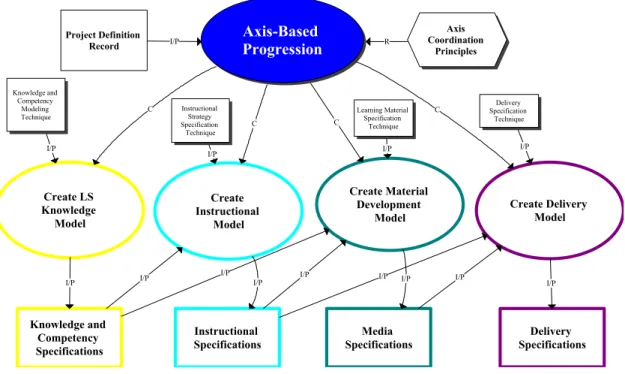
Create LS Knowledge Model Create Instructional Model Create Material Development Model Create Delivery Model Axis-Based Progression C C C C Knowledge and Competency Specifications Delivery Specifications Instructional
Specifications SpecificationsMedia
I/P I/P I/P
Axis Coordination
Principles
R
I/P
I/P I/P I/P I/P I/P
Project Definition
Record I/P
Knowledge and Competency
Modeling
Technique Instructional Strategy Specification Technique Learning Material Specification Technique Delivery Specification Technique I/P
I/P I/P I/P
Figure 6. Axis-Based LS Specifications
Each of the ovals in Figure 6 represents a procedure to be followed to produce an axis specification. The I/P link indicates that the production of the axis specification serves as input (prerequisite) to that of the following specification.
Four
techniques for four
procedures…
Each axis corresponds to a specific technique, i.e. knowledge and competency modeling, instructional specification design, media specification design and delivery specification design.
Four basic structures…
LSs can be very simple or very complex. The degree of complexity can show in different ways in the four basic structures found in the LS: knowledge and competencies, instructional activities, media and LS delivery.
Four models…
MISA 4.0 designers therefore provided four types of models to analyze the interactions within and between each of these specialized structures. These models are the Knowledge Model (including competencies), the Instructional Model (LEN and Instructional Scenarios), the Learning Material Model (media structure) and the Delivery Model.
Four types of
designers… In large project teams, each of these models may be developed by different specialists: content specialists, instructional technologists, media designers, delivery specialists.
1. The Four Models
Knowledge ModelThe Knowledge Model defines and structures the knowledge and skills as well as the competencies to acquire. It is created to serve as a basis for decisions related to the instructional approach and media support as well as the infrastructures and services for delivering the LS. In order to set clear boundaries for the Knowledge Model, the designer must avoid including Instructional Model elements such as information on the instructional materials and activities.
The Corner Stone of the LS
Since the Knowledge Model is created separately from the other models, it is the corner stone of the LS. The stability of the Knowledge Model makes it possible to change the LS without redesigning it, for example by modifying the LS's learning and instructional process or its delivery.
Instructional Model
The Instructional Model describes the learning events, learning activities and resources, and their interactions. It also describes the path the learners must follow to acquire knowledge. The Instructional Model is independent of the media, infrastructure and services chosen to help learners acquire the knowledge.
For example, a Learning Scenario may indicate that a learner is to simulate a certain phenomenon. However, only when the Learning Material Model will be produced, that the designer will decide if the simulation will be done on a computer or in a laboratory.
Learning Events*. Ex. Unit. Course. Programme.
Resources*. Ex.Learning guide. Case study. Learners' work.
Services*. Ex. Technical software support. Instructor assistance. Lecture.
Learning Scenario*. Ex. Set of activities in which learners assemble an electronic circuit. Software tutorial. Financial analysis case study serving as a basis for analyzing similar cases.
The Instructional Model provides the Learning Material Model with a general plan and a usage context.
Learning Material Models
Learning Material Models describe the internal structure (components and media elements) of the principal instructional materials in the LS in terms of the knowledge units discussed, the instructional approach used and the production and delivery constraints needing to be addressed. The Learning Material Model is the LS in its concrete form. It enables the LS designer to communicate to the development team the needs in terms of material production arising from the considerations defined in the various DEs and the other LS axis models.
Delivery Models
Delivery Models link materials, tools, means of communication, locations and services (including service suppliers) required by the users during LS delivery.
Delivery Models are independent of the Learning Material Models. The designer can choose to present any given instructional material, for instance multimedia educational software, in a classroom, distribute it on CD or floppy disk (self-paced learning) or store it on a server for Web delivery of a distance education course.
The fact that the models are relatively independent of one another makes LS maintenance and development easier. In most instances, only certain sections of the LS (modular reengineering) will need to be reviewed or redone. This feature also makes it possible to reuse certain LS components in other projects.
Relative Importance of Each Model
The relative importance of the four models varies according to the type of LS to be designed especially with regard to the nature and scope of the competencies to be achieved by the learners.
In a simple LS, the expected learning and competencies could be limited to memorizing certain facts. In that case, the Knowledge Model could be reduced to a set of concepts* joined by composition links (is composed of…) and specialization links (is a sort of…). The Instructional Model would also be fairly simple. However, if the designer decides to produce a multimedia presentation, the Learning Material Model will be more complex. When the LS is not very complex, one person could sometimes build it in a relatively short time, possibly even a week.
It is when the LS is complex that the designer can truly appreciate MISA 4.0's full potential. A complex LS can comprise one or several courses using multiple Instructional Scenarios* and Instructional Materials on various support media. It can be delivered in various modes, e.g. distance education, self-paced learning* or electronic performance support systems (EPSS).
Whatever the scope of the LS to be designed, the MISA Method enables the designer to make consistent choices in all four axes. It also facilitates LS update and maintenance and even the recycling of certain components. You can divide a complex training problem into simpler sub-systems and distribute the work among the LS team members.
With MISA 4.0, the entire design approach is visible through the models and broken down by specialized axis. This facilitates communication between the LS architect and the client and makes it possible to deliver the LS progressively as each part of the specifications is completed. This type of delivery enables quality control and development cost control.
2. Axis Specifications
Once the learning system's project definition record is completed, the designer can progress through MISA using the axes. As shown, in Figure 6. Based on the four axis specifications, you can define the LS specifications (see Figure 2, p. 4). Table 5, below, associates the model and specifications belonging to each axis.
Table 5. 4 Axes, 4 Models and 4 Specifications
Axis Model Specifications
1 Knowledge and Competency
Knowledge Knowledge and
Competency
2 Instructional Instructional Instructional
3 Media Learning Material Media
Establishing the Orientation Principles
The definition of each axis begins with its orientation principles. These are an important product of the Method, especially if there are several designers involved. The orientation principles set the guidelines the entire team must follow when building the Knowledge and Competency Model (DE 230), the preferred instructional approach (DE 230), the choice of media (DE 230) and the delivery modes (DE 240).
In DE 210, the orientation principles provide a basis for developing a structured Knowledge and Competency Model encompassing the LS's target knowledge and competencies.
In DE 220, the instructional orientation principles govern the definition of learning events*, learning units*, and learning activities* as well as that of the resources* and instruments* that go into their creation or result from them. These principles guide the instructional approach, evaluation, learner collaboration and customization of the Instructional Scenarios*.
In DE 230, using the Material Development Orientation Principles, you can make a preliminary list of materials that will assist you in assessing the costs of the LS (DE 242). If applicable, these principles can be revised in phases 3 and 4 to account for instruments in the Instructional Scenarios (DE 320) and their properties (DE 420). These principles also make it possible to prepare for the description and production of instructional materials.
DE 240, Delivery Orientation Principles deal mainly with the human resources, services and locations required for the delivery of the LS, and the LS's means of communication and tools. These elements will prove useful for analyzing costs (DE 242). Instructional Scenarios and the properties of each learning activity are incorporated into these principles in Phase 3 so as to establish the Development Infrastructure (DE 330) for material production, Delivery Planning (DE 340) and the various Delivery Model elements (DE 440, 442, 444 and 446). Building Axis Specifications
The autonomy and coordination of its four axes are the corner stone of the MISA Method. Each axis comprises one or more graphical models, and several templates (DEs) that describe the properties of the objects represented in those models. The axes' coordination principles are explained on page 37.
Let us now discuss the content of the specifications of each axis. To make this Section easier to understand, we have included a few definitions or examples of the MISA 4.0 concepts. However, for further information, we encourage you to refer to MISA 4.0 Concepts and Examples. For the sake of brevity, the explanations of the DEs associated with the orientation principles of each axis, and LS management that have been previously given, will not be reiterated in each axis.
Axis 1. Knowledge and Competency Specifications
Figure 7 shows the various components making up the Knowledge and Competency specification.
Knowledge and competency specifications include the Target Competencies (DE 214) and the Knowledge Model visualizing the LS content. This graphical representation is subdivided into sub-models describing in greater detail the Knowledge Model (DE 212), Learning Unit Content (DE 310) and the Content of Learning Instruments (DE 410).
A learning unit* is a basic component of the LS. It
encompasses activities making it possible to acquire knowledge and its related skills.
An instrument* makes the
knowledge to be acquired available in the form of information to refer to, use or produce. Ex. Lecture. List or table. Template. Diagram. Graph. Case study. Representation of physical objects. 212 (3) Knowledge Model 214 (3) Target Competencies 310 (6) Learning Unit Content 410 (6) Content of Learning Instruments 212 Knowledge Model 214 Target Competencies 310 Learning Unit Content 410 Content of Learning Instruments Knowledge and Competency Specifications C C C C LS Knowledge Model C 210 Knowledge Model Orientation Principles 610 Knowledge and Competency Management C C
Table 6. List of DEs Produced by the Knowledge and Competency Axis 210 212 and 212-3 214 and 214-3 310 and 310-6 410 and 410-6 610
Knowledge Model Orientation Principles Knowledge Model
Target Competencies Learning Unit Content
Content of the Learning Instruments Knowledge and Competency Management
Axis 2. Instructional Specifications
Figure 8 shows the components that make up the instructional specifications. The instructional specification comprises the
Instructional Model, which is composed of the Learning Event Network or LEN (DE 222) and the Instructional Scenarios (DE 320).
Each learning unit (LU) of the LEN has an associated Instructional Scenario in the form of a model that structures its activities, resources and directions intended for learners or facilitators (instructors, informational sources, managers, etc.), according to the Delivery Orientation Principles.
Learning Event Network*. Ex. Series of three computer classes to be followed in a pre-established order. Modular Web-based course with hyperlinked topics enabling navigation in all directions.
An instructional scenario* is made up of a learning scenario and scenario of assistance.
Instructional specifications also include the Learning Unit Properties (DE 224), the Properties of Each Learning Activity (DE 322) and the Properties of Learning Instruments and Guides (DE 420).
Learning scenario*. Ex. Set of activities where learners assemble an electronic circuit. Multimedia software on the Internet that simulates certain similar real-life situations. The learner applies acquired knowledge to predict the result in new situations.
Guide*. Ex. Learning guide. Tutorial. Introductory tour of software.
Scenario of assistance*.Ex. Learning by problem solving, including advice on methodology given by the instructor. Learning by case study.
320 (6) Instructional Scenarios 420 (6) Properties of Learning Instruments and Guides 222 (3) Learning Event Network (LEN) Instructional Specifications 220 Instructional Model Orientation Principles 222 Learning
Event Network 320 Instructional Scenarios
420 Properties of Learning Instruments and Guides C C C C Instructional Model C 620 Actor and Group Management 322 (6) Properties of Each Learning Activity 322 Properties of Each Learning Activity 224 (3) Learning Unit Properties 224 Learning Unit Properties C C C
Figure 8. Instructional Specification Components
Table 7. List of DEs Produced by the Instructional Axis
220 222 and 222-3 224 and 224-3 320 and 320-6 322 and 322-6 420 and 420-6 620
Instructional Model Orientation Principles Learning Event Network
Learning Unit Properties Instructional Scenarios
Properties of Each Learning Activity
Properties of Learning Instruments and Guides Actors and Group Management
Axis 3. Media Specification
Figure 9 shows the components that make up the Media Specification. The Media Specification indicates to the LS
manager the human and material resources that will be required to design and produce
the LS (DE 330: Development
Infrastructure). It is also within the framework of this specification that the designer will list the materials to produce for the LS (DE 430) (Web sites, multimedia documents, educational software, texts, video segments, etc.) and identify the properties of instruments and guides based on the list in DE 222 or in the Instructional Scenarios (DE 320).
Media component*. Section, page or segment of an instructional material that may be divided into smaller media components or elements.
Media element*. Instructional material component that can be associated to a source document. Ex. Video segment. Picture. Sound track. Titles and sub-titles of a Web site's home page.
The designer then creates a graphic representation of the structure and content of the most important materials (DE 432: Learning Material Models).
The media components that have yet to be broken down to their media elements are detailed using sub-models.
The designer then describes the properties of the source documents and of the media elements appearing in the Learning Material Model (DE 434: Media Elements).
Source document*. Document (file) that is associated with a media element and provides its content. This document is defined by one or more objects of the Instructional Model or the Delivery Model. Ex. Instruments. Guides. Services. Means of communication. Graph. Direction.
434 (6) Media Elements 230 (4) Material Development Orientation Principles 230 (3) Material Development Orientation Principles 430 (6) List of Learning Materials 432 (6) Learning Material Models Media Specifications 230 Material Development Orientation Principles 432 Learning
Material Models 434 Media Elements
C C C 330 Development Infrastructure C 436 Source Documents C 430 List of Learning Materials 630 Learning System and Resource Management C C
Figure 9. Media Specification Components
Table 8. List of DEs Produced by the Media Axis
230, 230-3 and 230-4 330 430 and 430-6 432 and 432-6 434 and 434-6 436 630
Material Development Orientation Principles Development Infrastructure
List of Learning Materials Learning Material Models Media Elements
Source Documents
Axis 4. Delivery Specifications
Figure 10 shows the components that make up the Delivery Specification. Delivery Models (DE 440) highlight the relationships between Actors and Packages of Materials (DE 442), Tools and Means of Communication (DE 444), Delivery Services and Locations (DE 446) that will be used or made available.
In addition, these specifications contain the trial and test plan (DE 540: Assessment Planning of the Learning System) describing the objects being assessed and the criteria used to assess each delivery of the LS (DE 340: Delivery Planning). They also include the Revision Decision Log (DE 542) that provides the manager with data related to changes to be made to the assessed LS product. This log makes it easier to evaluate and track requests for change.
Actor. Ex. Learner. Instructor. Informant. Manager. Designer. Packages of Materials*. Ex. Web site giving access to course materials. Box of printed materials, cassettes, floppy disks and support materials for the instructor or manager.
Tools. The tools enable the user to perceive or process the information required for performing one or more scenario activities. Ex. Scissors. Microscope. Radio or television set (non-computerized tools). Computer. Peripherals. Application Software Packages (computerized tools).
Means of communication. Ex.
Telecommunications network connecting a set of computers and offering different computer services (telematic means of communication). Face-to-face
communication. Postal/telephone/fax communication (non-telematic communication).
Services. Ex. Services of an instrument attendant. Lecture. Instructor assistance. Location. Ex. Classroom. Home. Workstation. Laboratory. Conference room (company, hotel, etc.).
440(6) Delivery Model 444(6) Tools and Means of Communication 446(6) Delivery Services and Locations 442(6) Actors and Packages of Materials 242 (4) Cost-Benefit Analysis 240 (3) Delivery Orientation Principles Delivery Specifications 442 Actors and Packages of Materials 446 Delivery Services and Locations 240 Delivery Orientation Principles 242 Cost-Benefit Analysis 444 Tools and Means of Communication 640 Maintenance and Quality Management C C C 440 Delivery Model 340 Delivery Planning 542 Revision Decision Log 540 Assessment Planning C C C C C C
Figure 10. Delivery Specification Components
Table 9. List of DEs Produced by the Delivery Axis
240 and 240-3 242 and 242-4 340 440 and 440-6 442 and 442-6 444 and 444-6 446 and 446-6 540 542 640
Delivery Orientation Principles Cost-Benefit Analysis
Delivery Planning Delivery Models
Actors and Packages of Materials Tools and Means of Communication Delivery Services and Locations
Assessment Planning of the Learning System Revision Decision Log
Maintenance and Quality Management Submitting Recommendations for Each Axis
When an axis is completed, the instructional design team submits its recommendations to the client organisation, specifically to the LS project manager. These
recommendations are recorded in DE 610, 620, 630 and 640 and cover the following points:
(DE 610): Research, update and reuse of knowledge and competencies linked with the learning units (LU) and the materials that encompass them.
(DE 620): Registration and facilitator management, organisation of groups, and learning evaluation.
(DE 630): Archiving and updating the LS and its components (specifications, packages of materials and other resources) as a design and delivery support mechanism. These recommendations also serve to make packages of materials and other resources available to learners and facilitators and deal with the issue of LS promotion for the purpose of maximizing its use.
(DE 640): The implementation of the first delivery, on-going quality control of the LS and its resources, and preparation of periodic revisions of LS
4. Axis Coordination Principles
Axis coordination principles define the interactions between the LS's four previously discussed components, i.e. the Knowledge and Competency Model, the Instructional Model, the Learning Material Model and the Delivery Model.
Knowledge and Competency Model
The Knowledge and Competency Model defines and structures the knowledge to be learned. Even though this model changes according to the competencies to be acquired by the learner, in no way does it depend on the Instructional Scenarios and materials supporting the learning or the infrastructure and services ensuring the delivery of the LS.
Instructional Model
The Instructional Model illustrates the learning and the instructional approach, and identifies the materials and tools required by this approach. In this Model, the choice of instructional instruments is independent of the media, infrastructure and services chosen to help learners and instructors apply the selected approach.
Learning Material Model
The Learning Material Model describes the internal organisation of the instructional materials while taking into account the knowledge to be acquired, production constraints and selected instructional approaches. However, no assumptions are made concerning the delivery mode.
Delivery Model
The Delivery Model is independent of the Learning Material Model. It has more to do with access to the learning system, the infrastructure required for LS delivery and training management tasks.
Independent Yet Coordinated Axes
Although the models are independent from one another, they must be effectively coordinated to produce an efficient LS. The Knowledge Model plays a major role in this regard.
In the Knowledge and Competency Model, a sub-model is associated to each learning unit, thus defining the content of the learning scenario. Within the learning scenarios, a sub-model is also associated to each learning instrument, therefore defining the content to be made available in the instructional
materials* (encompas