PRECISION
BEARINGS
CAT. No.E1254a 2005 E-8 Printed in Japan ©NSK Ltd. 2003 Printed on 100% recycled paper.
As technologies evolve, all manufacturers share a global responsibility
to respect and protect the environment.
NSK Motion and Control products reflect our corporate commitment to being
environmentally responsible. While our products improve the performance of
machines in a variety of industries, they also save energy and conserve resources
because of our superior precision machining technologies.
In order to meet the needs of the highly specialized machine tool industry,
we have enhanced every and all aspects of our R & D capability at our Technology Centers.
As a result, NSK’s precision bearings are also used in a wide variety of industries,
such as semiconductor production and industrial robots, and have
earned a reputation for excellent performance.
NSK’s purchase of RHP (Europe) allowed us to combine our collective
experience and expertise, and to unify our strengths in design. As a result,
our bearings are known for their exceptional accuracy and reliability.
This catalog explains technical materials including our latest research and
experimental data, various applications, the types of precision bearings available,
3
Part 1.NSK Super Precision Bearings P4–9
Global Network P4
Research and Development P6
Quality and Production P8
Part 2.Features of Precision Bearings P10–29 Metallurgical Technology to Extend Bearing Life P12
Ceramic Rolling Elements P14
Cages P16
Product Range P18
Performance of Each Bearing Type P20–29
Part 3. Selection of Precision Bearings P30–41
Part 4.Bearing Types P42–117
1. Angular Contact Ball Bearings (ACBB) P42–74
2. Cylindrical Roller Bearings (CRB) P76–85
3. Angular Contact Thrust Ball Bearings P86–95 4. Angular Contact Thrust Ball Bearings for
Ball Screw Support P96–103
5. Precision Deep Groove Ball Bearings P104–109
6. Gauges and Oil-Air Lubricators P110–117
Part 5.Technical Guide P118–175
Part 6.Bearing Handling P176–197
Part 7.Appendices P198–210
NSK’s global network means excellent products and superior customer service.
NSK has established a communication system that links the major markets of the world in Europe, Asia, Japan, and the Americas. We use this highly developed system to share information, in real time, related to changes and the trends of each market. As a result, we can react quickly to meet changing customer needs to supply the best, high quality products. Our global network
makes NSK a truly global company. We are able to transcend borders and other restrictions to meet the needs of our global customers.
Peterlee Newark Maidenhead Corentry Warsaw Kielce Leipzig Dusseldorf Stuttgart Munderkingen Paris Milano Torino Barcelona Istanbul Johannesburg Recife Belo Horizonte Sao Paulo Suzano Joinville Porto Alegre Buenos Aires Vancouver Montreal Toronto Ann Arbor Chicago Bennington Clarinda Indianapolis Franklin Liberty San Jose Los Angeles Atlanta Troy Miami Mexico City Beijing Shanghai Kunshan Guangzhou Anshun Zhangjiagang Suzhou Dongguan Hong Kong Changshu Chengdu Seoul Kumi Changwon Taipei Taichung Chennai Bangkok Chachoengsao Chonburi Prai Balakong Kuala Lumpur Johor Bahru Singapore Kota Kinabalu Manila Jakarta Tokyo ×45 ×17 ×4 Perth Adelaide Melbourne Brisbane Sydney Auckland
NSK’s global network is the key to our ability to develop innovative products
that incorporate the latest technologies.
The network connects each sales branch, distribution center, production facility, and technology center and enables us to gather the latest information from each location. Data is instantly accessible to every part of the network, resulting in products of the highest quality.
Our global system also includes activities such as receiving and processing orders, shipping products, and supplying technical support.
No matter how difficult or complex the challenge, NSK is able to respond immediately.
Headquarters Sales office Plant
Technical office Wherever our customers are in the world,
our global support network is there.
Our extensive global network is able to receive orders and supply products anywhere in the world. NSK’s distributors cover the world, and keep inventory of all critical products in all the major markets and locations, making it possible to supply the products to customers without delay. NSK also provides technical support globally to help
customers determine the best bearing for each application and to respond quickly to any questions and deal immediately
NSK Customers Sales Office Distributors CHANCE2 Internet communication system This system allows customers to access information such as inventory, products, pricing, technical information, and also to order our products via the Internet. It is also possible to download CAD data and some programs, such as
a bearing life calculation,
PLANETS
This system connects our Product division, Sales division, and Technical division, so that they can support each other and share information in real time.
Engineering System Production System
Sales System
Sister Plant
Vendors
7
Communicating through our global network, the Technology Centers in Europe, The Americas
and Japan engage in a continual exchange of ideas, reflecting NSK’s extensive commitment to
research and development.
NSK’s key technology is Tribology (the study of the friction and wear).
By decreasing friction and wear, it is possible to save energy and conserve resources, thus preventing machine failures and increasing reliability. NSK operates three Technology Centers located in Europe, the USA and Japan. They concentrate on Tribology as a means to develop innovative new technologies. Each Technology Center supports the customers in its region and all three communicate continually via our global network to share new information and findings.
The Technology Center in Japan acts as a direct support to Asian customers. It is also the center that systematically gathers information on market needs in Europe, Asia and the Americas to identify emerging needs and market trends so that NSK can aggressively develop the next generation of products.
Analysis Technologies
Evaluation Technologies
Material Technologies
Lubrication Technologies
Bearing Technology Center (Japan)
American Technology Center (USA)
European Technology Center (England)
Proposing a new approach to value New technology development
NSK is developing four basic technologies, Analysis, Materials, Lubrication, and Evaluation. Using these technologies, NSK produces new products that satisfy the unique requirements in each application. This approach provides real value to our customers.
Custom products for unique customer applications Each Technology Center works closely with our customers to determine their precise application needs. In doing so we can help them identify the right NSK product for each application so they receive maximum efficiency and cost effectiveness. Upon request, we can also supply completely customized products to satisfy highly specialized customer needs.
Technology Center customer support
In addition to basic research, each Technology Center provides technical support to the customers in its region. As a result of this support, our customers are able to use NSK’s products in their best condition and achieve their best performance.
We employ the latest manufacturing technologies and quality control procedures to produce
products that are recognized as having the highest degree of accuracy in the world.
NSK precision bearings deliver the highest level of quality because of our production capability, state of the art equipment, extensive manufacturing expertise, and our commitment to applying the same rigorous quality control procedures at every stage of the production process in every NSK facility.
Global production in England and Japan
NSK’s precision bearings are made in both England and Japan. The combined expertise of these manufacturing facilities, and their global locations allow us to meet every customer need.
Complete quality control and environmental responsibility As an ISO 9001 certified company, every NSK manufacturing facility adheres to the same strict standards for quality control. Frequent quality checks are one part of the production process to ensure that all our products maintain the same high level of quality.
Our company has also received ISO 14001 Certification and all our
facilities operate to the highest NSK’s symbol
Manufacturing technologies to produce high accuracy products To maintain our reputation for manufacturing precision bearings with the highest degree of accuracy in the world, all precision bearings are checked nanometer accuracy.
NSK Fujisawa Plant NSK Newark Plant
ISO 14001 Certification
Inspection Process (Fujisawa Plant) Bearing Production (Newark Plant) Newark Plant
F U T U R
E P R O D U C T S
ISO 9001 Certification
Courtesy of NASDA
Standard
Standard
Standard
Standard
Standard
Standard
Custom
Custom
Custom
Performance
Performance
Performance
Performance
High
High
High
High
High
High
Evolution
Evolution
Evolution
Custom
Custom
Custom
11
High Performance in the Next Generation:
NSK continually challenges the status quo to explore new possibilities. As our
design philosophy does not allow us to compromise quality in manufacturing,
we are driven to develop total solution technologies.
By using the latest material and analysis technologies we are able to design
and manufacture exceptional, high performance precision bearings.
NSK will always strive to achieve the quality and performance that will be
required in next generation bearings.
Quality controlled NSK bearing components
Standard BearingsThe NSK standard precision bearing series covers a wide range of sizes and conforms to ISO standards. The bearing rings are made of Z Steel, (a high cleanliness SUJ2 bearing steel) which extends bearing life.
High Performance Bearings for Machine Tools
Using new material and analysis technologies to optimize the design for high speed operation, NSK has developed a ROBUST series of high performance bearings for machine tool main spindles.
Custom Bearings
NSK provides custom bearings by using advanced materials and an optimal design suited to each application and operating condition.
Standard Bearing
High Performance
Bearing
for Machine Tools
Custom Bearing
●
●
●
Raceway Material
NSK uses only selected materials, such as Z Steel or EP Steel, to achieve longer life. SHX Steel provides seizure-resistant performance at ultra high speeds.
Rolling Element Material
NSK bearings deliver high performance at high operating speeds by using steel balls with ultra high accuracy or high performance, lightweight ceramic rolling elements.
Cage
NSK cages, made of standard materials such as phenolic resin, polyamide, and new engineered polymer, offer benefits of high temperature resistance, light weight and high rigidity. NSK cages provide reliable operation in a variety of applications.
NSK’s precision bearings, for Long Life and High Performance.
CONCEPT
Depending on each application and its operating conditions,
there are the following choices:
to Extend Bearing Life
Advanced materials combined with strict quality controls allow NSK bearings
to provide both long life and high performance.
EP Steel
EP Steel
EP Steel
EP Steel
Z Steel
Z Steel
Z Steel
Z Steel
Features of Z Steel
Z Steel is produced by reducing the amount of non-metallic inclusions, oxide and other inclusions such as Ti, or S, inside of the steel. Bearings made of this steel have a significantly extended service life when compared to conventional vacuum degassed steel. (up to 1.8 times longer)
Products made of Z Steel
NSK uses this Z Steel as a standard material
0 106 107 108 5 10 20 Cycle Life, L10 30 Z Steel
Vacuum degassed steel for the bearings in a wide variety of industries.
Oxygen Content in Steel, ppm
Features of EP Steel
Bearings made from EP Steel have increased reliability due to minimal variations in life resulting from the new evaluation technique and significant reductions in impurities.
Extra Long Life and High Reliability Steel
EP Steel
● The establishment of new a evaluation technique
In order to improve the evaluation of oxide non-metallic inclusions, NSK has established the NSK-ISD2
Method (an image analysis system and a special steel making procedure.) ● Improvement of steel making procedures
The introduction of this technique into steel manufacturing technology resulted in a significant improvement in purity and reduction of non-metallic inclusions relative to Z Steel. EP Steel has fewer large sized particles than Vacuum Arc Remelted (VAR) or conventionally refined Z Steel.
100 120 140 160 180 200 SUJ2 EP ≥3 m 40C. >5 m 5C. >10 m 0C. [O] : (5.5)ppm EP Steel µ µ µ
Purity comparison through image analysis
The Feature of SHX Steel
SHX is a heat resistant steel resulting from NSK’s special heat treatment technology. SHX Steel has similar heat resistant performance to M50 steel which is used for bearings on the main shaft of jet engine applications where temperatures reach 300°C. This heat resistance, combined with lower friction performance and indentation resistance are ideally suited steel characteristics for ultra high speed machine tool bearings. Patent Number: 2961768JP
Products made of SHX Steel
100 120 140 160 180 200 V.SUJ2 ≥3 m 149C. >5 m 61C. >10 m 3C. [O] : (5)ppm VAR Steel µ µ µ 100 120 140 160 180 200 SUJ2 Z ≥3 m 404C. >5 m 100C. >10 m 8C. [O] : (8)ppm Z Steel µ µ µ Tempering temperature (˚C) 400 300 200 100 Har dness (HV) 900 850 800 750 700 650 600 550 500 SUJ2 SHX M50 Temperature (˚C) Har dness (HV) 500 400 300 200 100 0 900 800 700 600 500 400 300 SUJ2 SHX M50 2 000 1 500 500 1 000 0 0 0.01 0.02 0.03 0.04 0.05 0.06 0.07 Sliding distance (m) Amount of wear (g) SUJ2 SHX M50 Load Lubricant 500 600 400 300 200 100 0 –100 M50 SHX Material
Time until seizur
e (sec) Rotating Fixed Load Life (h) Cumulative failur e pr obability (%) Clean lubrication 10 102 103 104 99.9 99 90 50 10 5 1 Test conditions (Bearing: 6206) P/C: 0.71 Temperature: 160˚C Speed: 4900rpm
Oil film parameter( ) : 5
SUJ2 SHX Life (h) Cumulative failur e pr obability (%) 1 10 102 103 99.9 99 90 50 10 5 1 Contaminated lubrication SUJ2 SHX M50 Test conditions (Bearing: 6206) P/C: 0.28 Temperature: 140˚C Speed: 4900rpm Foreign debris Hardness: Hv540 Size: 74–147 mµ Seizure Resistance
Dry seizure limit test (4 balls test)
Fatigue Life
Subsurface originated flaking test
Test conditions Lubrication: None Sliding condition: PV=380kgf·mm2
·m/s
Test conditions Lubrication: Oil bath Speed: (constant)
Heat Resistance
Tempering temperature and hardness of each material
Wear Resistance
Wear resistance of each material (2 cylindrical rollers wear test)
2 cylindrical rollers wear test It is well known that the rolling fatigue life of high carbon chrome bearing steel
(SAE52100, SUJ2) used for rolling bearings is greatly affected by non-metallic inclusions. Life tests show that oxide non-metallic inclusions exert a particularly adverse affect on the rolling fatigue life. In cooperation with a steel supplier, NSK improved the steel making process and operating conditions to reduce impurities substantially, thereby achieving a decrease in oxide non-metallic inclusions. The resulting long-life steel is Z Steel and EP Steel.
Products made of EP Steel
NSK Standard Material
Longer-Life Material
High temperature hardness of each material M50 SHX Material 1200 1600 800 400 SUJ2 PV value (kgf/mm 2·m /s)
Oil bath seizure limit test (4 balls test)
4 balls test
Surface originated flaking test
ACBB CRB
Long Life Material
Z Steel
Heat Resistant Steel, Extends the Life of Bearings used in
Ultra High Speed Applications
SHX Steel
Ball Screw Support Bearings for Machine Tool Applications
Bearings made of SHX Steel have a significantly extended service life when compared to SUJ2 Steel. (4 times longer)
SHX S teel
SHX S teel
High Speed and
Longer-Life Material
15
Superior High Speed Performance
●
Lightweight
As the density is 40% lower than that of steel, the centrifugal force applied to the rolling elements is smaller, thus extending bearing life.
0 5 000 10 000 15 000 20 000 25 000 0 50 100 150 200 0 10 20 30 40 50 60 70 80
Outer ring temperature rise (
˚C) (×104d mn) Steel balls Ceramic balls Speed (min–1) Bearing: 65BNR10XTDB+KL144 Grease lubrication (Isoflex NBU15) Position preload ( No Jacket Cooling) Preload after mounted: 300 (N)
20 40 60 80 100 120 1.0 2.0 0 0 2 500 5 000 7 500 10 000 Steel balls Ceramic balls
Internal load increase
Bearing: 95BTR10STYNDB Preload: 1470N Fain Fa0 Speed (min–1) (×104d mn)
Note ( ): Ratio of operating preload to initial preloadFain Fa0
The Outer Ring Temperature Rise in High Speed Operation.
Preload Increase Due To Centrifugal Force
When using ceramic rolling elements in
ACBB: low centrifugal forces decrease the gyroscopic and spin slip in high speed operation CRB: low material density reduces the heat generation caused by the skew of the rollers
0 0 100 200 300 400 500 1 2 3 4 5 6 7 8 Speed (min–1) ×103
Dynamic frictional loss (w) Rolling frictionbetween balls and raceways Gyroscopic Slip Spin Slip Others 0 0 100 200 300 400 500 1 2 3 4 5 6 7 8 ×10³
Dynamic frictional loss (w)
Rolling friction between balls
and raceways Gyroscopic Slip Spin Slip
Others
Speed (min–1) Calculated result of heat generation
Ceramic ball bearing Steel ball bearing
Fc Fc=Centifugal force αi αo Outer ring Inner ring 30 0
Outer ring temperature rise (
˚C)
Oil Interruption Test Result (s) Resupply Steel balls Seizure Ceramic balls Ball diameter: 9/32" Magnification: 50 000
Seizure Resistance
Relative to steel rolling elements, ceramics have a higher seizure resistance.
By including the purchase of materials in the QA system, NSK’s bearings with ceramic rolling elements are well accepted in the field as being of the highest quality.
High Accuracy through Manufacturing Technology
NSK’s expertise in the manufacturing of balls and rollers, and improvements in the sintering process and the grade of materials used, enables NSK to produce higher accuracy balls and rollers.
Roundness of Ceramic Ball
High Rigidit
y
Ceramic balls have a Youngs Modulus that is 50% higher than that of steel, making it an ideal material for use in machine tool spindles requiring rigid cutting performance.
High Quality by Selecting the Best Materials
Oil Interruption Test Result
CRB: Roller Skewing in High Speed Operation 0 10 20 30 1 000 2 000 3 000 Axial displacement ( m) Axial load (N) 65BNR10S (Steel balls) 65BNR10H (Ceramic balls)
65BAR10S (Steel balls) 65BAR10H (Ceramic balls) 65BTR10S (Steel balls) 65BTR10H (Ceramic balls) µ
High
High
Speed
Speed
High
High
Accuracy
Accuracy
High
Accuracy
High
Speed
High
High
Rigidity
Rigidity
High
Rigidity
High
High
Quality
Quality
High
Quality
Ceramic
Ceramic
Rolling Elements
Rolling Elements
Ceramic
Ceramic
Rolling Elements
Rolling Elements
Ceramic
Ceramic
Rolling Elements
Rolling Elements
Seizure
Seizure
Resistance
Resistance
Seizure
Resistance
Ceramic hybrid bearings have many excellent performancecharacteristics such as heat resistance, extended life, light weight, lower thermal expansion, electrically non-conductive, and thus can be used in an infinite number of applications as a new generation material. Early on NSK’s knowledge of materials and bearing manufacturing led us to utilize one ceramic in particular, silicon nitride (Si3N4), for the rolling elements in
ceramic hybrid bearings. Hybrid bearings with ceramic elements have earned a good reputation in the field
for ultra high speed combined with ultra high accuracy, a performance combination that is not achievable in bearings with steel rolling elements.
Precision Ceramic Angular Contact Ball Bearing
High Speed Performance Characteristics of Balls and Rollers
●
Low coefficient of linear expansion
In applications involving high speed operation, although the
temperature of the bearing is high, this low coefficient results in lower preload and lower heat generation.
●
Low friction
The slip of the rolling element during operation is reduced, and this means less heat is generated.
ACBB: Difference in Contact Angles in High Speed Operation Axial rigidity of ceramic angular contact ball bearings
Because of lightweight (polymer density is 1/6 that of brass), easy formability, and high corrosion resistance, polymer materials are used widely in bearing cages. Polymers can be engineered to have lower friction and thus lower heat generation and higher speed capability. Polymers can be engineered for low wear, thus extending grease life. The engineered polymer cage is well suited for bearings used in machine tool main spindles.
Cage for Angular Contact Ball Bearing
Ball Guided Polyamide Cage (TYN) Engineered Polymer
● This special design allows the bearing to have lower friction and lower noise.
● This cage is effective with grease lubrication. The internal free space of the bearing in this cage is larger than that with outer ring guided cage so, it is possible to keep more grease inside of the bearing.
● The period of the grease running in procedure for a bearing with this cage is shorter than that of a bearing, with a phenolic cage.
The temperature rise of the bearing with a TYN cage is lower than that with a Phenolic cage at a rotational speed lower than 1.4 million dmn
Cage Performance Test Result
Outer ring temperature rise (
˚C) (×104 d mn) T cage TYN cage 0 0 50 100 150 200 0 10 20 30 40 50 60 70 5 000 10 000 15 000 20 000 25 000 Bearing: 65BNR10H-DB
Preload after mounted: Position preload 300N Lubrication: Grease
Speed (min–1)
Outer Ring Guided Phenolic Cage (T, TR) Phenolic Resin
● The rotational movement of the outer ring guided cage is more stable in high speed operation.
Cage for Cylindrical Roller Bearing
High Strength Roller Guided PPS Cage (TB) Engineered Polymer
● High temperature resistance to a maximum of 220˚C.
● Complete chemical resistance against most acid, alkaline or organic solutions.
● Physical properties include high strength, toughness, wear and fatigue resistance relative to current Polyamide cage material.
Roller Guided Machined Brass Cage (MB, MR)
● This cage demonstrates high temperature resistance, high strength, and high rigidity.
Outer Ring Guided PEEK Cage with Ultra High Temperature Resistance (TP) Engineered Polymer
● High temperature resistance to a maximum of 240˚C.
● Excellent wear-resistant performance and suited to minimal oil lubrication.
● Physical properties include high strength, toughness, wear and fatigue resistance.
● Dimensional stability results in minimal deformation during high speed operation.
Application Example
Ultra High-Speed ACBB ROBUST Series
Application Example
Double row CRB High Rigidity Series
Application Example
Ultra High-Speed Single Row CRB Robust Series
Cage Variations
Engineered Polymer Cages Suited for High Speed Operation
19
High Precision Angular Contact Ball Bearings Standard Series
Basic NSK super precision bearings manufactured to conform to ISO standard. ● 70xx, 72xx, 79xx series
● Three types of contact angle: 15˚ (C), 25˚ (A5), 30˚ (A)
● Two types of cage design: Select either phenolic (TR) or polyamide (TYN), depending on application requirements
Angular Contact Thrust Ball Bearings for Ball Screw Support
for Injection Molding Machines The high load capacity design delivers five times the life expectancy compared to ball screw support bearings for machine tool applications of a similar size. The number of rows can also be reduced.
● Easier handling than tapered roller bearings or thrust spherical roller bearings as a result of non-separable configuration
● Optimum ball bearing design results in lower rotational torque
● Can be universally matched to any required rigidity specification or life cycle
High Precision Deep Groove Ball Bearings Special Series Suitable for high speed and high precision motors.
● Three types of cage : Ball guided polyamide cage (T1X,TYA) and inner ring guided phenolic cage (T), selection depends on the application
● Suitable for silent or low vibration operation
ROBUST series is the high performance series of NSK super precision bearings.
Angular Contact Thrust Ball Bearings for Ball Screw Support
for Machine Tool Applications High rigidity thrust bearings designed specifically for ball screw support applications in machine tools.
● Contact angle: 60˚
● Can be universally matched to any required rigidity specification or life cycle ● A pre-greased line using special grease is also available
● A new series is available, supplied with contact seals and waterproof grease
Sealed Angular Contact Ball Bearings Special Series
Pre greased and sealed to reduce handling problems. Suitable for maintenance of machine tool spindles.
●Standard series super precision angular contact ball bearings ● ROBUST series high speed angular contact ball bearings
Bore size range:
φ
30–100 mm in ISO series 10 and 19 (70xx and 79xx)Ultra High-Speed Single Row Cylindrical Roller Bearings
ROBUST Series Standard Series High performance cylindrical bearings designed for ultra high speed applications, such as machining center spindles. ● Two types of cage material: Brass (MR)(1)and PEEK resin (TP)
● Three types of roller material: Steel, SHX and Ceramic
● Ultra high speed ROBUST RXH design can be used up to 3 million dmn
(1) MR cage is used in the standard series
Double Row Cylindrical Roller Bearings High Rigidity Series
Designed to deliver high rigidity in high speed applications such as lathe spindles.
● Two types of cage material: Brass (MB), PPS resin (TB) ● Standard specification E44: Outer ring oil holes and groove
bearings, the special series of bearings for unique and specialized applications, and the standard series bearings.
Ultra High Precision Angular Contact Ball Bearings BGR Series High Performance bearings developed specifically for internal grinding or high speed motor applications under spring preload.
●Bore size range:
φ
6–25 mm, contact angle: 15˚●Two types of ball material: steel (S type) and ceramic (H and X type) ● Non separable type
● Universal combinations (DU and SU)
High-Speed Angular Contact Thrust Ball Bearings BAR, BTR Series High rigidity thrust bearings for lathe applications.
●Two types of contact angle: 30˚ (BAR), 40˚ (BTR)
● Two types of ball material: steel (S type) and ceramic (H type)
Ultra High-Speed Angular Contact Ball Bearings BNR, BER Series High performance bearings developed for high speed operation with low temperature rise. Suitable for ultra high precision machining
applications, and ultra high speed applications. ● Two types of contact angle: 18˚ (BNR), 25˚ (BER)
●Two types of ball material: steel (S type) and ceramic (H and X type) ●Two types of cage design: Select either phenolic (T) or polyamide (TYN),
depending on application requirements
0 0.5 1 1.5 2 0 0 10 20 30 40 50 60 5 000 10 000 15 000 20 000 25 000
Outer ring temperature rise (
˚C)
Temperature Data with Grease Lubrication
Bearing: 65BNR10-DBB Preload after mounted: 300N Lubrication: MTE Grease
(×106 d mn) X type H type S type Speed (min–1)
Test Data
0 1 2 3 0 0 10 20 30 40 50 60 70 80 5 000 10 000 15 000 20 000 25 000 30 000 35 000 Temperature Data of Spinshot™@Bearing: 65BNR10XETDB Preload after mounted: 200N Lubrication: VG32, 0.03cc/8min, 2 nozzles
With cooled housing Without cooled housing
(×106 d
mn)
Speed (min–1)
Outer ring temperature rise (
˚C)
30 40 50
Temperature Data with Oil-Air Lubrication
Bearing: 70BNR10-TDB Preload after mounted: 150N Lubrication: VG22, 0.03cc/8min, 2 nozzles
X type H type ˚C) 80 82 84 86 88 Noise Comparison XE type (Spinshot™ @) X type
High performance
High performance
ROBUST Series S Type
Steel ball bearings for optimal cost
● Material of Inner/Outer Rings: Steel
● Steel Balls
● Ball Guided Polyamide Cage
ROBUST Series H Type
High performance bearings that combine high speed operation with low heat generation
● Material of Inner/Outer Rings: Steel
● Ceramic Balls
● Cage selection based on speed requirements Ball Guided Polyamide Cage: up to 1.4 million dmn.
Outer Ring Guided Phenolic Cage: over 1.4 million dmn.
ROBUST Series X Type
High performance bearings demonstrating high wear and seizure resistance during ultra high-speed operation
●Material of Inner/Outer Rings: Heat ResistantSteel “SHX”
● Ceramic Balls
● Outer Ring Guided Phenolic Cage
Spinshot™@XE Type
Suitable for silent operation due to reduced air-noise achieved through oil-air lubrication design ● Material of Inner/Outer Rings: Heat Resistant Steel “SHX”
● Ceramic Balls
● Cage selection based on speed requirements Outer Ring Guided Phenolic Cage: up to 2.5 million dmn. Outer Ring Guided PEEK Cage: over 2.5 million dmn
Benefits
1
Low Heat Generation
2
High Seizure Resistance
3
Better Temperature Stability “Robustness”
4
Stable during High Speed Operation
Features of “XE” series
Analysis Data
Sophisticated analysis software takes into account the slip inside the bearing and simulates temperature rise to establish optimum design specifications. By reducing the heat generated, ROBUST series bearings remain much more stable during high speed operation than current series bearings.
Standard bearings
ROBUST Series
Heat generation (W)
Heat Generation with Grease Lubrication Analytical Value ( 65 mm) 0 5 10 15 20 Speed 100 120 140 80 60 40 20 0 φ (min–1×10³ ) 0 5 10 15 20 Speed Te mperatur e rise of outer ring ( ˚C) 50 40 30 20 10 0
Outer Ring Temperature Rise with Grease Lubrication Test Result ( 65 mm) Standard bearings ROBUST Series φ (min–1×10³ ) ● High Speed Performance (in Position Preload)
High speed performance in position preload to a maximum of 2.5 million dmnwith jacket cooling (Max. 2.7 million dmnwithout jacket cooling) ● Silent Operation
Silent operation 3-5 dB quieter than conventional oil-air lubrication. ● Orientation
Remains stable in either vertical or horizontal spindle orientation. ● Reduced Air Consumption
Air consumption can be 1/3 relative to conventional oil-air lubrication.
Ball Bearings
Designed to achieve high speed operation combined with low heat
generation —ROBUST Series
High performance
High performance
High speed
High speed
23
Roller Bearings
Designed to achieve high speed performance combined with
high rigidity
Benefits
1
Low Heat Generation
2
Improved Seizure Resistance
3
Stable Operation in Ultra High Speed
ROBUST Series RS Type
Ultra High-Speed Single Row Cylindrical Roller Bearings
Designed to deliver cost effective high-speed performance
● Material of Inner/Outer Rings: Steel ● Steel Rollers
● Outer Ring Guided PEEK Cage
ROBUST Series RX Type
Ultra High-Speed Single Row Cylindrical Roller Bearings
High performance with wear and seizure resistance during ultra high speed operation
● Material of Inner/Outer Rings: Heat Resistant Steel “SHX”
● SHX Rollers
● Outer Ring Guided PEEK Cage
ROBUST Series RXH Type
Ultra High-Speed Single Row Cylindrical Roller Bearings
Highest performance for optimum seizure resistance during ultra high-speed operation
● Material of Inner/Outer Rings: Heat Resistant Steel “SHX” ● Ceramic Rollers
● Outer Ring Guided PEEK Cage
Features of High Rigidity Double Row Cylindrical Roller Bearings
● Longer Bearing Life
The PPS (engineered polymer)cage is heat resistant and provides high rigidity. As compared to a brass cage, this cage eliminates any wear particles, allowing an extended grease life.
Bearing: NN3019 Lubrication: grease Clearance after mounted: 0 m
Bearing with new plastic cage (PPS) Bearing with current plastic cage (Polyamide)
0
0 2 000 4 000 6 000 8 000 10 000 12 000
0.6 1.2
Outer ring temperature rise (
˚C) 0 5 10 15 20 25 30 (×106 d mn) Speed (min–1) µ 5 000 10 000 15 000 0 60 65 70 75 80 85 90 95 100 105 110 Rings & rollers: Steel
Grease Lubrication
Limiting Speed (min
–1
)
Bore (mm)
0.85 million dmn
Limiting Speed Temperature Rise with Grease Lubrication
Features of the ROBUST series Ultra High-Speed Single Row Cylindrical Roller Bearings
● Low Heat Generation
Internal design and advanced cage material result in low heat generation. ● Seizure Resistance
RX and RXH types are made with SHX steel resulting in improved seizure resistance. ● High Speed Capability
RS, RX and RXH types have cages made of heat resistant PEEK material for ultra high speed operation
(over 2.5 million dmn) Bore (mm) 10 000 20 000 30 000 40 000 0 40 45 50 55 60 65 70 75 80 85 Oil-air lubrication RS type: 1.8 million dmn
RX & RXH type: 2.5 million dmn
Limiting speed (min
–1) 0 10 20 30 40 50 60 70 0 0 5 000 10 000 15 000 20 000 25 000 30 000 35 000 40 000 0.5 1 1.5 2 2.5 3 3.5 Test conditions Bearing: N1014RXHTP Lubrication: oil-air (VG22) Clearance after mounted: 0 m
(×106 d
mn)
Outer ring temperature rise (
˚C)
Speed (min–1 ) µ
Temperature Rise with Oil-Air Lubrication Limiting Speed
Standard Series
Single Row Cylindrical Roller Bearings
Standard type bearing with brass cage
● Material of Inner/Outer Rings: Steel ● Roller Guided Brass Cage
High Rigidity Series
Double Row Cylindrical Roller Bearings
High performance series with a newly developed polymer cage
● Material of Inner/Outer Rings: Steel
● Roller Guided PPS Cage or Roller Guided Brass Cage. Selection based on application requirements
Features of the BGR Series
● Optimum Design
Optimum outer ring guided cage design for better lubrication. Inner ring shoulder relieved to enable a stable supply of oil into the bearing. ● Longer Life
Heat resistant SHX steel for longer life. ● Easy Handling
Non separable structure makes handling easy. ● Ultra High Accuracy
ISO class 2 (ABMA ABEC9) is the standard. ● Universal Combination
Bearings can be configured in the usual arrangements of
Features of Angular Contact Thrust Ball Bearings
● High Accuracy
Due to the high degree of accuracy, they are particularly suited for lathe spindle applications. ● Interchangeable
To adjust spindle stiffness characteristics, BTR and BAR series can be interchanged with TAC series, with minimal modification of the spindle. (See right
figure ). Test machine structure
100BAR10STYN 100BTR10STYN 100TAC20X NN3020KR NN3017KR Thermocouple Thermocouple ˚C) 2 5 2 0 1 5 1 0 25 20 15 m) α0=40˚ ) α0=30˚ ) µ
Data with Grease Lubrication Axial Load and Axial Displacement
Ball Bearings
High performance bearings that combine high speed capability with high
rigidity—ROBUST Series
High-Speed Angular Contact Thrust Ball Bearings
BAR10 Series
30˚ contact angle delivers higher speed capability. Interchangeable with BTR and TAC series.
High-Speed Angular Contact Thrust Ball Bearings
BTR10 Series
40˚ contact angle and high axial rigidity and low heat generation. Interchangeable with TAC series.
Double Row Angular Contact Thrust Ball Bearings
TAC Series
60˚ contact angle with the highest axial rigidity.
Oil supply
Benefits
1
High Speed Capability
2
Low Heat Generation
3
High Accuracy
Benefits
1
Optimum Internal Design
2
Easy Handling Due to Non Separable Feature
3
Free Choice of Arrangement with Universal Combination
Contact Ball Bearings
Ultra high speed internal grinding spindle bearings for high accuracy
and longer life—BGR Series
27
● High Reliability
High load capacity design delivers five times the life value compared to the similarly sized TAC B series.
● Easy Handling
Easier to handle and use than tapered roller bearings or thrust spherical roller bearings due to the non separable design. ● Simplified Design Leads to Reduced Costs
Preload is preset so assembly is fast and without any preload adjustment. Design of special parts for preload adjustment is unnecessary, which saves time and cost.
● Lower Rotational Torque
Optimal internal design for lower torque (i.e., in cases where roller bearings are currently being used because of large load, these bearings can be used to reduce the bearing torque generated by roller bearings). 90 40 20 60˚ φ φ 50˚ 90 40 23 φ φ
Cross Section of the Bearing for Machine Tools and Injection Molding Machines
For Machine Tools 40TAC90B
For Injection Molding Machines
40TAC03AT85
Thrust Ball Bearings
(for Machine Tool Applications)
High performance special bearings with high rigidity—TAC B Series
● Longer Life
Components made from longer life EP extremely purified steel. ● High Rigidity
Special internal design (60˚ contact angle and more balls) for higher axial rigidity.
● Lower Torque
Lower starting torque than either tapered or cylindrical roller bearings means high rotation accuracy even at low driven power.
● Universal Combination
Bearings can be configured in the usual arrangements of DB/DF/DT, as well as a variety of other arrangements.
A pre greased option is also available (with Alvania No.2 grease). ● Easy Handling and Increased Reliability
New series with contact seals and waterproof grease has higher reliability and easier handling.
Single universal combination (SU) is the standard for this series. ● High Running Accuracy
New polyamide cage for high running accuracy.
Features of Ball Screw Support Bearings for Machine Tools
Cross Section of TAC B
Thrust Ball Bearings
(for Injection Molding Machines)
These special high performance bearings can simplify machine design and
reduce costs—TAC 02, 03 Series
Features of Ball Screw Support Bearings for Injection Molding Machines
Benefits
1
Longer Life
2
Lower Torque
3
Easy Handling
4
High Accuracy
Benefits
1
Space Saving, High Load Capacity
2
High Reliability
3
Easy Handling
4
Features of Sealed Angular Contact Ball Bearings
● Easy handling
No need to grease the bearing during spindle assembly. ● Environmentally Friendly
Sealed design avoids grease loss.
ROBUST Series with T cage
ROBUST Series with TYN cage
Standard Series with TR cage
Sealed Precision Spacers
Sealed spacers eliminate the possibility of contamination
Precision spacers available for machine tool spindles
Features of Sealed Precision Spacers
● Environmentally Friendly
Sealed design prevents grease loss. ● High Reliability
Reduced contamination from dust or coolant in grease lubricated spindles.
Suitable for spindle maintenance—ROBUST series and Standard series
Machine Tool Spindles
MTS, MTE, ENS
MTE and MTS are available in 100g tubes as well as 1kg cans, and ENS is available in 2.5kg cans.
Characteristics of each grease
Features of Greases for Machine Tool Spindles
MTS
Contains urea thickener and delivers higher heat resistance.
Recommended for use with ultra high speed machine tool spindles.
MTE
Formulated to handle higher load capacities.
Recommended for use in high speed machine tool spindles.
ENS
Environmentally friendly thanks to biodegradability.
Items Condition MTS MTE ENS Test Method
Thickener — Urea Barium Complex Urea —
Base Oil — Mixed Synthetic Oil Ester Oil Ester Oil —
Kinematic Viscosity of Base Oil
40˚C 22 20 32 JIS K 2220
5.19
Worked Penetration 25˚C, 60W 2–3 2 2 JIS K 2220
5.3
Dropping Point (˚C) — >220 >200 >260 JIS K 2220
5.4
Evaporation (mass%) 99˚C×22H 0.3 0.4 0.4 JIS K 2220
5.6B (mm2/S)
Selecting the Right Bearing is Critical
Precision bearings are designed to deliver the high accuracy, high rotational speed, and high rigidity needed for demanding machine tool applications. As each application has its own unique requirements, and each type of bearing has different characteristics, it is essential to select the type of bearing based on the specific demands of a given application.
Take Advantage of NSK Technical Support when
Selecting Bearings
NSK is committed to helping customers select the proper bearings that will deliver the best performance based on the application involved.
When designing a new spindle, including ultra high speed, specialized or custom applications, or making your bearing selection, please don’t hesitate to ask us for
technical assistance. We have the experience and expertise in state of the art, high speed, main shaft spindle technology to assure that you get the very best bearings for your application.
For more information on the latest NSK technology, please visit our Web site or call today.
NSK Web Site http://www.nsk.com
Bearing Selection
P32
P34
Other Spindle Structures
P36
Features of Angular Contact Ball Bearings
P38
Features of Cylindrical Roller Bearings
P40
Typical High Speed Main Shaft
Spindle Structures
The chart below outlines the correct five step procedure to follow when selecting the proper bearing for a typical
high-speed spindle application, including the factors to be considered in each stage of the selection process.
Remember, NSK technical support is always at your disposal when designing a new spindle, an ultra high speed spindle or a spindle for a unique specialized application. We offer customers our experience and our expertise in advanced technology.
1
1
2
2
3
3
4
4
5
5
1
1
2
2
3
3
4
4
5
5
➀
Main Shaft Spindle Concept
➁
Main Shaft Structure
➂
Main Shaft Size
➃
Bearing Performance
➄
Main Shaft Assembly
• • • • • • • • • •
• • • • • • • • • •
When designing a new main shaft spindle, we recommend a thorough analysis of the desired spindle performance before selecting the bearing. In designing the spindle, it is necessary to determine which performance factor is most important. For example, deciding if the rotational speed is more important than the rigidity, or vice versa. Once the performance factors are prioritized proceed to the next step.
After the performance analysis of the main shaft has been completed, the next step is to determine the structure of the main shaft. To determine the optimum structure, consideration must be given to each individual component: the bearing design (ball bearing or roller bearing); combination (the number of rows); type of drive (belt, gear, coupling or integral motor); and lubrication system (grease, oil-air, oil mist, or jet). Care must be taken to ensure that the structure is compatible with the criteria and priority established in your analysis of spindle performance. Please refer to the chart on Page 34 –35, which shows the relationship between the main shaft structure and its rigidity and speed. See Part 3
After the structure has been determined, the dimensions of the shaft must be determined, including diameter, length, and distance between the bearings. The size of the main shaft will determine the limiting speed of the bearing, the rigidity of the main shaft, and the natural frequency of the main shaft. As the size, type, combination of bearing used, and the method of lubrication all affect the limiting speed, please refer to Part 4 and Part 5 before making a final determination.
See Part 4 and Part 5
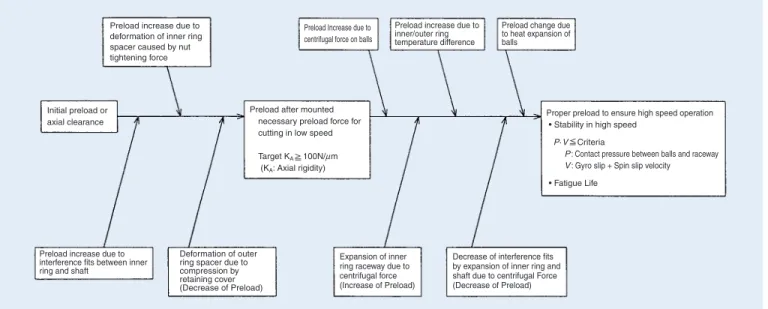
Once the size and type of the bearing are selected, the specification of the bearing should be determined. In order to select the appropriate clearance, or preload, of the bearing it is necessary to consider such factors as fatigue life, axial and radial rigidity, and heat generation. Clearance or preload must be selected carefully, as these factors have the largest impact on overall spindle performance, especially during high speed operation. If the preload is wrong it may cause problems such as early failure or seizure. Sometimes it is necessary to repeat step
➂
, or even steps➁
and➂
, before the most accurate spindle design is achieved.See Part 5
After the specification of the main shaft is complete, the final stage is the specification of the assembly method. Accuracy of the shaft and housing at the bearing seats is important. Specify the fit and clearance of the bearings to the shaft and housing. Use the correct nut tightening force to fix the bearings. And double check that the preload, or clearance, after the bearing has been mounted is
Fit and Clearance Housing Accuracy Shaft Run out
Checking Clearance Checking Preload Nut Tightening Force Lubrication Life
Bearing Heat Generation
Rigidity Fatigue Life
Static Load Capacity Running Accuracy Clearance Preload Limiting Speed Distance between Bearings Shaft Diameter and
Length
Bearing Series Natural Frequency
of the Shaft Main Shaft Rigidity Preload Method Bearing Arrangement Bearing Type Jacket Cooling Lubrication Drive Type Spindle Heat Generation Rigidity Speed Reliability Life Running Accuracy • • • • • • • • • • • • • • • • • • • • • • • • • • • • • •
35
Rotational Speed (
d
m
n
)
Rigidity of The Main Shaft
(Speeds Higher than 0.7 million
d
m
n
)
1
1
2
2
5
5
4
4
6
6
Bearing Arrangement11Front side: Ultra high-speed angular contact ball bearing duplex sets (DT)
Rear side: Ultra high-speed angular contact ball bearing duplex sets (DT)
Spindles with this arrangement are suited for ultra high speed operation and use constant pressure preload. Although this spindle has lower rigidity it delivers higher speed capability with a lower temperature rise performance relative to a spindle with position preload.
Applications: Machining Center, Grinding Machine, High Frequency Spindle, etc.
Bearing Arrangement22
Front side: Ultra high-speed angular contact ball bearing duplex sets (DB)
Rear side: Ultra high-speed single row cylindrical roller bearing
(In case of angular contact ball bearings, either position or constant pressure preload is applicable)
Spindles with this arrangement are suited for ultra high speed operation and use position preload. They achieve higher radial and axial rigidity than spindles with Bearing Arrangement1. It is possible to use a cylindrical roller bearing on the rear side, for better slide performance.
Applications: Machining Center, Grinding Machine, High Frequency Spindle, etc.
Bearing Arrangement 33
Front side: Ultra high-speed angular contact ball bearing quad sets (DBB) Rear side: Ultra high-speed single row cylindrical roller bearing
(In case of angular contact ball bearings, either position or constant pressure preload is applicable)
Spindles with this arrangement will have lower speed capability, and higher radial and axial rigidity relative to Bearing Arrangement2.
Applications: NC Lathe, NC Milling Machine, Machining Center, etc.
Bearing Arrangement 55
Front side: Ultra high-speed angular contact ball bearing triplex sets (DBD)
Rear side: Ultra high-speed single row cylindrical roller bearing
(In case of angular contact ball bearing, either position or constant pressure preload is applicable ) Spindles with this arrangement will have lower speed capability, and higher radial and axial rigidity relative to Bearing
Arrangement2, and lower speed capability and rigidity relative to Bearing Arrangements3and4.
Applications: NC Lathe, NC Milling Machine, Machining Center, etc.
Bearing Arrangement 44
Front side: Ultra high-speed single row cylindrical roller bearing, Angular contact ball bearing duplex sets (DB) Rear side: Ultra high-speed single row
cylindrical roller bearing
(In case of angular contact ball bearing, either position or constant pressure preload is applicable)
Spindles with this arrangement have high-speed capability similar to spindles with Bearing
Arrangement 3. As there is a cylindrical roller bearing in the front side, the radial rigidity is high, so it is possible to have both high speed and heavy cuts.
Applications: NC Lathe, NC Milling Machine, Machining Center, etc.
Bearing Arrangement 66
Front side: High rigidity double row cylindrical roller bearing, angular contact ball bearing duplex sets (DB) Rear side: High rigidity double row cylindrical
roller bearing
Although spindles with this arrangement have lower speed capability, the radial and axial rigidity of these spindles are highest.
Applications: NC Lathe, NC Milling Machine, Machining Center, etc.
Oil-air lubrication Grease lubrication
d
mn
d
mn
1.0M
0.8M
Oil-air lubrication Grease lubrication
d
mn
d
mn
2.2M
1.3M
Oil-air lubrication Grease lubrication
d
mn
d
mn
1.8M
1.2M
Oil-air lubrication Grease lubrication
d
mn
d
mn
2.2M
1.3M
Oil-air lubrication Grease lubrication
d
mn
d
mn
2.5M
1.5M
Oil-air lubrication Grease lubrication
d
mn
d
mn
3.5M
2.0M
3
3
Boring Head High Precision Spindle for Lathe
Live Center
Work Head Spindle Grinding Spindle
39
The main features of the ACBB are (1) a predefined contact angle, and (2) they are used in matched
combinations with preload.
When selecting Angular Contact Ball Bearings, it is important to take these features into account, as each ACBB has different performance. It is important to understand the affect of changes in contact angle and preload on performance so that you select the ACBB that is best suited to the application.
The following graphs represent the relative performance of each type of ACBB, depending on the contact angle, under the same size, preload, and combination.
Radial Rigidity Axial Rigidity Dynamic Load Rating
Rotational Speed 0 0 500 (N/ m) (N/ m) 0 500 1 000 0 50 100 150 (kN) 10 000 20 000 30 000 40 000 (min–1) Grease Lubrication Oil-air Lubrication µ µ Thrust ACBB Ultra High-Speed ROBUST Series High Precision ACBB
Standard Series 79_C 79_A5 70_C 70_A5 70_A 72_C 72_A5 72_A BNR19S BNR19H BNR19X BNR19XE BER19S BER19H BER19X BER19XE BNR10S BNR10H BNR10X BNR10XE BER10S BER10H BER10X BER10XE BAR10S BAR10H BTR10S BTR10H TAC20X Rigidity (N/ m) Axial rigidity Radial rigidity Limiting dmn value 0 100 200 300 400 500 600 700 800 50 55 60 65 70 75 80 85 90 95 100 7020_DB (L preload)
C(15˚) A5(25˚) A(30˚) C(15˚) A5(25˚) A(30˚)
Limiting dm n ( × 10 4)
Bearing temperature rise (
˚C)
Rolling fatigue life (h)
Bearing temperature LIFE 0 5 10 15 20 25 10 000 100 000 1 000 000 10 000 000 7020_DB (L preload) µ Rigidity (N/ m) Axial rigidity Radial rigidity Limiting dmn value 0 200 400 600 800 1 000 1 200 1 400 50 55 60 65 70 75 80 85 90 95 100 7020CDB (Contact angle 15˚)
L preload M preload H preload
Bearing temperature LIFE 0 5 10 15 20 25 10 000 100 000 1 000 000 10 000 000 7020CDB (Contact angle 15˚)
L preload M preload H preload
Limiting dm n ( × 10 4)
Bearing temperature rise (
˚C)
Rolling fatigue life (h)
µ
Performance Comparison of Each type of Bearing (Bore size–70mm, DB combination, L preload)
The Effect of Preload
Preload affects performance of ACBBs in much the same way that the contact angle does. As preload increases, the rigidity increases but the speed capability decreases. NSK has defined standard preload levels as extra light (EL), light (L), medium (M) and heavy (H).
The figure below compares the performance of a 7020CDB with each preload level. Even if the contact angle is held constant, when the preload is larger, both axial and radial rigidity are increased. However the temperature also rises, so the limiting speed and calculated life become lower.
In order to maintain high rigidity, it is necessary to sacrifice higher speed. Similarly to accomplish higher speed, it is necessary to sacrifice high rigidity. Caution must be exercised. If too high a preload is combined with high operation speed, there is a possibility of seizure.
The Effect of Contact Angle
As the contact angle increases, Angular Contact Ball Bearings have a higher axial load capacity, but a lower speed capability. Thus, the ACBB with a smaller contact angle is better suited for high speed and high radial load applications.
The figure below compares the rigidity, limiting speed and temperature rise of a 7020 Angular Contact Ball Bearing with different contact angles: C angle (15˚ ), A5 angle (25˚ ) and A angle (30˚ )
Under the same light preload level (L), the bearing with C angle has higher radial rigidity with lower temperature rise relative to the bearing with A angle. The bearing with A angle has the highest axial rigidity, three times higher than that of the bearing with C angle, but the limiting speed is lower than the others.
The Effect of Combination
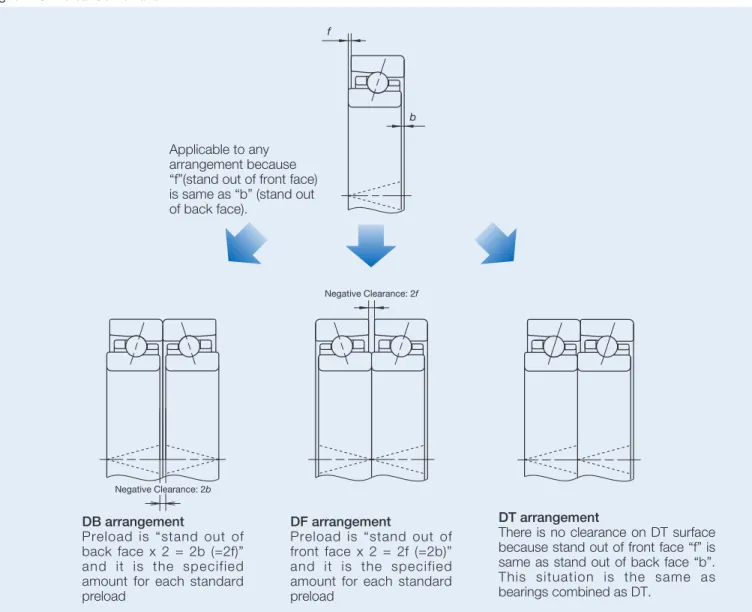
ACBBs are usually used as multiple bearing sets. There are three types of combinations —Back to Back (DB), Face to Face (DF) and Tandem (DT).
Two row, three row, and four row are the most popular multiple bearing sets. When the combination is held constant, and the number of rows is increased, the rigidity and the load capacity become larger, but the limiting speed becomes lower.
0 200 400 600 800 1 000 1 200 1 400 1 600 70 80 90 100 110 120 130 7020C_L (preload) Single row DB DBD DBB Rigidity (N / m) Axial rigidity Radial rigidity Limiting dmn value Limiting dm n ( × 10 4) µ
Single Row CRB Standard Series 0 5 000 10 000 0 1 000 2 000 0 100 200 Single Row CRB Standard Series Ultra High-speed Single Row CRB ROBUST Series NN3020MB NN3020TB NN3920MB NN4920MB NNU4920MB N1020MR Double Row CRB
High Rigidity series
Double Row CRB High Rigidity Series
Rotational Speed Dynamic Load Rating
Rotational Speed Radial Rigidity Dynamic Load Rating
(min–1) (kN) Grease Lubrication Oil-air Lubrication Grease Lubrication Oil-air Lubrication (N/ m)µ NN3014MB NN3014TB N1014MR N1014RS N1014RX Radial Rigidity
Performance Comparison Relative to CRB Type (bore size 100 mm)
Performance Comparison Relative to CRB Type: (bore size 70 mm )
The Effect of the Radial Clearance
When using cylindrical roller bearings, it is important to control the radial clearance since it will have the greatest impact on bearing performance.
As the radial clearance increases, both rigidity and calculated fatigue life decrease. With higher radial clearances heat generation during operation also decreases. Conversely, as the figure below illustrates, rigidity is not increased if the radial clearance drops below –0.003 mm, while the calculated fatigue life continues to decrease. Therefore, the optimum clearance target to achieve high rigidity and long life is 0 or just slightly negative clearance.
For applications involving high speed, it is necessary to control the clearance during operation. Properly adjusting the radial clearance when the bearing is installed to compensate for the effects of high speed operation does this.
– 0.008 0.0002 0 0.0004 0.0006 0.0008 0.0010 0.0012 – 0.006 – 0.004 – 0.002 0 Radial clearance (mm) Radial displacement (mm) 0.002 0.004 0.006 0.008 Bearing: NN3020MBKR Radial load: 1 000N – 0.008 0.2 0 0.4 0.6 0.8 1.0 1.2 – 0.006 – 0.004 – 0.002 0 Life ratio 0.002 0.004 0.006 0.008 Radial clearance (mm) Bearing: NN3020MBKR Radial load: 1 000N
The figure at the right shows test result of the temperature rise of CRB.
After-mounted Radial Clearance Bearing (1): 0 µm
Bearing (2): –30 µm
The temperature rise of bearing (2) is larger and the limiting speed is lower than bearing (1), clearly demonstrating the
importance of properly controlling the clearance. 0 2 4 6 8 10 12 14 16 18 20 0 2 000 4 000 6 000 8 000 10 000 12 000 14 000 16 000 18 000 20 000 Speed (min–1)
Bearing number: N1014 (outer and inner rings and rollers: SHX)
Discontinued
(1): Clearance after mounted: 0 m, Grease lubrication (NBU15) (2): Clearance after mounted: – 30 m
Outer ring temperature rise (
˚C)
µ µ
A CRB with a tapered bore is used to control radial clearance during spindle assembly because it is easy to adjust the radial clearance to any value. For a CRB with a tapered bore, the popular unmounted noninterchangeable radial clearance classes are CC9, CC0, and CC1. The specific features of each are outlined below.
CC0 clearance (NSK’s recommended clearance)
Matched clearance range less than CC1. This range overlaps with the upper values of CC9 and lower values of CC1. As this clearance is easy for customers to target this range, it is the recommended clearance offered for CRB with taper bore. ● CC1 clearance
Matched clearance range is greater than CC0. While not the standard, this clearance is most popular in the field. When clearance is at its maximum, special care is required to accomodate expansion of the inner ring. If care is not used, and the spindle's cross-section is thin, deformation of the bearing or shaft may occur.
● CC9 clearance
Bearing Rigidity Life Ratio
Unlike ACBB’s which support both axial and radial loads, cylindrical roller bearings support only radial loads. However the radial load capacity rating is larger than that of ACBBs. Depending on the application either double row CRBs (NN type and NNU type) or single row CRBs (N type) are used.
Generally, double row cylindrical roller bearings are used in high rigidity applications such as a lathes, while single row cylindrical roller bearings are used in high speed applications such as a machining centers. The following graphs represent cylindrical roller bearing performance depending on the type of bearing (single or double row) and the radial clearance involved.
43
42
1
High Precision Angular Contact Ball Bearings (Standard Series)
…
P44-56
Features
Numbering System
Bearing Tables
Miniature Series
79 Series
70 Series
72 Series
Ultra High-Speed Angular Contact Ball Bearings (ROBUST Series)
…
P58-69
Features
Numbering System
Bearing Tables
BNR19, BER19 Series
BNR10, BER10 Series
BNR19XE, BER19XE Series (Spinshot
TMII
)
BNR10XE, BER10XE Series (Spinshot
TMII
)
Ultra High Precision Angular Contact Ball Bearings (BGR Series)
…
P70-74
Features
Numbering System
Bearing Tables
BGR19 Series
BGR10 Series
BGR02 Series
Angular Contact Ball Bearings
Angular
Contact
Ball
Bearings
High Precision Angular Contact Ball Bearings
Standard Series
ROBUST Series
Spinshot
TMIIII
Ultra High-Speed Angular Contact Ball Bearings
Ultra High-Speed Angular Contact Ball Bearings
BGR Series
Ultra High Precision Angular Contact Ball Bearings
High Precision Angular Contact Ball Bearing (Standard Series)
30˚ contact angle 15˚ Contact point Contact point 15˚ contact angle Ball diameter 30˚ Load acting on rolling element Number of balls a F a F a / F Load acting on rolling element Number of balls a / FFeatures
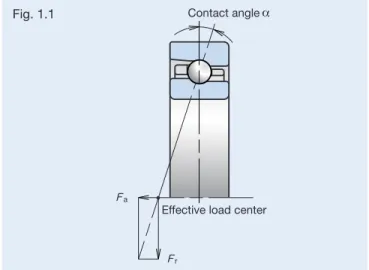
Single row angular contact ball bearings have a line connecting the contact points drawn in the radial direction, which is called the contact angle. The contact angle makes this bearing suitable for accommodating radial loads, single direction axial loads, and a combination of both. Furthermore, since an axial component is generated when a radial load is applied, these bearings are generally used in pairs, triplex sets, quadruplex sets, or multiplex sets.
Contact angle
Effective load center
a F r F
Contact Angle
Fig. 1.2When a load is applied to an angular contact ball bearing, elastic deformation and the amount of stress at the contact point changes as a result of the varying load conditions of the balls, inner ring, and outer ring according to the contact angle of the bearing.
Figure 1.2 illustrates loads acting on two rolling elements for a 30˚ contact angle, and a 15˚ contact angle. The relation between an axial load being applied to the bearing and resulting load acting on the rolling element can be formulated as: Fa/(Number of balls ×sinα).
Therefore, the larger the contact angle, the smaller the load acting on the rolling element. Load at the contact point, and its consequential deformation, is reduced thus resulting in longer life. When a radial load is applied, the smaller the contact angle, the smaller the load acting on the rolling element, thus resulting in reduced load at the contact point.
(See Pages 38 and 39 for contact angle specifics.)
Dimension Series
Numbering System of High Precision Angular Contact Ball Bearings (Standard Series)
7
Bearing type 7: single row angular contact ball bearing 38-39, 440
Dimension 9: 19 series, 0: 10 series, 2: 02 series 38-39, 44C
Contact angle C: 15˚, A5: 25˚, A: 30˚ 38-39, 44Material No symbol: bearing steel (SUJ2) SN24: ceramic ball (Si3N4) (2) 12-15
13
Bore number Less than 03, Bearing bore 00: 10mm, 01: 12mm 02: 15mm, 03: 17mm 46-56Over 04, Bearing bore Bore number×5 (mm)
TYN
Cage TYN: ball guided polyamide resin cage; limiting speed dmn= 1 400 000; operational temperature limit = 120˚C 16-17 TR: outer ring guided phenolic resin cage; operational temperature limit = 120˚CSeal No symbol: open type V1V: non-contact rubber seal (1) 28
L
Preload EL: extra light preload, L: light preload, M: medium preload, H: heavy preload 38-39CP: special preload, CA: special axial clearance 134-142
DB
ArrangementSU: universal arrangement (single row) DU: universal arrangement (double row)
38-39 DB: back-to-back arrangement DF: face-to-face arrangement DT: tandem arrangement
DBD, DFD, DTD, DUD: triplex set arrangement •DBB, DFF, DBT, DFT, DTT, QU: quadruplex set arrangement
130-133
P4
AccuracyP2: ISO Class 2, P4: ISO Class 4, P5: ISO Class 5
133 P3: special class (dimensional accuracy: ISO Class 4; rotating accuracy: ISO Class 2)
158-161 P4Y: special accuracy (Bore diameter and outside diameter are exclusive to NSK. All others are ISO Class 4.)
(Bearing number example)
Bearing type symbol Dimension symbol Bore number Contact angle symbol Material symbol Accuracy symbol Preload symbol Arrangement symbol Seal symbol Cage symbol
7
0
13 C
TYN
DB L
P4
Reference pages Standard Angular Contact Ball Bearings Fig. 1.3(1) Sealed angular contact ball bearings are standardized for SU arrangement and ISO Class 3. Fig. 1.1
47
70
Series
72
Series
Bore Diameter 5-8 mma
D
d
r
r1r
r
φ
φ
High Precision Angular Contact Ball Bearings (Miniature Series)
High Precision Angular Contact Ball Bearings (Standard Series)
Boundary Dimensions Basic Load Ratings Permissible Effective Load Mass Limiting Speeds (2)
Bearing (mm) (kN) Axial Center (g) (min–1)
Numbers
d D B r r1 Cr Cor Load (
1) (mm)
(approx) Grease Oil (min) (min) (Dynamic) (Static) (kN) a
725C 5 16 5 0.3 0.15 1.700 0.660 0.545 3.91 4.5 110 000 167 000 725A 5 16 5 0.3 0.15 1.610 0.620 0.665 5.53 4.5 72 000 96 000 706C 6 17 6 0.3 0.15 2.150 0.845 0.765 4.54 5.5 100 000 153 000 706A 6 17 6 0.3 0.15 2.030 0.795 0.725 6.32 5.5 66 000 87 000 726C 6 19 6 0.3 0.15 2.390 1.000 0.835 4.67 7.8 92 000 140 000 726A 6 19 6 0.3 0.15 2.240 0.940 0.395 6.61 7.8 60 000 80 000 707C 7 19 6 0.3 0.15 2.390 1.000 0.835 4.67 7.4 89 000 135 000 707A 7 19 6 0.3 0.15 2.240 0.940 0.375 6.61 7.4 58 000 77 000 708C 8 22 7 0.3 0.15 3.550 1.540 1.300 5.51 12.0 77 000 117 000 708A 8 22 7 0.3 0.15 3.350 1.450 1.020 7.84 12.0 50 000 67 000 728C 8 24 8 0.3 0.15 3.600 1.580 1.330 6.14 16.0 72 000 110 000 728A 8 24 8 0.3 0.15 3.350 1.480 0.610 8.62 16.0 47 000 63 000
(1) For permissible axial load, please refer to Page 129.
(2) For application of limiting speeds, please refer to Page 152.
Note: Bearing numbers with a “C” suffix: nominal contact angle 15˚ Bearing numbers with an “A” suffix: nominal contact angle 30˚
79
Series
Bore Diameter 10-55 mm
(1) For permissible axial load, please refer to Page 129.
(2) For application of limiting speeds, please refer to Page 152.
When a ceramic ball is used, limiting speed value will be 1.25 times the value of steel ball.
Note: Bearing numbers with a “C” suffix: nominal contact angle 15˚ Bearing numbers with an “A5” suffix: nominal contact angle 25˚
For additional information:
● Dynamic equivalent load ………121
● Static equivalent load ………128
● Preload and rigidity………134
● Abutment and fillet dimensions ………168
● Nozzle position ………174
● Quantity of packed grease………157
Page No. Standard Angular Contact Ball Bearings
Boundary Dimensions Basic Load Ratings Permissible
Factor Effective Load Mass Limiting Speeds (
2)
Bearing (mm) (kN) Axial Center (kg) Sealed (min–1)
Numbers
d D B r r1 Cr Cor Load (1) fo (mm) (approx) Design Grease Oil
(min) (min) (Dynamic) (Static) (kN) a
7900C 10 22 6 0.3 0.15 3.00 1.52 1.23 14.1 5.1 0.010 – 71 900 109 400 7900A5 10 22 6 0.3 0.15 2.88 1.45 1.44 – 6.7 0.009 – 62 500 93 800 7901C 12 24