Plastic Reduction Case Studies
Shengyuan Su, Yazhou Li, Emma Maschal, and Yuejiao Ha Dr. Emily Klein, advisor
April 23, 2015
Masters project submitted in partial fulfillment of the requirements for the Master of Environmental Management degree in the Nicholas School of the Environment of Duke University
2015
Executive Summary
Plastic is as one of the most common and convenient materials in modern society. The use of plastic is increasingly controversial, however, because of its negative impacts on the
environment, biodiversity, and human health. Plastic does not naturally biodegrade in the environment. Instead, it breaks down into small particles (micro-‐plastics) that can negatively impact human health by releasing toxins into the food chain and by poisoning wildlife and marine life. As awareness of the harm of plastic products increases, companies are searching for efficient and low-‐cost ways to reduce their use of plastic. Nevertheless, plastic reduction is challenging in many industries, especially when plastic products are an important part of their daily services. Though facing difficulties, companies and organizations have taken steps to reduce plastic consumption. Companies that have developed effective plastic reduction practices can serve as examples for peers in the same industries. Two particularly plastic-‐ intensive industries are hotels and restaurants. Leaders in these sectors have developed innovative approaches to reduce, recycle, and reuse the plastic consumed during their
operations. This project investigates the current plastic reduction practices among such leaders in the restaurant and hotel industries, and provides practical strategies for the improvement of sustainability performance in these and related business sectors.
We begin by reviewing the literature regarding the use of plastic, the environmental impacts of plastic products, the plastic reduction practices in industrial sectors, and the future forecasts about plastic consumption. We also summarize the regulation of plastic pollution through
legislation in the US. To collect information on plastic usage and reduction practices in selected restaurant and hotel companies, we conducted phone interviews, online research, and online surveys. The information was used to characterize each company’s basic operation, plastic usage, plastic reduction initiatives, and motivations for promoting plastic reduction and sustainability.
Based on the information collected, we developed individual case studies for five restaurants and five hotels. Each of the case studies highlights the company’s sustainability motivation and values, as well as their efforts, achievements, and challenges in plastic reduction.
Based on the case studies and additional research, we present a summary of common effective strategies for plastic usage management and reduction in the hotel and restaurant sectors. While all of our sample companies have achieved notable successes, they all encounter significant challenges, such as the relatively high costs of replacement of plastic products, inconsistent regulations, and, particularly in small companies, the difficulty of developing a tracking system. Summarizing our findings, we describe a wide range of strategies, large and small, to reduce plastic use and manage plastic waste that are applicable to diverse business sectors. The most important of these are attention and knowledge. We found that when company leaders consider it a priority to reduce plastic consumption, they can often develop practical approaches that benefit not only their company but also the environment and society at large.
For restaurants:
• Reduce the use of plastic that is passed on to customers by using biodegradable or recyclable materials for to-‐go cups, replacing take-‐out plastic containers with glass ones and encouraging customers to return the containers, minimizing unnecessary packaging for take-‐away food, and limiting take-‐away services
• Replace in-‐house plastic products with alternatives made from other materials, such as metal, paper, glass, wooden, recycled brown butcher paper, etc.
• Recycle plastic products by participating in local recycling programs, or conducting in-‐store recycling
• Change consumers’ behavior to reduce plastic usage and encourage recycling and reuse of plastic products by providing financial incentives, or provide reusable plastic containers that are not as expensive as the common ones that consumers need to buy
• Encourage suppliers to conduct similar actions (e.g. choose products that come with less or even no packaging and products that are packaged in more sustainable ways, encourage suppliers to reuse or recycle used plastic products, reuse the plastic products from suppliers) to reduce their plastic, decreasing the upstream plastic use, and set up selection criteria in terms of plastic usage for suppliers
• Engage staff in initiatives by staff education and training, and generate positions such as sustainability coordinator or manager to manage the system
• Implement information disclosure through corporate sustainability reports, websites, emails, posters, and menus
• Conduct research on life cycle environmental impacts of different potential materials that can replace plastic
• Initiate plastic data tracking and consistent policy enforcement
• Cooperate with social groups, including non-‐governmental organizations, government programs, high technology companies, competitors, and industry associations to identify more opportunities of plastic reduction, earn support for initiatives, reduce the costs of initiatives, and mitigate risks of plastic waste For hotels:
• Establish plastic waste management system, by creating initial baseline waste inventories, collecting data of current plastic usage amount, identifying hotspot, producing template for annual analysis, and building a sustainability position or a team
• Replace single-‐use plastics, by providing guests reusable and refillable tools instead of single-‐use plastic products
• Educate and encourage customers to reduce plastic use, by providing guests what they need to opt out the unsustainable options, and building new distribution system for the usage of plastic products in hotels
• Recycle used plastic products through providing recycling bins and information about local recycling practices in stores and public spaces
• Implement staff training through providing training materials with facts and numbers on plastic consumption and waste generation and having staff complete plastic audit • Preserve historic architecture and reuse materials to avoid plastic waste generation
during the process of renovation and rebuilding
• Enact responsible sourcing policy in hotels, including creating sourcing profile for suppliers and establishing consistent sourcing criteria based on local standard and sustainability standard
• Share information and communicate plastic reduction efforts to guests and
investors, through visualizing plastic waste data, generating marketing flyers, and so forth
• Build partnerships with industry competitors, or with other industries, to close the loop and reduce plastic usage in operations
• Advertise concepts of “green hotels” including initiatives of plastic reduction, waste management, and other sustainability practices to attract customers who recognize the values and strengthen cooperation with comprehensive stakeholders
Approved
_______________________________ (MP adviser signature here)
Emily M. Klein
4/23/2015
___________________________________ Date
Master's Project submitted in partial fulfillment of the requirements for the Master of
Environmental Management degree in the Nicholas School of the Environment, Duke University May 2015
Table of Contents
Abstract ... 1 Introduction ... 3 Literature Review ... 5 Methodology ... 11 Case Studies ... 14 Restaurants ... 14
The Grey Plume ... 14
Snappy Salads ... 17
Ted’s Montana Grill ... 21
Chez Panisse Restaurant ... 26
Starbucks ... 30
Hotels ... 34
Hotel Andaluz ... 34
Grossman Company Properties: Inn at Laguna Beach ... 37
Proximity Hotel ... 39
Rancho La Puerta ... 42
Discussion and Recommendations ... 48
Recommendations for restaurants ... 50
Recommendations for hotels ... 58
Conclusions ... 64 References ... 66 Appendix ... 71 Acknowledgements ... 79
Abstract
Plastic is one of the most commonly-‐used and convenient materials in most societies around the world. The use of plastic is increasingly controversial (CHF, 2015), however, due to its negative impacts on the environment, biodiversity, and human health. Two particularly plastic-‐ intensive industries, hotels and restaurants, have initiated efforts to reduce, recycle, and reuse plastic in their operations. This project aims to investigate current plastic reduction practices in the restaurant and hotel industries, and to provide practical strategy suggestions for the improvement of sustainability performance in these and related business sectors. Focusing on the practices of five partner restaurants and five partner hotels, we collected information through phone interviews, an online survey, and online research. This revealed each company’s basic operation, plastic usage, plastic reduction initiatives, and motivations to promote plastic sustainability. We found that although the sample companies have adopted initiatives to reduce plastic and have achieved some success, all of them encounter significant challenges. In
addition, there are differences between the hotel and restaurant sectors, as well as among different companies within each sector, in terms of the scales, types, and motivations for plastic reduction. Synthesizing the information we collected, we provide several practical strategies and recommendations for the restaurant and hotel industries to develop plastic reduction practices, and to communicate their initiatives, progress, and performance to the public. For example, we advise that restaurants and hotels cooperate with non-‐governmental
provide financial incentives to change consumers’ behavior of plastic usage. Other suggested strategies include material replacement, recycling and reuse, educating staff to improve the employee engagement, and cooperating with responsible suppliers. This initial study can be expanded in the future to include more sample companies in these two industries, as well as other plastic-‐intensive industries, such as airline companies and supermarket stores.
Introduction
The first man-‐made plastic was invented by Alexander Parkes, a British metallurgist, in 1862, and the result was publicly displayed at Great International Exhibition in London (Bellis, n.d.). Based on previous research, in 1907, Leo Hendrik Baekeland invented the first fully synthetic resin, called Bakelite, which experienced commercial success (Bellis, n.d.). The plastic industry greatly expanded during World War II, and continued thereafter (CHF, 2010). In the modern world, plastic use is ubiquitous. Plastic is now the material of choice used in numerous products that were previously fabricated from metal, glass, wood, or materials derived from plants and animals (e.g., cotton and wool). It is undeniable that plastic brings convenience to human life due to its versatility, durability, and low cost, and plastic is therefore popular among both manufacturers and consumers.
However, our understanding of the numerous negative impacts of using plastics has been growing. In her famous 1962 novel, Silent Spring, Rachel Carson pointed out the danger of chemical pesticides, and drew attention to the ways humans detrimentally impact the environment. In the 1960’s and 1970’s, scientists began to raise alarms about the effects of plastic debris in the oceans (Colton et al., 1974). Plastic degrades extremely slowly under typical environmental conditions; depending on the type of plastic, it may take 50 years or more for plastics to degrade in nature (Müller, 1998). In addition to producing debris pollution, plastic degradation may impact human, as well as terrestrial and marine life, by releasing toxins into the food chain (Andrews, 2012). Each year, about 300 million tons of plastic is generated
globally, and it is estimated that 10 to 20 million tons end up in the oceans (UNEP, 2014). Of all the plastic produced, only a small part is recovered for recycling; in 2012, the recovery rate of plastic generation in the United States was estimated to 9% (US EPA, 2014a).
As awareness of the harm of plastic products rises, companies are searching for efficient and economical ways to reduce their use of plastic. Nevertheless, plastic reduction is challenging in many industries, especially in sectors where plastic products are used daily as an important part of their services. Though they face difficulties, some companies and organizations have taken significant steps to implement plastic reduction practices, serving as examples for peers in the same or similar industries. Working with our client, Plastic Pollution Coalition, we sought to evaluate current practices in plastic reduction in two specific service industry sectors: restaurants and hotels.
This report begins with a review of the literature regarding the use of plastic, the environmental impacts of plastic products, and plastic reduction practices in commercial sectors. We then present the methodology used to collect information from companies in selected industries. This is followed by a presentation of our results in the form of case studies for companies within each sector. Each case study includes a description of the company’s activities with respect to sustainability in general, their motivations in adopting sustainable practices, their specific initiatives in terms of plastic reduction, as well as challenges they are facing. In our discussion section, we analyze these case studies and make recommendations to help similar businesses reduce their plastic footprint in effective and cost-‐efficient ways. Finally, we provide a summary and recommend additional work to improve this type of study in the future.
Literature Review
US plastic budget
Information made publicly available by the US Environmental Protection Agency (US EPA) includes data on the consumption patterns of plastic. According to the US EPA, plastic waste has dramatically increased in the United States since 1960 “when plastics were less than one
percent of the waste stream” (US EPA, 2014b). It is estimated that 8% of global crude oil production is used to produce plastics (Hopewell et al., 2015). Furthermore, about half of the annual plastic produced is used for the creation of single-‐use or disposable items (Hopewell et al., 2015). However, the durability of plastic makes single-‐use or disposable items an increasing environmental threat because such a “high resistance to aging and minimal biological
degradation” can lead to long-‐term problems (Moore, 2008).
One problem with plastics is the stress on the solid waste stream management (Chen, 2014). In the US alone, 88,000 tons of plastic is discarded daily; however, waste management systems cannot handle this amount and plastic waste escapes into the environment (Sachs, 2014). In 2012, the US EPA estimates that the United States is responsible for about 32 million tons of plastic waste (US EPA, 2014). Of the plastic waste generated annually, less than 10% is recycled or recovered, and therefore the vast majority of plastic ends up in landfills (US EPA, 2014).
At every step along the waste management stream, leakage and loss of plastics occurs. Because consumption is increasing exponentially while waste management infrastructure development
is stagnant, new solutions to plastic waste management are necessary (Merkl, 2014). Even with the estimates of just 0.1% of annual plastic waste escaping the waste management system, these thousands of tons of plastic pollution have serious environmental and public health implications (Cozar et al., 2014).
Damages of plastic pollution
Most of the peer reviewed literature on plastic pollution focuses on understanding and measuring the environmental and public health issues associated with plastic debris, both on land and in the ocean.
Much attention has focused on plastic pollution in the marine environment. Recent estimates conclude that there are more than 268,940 tons of plastic in the marine environment, and roughly 5.25 trillion plastic particles floating in the ocean (Eriksen et al., 2014). The literature clarified that plastic waste make up the most share in all marine litter (Derraik, 2002). As a public health, environmental health, and navigational hazard, the damages of plastic pollution in the marine environment have increased over time (Moore, 2008). The Marine Debris Working Group of the National Center for Ecological Analysis concluded that plastic pollution poses a threat to public health when persistent bioaccumulative and toxic substances (PBTs) adsorb to small plastic pieces and microplastics in the ocean (Lavendar Law & Thompson, 2014). While not all chemicals that adsorb onto plastics will bio-‐accumulate, some are potentially capable of expanding to the food chain, such as organic compounds and heavy metals that are harmful to humans (Lavender Law & Thompson, 2014).
Plastics in the ocean often break into smaller pieces (microplastics) and these particles can get caught in the gills of fish or ingested by marine life, resulting in suffocation or starvation of the organism (Moore, 2008). Crossing all environmental scales, plastic pollution poses a threat, locally and globally, to marine and wildlife ranging from microorganisms to marine megafauna (Moore, 2008).
Parallel to the marine environmental damages, the terrestrial impacts are often related to wildlife interactions -‐ ingestion and entanglement (EarthTalk, 2008). It is important to note that there is very little peer reviewed literature specifically highlighting the environmental and public health impacts of plastic pollution on land. The focus on marine plastic pollution comes from the likelihood that the plastic pollution will eventually travel downstream to the ocean
(EarthTalk, 2008). The United Nations Joint Group of Experts on the Scientific Aspects of Marine Pollution found that 80% of marine debris (not just plastic pollution) originates from land-‐based sources (UNEP and Greenpeace, 2014).
In addition to posing a navigational hazard, large amounts of plastic pollution in waterways, in stormwater drains, and on roadways can interfere with industries such as shipping, trucking, fishing, and tourism (Derraik, 2002). Economic interference is the number one driver for the creation of legislation regulating plastic pollution in the US (Derraik, 2002).
Legislation
While the US EPA regulates plastic pollution through various laws and regulations, the Marine Plastic Pollution Research and Control Act of 1987 authorizes the US EPA, US NOAA, and the US
Coast Guard to work together for understanding the impacts of plastic pollution specifically (US EPA, 2014). While all 50 states have individual waste management laws -‐ including Litter Laws, enforceability is an obstacle at the state and federal levels when trying to regulate the amount of pollution entering the environment because of traceability and often lack of culpability (Subramanian, 2000). The small fraction of plastic waste that becomes pollution makes it difficult to regulate and manage plastic generally, because different products have different life cycles, such as plastic bags and plastic straws (Derraik, 2002).
Plastic Reduction Initiatives
Reductions in the generation of new plastic are likely to provide the biggest environmental impact because cleanup is not efficient, in terms of time and money (Subramanian, 2000). With a 4% annual increase in global plastic production over the last 3 years, global plastic waste generation is expected to increase at a similar rate (Gourmelon, 2015). The consumption of plastic items does not necessarily mean that those items will end up in the oceans or the
terrestrial environment; however, consuming more plastic increases the probability of increased plastic pollution.
In this context, the goal of this project is to highlight positive business practices focused on reducing plastic consumption in two business sectors: hotels and restaurants.
Plastic reduction initiatives are often aimed at the individual consumer (My Plastic Freetime, 2015; Life without Plastic, 2015; Zero Waste Home, n.d.). But scaling up from the individual can achieve even greater reductions (UNEP, 2014). The UNEP and the Global Partnership on Marine
Litter argue that disclosing plastic use and the cost of plastic use in the consumer goods industry “can unlock previously unrecognized benefits. Such benefits are often good for business, for example, saving input costs and recovering value from waste; customer loyalty, such as
preferred products and enhanced brand value; employee engagement; community satisfaction, and improved access to capital” (UNEP, 2014). It is possible for the same to hold true for
businesses in service industries that consume plastic in the service of their customers. Identifying, disclosing, and valuing plastic use creates opportunities for innovation and reduction (UNEP, 2014).
Labeled as the most important of the three R’s, reduction is the first step in solid waste management, followed by reuse and recycling. Because reduction happens prior to the initial point of consumption, reduction is the most effective waste management technique (Plastic Waste Solutions, 2012). Therefore, the goal of our case studies is to focus on reduction
practices, although other solid waste management techniques related to reusing and recycling plastics are highlighted. Recycling efficiency is close to 9% in the United States, by some estimates, so although recycling is often touted on sustainability websites, more actions are needed (Plasticity, 2014). A priori, awareness is the first step in a reduction practice, so businesses can make informed decisions.
The shift from consumer-‐focused decisions to business-‐focused decisions in the trend of plastic consumption awareness campaigns is highlighted by the growth in participation at the 3rd Annual Plasticity Forum (Plasticity, 2014). Stated as the mission of The Plasticity Forum, “the
goal is to have a world where plastic is used, but without creating a plastic footprint on our communities” (Plasticity, 2014).
Challenges: Lack of Disclosure
In contrast to the valuation of reduction practices of performed by the UNEP, in the consumer goods industry, reduction of plastic in the service industry may be easier because there are likely alternatives that do not alter the ability to provide a service. Various business forums, such as GreenBiz, Green Plus, and SustainableBusiness.com, exist to highlight and promote sustainable business practices within different industries, but these websites are broad in nature, so we will focus on practices and challenges in the restaurant and hotel industries.
On the global stage, the Plastic Disclosure Project (Plastic Disclosure Project, 2014) is one of the prominent advocates for making changes in the way businesses measure, disclose, and thus verifiably reduce their plastic footprints (UNEP, 2014). The value and cost of plastic is hard to quantify, especially in the service industry, given that the consumer’s focus is on the quality of the service provided, rather than on the act of consuming the plastic good (UNEP, 2014). The measurement of economic value, or willingness to pay, for plastic items in the service industry has not been established (UNEP, 2014). Without information on how other businesses are operating or reducing their plastic footprint, many of the best business practices are still developing on a situational or individual company basis.
Methodology
To obtain information on plastic usage and reduction initiatives, we conducted online surveys and phone interviews with targeted businesses, and online research on the business and
industries. Based on the business contacts provided by our client, the Plastic Pollution Coalition, we reached out to a range of companies and organizations to explore their practices with respect to plastic use and reduction. The companies and organizations include restaurants, hotels, a winery, a studio, and other companies (see Table 1 in Appendix).
We developed an online survey (see Table 2 in Appendix) to gain the following information of each company (see specific survey questions in the Appendix):
● Background information of the company; ● Plastic usage;
● Plastic waste reduction initiatives;
● Value and motivations for sustainability activities.
Based on the initial information collected, we chose to focus on practices within two specific business sectors: the restaurant and hotel industries. We therefore supplemented our initial contact list with companies within these industries, and sought out businesses regarded as leaders regarding sustainability.
Table 1. Study methods for each target business Organization Name Research Methods
Restaurants
The Grey Plume Phone interview and online research Snappy Salads Phone interview and online research Ted's Montana grill Online survey and online research Chez Panisse Restaurant Online survey and online research Starbucks Corporation Phone interview and online research
Hotels
Inn at Laguna Beach Online survey, phone interview, and online research Proximity Hotel Phone interview and online research
Rancho La Puerta Phone interview and online research The King’s Daughters Inn Phone interview and online research Hotel Andaluz Phone interview and online research
Based on the responses obtained from online surveys, we conducted phone interviews with most companies to delve further into their practices and motivations. After collecting related information, such as plastic consumption rate, plastic products’ costs, and progress of reduction initiatives, we summarized as case studies their practices, performance, and motivation to
reduce plastic use. In addition, we conducted online and peer-‐review research to explore “best
Case Studies
RestaurantsThe Grey Plume
Website: http://www.thegreyplume.com
The Grey Plume was the first Green Restaurant Association 4-‐Star Sustainabuild™ restaurant in the country (Green Restaurant Association, n.d.; The Grey Plume, n.d.), incorporating sustainable practices in diverse aspects of its operations, including plastic waste management.
A. Introduction
The Grey Plume, located in Omaha, NE, features a seasonal-‐driven, American-‐style menu, based largely on locally sourced meats and produce (The Grey Plume, 2015a). Opened in 2010 by chefs Clayton Chapman and Michael Howe, the restaurant incorporates sustainable approaches throughout its operations. For instance, the restaurant uses recycled barn wood flooring in its dining area and bar, and prints its menus on recycled paper with soy-‐based ink (The Grey Plume, 2015b). As one of Nebraska’s first restaurants to incorporate sustainable practices into its mission, the Grey Plume has been described as the “Nation’s Greenest Restaurant” (Spencer, 2012) and the “Nation’s Most Sustainable Restaurant” (Markel, 2015).
In addition to providing superior food and service, owners of The Grey Plume are motivated by their sense of social responsibility, especially with respect to environmental sustainability. The owner and executive chef of the Grey Plume, Clayton Chapman, said: “we are constantly looking at what we are doing and asking how we can better our environmental consciousness” (Clem-‐ Mcclaren, 2012). The staff of the Grey Plume are motivated by his passion; they continually look for ways to better their surroundings, and they would like to learn how to incorporate these actions into their daily lives, as well as how to encourage their families, friends, suppliers and customers to do the same (personal communication with Rachel Patel, General Manager of The Grey Plume, February, 2015).
C. Plastic reduction initiatives
In terms of plastic reduction, the Grey Plume has initiated recycling programs for its plastic products, used reusable and compostable materials for plastic products, and replaced plastic products with alternatives. In particular, the following actions related to plastic reduction are included in their Green Restaurant Association Certification Report (The Grey Plume, n.d.).
● Recycling: Commingled (Plastics, Glass, Aluminum) ● Returnable Packaging
● Reusable Bag Program ● Reusable Container Program ● Bio-‐based Take-‐out containers ● Paper Bags
1) Environmental actions regarding to-‐go containers
Only about 2% of customers order food to go at The Grey Plume. Nevertheless, their to-‐go boxes are made from materials that are 100% recyclable and compostable, manufactured by the company Rosseto1. The Grey Plume also uses paper bags rather than plastic bags for
packaging. In addition, they use recyclable plastic straws for people that take drinks to go. They also encourage their customers to bring their own containers by providing a 10% discount to those who do so. The Grey Plume also encourages their patrons to return the containers for reuse, paying $1 for each returned glass jar.
2) Alternatives to replace plastic use
In the dining area, the Grey Plume uses glass or ceramic cups and plates instead of single-‐use plastic containers so that they can be cleaned and reused. The Grey Plume is also trying to find more affordable and reliable alternatives for plastic trash bags; however, they have been unable to identify a viable alternative to plastic trash bags to date.
3) Relationship with suppliers and customers
Many local farmers are suppliers for The Grey Plume. If the farmers provide produce or meats in containers made from glass or other materials that are reusable, The Grey Plume returns the containers to the farmers. For instance, The Grey Plume returns the egg crates to its egg
1 Rosseto compostable cutleries are sold on Amazon, http://www.amazon.com/Rosseto-‐Liteware-‐
suppliers for reusing. They are trying to influence their suppliers to take similar actions for the purpose of environmental protection.
To communicate with their customers, The Grey Plume displays various aspects of their sustainable practices in their restaurant. For instance, they display their sustainability certificates in the restaurant. In addition, they participate in a number of community organizations, including Green Omaha Coalition and Omaha Biofuels Coop (personal communication with Rachel Patel, General Manager of The Grey Plume, February, 2015).
D. Challenges
According to Rachel Patel, general manager of The Grey Plume, the biggest challenge they are facing is the balance between plastic reduction and commercial considerations. In particular, reusable alternatives usually cost more than traditional plastic products; how to incorporate these costs into their business model is currently under evaluation and analysis by the Grey Plume (personal communication with Rachel Patel, March, 2015).
Snappy Salads
Website: http://www.snappysalads.com
Snappy Salads is a restaurant chain based in Texas, with seven restaurants. In 2007, they were selected as “the Sustainable Business” by the Greater DFW Recycling Alliance (Dahlander, 2010).
A. Introduction
Based in Texas, Snappy Salads owns seven restaurants serving mainly salads to customers. Founded in 2006, Snappy Salads has adopted various sustainable practices, including recycling their compact fluorescent light bulbs (CFLs) and batteries and using renewable resources for their take-‐away containers. In 2007, they were selected as a “Sustainable Business” by the Greater DFW Recycling Alliance (Dahlander, 2010), and in 2010, Snappy Salads was one of two restaurants awarded the Green Business Certification by the city of Plano. In addition,
recognizing their contribution to the community, the Texas Restaurant Association honored them with “Restaurant Neighbor Award” in 2010 (Snappy Salads, 2014).
B. Motivation and values
The founder and CEO of Snappy Salads, Chris Dahlander, is inspired to help protect the environment, and has made numerous efforts to realize this goal. “Simply put, it’s just
something that I passionately believe in. I want to leave this world a little better than the way I found it. I serve fresh, healthy food in environmentally friendly surroundings by passionate folks who have an opportunity to improve their lives,” he said (Cook, 2014). “It’s easy to make a buck. It’s a lot tougher to make a difference.”
C. Plastic reduction initiatives
In terms of plastic reduction, Snappy Salads replaced their plastic products with sustainable alternatives. About 35% of their customers purchase take-‐away food, and they have replaced
single-‐use plastic containers with reusable materials. Particular actions taken by Snappy Salads include:
● Use to-‐go cups that are made from corn products ● Use compostable materials for to-‐go food containers ● Replace plastic products in store with non-‐plastic materials ● Starting to use paper straws
● Replace plastic bags with paper bags for to-‐go food
1) Change to biodegradable materials
Snappy Salads is working to reduce their dependence on plastic products. As for take-‐away food, they use cups made from corn, which is degradable and renewable. Furthermore, they turned to compostable options for utensils, such as forks and knives, and they use paper bags for their take-‐away food packages. As a result, almost all of their to-‐go products are now made of biodegradable materials. As for in-‐store service, almost none of the products used is plastic. For instance, they use metal bowls for salads and glass cups for drinks (personal communication with Chris Dahlander, the founder and CEO of Snappy Salads, January, 2015).
It is estimated that Snappy Salads used about 27,000 straws per month in its seven restaurants (Cook, 2014). Recently, they started to use paper straws. The straws are offered by Aardvark2 Straws. According to their website, Aardvark straws are the only FDA-‐approved, eco-‐friendly
paper straws that are totally made in the U.S. Chris Dahlander stated that most customers love this idea (personal communication with Chris Dahlander, January, 2015).
2) Relationship with suppliers and communication with customers
While Snappy Salads has control over products passed onto their consumers, they do not have much control over the practices of some of their necessary suppliers and manufacturers. For example, they order a great deal of ice, which comes in plastic bags. They say that the best they can do at this point is to recycle the plastic from their suppliers.
Snappy Salads puts some of the information about their sustainable and plastic reduction practices online and on site. They also believe that through their products, their customers come to understand their company’s environmentally friendly approaches and intents, and appreciate and support their actions.
3) Uniform standards for all restaurants
Snappy Salads has seven restaurants in different locations throughout Texas. Among the seven restaurants, they use the same standards for their materials regarding plastic reduction, and source their products from the same producers and manufacturers for their non-‐plastic products. Based on the number of their restaurants, uniform standards help Snappy Salads achieve a wider impact. In addition, consistency within their restaurants increases the efficiency of plastic management.
There are three main challenges that Snappy Salads is facing. The first is the price of alternatives to plastic, as they are generally more expensive than plastics. The second is the availability of recycling programs in the area. Snappy Salads receives various supplies that are packaged in plastic, and the packaging has to be thrown away into regular trash since their locations provide limited recycling services. The third challenge is some resistance from the public (guests and team members) to change their actions. Though they have tried to educate their customers, there are still a certain number who appear to be indifferent to plastic reduction (personal communication with Chris Dahlander, March, 2015).
Ted’s Montana Grill
Website: https://www.tedsmontanagrill.com
Ted’s Montana Grill, founded in 2002, has adopted the motto “Eat Great. Do Good” to emphasize its goal to merge superior dining with sound environmental approaches. The
company is committed to using environmentally sustainable practices in all of its activities (Ted’s Montana Grill, 2014).
Ted’s Montana Grill is a chain of restaurants located in 17 states3, serving mainly bison as a popular menu choice (Ted’s Montana Grill, n.d.). Its first restaurant opened in Columbus, Ohio, in January 2002. Ted’s Montana Grill is inspired by its co-‐founders, Ted Turner and George W. McKerrow, to focus on environmental sustainability. In order to improve its environmental performance, they have focused on several fronts including energy efficiency, water
conservation and waste reduction. In 2013, Ted’s Montana Grill recycled more than 350 tons of recyclable materials (Ted’s Montana Grill, 2014).
B. Motivation and values
To express their intent to balance economic profit and social responsibilities, Paula Owens, Ted’s Purchasing and Sustainability Manager, said: “ultimately a company is in business to make a profit, but we believe strongly you can build a successful business while still preserving the natural world around us. We take environmental considerations into every decision we make. We are committed to acting responsibly, preserving what we can, and helping to raise
consciousness concerning the health of our planet” (personal communication with Paula Owens, February, 2015).
In their sustainability report, the co-‐founders expressed their understanding of environmental protection. Ted Turner, Co-‐founder and Chairman of Ted’s Montana Grill, said: ”I’m an
environmentalist and have been for my whole life, since I was a little boy. It makes good
business sense and it’s the right thing to do for the planet and the people on it” (Ted’s Montana
3 Ted’s Montana Grill operates restaurants in New York, Virginia, North Carolina, Montana, Colorado,
Illinois, Indiana, Ohio, Pennsylvania, Massachusetts, Connecticut, Rhode Island, Kentucky, Virginia, Tennessee, Georgia, and Florida.
Grill, 2014). George W. McKerrow, Co-‐founder and CEO, said that “We know we’re only a small part of the solution, but we’re committed to acting responsibly, preserving what we can, and helping to raise consciousness concerning the health of our planet” (Ted’s Montana Grill, 2014).
C. Plastic reduction initiatives
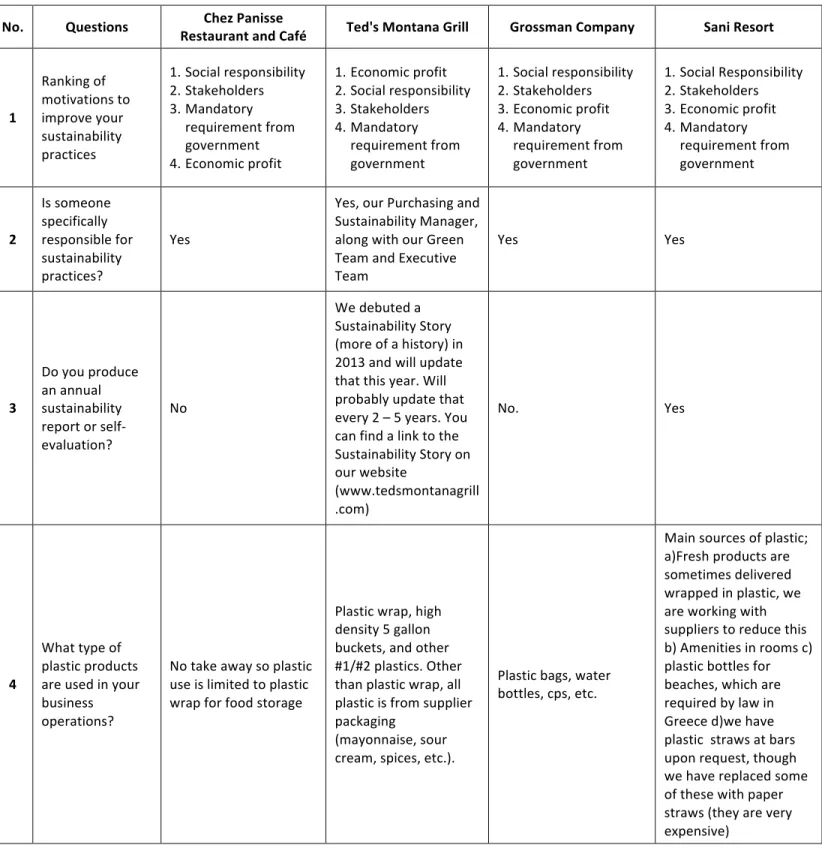
In terms of plastic reduction, Ted’s aims to be 100% plastic-‐free, and currently, they have eliminated 97% plastics that are not related to supplier packaging (personal communication with Paula Owens, February, 2015). In particular, the following actions have been taken (Ted’s Montana Grill, 2014):
● Print on recyclable paper
● Use straws that are made from eco-‐friendly polymer coated paper
● Use stir sticks that are made from wood rather than industry-‐standard plastic ● Cover tables with recycled brown butcher paper
● Use to-‐go cups made from corn materials that are 100% compostable
● Use to-‐go cutlery kits made from corn and tapioca that are biodegradable and compostable
● Recycle materials that are used in house, such as glass, plastic, paper, and metal, in 29 of all the Ted’s Montana Grill restaurants
1) Sustainability functions and reports
to achieve their sustainability goals. In addition, in 2013, they developed a Sustainability Story (Ted’s Montana Grill, 2014), a document introducing Ted’s sustainability aims and achievements with respect to the planet, plate, and people. In this case, “Plate” refers to managing the quality and content of their menu. Ted’s intends to renew the Sustainability Story every 2-‐5 years to measure their environmental performance and plan for the future. To communicate with their customers about their green actions, Ted’s uses the tools of its Sustainability Story, website, social media, email newsletters, and employee conversation with guests (personal
communication with Paula Owens, February, 2015).
2) Reduce plastic use in restaurants
Ted’s has made great progress in reducing its plastic use both for on-‐site dining and for take-‐ away containers. Currently, their major continued use of plastic within their restaurants is for plastic wrap. They have established the following guidelines for plastic use: 1) Avoid bringing in any plastic that is from supplier packaging; 2) Plastic used must be from recycled plastic source material; 3) Plastic used must also be reusable by guests, or recyclable in most municipalities (personal communication with Paula Owens, February, 2015).
3) Develop selection criteria for suppliers
Supplier packaging remains a challenge, and they have set criteria for their suppliers and products to reduce their plastic use. To choose suppliers, they research their suppliers’ sustainability efforts and practices to ensure their philosophy is closely aligned with Ted’s. In particular, Ted’s is looking for measurable results in water and energy conservation, and
recycling efforts within the supplier’s plans. In addition, they are working with vendor partners to seek out new and more sustainable packaging materials to replace plastic. For instance, cardboard lined with sustainable materials may be a potential alternative for plastic in some cases, and they are in the process of evaluating the material.
4) To-‐go containers
At Ted’s, few plastic products are passed to their customers. According to their data, only 3% of plastic waste consists of take-‐away materials, i.e. part of their to-‐go soup cups/lids (personal communication with Paula Owens, February, 2015). As for other take-‐away containers, they have replaced some of their to-‐go containers with biodegradable and compostable materials. For example, their to-‐go cups and cutlery kits are mostly made from corn materials that are 100% compostable. In addition, Ted’s has begun using wax-‐coated paper straws. Indeed, this has promoted the new demand for the use of eco-‐friendly straws in other industries (Ted’s Montana Grill, 2013).
5) Plastic waste management
Since most of their plastic waste (about 97%) is produced within their restaurants, Ted’s has worked to mitigate the impact of their plastic waste. Recycling plays a prominent role in these efforts. Most of their plastic products are recycled as single stream (co-‐mingled), and they have service providers in all locations to meet their recycling standards. In addition, they are working with third-‐party providers to obtain financial information, such as costs per week or per month of recycling, reusing or disposing of plastic waste.
D. Challenges
As Ted’s operates over 40 restaurants in 17 states, Ted’s faces the challenge of regulation differences between the states. In particular, each state, or even counties within a state, might have different regulations or standards regarding plastic recycling, as well as landlord and municipality restrictions. Ted’s works to understand the types of plastics that are recyclable in specific areas and to manage the restaurants accordingly.
In addition, it is challenging for Ted’s to coordinate with suppliers regarding plastic reduction for packaging. As mentioned above, to address this problem, Ted’s is trying to set strict criteria for its suppliers to better influence them.
An interesting challenge comes from the use of high-‐density 5 gallon buckets. Ted’s lacks the confidence that the buckets will actually be recycled. To address this, Ted’s is working with other organizations and companies develop possible solutions. For instance, Ted’s is donating the pickle buckets to Captain Planet Foundation to reuse the buckets in gardens in local schools. In addition, they are partnering with one of their suppliers to reuse the buckets as water
containers or for some other purposes in developing regions (personal communication with Paula Owens, March, 2015).
Chez Panisse Restaurant
Famous for organic, locally-‐grown ingredients and food sustainability, Chez Panisse restaurant was awarded among the World's 50 Best Restaurants from 2004 to 2007 (theworlds50best, 2015). Focusing on environmental harmony in addition to innovative delicious food, Chez Panisse has integrated plastic waste management into their sustainable food philosophy, and has
limited the usage of plastic to very low levels by adopting practical initiatives. A. Introduction
Chez Panisse, located in Berkeley, CA, was founded in 1971 by chef, author, and activist Alice Waters and a group of her friends (Chez Panisse, 2015). Credited with inspiring the California cuisine movement, the restaurant features a locally sourced and daily changing seasonal menu. Waters believes that “the best-‐tasting food is organically and locally grown and harvested in ways that are ecologically sound by people who are taking care of the land for future
generations” (Chez Panisse, 2015).
B. Motivation and values
Alice Waters is emphatic in her view that “social responsibility trumps financial costs” (personal communication with Alice Waters, February, 2015). She notes further that they “feel lucky to have many more sustainable products that are also increasingly affordable and effective on the market these days” (personal communication with Alice Waters, February, 2015). Building on the philosophy of sustainable food, Alice Water established the Chez Panisse Foundation to launch the Edible Schoolyard Project (ESP), an education-‐focused program that “uses food to nurture, educate and empower youth” (Chez Panisee, 2015). The mission of “edible education
curriculum”, the vision of “interactive classrooms”, and the goal to provide students with a “free, nutritious, organic lunch” all reflect Chez Panisse’s passions for food sustainability and social responsibility (Chez Panisse, 2015).
C. Plastic reduction initiatives
Regarding plastic usage reduction and control, Chez Panisse has:
● Limited plastic usage to only plastic wrap ● Named a sustainability coordinator ● Provided no take-‐away service
● Tried plastic substitutions in operations ● Used recycled plastic products
● Collaborated with suppliers
1) Sustainability organization and tracking system
Chez Panisse identifies a specific coordinator to coordinate and manage sustainability practices in the restaurant. However, they do not produce an annual sustainability report or similar self-‐ evaluation to track and communicate their sustainability practices.
2) Plastic control, replacement, and recycling
In regards of plastic usage and reduction, the primary plastic used in Chez Panisse is limited to plastic wrap for food storage. They provide no take-‐away service, so they pass no plastic waste on to their consumers. They have also tried various sustainable plastic wrap substitutes, but
based on their experience, nothing works as well as plastic wrap. Although they do not track how much plastic they consume, they estimate that they spend about $40 per week on plastic wrap. Because the costs and the amounts of wrap used are relatively low, they are not
particularly worried about the problem of plastic consumption. In daily operations, their other plastic usage is large plastic jugs to receive one kind of oil, and this plastic jug is made from recycled material. They are also fully aware of what categories of plastics are recyclable and reusable in the food storage area. They use reusable crates to keep products fresh and for transport.
3) Relationship with suppliers
In selecting the suppliers for plastic products, Chez Panisse has their own criteria and standards. Currently, Excellent Packaging and Supply4 is their supplier, which specializes in sustainable, recyclable, and post-‐consumer products. Since Chez Panisse involves sustainability concepts into the sourcing of food, they obtain organic and seasonal ingredients from local suppliers. Chez Panisse has established a partnership with local suppliers who share Waters’ goals to promote collective sustainability.
4) Sustainability communications
Chez Panisse does not communicate their plastic reduction practices to their consumers or other general public (e.g., through postings on their website or marketing to customers). Nor have they investigated specific environmental impacts caused by plastic wastes. However, the