Copyright by
Joao Filipe Beira 2016
The Dissertation Committee for Joao Filipe BeiraCertifies that this is the approved version of the following dissertation:
3D [Embodied]
Projection Mapping and Sensing Bodies:
A Study in Interactive Dance Performance
Committee:
Sharon Strover, Supervisor
Bruce Pennycook, Co-Supervisor
Yacov Sharir
Shanti Kumar
António Coelho
3D [Embodied]
Projection Mapping and Sensing Bodies:
A Study in Interactive Dance Performance
by
Joao Filipe Beira, Licenciatura, Master
Dissertation
Presented to the Faculty of the Graduate School of The University of Texas at Austin
in Partial Fulfillment of the Requirements
for the Degree of
Doctor of Philosophy
The University of Texas at Austin
December 2016
iv
3D [Embodied]
Projection Mapping and Sensing Bodies: A Study in Interactive Dance
Performance
Joao Filipe Beira, PhD
The University of Texas at Austin, 2016
Supervisor: Sharon Strover Co-Supervisor: Bruce Pennycook
This dissertation identifies the synergies between physical and virtual environments when designing for immersive experiences in interactive dance performances. The integration of virtual information in physical space is transforming our interactions and experiences with the world. By using the body and creative expression as the interface between real and virtual worlds, dance performance creates a privileged framework to research and design interactive mixed reality environments and immersive augmented architectures. The research is primarily situated in the fields of visual art and interaction design. It combines performance with transdisciplinary fields and intertwines practice with theory.
The theoretical and conceptual implications involved in designing and experiencing immersive hybrid environments are analyzed using the reality–virtuality
v
continuum. These theories helped frame the ways augmented reality architectures are achieved through the integration of dance performance with digital software and reception displays. They also helped identify the main artistic affordances and restrictions in the design of augmented reality and augmented virtuality environments for live performance.
These pervasive media architectures were materialized in three field experiments, the live dance performances. Each performance was created in three different stages of conception, design and production. The first stage was to “digitize” the performer’s movement and brain activity to the virtual environment and our system. This was accomplished through the use of depth sensor cameras, 3D motion capture, and brain computer interfaces. The second stage was the creation of the computational architecture and software that aggregates the connections and mapping between the physical body and the spatial dynamics of the virtual environment. This process created real-time interactions between the performer’s behavior and motion and the real-time generative computer 3D graphics. Finally, the third stage consisted of the output modality: 3D projector based augmentation techniques were adopted in order to overlay the virtual environment onto physical space.
This thesis proposes and lays out theoretical, technical, and artistic frameworks between 3D digital environments and moving bodies in dance performance. By sensing the body and the brain with the 3D virtual environments, new layers of augmentation and interactions are established, and ultimately this generates mixed reality environments for embodied improvisational self-expression.
vi
Table of Contents
Introduction ...1
Motivation and Background ...4
Research Questions ...8
Methodology ...11
Performance as Research ...12
Zero Point Methodology ...15
On Collaboration and Practice ...17
Contributions ...19
Overview of the Study ...20
Chapter 1: Context ...24
Overview ...24
Immersive Digital Environments ...26
Virtual Reality ...26
Beyond Virtual Reality ...28
Immersion and Interactivity ...29
Mixed Reality Performance Theoretical Framework ...31
Projection Mapping as Spatial Augmented Reality [Output] ...35
The Psychology of 3D Projection Mapping as a Visualization Display ...39
Projection Mapping and Performative Arts ...41
Sensing Bodies and Projection Mapping ...42
Augmented Virtuality Live Performance ...44
Augmented Reality Live Performance ...46
Mixed Reality Live Performance ...47
Conclusion ...48
Chapter 2: Too&For: An Exploration in Augmenting the Perception of Space and Movement ...50
vii
Context ...54
Computation and Dance Performance ...57
Motion Tracking and Dance Performance ...58
Computer Generated Imagery and Live Dance Performance ...63
Technical Description ...69
Multi-Touch Interface [Input] ...69
Software ...71
Projection Design [Output] ...73
The Process ...75
Rehearsals ...75
Performance ...76
Performance Analysis and Conclusions ...80
Chapter 3: Super Mirror: A Gesture-Based Interface for Ballet Dancers ...84
Introduction ...84
Concept ...86
Related Work ...87
Technical Description ...90
Pose Recording and Collection of Data ...91
Comparing Real-Time and Recorded Poses ...93
Three interfaces ...94
Research Design ...96
Participants’ Demographics and Ballet Experience ...97
Method ...98
Data Analysis ...101
Quantitative Data Analysis ...102
Qualitative Data Analysis ...106
Discussion: Analysis and Conclusion ...108
Chapter 4: 3D [Embodied] ...112
viii
Concept ...114
Related work ...117
The Medium of Illusion ...117
Projection Mapping ...118
3D Projection Mapping as an Art Form ...124
Framework Design and Technical System ...125
Setup ...127
Motion Tracking ...128
Computer Generated Graphics and Motion Tracking ...130
Projection design ...132
Mapping/Interaction Design ...134
Method 1 ...135
Method 2 ...141
Discussion and Conclusion ...144
Audience Reaction/Feedback ...145
Limitations of 3D Projection Mapping ...148
Future Work ...148
Chapter 5: Luxate [Komorebi] ...150
Overview ...150
Concept ...152
Related Work ...155
Holographic Environments and Simulation Displays ...155
The Exploration of the Sculptural and Holographic Dimensions of Light in New Media Art ...156
Framework Design and Technical System ...161
Motion Tracking ...162
Projection Design ...163
Mapping/Interaction Design ...167
Performance Analysis and Conclusion ...172
ix
Chapter 6: Biomediation ...177
Overview ...177
Concept ...180
Related Work ...184
Depth Sensor Based Visualizations ...184
Brain-Computer Interfaces and Performance Art ...187
Framework Design and Technical System ...192
Setup ...192
Depth Image Visualizations ...193
Sensing the Brain ...196
Projection Design ...198
Mapping /Interaction Design ...199
Performance Analysis and Conclusion ...202
Chapter 7: Conclusions and Contributions ...209
Main Contributions ...210
Technical Contributions ...211
Theoretical Framework for Mediated Live Performance ...212
Mixed Reality Performance ...213
Augmented Virtuality Performance ...214
Augmented Reality Performance ...215
1
Introduction
The combination of sensing with projection is to live digital visuals what a technique like perspective was to painting centuries ago. It’s a calculated illusion, but it could be the basis for an entire body of work, both a marvel in itself and a springboard to new art.
—Peter Kirn, 2011 The overlapping fields of technology and art blur the boundaries between
disciplines. This study is the result of collaborative work from different fields, namely computer science, the humanities, media studies, design, and visual art. The
interdisciplinary work presented involves interactive visual media designers and computer science researchers working with dance practitioners and choreographers in order to create interactive dance performances.
Computing has become more ubiquitous and pervasive in an increasingly digital world. The merging of real and virtual worlds is creating new environments in which physical and digital objects coexist and interact in real time. These hybrid spaces and architectures have unique qualities and forces at play. Mixed reality environments are manifestations of computer applications and digital environments that move beyond the desktop into our physical surroundings. They create hybrid realities, merging the digital and physical in interdependent environments. Expressions such as “virtual,” “augmented” and “mixed reality” environments are used to refer to computer-generated environments that involve some form of interactivity and visual immersion. Chan (2014, p. 1) sets the
2
stage for the terminology of “interactivity” and “immersion” by quoting Sohn:
“interactivity is a form of reciprocal engagement with a virtual environment, whilst the term ‘immersion’ refers to the feeling of being encompassed by computer-generated imagery” (2011, p. 1323). Interactivity and immersion thus provide the foundation for feedback architecture design within computer-generated environments. Such networks of communication in the context of live performance are described as “mixed reality
performances,” “a term that is intended to express both their mixing of the real and virtual as well as their combination of live performance and interactivity” (Benford, 2011, p. 1). Mixed reality performance is a new field of practice and artistic
experimentation, constituted by the combination of diverse computing technologies and performance genres that juxtapose and overlay the real and the virtual.
An emerging generation of artists is using digital interactive technologies to transform live performance. Using practice as research, this dissertation explores the ways humans can reshape interactions between physical spaces and virtual spaces.
Dance performance provides an essential infrastructure to develop and test experimental research by interconnecting the perception of space, movement and artistic expression. Digital dance performance, as an interactive art form, is a participatory experience that connects bodies with space through movement in immersive and responsive augmented architectures. The intersection between dance and interactive images coexists in a mixed reality environment, one that is neither solely “real” nor solely virtual. The relationships generated between the dancing body and these
3
augmented architectures of projected light are investigated through field experiments. This study focuses on the creative process of media design, starting from the assumption that digital technologies are integral, fundamental, and essential components of
contemporary live performance. These technologies are reshaping mediated dance
practices in the 21st century and can, ultimately, expand the ways we interact with digital information. By connecting digital information and space to our bodies and minds, we can augment our capabilities to interact with our surroundings and environments and make the invisible visible.
The world is experienced and perceived through the use of human senses and cognition. The interaction with virtual environments relies heavily on the stimulation of the multisensory perceptions of human environments. To address the need to classify and analyze the level of reality-virtuality overlap, Milgram and Kishino introduced the reality-virtuality (RV) continuum in 1994. This spectrum provides a fundamental theoretical framework to analyze and investigate the unique qualities of different
augmented environments. It was used in this study as a road map to analyze the creative mapping in mixed reality performance.
Figure 1: Simplified representation of the reality-virtuality (RV) continuum by Milgram & Kishino (1994)
4
Embodied interactions between the live performer and projection mapping are described in this study as “mixed reality performance.” To perform in mixed reality is to explore creatively the visual dimensions of communication and the metaphoric places of transition between the virtual and the real. In this study, I integrate depth sensors and brain-computer interface (BCI) sensing technologies with 3D projection mapping to investigate augmented environments for live performance.
MOTIVATION AND BACKGROUND
Investigating the intersection of immersive mixed reality spaces with performance forms the core of my research. By exploring these spaces, I can intertwine theory and practice, allowing the two to build off one another. More specifically, I try to understand how these mixed reality environments are fundamentally connected to the physical world and thus not simply a “virtual” reality.
The intersection of visual art with technology has been the main focus of both my artistic and academic bodies of work in the last decade. This dissertation draws on my experience as a student of media theory and a practitioner of projection design and new media art. As a student of fine arts and multimedia, and later as a professor, I am highly inspired by electronic music arenas. More precisely, I have focused on the immersive and improvisational aspect of the collaborative integration of lighting and visual design in performance.
5
Around the year 2000, I started to manipulate digital video for electronic music events. The collaborative and experimental process of designing these events influenced my artistic and personal development. My main interest as a visual artist has always been light. Cubitt described light as the condition of all vision: “Control over light, and its mediation through visual technologies, matters because it alters the constitutive grounds of sensing, knowing, and relating to another and to the world” (2014, p. 3). My master’s thesis, an extension of the design work I did in electronic music arenas, focused on the theory of real-time visual performance, also described as VJing (from “video jockey”). VJing is an extension of the DJ practice, which is based on live audio manipulation of records and audio signals. Also described as video jamming or live cinema, VJing is a “common term referring to a form of presentation, how visual content is combined and performed live. The origin of the content may be any combination of graphics, video, 3D animation, photography, film . . .” (Engström, Esbjörnsson, & Juhlin, 2008, p.2006).
To do a comprehensive study on the components of VJ performance was an opportunity to add a more defined layer of theory and research to my artistic practice with live visualizations and exploration of hybrid media forms and technologies. Following a practice-based approach, I identified the principles and elements in such practices. Further, I directly manipulated these parameters in response to energy transferred between music and visual representation. More precisely, I focused on the dynamic vocabulary used by new media performers, strongly related to the intrinsic characteristics of experimentation and improvisation in real time.
6
In August 2010, I moved to Austin to pursue my doctoral degree at The
University of Texas at Austin. I began to design for a new collaborative environment and framework: dance performance. Dance is a natural extension of my previous work based in the synesthetic experience of vision and sound. Even though my particular approach and output was based in the perception of light, video, and space, dance performance added unique characteristics towards media integration, such as presence and rhythm. Birringer defines dance as a fundamentally multimedia system due to the association with visual forms and rhythms and the integration with other media and art forms, similar to VJing principles, in which programming interfaces between live music and visuals imply the creation of an “unstable” and unpredictable system (Birringer, 2002, p. 87).
The dancer’s ability to express emotions through movement generates valuable and unique sources of data to be captured and incorporated in digital environments. Therefore, working with dance performance provides visual artists unique qualities and frameworks to design for real-time events and audiences. Those qualities are then applied in augmented environments generated by video projections. Projector-based
augmentations are created by the use of video projections and visual programming. They allow us to change the immediate relationship of space and body, essential in the nature of dance practice. Digital dance performance extends the alphabet of dance practice, creating and programming new sets of media that react to the dancer. This particular framework gave us the ability to generate a laboratory-based environment and, along with the dancers, co-create a digitally-enhanced space that continuously moves between
7
physical space and the projected spaces of light and sound. Working with dance performers and using sensing technologies to digitize their physical and brain activity allows media designers to have an organic ecosystem of patterns and creative expressions generated in real time. Our creative and technical process involves the mapping of these dimensional numeric patterns in augmented and responsive spatial
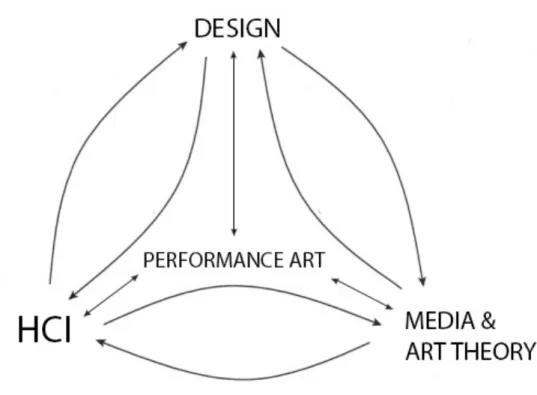
three-dimensional environments, all in real time. The multidisciplinary body of work created in this study is fundamentally structured by a triangle of three main fields: human computer interactions (HCI), visual art and design, and media and art theory. All these fields intersect and come together through performance art, more precisely, through digital dance performance (Figure 2). This becomes necessarily a collaborative process, mediated mostly through design and experimental use of sensing technologies with digital video projection techniques.
8
Figure 2: Multidisciplinary areas of research in this study that intersect in visual and performance art
RESEARCH QUESTIONS
The title of this dissertation, 3D [Embodied] Projection Mapping and Sensing Bodies: A Study in Interactive Dance Performance, reflects the experimental and conceptual approach of my work. It focuses on the understanding of the connection between the key concepts of immersion and interactivity in mixed reality environments. This study attempts to formalize practical guidelines for projection design and embodied
9
interaction, more precisely, to pinpoint strategies for generating projection-based augmentations with motion-sensing technologies and interfaces. My primary research question is related to the direct integration of sensing technologies with live visual projection design or, more precisely, to the intersection between interactive technologies and immersive environments: What are the creative opportunities that are open to us when we consider the use of augmented reality (AR) for live performance derived from digital video technologies combined with sensing technologies?
The spectrum between reality and virtuality becomes more complex as it is supplemented by computer-generated sensory inputs and situated in immersive environments beyond synthetic virtual reality headsets. I focus on creating collective visual augmentations for the audience through spatial augmented reality, also referred to as 3D video mapping, which allows me to overlay virtual environments directly over the physical space and the performers’ bodies. By combining sensing technologies as the input signal, and projected imagery as the output, we focus on identifying and creating communication channels and images for mediated creative expression in live dance performance. Using mixed reality performance as the context, my second research question is: Considering the full spectrum of the reality-virtuality continuum, what are the main attributes and limitations in designing embodied mixed reality environments using projector-based augmentations?
The architecture design in mixed reality environments has been expanding as new technologies and modalities are created to overlay and juxtapose real and virtual worlds.
10
Environments such as augmented reality and augmented virtuality have unique sets of attributes and qualities for live dance performance. By analyzing the input, processing, and output of these theoretical frameworks in the live dance performances created in this research, I identify the key issues to consider when designing immersive AR and AV-embodied environments. Finally, based on the interdisciplinary nature of dance performance, we also focus on the collaborative process between the agents (the
choreographer, the media designer, and the dance performer) and, borrowing Downie’s expression, the “extended agent” (the software) (2005). What are the key guiding
principles for designing software that function as a “choreography partner” in augmented dance performance? How can these interactions generate improvisational and dynamic mapping between the physical space and the virtual world?
The last research question in this study introduces a new layer of sensing
technologies by tapping directly into the performer’s brain activity. We incorporate new sets of data and behavior into our framework by connecting BCIs with depth
visualizations. Exploring the role of emotional response tracking to digitally augmented human movement as an art form to conceptually explore dance expression beyond physical movement: How can brain computer interfaces (BCIs) be integrated into mixed reality performance?
The integration of motion capture technologies with BCIs expands the design of mixed reality environments and expands the relationship between the performer and media. This particular framework is implemented and analyzed in the last chapter and
11
performance of this study, Biomediation, to add a new layer in 3D embodied environments.
METHODOLOGY
A doctorate in design and visual composition stems from a blend of theory and practice. It includes an understanding of ongoing innovation in practice-predicated environments and cognizance of insight acquired throughout the process. The research presented in this thesis follows a practice-based approach. Conducting research through practice has been widely used in the last decade by artists and researchers. This
framework for research gives us the structure to engage with issues by writing from within practice, generating an intimate and auto-ethnographic analysis of the experience of creating new artistic projects. Practice-based research has given rise to new concepts and methods in the generation of original knowledge (Candy, Amitani & Bilda, 2006). Media and cultural theorists look at artists to be among the first to explore and make sense of new media. Critical thinkers and creative minds operate in tandem as they both seek to understand new interactions with new technology. Media designers and
transmedia artists generate a privileged framework to provide and generate media theory, grounded in applied art. Lialina asks, “Who if not them are to be nurtured with media theory’s ideas, and give back in form of art works, artistic research and designs?” (2015).
12 PERFORMANCE AS RESEARCH
On practice and performance as research, Shannon writes:
While performance practices have always contributed to knowledge, the idea that performance can be more than the creative production, that it can constitute intellectual inquiry and contribute new understanding and insight is a concept that challenges many institutional structures and calls into question what gets valued as knowledge. Perhaps the most singular contribution of the developing areas of practice as research (PAR) and performance as research (PAR) is the claim that creative production can constitute intellectual inquiry. (2009, xv)
This research project emerged from practice, creating mixed reality environments beyond the virtual reality and embodying the physical world. We follow an
interdisciplinary approach that draws on design, visual arts, computer sciences, human computer interaction (HCI), performance and media studies, and art theory.
By using a mixed-methods approach within these different disciplines, the projects employ digital technologies to create distinctive forms of interactive and
experimental dance performances. Our methodology also includes qualitative interviews and questionnaires. The interdisciplinary success of longitudinal technology and temporal art projects depends directly on the articulation between creative and technical agents. Our methods and strategies are based on what Donald Schon described as “the situations of practice—the complexity, uncertainty, instability, uniqueness and value conflicts,
13
which are increasingly perceived as central to the world of professional practice” (Schon, 1983, p. 14).
Our methods enable intuitive and expressive navigation through gestural and mind interactions with our system and sensor reactive systems. Sensing design and stage mapping processes are fundamental for the practice generated in this work, and to connect the physical, the cognitive and the virtual. Our method began by collecting data from dancers. Then, we projected interactive imagery on the performers’ space. This system creates two-way communication between the dancer and the interactive projected imagery, generating the coexistence and convergence of interfaces in augmented
performance.
The methodology arises primarily from reflections on practice, but also by incorporating theories and related written research. The synergy between practice and theory is executed with a performative approach to research (Haseman, 2006). The early practical experiments were motivated by artistic and technical motivation, being guided by passion and my artistic instinct. The theoretical and research agenda is a direct consequence from this practice and framework. The 3D [Embodied] performance solidified the theoretical framework and the main terms of the research agenda.
Benford and Giannachi (2011) formalized the methodology of “research in the wild” as a result of a decade of collaborative work and research at the Nottingham University’s Mixed Reality Labs. The work is focused on the evolution of
14
researchers who want to develop new technologies, such as physical interfaces and/or software tools. The authors identify three main elements in this method: 1) It is led by practice; 2) The data collected is gathered from ethnographic studies on the technologies in use; 3) Theory is generated directly from these findings and analysis (Benford & Giannachi, 2011, p. 8).
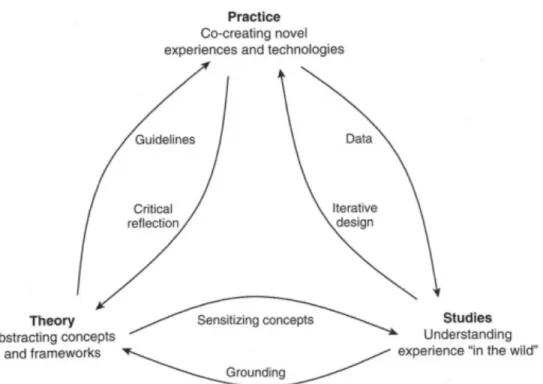
The relationship between theory, practice, and creativity is described as a feedback loop process in the following diagram from the doctoral research of Rowe (2015) (Figure 3), which has many similarities to the methodology and structure used for our study.
Figure 3: “Research in the wild” diagram, relating practice, studies, and theory (Rowe, 2015).
15 ZERO POINT METHODOLOGY
In his doctoral dissertation, Beyond the Electronic Connection, Yacov Sharir proposes a collaborative multidisciplinary methodology that he named the “Zero Point Methodology” (2012). Sharir uses this phrase to describe the necessary working relationships that best facilitate a multidimensional, multidisciplinary, genuinely
collaborative new project. The basis of this methodology lies in creating non-hierarchical roles in order to enhance the creative process. Communication is the key active agent between the collective and the creators; it is the fundamental premise that sparks the creative process and collaborative exchange between the media. The foundation for this collaborative method relies on communication. Applying effective listening skills and conceptualizing, proposing and respecting ideas in the space creates group commitment and non-hierarchical relationships.
Sharir writes, “The most precious asset related to this methodology is its ability to engage in careful listening, which leads to analysis, and ultimately the understanding of all the components that are necessary to engage in such an interaction” (2012, pp. 40-41). Sharir’s methodology was naturally suitable to my study. As a supervisor and mentor, Sharir guided the collective on mutually agreed upon “thematic ideas, content, and the meaning that will serve as the driving force that eventually brings about a successful iteration to be shared with an audience” (2012, pp. 40-41).
Working with interactive media and experimental visual arts in performance implies the need and ability to listen in a way that helps researchers understand the subtle
16
relationships between and among performers and technology. It requires technical
proficiency with a strong understanding of projection, video, animation, light, and design and the skills necessary to produce original artistic work. In academia, my research falls in the category of projection design programs. Similar programs are by nature geared towards the entertainment industry and, as an approach, are similar to media designs driven by technical applications. The work reported in this document was generated primarily from an artistic and conceptual augmented environment. The role of each collaborator was distributed equally between choreographer and media designers. The goal is to co-create an interactive media form in which the body in movement is an equal and integral partner.
Digital artist Klaus Obermaier argues that there are fundamental differences between interactive performances conducted by choreographers and directors and those conducted by media artists. When directors and choreographers think of a new piece, they create work primarily rooted in their main medium of expertise. For example, in theater, text will be the starting point for the creative process and thus, as Obermaier says, “Only very late do other media get involved and can thus only have an ornamental relevance instead of attaining essential parts in form and content” (2008, p. 259).
Media artists working with interactive performances start this creative process directly from their artistic medium and incorporate them in a multidisciplinary
framework. For example, light has been widely used as decoration and as an auxiliary tool for stage performance instead of becoming a fundamental creative partner and
17
medium for artistic production and performance. In fact, even today, there is a
conservative and traditional approach to media design in live performance. The role of media design is not a creative equal with performance partners such as dancers, but the implementation of new technologies in live performance “have changed and renewed them” and they have become “integral parts” of performance (Obermaier, 2008, p. 259).
Our methodology gives equal value to the different roles played by various creators in the creative process. All the elements involved in this body of work and research incorporate dance and expression in an augmented space that is designed as a living digital organism and environment. Under this framework, media designers working with choreographers and dancers need the interdisciplinary team and nonhierarchical order to enhance the creative process as an integral part in performing arts.
ON COLLABORATION AND PRACTICE
Combining practice with theory is difficult to present in a linear document. Theories were developed and processed during practice. The collaborative projects were also opportunities to test the theories, and performances embodied the research and knowledge acquired. To present both theory and practice simultaneously is a difficult and challenging task. This document is organized to present the research process in a
organized and structured publication, but does not reflect or mimic the timeline and temporal execution of the research.
18
Figure 4: Timeline of research projects and performances developed in the framework of
3D [Embodied] research and dissertation
The group of agents involved in interdisciplinary work in performing arts is vast, and it is very difficult to effectively describe the role and relevance of every agent that contributed to the pre-production and production of the show. The practice-based
approach of my committee towards live dance and media performance made it possible to collaborate directly with them and take my work beyond the theoretical. Dr. Sharir
choreographed three of the performances and Dr. Pennycook designed the interactive sound design from 2011 to 2015. Throughout the process, we worked with undergraduate and graduate students from the department of theater and dance at the University of Texas, Austin. I also worked with professional dancers from Quixotic, a performance art collective that fuses dance with new media art. The collaboration with professionals outside of academia can be argued to constitute a fundamental component of
transdisciplinary research, bringing a broader range of knowledge and different set of skills and expectations (Cutler, 2010).
19 CONTRIBUTIONS
The contributions of visual and performance artists to VE’s continued
development is key to how we will know and comprehend ourselves in the near and far future as creatures existing in both the physical and the digital domains. (Ford, 2007, p. 123)
Our focus in this interdisciplinary research project is using technology and creating responsive visual environments for dance performers and choreographers in order to expand the current set of expressive methods for digital dance performance. We avoid the gadget effect of displaying technology for its own sake and instead focus on using technology to drive interactivity and expand the ways we think of reality and virtuality. We appreciate the value of direct articulation of the expressive relation and network between the physical body, virtual environments, and artistic expression. We aim to create a practical guide for artistic, conceptual and technical implementation for mixed reality performance, outlining visual programming and media design between the sensing technologies (input) and projection based augmentations (output). We also provide a theoretical and critical analysis of the performances, specifically by reporting and analyzing creative applications and mapping strategies of motion tracking systems and projector-based augmentations.
We seek to explore the potential of using augmented reality (AR) in the context of contemporary dance performance through projector-based augmentations. The interaction between the software and the dancers is designed to better convey the choreographer’s
20
vision and act as an extended agent for the dancer. By incorporating brain computer activity in our workflow and interface, we extend the field of research beyond the physical dimension. We strive to streamline the theoretical understandings and analysis between real-time interaction of the body and mind with designed augmented spaces. These augmented architectures and custom-made algorithms and software are available for further research and experimentation through my website, an extension of the dissertation.
This study contributes to the HCI field by producing user-centered design development in software production with sensing hardware technologies. It adds to the field of performing arts by analyzing the interdisciplinary collaborative design process. Our study contributes to the media studies field by identifying practices and generating new architectures and interactions of virtual embodiment and mixed reality performance. Finally, the interactive systems created provide original contributions to knowledge focused on the improvement of the interdisciplinary practice of mixed reality performances.
OVERVIEW OF THE STUDY
This study is focused on dance performance and its intersection with and
mediation by digital light and visual art. It aims to create sensorial and experiential visual feedback through media design. It aims to co-create an interdisciplinary exchange and link between projected light and bodies in movement.
21
The Introduction describes the contextualization and methods used in the study, combining theory and observation in design and media with practice. It also introduces the previous work that led to the interdisciplinary group of students, professors, dancers, engineers, and artists that contributed to this study. It also highlights the problems and research questions this study explores.
Chapter 1 presents the context and theoretical framework used to analyze mixed reality environments as architectures for live performance. It focuses on the immersive and interactive qualities of augmented environments and the overall principles and main concepts developed in digitally augmented environments for mixed reality performance. The intersection between sensing technologies and projection augmentation is presented in this study as the input (sensing and digitizing the moving body), processing of data sets (interactive design), and output (3D projection mapping). This organization also reflects the architecture of digitally augmented environments.
Chapter 2 describes Too&For, an exploratory study and our first performance. Too&For was created with choreographer Yacov Sharir at the University of Texas in the Theater and Dance department in August 2012. Its focus is on the immediacy and
expressive role of multi-touch and drawing techniques in the mediation of live dance performance with computer-generated 3D graphics. This was an exercise to investigate the principles of motion tracking and computer-generated imagery without the use of automation in mixed reality environments.
22
Chapter 3 describes Super Mirror, an attempt to provide a motion capture interface for ballet dancers. Through software development and integration with a low-cost depth sensor, Super Mirror expands the role of the traditional mirror used in rehearsal spaces, providing automated corrective feedback to the dancer. Through comprehensive, evaluative research with dance students and practitioners we evaluated usability to understand the impact of our framework in assessing and assisting the practice of specific ballet movement.
Chapter 4 describes 3D [Embodied], the first dance performance we created incorporating the Super Mirror system and real-time generative computer graphics. It is an experimental mixed reality performance that investigates the real-time dialogue between the moving body and 3D geometry perspective calculations. Through a continuous stream of full body tracking, the dance performer is able to control and transform the geometric transformations of computer-generated imagery in real time. This mixed reality architectural design represents a practical application of spatial augmented reality environments.
Chapter 5 describes Luxate, which explores the qualities of digitally projected light beyond the screen and a different approach to projector based augmentations in the performance. The goal is to encourage the perception of an augmented holographic interface, creating a reactive environment between the dance performer and the
perception of a light field generated by smoke. Ultimately, this project seeks to explore the digital interactive qualities of light beam architecture in the physical space.
23
Chapter 6 describes Biomediation, which goes beyond the physical dimension of sensing the movements of the dancers and taps the performer’s brain directly. Through the use of Brain Computer Interfaces (BCIs), we establish a communication process between the depth sensor and the brain computer interface, creating a new and different form embodied in the mixed reality environment. Ultimately, Biomediation analyzes the potential of brain computer interfaces for dance performance.
Chapter 7, the conclusion, summarizes the main findings and contextualizes the study. It also discusses the study’s location in a broader landscape and suggests future work and research in mixed reality interaction design and performance.
24
Chapter 1: Context
OVERVIEW
This chapter presents the theoretical and conceptual implications involved in designing and experiencing immersive digital environments, specifically, in the creation of computer-generated environments that involve spatial interactivity and immersion. I start by defining virtual reality (VR) simulated environments and then transition to more hybrid augmented environments. Physical space and digital environments have rapidly converged in the last decade into a technological state known as “mixed reality.” Mixed reality pushed the boundaries of our contemporary theoretical relationship with digital technology, and, in turn, new conceptual models were created to describe and analyze this technical, cultural, and artistic shift.
Within mixed reality lies augmented reality (AR). Augmented reality enhances the user’s perception and interaction with the real world by supplementing 3D interactive virtual objects in the user’s field of view (Azuma, 2001, p. 34). AR is usually thought of in terms of a specific technology that recognizes computer-generated sensory input in the physical world and triggers audiovisual feedback in mobile displays, but AR is not restricted to mobile or screen-based display technologies. Projection-based visualizations for AR have unique qualities because the interface elements are projected directly into the real world. I move to discuss spatial immersion in performance by using
projector-25
based augmentations. In my work, I situate projection mapping, otherwise known as “spatial augmented reality,” within this framework.
To theoretically situate projection mapping as augmented reality, I start by explaining the current literature on immersive environments. I argue for the advantages of augmented environments over the purely virtual. To me, augmented reality created by projector-based augmentations maintains a connection with the tangible world, which can be considered a different approach from purely synthetic virtual spaces. Because the mediating technology is non-invasive, unlike the clunky equipment of virtual reality, the user can engage the experience in a more natural way. Furthermore, it avoids the one-way communication stream of virtual reality in favor of real-time interactions with the sensory world, and can even encourage people to build social connections.
From a full discussion of the media involved in spatial augmented reality, I move to explore the theoretical underpinnings and uses of spatial augmented reality and explain the theoretical concept of augmented virtuality. These theories help me explain how augmented virtuality is achieved through the integration of dance performance with digital software and projection.
This chapter serves to lay the groundwork for understanding the embodied projection-based augmentations created in this research and provides a fundamental map to understand and analyze the complex connections between virtuality and reality in live performance. The mixed reality continuum and theoretical framework will serve as a reference in order to map the whole spectrum established by different technologies and
26
modalities for the input and output between real and virtual, as this study presents four dance performances that explore those intersections and characteristics of media design in different areas of the continuum.
IMMERSIVE DIGITAL ENVIRONMENTS
Audiovisual magical environments have been imagined, explored, and created by artists, scientists, designers, engineers, writers, and others to generate unique sets of autonomous spaces and environments throughout history. More specifically, the use of projected light in performative settings and experimental live settings to invoke illusions, fantasy, and unnatural phenomena can be traced back several centuries. The introduction of digital media in the creation of immersive environments has created the possibility to be physically present in reality and a virtual world at the same time.
Virtual Reality
The first artificial environment created in computation was virtual reality. There is no common definition for virtual reality, but it is possible to identify common
characteristics. The main goal is to mimic the real world by creating a simulated 3D environment. Virtual reality visionary and theorist Ivan Sutherland explains the importance of replicating the “real” to practitioners of virtual reality: “The screen is a window through which one sees a virtual world. The challenge is to make that world look real, act real, sound real, feel real” (1965, p. 506).
27
Virtual environments are by design systems to enhance communication between humans and computers. The synthetic qualities of virtual environments, commonly referred to as virtual reality, consist of numeric and programmed data sets in a synthetic and digital world. The visualization is generated by head-mounted displays and sensor tracking interfaces such as gloves or head tracking. With advances in technology, the ability to recreate a simulation of reality or new realities was expanded to new levels of engagement and immersion for virtual reality, but it excluded the physical space and environment of the user from the experience.
Virtual reality has evolved in both our minds and in our attempts to achieve it. The first reference to the concept of virtual reality came from science fiction literature, in the 1935 short story “Pygmalion’s Spectacles” by Stanley G. Weinbaum. In the story, the “spectacles” are goggles that allow the user to interact with and engage in the sensory world of a movie. In the mid 1950s, cinematographer Morton Heilig created the Sensorama, an installation featuring stereo speakers, 3D display, fans, and vibrating chairs—a well-known attempt to engage all the senses in an immersive, virtual environment. Helig also patented the first VR head-mounted display, known as the Telesphere Mask, in 1960. This provided stereoscopic 3D, wide vision, and true stereo sound; importantly, it also freed virtual reality from cumbersome stationary equipment. In 1965, Ivan Sutherland created the Ultimate Display, a virtual reality head-mounted display in a room that allowed users to control and transform the virtual environment. Sutherland saw the potential to go beyond mimicking the real world. He described the
28
possibility of accessing places with “concepts not realizable in the physical world,” places with “forces in non-uniform fields, non projective geometric transformations, and high-inertia, low friction motion . . . . It is a looking glass into a mathematical
wonderland” (1965, p. 506). Sutherland’s vision marks a clear evolution in how virtual reality could be conceptualized.
At base, virtual reality is a computer technology that uses software to replicate real 3D environments and enables the user to interact with artificial and digital
environments through the use of head-mounted displays (HMD, the iconic head-mounted goggles with a screen in front of the eyes) and tracking systems. Sutherland constructed the first HMD VR system in 1968, which he nicknamed “Sword of Damocles” and which included head tracking and three-dimensional display (Sutherland, 1968). The
introduction of sensory devices incorporated different senses and transformed the medium’s ability to respond to the user’s movements in the artificial world. Since then, new technologies have powered high-fidelity experiences to the point of not just
mimicking reality, but creating a space that feels so real that it is indistinguishable from reality. Full immersion into virtual reality relies on the idea of transcending reality and is often described as the “willing suspension of disbelief” (Coleridge, 1817).
Beyond Virtual Reality
The extension of immersive environments beyond virtual reality address creative and artistic exploration of the experimental qualities of the digital medium. Immersive digital environments do not seek to replicate reality just as it is. Instead, creating
29
immersive digital environments provides an opportunity for artists and designers to generate environments in which the user feels an experience that transcends ordinary reality. It allows for the creation of “places that work as alternative, parallel worlds” (Beira, Carvalho & Kox, 2013, p. 45). These places don’t need to fulfill the same roles and functions as the real world, and perceptions of the laws of physics, logic, and sensory input can be manipulated and augmented. These spaces work as the “metaphoric places of transition between real and virtual worlds in which virtual and real elements are interwoven” (Beira et al, 2013, p. 45). The goal is not just to simulate the real world but instead to transform it by creating new perceptions and to “define arbitrary, abstract and otherwise impossible relationships between action and result” (Krueger, 1997, p. 119). Designers are now able to create unique digital environments that challenge the
fundamental rules of reality.
IMMERSION AND INTERACTIVITY
When designing digital environments, it is important to consider the fundamental principles of constructing an immersive space. The definition of immersion has a wide range of meanings, but in the context of digital media, it refers to the spectrum of mediated experiences within media arts and interaction design and the overall
engagement of the viewer. Immersion in virtual environments is enhanced by the active participation of the user, known in the field as interactivity. Because of interactivity, immersion stands in opposition to being a passive observer of pre-recorded media such as video or film. Key elements that can increase immersion include considering sensory
30
modalities and spatial fidelity, including kinesthetic learning, and making the medium invisible. Despite the medium’s ability to bend reality, orienting the senses can contribute to a more immersive experience, as the viewer’s ability to suspend their disbelief
increases. Brenda Laurel explains, “Tight linkage between visual, kinesthetic, and
auditory modalities is the key to the sense of immersion that is created by many computer games, simulations, and virtual-reality systems” (1993, p. 161). Considering sensory modalities and spatial fidelity in real time are fundamental to creating immersion in a virtual environment.
The role of spatial involvement and engagement in immersion is reflected in the relationships between image and body space, which is central in Calleja’s analysis of immersion (2011). In virtual environments, the relationship between the body and the mechanics of movement, also known as kinesthetic learning, is created by the interface. The adoption of non-invasive sensing technologies and interfaces is a fundamental process in the creation of virtual immersive environments. The ability of the media to disappear and to make the mediated content indistinguishable from reality is required for the creation of an immersive virtual medium (Ryan, 2001). In achieving this in an immersive environment, concept and technology are interdependent.
Grau also links optical illusion and transparency of the media with immersion: Immersion arises when the artwork and technical apparatus, the message and medium of perception, converge into an inseparable whole. At this point of calculated “totalisation,” the artwork, which is perceived as an autonomous
31
aesthetic object, can disappear as such for a limited time. This is the point where being conscious of the illusion turns into unconsciousness of it. As a general rule, one can say that the principle of immersion is used to withdraw the apparatus of the medium of illusion from the perception of the observers to maximise the intensity of the message being transported. The medium becomes invisible. (2003, p. 348)
The transparency of the medium generates more natural interactions between the user and the environment, which consequently increases user engagement in the environment.
The principles and qualities of immersion and interactivity are fundamental for the generation of immersive digital environments, where the user is able to interact in a natural and intuitive manner with the technology interface. The ultimate goal is to achieve what virtual reality researchers refer to as a “state of presence” in the mediated environment.
MIXED REALITY PERFORMANCE THEORETICAL FRAMEWORK
In recent decades, computer imagery and content have conquered the challenge of physical space, transcending the limitations of screen-based and head-mounted displays, thus leading to more possibilities for an immersive experience. Our concept of mixed reality is born out of the age of pervasive and ubiquitous computing and its ability to merge the real and the virtual in a unified environment. The space between reality and virtual reality, and the different varying levels between them, is called mixed reality. Milgram and Kishino defined a mixed reality as a mediated experience located
32
“anywhere between the extrema of the virtuality continuum” (1994, p. 1324). Such environments intertwine spatial and temporal components into cohesive, hybrid experiences between the viewer, the physical space, and the virtual space. The authors also created the “reality-virtuality continuum,” a taxonomy of mixed reality displays (Figure 5). This theoretical framework provides a fundamental roadmap to understand the complex connections between reality and virtuality. The continuum defines four
fundamental modes and areas of relationship between the viewer and the digital media in this mixed reality: the real environment, augmented reality (AR), augmented virtuality (AV), and virtual reality or virtual environment (VR/VE).
Figure 5: Adapted from Milgram & Kishino’s “reality-virtuality continuum”
In one extreme of the continuum lies virtual reality. Virtual reality describes computer-generated environments where the user experiences only virtual stimuli, experienced through head-mounted displays or stereo back-projection environments such as the CAVE (Cruz, 1992). Augmented reality lies between reality and virtual
33
information. Augmented virtuality, on the contrary, signifies virtual environments overlaid with physical information (Milgram & Kishino 1994).
The term “mixed reality” incorporates a spectrum of theoretical models for framing reality and virtuality by presenting them in one display and frame. Unlike virtual reality, Benford argues that the mixed reality environment “offers the possibility of creating such hybrid performative and participatory environments in which real and physical data appear” (2011, p. 5). Instead of being integrated into one another, they are juxtaposed on top of or next to one another.
The goal of mixed and augmented art forms is to challenge and explore different approaches to the relationship between the viewer, the experience, and the media. Through performance and installation, artists have attempted to aggregate computer-generated content and the physical environments in order to create higher levels of immersion. These theoretical models framing the relationship between real and virtual as a superimposition of the two were originally proposed by Sutherland: “The user of one of today’s visual displays can easily make solid objects transparent—he can ‘see through matter!’” (1968, p. 507).
In a first attempt to realize this theoretical model, Myron Kruger created Videoplace in 1974. This installation combined human interaction with computer-generated graphics in real time. Through the use of a video camera and software development, Krueger overlaid the graphical representation of the silhouette of the participant’s body (1991). Krueger is considered to be one of the first augmented reality
34
artists and researchers, and instead of using virtual reality head-mounted displays, Krueger investigated the output qualities of juxtaposing virtual projections onto physical walls. Krueger’s work pioneered augmented reality as an interactive art form.
Augmented reality became an independent field of research as the technological advances of the 1980s and early 1990s were used to advance the field’s conceptual output. Boeing researcher Caudell coined the term “augmented reality” to emphasize the need to focus beyond the virtual experience, but also in the augmentation of the real through digital information (Caudell & Mizell, 1992).
Augmented reality can be defined as an extension of virtual reality. The
difference between virtual reality and augmented reality is the fact that augmented reality integrates the real world and the physical environment in the mediated experience, in opposition to virtual reality, which positions the user’s senses always in the purely simulated virtual environment, ignoring any physical reference in the real environment. Examples of AR applications have been explored in products like Google Glass, and multiple camera-based applications in smart phones, such as QR and AR codes.
Contrasted with virtual reality, Milgram defined AR “as any case in which an otherwise real environment is ‘augmented’ by means of virtual (computer graphic) objects” (1994, p. 1323). Litchy extended this notion to include “a welding of a form of real-time video and virtual reality, or an optically registered simulation overlaid upon an actual spatial environment” (2014, p. 99). Thus we have both the virtual and the real sharing a mixed reality.
35
Augmented reality simulates virtual objects and displays digital information, juxtaposed with the physical environment. In augmented reality, sensors and algorithms are introduced to determine information such as the spatial position and orientation of the user in the real world. Litchy proposes five modalities in AR: Fiducial, Planar, Locative, Environmental, and Embodied (2014, p.100). Each one creates different relationships and interfaces with the user, the physical, and the virtual in order to create specific gestures of media delivery. Rowe identifies the transition from static media to augmented virtual environments, as one of three different stages of evolution in media art: first, by
expanding the image space, from a post-cinematic/video art tradition; second, by entering the image space, such as in virtual reality and, finally, by exploding the image space, which includes various forms of augmented spaces (2015, p. 58).
Augmented reality as a technology renders 3D graphics to be displayed exactly as they are perceived from the user’s position and location and the camera’s point of view in the virtual world. Such technology has created a fundamental transition in how users experience mediated experiences, and the practical outcome of virtual environments.
PROJECTION MAPPING AS SPATIAL AUGMENTED REALITY [OUTPUT]
Projection based augmentation, or projection mapping, is also referred to in academia as Spatial Augmented Reality (SAR) (Bimber, 2007). In such environments users can move freely without having to wear “oppressively heavy head mounted displays,” which generates a natural interface for artistic expression for the performers (Grau, 2003, p. 245).
36
The most common form of augmented reality visualization is known as See-Through Augmented Reality (STAR). The digital elements are seen through a screen, generally a mobile/portable screen, or a head-mounted display. STAR has limitations on the number of users who can experience the augmentation and also brings a physical obstacle to the process, the screen, which makes it difficult to use in a creative social and performative environment such as live dance. In this research we focus on another form of augmented reality visualization technology based on the projection of light directly to the physical space: projection mapping.
My focus goes more precisely towards the use of projected light as a form of augmented reality (AR). Projection based AR applications have unique and different characteristics from other AR applications:
With projection AR, interface elements can be projected directly onto the real world in registration with it. While it is also possible to create the appearance of interface elements in registrations with the real world in other AR paradigms, there is a more immediate sensation that the interface element is actually a part of the real world in projected environments. (Craig, 2013, p. 202)
The development of augmented reality interfaces led to the overlay of the real world and physical space with the virtual image space in three dimensions, and this has become a fundamental area of development and research of virtual environments and augmented reality.
37
Projection mapping, also referred to 3D video mapping, is a recent term that gained more popular acceptance and usage than the academic name “spatial augmented reality” (SAR) or “projection-based augmentation,” coined by Raskar in 1998. It is a mixed reality environment where the virtual elements are displayed in the space and mapped within the architecture of the space. Contrary to virtual reality, the observer does not use headsets or any other technical gear for viewing. The visualizations are integrated into the physical environment through the use of digital video projectors or by using built-in flat panel displays (Raskar, Welch, & Fuchs, 1998, p. 1).
For the purpose of this study, we focus on the use of digital projectors that
integrate computer-generated graphics directly into the user’s environment. 3D projection mapping, or projector-based augmentation, can be described as the manipulation of three-dimensional digital animation perspective transformed with projection design to match exactly the 3D canvas of objects and buildings in the real world and physical space. It is a technique that uses perspective 3D transformation in projected light in order to turn any surface into a dynamic visual display. It is an extension of virtual reality systems, consisting of physical three-dimensional models that co-exist in the physical and virtual space and which have the same geometric shape and structure/architecture.
This technique has created a new artistic medium in the last decade. One key advantage between 3D video mapping and other displays such as head-mounted displays is the capacity to generate multiple-user experiences in the same environment. In
38
technologies made it possible for a community of engineers, artists, and designers to create software and projection algorithms to experiment with and create interactive and augmented techniques in SAR. The design of immersive spaces with projection-based surround-screen displays, semi-immersive wall-like, cylindrical, or spherical spatial displays helps generate a more immersive experience due to the fact that “spatial displays detach the display technology from the user and integrate it into the environment”
(Bimber, 2005, p. 7).
Bimber and Raskar created a comprehensive overview of the general principles and techniques of 3D projection mapping in their book, Spatial Augmented Reality: Merging Real and Virtual Worlds (2005). They were two of the pioneers in applying the basic principle of 3D projection mapping by starting with a physical object and then creating a 3D virtual model of the same object. This was achieved by manipulating the object in the 3D software, and by transforming either the lightning, the position,
movement, and texture of the surfaces in the virtual space, and then projecting it back to the physical object. This projection and display technique allows for collective
experiences of optical illusions and virtual augmentations, taking advantage “from its geometrical features and viewers’ perspectives to insert objects, create new spaces or manipulate the real physical one” (Bimber, 2005, p. 214). 3D video mapping has unique qualities to explore and design immersive and interactive virtual environments beyond virtual reality. It allows us to create collective mediated experiences for dance
39
performance art, as it overlays virtual information onto physical environments through projected light.
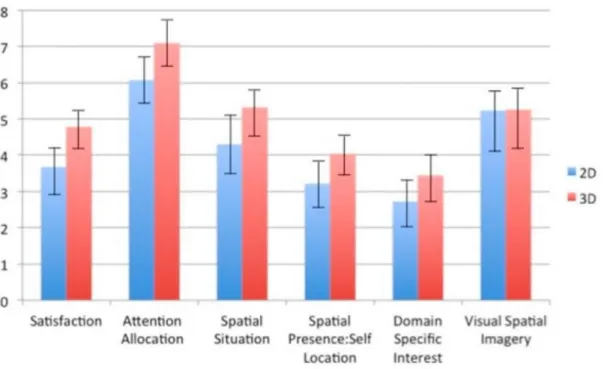
THE PSYCHOLOGY OF 3DPROJECTION MAPPING AS A VISUALIZATION DISPLAY Studies have demonstrated that embedded augmented reality information in physical surfaces and spaces produces superior performance in users (Tang, Owen, Biocca, & Mou, 2003). Jung’s research compares 3D projection mapping versus 2D projection (similar to the projection used in cinema, video, and television) to understand if projection mapping enhances user experience and cognition. More precisely, the researcher investigates the impact of 3D projection mapping displays versus 2D and examines if the sense of presence and immersion is enhanced, making the experience more memorable and accessible to viewers. The viewer’s transformation and perception of space is increased by 25% (Figure 6). Furthermore, the author argues the movement of images into the physical 3D environment increases the accuracy of the viewer’s
recognition memory by over 230% for pattern location (Jung, Biocca & Leee, 2015, p. 213).
40
Figure 6: Comparison of the effects of 3D projection mapping (versus 2D projection) on user satisfaction and various sub-dimensions of spatial presence (Jung, 2015).
Jung argues that 3D video mapping provides spatial presence to the viewer “and stronger than that created by the ghostly overlays of some head-mounted augmented reality and hologram technology” (2015, p. 216). Therefore, 3D video mapping is an effective SAR display technique to create an immersive environment beyond headsets and mobile display devices. By superimposing the projected image directly on a physical canvas and on the environment of the users and observers provides an effective solution to generate collective spatial augmentations visualizations.
41 PROJECTION MAPPING AND PERFORMATIVE ARTS
From a creative and artistic approach, the perception and visualization of 3D projection mapping illusions create a suspension of disbelief effect on the observers. In our case, the dancers and the virtual environments must be simultaneously perceived as part of a conceptual whole for the observers, the audience members. The capacity to make the audience perceive the displayed imagery as real is essential to the appreciation of the art form. The more real and genuine the illusion is, the more immersed the viewers are.
Immersion in augmented reality performance is experienced in digital
performance in two different and complementary ways—first, by the active participation of the live performer: the physical interaction between the live performer and the 3D projected environment. Secondly, the audience passively views these interactions between the performer and the 3D environment.
In short, creating spatial augmented strategies for live performance demands the creation of a scenic environment where physical performers and digital information must be simultaneously perceived by the audience as a singular, integrated experience. Vincs et al describes this process in relation to digital dance performance:
Digital dance performance evokes a kind of hallucination that is predominantly visual to the audience, but invisible to the biological body (the dancer) who is inhabiting that shared space. Without perspective and glasses, the dancer is present physically, temporally and geographically—but she is fundamentally
42
disengaged from the primary entry point of the “hallucination”—what can be seen (2014, p. 171).
Vincs is highlighting the limitations of using 3D projection mapping for the performers on stage. They are too close from the projection display area and their perception of the illusion is limited. Porter emphasizes the same idea: “the stage and theatrical environment are not primarily user-led environments, in opposition to most computer science
applications and research in spatial augmented reality for interactive rapid prototyping” (2010). This visualization hierarchy, in which audiences have the optimal reading, and full experience, is essential to perform SAR in the context of intermedia dance
performance as a performative art form. Immersion for the viewers arises from this inseparable whole between the dancers and the virtual elements in one augmented and hybrid environment.
SENSING BODIES AND PROJECTION MAPPING
The theoretical framework for embodied cognition in SAR in this study is
centered on sensing bodies and projector-based augmentations. We separate the tracking process as the input and projection mapping as the output, and view the interface and visual feedback as mediators.
Sensors (input devices) are critical components of augmented reality. They feed real-time information, a process known as “tracking.” Spatial augmented reality systems use tracking techniques carried on the user and the environment. Most commonly, the tracking is established through the use of cameras, in particular, depth sensor cameras