Title
An efficient auction mechanism for service chains in the NFV
market
Author(s)
Gu, S; Li, Z; Wu, C; Huang, C
Citation
The 35th Annual IEEE International Conference on Computer
Communications (IEEE INFOCOM 2016), San Francisco, CA.,
10-14 April 2016. In IEEE Infocom Proceedings, 2016, p. 1-9
Issued Date
2016
URL
http://hdl.handle.net/10722/229713
Rights
IEEE Infocom Proceedings. Copyright © IEEE Computer
Society.; ©2016 IEEE. Personal use of this material is permitted.
Permission from IEEE must be obtained for all other uses, in any
current or future media, including reprinting/republishing this
material for advertising or promotional purposes, creating new
collective works, for resale or redistribution to servers or lists,
or reuse of any copyrighted component of this work in other
works.; This work is licensed under a Creative Commons
Attribution-NonCommercial-NoDerivatives 4.0 International
License.
An Efficient Auction Mechanism for Service Chains
in The NFV Market
Sijia Gu
§†, Zongpeng Li
§†, Chuan Wu
‡, Chuanhe Huang
§§
State Key Lab of Software Engineering, School of Computer, Wuhan University
†Department of Computer Science, University of Calgary,
{sijia.gu, zongpeng}@ucalgary.ca
‡
Department of Computer Science, The University of Hong Kong,
[email protected]
Abstract—Network Function Virtualization (NFV) is emerging as a new paradigm for providing elastic network functions through flexible virtual network function (VNF) instances ex-ecuted on virtualized computing platforms exemplified by cloud datacenters. In the new NFV market, well defined VNF instances each realize an atomic function that can be chained to meet user demands in practice. This work studies the dynamic market mechanism design for the transaction of VNF service chains in the NFV market, to help relinquish the full power of NFV. Combining the techniques of primal-dual approximation algorithm design with Myerson’s characterization of truthful mechanisms, we design a VNF chain auction that runs efficiently in polynomial time, guarantees truthfulness, and achieves near-optimal social welfare in the NFV eco-system. Extensive simulation studies verify the efficacy of our auction mechanism.
I. INTRODUCTION
Network Function Virtualization (NFV) is emerging as a new network architecture that uses standard IT virtualization techniques to consolidate many network equipment types onto industry standard high volume servers [1]. In a traditional network, each distinct function was typically implemented as a specialized appliance based on proprietary hardware. Such appliances invariably include a substantial amount of software, but the software and hardware cannot be separated. NFV replaces dedicated network devices with software running on general-purpose CPUs or virtual machines. A network function such as firewall, load-balancer, or router deployed in the NFV
environment is known as a virtual network function (VNF).
The mission of NFV includes rapid service innovation, im-proved operational efficiencies, reduced power usage, standard and open interfaces, greater flexibility and improved capital efficiencies [2].
Prior to the NFV era, vendors sell a solution with integrated hardware and software. Due to the separation of hardware and software in NFV, interoperability becomes even more important. Now the hardware and software may come from different vendors, and the functions in the network have to work in concert with one another. Towards this goal, recent initiatives from major industry players start to define standards for the NFV market. For instance, Huawei provides the Open 0Work supported in part by: the Natural Sciences and Engineering Research
Council of Canada (NSERC); SKLSE, Wuhan University (SKLSE-2015-A-06); NSFC (61373040, 61571335, 61572370,); Ph.D. Programs Foundation of Ministry of Education of China (2012014111073), and Hong Kong RGC (HKU 718513, HKU 17204715, HKBU 210412).
Platform for NFV (OPNFV) aimed to ensure compatibility between NFV solutions from different vendors, and allow network service providers to choose from a variety of sup-pliers. NFV makes it easy to aggregate network functions into data centers or other centralized locations. However, concentration of VNFs sometimes is not the most effective and least expensive approach. For this target, a service provider should be free to locate VNFs in all possible locations, from data centers to network nodes to the customer premises. For example, RAD recently introduced a dedicated customer-edge Distributed NFV (D-NFV) solution [3].
A service provider in the NFV paradigm implements one or more virtualized network functions (VNFs). A VNF by itself does not necessarily provide a usable product or service to NFV customers. To build more complex services, the key
notion of service chaining [4] is introduced, where
multi-ple VNFs are used in sequence to deliver a service. More specifically, a set of VNFs is specified and data flow traverses these VNFs in a prescriptive order. A service chain may be unidirectional, bidirectional or hybrid. When all VNFs in a service chain process traffic in the forward direction only, the service chain is unidirectional. When all the VNFs process the traffic from both directions, it is bidirectional. Otherwise, it is hybrid. This work focuses on the unidirectional service chain where flows are forwarded through the ordered VNF sequence in one direction.
Depending on the property of a specific VNF, some types of VNF can be configured once and shared by multiple service chains (e.g., anti-virus functions), while other types of VNF
can only be used by one service chain (e.g., a firewall).
Furthermore, traffic analysis functions such as Deep Packet Inspection (DPI) do not modify the packet; some VNFs con-vert one packet format into another (e.g., video transcoding), which will change the packet size; some security functions such as a firewall drop incoming packets that violate security principles. Consequently, it is necessary to define the data rate for each hop in a service chain. Given the two salient features of VNF service chains, it is challenging to find an efficient solution to the VNF Orchestration problem and to compute suitable prices in the NFV market.
Auction mechanisms represent a flexible and efficient ap-proach to our resource allocation problem in NFV. Different from simple allocation schemes based on fixed pricing, an auction is economically efficient, automatically discovers the
market value of service chains, and assigns resources to users who value them most [5]. Instead of using static provisioning, the service provider dynamically assembles VNFs into a ser-vice chain and deploys VNF serser-vice chains in the data center according to users’ demand. Through competitive bidding, it can achieve a higher social welfare than fixed pricing approaches do. However, the social welfare maximization problem under dynamic resource provisioning is NP-hard [6], hence it is challenging to find an effective algorithm to such optimization, even if truthful bids are given for free.
This work focuses on the NFV market for selling service chains in the data center. The service provider acts as the auctioneer and owns network resources in the data center. It sells network services to the users (bidders) through an auction. Each service chain contains a series of VNFs. Due to CPU, memory and bandwidth limits in the data center, It can only configure a finite number of VNF instances that can be packed into service chains. While some VNFs can be shared among several service chains, however, the degree of sharing should be limited. To guarantee the performance of the VNF instance, we should only allow a limited amount of flows traverse a single VNF instance.
To design an economically efficient auction mechanism solving the resource allocation problem while pursuing the maximum social welfare, we formulate the social welfare maximization problem as an integer linear program (ILP) which is an NP-hard combinatorial optimization problem. Thus, it is unlikely to find an exact algorithm to get the solution in polynomial time. We instead resort to the design of an efficient primal-dual approximate algorithm to compute in polynomial time a close-to-optimal resource allocation solu-tion. Our primal-dual algorithm is carefully designed, so that it simultaneously achieves three goals. First, it is computation-ally efficient, making the NFV auction amenable for practical implementations. Second, it guarantees a small approximation ratio as compared to the optimal solution, ensuring good social welfare in the auction result. Third, our algorithm ensures that a higher bid can only help with the winning probability
of an NFV user, satisfying the monotone allocation rule [7]
that is essential to the design of an accompanying payment mechanism for together eliciting truthful bids.
Truthfulness is a desirable property in auction mecha-nism design. It is well-known that the Vickrey-Clarke-Groves (VCG) mechanism can guarantee both truthfulness and social welfare maximization, under the assumption that an optimal algorithm is applied to the underlying social welfare max-imization problem [8]. However, the VCG auction coupled with an approximate algorithm loses its truthfulness guarantee. Consequently, exploiting the monotone property of our primal-dual algorithm, we resort to design an alternate payment strategy base on Myerson’s celebrated characterization of truthful auctions, making sure that bidding truthful valuations for the service chains constitute a dominant strategy for each NFV user. Our primal-dual approximation algorithm works in concert with the tailored payment strategy, together making an efficient truthful NFV auction mechanism.
In the rest of the paper, previous literature is discussed in Sec. II. We formulate our system model in Sec. III. In Sec. IV, we design an auction mechanism containing an primal-dual algorithm to determine the resource provisioning with a small approximation ratio, and a payment strategy to guarantee truthfulness. We evaluate the performance of our auction mechanism in Sec. V. Sec. VI concludes the paper.
II. RELATED WORK
A number of industry standards on NFV were proposed by ETSI, IETF, as well as the industry sector (including Huawei and Cisco), resulting in a series of recently published white papers [1] [9] [10]. The document from IETF [4] defines a reference architecture and a framework to enforce Service Function Chaining (SFC) with minimum requirements on the physical topology of the network. Our work aims at the market design that facilities service chain transactions, and follows the concepts and frameworks outlined in these white papers.
Bari et al. [11] present two solutions to the problem of VNF orchestration. They formulate the problem as an ILP and compute the optimal solution using CPLEX when the network is small. When the network is large, a heuristic is used
to compute sub-optimal solutions. Gember et al. [12] design
and implement a network-aware orchestration layer to deploy middleboxes in the cloud, known as Stratos. The orchestration process is separated into three steps: first, deciding how many VNF instances of each type are needed; second, considering how to place these VNFs inside the cloud; finally, routing the traffic through the service chains. In [13], it is shown that properly placing VNFs in an NFV-enabled packet/optical Data Center is effective to minimize optical/electical/optical (O/E/O) conversion cost for VNF service chaining. A heuristic algorithm is provided to solve the problem for VNF placement. To our knowledge, our work is the first to address NFV resource allocation through an efficient auction mechanism, which strives to guarantee not only computational efficiency and approximate social welfare maximization, but also truthful bidding from NFV users.
Auctions have long been used as a mechanism for allocating
resources to competing users. Zamban et al. [14] design a
truthful auction based on an approximation algorithm for cloud resource allocation, but without proving the performance
of the algorithm. Wang et al. [15] provide a truthful VM
auction based on a greedy allocation algorithm and a well-designed payment method. However, the approximation ratio
is large and depends on the number of VMs. Zhanget al.[6]
focus on dynamic cloud resource provisioning, and design a randomized auction for VM transactions in the cloud market. The well-known VCG auction loses its truthful property when applied with an approximation algorithm to compute resource allocation [16]. Hence the VCG mechanism is unsuitable for our NFV service chain auction where optimal allocation is
NP-hard. In [17], Gopinathanet al.design a payment scheme
which can guarantee the truthfulness for approximation al-gorithm based on Myserson’s principle. While most cloud
auction mechanisms sell separate VMs, the auction designed in this work sells correlated VMs in the form of service chains.
III. SYSTEM MODEL
We consider an auction approach to provisioning resources
in the NFV market. There are K types of resources, as
ex-emplified by CPU, memory and bandwidth. The total amount of type k∈[K]resource in the data center isck. The service provider supplies V types of VNFs,v∈[V]denotes a typev
VNF instance that consumes a pkv amount of typekresource
for each k, and has a processing capacity of Mv. I users
participate in the auction as bidders. Each useri∈[I]submits a bidBi. Each bidBi requests a service chain, which can be
regarded as a directed path containing Vi types of VNFs and
Ei links, along with a bidding pricebi. For the service chain
inBi,(u, v)∈[Ei] is a link from VNF instanceutov. The
data rate on link(u, v)isdi(u, v)anddi(u, v) = 0if(u, v)is
not in service chaini. Let a binaryxi indicates whether useri
wins (xi = 1) or not (xi= 0). Letvi denote the true valuation
of user i for the requested service chain. If user i wins, the payment for its bid is pi. The utility ui for useriis
ui(Bi,B−i) =
(
vi−pi if useriwins its service chain
0 otherwise
B−iis the set of all the bids exceptBi. Our mechanism design
aims to guarantee the Truthfulnessproperty:
Definition 1 (Truthfulness). An NFV auction istruthfulif for any useri, declaring the true valuation of the service chain in
Bi maximizes its utility, regardless of other users’s bids.
We will design a truthful auction that utilizes an approxima-tion algorithm to compute the NFV resource allocaapproxima-tion. Along this direction, we will depend on Myerson’s characterization of truthful mechanisms [17]. We know thatbiis the bidding price
submitted by bidderi. Letb−i denote the other bidding prices
exceptbi.P(bi)isi’s winning probability when it submitsbi.
Theorem 1. An auction mechanism is truthful (in expectation) if and only if
1) Pi(bi)is monotonically non-decreasing inbi,∀i∈[I];
2) The payment of bidder i biddingbi is pi=biPi(bi)−
Z bi
0
Pi(b)db,∀i∈[I]
Under truthful bidding, the bidding pricebiin useri’s bidBi
equals the true valuation vi. The social welfare maximization
problem is to maximize the sum of service provider’s utility
(revenue),P
i∈[I]pixi, and all the bidders’ utilities,
P
i∈[I](vi−
pi)xi =Pi∈[I](bi−pi)xi, i.e., to maximize
P
i∈[I]bixi since
payments cancel themselves.
In the NFV system, we assume that each type of VNF appears in a service chain at most once, and there is no loop in the VNF chain. This is a reasonable simplification that is in line with most practical application scenarios, and helps present and analyze our NFV auction algorithm. Let
hi,v denote whether type v VNF is in Bi (hi,v = 1) or not
(hi,v = 0). We assume that the data rate di(u, v) for every
link that flows into VNF v does not exceed the processing
capacity of typevVNFMv, meanwhile, the usage of any type
of resource for a single bid will not exceed the total resource capacity,i.e.,Rk=maxi∈[I]Pv∈[V]p
k
vhi,v< ck.
Some VNF instances can be shared among multiple service chains, for better VNF utilization. For example, an anti-virus function can be configured once and used for each chain that relies upon this functionality [18]. Other types of VNF can not be shared. For instance, a firewall needs specific configurations for every chain request. A binaryqv indicates whether a VNF
instancev can be shared (qv = 1) or not (qv= 0)).
After receiving the requirements in all user bids, the service
provider can classify the total V types of VNF into subsets.
LetVa denote the total number of VNFs that are requested by
the users and can be shared among service chains,[Va] = [v∈
V|qv= 1,Pi∈Ihi,v6= 0]; LetVb denote the number of VNFs
that are requested by the users but can not be shared among service chains, [Vb] = [v∈V|qv= 0,Pi∈Ihi,v6= 0].
Because a VNF instancev∈[Va]permits cross-chain
shar-ing, the service provider can configure it once and provision
to every chain that requires this VNF. A binary variable yv
indicates whether a type of VNF v ∈ [Va] is active in the
data center (yv= 1) or not (yv= 0). When allocating service
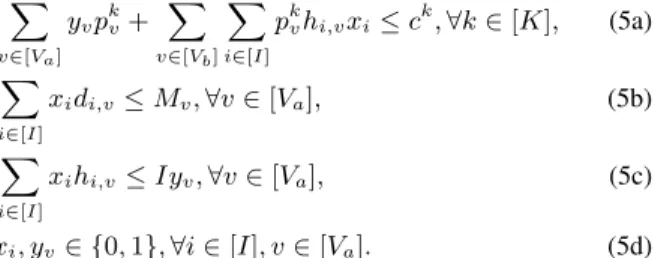
chains, we have to make sure the allocation respects resource capacity constraints of the data center and processing capacity constraints of VNF instances. The finite supply of each type of resource translates into the following capacity constraint:
X v∈[Va] yvpkv+ X v∈[Vb] X i∈[I] pkvhi,vxi≤ck,∀k∈[K] (1)
Each service chaini is a directed path. For every node v in
chain i, at most one node is connected to v. The notation
di(u, v) can be simplified to di,v, encoding the data rate
flowing into VNF v in service chain i. Given that a single
date rate will not exceed the processing capacity Mv, i.e.,
Dv = maxi∈[I]di,v < Mv, the total amount of traffic passing
through the shared VNF v should not exceed its processing
capacity. Thus, we have the following constraint: X
i∈[I]
xidi,v≤Mv,∀v∈[Va] (2)
The variableyv can be derived fromxi as follows:
yv= ( 1 ifP i∈[I]xihi,v>0 0 ifP i∈[I]xihi,v= 0 (3) We convert the above equation into a linear constraint:
X
i∈[I]
xihi,v≤N yv,∀v∈[Va] (4)
The value of N should be selected sufficiently large [19].
Given that P
i∈[I]xihi,v ≤
P
i∈Ihi,v ≤ I, it is safe to select
N = I. If P
i∈[I]xihi,v = 0 is at the optimum, then the
maximization of P
i∈[I]bixi together with constraint (1) will
forceyv to zero.
The social welfare maximization problem is:
Maximize X
i∈[I]
Subject To: X v∈[Va] yvpkv+ X v∈[Vb] X i∈[I] pkvhi,vxi≤ck,∀k∈[K], (5a) X i∈[I] xidi,v≤Mv,∀v∈[Va], (5b) X i∈[I] xihi,v≤Iyv,∀v∈[Va], (5c) xi, yv∈ {0,1},∀i∈[I], v∈[Va]. (5d)
Theorem 2. The social welfare maximization problem defined in ILP (5) is NP-hard.
Proof. The classic combinatorial optimization problem below,
0-1 knapsack, is known to be NP-hard:
Maximize n X i=1 vixi Subject To: n X i=1 wixi≤W, xi∈ {0,1}
ILP (5) with only one of the constraints (5b) is a 0-1
knapsack problem. The knapsack problem is a special case of ILP (5). Hence the social welfare maximization problem in ILP (5) is NP-hard.
We consider the LP relaxation of ILP (5) by relaxing (5d) to
0≤xi≤1, yv≥0,∀i∈[I], v∈[Va]. (5d’)
Then we introduce dual variable vectors λ, β, γ and φto constraints (5a), (5b), (5c) and (5d’) respectively. The dual of ILP (5) can be formulated as the following:
Minimize X k∈[K] ckλk+ X v∈[Va] Mvβv+ X i∈[I] φi (6) Subject To: φi+ X k∈[K] X v∈[Vb] λkpkvhi,v+ X v∈[Va] βvdi,v + X v∈[Va] γvhi,v≥bi,∀i∈[I], (6a) X k∈[K] λkpkv≥Iγv,∀v∈[Va], (6b) λk≥0, βv≥0, γv≥0, φi≥0,∀k∈[K],∀v∈[Va],∀i∈[I], (6c)
IV. APRIMAL-DUAL APPROXIMATION ALGORITHM
Based on the assumption that the bids we know are truthful, we first design a polynomial time approximation algorithm based on the primal-dual framework [7] for the social welfare maximization problem in ILP (5). The algorithm can output a feasible solution and guarantee a small approximation ratio. Then we design a payment strategy to work in concert with the approximation algorithm, for making sure that bids submitted by the users are truthful in practice.
TABLE I: Summary of Notations
I # of service users K # of resource types Bi useri’s bid ui utility of useri
bi bidding price of bidi vi true valuation of useri
Ei # of edges in service chaini
Vi # of VNF types in service chaini
Va # of requested VNF types which can be shared
Vb # of requested VNF types which can not be shared
ck the total amount of type k resource
pk
v VNFv’s requirement of type k resource
Mv processing capacity of VNFv
Rk the max user requirement for type k resource
Dv the max data rate which flows in VNFv
di(u, v) useri’s demand of data rate flowing fromutov
di,v useri’s demand of data rate flowing intov
pi payment of useriif winning the bid
hi,v hi,vequals 1 when VNF v in bidi, otherwise 0
qv qvequals 1 when VNF v can be shared, otherwise 0
xi xiequals 1 when bidiwins, otherwise 0
yv yvequals 1 if type v VNF is active, otherwise 0
A. The Primal-Dual Approximation Algorithm for Social Wel-fare Maximization
Our primal-dual algorithm, as shown in Algorithm 1, itera-tively selects the current best bid which has the largest value per unit resource, from the set of users who haven’t obtained
any VNF chain. The currently selected userµis appended to
the set Λ, which contains users who win their corresponding
bids. The types of shared VNF requested in the bid µ are
known, thus the value ofyv can be determined along with the
update of xµ. Because a shared VNF can be configured once
and used by several service chains, in every iteration after the correspondingyv is updated to1, the VNFv will be added to
the set∆that contains shared VNFs already configured. Then
VNFvwill not be configured again. Meanwhile, the algorithm
updates the dual variable vectorsλ,β andφin every iteration
and assignsγ= 0from beginning to the end.
Lines 2-4 in Algorithm 1 initialize primal variablesxandy
and dual variablesλ,β,φandγ. In thewhileloop in lines 5-21, variablesx,y, λ,β and φare updated iteratively. The
whileloop has three stop conditions. The conditionΛ6= [I]
ensures that the loop is executed at mostItimes. If thewhile terminates because Λ6= [I] is false, every user i can receive
its service chain. The second conditionP
k∈[K]c kλ
k< Keρ−1
and the third conditionP
v∈[Va]Mvβv< Vae
B−1 guarantee the
feasibility of constraints (5a) and (5b) respectively.
Line 6 selects the current best bid with the largest value of
unit resource bi P k∈[K] P v∈[V] λkpkvhi,v+ P v∈[Va]
βvdi,v. Line 7 updates
the primal variable x and the set Λ. p is the value of the
primal objective function. Line 8 sets dual variableφµ tobµ,
so that P
µφµ = p in all iterations. Lines 9-12 update the
dual variableλwith exponential cost to reflect the changes of
resource utilization. The for loop in lines 13-17 repeatedly
check the elements in set[Va]\∆ and updates the variableyv
as well as the set ∆. Lines 18-20 are similar to lines 10-12, using exponential cost to update the dual variableβ.
Algorithm 1A Primal-Dual Approximation Algorithm for ILP (5)
Input: (bi, pkv, hi,v, di,v, Rk, Dv)
Output: solution(x, y)for ILP (5), (λ,β,γ,φ) for LP (6)
1: // Initialization 2: ρ=mink∈[K]c k Rk;B =minv∈[Va] Mv Dv; 3: ∀i ∈ [I],∀v ∈ [Va],∀k ∈ [K] : xi = 0;yv = 0;φi = 0;γv= 0;λk= c1k;βv = 1 Mv; 4: p= 0; Λ =∅; ∆ =∅; [V0] = [Vb]S[Va]; 5: while Λ 6= [I] AND P k∈[K] ckλ k < Keρ−1 AND P v∈[Va] Mvβv< VaeB−1 do 6: µ= arg maxi∈I\Λ{ P bi k∈[K] P v∈[V] λkpkvhi,v+ P v∈[Va] βvdi,v}; 7: xµ= 1; Λ = ΛS{µ};p=p+bµ; 8: φµ=bµ; 9: [V0] = [V0]\∆; 10: for all k∈[K]do 11: λk =λk(eρ−1) ( P v∈[V0] hµ,vpkv)/(ck−Rk) ; 12: end for 13: for all v∈[Va]\∆ do 14: ifhµ,v= 1then 15: yv = 1; ∆ = ∆S{v}; 16: end if 17: end for 18: for all v∈[Va]do 19: βv=βv(eB−1)dµ,v/(Mv−Dv); 20: end for 21: end while
B. Solution feasibility for the approximation algorithm
Next we make sure that Algorithm 1 outputs a feasible solution to both the primal ILP (5) and the dual LP (6). Theorem 3. The output of Algorithm 1 includes a feasible solution to ILP (5).
Proof. In Algorithm 1, primal variablesxandyare initialized to0, and will be updated to1only; hence constraint (5d) will not be violated. After xi is set to 1, the corresponding yv is
set to1and removed from the original set[Va]. Onceyvis set
to 1, it will never become0 again, satisfying constraint (5c). We next check the feasibility of constraint (5a). Assume that thelth iteration is the first time that constraint (5a) is violated while the other constraints are satisfied. Thus, at iterationl−1,
λlk−1= 1 ck (eρ−1) ( P v∈∆l−1 pkv+ P v∈[Vb] P i∈Λl−1 pkvhi,v)/(ck−Rk) , and we have P v∈∆l−1p k v+Pv∈[Vb] P i∈Λl−1p k vhi,v ≤ ck. While in iteration l, X v∈[V0]l−1 hµl,vp k v+ X v∈∆l−1 pkv+ X v∈[Vb] X i∈Λl−1 pkvhi,v≥ck. Becauseck> Rk≥Pv∈[V0]l−1hµl,vp k v, X v∈∆l−1 pkv+ X v∈[Vb] X i∈Λl−1 pkvhi,v≥ck− X v∈[V0]l−1 hµl,vp k v ≥ck−Rk. Thus,(P v∈∆l−1pkv+ P v∈[Vb] P i∈Λl−1pkvhi,v)/(ck−Rk)≥1. This leads to P k∈[K]c k
λlk−1 ≥Keρ−1, satisfying the second
while loop stop condition. Thewhile loop will terminate
before iterationlstarts, and constraint (5a) will not be violated. The proof of feasibility of constraint (5b) is similar to that of (5a). We assume that round t is the first round to violate
constraint (5b). Therefore, P i∈Λt−1 di,v ≤ Mv, while, dµt,v + P i∈Λt−1 di,v≥Mv. In round t, P i∈Λt−1 di,v≥Mv−dµt,v≥Mv− Dv. It will result in X v∈[Va] Mvβt −1 v = X v∈[Va] Mv 1 Mv (eB−1) P i∈Λt−1 di,v/(Mv−Dv) ≥VaeB−1.
By the third stop condition of thewhileloop, this implies that the previous iterationt−1will be the last iteration of the algorithm. To conclude, the primal-dual algorithm provides us with a feasible output to ILP (5).
Though the primal solution is always feasible for every iteration, we can not guarantee the dual solution is also feasible. We need to apply the method ofdual fittingto scale the dual by a suitable factor to ensure its feasibility [20]. Theorem 4. Let (λ, β, γ, φ) be the vector of current dual variables which is infeasible for the dual LP (6) at the beginning of iterationτ , then the vector (εfµτ(λτ−1, βτ−1)λ,
fµτ(λτ−1, βτ−1)β,γ,φ) is a feasible fractional solution to the
dual LP (6).fµτ(λτ−1, βτ−1) =bµτ/( P k∈[K] P v∈[V] λτ−1 k p k vhµτ,v+ P v∈[Va] βvτ−1dµτ,v),ε= maxi∈[I] P k∈[K]Pv∈[V]pkvhi,v P k∈[K] P v∈[Vb]p k vhi,v.
Proof. We first check the feasibility for constraint (6b). With γv = 0, dual constraint (6b) becomesPk∈[K]λkp
k
v ≥0,∀v∈ [Va]which is always feasible becauseλk≥0,∀k∈[K].
∀i ∈ Λ, φi is assigned to bi. It is clear that constraint
(6a) is always satisfied. Then consider the remaining i ∈
[I]\Λ, let fi(λ, β) = bi P k∈[K] P v∈[V] λkpkvhi,v+ P v∈[Va] βvdi,v. Because
fµτ(λτ−1, βτ−1) is selected from line 6, we have
fµτ(λτ−1, βτ−1)≥fi(λ, β),∀i∈[I]\Λ.
By the definition ofε, we can getεP
k∈[K] P v∈[Vb]λkp k vhi,v≥ P k∈[K] P
v∈[V]λkpkvhi,v. Because γv = 0,∀v ∈ [Va] and we
haveφi= 0,∀i∈[I]\Λ, we have,
φi+εfµτ(λτ−1, βτ−1) X k∈[K] X v∈[Vb] λkpkvhi,v +fµτ(λτ−1, βτ−1) X v∈[Va] βvdi,v+ X v∈[Va] γvhi,v ≥fµτ(λτ−1, βτ−1)( X k∈[K] X v∈[V] λkpkvhi,v+ X v∈[Va] βvdi,v) ≥fi(λ, β)(X k∈[K] X v∈[V] λkpkvhi,v+ X v∈[Va] βvdi,v) =bi (7)
Consequently, the fitted solution (εfµτ(λτ−1, βτ−1)λ,
fµτ(λτ−1, βτ−1)β,γ, φ)is feasible to the dual LP (6).
After proving the correctness of Algorithm 1, we next analyze its computation complexity, and show that Algorithm 1 can compute a feasible solution in polynomial time. Theorem 5. The computational complexity of Algorithm 1 is polynomial time.
Proof. The whileloop in Algorithm 1 has at most I itera-tions. In the loop body, line 6 is executed at most 2I times.
Theforloop in lines 10-12 executesKtimes in eachwhile
loop iteration. Meanwhile, the forloops in lines 13-17 and
lines 18-20 can both be finished in at mostVa iteration steps.
Thus, the complexity of Algorithm 1 is O(I2).
Theorem 6. Algorithm 1 computes anα-approximate solution
to ILP (5), where α= max{ ϕε
ln(KeρK−+1 +Va Va ) , ϕε ln(K+KVaeB+ −1 Va ) }+ 1.
Proof. Let $ denote the terminating iteration of Algorithm 1. Let w1(τ) = Pi∈[I]φτi, w2(τ) = Pk∈[K]ckλτk, w3(τ) =
P
v∈[Va]Mvβ τ
v at iteration τ. w∗ denotes the optimal dual
solution to LP (6). We have w2(τ) = X k∈[K] ckλτk = X k∈[K] ckλτk−1(e ρ−1 ) ( P v∈[V0] hµτ ,vpk v)/(ck−Rk) = X k∈[K] ckλτk−1(1 + δ ck Rk −1 )( P v∈[V0]hµτ ,vpkv)/Rk ≤ X k∈[K] ckλτk−1(1 + δ ck Rk −1 ((X v∈[V0]hµτ,vp k v)/Rk)) = X k∈[K] ckλτk−1+ X k∈[K] δck ck−R k (X v∈[V0]hµτ,vp k v)λ τ−1 k ≤w2(τ−1) +σ X k∈[K] X v∈[V0] hµτ,vpkvλτk−1 ≤w2(τ−1) +σ X k∈[K] X v∈[V] hµτ,vpkvλ τ−1 k (8)
Because (1 +a)x ≤1 +ax when 0≤x≤1, we obtain the
first inequality. While δ = (ck
Rk −1)((e ρ−1) 1 ck Rk−1 −1), σ = maxk∈[K] δc k ck−Rk andρ=mink∈[K] ck Rk, we can get σ=maxk∈[K] δck ck−R k =maxk∈[K] ck Rk ((eρ−1) 1 ck Rk−1 −1) =ρ(e−1)
The derivation steps for w3(τ) are similar to those of
w2(τ). We define A = (MDvv − 1)((e B−1 ) 1 Mv Dv−1 − 1) and θ = maxv∈[Va]MAMv−Dvv = maxv∈[Va] Mv Dv((e B−1) 1 Mv Dv−1 −1). BecauseB=minv∈[Va] Mv Dv and AMv Mv−Dv is non-increasing with Mv Dv >1, we haveθ=B(e−1). w3(τ) = X v∈[Va] Mvβvτ = X v∈[Va] Mvβτ −1 v (e B−1 )dµτ ,v/(Mv−Dv) = X v∈[Va] Mvβvτ−1(1 + A Mv Dv −1 )dµτ ,v/Dv ≤ X v∈[Va] Mvβτ −1 v (1 + A Mv Dv −1 (dµτ,v/Dv)) = X v∈[Va] Mvβvτ−1+ X v∈[Va] AMv Mv−Dv dµτ,vβvτ−1 ≤w3(τ−1) +θ X v∈[Va] dµτ,vβvτ−1 (9)
With the definition offµτ(λτ−1, βτ−1), we can obtain,
X k∈[K] X v∈[V] hµτ,vpkvλτk−1+ X v∈[Va] βvτ−1dµτ,v= bµ τ fµτ(λτ−1, βτ−1) (10) In Algorithm 1, pτ represents the solution of primal ILP (5)
in round τ, then we can have pτ −pτ−1 = bµτ. We define
ϕ = max{σ, θ}. According to Eqn. (8), Eqn. (9) as well as Eqn. (10), we have, w2(τ) +w3(τ)≤w2(τ−1) +w3(τ−1) +σ X k∈[K] X v∈[V] hµτ,vpkvλτk−1+θ X v∈[Va] dµτ,vβτv−1 ≤w2(τ−1) +w3(τ−1) +ϕ(X k∈[K] X v∈[V] hµτ,vpkvλτ−1 k + X v∈[Va] dµτ,vβvτ−1) =w2(τ−1) +w3(τ−1) +ϕ bµτ fµτ(λτ−1, βτ−1) =w2(τ−1) +w3(τ−1) +ϕ pτ−pτ−1 fµτ(λτ−1, βτ−1) (11) To analyze the approximation ratio of Algorithm 1, we should separately consider it in different cases as the algorithm may terminate upon different stop conditions. WhenΛ == [I], all users win their bids. The output is optimal, so the approxima-tion ratio is1.
Next assume the algorithm stops due to P
k∈[K]c k λk ≥ Keρ−1 or P v∈[Va]Mvβv≥Vae B−1. If at an iteration tbefore
the terminate iteration$,w1(t−1)≥w
∗
α , it means we already
have an α-approximate solution at round t as w1(t) is non-decreasing. Now we need to consider the case that until the terminating round $, w1(t−1) < w
∗
α is always satisfied to
continue upper-bounding the value ofw2(τ) +w3(τ).
Theorem 4 indicates that (εfµτ(λτ−1, βτ−1)λ,
fµτ(λτ−1, βτ−1)β, γ, φ) is a feasible solution to the dual LP
(6) at round τ. By weak duality, every feasible dual solution is an upper bound of the optimal solutionw∗, therefore,
w∗≤w1(τ−1) +εfµτ(λτ−1, βτ−1)w2(τ−1) +fµτ(λτ−1, βτ−1)w3(τ−1)
By the definition of ε, we know it is a constant number no less than 1. Furthermore,∀τ≤$,w1(τ−1)<w
∗ α . Thus, 1 fµτ(λτ−1, βτ−1) ≤ εw2(τ−1) +w3(τ−1) w∗−w 1(τ−1) ≤ ε(w2(τ−1) +w3(τ−1)) w∗−w 1(τ−1) ≤ε α α−1 w2(τ−1) +w3(τ−1) w∗ (12) Recall the Eqn. (11) together with the upper bound for
1
fµτ(λτ−1,βτ−1) in Eqn. (12), we can boundw2($) +w3($):
w2($) +w3($)≤w2($−1) +w3($−1) + ϕεα (α−1)w∗(p $− p$−1)(w2($−1) +w3($−1)) = (w2($−1) +w3($−1))(1 + ϕεα (α−1)w∗(p $ −p$−1)) ≤(w2($−1) +w3($−1)) exp( ϕεα (α−1)w∗(p $− p$−1)) ≤(w2(0) +w3(0)) exp( ϕεα (α−1)w∗p $ ) (13) The second inequality in Eqn. (13) is due to(1+x)≤ex,∀x≥ 0. The initial values w2(0) andw3(0) areK andVa
respec-tively. When the algorithm terminates upon stop condition P
k∈[K]c k
λk≥Keρ−1, it indicates thatw2($)≥Keρ−1. And
we knoww3(τ)is non-decreasing, thus,w3($)≥w3(0) =Va.
We have, Keρ−1+Va≤(K+Va) exp( ϕεα (α−1)w∗p $ ) (14)
By weak LP duality, we know that OP T∗ p$ ≤
w∗
p$, whereOP T∗
represents the optimal objective value for ILP (5). From Eqn. (14), we can obtain the inequality,
w∗ p$ ≤ α α−1 ϕε ln(Keρ−1+Va K+Va ) =α
Then we can get the approximation ratio when the algorithm
terminates at the stopping condition P
k∈[K]c k λk≥Keρ−1 α= ϕε ln(Keρ−1+Va K+Va ) + 1 (15)
Similarly, when the algorithm terminates at the stopping
conditionP v∈[Va]Mvβv≥Vae B−1, with w3($)≥VaeB−1and w2($)≥K, we can get K+VaeB −1≤ (K+Va) exp( ϕεα (α−1)w∗p $ )
Under this condition, the approximation ratio is
α= ϕε
ln(K+VaeB−1
K+Va )
+ 1 (16)
Finally, by summarizing all three cases discussed
above, the approximation ratio of Algorithm 1 is
α= max{ ϕε ln(KeρK−+1 +Va Va ) , ϕε ln(K+KVaeB+Va−1) }+ 1
C. A truthful payment strategy for the social welfare maxi-mization problem
Algorithm 1 provides us a feasible resource allocation solution in polynomial time. Next we need to ensure that our mechanism is able to offer rational payments for every
winning bidder, which can guarantee truthfulness. By the second condition of Theorem 1, we need to find a threshold bidding priceb∗i as our mechanism is deterministic andPi(bi)
is binary:Pi(bi)is0ifbi< b∗i, and is1otherwise. Given the
threshold bidding priceb∗i, the payment rule is:
pi=biPi(bi)−
Z bi
b∗i
Pi(b)db=b∗i,∀i∈[I]
We can compute the threshold bidding price b∗i using the
following Algorithm 2. For each winning bidder, its payment pi returned from Algorithm 2 is upper-bounded by its bidding
pricebi.
Algorithm 2 Payment strategy
1: // Initialization 2: ∀i∈[I],pi = 0; 3: for all i∈[I]do 4: ifxi== 1then 5: m= 0;n=bi; 6: while(n−m)> do
7: Run Algorithm 1 with(m+n
2 , b−i)as bids;
8: ifbidderi winsthen
9: n= m+2n; 10: else 11: m= m+2n; 12: end if 13: end while 14: pi= m+2n; 15: else 16: pi= 0; 17: end if 18: end for
Theorem 7. Algorithm 1 (allocation method) together with Algorithm 2 (payment strategy) constitute a truthful auction.
Proof. Leveraging Theorem 1, we first inspect whether our mechanism can satisfy the first condition,i.e.,Pi(bi)is
mono-tonically non-decreasing inbi,∀i∈[I]. Assume bidderiwins
at a time with bidding price bi while other bidders’ bidding
price b−i and the amount of resources remain intact. Now
bidderistill wins when it increases its bidding pricebi, since
the allocation rule in Algorithm 1 is greedy. If the bidding price is lower than bi, bidder i may lose because other bids
may be chosen before bi. Therefore the winning probability
Pi(bi)is non-decreasing.
As discussed above, we have verified that the winning probability Pi(bi) is non-decreasing with the bidding price
bi. Next we need to demonstrate our payment strategy obeys
the second condition in Theorem 1. The paymentpi which is
calculated by Algorithm 2 is satisfied|pi−b∗i| ≤whereis
a small positive real number given as margin of error. Thus, the threshold bidding price b∗i can be found by Algorithm 2 which satisfies the second condition in Theorem 1.
D. Auction Framework for NFV Social Welfare Maximization
Algorithm 3 shows the overall auction framework for our NFV market. The first part of Algorithm 3 is to apply the
primal-dual approximate algorithm to compute the resource allocation solution to determine the winning bids. After that, payments of all the winning bidders are determined by the payment strategy in Algorithm 2.
Algorithm 3 Auction Framework Input: (~b, pk
v, hi,v, di,v, Rk, Dv)
Output: allocation solution(~x, ~y)for ILP (5) and payment~p
1: Compute allocation solution (~x,~y) = Algorithm 1 (~b,pkv, hi,v,di,v,Rk,Dv);
2: Compute payment~p= Algorithm 2 (~x,~b)
3: return~xand~p
V. PERFORMANCE EVALUATION
In the simulation studies, we study an NFV service chain market, in which five types of VNF instances can be shared among different users, and other types of VNFs can not be shared — one instance serves one user exclusively. Each VNF instance requires three types of resources: CPU, memory and bandwidth. We generate the bids and the corresponding bidding prices following random distributions.
A. Performance of the approximation algorithm
First, our theoretical analysis proved an approximation ratio for Algorithm 1 with α. Fig. 1 plots the theoretical approxi-mation ratio αwithε= 1.5,ϕ=ρ(e−1), and the algorithm
stops when P
k∈[K]c k
λk≥Keρ−1. We can find that with the
increasing ofρ, the ratio is always between 3 and 4. Then we execute the Algorithm 1 separately with the number of bidders
ranging from 10 to 100. As shown in Fig. 2, the theoretical
approximation ratio proven in Theorem. 6 is much larger than the real approximation ratio calculated with the algorithm iteration. The algorithm achieves a satisfying performance with a small approximation ratio between1and2 in practice. Furthermore, we can find that the approximation ratio is relatively stable when the number of bidders increases. The increase in bidder population does not make the approximation ratio worse. Fig. 3 compares the optimal and approximate social welfare. The gap between the two is small with the ratio close to1, which indicates the algorithm can compute an allocation solution close to the optimal one in practice.
B. Static allocation vs Dynamic allocation
We next compare the resource allocation performance be-tween static allocation and dynamic allocation. For static resource allocation, we assume the service provider offers
10 types of service chains packed with some fixed types
of VNFs. Every user specifies one from the 10 fixed types
of service chains along with a bidding price in its bid. In Fig. 4,user satisfactionis the ratio of the number of winning users to the total number of users. Decreasing trends can be observed in user satisfaction for both dynamic and static resource allocation, with more bidders participating. For a given number of bidders, the user satisfaction for dynamic resource provisioning is higher than that of the static method.
Furthermore, for the Social welfare shown in Fig. 5, dynamic allocation also outperforms static allocation.
C. Payment strategy
In Fig. 6, the solid red (top) line represents the optimal solution to the social welfare maximization problem, the solid black (middle) line is the social welfare calculated by the primal-dual approximation algorithm, while the dashed blue (bottom) line is the payment computed by Algorithm 2, the payment strategy. We can see that the trend in social welfare is increasing with a growing bidder population. This is due to the fact that there are more choices for bid selection, which helps achieve higher social welfare. Algorithm 2 is a payment strategy to compute the threshold bidding priceb∗i as the payment for each winning bidder. The threshold bidding price b∗i should always be smaller than the bidding price bi
submitted by the bidder. This is verified by the fact that the payment (bottom) line is always below the black (middle) line that represents the corresponding social welfare.
D. Level of overall resource supply
We examine the performance of algorithm 1 when the amount of resource provided by the service provider varies. The histogram in Fig. 7 is the social welfares when the users can choose from different types of VNFs. We separately show the social welfare with the conditionsVb= 5,Vb= 10as well
as Vb = 15. It can be seen that the social welfare decreases
when the number of VNF increases. During the simulation, the bidding prices as well as the total amount of resources remain the same, however the requirement for each user increases, thus the ratio of winning users decreases. Consequently the social welfare decreases. In Fig. 8, the approximation ratio decreases (becomes better) with the increase of the total amount of resource. It results from more relaxed restriction of constraint (5a), which makes it easier for our approximation algorithm to approach the optimal solution.
VI. CONCLUSION
NFV is emerging as a new paradigm for providing flexible, elastic and cost effective network functions based on software algorithms executed upon common computing platforms. As a key concept in NFV, a service chain is the unit of transaction in the NFV market that connects atomic network functions to provide composite services. This work is the first to design an efficient auction mechanism for the dynamic provisioning and pricing of NFV service chains in a datacenter. The NFV auction we design is computationally efficient, truthful, and achieves near-optimal social welfare. As an interesting future direction, one may study the design of a double auction for NFV markets with multiple VNF suppliers.
REFERENCES
[1] “Network Functions Virtualization - Introductory White Paper,” https: //portal.etsi.org/nfv/nfv white paper.pdf.
[2] “Network Functions Virtualization (NFV); Use Cases,” http://www.etsi.org/deliver/etsi gs/NFV/001 099/001/01.01.01 60/ gs NFV001v010101p.pdf.
500 400 300 ρ 200 100 0 0 100 200 300 K 400 2.9 3 3.1 3.2 3.3 3.4 3.5 3.6 500 Approximation Ratio
Fig. 1: Theoretical approximation ratio; ε= 1.5,ϕ=ρ(e−1) Number of bidders 10 20 30 40 50 60 Approximation Ratio 0 5 10 15 20 25 Theoretical Ratio Real Ratio
Fig. 2: Comparison between theoretical ratio and real ratio
Number of bidders 100 150 200 250 300 350 400 Social Welfare 0 100 200 300 400 500 optimal approximate
Fig. 3: Comparison between optimal and approximate social welfare
Number of bidders 20 30 40 50 60 70 User Satisfaction (%) 10 20 30 40 50 60 70 80 90 100 Dynamic Static
Fig. 4: User Satisfaction for Static alloca-tion and Dynamic allocaalloca-tion
Number of bidders 20 30 40 50 60 70 Social Welfare 0 50 100 150 200 250 300 350 400 Dynamic Static
Fig. 5: Social welfare for Static allocation and Dynamic allocation
Number of bidders 20 30 40 50 60 70 80 90 100 Price 100 150 200 250 300
Optimal social welfare Approximate social welfare Payment
Fig. 6: Performance of payment strategy
Number of bidders 20 30 40 50 60 70 Social Welfare 0 50 100 150 200 250 300 350 400 Vb=5 Vb=10 Vb=15
Fig. 7: Social welfare under deferent types of VNFs
Number of bidders 20 30 40 50 60 70 Approximation Ratio 0 0.5 1 1.5 2 2.5
small ck medium ck large ck
Fig. 8: Comparison of approximation ratio under different amount of resource ck
[3] “4 Vendors Bring Distributed NFV to BTE,” http://www.lightreading. com/4-vendors-bring-distributed-nfv-to-bte/d/d-id/709403.
[4] “Service Function Chaining: Framework & Architecture,” https://tools. ietf.org/html/draft-boucadair-sfc-framework-02.
[5] H. Fu, Z. Li, C. Wu, and X. Chu, “Core-selecting auction design for dynamically allocating heterogeneous vms in cloud computing,” inProc. of IEEE Cloud, 2014.
[6] L. Zhang, Z. Li, and C. Wu, “Dynamic resource provisioning in cloud computing: A randomized auction approach,” inProc. of IEEE INFOCOM, 2014.
[7] P. Briest, P. Krysta, and B. V¨ocking, “Approximation techniques for
utilitarian mechanism design,” inProc. of ACM STOC, 2005. [8] A. Mu’Alem and N. Nisan, “Truthful approximation mechanisms for
restricted combinatorial auctions,” Games and Economic Behavior, vol. 64, no. 2, pp. 612–631, 2008.
[9] “NFV Management and Orchestration: Enabling Rapid Service Innovation in the Era of Virtualization,” http: //www.cisco.com/c/en/us/solutions/collateral/service-provider/ network-functions-virtualization-nfv/white-paper-c11-732123.pdf. [10] “White Paper - Huawei Observation to NFV,” http://www.huawei.com/
ilink/en/download/HW 399662.
[11] M. Bari, S. R. Chowdhury, R. Ahmed, R. Boutabaet al., “Orchestrating Virtualized Network Functions,”arXiv:1503.06377, 2015.
[12] A. Gember, A. Krishnamurthy, S. S. John, R. Grandl, X. Gao, A. Anand, T. Benson, A. Akella, and V. Sekar, “Stratos: A network-aware orches-tration layer for middleboxes in the cloud,”arXiv:1305.0209v1, 2013. [13] M. Xia, M. Shirazipour, Y. Zhang, H. Green, and A. Takacs, “Network
Function Placement for NFV Chaining in Packet/Optical Datacenters,”
Journal of Lightwave Technology, vol. 33, no. 8, pp. 1565–1570, 2014. [14] S. Zaman and D. Grosu, “Combinatorial auction-based dynamic vm provisioning and allocation in clouds,” in Proc. of IEEE CloudCom, 2011.
[15] Q. Wang, K. Ren, and X. Meng, “When cloud meets ebay: Towards effective pricing for cloud computing,” inProc. of IEEE INFOCOM, 2012.
[16] N. Nisan and A. Ronen, “Computationally feasible VCG mechanisms,” inProc. of ACM EC, 2000.
[17] A. Gopinathan and Z. Li, “Strategyproof auctions for balancing social welfare and fairness in secondary spectrum markets,” inProc. of IEEE INFOCOM, 2011.
[18] S. Mehraghdam, M. Keller, and H. Karl, “Specifying and placing chains of virtual network functions,” inProc. of IEEE CloudNet, 2014. [19] H. A. Taha,Operations Research: An Introduction. Prentice-Hall, Inc.,
2006.
[20] V. V. Vazirani,Approximation algorithms. Springer Science & Business Media, 2013.
[21] R. B. Myerson, “Optimal auction design,”Mathematics of operations research, vol. 6, no. 1, pp. 58–73, 1981.
[22] R. Lavi and C. Swamy, “Truthful and near-optimal mechanism design via linear programming,”JACM, vol. 58, no. 6, p. 25, 2011.