LSC
Fort Carson Car-less Mobility Transit Study, Technical Memorandum #1 Page V-1
CHAPTER V
Conceptual Transit Service Options
The purpose of this chapter is to present conceptual transit service options within and to/from the Fort Carson Mountain Post. A conceptual service option is a broad-based option with little detail. It generally provides enough information so that once an option is selected, a more detaile d preferred transit plan can be developed. Capital requirements and management options can then be developed to support the planned services. Each service option must be evaluated using Fort Carson’s established goals and objectives for managing transportation. Any option which does not support the mission of transportation and the corresponding goals and objectives should not be considered for implementation. These preliminary conceptual transit options are given as a starting point for discussion and debate leading to selection of a preferred alternative. The various transit options will be presented to the Project Team to seek input for the selection of the preferred service alternative to further investigate.
LSC has reviewed previous plans and studies related to transit needs in Fort Carson, received input from the Fort Carson employees/dependents through an online survey, worked close ly with the Project Team, and applied proven transit planning techniques to arrive at these options. From these analyses, several basic improvements and enhancements have been identified, which are:
• Based on the survey results, a five percent mode split would be a con-servative mode split that would use a car-less transit mobility system; • Local transit service should operate five days per week, with peak
service hours in the morning and in the evening, and;
• Regional transit option s from/to Fort Carson need to be enhanced.
CONCEPTUAL TRANSIT OPTIONS
All transit options would include the use of an Automatic Vehicle Location (AVL) integrated with an Intelligent Transportation System (ITS). With an AVL system, the real-time location of any vehicle can be monitored with the help of an
in-Conceptual Transit Service Options
vehicle Global Positioning Satellite (GPS) receiver. That information could be relayed to a communication/dispatch center. When AVL is combined with an ITS technology, a passenger can then be informed about the time it takes for the next bus or the time for the ride to arrive. The AVL/ITS option will help passe ngers receive real-time information about the status of their bus/ride. The AVL system can be assessed by passengers via an online GIS system where passengers could check the status of their buses before going to the bus stop, check the status of their ride at a nearby kiosk, or by sending a text messag e.
In addition to the AVL/ITS option, to make transit favorable all transit option would include queue jump lanes for buses along major arterials on the Mountain Post. Queue jump lanes, in combination with bus signal priority, allow buses to bypass traffic queues by getting an early green signal. The se jump lanes are short stretches of bus lanes that can be used as turning lanes or used to allow buses to move straight at certain traffic intersections. With this system, buses in queue jump lanes receive signals to proceed before other traffic at the intersection.
The primary expenses for all transit agencies across the United States are driver’s salaries and benefits. To reduce the operating cost spent on driver’s salaries, these options could include Army personnel that volunteer to drive the bus/van. With Fort Carson availability of labor, the Army could make it compulsory for Army personnel/soldiers to drive a bus/van as part of their regular responsibilities. Soldiers/Army personnel who volunteer to drive would get a discount for riding the service or get free rides on the system. This would greatly reduce the operating cost of the transit service on the Mountain Post.
Option 1: Deviated Fixed Routes That Follow the Proposed PRT Guideway
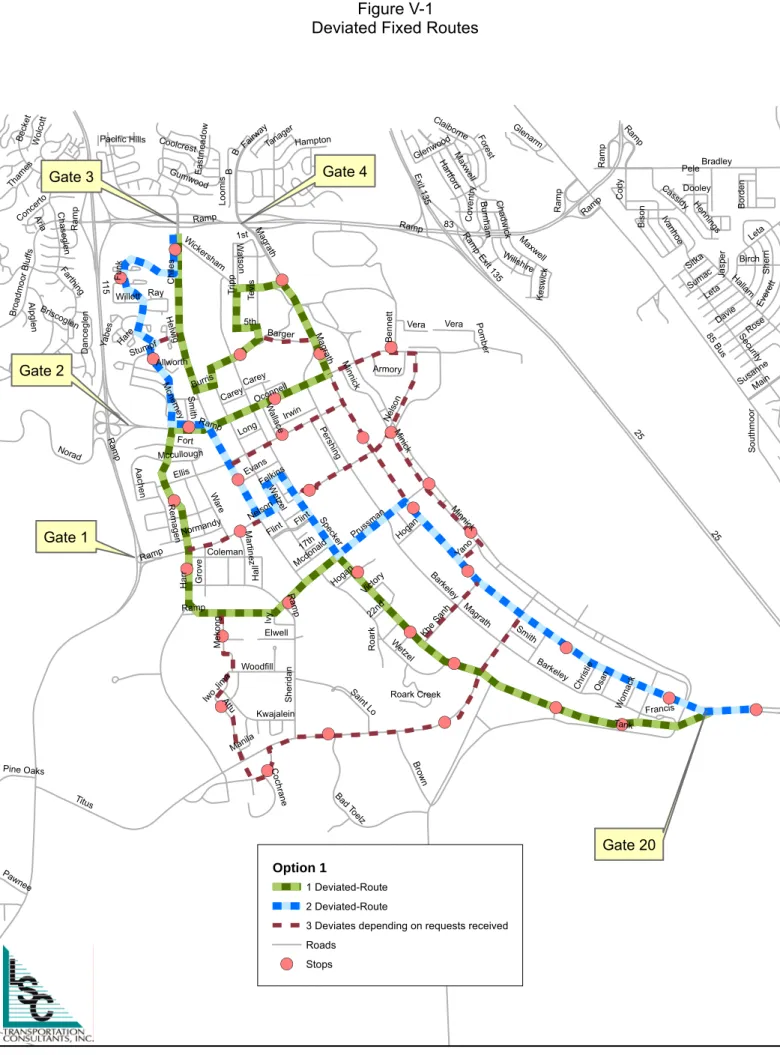
This option would operate buses/vans that follo w the proposed PRT guide way planned for Fort Carson. This option could act as a transitionary option until a PRT system is put in place. Modifications will need to be made to the proposed layout so that the bus/van routes follow existing roads.
Figure V-1 illustrates this route option. This figure shows two deviated fixed routes. This option will have a transit system map with stops displayed.
Passen-Conceptual Transit Service Options
LSC
Fort Carson Car-less Mobility Transit Study, Technical Memorandum #1 Page V-3
gers would have to punch the exact location that they would like to go. It would then display the approximate time it would take for their ride to arrive. These buses/vans travel could travel at higher speeds if they operate on high-occupancy vehicle (HOV) demarcated lanes in the major corridors. These HOV lanes could encourage the use of high-occupancy modes of travel such as transit, carpooling, and vanpooling. A deviated fixed-route system is an innovative and successfully implemented type of service in many low-density areas across the country. The reason this approach works well in low-density areas like Fort Carson is that the service can be designed around major origin-destination points, major corridors, and activity centers while still being flexible in nature. The routes are set up so they have a flexible-route structure, thus providing the consistent type of fixed service people expect as well as being flexible because they are able to deviate off a structured route to serve destinations.
This option will combine many qualities of Bus Rapid Transit (BRT)/PRT with the flexibility and cost-effectiveness of buses/vans. One of the biggest advantages to this option is it significantly lowers the initial infrastructure costs compared to a PRT. This option would be flexible enough that people whose work schedules are consistent could call ahead to schedule a ride. The schedules developed each day based on the reservations received will be useful to understand people’s travel patterns. The information will be used to modify the service routes or when fine-tuning the proposed PRT service. A disadvantage of this option would be slightly higher travel time compared to a PRT system.
This service would operate from 5:30 a.m. to 6:30 p.m. Monday through Friday. Cost for service is based on Mountain Metropolitan’s current cost per hour of service of $75.
!
(
!
(
!
(
!
(
!
(
!
(
!
(
!
(
!
(
!
(
!
(
!
(
!
(
!
(
!
(
!
(
!
(
!
(
!
(
!
(
!
(
!
(
!
(
!
(
!
(
!
(
!
(
!
(
!
(
!
(
!
(
!
(
!
(
!
(
!
(
Gate 1 Gate 2 Gate 3 Gate 4 Gate 20 25 115 83 Titus Ha rr Tank M ag rath Bu tts Sp ecker 85 Bus C hi le s B Ellis Bark eley Oconne ll Nelso n Prussm an We tzel Se curity Sh er id an Te vi s Be nn et t Attu Hallam Bradley Tr ip p W are Norad Barger Ha rtford M axw ell Fu nk Brow n S he rr i Bad To elz Cassidy Broa dmoo r Blu ffs R am p Flint Davie Irwin Hampton Lo om is Leta Rose Wick ersham Wats on Fo rest M inick Vera Ivanh oe Birch Bi so n Khe S anh Woodfill Main H al l Dooley Fort Fa rthing Coleman Kwajalein G ro ve C od y M inn ick He nnings Burn ham M ek on g Evans R em ag en Sa int L o So ut hm oo r Tham es Willshire Pe rsh ing 1st Elwell Coolcrest M artin ez Normandy Suma c 5th R oa rk Ray Sm ith Ever ett Briscoglen Glenwo od Gumwood Stumpf Hoga n M cn ern ey Ja sp er Long East mea dow Yano Manila Beck et C hase glen Sitka W alla ce Osa n Mcdo nald Aa ch en Armory Glenarm Chris tie Carey Willett Exit 13 5 Pawnee Ivy Bo rd en Felkins Pine Oaks Conc erto Burris 22nd Fairw ay C oc hrane Mccullough Iwo J ima Victory C ha dw ick Roark Creek D ance gl en Wom ack Kesw ick Tanage r 17th Wol cott Pom ber Alp glen Claiborne Hare Pacific Hills Yabe s C oven try Allworth Aria Susan ne Pele Francis H elw ig M agrat h Ramp Leta Flint Sm ith R am p Ramp Ramp Carey Exit 1 35 Nelson R am p Ram p Barkeley Max well R am p 25 Hoga n Ra mp Magrath R am p W etzel Ramp B Min nick Ramp Ramp Vera Option 1 1 Deviated-Route 2 Deviated-Route3 Deviates depending on requests received Roads
!
(
StopsFigure V-1 Deviated Fixed Routes
Operating
Hours of Operation # of Veh # of Veh Headway Headway Vehicle- Vehicle- Vehicle- Vehicle- Operating Cost
Peak Hr Off Peak Peak Off Peak Miles Hours Miles Hours Days Annual
Fixed-Route Deviation 1 5:30 am to 6:30 pm 5 2 15 45 608 38 152,000 9,500 250 $712,500
Fixed-Route Deviation 2 5:30 am to 6:30 pm 5 2 15 30 456 38 114,000 9,500 250 $712,500
Total/Average 266,000 19,000 $1,425,000
Note: Costs based on LSC analysis, 2009.
Table V-1
Option 1: Deviated Fixed Routes That Follow the Proposed PRT Guideway
Total Daily Total Annual
LSC
Fort Carson Car-less Mobility Transit Study, Technical Memorandum #1
Conceptual Transit Service Options
Option 2: Fixed Routes and Deviated Fixed Routes
Figure V-2 illustrates the proposed route structure for this option. This option includes two fixed routes and four deviated routes. This service would operate from 5:30 a.m. to 6:30 p.m. Monday through Friday. Cost for service is based on Mountain Metropolitan’s current cost per hour of service of $75.
One fixed route starts at Gate 4 (South Academy Boulevard/Magrath Avenue), travels south along Magrath Avenue, turns left at Bennett Street, serves the Field maintenance building, turns left at O’Connell Boulevard, turns right at Nelson Boulevard, turns right at Pershing Drive, turns left at Ellis Street, turns left at Chiles Avenue, and then right at Nelson Boulevard to reach Gate 1. The second fixed route is a loop route that travels along Minick Avenue and loops around to connect with Barkele y Avenue which connects with O’Conn ell Boulevard.
Based on the destination results from the Fort Carson survey, a large number of people travel to the office buildings and the Welcome Center located near the intersection of Ellis Street and Specker Av enue. Thus, this point was selected as the main transfer point whe re people can transfer be tween the various routes.
This option also includes four deviated-route services. One deviated-route service starts from the transfer point, travels along Specker Avenue, serves some of the community services, turns right onto Bad Toelz Road, and turns left at Titus Boulevard to serve the Evans US Army Hospital.
The second deviated-route service starts from the transfer point, travels along Specker Avenue, turns right at Prussman Boulevard, serves the school, then turns left at Harr Avenue, travels through Fort Carson housing to finally serve the Evans US Army Hospital.
The third deviated-route service starts at the transfer point, travels north on Specker Avenue, takes a left at O’Connell Boul evard, takes a left at Harr Avenue, goes through Fort Carson housing to reach the school, and then goes back to serve the transfer point. The route then travels south on Specker Avenue, then
Conceptual Transit Service Options
LSC
Fort Carson Car-less Mobility Transit Study, Technical Memorandum #1 Page V-7
loops around at Polio Street and Prussman Boulevard to return back to the transfer point.
The fourth deviated-route service starts at the transfer point, travels north along Specker Avenue, turns left to connect with Chiles Avenue, then turns right to serve the Fort Carson housing, and connects back to the transfer point. The fixed-route deviated service then goes south along Specker Avenue, takes a le ft at Prussman Avenue, takes a right at Minnick Avenue, and loops around at Titus Boulevard to connect back to Prussman Boulevard. The route then takes a right back to the transfer point. This service would ope rate from 5:30 a.m. to 6:30 p.m. Monday through Friday. Table V-2 shows the service characteristics of each route in this option.
Gate 1 Gate 2 Gate 3 Gate 4 Gate 20 25 115 83 Titus Ha rr Tank M ag rath Bu tts Sp ecker 85 Bus C hi le s B Ellis Bark eley Oconne ll Nelso n Prussm an We tzel Se curity Sh er id an Te vi s Be nn et t Attu Hallam Bradley Tr ip p W are Norad Barger Ha rtford M axw ell Fu nk Brow n S he rr i Bad To elz Cassidy Broa dmoo r Blu ffs R am p Flint Davie Irwin Hampton Lo om is Leta Rose Wick ersham Wats on Fo rest M inick Vera Ivanh oe Birch Bi so n Khe S anh Woodfill Main H al l Dooley Fort Fa rthing Coleman Kwajalein G ro ve C od y M inn ick He nnings Burn ham M ek on g Evans R em ag en Sa int L o So ut hm oo r Tham es Willshire Pe rsh ing 1st Elwell Coolcrest M artin ez Normandy Suma c 5th R oa rk Ray Sm ith Ever ett Briscoglen Glenwo od Gumwood Stumpf Hoga n M cn ern ey Ja sp er Long East mea dow Yano Manila Beck et C hase glen Sitka W alla ce Osa n Mcdo nald Aa ch en Armory Glenarm Chris tie Carey Willett Exit 13 5 Pawnee Ivy Bo rd en Felkins Pine Oaks Conc erto Burris 22nd Fairw ay C oc hrane Mccullough Iwo J ima Victory C ha dw ick Roark Creek D ance gl en Wom ack Kesw ick Tanage r 17th Wol cott Pom ber Alp glen Claiborne Hare Pacific Hills Yabe s C oven try Allworth Aria Susan ne Pele Francis H elw ig M agrat h Ramp Leta Flint Sm ith R am p Ramp Ramp Carey Exit 1 35 Nelson R am p Ram p Barkeley Max well R am p 25 Hoga n Ra mp Magrath R am p W etzel Ramp B Min nick Ramp Ramp Vera Option 2 1 Fixed-Route 2 Fixed-Route 3 Route-Deviation 4 Route-Deviation 5 Route-Deviation 6 Route-Deviation Roads 3/4 mile Buffer Figure V-2
Operating
Hours of Operation # of Veh # of Veh Headway Headway Vehicle- Vehicle- Vehicle- Vehicle- Operating Cost
Peak Hr Off Peak Peak Off Peak Miles Hours Miles Hours Days Annual
Fixed-Route 1 5:30 am to 6:30 pm 2 1 15 30 119 17 29,750 4,250 250 $318,750 Fixed-Route 2 5:30 am to 6:30 pm 2 1 20 45 153 17 38,250 4,250 250 $318,750 Fixed-Route Deviation 3 5:30 am to 6:30 pm 2 1 20 45 170 17 42,500 4,250 250 $318,750 Fixed-Route Deviation 4 5:30 am to 6:30 pm 2 1 15 30 119 17 29,750 4,250 250 $318,750 Fixed-Route Deviation 5 5:30 am to 6:30 pm 2 1 15 30 128 17 31,875 4,250 250 $318,750 Fixed-Route Deviation 6 5:30 am to 6:30 pm 2 1 20 45 128 17 32,000 4,250 250 $318,750 Total/Average 204,125 25,500 $1,912,500
Note: Costs based on LSC analysis, 2009.
Table V-2
Option 2: Fixed Routes and Deviated Fixed Routes
Total Daily Total Annual
LSC
Fort Carson Car-less Mobility Transit Study, Technical Memorandum #1
Conceptual Transit Service Options
Option 3: Deviated Fixed Routes and Demand-Response Zones
This option is illustrated in Figure V-3. This option includes two deviated-route services and three demand-response zones. The two de viated routes are similar in route structure to the fixed routes in Option 2. These deviated routes will deviate up to three-quarters of a mile from the route to se rve origins and destinations. As illustrated in Figure V-3, Fort Carson is divi ded into three demand-response zones. Passengers would have to call to schedule a ride to the demand-response service. Cost for service is based on Mo untain Metropolitan’s current cost per hour of service of $75.
Gate 1 Gate 2 Gate 3 Gate 4 Gate 20 25 115 83 Titus Ha rr Tank M ag rath Bu tts Sp ecker 85 Bus C hi le s B Ellis Bark eley Oconne ll Nelso n Prussm an We tzel Se curity Sh er id an Te vi s Be nn et t Attu Hallam Bradley Tr ip p W are Norad Barger Ha rtford M axw ell Fu nk Brow n S he rr i Bad To elz Cassidy Broa dmoo r Blu ffs R am p Flint Davie Irwin Hampton Lo om is Leta Rose Wick ersham Wats on Fo rest M inick Vera Ivanh oe Birch Bi so n Khe S anh Woodfill Main H al l Dooley Fort Fa rthing Coleman Kwajalein G ro ve C od y M inn ick He nnings Burn ham M ek on g Evans R em ag en Sa int L o So ut hm oo r Tham es Willshire Pe rsh ing 1st Elwell Coolcrest M artin ez Normandy Suma c 5th R oa rk Ray Sm ith Ever ett Briscoglen Glenwo od Gumwood Stumpf Hoga n M cn ern ey Ja sp er Long East mea dow Yano Manila Beck et C hase glen Sitka W alla ce Osa n Mcdo nald Aa ch en Armory Glenarm Chris tie Carey Willett Exit 13 5 Pawnee Ivy Bo rd en Felkins Pine Oaks Conc erto Burris 22nd Fairw ay C oc hrane Mccullough Iwo J ima Victory C ha dw ick Roark Creek D ance gl en Wom ack Kesw ick Tanage r 17th Wol cott Pom ber Alp glen Claiborne Hare Pacific Hills Yabe s C oven try Allworth Aria Susan ne Pele Francis H elw ig M agrat h Ramp Leta Flint Sm ith R am p Ramp Ramp Carey Exit 1 35 Nelson R am p Ram p Barkeley Max well R am p 25 Hoga n Ra mp Magrath R am p W etzel Ramp B Min nick Ramp Ramp Vera Option 3 1 2 Roads Demand-Response Zones 1 2 3 Figure V-3
Deviated Fixed Routes and Demand-Response Zones
LSC Fort Carson Car-less Mobility Transit Study, Technical Memorandum #1 Page V-11
Operating
Hours of Operation # of Veh # of Veh Headway Headway Vehicle- Vehicle- Vehicle- Vehicle- Operating Cost
Peak Hr Off Peak Peak Off Peak Miles Hours Miles Hours Days Annual
Fixed-Route Deviation 1 5:30 am to 6:30 pm 2 1 15 30 119 17 29,750 4,250 250 $318,750 Fixed-Route Deviation 2 5:30 am to 6:30 pm 2 1 20 45 153 17 38,250 4,250 250 $318,750 Demand-Response Zone 1 5:30 am to 6:30 pm 1 1 9 13 2,250 3,250 250 $243,750 Demand-Response Zone 2 5:30 am to 6:30 pm 1 1 9 13 2,250 3,250 250 $243,750 Demand-Response Zone 3 5:30 am to 6:30 pm 1 1 9 13 2,250 3,250 250 $243,750 Total/Average 74,750 18,250 $1,368,750
Note: Costs based on LSC analysis, 2009.
Total Daily Total Annual
Table V-3
Option 3: Deviated Fixed Routes and Demand-Response Zones
LSC
Page V-12
Conceptual Transit Service Options
LSC Fort Carson Car-less Mobility Transit Study, Technical Memorandum #1 Page V-13
Option 4: Electric Bicyles and Electric Cars/Solar-Powered Cars
This option includes electric bicycles and electric cars. These electric vehicles could be used in enhanced public transportation. This option would reduce fuel consumption and CO2 emissions.
Fort Carson can have these vehicles available for people to rent out at locations around the post for various trips/errands on the post. The disadvantage of an electric bicycle is that people would be discouraged to use this mode of transpor-tation during winter.
An electric bicycle would cost approximately $2,000 and would largely vary on the specifications. There are several ele ctric cars available on the market. The hybrid electric car is a common form of electric car sold by major manufacturers such as Toyota (Prius) and Chevrole t (Volt—expected at the end of 2010).
Another option to an electric car is a solar-powered car. These cars use solar energy obtained from solar panels attached to the roof of the vehicle. Sun Motors (US), Reva (Indian), and Venturi (French) have announced solar-powered cars that are battery electric cars with solar panels. While all these cars are not entirely solar powered, the range of these cars can be extended by charging their batteries and plugging these vehicles in a power socket at the end of the day. Information about each of these car manufactures can be found at
www.SunMotor.us, www.RevaIndia.com, and www.Venturi.fr.
Option 5: Smart Jitney
Smart Jitney is a fairly new concept which uses existing personal vehicles (cars/ SUVs, vans, and trucks), cell phones, GPS, and special software to create a real-time transportation system. This system increases service and passenger occu-pancy without using new resources and reducing the number of cars on the road. A jitney is an informal taxicab service that carries passe ngers on demand. Everyone on Fort Carson could use their car to be a part of the Smart Jitney service. This would require a person to have a good driving record, a cell phone that is connected to the car, and a sign on their car door that identifies that they
Conceptual Transit Service Options
are a part of the Jitney system. Drivers would be compensated for providing the transportation service by getting discounte d or free rides.
An Auto Event Recorder (AER)could be added to cars that are a part of the Jitney system. The AER would able to record driving activity in real time and check vehicle speed. This information could be sent to the central scheduling and dis-patching center that would also collect information on the number of passengers using the system at any given time, their pick-up/drop-off, and vacant seats avail-able. This information could also be used to better understand travel patterns and determine if there is a need for a more formal scheduled transportation service.
Passengers who need a ride would need access to a cell phone or the Internet. They would have to provide their contact name and phone number, a pick-up location, a drop-off location, and the preferred pick-up and drop-off time. The soft-ware would then assign the passenger to a participating Smart Jitney veh icle that could most efficiently transport them and give them information about the car description, time, and place for pickup. There could be several modifications to this basic type of service, where people can se lect various criteria such as having a gender preference for a driver and other criteria.
Option 6: Car Sharing
Car sharing is a service where people share resources without owning a car or use this option to fill the need for a second vehicle. This service helps reduce cars on the roads and thus reduce the pollution and congestion on the roads.
Car sharing is used more in an urban environment like Denver. Individuals register online, phone, and get access to a fleet of vehicles (cars, vans, trucks) in their area. Members rese rve cars on an hourly basis and pay when they use the service. The hourly rates include gas and insurance costs. A one-time application fee may apply in most cases. Organizations that do car sharing are nonprofit, for-profit, or cooperatives. Some of the organizations in Denver that do car sharing are e-Go CarShare (formerly Bo ulder CarShare) and Occasio nal Car.
Conceptual Transit Service Options
LSC Fort Carson Car-less Mobility Transit Study, Technical Memorandum #1 Page V-15
Option 7: Bike Sharing
Bike sharing—similar to car sharing—provides short-term rental and requires users to become members. Members reserve bikes on a daily or weekly basis and pay when they use the service. This service greatly encourages people to use alter-native modes of transportation.
Bike sharing is used more in an urban environment or around college campuses. Washington, DC is the only city that has a small bike sharing system in place. Other cities like Portland, Boston, Minneapolis, and Denver are in the process of studying the impact a bike-sharing system would have on their cities. Portland had a demonstration bike-sharing event which invited four bike-sharing ve ndors to demonstrate their sy stem.
Uses register online or over the phone and get access to a fleet of bikes in their area. There are about 100 sharing programs in Europe. Most of the bike-sharing systems around the world are automated. Smart card technology is used for tracking the fleet. Bike sharing can be encouraged by inclu ding bikes at transit stops and allowing bikes to be stored on buses.
Option 8: Rideshare Program
A rideshare program has many benefits for an area like Fort Carson. Employees commuting from various areas to Fort Carson would gain access to people who may be interested in carpooling or creating a vanpool. A regional rideshare pro-gram is most effective because often there are employe es of proximate employ ers who live near one another or along the same commute route.
A regional rideshare program matches people who have similar work and home locations. The matching service is most effective when combined with other pro-grams such as carpool incentives, vanpools, parking management, and guaranteed rides home.
The proposed rideshare program concept comprises two services—the carpool pro-gram (which can be used independently by individuals) and the vanpool propro-gram.
Conceptual Transit Service Options
Vanpool Service Characteristics
Vanpool service provides point-to-point transportation. The vanpool gathers riders within a community/neighborhood and then travels directly to major employment centers (such as those locate d on Fort Carson). Normally an agency owns and maintains the vehicles and allows individuals who join the vanpool program to ride the vehicles. The individuals riding on the vanpool share the cost and may even share the driving responsibilities. The sche dule and route of the service depends upon the individuals participating in the vanpool service. Vanpool service is limited to the individuals within the program and has limited service for medical or shopping trips. Vanpool service is primarily for employment trips for non-disabled individuals since there are liability issues with non-disabled individuals riding on vanpool service. One concept that has worked well in other areas is sub-scription vanpool service. A subsub-scription service is established betwe en regular users.
Vanpool services are o f three different types:
• Owner/operator vanpool – In this type of vanpool, an individual will
buy or lease a vehicle for the program and will be the sole owner or operator of the vanpool. The riders then de cide to meet at a central location and pay the owner/operator a fixed monthly cost. Affordable insurance and sufficient coverage are major concerns with this type of vanpool service.
• Employer vanpool – This type of vanpool is either assisted or operated
by an employer. The employer can assist employees in joining a vanpool through a rideshare program or by purchasing/leasing a vehicle to be used by its employees. The employer pays for the maintenance and insurance of the vehicle. The employer may choose to offer this service to its employees free of charge or asks its employees for a small pay-ment toward this service. This vanpool can be sponsored by an employer or a group of employers located within the same area.
• Third-party vanpool provider – This type of vanpool service is operated
by private vanpool providers for commuters, companies, and govern-mental agencies. These pro viders lease the v ehicles to a group of employees for a monthly lease fee, which includes operating cost, insurance, and maintenance costs. Van Pool Services Inc. (VPSI) is one of the main providers of this service, which provides 3,500 vehicles across 60 cities in the United States. They also provide service for com-panies in Colorado Springs.
Conceptual Transit Service Options
LSC Fort Carson Car-less Mobility Transit Study, Technical Memorandum #1 Page V-17 Current resource contacts for ridesharing are on the World Wide Web— www.eRideShare.com and www.alternaterides.com—and both offer nationwide free services for commuters or travelers going the same way. The Internet sites offer travelers a way of posting both wanted and available rides based on locations across the United States. In Co lorado, 254 carpools are listed on the current eRideShare.com site; however, utilization in the Fort Carson area seems to be sparse. Users are able to search for available carpools in their area or offer others the option to carpool to and from desired locations.
In the Colorado Springs area, Metro Rides is a grant-funded program that operates company carpool and vanpool programs. There are several conveniently located park-and-ride lots in Colorado Springs that allow commuters to get together before commuting to Fort Carson. Outreach efforts should be made in the Fort Carson area to increase the level of awareness and participation. Rideshare prog rams are more successful with greater numbers of participants because the re are more possibilities for individuals to be matched for shared rides. The monthly fare paid by passengers would include the cost of a van, insurance, comprehensive main-tenance, roadside assistance, customer support services, and gasoline expenses. A minimum of five riders, one primary driver, and one alternate driver would be required to start a vanpool group.
Service characteristics of a vanpool service between Pueblo and Colorado Springs would be as follows. These estimated costs would need to be updated based on costs from Metro Rides.
• Number of vans: 1
• Annual operating cost: $17,000
• Estimated annual passenger-trips: 3,500 o ne-way trips (seven riders assumed per van)
• Annual vehicle-miles: 20,000 • Cost per passenger-trip: $5
Conceptual Transit Service Options
Option 9: Commuter Bus Routes
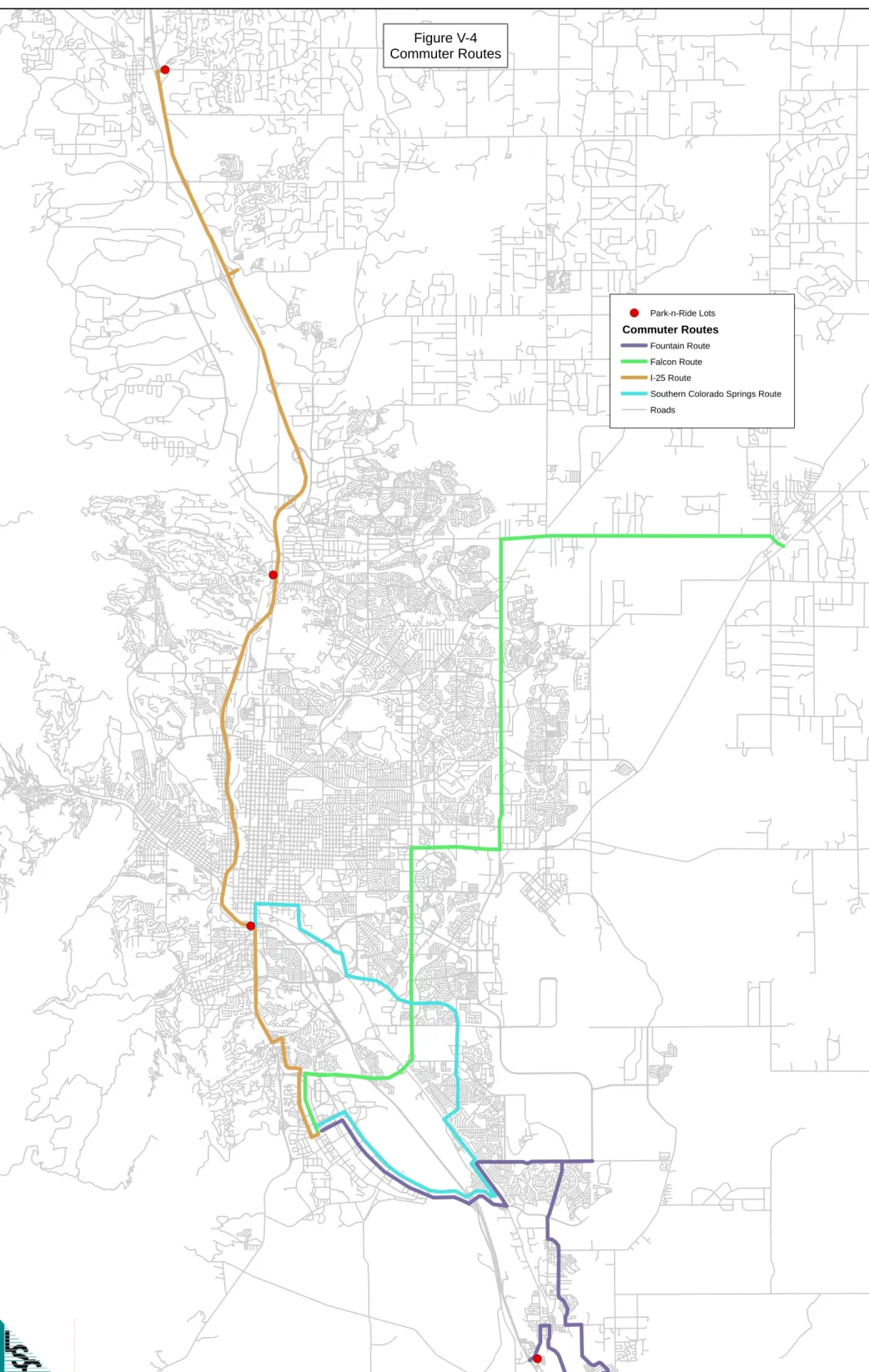
This transit service option would provide four commuter bus routes that would transport employees from a central origin, such as a park-and-ride lot (provided in the cities of Colorado Springs and Fountain) before heading to the Fort Carson post. Figure V-4 shows the four commuter routes. The first commuter route con-nects the Fountain park-and-ride to Fort Carson. The second route concon-nects Falcon to the Fort Carson Mountain Post. The third route travels from the Monu-ment park-and -ride, connects to the Woodmen park-and-ride and the I-25/Tejon park-and-ride, and then heads to the Fort Carson post.
The commuter bus service may the precursor to expanded regional services to other parts of the city. The difficulty with commuter bus service is meeting the various timing needs for employers and employees. This service is not as flexible as vanpool service.
Service characteristics of the four commuter bus routes are as follows: Fountain Route:
• Number of vehicles: 2
• Annual operating cost: $129,800
• Estimated annual passenger-trips: 16,000 one-way trips (eight passen-gers assumed per hour)
• Annual vehicle-hours: 2,000 • Annual vehicle-miles: 72,000 • Cost per passenger-trip: $8.11 Falcon Route:
• Number of vehicles: 2
• Annual operating cost: $147,800
• Estimated annual passenger-trips: 16,000 one-way trips (eight passen-gers assumed per hour)
• Annual vehicle-hours: 2,000 • Annual vehicle-miles: 96,000 • Cost per passenger-trip: $9.23 I-25 Route:
Conceptual Transit Service Options
LSC Fort Carson Car-less Mobility Transit Study, Technical Memorandum #1 Page V-19
• Annual operating cost: $153,800
• Estimated annual passenger-trips: 16,000 one-way trips (eight passen-gers assumed per hour)
• Annual vehicle-hours: 2,000 • Annual vehicle-miles:104,000 • Cost per passenger-trip: $9.61 South Colorado Springs Route:
• Number of vehicles: 2
• Annual operating cost: $123,800
• Estimated annual passenger-trips:16,000 one-way trips (eight passen-gers assumed per hour)
• Annual vehicle-hours: 2,000 • Annual vehicle-miles: 64,000 • Cost per passenger-trip: $7.73
Conceptual Transit Service Options
! ( ! ( ! ( ! ( ! ( Park-n-Ride Lots Commuter Routes Fountain Route Falcon Route I-25 Route
Southern Colorado Springs Route Roads
Figure V-4 Commuter Routes
Conceptual Transit Service Options
Conceptual Transit Service Options
LSC
Fort Carson Car-less Mobility Transit Study, Technical Memorandum #1 Page V-23
Option 10: Park-and-Ride Lots
For a car-less mobility transit system to be attractive and play a bigger role in serving transportation needs at Fort Carson, a regulation that prohibits all civilian vehicles on post co uld greatly enhance this system.
Also, to support carpooling, vanpooling, and commuter bus service in general, park-and-ride lots should be establ ished near Fort Carson. Park-and-ride lots will increase the options for users of the service. Carpool or vanpool participants may park at these lots and meet the others in their group. This also extends the areas that may be served by a carpool or vanpool. Other options that can be expl ored are church parking lots, college parking lots, and business parking lots that may have excess capacity during the day.
Park-and-ride space could be leased from the Pikes Peak Community College parking lot. In addition, a park-and-ride lot ne ar Gate 20 could be deve loped. A park-and-ride lot would cost approximately $5,000 per parking space. This cost would include constructio n cost for grading, curbing, landscaping, lighting, storm drainage, utility service, and signing/striping. This cost would not include acquisi-tion costs. Such a park-and-ride facility near the post would greatly increase transit and rideshare travel. Civilians would be required to park at these lots and then take transit or walk through gate security. This would greatly reduce the time spent to go through the gate security.