1-1-2010
A Scientific Workflow System For Genomic Data
Analysis
Jamal Ali Musleh Alhiyafi Wayne State University
Follow this and additional works at:http://digitalcommons.wayne.edu/oa_dissertations
Part of theComputer Sciences Commons
This Open Access Dissertation is brought to you for free and open access by DigitalCommons@WayneState. It has been accepted for inclusion in Wayne State University Dissertations by an authorized administrator of DigitalCommons@WayneState.
Recommended Citation
Alhiyafi, Jamal Ali Musleh, "A Scientific Workflow System For Genomic Data Analysis" (2010).Wayne State University Dissertations.
by
JAMAL ALI MUSLEH ALHIYAFI
DISSERTATION
Submitted to the Graduate School
of Wayne State University,
Detroit, Michigan
in partial fulfillment of the requirements
for the degree of
DOCTOR OF PHILOSOPHY
2010
MAJOR: COMPUTER SCIENCE
Approved by:
© COPYRIGHT BY
JAMAL ALI MUSLEH ALHIYAFI
2010
ii
This dissertation is dedicated to very special people in my life:
My late father, Ali Musleh Alhiyafi My mother, Husn Mohamed
My wife, Izdehar Alhiyafi My father-in-law, Mohamed Mohamed
My mother-in-law, Dolah Mohamed
My children: Jihad, Maymoonah, Laith, and Waleed
iii
First of all, I thank Allah for guiding me and making it easy for me to complete my education. I thank Him alone for blessing and protecting me and my family.
I would like to express special thanks to my advisor Dr. Shiyong Lu, whose efforts and thoughtful supervision were extraordinary throughout my PhD studies. Had it not been for Dr. Lu‟s insightful comments and suggestions, this dissertation would not have been completed. As my advisor, colleague, and friend, Dr. Lu has been outstanding in providing me with his remarkable guidance, knowledge, and experience so that this research would bear fruit. I also express my thanks and appreciation to Dr. Jeffrey L. Ram for his support and excellent advice that he gave throughout the research period. I appreciate his precious encouragement and suggestions that contributed a great deal to this project. I am very grateful to Dr. Shiyong Lu, Dr. Chandan Reddy, Dr. Jing Hua, and Dr. Jeffrey L. Ram for serving on my dissertation committee and providing constructive suggestions on the direction of my project and wonderful recommendation letters.
I would like to thank and acknowledge all my co-authors during my PhD period specially Cavitha Sabesan for her collaboration during the Analysis of Intragenomic Gene Conversion phase of this research.
I would like to thank my fellow students for their encouragement and friendship: Dr. Artem Chebotko, Dr. Mustafa Atay, Dr. Yi Lu, Cavitha Sabesan, Chunhyeok Lim, Cui Lin, Dong Ruan, Xubo Fei, and the list continue to my memory. I would like to thank my friends: Dr. John Paul Walter, Jeff Ginn and Ahmed Muaydh for their helpful discussion and suggestions during this project. I would also like to thank the following
iv
My special thanks and appreciation goes to my mother, Husn Mohamed, whose prayers have been crucial for my accomplishments. She stood behind me and was fully supportive to my decisions since I was 13 years when my father passed away. Having a mother like her while growing up, was the greatest gift and biggest advantage anyone could ever have given me. Thank you for your unwavering support throughout my journey. Whatever I do or say, I will not be able to pay her back for a minute she spent, and still is, praying for me.
I extend my grateful thanks to my prodigious wife, Izdehar Alhiyafi, my real and continuing love, and my best friend for her help, support, and tolerance throughout my studies. She provided the comfort, affection, and love that were motivating factors toward the accomplishment of my social and academic goals. I would also extend my love and thanks to my daughters Jihad and Maymoonah and my sons, Laith and Waleed.
I also extend my thanks to my Father-in-Law, Mohamed Mohamed, and Mother-in-Law, Dolah Mohamed, for their prayers, love, and support for me, my wife, and my kids.
I also would like to extend my appreciation to my brothers: Abdulwahab, Abdulhakim, and Abu Baker, and my sisters: Tuhrah, Seham, Assma, Maryam, and Shfae for their prayers, love, affectionate concern, encouragement, and constant supports throughout my life. I would like to thank my brother-in-laws: Abdo, Khaled, Waleed, Hamza, and Yousaf, and sister-in-laws: Nabila, Yemen, Bushra, and Hella. Thanks for always being there for me.
v
encouragements, concerns, and wishes. Many of my relatives and friends supported me during the last few years with their encouragements and prayers, and I cannot mention them all but I would like to extend my thanks to the following relatives and friends: Uncle Abdo, My cousins, Noman, Fahd, and Abdulraqib, My friends: Amin Alsaidi, Dima Khalidi, Ibrahim Mohamed, Ibrahim Saleh, Ishraq Thabet, Mahdi Ali, Mansour Sharha, Mohamed Mohamed, Mohamed Nasser, Dr. Mustafa Hashem, Omari Bayi, and Saleh Almansoob. Also, my thanks to my friends overseas who kept asking about my PhD status and provided their encouragements for me to continue achieving my goal: Abdulrahman Alwaheeb, Abdulwahab Mayas, Bashir Aziz, Dr. Fahd Alharbi, Faisal Alyasin, Dr. Ghazi Alotaibi, Dr. Sultan Almeser, Waleed Alsabahi, Yasser Alburaihi and the everlasting list continues to my memory. Thanks for your concerns and encouragements.
Finally, I send my prayers to my father who passed away when I was in the 7th grade (21 years ago to this March). I wish he was here with me during this time to celebrate an accomplishment that he would have been proud of. I also send my prayers to my oldest brother, Hassan, who passed away 6 months ago. His encouragement and support were missed dearly. May Allah put mercy on both of them.
vi
Acknowledgments ... III List of Tables ... IX List of Figures ... X
CHAPTER 1 : INTRODUCTION ... 1
1.1 MOTIVATION,CHALLENGES, AND APPROACH ... 1
1.2 CONTRIBUTIONS ... 4
1.3 ORGANIZATION ... 7
CHAPTER 2 : RELATED WORK ... 8
2.1 SCIENTIFIC WORKFLOW MANAGEMENT SYSTEMS ... 8
2.2 USE OF GRID FOR SCIENTIFIC WORKFLOW SYSTEMS ... 11
2.3 SCIENTIFIC WORKFLOW SCHEDULING ALGORITHMS ... 12
2.4 INTRAGENOMIC RECOMBINATION ... 17
2.5 A COMPARISON BETWEEN GENOMEFLOW AND RELATED SYSTEMS ... 22
CHAPTER 3 : GENOMEFLOW SCIENTIFIC WORKFLOW SYSTEM ... 25
3.1 MOTIVATION ... 25
3.2 SERVICE-ORIENTED ARCHITECTURE FOR GENOMEFLOW ... 26
3.3 GENOMEFLOWSPECIFICATION LANGUAGE (GSL) ... 29
vii
CHAPTER 4 : SIMULATION OF GENOMIC RECOMBINATION AND
DETECTABILITY OF RECOMBINATION ... 45
4.1 MOTIVATION AND CHALLENGES ... 45
4.2 METHODS ... 48
4.3 DNASEQUENCE DATA ... 62
4.4 GENECONVDETECTION METHOD ... 63
4.5 EXPERIMENTAL PARAMETERS ... 65
4.6 GENECONVANALYSIS WHILE USING FIXED RECOMBINATION RATE ... 65
4.7 EXPERIMENTAL RESULTS WHILE USING VARIABLE RECOMBINATION RATE ... 69
4.8 SUMMARY AND FUTURE WORK... 76
CHAPTER 5 : INTRAGENOMIC GENE CONVERSION ANALYSIS ... 80
5.1 MOTIVATION AND CHALLENGES ... 81
5.2 INTRAGENOMIC GENE CONVERSIONS ... 82
5.3 INTRAGENOMIC RECOMBINATION ANALYSIS PIPELINE ... 84
5.4 IMPLEMENTATION OF THE WORKFLOW ... 87
5.5 GENOME SEQUENCES ... 88
viii
5.9 SUMMARY AND FUTURE WORK... 118
CHAPTER 6 : CONCLUSIONS AND FUTURE WORK ... 126
References ... 128
Abstract ... 144
ix
Table 4.1: Number of surviving alleles after running the simulation. ... 70
Table 5.1: Intragenomic gene conversions among the 15 largest microbial genomes. 96 Table 5.2: Variation of number of intragenomic gene conversions among species for which >3 genomes have been sequenced. ... 97
Table 5.4: Streptococcus pyogenes strains... 98
Table 5.5: Number of members of gene families of Streptococcus pyogenes. ... 99
Table 5.6: Details of large number of conversions identified ... 101
Table 5.7: Verification of method by comparison to Morris & Drouin (M&D), 2004... 104
Table 5.8: Gene conversion numbers and sizes in E. coli and Shigella spp. ... 106
Table 5.9: Gene conversions identified with flanking region of 600 bp included in the calculation. ... 111
Table 5.10: Intragenomic gene conversions identified in functional bacterial protein families with >2 members ... 117
x
Figure 3.1: (a) Service-oriented architecture for the GENOMEFLOW system; (b) GENOMEFLOW Task Manager for the execution of heterogeneous
tasks. ... 27
Figure 3.2: Create a GENOMEFLOW workflow task. ... 28
Figure 3.3: GUI to enter input data for a task or create a data link between two tasks. 30 Figure 3.4: Example of a GENOMEFLOW workflow specification. ... 31
Figure 3.5: A schema representation for a GSL file. ... 32
Figure 3.6: Algorithm GSA. ... 34
Figure 3.7: Algorithm FindSubWorkflows. ... 36
Figure 3.8: Example to illustrate the scheduling and portioning algorithms. ... 37
Figure 3.9: Example 2 to illustrate the scheduling and portioning algorithm. ... 38
Figure 3.10: GENOMEFLOW scientific workflow workbench... 40
Figure 3.11: A Taverna workflow ... 41
Figure 3.12: A Swift workflow ... 41
Figure 3.13: Execution time when using Taverna workbench to process IGC vs GENOMEFLOW. ... 43
Figure 4.1: Different forms of Homologous Recombination... 47
Figure 4.2: Processors, links, and workflow inputs and outputs of the recombination simulation scientific workflow. ... 49
Figure 4.3: A simple GENOMEFLOW scientific workflow to simulate a population of sequences and analyze the detectability of recombination. . 50
Figure 4.4: A Taverna representation for the DNA Simulation task. ... 51
xi
Figure 4.8: Lack of effect of position of recombined fragment on detectability. ... 67
Figure 4.9: Effect of pairwise differences of the non-transferred segment of parental sequences on detection of recombinations by GENECONV. ... 68
Figure 4.10: Decrease in PDs between initial and final populations. ... 70
Figure 4.11: Representative changes in population structure over the course of 1500 generations. ... 72
Figure 4.12: Effect of Δ on the percentage of simulated gene conversions detected by GENECONV for simulated populations with initial APD = 2%. ... 75
Figure 5.1: Gene Conversion. A Segment of one DNA sequence is replaced by a segment from the other sequence. ... 84
Figure 5.2: Pipelined view of the intragenomic recombination analysis. ... 87
Figure 5.3: A scientific workflow for Intragenomic Recombination Analysis. ... 88
Figure 5.4: Processing time vs. genome size. ... 94
Figure 5.5: Number of IGCs found in Streptococcus pyogene. ... 100
Figure 5.6: Number of IGCs vs. genome size. ... 102
Figure 5.7: Relationship between number of IGCs identified in various E. coli and Shigella strains. ... 107
Figure 5.8: Number of members in largest multigene families in E. coli and Shigella genomes. ... 109
Figure 5.9: Number of IGCs in E. coli and Shigella strains determined with flanking sequences 600 bp long including in the analysis. ... 114
CHAPTER 1
: INTRODUCTION
In this chapter, the concept of Scientific Workflows will be introduced along with our research motivation, challenges, goals, and contributions. Finally, an organization of the rest of the dissertation is outlined.
1.1 Motivation, Challenges, and Approach
Recently, scientific workflows have become increasingly popular as a new method for scientists to develop and design complex and distributed scientific processes to enable and accelerate many scientific discoveries [25, 27]. Scientific workflows are becoming an efficient way to model and automate these complex computations and automating such complex scientific experiments. Scientific workflows are rapidly becoming recognized as an important unifying mechanism to combine scientific data management, analysis, simulation, and visualization tasks [19]. A scientific workflow is a formal specification of a scientific process, which represents, streamlines, and automates the analytical and computational steps that a scientist needs to go through from dataset selection and integration, computation and analysis, to ultimately data products presentation and visualization [57, 68]. In scientific workflows, it is very important to seamlessly access and integrate various heterogeneous and distributed datasets and to integrate and reuse various third-party analysis tools. The design of a scientific workflow system often focuses on “data flows,” i.e., how the input data is streamlined into various analyses using data channels to produce multiple intermediate data products and ultimately final workflow output data products.
Many scientific problems involve processing huge amounts of data and other complex computations which may require the use of many other tools to analyze data and execute accordingly. Typically, scientists spend tremendous amounts of effort to handle manual work and computations. The results from such computations are shared among the interested scientists for further analysis or modification. Scientific workflows can provide such a supportive and creative environment for scientists in their research by integrating complex computations and automating complex scientific analysis.
Workflow design is often concerned with the automation of procedures whereby files and data are passed between participants according to a defined set of rules to achieve an overall goal [43]. Automation is a major benefit of the scientific workflow approach. A scientist may want to execute the same data analysis pipeline repeatedly with many different input datasets and/or the same dataset using different parameter settings. Another benefit is the sharing and the reusing of computational components and/or whole workflows. Analysis and results of scientific workflows can be easily shared among collaborators. Workflow systems can be designed to easily implement additional computational steps that are eventually associated by data links to existing workflows.
Several scientific workflow systems have been developed (e.g. Taverna [68], Swift [84], Kepler [57], VIEW [53], Pegasus [28], Triana [87]). Some are visualization-based system and others are script-based systems. Most of the systems have their proprietary language representations. Based on a scientific problem that is being researched, a scientist may need to manually combine the results and analyses from multiple systems which can be quite time consuming.
Based on an evaluation conducted on five scientific workflow management systems (SWFMS) using the reference architecture for SWFMSs [53], none of the systems meets all the requirements. Pegasus and Swift provide weak user interaction support while Taverna, Kepler, and Triana provide better user interaction support [53]. Almost all systems have poor support for user interface customizability. Taverna, Kepler, and Triana have partial support for the integration of heterogeneous service and software tools, while Pegasus and Swift focus only on Grid-based applications [53]. Pegasus and Swift have better support to high-end computing, while other systems are being enhanced in such support. Taverna and Kepler provide custom tasks to communicate with the Grid environment, while Triana uses the GAT interface to access Grid jobs [53]. No system provides the ability to reuse existing workflows implemented by other systems.
The problems noted with existing scientific workflow management systems provide the rationale for the development of a new system for the efficient use of heterogeneous scientific workflow systems and the utilization of Grid computing. When developing a scientific workflow, some functionality may be missing in one workflow system, yet available by another, so with a system that supports heterogeneous scientific workflows, the user can develop the targeted scientific workflow. Also, scientific workflows can be shared among users. To illustrate, a user can implement a Taverna workflow and pass it to another user who does not know how to use Taverna; however he can add the workflow to his GENOMEFLOW workflow using a user friendly interface.
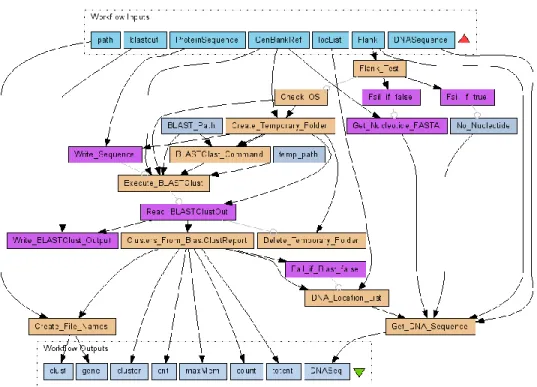
By analyzing the results of our research and processing time when running the Recombination Simulation Scientific Workflow [3] and Intragenomic Gene Conversion
[6], we realized the importance of a scientific workflow system that supports the execution of heterogeneous workflows using various services.
1.2 Contributions
Although several scientific workflow management systems (SWFMSs) have been developed, there is a great need for an integrated scientific workflow system that enables the design and execution of higher-level scientific workflows, which integrate heterogeneous scientific workflows enacted by existing SWFMSs. On one hand, science is becoming increasingly collaborative today, requiring an integrated solution that combines the features and capabilities of different SWFMSs, which are typically developed and optimized towards one single discipline. One the other hand, such an integrated environment can immediately leverage existing and emerging techniques and strengths of various SWFMSs and their supported execution environments, such as Cluster, Grid, and Cloud.
The dissertation goal is to address the design of scientific workflow systems and how they can be utilized to serve the bioinformatic community both from the theoretical and practical perspective.
The dissertation makes the following research contributions:
We present a scientific workflow system that can support the design, development, and execution of heterogeneous scientific workflow systems. We implemented the GENOMEFLOW scientific workflow system to design, develop, and execute heterogeneous tasks in heterogeneous environments. We present a GENOMEFLOW scientific workflow application to demonstrate the
capabilities of GENOMEFLOW in support of user interaction of intensive scientific workflows in a heterogeneous and distributed computing environment [2].
We propose a scientific workflow scheduling algorithm t o enable the parallel execution of such heterogeneous scientific workflows in their native heterogeneous environments [2].
A scientific workflow to simulate the DNA recombination process was developed. History of the recombinant events is saved for further comparison and analysis. The known history of recombination occurring in the simulation was compared with the output of putative recombinations detected by a well known highly ranked recombination detection program (GENECONV). The results show that the recombination detection software fails to identify more than 50% of recombination events, designated as “cryptic recombinations.” We implemented GENOMEFLOW towards the life science community and
developed several GENOMEFLOW scientific workflows to demonstrate the capabilities of our system for genome data analysis applications.
A method for generating initial populations of DNA sequences of any given Average Pairwise Difference (APD) is described[3].
The effect of varying the recombination rate according to the pairwise difference between the potentially recombining sequences was examined [3]. Two effects of varying the recombination rate were:
a. Under some conditions of initial pairwise differences and steepness of the pairwise difference:recombination rate relationship, multiple populations could arise, illustrating a mechanism that could underlie sympatric speciation
b. Decreasing recombination rate according to the pairwise difference between potentially recombining sequences decreased the percentage of simulated recombinations that could be detected by GENECONV. Thus, the problem of „cryptic recombination‟, identified by Alhiyafi et al. [4] using constant recombination rates, is exacerbated by the effect of pairwise differences on recombination rate.
We conclude that variation in recombination rate owing to sequence mismatches should be taken into account when estimating recombination rates and when designing recombination detection experiments.
Compare Intragenomic Gene Conversions (IGC) in the many additional
Escherichia and Shigella genomes now available to test the hypothesis about the relationship of IGC frequency to pathogenicity more critically. A scientific workflow system for automating IGC analysis in multiple genomes is developed [6]. Furthermore, since sequences flanking both ends of the potential conversion sites have been shown to affect the detectability of gene conversions [4], IGCs were also analyzed with neighboring sequences included, a procedure that allowed the detection of IGCs larger and in greater numbers than had previously been described. Finally, the types of genes exhibiting IGCs were characterized.
Considering the amount of time it takes to complete a single run-through of all currently available bacterial genomes lead us to put these principles into a high performance computing environment. Since each genome is analyzed individually, these processes are ideal for incorporating the workflow into a parallel processing grid.
We have developed a realistic method to do bioinformatic analysis on large numbers of whole genomes, designing processors that can be used for other bioinformatic tasks and also establishing a structure into which additional bioinformatic analyses can be incorporated.
1.3 Organization
The remaining chapters of the dissertation are organized as follows. Chapter 2 reviews the research on scientific workflow management systems, using a high performance environment when executing scientific workflows, scientific workflow scheduling algorithms and intragenomic recombination. Chapter 3 presents our scientific workflow system, GENOMEFLOW, and our scheduling algorithm. Chapter 4 presents the use of our scientific workflow system to simulate genomic recombination and detectability of recombination. Chapter 5 introduces our Intragenomic Gene Conversion analysis. Finally, Chapter 6 concludes the dissertation and lists some of the remaining interesting research problems.
CHAPTER 2
: RELATED WORK
Significant research has been done in the area of scientific workflow management system and scientific workflows scheduling algorithms. In this chapter, we limit ourselves to reviewing the research that is most closely related to the work we have done here: Section 2.1 reviews research in Scientific Workflow Management Systems, Section 2.2 presents the use of Grid for scientific workflow systems, Section 2.3 introduces some of the existing Scientific Workflow Scheduling Algorithms, and Section 2.4 summarizes related work in Intragenomic Recombination. Finally, Section 2.5 gives a comparison between GENOMEFLOW and other systems.
2.1 Scientific Workflow Management Systems
Many scientific workflow management systems are available today that are open source and specifically designed for different disciplines such as biology, astronomy, ecology, chemistry, engineering, and medical imaging. Scientific workflow management systems (SWFMSs) provide an environment to model, develop and run scientific workflows efficiently. Here are some examples with brief information of existing scientific workflow management systems:
Taverna. Taverna is a scientific workflow management environment developed by
my
Grid, a UK project [68]. In Taverna, a workflow can be described as a set of processors and the relations between those processors used to define a complex process. A processor is the smallest reusable component, which performs some well-defined function within a process. Data links transfer information from workflow input, or an output of one
processor, to the input of another processor, or to a workflow output. A control link enables you to set dependencies to be set between services in a workflow that do not directly share data (i.e. that are not otherwise linked by passing data from one to the other directly or indirectly). A control link allows delaying the invocation of a service until another has finished.
VIEW. VIsual SciEntific Workflow Management system (VIEW) has been developed by a group of researchers in the Scientific Workflow Research Laboratory at Wayne State University. VIEW [22, 53] is a service-oriented scientific workflow management system. VIEW comprises a workbench [22] to visually design workflows, a workflow engine [33] to execute workflows, a task manager to manage the execution of workflow tasks, a provenance manager [21] to store and query workflow provenance, and a data product manager to store and manage data products. VIEW is the first system that features a service-oriented architecture conforming to the reference architecture for scientific workflow management systems [53]. Also, VIEW is the first system that supports dataflow-based MapReduce-style scientific workflows for data-intensive scientific applications [33], and it supports an innovative task abstraction and mapping technique that uniquely addresses the type-II shimming problem, which occurs due to the incompatibility between the ports of a task and the inputs/outputs of its internal task component[54].
Swift [84]. Swift is a system for scheduling large scale scientific projects. It provides a scripting language that allows the users to express operations on datasets in terms of their local organization [102]. Swift supports the parallel and distributed execution of
computationally demanding and data intensive scientific computations [83]. With Swift, the performance gains depend primarily on the parallelism that the workflow exhibits [83].
Kepler [57]. Kepler is an open source workflow management system that is available for download at the Kepler website [48]. Kepler is based on Ptolemy II, developed at UC Berkeley, and provides a platform for building and executing workflows. Kepler is an Actor-oriented workflow system designed specifically to improve component reusability.
Triana [87]. Triana is an open source graphical problem solving environment available for download at the Triana website [88]. Triana enables creation and execution of scientific applications, especially signal, text and image processing tasks. Triana is not only a powerful visual programming tool but also provides Grid technology as a means to providing an “easy to use” environment to scientists who may not be interested in the complex details of its implementation.
VLE-WFBus [103]. VLE-WFBus is a scientific workflow management system developed to support workflow interoperability. Legacy SWFMSs are wrapped as federated components and are loosely coupled as one workflow system. The supported workflow systems are called subworkflows. The VLE-WFBus support is limited to certain workflow systems.
Pegasus [26] (Planning for Execution in Grids) is a workflow mapping engine developed and used as part of several projects in physics, astronomy, gravitational-wave science, earthquake science, and others. Pegasus bridges the scientific domain and the
execution by automatically mapping the high-level workflow descriptions onto distributed resources such as the TeraGrid, the Open Science Grid, and others.
2.2 Use of Grid for scientific workflow systems
Along with the scientific workflow systems, scientific communities are utilizing Grids to share, manage and process large data sets [99]. In order to support complex scientific experiments, distributed resources such as computational devices, data, applications, and scientific instruments need to be orchestrated while managing the application workflow operations within Grid environments [61].
Grids [34] have emerged as a global cyber-infrastructure for the next-generation of e-Science applications by integrating large-scale, distributed and heterogeneous resources. Imposing the workflow paradigm for application composition on Grids offers several advantages [82] such as utilization of resources that are located in a particular domain to increase throughput or reduce execution costs, and execution spanning multiple administrative domains to obtain specific processing capabilities.
Some of the existing scientific workflow management systems have tried to exploit the advantages of using Grid technology with scientific workflows. A scientific workflow as a service [85] was implemented based on the Taverna workflow engine and gRAVI (Grid Remote Application Virtualization Interface) as the wrapping tool to improve execution performance. Scientific communities are utilizing Grids to share, manage and process large data sets [99]. In order to support complex scientific experiments, distributed resources such as computational devices, data, applications, and
scientific instruments need to be orchestrated while managing the application workflow operations within Grid environments [61].
Some of the features of scientific workflow in Grid environment are: (1) resources are highly distributed, (2) scientific workflows often contain many tasks and involve large data sets which requires intensive computation, so it will be easy to use on the Grid environment [86], and (3) many computational tasks can be processed in parallel.
2.3 Scientific Workflow Scheduling Algorithms
Scheduling of workflows is a problem of finding a correct execution sequence for the workflow tasks [78]. Scientific workflow scheduling in high performance computing environments usually focuses on the optimization of performance when executing workflows. In most cases, the scheduler is required to predict the performance of tasks on the various resources in order to guarantee performance [1].
The ultimate goal of the schedule is to minimize the scientific workflow execution time and maximize resource utilization or throughput. To implement a scientific workflow schedule, the following challenges will be presented [11]: (1) Precedence constraints or control dependencies where outputs from one task in the workflow will serve as inputs to other tasks. In this case, the task that produces this output should be executed as early as possible, (2) Data transfer overhead or data dependencies where all data needed for any task should be available and ready to be transferred to the compute node where the workflow task is to be executed, (3) the ability for the workflow tasks to access the required Grid resources [59], (4) Efficient selection of resources for the
components in order to achieve good performance [59], and (5) satisfying all dependencies and automating the Grid execution of the entire workflow [59].
A scientific workflow is a collection of tasks organized in a way to achieve a specific target. Scientific workflow tasks can be categorized into a Simple task or a synchronization task [101]. A synchronization task is a task that has more than one parent or child task. Synchronization Task Scheduling (STS) [101] only considers one task to decide the service for executing that task. If there is only one simple task in a branch (Branch Task Scheduling (BTS)) then the solution for BTS is the same as STS. However, if there are multiple tasks, the scheduler needs to make a decision on which service to execute each task after the completion of its parent task [101]. Simple or Static Scheduler is based on well-known advance reservation based co-allocation techniques. Static scheduler performs sub-deadline re-calculation and re-negotiation if the initial co-allocation request fails, whereas the Simple scheduler does not. Dynamic Scheduler is where the tasks of an application are scheduled Just-in-time. Scheduling of scientific workflows on the Grid is a complex optimization problem which may require consideration of different scheduling criteria. The most important criteria are the expected execution time and the cost of running an activity on a machine [71].
Min-Min [56, 59]. The Min-Min heuristic algorithm makes decisions based on a set of parallel independent tasks. It assigns priority and schedules the task based on its Expected Completion Time (ECT) for the task over all available resources. It produces good results but is computationally expensive [32]. For each component, the resource having the minimum estimated completion time (ECT) is found. The component having
the minimum ECT value is chosen to be scheduled next. This is done iteratively until all the components have been mapped. The concept behind Min-Min is to consider all unmapped independent tasks during each mapping decision. [73].
Max-Min. The first step is exactly same as in the Min-Min heuristic. Then the resource having the maximum estimated completion time (ECT) is found and the corresponding component is mapped instead of choosing the minimum. The intuition behind this heuristic is that by giving preference to longer jobs, there is a hope that the shorter jobs can be overlapped with the longer job on other resources [59]. It is similar to Min-Min except that in each iterative step, a task having the maximum ECT is chosen to be scheduled on the resource that is expected to complete the task at the earliest time. Once the machine that provides the earliest completion time is found for every task, the task that has the maximum earliest completion time is determined and then assigned to the corresponding machine [58]. Intuitively, Max-Min attempts to minimize the total workflow execution time by assigning longer tasks to comparatively better resources. Both Min-Min and Max-Min have been used for scheduling workflow tasks in Pegasus [59, 73]. The Max-Min is likely to do better than the Min-Min heuristic in the cases where we have many more shorter tasks than long tasks [58].
Sufferage. The first step in the Sufferage algorithm [59] is to find both the minimum and second best minimum ECT values. The difference between these two values is defined as the sufferage value. In the second step, the component having the maximum sufferage value is chosen to be scheduled next. The intuition behind this is that jobs are prioritized on relative affinities. The job having a high sufferage value suggests that if it
is not assigned to the resource for which it has minimum ECT, it may have an adverse effect because the next best ECT value is far from the minimum ECT value. A high sufferage value job is chosen to be scheduled next in order to minimize the penalty of not assigning it to its best resource [59].
Bi-criteria Scheduling. Bi-criteria Scheduling [71] restricts the user to certain criterion pairs. It requires the user to identify preferences either as (1) weights assigned each criterion or as (2) fixed constraints defined for one criterion. The first approach has the drawback that combining multiple criteria into a single objective function is not always intuitive to the end-user, while the second requires a priori knowledge about the result of the first criterion scheduling result.
Dynamic Constraint Algorithm (DCA). DCA addresses the optimization problem of the two independent criteria: execution time and economic cost tradeoff. DCA is based on dynamic programming [71]. The user is expected to identify primary and secondary criteria, and a sliding constraint. DCA algorithm consists of two phases: (1) primary scheduling for optimizing for the primary criterion only; and (2) secondary scheduling for optimizing for the secondary criterion while keeping the primary criterion cost within the defined sliding constraint.
Heterogeneous Earliest Finish Time (HEFT). HEFT algorithm makes decisions based on a critical path of the tasks. This strategy selects the task with the highest upward rank value at each step. This is the length of the critical path from a task to the exit task, including the computation cost of this task. It assigns higher priority to the workflow task having higher rank value. It calculates rank value based on the average
execution time for each task and average communication time between resources of two successive tasks, where the tasks in the „critical path‟ get comparatively higher rank values. The selected task is then assigned to the processor that minimizes its earliest finish time. The algorithm is designed for scheduling DAG (Directed Acyclic Graph) so it is not so efficient for scheduling a huge number of concurrent workflow instances [56]. The advantage of using this technique over Min-Min or Max-Min is that while assigning priorities to the tasks, it considers the entire workflow rather than focusing on only unmapped independent tasks at each step [73].
Greedy Randomized Adaptive Search Procedure (GRASP). GRASP is an iterative randomized search technique. In GRASP, a number of iterations are conducted to search a possible optimal solution for mapping tasks on resources. A solution is generated at each iterative step and the best solution is kept as the final schedule. This searching procedure terminates when the specified termination criterion, such as the completion of a certain number of iterations, is satisfied. GRASP can generate better schedules than the other scheduling techniques stated previously as it searches the whole solution space considering entire workflow and available resources [18, 73].
Portable Batch System (PBS) [38, 67]. The Portable Batch System is a management and batch job scheduling system. It schedules and distributes various types of application runs (serial, parallel, distributed memory, etc.). It supports parallel programming libraries such MPI and openMP. It also can be used as a scheduler for scientific workflow systems such as Swift or can serve as a front end to Globus,
permitting the user to submit jobs requesting Globus resources using the normal PBS Pro commands.
In conclusion, Min-Min, Max-Min, Sufferage, Greedy Randomized Adaptive Search Procedure (GRASP), and Heterogeneous-Earliest-Finish-Time (HEFT) algorithm only attempt to minimize workflow execution time and do not consider users‟ budget constraints [100]. Several tools, including Kepler, Triana, and Taverna, provide interfaces and tools to specify and execute scientific workflows. The emphasis of these tools is on formalizing and constructing workflows and providing access to heterogeneous data and distributed web services[20].
2.4 Intragenomic Recombination
DNA consists of many genes and provides genetic information to regulate and reproduce cells. Information from each gene encodes a unique protein, which performs necessary tasks for the cell to function. Bacteria are very small single cell organisms that are found almost everywhere, in the air, water, soil, food, and human body. Bacteria are prokaryotes, which indicate that they contain a single cell that does not contain a nucleus. Instead, their genetic information is within a single circular chain of DNA. Even though they are small organisms, many live in groups and can multiply quickly by cell division, by which a single cell splits into two new daughter cells both with the same genetic material, and can conjugate (~ have sex) with each other to exchange and insert genetic material from one cell to another by homologous recombination. Recombination of bacterial genomes is widespread, occurring in soil bacteria [91] and numerous pathogens,
such as Neisseria meningitides [39]. Recombination is the transfer, insertion or replacement of a length of DNA into a genome from another source and results in the exchange of genetic information between organisms [70]. The seminal discovery of recombination by bacterial conjugation was made by Lederberg [49]. During conjugation, a single strand of replicated DNA is transferred sequentially through a bridge connecting the donor to the recipient cell. Genes or fragments of genes can integrate into the recipient‟s chromosome by homologous recombination, in which portions of the recipient cell‟s chromosome are replaced by similar or identical sequences from the donor. The result of this one-way transfer of DNA sequence is known as gene conversion.
Gene conversion can occur between two cells or between different genomic regions of the same cell. Intragenomic Gene Conversion (IGC), which is an outcome of a recombination event, is defined as the non-reciprocal transfer of genetic information from one gene to another related gene elsewhere in the genome. IGCs play an important role in the evolution of multigene families of bacteria and the generation of antigenic variations, where some pathogenic bacterial strains are avoiding the host immune system [68]. More details on the occurrence of IGCs are given below.
Computer modeling of genomic data is a powerful tool for simulating mechanisms maintaining diversity and mediating evolution of organisms and for testing methods measuring such mechanisms. For example, bacterial populations are highly diverse. Whittam estimates average pairwise differences over several genes of E. coli of about 2% [96]. Average pairwise differences reported by Alhiyafi et al. [4] in the fimH and uidA
mutations can certainly create pairwise differences between bacterial strains, genetic change can also come about through horizontal gene transfer by recombination. A central problem in understanding the diversity and evolution of organisms, therefore, is knowing how much genetic change has come about through recombination. This problem is complicated by the fact that recombination is both affected by sequence diversity and is a mechanism that helps maintain it. Evidence that recombination frequency between strains is decreased by higher levels of DNA sequence mismatches has been found in many studies. Among recombinations of five bacterial strains (two strains of E. coli, and one each of Shigella flexneri, E. fergusoni, and Salmonella typhimurium, each reciprocally crossed with E. coli K12) recombination frequency decreased exponentially with amount of DNA sequence divergence [92]. 10% divergence of DNA sequences decreased recombination frequency by approximately three orders of magnitude. Similarly, recombinations between E. coli strains from Lenski‟s long-term closed cultures [50, 51] decreased in frequency approximately 0.5 log units with a 0.2% sequence divergence [93]. Extrapolating their data suggests a decrease of 5 orders of magnitude for a 2% sequence divergence. In studies of recombination between homologous DNA sequences in plasmids and phage lambda in E. coli (K12) hosts, Watt et al. [94] observed a 2- to 4-fold decrease in recombination frequency with a single mismatched base out of 53, and Shen and Huang [79] observed up to a 300-fold decrease in recombination with a 16% DNA sequence mismatch. Fraser et al. [35] also summarizes data in Bacillus subtilis,
Bacillus mojavensis, Streptococcus pneumoniae, and E. coli that suggest an average 1000-fold decrease in recombination with a 16% DNA sequence mismatch. While
considerable variations in the quantitative estimates are apparent, there is no disagreement with the general observation that recombination frequency decreases with greater pairwise difference between potentially recombining genomes.
Although recombination is usually thought of as occurring between two different cells, IGCs can also occur in which recombination occurs between genes in gene families, i.e., genes with similar sequence that can be found in the same genome. For example, the concerted evolution of multiple copies of genes coding for ribosomal RNA may depend on intragenomic recombination between the homologous copies to keep all copies more or less “in synch” [52]. In addition to the concerted evolution of rRNA genes, intragenomic recombination has been demonstrated experimentally between the
tufA and tufB genes in Salmonella typhimurium [9, 46] and the gadA and gadB genes in
Escherichia coli [15]. Since the main requirement for this type of genetic exchange to occur is similarity of sequence, families of genes sharing similar sequence within a genome may be fertile ground for IGCs. IGC in bacteria has been suggested to occur more frequently in pathogenic species or strains than in non-pathogenic strains [63, 64, 75]. A computational analysis comparing the genomes of a non-pathogenic strain of E. coli (K12) and three pathogenic strains (CFT073 & O157:H7 Sakai and EDL933) concluded that IGCs were more frequent and require less sequence similarity in the pathogenic strains than in K12 [63]. One of the major issues considered in this dissertation is whether the differences in IGC frequency between pathogenic and non-pathogenic E. coli are representative of a general difference between pathogenic and non-pathogenic bacteria. However, the conclusion of Morris and Drouin [63] that “gene
conversions are more frequent and much less dependent on sequence similarity in pathogenic strains than in K-12” depended on a comparison of only one non-pathogenic strain and a select subset of pathogenic E. coli strains. In contrast, a subsequent study of the same four genomes by Morris and Drouin found no difference in the Intragenomic Gene Conversion rates when only “backbone” genes were considered, i.e., only those genes found in common among the four strains [65]. A larger number of whole genome sequences of other pathogenic and non-pathogenic strains of E. coli are now available for determining the representativeness of their conclusions. In addition, other bacterial species in which such pathogen:non-pathogen comparisons can be made are also available.
In order to detect whether recombination or gene conversion has occurred in the past, divergent sequences can be analyzed for vestiges of previous genetic transfers. Many methods have been developed during the last 15 years to detect the presence of recombination in sequence alignments. Methods work by identifying discontinuities in sequence similarities or genetic distance (e.g., GENECONV [76, 77] and MAXCHI [70, 80] or by phylogenetic methods that, for example, identify incongruous tree topologies (e.g., RECPARS[42]). Many methods have been evaluated [69, 70, 97], and new ones continue to be developed. GENECONV is among the most highly ranked methods and is included in the RDP2 analysis suite [60]. In a comparison of 14 different gene recombination detection methods, GENECONV was consistently among the best [69, 70]. GENECONV has been applied successfully to various biological data sets to analyze recombination among alleles of homologous genes [10, 15, 31, 89]. GENECONV was
also used to demonstrate IGCs between genes in gene clusters in both yeast and E. coli
genomes[29, 63] and was the method used to compare pathogenic and non-pathogenic strains of E. coli. The detection of recombination from DNA sequences by such methods is therefore relevant to the understanding of evolutionary and molecular genetics in bacteria.
2.5 A comparison between GENOMEFLOW and related systems
The problems noted with existing scientific workflow management systems and scheduling algorithms provide the rationale for the development of a new system for the efficient use of heterogeneous scientific workflow systems and the utilization of Grid computing. In this dissertation, we propose a scientific workflow system, GENOMEFLOW, with a scheduling algorithm to execute heterogeneous scientific workflows.
GENOMEFLOW scientific workflow system has the following specifications and advantages compared to other scientific workflow systems:
GENOMEFLOW is a scientific workflow system that is designed and implemented by following the Reference Architecture for Scientific Workflow Management Systems.
GENOMEFLOW has a user friendly interface, workbench, which gives the user the ability to design scientific workflows by clicking on existing tasks and adding them to the workflow design window. No need to learn a scripting language (e.g. Swift scripting language) in order to develop the workflow.
GENOMEFLOW has a user friendly interface, workbench, which gives the user the ability to design scientific workflows by clicking on existing tasks and adding them to the workflow design window. No need to learn a scripting language (e.g. Swift scripting language) in order to develop the workflow. GENOMEFLOW scientific workflow system supports the design, development,
and execution of heterogeneous scientific workflow systems. When developing a scientific workflow, a user may need to use a function that is missing from the workflow system that he is using, yet available by another, so with a system that supports heterogeneous scientific workflows, the user can develop the targeted scientific workflow.
Scientific workflows can be shared among users. To illustrate, a user can implement a Taverna workflow and pass it to another user who does not know how to use Taverna; however he can add the workflow to his GENOMEFLOW workflow using a user friendly interface.
GENOMEFLOW scientific workflow system supports the execution of tasks in a heterogeneous environment.
GENOMEFLOW executes tasks using its own scheduling algorithms. It executes heterogeneous scientific workflows in parallel processing in a high performance computing environment. GENOMEFLOW scheduling algorithms optimize the process and execution time of the GENOMEFLOW workflow. Most of the existing scheduling algorithms depend on knowing in advance how
workflow tasks work and setting criteria or priority weights that will help make scheduling decision.
Using GENOMEFLOW will give the user the advantages of using two levels of execution: local and global. The GENOMEFLOW scheduling algorithm looks at the workflow as a whole and also focuses on GENOMEFLOW individual tasks. It then uses the local scheduler (e.g. PBS) to minimize the scientific workflow execution time and maximize resource utilization or throughput.
CHAPTER 3
: GENOMEFLOW Scientific Workflow System
In this chapter, we introduce our GENOMEFLOW Scientific Workflow System and propose our scientific workflow scheduling algorithm. The rest of the chapter is organized as follows. Section 3.1 discusses motivation and challenges for our research. Section 3.2 presents the service-oriented architecture for GENOMEFLOW. Section 3.3 introduces the GENOMEFLOW Specification Language (GSL). Section 3.4 defines the scheduling algorithm. Section 3.5 presents the system execution and evaluation. Finally, Section 3.6 summarizes the chapter.
3.1 Motivation
Scientific workflows have become increasingly popular as a new computing paradigm for scientists to design and execute complex and distributed scientific processes to enable and accelerate many scientific discoveries. Although several scientific workflow management systems (SWFMSs) have been developed, there is a great need for an integrated scientific workflow system that enables the design and execution of higher-level scientific workflows, which integrate heterogeneous scientific workflows enacted by existing SWFMSs. On one hand, science is becoming increasingly collaborative today, requiring an integrated solution that combines the features and capabilities of different SWFMSs, which are typically developed and optimized towards one single discipline. One the other hand, such an integrated environment can immediately leverage existing and emerging techniques and strengths of various SWFMSs and their supported execution environments, such as Cluster, Grid, and Cloud.
Based on an evaluation conducted on five scientific workflow management systems (SWFMS) using the reference architecture for SWFMSs [53], none of the systems meets all the requirements. Also, by analyzing the results of our research and processing time when running a recombination simulation scientific workflow [4] and another scientific workflow to study the Intragenomic Gene Conversion [5, 6], we realized the importance of a scientific workflow system that supports the execution of heterogeneous workflows using various services. The advantages of high-performance Grid-based computing for scientific workflows, and the problems noted with existing scientific workflow management systems (SWFMSs), provide the rationale for the development of a new scientific workflow system for the efficient use of heterogeneous scientific workflow systems and utilizing Grid computing.
3.2 Service-Oriented Architecture for GENOMEFLOW
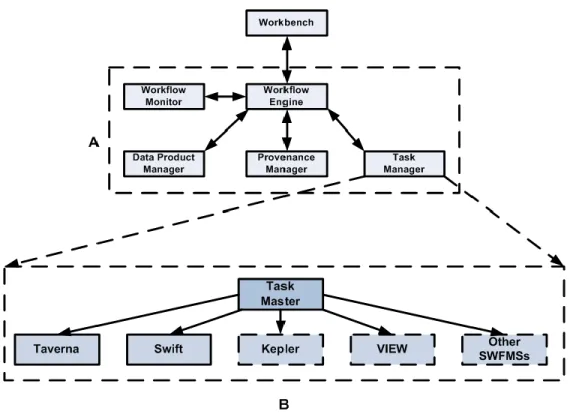
The system was designed and implemented by following the Reference Architecture for Scientific Workflow Management Systems [53]. The system consists of the following major sub-systems (Figure 3.1A): Interface and workflow design subsystem, Workflow Engine, Workflow Monitor, Task Manager, Data Product Manager, and the Provenance Manager. The interface and design subsystem is represented by a workbench that will give the user the ability to visually design the scientific workflow.
Figure 3.1: (a) Service-oriented architecture for the GENOMEFLOW system; (b) GENOMEFLOW Task Manager for the execution of heterogeneous tasks.
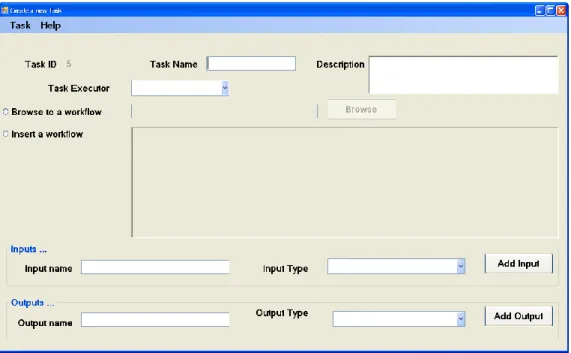
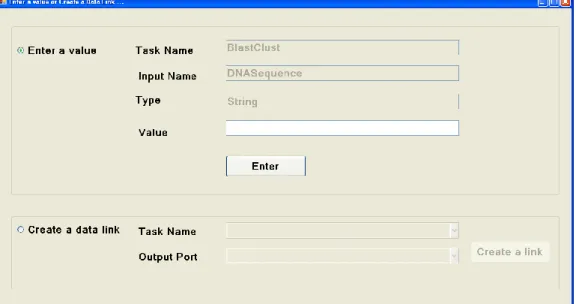
A list of available built-in tasks is available. If a task is not available, the user can create a new task which will be then available for future usage as well (Figure 3.2). A workflow consists of one or more tasks and each task has input/output ports. Each task represents a workflow that was built by a scientific workflow developed by a third party SWFMS. The user will have to enter data for the input ports and/or create data links between input ports and output ports of another task which indicate a dependency step.
The Workflow Monitor monitors the workflow and task execution status. The Task Manager will execute workflow tasks. The Data Product Manager will store, query, and manage data products, and the Provenance Manager stores and queries provenance. Database storage, along with a file repository, holds the task workflows and implemented
workflows. The results from running the workflows will also be saved in the storage based on the name of the workflow. Inputs and outputs are transferred back and forth between the local machine and the remote machines when necessary; if the actual execution is occurring remotely.
Figure 3.2: Create a GENOMEFLOW workflow task.
Figure 3.1B represents a service-oriented architecture for the Task Manager. The Task Manager consists of heterogeneous scientific workflows and their executable programs with other software tools, including high-end computing environments. The execution of the workflow starts by transferring the GENOMEFLOW Specification Language (GSL) file (.xml) that represents the workflow and internal tasks to the remote machine along with job script execution file. The job script file is called to start the execution and once it finishes, the resultant data is transferred back to the local machine.
When implementing GENOMEFLOW, we applied the key architectural requirements for a SWFMS [53]. The system has user interface and support user interaction (Requirement 1). The end user can develop scientific workflows by using the user friendly workbench. One of the user interfaces is to create control or data links between the workflow tasks (Figure 3.3). The system also meets the second requirement that it supports reproducibility of results by re-executing the workflow. Provenance data will be stored to support this requirement. The core of this system is to support heterogeneous and distributed services and tools (Requirement 3). GENOMEFLOW gives the end user the ability to develop workflows that contain tasks implemented by heterogonous scientific workflow systems and tools. As shown in Figure 3.1B, the Task Manager can execute tasks that represent Taverna workflow, Swift workflow, etc. The system also supports heterogeneous and distributed data product (Requirement 4). GENOMEFLOW also supports high-end computing by executing tasks and subworkflows in parallel mode on the Grid when needed.
3.3 GENOMEFLOW Specification Language (GSL)
Many systems were developed to execute scientific workflows as described in section 2.1 and each one has its own language to represent its workflow. Each system only supports workflows designed and implemented by itself. However, GENOMEFLOW supports heterogeneous workflows that were implemented by other systems and will be connected and represented via GSL. In this section, I will introduce the GENOMEFLOW Specification Language (GSL) that will represent a scientific workflow consisting of one or more tasks. Each task represents a workflow implemented
by any one of the other systems. Two tasks are represented in the sample GSL (Figure
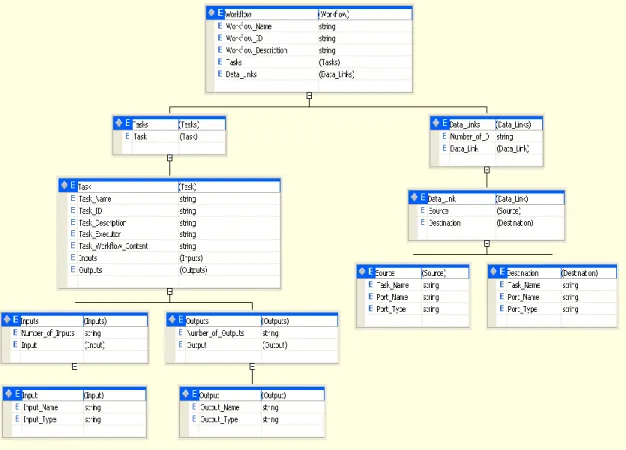
3.4); one for a Swift workflow and the other one for a Taverna workflow. The language will also show the data links between tasks where an output of a task can be an input for another one. Figure 3.5 displays a schema representation for the GSL file. It shows that a workflow can contains one or more tasks. Each task contains inputs and outputs. The workflow also can have data links to represent data dependency or control dependency.
< Workflow>
<Workflow_Name>IGC-DownloadFiles</Workflow_Name> <Workflow_ID>10</Workflow_ID>
<Workflow_Description>test</Workflow_Description> <Tasks>
<Task>
<Task_Name>CreateGenomeFiles</Task_Name> <Task_ID>20</Task_ID>
<Task_Description>Create Genome Files</Task_Description> <Task_Executor>Swift</Task_Executor>
<Task_Workflow_Content>
type file{}; type messagefile {}; …...
</Task_Workflow_Content>
<Inputs><Number_of_Inputs>1</Number_of_Inputs> <Input> <Input_Name>GenomeList</Input_Name> <Input_Type>File</Input_Type>
</Input> </Inputs>
<Outputs> <Number_of_Outputs>1</Number_of_Outputs> <Output>
<Output_Name>Input</Output_Name> <Output_Type>Files</Output_Type> </Output>
</Outputs>
</Task>
<Task><Task_Name>GetGenomeInfo</Task_Name> <Task_ID>11</Task_ID>
<Task_Description>……</Task_Description> <Task_Executor>Taverna</Task_Executor> <Task_Workflow_Content>
<s:scufl xmlns:s="http://org.embl.ebi.escience/xscufl/0.1alpha" version="0.2" log="0"> ……..
</Task_Workflow_Content>
<Inputs> <Number_of_Inputs>1</Number_of_Inputs> <Input> <Input_Name>Bacteria</Input_Name> <Input_Type>String</Input_Type>
</Input> </Inputs>
<Outputs> <Number_of_Outputs>4</Number_of_Outputs> <Output> <Output_Name>NCBIRef</Output_Name> <Output_Type>String</Output_Type>
</Output> …… </Outputs> </Task> </Tasks> <Data_Links><Number_of_DataLinks>20</Number_of_DataLinks> <Data_Link>
<Source><Task_Name>CreateGenomeFiles</Task_Name> <Port_Name>Input</Port_Name>
<Port_Type>Files</Port_Type> </Source>
<Destination><Task_Name>GetGenomeInfo</Task_Name> <Port_Name>Bacteria</Port_Name>
<Port_Type>String</Port_Type> </Destination>
</Data_Link>
...
</Data_Links> </Workflow>
Figure 3.5: A schema representation for a GSL file.
3.4 GENOMEFLOW Scheduling Algorithm (GSA)
In this section, we propose a scheduling algorithm to execute scientific workflows in order to optimize the process and execution time of the GENOMEFLOW workflow.
Scheduling of workflows is a problem of finding a correct execution sequence for the workflow tasks [78]. One of the features that distinguishes various scientific workflow systems is the scheduling algorithm that it uses. The goal is to optimize the execution of the scientific workflow task while utilizing the available resources. Most of the existing scheduling algorithms depend on knowing in advance how workflow tasks work and setting criteria or prioritizing weights that will help make scheduling decisions. Some
systems use either task scheduling, which only looks at the tasks within the workflow, and others look at the workflow as a whole. One of the main features for GENOMEFLOW is that it supports the design of scientific workflows from heterogeneous scientific workflow systems. Since each GENOMEFLOW task is representing a scientific workflow system, it automatically uses the scheduling algorithms integrated with the task executor. In addition to this, we propose our GENOMEFLOW Scheduling Algorithm (GSA) that will look at the whole workflow. We schedule the execution of each task based on control and data dependency and based on the available resources.
Algorithm GSA, given in Figure 3.6 corresponds to the scheduling algorithm implemented in GENOMEFLOW. The end user will design a scientific workflow using the GENOMEFLOW workbench. Once it is saved, the system will follow the algorithm to prepare the execution job script files. The input for the algorithm will be an XML file representing the GENOMEFLOW workflow designed in the previous step.
The XML will contain information about the tasks involved in the workflow, inputs/outputs for each task, and the task executor. A task executor is the program that will understand and execute the workflow language representation integrated in each task. The output will be the results from executing each task. In line 8, the system will parse the XML file and capture a list of all tasks with inputs (name, type) associated with each task. In line 9, based on the dependency of each task, a list of subworkflows will be created by applying algorithm FindSubWorkflows (Figure 3.8). In line 10, a dependency list will be created based on parsing the workflow file and the data link section of the
workflow file. In line 11, corresponding job scripts to execute each subworkflow will be prepared (waiting list). In line 14, the algorithm starts going through each job script in the waiting list.
If a subworkflow does not depend on any previous tasks then the job script file that contains this subworkflow will be executed after allocating resources necessary to execute it. All the jobs that were executed will be added to the running jobs list (line 18) and deleted from the waiting list (line 19). Once going through all the jobs for the first round, the algorithm parses through all the jobs that are running. For any job that was done, its output files are collected (line 25), it is deleted from the running jobs (line 26), and the completed task is added to the completed jobs list (line 27). Then the algorithm goes through all the jobs in the waiting list (lines 30-37) as follows: For every job J in the waiting list, if the subworkflow that it contains depends on another subworkflow that was executed and completed already, job J is executed after allocating the necessary resources. J is also added to the running list and deleted from the waiting list. The last steps (lines 23-37) are repeated until all the jobs in the waiting list have been executed and the waiting list doesn‟t contain any jobs to run.
Algorithm FindSubWorkflows, given in Figure 3.7 corresponds to the algorithm implemented to find all the subworkflows within a GENOMEFLOW workflow and it represents line 9 of algorithm GSA (Figure 3.6).
Figure 3.8: Example to illustrate the scheduling and portioning algorithms.
Figure 3.8 illustrates both algorithms: GSA and FindSubWorkflows. For a workflow that consists of 6 tasks, the arrows represent the flow of tasks and dependency. Based on both algorithms, the following tasks and lists are generated:
Line 8 of GSA: WF = ({Task1, Task2, ..,Task6}, …..) Equation 3.1
Line 9 of GSA which is the outcome of running FindSubWorkflows:
WFList = [W1(Task1), W2(Task2, Task4), W3(Task3, Task5),W4(Task6)] Equation 3.2
Line 10 of GSA:
DependencyList = [D1(Null), D2(W1), D3(W1), D4(W2,W3)] Equation 3.3
Line 11 of GSA: WaitingJobs = [J1, J2, J3, J4] Equation 3.4
Hence, equation 3.1 represents all the tasks, input ports, output ports, and data links in the GENOMEFLOW workflow GSL file. Equation 3.2 represents the subworkflows after partitioning the main workflow based on the dependency found between the tasks. The output of the partitioning step shows that subworkflow W1 contains one task,
subworkflows W2 and W3 contains two tasks each, and subworkflow W4 contains one
previous step. Subworkflow W1 depends on nothing; however, W2 and W3 each depend
on the output from W1. W4 depends on output from subworkflows W2 and W3. Equation
3.4 corresponds to each subworkflow listed in equation 3.2.
After partitioning the GENOEMFLOW workflow into subworkflows and preparing the Grid job script files, a list of available free nodes on the Grid will be gathered where its CPU usage is 0%. The job script will be submitted to the Grid to start the execution. For the above example (Figure 3.8), subworkflow W1 will be executed first. Then
subworkflows W2 and W3 will be executed in parallel after W1 is finished. Lastly, W4 will
be executed.
Figure 3.9: Example 2 to illustrate the scheduling and portioning algorithm. Another example is showing in Figure 3.9:
WF = ({Task1, Task2, ..,Task6}, …..)
WFList = [W1(Task1), W2(Task2, Task4), W3(Task3, Task5),W4(Task6),
W5(Task7), W6(Task8),W7(Task9 , Task10), W8(Task11) ]
DependencyList = [D1(Null), D2(W1), D3(W1), D4(W2,W3), D5(W1), D6(W5),
D7(W5), D8(W4,W7)]