Sequence-based molecular phylogenetics and phylogeography of the American
box turtles (
Terrapene
spp
.
) with support from DNA barcoding
Bradley T. Martin
a,⇑, Neil P. Bernstein
b, Roger D. Birkhead
c, Jim F. Koukl
a, Steven M. Mussmann
d,
John S. Placyk Jr.
aa
Department of Biology, The University of Texas at Tyler, Tyler, TX 75799, USA
bDeptartment of Natural and Applied Sciences, Mount Mercy University, Cedar Rapids, IA 52402, USA c
Alabama Science in Motion, Auburn University, Auburn, AL 36849, USA d
Department of Biological Sciences, University of Arkansas, Fayetteville, AR 72701, USA
a r t i c l e
i n f o
Article history:
Received 31 December 2012 Accepted 8 March 2013 Available online 20 March 2013 Keywords: Box turtle DNA barcoding Molecular phylogenetics Phylogeography Terrapene Emydidae
a b s t r a c t
The classification of the American box turtles (Terrapenespp.) has remained enigmatic to systematis ts. Previous comp rehensive phylogenetic studies focused primarily on morphology. The goal of this study was to re-assess the classification ofTerrapenespp. by obtaining DNA sequence data from a broad geo- graphic range and from all four recogni zed species and 11 subspecies within the genus. Tissue samples were obtained for all taxa except for Terrapene nelsoni klauberi . DNA was extracted, and the mitochondrial DNA (mtDNA)cytochrome b(Cytb) and nuclear DNA (nucDNA)glyceraldehyde-3-phosph ate-dehydrogenase (GAPD) genes were amplified via polymera se chain reaction and sequenced. In addition, the mtDNA gene commonly used for DNA barcoding (cytochrome oxidase c subunit I;COI) was amplified and sequenced to calculate pairwise percent DNA sequence divergen ce compariso ns for each Terrapenetaxon. The sequence data were analyzed using maximum likelihood and Bayesian phylogenetic inference, a molecular clock, AMOVAs, SAMOVAs, haplotype networks, and pairwise percent sequence divergence comparisons. Terra-pene carolina mexicana andT. c. yucatana formed a monophyletic clade with T. c. triunguis , and this clade was paraphyletic to the rest ofT. carolina .Terrapene ornata ornata andT. o. luteola lacked distinction phy- logenetically, and Terrapene nelsoni was confirmed to be the sister taxon ofT. ornata .Terrapene c. major ,T. c. bauri , and Terrapene coahuila were not well resolved for some of the analyses. The DNA barcoding results indicated that all taxa were different species (>2% sequence divergence) except for T. c. triunguis –T. c. mexicana andT. o. ornata –T. o. luteola . The results suggest that T. c. triunguis should be elevated to species status (Terrapene mexicana ), and mexicanaandyucatanashould be included in this group as sub- species. In addition,T. o. ornat aandT. o. luteo lashould not be considered separat e subspecies. The DNA barcoding data support these recommended taxonomic revisions. Because conservation efforts are typi- cally species-based, these results will be important for facilitating suc cessful conservation management strategies.
Ó2013 Elsevier Inc. All rights reserved.
1. Introduction
The American box turtle genus,Terrapene(Chelonia, Emydidae), includes four primarily terrestrial New World species, the eastern (T. carolina ;Linnaeus, 1758 ), ornate (T. ornata ;Agassiz, 1857 ), spot- ted (T. nelsoni ; Stejneger, 1925 ), and Coahuilan (T. coahuila ; Schmidt and Owens, 1944 ) box turtles, characteri zed, in part, by their ability to tightly close their plastron via a single moveable hinge (plastral shell kinesis). With the exception ofT. coahuila , each species is further divided into multiple subspecies including the
eastern (T. c. carolina ), three-toed (T. c. triunguis ), Mexican (T. c. mexicana), Yucatan (T. c. yucatana ), Gulf Coast (T. c. major ), Florida (T. c. bauri ), and the purported ly extinct giant (T. c. putnami ) box turtles for T. carolina ; the ornate (T. o. ornata ) and desert (T. o. lut- eola) box turtles for T. ornata ; and the northern spotted (T. n. klau- beri) and southern spotted (T. n. nelsoni ) box turtles for T. nelsoni . While their current classification is generally accepted based on morphological data and geographi c distribution s, the use of molec- ular data in understand ing the evolutionary history of the group has been limited, as the systematic studies that have included Ter-rapenehave (1) focused on higher level intergeneric classification, (2) failed to include all taxa within Terrapene(e.g., all species and subspecies ), or (3) been limited in sample sizes and/or geographic sampling (Bickham et al., 1996; Butler et al., 2011; Feldman and
1055-7903/$ - see front matter Ó2013 Elsevier Inc. All rights reserved.
http://dx.doi.org/10.1016/j.ympev.2013.03.006
⇑ Corresponding author. Present address: Department of Biological Sciences, The University of Arkansas, Fayetteville, AR 72701, USA. Fax: +1 903 723 1095.
E-mail addresses: [email protected], [email protected] (B.T. Martin).
Contents lists available atSciVerse ScienceDi rect
Molec ular Phylo genetics and Evolution
Parham, 2002; Herrmann and Rosen, 2009; Spinks and Shaffer, 2009; Stephens and Wiens, 2003; Wiens et al., 2010 ). When Terra-pene has been the focus of more detailed molecular taxonomic scrutiny, issues inherent in the genus have been problematic. Fur- thermore, although the importance of using morphological data in phylogeneti c analyses has recently been emphasized (Losos et al., 2012), issues specific toTerrapenehave also complicated the use of morphology for assessing their classification.
First, paraphyly within Terrapene carolina has made phyloge- netic inference of this species particularly problematic with Ste-phens and Wiens (2003) stating that T. carolina ‘‘might also consist of multiple species.’’ Second, a significant amount of inter- and intraspecific morphological variation along with the overlap of characters has made phylogeneti c inference based on morphology, which is what the current classification is based on (e.g.,Minx, 1996), less than useful. Third, intergradation between sympatric taxa imposes significant difficulties in resolving specific and sub- specific relationship s (Butler et al., 2011; Carr, 1940, 1952; Conant and Collins, 1991; Milstead, 1969 ). Therefore, a more thorough molecular phylogenetic investiga tion is warranted to resolve these issues and to assess the validity of the current classification. The lack of such information is compounded by the problematic con- servation status of members of this genus.
Terrapenepopulations are declining throughout their range, in part, due to habitat loss resulting from increasing urbanization, collection from the wild for the pet trade, and changes in predator pressures (Dodd, 2001 ). The 2011 Internationa l Union for Conser- vation of Nature (IUCN) Red List classifiesT. carolina as Vulnerabl e, T. ornata as Near Threatened,T. coahuila as Endangered with a Very High Risk of Extinction, and T. nelsoni as Data Deficient (although it
was listed as Threatened on the 2006 Red List). In the United States, the various subspecies of the endemic T. carolina and T. ornataare state listed as Species of Special Concern in New Hamp- shire, Connecticut, Michigan, Texas, and Massachusetts , Protected in Indiana and Kansas, Threatened in Iowa, and Endangered in Maine, Wisconsin, and Illinois. Thus, understanding Terrapene evo-lutionary history is particularly urgent, as conservation efforts are often species-based. Our research will be important to both those intereste d in the evolutionary history of the Terrapene, as well as those that might be attempting to conserve them.
The goals of this research are to (1) resolve the evolutionary his- tory of the Terrapenegenus by assessing their classification using molecula r phylogeneti c and genetic barcoding data and (2) assess the population structure within Terrapeneto evaluate the phyloge- ography of the genus.
2. Methods
Tissue samples in the form of toenails, shell shavings and frag- ments, bone fragments, scutes, muscle tissue, feces, and blood were collected/obtaine d for all four extant species and all but one of the ten currently recognized subspecies (i.e.,T. n. klauberi ; Appendix A). Geographic distribution s based onDodd (2001)and morphologi cal identification were used to identify collected speci- mens. At least three individuals of each subspecies were chosen from every US state within their range to obtain a sufficient sample size and to include wide geographic sampling (Fig. 1). In addition, at least three tissue samples were used in the data analyses for the Mexican species and subspecies (except for T. c. yucatana andT. n.
Fig. 1.Sampling localties for the mitochondrial DNA (mtDNA)cytochrome bgene and the nuclear DNA (nucDNA)glyceraldehyde-3-phosphate dehydrogenase (GAPD) gene. The hatched region in the central USA indicates a sympatric zone with more than one subspecies present as proposed byDodd (2001), and the hatching in the Gulf Coast region indicates a potential intergradation zone as indicated byCarr (1952).
nelsonidue to the very limited amount of tissue samples available for these taxa).
2.1. DNA extractions, PCR, and sequencing
Genomic DNA was extracted from tissue samples with the illus- tra™ tissue & cells genomicPr ep Mini Spin Kit (GE Healthcare). One mitochondr ial DNA (mtDNA) gene (cytochrome b; Cytb ) and one nuclear DNA (nucDNA) gene (glyceraldehyde-3 -phosphate dehydro- genase; GAPD) were then amplified and sequenced. For Cytb, the entire 1097 base pair (bp) gene along with part of the adjacent tRNA-threon ine (tRNA-thr) gene was amplified and sequenced using the forward primer CytbG and the reverse primer THR-8 (Engstrom et al., 2007; Spinks et al., 2004 ). A 430-bp region of the GAPDgene, including intron 11 and partial coding region, was amplified and sequenced using the forward primer GAPDL890 and the reverse primer GAPDH950 (Dolman and Phillips, 2004; Friesen et al., 1997). Twenty-
l
L PCR reactions were used for both genes and con- sisted of 7.1l
L H2O, 2.0l
L TopTaq PCR buffer (Qiagen), 0.4l
LdNTPs, 2.0
l
L Coral Load (Qiagen), 4.0l
L Q-solution, 1.0l
L each 2-l
mol primer, and 2.4l
L DNA. A negative control was included with each PCR. The following parameters were used for the Cytb DNA amplification: 35 cycles of 1 min denaturing at 94°C, 1 min annealing at 51°C, and 2 min DNA elongation at 72°C.GAPDPCR parameters were as follows: initial denaturation for 5 min at 94°C followed by 35 cycles of 30 s denaturing at 94°C, 1 min annealing at 63°C, and 1 min 30 s extension at 72°C. A final exten- sion for GAPDwas performed for 5 min at 72°C. Amplification of the PCR product was verified via gel electrophor esis and the ampli- fied DNA was purified with the E.Z.N.A. Cycle Pure Kit (OMEGA bio- tek). Purified DNA was concentrated to the level recommend ed by Eurofins MWG Operon (20–40 ng/l
L) and shipped to Eurofins MWG Operon for sequencing reactions using BigDye ÒTerminatorv 3.1 Cycle Sequencing kits (Applied Biosystem s). 2.2. Sequence analysis and phylogeneti c inference
DNA was sequenced on an ABI 3730xl DNA sequencer at Euro- fins MWG Operon and manually proofread and edited using Sequencher 4.9 (Gene Codes Corporation ). Sequence alignments were conducted in Clustal X 2.0.11 (Thompson et al., 1997 ). Final editing was done using MacClade 4.08 (Maddison and Maddison, 1989). When available, existing GenBank sequences were included in the analyses (Table 1). The nucDNA GAPDsequence alignmen t contained IUPAC ambiguity characters designating heterozygous sites, and because some phylogeneti c inference software does not recognize ambiguity characters we used the program Haplotype Inference by Parsimony (HAPAR) to infer haplotypes from geno- typic data (Wang and Xu, 2003 ). HAPAR uses maximum parsimony
to resolve heterozygou s characters into each possible genotype and collapses identical genotypes to find the minimum number of hap- loid haplotypes. HAPAR analysis for the GAPDgene was used for all analyses except for the analyses of molecular variance (AMOVAs) and the spatial analyses of molecula r variance (SAMOVAs), which are able to read IUPAC ambiguity characters (Excoffier et al., 2005 ).
Tajima’s D and Fu and Li’s Dand F tests for neutrality were conducte d for each gene using DnaSP v 5.10.01 (Librado and Rozas, 2009) to confirm that natural selection did not significantly influ-ence the phylogenetic data and that the inferred phylogeny largely reflects the background rate of mutation (Fu and Li, 1993; Tajima, 1989). Phylogenies were inferred via maximum likelihoo d (ML; Felsenstei n, 1981 ), and Bayesian inference (BI;Larget and Simon, 1999; Rannala and Yang, 1996; Smouse and Li, 1989; Yang and Rannala, 1997 ) methods. PhyML 3.0 was used to generate ML trees (Guindon et al., 2010 ), and BEAST v1.6.2 was used to infer BI trees (Drummond and Rambaut, 2007 ). Non-parametr ic bootstrap re- sampling (Felsenstein, 1985 ) was employed to quantify the statis- tical support for ML phylogenies and the Markov chain Monte Car- lo (MCMC) method was used to infer confidence values for BI (Mau, 1996; Mau and Newton, 1997; Mau et al., 1999; Rannala and Yang, 1996; Yang and Rannala, 1997 ). One thousand non-parametric bootstrap replications were used to generate ML trees (Pattengale et al., 2010 ). Bootstrap support values above 70% were considered well-sup ported (Hillis and Bull, 1993 ). The CytbBI analysis was run for 3.0 106 MCMC generations using default temperatures and
with sampling trees occurring every 100 generations, while the GAPDBI analysis was run for 3.0 107MCMC generations and with
sampling trees occurring every 1,000 generations. The aforemen- tioned 3.0 106and 3.0 107MCMC generations were chosen to
make effective sample sizes (ESS) >200 for each individual param- eter in the analysis, as determined by Tracer v1.5, a program rec- ommend ed byDrummond and Rambaut (2007)to analyze BEAST v1.6.2 output files. The likelihood scores were monitore d during each analysis until stabilization, and the samples obtained prior to stabilization (7500 for both CytbandGAPD) were discarded as burn-in (Parham et al., 2006 ). Nodes having a Bayesian posterior probabili ty (BPP) P0.95 were considered well-supported ( Huel-senbeck and Ronquist, 2001 ). For all analyses, jModelTe st 0.1 was used to determine substitution model parameters using the Akaike Informati on Criterion corrected for small sample size (AICc; Posa-da, 2008 ). ML and BI analyses were conducted for Cytbusing the TPM2uf +I+G substitution model, with I= 0.4450, G= 0.6160, and the sample size = 1097. The rate matrix parameters were as follows: AC = 3.2798, AG = 21.7809, AT = 3.2798, CG = 1.0000, CT = 21.7809, and GT = 1.0000. The base frequenc ies were set to 0.3059 (A), 0.3131 (C), 0.1213 (G), and 0.2598 (T).GAPDML and BI analyses were conducted using the TPM2uf +I substitut ion model, with I= 0.8480 and the sample size = 430. The GAPDrate Table 1
GenBank Access ion numbers used in this study for the cytochrome b(Cytb),glyceraldehyde-3-phosphate dehydrogen ase (GAPD), and cytochrome oxidase c subunit 1(COI) genes.
Taxon GenBank ID Source(s)
Cytb GAPD COI
Terrapene carolina carolina AF258871 GQ896138 HQ329658 Feldman and Parham (2002), Wiens et al. (2010) and Reid et al. (2011)
Terrapene carolina triunguis FJ770616 GQ896139 Spinks and Shaffer (2009) and Wiens et al., 2010
Terrapene coahuila – AF258872 GQ896140 HQ329659 Feldman and Parham (2002), Wiens et al. (2010) and Reid et al. (2011)
Terrapene ornata ornata GQ896203 GQ896142 HQ329660 Wiens et al., 2010; Reid et al., 2011
Terrapene ornata luteola AF258874 N/A Feldman and Parham (2002)
Terrapene nelsoni nelsoni AF258873 GQ896141 Feldman and Parham, 2002; Wiens et al., 2010
Clemmys guttata FJ770591 GQ896113 Spinks and Shaffer (2009) and Wiens et al., 2010
Glyptemys insculpta AF258876 Feldman and Parham, 2002
Glyptemys muhlenbergii AF258875 Feldman and Parham (2002)
Emys orbicularis AF258868 Feldman and Parham, 2002
Emys marmorata AF258867 Feldman and Parham (2002)
matrix parameters were as follows: AC = 4.1405, AG = 8.7269, AT = 4.1405, CG = 1.0000, CT = 8.7269, and GT = 1.0000. The base frequencies were set to 0.2089 (A), 0.2012 (C), 0.3000 (G), and 0.2900 (T). Each phylogeny was rooted with a published GenBank sequence from Clemmys(Table 1), which is considered the sister genus toTerrapene(Bickham et al., 1996; Bramble, 1974; Feldman and Parham, 2002; Stephens and Wiens, 2003 ). The Clemmys Gen-Bank reference sequence for GAPD contained IUPAC ambiguity characters and was separated into two haplotypes after HAPAR analysis. Zero-length branches for all genes were collapsed into un- ique haplotypes using Collapse 1.2 to reduce clutter and computa- tion time.
2.2.1. Combined mtDNA and nucDNA phylogenetic analysis
TheCytbandGAPDDNA sequence data were concatenated into a single dataset to infer a combined mtDNA and nucDNA phylo- gram. The combined dataset contained 172 sequences condensed into 121 haplotypes. Prior to phylogeneti c analysis, an Incongru- ence Length Differenc e (ILD;Farris et al., 1994; Mickevich and Far- ris, 1981 ) test with 100 replicates was performed using PAUP v4.0b10 (Swofford, 2003 ) to assess whether the topologies of the two trees were congruent. Each gene was partitioned separately for the combined analysis, and the model paramete rs for each par- tition were kept the same as for the individual analyses.
2.3. Haplotype networks
Haplotype networks are useful for visualizing sequence varia- tion within species or among closely related congenerics because (1) there could potentially be a high number of mutational variants and (2) reversion to ancestral haplotypes is possible in recently di- verged taxa (Crandall, 1994; Posada and Crandall, 2001 ). Because these conditions could apply to some taxa within Terrapene, haplo- type networks may provide some insight into intraspeci fic and interspecific population structuring for this genus.
Using the 95% statistical parsimony procedure (Templeton, 1998), TCS 1.13 (Templeton et al., 1992 ) was used to estimate a gene genealogy. For clarity, reticulation loops were removed a pos- terioribased on coalescent theory (Crandall, 1994 ). Haplotype bub- bles were sized relative to the number of sequences within each haplotype. The haplotype bubbles connected by branches differed by one mutational step, and smaller bubbles were placed on the branches to represent missing intermedi ate steps.
2.4. AMOVA and SAMOVA analyses
Spatial Analysis of Molecular Variance (SAMOVA) was per- formed using SAMOVA 1.0 (Dupanloup et al., 2002 ) and Analysis of Molecular Variance (AMOVA;Excoffier et al., 1992 ) was con- ducted using ARLEQUIN v. 3.11 (Excoffier et al., 2005 ) to examine population structure s.Ustatistics, which are analogous to F-statis- tics (Wright, 1951 ), were calculated from these analyses to assess how much variation is explained by groupings of populations or classification-based groupings.UCTvalues indicate the percent of
variation explained among groups,USCvalues indicate the percent
of variation explained among populations within groups, and UST
values indicate the percent of variation explained within popula- tions. AMOVA was used to assess the population structure of molecular variation, and SAMOVA was used to assess whether geo- graphically sympatric groups are maximal ly genetically isolated. In other words, AMOVA and SAMOVA use the amount of variance ex- plained among groups to assess whether there is a well-defined population structure. SAMOVA does not make assumptions about whether the populations are at Hardy–Weinberg equilibriu m and a priori groups are not assigned to the populations , whereas AMO- VA assigns populations into a priori groups. SAMOVAs can be less
biased than AMOVAs because SAMOVA s assign groups based on geographi c data with a user-defined number of groups, whereas the user must assign a priori AMOVA groups. Each SAMOVA and AMOVA was conducted with 1,000 simulated annealing permuta -tions. For both Cytb andGAPD,a priori AMOVA groups were as- signed in several different fashions to compare phylogenetic hypothes es using population structuring. Furthermore, different AMOVA tests were run both a priori anda posteriori to seeing the phylogen etic trees.
2.4.1. A priori AMOVAs
Thea priori AMOVA analyses were conducted in three different fashions. First, groups were apportioned into one eastern (T. caro- lina and T. coahuila ) and one western (T. ornata and T. nelsoni ) group. Second, groups were assigned based on the morphological data ofMinx (1996), which included four groups based on spe- cies-level classification (T. carolina ,T. ornata ,T. coahuila , and T. nel- soni). Third, each subspecies (or species for monotypic groups) was apportioned separately into ten unique groups as follows:T. coahu- ila,T. n. nelsoni ,T. c. carolina ,T. c. triunguis ,T. c. major ,T. c. bauri ,T. c. yucatana,T. c. mexicana ,T. o. ornata , and T. o. luteola .
2.4.2. A posteriori AMOVAs
Several AMOVAs were performed based on the results of the phylogen etic analyses. First, each subspecies was grouped sepa- rately except for T. o. ornata andT. o. luteola (totaling nine groups). Terrapene o. ornata and T. o. luteola were combined to assess whether population structuring was greater or lower after they were clumped together. Second, the re-assessment provided by the mtDNA and nucDNA phylogenies (Figs. 2 and 3) was compare d with the hypothesis ofMinx (1996)to evaluate which hypothesis indicated a higher level of population structure . The a posteriori AMOVA based on the mtDNA and nucDNA phylogenies consisted of five total groups and were as follows: (1)T. c. carolina –T. c. ma- jor–T. c. bauri , (2)T. coahuila , (3)T. c. triunguis –T. c. mexicana –T. c. yucatana , (4)T. o. ornata –T. o. luteola , and (5)T. nelsoni . Third,T. coahuilawas apportioned into a group along with T. c. carolina and T. c. major to evaluate whether a greater population structure would be observed by grouping T. coahuila with the T. c. carolina group. Fourth,T. c. bauri was combined with T. c. carolina –T. c. ma- jorto evaluate whether a greater amount of population structure would be observed by grouping T. c. bauri with the T. c. carolina group.
2.5. Cytb molecular clock analysis
A relaxed, uncorrela ted lognormal molecular clock was placed on the Cytbsequence data using the BEAST v1.6.2 software package to estimate divergence times (Drummond and Rambaut, 2007 ). A molecula r clock was not inferred for GAPDdue to a generally lower resolution of the ML and Bayesian phylograms.Clemmys guttata , Glyptemy s muhlenbergii ,G. insculpta ,Emys orbicularis , and E. mar- moratawere used to root the tree, as previous data indicated that these genera are most closely related toTerrapenewithin Emydi- nae (Bickham et al., 1996; Bramble, 1974; Feldman and Parham, 2002; Stephens and Wiens, 2003 ). The molecula r clock analysis was conducted using the Yule Process speciation tree prior and a GTR +I+Gsubstitution model with the parameters and tree priors equal to those for the previously mentioned CytbML and BI phylo- genetic analyses, as determined by jModelTest 0.1 (Posada, 2008 ). Fossil data and previously published divergence estimates were used to calibrate the molecular clock. The root was calibrated to 29.4 million years ago (mya), with the standard deviation (SD) = 2.01, as the most recent common ancestor (MRCA) to Emy- dinae, and the MRCA toGlyptemyswas calibrated to 17.0 mya, with the SD = 2.90 (Spinks and Shaffer, 2009 ). Based on fossil data, the
MRCA toT. ornata was calibrated at 12.5 mya with the SD = 1.00, and the MRCA toT. carolina was calibrated to 10.0 mya with the SD = 1.00 (Holman and Fritz, 2005; Spinks and Shaffer, 2009 ). The molecular clock analysis was conducted using a Markov chain of 75.0106generations, with sampling occurring every 1000 gener-
ations. As with the previously mentioned BI trees, 75.0 106
gen-erations were chosen to bring the ESS > 200 for all parameters and tree priors in the analysis when analyzed using Tracer v1.5 ( Drum-mond and Rambaut, 2007 ). The number of generations excluded
from the analysis as burn-in was chosen based on visual inspection for stabilization of the log likelihood values.
2.6. Pairwise percent sequence divergences 2.6.1. Cytb and GAPD
Pairwise Jukes-Cantor DNA sequence divergences corrected for population comparisons (Jukes and Cantor, 1969 ) were calculated with DnaSP v5.10.01 (Librado and Rozas, 2009 ) and used to Fig. 2.Thecytochrome bphylogram, generated using PhyML 3.0 and BEAST v1.6.2, consisting of 253 sequences distributed into 103 haplotypes. As determined by the Akaike Information Criterion corrected for small sample size (AICc), TPM2uf +I+G was used as the nucleotide substitution model, with I= 0.4450,G= 0.6160, and sample size = 1097. The rate matrix parameters were as follows: AC = 3.2798, AG = 21.7809, AT = 3.2798, CG = 1.0000, CT = 21.7809, GT = 1.0000. The base frequencies were 0.3059 (A), 0.3131 (C), 0.1213 (G), 0.2598 (T). Bayesian posterior probabilities (above branches) and non-parametric bootstrap resampling values (below branches) were considered supported atP0.95 and P70%, respectively.
calculate the percent sequence divergence between taxonomic groups. Interspecific mtDNA sequences for most Emydine turtles typically vary between 4% and 6%, with a mean of 5% for the mtDNACytbgene, and interspecific nuclear DNA sequences typi- cally vary between 0.2–4%, with a mean of1% in most freshwa- ter turtles and tortoises, depending on the gene (Feldman and Parham, 2002; FitzSimmons and Hart, 2007 ). Therefore these aver- age values were used as references to compare the species and subspecies within Terrapene.
2.6.2. DNA barcoding
A 650 base pair region of the mtDNA cytochrome oxidase c sub- unit 1(COI) gene was amplified and sequenced for DNA barcodin g purposes. The 20
l
LCOIPCR reactions consisted of the same volu- metric ratios as with the CytbandGAPDgenes (see Section 2.1.). Two primer sets were used to amplify and sequence the selected COI region. The first consisted of the forward primer L-turtCOI and the reverse primer H-turtCOIb (Stuart and Parham, 2004 ), and the second consisted of the forward primer VF2_t1 (Ward et al., 2005 ) and the reverse primer FR1d_t1 (Ivanova et al., 2007). The following PCR paramete rs were used with the L-turtCO I and H-turtCOIb primers: an initial denaturation of 95°C for 5 min; 35 cycles of 95°C for 45 s, 55°C for 45 s, 72°C for 45 s; and a final extension of 72°C for 6 min. PCR parameters for the VF2_t1 and FR1d_t1 primers were as follows: an initial denaturation of 94°C for 2 min; 35 cycles of 94°C for 30 s, 52°C for 40 s, and 72°C for 1 min; and a final extension of 72°C for 10 min.Pairwise Kimura 2-paramete r (K2P) divergence comparis ons were performed in Mega 5.05 (Tamura et al., 2011 ). K2P compari- sons were utilized over Jukes and Cantor divergence comparisons to be consistent in comparisons with the Barcode of Life Data Sys-
tems (BOLD) database (www.boldsystems.org).Reid et al. (2011) indicated that interspecific COI sequences for many organisms (including turtles) are divergent by >2% and intraspecific percent sequence divergences are often <2%. This 2% sequence divergence was used as a reference value for Terrapenepairwise DNA sequence comparis ons to evaluate their taxonomic status. As ana posteriori analysis based on the Cytbresults, which showed two groups com- posed primarily ofT. c. major ,T. c. major was divided into two sep- arate groups, with one consisting solely ofT. c. major and one consisting of T. c. major and T. coahuila . This analysis was per- formed to assess whether T. c. major consisted of more than one phylogen etic lineage.
3. Results
3.1. Phylogen etic analyses 3.1.1. Cytochrome b
The mtDNA Cytbphylogram contains 253 sequence s distribut ed into 103 haplotypes (Fig. 2). Out of the 1097 characters, 254 are variable, and 191 are parsimon iously informative . Tajima’s D, Fu and Li’s Dand Ftests indicate that Cytbis not significantly being influenced by natural selection and that it largely reflects the back- ground rate of mutation (Tajima’s D: 0.07205,P> 0.10; Fu and Li’s D: 1.14188,P> 0.10; Fu and Li’s F: 0.80538,P> 0.10).
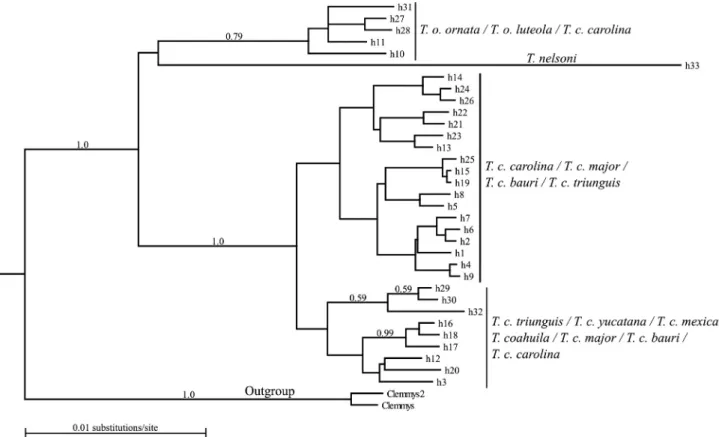
The phylogenetic analysis split Terrapeneinto eastern and wes- tern clades. The eastern clade contains T. carolina andT. coahuila , and the western clade contains T. ornata and T. nelsoni , which agrees with Minx (1996). However, several relationshi ps within each clade differ from his phylogenetic hypotheses. Specifically, the relationship s within the eastern ‘‘trichotomy ’’ (i.e., the T. c. Fig. 3.Theglyceraldehyde-3-phosphate dehydrogenase (GAPD) phylogram, generated using PhyML 3.0 and BEAST v1.6.2, consisting of 201 sequences distributed into 33 haplotypes. HAPAR analysis was performed prior to phylogenetic inference to resolve genotypes with IUPAC ambiguity characters into haplotypes. As determined by the Akaike Information Criterion corrected for small sample size (AICc), TPMuf +Iwas used as the substitution model, with I= 0.8480, and sample size = 430. The GAPDrate matrix parameters were as follows: AC = 4.1405, AG = 8.7269, AT = 4.1405, CG = 1.0000, CT = 8.7269, and GT = 1.0000. The base frequencies were set to 0.2089 (A), 0.2012 (C), 0.3000 (G), and 0.2900 (T). Bayesian posterior probabilities are shown above the branches and are considered supported atP0.95.
carolina,T. c. bauri , and the T. c. triunguis –T. c. yucatana –T. c. mex- icana clades) and between T. o. ornata and T. o. luteola are not apparent in the molecular phylogenies.
3.1.1.1. T. c. carolina – T. c. triunguis and their associated taxa. The Cytbphylogeneti c data suggests that the T. c. triunguis –T. c. yuca- tana–T. mexicana clade is paraphyleti c toT. carolina . Rather, there appear to be two monophyletic clades within the larger eastern clade: (1) one including T. c. major ,T. c. bauri ,T. c. carolina , and T. coahuilaand (2) one including T. c. mexicana ,T. c. yucatana , and T. c. triunguis .
3.1.1.2. T. c. major – T. coahuila. Terrapene c. major is polyphyletic withinT. carolina , as it is found in three different clades: (1) a clade consisting strictly ofT. c. major , (2) a clade consisting of aT. coahu- ilahaplotype represented by five individua ls and several separate T. c. major haplotypes, and (3) within the T. c. carolina clade. In some cases, the T. c. major found within the T. c. carolina clade are unique haplotypes, whereas others share haplotypes with T. c. carolina .
3.1.1.3. Western clade.Within the western clade,Terrapene o. ornat- aandT. o. luteola form a monophy letic clade.Terrapene o. ornata andT. o. luteola lack the population structure that Herrmann and Rosen (2009) suggested (they found unique groupings of T. o. ornataandT. o. luteola ). In our dataset,T. o. ornata andT. o. luteola do not share any haplotypes but do not show any apparent pattern of grouping, suggesting that they are lacking distinction phyloge-
netically. Terrapene nelsoni and T. ornata are sister taxa within the western clade.
3.1.2. Glyceraldehyde -3-phosphat e dehydrogenase
The nucDNA GAPDphylogram contains 33 haplotypes and 201 sequence s after resolving the sequences containing IUPAC ambigu- ity characters into haploid haplotypes using HAPAR (Fig. 3). Thirty- one of the 430 characters are variable, and 13 characters are parsi- monious ly informative. For GAPD, Tajima’s D, Fu and Li’s Dand F tests for neutrality indicate that natural selection is not signifi-cantly influencing the rate of mutation (Tajima’s D: 1.30376, P> 0.10; Fu and Li’s D: 2.35865, P> 0.05; Fu and Li’s F:
2.37390,P> 0.05).
The split of the eastern (T. carolina ) and western (T. ornata ) clades is well supported with Bayesian posterior probabilities (BPP) but not with bootstrap resampling. In discordance with the mtDNA data set, one individual morphologi cally identified as aT. c. carolina is found in the western clade.
3.1.2.1. T. c. carolina – T. c. triunguis. Within the eastern clade, the GAPDtree topology agrees with the mtDNA data in terms of the paraphyl y between T. c. triunguis –T. c. mexicana –T. c. yucatana andT. carolina , with the exception of three haplotypes (haplotypes 3, 12, and 29; see Appendix A for more informat ion) containing someT. c. carolina individuals being found within the T. c. triunguis clade and one haplotype containing T. c. triunguis being found in the T. c. carolina clade (haplotype 2; Fig. 3). As with the mtDNA phylogen y, T. c. mexicana , and T. c. yucatana are monophylet ic Fig. 4.Cytochrome b(Cytb) haplotype network with nine subgroups calculated using the 95% statistical parsimony method. Haplotypes are smaller when containing fewer sequences and larger when containing more sequences. Each branch represents a single mutational step, and the small black dots represent missing intermediate steps.
within the T. c. triunguis clade, although T. c. major andT. coahuila are also present in this clade for the GAPDgene specifically. 3.1.2.2. Taxa associate d with T. c. carolina.TheGAPDtree indicates thatT. c. bauri is polyphyletic as it is present in both the T. c. caro- lina and T. c. triunguis clades, which is in discordance with the mtDNA tree. In concordance with the mtDNA tree,T. c. major is polyphyletic within T. carolina for the nucDNA GAPDtree, being distributed into three clades: (1) a clade consisting of one haplo- type that shares T. c. major andT. coahuila and several haplotypes ofT. c. major ; (2) a clade in which T. c. major haplotypes are shared withT. c. carolina ; and (3) three haplotypes that are grouped with bothT. c. triunguis andT. c. carolina .
3.1.2.3. Western clade. Within the western clade,Terrapene nelsoni is sister to T. ornata , but this relationshi p is not well supported with bootstrap or BPP values. As with the mtDNA tree,T. o. ornata andT. o. luteola appear to lack genetic distinction. They are not grouped in any apparent pattern for either gene, and for GAPD spe-cifically,T. o. luteola share some haplotypes with T. o. ornata . 3.1.3. Combined mtDNA and nucDNA phylogenetic analysis
Cunningham (1997)suggestsP-values for the ILD test that as- sess whether there is a significant improvement (P> 0.01) or reduction (P< 0.001) in phylogeneti c accuracy. The ILD test for our combined mtDNA and nucDNA phylogen y indicates that there is not a significant improvem ent or reduction in phylogeneti c accu- racy (P= 0.01). Thus, the combined mtDNA and nucDNA phylogeny is not included here.
3.2. Haplotype networks
TheCytbhaplotype network consists of 103 haplotypes and is divided into nine subgroup s that do not fall within 95% confidence
intervals using the statistical parsimony procedure (Fig. 4). Terra-pene o. ornata andT. o. luteola are the only taxa that that fall within a 95% confidence interval and are located within the same sub- group. As is the case with the Cytbphylogram,T. c. major is poly- phyletic, being distributed among three clades and sharing haplotypes with T. c. carolina in some cases.Terrapene coahuila is closely associated with T. c. major and is separated from T. c. major by nine missing intermediate steps, suggesting the need for addi- tional sampling for T. coahuila .
TheGAPDhaplotype network consists of 33 unique haplotypes after removing heterozygous characters and collapsing identical sequence s using HAPAR (Fig. 5). The network is split into two sub- groups, with one containing T. nelsoni and the other containing the rest ofTerrapene. Although several taxa within the GAPDnetwork are difficult to interpret because of polyphyly, five main clades are evident: (1)T. c. carolina , (2)T. c. triunguis , (3)T. c. major –T. coahuila, (4) T. ornata , and (5) T. nelsoni . However it should be noted that some of the aforementione d five groups are polyphy- letic for a few individuals. For example, individua ls from T. c. caro- lina are present in haplotypes containing T. o. ornata or T. c. triunguis, and vice versa. Also,T. c. major is present in haplotypes containingT. c. triunguis andT. c. carolina . Some of the aforemen- tioned haplotypes consist of several taxa (e.g., haplotypes 2, 12, and 29;Fig. 5;Appendix A). Finally,T. c. yucatana is present in a clade consisting ofT. coahuila andT. c. major , and T. c. bauri is poly- phyletic, with one haplotype being found in the T. c. triunguis clade and the other in the T. c. carolina clade.
3.3. Population structure
The AMOVAs and SAMOVAs contained 59 haplotypes for GAPD because they were not subjected to HAPAR analysis, while Cytb containe d the same 103 haplotypes. A total of seven AMOVA hypothes es and one SAMOVA analysis were conducted for each Fig. 5.Glyceraldehyde-3-phosphate dehydrogenase (GAPD) haplotype network with two subgroups calculated using the 95% statistical parsimony method. Haplotypes are smaller when containing fewer sequences and larger when containing more sequences. Each branch represents a single mutational step, and the small black dots represent missing intermediate steps.
respective mtDNA and nucDNA gene. For clarity, only the UCT val-ues and their associated percentages are reported, as this was the level of variation of interest to us (Tables 2–4).
3.4. Molecular clock analysis
TheCytbtime-calibra ted molecular clock analysis indicated an eastern/wester n divergence time estimate of15 mya (Table 5; Fig. 6). The estimated divergence times for carolina/coahuila, caro-lina/bauri, and carolina/majorsplits were 10.6 mya,10.3 mya, and7.2 mya, respectively , and the divergence estimates for triun-guis/yucatana and triunguis/me xicana were 9.2 and 7.0 mya, respectively . Divergence times for T. o. ornata andT. o. luteola could not be calculated because they are so geneticall y similar and be- cause the haplotypes containing these taxa are intermixed in no apparent pattern within the T. ornata clade.
3.5. Percent sequence divergences 3.5.1. Cytb and GAPD
Pairwise percent sequence divergences for the mtDNA Cytb gene ranged from 0.583% to 7.34%, while percent divergen ces for
the nucDNA GAPD gene ranged from 0.350% to 3.15% (Table 6). For both CytbandGAPD,T. c. carolina –T. c. triunguis ,T. c. carolina –T. o. ornata ,T. c. carolina –T. c. bauri ,T. o. ornata – T. n. nelsoni , and T. o. ornata – T. c. triunguis showed relatively high sequence diver- gences. The comparison between T. c. triunguis andT. c. yucatana was relatively high for Cytbbut not for GAPD. For GAPD, the percent divergen ce between T. c. carolina and T. coahuila was relatively high; this comparison was low for Cytb. The aforementione d pair- wise comparisons showed a percentage of sequence divergence greater than or equal to what Feldman and Parham (2002) indi-cated as typically representi ng interspecific relationships within Emydine turtles for the mtDNA Cytbgene and what FitzSimm ons and Hart (2007)indicated as interspecific for nucDNA in freshwa- ter turtles and tortoises. The remaining groups showed relatively lower nucleotid e divergences.
3.5.2. DNA barcoding
Twenty-fou r DNA sequence s were obtained for the COI gene (Appendix A).COIpairwise comparisons indicate that all taxa are Table 2
Analyses of molecular variance (AMOVAs) run a prio rianda posteriori to the cytochrome b(Cytb) mtDNA and glyceraldehyde- 3-phosphate dehydrogenase (GAPD) nucDNA phylogenetic analyses from this study (Figs. 2 and 3). The a priori AMOVAs are defined as follows: The ‘‘All subspecies’’ AMOVA consists of all ten species and subspecies grouped separately; the ‘‘Four species’’ AMOVA is apportioned based on the morphological phylogeny ofMinx (1996); and the ‘‘East/west clades’’ AMOVA divides Terrapeneinto an eastern clade and western clade. The a posteriori AMOVAs are defined as follows: The ‘‘T. o. ornata /T. o. luteola combined’’ AMOVA contains all taxa apportioned separately except for T. o. ornata andT. o. luteola ; the ‘‘mtDNA and nucDNA phylogenies’’ AMOVA is based on the CytbandGAPDmolecular phylogenies from this study (Figs. 2 and 3); the ‘‘T. coahuila /T. carolina combined’’ AMOVA follows the ‘‘mtDNA and nucDNA phylogenies’’ AMOVA with the exception of placing T. coahuila intoT. carolina ; and the ‘‘T. c. bauri into unique group’’ AMOVA follows the ‘‘mtDNA and nucDNA phylogenies’’ with the exception of separating T. c. bauri into its own unique group.
Cytb GAPD % variation among groups UCT P-value % Variation among groups UCT P-value A priori AMOVAs
East/west clades 62.08 0.6208 <0.0001 67.32 0.6732 <0.0001
Four species 63.87 0.6387 <0.0001 70.19 0.7019 <0.0001
All subspecies 85.94 0.8594 <0.0001 78.60 0.7860 <0.0001
A posteriori AMOVAs
T. o. ornata /T. o. luteola combined 86.11 0.8611 <0.0001 79.05 0.7905 <0.0001
mtDNA and nucDNA phylogenies 79.79 0.7979 <0.0001 74.44 0.7444 <0.0001
T. coahuila /T. carolina combined 77.81 0.7781 <0.0001 71.69 0.7169 <0.0001
T. c. bauri into unique group 82.20 0.8220 <0.0001 76.44 0.7644 <0.0001
Table 3
Cytochrome bSAMOVA with the populations maximally differentiated into 19 groups. Samples were labeled by scient ific name followed by the state from whi ch they were collected. Too =T. o. ornata , Tol =T. o. luteola , Tnels =T. nelsoni , Tcoah =T. coahuila , Tcm =T. c. major , Tcc =T. c. carolina , Tcb =T. c. bauri , Tct =T. c. triunguis , Tcy =T. c. yucatana , and TcMX =T. c. mexicana .
TccKY TccIL TccGA TccDE TccVA TccWV TcbFL TctLA
TccNC TccTN TccAL TccMA TctKS
TccSC TccMD TctMO
TccMS TccPA TctAR
TccIN TccME TctMS
TccOH TccNY TctOK
TccMI TccCT TccRI
TccNJ
TctTX TcMX Tcy Tcoah TcmLA TcmAL TcmFL Tnels TolAZ
TcmMS TooNM TolNM TooTX TooCO TooWI TooSD TooKS TooNE TooOK TooIA TooMO UCT= 0.9101.
% Of variation explained among groups = 91.01. P< 0.0001.
Table 4
Glyceraldehyde-3-phosphate dehydrogenase SAMOVA with the populations maximally differentiated into seven groups . Samples were labeled by scientific name followed by the state from which they were collected. Too =T. o. ornata , Tol =T. o. luteola , Tnels =T. nelsoni , Tcoah =T. coahuila , Tcm =T. c. major , Tcc =T. c. carolina , Tcb =T. c. bauri , Tct =T. c. triunguis , Tcy =T. c. yucat ana , and TcMX =T. c. mexica na.
TooWI Tnels Tcoah TcmAL TccDE TcbFL TctKS
TooCO TcmFL TcmMS TccMA TctMO
TooNM TccMD TctTX
TooSD TccPA TctLA
TooNE TccME TctAR
TooKS TccNY TctMS
TooIA TccCT TctOK
TooTX TccWV TcMX
TolAZ TccGA Tcy
TolNM TccOH TccSC TccAL TooOK TccKY TcmLA TccNC TccIN TccTN TccVA TccMI TccRI TccNJ TccMS TccIL UCT= 0.8278.
% Of variation explained among groups = 82.78. P< 0.0001.
divergent by more than the reference value of 2% (Reid et al., 2011 ) except for T. c. triunguis –T. c. mexicana ,T. o. ornata –T. o. luteola , and the T. c. major clade that did not include T. coahuila andT. c. carolina(Table 7). Furthermore, the majority of the comparisons are at least 5% divergent, with some between 6% and 7.5%.
4. Discussion
4.1. Phylogenetic analyses
Our molecular phylogeneti c data (Figs. 2 and 3) agree with Minx (1996)in several ways. First, the phylogen ies support the mono- phyly of the eastern and western clades. Second,T. c. mexicana ,T. c. yucatana , and T. c. triunguis form a monophyletic clade. Third, the sister relationship ofT. ornata andT. nelsoni is supported. How- ever, our data bring several currently hypothesized relationship s within Terrapene into question, while leaving some taxa unre- solved. It should be noted that many of the clades in the GAPD phy-logenetic analysis are well-sup ported by Bayesian posterior probabilitie s but not by bootstrap resampling. This situation can occur in datasets with low variabilit y (such as our GAPDdataset), and it has been shown that BI can pick up low phylogen etic signal more effectively than bootstrap resampling (Alfaro et al., 2003 ). 4.1.1. Eastern clade
Several relationships proposed by Minx (1996) are not sup- ported in the molecular phylogenies. First, the T. c. triunguis –T. c. yucatana –T. c. mexicana clade is paraphyleti c to the T. c. carolina –T. c. major clade. Second, with respect to the sister relationship betweenT. carolina andT. coahuila as hypothesize d by morpholog- ical and previous molecular data (Auffenbe rg and Milstead, 1965; Feldman and Parham, 2002; Milstead, 1969; Minx, 1992, 1996; Wiens et al., 2010 ), the molecular phylogenetic analyses show that T. coahuila is associate d with T. c. carolina , but the relationshi p be- tween the two lacks resolution.Terrapene coahuila andT. c. major also appear to be closely associated, but T. c. major is polyphyletic, also being present within other T. carolina clades (see Section 4.3. for possible explanation s of this polyphyly). Third, the relationship ofT. c. bauri to the rest ofT. carolina is unclear, with the Cytb phy-logeny supporting (weakly) the monophyly ofT. c. bauri withT. car- olina but the GAPDphylogeny supporting the polyphyly ofT. c. bauriin both the T. c. carolina andT. c. triunguis clades.
4.1.2. Western clade
Terrapene o. ornata andT. o. luteola are monophylet ic within T. ornatabut are not grouped in any apparent pattern in this clade. Herrmann and Rosen (2009)found population structuring and a unique clade for T. o. luteola in their haplotype network and molec- ular phylogeny, respectively. However , for the phylogenies pre- sented here these two taxa are intermixed within the T. ornata clade, and, in some cases,T. o. ornata andT. o. luteola share haplo- types, suggesting they lack subspecific resolution.
4.2. Haplotyp e networks
TheCytbhaplotype network (Fig. 4) was divided into nine sub- groups that did not fall within 95% confidence intervals with the statistical parsimon y method. The only two taxa that fell within a 95% confidence interval were T. o. ornata andT. o. luteola . Accord- ingly, this mtDNA network indicates a high amount of population structure at the subspecific level, excluding T. o. luteola . The GAPD haplotype network (Fig. 5) is allocated into just two subgroups,T. nelsoniand all other taxa. The GAPDnetwork indicates high popu- lation structure for four main clades:Terrapene c. carolina ,T. c. tri- unguis, T. ornata , and T. nelsoni . Terrapene coahuila is closely associate d with some of the T. c. major haplotypes. As with the Cytb andGAPDphylogenies, however, T. c. major is polyphyletic, and there are other T. c. major clades in addition to the one associate d withT. coahuila , making the T. coahuila -T. c. major relationship convolut ed. The presence of these main clades in the GAPD net-work and the lack of a division between T. o. ornata andT. o. luteola within the T. ornata subgroup in the Cytbnetwork suggests that (1) T. c. carolina andT. c. triunguis form distinct groups, and as such, their current classification status needs to be amended and (2)T. o. ornata andT. o. luteola are very closely related, and they possibly do not show enough population structure to be considered sepa- rate subspecies. There is, however, some polyphyly between T. c. carolinaandT. c. triunguis and between T. c. carolina andT. ornata in the GAPD phylogeny and haplotype network, and we discuss possible explanations for this polyphyly below.
4.3. Polyphyly within Terrapene
Polyphyl y was present in the nucDNA GAPDgene that is not present in the mtDNA Cytbgene. For example, in the GAPDanalysis oneT. c. carolina from IL is found within T. ornata ; three haplotypes containingT. c. carolina from SC, GA, NC, and VA are present in the T. c. triunguis clade; a haplotype containing several T. c. triunguis individua ls are present within the T. c. carolina clade; and three T. c. major haplotypes are found within T. c. triunguis . In addition, several T. c. major individuals from various localities are found withinT. c. carolina for both CytbandGAPD. For the ILT. c. carolina found within the T. ornata clade, it is possible that this individual is a hybrid because it was collected at a locality where the two spe- cies are sympatric. Based on discordance between the nucDNA and mtDNA phylogenies, the T. c. major individuals found within T. c. carolinaandT. c. triunguis are possibly hybrids as their ranges are close together and often are sympatric. Since T. c. major is thought to have originate d from a hybridiza tion event between the extinct T. c. putnami (giant box turtle) and T. c. carolina,based on similar- ities of morphological features (Auffenberg, 1958, 1959; Dodd, 2001), it is possible that T. c. major represents to some extent the ancestral genetic lineage of the extinct T. c. putnami .
The presence of some polyphyleti c individuals between the T. c. triunguisandT. c. carolina clades is more difficult to explain. Specif- ically, two haplotypes containing T. c. carolina from GA, SC, VA, and NC are present within the T. c. triunguis clade for the haplotype net- work (haplotypes 12 and 29;Fig. 5), plus one additional haplotype for the phylogram (haplotype 3;Fig. 3). One T. c. triunguis haplo-type is also present in the T. c. carolina clade (haplotype 2). The ab- sence of haplotype 3 in the haplotype network makes sense because there was a reticulation loop in the network which we re- solved using coalescent theory (Crandall, 1994 ). As for the other polyphyleti c haplotypes, we suggest two possibilities. First, haplo- type 12 may represent an ancestral haplotype because it connects T. c. triunguis andT. c. carolina on the haplotype network (Fig. 5). Second, it is possible that incomplete lineage sorting has occurred for these polyphyletic and discordant individuals (Avise et al., 1983; Maddison, 1997; Neigel and Avise, 1986; Rosenberg, Table 5
Mean divergence time estimates (mya), standard deviation (SD), and upper and lower 95% confidence intervals (CI) for the mtDNA cytochrome bgene. Let ters refer to specific nodes onFig. 6.
Mean SD Upper 95% CI Lower 95% CI
A 15.3 0.054 19.5 11.8 B 10.6 0.022 12.8 8.3 C 10.3 0.025 12.7 7.7 D 7.2 0.038 9.6 5.0 E 9.2 0.031 11.4 6.9 F 7.0 0.035 9.2 4.8 G 23.0 0.26 30.6 15.5
2002). Incomplete lineage sorting occurs in cases of short inter- nodes coinciding with large effective population sizes. In other
words, a speciation event is followed by a large demograph ic expansion, resulting in ancestral lineages being found within cer- tain clades in a gene tree. Incomple te lineage sorting can occur even in populations that are allopatric (Avise et al., 1983; Neigel and Avise, 1986 ), and could explain at least some of the polyphyly found within GAPD. The individuals from NC and VA in haplotype 12 represent most of the T. c. carolina individuals in the haplotype connectin gT. c. carolina andT. c. triunguis on the haplotype net- work (Fig. 5), with the only other T. c. carolina individua l in haplo- type 12 being from GA. Thus, it is possible that the NC and VA individua ls represent an ancestral lineage and/or that incomplete lineage sorting has occurred for these individuals. The polyphyletic T. c. yucatana present in the GAPDhaplotype network could also be a result of incomplete lineage sorting, asMilstead’s (1969) hypoth-esized that T. c. yucatana arose from a hybridization event between T. c. putnami andT. c. triunguis .
Fig. 6.A mtDNA cytochrome b(Cytb) chronogram in millions of years, generated in BEAST v1.6.2. The nucleotide substitution model was TPMuf +I+G, with I= 0.4450 and G= 0.6160. The rate class and base frequency parameters were as follows: AC = 3.2798, AG = 21.7809, AT = 3.2798, CG = 1.0000, CT = 21.7809, GT = 1.0000; freqA = 0.3059, freqC = 0.3131, freqG = 0.1213, freqT = 0.2598, and sample size = 1097. Bayesian posterior probabilities (BPP; above branches) were considered supported atP95%. Fossil data and published divergence time estimates were used for node calibration (black squares). The root (MRCA to Emydinae) was calibrated to 29.4 mya with a standard deviation (SD) of 2.01, the MRCA toGlyptemyswas calibrated to 17.0 mya with a SD of 2.9, the MRCA toT. carolina was set to 10.0 mya with a SD of 1.0, and the MRCA toT. ornata was set to 12.5 mya with a SD of 1.0. The grey bars represent the upper and lower 95% confidence intervals. The letters refer to estimated divergence times inTable 5.
Table 6
Percent divergences calculated using Jukes Cantor nucleotide divergences corrected for comparing populations.
Cytochrome b GAPD carolina –bauri 6.10 1.11 carolina–coahuila 0.583 1.11 carolina–triunguis 6.71 0.983 triunguis–mexicana 2.56 0.350 triunguis–yucatana 6.59 0.642 ornata–carolina 6.83 1.39 ornata–nelsoni 6.08 3.15 ornata–luteola 0.583 0.408 ornata–triunguis 7.34 1.20
It is possible that some of the polyphyly is a result of hybrids being present in an intergradation zone (Dodd, 2001 ). Butler et al. (2011)similarly identified several individuals from GA that molecularly resembled T. c. carolina but morphological ly resem- bledT. c. triunguis , giving an indication of hybridiza tion. The sam- pling localities of their GA samples are also near an intergradation zone ofT. c. carolina ,T. c. major ,T. c. triunguis , and T. c. bauri in the Gulf Coast region (Fig. 1). Our SC samples are from the far south- west region of the state, and because of the close proximity of southwest SC and GA, it is possible that this GA hybrid T. c. triun- guis-T. c. carolina population has spread to SC. This intergradation zone may also at least in part be responsible for the T. c. major and T. c. bauri polyphyly seen in our dataset. Lastly, the T. c. triunguis individuals in the T. c. carolina clade (haplotype 2;Figs. 3 and 5) consist of the some of the same individuals present in haplotype 29 within the T. c. triunguis clade, and the T. c. bauri haplotype in theT. c. carolina clade also contains only one individual that is also present in the larger T. c. bauri haplotype within the T. c. triunguis clade. The HAPAR analysis split these individuals into two separate T. c. triunguis andT. c. bauri haplotypes, respectively , depending on the resolution of the heterozygous characters. This could have re- sulted from of a low number of parsimoniously informative char- acters in the GAPDdataset. Despite polyphyly within some clades and some discordan ce between the mtDNA and nucDNA phyloge- nies, both phylogenies and haplotype networks are well resolved enough to interpret relationship s between T. c. carolina –T. c. triun- guis,T. ornata –T. nelsoni , and T. c. triunguis –T. c. mexicana –T. c. yucatana.
4.4. Assessing the population structure of Terrapene 4.4.1. Population structure based on AMOVA analyses
The AMOVAs (Table 3) used to assess the separation or clump- ing ofT. o. ornata andT. o. luteola indicate a low amount of popu- lation structure for these taxa. This suggests that T. o. luteola andT. o. ornata be clumped into one group asT. ornata . For both Cytband GAPD, the lowest amount of between-gr oup population structure is found when assigning just two a priori groups consisting of the eastern and western clades, supporting that the east/west classifi-cation is not adequate for describing the population structure withinTerrapene.
4.4.1.1. T. carolina population structure.Thea priori AMOVA based on the presented mtDNA and nucDNA phylogenies indicates a higher level of population structure than that of the morphological data ofMinx (1996). Specifically, a higher amount of population structure is seen when assigning the T. c. triunguis –T. c. mexicana –T. c. yucatana clade into a unique group. This suggests that the current classification needs to be revised by elevating the triunguis –mexicana–yucatanaclade to a separate species from T. carolina .
The apportionment ofT. coahuila as a unique group is supported due to a lower amount of population structure seen when clump- ingT. coahuila intoT. carolina , which supports the sustaining ofT. coahuilaas its own species. The population structure for T. c. bauri is higher when represented as a unique group suggesting that this group may be more divergen t from T. c. carolina thanMinx (1996) hypothes ized. These results suggest that T. coahuila should remain a monotypic species and that T. c. bauri may need to be elevated to species status.
4.4.2. Population structure based on SAMOVA analyses
TheCytbSAMOVA shows maximal genetic apportionment when split into 19 groups (Table 4). However, the GAPDSAMOVA appor- tionsTerrapeneinto seven groups (Table 5). For GAPD, several taxa share haplotypes in some cases, which reduces the number of groups. For example, a large haplotype consisting mostly ofT. c. tri- unguisalso contains a small number of sequence s from T. c. yucatana , T. c. mexicana ,T. c. major , and one T. c. carolina . This is the only hap- lotype in which T. c. mexicana is found and is one of only two haplo- types in which T. c. yucatana is found. The CytbSAMOVA groups T. coahuilainto its own unique group, but the GAPDSAMOVA combines T. coahuila withT. c. major from FL. The GAPDSAMOVA places T. c. major,T. c. bauri ,T. c. triunguis –T. c. mexicana –T. c. yucatana ,T. c. car- olina, and T. nelsoni , into unique groups, while T. o. luteola andT. o. ornataare allocated into the same group for both CytbandGAPD.
TheCytbgene shows much more variation than GAPD. The in- creased number of unique groups seen for Cytbsuggests that there is a barrier to gene flow within taxa. While this barrier may not have been present long enough to cause deep divergen ces for intraspeci fic relationshi ps with nucDNA, it is affecting faster evolv- ing genes.
These findings further support (1) separating T. c. triunguis –T. c. mexicana–T. c. yucatana from the rest ofT. carolina and classifying them as a separate species, (2) that T. c. bauri may constitute its own species, (3) that T. coahuila is closely associate d with some, but not all,T. c. major haplotypes , suggesting multiple T. c. major lineages, and (4) that T. o. ornata and T. o. luteola should be clumped together asT. ornata (without subspecific designations) due to the apparent lack of population structure for these taxa. 4.5. Molecula r clock – possible explanations for the speciation of Terrapene
Several historical geological and climatic events may explain the chronogram and estimate d divergence times (Table 5;Fig. 6). First, the divergence time for the split between the eastern and western groups occurred 15 mya. At this time in the middle -late Miocene (Barstovian Age), the climate in central North America (e.g., Kansas and Nebraska) was becoming warmer, and mesic areas were becoming interspersed with grasslands (for a review, Table 7
Pairwise percent DNA sequence divergences for the cytochrome oxidase c subunit 1(COI) gene. Percent divergences that indicate intraspecific relationships are denoted by. Two
clades, one consisting of solely T. c. major and the other consist ing ofT. c. major andT. coahuila represent the two different T. c. major groups from Fig. 2.
triunguis coahuila luteola carolina bauri major-coah major mexicana nelsoni ornata yucatana triunguis – coahuila 5.66 – luteola 6.36 5.14 – carolina 6.17 4.97 5.14 – bauri 5.35 4.65 4.99 5.32 – major-coah 5.49 0.23 4.97 4.80 4.48 – major 6.08 4.97 5.06 0.78 5.49 4.80 – mexicana 1.40 6.00 6.88 6.68 5.85 5.83 6.50 – nelsoni 6.57 6.00 5.00 6.00 5.53 6.17 5.92 7.08 – ornata 6.45 5.14 0.23 5.19 5.07 4.97 5.10 6.96 5.08 – yucatana 4.67 5.83 5.84 6.68 5.51 5.66 6.42 5.00 7.44 5.92 –
see Axelrod, 1985; Berry, 1918; Chaney and Elias, 1936; Hesse, 1936; Wolfe, 1985 ). In addition, the earliest known fossil box tur- tles were found in Barstovian deposits from 15 mya in Nebraska (Holman, 1987; Holman and Corner, 1985 ). Because T. o. ornata are typically a more grassland-o riented species and T. carolina typically inhabit mesic woodlands (Dodd, 2001 ), it makes sense that the divergence between the eastern and western clades would have occurred 15 mya in the Barstovia n Age where savannah-like grasslands were becoming more abundant. The earliest fossils resemblingT. ornata were also dated to14.5 mya and were found in Barstovian deposits (Holman and Fritz, 2005 ), which further supports the estimate d divergence dates given inTable 5andFig. 6. 4.5.1. T. carolina
In comparison, T. carolina tend to inhabit mesic woodlands (Dodd, 2001 ). Progressing towards the late Miocene (10 mya), much of eastern North America consisted of deciduou s forests that were gradually being separated by emerging grassland in the southeast (Graham, 1965; Webb, 1983; Woodburne , 2004 ), and the northeast was predominantly deciduous forest (Graham, 1993; Janis et al., 1998; Mai, 1995 ; for a review, see Manchester , 1999; Tiffney, 1985a, 1985b; Wolfe, 1975 ). This coincides with the divergen ce of the T. carolina group because separation from the western group as a result of diverging habitat requirements may have resulted in speciation once box turtles began to migrate eastward. The divergen ce of the ancestral T. c. carolina lineage
7 mya in very late Miocene or early Pliocene climatic conditions makes sense geologically due to the woodland habitat seen in the in the northeastern part of the United States and the temperate cli- mate at the time (Woodbu rne, 2004 ). Lastly, during the very late Miocene or early Pliocene, climate change caused an increase in provincialism in the North American biomes (Webb, 1977 ), which could have contributed to the speciation ofTerrapenetaxa. 4.5.2. T. c. bauri and T. c. major
WhileT. c. bauri tend to inhabit mesic woodlands, they also are often found in savannah-li ke biomes (Dodd, 2001 ). Because Florida developed more mesic habitats over time, it makes sense that T. c. bauri, which could have originated in savannah and salt marsh bio- mes that were present 10 mya in northern Florida and the Gulf Coast (Webb, 1977; Woodburne , 2004 ), would be more adaptive with their habitat preferences . In the middle to late Miocene (12.5 mya –5 mya), sea levels were generally receding and sed- iment from the Appalachi an Mountains filled the channel separat- ing central and lower Florida from the Gulf Coast (Randazzo and Jones, 1997 ). This land connection could have allowed the ancestor toT. c. bauri to migrate southwa rd into useable habitats that were present in southern Florida during the mid-late Miocene and early Pliocene (Wolfe, 1985 ). It is also possible that after box turtle migrations to peninsular Florida, vicariance events due to the ris- ing and receding of sea levels resulted in the separation and subse- quent speciation of an isolated ancestral population ofT. c. bauri. Lastly, the MRCA toT. c. major andT. c. carolina diverged7 mya, and this relatively recent divergence makes sense due to some non-monophy ly being found between the two taxa.
4.5.3. T. c. triunguis, T. c. mexicana , T. c. yucatana
TheT. c. yucatana lineage was estimated to have diverged from theT. c. triunguis lineage earlier than T. c. mexicana , which is sup- ported byMilstead’s (1969)explanation of the origin ofT. c. mexi- cana. He postulated that T. c. mexicana originated through an intergrade between T. c. yucatana andT. c. triunguis . It is possible that the MRCA of the T. c. yucatana andT. c. mexicana lineages dis- persed southward via coastal drainages along the eastern coast of Mexico that were not affected by the increasing aridity coming from the west (Rosen, 1978 ). It is also possible that the MRCA to
T. c. yucatana was genetically isolated after migrating to the Yuca- tan Peninsul a via the Isthmus of Tehuantep ec land bridge in the Pliocene and Pleistoce ne from 8 mya until 2.5 mya, when fluc-tuations in sea levels may have caused their isolation (Beard et al., 1982; Bryant et al., 1991; Mulcahy and Mendelso n, 2000; Mulcahy et al., 2006 ).Rosen (1978)also speculated that volcanic activity in the Pliocene could have isolated the Yucatan Peninsula, resulting in the divergen ce of T. c. yucatana from the ancestral lineage.
4.5.4. Comparisons with published divergence estimates
Divergen ce estimates for Terrapenehave been reported in the literature (Near et al., 2005; Spinks and Shaffer, 2009 ), but these analyses are mostly focused on intergener ic classification and no studies have been published that comprehensive ly analyzed the majority of the taxa within the genus. Thus, while we realize that the comparisons of our divergence estimate s with geographic and climatic events is speculative, this chronogram provides the first divergen ce time estimates for most taxa within Terrpaene and can help in our understand ing of the climatic and geographic pro- cesses by which these groups diverged. The pairwise percent diver- gences also shed light on how divergent the taxa within Terrapene are and provide quantitat ive evidence of taxonomic classifications that are in need of revisions.
4.6. Percent divergenc es 4.6.1. Cytb and GAPD
Percent divergences were at interspeci fic levels between T. c. carolina–T. c. triunguis ,T. c. carolina –T. c. bauri ,T. c. carolina – T. o. ornata ,T. o. ornata –T. c. triunguis , and T. o. ornata –T. nelsoni for both mtDNA and nucDNA (Table 6). For only Cytb, percent divergen ces were at interspecific levels for T. c. triunguis – T. c. yucatana, and for only GAPD T. c. carolina – T. coahuila were at interspeci fic levels. Each of these pairwise comparisons was equivalent to or greater than what Feldman and Parham (2002) and FitzSimmons and Hart (2007) considered as representing separate species for the mtDNA Cytb gene in Emydid turtles and nucDNA in freshwater turtles, respectively. In fact, many of these comparis ons are in the range for what are typically considered inter-fami ly divergence levels.
4.6.2. DNA barcoding
The DNA barcoding results (Table 7) indicate that all taxa repre- sent unique species except for T. c. triunguis –T. c. mexicana ,T. o. ornata–T. o. luteola , and the T. c. major clade that did not include T. coahuila andT. c. carolina . The mutation rate of the COIgene is relatively high, and as such it is useful for delineating congenerics and conspecific groups (Cox and Hebert, 2001; Wares and Cunn- ingham, 2001 ). DNA barcodin g has also been shown to be accurate in delineating species from one another (Hebert et al., 2003 ), which is useful for our dataset because some of the congeneric relation- ships within Terrapeneare in question. Our barcoding data agree with all of the other analyses, and in light of this concordanc e and with the quantitative evidence that the DNA barcodin g analy- sis provides, it is evident that taxonomic revisions are needed withinTerrapene.
5. Conclusion s
5.1. Recommen dations for classification revisions
Phylogenetic analyses, AMOVAs, SAMOVAs, haplotype net- works, pairwise percent divergences , and barcoding data all suggest that classification revisions are in order for Terrapene. With
respect to the T. carolina group, all analyses support the splitting of T. c. carolina andT. c. triunguis into separate species. We recom- mend that Terrapene c. triunguis be elevated to full species status as Terrapene mexicana triunguis. Terrapene c. mexicana and T. c. yucatanashould be placed within T. mexicana as T. m. mexicana andT. m. yucatana . The species should be named T. mexicana be-causemexicanawas the earliest to be described (Gray, 1849 ). Ter-rapene c. bauri represents its own unique group from T. c. carolina according to the AMOVA and SAMOVA analyses, percent diver- gences, and DNA barcodin g data, but in the Cytb phylogeny the clade is not well-supported with bootstrap resampling or BPP and the clade is polyphyletic for the GAPDphylogeny. Thus, the phylogeneti c data are inconclus ive for T. c. bauri . Data are also inconclusive for T. c. major because of polyphyly . Due to the histor- ical affinity ofT. c. major andT. c. bauri withT. c. carolina , these taxa should remain inT. carolina pending further analyses.
It is certainly possible that the polyphyly for T. c. major and incongruenc es between the Cytb andGAPD phylogenies are due to introgression and hybridizatio n. It is also possible that the thought to be extinct giant box turtle (Terrapene carolina putnami ; Hay, 1906 ) lineage still exists and is represented in one of the T. c. majorclades, but we were unable to obtain DNA from fossil re- mains ofT. c. putnami to verify this.Terrapene coahuila is closely associated with one of the T. c. major clades but is not well-re- solved in the phylogenies. The retention ofT. coahuila as the sister species toT. carolina is supported by the Cytbhaplotype network, the GAPDpercent divergences, the Cytb SAMOVA , both the Cytb andGAPDAMOVAs, and the barcoding data. However, due to the lack of resolution for T. coahuila in the phylogenies and the convo- luted association with T. c. major , we recommend that T. coahuila maintain its current specific status and remain the sister clade to T. carolina until additional data are available.
Terrapene o. ornata andT. o. luteola are very closely related and do not appear to be divergent enough to be considered separate subspe- cies. We recomme nd that these taxa should be clumped together as T. ornata , which disagrees with Herrmann and Rosen (2009), who found population structuring between T. o. ornata andT. o. luteola . Terrapene nelsoni should remain the sister species toT. ornata .
It is important to note that these data are based on just two mtDNA genes (CytbandCOI) and one nucDNA gene, and data for additional genes would be beneficial. Furthermor e, sequencing additional genes could be helpful with resolving some of the more ambiguous clades, such asT. c. bauri ,T. c. major , and T. coahuila . It should be noted that while Bayesian inference is more sensitive to low variability than is bootstrap resampling, this is both a blessing and a curse because it is possible that the posterior probabilitie s for GAPDcould have been inflated due to short internodes in the phy- logeny (Alfaro et al., 2003 ). However, if the genetic barcodin g data are any indication, all taxa represent different species except for T. o. ornata –T. o. luteola andT. c. triunguis –T. c. mexicana . The bar- coding data agree with most of our other analyses in this regard. This dataset provides an important example that multiple types of analyses and multiple molecula r markers should be used before implementi ng any taxonomi c revisions. In the case of discordance between analyses, DNA barcoding percent divergences suggested by the literature to distinguish between species for COIshould, per- haps, be used to reevaluate the data from other markers.
In conclusion, we recommend splitting Terrapeneinto five spe- cies (1)T. carolina , (2)T. mexicana , (3)T. coahuila , (4)T. ornata , and (5)T. nelsoni .Terrapene carolina should contain three subspecies (T. c. carolina ,T. c. bauri , and T. c. major ).Terrapene mexicana should contain three subspecies (T. m. mexicana ,T. m. triunguis , and T. m. yucatana). While T.m. yucatana appeared to be a unique species based on the Cytb percent divergences and the barcodin g data, there was a limited sample size for this taxon and the nuclear data disagreed; thus, we recommend that yucatanaremain with T. mex-
icana. Lastly,T. coahuila andT. ornata should be monotypic. Since we did not obtain any samples for T. n. klauberi evaluations could not be made between the subspecies ofT. nelsoni .
5.2. Conserva tion implications
It is essential to have an understanding of the evolutionary his- tory of a group in need of conservation management, and these data have shed light on some of the evolutionary relationship s withinTerrapene. Because conservation efforts are typically spe- cies-based and tend to ignore subspecies, the splitting ofT. carolina (with 6 subspecies ) into T. carolina andT. mexicana (with three sub- species each) will be important for future conservation manage- ment strategies. In addition, the CytbSAMOVA analysis indicated restricted gene flow for some intraspecific populations. Having an understanding of the underlying genetics of intraspecific popu- lations is very important for successfully facilitating conservation managemen t strategies. As such, further population-level analyses are warranted to assess the genetic ‘‘health’’ of individua l popula- tions. Parameters including effective population sizes, inbreeding coefficients, and levels of heterozygos ity can shed light on the con- servation status ofTerrapene, and while some work in this regard has already been done (e.g.,Buchman et al., 2009; Cureton et al., 2009; Howeth et al., 2008; Kuo and Janzen, 2004 ), a wider range of populations and geographi c localities need to be sampled. Most previous work has focused on limited geographic ranges, and it will be useful to have an understanding of the conservati on status of each taxon throughout their range. Thus, while these data provide support for revising the Terrapeneclassification scheme, there is still much work to be done in terms of finer-scale population genetics.
Future research for Terrapeneshould focus on two areas. First, additional mtDNA and nucDNA genes need to be sequence d to im- prove sample sizes. This may help to resolve some of the poorly supported clades and to provide further support for those that are supported . Second, finer-scale population genetic analyses should be performed to better assess the conservation status of Terrapeneand to provide insight into their underlying genetics so that successful conservation managemen t strategie s can be em- ployed. It is our hope that the data within as well as additional data from future work will aid not only in our general understanding of the evolutionary history of Terrapene, but also with their conservati on.
Acknowled gments
We thank the University of Texas at Tyler for laborator y space and facilities. We also thank M. Bangs for his advice on analyzing the phylogenetic data and for his comments and critique of this manuscr ipt. The University of Texas at Tyler Office of Sponsored Research , Chelonian Research Foundation, Louis Stokes Alliance for Minority Participation (LSAMP), Department of Natural and Ap- plied Sciences and Faculty Development Program at Mount Mercy Universit y, Natural Heritage & Endange red Species Program of the Massachus etts Division of Fisheries and Wildlife, East Texas Herpe- tological Society, and National Box Turtle Conservation Committee provided funding for this research. Tissue samples were collected under a University of Texas at Tyler IACUC protocol (No. 2009- 02) issued to JSP.
Appendi x A. Supplementar y material
Supplement ary data associated with this article can be found, in the online version, athttp://dx.doi .org/10.1016/j.ympev.2013.03 . 006.