Win-Move is Coordination-Free (Sometimes)
Daniel Zinn
1[email protected]
Todd J. Green
1,2[email protected]
Bertram Ludäscher
2
[email protected]
1LogicBlox, Inc.1349 W Peachtree St NW Atlanta, GA 30309 USA
2Dept. of Computer Science University of California, Davis
Davis, CA 95616 USA
ABSTRACT
In a recent paper by Hellerstein [15], a tight relationship was conjectured between the number of strata of a Datalog¬ program and the number of “coordination stages” required for its distributed computation. Indeed, Ameloot et al. [9] showed that a query can be computed by a coordination-free relational transducer network iff it ismonotone, thus answering in the affirmative a variant of Hellerstein’s CALM conjecture, based on a particular definition of coordination-free computation. In this paper, we present three additional models for declarative networking. In these variants, rela-tional transducers have limited access to the way data is distributed. This variation allows transducer networks to compute more queries in a coordination-free manner: e.g., a transducer can check whether a ground atomA over the input schema is in the “scope” of the local node, and then send eitherAor¬Ato other nodes.
We show the surprising result that the query given by the well-founded semantics of the unstratifiablewin-move pro-gram is coordination-free in some of the models we consider. We also show that the original transducer network model [9] and our variants form a strict hierarchy of classes of coor-dination-free queries. Finally, we identify different syntactic fragments of Datalog¬¬∀ , called semi-monotone programs,
which can be used as declarative network programming lan-guages, whose distributed computation is guaranteed to be eventually consistent and coordination-free.
Categories and Subject Descriptors
H.2.4 [Information Systems]: Database Management—
Systems, Distributed databases
General Terms
Languages, Theory
Keywords
Datalog, distribution, relational transducer, monotonicity
Permission to make digital or hard copies of all or part of this work for personal or classroom use is granted without fee provided that copies are not made or distributed for profit or commercial advantage and that copies bear this notice and the full citation on the first page. To copy otherwise, to republish, to post on servers or to redistribute to lists, requires prior specific permission and/or a fee.
ICDT 2012, March 26–30, 2012, Berlin, Germany. Copyright 2012 ACM 978-1-4503-0791-8/12/03 ...$10.00
1.
INTRODUCTION
The popularization of cloud computing as a scalable, dis-tributed computing paradigm has reinvigorated work on pro-gramming distributed systems and databases. One of the thornier sources of inefficiency in such systems, identified first in [15] and reiterated in [9,18], is the presence ofglobal coordination barriers in distributed computation.
For example, consider a stratified Datalog¬program with a rule of the form A ←B,¬C. If a new fact C becomes known, previously derived atomsAmay no longer be deriv-able, i.e., the program is non-monotonic. Therefore, the standard bottom-up evaluation procedure for such programs involves a staged, stratum-at-a-time evaluation [2], with com-putation of a given stratum allowed to proceed only when computation of all lower strata is complete. In the dis-tributed context, each stratum apparently constitutes a syn-chronization barrier where all nodes must wait for all other nodes from lower strata to finish. Moreover, it seems that no results can be returned to the user or client application until computation reaches the last stratum.
In contrast, in Datalog programs without negation, the rules can be evaluatedin any orderuntil a fixpoint is reached, since such positive programs are monotone. Even though this “disorderly” evaluation strategy can proceed in a non-deterministic fashion, the resulting fixpoint is uniquely de-termined, independent of the chosen evaluation order [5]. Thus, positive Datalog programs lend themselves to a coor-dination-free evaluation. This has been exploited, e.g., by Loo et al. [19] for declarative networking, using a pipelined semi-naive strategy, which, as Hellerstein [15] puts it, “makes monotonic logic embarrassingly parallel”. In contrast, strat-ified Datalog¬ programs seem to require distributed coor-dination to proceed from one stratum to the next: “ Non-monotonic stratum boundaries are global barriers: in gen-eral, no node can proceed until all tasks in the lower stratum are guaranteed to be finished” [15]. Guided by this intution, Hellerstein conjectured:
Conjecture 1.1 (CALM [15]) A program has an even-tually consistent, coordination-free execution strategy if and only if it is expressible in (monotonic) Datalog.
The CALM1conjecture is informal—it requires precise no-tions of eventually consistent, coordination-free, etc.—but seems plausible nevertheless. Ameloot et al. [9] have shown that a version of the conjecture holds for transducer net-works with a particular notion of coordination-freeness. For
1
stratified Datalog¬, Hellerstein [15] suggests that the paral-lel runtime “might be best measured by the number of strata it must proceed through sequentially”, which thus would yield a simple, elegant notion of coordination complexity, and fur-ther support the intuition that “there is deep connection be-tween non-monotonic reasoning and parallel coordination”.
A close correspondence between coordination complex-ity and number of strata in Datalog¬ programs would also nicely mimic the strict class hierarchy of queries express-ible by Datalog¬ programs withnstrata: positive Datalog programs are coordination-free and can be executed in any order within a single stratum, while programs withnstrata could have a disorderly rule evaluation within a stratum, but would require n global coordination barriers between strata. Extrapolating these ideas even further, unstratifi-able Datalog¬ programs, evaluated under the well-founded semantics [22], would then require anunboundednumber of coordination stages, corresponding to the number of rounds of the alternating fixpoint computation [14], i.e., the number of coordination barriers would no longer be fixed for a given program (as for stratified Datalog¬) but instead depend on the database instance.2
In this paper, we revisit and shed new light on the CALM conjecture. We show that, surprisingly, the canonical exam-ple of an unstratifiable program, thewin-moveprogram, has a coordination-free distributed evaluation strategy in some of the declarative networking variants we consider.
A Hierarchy of Relational Transducer Networks
The original model, denoted N0, are the transducer net-works defined by Ameloot et al. [9]. Only monotone queries are coordination-free in this model. In our first variant,N1, transducers have some limited knowledge about the hori-zontal data distribution: a transducer can check whether an input atomA (i.e., a ground factR(¯x) from the Herbrand base) is in its “scope”. If that is the case, then the local node can determine whetherAor¬Ais true using only local com-putations, and pass on this information to other nodes. In
N1, semi-positive Datalog¬ programs are coordination-free. In our second variant,N2, we require partitioning policies to beelement-determined, i.e., there is a functionF, mapping each domain element to a set of nodes. A ground input atom
R(x1, . . . , xk) is then in the scope of all nodesF(xi), for all
i= 1, . . . , k. We show that in this model the unstratifiable win-move program is coordination-free.
Finally, inN3, transducers have access to a system rela-tionadomcontaining the active domain of the global input. As it turns out, this knowledge has a dramatic effect on the class of coordination-free programs, making all queries coordination-free.
Our main result, Theorem6.2, states that the classes of queries that are coordination-free under the network models
N0,N1,N2, andN3, form a strict hierarchy.
Games and Coordination
After presenting preliminaries in Section2, we first motivate our approach for minimizing coordination in the presence of non-monotonic constructs (negation), on the example of the well-known win-move program (Section3). We start from the “doubled program” [16] version of win-move and
trans-2Well-founded Datalog¬
expresses the fixpoint queries [2], and is strictly more expressive than stratified Datalog¬[17].
late it into Datalog¬¬∀ , which is a Datalog ¬
variant proposed by Abiteboul and Vianu [3] with negation in the head (to in-dicate deletions) and∀-quantification in the body. The key idea of our approach to deal with the inherent difficulties in programming distributed systems is to define adisorderly
semantics for Datalog¬¬∀ with built-in non-determinism that
corresponds to non-determinism caused by (i) network mes-sage re-ordering or by (ii) asynchronously incorporationg incoming updates to the local database state as in [19]. We show that our transformed program is confluent and termi-nating under this semantics, and that the result agrees with both the deterministic and non-deterministic semantics of Datalog¬¬∀ given by Abiteboul and Vianu. Since the
deter-ministic and non-deterdeter-ministic semantics in general disagree for arbitrary programs, another contribution is the identifi-cation of a “well-behaved” fragment of Datalog¬¬∀ , which we
call semi-monotone Datalog (Section4).
Section5introduces the basic transducer network model of Ameloot et al. [9], calledN0here, and then describes our variantsN1,N2, andN3. Section6presents our main result, the hierarchy of classes of coordination-free queries implied by these network models. The remaining sections contain discussions of related work and concluding remarks.
2.
BACKGROUND AND PRELIMINARIES
2.1
Datalog with Negation
A relational schema σ consists of a finite set of relation symbols r1, . . . , rk with associated arities α(ri) ≥ 0. Let
dombe a fixed and countable underlying domain. Adatabase instance (database)overσis a finite structure
D= (U, rD1, . . . , r D k)
with finite universe U ⊆ dom and relations rDi ⊆ Uα(ri).
We will often identify database instances with sets of ground facts in the standard way, assumingU to be the active do-main.
ADatalog¬ programP is a finite set of rules of the form
A←B1, . . . , Bn,¬C1, . . . ,¬Cm
where the head A, positive body literals Bi and negative
body literalsCi are relational atoms, i.e., of the form
R(x1, . . . , xl)
withR∈σP being a relation symbol withα(r) =land each
xiis either a variable or a constant fromdom. The signature
σP ofP is partitioned into a setidb(P) ofintensional
rela-tion symbols ofP occurring in some head ofP andedb(P) ofextensionalrelation symbols occurring only in the bodies of rules. We require negation to be safe, i.e., in every rule, each variable must occur positively in the body. Among the relation symbols ofidb(P), one is distinguished as theoutput predicate.
A(positive) Datalog program is a Datalog¬ program that does not have negative literals. A Datalog¬ program P
is semi-positive if all negatively used relations are among
edb(P).
Fix a Datalog¬ program P. The predicate dependency graph forP is the directed graph G(P) = (σP, E+∪E−)
whose vertices are the relation symbols ofP, and such that (r, r0) ∈ E+ (resp. E−) if r occurs positively (resp. nega-tively) in the body of a rule inP that hasr0 in the head. P
isrecursiveifG(P) contains a cycle.P isstratifiableifG(P) does not contain a cycle with a negative edge (r, r0)∈E−. Every semi-positive Datalog¬ program is trivially stratifi-able.
2.2
Well-Founded Semantics
LetP be a Datalog¬program, including a given database
D as a set of facts. Fix some Herbrand interpretationJ ⊆ BP, where BP denotes the set of all ground instances of atomic formulas ofP. Theimmediate consequences under the assumptionsJare given by:
TP,J(I) :=
{H |(H ←B1, . . . , Bn,¬C1, . . . ,¬Cm)∈ground(P),
I|=B1∧ · · · ∧Bn, J |=¬C1∧ · · · ∧ ¬Cm}.
SinceJis fixed,TP,Jis a monotone operator. Let ΓP(J) :=
lfp(TP,J) be its least fixpoint. The operator ΓP is
antimono-tone (observe howJ is used in TP,J, i.e., J1 ⊆ J2 implies
ΓP(J2) ⊆ ΓP(J1)). It follows that Γ2P(:= ΓP ◦ΓP) is a
monotone operator, so it has a least and a greatest fixpoint. These are used to define the 3-valued well-founded model WP, a mapping of ground atoms to{true,false,undefined}
as follows: WP(A) := true ifA∈lfp(Γ2 P) false ifA6∈gfp(Γ2 P) undefined ifA∈gfp(Γ2P)\lfp(Γ2P)
We recall also that the well-founded semantics is a con-servative extension of the stratified semantics, i.e., the well-founded semantics is two-valued for stratifiable Datalog¬ programs P; and in these cases, the well-founded model agrees with stratified model.
2.3
Alternating Fixpoint
The construction of WP given above is called the
alter-nating fixpointcomputation of the well-founded model [14] and involves a nested fixpoint: The inner fixpoint is given by ΓP(J) = lfp(TP,J), the outer fixpoints are obtained by
iter-ating the antimonotone operator ΓP. The sequence Γ0P,Γ1P,...
given by
Γ0P :=∅ and Γ i+1
P := ΓP(ΓiP), (1)
alternates between underestimates oftrue, and overestimates oftrueorundefinedatoms, respectively. More precisely, the subsequence Γ2k
P converges to the least fixpoint (the set of
true atoms) from below, while Γ2k+1P converges to the great-est fixpoint (the set of true or undefined atoms) from above. The key idea is that applying the antimonotone operator ΓP
to an underestimate yields an overestimate and vice versa.
2.4
Doubled Program
A standard refinement of the alternating fixpoint tech-nique initializes the first underestimate with the set of defi-nitely true facts, i.e., those that do not depend on any nega-tive subgoals [16]. Furthermore, previously computed under-and over-estimates are used to “seed” the fixpoint computa-tion exploiting monotonicity ofTP,J(I) inI. Here,
comput-ing a new underestimate starts from the old underestimate (since the sequence of underestimates is monotonically in-creasing), and computing a new overestimate starts from the last underestimate since underestimates are always sub-sets of the overestimates. LetP+ be the subset of rules of
a programP that do not contain negation, and Tω P,J(I)
de-note the least fixpoint obtained by iteratingTP,J onI. The
doubled programapproach can be described as:
U0 := TPω+,∅(∅)
V0 := TP,U0ω (U0)
Ui := TP,Vω i−1(Ui−1), i≥1
Vi := TP,Uω i(Ui), i≥1
This computation is performed until the sequence of under-estimates Uk and overestimates Vk become stationary. It
is equivalent with the definition given in (1) in the sense that lfp(Γ2P) equals the fixpointUiωand gfp(Γ2P) equals the
fixpointViω.
We use the doubled program approach as a starting point for our parallel win-move evaluation (Section3). However, note that while in this scheme an underestimate Ui+1 is
computed “incrementally” (using the previous underestimate
Ui), an overestimateVi+1is always computed “almost from
scratch” (without using the previous overestimate Vi but
onlyUi), which is somewhat inefficient. A number of papers
(e.g., [11,12,24,10]) have explored techniques for incremen-tally computing overestimatesVi+1by directly inferring the
“to-be-deleted” facts fromVi.
2.5
Production Rules Semantics
A number ofproduction rulesemantics have been defined for Datalog¬ and extensions thereof [23,3, 4]. These pro-cedural semantics are easy to compute: The program is un-derstood as a set of rules that are fired until a fixpoint is reached. A rule can fire if its body is true for the cur-rent database instance. The rule heads are interpreted as
updates, i.e., positive heads are insertions, while negative literals are deletions. Here, we consider Datalog¬¬∀ [3], a
language whose syntax extends Datalog¬ by allowing nega-tive literals in the head (deletions), and ∀-quantification of variables in the rule body. Thus, Datalog¬¬∀ rules are of the
form
A← ∀X B¯ 1, . . . , Bn,¬C1, . . . ,¬Cm
where Ais a positiveornegated(¬) relational atom3, each variable not in ¯X occurs in at least one positive atom in the body, and the variables in ¯X occur only in the body and only in negated atoms.
It is convenient to allow Datalog¬¬∀ programs to perform
updates to extensional relations; or, equivalently, to allow for some intensional relations to come “pre-initialized.” Thus we assume that the schemaσP of a Datalog¬¬∀ programP
is partitioned into a set edb(P) of relation symbols occur-ring only in the bodies of rules, and two sets idb(P) and
eidb(P) of relation symbols occurring in the heads of rules. The input toP will be an instance consisting ofedb(P) and
eidb(P) tuples. The distinguished output predicate for P
must come fromidb(P).
A Datalog¬¬∀ program may be interpreted under either
of two distinct semantics, the deterministic and the non-deterministic semantics. We will return to these semantics, and present a third “even more non-deterministic” alterna-tive which we call the disorderly semantics, in Section4.
3In the presentation of Abiteboul and Vianu [3], heads may
have multiple atoms, giving additional expressive power under their non-deterministic semantics, but the more re-stricted version here is sufficient for our purposes.
Intuitively, thedeterministic semantics involves firing all applicable rules in parallel at each step of the computa-tion. Rules with positive heads are treated as insertions, while those with negative heads are considered deletions; conflicting insertions and deletions are ignored. The non-deterministic semantics for Datalog¬¬∀ , on the other hand,
involves firing just a single ground rule at each step of the computation, with the rule chosen non-deterministically.
Formally, given a Datalog¬¬∀ programP and database
in-stanceI, we define thedeterministic immediate consequence operatorAdet P () as follows: Adet P (I) := (I∪(∆I+\∆I − ))\(∆I−\∆I+) with
∆I={ν(head)|I|=ν(body) for (head←body)∈P}
The resultSP(I) of applying a Datalog¬¬∀ programP to an
input instance I under the deterministic semantics is de-fined as the least fixpoint of iteratingAdet
P (·) onI. In case
the fixpoint does not exist SP(I) is undefined. Note, that for these procedural semantics we donot encode the EDB facts as body-less rules inP. Instead, they are introduced by seeding the fixpoint computation. Since the procedural semantics allow deletions, this is significant.
The non-deterministic semantics is based on the notion of
immediate successor[23] of a set of facts using a rule, defined as follows. Letr=head←bodybe a Datalog¬¬∀ rule. Let
Ibe a set of facts andνbe a consistent variable assignment for the variables in r such that I implies ν(body). Then an instance I0 is an immediate successor of I if it can be obtained fromI by (a) deleting the factAifν(head) =¬A, or (b) by insertingA ifν(head) =A. An instance J is an
eventual successorofI using the rules ofP if there exists a sequenceI0 =I, . . . , In=J such that for eachi,Ii+1 is an
immediate successor ofIi using some rule inP.
Definition 2.1 LetP be a Datalog¬¬∀ program, and letI
be a source instance. The resultof applyingP toI under the non-deterministic semantics is the set containing all in-stancesJsuch thatJis an eventual successor ofIusing the rules ofP, and there is no immediate successorJ06=J ofJ
using some rule inP.
3.
BASIC APPROACH
In this section, we present the key intuitions for a parallel and “disorderly” evaluation strategy for thewin-move game:
win(X) ←move(X,Y), ¬win(Y). (2) Here, we have a database instance over an active domain of
positionsand having a single binarymoverelation. A tuple
move(a,b) can be read as indicating that “from positiona
a player can move to positionb.” In the game, two players
WhiteandBlacktake turns making moves, starting from a given position, withWhite playing first. A playerloses at positionXif she cannot move; and shewinsatX if she can move to a position which the opponent loses.
Evaluating program (2) under the well-founded semantics, the true facts inwin are the positions X such that White
has a winning strategy for the game starting at X, while thefalsefacts inwinare the positions for whichBlackhas a winning strategy. Theundefinedfacts in winare thedrawn
positions for which neither player has a winning strategy, that is, the two players can move in cycles without either one being able to force the other into a lost position. See
a b c
(a)cis initially lost, thereforebis won and thusais lost.
a b c d
(b)dis initially lost, thereforecis won. Fromb, the optimal strategy is to move back toa; thusaandbare draws.
a b c d j e g f k l h i
(c)g, h, i, lare initially lost. Thus, e, f, kare won (for each of the won positions, there exists an adjacent lost position).
d andf are lost, since all adjacent positions win. cis won either by moving todorj. Positionsaandbare draws.
Figure 1: Examples of solved win-move games Figure1for several examples ofmovegraphs together with their solutions.
Our strategy uses a multi-step program transformation whose first step is just the standard doubled program ap-proach (cf. Section 2). Thus, we introduce two relations that we shall call won and may win, in which we compute the set of definitely won and not definitely lost positions, respectively. Here,wonis theunderestimateof thewin rela-tion, whilemay winis theoverestimate of thewinrelation.
won(X) ←move(X,Y), ¬may_win(Y). (Pu) may_win(X) ←move(X,Y), ¬won(Y). (Pv)
Example 3.1 Consider Figure1(c). The doubled program computation proceeds as follows to determine positionsc, e, f
andkas win;aandbas draws and the remaining positions
d, g, h, i, j andlas lost positions. estimates U0 won = {} V0 may_win = {a, b, c, d, e, f, j, k} U1 won = {e, f, k} V1 may_win = {a, b, c, e, f, k} U2 won = {c, e, f, k} V2 may_win = {a, b, c, e, f, k}
Note that in the doubled program evaluation,PuandPvare
evaluated sequentially in a strictly alternating order. Di-rectly mapping this approach to a distributed setting would seem to require reaching a global consensus that a given step is complete before the next step is allowed to proceed. To avoid the need for such coordination, we will derive a new set of rules in which all rules can be applied to ground factsin any order. The new set of rules will be a Datalog¬¬∀ program,
whose result turns out to agree with the doubled program whether we evaluate it under the deterministic semantics of Abiteboul and Vianu, under their non-deterministic seman-tics, or under the disorderly semantics that we introduce in this paper.
As a first step in this derivation, we introduce an auxiliary binary relationgood movein which we record moves that, so far as we know, may be able to be played to avoid a certain defeat. Initially, any move out of a node is such a move, and all interior nodes may still win. That is, we initialize our relationsmay winandgood moveas follows4:
good_move(X,Y) ←move(X,Y).
may_win(X) ←move(X,Y). (Pinit)
Now, intuitively, we can successively recognize won positions by detecting an adjacent lost position, i.e., one that may not win anymore (or is not in the over-estimate). Further, whenever a position has been discovered to be won, moving into that position is definitely not a good move since now the opponent would be left in a winning position; thus the edge should be deleted from ourgood moverelation. Finally, if no good moves remain from a position, then it is certain that the position is lost.
1 won(X) ←move(X,Y), ¬may_win(Y). 2 ¬good_move(X,Y) ←won(Y), move(X,Y).
3 ¬may_win(X) ← ∀Y ¬good_move(X,Y),move(X,_).
(Pwm)
Example 3.2 Continuing with the example of Figure1(c), we now consider two possible computations according to the non-deterministic semantics for Datalog¬¬∀ . In either case,
we repeatedly choose a valuation of variables that makes the body true for a rule inPwmand the current database state,
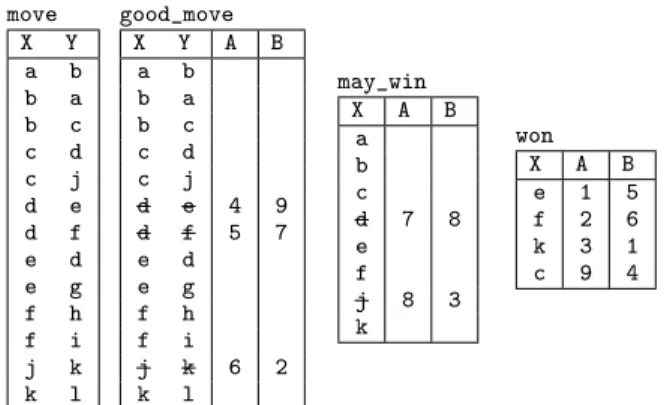
and apply the corresponding insertion or deletion. The two computations A and B are represented in Figure2 as fol-lows: move is an EDB relation, so it stays constant. The relationgood moveis initialized with the contents of move, and during the computation we are subsequently deleting facts fromgood move. Formay winit is similar: may winis initialized with non-leaf nodes, some of which are going to be deleted during the computation. wonbegins empty. The numbers in the columns A (resp.B) indicate the order in which a fact is derived intowon or deleted fromgood move
andmay winin the computation traceA(resp.B). For ex-ample consider computationA. The first three derivations performed are to successively declare positions e,f, andk
won according to rule (1) ofPwm. We can then apply rule
(2) to delete(d,e)fromgood movesinceeis lost (step 4), similar for(d,f), and(j,k). Now,ddoes not have a good-move out anymore, and thus can be deleted from may win
according to rule (3), same forj. Finally, we can apply rule (1) again to declare cwon, since, for example, dis not in
may winanymore. Now, no applicable rule would change any of the IDB relations anymore. We end up with the winning positions in won; the drawn positions are those in may win
that are not also inwon, in our caseaandb.
In the computationA, we derivewon(c)last5. However, the different orderB of evaluating Pwm deriveswon(c)
al-ready after only four rule applications. Intuitively, this is due to the fact that there is a short “winning path” from
cthroughj, k, andl, which doesnot have to wait for the deletion ofdfrommay_win.
4The rule to compute may winis equivalent to computing
the first overestimate of the alternating fixpoint procedure.
5Observe how this order roughly corresponds to the
alter-nating fixpoint order.
move X Y a b b a b c c d c j d e d f e d e g f h f i j k k l good_move X Y A B a b b a b c c d c j d e 4 9 d f 5 7 e d e g f h f i j k 6 2 k l may_win X A B a b c d 7 8 e f j 8 3 k won X A B e 1 5 f 2 6 k 3 1 c 9 4
Figure 2: Two non-deterministic evaluationsAand
BofPwm, solving the win-move game in Figure1(c).
Furthermore, both computationsAandBreach the same result, althoughPwmcontains negation and is non-monotonic.
The fact that computations A and B from the example evaluate Pwm differently, yet reach the same conclusion, is
not a coincidence: as we will show in Section4, it is a conse-quence of the structure ofPwm that holds foranyexample
of a win-move graph and order of evaluation. Moreover, we will also show there that the result is in accordance with the well-founded semantics.
Since the order of picking rules for evaluation does not change the final result, we have much more flexibility when we distribute the computation, as discussed next.
3.1
Distributed Execution
We assume the contents of the relationsmove,won,may win, andgood moveto be horizontally distributed across multiple nodes. Aglobal database state thus only exists virtually as a union over alllocal databases. We would like each node to be able to take part in the computation, i.e., execute rules and update the global state. To do so, it is necessary that a node can judge by only investigating itslocal state whether theglobal database implies a certain valuation for a body of a rule. Consider a rule that has only positive body literals, e.g.,a(X) ←b(X),c(X). Clearly, if a nodeN hasb(1)and
c(1) amongst its local data, thana(1) can be derived. If
a(1) should be stored at a different node N0, then an in-sertion request for a(1) is sent toN0, who in turn inserts it into its local database. However, consider a rule such as
won(X) ←move(X,Y),¬may_win(Y). To be applicable with a binding ofX=k,Y=l on theglobal database state, it is in general not enough to check whether the factmay_win(l)is missing in the local state, since it could be in one of the other partitions located at a different node. Here, we exploit the fact that data is often not partitioned arbitrarily, but for ex-ample, according to a hash-function, or a range-partitioning scheme. In our example here, we assume a globally known, fixed partitioning functionhthat maps each fact of the ac-tive domain to a certain host. In our example, this simply means that each node is responsible for a certain set of po-sitions and its adjacent edges. The tuplemay_win(l), when existing, is thus stored at nodeN :=h(may_win(l)). Now, since node N knows that may_win(l) should be stored lo-cally, it can deduce that the valuationX=k,Y=lis applicable ifmay_win(l)is not present in its local database.
Pwm, without coordination. Not only is the final result
de-terministic, but also can the computation potentially pro-ceed even if communication to other nodes has been lost (or is slow). Returning to example Figure1(c). Assume a par-titioning function that assigns positionsa, b,andcto node
N1;j, k, lto nodeN2; and the remaining positions to node
N3. Now, consider the case in which the network is
parti-tioned such thatN3cannot communicate with the other two
nodes. Surprisingly, in this case, running programPwm on
each node individually with communication only between nodes N1 and N2 will compute the complete result! The
intuitive reason is that the only dependence between the subgraphsa, b, c, j, k, landd, e, f, g, h, iis the edge between
cand d. But then, the fact that positioncis won, can be established from the fact thatjis lost and does not require the cooperation of nodeN3. From the view of nodesN1and
N2, the final result of d is irrelevant in deciding that c is
won. Similarly,dcan be established to be lost by nodeN3
independently.
4.
DISORDERLY EVALUATION MODEL
In this section, we formalize the ideas illustrated in the previous section. We proceed in three steps. First, we define an “even more non-deterministic” semantics for Datalog¬¬∀
which we call thedisorderlysemantics. The basic idea is to relax the non-deterministic semantics by allowing deferred application of updates, to model network delay effects. Sec-ond, we identify a syntactic fragment of Datalog¬¬∀ , called
semi-monotone Datalog, where the deterministic, non-deter-ministic, and disorderly semantics of Datalog¬¬∀ coincide;
and which iseventually consistentin a certain precise sense. Third, we demonstrate that our construction for evaluating win-move is eventually consistent and correct.
4.1
The Disorderly Semantics
Intuitively, in a distributed system, each node only has local knowledge about the global state. As in declarative networking [19], we assume that the “global” database is horizontally distributed accross various nodes in the system. Each node runs a copy of thesameDatalog¬¬∀ program, but
has access only to its ownlocaldata. During the distributed computation, a node fires rules of the program based on its locally available data, requests updates that are either applied locally or shipped to other nodes. Crucially, even rules using negation in the body are fired using just locally available information; correctness of the scheme will rely on source data being partitioned in such a way that the local node always sees a conservative underestimate of the relevant negative information, making it safe to fire such rules. To capture the network message delays and reordering which arise in distributed systems, we include a global bag (multiset) ofpending updates in the description of the state of the distributed system, manipulated by local nodes in a non-deterministic fashion.
Fix a Datalog¬¬∀ programP with schemaσ. Anupdateis
a positive or negative ground literal overeidb(P)∪idb(P). A state of the computation is a pair (I, U) comprising a database instance I over σ and a bag (multiset) U of re-quested updates overσ. U can be thought of as a collection of pending or deferred updates.
Like the non-deterministic semantics, the disorderly se-mantics is based on the notion of animmediate successor, but this time of states rather than sets of facts. Let (I, U)
be a state, letrbe a Datalog¬¬∀ rule,
H← ∀XB¯ 1, . . . , Bn,
inP, and letνbe a consistent valuation of the free variables in r such thatI |=∀Xν¯ (B1)∧ · · · ∧ν(Bn). Then a state
(I0, U0) is animmediate successorof (I, U) usingr if one of the following holds:
requestI0=IandU0=U]{ν(H)}, where]denotes bag union
insertA0 is an update from U, I0 = I∪ {A0}, and
U0=U− {A0}, where−denotes bag difference delete ¬A0 is an update fromU,I0 =I\ {A0}, and
U0=U− {¬A0}, where−denotes bag difference A state (J, V) is an eventual successor of state (I, U) us-ing the rules of P if there exists a sequence (I0, U0) =
(I, U), . . . ,(In, Un) = (J, V) such that for eachi, (Ii+1, Ui+1)
is an immediate successor of (Ii, Ui) using some rule inP.
Under the disorderly semantics, a program has a set of possible outcomes (due to non-deterministic choices). Intu-itively, the instanceJis part of this result set if a state (J, U) can be reached for which the only further updates that can be requested or applied are “no-ops.”
Definition 4.1 LetP be a Datalog¬¬∀ program, and letI
be a source instance. Theresultof applyingPtoIunder the disorderly semantics is the set of all instancesJ such that there existsV satisfying (i) (J, V) is an eventual successor of (I,∅) using the rules ofP, and (ii) (J, V) is aterminal state, i.e., it has no eventual successor (J0, V0) of (J, V) with
J06=J.
The disorderly semantics is “even more non-deterministic” than the non-deterministic semantics in the following sense:
Proposition 4.2
1. For any Datalog¬¬∀ program P and source instance I,
if J is in the result ofP under the non-deterministic semantics, thenJ is in the result ofP under the dis-orderly semantics.
2. There exists a Datalog¬¬∀ programP, a source instance
I, and an instanceJ such thatJ is in the result ofP under the disorderly semantics, but not under the non-deterministic semantics.
Proof. (1) follows from the observation that any
computa-tion under the non-deterministic semantics can be emulated by strictly alternating update derivation and update appli-cation. To prove (2), consider the Datalog¬¬∀ program
P = r ← ¬r, ¬s.
s ← ¬r, ¬s.
applied to the empty source instance. Under the non-deter-ministic semantics, the result is{{r},{s}}, while under the disorderly semantics, the result is{{r},{s},{r,s}}. 2
Practical Considerations
For practical reasons, we are interested in Datalog¬¬∀
while allowing the computation of that result to be car-ried out in a non-deterministic or disorderly fashion. This is captured by the notion of a functional fragment [4] of Datalog¬¬∀ :
Definition 4.3 A Datalog¬¬∀ programP isfunctional,
un-der a given semantics, if the result unun-der that semantics has cardinality≤1 for any source instanceI.
However, even functional programs that compute exactly one result can be undesirable from a practical point of view, when they admit divergent evaluation sequences that never reach a terminal state. Consider, for example, the following functional Datalog¬¬∀ program:
P= t ← ¬a. p ←t.
a ←b. ¬p ←t.
Evaluated under the disorderly semantics, the result ofP on
{b}is the single output{a, b}. Yet, if the first rule is used to derivetin a state (I, U) (by for example, executing it first), then no eventual successor of (I, U) will satisfy requirement (ii) of Definition4.1. This is problematic because we intu-itively, would want to reach the final resulteventually even though some “bad choices” have been made while picking the order of evaluation.
Before defining a notion of termination, we first dispatch with one technical issue. Nothing in the formal semantics we have presented so far rules out the possibility that, in a given evaluation trace, the same update will be derived
ad infinitum, a given rule will never be given a chance to fire, or a certain pending update will never be applied. To rule out such pathological cases, we first introduce a notion of fairness, which informally requires that each derivable update is eventually derived, and each derived update is eventually applied.
Definition 4.4 Given a Datalog¬¬∀ programP. A sequence
of states (I0,∅),(I1, U1), . . . for which (Ii+1, Ui+1) is an
im-mediate successor using a rule inP is afair trace if (1) for any state (Ii, Ui) for which there is a rule r = (head ←
body) ∈ P and valuation ν with Ii |= ν(body), there are statesSj = (Ij, Uj) andSj+1 = (Ij+1, Uj+1) with j ≥ i
such thatSj+1 is obtained from Sj by requesting the
up-dateν(head) (i.e.,Uj+1=Uj∪ {ν(head)}). And also, (2) if
A∈Ui(¬A∈Ui), then there are statesSj= (Ij, Uj) and
Sj+1= (Ij+1, Uj+1) with j≥isuch thatSj+1 is obtained
fromSjby inserting (deleting)A.
Having ruled out these pathological traces, we can now de-fine termination6 desired:
Definition 4.5 A programPisterminating under a given semantics if every fair trace reaches a terminal state. Finally, combining termination and determinism yields our desired property of Datalog¬¬∀ programs:
Definition 4.6 A programP iseventually consistent un-der a given semantics, if it is functional and terminating under this semantics.
It was shown in [4] that for Datalog¬¬∀ under the
non-deterministic semantics, functionality is undecidable. As might be expected, this property (along with termination and eventual consistency) is undecidable for the disorderly semantics as well:
6
This property is also often called quiesence, e.g., [9,15].
Theorem 4.7 Under the disorderly semantics, functional-ity, termination, and eventual consistency are undecidable for Datalog¬¬∀ , even for programs without universal
quantifi-cation or eidb relations.
The proof is by reduction from the undecidable problem of checking containment of (positive) Datalog programs [21], and can be found in the Appendix.
4.2
Semi-Monotone Datalog
¬¬ ∀Consider again the win-move program from Section 3, which we saw there compiled into the Datalog¬¬∀ program
Pwm. Observe that the updates in the program follow a
certain, regular form: in particular, we only insert into the
won relation, while we only delete from thegood_move and
may_win relations. Moreover, wonoccurs only positively in the bodies of rules, whilegood_moveandmay_winoccur only negatively. We are therefore motivated to define the follow-ing fragment of Datalog¬¬∀ :
Definition 4.8 A Datalog¬¬∀ programPissemi-monotone
if the relation names inidb(P) occur only positively, while the relation names ineidb(P) occur only negatively.
Note that in the course of computation for such a program, the idb(P) relations only grow, while theeidb(P) relations only shrink. This justifies the terminology semi-monotone Datalog¬¬∀ (orsemi-monotone Datalogfor short).
Theorem 4.9 Every semi-monotone Datalog¬¬∀ program is
eventually consistent under the disorderly semantics.
The proof can be found in the Appendix.
We conclude the subsection by noting the following: Corollary 4.10 For semi-monotone Datalog¬¬∀ programs,
the deterministic, non-deterministic, and disorderly seman-tics coincide.
Proof. Let P be a semi-monotone Datalog¬¬∀ program,
and let I be a source instance. Suppose that J is the re-sult of evaluatingP onI under the deterministic semantics. By results of Abiteboul and Vianu [5], J is in the result set of P applied to I under the non-deterministic seman-tics. By Proposition 4.2, J is also in the result set of P
applied to I under the disorderly semantics. But since P
is semi-monotone, it is functional under that semantics, by Theorem 4.9. It follows that the result under any of the three semantics is exactlyJ. 2
4.3
Correctness of the Transformed Win-Move
Next, we return to the Datalog¬¬∀ version Pwm of the
win-move game presented in Section3. SincePwm is
semi-monotone, Theorem4.9tells us that it is eventually consis-tent. We now show that it also correctly computes the result of the original Datalog¬ under the well-founded semantics: Lemma 4.11 Let P be the Datalog¬ version of the win-move game, let (Pinit,Pwm) be its semi-monotone Datalog¬¬∀
translation, and letI be a source instance. Denote byJ the result of applying firstPinittoIobtainingI0, and thenPwm
to I0, both under the disorderly semantics. Let P0 denote the extension ofP to include the facts ofI. Then for any ground factwin(a)we have the following:
WP0(win(a)) =
true iff won(a)∈J false iff may win(a)6∈J undefined iff won(a)6∈J and
Proof sketch. The basic idea is to show that the
alter-nating fixpoint computation is simulated by a certain dis-orderly computation. (Since Pwm is semi-monotone, it is
functional by Theorem4.9, hence any disorderly computa-tion will produce the same result.) The initializacomputa-tion stage computes the set of first overestimates. The proof is then done by induction on the length of the alternating fixpoint computation Γi using a strengthened induction hypothesis
(which includes an added good move relation to the alter-nating fixpoint sequence). The chosen execution for the dis-orderly semantics, computes all immediate consequences of the first rule inPwm(after which the underestimates agree),
then the secon and the third (after which the overestimates agree). Induction is done by proving the claim fori= 0,1 as a base. Proving for i = 2k+ 2 assumingi = 2k and
i= 2k+ 1, i.e., correctness of a new underestimate es easy to show, since applying rule 1 to the earlier state naturally computes the new state. Correctness of the overestimates
i= 2k+ 1 is a little trickier and requires applying induction hypothesis fori= 2k,2k−1,2k−2. The key insight here is that thegood movefrom both programs agree in the oddi, i.e., in the over-estimations. 2
5.
TRANSDUCER NETWORKS
In this section we develop four closely-related models for distributed computations.
The first model, denoted N0, is that of relational trans-ducer networks as defined by Ameloot et al. [9]. The other three models are new and vary fromN0 along two dimen-sions: how the input data is distributed across the network; and how much a transducer node “knows” about the distri-bution process. In the modelN1, input facts are distributed according to a distribution policy which assigns each fact of the Herbrand base over the extensional schema to one or more nodes. Further, the distribution policy is known to each node in the transducer network, in a sense we shall make precise shortly. In modelN2, the facts of ak-ary re-lation are distributed with a replication factor of at most
k, determined by their attribute values. Finally, model N3
differs fromN1in that each transducer also has information about the active domain of the global input instance.
In the following, we describe these models in detail, begin-ning with a review of transducers and networks of relational transducers (modelN0).
5.1
Background
We follow the paper by Ameloot et al. [9] in presenting the background notions of relational transducers [6] and re-lational transducer networks [9].
Relational Transducers
A transducer schema is a tuple (Sin,Ssys,Smsg,Smem, k) of four disjoint database schemas along with an arityk. (The subscripts stand for ‘input’, ‘system’, ‘message’, and ‘mem-ory’, respectively.) Anabstract relational transducer ( trans-ducer for short) over this schema is a collection of queries
{QRsnd | R ∈ Smsg} ∪ {Q R
ins | R ∈ Smem} ∪ {Q R
del | R ∈ Smem} ∪ {Qout}, where
• every query is over the combined schemaSin∪ Ssys∪ Smsg∪ Smem;
• the arity of eachQRsnd, eachQ R
ins, and eachQ R delequals
the arity ofR; and
• the arity ofQoutequals the output arityk.
Here, ‘snd’ stands for ‘send’; ‘ins’ stands for ‘insert’; ‘del’ stands for ‘delete’; and ‘out’ stands for ‘output’. A state
of the transducer is an instance of the combined schema
Sin∪ Ssys∪ Smem. Amessage instanceis an instance ofSmsg. Such a message instance can stand for a set of messages (facts) received by the transducer, or a set of messages sent by the transducer; the intended interpretation will always be clear in context.
LetT be a transducer. A transitionofT is a five-tuple (I, Ircv, Jsnd, Jout, J), also denotedI, Ircv
Jout
−→J, Jsnd, where
I andJare states,IrcvandJsndare message instances, and
Joutis ak-ary relation such that
• every query ofT is defined onI0=I∪Ircv; • Jagrees withI onSinandSsys;
• Jsnd(R), for eachR∈Smsg, equalsQRsnd(I 0
);
• Jout equalsQout(I0);
• J(R), for each R ∈ Smem, equals R0 as follows. Let
the set of insertions forRbeR+:=QRins(I 0
)\QRdel(I 0
), the set of deletions forRbeR−:=QRdel(I
0
)\QRins(I 0
). Then,R0:= (R∪R+)\R−
. (That is, conflicting up-dates are ignored.) Note that this allows assignment
R0:=Qto be implemented.
The intuition behind the instanceI0is thatT sees its input, system and memory relations, plus its received messages. The transducer does not modify the input and system rela-tions. The transducer computes new tuples that can be sent out as messages; this is the instance Jsnd. The transducer
also outputs some tuples (which cannot later be retracted); this is the relationJout. Finally the transducer updates its
memory by inserting and deleting some tuples in its memory relations.
Transducers are parameterized by the languageLin which the queries are expressed. A UCQ-transducer, for example, uses unions of conjunctive queries. Note that transducer transitions are deterministic, in constrast to those of trans-ducer networks, discussed next.
Transducer Networks
Next we recall transducer networks (model N0), in which relational transducers are placed on nodes in a communicat-ing network. Here anetworkis a connected (not necessarily complete), directed graph of nodes N ( dom. By
insist-ing that the graph is connected, we ensure that information can (eventually) flow between any two nodes. Atransducer network is a pair (N,T) where N is a network andT is a relational transducer.
Operationally, each node in the network has a relational transducer and a receive buffer of incoming messages. In the initial state, all memory relations and receive buffers of all nodes are empty. The system relations contain useful information about the transducer network and input distri-bution (we will formally describe what this entails). The input I of schemaSin to the transducer network is parti-tioned (possibly with replication) across the input relations via a partitioning functionH that maps every noden to a subset ofI, such thatI=S
n∈NH(n).
The (global)stateof a transducer network is a functionS
mapping each noden∈Nto a pair (I, B) whereIis a (local) transducer state andB, thereceive buffer, is a bag of facts
over the schema Smsg. The state of a transducer network evolves via two kinds of transitions. In a delivery transi-tion, a node reads and removes one fact over the schema
Smsg from its input bufferB, adds the fact to the appro-priate memory relation, makes a local transducer transition transforming the local stateI toJ, and sends the resulting message instanceJsnd to its neighbors. Aheartbeat
transi-tionis the same as a delivery transition, but no input is read from the input buffer. SendingJsndto neighbors means that
after the transition,Jsnd is added to the input bags of the
neighboring nodes.
Non-Determinism and Desired Properties
To define desired properties of network transducers, we first require the notion of a run. A run of a transducer net-work (N,T) on inputI according to a partitioning function
H is an infinite sequence (τn)nof transitions starting from
an input configuration with empty network buffers, empty memory relations, and input relations populated according to the partitioning functionH. Theresultof a run is defined as the union over allJoutproduced during the transitions of
the run. A run isfair if every node does heartbeat transi-tions infinitely often, and every fact in every message buffer is eventually taken out by a delivery transition.
Network transducer transitions are non-deterministic in several respects: from a given state, many transitions are possible in general depending on the choice of node where the transition occurs, the choice of transition type (heart-beat or delivery), and, for delivery transitions, the choice of fact delivered. These correspond to the kinds of non-determinism found in real distributed systems.
It is desirable nevertheless for transducer networks to pro-duce the same output regardless of the network topology, partitioning strategy, or non-deterministic choices of the run. We formalize this notion below.
Definition 5.1 A transducerT computes the query Qif for any inputI, networkN, and distributionH, the result of any fair run of (N,T) onI according toH isQ(I).
5.2
Variations on Transducer Networks
In basic relational transducer networks (model N0), the horizontal partitioning of the input data is done arbitrarily and, without communication, nodes know only which part of the input data was assigned to them. By varying these assumptions, we derive three natural variations on the basic model.
In all of our variations, we derive the horizontal parti-tion funcparti-tion for a particular input I from an instance-independentpartitioning policy. Apartitioning policyfor a schemaSPand networkNis a computable functionPthat associates with each ground atom in the Herbrand base of
SP a non-empty subset of the nodes ofN. The domain of the functionPis infinite (the policy is independent of a par-ticular input instance), covering all “potential” tuples. Given a partitioning policyP and an input instance I, we define the horizontal partition functionHP,I used for distributing
the input instance data as follows:
HP,I(i) :={f|f∈I andi∈ P(f)}
Note that for any horizontal partioning H of an input in-stanceI, there is a partitioning policyP such thatHP,I =
H. (For one of the models to be described, however, we will
restrict the allowed partitioning policies such that this no longer holds.)
Next, we allow each transducer restricted access to the partitioning policy Pby adding a relation LocalR for each
R∈ Sin to its system relations. LocalRhas the same arity as R, and a tuple ¯xis in LocalnR (the copy of LocalR at
noden) iffn∈ P(R(¯x)). Intuitively, on a noden, there is a tuple ¯x∈ LocalR ifn is “responsible” for this tuple. If
R(¯x) is in the global inputI, thenR(¯x) will be distributed to noden(and possibly others). Conversely, if nodenfinds
R(¯x) absent from its local input, thenn“knows” thatR(¯x) isnotin the global inputI.
Note that theLocaliR are in general infinite relations; in
practice each node would be equipped with a decision pro-cedure to check whether an arbitrary tuple is contained in
LocaliR or not. Also, while the queries of a transducer at
nodeimay accessLocaliR, we require that the queries still
produce finite results. (For UCQ-transducers, for instance, this can be ensured by extending the notion of safety to require all variables occuring in LocalR atoms to also oc-cur positively in normal atoms.) This requirement could be lifted by restrictingLocaliR to the active domain of the
global input instance, but we prefer not to do this as we shall see in Lemma 6.3that providing nodes knowledge of the active domain has a dramatic impact on the notion of coordination-freeness.
We are now ready to define our first variation on relational transducer networks.
Definition 5.2 AnN1-L-transducer networkis anL -trans-ducer network along with a partitioning policyP, in which each transducer is additionally provided system relations
LocalR for allR∈ Sin as described above.
In our second model, we restrict the allowed partitioning policies to those which, intuitively, map domain elements (rather than ground facts) to nodes. This captures the style of distribution used in our construction for the win-move game in the earlier sections. More precisely, a partition-ing policy P is called element-determined if there exists a (unique) mapping F : dom → 2N of domain elements to
sets of nodes such that
P(p(x1, . . . , xn) ) = [
i=1,...,n
F(xi).
for every ground factp(x1, . . . , xn) in the Herbrand base of
the transducer’s input schemaSin.
Definition 5.3 An N2-L-transducer network is an N1-L -transducer network whose associated partitioning policy is element-determined.
We do not impose any restriction on P for nullary rela-tions beyond what was done for type N2 transducer net-works. Note that the nodes of anN2-L-transducer network have, essentially, full knowledge of the underlying mapping
F :dom →2N for the partitioning policy via their LocalR
relations, since F(a) = LocalR(a, . . . , a) for any domain valueaand (non-nullary) relationR.
Finally, our third variation on transducer networks ex-poses global knowledge of the active domain to nodes. Definition 5.4 An N3-L-transducer network is an N1-L -transducer network in which the -transducers additionally have access to a system relationadomcontaining the active domain of the global input instance.
For any of these models, we also require that a transducer is “oblivious” to the network and partitioning policy, in the sense that the same transducer should produce the correct result on any fair run, regardless of the choice of network and partitioning policy.
Definition 5.5 AL-transducer T computes a queryQin modelX ∈ {N1,N2,N3}if for every networkN, every dis-tribution policyP compatible withX, and every input in-stanceI, every run ofT in which the input is distributed according toHP,I results in the outputQ(I). In this case
we say thatT isconsistent.
5.3
Disorderly Semantics via Transducer
Net-works
In this section we will show how certain syntactic classes of semi-monotone programs can be “compiled down” to equiva-lent transducer networks of various kinds. The semi-monotone program we have given for computing the win-move game will be seen to obey the syntactic restrictions of one of these classes.
Lemma 5.6 Let Qbe a query computed under the disor-derly semantics by a semi-monotone,∀-free Datalog¬¬∀
pro-gram P in which each rule has at most one negated eidb atom. Then there exists a type N1 UCQ¬-transducer net-work which computesQ.
A similar result holds for type N2 transducer networks. Here, we are allowed to use multiple negated eidb in the body of rules and ∀-quantification. A Datalog¬¬∀ rule r is
friendly if any negated atoms in the body ofrshare a com-mon variablexwhich is not universally-quantified.
Lemma 5.7 LetQbe a query computed by a semi-mono-tone Datalog¬¬∀ programP under the disorderly semantics.
If all rules in P are friendly, then there exists a type N2
FO-transducer network which computesQ.
Even certain kinds of pre-processing are allowed: A Data-log program consisting only of constant-free projection rules, i.e., of the formR’(¯Z) ←R(¯X) with∅ 6= ¯Z ⊆ X¯, and all
Xi∈X¯ being variables, is called aprojection program.
Lemma 5.8 Let P be a projection program, and let Qbe a query as defined in Lemma5.7. Then there exists a type
N2 FO-transducer network which computesQ◦P.
As is customary, we mean query compostion with◦, i.e., for any input instanceI,Q◦P:=Q(P(I)). We point out that the programsPinit and Pwm for computing win-move
pre-sented in Section3satisfy these requirements.
Proofs. All proofs for these lemmata are constructive. The intuition is that the created transducer networks essentially perform a distributed computation of the disorderly seman-tics. Each transition of the transducer implements the FO-query denoted by the body of the semi-monotone program applied to itslocal state. Derived updates are locally applied as well as broadcasted to all nodes in the network. Eventual consistency for the disorderly semantics of semi-monotone programs guarantees the consistency of the transducer. The syntactic restrictions and access to theLocal relations are necessary to allow the evaluation of rule bodies in a dis-tributed manner: Even though each transducer only has par-tiallocal knowledge of the virtualglobal database state, the
restrictions guarantee that (1) each conclusion drawn from the local state could also have been drawn from the global state, and (2) each conclusion that can be drawn from the global state can also be drawn on at least one node with only its local knowledge.
The transducerT constructed for Lemma5.8is a modifi-cation of the one constructed for Lemma5.7that first com-putes the projection-program locally. Since the partitioning policy is element-determined, all necessaryLocalsystem re-lations for the idb(P), which are the edb and eidb for the transducer, can be emulated.
While the proofs provide valuable insights in how to pro-gram the transducer to guarantee consistency and correct-ness, the details are somewhat technical. We thus decide to skip them here and refer the interested reader to Ap-pendixA.2.
6.
COORDINATION
Again following Ameloot et al. [9], we say that an L -transducerT that computesQiscoordination-free with re-spect to model N0 if for every inputI and every network
N, there exists a distributionH for which when the trans-ducer network (N,T) is run with only heartbeat transitions, it already produces the correct result. Note that since local heartbeat transitions are deterministic, the result is deter-ministic for a given input I, network N, and partitioning
H. A queryQ iscoordination-free in N0 if there exists a coordination-freeL-transducerT that computesQ, for some query languageL.
A main result of the paper by Ameloot et al. [9] relates coordination-freeness and monotonicity:
Theorem 6.1 [9]A query is coordination-free in modelN0
if and only if it is monotone.
The notion of coordination-free queries extends naturally to modelsN1,N2, andN3 (replace horizontal distributions with distribution policies in the definitions above for N0). For X ∈ {N0,N1,N2,N3}, denote by F[X] the class of queries that are coordination-free with respect to modelX. Denote by C the class of all computable queries, byMthe class of monotone queries, and bySP the class of all queries computable by a semi-positive Datalog¬ program.
The main result of this section is that these classes form the following hierarchy:
Theorem 6.2
M=F[N0](F[N1](F[N2](F[N3] =C
The first equality is just a restatement of Theorem6.1; and it is clear from the construction of the models thatF[N0]⊆
F[N1],F[N1]⊆F[N2], andF[N1]⊆F[N3]. The remainder of the section is devoted to a proof that these inclusions are proper, and indeed that the above hierarchy holds.
6.1
Proof of Main Theorem
First, we show that endowing the nodes with knowledge of the global active domain has a dramatic impact on the class of coordination-free queries:
Lemma 6.3 Every computable query is coordination-free in model N3, i.e., F[N3] =C.
Proof. First, we claim that there is a coordination-free
Datalog¬-transducer T of type N3 such that, on any net-work, and any inputI distributed according to any policy, any fair run reaches a configuration where every node has a local copy of the entire instanceI in its memory, and an additional flagready(implemented by a nullary memory re-lation) is true. Moreover, the flagready does not become true at a node before that node has the entire instance in its memory.
We use the programming techniquebroadcastas described in AppendixA.2to let transducers send messages (contain-ing update requests) that will eventually be delivered to any node in the system; besides sending the updates out, they are also locally applied. The transducer does the follow-ing on heartbeat transitions: for each edb-relationR, it uses
adomandLocalR to broadcast existence and non-existence of tuples which is then stored in the memory relationsRm, andRcm, respectively. With@alldenoting broadcast: Rm@all(¯X) ←R(X).¯
Rcm@all(¯X) ←adom(X1),...,adom(Xn),LocalR(X),¬R(¯ ¯X).
Then, each edb relationRalso has a flagreadyRthat is set as follows:
knownR(¯X) ←Rm(¯X). knownR(¯X) ←Rcm(¯X).
not_readyR ←adom(X1),...,adom(Xn),¬knownR(¯X).
readyR ← ¬not_readyR. ready ←readyR, readyS,...
Finally,readyis implemented as a conjunction of allreadyR
for each edb relation R. This Datalog¬ program is run in each transition byT.
Next, for any queryQexpressible in a query languageL, let L0 be a query language at least as expressible as both
Land stratified Datalog¬. TheL0
-transducerT, which dis-tributedly computesQ, does now first use the sub-routine from above to distributeI to all nodes, and then, on each node, whenreadyis true, computesQin one step.
T is coordination-free. For any network, consider the pol-icy that allocates all data to a single noden0. Even though
none of the sent messages arrive,n0 will reach the “ready
-state” and output the complete result. 2 Lemma 6.4 In modelN1, for each semi-positive Datalog¬ program there exists an equivalent coordination-free UCQ¬ -transducer. As a consequence, SP ⊆ F[N1], and in partic-ularF[N0](F[N1].
Proof. Each semi-positive Datalog¬ program P is also a semi-monotone program, which additionally satisfies the syntactic restrictions identified in Lemma 5.7. Let T be the typeN1 transducer as in the proof for Lemma5.7. We observe thatT is coordination-free. Consider again the par-titioning policy mapping all data to a single noden0. T on 1
will run the complete semi-monotone program already with only heartbeat transitions. 2 Lemma 6.5 The query computing the won positions of the win-move game isN2-coordination free.
Proof. Lemma4.11states thatPwm◦Pinit computes the
won positions for win-move. Pwm satisfies the restrictions
of Lemma 5.7; and Pwm is a projection program. Now,
consider the N2-FO-transducer T that was constructed in
the proof for Lemma 5.8. T is coordination-free: consider the partitioning policy that puts all data on a single node
n0. 2
Lemma 6.6 F[N1]is strictly contained inF[N2].
Proof. Considering Lemma6.5, we assume towards a con-tradiction that there is a coordination-freeN1-transducerT
computing the won positions of the win-move game. Let
I ={move(a,b)}. SinceT is coordination-free it computes the correct resultwin(a)on all networksNand a partition-ing policy P with only performing k heartbeat transitions for some k ∈N. Choose the network that contains only a
single node n0. We observe that this implies P ≡ {n0}.
Now, consider input I0 = {move(a,b),move(b,c)} on the network N0 = {n0, n1}. We choose a partitioning policy P0
that assigns all ground atoms ton1 except move(a,b),
which is assigned to n0. Consider stepping T on n1 with
k heartbeat transitions. T will output win(a)since its in-put and system relationsmoveandLocalmovehave the same contents as above (remember,T is deterministic if run only with heartbeat transitions). This is a contradiction since
win(a)isnot part of the correct result forI0. 2 We finish the proof of Theorem6.2by showing that the last containment in the hierarchy is strict.
Lemma 6.7 Not all computable queries are coordination-free in modelN2, i.e., F[N2](F[N3] =C.
Proof. Assume towards a contradiction that the query that decides whether a unary relationRis empty is inF[N2]. Following the argument from the proof for Lemma6.6, con-sider I = ∅ on the network with one node n0; and then
I0 ={R(a)}together withP0≡ {n1}on the networkN0=
{n0, n1}. 2
We point out that although win-move is coordination-free inN2, this does not directly imply that all well-founded Datalog¬is in F[N2], even though “win-move” is a normal-form for well-founded Datalog [13]. The normal-form result for win-move as described in [13] requires a recursion-free semi-positive pre-processing step. It is not clear how, in general, this can be done in a coordination-free manner.
7.
RELATED WORK
Our work is inspired by Hellerstein’s quest for logic-based foundations of parallel, distributed, data-intensive comput-ing [15], and the search for suitable models of computation and parallel complexity. Hellerstein’s model incorporates non-determinism via the choice construct with an explicit representation of time within Datalog; we use instead a bag of pending updates. The paper by Alvaro et al. [7] also studies methods to ensure eventual consistency of dis-tributed computations. In particular, the authors analyze Dedalus programs (a version of distributed Datalog) to iden-tify points of non-monotonicity that require coordination.
Much of our technical approach is inspired by the paper by Ameloot et al. [9], which introduced the framework of networks of relational transducers and was the first to ven-ture a formal notion of coordination complexity. We have shown that slight variations on the model have a dramatic impact on the ensuing notion of coordination complexity.
A more recent paper by Ameloot et al. [8] investigates syntactic restrictions under which eventual consistency of
networks of relational transducers can be decided. Our pa-per complements that work by introducing disorderly eval-uation of semi-monotone Datalog¬¬∀ programs and a
com-pilation procedure for such programs guaranteed to create eventually consistent transducer networks.
Our disorderly semantics is closely related to the so-called “production-rule” semantics of Datalog¬ [5, 23]. Recent work by Abiteboul et al. [1] also investigates confluence and distributed systems, however without the focus on coordi-nation freeness.
The paper by Koutris and Suciu [18] presents a “massively parallel” computation model (MP) for conjunctive queries that takes data skew into account. They show that in the MP model, the so-called “tall-fat queries” are precisely the ones that can be executed in a single stage. It would be interesting to investigate formal notions of coordination that take into account data skew.
Finally, the paper by Brass et al. [10] describes transfor-mation based strategies for incremental, bottom-up evalua-tion of Datalog¬ programs under the well-founded seman-tics [14]. Some of their conditional rewriting techniques re-semble ours, but the paper does not address distributed or coordination-free computations.
8.
CONCLUSION
We have presented a syntactic fragment of Datalog¬¬∀ ,
semi-monotone Datalog, that lends itself to a disorderly, eventually consistent evaluation strategy, while permitting certain kinds of negation. We have shown that the win-move game, the canonical example of a non-stratifiable Datalog¬ program, can be solved using a semi-monotone Datalog pro-gram, and that the program can also be compiled into a rela-tional transducer network for distributed evaluation without resorting to “global synchronization barriers.”
We have also introduced several natural variations on re-lational transducer networks [9], in which various degrees of partitioning policy information are made available to partici-pating network nodes, and we used these models to study the notion of coordination-freeness. We showed that the classes of queries which are coordination-free under these various models form a strict hierarchy, highlighting the sensitivity of the formalization of coordination-freeness by Ameloot et al. to the precise details of how partitioning policy informa-tion is made available to nodes. The win-move game, and our semi-monotone Datalog program for solving it, play a starring role in separating two of these classes.
Like Ameloot et al. [9], we do not claim that the notions of coordination-freeness developed here are definitive7. How-ever, our results can be interpreted as informing the on-going development of more robust notions of coordination-freeness.
9.
REFERENCES
[1] S. Abiteboul, M. Bienvenu, A. Galland, and ´
E. Antoine. A rule-based language for web data management. InProceedings of the 30th symposium on Principles of database systems of data, pages 293–304. ACM, 2011.
7
Current events in American campaign finance law [20] sug-gest that confusion over the precise meaning of “coordina-tion” is not limited to the database theory community!
[2] S. Abiteboul, R. Hull, and V. Vianu.Foundations of Databases. Addison-Wesley, 1995.
[3] S. Abiteboul and E. Simon. Fundamental properties of deterministic and nondeterministic extensions of datalog.Theor. Comput. Sci., 78(1):137–158, 1991. [4] S. Abiteboul, E. Simon, and V. Vianu.
Non-deterministic languages to express deterministic transformations. InPODS, 1990.
[5] S. Abiteboul and V. Vianu. Datalog extensions for database queries and updates.J. Comput. Syst. Sci., 43:62–124, August 1991.
[6] S. Abiteboul, V. Vianu, B. Fordham, and Y. Yesha. Relational transducers for electronic commerce. In
PODS, pages 179–187. ACM, 1998.
[7] P. Alvaro, N. Conway, J. Hellerstein, and W. Marczak. Consistency analysis in bloom: a calm and collected approach. InCIDR, 2011.
[8] T. J. Ameloot and J. V. den Bussche. Deciding eventual consistency for a simple class of relational transducer networks. InICDT, 2012.
[9] T. J. Ameloot, F. Neven, and J. Van den Bussche. Relational transducers for declarative networking. In
PODS, 2011.
[10] S. Brass, J. Dix, B. Freitag, and U. Zukowski. Transformation-based bottom-up computation of the well-founded model.TPLP, 1(5):497–538, 2001. [11] F. Bry. Logic programming as constructivism: a
formalization and its application to databases. In
PODS, 1989.
[12] P. M. Dung and K. Kanchanasut. A natural semantics for logic programs with negation. InFoundations of Software Technology and Theoretical Computer Science, LNCS 405, pages 78–88, 1989.
[13] J. Flum, M. Kubierschky, and B. Lud¨ascher. Total and partial well-founded datalog coincide. InICDT, 1997. [14] A. V. Gelder. The alternating fixpoint of logic
programs with negation.JCSS, 47(1):185 – 221, 1993. [15] J. M. Hellerstein. The declarative imperative:
experiences and conjectures in distributed logic.
SIGMOD Record, 39, March 2010.
[16] D. B. Kemp, D. Srivastava, and P. J. Stuckey. Bottom-up evaluation and query optimization of well-founded models.TCS, 146:145–184, 1995. [17] P. Kolaitis. The expressive power of stratified logic
programs.Information and Computation, 90(1):50–66, January 1991.
[18] P. Koutris and D. Suciu. Parallel evaluation of conjunctive queries. InPODS, 2011.
[19] B. T. Loo, T. Condie, M. N. Garofalakis, D. E. Gay, J. M. Hellerstein, P. Maniatis, R. Ramakrishnan, T. Roscoe, and I. Stoica. Declarative networking.
CACM, 52(11), 2009.
[20] P. Overby. SuperPACs, candidates: Dancing solo or together? InNational Public Radio. January 6, 2012.
http://www.npr.org/2012/01/06/144801659/
a-look-at-super-pacs-and-political-coordination.
[21] O. Shmueli. Equivalence of datalog queries is undecidable.J. Logic Programming, 15(3), 1993. [22] A. Van Gelder, K. A. Ross, and J. S. Schlipf. The
well-founded semantics for general logic programs.J. ACM, 38:619–649, July 1991.