DOI 10.1007/s10267-006-0279-7 REVIEW
Irina S. Druzhinina · Alex G. Kopchinskiy Christian P. Kubicek
The first 100 Trichoderma species characterized by molecular data
Received: November 14, 2005 / Accepted: January 28, 2006
Abstract Trichoderma species are generally abundant on decaying wood and in soil because of their success in vari-ous heterotrophic interactions, including decomposition, parasitism, and even opportunistic endophytism. Many
Tri-choderma species or, precisely, many individual Tricho-derma strains, have various important applications in
industry and human life, which led to the inclusion of
Hypocrea jecorina (Trichoderma reesei), the well-known
producer of industrial enzymes, in the list of organisms whose genomes have been sequenced. Trichoderma species also have been adopted as agents of biological control of plant pathogenic fungi and as antibiotic producers.
Tricho-derma longibrachiatum is known as an opportunistic
patho-gen of immunocompromised mammals, including humans, and some species are common indoor contaminants. Given these properties, correct identification at the species level is highly desirable. However, within the past decade, the num-ber of recognized Trichoderma species has tripled, reaching 100. Therefore, Trichoderma taxonomy and species identifi-cation is a difficult issue. The abundant homoplasy in phe-netic characters is likely the reason, given that the number of morphologically distinct species is significantly lower than the number of phylogenetically distinct species recog-nized using methods of gene sequence analysis. In this review, we introduce to the scientific community the devel-opment of modern tools for Trichoderma species identifica-tion: the oligonucleotide barcode program TrichOKEY version 1.0, and TrichoBLAST, the multilocus database of vouchered sequences powered by a similarity search tool. We also discuss the application of the Genealogic Concor-dance Phylogenetic Species Recognition approach. In com-bination, these advances make it possible to identify all known Trichoderma species based on sequence analysis.
I.S. Druzhinina (*) · A.G. Kopchinskiy · C.P. Kubicek Research Area of Gene Technology and Applied Biochemistry, Institute of Chemical Engineering (ICE), Vienna University of Technology, Getreidemarkt 9/1665, A-1060 Vienna, Austria Tel. +43-1-58801-17202; Fax +43-1-58801-17299
e-mail: [email protected]
Introduction
Fungi are different. In many botany courses they are still introduced in the sense of Linnaeus’s Cryptogams (Systema Naturae; Linnaeus, 1703) as a group closely related to green plants. Moreover, many mycologists have a botanical edu-cation. However, recent phylogenetic reconstructions, such as the Tree of Life project based on nuclear small subunit ribosomal DNA (nSSU rDNA), put fungi and animals as sister clades (Heckman et al. 2001; Taylor et al. 2004). The confusion at such a high taxonomic level may exemplify the general difficulty in inferring an adequate fungal taxonomy based on phenetic data. All fungi are heterotrophs, but unlike animals, they live in their food. Probably evolution-ary adaptations to such a specific nutritional strategy led to the development of abundant homoplasious morphs; in other words, fungi seem to be significantly more diverse genetically than can be observed solely from phenetic char-acters. The gradual introduction of molecular data into the systematics of fungi, which started in the 1980s and became a standard by the late 1990s, has thus boosted research on the diversity and speciation of those fungal groups that scientists have studied for centuries. In this review, we focus on a single genus of the ascomycetes (the mitosporic genus
Trichoderma; Hypocreales, Ascomycota) to illustrate the
current trends in fungal taxonomy based on molecular data. Our aim is to describe new methods of species identification in light of modern approaches to species recognition. We discuss their advantages, requirements, pitfalls, and further developments.
Why was the genome of Trichoderma sequenced?
The complete genome sequence of one species of
Tricho-derma (Hypocrea jecorina/TrichoTricho-derma reesei) was released
to the public early in 2005 (http://gsphere.lanl.gov/trire1/ trire1.home.html). This species was selected for genome sequencing because of its significance for the production of
industrial enzymes and recombinant proteins (Kubicek and Penttilä 1998; Penttilä 1998). Trichoderma species are gen-erally abundant in nature, frequently found on decaying wood and in soil (Samuels 1996; Klein and Eveleigh 1998), where its individual genet can comprise a major portion of the total fungal biomass (Danielson and Davey 1973; Nelson 1982; Widden and Abitbol 1980). This abundance results from its success in diverse heterotrophic interactions including decomposition, parasitism, and even oppor-tunistic endophytism (Harman et al. 2004). Many
Tricho-derma species or, precisely, many individual TrichoTricho-derma
strains have various important applications in industry and human life. Several of them have been adopted as agents of biological control of plant pathogenic fungi (i.e., Trichoderma harzianum, T. atroviride, T. asperellum; Hjeljord and Tronsmo 1998) and as antibiotic producers (Sivasithamparam and Ghisalberti 1998). Trichoderma
longibrachiatum is known as an opportunistic pathogen of
immunocompromised mammals including humans (Kredics et al. 2003), and some species are common indoor contami-nants (Thrane et al. 2001). These diverse impacts of
Tricho-derma on human life and sustainable development of
natural ecosystems are reflected in the fact that additional species of the genus (T. virens, T. atroviride) are in the pipeline for genome sequencing, which, through com-parative genomics, will enable a general insight into this genus.
From 1 to 100 Trichoderma species
All these important properties make correct identification of unknown isolates of Trichoderma highly desirable. Printed scientific journals and monographs are the most reliable sources of information on fungal taxonomy. How-ever, because the publishing process is still relatively time consuming, online interactive databases powered with search engines are ideally suited for gathering cumulative information from various origins. Several such sources attempt to maintain the current taxonomy of Ascomycota. The state of the art of higher ranks is presented electroni-cally in MYCONET (www.umu.se/myconet/myconet6. html) edited by O.E. Ericsson. According to this source,
Trichoderma combines anamorphic (mitosporic) fungi
of genus Hypocrea belonging to the Hypocreaceae of the Hypocreales within the class Sordariomycetes. The
ground-level taxonomy for the majority of published names, i.e., taxonomy at the level of species, is available in Index Fungorum (www.indexfungorum.org/Names/Names.asp). The search for Hypocrea and Trichoderma resulted in 427 and 110 species epithets, respectively (October 16, 2005). However, among the latter number, 40% (44 names) are either outdated (synonyms) or have an unknown identity. The NCBI Taxonomy browser contains the names of all organisms that are represented in the genetic databases with at least one nucleotide or protein sequence. Unfortu-nately, this source also provides an unclear picture of
Tri-choderma taxonomy (Table 1). It is interesting to note that
although the total number of sequences deposited for
Hypocrea holomorphs is similar to the number of sequences
for mitosporic Trichoderma, the latter group comprises only one-third as many species (23 compared to 62). At the same time, one can see that the number of unidentified
Trichoderma records (Trichoderma spp.) is one order of
magnitude higher than that for Hypocrea. It clearly exemplifies the difficulty in the identification of
Tricho-derma species, which leads to the fact that researchers
pre-fer to submit sequences of certain strains as Trichoderma sp. where identifications are problematical. According to our preliminary estimates of the Hypocrea and
Tricho-derma records in GenBank, approximately 40% are either
unidentified or misidentified at the species level. To under-stand the reasons for this, we briefly discuss the develop-ment of Trichoderma taxonomy.1
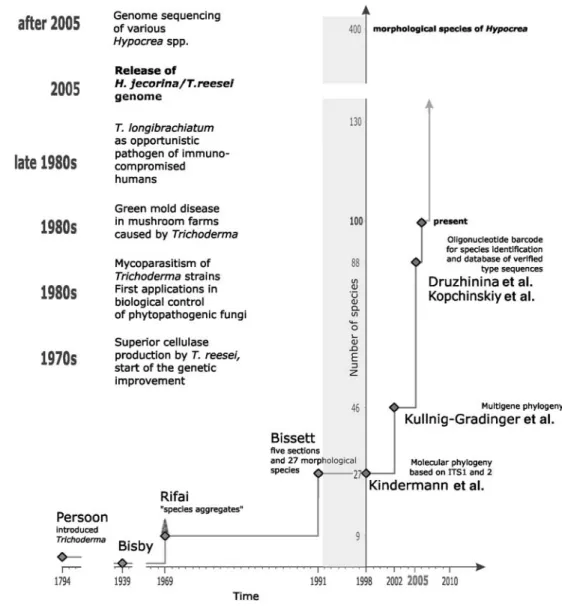
The generic name Trichoderma was introduced more than 200 years ago by Persoon (1794) on the basis of mate-rial collected in Germany (Fig. 1). He included four species in the genus, but only one, Trichoderma viride, actually proved to be Trichoderma based on subsequent investiga-tions. Seventy years later Tulasne and Tulasne (1860) deter-mined that T. viride is the asexual stage of Hypocrea rufa. The fact that this relationship is still true today renders their finding a milestone in the taxonomy of conidial fungi. Con-tinuing into the early 20th century, additional species of
Trichoderma were described, but because most of these
isolates have not been maintained, their identity is doubtful. Many of those isolates that were kept turned out either to be identical to a described species or not to belong to
Tri-choderma. For example, Abbott (1927) recognized four
Table 1. Distribution of Hypocrea/Trichoderma sequences in NCBI GenBank
Molecularly Unpublished Unaccepted Tentatively Undefined Species Total number characterized species species names identified strains complexes of records
species (confer)
Number of records in NCBI taxonomy browser/Number of core nucleotide sequences
Trichoderma 23/929 7/14 7/62 10/20 246/303 1/144 300/1472
Hypocrea 62/842 8/16 2/5 11/13 19/27 – 103/903a
aThis number does not include 554 core nucleotide sequences for H. lixii and 3836 for H. jecorina. For the latter species, 2407 sequences were obtained from the cellulase overproducing mutant NRRL 6156 (=QM 9414)
1The complete taxonomy of Hypocrea was not considered in this manuscript because it is still partly unresolved. The review is therefore dedicated to the molecular taxonomy of Trichoderma
well-defined groups among the intergrading Trichoderma isolates from soil but distinguished only three species in a key; two of them are now considered to be synonyms of T.
viride. Bisby (1939) therefore reduced all species of Tricho-derma to the single species T. viride, a system that was
followed until 1969. However, the high phenetic diversity of the one-species system prompted John Webster and Mein Rifai to review the taxonomy of Trichoderma and Hypocrea by examining life cycles of Hypocrea species (Rifai and Webster 1966a,b; Rifai 1969). They took the approach that the addition of characters from a teleomorph would help to define the Trichoderma. In a subsequent comprehensive monograph, Rifai (1969) recognized nine aggregate species, some of which were isolated from Hypocrea specimens. It is important to note that Rifai never considered his system to be complete, but emphasized that each of the “aggregate” species, particularly T. hamatum, could indeed contain dif-ferent species which may be distinguishable once appropri-ate methods became available.
A first step toward this direction was done by Bissett (1984, 1991a–c, 1992). He viewed some of Rifai’s aggregate species to be sections, and within those sections, Bissett
recognized biological species. Indeed, many of Bissett’s new species were based on cultures obtained as T. hamatum. He replaced the 9 aggregate species by formally recognizing four sections comprising 27 species (see Fig. 1).
With the availability of DNA analytics for fungal system-atics, Trichoderma researchers quickly incorporated first restriction fragment length polymorphism (RFLP) and ran-dom amplified polymorphic DNA (RAPD), and later on sequence analysis to the developing taxonomy of
Tricho-derma and Hypocrea (for review, see Lieckfeldt et al. 1998).
Work conducted up to 2000, which included the identifica-tion of T. reesei as the anamorph of H. jecorina, the most important Trichoderma species industrially, and a revision of section Longibrachiatum (Kuhls et al. 1996, 1997), mainly used the internal transcribed spacer (ITS) regions of the ribosomal RNA-encoding genes, ITS1 and ITS2. Kindermann et al. (1998) attempted a first phylogeny of the whole genus based on ITS1 sequences. However, following the work on the Gibberella fujikuroi species com-plex (O’Donnell et al. 1998, 2000), researchers felt the need to put their phylogenies on the ground of analysis of several unlinked genes (Taylor et al. 2000). Kullnig-Gradinger et al. Fig. 1. Development of
Trichoderma spp. taxonomy before and after methods of molecular phylogenetics were introduced. Only studies focusing on the entire genus are cited. Gray line indicates the anticipated growth in the number of recognized species in the near future
(2002) pioneered with a phylogeny of all described
Tricho-derma species, based on sequence analysis of ITS1 and -2,
the fifth intron of translation elongation factor 1-alpha (tef1), a partial exon of endochitinase 42 (ech42), and the small subunit of the mitochondrial rRNA-encoding gene. Their work raised the number of species distinguishable by molecular methods to 47. In the following years, the work of Chaverri and Samuels (Chaverri et al. 2003 a,b; Chaverri and Samuels 2004) on green-spored Hypocrea spp. and of Druzhinina and coworkers (Bissett et al. 2003; Kraus et al. 2004; Druzhinina et al. 2005; Jaklitsch et al. 2005) doubled the number of Trichoderma species.
Given that the majority of species were recognized in the “molecular era” of fungal taxonomy, the genus
Tricho-derma is exceptionally well documented by gene sequence
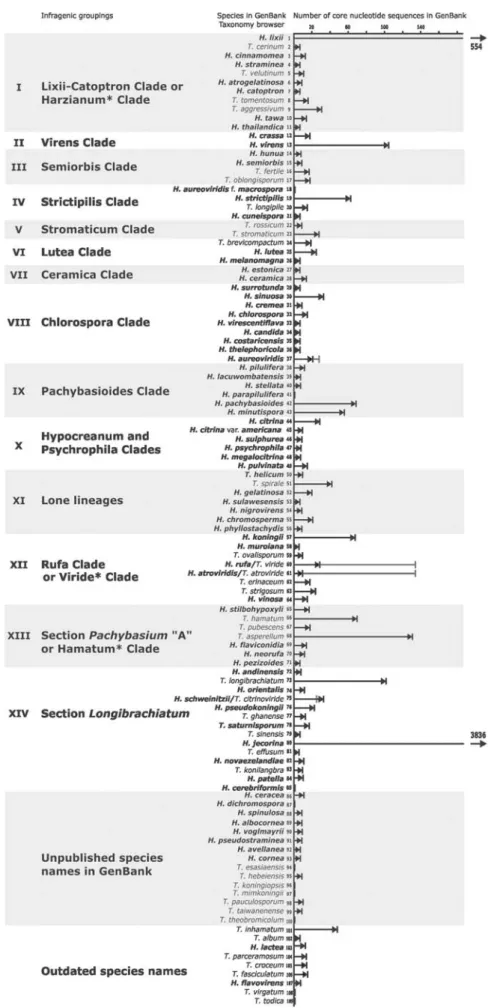
data, as virtually every species is documented with diagnos-tic sequences from at least one to two genes (Fig. 2). When new species for which sequence data are deposited in GenBank but are not yet formally named are included in the enumeration of known diversity, and those of unaccepted species names are removed, 100 species of
Hypocrea/Trichoderma have now been described. Still, we
believe that the rapid rise in the number of phylogenetically distinct species is likely to continue because many of the new species were found in surveys of poorly sampled bio-geographic areas (Siberia, South-East Asia, and Central and South America), whereas the investigation of areas such as Africa, Central Asia, and the Pacific are still missing. In addition to the significant number of “white spots” on the
Trichoderma biogeographic map, the recent
reconsidera-tion of criteria for the recognireconsidera-tion of species has led to the identification of new taxa. Many morphological species (e.g., sensu Bissett 1991a–c) have been shown to contain several cryptic phylogenetic species, and this will likely be the case for many other morphospecies not yet investigated in detail. However, it is important to note that the number of known Trichoderma “morphs” (morphological species) recognized by Bissett has not increased significantly, and they represent only one-third of the known phylogeneti-cally distinct species. Therefore, it poses a challenge to those wishing to identify species of Trichoderma.
Identification of species based on the analysis
of DNA sequences
The classical approach to identify fungi such as
Tricho-derma was based on differences in morphology and growth
characters. However, because of the homoplasy of morpho-logical characters, morphomorpho-logical species recognition is problematical even by specialists. Therefore, published studies on the ecology (Danielson and Davey 1973), enzyme production (Wey et al. 1994; Kovacs et al. 2004), biocontrol (Kullnig et al. 2000), human infection (Gautheret et al. 1995), and secondary metabolite forma-tion (Cutler et al. 1999; Humphris et al. 2002) within
Tricho-derma are difficult to interpret. Consequently, almost all
recent studies have used molecular data to characterize and
identify species (Kullnig et al. 2000; Kubicek et al. 2003; Wuczkowski et al. 2003; Gherbawy et al. 2004; Chaverri and Samuels 2004). With the accumulation of sequence data in GenBank (see above; Fig. 2), using the most popular tool for this purpose, a NCBI similarity search tool (BLAST, Basic Local Alignment Search Tool; http:// www.ncbi.nih.gov/BLAST), researchers are now theoreti-cally able to identify all known species. Unfortunately this approach has several pitfalls because (a) the deposition of sequences within NCBI GenBank has not included a quality control of species identification; (b) some sequences are deposited under the name the species was originally ob-tained and not under the name it has been identified subse-quently; (c) high similarity of sequences does not confirm species identity unless intraspecific variability of this se-quence is known; and (d) even if it is known that a given species may show, e.g., 1% nucleotide (nt) variation, this may not apply to the entire sequence, and nts in some positions may be invariable.
To overcome these problems in the identification of
Tri-choderma by means of gene sequences, the subcommission
for Hypocrea/Trichoderma taxonomy (ISTH) of the Inter-national Commission on the Taxonomy of Fungi (Myco-logical Division of IUMS) has initiated the development of automated methods for species identification in
Tricho-derma based on thoroughly revised and validated sequence
data (www.isth.info). To this end, several tools for sequence analysis were developed and incorporated into the portal. The flowchart in Fig. 3 shows interconnections between various Hypocrea/Trichoderma sequence databases and programs for species identification. Below, we describe these tools individually, and explain the most optimal and up-to-date path through these tools, which should lead the user to a reliable identification of currently known
Hypocrea/Trichoderma species.
TrichO Key: an oligonucleotide barcode for
Hypocrea and Trichoderma
Druzhinina et al. (2005) developed the first fungal oligo-nucleotide barcode for the identification of Hypocrea and
Trichoderma species, TrichOKey version 1.0. The program
provides an online method for the quick molecular identifi-cation of an isolate at the genus, clade, and species levels based on a diagnostic combination of several oligonucle-otides (hallmarks) specifically nested within the internal transcribed spacer 1 and 2 (ITS1 and -2) sequences of the rDNA repeat. The first version of the barcode was devel-oped using 979 sequences of 88 vouchered species contain-ing a total of 135 ITS1 and 2 haplotypes. Oligonucleotides, which were conserved in all known Hypocrea/Trichoderma ITS1 and ITS2 sequences but different in closely related fungal genera, were used to define genus-specific hallmarks.
TrichOKey identifies most species unequivocally, although
five species pairs and one triplet share identical ITS1 and ITS2 sequences and are therefore indistinguishable by the method.
Fig. 2. Hypocrea/Trichoderma species names and number of their core gene sequences deposited in NCBI GenBank and Taxonomy browser. *, Updated clade names proposed by G.J. Samuels (personal communication)
TrichOKey version 1.0 also includes a library of species-,
clade-, and genus-specific hallmarks, which enables the user to check the correctness of results of each of the steps: the detected hallmarks are displayed on both the query and the reference sequence by a barcode visualization module. The start page of the TrichOKEY version 1.0 user interface contains the link to the Hypocrea/Trichoderma biodiversity table, hallmark library, and the database of type sequences used for barcode development. The type sequence of the identified species can be retrieved from the database. More-over, the ITS1 and ITS2 master alignment of Hypocrea/
Trichoderma sequences is available on the same page.
The advantage of TrichOKEY version 1.0 is that it gives an unambiguous result, i.e., it can be applied even by researchers with only little experience in Hypocrea/
Trichoderma taxonomy. The important point, which must
be considered by the user, is the assigned level of identification reliability. For those species that are only known from a single strain, it is charged as “low.” In con-trast, barcodes that have been developed from the inspec-tion of 20 or more sequences from a worldwide collecinspec-tion of isolates provide the most reliable identification (reliability level, “high”). However, a low reliability level does not necessarily negate the result. As an example, sequences for only three isolates of T. oblongisporum are present in our database, but one of these represents the ex-type (Siberia versus Canada; Kullnig et al. 2000). Moreover, the ITS sequences of all three strains share the same species diag-nostic barcodes.
The lack of a reliable ITS barcode for T. koningii/T.
ovalisporum/H. muroiana is a more serious shortcoming.
Studies on the distribution of Trichoderma in different habi-tats (Kullnig et al. 2000; Kubicek et al. 2003; Wuczkowski et al. 2003; Druzhinina et al. 2005; Zhang et al. 2005) have frequently detected strains with the ITS sequence charac-teristic for these three species. Unfortunately, an accurate identification of species in the Rufa Clade (Viride Clade sensu Samuels et al., in manuscript) by other means (e.g.,
tef1 analysis) is still hampered by the fact that species limits
within this clade are under revision, and both T. viride and
T. koningii appear to contain several cryptic species. Some
of these species have the species-specific hallmarks in ITS1 and ITS2 sequences that are sufficient for barcode develop-ment, whereas others share the same allele of this locus. The observed diversity will be integrated in the subsequent version of TrichOKEY (G.J. Samuels and I. Druzhinina, unpublished data).
As already noted, the number of recognized
Tricho-derma species is constantly growing. Moreover, even the
number of morphspecies within Hypocrea exceeds that for
Trichoderma by fourfold. Therefore, it is reasonable to
ex-pect that new species or new ITS1 and ITS2 alleles of known taxa will be discovered. How does TrichOKEY handle unknown sequences? First, it is necessary to rule out that a lack of identification is not caused by a low sequence quality. To check this automatically, TrichOKEY version 1.0 was powered by a special module, which helps to differ-entiate between various reasons leading to the negative species identification (see Fig. 3). For instance, it
distin-guishes cases of truncated fragments when only separate ITS1 or ITS2 sequences were submitted. Moreover, if the query sequence is missing the most diagnostic hallmark area at the beginning of ITS1, the program gives the correspond-ing warncorrespond-ing message and proposes several ways how to overcome the difficulty. In most cases, TrichOKEY version 1.0 also identifies the isolate at the subgenus level, i.e., assigns it to one of several defined clades within Hypocrea/
Trichoderma (cf. Druzhinina and Kubicek 2005). Only if the
unidentified query sequence has passed through all these filters, and it was assigned to Hypocrea/Trichoderma, then the hypothesis of an unknown species can be proposed and tested. In such a case, the next step in species identification should be the search for the next similar sequence and its comparison with the query. Therefore, TrichOKEY version 1.0 is supported by the link to the tool that implements all necessary options (see Fig. 3).
TrichoBLAST: a sequence similarity search tool for
Hypocrea and Trichoderma
BLAST scripts (Altschul et al. 1997) available at NCBI are probably the most popular tools for identification of organisms based on sequence similarity. To eliminate the problems outlined above when using it for Hypocrea/
Trichoderma, Kopchinskiy et al. (2005) developed TrichoBLAST, a publicly available database of vouchered
sequences supported by sequence diagnosis and the similar-ity search tools, which includes all genetically characterized
Trichoderma and Hypocrea species and contains almost
complete sets of the five most frequently used phylogenetic markers: the internal transcribed spacers 1 and 2, ITS1 and ITS2; two introns [tef1_int4(large), tef1_int5(short)] and one exon [tef1_exon6(large)] of the gene encoding transla-tion elongatransla-tion factor 1-alpha (tef1), and a portransla-tion of the exon between the fifth and seventh eukaryotic conserved amino acid motives (Liu et al. 1999) of subunit 2 of the RNA polymerase gene (rpb2_exon). TrichoBLAST is also located on the ISTH website (www.isth.info), and is con-tinuously updated by inclusion of new sequences of more species and/or loci and/or alleles, as they become available (see Fig. 3).
Because there is no consensus in the Trichoderma com-munity about the primers to use for amplification and se-quencing genes such as tef1, there is considerable variation in the length and location of the fragment within the gene of the sequences deposited in public databases under the same gene name. Consequently, the accuracy of a similarity search can be seriously corrupted: for example, if sequences of tef1 containing both the short, highly variable intron and a long portion of the conserved exon are submitted to the similarity search, the “best hit” will be calculated based on the high score for exon–exon alignment while the intron– intron similarity will be neglected. To eliminate this ob-stacle TrichoBLAST is enforced by TrichoMARK (see Fig. 3), which enables the detection and retrieval of phyloge-netic markers in query sequences and their subsequent
indi-vidual submission to the similarity search. The first version of TrichoMARK is able to diagnose ITS1 and ITS2 se-quences as belonging to members of
Hypocrea/Tricho-derma based on genus-specific oligonucleotide sequences at
the 5′- and 3′-end of this locus (Druzhinina et al. 2005) and retrieves the exact area of the ITS1 and ITS2 phylogenetic marker, excluding the flanking regions. In the case of the highly diagnostic tef1 introns, TrichoMARK searches for conserved and genus-specific areas that flank the two in-trons, retrieves each intron individually for the similarity search, and also provides the results with a comparison of the actual and theoretically expected length of the detected phylogenetic marker. Similarly, the program scans for specific oligonucleotide stretches in the tef1 and rpb2 exons, respectively, to retrieve a fragment from the query se-quence that exactly matches that of the corresponding
phy-logenetic marker in TrichoBLAST. Such pre-BLAST sequence diagnosis significantly increases the accuracy of the subsequent similarity search.
After this first step, the user can then automatically transmit the sequence to the similarity search and receive the results in the standard for BLAST way. However, a few general precautions with this approach must be stressed: first, similarity does not represent a sound measure of relatedness (de Queiroz 1992) and will depend on (i) which phylogenetic marker was used and (ii) whether
TrichoBLAST contains the respective sequences for all
known species. In this regard, we note that ITS1 and ITS2 are very diagnostic and are unique with the exception of the few cases mentioned earlier (all these exceptions are clearly noted in TrichoBLAST results). Cases where the ITS1 and ITS2 sequences do not exactly match any record in the Fig. 3. Flowchart showing the optimal sequence of steps in the
molecu-lar identification of Hypocrea/Trichoderma species using tools avail-able at the www.isth.info portal. The * indicates that the degree of
similarity sufficient for species identification differs depending on the locus employed
database, but differ by one or a few nucleotides, are either indicative of an unknown allele of a known species or very likely represent a new species. To confirm the species identification in such a case, a similarity search in
TrichoBLAST should be done for other phylogenetic
mark-ers and/or the multiloci phylogenetic analysis. In the case of the two tef1 introns, the situation is ambiguous, as sequence identities are rare because the high level of intraspecific variability within them (Chaverri et al. 2003a; Druzhinina et al. 2004).
Under the precautions given above and listed in Kopchinskiy et al. (2005), matches of lesser extent are in-dicative of relatedness at best; however, hypotheses of rela-tionships should not be inferred directly from similarity indices in BLAST, but must be based on the application of phylogenetic inference methods instead (see following). To facilitate this, the third interactive module on www.isth.info was developed (see Fig. 3), i.e., a publicly available Multiloci Database of Phylogenetic Markers (MDPM; Kopchinskiy et al. 2005). This database contains only records exactly corresponding to five selected phyloge-netic markers, which after manual retrieval and alignment with published sequences were trimmed to exactly fit the TrichoBLAST formats and thus can be used directly for phylogenetic analysis together with the sequence(s) in question.
Trichoderma species identification based on
genealogical concordance
Despite the fact that the majority of Trichoderma isolates are easily identified by TrichOKey and TrichoBLAST, there will be cases where the sequence does not match that of an existing species, thus suggesting the presence of a putative newly discovered species. The most correct ap-proach would then be to apply Genealogical Concordance Phylogenetic Species Recognition (GCPSR; Taylor et al. 2000) to investigate species limits. It requires the analysis of phylogenies of several unlinked genes, and further requires that the position of a phylogenetically distinct species is concordant in at least three of them and not contradicted in the others. GCPSR has not been stringently applied to
Hypocrea/Trichoderma: Kullnig-Gradinger et al. (2002; see
earlier) because of insufficient phylogenetic resolution in the genes that were used. Similar problems were faced by Chaverri et al. (2003a) and Chaverri and Samuels (2004) using rpb2 and tef1 exon sequences to distinguish phyloge-netic species within the green-spored Hypocrea spp. This problem has recently been discussed in detail by Druzhinina and Kubicek (2005). Among 11 gene loci or fragments tested in Hypocrea/Trichoderma, the most promising ones appear to be the 4th and 5th introns of translation elonga-tion factor 1-alpha (tef1, ∼EF-1α,), and the coding portions of endochitinase 42 (ech42). Resolution of some clades can be obtained by the use of rpb2 and the ITS1 and ITS2 diagnostic regions. Most of the other genes/loci tested pro-vided only poor resolution, and thus the optimal
combina-tion of loci for all infrageneric groups of
Hypocrea/Tricho-derma allowing a straightforward application of GCPSR
has not yet been found. A search for new phylogenetic markers in Trichoderma is therefore highly warranted.
Finally, we would like to outline our preferred phyloge-netic approach to identify phylogephyloge-netic species. So far, most workers have employed the maximum-parsimony method to analyze sequence data, which does not employ a model-ing of evolution and therefore poses several problems when investigating either very closely or very distantly related taxa (see Salemi and Vandamme 2003; and references therein). Maximum-likelihood methods are adequate but suffer from the long computation time they usually require. For this purpose, the Bayesian approach to phylogenetic inferences represents the most recent advance in phyloge-netic analysis (Rannala and Yang 1996; Huelsenbeck and Ronquist 2001; Lutzoni et al. 2001). Bayesian approaches have been introduced in the analysis of phylogenies of other genera and have also recently been applied to Hypocrea/
Trichoderma (Chaverri et al. 2003a; Druzhinina et al. 2004).
When combined with rigorous testing of evolutionary mod-els and the choice of an appropriate gene/locus, this method yields excellent resolution even for difficult to resolve clades (Samuels et al., manuscript submitted; Druzhinina et al., manuscript in preparation).
Trichoderma species identification using
molecular data
As shown, Trichoderma taxonomy is a difficult issue. The abundant homoplasy in morphological and phenetic characters is likely the reason, which helps to explain why the number of morphologically distinct species has re-mained constant over time, whereas the number of phyloge-netic species has rapidly reached 100, and it is expected to keep growing. In this review, we have attempted to intro-duce to the scientific community the recent effort in the development of modern tools for Trichoderma species iden-tification. It has put these fungi in the privileged position that all its known species can be identified by the applica-tion of the very simple to perform polymerase chain reac-tion (PCR) technique, DNA sequencing, and user-friendly bioinformatics tools. This is a situation that is not yet true for most of the other fungal genera. Although online data-bases for identification of selected fungal groups such as ectomycorrhiza (UNITE, http://unite.zbi.ee for identifi-cation of ectomycorrhizal fungi) or Fusarium spp. (FUSARIUM-ID version 1.0; Geiser et al. 2004) are avail-able, they only use sequences from a single locus, and they do not contain additional tools enabling the user to retrieve the respective sequences for subsequent phylogenetic analysis. With the tools described in this review, virtually every scientist working with Trichoderma can now reliably identify species using DNA sequence data. We believe that this will lead to the accumulation of a large amount of data on this genus, thereby advancing our understanding of its biology, ecology, and applied value in more detail.
Acknowledgments This work was supported in part by the Austrian Science Fund grants P-12748-MOB and FWF P-16601.
References
Abbott EV (1927) Taxonomic studies on soil fungi. Iowa State Coll J Sci 1:15–36
Altschul SF, Madden TL, Schäffer AA, Zhang J, Zhang Z, Miller W, Lipman DJ (1997) Gapped BLAST and PSI-BLAST: a new genera-tion of protein database search programs. Nucleic Acids Res 25:3389–3402
Bisby GR (1939) Trichoderma viride Pers. ex Fries, and notes on Hypocrea. Trans. Br Mycol Soc 23:149–168
Bissett J (1984) A revision of the genus Trichoderma. I. Sect. Longibrachiatum sect. nov. Can J Bot 62:924–931
Bissett J (1991a) A revision of the genus Trichoderma. II. Infrageneric classification. Can J Bot 69:2357–2372
Bissett J (1991b) A revision of the genus Trichoderma. III. Sect. Pachybasium. Can J Bot 69:2373–2417
Bissett J (1991c) A revision of the genus Trichoderma. IV. Additional notes on section Longibrachiatum. Can J Bot 69:2418–2420 Bissett J (1992) Trichoderma atroviride. Can J Bot 70:639–641 Bissett J, Szakacs G, Nolan CA, Druzhinina IS, Kullnig-Gradinger
CM, Kubicek CP (2003) Seven new taxa of Trichoderma from Asia. Can J Bot 81:570–586
Chaverri P, Castlebury LA, Samuels GJ, Geiser D (2003a) Multilocus phylogenetic structure within the Trichoderma harzianum/Hypocrea lixii complex. Mol Phylogenet Evol 27:302–313
Chaverri P, Castlebury LA, Overton BE, Samuels GJ (2003b) Hypocrea/Trichoderma: species with conidiophore elongations and green conidia. Mycologia 95:1100–1140
Chaverri P, Samuels GJ (2004) Hypocrea/Trichoderma (Ascomycota, Hypocreales, Hypocreaceae): species with green ascospores. Stud Mycol 48:1–116
Cutler HG, Cutler SJ, Ross SA, Sayed KE, Dugan FM, Bartlett MG, Hill AA, Hill RA, Parker SR (1999) Koninginin G, a new metabolite from Trichoderma aureoviride. J Nat Prod 62:137–139
Danielson R, Davey C (1973) The abundance of Trichoderma propagules and the distribution of species in forest soils. Soil Biol Biochem 5:485–494
de Queiroz K (1992) Phylogenetic definitions and taxonomic philoso-phy. Biol Philos 7:295–313
Druzhinina I, Chaverri P, Fallah P, Kubicek CP, Samuels GJ (2004) Hypocrea flaviconidia, a new species from Costa Rica with yellow conidia. Stud Mycol 50:401–407
Druzhinina I, Koptchinski A, Komon M, Bissett J, Szakacs G, Kubicek CP (2005) An oligonucleotide barcode for species identification in Trichoderma and Hypocrea. Fungal Genet Biol 42:813–828 Druzhinina I, Kubicek CP (2005) Species concepts and biodiversity in
Trichoderma and Hypocrea: from aggregate species to species clus-ters? J Zhejiang Univ Sci 6:100–112
Gautheret A, Dromer F, Bourhis JH, Andremont A (1995) Tricho-derma pseudokoningii as a cause of fatal infection in a bone marrow transplant recipient. Clin Infect Dis 20:1063–1064
Geiser DM, Jiménez-Gasco M, Kang S, Makalowska I, Veerarahavan N, Ward TJ, Zhang N, Kuldau GA, O’Donnell K (2004) FUSARIUM-ID v. 1.0: a DNA sequence database for identifying Fusarium. Eur J Plant Pathol 110:473–479
GherbawyY, DruzhininaI, ShabanGM, WuczkowskyM, YaserM, El-NaghyMA, PrillingerHJ, KubicekCP (2004) Trichoderma popula-tions from alkaline agricultural soil in the Nile valley, Egypt, consist of only two species. Mycol Prog 3:211–218
Harman GE, Howell CR, Viterbo A, Chet I, Lorito M (2004) Tricho-derma species – opportunistic, avirulent plant symbionts. Nat Rev Microbiol 2:43–56
Heckman DS, Geiser DM, Eidell BR, Stauffer RL, Kardos NL, Hedges SB (2001) Molecular evidence for the early colonization of land by fungi and plants. Science 293:1129–1133
Hjeljord L, Tronsmo A (1998) Trichoderma and Gliocladium in bio-logical control: an overview. In: Harman GE, Kubicek CP (eds) Trichoderma and Gliocladium, vol 2. Enzymes, biological control and commercial applications. Taylor & Francis, London, pp 131–151
Huelsenbeck JP, Ronquist F (2001) MRBAYES: Bayesian inference of phylogenetic trees. Bioinformatics 17:754–755
Humphris SN, Bruce A, Buultjens E, Wheatley RE (2002) The effects of volatile microbial secondary metabolites on protein synthesis in Serpula lacrymans. FEMS Microbiol Lett 210:215–219
Jaklitsch WM, Komon M, Kubicek CP, Druzhinina IS (2006) Hypocrea voglmayrii sp. nov. from the Austrian Alps represents a new phylo-genetic clade in Hypocrea/Trichoderma. Mycologia in press Kindermann J, El-Ayouti Y, Samuels GJ, Kubicek CP (1998)
Phylog-eny of the genus Trichoderma based on sequence analysis of the internal transcribed spacer region 1 of the rDNA clade. Fungal Genet Biol 24:298–309
Klein D, Eveleigh DE (1998) Ecology of Trichoderma. In: Kubicek CP, Harman GE (eds) Trichoderma and Gliocladium, vol 1. Basic biol-ogy, taxonomy and genetics. Taylor & Francis, London, pp 57–73 Kopchinskiy A, Komon M, Kubicek CP, Druzhinina IS (2005)
TrichoBLAST: a multiloci database of phylogenetic markers for Trichoderma and Hypocrea powered by sequence diagnosis and similarity search tools. Mycol Res 109:658–660
Kovacs K, Szakacs G, Pusztahelyi T, Pandey A (2004) Production of chitinolytic enzymes with Trichoderma longibrachiatum IMI 92027 in solid substrate fermentation. Appl Biochem Biotechnol 118:189– 204
Kraus G, Druzhinina I, Bissett J, Prillinger HJ, Szakacs G, Koptchinski A, Gams W, Kubicek CP (2004) Trichoderma brevicompactum sp. nov. Mycologia 96:1059–1073
Kredics L, Antal Z, Doczi I, Manczinger L, Kevei F, Nagy E (2003) Clinical importance of the genus Trichoderma. A review. Acta Microbiol Immunol Hung 50:105–117
Kubicek CP, Bissett J, Druzhinina IS, Kullnig-Gradinger CM, Szakacs G (2003) Genetic and metabolic diversity of Trichoderma: a case study on South East Asian isolates. Fungal Genet Biol 38:310–319 Kubicek CP, Penttilä ME (1998) Regulation of production of plant
polysaccharide degrading enzymes by Trichoderma. In: Harman GE, Kubicek CP (eds) Trichoderma and Gliocladium, vol 2. Enzymes, biological control and commercial applications. Taylor & Francis, London, pp 49–71
Kuhls K, Lieckfeldt E, Samuels GJ, Kovacs W, Meyer W, Petrini O, Gams W, Börner T, Kubicek CP (1996) Molecular evidence that the asexual industrial fungus Trichoderma reesei is a clonal derivative of the ascomycete Hypocrea jecorina. Proc Natl Acad Sci USA 93:7755–7760
Kuhls K, Lieckfeldt E, Samuels GJ, Meyer W, Kubicek CP, Börner T (1997) Revision of Trichoderma section Longibrachiatum including related teleomorphs based on an analysis of ribosomal DNA internal transcribed spacer sequences. Mycologia 89:442–460
Kullnig CM, Szakacs G, Kubicek CP (2000) Molecular identification of Trichoderma species from Russia, Siberia and the Himalaya. Mycol Res 104:1117–1125
Kullnig-Gradinger CM, Szakacs G, Kubicek CP (2002) Phylogeny and evolution of the fungal genus Trichoderma: a multigene approach. Mycol Res 106:757–767
Lieckfeldt E, Kuhls K, Muthumeenakshi M (1998) Molecular tax-onomy of Trichoderma and Gliocladium and their teleomorphs. In: Kubicek CP, Harman GE (eds) Trichoderma and Gliocladium, vol 1. Basic biology, taxonomy and genetics. Taylor & Francis, London, pp 35–74
Linnaeus C (1703) Systema naturae. Halae Magdesburgicae. Lu B, Druzhinina I, Fallah P, Chaverri P, Gradinger C, Kubicek CP,
Samuels GJ (2004) Hypocrea/Trichoderma species with pachybasium-like conidiophores: teleomorphs for T. minutisporum and T. polysporum, and their newly discovered relatives. Mycologia 96:310–342
Lutzoni F, Pagel M, Reeb V (2001) Major fungal lineages are derived from lichen symbiotic ancestors. Nature (Lond) 411:937–940 Nelson EE (1982) Occurrence of Trichoderma in a Douglas-fir soil.
Mycologia 74:280–284
O’Donnell K, Cigelnik E, Nirenberg HI (1998) Molecular systematics and phylogeography of the Gibberella fujikuroi species complex. Mycologia 90:465–493
O’Donnell K, Nirenberg HI, Aoki T, Cigelnik E (2000) A multigene phylogeny of the Gibberella fujikuroi species complex: detection of additional phylogenetically distinct species. Mycoscience 41:61–78 Penttilä ME (1998) Heterologous protein production in Trichoderma.
vol 2. Enzymes, biological control and commercial applications. Taylor & Francis, London, pp 356–383
Persoon CH (1794) Disposita methodical fungorum. Römers Neues Mag Bot 1:81–128
Rannala B, Yang Z (1996) Probability distribution of molecular evolu-tionary trees: a new method of phylogenetic interference. J Mol Evol 43:304–311
Rifai MA (1969) A revision of the genus Trichoderma. Mycol Pap 116:1–56
Rifai MA, Webster J (1966a) Culture studies of Hypocrea and Tricho-derma II. H. aureoviridis and H. rufa f. sterilis f. nov. Trans Br Mycol Soc 49:289–296
Rifai MA, Webster J (1966b) Culture studies on Hypocrea and Tricho-derma III. H. lactea (=H. citrina) and H. pulvinata. Trans Br Mycol Soc 49:297–310
Salemi M, Vandamme A (2003) The phylogenetic handbook. A prac-tical approach to DNA and protein phylogeny. Cambridge Univer-sity Press, Cambridge
Samuels GJ (1996) Trichoderma: a review of biology and systematics of the genus. Mycol Res 100:923–935
Sivasithamparam K, Ghisalberti EL (1998) Secondary metabolism in Trichoderma and Gliocladium. In: Kubicek CP, Harman GE (eds) Trichoderma and Gliocladium, vol 1. Basic biology, taxonomy and genetics. Taylor & Francis, London, pp 139–191
Taylor JW, Jacobson DJ, Kroken S, Kasuga T, Geiser DM, Hibbett DS, Fisher MC (2000) Phylogenetic species recognition and species concepts in fungi. Fungal Genet Biol 31:21–32
Taylor JW, Spatafora J, O’Donnell K, Lutzoni F, James T, Hibbett DS, Geiser D, Bruns TD, Blackwell M (2004) The Fungi. In: Cracraft J, Donoghue MJ (eds) Assembling the tree of life. Oxford University Press, New York, pp 171–194
Thrane U, Poulsen SB, Nirenberg HI, Lieckfeldt E (2001) Identifica-tion of Trichoderma strains by image analysis of HPLC chromato-grams. FEMS Microbiol Lett 203:249–255
Tulasne L, Tulasne R (1860) De quelques Sphéries fungicoles, à propos d’un mémoire de M. Antoine de Bary sur les Nyctalis. Ann Sci Nat Bot 13:5–19
Wey TT, Hseu TH, Huang L (1994) Molecular cloning and sequence analysis of the cellobiohydrolase I gene from Trichoderma koningii G-39. Curr Microbiol 28:31–39
Widden P, Abitbol JJ (1980) Seasonality of Trichoderma species in a spruce-forest soil. Mycologia 72:775–784
Wuczskowski M, Druzhinina IS, Gherbawy Y, Klug B, Prillinger HJ, Kubicek CP (2003) Taxon pattern and genetic diversity of Tricho-derma in a mid-European, primeval floodplain-forest. Microbiol Res 158:125–134
Zhang CL, Druzhinina IS, Kubicek CP, Xu T (2005)Biodiversity of Trichoderma in China: evidence for a North to South difference of species distribution in East Asia. FEMS Microbiol Lett 251:251– 257