2018
More Than Fun and Games: Changing Library
Perceptions Through Outreach Efforts
Maureen Rust
James E. Brooks Library, Central Washington University, [email protected] Elizabeth Brown
Central Washington University, [email protected]
Follow this and additional works at:https://scholarsarchive.library.albany.edu/jlams Part of theLibrary and Information Science Commons
This Peer Reviewed Article is brought to you for free and open access by Scholars Archive. It has been accepted for inclusion in JLAMS by an authorized editor of Scholars Archive. For more information, please [email protected].
Recommended Citation
Rust, Maureen and Brown, Elizabeth (2018) "More Than Fun and Games: Changing Library Perceptions Through Outreach Efforts,"
JLAMS: Vol. 14 : Iss. 1 , Article 2.
Author Information
Maureen Rust is the Student Engagement and Community Outreach Librarian at the James E. Brooks Library of Central Washington University, where she is responsible for developing and promoting library outreach programming for the student, campus, and greater Ellensburg (Washington) community. Rust received her Bachelors in Liberal Arts from the University of Alaska Southeast, and her Masters in Library and Information Studies from the University of Rhode Island. Prior to joining the Brooks faculty, Rust served as the school librarian at a 6-12 grade secondary school in southeastern Connecticut. Elizabeth H. Brown is the Instruction Coordinator at Brooks Library of Central Washington University where she oversees library instruction and coordinates the library’s minor in Library and Information Science. She has presented to regional, national, and international audiences on topics of instruction. Brown obtained her MLIS from the University of Illinois at Urbana-Champaign.
Introduction
On public university campuses across the country, there is a climate of decreased state funding and increased competition for student recruitment, retention, and progression toward degree completion. Additionally, the prolific availability of instant information via Google searches supports the impression of decreased reliance on traditional academic library services and resources. To accommodate the first phenomena, and to counteract the second, formal outreach programs at academic libraries have been developing at a rapid rate. Yet assessing how
successfully these programs are meeting their objectives has proven to be a slippery endeavor. This study investigates what effect one academic library’s outreach efforts have had on campus perceptions of the library, its resources, and the services it provides. This particular academic library is at a Master’s granting regional comprehensive public university, with a current enrollment of approximately 12,000. A tremendous amount of resources have been directed to the library’s outreach efforts in the past five years. Is it possible to assess if the university community’s perception of library relevance has changed after increased student exposure via instruction, engagement, embedded librarian efforts, branded marketing, and an increased social media presence? Can library outreach increase awareness of library resources and influence library use among students and faculty? Understanding the relationship between changing stakeholders perceptions of the library and demonstrating the relevance of these perceptions can inform our methods for illustrating library value. Offhand comments and compliments from students and faculty alike indicate that library outreach efforts are making a positive difference in terms of library perceptions and use. This study attempts to offer support for this hypothesis, using both qualitative and quantitative methods.
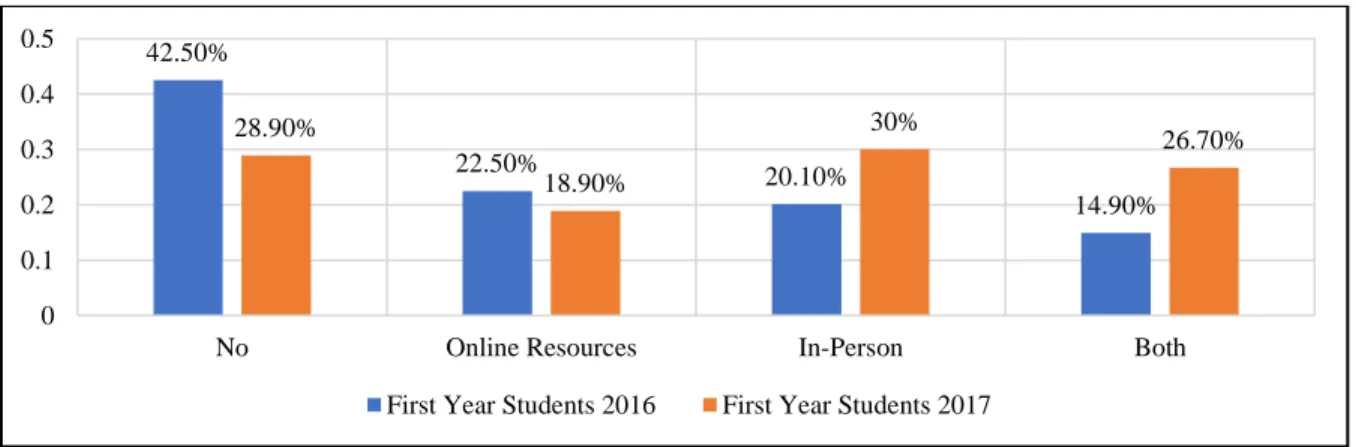
The impetus for this research came in the form of an email from the Sophomore Year Experience Assistant Director. At the library’s request, he had added a question about student library use to the annual MapWorks (Making Achievement Possible) student survey. Tabulation of the 2017 results indicated first-year student use of library resources had increased significantly (Figure 1). Was this due, at least in part, to increased outreach efforts? Was outreach having the same effect on faculty and staff, in terms of heightened awareness and use of the library’s resources?
Figure 1. Student responses to the question “Have you accessed the university library?” Question conducted with “select all” settings and question totals do not equal 100. E. Scott, personal correspondence, November 2017
42.50% 22.50% 20.10% 14.90% 28.90% 18.90% 30% 26.70% 0 0.1 0.2 0.3 0.4 0.5
No Online Resources In-Person Both
Literature Review
Research regarding aspects of academic library outreach assessment and analyses is a flourishing genre. Library support for faculty, student retention and progress toward degree completion are some of the issues addressed in this research. (Alapo, 2013; Association of College and Research Librarians, 2017; Farrell & Mastel, 2016; German & LeMire, 2017; Murray & Ireland, 2017; Oakleaf & Kyrillidou, 2016). Despite the wealth of related scholarship, there is little published assessment of student and faculty perceptions of the academic library following concerted outreach efforts. However, scholarship confirms the inherent value of library outreach to its campus community. Increased awareness of library resources benefit students in their coursework and improves student retention among library users. Additional library actions proven to have positive affects on student learning include participation in successful campus collaborations, information literacy instruction on general education outcomes, and one-on-one research consultations (Association of College and Research Libraries, 2017).
Soria (2013) found that 71.3% of the students surveyed reported access to a world-class library collection was important, very important, or essential. Soria recommends that library outreach efforts to undergraduate students should not solely focus on evaluating or imparting the value of library resources and services directly, and suggests other methods such as campus partnerships with student success departments and strategic marketing campaigns. Employing methods designed to “reduce the potential bias found within students’ self-selection to use specific library resources” (p.7), Soria, Fransen and Nackerud (2017) studied the “perceived importance of the role of the library in helping undergraduate students develop research, critical analysis, and information literacy skills” (p. 6) and concluded: “The results of this study suggest that first-year students who used a library resource at least once were significantly more likely than their peers who did not use the library to report development of critical thinking and analytical skills, written communication skills, and reading comprehension skills” (p. 14), reinforcing the importance of reaching out to students and encouraging them to see the library as a welcoming, supportive environment.
In a study gauging perceptions of library student workers, Brenza et al. (2015) concluded their level of familiarity resulted in an increased awareness of library resources. Nitecki and Abels (2017) assessed faculty perceptions of a library at a small university and learned that faculty value the library for how well it meets their ability to accomplish five “root causes”: increased productivity, expanded student access to information; “to do my job”; save money; and indulge intellectual curiosity. Murray & Ireland (2018) researched how university provosts perceive academic library value and found a need for “continued effort to link library services and
resources to initiatives of institutional priority” to increase campus awareness of the benefits the library provides to the campus community and the role it plays in terms of student recruitment and retention (p. 350).
In order to increase awareness of library services, Welburn, Welburn and McNeil (2010) encourage academic libraries to develop advocacy with both faculty and students. Oakleaf and Kyrillidou (2016) expand beyond the campus gates, prodding academic libraries to “begin by casting a wide net, exploring the needs and goals of their overarching institution, as well as other organizations and communities they serve” (p. 758).
Academic libraries are becoming more collaborative with faculty and students, facilitating the development of support and resources more in line with the users’ actual needs (Delaney & Bates, 2015; Henderson, 2016; Young & Kelly, 2017). Collaboration with non-academic departments on campus provide a multitude of benefits, such as increased interaction with students, and sharing effort and cost (Wainwright & Davidson, 2017).
Return on investment (ROI) analyses in the context of academic libraries have been reported on by Pan et al. (2013) and Tenopir (2011). Pan et al. quantified the ROI between funding the library collection and faculty scholarship, while Tenopir reports on a measure between institution financial investment in the library to the demonstrated return the library gives back to the
institution. However, research to gauge the ROI of library outreach efforts to increased faculty and student positive perceptions of the library proved difficult to find. This study was intended not to assess impact of outreach on outcomes such as student retention or the usage of the library collection, but to quantify library outreach impact on user engagement and perceptions of the library and its resources.
Instruction and Outreach Overview
Library Instruction
Measures of library instruction at the subject institution have demonstrated an increase over the past four years with the adoption of standardized information literacy for all orientation courses and more strategic embedded librarian efforts. In the fall of 2014, the library developed and hired a dedicated instruction coordinator responsible for oversight of instruction efforts. Following the summer of 2015, the library undertook a standardized approach to information literacy
instruction for first year students (Brown, 2017). Prior to this standardized approach to
instruction, librarians had accommodated instruction requests on an as needed basis without the assistance of a dedicated role to help with instruction oversight or coordination. Along with standardizing instruction delivery and redefinition of course goals, the new implementation involved a flipped model for instruction with online content, a pre-test and post-test, and in-person class activities building in more opportunities for student engagement. This positively influenced student experiences and after the first year of instruction, increased buy-in from orientation course instructors who were pleased with the changes to the curriculum and excited to continue partnering with the library for future years.
Between the 2013/14 academic year and the 2016/17 academic year, instruction increased from reaching 2,675 students a year to 4,614 (72% increase). The convergence of changes in
instructional staff, a strategic design plan for instruction, creation of embedded librarian goals, and the establishment of instructional goals can be attributed to placing new design efforts on information literacy instruction. In addition to measuring usage trends of instruction, in 2016 the instruction unit started using a standard assessment of student learning and perspectives after a sample of instruction sessions. Consisting of 10 questions, students were asked 3 questions about library content and 1 question about how much they valued the library session. The combined results of these questions demonstrated that for the sample population assessed (174 students were assessed), 95% indicated after instruction that they agreed or strongly agreed they knew what library resources were available to them and felt prepared to use the library catalog. When asked to rank the overall value of the instruction session, 90% indicated the value was either
“good” or “excellent”. In looking at instruction efforts overall, increased trends in library instruction could be most closely tied to changes in the library instruction program.
Library Engagement and Outreach
Library engagement and outreach efforts prior to the 2015 establishment of the Student Engagement and Community Outreach (SECO) librarian position fell to faculty and staff who had to shoehorn in programming among their other, higher priority tasks and responsibilities. Nevertheless, by 2013 the library had started to increase its visibility with programs such as participation in summer and fall orientations, resource tables at campus events, a Banned Book table at the community farmers market, International Games Day, quarterly all-you-can-eat waffle nights during finals week, and an annual Gala fundraiser. The 2015 advent of a SECO librarian dedicated specifically to engagement and outreach provided a person to oversee established events, further develop engagement and outreach activities, and implement an outreach tracking system. New programming included a “Welcome Back, Students” library information give-away, therapy dogs each finals week, monthly game nights, quarterly book discussions, mid-term “long nights against procrastination,” and an annual Wikipedia edit-a-thon. Simultaneously, other library faculty continued to develop new programs such as bilingual poetry readings, regional archives and museums tours, Blind Date with a Book, a #lovemyFDL campaign organized by the Government Publications and Services unit, and two National Endowment for the Arts Big Read programs.
One continued method of engaging with students on a weekly basis has been through the use of a whiteboard question in the library entryway. During the early stages of testing out the
whiteboard questions, few students stopped to write a response, or treated the board hesitantly. As the year wore on, students became more active in their responses and the 4x6 foot whiteboard could be full after two days depending on the new question (see Figure 2). During the school year, the whiteboard question has become a casual place to share favorite quotes, best class of the quarter, most recommended book titles, or positive advice during finals. This can also be used as a qualitative method for student feedback on library use and resources. NOTE: not all comments are sincere or appropriate and libraries that choose to implement such a board should plan to monitor the content.
Figure 2. Photos of whiteboard front and back response to “What is your favorite thing about *this* Library?” during National Library Week.
Additional changes to library outreach during the 2013-2018 period include the formal
establishment of an embedded librarian program, the creation and promotion of an institutional repository, the reorganization and promotion of the Government Publications and Services unit, and increased library representation on university committees.
While the library had developed a standardized system for tracking instruction statistics since 2013, by working with an individual from technical services in the library, the SECO Librarian implemented a tracking system specific to outreach efforts. This resulted in a better method of understanding patterns of change in library activities and engagement. Outreach statistics are entered into the tracking system by the organizing faculty or staff member. During the early establishment of the outreach tracking system, due to a lack of standardized data requirements, some events were incorrectly classified, double counted, or never entered. When inconsistencies became apparent, the tracking system was revised and resulted in more standardized options for data entry and better education to staff and faculty about appropriate information to include. Given that some outreach is misrecorded, or never recorded, there is an expected degree of variance in these numbers.
A comparison of the outreach statistics for 2015/16, 2016/17, and 2017/18 reveal an upward trend in outreach activities and participation. Statistics reflected are for the fiscal year July 1 – June 30 in order to consider summer orientation and the library’s involvement with this higher number of first-year and transfer students. In 2015/16, the library recorded 220 separate outreach activities with a total attendance of 11,088, for the 2016/17 year the library saw 276 separate activities and 14,517 total attendance, and 2017/18 with 172 separate outreach activities and 14,462 total attendance. The additional Big Read activities in 2016/17 account for the spike in activities and attendance.
The arrival of the User Experience Librarian in 2015 heralded an expanded social media presence and the establishment of library branding standards and identity. These factored significantly into the library’s increased visibility on campus in both electronic and printed promotion of programming and resources.
Creating a culture of student engagement with the library requires time, along with trial and error to establish approachable avenues for students to engage with the library. When the User
Experience Librarian joined in 2015, they were able to significantly increase student reach on social media through intentional posting and using platforms like Snapchat that are more heavily used by younger generations. While the library didn’t track social media engagement prior to having a User Experience Librarian, the significance of having a librarian dedicated to social media engagement efforts is clear by looking to the numbers in the interim after losing the person in that position. During the 2017/18 academic year, social media responsibilities were reassigned among individuals who had other primary duties. During this period, the effect of making social media outreach a secondary focus was evident and Facebook engagement
decreased by 75%, Snapchat followers decreased by 56%, and Twitter engagement decreased by 79%. As libraries transition or lose staff, it’s often easier to discuss how the loss of a position negatively affects production rather than show it. However, being able to demonstrate through numbers the effect of a dedicated role has proven meaningful to maintaining a place for this position in the library.
Over the past three years, the library has made significant and intentional investments in outreach and engagement ranging widely to include rebranding library promotions, increased marketing, social media engagement, increased programing and library involvement in campus and community events, and many other outreach activities. Changes in instruction have also resulted in increased teaching. Collectively, these increases in activities and involvement on campus can be attributed to the overall increase in patrons reached and impacted.
Methodology Survey of Faculty, Staff, and Administrators
This research examined campus perceptions of the library through a survey developed by the authors. Questions were reviewed by the faculty chair, Human Subject Review Council, and campus survey approval groups prior to distribution. The survey included 14 questions, three of which asked for demographic information, and one used skip logic—only appearing when specific criteria was met. Emailed to all faculty, staff, and administrators, all respondents were informed that their responses were anonymous and their participation was voluntary. Conducted using Qualtrics software, the survey was distributed to 1,744 individuals. The survey was open for 11 days and 319 individuals started the survey, 266 self-selected individuals completed the survey for a response rate of 18% and a completion rate of 15%.
Results
Survey responses represented individual perspectives from 94 departments on campus out of 189 contacted (50%). Departments representing the most responses with nine or more respondents from the department included Academic Advising, English, and Psychology. While 84% of participants chose to identify their department, 16% did not. Therefore, 52 included in the results are not associated with a department. Responses from individuals working in the library were excluded from the analysis. Not all participants answered all questions and totals between questions varied.
When asked how long they had worked at the university, 47% of participants stated that they had worked at the university between 1-4 years, and 31% indicated that they had worked on campus longer than 10 years. The smallest represented group of respondents were those that had worked between 5-10 years at 22%. With regard to roles held on campus, participants represented in the survey were 53% staff, 36% faculty, and 11% administration.
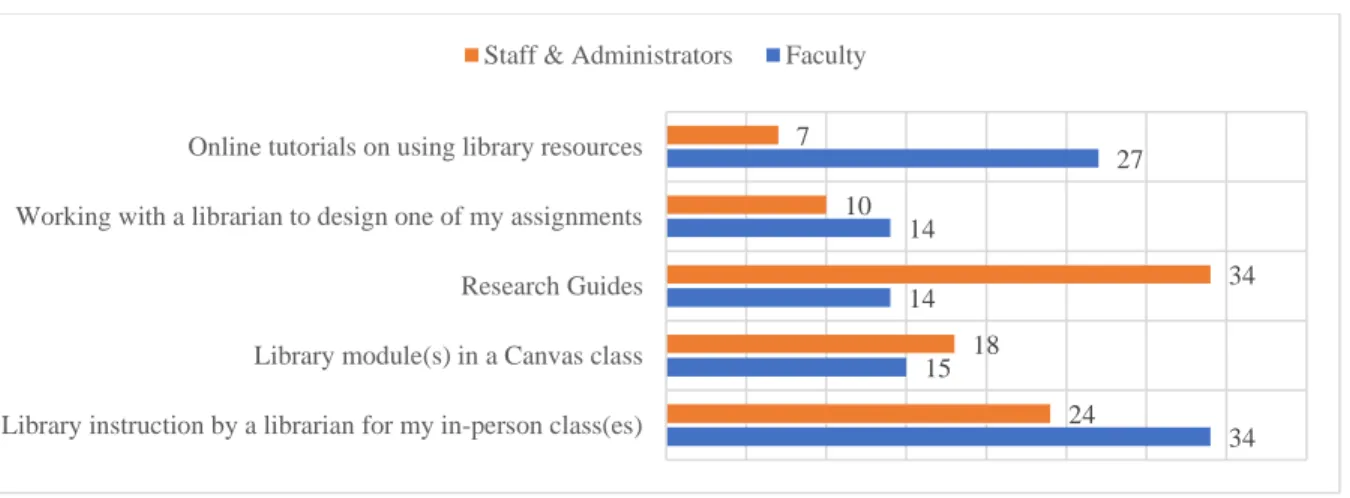
When asked about their use of library instruction, 55% of respondents indicated that they had used one or more of the offered library instruction resources. In comparison to all respondents, faculty tended to use more in-person library instruction for a course (59%), online tutorials (78%), or have worked with a librarian to design course assignments (57%) (see Figure 3). Individuals who were from staff or administration groups indicated more frequent use of library modules in Canvas (55%) or use of research guides in Libguides (71%). The high use of research guides by staff and administration in comparison to faculty may be explained through use of research guides for our library orientation courses taught by campus staff. During the 2016/17
and 2017/18 academic years, library instruction in the orientation course comprised 38% and 39% of all library instruction for the year and follows a lesson that consistently uses a specific libguide. This guide sees the most use of any research guide and may account for the indicated usage by staff.
Figure 3. Use of library instruction resources comparison.
In response to the question about what library resources they use and/or recommend to their students, the general trend among participants was to indicate that they used library resources at a slightly higher rate than they recommended resources to their students (Figure 4). The authors speculate that this may be explained through fewer opportunities to recommend resources to students than use materials themselves, higher resource demands for research or teaching preparation, or forgetting library resources as a recommendable source. When isolating for only faculty, we found that the same trend of use and recommendation was true. The exception to this trend was for “library technology” and “library spaces,” for which participants were more likely to indicate they would recommend them to students than use themselves.
Figure 4. Responses to the question: What library resources have you used and/or recommended to your students? 34 15 14 14 27 24 18 34 10 7
Library instruction by a librarian for my in-person class(es) Library module(s) in a Canvas class Research Guides Working with a librarian to design one of my assignments Online tutorials on using library resources
Staff & Administrators Faculty
57% 55% 63% 59% 51% 54% 58% 45% 47% 43% 45% 38% 41% 49% 46% 42% 55% 53% 0% 10% 20% 30% 40% 50% 60% 70% Books & ebooks Articles & journals DVDs or streaming videos Musical scores or recordings Government documents Library databases Inter-library loan Library technology Library spaces (e.g. study areas, presentation rooms, computer lab) I have used Recommended to students
In comparing faculty use and recommendation to students, with staff and administration use and recommendation habits, we saw similar trends. For most resources, faculty were more likely to use a resource than recommend it to a student. Faculty were 52% more likely to recommend students use library spaces than to actually use spaces themselves. In comparison to faculty, staff and administration were more likely to use resources than recommend them to students. In reviewing group numbers as a whole, staff and administration are quite similar in their levels of use and recommendation patterns. Broken into groups, faculty were 29% more likely to use library resources than staff and administration, and 61% more likely to recommend them. This wasn’t particularly surprising given the nature of work expected by respective groups. Results from two questions are listed in Table 1, numbers are totals.
Table 1
Resource Use by Type and Group
Faculty
Staff &
Administrators Faculty
Staff & Administrators
Have Used Would Recommend
Books & ebooks 74 86 67 53
Articles & journals 82 82 77 59
DVDs or streaming videos 34 36 22 21
Musical scores or recordings 14 24 9 19
Government documents 22 29 24 25
Library databases 69 70 71 47
Inter-library loan 70 63 57 41
Library technology 15 41 25 39
Library spaces (e.g. study areas,
presentation rooms, computer lab) 23 64 44 54
Library instruction 28 16 40 25
In-person reference services 34 19 54 32
Chat reference 7 5 16 11
Library Programs (e.g. poetry readings, book discussions, workshops, Waffle
Night) 11 20 14 41
Family Friendly space and/or Family
Literacy Night 13 17 11 28
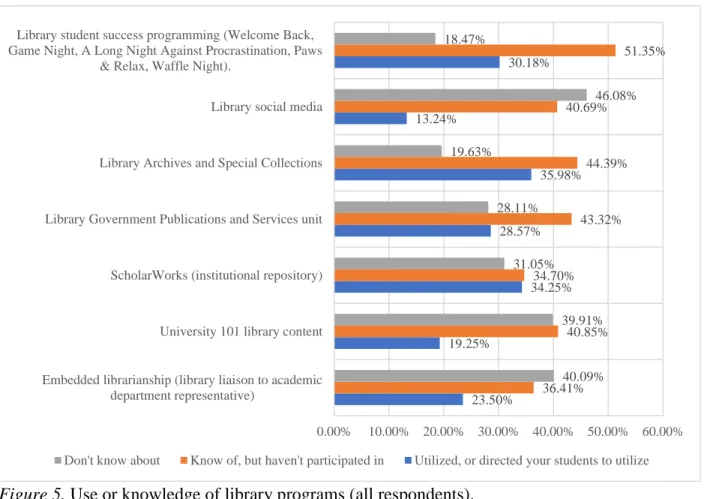
One question asked participants to consider a selection of library services and indicate whether they had “Utilized, or directed your students to utilize,” “Know of, but haven't participated in,” or “Don't know about” (Figure 5). Some of the notable discoveries from this question included that for five of the seven questions, “Know of, but haven't participated in,” was the most chosen response. This response may be for a variety of reasons, and faculty responded differently to some questions than staff and adminstration. The combined average from the categories of “Utilized, or directed your students to utilize” and “Know of, but haven't participated in” was 68%, indicating knowledge of programs or resources, regardless of use. Unsurprisingly, social media ranked lowest for useage and 46% of respondents indicated they didn’t know about it.
Isolating for only faculty, 78% of faculty knew of or had utilized the liaison librarian for their deparment. As part of the embedded librarianship program, each department has a dedicated library liaison who serves as the department’s primary contact to the library on matters of
collection development, instruction, and general questions. Establishing this connection is a continued effort and recognizing that 22% of faculty either didn’t know of or didn’t use their library liaison indicates an area for building further awareness. A few non-academic departments who deliver instruction also have a library representative or liaison, and this likely accounts for the 14% who indicated they utilized, or directed students to consult with a library liaison. One of the most significant results from this question, was that only 18% of respondents indicated they didn’t know about the library student success programming.
Figure 5. Use or knowledge of library programs (all respondents).
When asked about their relationship with the library with regards to developing or offering programs, 36 individuals from the staff and administration group skipped the question and all faculty completed it. Both groups follow the same bell curve with most falling into the category of promoting library programs to the students they serve, but not co-developing programs with the library (Figure 6). Information not gathered by this question was the reason behind why individuals selected “I don’t work with the library to develop co-sponsored programs and don’t promote them to the students I serve.” Of the 23 individuals who indicated “other,” reasons for not promoting or partnering on library programs included: being located at a distance campus, working in a capacity that doesn’t have direct student contact, or lacking the clearance to plan programs. Some of these scenarios may also apply to option 4, but no space was allowed for respondents to indicate why they neither attended or promoted library programs.
23.50% 19.25% 34.25% 28.57% 35.98% 13.24% 30.18% 36.41% 40.85% 34.70% 43.32% 44.39% 40.69% 51.35% 40.09% 39.91% 31.05% 28.11% 19.63% 46.08% 18.47% 0.00% 10.00% 20.00% 30.00% 40.00% 50.00% 60.00% Embedded librarianship (library liaison to academic
department representative)
University 101 library content ScholarWorks (institutional repository) Library Government Publications and Services unit Library Archives and Special Collections Library social media Library student success programming (Welcome Back, Game Night, A Long Night Against Procrastination, Paws
& Relax, Waffle Night).
Figure 6. Relationship with the library regarding developing and/or offering programs.
In addition to the question about program partnerships and promotion, respondents were asked how likely they were to recommend library services or resources to a peer or colleague. To this question, 71% indicated that they were likely or very likely to recommend library services, 19% were indifferent, 7% indicated they were not likely, and only 2% indicated never.
Asked to reflect on prior interactions with the library, respondents were prompted to consider just the past 5 years and whether their use of resources or participation in library events and partnerships has increased. Since the development of the SECO Librarian position and increased partnerships with the library, this question examined whether this may have had an impact on library involvement. Overall, 24% of respondents indicated that their particpation had increased, 10% indicated it decreased—a difference of 13%—52% indicated it stayed the same, and 13% indicated they hadn’t attended, recommended, or partnered on any library events, or used any library resources. Within the group of faculty respondents, as compared to staff and
administration, 5% of faculty and 19% of staff indicated that they hadn’t used any library resources. Given the nature of some staff jobs on campus, it’s unsurprising that they wouldn’t need to use the library; however, it’s worth acknowledging that some library services or events may not be easily recognized as being associated with the library (e.g. cosponsored events, online resources found through Google Scholar, resources made available within their online course).
As a follow up question, respondents were asked to elaborate on why their involvment increased or decreased. In response to the question about decrease, some indicated that they were on a different campus, their job required less use of library resources, and change of priorities. A
6 10 58 24 4 11 14 71 31 19 0 10 20 30 40 50 60 70 80
I frequently work with the library to develop co-sponsored programs
I infrequently work with the library to develop co-sponsored
programs
I don't work with the library to develop co-sponsored programs, but promote them to the
students I serve when applicable
I don't work with the library to develop co-sponsored programs and don't promote them
to the students I serve
Other
number of individuals indicated that there is more access to resources online, or that they used online library resources and didn’t have a need to physically come to the library. Most responses were related to a change in their job resulting in a reduced need for library resources. Even though 10% of respondents indicated their use of library resources had decreased, only 4 out of 25 responses indicated their use of the library had decreased for negative reasons.
Individuals who responded to the question on why their involvement had increased, included a variety of reasons: learning more about what the library offered, good relationships with staff, better advertisement of library resources, being located physically closer to the campus library, noticing a positive effect on student work after library use, partnering with the library on events, pursing a degree/education while working, access of online resources, more meetings being held in the library, increased research or scholarship projects, partnerships with other groups
physically housed in the library, being invited to present for library programs, increased online instruction, and liking the new search engine better.
Discussion
Since the Student Engagement & Community Outreach Librarian position was created and filled in the summer of 2015, the library has significantly increased its efforts and offerings of student success programs. Distinct from library instruction efforts, these programs are attended by interested students or community members and are not a required part of course participation. Promotion efforts started with establishing a library brand identity. This facilitated
standardization and consistency throughout all promotion methods, including printed materials, social media posts, and website presence. Flyers were posted throughout campus, including all residence halls. Events were electronically posted to the library website calendar and campus and off-campus calendar platforms. Additionally, the User Experience librarian invigorated the library social media accounts and expanded forums from Facebook and Instragram to include Twitter and Snapchat. The finding that 82% of respondents indicated they were aware of library student success programming is significant. Reviewing the increases in number of students reached through outreach clearly demonstrates the impact of intentional outreach efforts. Connecting the number of individuals reached with the event knowledge on campus, demonstrate that developing and marketing these events has resulted in a broad campus knowledge of library programming.
Analyzing the resource usage and recommendation patterns uncovered that DVDs and streaming media were the most used resource, and also the least recommended to students. In review of faculty use or recommendation of library instruction and/or in-person reference services, an interesting parallel emerges. In looking at sheer volume of students reached with instruction in the past year (not controling for students who may have received two instruction sessions), approximately 37% of undergraduates received information literacy instruction in the 2017-18 academic year and 27% of faculty surveyed indicated they had used library instruction. The differences in percentage could be accounted for in that faculty teach more students in this comparison. Perhaps more significant, was that 39% of faculty said they would recommend it to their students. For many faculty who didn’t have time or space in their class for library
While libraries everywhere would like 100% of their patrons to know what services are available to them, this is rarely the case. The response that 78% of faculty utilized or knew of their
department library liaison is a significant group, but also means 22% of respondents didn’t even know they had a librarian for their department. This is an area for continuous outreach to work with departments and ensure they are aware of what the library has to offer them.
Through evaluating responses that indicated decreased use of library resources, it became clear that individuals did not see use of online materials as equivalent to use of physical library space. In multiple cases, individuals indicated they weren’t using the library because they were using more online library resources, or online resources (which may or may not have been from the library). While this dicotomy of perspectives is not new to librarians, it illustrates a perception that online resources are not equivalent to using the library.
While the results of this survey tell the story of current perspectives on library outreach, and ask participants to reflect on prior engagement with the library, conclusions could be improved if accompanied by a pre-survey. Given the organic growth of outreach activities, there was not a clear timeline between “no outreach” to “outreach program.” While an assessment of campus perspectives prior to the library’s recognized outreach efforts could have added to this
comparison, that data was never gathered. Questions from this survey regarding changes in library involvement begin to open that discussion. For institutions in the process of designing a dedicated outreach program, considering further research on the pre/post efficacy could benefit the field.
Conclusion
Conclusions from this research suggest the significance of having dedicated staff and faculty roles to manage library outreach and marketing efforts. Campus knowledge of newly developed library programming correllate with revitalized and intentional marketing efforts. In the reverse, transitional staff phases without dedicated roles for social media management can contribute to a decline in engagement on these platforms.
Dedicated faculty roles for oversight of instruction efforts and library outreach have resulted in more coordinated efforts, along with increased reach to patron populations. While student involvement numbers confirm use of programs or instruction, learning from faculty, staff, and administrator perspectives can inform our understanding of how a campus views library efforts or resources. In turn, a better understanding of campus perceptions can be an effective gauge of what and where the library is noticed, and indicators of why it may be underutilized. As libraries engage in discussions of ROI, the findings from this study contribute a campus perspective that reaffirms the benefits of a strategic approach to instruction and outreach from the library.
References
Alapo, L. (2013). Maximizing Value. Retrieved from http://quest.utk.edu/2013/maximizing-value/
Brenza, A., Kowalsky, M., & Brush, D. (2015). Perceptions of students working as library reference assistants at a University Library. Reference Services Review, 43(4), 722–736. https://doi.org/10.1108/RSR-05-2015-0026
Brown, E. (2017). You have one hour: developing a standardized library orientation and evaluating student learning. Education Libraries, 40(1), 3–14. Retrieved from
http://ezproxy.library.arizona.edu/login?url=http://search.ebscohost.com/login.aspx?direct=t
rue&db=llf&AN=128342303&site=ehost-live%0Ahttp://eds.b.ebscohost.com.ezproxy3.library.arizona.edu/ehost/command/detail?vid =5&sid=3eae24c5-d1bc-43af-b961-43184406eabd
Brown, K., & Malenfant, K. (2017). Academic Library Impact on Student Learning and Success: Finding from Assessment in Action Team Projects, (April). Retrieved from
http://www.ala.org/acrl/sites/ala.org.acrl/files/content/issues/value/findings_y3.pdf Delaney, G., & Bates, J. (2015). Envisioning the Academic Library: A Reflection on Roles,
Relevancy and Relationships. New Review of Academic Librarianship, 21(1), 30–51. https://doi.org/10.1080/13614533.2014.911194
Farrell, S. L., & Mastel, K. L. (2016). Considering Outreach Assessment: Strategies, Sample Scenarios, and a Call to Action. In The Library With The Lead Pipe. Retrieved from http://www.inthelibrarywiththeleadpipe.org/2016/considering-outreach-assessment-strategies-sample-scenarios-and-a-call-to-action/
German, E., & Lemire, S. (2017). Sharing the value and impact of outreach: Taking a multifaceted approach to outreach assessment. The Journal of Academic Librarianship. https://doi.org/10.1016/j.acalib.2017.11.001
Henderson, M. (2016). Successful partnerships for academic libraries, 1(1216), 28–54. Murray, A. L., & Ireland, A. P. (2017). Communicating Library Impact on Retention: A
Framework for Developing Reciprocal Value Propositions. Journal of Library Administration, 57(3), 311–326. https://doi.org/10.1080/01930826.2016.1243425 Murray, A., & Ireland, A. (2018). Provosts’ Perceptions of Academic Library Value &
Preferences for Communication: A National Study. College & Research Libraries, 79(3), 336–365. https://doi.org/10.5860/crl.79.3.336
Nitecki, D. A., & Abels, E. G. (2013). Exploring the cause and effect of library value.
Performance Measurement and Metrics, 14(1), 17–24. https://doi.org/10.1108/14678041311316103
Oakleaf, M., & Kyrillidou, M. (2016). The Journal of Academic Librarianship Revisiting the Academic Library Value Research Agenda : An Opportunity to Shape the Future Library Value. The Journal of Academic Librarianship, 42(6), 757–764.
https://doi.org/10.1016/j.acalib.2016.10.005
Pan, D., Wiersma, G., Williams, L., & Fong, Y. S. (2013). More Than
a Number: Unexpected Benefits of Return on Investment Analysis. The Journal of Academic Librarianship, 39(6), 566–572. https://doi.org/10.1016/j.acalib.2013.05.002 Soria, K. M. (2013). Factors Predicting the Importance of Libraries and Research Activities for
Undergraduates. The Journal of Academic Librarianship, 39(6), 464–470. https://doi.org/10.1016/j.acalib.2013.08.017
Soria, K. M., Fransen, J., & Nackerud, S. (2017). The Impact of Academic Library Resources on Undergraduates' Degree Completion. College & Research Libraries, 78(6), 812–823. https://doi.org/10.5860/crl.78.6.812
Tenopir, C. (2011). Beyond usage: measuring library outcomes and value. Library Management,
33(1/2), 5–13. https://doi.org/10.1108/01435121211203275
Wainwright, A., & Davidson, C. (2017). Collaborative Librarianship Academic Libraries and Non-Academic Departments: A Survey and Case Studies on Liaising Outside the Box Academic Libraries and Non-Academic Departments: A Survey and Case Studies on Liaising Outside the Box. Collaborative Librarianship, 9(92), 117–134. Retrieved from https://digitalcommons.du.edu/collaborativelibrarianship%0Ahttps://digitalcommons.du.edu /collaborativelibrarianship/vol9/iss2/9
Welburn, W. C., Welburn, J., & McNeil, B. (2010). Advocacy, outreach, and the nation's academic libraries : a call for action. Advocacy, outreach, & the nation's academic libraries. Chicago, Ill.: Chicago, Ill. : Association of College and Research
Libraries.
Young, B. W., & Kelly, S. L. (2018). How Well Do We Know Our Students? A Comparison of Students’ Priorities for Services and Librarians’ Perceptions of Those Priorities. Journal of Academic Librarianship, 44(2), 173–178. https://doi.org/10.1016/j.acalib.2018.02.010