Education and Human Development Master's
Theses Education and Human Development
Spring 5-13-2017
First Grade Teachers' Literacy Instructional
Practices Influence on the Learning of Elementary
School Students in English Language Arts (ELA)
and Reading
Carole A. Barkin
The College at Brockport, [email protected]
Follow this and additional works at:http://digitalcommons.brockport.edu/ehd_theses
Part of theArt Education Commons,Early Childhood Education Commons, and theElementary Education Commons
To learn more about our programs visit:http://www.brockport.edu/ehd/
This Thesis is brought to you for free and open access by the Education and Human Development at Digital Commons @Brockport. It has been accepted for inclusion in Education and Human Development Master's Theses by an authorized administrator of Digital Commons @Brockport. For more information, please [email protected].
Repository Citation
Barkin, Carole A., "First Grade Teachers' Literacy Instructional Practices Influence on the Learning of Elementary School Students in English Language Arts (ELA) and Reading" (2017).Education and Human Development Master's Theses. 748.
First Grade Teachers’ Literacy Instructional Practices Influence on the Learning
of Elementary School Students in English Language Arts (ELA) and Reading
by
Carole A. Barkin
A thesis submitted to the Department of Education and Human Development at the College at Brockport, State University of New York, in partial fulfillment of the requirements for the degree
of Master of Science in Education. May 13, 2017
Table of Contents Abstract………...5 Introduction………..……….….6 Research Problem………6 Topic………8 Rationale………10 Purpose………...…11 Research Questions………11 Literature Review……….………....12
Technology in the Classroom……….13
E-Books………..14
Multiliteracies and Technology……….……….16
Arts Integration and Literacy………..18
Universal Design for Learning (UDL)………22
Summary of Literature Review………...24
Methodology………..………25
Participants……….……….25
Setting……….26
Positionality as the Researcher………...…27
Methods of Data Collection………28
Initial Semi-Structured Interview………28
Final Semi-Structured Interview……….29
Observational Notes………...29
Procedures……….30
Trustworthiness……….32
Analysis………33
Finding One………..34
Ms. May and Literacy Instruction………35
Ms. Smith and Literacy Instruction………..36
Ms. Tanner and Literacy Instruction………....36
Ms. Wilde and Literacy Instruction………..38
First Grade Teachers and Their Students’ Literacy Needs………...…39
Finding Two………..39
Ms. May’s Instructional Technology Use……….40
Ms. Wilde’s Instructional Technology Use………..41
Ms. Smith’s Instructional Technology Use………..42
Ms. Tanner’s Instructional Technology Use………44
Finding Three………...……46
Ms. Smith’s View on Arts Integration……….46
Ms. Wilde’s View on Arts Integration……….47
Ms. May’s View on Arts Integration………48
Mr. Lloyd’s View on Arts Integration………..…48
Finding Four……….…49
Mirror Words: Call and Response………50
Discussion……….………..……….…………52
Summary of Findings……….53
Conclusions and Implications……….53
Conclusion One………...53
Implication One………..55
Conclusion Two………..57
Implication Two………..57
Limitations………..59
Suggestions for Future Research…….………....60
Overall Significance……….………...……61
References……….………..63
Abstract
This qualitative case study investigated the literacy educational practices of five general education first grade teachers in a charter school in Western New York. Charter schools typically higher teachers with less experience; therefore, the purpose of this study is to explore how first grade teachers in English Language Arts (ELA) and reading modified their literacy instruction to support all students, including, but not limited to, students with a variety of different disabilities. Through semi-structured interviews and classroom observations, this study focused on how specific literacy instructional tools and teaching methods, such as the arts and/or technology, impacted students’ literacy learning.
Introduction
“She wanted everyone to be treated equally, but a lot of other white women didn’t. How did the students stand up by sitting down? What about when other African Americans marched and boycotted?….What did we learn from Helen’s point of view that we didn’t learn before? Turn and talk with your partner about Helen’s point of view….Turn and talk with your partner about why African Americans marched and boycotted.” –Data Excerpt
The preceding is data collected during three observations from Ms. Smith (pseudonym), a first grade teacher at Oakwood Elementary (pseudonym). Ms. Smith asked questions and made reading connections through discussions, such as these, with her students during daily-shared reading time. Ms. Smith used a literacy curriculum written by her school; this means Ms. Smith’s fellow first grade teachers, as well as her school’s literacy specialist, carefully decided these in-depth discussion questions and reading connections on a weekly basis during curriculum writing sessions. Ms. Smith believed these discussion questions went beyond rote-recall and
memorization. She was excited that her students enjoyed reading about historical figures who initiated changes in the world, such as Helen Keller and Martin Luther King. Throughout this research study, I focused on how five first grade teachers changed their literacy instruction to meet the needs of his or her students. Classroom observations and interviews, as mentioned above, provided an in-depth view into each teacher’s literacy instructional methods.
Research Problem
Shared reading lessons, such as the example from Ms. Smith’s class, highlighted a typical first grade literacy lesson at Oakwood Elementary (pseudonym). As a charter school, Oakwood Elementary prides itself on recruiting highly qualified teachers to instruct their students
(“Careers,” 2017). Research has shown the importance of elementary teachers’ ability to identify students’ reading needs early on in order to jump start early literacy intervention (National Institute of Child Health and Human Development, 2000). Oakwood Elementary aligns itself with the idea of early literacy intervention because they believe each teacher should: 1) Possess the ability to analyze student data in order to identify students’ learning needs; 2) Know and apply effective teaching practices; and 3) Differentiate instruction according to students’ needs. (“Careers,” 2017). Since each teacher was required to follow these teaching expectations, I wondered if teachers at Oakwood Elementary were indeed following these guidelines through their English Language Arts (ELA) and reading instruction. In particular, I was interested in how each teacher modified their literacy instruction to meet the literacy needs of his or her general education students, as well as his or her students with a variety of different disabilities. Furthermore, I sought to discover how specific literacy instructional tools and/or teaching methods already used by Oakwood Elementary, such as the arts and/or technology, impacted students’ literacy learning.
According to Exstrom (2012), teachers in charter schools are typically less experienced, with 30% of teachers in their first three years of teaching and 75% teaching for less than ten years. When compared to public school teachers, about 15% are in their first three years of teaching and 43% teaching for less than ten years (Exstrom, 2012). When the No Child Left Behind (NCLB) Act of 2001 was passed, innovative programs, such as charter schools, were endorsed because charter schools were seen as a way to force public schools to raise their academic achievement (Lubienski & Lubienski, 2006). All the teachers in this study are new teachers (e.g., three years or less of teaching experience); therefore, I was interested in discovering how these new teachers navigated their instruction to meet the needs of their
students. Understanding the context of how teachers work in charter schools is relevant because this paper explores how teachers modified their ELA and reading instruction at Oakwood Elementary to meet the literacy needs of their students.
Another important Act to be made aware of is the Individuals with Disabilities Act (IDEA). In 1997, IDEA was amended, resulting in an emphasis on changing the academic content to meet the needs of students with disabilities (“Building the legacy,” 2004; Klein, 2015; Petersen, 2016). Given the following: 1) IDEA emphasis on academic content for students with disabilities; 2) The push for charter schools; and 3) Charter school teachers’ limited teaching experience, I wondered how charter school teachers managed. It is plausible to think that charter school teachers’ inexperience could impact elementary school teachers’ knowledge of effective ELA and reading instructional modifications for all students, including, but not limited to, students with a variety of different disabilities.
Topic
For this study, focused on first grade teachers’ instructional modifications in ELA and reading. Developing solid foundational literacy skills and receiving early reading intervention is vital in the elementary school grades (National Institute of Child Health and Human
Development, 2000; The Annie E. Casey Foundation, 2010). According to The Annie E. Casey Foundation (2010), “Reading proficiently by the end of third grade…can be a make-or-break benchmark in a child’s educational development.” (p. 9). From Kindergarten to third grade, most students are learning to read, but by fourth grade, students are “reading to learn” (The Annie E. Casey Foundation, 2010, p. 9). At Oakwood Elementary, about 16% of students qualify for special education services (“Academics/staff,” 2016); therefore, teachers at Oakwood
Elementary must recognize their students literacy needs (including students with a variety different disabilities) and apply effective literacy instruction.
An effective teacher must have a solid understanding of how to impact each students’ literacy learning needs in his or her classroom (Jensen, 2009). McGee and Richgels (2012) highlight the importance of differentiated literacy instruction in order to meet student’s
individual literacy needs. Teachers must set aside time and explicitly teach literacy skills, such as fluency, phonological awareness, vocabulary, comprehension, and phonics, to his or her students because research has shown that many students will not learn these essential literacy skills without support from adults (Jensen, 2009).
The first grade teachers in this research study instructed students in a general education setting, where the majority of their students were not diagnosed with disabilities. However, some of their students were English as a New Language (ENL) learners or were diagnosed with a variety of different disabilities, such as Attention Deficit Hyperactivity Disorder (ADHD) and Learning Disabilities (LD). Therefore, each teacher, in this study, was potentially in a position to discover meaningful ways to make his or her classroom environment accessible to each student’s specific literacy needs. This study explored various ways in which each teacher modified his or her ELA and reading instruction to meet the literacy needs and background needs of each student. Furthermore, I explored each teacher’s literacy instructional awareness. Meaning, was each teacher aware of the impact of his or her literacy instructional modifications? Could each teacher identify the literacy supports that are in place to promote his or her students’ diverse literacy learning needs?
According to Jenson (2009), sometimes individual student’s needs are not readily apparent because behaviors, such as acting out or impulsivity, may be misinterpreted as a
disengaged student or a bad student, when in reality students may be dealing with constant stressors at home. However, when left unchecked, these stressors may inhibit learning in school (Jenson, 2009). I believe teachers who are unfamiliar with “how” to teach students, may resort to ineffective teaching methods, which may subsequently impact students’ literacy growth.
Nevertheless, “the better the school environment is, the less the child’s early risk factors will impair his or her academic success” (Jensen, 2009, p. 44); therefore, as a teacher myself, it was important for me to observe and understand the thinking behind other teachers’ literacy
instruction. Morrow (2012) notes that teachers should always inform his or her instruction (formally or informally) based on the needs of his or her students. Furthermore, appropriate assessments, geared towards individual student’s needs, will serve as a guide for future instruction (Bambrick-Santoyo, 2010).
Rationale
A massive amount of literacy resources and literacy programs exist; nevertheless, how do teachers choose the “right” program or resource? One Google search about best teaching
practices and literacy resources can confuse and frustrate teachers (such as myself). As a new teacher, I often reviewed literacy programs for any number of reasons: 1) The availability of resources; 2) A colleague’s recommendation; or 3) A program is required by my school, school district, and/or state. Nonetheless, I often find myself questioning the impact of these resources or literacy programs on students’ literacy learning. Ducan-Owens (2009) also questioned the impact of scripted reading programs. However, Ducan-Owens (2009) says “the critical factor in successful reading instruction is not the program, but teacher quality” (p. 27). Therefore, how do I know which resources or programs work best for “my” students? Furthermore, are my
solely on the teaching practices of the first grade teachers with whom I worked directly with every day. Specifically, my research focused on the varieties of instructional modifications teachers report are in place, in the areas of English Language Arts (ELA) and reading, to promote students’ literacy learning; I discovered ways each teacher influenced his or her students’ literacy learning.
This study is important because it analyzes teachers’ literacy instructional practices across three first grade classrooms. Other educators may be interested in this study if they work with students in a similar classroom environment or context. This study is also of personal significance to my practice because I will have my own classroom one day; thus, it is important for me to use the information I learn from this study to help me become a better teacher.
Purpose
The purpose of this study is to explore how first grade teachers in English Language Arts (ELA) and reading modified their literacy instruction to support all students, including, but not limited to, students with a variety of different disabilities. Approximately 93% of the students attending Oakwood Elementary (pseudonym) are from an urban setting, and 93% of the students qualify for free or reduced lunch (“Academics/Staff,” 2016). Additionally, about 16% of the students qualify for special education services (“Academics/staff,” 2016). As a result, it was essential for me to discover how each first grade teacher changed his or her instruction to meet each student’s specific needs.
Research Questions
This study focused solely on five first grade teachers’ literacy instructional practices in three separate first grade classrooms within the same school (Oakwood Elementary). I gathered
information over six weeks through daily classroom observations and through a series of structured interviews with each teacher (e.g., an initial structured interview, a final semi-structured interview, and weekly semi-semi-structured interviews). After I interviewed each teacher one-on-one and observed each teacher in his or her classroom, I analyzed the semi-structured interviews and observations against the following research questions:
1. What do first grade teachers report as the literacy instructional practices that most influence and promote literacy learning in their classrooms?
2. In what ways do teachers report that technology and/or the arts influence the literacy learning environment in English Language Arts (ELA) and reading?
Literature Review
The following literature review focuses on literacy instructional practices relevant to teaching elementary school students in a general education setting. The information included in this literature review could be useful for teaching a variety of learners, such as English as a New Language (ENL) learners or students diagnosed with a variety of different disabilities (e.g., ADHD and LD). This literature review also focuses on the role of technology (e.g., digital literacy) and arts integration, since many of the teachers who instructed students at Oakwood Elementary (pseudonym) placed a strong emphasis on arts integration and technology use. Consequently, the information provided in this literature review will serve as a comparison for best literacy teaching practices for instructing students with a variety of needs, including specific needs (e.g., ENL learners) and/or students diagnosed with a variety of different disabilities (e.g., ADHD and LD).
Technology in the Classroom
The term “digital technology in literacy” has increased rapidly over the years (Hutchison & Colwell, 2014, p. 147); thus, it is important to see how educators have used digital technology as a means to promote literacy in their classrooms. In the context of this study, each teacher used technology in a variety of ways during English Language Arts (ELA) and reading instruction. Many teachers today, including teachers in this study, use digital technology as an integral part of their ELA standards; however, Hutchinson and Colwell (2012) note that many educators are unaware of the extent in which technology should be used in the classroom. McGee and Richgels (2012) emphasize the importance of meaningfully integrating technology in response to various literacies activities, instead of using technology tools as a workbook style exercise. Furthermore, Vogt and Shearer (2011) note that relying solely on technology, such as computer-based teaching programs, is “not a substitute for literacy instruction” (p. 206). The teachers at Oakwood
Elementary used a combination of computer-based literacy programs, such as myLexia and myON (iPad compatible literacy applications), as well as other digital technology resources, such as Blast Foundations (SMART board compatible phonics program). Despite the use and
availability of these digital literacy programs and resources, teachers at Oakwood Elementary had a solid understanding of the extent and purpose of every literacy instructional tool in his or her classroom.
A noted above, technology is a fact of life in today’s classroom; however, teachers also need to use technology in a thoughtful and meaningful manner. According to Vogt and Shearer (2011), in order for teachers to remain current in today’s technology heavy world, teachers must: 1) Understand how to work commonly used technology resources (e.g., PowerPoint and SMART board); 2) Know how to adapt evidence-based teaching with technology; 3) Feel supported with
using new technology; and 4) Understand how their students are using technology outside of the classroom. Research shows that teachers are unlikely to learn the best ways to use technology in the classroom through isolated workshops (Sparks & Hirsch, 1997). Instead, Vogt and Shearer (2011) advocate for professional development geared towards each teacher’s learning,
experience with hands-on learning, and continue to receive support from other colleagues. Technology is ever changing; therefore, I believe teachers need to take the initiative and constantly improve their own technology learning.
The first grade teachers at Oakwood Elementary each had varying levels of experience with integrating technology within their literacy instruction. Oakwood Elementary requires their teachers to use literacy technology (e.g., myLexia, myON, and Blast Foundations) in ELA and reading instruction; however, the school does not provide explicit training in the use of these literacy programs. Consequently, some teachers may have a limited understanding of the full capacity of technology use in ELA and reading instruction.
E-books. Technology is changing the way educators view and use the classroom literacy environment. When I was in first grade, my teacher created a reading corner where we could choose a book, relax on a pillow, and quietly read. Some of today’s 21st century students have the opportunity to read differently by using electronic books (e-books) to read (Larson, 2015). E-books and tablets are now part of the new digital technologies implemented in classrooms alongside the traditional printed text (Larson, 2015). The teachers at Oakwood Elementary already use e-books, such as myON, as a way to foster their students’ independent reading skills at school and at home. Students can choose their own “online library” of books on myON. myON is simply one technology-based educational tool used by teachers and students. Although
the teachers at Oakwood Elementary use myON to promote independent reading skills, I wondered if e-books truly helped improve students’ independent reading skills.
Boushey and Moser (2014), state the importance of allowing students to practice
struggling with reading during guided reading time. Clay (2001) adds that students must engage in “frequent successful problem solving” in order to strengthen their reading system (p. 134). Even though educational tools, such as e-books, allow for a more individualized educational experience (Larson, 2015), are students still receiving the same quality literacy instruction? Larson (2015) suggests that the use of audiobooks allows students to experience the benefits of a teacher directed read-aloud, since many e-books have audiobook features that are narrated by professional actors or authors.
Boushey and Moser (2014) note the importance of e-books for improving students’ pronunciation, expression, fluency, and reading motivation. E-books are versatile for a number of reasons: 1) E-books allow students to perform at their reading grade level; 2) E-books help English as a New Language (ENL) learners navigate English; and 3) E-books help older students who can comprehend beyond his or her reading level (Boushey & Moser, 2014). Further research suggests that students using an animated e-book to learn English reported that the e-book
improved their English skills and increased their reading motivation (Yoon, 2013). Pre and post-tests of the students showed a marked improvement in the students’ overall reading and
vocabulary skills (Yoon, 2013). The preceding truly shows that the classroom environment has changed. Oakwood Elementary is proactive with including technology in the daily classroom environment; subsequently, many of the teachers already use e-books to engage and motivate their students in the act of reading and as a way to model fluent reading.
Larson (2015) notes that some parents and educators fear the change that audiobooks bring because the audiobooks take away from the true reading experience. Nevertheless, Larson (2015) believes that many beneficial literacy skills, such as fluent reading, correct cadence, and accurate reading, can be successfully taught from audiobooks. Educators today have the ability to pick and choose the appropriate forms of technology to enhance their own literacy instruction. In the context of this study, the first grade teachers at Oakwood Elementary primarily used e-books (e.g., myON) and literacy iPad applications (e.g., myLexia) as additional literacy teaching tools. The teachers in this study noted that their students enjoyed reading along with the
audiobooks and enjoyed playing the interactive games on myLexia. The first grade teachers felt as if these tools sometimes motivated their students, and unavoidably caused unwarranted competition amongst the students. Despite these inconsistencies, the teachers at Oakwood
Elementary reported that these technology tools (e.g., myON and myLexia) served as a two types of literacy instructional resources and these resources, in isolation, would not replace traditional literacy instruction.
Multiliteracies and technology. In order to gain a better understanding of the role of technology in the classroom, it is imperative to understand the meaning and origins of
“multiliteracies” (The New London Group, 1996). The New London Group (1996) first coined the term “multiliteracies” in 1996 as a contrast to the conventional “page-bound” version of reading and writing (p. 60-61). The New London Group consisted of a group of ten educators and researchers from New London, New Hampshire who collectively drew from each other’s experiences to widen the view of the literacy pedagogy, hence the development of
is defined as “the skills and capabilities of those who interact with and make meaning from multimodal texts within and across contexts” (p. 7).
The relevancy of the “multiliteracy” pedagogy is ever more evident as schools rely more on the use of technologies in the classroom. Our young children are already “growing up in a digitally connected, media-rich world” (O’Rourke, 2005, p. 1). Technology is simply under the umbrella of “multiliteracies” because “multiliteracies” acknowledges the “diverse forms of literacy practice required for work and leisure, citizenship and community participation, personal growth and cultural expression” (O’Rourke, 2005, p. 1). Technology has already become
engrained in our day-to-day culture. Many students in our schools today, including students in this study, already live and breathe technology, so the idea of schools embracing the
“multiliteracies” pedagogy makes sense. Furthermore, in order for our 21st century students to be
successful, schools must begin to see literacy in multiple ways (Hutchinson & Colwell, 2014; O’Rourke, 2005; The New London Group, 1996). “Multiliteracies” fills the “gap” in literacy by highlighting the need for a new literacy pedagogy that encompasses a diverse ever-changing, global society and accounts for a variety of text formats (e.g., iPads, computers, and SMART boards).
Nevertheless, teachers can use “multiliteracies” in a way that positively impacts students’ literacy development. As literacy is constantly changing and evolving, teachers encounter unique challenges as they are searching for new reading and writing instruction aligned with the
“emerging technologies” (Larson, 2015, p. 177). Teachers can incorporate and embrace the “multiliteracy” pedagogy as a new literacy model to meet the unique literacy needs of their students. The term “multiliteracies” can be thought of as multimodal text (Healy, 2016); teachers
can begin to see literacy as dynamic (Bailey, 2009) and begin to value the many ways of literacy meaning-making through the use of multimodal texts (Treasure, 2015).
Educators should no longer view literacy in the traditional pen and paper method; consequently, educators who still hold this view, risk their students missing out on a wide range of literacy learning opportunities (Treasure, 2015). Makin, Dias, and McLachlan (2007)
emphasize, “A modern educator is called to move forward into graphics, imagery, and interactive forms of communication” (p. 58). Moreover, this modern shift in the use of “multiliteracies” and multimodal texts in the classroom is evident in the context of this study because many of the teachers are already using many modes of literacy in their instruction, such as iPads, SMART boards, page-bound texts, and arts integration. However, for the sake of this study, I focused on elements of “multiliteracy” that were most relevant to the educational setting/environment at Oakland Elementary.
Arts Integration and Literacy
The interest in arts integration as a teaching approach to improve students’ learning in other subject areas, such as mathematics, social studies, science, and English Language Arts (ELA), has increased over the years (Silverstein & Layne, 2010). Oakwood Elementary has adopted the arts integration teaching model as part of their core curriculum design; Oakwood believes in teaching students “about” the arts and as well as “through” the arts by teaching students to construct meaning in a content area (e.g., ELA) through an art form (e.g., music, dance, drama, or visual arts). In order to understand arts integration in education, it is important to have a clear definition of arts integration.
Doyle, Hofstetter, Kendig, and Strick (2014), note “several researchers, arts advocacy groups and arts education professional organizations have published variations on what arts integration is” (p. 3). Since many definitions of arts integration exist, schools utilizing an arts integration teaching model, such as Oakwood Elementary, must clearly define their arts integration teaching model. I found that Silverstein and Layne’s (2010) definition of arts integration aligns with Oakwood’s definition of arts integration, as well as my definition of arts integration: “Arts integration is an approach to teaching in which students construct and
demonstrate understanding through an art form. Students engage in a creative process which connects an art form and another subject area and meets evolving objectives in both” (p. 1). The first grade teachers at Oakwood Elementary were instructing their students using Silverstein and Layne’s (2010) definition of arts integration because each teacher was teaching their students: 1) About the arts; 2) About the content area; and 3) Instructing through the arts. Therefore, all students were engaging in a creative process to meet both the content standards and arts standards. Doyle et al. (2014) say Silverstein and Layne’s (2010) definition of arts integration provides “a comprehensive working definition for the arts integration concept” (p. 3). I believe schools utilizing the arts integration teaching model (such as Oakwood Elementary), must have a clearly defined schoolwide model of arts integration to ensure teachers, administrators, and students engage in arts integration in a meaningful and purposeful way.
Goldberg (2012) describes the differences between two key aspects of arts integration: learning “through” the arts and learning “with” the arts. Learning through the arts requires students to learn content (e.g., ELA or math) by using the arts as an avenue for demonstrating their learning (Goldberg, 2012). Peterson (2010) further emphasizes that learning through the arts means students are using an art form to learn more about a content form. For example,
students in an ELA classroom can learn more about a character in a story by becoming that character (Peterson, 2010). In contrast, learning with the arts is described as a type of teaching method in addition to the regular instruction. Doyle et al. (2014) describe learning with the arts “as a complementary method of teaching…used as one type of curriculum resource to teach broader concepts” (p. 3). Peterson (2010) emphasizes how teachers can use the concept of learning with the arts to make explicit connections in curricular areas. The teachers at Oakwood Elementary typically tried to instruct their students “through” the arts; however, sometimes each teacher collectively relied on both forms of arts integration (e.g., “with” and “through”) to instruct their students.
Burnaford, Brown, Doherty, and McLaughlin (2007) highlight three ways to describe arts integration: transference, connections, and collaboration. Transference in arts integration refers to the transfer of skills learned in the art form to the content form (Burnaford et al., 2007). Eisner (1999) notes that many educators want to know the value of the arts in relation to academic achievement. In other words, how do the arts help contribute to our students’ academic success? However, research has shown that it is difficult to accurately measure the transfer of art concepts to specific content skills and concepts (Catterall, 2002; Rabkin & Redmond, 2004). Moreover, connections in arts integration refers to opportunities for educators to incorporate arts integration across the school’s curriculum (Burnaford et al., 2007). In order for true curricular connections to occur with arts integration, educators must work towards meaningfully integrating a common idea when planning instruction (Kelner & Flynn, 2006). Finally, collaboration in arts integration calls for a cooperative effort to plan and include arts integration in the curriculum. In a school setting, this might be interpreted as classroom teachers and arts specialists frequently planning arts integrated instruction (Burnaford et al., 2007). The teachers at Oakwood Elementary applied
transference, connections, and collaboration in arts integration on a daily basis. The first grade teachers focused on identifying and creating cross-curricular connections with the arts; therefore, frequent collaboration meetings (with classroom teachers and the arts specialist) were necessary to align the art form with the content form.
With a solid understanding of arts integration, it is important to question the relevance of arts integration in education. Some educators may ask: Why should we use arts integration in education? Before understanding meaning and relevance of the arts and arts integration, I would have asked this same question. Douglas (2009) concluded that the arts play a crucial role in keeping high school students in school. Douglas (2009) found “that schools offering students the most access to arts education have the highest graduation rates” (p. 19). Furthermore, an arts based curriculum helps students practice “sustained inquiry”, which is an important skill for students to master in both the arts and reading (Coleman, 2011, p. 1). Bradshaw (2016) also emphasizes that the arts allow students to “readily construct meaning from unfamiliar material” (p. 6) and encourage discovery. Finally, the constant exposure to arts infused lessons may contribute to higher test scores on non-art related tests (Lackey & Huxhold, 2016). Most of the first grade teachers at Oakwood Elementary understood the relevance of arts integration and knew the educational impact; however, some teachers questioned if arts integration was working in their school. These teachers believed in the idea of arts integration, nevertheless they were discouraged by the limited results in their school
Despite the positive reasons for including the arts and/or arts integration in a school’s curriculum, some researchers and educators questioned many claims of arts integration
(Bradshaw, 2016; Eisner, 1999; Winner & Cooper, 2000). Bradshaw (2016) recognized the lack of organization and direction when co-teaching arts integration. During arts integration lessons,
Bradshaw (2016) found that some teachers were willing to collaborate with an arts specialist, while other teachers misunderstood the goals involved in the arts integration collaborative process and chose to exclude themselves entirely. Furthermore, Bradshaw (2016) saw how classroom behaviors interfered with students’ ability to fully engage in an arts integration lesson. Bradshaw’s (2016) findings mirrored many struggles of the teachers at Oakwood Elementary. I also experienced similar struggles on a daily basis, despite my passion for arts integration in schools.
The teachers at Oakwood Elementary are not alone in their questions about arts integration in education. It is natural for educators in arts programs and non-arts programs to disagree on the relevance of the arts or arts integration in schools (Eisner, 1999). Eisner (1999) explains that some arts educators feel the need to justify how the arts impact academic
achievement; however, Lackey and Huxhold (2016), note that research fails to address how or why positive academic achievement may occur because it is difficult to measure “what” impacted each student’s academic achievement. Winner and Cooper (2000) note that many claims about the arts improving academic achievement are made without examining the “causal link” (p. 13). Additionally, specific cognitive skills learned in the arts, such as divergent
thinking, independent thinking, and critical thinking, may transfer to other subject areas; however, these transfers are unlikely to occur without explicit directions from the teacher (Winner & Cooper, 2000).
Universal Design for Learning (UDL)
There has been a shift in special education over the years due to changes in federal laws such as the Individuals with Disabilities Education Act (IDEA) (“Building the legacy,” 2004; Petersen, 2016). IDEA highlights the importance of including students with disabilities within
academic content areas (“Building the legacy,” 2004; Petersen, 2016). Teachers must apply the necessary educational tools in order to narrow down the instructional methods that work for their students. Universal Design for Learning (UDL) is one instructional method used by many
teachers as a comprehensive teaching model designed to educate all students (Al-Azawei, Serenelli, & Lundqvist, 2016; Smith Canter, King, Williams, Metcalf, & Potts, 2017).
The concept of UDL came from an architect named Ronald Mace, who coined the term Universal Design (UD) in the 1970s (Al-Azawei et al., 2016; Smith Canter et al., 2017; The Center for Universal Design, 2008). UD helped individuals with disabilities by changing the design of products and making buildings accessible for all individuals regardless of their
differences (Al-Azawei et al., 2016; The Center for Universal Design, 2008). Stemming from the idea UD, the aim of UDL is to reduce educational barriers (Al-Azawei et al., 2016) and provide specialized educational support for all students, including students with disabilities (Ok, Rao, Bryant, & McDougall, 2017). In the context of this study, the teachers at Oakwood Elementary frequently used elements of UDL through strategic grouping with differentiated instruction (e.g., guided reading and literacy centers) and one-to-one technology at each student’s level (e.g., myLexia).
UDL has grown in popularity over the years, and research on UDL has expanded. UDL is defined as “a learning approach that designs curricular materials, activities, and instruction with the flexibility to meet individual learners’ strengths and needs so all students can have access to what is being learned in the class” (Smith Canter et al., 2017, p. 2-3). UDL consists of three guiding principles: “multiple means of representation, expression and action, and engagement” (Ok et al., 2017, p. 116). Furthermore, UDL focuses on critical thinking skills instead of rote recall and memorization, which, in turn, promotes student independence and eventually reduces
teachers’ workload over time because students are immersed in their own learning (Al-Azawei et al., 2016). UDL also draws on multiple theories such as brain research, cognitive-social learning, and multiple intelligences (Alnahdi, 2015; Hartmann, 2015; Smith Canter et al., 2017;).
As noted previously, the use of UDL as an educational framework has grown in
popularity over the years primarily due to its inclusive nature (Smith & Lowrey, 2017). With the increase of students with disabilities in the general education setting, teachers are seeking
creative ways to meet the educational needs of all their students (Cortiella & Horowitz, 2014); therefore, UDL serves as a way to design instruction for all students. When using UDL, teachers must design lessons to meet the unique needs of their students, such as students who require enrichment or students with disabilities (Smith & Lowrey, 2017). Despite the growth of UDL, much of the current research on UDL focuses on advocacy rather than “assessing and measuring UDL outcomes” (Smith Canter et al., 2017, p. 1).
I believe the UDL framework is a powerful educational tool; however, knowledge alone is not enough. Many of the teachers at Oakwood Elementary knew how to use elements of the UDL framework (e.g., differentiation); nevertheless, some of the teachers inconsistently applied the UDL framework through literacy instructional modifications. Smith and Lowrey (2017) emphasize that teachers must use the knowledge of the UDL framework to effectively create lessons for all their students. UDL serves as a guide, while the teacher decides which
instructional modifications work best for their students.
Summary of Literature Review
The classroom environment has changed over the years; teacher instruction has shifted from the “one size fits all model” to differentiation and inclusion tool (Hutchinson and Cowell,
2012). Therefore, teachers and administrators have sought out new ways to teach students through the use of various teaching models and resources such as: 1) Technology resources (iPads, Chromebooks, SMART boards, and ELMO); 2) Research based technology programs (my Lexia, Blast Foundations, myON); 3) The arts integration teaching model; and 4) Universal Design for Learning (UDL). Each teaching model and/or teaching resource provides teachers with the flexibility to meet their students’ literacy needs by allowing teachers to make use of the best teaching models and resources for their students.
Methodology
The purpose of this qualitative case study was to explore how first grade teachers in English Language Arts (ELA) and reading modified their literacy instruction to support all students, including, but not limited to, students with a variety of different disabilities. I studied five first teachers total from three separate first grade classrooms within the same school (Oakwood Elementary). I interviewed and observed each teacher in order to understand the reasoning behind each first grade teacher’s literacy instructional modifications. All the teachers in this study met frequently as a team to write the school’s first grade ELA curriculum; therefore, I was interested in how each first grade teacher chose to modify his or her literacy instruction in his or her own classroom to meet the literacy needs of his or her specific students.
Participants
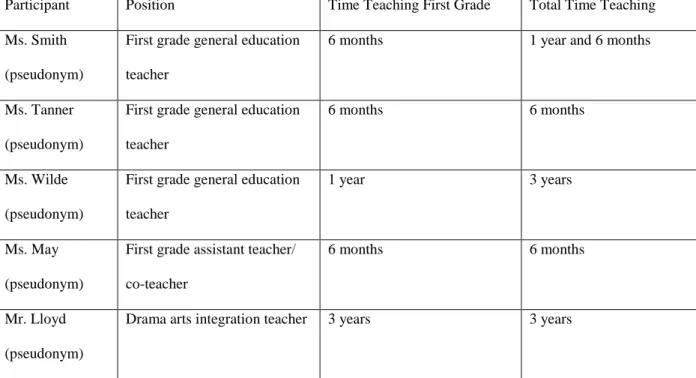
Participants in my study included five first grade teachers: three first grade general education teachers, one first grade assistant teacher (also referred to as a co-teacher), and one first grade arts integration teacher (see Figure 1). All of the first grade teachers taught at Oakwood Elementary (pseudonym). There were three first grade classrooms total at Oakwood
Elementary and each first grade general education teacher was the primary teacher for one of the first grade classrooms. Each first grade classroom also had one assistant teacher and one primary general education teacher. I was an assistant teacher in one of the first grades (I excluded myself from this study). For clarity, I studied all three first grade general education teachers, one first grade assistant teacher, a drama arts integration teacher, and a dance arts integration teacher (see Figure 1).
Participant Position Time Teaching First Grade Total Time Teaching Ms. Smith
(pseudonym)
First grade general education teacher
6 months 1 year and 6 months
Ms. Tanner (pseudonym)
First grade general education teacher
6 months 6 months
Ms. Wilde (pseudonym)
First grade general education teacher
1 year 3 years
Ms. May (pseudonym)
First grade assistant teacher/ co-teacher
6 months 6 months
Mr. Lloyd (pseudonym)
Drama arts integration teacher 3 years 3 years
Figure 1. Overview of participants. This figure shows each participant’s teaching experience and current teaching
position. Setting
I conducted my research study at Oakwood Elementary (pseudonym). Oakwood
Elementary is located in a suburban town called Hedgefield (pseudonym) in Western New York. The school is about twenty minutes away from the main city of Norvale (pseudonym) and ten minutes away from the local beach. The residents of Hedgefield are primarily middle class blue-collar workers who work at local jobs available at the Hedgefield Mall (pseudonym) and
surrounding local and chain retail centers. Many people who work in Hedgefield travel from neighboring cities and towns. Approximately 93% of the students attending Oakwood Elementary live in the nearby city of Norvale (“Academics/Staff,” 2016). Overall, Oakwood Elementary is diverse and encourages students to see themselves as upstanding citizens.
Positionality as the Researcher
As an assistant teacher at Oakwood Elementary, I was accustomed to the school’s daily operations. This study’s origins began naturally because of my familiarity with the teachers and the school. All of the teachers in this research study already worked with me on a daily basis, so I believed this study would most likely not interfere with each teacher’s daily instruction. None of the teachers were required to change his or her instruction for this study, and my role as an assistant teacher, in one of the first grade classrooms, remained the same. I live about twenty-five minutes away from Oakwood Elementary, so the demographics of my community are slightly different. I live in a town called Westgate (pseudonym) made of up 83.4% White, 5.2% Black or African American, 5.7% Asian, and 5.2% Hispanic or Latino (United States Census Bureau, 2010). My town is less diverse than the city of Norvale, where the majority of the students live. Although, my local town is similar in diversity to Hedgefield, which is the location of Oakwood Elementary.
I am an educated Caucasian female in my late twenties. I have worked as an assistant teacher at Oakwood Elementary for about three months; therefore, I am familiar with the school and many of the teachers. I am also familiar with the location and surrounding area of Oakwood Elementary because I grew up in Hedgefield; however, the majority of the students attending Oakwood Elementary are not familiar with Hedgefield because they live in the city of Norvale. During this research study, I worked directly with one of the first grade general education
teachers as an assistant teacher or co-teacher (e.g., teaching small groups, co-teaching whole group, and one-to-one tutoring). As a result of my familiarity and closeness with my teaching partner, I have a bias towards my own first grade classroom and my own first grade teaching partner. Since I am familiar with my students and my own teaching partner, I actively attempted to maintain a higher level of professionalism whenever I observed my classroom or interviewed my teaching partner. Furthermore, I only wrote down the actions and words of each teacher in the study; I made every attempt to ignore my existing background knowledge about the school, curriculum, and/or teachers during each observation and interview. Even though I was an
assistant teacher (co-teacher) in my own classroom, my only focus for this research study was to observe and record the language and actions of the other first grade teachers. I wanted to see how each teacher modified his or her literacy instruction to meet the literacy needs of his or her specific students.
Methods of Data Collection
I conducted a qualitative research case study on five first grade teachers at Oakwood Elementary. The data I gathered included the following: 1) An initial semi-structured interview; 2) A final semi-structured interview; 3) Two weekly semi-structured interviews; 4)
Observational notes; and 5) Audio-recordings.
Initial semi-structured interview. In the beginning of the study, the initial semi-structured interview (see Appendix A) was conducted to gather preliminary information about each teacher’s instructional practices and experiences. I interviewed each teacher on a one-to-one basis for a maximum of thirty minutes. Each initial semi-structured interview was
audio-recorded, with approval, and transcribed verbatim. I erased each audio-recording as soon as they were transcribed.
Final semi-structured interview. At the end of the study, a final semi-structured
interview (see Appendix B) was conducted to show any thoughts or ideas that may have changed in each teacher’s instructional practices during the study. I interviewed each teacher in the study on a one-to-one basis for a maximum of thirty minutes. Each final semi-structured interview was audio-recorded, with approval, and transcribed verbatim. I erased each audio-recording as soon as they were transcribed. The final semi-structured interview consisted of a series of questions related to my research questions and/or observations noted during the study. Please refer to question number six and seven in the final semi-structured interview form (see Appendix B) for clarity regarding questions related to observations noted during the study.
Weekly semi-structured interviews. I conducted a total of two weekly semi-structured interviews (see Appendix D) with each participant. Each weekly semi-structured interview was a minimum of five minutes and a maximum of fifteen minutes long. During these weekly semi-structured interviews, I used a weekly semi-semi-structured interview form to record each teacher’s views about his or her own literacy instruction over the duration of the research study. I obtained permission before audio-recording each weekly semi-structured interview in order to accurately capture each teacher’s words. I erased each audio-recording as soon as they were transcribed. The weekly semi-structured interview worksheet (see Appendix D) had two columns: one side noted each teacher’s responses and the other side included my thoughts and connections my research questions.
Observational notes. I wrote and/or typed observational notes for each teacher (using the observational notes form) as each teacher was instructing his or her students (see Appendix C). The purpose of these observations was to note the actions of the teachers, as well as highlight any connections I made to the research questions. I made an effort to observe each first grade
classroom on a daily basis; however, due to the busy nature of each classroom, daily observations of each teacher in every classroom was not reasonable.
Procedures
My study began after I received verbal confirmation from each teacher. Since this study was exempt, I was not required to collect signed consent forms. I recruited teachers through a recruitment letter and Exempt Form A. The recruitment letter gave a brief introduction as to why I was conducting this study, and Exempt Form A provided the teachers with an overview of the study. After reading the recruitment letter and Exempt Form A, each teacher had the opportunity to agree or decline to be in the study (through verbal confirmation). Once I obtained consent from each teacher, I began collecting data over the course of six weeks.
In the beginning of the study, I interviewed each teacher using the initial semi-structured interview form (see Appendix A). Each initial semi-structured interview was conducted on a one-to-one basis in each teacher’s own first grade classroom at Oakwood Elementary. Each initial structured interview was no more than thirty minutes long. All of the initial semi-structured interviews took place in each first grade teacher’s classroom before or after school. Out of the five teachers in this study, three initial semi-structured interviews were
audio-recorded; one teacher declined to be audio-recorded and one teacher declined to be interviewed (see Figure 2). Each audio-recording was deleted as soon as it was transcribed. The initial semi-structured interview served as a starting point for my research.
I conducted a total of two weekly semi-structured interviews on a one-on-one basis with three of the participants. Each weekly semi-structured interview was a minimum of five minutes and a maximum of fifteen minutes long and took place in each teacher’s own first grade
classroom at Oakwood Elementary. During these weekly semi-structured interviews, I asked each teacher the same questions (see Appendix D). I typed or handwrote notes during each weekly semi-structured interview with each teacher using the weekly semi-structured interview worksheet I created (see Appendix D). I recorded three out of five teachers, and the audio-recordings were deleted as soon as they were transcribed (see Figure 2). Each of the teacher’s responses were compared to my research study questions.
Over a six week time period, I observed each participant as he or she taught in his or her classroom at Oakwood Elementary. During each observation, I handwrote or typed the actions and words of each teacher using the observational notes form I created (see Appendix C) during lessons in English Language Arts (ELA) and reading. These daily observations were a minimum of five minutes and a maximum of fifty minutes. Sometimes I observed the same classroom and the same teacher multiple times during the same session or multiple times during the day. Many of my daily observations were interrupted, meaning, sometimes I observed for five minutes, stopped observing for a few minutes, and resumed my observations again. It was implausible for me to conduct uninterrupted observations for this study; therefore, I utilized this flexible note-taking method, which allowed me to pause and resume my observations as needed.
During each observation, I was interested in observing the instructional actions of each teacher in relation to my research questions. During ELA and/or reading time (in any of the first grade classrooms), I made every attempt to observe that particular teacher. For organizational purposes, I sat down with each teacher, before I observed, and I created an observational schedule. I attempted to follow this schedule daily, but sometimes unforeseen circumstances in my own classroom prevented me from observing each first grade teacher on a daily basis.
At the end of the study, I interviewed and audio-recorded three out of five teachers (see Figure 2) using the final structured interview form (see Appendix B). Each final semi-structured interview was conducted on a one-to-one basis in each teacher’s own first grade classroom at Oakwood Elementary. Each audio recording was deleted as soon as it was transcribed. The final semi-structured interview aided in culminating my research findings.
At the beginning of the study, I sought to observe each teacher a minimum of four times and interview each teacher four times (one initial structured interview, two weekly semi-structured interviews, and one final semi-semi-structured interview). However, due to unforeseen circumstances, I observed each teacher at least four times, interviewed three teachers in full, and interviewed one teacher once (see Figure 2).
Participant Initial
semi-structured interview
Two weekly semi-structured interviews Final semi-structured interview At least four observations Ms. Smith X X X X Ms. Tanner X X Ms. Wilde X X X X Ms. May X X X X Mr. Lloyd X
Figure 2. Data collected from each participant. This figure shows the data collected from each first grade teacher over the course of a six-week qualitative case study. I collected the least amount of data from Mr. Lloyd and Ms. Tanner.
Trustworthiness
I conducted a qualitative research case study on five teachers at my school. I obtained verbal consent from each teacher before beginning this study. None of the participants was required to change their instructional practices for this study. If any of the teachers felt that this study hindered his or her teaching at any point, he or she was no longer required to be in the
study. Before conducting any research, The Institutional Review Board at SUNY Brockport reviewed and approved this research study. I made every effort to conduct my research in the same room or rooms to help maintain consistency in my observations, but at times, this was not possible with all of the participants in my study. After I collected all the data from a variety of data sources (e.g., semi-structured interviews and classroom observations), I searched for themes across the data. Clark and Creswell (2015) emphasize the importance of using multiple data sources from each participant’s perspectives in order ensure accurate themes develop in research findings.
Analysis
This qualitative case study explored first grade teachers’ literacy instructional practices in English Language Arts (ELA) and reading. As an assistant teacher, I had the unique opportunity to divide my time between observing, teaching, and collaborating. My day-to-day assistant teacher duties did not change for this study, I simply decided to explore my fellow first grade teachers’ instructional practices, as part of my master’s thesis requirement. I focused only on each first grade teacher’s instructional teaching methods in English Language Arts (ELA) and reading. After collecting data from all my teacher participants (e.g., semi-structured interviews and classroom observations), I transcribed each semi-structured interview verbatim. The use of verbatim transcripts allowed me to obtain the most accurate and complete data from my
participants (Clark & Creswell, 2015).
Additionally, I used an “open coding” method to discover patterns in my data. Clark and Creswell (2015) say an open coding method allows a researcher to be “open to the ideas that occur in the data” (p. 356). As I combed through all the data, I coded for three patterns across semi-structured interviews with participants and patterns in instruction across participants: 1)
Literacy instruction; 2) Technology use; and 3) Arts integration. From these three codes, I searched for similarities and differences within the data and compared the data against my research questions. Throughout this coding process, I maintained an open mind and followed Shagoury and Power’s (2012) advice to “explore the unexpected” in my data.
The following section outlines an example of my data coding process: I used the “literacy instruction” code during classrooms observations in ELA and reading instruction. I noted that all of the teachers used the same instructional teaching method called Whole Brain teaching. To determine the usefulness of this teaching method, I asked myself if Whole Brain teaching could be used to meet the literacy needs of all students. Finally, I compared the Whole Brain teaching model against the research questions; if not enough data supported this research finding, I dismissed it. I found that the Whole Brain teaching model answered my first research question, supported literacy learning for all students, and appeared in more than one data source; therefore, Whole Brain teaching became a relevant finding.
Finding One: Teachers Report Limited Time for Literacy Instruction
All of the teachers in this study reported a variety of difficulties in regards to meeting the literacy needs of their students. These instructional difficulties ranged from students’ literacy abilities, teacher readiness, and/or home-school literacy connection. In particular, question nine on the initial semi-structured interview (see Appendix A) prompted a similar response from each first grade teacher. Three teachers indicated that many of their students’ parents believed that literacy instruction was the sole responsibility of the school. Most of the teachers reported that literacy learning ended at school. Other teacher participants highlighted students’ literacy abilities as a challenge to overcome. As a result, every teacher was overwhelmed with meeting their students’ wide range of literacy needs.
Ms. May and literacy instruction. When asked about her greatest challenge for meeting the literacy needs of her students during the initial semi-structured interview, Ms. May
(pseudonym), a first grade assistant teacher, was very honest with her response. She highlighted the challenges she faced when trying to meet the literacy needs of her students. She believed her students’ literacy learning stopped as soon as school ended and her students engaged more with current TV shows than reading. She revealed that many of the parents viewed literacy learning as the teacher’s responsibility. As Ms. May explained:
“The fact that a lot of our kids are not exposed to books and reading and literature. It’s almost as if I truly believe that, that, yeah teachers are supposed to teach concepts and we’re supposed to teach the basic skills, but there are certain skills that should be happening at home so we can advance. And with our demographic and with our kids, um…we’re just not getting that. We are playing mommy, daddy, and teacher. And, that’s where you’re seeing there’s a lot. I know a lot of my kids are very in tune with TV and they could tell you what’s on TV, but when it comes to recognizing a book, they’re not, they’re not able to do that, yet. They’re not able to, you know, sit down and start beginning things and, you know, where they should be because they’re not having that exposure at home. I think a lot of that problem is because from the perspective of the parent’s now a days that we should be teaching it all. And that learning stops as 3:30. So that’s the challenge that we’re fighting.”
Ms. May’s response echoed each first grade teachers’ struggles to meet their student’s literacy needs. Furthermore, Ms. May felt pressured from her students’ parents or guardians to “teach it all”, which might make some teachers feel alone in engaging students in the learning
process. However, this does not mean parents are unengaged, I believe each parent at Oakwood Elementary wants their child to succeed in literacy.
Ms. Smith and literacy instruction. Ms. Smith (pseudonym) also emphasized the importance of literacy engagement at home. She noticed that many of her students required extra literacy support during the school day because her students were not exposed to literacy at home. She stated, “Many of our students are from poverty. And what is holding kids behind is the home and school connection. It [literacy learning] is cut off once they get home.” Ms. Smith said she could relate to her students because she grew up in poverty herself, and she struggled with literacy as a young student. She indicated that many of her students’ parents believe that, “it [literacy learning] is the school’s responsibility.” Ms. Smith admitted that she used to have the same mindset as many of her students’ parents, but from her experience as a parent and as a teacher, she now sees the importance of literacy learning at home. As a young parent, she did not engage her own son in literacy learning outside of school, but now she reads at home with her son. Overall, was delighted with the reading progress her son made because she started reading at home. She states, “We do RtI [Response to Intervention] here. And that helps our students, but that can only go so far.” Ms. Smith empathized with the parents struggles and also saw the importance of engaging students in literacy at school and at home. She realized that the teachers need the parents’ support in order to help their children grow in literacy.
Ms. Tanner and literacy instruction. When asked about the greatest challenge for meeting the literacy needs of her students, during the initial semi-structured interview, Ms. Tanner (pseudonym), a first grade teacher, responded in two parts. First, she noted struggles her own personal struggles with adapting as a new classroom teacher and her concerns with teacher readiness along with her administrator’s expectation for each teacher to learn and use research
based programs. Finally, she concluded that literacy is not valued at home for many of her students. Ms. Tanner responded:
“[Answer one] Straight-up the greatest challenge I felt is learning specific research based programs that are expected to be used for assessment and instruction and not necessarily being given that training and kind of feeling a little lost the first few months because this is my first year teaching…first year as a classroom teacher. That for me was very frustrating because I felt that I had the knowledge base and the drive and stick with-it-ness, if that’s a thing…but I did feel that for a while I just didn’t know the direction to go in. It was kind of, I was doing a lot more planning and creating on my own for quite a while. But that, you know, that is specific to this location I believe.
[Answer two] So I think if that weren’t an issue and I could see past that, or even take into consideration past experiences, one of my greatest (sigh), probably one of my most heart breaking challenges with literacy is that it isn’t seeming to be as pervasive in, at home or outside of school. I was raised to believe and had experiences enough to connect it and reinforce that belief that reading is something that should happen every day. And that whether it’s for joy, whether it’s for information, reading conversation, taking advantage of the library’s resources…I find that, it feels at least, that we’re seeing that it [reading] doesn’t seem to be as much value…and therefore, it effects a lot of other things. I get this feeling that, again my first year, that a lot of what we are trying to teach at school is being reflected as something that only happens at school. This is, my child is supposed to learn these skills, you will be the one to teach them that, if they are struggling, you must have a plan to deal with that. So I guess that’s quite a challenge. And that might be more personal than professional…In my undergraduate classes, we were told that sometimes you
have to leave some students behind (began crying). And that’s so sad. We just have to move on.”
Ms. Tanner felt the pressure to “learn everything” in a limited amount of time, as well as teach everything in a limited about of time; therefore, Ms. Tanner felt overwhelmed and
unprepared at times to teach specific research based literacy programs (e.g., Blast Foundations and myLexia).
Ms. Wilde and literacy instruction. When asked about the greatest challenge for meeting the literacy needs of her students, Ms. Wilde (pseudonym), another first grade teacher, gave a different response from any of the other participants. Shagoury and Power (2015) note, as researchers, we must welcomed the unexpected in data; therefore, I noted how Ms. Wilde’s response added to the data. Ms. Wilde, highlighted “memory issues” many of her students experienced on a daily basis. As Ms. Wilde explained:
“That’s a good one. I think my greatest challenge is that I have some students who…struggle with memory, I don’t want to say memory issues. But just having them remember what they learned the previous day and being able to transfer it into a new environment or a new situation. We might go over…some sight words during guided reading and in reviewing those same sight words the following day, you know, I find that some of my students won’t remember it. You know…so that, that would be I think the struggle. Because memorization…and sight words are not really words you can’t phonemically sound out, so those are words you just have to know. It’s hard when they can’t phonemically sound out the word.”
First grade teachers and their students’ literacy needs. After I asked each teacher about their greatest challenge for meeting the literacy needs of their students, I noticed a similar response amongst all the teachers. I decided to include each teacher’s exact words in order to reflect each teacher’s true response. Clark and Creswell (2015) say verbatim transcripts allow researchers to maintain the most accurate data. Ms. Tanner’s response, in particular, was interesting because her response showed her dual train of thought; this allowed me, as a teacher researcher, to notice her reflective nature as a teacher. She noted her struggles first, and then she noted her students’ struggles. Ms. May seemed scattered in her train of thought. Through the transcript, I noticed how she pieced together her answer and gave a powerful response at the end: “And that learning stops at 3:30, so that’s the challenge we’re fighting.” Ms. Smith was not audio-recorded; therefore, I wrote down a few exact quotes in order to capture her train of thought. Finally, Ms. Wilde’s response was brief; however, she gave detailed examples to justify her response. Ms. Wilde focused primarily on specific student’s literacy issues as a possible obstacle for literacy learning. Each teacher’s response was similar; nevertheless, each participant noted their own unique literacy instructional challenges through their answers.
Finding Two: Teachers Use Technology to Enhance Students’ Literacy Learning
All five teacher participants used technology in a variety of ways during instruction in ELA and/or reading; nevertheless, I only gathered enough data to analyze four teachers. Four teachers reported that technology enhanced students’ learning by increasing literacy motivation and engagement. According to Boushey and Moser (2014), students using technology, such as e-books, increase their reading motivation, expression, fluency, and letter sound pronunciation. Teachers also stated that some forms of technology, such as myLexia, helped them easily track their students’ overall literacy progress. During classroom observations, I observed each teacher
using one or more of the following technology during ELA and/or reading instruction: SMART board, ELMO, iPads, and Chromebooks.
Ms. May’s instructional technology use. During phonics instruction, Ms. May used the SMART board to project phonics videos on Go Noodle and phonics instruction using Blast Foundations. Go Noodle is used by many teachers to promote movement and mindful moments in the classroom (“Go Noodle”). Blast Foundations is a research based literacy program geared toward students’ phonemic abilities in Kindergarten through grade three (“Phonics suite,” 2015). I observed Ms. May using the SMART board during phonics instruction to project various phonics related songs using Go Noodle before beginning Blast Foundations. On a few occasions, she played the alphabet song featuring Usher singing with the Sesame street Muppets on the SMART board. Ms. May danced along with the students as she played the Usher alphabet song. Afterwards, she continued using the SMART board as she guided students through Blast
Foundations. Trios of letters (e.g., x z y, b x y, z b j) and/or trios of words (e.g., draw night am, big pick pink) were projected on the SMART board. Ms. May said, “look, think, say,” as she introduced each letter or word by tapping on the SMART board. Each tap revealed the next letter or word. The SMART board was the primary teaching tool as each letter or word was introduced.
Through classroom observations of Ms. May, I noticed that she primarily used
technology as a literacy resource; however, this may not reflect her overall use of instructional resources because I observed her teach only during phonics instruction. Over the course of four observations, my data indicated discrepancies with Ms. May’s instructional methods (e.g., the use of technology) and her views towards technology integration in literacy. For instance, when Ms. May was asked about how teachers should use technology for literacy instruction, during the initial semi-structured interview, she responded, “Technology should be used as an enrichment