U N I V E R S I T Y O F T A M P E R E
PARENT INVOLVEMENT IN SCHOOLING
PROCESSES: A CASE STUDY IN AN ACEH SCHOOL
Faculty of Education
Master’s thesis in education
DWI WULANDARY & HERLISA
July 2017
University of Tampere Faculty of Education
DWI WULANDARY & HERLISA
Parent Involvement in Schooling Processes: A Case Study in an Aceh School Master’s thesis in education, 70 pages, 3 appendices
July 2017
The research topic of parent involvement in schooling processes in an Aceh school is examined through qualitative case study and interpretative phenomenological analysis (IPA). The study focuses on exploring the parents’ understanding of their involvement in schooling processes based on the six typologies of Epstein. Parent involvement in an Aceh school is a crucial issue which needs to be studied. This research provides an analysis of parents’ understanding of their involvement in schooling processes, what different kinds of ways parents/homes and school communicate between each other, and whose parents are frequently involved in schooling.
The research design is based on a case study which explored the implementation of parent involvement in schooling processes in an Aceh private school. This study tried to find information concerning the parents’ understanding about their involvement in schooling processes, the ways parents/homes and the school communicate with each other, and whose parents were frequently involved in schooling, from 16 parents consisting of eight mothers and eight fathers. The data included interviews of parents, and a document review that was comprised of the attendance list of the parents in school meetings and student academic reports. The steps of data analysis were covered through the transcript, and by coding and categorizing. The categories of the study were based on the six typologies of Epstein consisting of parenting, communicating, volunteering, learning at home, decision-making, and collaboration with the community. The purpose of these categories was to uncover the whole understanding of parents related to their involvement in schooling processes.
The three cores of education consisting of family, school, and community have an important role in attaining the goals of learning. The theoretical basis of parent involvement discusses several previous studies concerning parent involvement and student achievement. School and student achievement can be enhanced by involving parents in schooling processes. A good relationship between parents and school will foster the children’s development in their learning. There are several barriers parent involvement in schooling, such as work demands, reluctance to attend the school, lack of communication with the school, and parents’ perception of their involvement. Likewise, the reason behind parent involvement in schooling processes can be explained with attribution theory. According to Bernard Weiner’s framework concerning of an attribution theory, there are four causes of motivation and emotion comprising of ability, effort, task difficulty, and luck.
This study revealed that parents’ understanding regarding parent involvement in schooling processes is limited and needs to be improved. The parents have limited comprehension in the typology of Epstein, on types such as parenting, communicating, volunteering, learning at home, decision-making, and collaborating with the community. The findings indicated that parent involvement in schooling processes in an Aceh school is low. In addition, the motivation of parents to be involved in schooling processes was related to their own motives, such as merely to fulfill their obligation as a parent in rearing the children. Therefore, we suggest that the school needs to improve the school system concerning parent involvement. Further studies are also needed for this topic, by involving participants from several public schools.
ACKNOWLEDGEMENTS
Praise be to ALLAH SWT, God Almighty, and Merciful, who has given the writers full strength in every struggle to complete the thesis entitled "Parent Involvement in Schooling Processes: a Case Study in an Aceh school". Peace upon the prophet Muhammad SAW who has brought the Islamic norms and values from darkness to the brightness of the entire world.
We would like to thank our family, especially for our beloved parents (mother and father) and nuclear family (husband, children, sister, and brother), who inspired and supported us in learning to continue the study.
In addition, we would like to express our sincerest gratitude and appreciation to the following scholarship sponsorship, Mr. Surya Paloh, Lestari L. Moerdijat, and Ahmad Baedowi, theDirector of Education Sukma Bangsa. The writers also would like to thank those who helped in completing the thesis, Dr. Samsul Rizal Panggabean as the first advisor, Fuad Fakhruddin, Ph.D., Prof. Khoiruddin Bashori, Samsir Alam, M.Ed., and Nadiya Hayati for their patience in providing careful guidance, helpful corrections, giving advice as well as suggestions and encouragement during the consultation.
Thanks are also due to thank for our supervisor, Prof. Eero Ropo and Pekka Räihä Ph.D., their guidance, advice, and assistance during our research. We have also received many positive corrections from Julie Rajala and suggestions for finding support literature from Markus Huhtamaki, and we are also indebted to thank his valuable recommendations to access the information supporting our writing-up process.
We acknowledge the contribution of our classmates, colleagues, and friends who helped us at all stages in the research and offered kind words, thoughts, and actions in supporting our work.
CONTENTS
1 INTRODUCTION ... 1
1.1 BACKGROUNDOFSTUDY ... 1
1.2 PURPOSEOFSTUDY ... 4
2 LITERATURE REVIEW: TOWARD MORE ACTIVE COOPERATION BETWEEN SCHOOL AND PARENTS/HOMES ... 6
2.1 THECONCEPTOFPARENTINVOLVEMENT... 6
2.2 TYPOLOGYOFPARENTINVOLVEMENT ... 7
2.2.1 Parent involvement at home ... 11
2.2.2 Parent involvement at school... 12
2.3 PARENTS’PERCEPTIONSOFPARENTINVOLVEMENT ... 13
2.4 BENEFITSOFANDBARRIERSTOPARENTINVOLVEMENT ... 15
2.5 PARENTINVOLVEMENTINTHEACEHCONTEXT ... 19
2.6 ATTRIBUTIONTHEORY ... 21
3 RESEARCH METHODOLOGY ... 26
3.1 QUALITATIVECASESTUDY... 26
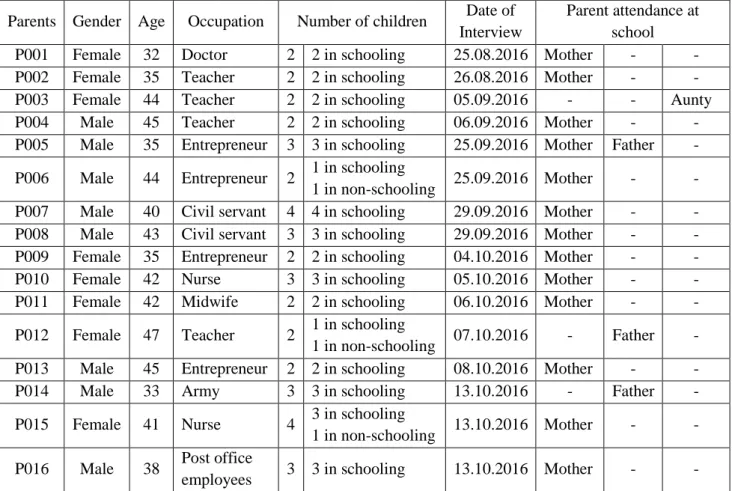
3.2 PARTICIPANTS ... 28
3.3 PROCEDUREOFSTUDY ... 29
3.4 DATAANALYSIS ... 31
3.5 ETHICALCONSIDERATIONS ... 32
4 FINDINGS AND DISCUSSION ... 33
4.1 PARENTS’UNDERSTANDINGOFTHEIRINVOLVEMENTINSCHOOLINGPROCESSES ... 33
4.1.1 Lack of information of parents about volunteering in schooling, participating in school committee, and collaborating with the community ... 34
4.1.2 Parents feeling fear when getting a phone call from school... 42
4.1.3 Parents feeling ashamed to attend school ... 44
4.1.4 Parent did not understand the importance of their involvement in learning at home ... 45
4.2 WAYSOFCOMMUNICATIONBETWEENPARENTSANDSCHOOL ... 48
4.2.1 Types of communication ... 49
4.2.2 Two-way communication ... 51
4.3 WHOSEPARENTSARE FREQUENTLYINVOLVEDINSCHOOLINGPROCESSES ... 54
5 CONCLUSIONS AND RECOMMENDATIONS FOR FURTHER RESEARCH ... 59
5.1 CONCLUSIONS ... 59
5.2 IMPLICATIONS ... 62
5.2.1 Policy implications ... 62
5.2.2 Recommendation for further research ... 63
REFERENCES ... 64
APPENDIX 1 ... 71
APPENDIX 2 ... 72
LIST OF TABLES
Table 1. Theoretical framework of Epstein based on family, community, and partnership model ... 10 Table 2. Data of informants ... 28
LIST OF FIGURES
Figure 1. Model of potential barriers to parent involvement ... 18
Figure 2. A2X2 scheme for the perceived causes of achievement outcome ... 22
Figure 3. Locus X stability scheme, classified according to locus and stability... 23
Figure 4. Attribution – Emotion – Behavior process ... 23
Figure 5. Internal causes of success and failure, classified according to stability and control ability ... 24
1
1
INTRODUCTION
1.1. Background of the study
Recently, there has been growing interest in parent involvement in Aceh. Parent involvement has concerned many stakeholders, namely the government, education practitioners, the community, and parents. Many attempts have been made to develop the quality of education, particularly at school, such as constructing facilities in education, improving the quality of teachers and increasing the quality of learning. However, the role and engagement of teachers, school staff, society, school committees and families are a crucial to support the learning process as well. Therefore, parents also have an essential contribution to their children's success.
Primarily, the family is the first education center for children. Parents have a very significant influence on their children’s development. Consequently, parents have the important responsibility to lead and support their children’s development. Parents should create a pleasurable environment so that children's potential and self-confidence can develop well. Moreover, parents should also have an active role in their spare time for their children, including attending and following school programs. On the other hand, school as formal education helps children learn about socialization, communication, and develops their academic ability. For this purpose, a positive school is a school that provides a place for parents to get involved in the schooling processes. Thus, parents have the responsibility to involve themselves in their children’s education through school programs. Furthermore, positive cooperation and communication between parents and school will foster children’s progress and success in their education.
Additionally, the responsibilities of parents for their children’s education will be reduced when they enroll their children in school. Therefore, parents may fully devolve their children’s learning process to the school. This is supported by Hornby (2011), who stated that parents’ perception of their role is only taking children to school, after which then the school has the responsibility to educate their children, so that parents are less engaged to participate in supporting their children’s education both at home and at school. In line with that, Cooper, (1991) as cited by Smith et al., (2011) found that when parents decided to choose the best school for their children, they assumed that this would be adequate to guarantee the success of their children without the need
2
for their further involvement. This implies the school has full responsibilities in the learning process. However, since children’s success also depends on parent involvement, a school should provide more programs involving parents.
First and foremost, parent involvement in their children’s education is not only at home but also at school. Parents' participation in their children’s education at home includes motivating their children to learn, creating a conducive environment at home, monitoring their learning, and assist them in doing homework. Parents are able to understand the children’s difficulties at school when they assist their child in doing homework. In addition, parents are also able to build a positive emotional connection when they have good communication with their children. On the other side, parent involvements at the school include their willingness to attend school events, initiative to communicate with teachers, and contribution in providing suggestions to support the school policy. For instance, parents can get information about their children’s learning progress through communicating with teachers. Hence, they would know what difficulties their children have had, and how their children interact with others at school. Therefore, parents’ attention gives a comfortable feeling for children that is able to build children’s’ motivation to learn.
Several studies have found that there is a relationship between parent involvements in schooling with their children’s achievement. Georgiou (1997) found that parent involvement, which includes assistance in doing homework and involvement in school programs, has a correlation with student success. Parent involvement has benefits for children’s academic achievement and the development of their characters and behaviors. This is supported by Henderson, (1987) as cited by Georgiou, (1997), who said that the ability of children at school will be better when parents are involved in schooling. In addition, Fan and Chen, (2001) as cited by Yoder and Lopez, (2013) argued that parent involvement in education is one of the major factors in enhancing students’ academic achievement and promoting their positive behavior.
Parent involvement is a crucial issue all over the world, including in Indonesia. As Indonesian Law Number 20, 2003, on the national education system, in the second part of Subsection 7 about the rights and duties of parents stated: "(1) Parent have the right to participate in choosing education units and to receive information about their children’s educational development. (2) Parents of compulsory school-aged children are obliged to provide basic education to their children". Werf, Creemers, and Guldemond, (2001, p. 449) stated that “In Indonesia, parent involvement was seen as an important aspect in increasing the quality of education in order to have better student outcomes”. However, do Indonesian, especially Acehnese parents know what importance their involvement in schooling processes has? Is there any guarantee that parent involvement is also occurring in Aceh?
3
Numerous studies in Indonesia about parent involvement indicate several factors that cause parents’ lack of involvement in schooling processes. A study about children’s interest in reading by Sandjaja (2001) revealed that parents’ lack of involvement is mainly caused by the low social economic factor and conflict within the family. This is supported by Yetti (2012) who claimed that economic crises and natural disasters in several regions in Indonesia cause conflicts within families. Mental stress experienced by parents due to the conflicts reduces their capacity to develop and sustain their children’s interest in reading. Hence, the children’s development is not optimal. However, parent involvement has received little attention.
The fact that parent involvement in Aceh in schooling processes is still low can be observed from the school's perspective. One of the factors that leads to a lack of parent involvement is the ignorance of participating in school events. On these occasions, most of the parents cannot attend the school’s events such as attending the Parent Teacher Association (PTA) meetings, school fair, and bazaar. The parents also do not participate well in school programs because they are busy with their jobs or fail to see the schedule of school events. It can also be said that there is a lack of communication between parents/homes and school with each other. As a consequence, a relationship between parents and school through communication is important to deliver the information in supporting school programs in schooling processes.
Primarily, one of the school's programs is inviting parents to acquire their children’s academic report. Essentially, it is the result of the student’s progress in their learning process in school. Nevertheless, a preliminary finding of a case study that we conducted in the Junior High Level of Sukma Bangsa School, parents’ attention to come to school in receiving the academic reports of midterm years of 2016-2017 from the total number of parents was 148 people, 74% of parents merely attended to school. Based on this finding, it proves that not all parents participated fully in their children’s schooling processes. Furthermore, they asked their family or neighbor to replace them for taking their children’s academic reports. At this point, the reasons why most of the parents still do not attend the school events were not obvious.
This study was conducted in Sukma Bangsa School, Aceh. Involvement from various elements of education is an important issue in making a positive educational environment (this is the vision of the Sukma Bangsa School). In the Blueprint of Sukma Bangsa School, Baedowi et al., (2005, p. 57) claimed that “the school elements that should be involved in the learning process are: (1) Parents or family, (2) Organizations or civil society institutions, (3) local government and its branches, and (4) business”. It could also be said that the blueprint has also stated clearly the issue concerning parents’ responsibility and participation in students’ learning processes. Therefore, the elements such as school, family, and community cooperation have an important role in developing
4
education, and parents’ engagement in Sukma Bangsa School became an important issue to be examined.
In this case, parents could be involved in the learning process such as assisting their children in doing homework (Baedowi et al., 2005). Also, the school is also expected to create programs that can enhance parent involvement in education. The school holds the events for parents such as parent-teacher association (PTA) meetings, school committee meetings, workshop, bazaar, school fair and family recreation in order to bind a positive connection between parents and children. Then, parents are also engaged in making decisions, such as developing the curriculum, determining and evaluating the teachers, applying the school's procedure, and allocating the budgets. All of those outcomes are needed to promote and contribute to parent involvement.
Most of the parents in Aceh, in the scope of Sukma Bangsa School, think that their involvement in schooling processes is less important. Evidence of this fact is that the presence of parents in the PTA in 2016-2017was only 74% of parents. We think for those 74% of parents attending school is quite enough. But, it would be better if 100% of parents were involved. For this reason, we would like to explore the parents’ understanding in Aceh about their engagement in education. Therefore, the parents could realize that their involvement at school can improve their children’s academic achievement. Similarly, this study can make parents/homes closer to the school. This study focuses on the perception of parents’ involvement in learning in Aceh. In this study, we address the question more broadly; what is parents’ understanding about their involvement in the educational process, what different kinds of ways parents/homes and school communicates with each other, and whose parents are frequently involved in schooling?
1.2. Purpose of the study
The purposes of this thesis are to explore an understanding of parents specific to their involvement in schooling, to identify the way of communication between schools and parents/homes, and to know about the engagement of parents who are often involved at school. In the same way, the aim of this thesis is to explore the parents’ understanding of their involvement in schooling processes. The researchers determined the form of parenting at homes such as their assistance when children have difficulty in doing homework, also at schools, such as parents’ attendance and participation in the school's events, their communication with school/teachers, and their relationship with other parents, as well as their connection with the school committee. Therefore, this thesis seeks to address the following questions: What is parents’ understanding of their involvement in schooling processes? What different ways do parents/homes and school communicates with each other?
5
Whose parents are frequently involved in schooling? The results of this study are expected to provide benefits not only for parents but also for the school. In order to improve parent involvement in the schools, the obstacles which prevent their involvement should be understood. After that, the school could arrange programs which are needed from the parents' point of view. Thus, parents will have awareness and possibilities for participation, to be involved in their children’s education.
This thesis is divided into four main sections. Chapter 2 reviews existing literature in the field. Chapter 3 describes the research design. Chapter 4 explores the findings of the study and examines the results related to our research questions and hypotheses. Finally, chapter 5 presents the main points and implications of policy and further research.
6
2
LITERATURE REVIEW: TOWARD MORE
ACTIVE COOPERATION BETWEEN
SCHOOL AND PARENTS/HOMES
2.1. The concept of parent involvement
There are several perspectives on the concept of parent involvement from teachers, principal, parents, and even students. Defining parent involvement depends on their respective experience. However, parent involvement has been defined by many researchers in a variety of ways. The term "parents" means that people are engaged and more involved in caring for children. Parents here are not only the core family like a father or mother, but includes also grandparent, foster parents, and guardians (Hornby, 2011). Parents have the responsibility of raising, educating and guiding offspring towards a better life in the future. Thus, they prepare their children to socialize with the outside world.
Parent involvement is the essential factor in improving the knowledge and supports children’s education. It is referred to as the relationship between parents and children that plays a part in their children’s progress and also leads the parents to take part in schooling processes (Reynolds, 1992). In general terms, parent involvement is defined as representing “...parents’ active commitment to spend the time to assist in the academic and general development of their children” (Borgonovi & Montt, 2012, p. 20 as cited by Daniel, Wang & Berthelsen, 2016).
Fantuzzo et al., (2004) as cited by Yoder and Lopez (2013) define parent involvement as communication between home and school, supporting learning at home, participating in school activities, and having a voice in decision-making practices within the administrative structure. The development of children in learning progress can be identified by such indicators as better grades, attendance, and a good attitude. It can be monitored through good communication between parents and teachers. One form of parent involvement in school is communicating with teachers. Communication can be a bridge for parents to get involved in children's education. In essence, parents have an obligation and responsibility to carry out the education of their children. The role of
7
parents in the learning process can influence children’s development. For this reason, the quality of education can be improved by involving parents in education.
Parent involvement is necessary to improve the academic achievement of students. When the parents get involved in the learning process, the children will be motivated to do better at school. Wood, (2003) as cited by Ibrahim and Jamil (2012), showed that parents who are involved in the school process of their children will enhance academic success at school. Participation of parents in learning, such as assisting their children in doing homework or assignments from school, being a volunteer, contributing through support and affirmation of their children's achievement can be identified by better grades, attendance, attitudes, and homework completion (Smith, Wobhlstetter & Pedro, 2011). Reynolds (1992, p.446) states that “The indicator of PI obtained from parents, teachers, and children regard potentially enriching interactions with the child at home or in support of the child at school”. Intense contact with children at home and facilitating them in school is also included as an indicator of parent involvement.
Olmstead (2013) classified parent involvement into reactive and proactive involvement. Reactive involvement means parents attend to school programs that are organized by the school such as parents’ meetings, family gatherings, or volunteering whereas proactive involvement is the participation of parents in assisting their children, completing homework, discussing school activities, and following the children’s improvement. In conclusion, parents need to be aware of their roles and responsibilities in educating their children. The desire to engage in any activity related to their children’s education both at home and in school involvement should be owned by each parent.
The concept of parent involvement in this part is clear based on the definition of the authors that emphasizes its the different aspects. It is related to the multiple perspectives that are influenced by their lived experiences. An explanation of the types of parent involvement both at home and at school will be explained in the next sub-section.
2.2. Typology of parent involvement
The parent involvement approach that focuses on Epstein’s framework has a different perspective in considering the behavioral dimension of parents than Hoover-Dempsey’s and Sandler’s model. The psychosocial dimension of parent engagement based on Hoover-Dempsey and Sandler’s model was categorized into three parts: participation of parents in school such as assisting their children to do homework or assignments from school and being a volunteer; contributing through support
8
affirmation to their children's achievement; and implementing social values such as having great hopefulness for their children’s success in education (Chen & Gregory, 2010).
On the other hand, many researchers have examined the types of parent involvement in schooling processes related to parents’ participation in supporting the learning process. These findings generally include the following: parents’ contribution in education in paying tuition fees routinely and providing for the children's needs (Honrby, 2011), parents’ participation related to school programs such as assisting in doing homework and attending school events (Meintjies, 1992 as cited by Ibrahim & Jamil, 2012), parents’ encouragement of their children's behavior (Atkinson & Forehand, 1979 as cited by Chen, 2009), and parents’ expectations for their children's achievement in the learning process (Fan & Chen, 2001; Houtenville & Conway, 2008). Most importantly, the school can renew its programs in encouraging parents to be more involved in the schooling processes.
Parents' responsibility is to provide children's needs such as paying tuition fees, taking to and picking up their children from school and buying books. According to Peng and Lee, (1993) as cited by Werf et al., (2001) that the home variable and the count of parent-child activities have a significant portion of variance, yet there is a negative relationship between discussion at home about school activities and academic achievement. It is an essential role of parents to support their children's learning process in education. Basically, time to interact at home between children and parents is less compared to the time children spend at school. Furthermore, the quality of communication and interaction between children and parents motivate the children in learning to enhance their achievement in the future.
In addition, the participation of parents in assisting in doing homework or assignments from school also supports their children's achievement. Pomerantz and Eaton (2001) claimed that especially for middle-class European American families, children's performance in school is predicted to increase when the mother assists in her children's homework for 6 months after. Conversely, Hill and Tyson (2009) claimed that parents’ assistance in doing homework or assignments from school, accompanying and ensuring the homework is complete were the only types of participation that inconsistently related to their children's success. Basically, parents assist children who are having difficulties in doing homework from school even though the children do not feel the parents' assistance is necessary, and also parents may examine it to make sure that is correct so that the children's understanding will be better. Another form of parents’ engagement is attending the school. Parents’ attendance in a school’s events is helpful for them and the teachers. The parents are able to know about their children activities and progress in learning. Here, the teachers will know more about their students' problems and attitudes at home, which helps teachers
9
find the solutions concerning how to support the students in the learning process. Moreover, the school can develop school programs to increase parents’ involvement at school.
Next, parents’ encouragement can improve the behavior of their children. DeHass (2005) argued that the children will be motivated when parents and teachers work together to support them. Parents are role models for children at home. For that reason, they should provide a positive behavior in actions and communication with each other. For example, when the children make a mistake, the parents should not scold their child and not commit verbal violence. In this case, they should approach the child and try to find the solution through communication.
Lastly, parents' expectations for their children in the learning process can mean that the children are successful in the future. Parents certainly have a high expectation for their children, so that they enroll their children in the best school. Fan and Chen (2001) claimed that the control and support of parents at home have virtually no connection with their children’s progress, but the parents' expectation for their children’s success has a positive relationship with their children’s achievement. Therefore, high parent expectation will strengthen their children's motivation to achieve their goals in education.
The study of parent involvement considers the theoretical framework of Epstein. She has developed the most reputable framework about parent involvement which defines six types of parent engagement (Epstein, 2010; Epstein et al., 2002. Epstein’s framework, 2001, 2011) and served as the frame of our study through exploring parent involvement at home and also at school. Henderson and Mapp, (2002) as cited by Patrikakou and Anderson (2005) claimed that parents’ engagement is often classified into two broad categories: “at home” and “at school”. It shows how parents are able to be involved in the schooling process, as well as to examine whose parents are active or not in involving themselves in their children's learning process.
Epstein’s framework, categorizing parents’ engagement related to the school-family-community model into six types, was derived from the theory of overlapping spheres of influence (Epstein, 1995 as cited by Sanders & Epstein, 1998, p. 4; Ibrahim & Jamil, 2012, p. 39; Smith, Wohlstetter, Kuzin & Pedro, 2011, p. 77). Sanders and Epstein, 1998, p. 4 said:
“The six types of involvement are: 1) parenting — helping all families establish home environments that support children as students; 2) communicating — designing and conducting effective forms of communication about school programs and children’s progress; 3) volunteering — recruiting and organizing help and support for school functions and activities; 4) learning at home — providing information and ideas to families about how to help students at home with school work and related activities; 5) decision-making — including parents in school decisions, and 6) collaborating with the community — identifying and
10
integrating resources and services from the community to strengthen and support schools, students, and their families”.
Basically, the above shows specific responsibilities of parents. Each type of engagement of parents or relationship between parents and school has different outcomes for students. The type of the basic obligations at home is parenting. However, communicating is the basic obligation at school. Therefore, parent involvement in the schooling process consists of home-based involvement and also school-based involvement (Sui-Chu, 1996; El Nokali et al., 2010: Strickland, 2015).
For example, home-based involvement as the engagement of parents refers to type 1 and 4, and means when parents assist their children about motivation in learning and provides conditions at home that support them comfortably in studying. On the other hand, school-based involvement as the participation of parents refers to types 2, 3, 5, and 6, which show their awareness of involvement in schooling processes (Hayes, 2011 as cited by Strickland, 2015). El Nokali et al., (2010) said that parent involvement includes of their behavior at home and participation at school in trying to promote their children’s educational learning.
TABLE 1. Theoretical framework of Epstein based on family, community, and partnership model
Type Based
Involvement Description Example
1 Parenting
Home Basic obligations of families
Fulfilling students’ needs such as health and home environment, assisting families with parenting skills, building the discipline and motivation of students, paying tuition fees on time, solving the constraints as a parent.
2
Communicating
School Basic obligations of schools
Communicating by schools to parents through a letter, via phone, or parent-teacher meetings.
3 Volunteering
School Contribution at school
Volunteering in a classroom to share and support in the learning process or attending the schools' events.
4
Learning at home
Home Engagement in learning
activities at home
Helping their children in doing homework categorized into control of learning and support of learning. 5 Decision making School Participation in decision-making, governance, and advocacy
Discussing in a parent-teacher association (PTA), school committees, and home visit.
11
Type Based
Involvement Description Example
6 Collaborating with community
School Collaboration and exchanges with community organizations
Making relations with other groups and sharing the responsibility to strengthen the schools' programs, family practices and student development.
2.2.1. Parent involvement at home
In fact, parent involvement is one of the most important things to improve children's behavior and achievement in schooling processes. It will be achieved by involving parents in the schooling process at home, such as in motivating, facilitating, and assisting the student. Singh et al., (1995) cited by Fan and Chen (2001) stated that there are many facts showing that some aspects of parent involvement possibly have more obvious consequences for children’s academic progress than others. Furthermore, parent involvement is important in learning because it will enhance students’ motivation and achievement.
For instance, parent involvement at home can be categorized into parenting and learning at home. Firstly, families have a responsibility in providing for the health of their children and setting up a home which is acceptable for study. In any case, a mother has an enormous role in assisting their children at home rather than a father. Conrade and Ho, (2001) as cited by Alsheikh, Parameswaran and Ethoweris, (2010) found that the parenting style of a mother had a bigger influence on the acts of children in school at Bronte-Tinkew. Another possibility, Moore and Carrano, (2006) as cited by Alsheikh et al., (2010) found, was that the parenting style of fathers’ emotional awareness was related to actions of their children as well. Therefore, parents’ participation at home will foster the motivation of their children in schooling.
Secondly, the participation of parents at home is assisting their children in learning at home. This engagement consists of the control and support of learning. For example, control of learning is asking if the children have homework or assignments from school, suggesting to their children to finish their homework, reciting the Qur’an, knowing of their children's activities, looking for activities for their children and choosing friends for their children. On the other hand, support of learning is giving the facilities such as a smart phone, the internet, and a laptop. Then, parents are also providing additional learning, reciting the Qur’an, and asking about difficulties in doing homework from friends or neighbors who have more understanding.
Finally, parent involvement at home is not only parents' responsibility for health and safety, but also in doing homework. It has a close relationship to their behavior. Hayes, (2011) as cited by
12
Strickland (2015) said that home-based involvement is the ways parents educate their children at home that enhance their children's academic achievement.
2.2.2. Parent involvement at school
Basically, the role of parents in education is enrolling their children in school. It shows that parents have the responsibility to support their children’s success in the future. On the other side, the school is preparing many events and programs that can involve parents in the schooling processes. Parents and teachers have a very important role in constructing the children’s willingness to learn. Wilder (2014) claimed that overall there is a positive relationship between parents’ involvements in school with the children's achievement. A more detailed analysis found that this relationship would be weakened if the parents' engagement involved only assisting and monitoring their children in doing homework. On the contrary, when parents participate the show hope and care about their children's future so that the relationship would be strengthened.
For example, one of the forms of parent involvement at school is communication between parents and teachers. Through communication, parents can discuss their children’s achievement and attitude. In addition, teachers can also know the children’s problems at home and how to encourage them in learning. Therefore, the communication of parents helps in understanding their children’s learning ability, and helps in solving their children’s problems at school and constructing their children’s behaviors. Then, parents can guide their children’s development in the educational process at school. Furthermore, parent involvement is able to motivate and promote the self-confidence of student. This issue will be a factor which encourages students in learning. Eventually, the quality of parent involvement will facilitate the effectiveness of a student’s academic achievement.
Specifically, the school made an appropriate program and organized events to involve parents in the schooling process. One of the school programs is communication with parents. Teachers should make a relationship with parents in providing the information about their child. In addition, the school explains to them about policies, the school’s programs, the school’s rules, and the school’s regulations. Furthermore, they also advise them about their children’s progress. Therefore, the parents should take their time to attend the school's events and initiate effective communication with the teachers. Additionally, parent involvement in the schooling process helps the school create strategies and programs so that parents can be more engaged.
For the most part, the school-based involvement of parents describes parents' relationship to the school (Pomerantz et al., 2007). For instance, activities can include visiting the classroom as a
13
guest teacher, helping in the school's events as a volunteer, attending to the PTA or taking the report, and communicating directly or indirectly with teachers (Daniel, Wang & Berthelsen, 2016).
For example, parents can become volunteers who support the school's activities. In this case, the school is offering opportunities for parents to visit school to offer their help on various occasions. Similarly, the parents as guest teachers come to share their experiences with the students. Also, the parents can be invited as an audience in various events at school. According to Smith et al., (2011), decision-making aims to implicate and empower parents in the school's programs and management in providing their suggestions to support the learning process for their children. Furthermore, parents will have an active participation in decision making when the school holds meetings with them. Briefly, there are some governing aspects, such as planning, setting priorities and budgeting, of parents’ participation and involvement in the school's activities and programs.
2.3. Parents’ perceptions of their involvement
Basically, parents want their children to grow and develop to be good, smart and successful in the future. There are many more expectations of parents for their children, all of which are positive. In order to accomplish these expectations, parents will endeavor to fulfill every need of their children at the expense of time spent with their family both in learning and playing. On the one hand, the duty of parents to discharge the basic needs of their children is fulfilled in a good way. Conversely, the lack of involvement of parents in assisting children in learning will have an impact on their achievement at school. Deslandes (2009) stated that if the parent believes in the importance of their responsibility in their role as parents in their role to be involved in their children's schooling, parents tend to be more actively involved.
The perception of parents commonly happens when enrolling their children in school. They perceive that their obligation as parents has been completed in terms of learning, and that furthermore, the school has the function and responsibility to provide their children with knowledge. When the children are in school, this part of the parent's responsibility is reduced, so that they only need to execute their other role. This leads to an imbalance between expectations and action. If parents want their children to succeed, their role should be more active in fulfilling the basics of their children’s needs. Parents’ engagement in the learning process of their children includes assisting children with homework, attending school activities and discussing with the school to inquire about the development of their children in school. Through this involvement, the children will be motivated and will have enhanced self-confidence to do their best in school and at home. Epstein (1987, p.121) stated that parents train the children at home by constructing
"self-14
confidence, self-concept, and self-reliance" to promote their achievement in schooling. Not only do parents have the responsibility to cultivate these aspects, but also the school has the same responsibilities when children are at school.
Parents play a role in education, which is providing the first educational center for children in assisting, guiding, teaching, so that what is done by the parents at home, both in terms of behavior and speech, will be a reference for children. Additionally, children will imitate what is in learnt in the family. The family is the first environment that initiates the experiences of efficacy. However, in line with their development, when the child is interacting with the society, playmates become more important for children in improving self-knowledge of their abilities (Bandura, 1994). Therefore, parents should have adequate knowledge in parenting and have to think that their involvement is a form of responsibility and obligation as a parent (Deslandes & Bertrand, 2005).
The development of children depends on the parenting style. Children who have received good care usually also have a good character and good manners in society. For example, they have good behavior, discipline, and are helpful. Parenting has an important role in constructing self-efficacy for children, and parents’ own beliefs and life experiences determine their parenting style in rearing their children. Bandura (1994, p.2) defines “self-efficacy as people’s beliefs about their abilities to produce effects”. Parents who have high self-efficacy are inclined to overcome barriers that prevent them getting involved in their children's success. On the contrary, parents who have low self-efficacy tend not to want to be involved in encouraging the success of their children. They believe that their parenting effort would be useless (Ardelt & Eccles, 2001). The findings from the research “understanding parenting practices and parents’ views of parenting programs: a survey among Indonesian parents residing in Indonesia and Australia”, showed that ”Indonesian parents had a high level of parents’ self-efficacy and low levels of parents’ stress, dysfunctional parenting practices, family relationship and parents’ teamwork problems” (Sumargi, Sofronoff & Morawska, 2015, p. 153).
Parent engagement depends on what is desired by their child. If their children want them to be involved, they will become involved (Deslandes & Bertrand, 2005). The closeness of parents with children can improve their achievements, both academic and non-academic achievements. Kocayörük and Şimşek (2016) stated that the positive effect of the good relationship between parents and adolescents can increase student outcomes. In addition, parents’ perception of reports provided by teachers about students’ growth impact on parent involvement both at home and at school. Communication between parents and teachers, a positive school environment and a welcoming atmosphere at the school perceived by parents can improve parent involvement (Patrikakou & Weissberg, 2000).
15
There are several factors that impede parent involvement in school. For instance, “feelings of marginalization” (Yoder & Lopez, 2013, p. 429), lack of skills, limited communication, as well as different cultural and psychological factors. In addition, lack of knowledge of educators concerning how to build partnerships with parents becomes as an obstacle to parent involvement (Yao, 1988; Swap, 1993 cited in Sohn & Wang, 2006). Most parents are embarrassed to come to school. Parents feel that teachers have a better knowledge and competence. The lack of a welcoming atmosphere toward parents at school also constrains parent involvement. For example, when parents come to school to complain about their children's achievement or the school system, it can be perceived as a threat to educators. This is one of the common attitudes educators show to parents. The fact is that “parents are often viewed as being either problems or adversaries” (Hornby, 2011, p. 4).
Another form related to parent perceptions of parent involvement is the selection of schools for their children. Parents whose economic status is at medium level are more likely to choose private schools than public schools. They may assume that private schools have more advantages in teaching and learning. The reasons of parents for choosing private schools may be related to their belief that their children have a better probability for success at the school (Colley, 2014), even though there is no difference in adoption of the national curriculum in both private and public schools. However, as Colley (2014, p.217) stated, “whether the school is public or private, the sacrifices parents make to send their children to school are backed by their high expectations and the motivation they provide to their children to succeed”.
2.4. Benefits of and barriers to parent involvement
In exploring about the benefits of parent involvement in the learning process, an important question came to mind; why should parents be involved in schooling processes? Basically, the role of parent involvement in education would be the support for children's success in the future. Sapungan (2013) stated that parent involvement in schooling processes fosters their children's development. In addition, parents also have a responsibility for children's development in supporting the social environment. The school is able to increase parent involvement in education so that it enhances the quality of education. Child Well-Being, 2010 as cited by Sapungan, (2013) claimed that the engagement of parents in the learning process not only enhances morale, behavior, and academic attainment but also encourages a positive attitude and social intercourse in society.
In addition, parent involvement is one form of the external motivations that can develop intrinsic motivation in the children's learning. Froiland, (2011a); Froiland et al., (2012) as cited Froiland et al., (2012) claimed that school autonomy, the room where the children learn in school,
16
and home atmospheres encourage children to get motivation from them. They will be motivated to do better in school when parents are involved in the schooling process. Parents and teachers are aware of the link between a child’s will to learn and becoming a knowledgeable person. Froiland (2011a); Reeve and Jang, 2006, as cited Froiland et al., (2012) said that even though there some awareness comes from parents, the influence of teachers has an impact in building children’s consciousness. The school counselor is able to suggest to both parents and teachers that they raise their relationship through communication each other. Moreover, parents can help their children to make appropriate choices based on their perceptions.
Specifically, children’s low motivation or even amotivation would prevent them from learning, making them satisfied with the results achieved. In addition, they also may feel apathetic, uncreative and unfocused in learning. Considering these conditions, the role of parent as motivator is required to raise the level of motivation in their children for learning. The school counselor can also train parents to be autonomous in supporting their children at home. Froiland, (2011a) as cited Froiland et al., (2012) focused in their study on parents who were met with by the school's counselor for half an hour a week over seven weeks. They were taught how parents can be autonomous in supporting their children. It was found that the process helped the children believe their parents love them, and consequently, they were more comfortable with their parents. When the children feel that comfort, then their self-esteem will increase as well. In other words, increases in self-esteem and motivation to learn will also enhance students’ confidence in learning.
Myers and Monson (1992), as cited by Anfara and Mertens (2008), prove that the benefits of parent involvement are as follows: enhancing academic achievement, increasing students’ grades, improving school attendance, having a sense of well-being, improving students’ behavior, completing homework, intensifying the time spend with parents and students together, having a better expectation of students and parents about higher education, having a better perception of students and parents about classroom and school climates, and creating a greater satisfaction of parents with teachers.
Firstly, parent involvement either at home or at school has an effect on enhancement of the children's academic achievement. This is supported by research by Houtenville and Conway (2008), who found that the parents’ effort has a direct impact on the student's attainment (Fan & Chen, 2001, Epstein et al., 2002). The children will be motivated to learn when their parents care and are directly engaged in the learning process. Therefore, they will be more enthusiastic about learning. In addition, a high student academic achievement can be seen in the student's grades concerning all learning activities. Pinantoan, (2013) as cited by Sapungan (2013) stated that there is a strong influence of parents’ engagement on a student’s academic achievement. Lee, (1994) as cited by
17
Epstein (2010) found, by using longitudinal data and accurate statistical controls, that parent engagement has important benefits for the children’s attitudes, behaviors, and grades in junior high school through senior high school. Likewise, parents will motivate the children to enhance their discipline, including attendance at school. Moreover, when parents build a positive relationship through active communication with the homeroom teacher it will help them to know about their children’s condition faster.
Secondly, children have a sense of well-being when parents have care and concern for them. A strong sense of wellbeing means a combination of physical, social and emotional factors. Parent involvement at home such as motivating children to learn and constructing a comfortable home condition has an essential influence that helps children to feel happy all the time and be free of illness. In addition, parents' engagement in promoting social factors will have a positive influence on a student's behavior. Thirdly, can parents assist in completing homework or assignments from school? Hoover-Dempsey and Sandler, (1995, 1997) as cited by Hoover-Dempsey et al., (2001) argued that there are three main reasons that parents engage in their children's homework, as follows: parents believe they should be involved and it will create a positive improvement, and also they feel there it provides an invitations for involvement. Furthermore, help in doing homework is also one of the ways that intensifies the time spent by parents and students together.
Lastly, parents assume that if they have trust in their children's education it will make better expectations for them in the future, because the ambitions of children will be increased when parents get involved more in their education. Furthermore, parents also assume they will have a better perception of the classroom and the school climate of their children. The children will also be enthusiastic to learn if they feel comfortable with the classroom conditions, such as cleanliness and orderliness. The school climate also supports learning, such as school culture; no cheating, no bullying, and no smoking. Therefore, parents have a high contribution to make to their children and the school, and parent involvement can help teachers in the learning process.
In this study, based on the theoretical work of Epstein (2001) which concerned overlapping spheres of influence between family, school, and community, there are several barriers to parent involvement in schooling (Hornby & Lafaele, 2011).Generally, the barriers (Figure 1) that influence parents to engage in the learning process must be resolved. There are many positive effects of parent's involvement for children’s progress, such as enhancing academic achievement, behavior, attitude, attendance, and life goals (Kerbow & Bernhardt, 1993 as cited by Anfara & Mertens, 2008). Therefore, it is increasingly crucial to explore the gap of these barriers to encourage parents to become actively engaged in their children's learning process at school (Yoder & Lopez, 2013).
18
Lack of parents’ confidence is one of the barriers that can affect their children's attainment (Eccles & Harold, 1993 as cited by Hornby & Lafaele, 2011). Parents assume their capability in content knowledge cannot support their children. However, Hornby, (2000) as cited by Hornby and Lafaele (2011) stated that a higher level of parents’ education does not always support their children in learning. Therefore, parents should have confidence in themselves and they should believe their confidence will help their children in learning.
The potential barriers to parent involvement can be categorized into four areas to try to explain and elaborate on the difficulties of parents. First, family factors, which include parents’ beliefs about getting involved in their children’s education; parents’ attendance in school's events, parents’ life context, and parents’ backgrounds, such as social class, ethnicity, and gender. Second, factors related to the children's age, barriers in learning and disabilities, rewards, and aptitudes, and also problems in attitude. Next, factors of the relationship between parents and teachers, related to managing purposes and schedules, interacting with other and using effective language. Finally, factors of the social environment related to historical and demographic, political and economic issues.
FIGURE 1. Model of potential barriers to parent involvement Individualparent and familyfactors
Parents’ belief about PI
Perception of invitations for PI
Current life contexts
Class, ethnicity and gender
Child factors Age
Learning difficulties and disabilities
Gifts and talents
Behavioral problems
Parent – teacher factors Differing goals and agendas
Differing attitudes
Differing language used
Social factors
Historical and demographic
Political
19
2.5. Parent involvement in the Aceh context
The Indonesian government has set a law on community participation in improving the quality of education. In accordance with Law Number 20 in 2003 on the education system in Indonesia, Subsections 7 and 8 focus on the rights and obligations of parents and the community. In reference to the law, we have concluded that parents have the right to choose their children’s education and gain information about the development of their children's education. In the same way, parents are obliged to provide a basic education to their children. On the other hand, the society is entitled to participate in the planning, implementation, monitoring, and evaluation of educational programs. Likewise, the community is obliged to provide support resources in education.
Parent involvement is an essential factor to enhance the quality of education related to student achievement. However, Karsidi et al., (2014) revealed that parents from public senior high schools in Karanganyar, Central Java, Indonesia are not actively involved in assisting their children’s learning because parents have a lack of understanding about the benefits of their involvement in education. According to Werf, Creemers, and Guldemond (2001), parent involvement is a key focus of the Primary Education Quality Improvement Project in Indonesia (the PEQIP project) to improve student outcomes. In 1990, the Indonesian government through the World Bank, as an assistance to improve the quality of primary education, formed the PEQIP. The PEQIP took place in six provinces: Aceh, Sulawesi Utara, Sumatera Barat, Yogyakarta, Bali, and Nusa Tenggara Timor (NTT); all these provinces cover rich and poor regions in Indonesia which are uneven in education. The aims of the PEQIP project were to improve student achievement in Bahasa Indonesia, mathematics, and science. The results of this research showed that parent involvement had a positive impact on student achievement, even though parents’ engagement was not implemented very successfully.
The learning process does not only happen in the family environment and the school, but also in society. Parents, schools, and communities are called the three centers of education, where all three environments have an important role in improving the quality of education. Moreover, the tri education center also has an influence on the formation of the character and behavior of children. Not only do schools have a role in shaping children's behavior, but also the community has a part to play. For instance, if a child does not have a strong foothold or parents do not inculcate good values when children are in school and society their manners can be affected, so that it can eventually result in abuse and irregularities against the prevailing norms.
20
Parent involvement and school committees are the driving force to carry out the activities related to parent participation in public primary schools in Depok, Indonesia (Fitriah et al., 2013). The school committee is an organization that embodies the aspirations and community participation in order to improve the quality and supervision of education. A school committee is composed of elements of society and the board of teachers. The elements of society include student guardians, community leaders, educational leaders, and business or industry groups as well. The success of a school cannot be separated from the role of all those parties involved. All parties in the school community have the responsibility to develop the school in handling the school program. According to Werf, Creemers, and Guldemond (2001), community participation can increase the quality of the school leave out. They also stress that the quality of education can be enhanced by cooperation between school, teachers, parents, as well as the students.
Aceh has a long history associated with conflict and natural disasters. During the conflict, many schools were burned, while the earthquake and the tsunami not only destroyed school buildings but also the lives of children and adults. It is estimated that the impact of the tsunami was that more than 2.000 schools were destroyed, 2.500 teachers died, and 160.000 children could not attend school (Commonwealth of Australia, 2008 cited by Shah & Kardozo, 2014). Education is one area that is very important in the work on the reconstruction of Aceh after the tsunami on December 26, 2004. The field of education includes both rebuilding educational facilities, thousands of school buildings destroyed by the tsunami, and human resources.
Damage and loss of educational staff have a great impact on the lives of the people of Aceh. Most Aceh children experienced a loss in education. Furthermore, they had serious trauma psychology after the tsunami. Education is important in rebuilding Aceh, giving chances for the children to study and build their futures. Consequently, rebuilding the education sector is one of the fundamental aspects of the process of rehabilitation and reconstruction of Aceh after the earthquake and tsunami. Hence, the Aceh government, together with the private sector and foreign institutions has given great attention to rebuilding the educational facilities in Aceh.
In the context of Aceh society, the involvement of parents in teaching children religious education is more viscous. Parents are more involved in supporting the education of children in reciting the Al-Qur’an than in learning in school. According to Samad (2015), parents have the obligation to enroll their children to learn the Al-Qur’an when they are about six or seven years old. Acehnese will feel like a failure and sinful if they are unsuccessful in teaching their children to read the Al-Qur’an.
Acehnese people have different perceptions about education. Nowadays, awareness of the importance of education has been better. If compared with the previous era, when education was not
21
an important priority, and thus, the involvement of the parents in education was very low. However, in parent involvement in the context of Acehnese society the relationship between fulfilling the needs of daily life and children's education is not balanced. Most parents are more concerned with the fulfillment of daily needs rather than assistance in learning. Lack of parent participation in schooling occurs not only in Aceh province but also occurs in other provinces in Indonesia. According to Majzub and Salim (2011), parent involvement in private kindergartens in Curug district, Tangerang was still at a low level. The reason was the school policy, with no program related to the involvement of parents and the financial and social economic status of parent.
2.6. Attribution theory
Attribution is the process to understand the causes of events or behaviors oneself or inother people. Similarly, attribution explains the reasons behind the experiences and behaviors of oneself or others. Making attributions or conclusions about events or behaviors helps in understanding oneself or others based on nature, purpose or certain capabilities. On the other hand, we cannot interpret the inferences of the characteristics of a person when observing their behavior. This is because we do not have access to the personal thoughts, motives, and feelings of others. However, by making such attributions, we can improve our ability to predict what is done by the person.
To illustrate, teachers observe a student when they did not obey the rules at school such as attending late. Teachers try to construe the causes of the student's behavior. For instance, the teacher has an assumption that the student got up late, the parents were late to take them in school, or something bad happened on the way to school. It means that the teachers as an observer are linking behavior to inadequate abilities.
Attribution theory is a decision about the basis of a person's behavior. Attribution theory focuses on how people explain the behavior of others and their own behavior, and the consequences of the behavior in question. The basis of attribution theory is that people want to know the reasons for a behavior of themselves or others. Therefore, interpreting the behavior causes illustration of the behavior reasons. Briefly, attribution theory is concerned with how individuals interpret events and how this relates to their thinking and behavior.
In 1958, Fritz Heider (1896–1988) was the first person who developed the theory of attribution. He was a psychologist who proposed that people’s beliefs were based on an understanding of their observation of behavior, although their beliefs were sometimes unacceptable. After that, in the 1970s and 1980s, Bernard Weiner and colleagues further developed the attribution
22
theory founded by Heider to expand in figuring out why people do what they do. The theory developed by Weiner is a combination of the two areas of primary interest in the psychological theory of motivation and attribution studies. Currently, this theoretical framework is the beginning of attribution research.
In particular, our study focuses on the attribution theory which was developed by Bernard Weiner. His theory was most dominant in achievement. Weiner claimed that there are four causes within two dimensions within a 2 X 2 categorization scheme (Figure 2) which includes: ability, effort, task difficulty, and luck (Weiner et al., 1971 as cited by Weiner, 1986).
First, the specific cause for ability is an internal factor which may be perceived as a stable if learning is possible. Second, an effort is also an internal factor often perceived as a stable trait, captured with the labels lazy and industrious, and the intent to work hard or not may be quite enduring. Next, the difficulty of a task as stable external factors can be changed to be more or less difficult, and the perceived difficulty of a task is in part dependent on one's ability and expenditure of effort. Last, luck is also a stable external factor which may be thought of as a property of the person (lucky or unlucky). The internal factors, called dispositional attribution consists of personality traits, motivation, ability, fatigue, and effort. Meanwhile, the external factors, called situational attribution, are factors such as equipment, rules, and social influence.
Internal External Stable Ability Task difficulty Unstable Effort Luck
Accordingly, the causes of achievement outcomes in the classification system within the cells (Figure 3) does not represent overall of causes (i.e., they did not conform to the phenomenology of the naive attributor). Therefore, a scheme to support that classification is shown in Figure 3. Weiner et al., (1971) as cited by Weiner, (1986) claimed that there are four factors, as follows; the aptitude as a stable internal factor, objective task characteristics as a stable internal factor, temporary as an unstable internal factors and chance also as an unstable external factor.
Thus, aptitude as an innate ability that will be better captured and trained continuously is a fixed capacity rather than ability; temporary exertion such as mood, motivation, and fatigue support