EUROPEAN COMMISSION
Brussels, 31.10.2013 SWD(2013) 456 final
COMMISSION STAFF WORKING DOCUMENT EU 2013 Report on Policy Coherence for Development
TABLE OF CONTENTS
Executive summary ... 10
Introduction ... 15
I. CROSS-CUTTING ISSUES... 16
1. Policy Coherence for Development ... 16
1.1. The concept of PCD ... 16
1.2. Several dimensions of coherence ... 16
2. Legal commitments... 16
2.1. Legal commitment at EU level ... 16
2.2. Legal commitments in Member States... 17
3. Political commitments... 17
3.1. European Consensus ... 17
3.2. Council conclusions on PCD ... 17
3.3. The European Parliament’s PCD Report and Standing Rapporteur for PCD ... 18
3.4. Agenda for Change ... 19
3.5. Post-2015 — Communication A decent life for all ... 19
3.6. Political commitments by Member States... 20
4. Measuring progress and moving towards more evidence-based PCD... 20
4.1. 2010-13 PCD Work Programme ... 20
4.2. Impact assessments ... 21
4.3. Policy analysis in support of trade agreements and negotiations... 21
4.4. Impact Assessment in the European Parliament ... 22
4.5. Evaluations... 23
4.6. Feedback from partner countries and the role of EU Delegations ... 23
4.7. Independent assessments... 24
4.7.1. European Report on Development ... 24
4.7.2. OECD/DAC Peer reviews of the EU and of Member States ... 25
4.7.3. The Commitment to Development Index... 29
4.7.4. Studies by the European Centre for Development Policy Management (ECDPM) .. 29
4.7.4.1. Comparative studies on PCD in EU countries ... 29
4.7.4.2. Exploring the feasibility of a PCD index ... 30
4.7.4.3. Methodological approaches to evaluating PCD... 31
4.7.5. Civil society scrutiny... 31
4.9. Thematic PCD case studies... 34
4.9.1. Biofuels study... 34
4.9.2. Trade study... 35
4.9.3. Migration — measuring impact at country level ... 35
5. Main PCD actors and their contributions to the EU PCD agenda ... 35
5.1. PCD in the European Commission ... 35
5.2. PCD in programming guidelines... 35
5.3. PCD in the EEAS ... 36
5.4. PCD in the Council ... 36
5.5. PCD in the European Parliament ... 36
5.6. PCD in Member States... 37
5.6.1. Reporting requirements on PCD in the Member States ... 37
5.6.2. Role of national parliaments ... 38
5.6.3. Role of embassies... 38
6. Communicating and capacity-building on PCD in the EU and beyond... 38
6.1. Communication and awareness-raising... 38
6.2. Training and capacity-building ... 39
6.3. Encouraging international debate at the OECD and the UN... 39
II. THEMATIC ISSUES ... 40
Trade and finance ... 41
7. Trade ... 42
7.1. Trade and Development ... 43
7.2. Trade Negotiations ... 43
7.2.1. Multilateral... 43
7.2.1.1. Doha Development Agenda ... 43
7.2.2. Bilateral ... 44
7.2.2.1. Comprehensive and modulated bilateral/regional agreements ... 44
7.2.2.2. Economic Partnership Agreement (EPA) negotiation and implementation ... 45
7.2.2.3. Free Trade Agreement (FTA) negotiations... 46
7.3. Market Access... 48
7.3.1. The Generalised Scheme of Preferences (GSP)... 48
7.3.2. Adjustments to Sanitary and Phytosanitary (SPS) measures, technical regulations and standards ... 49
7.3.3. Market information tools... 50
7.3.4. Aid for Trade (AfT) ... 51
7.3.5. Fair Trade ... 52
8. Social and Environmental Standards ... 53
8.1. Trade instruments... 54
8.2. Support through development cooperation ... 55
9. Corporate Social Responsibility (CSR) ... 56
9.1. The CSR Communication ... 57
9.2. National Action Plans ... 57
9.3. Disclosure of Non-Financial Information ... 60
10. Intellectual Property Rights (IPRs) ... 61
11. Commodities and Raw Materials ... 63
11.1. The EU Raw Materials Policy... 63
11.2. Forest Law Enforcement, Governance and Trade (FLEGT) ... 65
11.2.1. EU legislative measures ... 66
11.2.2. Incentive measures ... 66
11.2.3. Voluntary Partnership Agreements (VPA) ... 67
11.3. Member States Initiatives... 67
12. Good Tax Governance and Finance... 68
12.1. Fight against Tax fraud and Tax evasion ... 69
12.1.1. Recommendation regarding measures intended to encourage third countries to apply minimum standards of good governance in tax matters... 69
12.1.2. Recommendation on aggressive tax planning... 70
12.1.3. Next steps ... 70
12.2. Country-by-Country Reporting... 70
12.3. Member States Activities ... 71
Climate change ... 73
13. Climate change... 73
13.1. International climate negotiations ... 74
13.1.1. First Kyoto Protocol... 74
13.1.1. Voluntary pledges for 2020... 75
13.1.1. Second Kyoto period... 75
13.1.2. Towards a new global climate agreement ... 75
13.2. Raising the ambition of global action for this decade and promoting coherence for sustainable development ... 76
13.2.1. International Cooperative Initiatives... 77
13.3. Climate finance ... 78
13.3.1. Fast start finance ... 78
13.4. Global climate change alliance ... 80
13.5. Facilitating access of developing countries to low-carbon and climate-resilient technologies: ... 80
13.6. Promoting developing countries’ participation in the international carbon market... 81
13.6.1. Developing an international carbon market ... 82
13.6.2. New market mechanism implemented in developing countries ... 82
14. Energy ... 83
14.1. Africa-EU Energy Partnership ... 83
14.2. Renewable Energy ... 84
14.3. Renewable Energy in the transport sector... 85
14.4. EU biofuel trade and developing countries... 85
14.5. Renewable Energy Directive... 86
14.6. Cooperation with the EU neighbouring countries on renewable electricity production ... 87
14.7. Biofuel sustainability ... 88
14.7.1. Harmonised and mandatory sustainability criteria for biofuels and bioliquids ... 88
14.7.2. Additional regulatory support for advanced biofuels... 88
14.7.3. Monitoring and reporting requirements ... 89
14.7.4. Voluntary certification schemes... 90
14.7.5. Support for research and international cooperation on biofuel sustainability... 90
14.7.6. Ongoing public debate on the impacts of EU renewable energy policy ... 92
15. Research, Development and Innovation in The Area of Climate Change ... 93
15.1. EU research on developing country climate change issues in 2010 and 2011... 93
15.2. Research on low-carbon technologies, including renewable energy ... 94
15.3. Socio-economic research related to climate change and its impacts in developing countries ... 96
Food security ... 98
16. Food security in EU Development Policy... 99
17. Common Agricultural Policy ... 101
17.1. Reform of the CAP post 2013... 101
17.2. The trade dimension and food price volatility ... 103
17.3. Taking into account the impacts of development objectives: an advanced PCD process... 106
18. Agricultural Product Quality Policy... 107
19. Organic production... 108
20. The Common fisheries policy (CFP) and its external dimension ... 108
20.1. Bilateral Fisheries Agreements ... 109
20.2. Supporting developing countries in their participation in Regional Fisheries Management Organisations (RFMOs) and international organisations... 110
20.3. Illegal, Unreported and Unregulated (IUU) fishing ... 112
20.4. Economic Partnership Agreements and fisheries... 114
21. Ensuring food safety and animal health and plant protection ... 114
21.1. Smarter rules for safer food: modernising, simplifying and strengthening the agri-food chain ... 115
21.1.1. Animal health law ... 116
21.1.2. Plant health law ... 116
21.1.3. EU legislation on Plant reproductive material (including Seeds) ... 117
22. Research, development and innovation in the area of food security... 118
Migration ... 122
23. Migration... 122
23.1. Migration as a Development Enabler... 122
23.2. Migration and the EU — Key Trends ... 123
23.3. EU PCD Commitments on Migration ... 123
24. Policy Framework for PCD on Migration at EU, Member State, and multilateral levels ... 124
24.1. EU Level ... 124
24.2. Member State Level ... 126
24.3. Multilateral Level... 127
25. Policy Dialogue with non-EU Countries and Regions... 127
26. Mobility Partnerships and Common Agendas on Migration and Mobility... 129
27. Facilitating Mobility, Promoting Circular Migration, Reducing Brain Drain ... 130
27.1. Building a common immigration policy at EU level ... 131
27.2. Informing Migrants, Matching Skills and Supply and Promoting Portability of Social Rights ... 131
27.3. Cooperation with non-EU countries... 133
27.4. Reducing Brain Drain ... 134
27.5. Facilitating mobility through the EU’s Visa Policy... 134
28. Remittances and Diaspora... 135
28.2. Diasporas... 136
29. Asylum and International Protection ... 137
29.1. Refugees and Development... 138
29.2. ‘Joint EU Resettlement Programme’ ... 138
30. Preventing Exploitation and Empowering Migrants... 139
31. Conditionality... 140
32. Promoting Policy Coherence on Migration in Partner Countries ... 141
Security... 142
33. Security and development ... 142
34. Responding to fragility and conflict... 143
35. Supporting and promoting increased ownership of SSR processes ... 145
36. Control the spread of small arms and light weapons (SALW) and addressing the issue of anti-personnel landmines ... 146
36.1. Efforts to regulate and make more responsible the global arms trade ... 146
37. Improving natural resource management... 147
38. Better articulating development assistance and peace operations objectives, planning and implementation... 149
38.1. Implementation of UN Security Council Resolution 1325 on Women, Peace and Security ... 150
39. Strengthening partnerships with international, regional and subregional organisations ... 151
Other issues ... 153
40. Resilience ... 153
41. Climate change and disaster risk management ... 154
41.1. Disaster response... 155
41.2. Volunteers ... 156
42. Biodiversity ... 156
42.1. The EU 2020 Biodiversity Strategy ... 157
42.2. Biodiversity and development... 159
43. Water, Land and Energy nexus ... 159
44. Information Society... 160
44.1. Importance of ICT for development recognised in EU development policy ... 160
44.2. Actions, partnerships and priorities for ICT at the international level... 162
44.3. Living Labs ... 162
44.4. International cooperation strategy for Horizon 2020 ... 163
45.1. Research and PCD... 163
45.2. EU Development Instruments and Research... 163
45.3. EU Framework Programmes for Research and Innovation ... 165
III. LESSONS LEARNED AND OUTSTANDING ISSUES ... 167
46. PCD Cross cutting issues ... 167
46.1. Work programme and measuring... 167
46.2. Impact assessments and Evaluations... 167
46.3. Role of EU Delegations/Embassies and feedback from partner countries ... 167
46.4. International dialogue... 167
46.5. More independent assessment in PCD reporting ... 168
46.6. More thematic studies on PCD ... 168
46.7. Role of parliaments ... 168
46.8. Awareness raising and training ... 168
47. PCD Thematic issues ... 168
47.1. Trade and finance... 168
47.1.1. Trade: ... 168
47.1.2. Social and environmental standards and Corporate Social Responsibility (CSR):.. 169
47.1.3. Intellectual Property Rights (IPRs): ... 169
47.1.4. Commodities and Raw Materials:... 169
47.1.5. Good Tax Governance and Finance:... 169
47.2. Climate change... 170
47.2.1. International negotiations... 170
47.2.2. Research, innovation and green technologies ... 170
47.2.3. Climate finance ... 170
47.2.4. Energy ... 171
47.3. Food security... 171
47.3.1. Common Agricultural Policy ... 171
47.3.2. Food waste ... 171
47.3.3. Fisheries policy ... 171
47.3.4. Better training for safer food and Animal and Plant health Package... 172
47.3.5. Research ... 172
47.4. Migration... 172
47.5. Security ... 172
47.6. Other issues ... 173
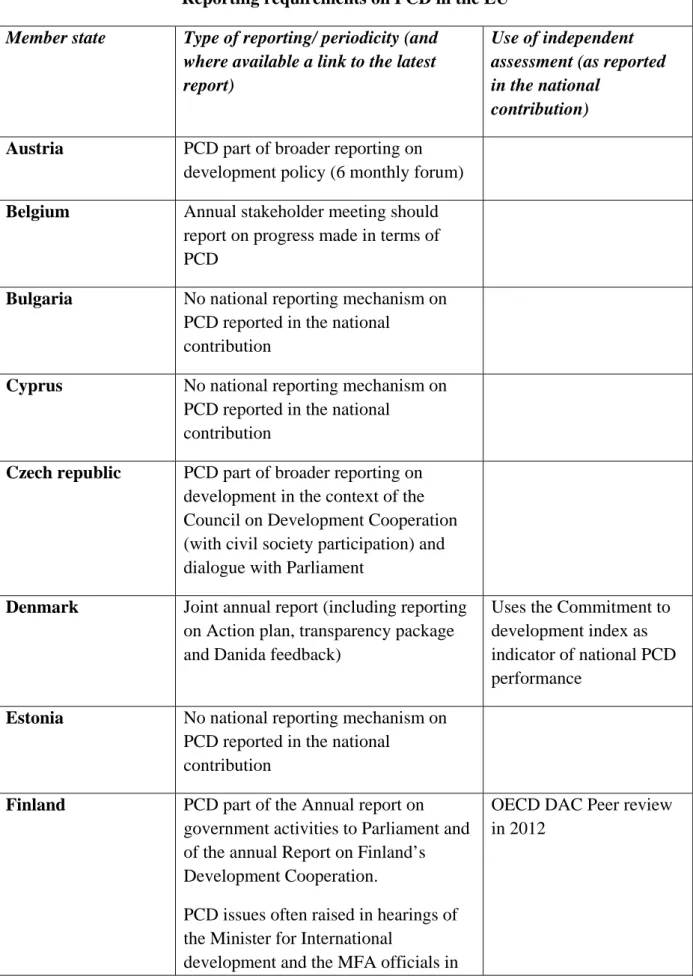
Table of reporting requirements of EU Member States ... 175 List of acronyms... 179 List of main web links ... 186
Executive summary
The report shows that the European Union has made good progress on Policy Coherence for Development (PCD) at both European and Member State level, a fact recognised by the OECD1 in the most recent (2012) OECD DAC peer review.
The report starts by recording progress and developments on cross-cutting PCD issues and then presents thematic issues organised around the five global PCD challenges of trade and finance, climate change, food security, migration and security.
Several important developments in recent years on cross-cutting issues and PCD coordination are presented in this report and summarised below. These have confirmed the EU’s position as a global leader in implementing PCD commitments in policy-making.
Although there is still room for progress in terms of using mechanisms such as impact assessments, evaluation and/or measuring, monitoring progress and reporting on implementation, the EU remains the lead actor for PCD internationally, ahead of its main partners, with the highest levels of political and legal commitment.
Between 2011 and 2013, in particular, PCD issues have benefited from sustained high-level political attention in the EU and featured more prominently on the agenda of the Foreign Affairs Council (Development). In addition, international reflection on the form and content of a post-2015 framework has highlighted the key importance of ‘beyond-aid’ issues, including PCD.
This year’s report goes beyond the usual self-reporting exercise — based on contributions from European Commission services, the European External Action Service (EEAS) and Member States — and includes references to and examples of independent PCD ‘development-friendliness’ assessments.
Moreover, in addition to the EU’s biennial reporting exercise, several Member States now also produce national reports on PCD and many more have included it as a key element in their annual reports on development cooperation. Member States have also been more active in their exchanges on the issue, both among themselves and with the Commission and the High Representative of the Union for Foreign Affairs and Security Policy (HR). Several Member States have also invested to improve the measuring of PCD in their national systems. Also to be noted is the increased attention given to PCD by many national parliaments in the EU.
Progress has also been registered as regards awareness of and attention to PCD issues, especially in the policy-making process and in relation to key policy initiatives. Knowledge of and research into the development impacts of key sectoral policies have grown, partly thanks to increased political and financial support. Research and innovation policy has been supportive of development cooperation in specific thematic sectors as well as a cross-cutting driver for inclusive and sustainable growth. The PCD training that has been introduced for the Commission’s headquarters and Delegation staff (and open to EEAS and Member State officials) is likely further to improve awareness and implementation of PCD principles at EU and Member State level.
There has also been an increase in the last two years in the number of pilot studies, interservice processes and public debates on PCD and good practices at EU level and in the Member States, reaching far beyond the traditional development policy community.
The lack of feedback from partner countries and the need for more PCD dialogue with them, as highlighted in previous editions of this report, are currently being addressed by the Commission and the HR, notably through EU Delegations around the world.
However, despite efforts at EU, Member State and OECD level, the main challenge for EU progress on PCD still remains the issue of measuring – baselines, targets and PCD indicators (including the cost of incoherence) – and in general PCD-targeted research (e.g. case and country studies) is necessary if PCD commitments are to be translated into more concrete results and to demonstrate the added value of PCD.
Many positive developments have been recorded over the last few years in efforts to address the five PCD challenges identified in the Council conclusions in 2009, i.e. trade and finance, climate change, food security, migration and security.
As regards trade and finance, the EU has concluded and continues to negotiate a series of bilateral free trade agreements (FTAs), including with developing countries and regions. In 2012, it revised its Generalised Scheme of Preferences (GSP), which provides trade preferences to developing countries. New preferences enter into force on 1 January 2014. The revision focuses on countries most in need and is geared to accommodating their exports, thus confirming the EU’s position as the most open market in the world for exports from developing and, in particular, least-developed countries (LDCs). Under the Everything-But-Arms (EBA) scheme, LDCs are granted duty-free/quota-free access for all their products, except arms and ammunition. Moreover, a high proportion of developing countries’ imports from the EU are capital goods and intermediate inputs, and reducing tariffs on these within an FTA directly cuts the importing country’s production costs and increases its competitiveness. Besides providing developing countries with new opportunities for trading and economic growth, FTAs also entail or encourage related domestic reforms.
In order to help developing countries reap the benefits of new trade agreements and promote regional integration, the EU and its Member States have considerably increased their Aid for Trade (AfT) in recent years. Collectively, they are the largest provider of AfT in the world, accounting for a third of global international AfT flows. The EU supports developing countries in their efforts to comply with core human rights and international labour and environmental conventions, particularly through the incentive-based GSP+ scheme. The EU also remains committed to supporting fair and ethical trade schemes. At multilateral level, the EU has intensified its efforts to achieve progress on the Doha Development Agenda, with a focus on concluding, at the 9th WTO Ministerial Conference, a Trade Facilitation Agreement as well as agreeing on certain agriculture and development deliverables, some specifically for LDCs.
The Commission and Member States encourage European companies in many ways to adhere on a voluntary basis to internationally recognised guidelines for corporate social responsibility (CSR) in their business operations. The Commission’s Communication on CSR2, one of the main sections of which covers international aspects of CSR, contains an EU-level action plan and invites Member States to draw up or update national action plans on business and human rights. To date, 23 Member States have responded positively, devising numerous activities aimed at promoting responsible conduct on the part of private and public enterprises. Despite the progress made, the international dimension of CSR remains one of the key challenges for EU companies. The Commission also plays a supporting role through complementary initiatives, such as the tabling in April 2013 of a proposal for a directive on the disclosure of non-financial information by large companies. The Commission sees the proposal as an effective way of encouraging large European companies to integrate social and environmental
considerations into their operational practices and business strategies, including supply chains in developing countries. Once adopted by the European Parliament and the Council, the Directive would create legally binding obligations that go beyond the voluntary nature of CSR.
The EU continues at bilateral and multilateral level to pursue a balanced intellectual property rights (IPR) policy vis-à-vis developing countries, taking into account their level of development and capacity, and the importance of striking a balance between encouraging and rewarding innovation on the one hand, and ensuring access for users and the public on the other. The upcoming revised strategy for the protection and enforcement of IPR in third countries is expected to consolidate this approach. The EU is also committed to preserving access to affordable medicines in line with the principles of the Doha Declaration.
The EU’s policy on raw materials attaches great importance to improving governance in developing countries and making sure that due revenues are received by governments and used in a transparent and development-oriented way. The EU therefore supports raw materials transparency schemes such as the Extractive Industries Transparency Initiative (EITI) and Forest Law Enforcement, Governance and Trade (FLEGT). A flagship of EU action in this regard is the EU’s FLEGT Action Plan, which uses trade incentives and the EU market as levers to promote forest governance and law enforcement reforms in timber-exporting countries. Among other things, the Plan involves support to timber-exporting developing countries, the development of a licensing system to ensure that only legal timber is imported into Europe, support to the private sector and promoting responsible investment and new domestic policies to promote legal and sustainably produced products in European governments’ purchasing practices. It also provides for the conclusion of Voluntary Partnership Agreements (VPAs) with timber-producing developing countries on cooperation against illegal logging. Six VPAs have been concluded and more are under negotiation. A milestone in the implementation of the Action Plan was the entry into force in March 2013 of the EU Timber Regulation, which imposes obligations on operators placing timber and timber products on the EU market.
The EU has an established policy of promoting good governance in tax matters aimed at tackling harmful tax competition and tax evasion within the EU and at international level. In December 2012, the Commission presented an Action Plan to strengthen the fight against tax fraud and tax evasion3, including in relation to third countries. One of the recommendations accompanying the Plan proposes measures to the Member States intended to encourage third countries to apply minimum standards of good governance in tax matters.
In June 2013, the EU adopted amendments to the Accounting and Transparency Directives which, inter alia, promote the disclosure of payments to governments by listed and other large EU companies in the extractive and forestry industries (country-by-country reporting) as well as providing civil society in resource-rich countries with the information they need to hold governments to account for income from the exploitation of natural resources, such disclosure will provide pointers as to possible cases of tax avoidance and evasion. This is considered an important step towards bringing more transparency to an industry often shrouded in secrecy and towards fighting tax evasion and corruption.
In the area of climate change, EU policies have contributed positively overall to global development. Not only is the EU the largest contributor of climate finance to developing countries, but it has also delivered on and surpassed its commitment on Fast Start Finance. In addition, the EU (including its new Member States) has outperformed on its emission reduction target for the first Kyoto commitment period.
As the situation develops, and emissions from the developing world now exceed those from developed countries, the promotion of a joint approach and stronger global commitments, especially for emerging countries, are necessary: Up to 2020, around 90 countries, including all major economies worldwide, covering more than 80% of global emissions have pledged to take action and to tackle their greenhouse-gas emissions. The EU can help other countries (especially developing countries) by sharing its experience and its low-carbon and climate-friendly technologies and further promoting resilience.
Nevertheless, the EU continues to be attentive to the possible effects of its climate-related policies on other development objectives and challenges such as environmental, social and economic sustainability, and monitoring these effects, e.g. in the area of renewable energy, where a study on the impacts of biofuels production in developing countries was conducted in 2012, will remain important to ensure coherence.
Other environmental (e.g. land, water and biodiversity) issues are being followed closely in the context of PCD, as they are equally important for development.
In the area of food security, the EU food industry remains an important supplier of high-quality, safe agricultural and food products on a growing world market. The common agricultural policy has been at the heart of the PCD debate in the context of its recent ‘after 2013’ reform. Impact analysis indicates that, thanks to profound reorientations in recent decades, the impact of the CAP on third-country markets has become more limited and is projected to remain negligible. The regular use of export refunds has been gradually eliminated and the EU has become a ‘price-taker’ in the world markets for most agricultural products.
Another recent major policy reform to impact global food security has been that of the common fisheries policy, which will also influence the new generation of Fisheries Partnership Agreements. The reform is aimed at reinforcing resource sustainability and the FPAs seek to make funding for sectoral support more efficient and transparent and to increase added value for partner countries. The EU also encourages better regional and local resource governance by supporting developing countries’ participation in regional fisheries management organisations. The EU actively contributes to reducing damages for developing countries in its policy efforts to prevent and fight illegal, unreported and unregulated fishing. Finally, it provides financial support for scientific research in this area and pushes for better monitoring of the resource in order to ensure sustainable management at global and regional levels.
Lastly (as regards food security), the Commission has recently proposed a package of legislation on animal and plant health, including plant reproductive material. This proposal aims to update and simplify existing legislation while preserving high levels of safety. Through the Better Training for Safer Food programme and support for developing countries’ participation in international standard-setting bodies, the Commission not only shares good practices and promotes compliance with EU standards — thus improving EU market access for developing country producers — but also helps to increase the availability of safe and nutritious food, including in developing countries.
In the area of migration, progress remains uneven. The EU policy framework for migration and development has been strengthened significantly during the reporting period. The revised Global Approach to Migration and Mobility (GAMM) is more comprehensive and strategic, with greater emphasis on ensuring coherence between internal and external policy priorities. This has brought positive change as regards short-term mobility and the international protection of migrants. The Council’s conclusions on migration and development in September 2013 re-emphasised the importance of PCD for migration and outlined a broader,
more ambitious approach to migration issues under the GAMM and EU development policy in general.
Member States’ understandings of migration and development issues tend to vary significantly and as a result approaches to PCD on migration differ widely. Progress in this area often remains subject to political considerations, but some has been made on the economic aspects of migration and development, particularly when it comes to facilitating remittance flows and supporting diasporas, and reducing brain drain. Further efforts are required on the management of mobility (including labour-matching and the recognition of qualifications) and circular migration.
The EU has made significant efforts to promote PCD in policy dialogues on migration with non-EU countries and regions, notably African and ACP partners (intensive talks on migration and development between 2011 and 2012 focused on remittances and visa policy), and countries to the East (through the Prague Process, the Eastern Partnership and the Budapest Process). In addition, Mobility Partnerships and Common Agendas in Migration and Mobility, which provide useful platforms for cooperation and promoting PCD in the context of migration, continue to be negotiated and concluded with partner countries in the Eastern and Southern neighbourhood and further afield.
In the area of security, progress has been made in recent years in addressing fragility in the EU’s development cooperation and strategies and improving its overall response. The EU is the key stakeholder for implementation of the New Deal for Engagement in Fragile States and has offered to lead the pilots in three of the ten countries: the Central African Republic, Somalia and Timor-Leste. PCD has also been explicitly included as one of the programming principles of the future Instrument for Stability (2014-20), with a view to prioritising those security issues that have the greatest impact on EU development policy objectives, and comprehensive regional strategies have been developed, which will improve the coherence and effectiveness of EU action.
The EU is developing a global conflict early warning system (with a pilot in the Sahel region in 2013) and conflict analysis in general, with specific security and conflict-related guidance for the programming and implementation of EU assistance.
A second important area of progress is the Security Sector Reform (SSR), increased ownership of which (including the judicial element) is being promoted by the EU in partner countries.
At the multilateral level, the EU has actively participated in efforts to regulate and limit the global arms trade, and to combat the illicit accumulation and trafficking of small arms and light weapons. It has continued actively to address the issue of landmines in all its geographical development programmes.
In addition, the EU has been working on initiatives to improve management of natural resources so as to pre-empt potential conflict. In 2013, work started on a possible initiative on minerals originating in conflict-affected and high-risk areas. Also, the EU is working intensively on implementation of the Kimberley Process to reduce trade in conflict diamonds. Lastly, the EU has undertaken significant efforts in the context of Common Security and Defence Policy missions and operations to promote coherence between development and security, and to make the most of potential synergies, e.g. between anti-piracy strategies and law enforcement and justice in the Horn of Africa.
This report concludes by setting out the medium- and long-term challenges relating to cross-cutting and thematic issues.
Introduction
This fourth report on Policy Coherence for Development (PCD) has been produced in line with the mandate given to the European Commission by the Council in 2005, calling for regular biennial reporting on PCD. Over the years, the PCD report has become the main tool for monitoring progress on PCD by the EU and its Member States, and the basis for strategic interinstitutional debate on the matter at EU level. It is also used as a major EU reference document on PCD issues.
While this report focuses on 2012-13, on some key policies it has been necessary to take a longer-term perspective.
Preparation of the 2013 Report has highlighted renewed interest in PCD issues in the EU, both at political and at technical level.
In view of many Member States’ reluctance in the past to use a standard questionnaire, the Commission asked this time for contributions in an open format, providing only general guidance. This approach seems to have paid off, as far more contributions were received than in the last reporting exercise and the volume and quality of information have improved significantly. All Member States have responded to the request for contributions and all 27 full contributions are reflected in this report.
Progress was also achieved on the transparency of the process, as a majority of Member States agreed to make their contributions publicly available and some have already published them. As the EU report cannot do justice to the wealth of information and level of detail in the national responses, the contributions from Member States which have given their agreement will also be published on the European Commission website.
This report feeds into the political debate on PCD and beyond-aid issues by reviewing progress and challenges, but does not aim to present new Commission initiatives or proposals. The report is organised broadly in two main sections, looking first at PCD cross-cutting issues and then at thematic issues. The first part highlights advances in promoting PCD, such as the setting-up of PCD training, the ongoing work to include development aspects in the Commission’s impact assessments and the reinforced PCD role of EU Delegations. It notes the progress made in some Member States, especially those who have set up a national reporting process and the mobilisation of Parliaments on PCD issues. It also underlines the challenge of more evidence-based PCD and — for the first time, at Member States’ request — refers to a number of independent assessments, studies and reports on PCD.
The second part of the report is structured around the five main challenges for PCD: trade and finance, climate change, food security, migration and security. Other policy areas that are relevant for PCD but do not fit neatly into this main structure, such as resilience, research, information society and biodiversity, are addressed in more detail at the end of the report (see other issues).
Finally, the report sets out medium- and long-term challenges relating to cross-cutting and thematic issues in the section on lessons learned and outstanding issues.
I. CROSS-CUTTING ISSUES
1. POLICY COHERENCE FOR DEVELOPMENT
1.1. The concept of PCD
The concept of Policy Coherence for Development (PCD) emerged in international discourse in the early 1990s against a background of increasing global challenges and growing concerns as to the effectiveness of aid. There is no single agreed definition of PCD, but it is widely accepted that it means that, in pursuing their domestic policy objectives, governments should at a minimum avoid negative consequences and spill-overs which would adversely affect the development prospects of poor countries (‘do no harm’). More positively, PCD also means that, when formulating domestic policies, governments should actively look for ways to exploit the potential for positive spill-overs and build synergies between different policies to benefit developing countries.
1.2. Several dimensions of coherence
Since PCD encompasses a wide range of policy areas, effective coordination between the parties involved is essential. Because of the Commission’s key role in initiating the EU policy process, coordination is needed first within the Commission and with the HR.
The next level of coordination is between and within the European institutions, in particular those co-deciding policies, the European Parliament (EP) and the Council of the European Union (the Council).
The EU Member States constitute the third relevant level for promoting PCD because of their decision-making role in the Council and their responsibility for implementing policies which may in turn affect development objectives, e.g. in the areas of migration or security. Also, Member States should ensure that national policies are PCD-compatible.
Fourth, cooperation and consultation with developing countries is instrumental in informing the policy process. Similarly, NGOs and civil society can play an important role in relaying bottom-up information on the impact of EU policies on development objectives.
Finally, whilst the EU is a global player, it is of course not alone in shaping the environment of developing countries. PCD needs to be further promoted in international fora, in particular the OECD, to ensure that global rules and frameworks are consistent with development objectives.
2. LEGAL COMMITMENTS
2.1. Legal commitment at EU level
At EU level, the concept of PCD was originally formulated in the Maastricht Treaty in 1992. Re-using the same language, the Treaty on the Functioning of the European Union stipulates in Article 208 that ‘[t]he Union shall take account of the objectives of development cooperation in the policies that it implements which are likely to affect developing countries’. The Treaty describes the primary objective of development as ‘the reduction and, in the long term, the eradication of poverty.’
The entry into force of the Treaty in December 2009 reinforced the legal basis of PCD in the EU. The inclusion of PCD in its fundamental law sets the EU apart on the international stage. The EU recognises that some of its policies have significant external impacts that can either contribute to or undermine its development policy. It therefore seeks to gather information on
the nature and scale of these impacts, and strives to minimise inconsistency and create synergies between policies that have a demonstrated impact on developing countries.
2.2. Legal commitments in Member States
A growing number of Member States have in recent years introduced legal commitments to PCD in their domestic legislation. Eight reported that they have a law (mostly on development cooperation) or a government decree in place which obliges governments and public administrations to pursue the objective of PCD. For instance, most recently (in March 2013), the Belgian Parliament adopted a new Law on Development Cooperation which identifies PCD as one of six overarching objectives. In addition, the Law contains three specific operational proposals: setting up an institutional mechanism within the federal government to monitor progress on PCD; obligatory ex-ante examination of the impact of new federal policies on developing countries; and the inclusion of a specific chapter on PCD in the annual report of the Belgian Development Cooperation. Other Member States which have made PCD-related legal commitments recently include Luxembourg and Denmark.
3. POLITICAL COMMITMENTS
3.1. European Consensus
The European Consensus on Development of December 2005, which provides, for the first time, a common vision to guide EU and Member States’ development cooperation, makes a specific commitment to promoting PCD. It requires all policies likely to affect developing countries to support development objectives and confirms the twelve priority areas identified in the PCD Council conclusions of May 2005 (see next section). The Consensus also contains a commitment to strengthening PCD procedures, instruments and mechanisms at all levels. In 2005, the EU also committed itself to a biennial PCD reporting process, and the first PCD progress report was published in 2007. All reports are published on the Commission’s website4 and sent to the Council and the European Parliament.
3.2. Council conclusions on PCD
Since 2005, the EU has gradually strengthened its PCD procedures, instruments and mechanisms at all levels. The Council agreed in its conclusions of May 2005 to track progress on PCD in 12 policy areas: trade, environment, climate change, security, agriculture, fisheries, the social dimension of globalisation (including employment and decent work), migration, research and innovation, information society, transport, and energy.
Drawing lessons from the 2009 PCD Report, the EU decided to rethink its approach. In a 2009 Communication Policy Coherence for Development — Establishing the policy framework for a whole–of–the-Union approach, the Commission made suggestions as to how PCD could be approached in a more targeted, effective and strategic way. It also proposed that development objectives be explicitly used as a starting point for PCD efforts.
The Council endorsed the following five PCD global challenges in November 2009: 1. Trade and finance;
2. Addressing climate change; 3. Ensuring global food security;
4. Making migration work for development; and
4
5. Strengthening the links and synergies between security and development in the context of a global peace-building agenda.
The challenges at the heart of the new approach to PCD are closely linked to progress towards the Millennium Development Goals (MDGs). The policy areas identified by the Council in 2005 remain relevant to PCD and can effectively complement each other in addressing the five global challenges. For example, policy areas relevant to food security include fisheries, agriculture, trade, research, responsible investment, biodiversity, etc. Similarly, those relevant to climate change include transport, energy and trade, but also biofuels production, thus linking the challenge to the area of agriculture.
The most recent Council conclusions on PCD5, adopted as a follow-up to the 2011 PCD Report, took stock of progress, reaffirmed the EU’s political commitment to the promotion of PCD and set out policy guidelines for the future. They express the belief that PCD is essential for the EU’s credibility as a global actor and that the EU should take the lead on these issues. The Council also reiterated its decision to focus in the immediate future on five areas: trade and finance, climate change, food security, migration and security. It particularly highlighted the role of the EEAS and EU Delegations in keeping PCD issues on the agenda in their regular dialogue with partner countries. Finally, the Council called on the Commission to head up the work on a more evidence-based approach informed by independent assessments and on improving coordination mechanisms and implementation within the EU institutions and with Member States.
3.3. The European Parliament’s PCD Report and Standing Rapporteur for PCD
The European Parliament has also gradually strengthened its PCD procedures, instruments and mechanisms in the past few years. In May 2010, it adopted a resolution on PCD6 which brought in biennial reporting and a Standing Rapporteur for PCD in its Development (DEVE) Committee. As the first Standing Rapporteur, Birgit Schnieber-Jastram MEP was responsible for drafting and presenting the report that formed the basis of the EP Resolution of 25 October 2012 on the EU 2011 PCD Report7. This was the first comprehensive EP report/resolution covering institutional, cross-cutting and thematic areas aspects of PCD. The report was adopted in the DEVE Committee and three other committees submitted opinions (Employment and Social Affairs, Fisheries and Women’s Rights and Gender Equality).
The EP Resolution stressed that PCD is not merely a technical issue but primarily a matter of political responsibility and that the EP has a key role in this respect. The Parliament welcomed the 2011 PCD Report but agreed with the Council on the need to include independent assessment, including on the cost of policy incoherence, in future reports. It asked the HR and the EEAS to fulfil their roles by making PCD a reality and underlined the important role of the EU Delegations. The Resolution called on the Commission to take specific action on a wide range of institutional and thematic issues (in particular trade, agriculture, fisheries, climate change, energy, security and migration).
5
Adopted on 14 May 2012:
http://www.consilium.europa.eu/uedocs/cms_data/docs/pressdata/EN/foraff/130225.pdf. 6
European Parliament Resolution of 18 May 2010 on EU Policy Coherence for Development and the ‘Official Development Assistance plus’ concept (2009/2218(INI).
7
3.4. Agenda for Change
The Commission Communication Increasing the impact of EU Development Policy: an Agenda for Change8 triggered further discussions and proposals in 2012 and was welcomed and endorsed by the Council in May 2012.
The Agenda for Change proposed an ambitious programme of change designed to heighten development impact and improve progress towards the MDGs by focusing strategically on countries most in need (including fragile countries) and on priority areas that promote good governance, human rights and the rule of law and inclusive and sustainable growth. These principles and priorities have been integrated in the design of the 2014-20 external financial instruments and the programming instructions to EU Delegations.
Several Communications and Council conclusions in 2012 focused on specific aspects of the Agenda for Change, e.g. Social Protection in European Union Development Cooperation9; The Roots of Democracy and Sustainable Development: Europe’s Engagement with Civil Society in External Relations10 and The EU Approach to Resilience: Learning from Food Security Crises11.
3.5. Post-2015 — Communication A decent life for all
The period from 2009 to 2013 has also been marked by the growing debate on a new ‘post-2015’ global development framework to replace the Millennium Development Goals (MDGs). To lay the ground for an EU position on a future framework, the Commission presented the Communication A decent life for all: Ending poverty and giving the world a sustainable future12. It proposes a common approach for the EU’s involvement in ongoing and forthcoming international processes relating to the MDG review and the follow-up to the Rio+20 Conference in June 2012.
The Communication suggests five elements which should underlie a future set of goals and which are essential to ensuring a ‘decent life for all’ by 2030:
• Basic living standards (based on the unfinished MDG business);
• Drivers for inclusive and sustainable growth;
• Sustainable management of natural resources;
• Equality, equity and justice, including human rights, democracy and other aspects of good governance;
• Peace and security.
In June 2013, the Council endorsed this overall approach in conclusions13 that now serve as the basis for the EU’s input into various UN processes, including the work of the UN Open Working Group on Sustainable Development Goals (SDGs). The EU position highlights the 8 COM(2011) 637 final http://www.consilium.europa.eu/uedocs/cms_data/docs/pressdata/EN/foraff/130225.pdf. 9 COM(2012) 446 final. http://www.consilium.europa.eu/uedocs/cms_data/docs/pressdata/EN/foraff/132875.pdf. 10 COM(2012) 492 final. http://www.consilium.europa.eu/uedocs/cms_data/docs/pressdata/EN/foraff/132870.pdf. 11 COM(2012) 586 final. http://www.consilium.europa.eu/uedocs/cms_Data/docs/pressdata/EN/foraff/137319.pdf. 12 COM(2013) 92 final http://ec.europa.eu/europeaid/documents/2013-02-22_communication_a_decent_life_for_all_post_2015_en.pdf. 13
importance of a single overarching framework and a single set of goals for a post-2015 agenda that brings together the Rio+20 follow-up and MDG review processes. It also points to the need for a truly global and universal framework, with responsibilities for all countries — developing, emerging and developed.
In July 2013, the Commission presented the Communication Beyond 2015: towards a comprehensive and integrated approach to financing poverty eradication and sustainable development, which suggests possible elements of a common EU approach to financing post-2015. The Communication advocates consolidating and rationalising ongoing international financing processes (e.g. development, climate, bio-diversity) and puts forward universally applicable principles that could guide international discussions.
The importance of PCD is also stressed in the 2013 European Report on Development (ERD) (Post 2015: Global Action for an Inclusive and Sustainable Future14), which provides analysis to support the EU’s post-2015 policy approach.
Both the Communication and the EU position in the June 2013 Council conclusions attach importance to ‘beyond-aid’, and especially PCD, issues in the new framework.
3.6. Political commitments by Member States
Of the 28 Member States, 17 reported that they had entered into political commitments to make progress on PCD and take account of development objectives in other policies. Such objectives are often incorporated as guiding principles in a government programme (e.g. in Finland, Spain, Portugal and Poland) or set out in strategic documents on development cooperation (e.g. Ireland’s 2012 Aid White Paper, Austria’s new three-year (2013-15) strategy for development policy and The right to a better life, Denmark’s 2012 strategy for development cooperation). In several cases, the commitments are reflected in a ‘whole-of-government’ approach. Some Member States (e.g. Denmark, Finland, Sweden, Belgium and the Czech Republic) have translated their political commitments to PCD into plans of action and/or identified PCD priority areas. Frequently mentioned priority areas include trade, taxation, food security, environment, health, migration and security. A number of Member States have also established policy coordination mechanisms and systems for monitoring and reporting, including, in several cases, to national parliaments.
4. MEASURING PROGRESS AND MOVING TOWARDS MORE EVIDENCE-BASED PCD
4.1. 2010-13 PCD Work Programme
In 2010, the Commission responded to calls for a more pragmatic approach and more systematic measurement of PCD by publishing a PCD Work Programme.
Presented as a Staff Working Document, the Policy Coherence for Development Work Programme 2010-1315 is structured around the five priority areas (trade and finance, climate change, food security, migration and security). It guides the work of the Commission and the HR and serves as a reference for Member States’ PCD work. It translates the political principle of PCD into an operational framework, with specific steps to address, through
14
The ERD is an independent report, supported by the European Commission and seven EU Member States.in the framework of the Mobilising European Research for Development Policies initiative. The 2013 ERD was prepared by a research consortium of the Overseas Development Institute (ODI), the German Development Institute (Deutsches Institut für Entwicklungspolitik – DIE) and the European Centre for Development Policy Management (ECDPM)
http://www.erd-report.eu/erd/report_2012/index.html. 15
concrete policy initiatives, processes and financial means, the priority areas in a development-friendly manner.
The Work Programme does not provide a comprehensive list of all initiatives that might be relevant for development, but rather focuses on planned initiatives and processes that stand out for their potential as ‘PCD catalysts’.
Targets and indicators were set to help track progress towards the identified PCD objectives, but these have been criticised for being too imprecise. Also, they have been of limited usefulness for the EU as many of them (e.g. ‘conclusion of the Doha Round’) are, to a greater or lesser extent, beyond its control.
4.2. Impact assessments
The Commission uses its Impact Assessment (IA) process16 as a key tool to ensure that its proposals are prepared on the basis of transparent, comprehensive and balanced evidence. IAs provide structured, standardised and systematic ex-ante policy analysis. They help Commission services and the EEAS to develop and prepare initiatives by providing evidence for political decision-makers on the advantages and disadvantages of policy options through the assessment of their potential economic, social and environmental impacts. They are carried out in-house but external inputs from stakeholders, e.g. in the context of a public consultation process (mandatory part of an IA process), also feed into the analysis. The procedural rules for preparing, carrying out and presenting an IA are set out in the Commission’s Impact Assessment Guidelines of January 200917.
IAs have great potential to strengthen PCD at a very early stage of the preparation of a political initiative. In the last revision of the IA Guidelines in 2009, a new section on assessing impacts on developing countries was added, together with upgraded guidance in the annexes. Initiatives that may affect developing countries should be analysed for their consistency with EU development policy objectives. This includes analysis of longer-term consequences (or spill-overs) in areas such as economic, environmental, social and security policy.
Despite this requirement, in the two years that followed this reform only a small number of IAs on initiatives with a potential impact on developing countries actually included analysis of those aspects. This poor record — criticised in a report by the European NGO Confederation for Relief and Development (CONCORD)18 in autumn 2011 — shows that PCD and development objectives are not yet given sufficient weight in the IA process. The Commission is therefore looking at ways of raising the profile and awareness of the PCD requirement in the IA Guidelines and strengthening analytical capacity for assessing development impacts of non-development policies.
An opportunity to do so has arisen with the Commission’s review of the IA Guidelines (as announced in its Communication on EU Regulatory Fitness), which will be completed in 2014. The objective in terms of promoting PCD is to make the requirement to analyse impacts on developing countries more explicit in the Guidelines and provide clearer guidance in the technical section on how to assess them.
4.3. Policy analysis in support of trade agreements and negotiations
EU decision-making in respect of trade negotiations and proposed trade agreements is supported by a substantial body of policy analysis. This includes specific economic studies on 16 http://ec.europa.eu/governance/impact/index_en.htm. 17 SEC(2009) 92. 18
various aspects of proposed trade negotiations, impact assessments (IAs) and trade sustainability impact assessments (SIAs).
Trade SIAs were first developed in 1999— even before the Commission launched its impact assessment policy – in response to the WTO DDA negotiations. Since then, the Commission has completed a number of SIAs, covering all of its major (multilateral, regional or bilateral) trade negotiations, and five more are under preparation.
Impact assessments on trade initiatives are more recent, but the practice is growing fast: as highlighted in the 2011 Communication Trade, Growth and World Affairs, the Commission is committed to conducting impact assessments on all new trade initiatives with a potentially significant economic, social or environmental impact on the EU and its trading partners, including developing countries. IAs are also undertaken for areas of trade policy other than negotiations, e.g. on the proposal at the basis of the revision of the GSP Regulation.
IAs and trade SIAs are complementary analysis tools to support decision-making on trade policy. The IA takes place before agreement on major new proposals is reached and provides evidence to support Commission decisions on whether these proposals should be launched at all. The latter provide more detailed analysis of proposed trade agreements (including extensive stakeholder consultation), to be fed into negotiations once they have been launched. Trade SIAs are independent studies conducted by external consultants, on the basis of which the Commission sets out its own views on the identified impacts and the policy measures proposed to address them. They help to integrate sustainability into trade policy:
• by analysing the issues covered by a trade negotiation from a sustainable development perspective;
• by informing negotiators of the possible economic, social, environmental and human rights consequences of a trade agreement; and
• by providing recommendations for the design of possible flanking (complementary) measures to maximise positive impacts and reduce negative impacts of the negotiations in question.
To date, trade SIAs have been carried out for free trade agreements (FTAs) with Chile and with the GCC countries, economic partnership agreements (EPAs) with ACP countries, the EU-Mediterranean FTA, the partnership and cooperation agreement (PCA) with China, the association agreement with Mercosur, FTAs with South Korea, six ASEAN countries19, India and Libya, the trade part of the association agreements with Central America and the Andean Community, the comprehensive economic and trade agreement (CETA) between the EU and Canada; the deep and comprehensive free trade agreements (DCFTAs) with Ukraine, Georgia and Moldova; and the potential DCFTA with Armenia.
Five Trade SIAs are ongoing: two for negotiations to upgrade the Euro-Mediterranean association agreements and for DCFTAs with Morocco and Tunisia; two related to the FTA negotiations with Japan and USA; and one on the trade in services agreement (TiSA).
4.4. Impact Assessment in the European Parliament
Significant progress in terms of overall coherence has been made by the European Parliament (EP) in its recognition of the importance of the Impact Assessments for political discussion and recent creation of its own impact assessment team, as agreed in the 2003
institutional Agreement on better law-making20. They are based on the three main components of the policy cycle: ex-ante impact assessment, ex-post impact assessment and European Added Value assessments to evaluate the impact of Parliament’s own proposals. Three units are located in the Parliament’s Secretariat in the Directorate for Impact Assessment and European Added Value under the Directorate-General for Internal Policies of the Union. Although it is still small, the existence of new analytical capacity and IA quality control should make for better coherence and provide another opportunity in the policy-making process to take account of impacts on developing countries.
4.5. Evaluations
While IAs use evidence before decisions are taken to assess whether a specific intervention is justified and how it should work to achieve certain objectives, evaluations use evidence to assess whether an ongoing or past intervention was justified and whether it worked (or is working) as expected and achieved its objectives. Evaluations also take in causality, analysing why something did or did not happen, and look for unintended or unexpected effects which were not predicted at the time of the IA. Evaluations and IAs therefore complement each other at different points of the policy cycle.
Evaluation is a building block of the Commission’s smart regulation strategy. Each Directorate-General has an evaluation function with clearly defined responsibility for coordinating and monitoring the DG’s evaluation activities (from the planning of evaluations to their dissemination and use), promoting the quality of evaluation and organisational learning, and assisting central services in implementation of the Commission’s overall evaluation policy.
The scope of an evaluation must be tailored to a particular intervention and is influenced by the type of intervention and the point it has reached in its development cycle. There are, however, five mandatory evaluation criteria to be considered in any evaluation: relevance, effectiveness, efficiency, EU added value and coherence21. The Commission is currently working on a review of its Evaluation Guidelines and this will be an opportunity to assess — on the basis of past experience — how evaluation contributes to PCD.
4.6. Feedback from partner countries and the role of EU Delegations
Both the Agenda for Change and the PCD Council conclusions of 14 May 2012 suggest a stronger role for EU Delegations and for PCD dialogue in partner countries. The lack of feedback and, often, partner countries’ lack of interest in discussing PCD are constant challenges both for the EU internally and for promoting coherence in partner countries.
Article 12 of the Cotonou Agreement encourages dialogue on PCD issues with and among partners, but few countries take advantage of this opportunity for consultation and policy discussion. This is quite surprising, as many of the priority PCD themes such as trade, agriculture and security are constantly — but separately — at the heart of bilateral policy dialogue. There is a need for a more systematic gathering of feedback from developing countries on priority issues, more country-level studies and information on ongoing PCD-relevant thematic dialogues with partners and stakeholders. EU Delegations need to be better informed about the PCD agenda and work, and authorised to conduct effective multi-stakeholder dialogues on key PCD issues and inform headquarters of impacts of EU policy observed at country level.
20
OJ C 321, 31.12.2003, p. 1. The agreement also states that an assessment of the impact of any amendment made by the European Parliament or the Council is desirable.
21
In response to this need, the Commission and the HR are working to improve awareness of the PCD approach and provide information and basic PCD training to staff in EU Delegations22, and exploring Delegations’ capacity to improve country-level dialogues on PCD and gather information on country-level impacts of EU policies. A joint HR/Commission letter sent to EU Delegations in July 2013 requested initial reports on PCD processes and priority PCD issues at country level by the end of January 2014. Following this first round of reporting, consideration will be given to more regular PCD reporting from Delegations, ways of integrating the results of country-level analysis into biennial reporting, and follow-up in the form of case/country studies where relevant.
4.7. Independent assessments
One of the key criticisms of the 2011 PCD Report focused on the issue of ‘self-reporting’. In response to the request in the Council conclusions of 14 May 2012 that ‘the fourth biennial PCD Report, […] should include an independent assessment of progress’ as well as to demands in the EP Resolution, this section cites several examples of independent PCD assessments that could be used to enrich future reporting.
It is important to note that the assessments vary widely as regards level of independence, criteria, scope and Member States covered. The fact that they are reviewed here should be taken neither as an endorsement nor criticism of their methods, criteria and conclusions by the EU, although in many cases their conclusions and recommendations have been fed into PCD debate at EU level. Some, e.g. the Commitment to Development Index, are also used nationally and even co-financed by Member States.
Although they constitute important sources of information and analysis, and useful examples of how indicators can be used for PCD monitoring, none of the assessment or ranking initiatives reviewed could fully replace the EU biennial self-reporting exercise.
If more space is to be given in future reporting to independent assessments of EU progress on PCD, in response to the Council’s and the European Parliament’s requests, more PCD expertise and discussion will be required. Further efforts are needed to raise interest in PCD, build analytical capacity for credible independent assessment outside EU and Member State administrations and promote independent research and monitoring of progress on PCD.
The objective of this section is not to give a comprehensive list of all PCD-relevant work, but to highlight initiatives with the widest scope, those that are especially relevant for EU-level reporting and/or those that have been reflected in Member States’ contributions.
4.7.1. European Report on Development
The 2013 European Report on Development (ERD) (Post-2015: Global Action for an inclusive and sustainable future) seeks to contribute to the reflection on the post-2015 development agenda by providing independent research-based analysis, stimulating debate and building common ground among key stakeholders. Based on an assessment of the MDG experience and analysis of the changing international context and likely trends in the next 20-30 years, the report attempts to identify key potential drivers of a global partnership for development post-2015, in order to tackle poverty in the poorest countries in an inclusive and sustainable manner. Three such drivers are highlighted: flows of money (development finance), flows of goods (trade) and flows of people (migration). As regards options for a post-2015 framework, ERD 2013 seeks to look ‘beyond MDGs’ and ‘beyond aid’ in its policy recommendations for international and EU action.
22
PCD is identified as one of the specific post-2015 action points where tangible progress and results are important for the EU’s credibility. The report acknowledges that progress on PCD is not easy and that the EU has made more efforts than most, but goes on to argue that those efforts have had a limited impact. Nevertheless, one of the main messages of the report is that the EU’s most valuable contribution to a new global framework for development will be in the range of policies beyond development cooperation (e.g. trade, migration, PCD and knowledge- sharing).
4.7.2. OECD/DAC Peer reviews of the EU and of Member States
Each DAC member country is peer-reviewed roughly every four years, with two main aims:
• to help the country understand where it could improve its development strategy and structures so that it can increase the effectiveness of its investment; and
• to identify and share good practice in development policy and strategy.
Led by examiners from two DAC member states, the process takes around six months to complete and includes both capital and field visits. PCD is a regular feature of the reviews. In the OECD/DAC context, three building blocks have been identified as necessary for achieving PCD:
(a) political commitment and policy statements; (b) policy coordination mechanisms; and
(c) systems for monitoring, analysis and reporting.
The table below shows the key PCD-related findings and recommendations for the EU and individual Member States (Spain, Greece, the Netherlands, Finland, Luxembourg, Slovakia and Slovenia) in 2011 and 2012. France and Sweden are being peer-reviewed in 2013.
Country Key findings Recommendations
EU (2012)
* Having enshrined PCD in the Lisbon Treaty, the EU has taken a lead role in promoting such coherence, but implementation of commitments by Member States has been uneven.
* The Commission has developed
appropriate institutional mechanisms, frameworks and tools
for promoting PCD, but these are not yet used to their full potential, which is hindering progress in ensuring that policies are consistent with development goals.
* To give PCD sufficient weight in EU decision-making, the Council should forge political will and reinforce existing mechanisms.
* To get the most out of PCD mechanisms and secure better evidence to inform decision-making, the Commission and the EEAS should:
- strengthen knowledge management, making more use of internal and external capacity;
- develop and implement a development research strategy which would include producing evidence on PCD;
- together with the Council and EP, improve PCD awareness and training for headquarters and Delegation officials.
(2011) efforts to deliver on its strong legal commitment to PCD have focused largely on setting up new institutions. However, Spain has insufficient capacity for analysing and monitoring policy coherence. The sharing of information between existing bodies and with development stakeholders is not effective and systematic enough to allow monitoring, analysis and accountability to inform and influence policy decisions.
policy, Spain should strengthen its PCD analysis capacity and ensure that information on analysis and decisions flows freely and effectively between existing bodies.
Greece (2011)
* Although Greece is bound by its EU commitment on PCD, none of the building blocks for policy coherence (political commitment,
coordination mechanisms, monitoring systems) are in place
and the draft law and five-year programme do not specify clearly the objectives and mechanisms for ensuring that policies across all government departments are coherent with development goals.
* To ensure that all government policies support, or at least do not undermine, development objectives, Greece should: - make a clear commitment in the law and five-year programme to ensuring that domestic and international policies are coherent with overall development goals. Outline clear PCD priorities on the basis of the EU programme and steps towards achieving them;
- ensure that the new law clearly mandates the inter-ministerial committee to scrutinise domestic, foreign and EU policy proposals for their impact on development and to monitor and report on the impact on developing countries of incoherence in Greek policies;
- reinforce DG Hellenic Aid’s role and capacity to support the inter-ministerial committee and promote awareness of PCD across the administration, parliament and Greek society.
The
Netherlands (2011)
* The Netherland’s approach to PCD has good foundations, but is not yet fully ‘owned’ by a broad range of government offices. Other donors can learn from the Netherlands’ experience with whole-of-government approaches.
* Building on the progress that it has made in development beyond aid, the Netherlands should put in place a clearly-prioritised and time-bound programme as part of its new globalisation agenda to ensure that relevant Dutch and EU policies support, or at least do not undermine, development policies. This programme should translate the commitment to development into plans for action and