A
University
of
Sussex
PhD
thesis
Available
online
via
Sussex
Research
Online:
http://sro.sussex.ac.uk/
This
thesis
is
protected
by
copyright
which
belongs
to
the
author.
This
thesis
cannot
be
reproduced
or
quoted
extensively
from
without
first
obtaining
permission
in
writing
from
the
Author
The
content
must
not
be
changed
in
any
way
or
sold
commercially
in
any
format
or
medium
without
the
formal
permission
of
the
Author
When
referring
to
this
work,
full
bibliographic
details
including
the
author,
title,
awarding
institution
and
date
of
the
thesis
must
be
given
in Global Value Chains:
Insights from Input-Output Analysis
and Customs Transaction Level Data
Filippo Bontadini
Doctor of Philosophy in Science and Technology Policy Studies
Science Policy Research Unit (SPRU)
University of Sussex – UK
I hereby declare that this thesis has not been and will not be submitted in whole or in part to another University for the award of any other degree.
This is a thesis in papers style, and Chapter 3 of this thesis is co-authored with my supervisor Prof. Maria Savona; I wish to acknowledge her contribution in drafting the introduction and conclusion of the Chapter. The Hirschman-Linder hypothesis has been put forward in previous work by Prof. Savona, as properly cited in the Capter 3 of this thesis; however the expansion of this conjecture to natural resource industries and the empirical testing of it is the outcome of my work for this thesis.
Acknowledgments
I would like to express my profound gratitude to my two supervisors Maria Savona and Tommaso Ciarli, who have simply been second to none. They have provided me with continuous support on all fronts, both intellectually and emotionally. Their encouragement, patience, insights and generosity are no doubt the main reason why I have managed to produce this thesis.
In addition I am in huge debt to Dr. Ariel Wirkierman, who has introduced me to input-output analysis and coding in R. Besides opening my eyes on new intellectual challenges, he has been an endless source of stimulating conversations and support over the past four years.
My network of friends at SPRU and the University of Sussex also deserves my deep gratitude in particular my flatmate Andrea and my great friends at the University of Sussex Business School: Bernardo, Daniele, Maika, Nicolò, Pier, and Mattia. My yoga buddies Elsa, Cecilia, Eva also deserve a special mention. I am also very thankful to Amrita for our shared interest in global value chains, trade and development issues, as well as for her friendship. You have all made my life in Brighton sweet and exciting. While not in Brighton, Nunzia also deserves my thanks for being a great friend and making me believe in myself. I would like to thank Jon for the lovely time we spent together in the last few months.
During the work for my thesis I have been lucky enough to encounter many stimulating people who have provided me with valuable insights and feedback on my work. I am particularly grateful to Javier Lopez Gonzalez for taking the time to share his views with me when this thesis was at a very early stage. Nanno Mulder also deserves my thanks for his continuous encouragement and interest in my work.
Last, but certainly not least, my family has been instrumental in the completion of this thesis. My parents’ love, support and patience has been unwavering throughout this journey and I am forever in their debt for this. I also wish to thank my twin Giulio for being my benchmark of intellectual integrity, as well as for his relentless support. My best friend Camilla also deserves my unconditional gratitude, for her love and for seeing me through the highs and lows.
Table of Contents
Thesis summary 71. Introduction 91.1 Trade Specialisation in Global Value Chains. 122.2 Revisiting the Natural Resource “Curse” in the Context of Business Services Trade: Enclave or High-Development Backward Linkages? 153.3 Power and Export Sophistication in Buyer-Supplier Relationships: Insights from Colombian Customs Data
182.Trade Specialisation and Performance in Global Value Chains 222.1 Introduction 222.2 Trade specialisation and performance in the context of GVCs
252.2.1 Trade specialisation and the domestic productive structure 252.2.2 Direction and pace of change in countries’ trade specialisation and economic structure
262.2.3 Research question and Chapter’s contribution 282.3 Measuring trade in a GVC context: descriptive evidence 292.4 Methodology and empirical strategy 372.5 Econometric results and discussion 402.6 Discussion and concluding remarks 443. Revisiting the Natural Resource “Curse” in the context of trade in value added: Enclave or high-development backward linkages? 483.1 Introduction 483.2 Background
533.2.1 The evolution of the NR curse debate 533.2.2 Export diversification, NRI and “high development linkages” 553.2.3 The Hirschman-Linder hypothesis and NRI: research questions 573.3 Data and Empirical Strategy 583.3.1 Data 593.3.2 Variables 603.3.3 Econometric strategy 623.4 Descriptive evidence 643.5 Econometric results 683.5.1 NRI and backward linked KIBS 683.5.2 NRI and backward linked High-Tech Manufacturing743.6 Conclusions 794. Power and export sophistication in buyer-supplier relationships: insights from Colombian customs data 824.1 Introduction
824.2 Literature review 864.2.1: Global value chains: power and upgrading
864.2.2 Exploring the value of buyer-supplier relationships with micro data
904.2.3: Quantitative approaches to power in buyer-supplier relationships 924.3 Chapter’s research questions and contributions 974.4 The data and variables 994.5
Empirical approach and results 1214.5.1 Power components and levels of export
sophistication 1264.5.2 Power measures and the introduction of new products in buyer-supplier pairs 1294.5.3 Power in buyer-supplier relationships and upgrading 1344.5.4 Buyer-supplier relationships across destination countries 1384.6 Conclusions 1445. Conclusions 1495.1 Domestic productive structure and global value chains 1495.2 Inter-sectoral linkages: a platform for export?1515.3 Global value chains: power and export sophistication at the micro-level1525.4 Conclusions and new research avenues 154List of References 157Appendix 175Appendix to Chapter 2 175Appendix 2.1 – Data and variables 175Appendix 2.2 – Computation of domestic value added in exports
182Appendix to Chapter 3 183Appendix 3.1 – Variables and data 183Appendix 3.2 – Detailed tables of countries with RCAs 187Appendix 3.3 – Robustness checks
189Appendix to Chapter 4 193Appendix 4.1 – Robustness checks 193Appendix 4.2 – Productivity estimates 198Appendix 4.3 - Robustness checks 199
List of Tables
Table 2.1: GMM results on the effect of increases in trade specialisation on growth of export shares, in value added terms 41Table 2.2: GMM results on the effect of increases in trade specialisation on growth of export shares, in value added terms, controlling for income level 43 Table 3.1: The effect of NRI intermediate demand on the DVA of KIBS in export per capita – System GMM estimation 69Table 3.2: The effect of NRI intermediate demand on the DVA of KIBS in exports per capita, controlling for NRI productivity – System GMM estimation 72Table 3.3: The effect of NRI intermediate demand on the DVA of high-tech manufacturing in exports per capita – System GMM estimation75Table 3.4: The effect of NRI intermediate demand on the DVA of high-tech manufacturing in exports per capita, controlling for NRI productivity – System GMM
estimation 77
Table 4.1: Power’s components indexes 106Table 4.2: Distribution of power indexes 108Table 4.3: Complexity measures distribution 108Table 4.4: Distribution of diversification measures 109Table 4.5: Export Categories from Colombia to its three main trading partners, 1-digit product categories, excluding fuels, lubricant and related materials 121Table 4.6: Power components and sophistication 127Table 4.7: Linear probit on the power components and the introduction of new products in the pair 131Table 4.8: Linear probit on the power components and the likelihood of increases in the sophistication of the pair135Table 4.9: Power components and sophistication, US subsample139Table 4.10: Linear probit on the power components and the introduction of new products in the pair, US subsample140Table 4.11: Linear probit on the power components and the likelihood of increases in the sophistication of the pair, US subsample143
Tables in the Appendix:
Table A.1: Macro sector groups and ISIC codes 175Table A.2: High-income countries 176Table A.3: Sector groups and ISIC codes 184Table A. 4: List of variables and acronyms 185Table A. 5: Correlation matrix of main variables 186Table A.6: Countries with RCA in AGR 187Table A. 7: Countries with RCA in MIN 188Table A.8: The effect of NRI intermediate demand on the DVA of KIBS in exports, using Leontieff Inverse coefficients – System GMM estimation 190Table A.9: The effect of NRI intermediate demand on the DVA of high-tech manufacturing in exports, using Leontieff Inverse coefficients – System GMM estimation 192Table A.10: correlation table of the main variables 193Table A.11: Table 4.6 controlling for size 199Table A. 12: Table 4.7 controlling for size 201Table A.13: Table 4.8 controlling for size 202Table A.14: Table 4.7 controlling for supplier’s sophistication 204Table A.15: Table 4.8 controlling for supplier’s sophistication 205Table A.16: Linear probit on power components and increases in supplier’s sophistication 207Table A.17: Power components and sophistication, Ecuador and Venezuela subsample 208Table A.18: Linear probit on the power components and the introduction of new products in the pair, Ecuador and Venezuela subsample 209Table A. 19: Linear probit on the power components and the likelihood of increases in the sophistication of the pair, Ecuador and
Table of Figures
Figure 2.1: Country Average RCA in KIBS across years in gross exports and domestic value added 32Figure 2.2: Average RCA Across countries and over years
Error! Bookmark not defined.Figure 2.3: Average RCA over the years, comparing
high-income and developing countries 36_1ksv4uv
Figure 2.4: Average change in DVA across countries and over time, comparing high-income and
developing countries 36
Figure 3.1: Domestic intermediate demand from NRI and KIBS domestic value added in exports 65Figure 3.2: Domestic intermediate demand from AGR and KIBS domestic value added in exports66Figure 3.3: Domestic intermediate demand from MIN and KIBS domestic value added in
exports 67
Figure 4.1: Upper bound complexity and number of traded products 111Figure 4.2: Lower bound complexity and number of traded products 112Figure 4.3: Suppliers’ number of traded products and number of buyers 114Figure 4.4: Buyer’s number of traded products and number of suppliers 115Figure 4.5: Suppliers’ dependence and complexity. 115Figure 4.6: Buyers’ market share and complexity 115Figure 4.7: Buyers’ dependence and complexity 115Figure 4.8: Suppliers’ market share and complexity 115Figure 4.9: Suppliers’ dependence and buyers’ market share 117Figure 4.10: Buyers’ dependence and suppliers’ market share 118Figure 4.11: Average upper bound complexity across destination countries119Figure 4.12: Average lower bound complexity across destination countries 120
Figures in the Appendix:
Figure A.1: Country Average RCA in NR across years in gross exports and domestic value added
178Figure A.2: Country Average RCA in LTM across years in gross exports and domestic value added 179Figure A.3: Country Average RCA in HTM across years in gross exports and domestic value added 180
Thesis summary
The thesis explores how the fragmentation of production and the subsequent emergence of Global Value Chains (GVCs) have changed countries’ and firms’ chances to benefit from international trade and attain economic development.
In the first Chapter we use inter-country input-output (ICIO) tables from the OECD and WTO to revisit the role of trade specialisation taking a value added, rather than gross export, approach that allows to identify countries’ domestic contribution to trade specialisation and export performance. I explore these issues implementing the generalised method of moments (GMM) to estimate an autoregressive model. In doing this, we contribute to the literature on trade in value added, as well as on structural change and the role of manufacturing for economic growth.
We find that natural resources are not, unsurprisingly, a beneficial specialisation pattern. Specialisation in manufacturing has a different effect depending on the technology level; low-tech manufacturing seems to exert a negative effect on countries trade performance. In contrast, high-tech manufacturing and knowledge intensive business services (KIBS) do not have strong negative effects in the long run, while we detect a positive effect during the years of the crisis.
The second paper explores a related issue, focusing in particular on the relationship between domestic backward linkages and export in value added. Taking stock on the findings of the first paper, with natural resources as a detrimental specialisation pattern, we assess whether backward linkages emanating from this sector can spur export in other sectors, namely high-tech manufacturing and KIBS. We use the same data as the first Chapter and also implement a system GMM, finding that a large intermediate domestic demand from the natural resource sector has a positive effect on the export of domestic value added of both KIBS and high-tech manufacturing. These results are strong and significant both for the mining and the agriculture sectors. One of the main policy implications of these results is that countries with a large endowment in natural resources can foster domestic backward linkages to pursue export diversification.
Finally, the third Chapter studies the linkages in GVCs at the buyer-supplier level exploring how buyer supplier relationships can affect exporters capabilities in Colombia. We combine three datasets: one with information on buyer-suppliers matches, from the Colombian Customs, a second dataset with the financial statement of the exporters and a third one the complexity of the traded products computed by the Atlas of Complexity compiled by Harvard University. We then construct measures of market power and buyer-supplier dependence to study how these are related to the complexity of each relationship and the capabilities of the Colombian exporters. In line with the growing literature on trade and firm heterogeneity, we find that complex buyers tend to engage with complex suppliers, trading a larger number of products than less complex buyer-supplier pairs.
Moreover, we find that the buyer’s market power and the buyer-supplier mutual dependence are associated with a higher complexity of the products traded, suggesting that large buyers in intense relationship tend to favour suppliers’ efforts for product upgrading. These results lend support to the well-established literature on GVCs, confirming that power relationships are related to exporters’ performance, especially in terms of sophistication. We contribute to this literature by offering a quantitative approach that relies on administrative data, rather than surveys and distinguishes different kinds of power, based on its source; within this framework we show that different kinds of power are associated with different export outcomes.
1. Introduction
One of the most salient consequences of globalisation is the fragmentation of production across countries and the emergence of global value chains (GVCs): this has led to a significant share of countries’ exports consisting of imported inputs (OECD 2013a; Baldwin 2012).
It has been argued that a key factor in shaping countries’ economic performance is not whether GVC integration is beneficial (or not) per se, but rather the way in which countries (and firms) enter GVCs (Kaplinsky 2004; Mcmillan et al. 2014; Baldwin & Lopez-Gonzalez 2015).
On the one hand, at the macro level the mode of insertion in GVCs will depend on the relationship between domestic production and export dynamics, which has become less straightforward: the divide between the two has in fact widened as countries’ exports are increasingly the outcome of production activities happening in other countries (Baldwin 2011).
Therefore, it becomes necessary to reappraise this relationship and to establish whether differences in countries’ productive structure are a determinant of countries’ overall performance in GVCs and the sectors in which they are more likely to participate.
On the other hand, at the micro level there is now a large body of evidence emphasising the importance of power relationships within GVCs, leading to different kinds of governance and economic outcomes (Gereffi et al. 2005; Humphrey and Schmitz 2002). However, the scholarship has not so far put forward a measurable and comparable understanding of the concept of power and its relationship with firms’ ability to improve their position in GVCs.
So it seems that countries’ domestic features, their productive structure in particular, and the characteristics of the specific GVCs segment being entered are important factors to be studied in assessing the benefits of GVC participation. This thesis explores this overarching issue at different levels of analysis.
Value chains represent all the activities involved to bring a product or service from conception, through production to delivery to final consumers (Kaplinsky and Morris 2000). Since the late 1980s, trade liberalisation and the ICT revolution have reduced not only the costs of transport and communication, but have also made coordination of the different productive activities much easier and cheaper (Baldwin 2012). This has led to the increasing fragmentation of production across countries, making value chains global (Gereffi 1994).
Now that production is fragmented across countries, it has been argued that it is no longer necessary to develop the full set of capabilities and technology necessary to produce a particular good; these may now very well come from abroad through the import of intermediates and technology (Baldwin 2011). The main implication of this is that countries no longer specialise in a sector as a whole, but in part of its value chain (Baldwin 2012).
This has sparked some optimism with respect to the potential for new specialisation paths for countries (OECD 2013b). Developing economies can achieve these by entering GVC segments based on their factor endowments, and then upgrade to more value added intensive activities within the chain.
According to this view, GVCs would therefore provide countries with the opportunity to diversify their productive structure.
Structural change, i.e. long-term shifts in the composition of countries’ economic activity and the relative importance of sectors, has been a central topic of the literature on economic development for decades (Bah 2011; Imbs and Wacziarg 2003). While it is widely recognised that changes in economies’ structure are tightly linked to economic growth, we also know that these patterns have been heterogeneous across countries with different outcomes (de Vries et al. 2017; Timmer et al. 2014).
The literature around countries’ specialisation trajectory has often discussed export specialisation as an expression of the underlying productive structure (Hausmann and Klinger 2006; Hausmann et al. 2007; Hidalgo et al. 2007).
The international fragmentation of production has changed this. By joining GVCs, countries can now develop an export specialisation in a given sector, without experiencing changes of the same magnitude in their domestic productive structure. This is because much of what countries export can be the outcome of imported inputs produced abroad.
In line with this, and despite many countries joining GVCs over the past decade, we observe very diverse outcomes in developing countries. This suggests that the manner in which such GVC integration takes place is crucial for countries’ development (Kaplinsky 2004; McMillan et al. 2014).
The relationship between GVC participation, structural change and, ultimately, economic development is in fact not straightforward. It is likely to be related to different aspects, both at the macro-, meso- and micro-level.
In this thesis we explore in particular the three following issues:
● First, at the macro-level, do different export specialisation trajectories impact countries’ trade performance, in a GVC context? To answer this question, we revisit the link between countries’ domestic productive structure, trade specialisation and performance in the context of the international fragmentation of production. We find that increasing specialisation in natural resources and low-tech manufacturing has a negative impact on countries’ export performance, which we discuss in relation to the on-going debate around structural change and industrialisation.
● Second, as we find that specialisation in certain sectors, such as natural resources, can be detrimental to countries’ economic performance, we explore another aspect of the relationship between domestic production structure and GVC participation. Focusing on countries with a specialisation in natural resources, we look at inter-sectoral backward linkages as a platform for the emergence of exports in new sectors. Specifically we test the following new conjecture: can the intermediated domestic demand of natural resource industries spur exports from both high-tech manufacturing and knowledge intensive business services?
● Third, GVCs take place at the micro-level in the form of buyer-supplier relationships in which power asymmetries may influence the possibilities for firms to introduce new, more sophisticated products. So, is power in buyer-supplier relationships associated with export sophistication and upgrading? We contribute to the literature on power in GVCs providing new quantitative evidence at the micro level.
The remainder of this section addresses these three questions in turn, highlighting the thesis’s contribution through each paper, which constitutes a Chapter each.
1.1 Trade Specialisation in Global Value Chains.
GVCs have indeed made it easier to produce and/or export new products and services, but they have also led to a growing gap between a country’s exports and its actual contribution, in value added terms, to the production process (Baldwin 2011). Crucially, opening the global economy has led countries to different productive trajectories, yielding widely different outcomes (McMillan et al. 2014).
Different specialisation patterns may have different growth potentials (Amable 2000; Matsuyama 1992) due to differences in income and price elasticities of the products exported (Thirlwall 1979; Cimoli et al. 2009) as well as endogenous structural change (Fagerberg 1988; Uchida and Cook 2005).
The scholarship has particularly emphasised the positive relationship between manufacturing and economic growth (Szirmai and Verspagen 2015; Szirmai 2012; Matsuyama 2008; Rodrik 2013).
There are, however, growing concerns around this view, in the current context. First, developing countries seem to be specialising away from manufacturing towards services at increasingly low income levels (Rodrik 2015). Second, Szirmai and Verspagen (2015) cast further doubt on whether manufacturing is still working as an engine of growth, proposing evidence that the relationship between manufacturing specialisation and economic growth has weakened in the last two decades and seems to be conditional on countries’ human capital supply.
Unlike manufacturing, services are not usually considered to exert positive effects on economic growth, despite the fact that structural change towards this sector at high levels of income is an empirical regularity (Bah 2011; Rodrik 2016b).
However, as the fragmentation of production has expanded, including the off-shoring of services, decoupling provision and consumption of services, a growing literature has put forward several case studies showing that the off-shoring of service activities may
be a new development avenue (Gereffi and Fernandez-Stark 2010; Fernandez-Stark and Gereffi 2011; Hernandez et al. 2014).
While the debate around manufacturing and services as an engine of growth has been on-going for a long time (Di Meglio et al. 2018; Szirmai 2012), much less is known on the dynamic, rather than static, effects of changes in the production structure of countries. de Vries et al. (2017) recently emphasised how developing countries have managed to move away from an agriculture-based economic structure towards services, which led to a one-off static gain but failed to trigger a long-term positive productivity dynamic.
A value added approach is particularly relevant to understanding the implications of structural change in light of the emergence of GVCs.
First, the gross exports (or output) of a country may consist of value added imported from other countries; this makes it harder to clearly appraise countries’ domestic productive structure.
Second, value added produced by a given sector may be exported indirectly in the gross export of another sector, which again would give biased perception of countries’ domestic productive structure. This is likely to be particularly true for business services that are often important in increasing other sectors’ performance, providing crucial inputs to the production process (Guerrieri and Meliciani 2005; Meliciani and Savona 2014).
So, a first contribution of this thesis is to revisit the link between economic performance and specialisation, contributing to the debate on premature deindustrialisation and structural change towards services in a GVC framework.
Second, we also study dynamic, rather than static and one-off, effects of changes in countries’ specialisation. In doing so, we also propose a new application for input-output measures to compute specialisation indexes.
We wish therefore to study whether the acceleration in different specialisations has different impacts on countries’ export growth. In order to bring this to the data and
fully account for the emergence of GVCs and the subsequent fragmentation of production, we use the OECD inter-country input-output (ICIO) tables for 64 countries and 33 sectors covering the period 1995-2011.
We trace value added embodied in countries’ exports back to the originating sectors, and identify countries’ own contribution to their gross exports, i.e. the domestic value added. We use this measure to also compute revealed comparative advantages with Balassa indexes in value added; these reflect, we argue, countries’ domestic productive structure more accurately than their gross export homologues.
We perform our analysis with an autoregressive dynamic panel, using a system GMM to deal with potential endogeneity due to the simultaneous effects between trade specialisation and export performance.
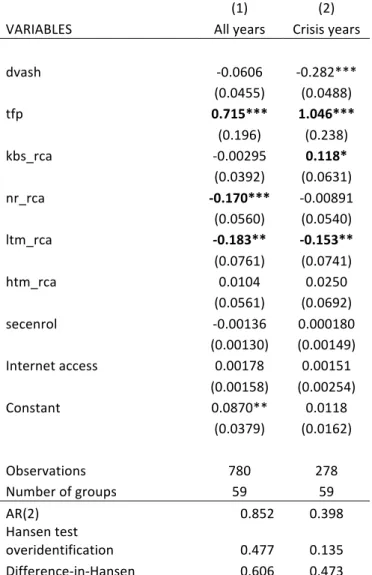
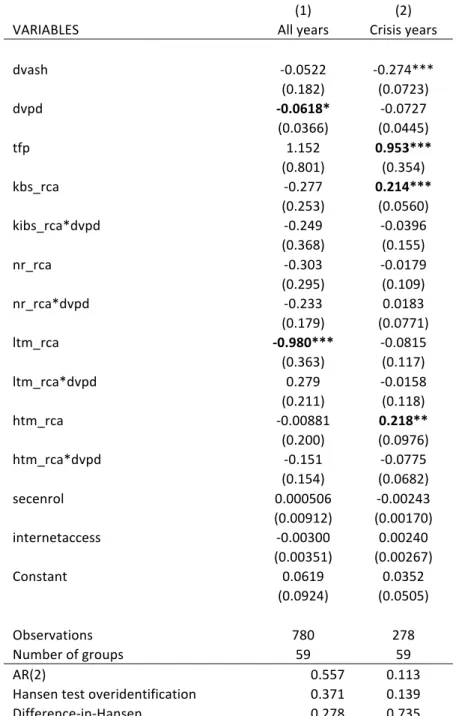
We find that countries increasing their specialisation in low-tech manufacturing and natural resources experience a decrease in the domestic value added embodied in their exports. We detect a positive effect of increases in specialisation in both high-tech manufacturing and knowledge intensive services, although only during the crisis period.
The general implication of these results is that countries’ production and export structure remain a determinant of their economic performance, and countries specialising in GVCs in different sectors will fare differently.
The Chapter provides a thorough discussion of these results in relation to the debate around premature deindustrialisation, and argues that specialising in low-tech manufacturing to then move onto high-tech activities may no longer be a viable option for developing countries.
Our results on the negative effect of an acceleration of the specialisation in natural resources on countries’ export performance are consistent with a very large literature regarding developing countries with such a productive structure being bound to experience stagnant or low growth. The third chapter of this thesis contributes to this literature and specifically to the view of natural resources as an enclave sector hindering the emergence of other sectors.
2.2 Revisiting the Natural Resource “Curse” in the Context of Business Services Trade: Enclave or High-Development Backward Linkages?
A common way of referring to the empirical association between natural resource abundance and disappointing economic performance is the “natural resource curse”, first put forward by Corden (1982).
Around this, a fierce debate has sparked in the literature with views both in favour of this view (Auty 1986, 1987; Sachs and Warner 1997; Venables 2016; Davis and Tilton 2008) and opposing it (Lederman and Maloney 2012; Wright and Czelusta 2004; Brunnschweiler and Bulte 2008; Bloch and Owusu 2012).
One of the crucial aspects of this debate is the link between abundance in natural resources and the potential for export diversification. This is again related to the structure of the domestic economy, and specifically inter-sectoral linkages originating from natural resource industries.
The notion of a specialisation in natural resources halting the development of other sectors and, ultimately, export diversification relies on two theoretical explanations.
First, a large natural resource sector would hinder other sectors through an appreciation in the exchange rate reducing competitiveness of other tradable (manufactured) products and draw investments away from non-NR intensive sectors (Corden 1984; Harding and Venables 2016; Venables 2016).
This view was first put forward based on the experience of the Netherlands after the discovery of a large endowment in natural gas that negatively impacted exports in other sectors, which is why this mechanism is often referred to as the Dutch disease. Second, and more broadly, natural resource industries are often considered enclave sectors, with little to no inter-sectoral linkages with the rest of the economy (Heeks 1998; Matsuyama 1992; Vogel 1994). The importance of such linkages stems from Hirschman's (1958) seminal contribution on the importance of inter-sectoral linkages to provide input (forward) to and require output (backward) from other sectors.
In this view, the growth in a large sector, well connected with the rest of the economy through backward and forward linkages, would also lift other sectors, through an unbalanced development strategy.
More recently, and relatedly with this literature, Hausmann and Klinger (2006) and Hidalgo et al. (2007) have adopted a different approach to look at linkages between sectors. Instead of input-output flows, they use the probability of two products being exported by the same countries to proxy for similarity in capabilities requirements and create a product space. They find that not all products are equally connected to each other; they also conclude that natural resource sectors tend to produce low-complexity products that are unlikely to lead to the emergence of other industries.
Based on this approach, Hausmann et al. (2008) argue that forward linkages stemming from the natural resource sector would not be a suitable avenue for fostering export diversification towards downstream manufacturing activities in resource abundant countries.
Most of the literature has indeed focused on forward linkages from natural resource industries to the manufacturing sector, debating around the viability of resource based industrialisation as a development strategy for countries abundant in natural resources (Auty 1987; Roemer 1979; Massol and Banal-Estañol 2014; Morris et al. 2012).
The third chapter of this thesis contributes to this debate by exploring a different strategy, i.e. whether countries with a large endowment in natural resources could exploit backward linkages to foster the export of the knowledge intensive business services or high-tech manufacturing that provide domestic inputs for the extraction of natural resources.
Moreover we wish to test whether this potential effect is stronger for countries with a specialisation in natural resources. This is because, first, such countries would benefit from a way of exploiting their specialisation to foster exports in other sectors and specialise away from natural resource industries. Second, countries with a specialisation in natural resources are also more likely to have a large domestic
intermediate demand stemming from this industry and thus be able to exploit this mechanism to a greater extent than other countries.
To test this set of hypotheses we implement an autoregressive panel analysis with the ICIO data from the OECD. Consistent with Chapter 2, our measures are computed in value added terms: this is to take into account the emergent GVCs and the issues discussed in the previous section, i.e. export specialisation based on value added (rather than gross exports) is more likely to represent the underlying domestic structure, and services often tend to be exported embodied in other manufactured products.
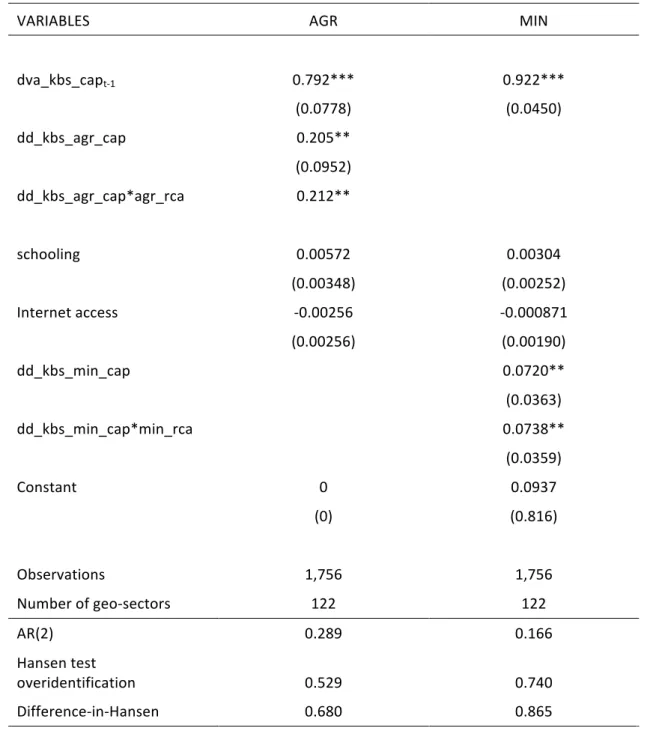
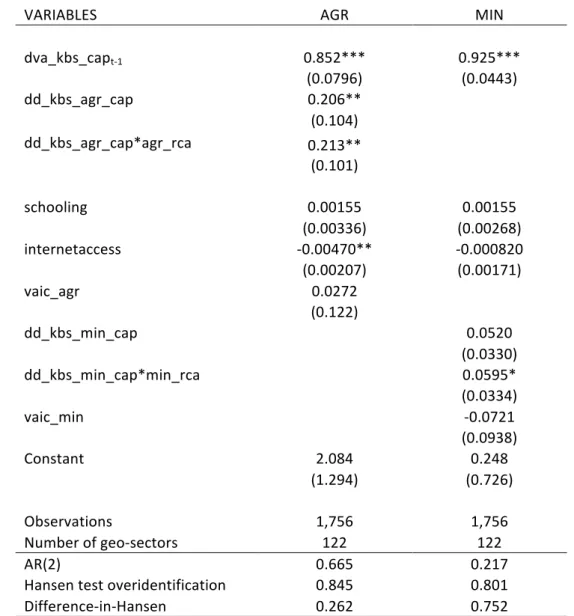
We find that backward linkages from the natural resource sector can indeed foster exports in knowledge intensive business services. We also test our main conjecture for the export of high-tech manufacturing, finding that in this case the positive effect of backward linkages from natural resource industries vanishes when we control for the productivity of this sector.
This suggests that relying on the sheer strength of backward linkages from natural resource industries may be a more promising strategy towards fostering exports in knowledge intensive business services rather than high-tech manufacturing.
Our findings contribute to revisiting the natural resource curse and, within this debate, we challenge the view that natural resource sectors are enclaves lacking input-output linkages with the rest of the economy and hindering economic diversification. In fact, we find the opposite to be true for knowledge intensive business services and this effect to be stronger in countries with a specialisation in natural resource sectors.
In line with the Chapter 2, this second contribution of the thesis also suggests that the productive structure and specialisation trajectories are a determinant not only of the extent to which countries will benefit from participation to GVCs, but also which GVC they will be most likely to join in the first place.
3.3 Power and Export Sophistication in Buyer-Supplier Relationships: Insights from Colombian Customs Data
Chapters 2 and 3 in this thesis look at both GVC participation and structural change as aggregate phenomena; these are, however, the results of changes and firm-to-firm interactions at the micro level.
There is a well-established literature on GVCs exploring such interactions, mainly through case studies at the firm or industry level (Gereffi and Fernandez-Stark 2011; Hernandez et al. 2014; Frederick et al. 2015).
In parallel, the literature on structural change has been enriched with new evidence looking at products at a more disaggregated level, rather than broad macro-sectors, proposing the notion of sophistication as key to identifying profitable trajectories for structural change and export upgrading (Hidalgo and Hausmann 2009; Cristelli et al. 2014; Zhu and Fu 2013; Poncet and Starosta de Waldemar 2013).
Chapter 4 blends these two streams of literature to explore the association between buyer-supplier international trade relations and supplier’s export sophistication, putting forward a quantitative approach based on large samples from transaction level data.
One of the main insights of the literature on GVCs is that while the fragmentation of production has made it easier for suppliers in developing countries to have access to global markets and foreign, more productive, buyers, this is no guarantee that suppliers will easily increase the sophistication of their exports.
In particular, this literature has emphasised that GVCs are ruled by lead firms that establish different kinds of governance and power relationships, determining who does what, and thus supplier’s possibilities of upgrading along the value chain (Kaplinsky 2013; Gereffi 1994; Gereffi et al. 2005).
The concept of export upgrading is particularly important because recent contributions in the literature have better qualified the widely accepted positive relationship between exports and growth, by introducing the quality of exports as a determinant of
firms’ (and countries’) economic performance (Iacovone and Javorcik 2009, 2010; Hidalgo et al. 2007; Poncet and Starosta de Waldemar 2013; Lall et al. 2006).
Based on this, the idea of export sophistication has become central to capturing the ‘quality’ of the exports, and an increasing body of evidence supports the idea that increases in export sophistication go hand in hand with improvements in economic performance (Minondo 2010; Hidalgo et al. 2007; Lall et al. 2006; Zhu and Fu 2013). While adopting a mainly qualitative approach, the literature on GVCs has gathered a large body of evidence on the importance of power asymmetries as a determinant of supplier’s upgrading possibilities over the past two decades (Humphrey and Schmitz 2002; Giuliani et al. 2005; Gereffi et al. 2005; Gereffi and Fernandez-Stark 2011).
The importance of buyer-supplier relationships has also been emphasised by literature relying on micro-level transaction data. This literature has contended that mutual knowledge between buyers and suppliers is key to a relationship’s survival and profitability, especially in the context of low contract enforceability (Macchiavello and Morjaria 2015, 2016; Macchiavello and Miquel-Florensa 2017). This latter stream of literature has, however, put little evidence forward concerning the linkage between power asymmetries in trade relationships and suppliers’ upgrading.
We attempt to fill this gap by constructing measures of power in trade relationships: we distinguish in particular between two kinds of power, based on its source: (i) relational power based on dyadic features of the relationship, such as the dependence of one party on the other, and (ii) market power, i.e. the position that each of the trading parties occupies in the market, which we capture with market shares.
We then explore the association of these different kinds of power to supplier’s sophistication, the likelihood of introducing a new product and that of increasing the supplier’s sophistication.
To test these hypotheses we use transaction data from the Colombian customs. After extensive cleaning, we obtain buyer-supplier pairs in each year and quantify both the power in each pair and the sophistication of the products in which they trade.
We find that suppliers that depend heavily on purchases from their buyers are more likely to have low sophistication levels of exports and are less likely to upgrade to more sophisticated products. A large market size of the buyer is positively associated with higher levels of sophistication of trade.
Suppliers with large market shares are more likely to start trading in new products, while the dependence of the buyer vis-à-vis the supplier is positively associated with increases in the sophistication of the products traded within the pair.
We also explore how these associations change across destination countries and find that while a large market share of a buyer is, on average, associated with high export sophistication, buyers dominating the market in the US tend to import low sophistication products and make it harder for suppliers to upgrade.
The main implication of these findings is that power in trade relationships seems to be related to suppliers’ upgrading prospects. We contribute to the growing literature on buyer-supplier relationships, and we also offer new quantitative evidence in favour of the mainly qualitative literature on GVCs.
We also expand the literature on GVCs, qualifying the concept of power and its relationship with supplier’s upgrading in a more nuanced way.
More specifically, we find that different kinds of power, i.e. whether they stem from buyer-supplier mutual dependence or the wider market structure, are correlated in different ways to both sophistication and upgrading.
These results are relevant both to firms that should take power asymmetries into account when attempting to enter foreign markets, as well as to policy makers in the design of policies to foster domestic suppliers’ engagement with global markets.
This is a first contribution based on micro-level evidence, paving the way for future research on inter-firms’ relationship in trade, exploring more potential factors shaping power between trading partners, such as ownership relationships, size, productivity and technological capabilities of the buyer. To the best of our knowledge these are
issues that have so far remained unexplored that would yet provide very useful insights for trade theory as well as to both private firms and policy makers.
2.Trade Specialisation and Performance in Global Value Chains
Abstract
This Chatper investigates whether trade specialisation explains economies’ trade performance within a Global Value Chain (GVC) context. We consider trade specialisation in natural resources, high and low tech manufacturing and business services, before and after the financial crisis. The aimed contribution of this Chapter is to shed light on the effects of trade specialisation as measured in domestic value added embodied in exports rather than gross exports. We add to the literature on GVCs by: (i) studying the role of the domestic productive structure in countries’ trade specialisation and performance, (ii) accounting for the rate of changes in trade specialisation as affecting GVC performance. We employ Balassa indexes based on value added flows in a GMM dynamic panel framework.
We find that trade specialisation in low-tech manufacturing and natural resources have a negative impact on value added exported by countries. High-tech manufacturing and knowledge intensive services exhibit a positive effect during the crisis period. We discuss these findings in relation to the recent debates on the role of manufacturing and premature de-industrialisation in developing countries.
2.1 Introduction
Countries’ economic development and its relationship with the productive structure has been the subject of a long and established literature, spanning several decades, looking at the role of specific sectors, such as agriculture, manufacturing ad services (Kaldor 1968; Matsuyama 2008; Szirmai and Verspagen 2015), the linkages across sectors (Guerrieri and Meliciani 2005; Hirschman 1958; Evangelista et al. 2015; Meliciani and Savona 2014; Lopez-Gonzalez et al. 2015), and the importance of trade structure for economic performance (Balassa 1978; Hausmann et al. 2007; Lederman and Maloney 2012; Lee 2011).
In the past decades, globalisation has brought about a much higher degree of interdependence and interconnectedness across countries, also in trade flows. A consequence of this, and arguably one of the most relevant changes in recent years
concerning the nature of trade, is that intermediate goods account for an increasing share of trade flows (OECD 2013a). This is because production is scattered across countries, and global value chains (GVCs) represent a large proportion of trade (Gereffi 1994; Gereffi et al. 2005; Baldwin and Robert-Nicoud 2014). This Chapter studies countries’ export performance in light of this significant change.
Foreign imported inputs constitute an increasing share of gross exports, which in turn are less representative of countries’ domestic production structure (Koopman et al. 2014). As Baldwin (2011, p.33) puts it, while previously “exporting engines was a sign of victory now it is a sign that the nation is located in a particular segment of an
international value chain”. Moreover, this phenomenon has turned foreign countries
not only into export destinations, but also into co-producers; this changes the way in which we think about countries’ trade specialisation and its impact on export performance.
In light of the growing importance of GVCs, this Chapter investigates the role of trade specialisation as a determinant of countries’ export performance. In particular, we argue it is increasingly important to distinguish countries’ domestic value added contribution from what other countries provide, rather than relying on gross exports. In sum, rather than “what you export matters”, as posited by Hausmann et al. (2007), it is what a country produces (and then exports) that matters.
In addition, we characterise changes in trade specialisation, not only in terms of direction, i.e. in which sectors a country specialises, but also in terms of the rate of change, i.e. the speed at which such changes occur.
More specifically, we focus on the relationship between countries’ acceleration in specialisation and the growth of export shares. This is quite a novel approach, and complements earlier studies on countries’ trade and structural change, which focus on static effects.
We also include services (and in particular knowledge intensive business services - KIBS) in the analysis of output and export specialisation; as opposed to manufacturing, services have been comparatively overlooked in the literature on both trade and
structural change, despite some exceptions (Anderson et al. 2015; Wolfmayr 2012; Varela and Hollweg 2016; Di Meglio et al. 2018). However, services represent an increasing share of trade and countries’ productive structures (Anderson et al. 2015). Being less tradable than manufactured goods, it is even more important to assess their contribution to countries’ trade with a value added approach.
We build on Kowalski et al. (2015) and operationalise our questions by estimating the effect of the rate of change in countries’ trade (in value added) specialisation on the growth of countries’ share in domestic value added exported. We find that trade specialisation in low-tech and natural resources has a negative or not significant impact, while we detect a positive and significant effect of increases in specialisation in KIBS and high-tech manufacturing, although only after the financial crisis. These results suggest that countries increasing their specialisation towards low-tech manufacturing are likely to experience a decrease in the growth of export shares in value added terms. Relating this more in general to the debate on manufacturing as an engine of growth (Rodrik 2016b; Szirmai and Verspagen 2015; Szirmai 2012) this hints towards a differential impact of specialisation in high- versus low-tech manufacturing.
Our results are also relevant to the literature on the role of countries’ trade specialisation and their performance (Hausmann et al. 2007; Hidalgo et al. 2007), which has so far overlooked the emergence of GVCs (Koopman et al. 2014). We provide a richer understanding of trade specialisation, not only through our value added approach, but also looking at the speed of changes in specialisation, which the literature has shown to have important effects on countries’ long-term growth dynamics (de Vries et al. 2017; Timmer and de Vries 2009; Timmer et al. 2014).
The remainder of the Chapter is organised as follows: Section 2 reviews the relevant literature; Section 3 presents our value added based measures and some relevant descriptive evidence; Section 4 illustrates how they are computed and the overall empirical strategy as well as the data used; Section 5 presents the results and discusses the Chapter’s findings; Section 6 concludes.
2.2 Trade specialisation and performance in the context of GVCs
2.2.1 Trade specialisation and the domestic productive structure
There is a long standing literature looking at exports as a driver of economic growth (Balassa 1978; Marin 1992). The export sector has been regarded as more productive (Feder 1982) for reasons ranging from access to a larger market, economies of scale and scope, technological spillovers, and incentives for exporters to increase productivity (Bustos 2015; Rivera Batiz and Romer 1991). Moreover, access to international market has historically played an important role in the development of several developing countries, particularly in East Asia (Lee et al. 2011; Kim and Lee 1987; Kim 1980; Hobday 2015; World Bank 1993).
Economic theory has mainly stressed the role of factor endowment in shaping countries’ comparative advantage and specialisation in trade. According to this view, countries should specialise in sectors in which they have a comparative advantage, regardless of the sector’s specific characteristics.
In contrast with this sector-neutral approach, some economists have also argued that countries’ specialisation and its changes reflect their technological capabilities, endogenous technical change and thus their competitiveness (Fagerberg 1988; Uchida and Cook 2005). In this stream of research, income and price elasticities vary across specialisation trajectories, determining demand and productivity growth dynamics (Thirlwall 1979). So, trade specialisation and trade performance influence each other and, at times, countries go down specialisation patterns with low growth potential (Amable 2000) as shown, for instance, by Matsuyama (1992) for the agriculture sector.
A more recent literature has looked at countries’ trade specialisation, and revealed comparative advantage (RCA) in particular, to infer countries’ underlying domestic capabilities. Hidalgo et al. (2007) and Hausmann and Klinger (2007) have argued that countries’ export specialisation reflects their domestic capabilities as well as their development perspectives. As a result, Hausmann et al. (2007) show that export specialisation is a determinant of future economic growth and that therefore “what you export matters”.
Interestingly, Hausmann and co-authors link countries’ export specialisation with their underlying domestic economic structure and ultimately study how this evolves and affects long-term growth. However, they do not account for the increasing fragmentation of production across countries that accompanies the emergence of global value chains (GVCs) and the limitations of using gross export data to infer on the domestic economic structure and capabilities (Baldwin 2012).
The relationship between domestic productive structure and GVCs is not merely a methodological issue but represents a significant change in countries’ specialisation opportunities. In fact, while globalisation has opened up new specialisation avenues for countries (Baldwin 2011), this has yielded rather diverse outcomes as developing countries have taken different specialisation patterns at different speeds, also depending on their pre-existing productive structure (McMillan et al. 2014).
2.2.2 Direction and pace of change in countries’ trade specialisation and economic structure
Within the literature on structural change, manufacturing has traditionally been considered as the engine of growth; Szirmai (2012) provides a thorough discussion of the different arguments in favour of this hypothesis. The first Kaldor's Law (1968), postulates that manufacturing share and economic growth are positively correlated, and Verdoorn’s Law posits a positive relationship between the manufacturing sector’s size and its productivity. Furthermore, manufacturing has been argued to have many linkages with other sectors, for which it provides either inputs or demand for output (Hirschman 1958), as well as opportunities for technology and knowledge spillovers. Rodrik (2013) finds that while the convergence between developing and advanced economies predicted by neoclassic growth models is conditional on a set of other factors, such as education and institutions, productivity in the manufacturing sector shows unconditional convergence, i.e. irrespective of countries’ characteristics.
Recent evidence seems to question whether manufacturing is still playing its traditional role of a growth engine. In another contribution, Rodrik (2015a) argues that rapid industrialisation for developing countries is going to be more difficult in the future due to the strong Chinese competition in low-tech labour-intensive manufacturing sectors and the fragmentation of production.
Szirmai and Verspagen (2015) also find that an increasing amount of human capital is now needed in order for manufacturing to trigger its engine of growth effect. This evidence suggests that specialisation in high- and low-tech manufacturing may yield different outcomes in terms of countries’ economic performance.
Services have traditionally not been considered to exert the same virtuous properties on economic growth. However, structural change towards services is an empirical regularity associated with economic growth (Bah 2011), both in high and low income countries. Rodrik (2015b) finds that structural change towards services and away from manufacturing is happening in developing countries at much lower income levels than in the past; for this reason, he raises concerns for its implication for low-income countries’ growth perspectives.
In contrast with this view on the contribution of services to economic development, recent studies on the emergence of GVCs in services have provided evidence on the opportunities of offshoring service activities from developed towards developing countries (Gereffi and Fernandez-Stark 2010; Hernandez et al. 2014). However, most of the studies in this strand of work take a qualitative approach, while little quantitative evidence has been offered so far to the debate around GVCs and the role of services in developing countries.
While the body of literature on the direction of structural change is vast, still little is known on the dynamic effects of the pace at which countries specialise on their growth rate. It has been argued that the speed at which structural change takes place is key to countries’ successful development (Haraguchi 2014; Matsuyama 1992). McMillan et al. (2014) stress the importance of the dynamic effects of structural change, distinguishing between structural change that is growth enhancing or growth reducing. In particular they argue that developing countries with significant productivity differences between sectors may have a lot to gain – or to lose – by simply reallocating the labour force from low to high productivity growth sectors.
For instance, when we compare Asian and Latin American countries, we see that while in the former structural change has favoured sectors with higher productivity dynamics, this has not happened in the latter (Timmer et al. 2014). More specifically,
Asian economies have moved towards manufacturing sectors that had a faster technological dynamic and thus higher productivity growth rates. In contrast, Latin America and Africa have specialised in services that did have higher productivity levels
than agriculture, but much lower productivity growth rates than other manufacturing sectors. The result has been a static, one-off, productivity boost rather than a dynamic one (de Vries et al. 2017; Timmer and de Vries 2009; Timmer et al. 2014).
The qualitative literature on GVCs has also emphasised the importance of speed when countries specialise in sectors with high value added content, in order to reap the benefits of the first-mover. Furthermore it is important that countries maintain their ability to specialise quickly so they can sustain a rent, deriving from constantly moving towards new high-value added sectors (Kaplinsky 2004).
For this reason, it is particularly interesting to look at rates of change, rather than levels, in both export performance and specialisation.
2.2.3 Research question and Chapter’s contribution
This Chapter sets out to study the relationship between trade specialisation and performance in the context of GVCs. We aim to take into account that the emergence of GVCs has made the relationship between export specialisation and the underlying domestic productive structure less straightforward, with the former being less and less representative of the latter. This requires a novel understanding of trade flows: they are no longer the outcome of exchanges of finished goods produced within countries’ borders, but rather a process of production fragmented across borders in which countries are both destination and co-producers.
In addition, and in line with a growing literature, we argue that changes in countries’ specialisation will have an impact on the dynamic of their export performance, i.e. the rate at which it will improve (or worsen), and that the speed at which countries change their specialisation will also be a determinant of their performance. This is something that the scholarship has already acknowledged (McMillan et al. 2014; Kaplinsky 2004), although the evidence on this remains scarce, compared to the vast body of studies looking at the relationship between levels of trade specialisation and levels of export performance.
Following on from this, this Chapter aims to answer the following research question: do changes in countries’ trade specialisation affect their export performance, within a GVC context?
We bring this hypothesis to the data by computing measures of trade specialisation and of trade performance. In order to account for the emergence of GVCs and to explore the relationship between exports and domestic specialisation, we build on the growing literature on trade in value added, which we review in detail in the next section.
2.3 Measuring trade in a GVC context: descriptive evidence
In order to account for the emergence of GVCs and the gaping divide between trade in value added and gross exports, a recent and growing stream of research has developed a set of measures capturing countries’ participation in GVCs. De Backer and Miroudot (2013) and, more recently, Johnson (2018) provide a quite complete review of the measures of both backward participation, i.e. the value added a country imports from other countries that is subsequently exported, and forward participation, i.e. the value added a country exports and is subsequently exported by third countries.
In line with the export-led growth models, the underlying assumption of this strand of literature is that GVC participation is desirable and that it should lead to economic growth. Without making such an assumption, Banga (2014) argues that linking into GVCs is not necessarily enough to trigger export-led growth. As an alternative measure of countries’ GVC performance, she proposes to use the difference between backward and forward participation and found very unequal benefits being drawn from GVC participation across countries. Based on these results, she argues for policies favouring forward, rather than backward, participation.
Kowalski et al. (2015) show, however, that backward and forward participation may be complementary and propose an alternative measure of countries’ trade performance in GVCs. They look at domestic value added embodied in countries’ exports (DVA, henceforth), which corresponds to the share of exports that is used to remunerate
domestic labour and capital. This measure captures the parts of countries’ domestic productive structure that can compete in the international market and ultimately contributes to their export.
In order to measure countries’ performance in GVCs, we thus follow Kowalski et al. (2015) and opt for DVA as our main variable of interest, which we use to compute both our outcome and explanatory variables. This variable is particularly interesting for us for two main reasons.
First, while DVA can be intuitively understood as the value added homologue of gross exports, it is worth stressing that this measure accounts for the fact that within each country value added exported by one sector may be generated by different sectors. This measure thus allows reallocating value added to the sector that originated it rather than the one that exported it. This is particularly relevant when looking at countries’ export specialisation in relation to domestic structure, and a fortiori for business services that are often embodied in manufacturing goods and exported.
Second, the growth of a country’s share in total DVA flows (which we will refer to as DVA share henceforth) is loosely related to countries’ competitiveness. This is because an increasing growth rate in DVA share is arguably a manifestation of countries’ increasing competitiveness in the export markets (Kowalski et al. 2015a).
The literature has yet to reach a consensus on a single approach to measuring DVA. Koopman et al. (2014) suggest using a vector of gross exports including both final and intermediate foreign demand. Johnson (2018) points out that in Koopman et al.’s (2014) approach, foreign intermediate demand is treated inconsistently because it is included in both the gross export vector and in the global Leontief Inverse, which leads to a double counting of a sort.
In an attempt to tackle all these issues, our measure of DVA includes the value added exported by a country either as final foreign demand or intermediate foreign demand, the latter being the value added demanded by other countries’ production processes. However, we also exclude the value added generated by a country, exported to meet
foreign intermediate demand and then re-imported to satisfy the country’s own final demand1.
We use the Inter-Country Input-Output (ICIO) tables compiled by the OECD, and compute countries’ DVA shares and value added RCA in four sector groups: knowledge intensive business services (KIBS), natural resource (NR), low-tech and high-tech manufacturing (LTMF and HTMF respectively).
In Section 2.4 we explain in more detail how these measures are computed. However, we first present some descriptive evidence of how different our value added measures are compared with their gross export homologues, especially when looking at countries’ trade specialisation. This evidence suggests that when countries export value added of a sector indirectly, i.e. embodied in exports of other sectors, a gross export approach is likely to underestimate trade specialisation.
We compare countries’ RCA when computed in gross exports and DVA, and we show that using value added has a relevant impact on our trade specialisation measure. To be sure, the pattern of GVC participation may vary across sectors. KIBS are often non-tradable; as a consequence their contribution to a country’s export is likely to be indirect, e.g. KIBS value added provided domestically contributing to the gross export of manufacturing. For this reason gross export figure may underestimate KIBS importance for countries’ export and therefore the countries’ trade specialisation.
Manufacturing on the other hand usually consists of tradable products, whose production is likely to be fragmented across countries. For this reason gross export figures may be overestimated, due to the large share of imported inputs that are included in gross export.
Figure 2.1 below shows how the average RCA in KIBS over the years changes across countries when using measures based on gross exports or DVA. We take KIBS as a particular example since, as we have already pointed out, this sector is more likely to be exported indirectly through manufactured exports. However, the same pattern can
be found looking at the other three macro-sectors in our analysis2. Regardless of the mechanisms at play, it is important to note that using a value added approach, as opposed to a gross export one, will yield different specialisation patterns for most countries.
Figure 2.1: Country Average RCA in KIBS across years in gross exports and domestic value added
Note: Figure 1.1 compares countries’ average RCA in KIBS across years in our sample, using gross exports and domestic value added in exports.
Source: Author’s own calculation using ICIO tables.
In Figure 2.1, we can see that using DVA does not simply reduce the RCA. For countries such as Chile, France, Germany, Italy or Japan, the gross export RCA underestimates their trade specialisation in KIBS. In contrast, countries such as Luxembourg, the UK, Cyprus, Ireland, India and Singapore, see their RCA increase significantly when measured in gross exports.
2 Figures A1-A3 in the Appendix report the same comparison between gross exports and domestic value
It is important to stress that using gross exports does not move all RCAs in the same direction, which makes the bias of using of gross exports particularly relevant when studying trade specialisation. The distribution of the two variables differs substantially, which means that estimates based on gross exports may lead to incorrect conclusions: RCAs based on gross exports capture values exported by services but possibly originating from other sectors (and countries), while they leave out value added originating from domestic services but exported by other sectors. This arguably explains the difference between DVA and gross export-based RCAs: sectors that are less tradable, such as services, may be traded through other sectors’ exports, which would only be captured by DVA-based RCA.
In support of this conjecture we see in Figure 2.1 that gross export RCA inflates the KIBS specialisation of countries that are direct exporters of services (such as the UK, Luxembourg, Singapore, and India), while it underestimates the service specialisation of countries that are direct exporters of other sectors but that also have significant domestic provision of services (such as Australia, France, Germany, and Japan).
In conclusion, we argue that value added based measures better capture the link between trade specialisation and the underlying domestic economic structure. It does this by focusing on the parts of the domestic productive structure that contribute to countries’ export performance, either directly or indirectly.
Within this value added based approach we are particularly interested in looking at how the evolution of countries export structure in relation to trade performance has changed over time. We find some significant heterogeneity of these measures of specialisation when we distinguish between high-income and developing countries in our sample3. In Figure 2.2 we see that developing countries tend to have much starker specialisations, especially in natural resources and low-tech manufacturing, although this seems to decrease over time. We note an increase over time of the specialisation in high-tech manufacturing; however, this remains smaller than high-income countries. Developing countries seem to have been specialising away from KIBS, showing a slightly decreasing trend.
3 We use the WB threshold of US$ 12,236 of GDP per capita. Table A1.2 reports number of years in which