G R A P H P R O C E S S I N G I N
M A I N - M E M O R Y C O L U M N S T O R E S
F
Zur Erlangung des akademischen Grades
Doktor-Ingenieur (Dr.–Ing.)
der Fakultät für Informatik
der Technischen Universität Dresden
vorgelegte
Dissertation
von
M A R C U S PA R A D I E S
geboren am
10
. Februar
1987
in Ilmenau.
Tag der mündlichen Prüfung:
03
. Februar
2017
Erster Gutachter:
Prof. Dr.–Ing. Wolfgang Lehner
Zweiter Gutachter:
Prof. Dr.–Ing. Thomas Neumann
Dedicated to my grandfather. 1936–2012
A B S T R A C T
Evermore, novel and traditional business applications leverage the advantages of a graph data model, such as the offered schema flexibility and an explicit representation of relation-ships between entities. As a consequence, companies are confronted with the challenge of storing, manipulating, and querying terabytes of graph data for enterprise-critical appli-cations. Although these business applications operate on graph-structured data, they still require direct access to the relational data and typically rely on anrdbmsto keep a single source of truth and access.
Existing solutions performing graph operations on business-critical data either use a combination of sql and application logic or employ a graph data management system. For the first approach, relying solely onsqlresults in poor execution performance caused by the functional mismatch between typical graph operations and the relational algebra. To the worse, graph algorithms expose a tremendous variety in structure and function-ality caused by their often domain-specific implementations and therefore can be hardly integrated into a database management system other than with custom coding. Since the majority of these enterprise-critical applications exclusively run on relationaldbmss, em-ploying a specialized system for storing and processing graph data is typically not sensible. Besides the maintenance overhead for keeping the systems in sync, combining graph and relational operations is hard to realize as it requires data transfer across system boundaries. A basic ingredient of graph queries and algorithms are traversal operations and are a fundamental component of any database management system that aims at storing, ma-nipulating, and querying graph data. Well-established graph traversal algorithms are stan-dalone implementations relying on optimized data structures. The integration of graph traversals as an operator into a database management system requires a tight integra-tion into the existing database environment and a development of new components, such as a graph topology-aware optimizer and accompanying graph statistics, graph-specific secondary index structures to speedup traversals, and an accompanying graph query lan-guage.
In this thesis, we introduce and describe Graphite, a hybrid graph-relational data man-agement system. Graphite is a performance-oriented graph data management system as part of anrdbmsallowing to seamlessly combine processing of graph data with rela-tional data in the same system. We propose a columnar storage representation for graph data to leverage the already existing and mature data management and query process-ing infrastructure of relational database management systems. At the core of Graphite we propose an execution engine solely based on set operations and graph traversals. Our design is driven by the observation that different graph topologies expose different algo-rithmic requirements to the design of a graph traversal operator. We derive two graph traversal implementations targeting the most common graph topologies and demonstrate how graph-specific statistics can be leveraged to select the optimal physical traversal opera-tor. To accelerate graph traversals, we devise a set of graph-specific, updateable secondary index structures to improve the performance of vertex neighborhood expansion. Finally, we introduce a domain-specific language with an intuitive programming model to ex-tend graph traversals with custom application logic at runtime. We use thellvmcompiler framework to generate efficient code that tightly integrates the user-specified application logic with our highly optimized built-in graph traversal operators.
Our experimental evaluation shows that Graphitecan outperform native graph man-agement systems by several orders of magnitude while providing all the features of an rdbms, such as transaction support, backup and recovery, security and user management, effectively providing a promising alternative to specialized graph management systems that lack many of these features and require expensive data replication and maintenance processes.
A C K N O W L E D G E M E N T S
First and foremost, I would like to thank my supervisor Wolfgang Lehnerfor his uncon-ditional support throughout the course of the entire PhD project. It was Wolfgang, who sparked my interest in database research during my undergraduate internship atsapin 2009. Ever since then, Wolfgang has been not only a great technical mentor but also a great motivator and a true source of inspiration.
I would like to express my deepest gratitude to my advisor during the first part of my PhD project at sap, Christof Bornhövd, who perfectly complemented Wolfgang from the production side and gave valuable feedback on applicability and usefulness of my research.
A special thanks goes toHannes Voigt, who co-advised me during the second part of my PhD project, for many insightful discussions on query language design, for proof-reading the thesis document, and finally for introducing me to the art and enjoyment of craft beer. Besides my advisors, I would like to thankProf. Dr. Thomas Neumann for serving as a reviewer on my PhD committee and for the inspiring discussions and the valuable tips during my visit in Munich.
I thank my PhD fellow Michael Rudolf, who started with me the journey of pursuing a doctorate degree on the graph processing project. Although we are quite different in character and in the way we approach challenges and finally find solutions, I always felt inspired by his ideas and I am very thankful for the fruitful discussions we had during the last five years—a realM+Mteam!
I am deeply thankful to my fellow PhD colleagues at thesap hanaCampuswho made my PhD ride a pleasant and not a lonely one. In particular I would like to thank my former office matesMichael Rudolf,Robert Brunel,David Kernert, andIraklis Psaroudakisfor accepting me as being terribly grumpy in the mornings, but also my other colleagues
Philipp Große,Hannes Rauhe,Ingo Müller,Jonathan Dees,Ismail Oukid,Thomas Bach,Florian Wolf,Matthias Hauck, Martin Kaufmann,Francesc Trull,Elena Vasilyeva,Lucas Lersch, Frank Tetzel,Robin Rehrmann, andGeorgios Psaropoulos.
I was lucky to be able to supervise a large number of extremely talented students and PhD students who significantly contributed to the entire graph processing project:Radwan Deeb,Sebastian Rode,Luis Brandelli,Gaspard Ohlmann,Max Wildemann,Jan Broß,Jens Cram,
Frank Tetzel, andMatthias Hauck.
I would also like to thank my “second family” at the Database Systems Group in Dres-den for always making me feel welcome and well integrated into the group. For many pro-ductive discussions I would like to thankMatthias Böhm,Steffen Preißler,Benjamin Schlegel,
Gunnar Fabritius, Rihan Hai, Frank Rosenthal, Lars Dannecker, Ulrike Fischer, Katrin Braun-schweig, Julian Eberius, Tim Kiefer, Robert Ulbricht, Ines Funke, Ulrike Schöbel, Dirk Habich,
Maik Thiele, Martin Hahmann,Hannes Voigt, Thomas Kissinger,Tobias Jäkel, Tomas Karnagel,
Till Kolditz, Claudio Hartmann, Kai Herrmann, Kasun Perera,Ahmad Ahmadov, Johannes Lu-ong,Annett Ungethüm,Patrick Damme,Lars Kegel,Juliana Hildebrandt,Alexander Krause, and
Bernd Keller.
I am deeply thankful for the offered opportunity of pursuing a PhD atsap, in particular I would like to thank Arne Schwarz for being the good soul of the sap hana Campus, helping in all sorts of technical and non-technical questions. Further, I would like to thank
Franz Färber,Norman May,Alexander Böhm, andStefan Bäuerlefor believing in me and my research vision, and many discussions on various research aspects around graph data management.
Pursuing a PhD is not for the faint-hearted ones: There are many ups and downs during the PhD lifetime, especially during the downs, support and belief from family and friends are really important. I am deeply honored and proud to have a family and friends who motivated and encouraged me during the downs and celebrated with me during the ups.
for not letting you visit me in the final year while I was writing the thesis. I also thank my beloved partnerKerstin Witter for her support, she certainly suffered the most from evenings that I worked until late at night and weekends that I spent in the office. Finally I would like to thank my grandparents for always believing in me. I dedicate this thesis to my beloved grandfather Helmut who sadly did not live long enough to see me graduate.
Marcus Paradies Walldorf, April25,2017
C O N T E N T S
1 i n t r o d u c t i o n 1
1.1 Heterogeneous Data Management System Landscapes . . . 2
1.2 Cross-Data-Model Query Processing . . . 3
1.3 Contributions . . . 4 2 f o u n d at i o n s o f g r a p h d ata m a na g e m e n t 7 2.1 Data Models . . . 7 2.2 Graph Properties . . . 8 2.3 Query Languages . . . 9 2.4 Graph Algorithms . . . 11
2.5 Graph Data Generators and Benchmarking . . . 13
2.6 Graph Processing Systems . . . 14
2.6.1 Single-Node Graph Systems . . . 16
2.6.2 Distributed Graph Systems . . . 20
2.6.3 Graph Processing in RDBMS . . . 22
2.6.4 Graph Database Management Systems . . . 24
2.7 Summary . . . 25
3 r e q u i r e m e n t s a n d s y s t e m ov e r v i e w 27 3.1 System Requirements . . . 27
3.1.1 Functional Requirements . . . 27
3.1.2 Non-Functional Requirements . . . 30
3.2 GraphiteSystem Overview . . . 31
3.3 Summary . . . 32
4 g r a p h s t o r a g e 35 4.1 Related Work . . . 35
4.1.1 Graph Processing in RDBMS . . . 35
4.1.2 Compression Techniques . . . 37
4.2 Physical Graph Representation . . . 38
4.2.1 General Storage Layout . . . 39
4.2.2 Read- and Write-Optimized Storage . . . 40
4.3 Graph Data Reorganization Techniques . . . 41
4.3.1 Graph Compression . . . 41
4.3.2 Edge Ordering . . . 47
4.4 Experimental Evaluation . . . 49
4.4.1 Setup and Data Sets . . . 49
4.4.2 Read Operations . . . 50 4.4.3 Write Operations . . . 54 4.4.4 Memory Consumption . . . 56 4.5 Summary . . . 60 5 g r a p h t r av e r s a l o p e r at o r s 63 5.1 Related Work . . . 63
5.1.1 Single-Node Graph Traversals . . . 63
5.1.2 Distributed Graph Traversals . . . 66
5.2 Abstract Graph Traversal Operator . . . 67
5.2.1 Traversal Query Specification . . . 67
5.2.2 Formal Description . . . 68
5.3 Graph Traversal Operator Implementations . . . 69
5.3.1 Traversal Strategies . . . 70
5.3.2 Level-Synchronous Traversal . . . 71
5.3.3 Fragmented-Incremental Traversal . . . 75
5.3.4 Customization by User Code . . . 81
5.4 Distributed Traversals in Shared-Memory . . . 82
5.4.2 Data Structures . . . 84
5.4.4 Query Processing . . . 86
5.5 Experimental Evaluation . . . 88
5.5.1 Setup and Data Sets . . . 88
5.5.2 Memory Consumption . . . 90
5.5.3 Runtime Analysis . . . 91
5.6 Summary . . . 95
6 s e c o n d a r y i n d e x s t r u c t u r e s f o r g r a p h s 97 6.1 Related Work . . . 97
6.1.1 Primary Graph Index Structures . . . 97
6.1.2 Secondary Graph Index Structures . . . 104
6.2 General Requirements . . . 106
6.3 Block-Based Topology Index . . . 107
6.3.1 Construction and Maintenance . . . 108
6.3.2 Index Lookups . . . 110
6.3.3 Memory Consumption . . . 111
6.3.4 Graph Traversal Implementations . . . 111
6.4 Adjacency-Based Topology Index . . . 112
6.4.1 Index Construction . . . 113
6.4.2 Mapping Tables . . . 113
6.4.3 Index Maintenance . . . 115
6.5 Experimental Evaluation . . . 115
6.5.1 Experimental Setup . . . 116
6.5.2 Index Construction Time and Memory Consumption . . . 116
6.5.3 Traversal Performance . . . 117
6.6 Summary . . . 121
7 t r av e l —a d o m a i n-s p e c i f i c l a n g ua g e f o r g r a p h a na ly s i s 123 7.1 Related Work . . . 125
7.1.1 Programming Models . . . 125
7.1.2 High-Level Graph Abstractions . . . 126
7.1.3 Code Generation . . . 128
7.2 Model of Computation . . . 128
7.2.1 Traversal Events . . . 129
7.2.2 Traversal Context . . . 129
7.2.3 Traversal State . . . 130
7.2.4 Traversal Control Flow Manipulation . . . 130
7.3 TraveL . . . 131
7.3.1 Data Types . . . 132
7.3.2 Language Constructs . . . 132
7.3.3 Invoking Built-In Algorithms . . . 138
7.4 TraveL Compiler . . . 139
7.4.1 General Architecture . . . 139
7.4.2 Code Generation . . . 140
7.5 Travel Query Rewriting . . . 143
7.5.1 Filter Rewriting . . . 144
7.5.2 Merging Traversal Hooks . . . 145
7.5.3 Rewriting of TraveL Scripts with Traversal Hooks . . . 145
7.5.4 Traversal Hook Pipelining . . . 145
7.6 Applications . . . 148
7.6.1 K-Hop Reachability . . . 148
7.6.2 Collaborative Filtering . . . 148
7.6.3 Weighted Shortest Path . . . 149
7.6.4 Critical Path Analysis . . . 151
7.7 Experimental Evaluation . . . 152
c o n t e n t s xi 7.7.2 System-Level Benchmarks . . . 156 7.8 Summary . . . 158 8 c o n c l u s i o n 159 8.1 Contributions . . . 159 8.2 Future Work . . . 161 a e va l uat e d d ata s e t s 163
a.1 Data Set Properties . . . 163 a.2 Vertex Outdegree Histograms . . . 163
b a d d i t i o na l t r av e l e x a m p l e s 165
b.1 Betweenness Centrality . . . 165 b.2 Degree Centrality . . . 165 b.3 Random Walks With Restart . . . 166
1
I N T R O D U C T I O NWe are all living in a highly connected world. This connectedness influences almost every part of our daily life and can be found in a large variety of situations—from the phenome-nal growth of the World Wide Web to epidemics and financial crises in our modern society. The interrelationships between a set of things can be represented as a graph (network).1
Graphs can be found in an enormous heterogeneity of domains and applications, ranging from making recommendations in social media platforms to analyzing protein interactions in bioinformatics.
The potential to acquire new business insights from graph-shaped data through graph analytics is increasingly attracting companies from a variety of industries, ranging from web companies to traditional enterprises. Increasingly, companies offer and advertise—in conjunction with their products—social media platforms that allow connecting customers with each other to share ideas, discuss products and features/extensions, and take part in competitions. The recent advent ofconnected fitnessis one prominent example, where cus-tomers build large communities and report fitness results, compete in monthly challenges, and share common consumption interests. Gartner (Valdes,2012) classifies the consumer
web, a domain with a steeply rising market share, into five graphs: (1) the social graph, (2) the intent graph, (3) the mobile graph, (4) the interest graph, and (5) the consumption/-payment graph.
The main challenge, however, lies not only in storing graph-structured data, but also in performing complex queries efficiently on it to derive new insights that can help to create personalized advertisements and to react faster to the consumption behavior of customers. Enterprise applications, target a wider range of use cases, includingnetwork impact analysis to find potential multiplicator persons, route finding to improve delivery times of transportation companies,collaborative filteringto give recommendations according to the buying behavior of users,supply chain management and logistics to find bottlenecks in supplier networks,fraud detection, and knowledge graphs to find domain experts using semantic search technology in a company (digital asset management).
Coherently with the widespread adoption of graph data to model and represent real-world entities and their relationships, the size of graphs is growing to an unforeseen scale. Table1.1depicts a graph sizing classification byBurkhardt and Waring(2013). If we
com-pare the presented numbers with the largest freely available real-world graph data set (partial hyperlink graph, common web crawl,2012)2, consisting of about 129·109edges, we can reason that—even compared to the smallest predicted scale—the size of graph data is about to exceed current scales by multiple orders of magnitude. Although the table only provides numbers of the graph topology, there is evidence that attributes associated with vertices and edges will multiply the raw size of a graph on disk by several orders of magnitude.
One of the most promising solutions to overcome the sheer flood of data to be stored and processed are NoSQL database systems. These systems target an immense variety of data models and application domains, including key-value stores, documentdbms, graphdbms (gdbms), and multi-modeldbmsamong others. NoSQL systems aim at providinghorizontal
scalingto growing data sizes and achieve this by softening up strong transaction guaran-tees by employingeventual consistency instead ofstrong consistency. Driven by a growing customer adoption, especiallygdbmsreceived a considerable amount of attention in both the research community and the industry. In a recent study Forrester Research (Yuhanna et al.,2014) reported that over25% of enterprises will be using graph database technology by2017, resulting in a growth of500% since2013.
1 We use the two terms synonymously in the course of this thesis 2 http://webdatacommons.org/hyperlinkgraph/
Table1.1: Different graph scales and their (predicted) characteristic key numbers, including the number of vertices and edges, and the raw size of the graph topology in a csv for-mat (Burkhardt and Waring,2013).
# of vertices # of edges Raw size (csvformat) Social Scale ∼109 ∼1011 2.92T B Web Scale ∼5·1010 ∼1012 29.50T B Brain Scale ∼1011 ∼1014 2.84PB
Specifically, novel and traditional business applications leverage the advantages of a graph data model, such as schema flexibility and an explicit representation of relationships between data records. Although these business applications mainly operate on graph-structured data, they still require direct access to the relational data. Typically, these in-dustries rely on mature rdbms technology to keep a single source of truth and access. Although graph structure is already latent in the database schema and inherently rep-resented by foreign key relationships, managing native graph data is moving into the focus as it allows rapid application development due to the absence of an upfront defined database schema. Existing solutions performing graph operations on business-critical data either use a combination ofsqland application logic or employ a graph management sys-tem (gms), such as Neo4jor Sparksee, or distributed graph systems, such as GraphLab or Apache Giraph. For the first approach, relying only onsql typically results in poor execution performance caused by the functional mismatch between a graph algebra and the relational algebra. Even worse, the relational query optimizer is notgraph-aware, i.e., it does not keep statistics about the graph topology nor about graph query patterns, and is likely to build a suboptimal execution plan. The other alternative is to process the data in a nativegmsto overcome the unsuitability of the relational algebra to express complex graph queries in anrdbms.
In the following we further elaborate on the characteristics of modern data management system landscapes as can be found in most large companies. In the course of this thesis, we describe the most important problems and challenges that we see for graph data manage-ment and outline one possible solution for graph processing in modern data managemanage-ment system landscapes.
1.1 h e t e r o g e n e o u s d ata m a na g e m e n t s y s t e m l a n d s c a p e s
In the era ofBig Data, companies face tremendous challenges when processing data of different shape, size, and velocity. These challenges are the key drivers that led to the separation of dbmss into isolated data silos and the proliferation of diverse dbms land-scapes. Specifically, these challenges are driven by the following characteristics of typical data management system landscapes: (1) Data is ingested from a large number of differ-ent data sources—ranging from structured to unstructured data—and (2) there is a broad range of modern business applications with specific needs in terms of data storage, con-sistency guarantees, schema flexibility, and scalability to handle larger data volumes. The heterogeneity of the dbms landscape and its separation into data silos, however, poses the challenges of orchestrating query processing and assuring data consistency across sys-tem boundaries. Even a modest-sizedbms landscape of an enterprise can easily consist of several thousands of isolated dbmss, partially coordinated in a common middleware layer (Brodie and Liu,2010).
Traditionally, row-oriented, disk-based rdbmss were designed for transactional busi-ness processing with frequent updates to the database and short-running point queries. Although row-oriented rdbmss are still used for processing transactional data in most business-critical applications, they cannot serve novel business applications demanding a
1.2 c r o s s-d ata-m o d e l q u e r y p r o c e s s i n g 3
different set of supported functionality, data models, and query languages. Stonebraker and Çetintemel(2005) raise the question whether the sermonized“One Size Fits All”
par-adigm still holds true for row-orientedrdbmss and whether they should be considered as the only valid answer to an arbitrary data problem and workload. Specifically, they propose to build specializeddbmss for these non-traditional workloads, focusing on the specific requirements of the data model and the query workload during the design phase of thedbms. The recent NoSQL movement is one indicator of this paradigm shift from tra-ditional, row-orientedrdbmss tailored to business transaction processing towards highly specialized systems for non-traditional workloads, such as graph processing, stream pro-cessing, and statistical operations (Mohan,2013).
Incoming transactional data is usually processed by a few operational systems that rely on mature rdbms technology to store, manipulate, and query the data. System stability, security, and reliability are of utmost importance for these systems since a database corrup-tion or a security leak can have a tremendous negative business impact. Specialized data management systems are usually not designed to cope with these kinds of non-functional requirements, which is why they are mainly used to run on replicated data only (Mohan,
2013).
A typical business application built on top of an rdbms interacts with the database through some common relational query interface, such as sql. If the specialized dbms should replace therdbms, it has to offer an equivalent query interface and other important functionalities required by the business application, such as transaction support or backup & recovery.
Another option would be to replicate the data by filtering and “massaging” the data (etl) into a dedicated dbmsand to facilitate the query capabilities of the system directly. This approach requires online data replication and demands strong consistency guarantees across both systems, which is difficult to realize for online transaction processing with frequent updates to the data. For batch query processing not requiring an up-to-date view on the data, replicating the data into a specializeddbmsmight be practical.
1.2 c r o s s-d ata-m o d e l q u e r y p r o c e s s i n g
A graph does not consist of a topology only but also has a rich set of attributes attached to vertices and edges. For example, road networks do not only contain a topology, but also store information about road names, geographic coordinates denoting the intersections of roads, and represent an edge as a line segment using a geospatial data type. Similarly, so-cial networks do not only represent the current state of the graph, but also have a temporal dimension that tracks when certain connections between entities have been established. Or consider a knowledge graph, where all shapes of data are integrated into a single graph in-stance describing certain facts and entities in the form of documents, videos, or structured data, and their interrelationships.
To issue queries that access data from different data models and types seamlessly, the data should be ideally stored in a single dbms. Moreover, specialized query processing engines in the dbms are tailored towards efficient query execution on the data. If one would want to issue the same query against a diverse system landscape, one would need a large number of specialized systems and an additional orchestration layer to merge intermediate results. Further, the graph data has to be accessible from thesqlinterface to also allow non-graph applications to query the data via traditional relational queries.
To cope with these issues, there are ongoing efforts driven by industry leaders to consol-idate thedbmslandscape where possible and to allow online querying even on the most recent data snapshot that is not necessarily relational. One of the most promising possible solutions is the development of adata platform (Färber et al., 2012). A data platform is a
multi-enginedbmsaccommodating native support for a large variety of data models and query processing capabilities. Such a data platform lowers the total cost of ownership, sim-plifies the administration of the system landscape, and provides a unified view of the data to the application developer.
TraveL (Chapter7) Traversal Operators (Chapter5) Graph Indexing (Chapter6) Graph Storage (Chapter4)
G
raphite
(Chapter3)Foundations of Graph Data Management
(Chapter2)
Figure1.1: General overview of the thesis structure.
1.3 c o n t r i b u t i o n s
In the course of the thesis, we describe the system architecture of a graph processing run-time as part of an operationalrdbmsand discuss its fundamental components. Our main concern is the development of a graph runtime as an extension of anrdbmsthat is com-petitive in terms of execution performance with native graph processing systems while retaining strong guarantees required by enterprise-critical applications, including transac-tion support, backup & recovery, and security management. To that end, we describe the system architecture and core components of Graphite, a prototypical implementation of a graph runtime, which is integrated into an existingrdbmskernel. Figure1.1illustrates our major contributions in the context of Graphite.
g r a p h s t o r a g e. The physical graph representation is based on the assumption that graph data originally resides in relational tables and can be transformed into a dedicated tabular graph storage. We extend the simple graph representation based onuniversal tables
with strategies to improve the data compression and attribute access of vertices and edges. We discuss the graph representation and the data reorganization techniques applied to vertices and edges in Chapter 4. Parts of the material presented in Chapter4 have been developed together with Michael Rudolf, Radwan Deeb, and Wolfgang Lehner and have been partly published inRudolf et al.(2013).
g r a p h t r av e r s a l o p e r at o r s. In Chapter 5 we introduce our notion of a graph traversal operation, which is inspired by a breadth-first traversal, but allows performing a graph traversal configured by a user-defined traversal specification. A traversal configu-ration describes the subgraph to traverse through an optional vertex and edge filter. The traversal is specified by the traversal boundaries defining the maximum traversal depth and the traversal iteration from where to start collecting visited vertices. Based on the logical definition of a graph traversal operator, we outline two implementations targeting different traversal configurations and underlying graph properties. We describe a common cost model for both implementations based on collected graph statistics. Parts of the ma-terial have been developed together with Wolfgang Lehner and have been published in Paradies et al.(2015).
g r a p h i n d e x s t r u c t u r e s. We introduce two graph-specific secondary index struc-tures in Chapter6, which we use to accelerate the execution of neighborhood queries and
1.3 c o n t r i b u t i o n s 5
graph traversal operations. One of the major drawbacks of most graph index structures is the lack of update support, which is an essential requirement for an index structure to be used in an operational environment. Therefore, we developed an index structure called Gratin(graph traversal index), which is a clustered, block-based lightweight index structure and mimics a compressed-sparse-row (csr) storage format in a relational table. Further, we introduce a high-performance adjacency list as a secondary index structure, which is updatable and maintains logical pointers between the index and the relational base tables. This allows seamlessly combining relational predicate evaluation with graph-oriented topological queries. Parts of the material presented in Chapter6have been devel-oped together with Sebastian Rode, Matthias Hauck, and Wolfgang Lehner and have been published inParadies et al.(2014) andHauck et al.(2015), respectively.
t r av e l —a d s l f o r g r a p h a na ly t i c s. In Chapter7we describe TraveL (traversal language), a domain-specific language for traversal-based graph algorithms. To write graph algorithms that are tailored to a specific domain, simple graph traversals are not expressive enough nor do they allow customization to the user’s needs. To cope with this issue, graph database vendors provide—in addition to declarative graph query languages—procedural interfaces to write user-defined graph algorithms. Imperative interfaces are a powerful tool, but they also have major drawbacks. A procedural programming interface is cumber-some to use and requires the user to specify the graph algorithm against a low-level graph apiin a general-purpose language, such as c++ or Java. To the worse, writing graph al-gorithms in a general-purpose language prevents exploiting data- and domain-dependent optimizations at runtime and certain query optimization and rewriting techniques, such as filter push-down and exploiting intra-query parallelism, are not possible.
We introduce a programming model based ontraversal hooks, a powerful concept to ex-tend and manipulate graph traversal implementations with domain-specific code provided by the user. Traversal hooks follow an event-based programming model and provide an interface for a variety of traversal events, such as the discovery of a new edge or the visit of an already discovered vertex. Traversal hooks are expressed in TraveL and we use the llvmframework to glue together the traversal code with the traversal hooks at runtime and generate efficient user-defined traversal operators.
Before we start and describe the components of Graphitein detail, we provide a broad overview of graph data management in Chapter2and classify therein several alternative graph systems, algorithms, graph index structures, and programming models. In each of the chapters, where we describe core components of Graphitein detail, we will discuss the related work for each component individually. The last chapter summarizes the con-tributions and findings made in the thesis and discusses several directions for follow-up projects and future research. In Appendix A we give a detailed overview of computed graph properties of real-world and synthetic graph data sets that we use in the course of the thesis.
2
F O U N D AT I O N S O F G R A P H D ATA M A N A G E M E N TWith the ever-growing availability of graph-structured data from public, freely accessible data sources like Wikipedia and Stackoverflow, there has been a growing interest in mining and understanding the properties of these graphs. Popular repositories, which offer deep insights about the properties and the structure of the contained graphs, are Snap1, the WebGraphFramework(Boldi and Vigna,2004), and Konect2(Kunegis,2013).
In addition to the availability of graph data sets, graph libraries, such as Snap(Leskovec and Sosic,2016) and the Boostgraph library (bgl) (Gregor and Lumsdaine, 2005), have
been developed to gather insights from the data. 2.1 d ata m o d e l s
There is a zoo of available graph data models to choose from. Graphs appear in many fla-vors, resulting in a large variety of graph data models, which are usually tailored towards a specific domain or use case (Rodriguez and Neubauer, 2010b). Angles and Gutierrez
(2008) give a detailed survey of the evolution of graph data models, with the so-called property graph data modeldescribed byRodriguez and Neubauer(2010b) as the latest
mem-ber of the family of graph data models. In the following we briefly introduce the basic mathematical model of a graph, therdfdata model, which gained quite some popularity in the semantic web and linked data community, and the property graph data model. For a detailed survey we refer the reader toAngles and Gutierrez(2008).
2.1.1 Mathematical Data Model
In the following we define fundamental notations and introduce basic concepts used in the course of this thesis.
Definition1(Graph) A directed, multi-relational graphG is a pair of sets with G := (V,E), whereV is the set of vertices andE⊆V×Vis the set of edges. Each vertex is uniquely identified by a vertex identifier. Two verticesu,vare equal, iffid(u) =id(v). An edgee∈ Eis written as hu,viwithu,v∈V. We consider each edge as directed, i.e.,∀u,v∈V:hu,vi 6=hv,uimust hold.
A vertex visincident with an edgee, ife = hu,vi ∈ E∨e = hv,ui ∈ E. Two verticesu,v
are adjacent (neighbors) ifhu,vi ∈E∨hv,ui ∈E. We call a vertexuthesource vertexof an
edgee, ifhu,vi ∈E. Likewise, we call a vertexvthetarget vertexof an edgee, ifhu,vi ∈E. Definition2(Path) A path of length k is a non-empty, acyclic graph P = (V,E) with V = {v0,. . .,vk}andE={hv0,v1i,hv1,v2i,. . .,hvk−1,vki}.
2.1.2 The RDF Data Model
The Resource Description Framework (rdf) has been initially proposed and designed as a data model for the semantic web, but recently also received a wider adoption in knowl-edge management applications (RDF,2014). The fundamental concept ofrdfis the ability to make statements aboutresourcesusing so-calledtriples. A triple consists of asubject, a
predicate, and anobject. Each entity inrdf is identified via an internationalized resource identifier (iri), where subjects and predicates are always represented by their correspond-ingiri, and objectscanbe represented by airior a value. The total of all triples in anrdf data set form a directed, multi-relational labeled graph.
1 Stanford Large Network Dataset Collection —http://snap.stanford.edu/data/(Last accessed: April2017) 2 Konect Network Datasets —http://konect.uni-koblenz.de/networks/(Last accessed: April2017)
2.1.3 The Property Graph Data Model
The property graph data model is based on a directed, multi-relational graph and an arbi-trary number of attributes attached to vertices and edges in a key-value pair fashion (Ro-driguez and Neubauer,2010b). It received a wide adoption from the industry, especially
from graph database management systems (gdbms) like Neo4j and Sparksee, but also otherrdbms-based systems that support graph processing likesap hanaand SQLGraph. As pointed out byRodriguez and Neubauer(2010b), the property graph model subsumes
simpler graph data models by adding or removing certain constraints imposed on the spe-cific data model. Neo4jandsap hanause variations of the property graph data model by extending it with support fortype(label) information that can be attached to vertices and edges. While Neo4j treats vertex/edge labels as normal attributes (except for querying), sap hanahas a concept of allowing type subsumption over a hierarchy of semantic types, calledterms(Bornhövd et al.,2012). There is ongoing work trying to reconcile therdfdata model and the property graph data model (Hartig,2014).
2.2 g r a p h p r o p e r t i e s
Throughout the course of the thesis, we will use fundamental graph properties, such as the number of vertices |V|, the number of edges |E|, the minimum/maximum/average
in/outdegree of vertices, and the (effective) diameter, and define them in the following.
Definition3 (Vertex Degree) The outdegree degoutof a vertexuis
degout(u):=|{hu,vi ∈E}| (2.1)
The indegree degin of a vertexuis
degin(u):=|{hv,ui ∈E}| (2.2) The outdegree (indegree) represents the number of vertices that are connected to a given vertex via outgoing (incoming) edges. In addition to the per-vertex degree information, we define the average outdegree degavgout, the maximum outdegree degmaxout, and the minimum outdegree degminout. The indegree measures are defined equivalently. Another important graph-global property is the diameter of a graphG, which describes the longest shortest
path for any given pair of vertices.
Definition4(Graph Diameter) The diameter of a graphGis:
diam(G):=max{shortestPath(u,v)∀u,v∈V,u6=v} (2.3)
The n-percentile (effective) diameter is often used to disregard long outlier paths:
diamn(G):=percentilen{shortestPath(u,v)∀u,v∈V,u6=v} (2.4) In practice, theeffective diameter diam0.9(G) is often used to describe the all-but-longest
distance between any pair of vertices in a graph.
The availability of graph data sets also spawned research in the area of social network analysis. For example, thesmall-world phenomenon, first observed byMilgram(1967), states
that every human being knows every other human being along six hops. In fact, Back-strom et al.(2012) confirmed the general observation of the small-world phenomenon for
the Facebooksocial graph, resulting in a diameter of4.74. In a recent study,Meusel et al. (2014) analyzed a web graph crawl provided by the Common Crawl Foundation containing
over3.5 billion web pages and128.7billion links between them. They report an average distance of12.84. Similar studies have been performed for detecting and characterizing
2.3 q u e r y l a n g ua g e s 9
communities in graphs, i.e., sets of vertices that share more connections to other vertices in the community than to vertices outside of the community (Leskovec et al.,2008).
In contrast to the calculation of graph properties on a static snapshot,Leskovec et al. (2005) investigate the evolution of the degree distribution and the diameter of a graph
over time. They report that graphs tend to becomedenserover time, i.e., the average degree increases and the graph diametershrinksover time. Monitoring these properties on a static graph as well as over a period of time is an important tool to improve the quality of graph data generators to capture realistic properties (Chakrabarti and Faloutsos,2006).
2.2.1 Graph Statistics
The collection of graph statistics about global properties of the graph topology, such as the degree distribution (Ribeiro and Towsley,2012; Zhang et al., 2013), diameter
estima-tion (Kang et al.,2011b;Roditty and Vassilevska Williams,2013), and neighborhood size
estimation (Lipton and Naughton,1989;Cohen,1997;Palmer et al.,2002;Boldi et al.,2011;
Boldi and Vigna,2013;Cohen,2013), has been an active area of research for almost three
decades. With the advent of social network analysis and the need to compute graph-global measures, novel estimation and sampling techniques have been developed (Lovász,1993;
Wei et al.,2004). Since graphs do not only consist of a topology, but usually also contain
a rich set of attributes, cardinality estimation techniques known from the relational world have been applied to graphs as well. One prominent example is the notion ofcharacteristic sets, which estimates the cardinality of a set of vertices exposing certain attributes (Neu-mann and Moerkotte,2011).
2.3 q u e r y l a n g ua g e s
Although early proposals of query languages for gdbms date back to the 1980s, there has been made only little effort lately to develop new or to adapt existing graph query languages.Wood(2012) gives an extensive overview of graph query language proposals
over the last 25 years. In contrast to the rdf data model and its corresponding query languagesparql(SPA,2013), there are currently no standardization efforts in the field of
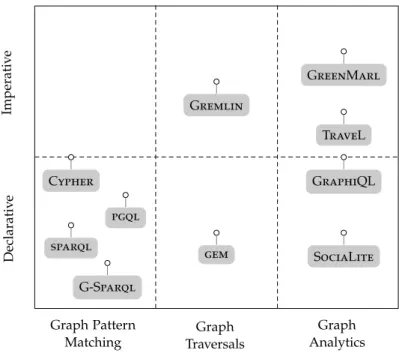
graph query languages for the property graph data model. In Figure2.1we depict the most recent graph query language proposals and classify them in two directions: (1) targeted application area and (2) language paradigm.
2.3.1 Pattern-Matching-Based Query Languages
The most prominent graph query languages target the subgraph isomorphism problem and follow a declarative language paradigm (Sakr et al., 2012; Panzarino, 2014; Raman
et al.,2014; SPA,2013). G-Sparql (Sakr et al.,2012) is an extension of sparql with spe-cific language constructs to query property graphs, including the spespe-cification of edge attribute filters and unbounded traversals to support reachability queries. The limitation ofsparql 1.0 of not being able to specify unbounded path expressions has been solved with the sparql 1.1 language specification. Cypher, the declarative query language of Neo4j, is internally transformed into an execution plan and further optimized based on collected graph statistics (Panzarino, 2014). Inspired by sparql and Cypher is pgql, a declarative graph pattern matching query language for the property graph model that is part of pgx (Raman et al., 2014). pgx exposes both sparql and pgql, and supports the automated conversion of a subset ofsparqlinto equivalentpgqlstatements.
2.3.2 Traversal-Based Query Languages
Traversal-based query languages provide native support for graph traversals as part of the language, examples aregem(Rudolf et al.,2013), the graph query language ofsap hana,
Graph Pattern
Matching TraversalsGraph
Graph Analytics Declarativ e Imperativ e Gremlin GreenMarl Cypher G-Sparql pgql GraphiQL sparql SociaLite gem TraveL
Figure2.1: Classification of graph query languages according to their main targeted application area and the language paradigm.
and Gremlin(Tin). Gremlin is a Java-based graph traversal language and is as part of the ApacheTinkerPop3 graph computation framework available on top of many graph processing systems, including Neo4j, Sparksee, and SQLGraph. Gremlin is one of the few graph query languages that received a wide adoption from the graph community by relying on a vendor-agnostic interface named BluePrints, the graphapiof Apache Tin -kerPop. Gremlinprovides rich query and manipulation capabilities and can be further ex-tended through Javaand Groovyinterfaces, for example to define domain-specific graph traversal semantics. On the downside, most vendors offering a Gremlininterface do not perform any query optimizations, with SQLGraphbeing the only exception. SQLGraph, however, does not offer a BluePrintsbackend, but instead directly translates (read-only) Gremlinstatements intosql.
2.3.3 Query Languages for Graph Analytics
Increasingly, more applications target graph analytics or graph mining, i.e., algorithms that traverse the entire graph, possibly multiple times. While imperative programming models, such asvertex-centricoredge-centriccomputation models, are gaining popularity, they are lacking a high-level exposition to the end user. GreenMarl (Hong et al., 2012, 2013b)
is among the first domain-specific graph query languages targeting graph analytics and exposes high-level constructs, such as graph traversals and parallelized loops. Similar in that spirit are SociaLite, a declarative query language based on Datalog (Lam et al.,
2013), and our language proposal TraveL, a traversal-based domain-specific language, and a corresponding TraveL code generator that emits executable code (cf. Chapter 7). GraphiQL (Jindal and Madden, 2014) is an imperative query language that exposes
im-portant primitives, such as loops, recursion, and neighborhood operations, to the end user. GraphiQL runs on top of anrdbmsand the corresponding compiler translates GraphiQL statements into a series ofsqlcommands.
2.4 g r a p h a l g o r i t h m s 11
2.4 g r a p h a l g o r i t h m s
Graph algorithms have witnessed an everlasting interest in the theoretical computer sci-ence community with applications in various domains, including routing, electronic cir-cuit design, proteomics, and chemistry. They range from simple graph traversals, such as breadth-first traversals (bft) and depth-first traversals (dft) (Cormen et al.,2001), graph
summarization algorithms, including the detection of strongly connected components (Tar-jan,1972;Hong et al.,2013a;Slota et al.,2014) and minimum spanning trees (see algorithms
by Borkuvka (1926), Prim (1930), and Kruskal (1956)), to complex graph optimization prob-lems, such as traveling salesman or the Chinese postman problem (Christofides, 1973),
which are not computable in polynomial time.
Despite the availability of more computing resources and an increased level of avail-able parallelism, graph algorithms can hardly fully benefit from the availavail-able hardware resources.Lumsdaine et al.(2007) analyze the root causes of the performance problems of
parallel graph processing and make the following observations: • Graph algorithms are data-driven
• Graph algorithms expose a poor data locality
• Graph algorithms belong to the data-crunching category
Many well-known graph algorithms have been successfully implemented in a multi-core environment by fully leveraging all available compute cores, such as depth-first traver-sal (Crauser et al.,1998), strongly connected components (Hong et al.,2013a;Slota et al., 2014), and triangle counting (Sevenich et al.,2014). In addition to exploiting the available
parallelism, several recent studies explore improvements of graph algorithms on specific hardware aspects, such as exploiting the memory hierarchy and available cache levels by avoiding data cache misses (Cong and Makarychev,2011), instruction cache misses (Green
et al.,2014), or by avoiding remote memory accesses on non-uniform distributed memory
(numa) machines (Zhang et al.,2015). Several programming models and corresponding
ab-straction layers have been proposed to provide the basis for writing performance-oriented, hardware-conscious graph algorithms (Nguyen et al.,2013;Shun and Blelloch,2013;
Harsh-vardhan et al.,2014). 2.4.1 Graph Traversals
Graph traversals are a fundamental building block for more complex graph algorithms, such as detecting connected components, bipartite graph matching, finding shortest paths in unweighted graphs, and appear in domain-specific use cases, such as 3d computer graphics (Hanrahan,1986), image processing (Silvela and Portillo,2001), and solving
bool-ean satisfiability (sat) instances (Motter and Markov,2002).
Increasing graph data sizes and the proliferation of parallelism on different hardware levels as well as heterogeneous processor environments encouraged researchers to revise well-known graph algorithms and to propose novel implementations on high-end comput-ers with a large number of cores and heterogeneous processor types in a single machine.
There are two fundamental traversal strategies to visit all vertices in a graph: breadth-first and depth-first (Cormen et al., 2001). In a breadth-first traversal, the traversal starts
at a root vertex and visits vertices in a level-synchronous manner, i.e., by first visiting all adjacent vertices before the traversal continues with the next level. A depth-first traversal visits recursively one adjacent vertex at a time and continues the traversal from there. If the traversal reaches a vertex with no adjacent vertices, it continues at the unfinished vertex, which is the closest to the root vertex.
In the course of this thesis, we will investigate breadth-first traversals in detail. We chose breadth-first traversals over depth-first traversals since breadth-first traversals can be im-plemented more efficiently in a multi-core environment. In contrast, depth-first traversals
are inherently sequential and can be hardly parallelized to scale to large server machines with dozens of available computing units. This observation led to the development of par-allel graph algorithms, which are originally based on adft, but in practice implemented using a parallelizedbft(McLendon III et al.,2005).
Single-Node Breadth-First Traversals
A large body of research has been conducted on efficient parallel graph traversals on a single server (Brodal et al.,2004;Agarwal et al.,2010;Pearce et al.,2010;Chhugani et al., 2012; Cui et al., 2012; Beamer et al., 2012; Yuan et al., 2012; Hong et al., 2011; Xia and
Prasanna,2009;Kernert et al.,2014;Then et al.,2014;Berrendorf and Makulla,2014;Yasui
et al.,2014). State-of-the-art parallel graph traversals use a level-synchronous strategy and
parallelize the work to be done at each level. Early work byXia and Prasanna(2009) adapts
the number of worker threads at each level in the traversal according to the working set size. Several implementations optimize for specific hardware characteristics, such as minimizing data cache misses (Brodal et al.,2004;Agarwal et al.,2010;Yuan et al.,2012;
Chen et al.,2013) and reducing remote memory accesses (Agarwal et al.,2010;Yasui et al., 2014;Chhugani et al.,2012;Cui et al.,2012). Especially maximizing temporal and spatial
memory locality is important for achieving optimal traversal performance (Yuan et al.,
2012;Chen et al.,2013).
An effective optimization for scale-free graphs with a low diameter has been proposed byBeamer et al. (2012). They describe a direction-optimized traversal, which switches the
execution order during the traversal from a top-down traversal to a bottom-up traversal. While a top-down traversal searches for children of a set of frontiers, a bottom-up traversal searches for a set of unvisited vertices for parents. This optimization leverages the fact that traversals on scale-free graphs tend to expose a large frontier set after the first2–3traversal iterations, making it more efficient to switch the execution mode.
A different interpretation of a breadth-first traversal originates from the observation that it can be implemented as a repeated matrix-vector multiplication of the sparse adjacency matrix (Kernert et al.,2014).Hong et al.(2011) propose a breadth-first traversal
implemen-tation that leveragescpuandgpuprocessing resources in a hybrid execution. While most breadth-first traversal implementations focus on the acceleration of a single traversal opera-tion utilizing all available resources,Then et al.(2014) propose a multi-source breadth-first
traversal, which shares commonly explored frontier sets between graph traversals to re-duce the amount of work to be performed. Such a work sharing between concurrent graph traversals can be exploited in graph algorithms that have to issue a traversal from each vertex in the graph and on scale-free graphs with a low diameter.Berrendorf and Makulla (2014) provide an in-depth experimental analysis of several level-synchronousbft imple-mentations and discuss several optimization techniques and measure their performance impact.
Breadth-First Traversals on Co-Processors
Graph traversals, specifically breadth-first traversals, have been an active application area for high-performance computing on specialized hardware, such as graphics processing units (gpu) (Harish and Narayanan,2007;Merrill et al.,2012;Bisson et al.,2014;Gharaibeh
et al.,2013;Sallinen et al.,2015;Fu et al.,2014;Slota et al.,2015), Intel® Many Integrated Core (mic) (Gao et al.,2014;Slota et al.,2015), and tree-based memory models (St. John
et al., 2012). While initial proposals focus on the pure implementation of breadth-first
traversals, typically based on cuda, recent works have focused on providing a higher level abstraction that either guarantees portability to different classes of many-core proces-sors (Slota et al.,2015) or provides a vertex-centricapithrough ascatter-gatherinterface (Fu et al.,2014;Sundaram et al.,2015).
2.5 g r a p h d ata g e n e r at o r s a n d b e n c h m a r k i n g 13
Distributed Breadth-First Traversals
If the graph size exceeds the memory capacity of a single server, the graph can be ei-ther processed from semi-external memory, such as a hard disk or a flash-based storage medium (Pearce et al.,2010), or can be distributed among several servers in a cluster. There
are multiple implementations targeting distributed memory graph traversals, which differ mainly in their initial graph partitioning scheme and the strategies to minimize communi-cation across the network (Yoo et al.,2005;Buluç and Madduri,2011;Lv et al.,2012;Beamer
et al.,2013;Shang and Kitsuregawa,2013;Checconi and Petrini,2014). One of the first
dis-tributed graph traversals is described byYoo et al.(2005), who implement a breadth-first
traversal on a large cluster installation of a BlueGene/L with up to32,000processors and achieve up to100million traversed edges per second (teps). They avoid the expensive all-to-all communication by applying a two-dimensional partitioning on the adjacency matrix. In a related study,Checconi and Petrini(2014) investigate breadth-first traversals on a
clus-ter with64,000BlueGene/Q nodes and achieve an impressive number of15.3trillionteps. Among several algorithmic tricks, they changed the initial two-dimensional partitioning to a one-dimensional vertex partitioning.Beamer et al.(2013) discuss the direction-optimized
traversal strategy, which switches from atop-downto abottom-uptraversal evaluation dur-ing execution, on a distributed memory cluster.Shang and Kitsuregawa(2013) propose a
novel distributed graph traversal by applying a degree-based partitioning, which provides a balanced execution on skewed vertex degree distributions. To reduce the communica-tion overhead in distributed traversals,Lv et al. (2012) propose message compression to
minimize the size of communication messages.
2.5 g r a p h d ata g e n e r at o r s a n d b e n c h m a r k i n g
There have been early discussions on the design of benchmarks for graph processing sys-tems, mainly driven by the graph database community (Dominguez-Sal et al.,2010,2011)
and the high-performance community (Gra). While the high-performance community uses bftto measure the execution performance of supercomputers, major gdbmsvendors are interested in showing the performance and scalability of their systems for a wider range of use cases and applications. One of the main distinguishing factors ofgdbmsis the ability to perform topological queries, such as graph traversals, faster than theirrdbms equiva-lents using chained self-joins. Therefore, the main focus forgdbmsbenchmarking has been on graph traversals (Ciglan et al.,2012). With the more widespread adoption of
pattern-matching-based query processing on property graphs with a large number of attributes attached to vertices and edges, new benchmarking initiatives, such as the Linked Data Benchmarking Council (ldbc)4(Erling et al.,2015), emerged.
R-MAT Data Generator
The r-mat data generator proposed by Chakrabarti et al. (2004) creates graphs with a
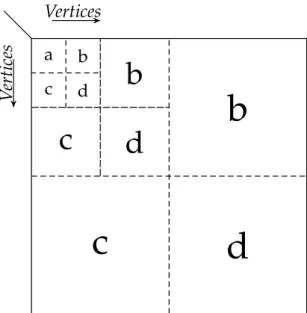
skewed degree distribution (power-law distributed), a community structure, and a small diameter. Figure2.2 depicts the general data generation model ofr-mat. The data gener-ation works on the adjacency matrix of the graph and recursively subdivides the matrix into four equal-sized partitionsa,b,c, andd. Each partition is subsequently divided into
four partitions, until a partition size of one is reached. Each edge to be inserted is added with a given probability that is taken from the input parameters a,b,c, and d. Thereby,
the preconditiona+b+c+d=1must hold. To generate a power-law degree distribution, a community structure, and a small diameter, the authors recommend choosing the input parameters such thata>b∧a>c∧a>dholds. For example, the Graph500benchmark uses a data generator similar tor-mat (the Kronecker data generator) and relies on the following parameter configuration:ha=0.57,b=0.19,c=0.19,d=0.05i5. Although the
4 Linked Data Benchmarking Council —http://ldbcouncil.org/(Last accessed: April2017)
b
c
d
b
c
d
a
b
c
d
Vertices
V
ertices
Figure2.2:r-matdata generation model (adapted fromChakrabarti et al.(2004)).
r-matdata generator solves some of the problems of generating large graphs with realistic properties, it does not capture attributes attached to vertices and edges. We use ther-mat data generator in our experimental evaluations to easily generate realistic graph topologies of different scale.
LDBC Social Network Benchmark
Theldbcsocial network benchmark provides the first graph data generator that generates a realistic graph topology, but also a set of attributes attached to vertices and edges. It represents a social network application with user activities during a period of time (Erling et al., 2015). The data is used in the interactive, the business-intelligence, and the
algo-rithmic workload (Capot˘a et al.,2015) of theldbc social network benchmark. It contains persons, tags, forums, messages, likes, organizations, and places as vertices and about20 different relations between them. The backbone of the graph is a fully connected com-ponent of users and their friendship relationships. The ldbc data generator puts a spe-cial emphasis on correlated attributes and structural correlations, such as the correlation between person’s first names and their gender or the correlation between the places of study/common interests and the probability of establishing a friendship connection be-tween two users (Pham et al.,2012). The attribute dictionaries are extracted from DBpedia
and are assigned using a skewed value distribution. Finally, an implicit time dimension allows representingtrending topicsand the number of messages, comments, and posts are skewed to reflect occurring political and sport events as well as natural disasters.
2.6 g r a p h p r o c e s s i n g s y s t e m s
In this section we review, compare, and classify the most popular graph processing sys-tems available that target different graph applications, programming models, and com-putation environments. We classify them into: (1) single-node graph processing systems, (2) distributed graph processing systems, (3) graph processing systems as extensions of rdbms, and (4) graph database management systems (gdbms). We provide a summary of our classification on all reviewed single-node graph processing systems, including graph processing systems on top ofrdbmsand graph database management systems, in Table2.1.
2.6 g r a p h p r o c e s s i n g s y s t e m s 15 Table 2 . 1 :Comparison of single-node graph pr ocessing systems and their supported featur es. System Vertex/Edge Attributes Updates/ Deletions Transactions Language Support Quer y/Pr ogramming Model Interaction with Relational S p arksee ( Martínez-Bazan et al. , 2012 ) 3 3 3 — Blueprints api — L igra ( Shun and Blelloch , 2013 ) ( 3 ) a — — — Map Functions — pgx ( Raman et al. , 2014 ) 3 ( 3 ) b — 3 c Patter n Matching — G raph L ab ( Lo w et al. , 2012 ) 3 3 — — Vertex-centric — N eo4j ( Neo ) 3 3 3 3 Patter n Matching — G raph C hi ( Kyr ola et al. , 2012 ) ( 3 ) d 3 — — Vertex-centric — G ra ce ( Prabhakaran et al. , 2012 ) 3 3 3 — Vertex-centric — E mpty H eaded ( Aber ger et al. , 2015 ) 3 — — 3 Boolean Algebra 3 e G alois ( Nguy en et al. , 2013 ) 3 — — — adp f — SQLG raph ( Sun et al. , 2015 ) 3 3 3 3 g Relational/Pipes 3 V ertexica ( Jindal et al. , 2014 a ) 3 3 3 3 h Relational 3 T era D a t a A ster ( Simmen et al. , 2014 ) 3 3 3 — Vertex-centric 3 S ystem -G ( Xia et al. , 2014 ) 3 ( 3 ) i — — Blueprints API — LL ama ( Macko et al. , 2015 ) 3 3 — — General Pur pose API — T urbo G raph ( Han et al. , 2013 ) 3 3 — — Pin-and-Slide — P ower G raph ( Gonzalez et al. , 2012 ) 3 3 — — Vertex-centric — P ol ymer ( Zhang et al. , 2015 ) 3 — — — Map Functions — a Only a single numerical edge attribute (e.g, a w eight) is supported b Batch updates c pgql d only a single vertex/edge attribute is supported e All operations ar e set-based/based on joins f Amor phous Data Parallelism Pr ogramming Model g G remlin h G raphi QL by Jindal and Madden ( 2014 ) i not all graph repr esentations support mutations
2.6.1 Single-Node Graph Systems
Out-of-Core Graph Systems
The initial experimental results of GraphChi(Kyrola et al.,2012), which demonstrate that
a carefully implemented disk-based single-node graph processing system can outperform a large cluster installation, triggered an ever-growing interest in processing billion-scale graphs on a single commodity machine (Han et al., 2013;Roy et al.,2013; Cheng et al., 2015;Wang et al.,2015;Zhu et al.,2015;Zheng et al.,2015;McSherry et al.,2015).
GraphChi (Kyrola et al., 2012) is among the first implementations of a disk-based,
single-node graph processing system running on commodity hardware and targeting ap-plications dealing with billion-scale graphs. GraphChiavoids random access read opera-tions on the graph stored on hard disk orssdby transforming them into more disk-friendly, sequential read patterns. The authors propose a parallel sliding window (psw) approach and distribute the vertex space into disjoint intervals that are subsequently mapped to so-calledshards. A shard stores all edges whose target vertex is in the corresponding in-terval and sorts them by their source vertices. GraphChi implements a variation of the bulk-synchronous processing (bsp) model through an asynchronous vertex-centric execu-tion model, but writes updated values directly instead of sending messages to adjacent vertices. The execution model is based on a one-interval-at-a-time paradigm—one shard (the memory shard) is fetched completely into memory and other subsequent shards are also read fromssdto fetch the outgoing edges of a given vertex set.
TurboGraph(Han et al.,2013) is comparable to GraphChiand is a disk-based graph engine to process billion-scale graphs and leverages multi-core parallelism and parallel, asynchronousi/oof ssds to efficiently interleave i/o andcpu processing. TurboGraph proposes a novel execution model, calledpin-and-slide, which is based on thecolumn view
of a matrix-vector multiplication. For a given set of vertices, TurboGraph identifies the required pages andpinsthem in the in-memory buffer pool. If some of the pages reside al-ready in the buffer pool, one execution thread per page starts processing the vertex update function. While the first pages are being processed, TurboGraphissues asynchronousi/o calls to thessddevice to fetch the missing pages into the buffer pool. Whenever a page is fetched into the buffer pool, the execution engine is notified and can proceed to process the pages. Once TurboGraphfinishes the processing of a page, it unpinsthe page explicitly and the buffer pool eventually evicts it. Thereby, TurboGraphslidesover the pages of the graph.
In contrast to the vertex-centric systems GraphChi and TurboGraph, X-Stream(Roy et al.,2013) relies on anedge-centricprogramming model. In thescatterandgatherphase,
X-Stream iterates over edges and performs updates on edges rather than on vertices. An edge-centric approach avoids expensive random access operations to the edges of the graph. Instead of minimizing random accesses on vertices, X-Streamminimizes random accesses on edges, under the assumption that the number of edges is much larger than the number of vertices in the graph. To overcome the random access pattern on the vertices, X-Streampartitions the set of vertices such that it fits into memory or thecpucache. While GraphChi requires the entireshard, including vertices and incoming/outgoing edges, to be in memory, X-Streamonly requires the vertex state to be in memory.
Yuan et al. (2014) propose to use a path-centriccomputation model instead of a vertex-or edge-centricmodel. PathGraph partitions the graph into trees and stores each tree in dfsorder to improve the disk and memory locality and uses data compression to further reduce the size of the graph on disk. Further, PathGraphclusters highly correlated paths together and parallelizes the execution at the tree partition level.
Lin et al.(2014) explore an alternative strategy to read graph data efficiently from disk by
reusing thememory mappingfacilities provided by the operating system. This is in contrast to systems like GraphChiand TurboGraph, which manage memory and page tables by themselves.
2.6 g r a p h p r o c e s s i n g s y s t e m s 17
Zheng et al. (2015) propose FlashGraph, a semi-external memory graph processing system running on an array ofssds. FlashGraphis built on top of a user-spacessd file system calledset-associative file system. It stores vertex state in memory and the edge lists on ssds. Similar to TurboGraph, FlashGraphalso overlapsi/owith the actual computation and mergesi/orequests where possible.
Venus (Cheng et al., 2015) exhibits a vertex-centric programming model and loads a
graph from disk sequentially in astreamlined fashion. Such a streaming approach allows interleaving data loading from disk with the computation by exploiting the large sequen-tial bandwidth of the disk.
GridGraph(Zhu et al.,2015) stores the vertices of the graph in1D partitions and the edges in2D partitions using a level partitioning during the preprocessing phase. Similar to GraphChi, GridGraphalso applies a sliding window technique to stream the edges from disk. In contrast to other vertex- or edge-centric processing models, GridGraphcombines thescatterand the gather phase into a singlestreaming-applyphase allowing to minimize the number of reads for a block of edges.
GraphQ (Wang et al., 2015) proposes an interesting alternative to processing analytic
queries on the complete graph: a large graph is represented as multiple levels of abstrac-tions and a query is executed through an iterative refinement across the abstraction levels. The general assumption is that many use cases do not require a complete solution on the entire graph, but instead can also rely on a partial result derived from a small fraction of the input graph. Query processing in GraphQ performs repeated lock-stepcheck-refine calls, until the query returns the desired result or the given query budget, e.g., memory or cpu, is exhausted. Thecheckphase processes the query on each individual graph partition. If no query in the check phase returns successfully, therefinephase identifies inter-partition edges and adds them back to the graph. Finally, the procedure continues with thecheck
phase in the next iteration.
In-Memory Graph Systems
Galois(Nguyen et al.,2013) is a task-based parallelization system that is particularly
well-suited for irregular computations, such as graph algorithms. It exposes a sophisticated programming model withautonomousandcoordinatedscheduling and with or without spe-cific application priorities to provide correctness guarantees for autonomous scheduling.
Ligra(Shun and Blelloch,2013;Shun et al.,2015) is a graph processing library tailored
to large multi-core shared-memory machines and for traversal-based graph applications, such as breadth-first search, betweenness centrality, graph radii estimation, graph connec-tivity, PageRank, and single-source shortest path. A graph in Ligracan be either a graph topology solely or a weighted graph and stored in two arrays, one for storing the incoming edges and one for storing the outgoing edges for each vertex. Both arrays are partitioned (sorted) by source vertex (for outgoing edges) and target vertex (for incoming edges). Each vertex maintains the positions of its adjacency using an index into the array and degree information for incoming and outgoing edges. For weighted graphs, the edge attribute is interleaved with the target vertices and stored as a tuple in the outgoing adjacency. If additional vertex attributes are required, they have to be stored and processed in the ap-plication layer. Ligra supports two fundamental data types: graphs and sets of vertices. Vertex identifiers have to be continuous, discrete in the range from0 to|V|−1. Depend-ing on the size, a vertex set can be represented either as an integer array or as a bitset. Ligra provides a simplistic programming interface to formulate graph algorithms. The core functions are: (1) an edge map function taking as input the graph, a vertex setU, an edge function, and a vertex functionC, (2) a vertex map taking as input a vertex set and a vertex function, and (3) a cardinality function that returns the size of a given vertex set.
In an edge map call, Ligraapplies the edge function to all edges with a source vertex in the input vertex setUand target vertex satisfying the vertex conditionC. For each active
edge(u,v), the edge map returns the target vertex v in the result vertex set. Internally,