c
CONSTRUCTING AND MODELING TEXT-RICH INFORMATION NETWORKS: A PHRASE MINING-BASED APPROACH
BY JIALU LIU
DISSERTATION
Submitted in partial fulfillment of the requirements for the degree of Doctor of Philosophy in Computer Science
in the Graduate College of the
University of Illinois at Urbana-Champaign, 2016
Urbana, Illinois
Doctoral Committee:
Professor Jiawei Han, Chair Professor Chengxiang Zhai Professor Aditya Parameswaran Doctor Cong Yu, Google Research
Abstract
A lot of digital ink has been spilled on “big data” over the past few years, which is often characterized by an explosion of information. Most of this surge owes its origin to the un-structured data in the wild like words, images and video as comparing to the un-structured information stored in fielded form in databases. The proliferation of text-heavy data is par-ticularly overwhelming, reflected in everyone’s daily life in forms of web documents, business reviews, news, social posts, etc. In the mean time, textual data and structured entities often come in intertwined, such as authors/posters, document categories and tags, and document-associated geo locations. With this background, a core research challenge presents itself as how to turn massive, (semi-)unstructured data into structured knowledge. One promis-ing paradigm studied in this dissertation is to integrate structured and unstructured data, constructing an organized heterogeneous information network, and developing powerful modeling mechanisms on such organized network. We name it text-rich information net-work, since it is an integrated representation of both structured and unstructured textual data.
To thoroughly develop the construction and modeling paradigm, this dissertation will focus on forming a scalable data-driven framework and propose a new line of techniques relying on the idea of phrase mining to bridge textual documents and structured entities.
We will first introduce the phrase mining method named SegPhrase+ to globally discover semantically meaningful phrases from massive textual data, providing a high quality dictio-nary for text structuralization. Clearly distinct from previous works that mostly focused on
raw statistics of string matching, SegPhrase+ looks into the phrase context and effectively rectifies raw statistics to significantly boost the performance.
Next, a novel algorithm based on latent keyphrases is developed and adopted to largely eliminate irregularities in massive text via providing an consistent and interpretable docu-ment representation. As a critical process in constructing the network, it uses the quality phrases generated in the previous step as candidates. From them a set of keyphrases are extracted to represent a particular document with inferred strength through a statistical model. After this step, documents become more structured and are consistently represented in the form of a bipartite network connecting documents with quality keyphrases. A more heterogeneous text-rich information network can be constructed by incorporating different types of document-associated entities as additional nodes.
Lastly, a general and scalable framework, Tensor2vec, are to be added to trational data minining machanism, as the latter cannot readily solve the problem when the organized heterogeneous network has nodes with different types. Tensor2vec is expected to elegantly handle relevance search, entity classification, summarization and recommendation problems, by making use of higher-order link information and projecting multi-typed nodes into a shared low-dimensional vectorial space such that node proximity can be easily computed and accurately predicted.
Acknowledgments
I would like to thank all the people and agencies who give me tremendous support and help to make this thesis happen.
First and foremost, I am greatly indebted to my advisor, Prof. Jiawei Han, one of the nicest and most generous people I have met in my life. In the past five years, Prof. Han has set up a great example of scientific researcher for me: his keen insights and vision, his passion on research and life, his patience in mentoring students, and his diligence. Even during his sabbatical, he spent most of the time on campus giving advice on our research. I always feel lucky to have Prof. Han as my advisor, for all the insightful discussions, bright ideas, earnest encouragements, and strongest supports in every means, which have turned me into a qualified and mature researcher.
I would like to thank my thesis committee members, Prof. Chengxiang Zhai, Prof. Aditya Parameswaran, and Dr. Cong Yu, for their great feedback and suggestions on my Ph.D. research and thesis work. Prof. Zhai has been giving me invaluable support in many aspects of my research and I have also benefited a lot from the discussions with him and his Information Retrieval course. Prof. Parameswaran has given me many insightful comments on this document, and help improve the content. I am grateful to Cong for not only sitting on my dissertation committee, but also mentoring me through a wonderful intership at Google Research, advising me through my job application process, and becoming my future manager.
interships at IBM Research and Google. I want to thank Charu Aggarwal, Xiaoxin Yin, Don Metzler for the opportunity to work with them on fascinating research problems, and for their guidance.
During my Ph.D. study, it is my great honor to work with talented colleagues (also friends) in the Data Mining group as well as the whole Database and Information System (DAIS) group and Computer Science department at UIUC. I have benefited so much from discussions and I owe sincere gratitude to them, especially, Mingcheng Chen, Jing Gao, Quanquan Gu, Gui Huan, Meng Jiang, Brandon Novick, Meng Qu, Xiang Ren, Jingbo Shang, Fangbo Tao, Chi Wang, Jingjing Wang, Yinan Zhang, Rongda Zhu (sorted alpha-betically). I would also like to thank researchers from Army Research Lab during my visit to Maryland, especially, Taylor Cassidy, Lance Kaplan and Clare Voss (sorted alphabetically). Finally and above all, I owe my deepest gratitude to my parents and my wife. I want to thank my parents for their endless and unreserved love, who have been encouraging and supporting me all the time. I want to thank my wife, Xiaoxuan, for her love, understanding, patience, and support at every moment. This thesis is dedicated to them.
Table of Contents
Chapter 1 Introduction . . . 1
1.1 Background and Motivation . . . 1
1.2 Problem Formalization . . . 3
1.3 Framework . . . 7
Chapter 2 Literature Review . . . 12
2.1 Constructing Text-Rich Information Network . . . 12
2.2 Modeling Text-Rich Information Network . . . 13
2.3 Phrase Mining . . . 14
2.4 Document Representations . . . 15
2.5 Keyphrase Extraction . . . 17
2.6 Network Embedding . . . 18
Chapter 3 A Data-Driven Approach for Phrase Mining . . . 20
3.1 Phrase Quality and Phrasal Segmentation . . . 25
3.2 Phrase Mining Framework . . . 28
3.2.1 Frequent Phrase Detection . . . 29
3.2.2 Phrase Quality Estimation . . . 30
3.2.3 Phrasal Segmentation . . . 33
3.2.4 Feedback as Segmentation Features . . . 38
3.2.5 Complexity Analysis . . . 40
3.3 Experimental Study . . . 41
3.3.1 Quantitative Evaluation and Results . . . 44
3.3.2 Model Selection . . . 46
3.3.3 Efficiency Study . . . 48
3.3.4 Case Study . . . 50
Chapter 4 Latent Keyphrase Extraction for Semantic Information Mod-eling . . . 53
4.1 Quality Phrase Silhouetting . . . 57
4.1.1 Model Learning . . . 60
4.1.2 Model Initialization . . . 62
4.2.1 Inexact Inference Using Gibbs Sampling . . . 64
4.2.2 Search Space Reduction . . . 66
4.3 Experimental Study . . . 67
4.3.1 Quantitative Evaluation and Results . . . 69
4.3.2 Model Selection . . . 75
4.3.3 Efficiency Study . . . 77
4.3.4 Case Study . . . 78
Chapter 5 Tensor-Based Large-Scale Network Embedding . . . 81
5.1 Network Schema and Entity Proximity . . . 85
5.2 Tensor2vec: The Network Embedding Framework . . . 88
5.2.1 Entity2vec . . . 88
5.2.2 Relation2vec . . . 90
5.2.3 Multiple Relation Types . . . 91
5.3 Noise Pairwise Ranking . . . 92
5.3.1 Objective Derivation . . . 92
5.3.2 Optimization for Entity2vec . . . 94
5.3.3 Optimization for Relation2vec . . . 96
5.3.4 Unified Algorithm . . . 97
5.4 Experimental Study . . . 97
5.4.1 Quantitative Evaluation and Results . . . 102
5.4.2 Robustness Study . . . 103
5.4.3 Model Study . . . 107
5.4.4 Efficiency Study . . . 109
Chapter 6 Conclusion and Future Work . . . 110
6.1 Conclusion . . . 110
6.2 Impact . . . 112
6.3 Research Frontiers . . . 113
6.3.1 Enriching Text-Rich Information Networks . . . 113
6.3.2 Refining Text-Rich Information Networks . . . 114
6.3.3 Modeling of Text-Rich Information Networks . . . 114
Chapter 1
Introduction
1.1
Background and Motivation
The past decade has witnessed the surge of interest in data mining which is broadly construed to discover knowledge from all kinds of data, be it in academia, industry or daily life. The information explosion brings the “big data” era to the light of the stage. This overwhelming tide of information is largely composed of unstructured data like words, images and videos. It is easy to distinguish them from structured data (e.g., relational data) in that the latter can be readily stored in the fielded form in databases. A particularly prominent kind of unstructured data comes in the form of text. Examples of such collections include scientific publications, enterprise logs, news articles, social media and general Web pages.
documents
Words:
dbscan, methods, clustering, process, …
Topics:
[k-means, clustering, clusters, dbscan, …] [clusters, density, dbscan, clustering, …] [machine, learning, knowledge, mining, …]
Knowledge base concepts:
data mining: /m/0blvg clustering analysis: /m/031f5p dbscan: /m/03cg_k1 Document Representation Others? Document Keyphrase:
dbscan: [dbscan, density, clustering, ...] clustering: [clustering, clusters, partition, ...] data mining: [data mining, knowledge, ...]
author venue
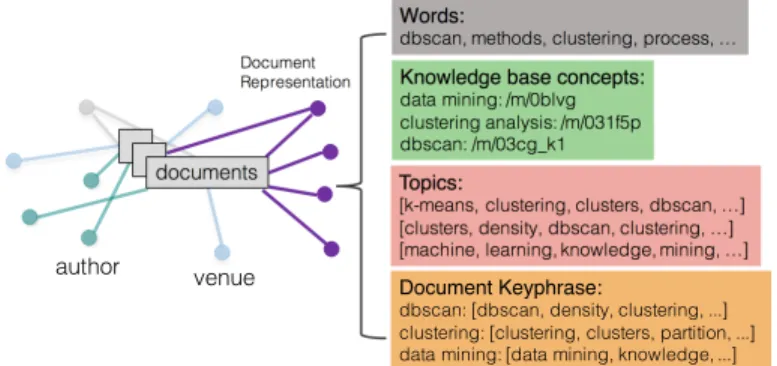
Figure 1.1: Research papers with various of docu-ment representations can be associated with differ-ent types of differ-entities.
It can often be observed that un-structured textual data and struc-tured entities are interconnected, such as document authors/posters, categories/tags, and associated ge-ographical locations. By mining massive unstructured and struc-tured data where the entities occur, one can expect to extract
topical grouping of them.
Example 1.1 (Textual Data in Research Community) For bibliographic data like
DBLPa , research papers are explicitly linked with authors and venues. Many
interest-ing research topics in Computer Science are studied and tremendous scientific terms are mentioned in these publication records. Observing these relations as plotted in Fig. 1.1, a user may expect to infer a researcher’s expertise through mining his/her published pa-pers, or to figure out what venues are related and what papers to read and cite based on his/her research interest.
a
http://dblp.uni-trier.de/
Under this expectation, a core research challenge is how to turn massive, unstructured data into structured knowledge due to the lack of a general data model that supports in-tegrated structured and textual data. After such structuralization, many powerful analysis methods and tools can be developed, experimented and refined. One promising paradigm studied in this dissertation is firstconstructingan organized text-rich information networks given the two parts, and then developing powerfulmodelingmechanisms on such organized networks.
Such a data-to-network-to-knowledge paradigm is motivated based on these observations: • Most social, informational, and physical entities are interconnected or interacting,
forming massive networks;
• Structured and unstructured textual data can be naturally linked together after text structuralization1, which is the key step to construct text-rich information networks;
• If a text-rich information networks can be constructed, consisting of a small number of types on the nodes and links but with a massive amount of data, they can be expected to bring tremendous power on search, mining, and knowledge generation.
However, this paradigm poses significant challenges to the traditional text and network mining techniques, including the following but not limited to
• The emerging big textual data, such as social media messages, can deviate from rigor-ous language rules. Using varirigor-ous kinds of heavily trained linguistic processing makes the method difficult to be applied.
• Document length and vocabulary may vary significantly across the corpus, e.g., web pages. A good text structuralization approach needs to eliminate these obstacles and generate compatible document representation.
• If a text-rich information networks can be constructed, it will be such a powerful tool in data mining applications that we may predict it in no time to meet the requirements of being extremely robust and scalable.
In this regard, we believe that the community would welcome and benefit from a set of
data-drive algorithms that work for large-scale datasets involving irregular textual data in
a robust way, while minimizing the human labeling cost. We are also convinced by various study and experiments that our proposed methods embody enough novelty and contribution to add solid building block, if not lay a sound base to the successive research.
1.2
Problem Formalization
We have developed a phrase mining algorithm en route of tackling the above mentioned chal-lenge, which is one of our main contributions. This text structuraliation technique discovers and utilizes semantically meaningful phrases from massive irregular text. Specifically,
Problem 1.1: Phrase Mining
Given a large in-domain document corpus D with specific focus on certain genres of content, which can be any textual word sequences with arbitrary lengths, such as articles, titles and queries, phrase mining tries to assign a value between 0 and 1 to indicate the quality of each phrase, and provide a segmenter being able to partition a text snippet into un-overlapped segments and identify phrase mentions. Phrases with scores larger than 0.5 are viewed as quality phrases K ={K1,· · · , KM}.
Definition 1.1 (Quality Phrase) A quality phrase is a sequence of words that appear contiguously in the text, and serves as a whole (non-composible) semantic unit in certain context of the given documents.
There is no universally accepted definition of phrase quality. However, it is useful to quantify phrase quality based on certain criteria, which will be discussed and defined in Chapter 3. Note that within a particular domain, a phrase will likely have one meaning [36], making the phrase relatively unambiguous and its quality estimation feasible. Moreover, phrase quality is not contextual dependent. For example, both ‘knowledge discovery’ and ‘np hard’ are identified to be quality phrases from the bibliographic data in the computer science domain. But in a specific paper published in the data mining conference, ‘knowledge discovery’ should be considered to be more salient than ‘np hard’ even though they are both mentioned in that paper. We call such salient phrases in the document as document keyphrases, formally defined as
Definition 1.2 (Document Keyphrase) A document keyphrase is a quality phrase
that is relevant to a specific in-domain document, i.e., it serves as an informative word
Different from typical way of defining keyphrase in the literature, we do not require their number of mentions in a document to be significantly large. A supporting example is that: a text mining paper may only mention ‘text mining’ once in its abstract, but this phrase is still of great value since it is topically relevant to the rest of the content. This presents a brand new challenge as well as brings great usefulness, especially for short texts. We formalize this challenging problem as follows:
Problem 1.2: Document Keyphrase Extraction
Given a large collection of documents C and a set of high quality phrases K = {K1,· · · , KM}, we aim to build a keyphrase extractor that can automatically
iden-tify document keyphrases given a new text query q, and infer strength scores [P1(q),· · · , PM(q)]. Each entry in the vector quantifies relatedness between query and a phrase in the range [0,1]. Phrases with positive strength scores are considered to be document keyphrases.
Compared with existing text mining approaches of modeling documents such as takingn -grams, deriving noun phrases or using knowledge base concepts as demonstrated in Fig. 1.1, we argue that high quality document keyphrases are naturally a better choice in the big data scenario since they capture meaningful sequences of different lengths and can be easily applied to emerging big corpora as a data-driven approach.
Meanwhile, documents become more structured and from the perspective of network, one can think of bipartite relations between documents and keyphrases. On top of this simple network, incorporating entities associated with the document extends the bipartite rela-tions to higher-order relarela-tions, which is defined as a text-rich information network
Definition 1.3 (Text-Rich Information Network) A text-rich information
net-work can be formally represented by G = (E,R), where E is the set of entities serving
as nodes, and R is the set of relations (second-order or higher-order) connecting the
entities, serving as links in the network.We useO and T to represent the sets of entity
types and relation types respectively. For any entity type o ∈ O, Eo refers to the set of
entities of type o; for any relation type t ∈ T, Rt defines the set of relations of type
t. Without loss of generality, E1 = K is the set of quality phrases mined from a large
collection of documents C.
The bibliographic data mentioned in Example 1.1, can be represented a text-rich infor-mation network as follows:
Example 1.2 (Bibliographic Network) There are four types of nodes: E1 for phrases,
E2 for papers, E3 for authors, and E4 for venues. For links in the network, if we
con-sider higher-order relations, there is only one type of links connecting these nodes to-gether, referred as “author publishes paper in a venue with keyphrases”. If we divide
these higher-order relations into bipartite ones, there exist three types of links: R1 for
the links connecting papers and their keyphrases; R2 for the links between papers and
authors; and R3 for the links between papers and venues.
Note that text-rich information network is a particular type of heterogeneous information network in the sense that its links connect different types of nodes together constructed from textual corpus. Modeling such a structured representation of textual data will benefit quite many applications like entity classification, relevance search and multi-aspect mining. We achieve this goal by solving a fundamental problem shared by all these tasks. That is,
Problem 1.3: Text-Rich Information Network Embedding
Given a text-rich information network, the problem of network embedding is to learn a function M that projects each entity e ∈ E to a vector in a d-dimension space Rd
that keeps certain proximitya, where d |E|, i.e., M:E →
Rd.
aThe definition of entity proximity will be provided in the network embedding chapter.
This embedding problem is very general, which can be integrated with different tasks in a natural way. For instance, by searching nearest neighbors of an author node constrained on phrase nodes, we are able to identify his/her expertise and research interest. Also, by plotting the same typed nodes like venues and keyphrases, we may tell the closeness between different research areas and topics. Other than these two examples, embeddings are useful for a lot of downstream applications including entity classification, clustering, recommender system, and link prediction.
1.3
Framework
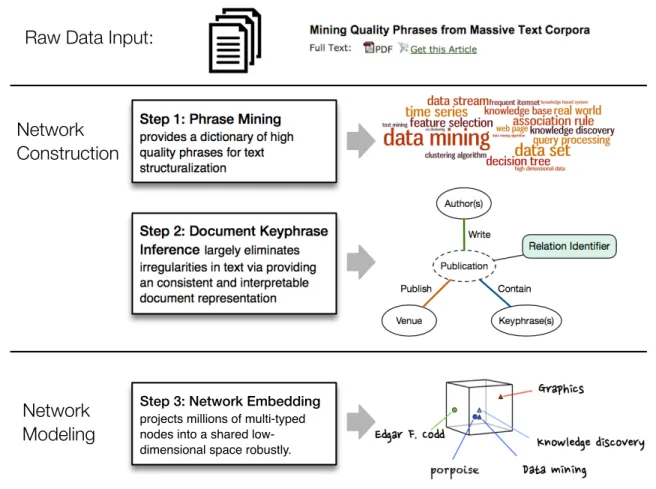
This section presents a coherent framework for constructing text-rich information network using phrase mining-based techniques and modeling it using the embedding method. It is comprised of three important modules as demonstrated in Fig. 1.2 to solve the previously mentioned research challenges respectively. A series of new methodologies are invented accordingly.
Phrase Mining
As the first step of the framework, a fully data-driven phrase mining method called Seg-Phrase+ is proposed to efficiently discover quality phrases from massive text corpora. These phrases form a dictionary for text structuralization.
informa-Step 2: Document Keyphrase Inference!largely eliminates irregularities in text via providing an consistent and interpretable document representation
Network Construction
Network Modeling
Raw Data Input:
!"#"$%&'&'(
)'*+,-.(-$.&/0*1-23 42"56&0/
7.("2$ 89$:*..
Step 1: Phrase Mining!
provides a dictionary of high quality phrases for text structuralization
Step 3: Network Embedding!
projects millions of multi-typed nodes into a shared low-dimensional space robustly.
Figure 1.2: Overview of the scalable data-driven framework proposed in this dissertation to construct and modeling text-rich information networks in three.
tion, the contribution of SegPhrase+ is to rectify the decisive raw frequency to help discover the true quality of a phrase. In particular, the goal of the rectification is to estimate how many times each word sequence should be interpreted in whole as a phrase in its occurrence context. For example, frequency of ‘vector machine’ will be close to 0 after rectification but its raw frequency will be the same as (or similar to) ‘support vector machine’.
In order to recover the true frequency with best effort, SegPhrase+ examines the context of every occurrence of each word sequence and decides whether to count it as a phrase. Such process is conducted by a dynamic programming process segmenting the word sequence into non-overlapped words and phrases. Moreover, Segphrase+ integrates this segmentation with
the phrase quality assessment, such that (i) only frequent phrases with reasonable quality are taken into consideration when enumerating segments; and (ii) the phrase quality guides the segmentation, and the segmentation rectifies the phrase quality estimation. Such an integrated framework benefits from mutual enhancement, and achieves both high quality and high efficiency. Finally, both the phrase quality and the segmentation results are useful from an application point of view. The segmentation results are especially desirable for tasks like document indexing, categorization or retrieval, which will be covered in the next module.
Document Keyphrase Inference
The next step is to utilize these detected quality phrases and link them with documents in the form of keyphrases, with the goal of largely eliminating irregularities in text via providing an consistent and interpretable document representation.
We observe that many keyphrases relevant to a given document are not frequently men-tioned, which is especially true for short texts like paper abstracts and business reviews. On the other hand, a keyphrase should be summarizing the topics of a document and closely relevant to some parts of its content. Based on this idea, a novel solution, called Latent Keyphrase Inference (LAKI), is developed to extract document keyphrases by modeling such topical relevance. Specifically, each phrase mined in the last module is learned with a silhouette-a cohesive set of topically related words and phrases, which enables the method to assign appropriate strength scores to keyphrase candidates through statistical inference, going beyond just explicit mentions.
Compared with the state-of-art document representation approaches, LAKI replaces bag-of-words and concepts in knowledge base by using semantically meaningful phrases as the representation unit. It removes the dependency on a knowledge base while providing, with keyphrases, readily interpretable representations. This work also paves the way for the
third module,i.e., finally constructing and modeling more complicated text-rich information networks which involve in entities associated with the documents like authors, locations,etc. Text-Rich Information Network Embedding
By representing documents as a collection of keyphrases, one can naturally view those keyphrases as structured units and build a bipartite network between them and documents. Moreover, a gigantic text-rich information network can be constructed by incorporating more document-relevant entities. In this step, we try to model with an embedding approach, i.e., nodes in the network including the document keyphrases are projected into a common space such that different types of nodes can be compared in a homogeneous fashion. We believe that different types of nodes and links in network will provide important insight to the mod-eled data, in a much better way than the messy pieces without the heterogeneity that we take great effort to strike.
To achieve this goal, we noticed that the links between different node types in a text-rich information network can be inherently considered to describe higher-order relations between document keyphrases and document-relevant entities. In our bibliographic network exam-ple 1.2, relations are in the form of authors publishing papers in venues with keyphrases, etc. In such scenarios, existing methodologies may fail because they simply extend homoge-neous network analysis by sequentially modeling bipartite links between multi-typed nodes and thus lose massive information. A legitimate approach towards successfully utilizing heterogeneity in the network is to model the involved entities and keyphrases as a whole.
Therefore, a novel framework called tensor2vec is proposed to collectively learn network embeddings by preserving proximity among nodes indicated by higher-order relations. Two modeling methods are developed under the tensor framework with different definitions about proximity. Extensive quantitative experiments have been conducted to demonstrate the effectiveness, efficiency and robustness of the proposed tensor2vec framework.
We hope such an embedding approach can benefit a number of different data mining tasks including relevance search, recommendation and classification.
The rest of the thesis is organized as follows. Chapter 2 reviews the literature. Then the above modules are presented in Chapter 3 to 5. Chapter 6 concludes this thesis and discusses the future work.
Chapter 2
Literature Review
In this chapter, an overview of the related work in constructing and modeling text-rich information networks are first provided, followed by a detailed discussion about the literature relevent to our proposed approaches.
2.1
Constructing Text-Rich Information Network
In order to construct high-quality information networks from textual data, information ex-traction, natural language processing, and many other techniques should be integrated with network construction. For textual data from general domain, entity linking techniques [90] are developed to map from given entity mentions detected in text to entities in manually curated knowledge bases like Freebase. For data in closed-domain where entity coverage in public knowledge base is limited, mining quality phrases is a critical step. Similar to our phrase mining work, [32] proposes a computationally efficient and effective model ToPMine, which first executes an unsupervised phrase mining framework to segment a document into single and multi-word phrases, and then employs a new topic model that operates on the induced document partition. On top of that, entity typing techniques [84, 85] run data-driven phrase mining to generate entity mention candidates and assign (fine-grained) types (e.g., people, artist, actor) to mentions of entities in documents. Relationship extraction is another important step to form links in network. Surface patterns between mentions of entities in the text are grouped or categorized to serve as relations [106].
For the structured entities associated with textual data like relational database, it may be easy to partially construct an information network from it with well-defined schema. But they can still be noisy in real world. The first problem is ambiguity. That is, one entity in a network may refer to multiple surface names, or different entities may correspond to the same surface name in the input data. Realizing this problem, the goal of entity resolution [11, 62] is to determine the mapping between entities and their mentions in the input structured data. Secondly, relations among entities may not be explicitly given or not complete sometimes, e.g., the advisor-advisee relationship in the academia network [109]. Link prediction [60] can be employed to fill out the missing relations for comprehensive networks. Finally, links may not be reliable or trustable,e.g., the inaccurate item information in an E-commerce website and conflicting information of certain objects from multiple websites. Studies on this mainly include truth discovery [58] and crowdsourcing [33].
2.2
Modeling Text-Rich Information Network
Once the text-rich information network is constructed, the modeling part is similar to the existing literature regarding heterogeneous information network.
Compared to the widely-used homogeneous information network which models links be-tween single-typed nodes, the heterogeneous information network can effectively fuse more information and contain rich semantics in nodes and links, and thus it forms a new develop-ment of data mining. More and more researchers have noticed the importance of heteroge-neous information network analysis and many novel data mining tasks have been exploited in such networks, such as similarity search [96], clustering [65, 97], classification [45], recom-mendation [115] and information fusion [40]. More detailed literature review is introduced in a recent survey [91].
since it can flexibly and effectively integrate varied objects and heterogeneous information. However, it is non-trivial work to build a real heterogeneous information network based analysis system for huge, even dynamic data. So it usually cannot be contained in memory and cannot be handled directly. Most of contemporary data mining tasks on heterogeneous information network only work on small dataset, and fail to consider the quick and parallel process on big data. But for our constructed text-rich information network, the scale is really large considering millions of documents. There is an urge need for a scalable and robust network mining technique that can solve very fundamental problem and serve the results with other mining tasks.
2.3
Phrase Mining
Automatic extraction of quality phrases (i.e., multiword semantic units) from massive, dy-namically growing corpora gains increasing attention due to its value in text analytics of various domains. As the origin, the NLP community has conducted extensive studies [111, 34, 79, 118, 5]. With pre-defined POS rules, one can generate noun phrases from each document1. However, such rule-based methods usually suffer in domain adaptation.
Supervised noun phrase chunking techniques [81, 113, 20] leverage annotated documents to automatically learn rules based on POS-tagged corpus. These supervised methods may utilize more sophisticated NLP features such as dependency parser to further enhance the precision [52, 69]. The various kinds of linguistic processing, domain-dependent language rules, and expensive human labeling make it challenging to apply to emerging big corpora.
Another kind of approaches explore frequency statistics in document collections [28, 82, 78, 26, 32]. Most of them leverage a variety of statistical measures derived from a corpus to estimate phrase quality. Therefore, they do not rely on linguistic feature generation,
specific rules or large training sets, and can process massive corpora efficiently. In [78], several indicators, including frequency and comparison to super/sub-sequences, were proposed to extractn-grams that are not only popular but also concise as concepts. Deane [28] proposed a heuristic metric over frequency distribution based on Zipfian ranks, to measure lexical association for phrase candidates.
In our phrase mining solution [64], phrasal segmentation is integrated with phrase quality assessment, as a critical component for rectifying phrase frequency. Formally, phrasal seg-mentation aims to partition a sequence into disjoint subsequences each mapping to a semantic unit, i.e., word or phrase. In terms of identifying semantic units in word sequences, existing work includes query segmentation [98, 59], phrase chunking [102, 14, 30], and Chinese word segmentation [94, 18], following either supervised setting on labeled data, or unsupervised setting on large corpus. In [98], Tan and Pang proposed a generative model in unsupervised setting which adoptedn-gram frequency from a large corpus and used expectation maximiza-tion for computing segment scores. Li et al. [59] leveraged query click-through data based on a bigram language model and further refined retrieval model with query segmentation.
2.4
Document Representations
A concise and comprehensive text representation is fundamental for different text processing tasks. It also helps users quickly comprehend a text fragment or a document. In the past decades, a good number of methods have been proposed for text representation.
Traditional bag-of-words and n-grams representation [4] are used to model word fre-quency statistics but they suffer from inherent over-sparsity and fail to capture word-level synonymy and polysemy. In addition to these two content features, some studies also con-sider grammatical and syntactic features as complements, including part-of-speech tag se-quence [48], parsing tree structure [68]. Such methods can better reflect writing style of a
text fragment. But they rely on existing NLP tools and are heavily trained to be working in a specific domain (usually open-domain).
On the other hand, neural network models are used to learn embeddings for each word in a continuous space,e.g., distributed representation, which can encode not only attributional similarity (i.e., words that appear in similar contexts will be close in the projected space), but also the linguistic regularities (i.e., relational similarity between a pair of words) into the learned vectors [8, 72]. However, aforementioned document representations are lack of semantic interpretation—they do not have explicit semantic meaning and thus are hard to be understood by users.
To provide an overview of the input text with richer semantics, a number of latent topic-based methods are proposed [29, 15]. These methods leverage corpus-level word co-occurrence statistics to discover different themes (i.e., latent topics) behind the input text, and represent it using a vector where each dimension is a latent topic and each topic is a distribution over words. Nevertheless, the interpretability of latent space for topic models is still not straightforward and pursuing semantic meaning in inferred topics is difficult [17].
A recent trend aims to find “explicit” semantic units rather than latent topics to represent text [110, 35, 39, 47]. Instead of leveraging only corpus-level statistics like topic modeling does, the new approaches resort to external human-curated KBs and use a distribution over the entire set of KB entries to represent text. This presents a big step towards promoting semantics in text representations. Previous efforts mainly focus on designing more effective models [43], and leveraging richer signals such as context information [31, 47], for generating effective text representations. In particular, to overcome the limited coverage and freshness of existing knowledge bases, researchers have studied on generating high coverage proba-bilistic ontology/taxonomy from web corpus [112] and applying it to generate short text representations [93].
2.5
Keyphrase Extraction
Keyphrases are defined as a short list of terms to summarize the topics of a document [104]. Automatic keyphrase extraction has broken down the task into two main components, namely, candidate keyphrase generation and keyphrase ranking.
Given a document, candidate keyphrase generation is the task of detecting all keyphrase candidates, in the form of semantically meaningful phrases mentioned in the document. It is quite similar to phrase mining and the majority methods are based on either n-grams or POS sequences. Interested readers please refer to the related work in Sec. 2.3.
The next step of keyphrase ranking involves both supervised and unsupervised ap-proaches. For the most supervised methods, they usually consist of a feature generation module together with a ranking or classification algorithm. The majority of proposed fea-tures combine frequency statistics within a single document and across an entire collection, semantic similarity among keyphrases, popularity of keyphrases among manually assigned sets, lexical and morphological analysis, and heuristics such as locality and the length of phrases [111, 49]. For the classification/ranking algorithm, commonly-employed learners are based on maximum entropy models [75], naive bayes [111, 104], support vector machine [117], decision trees [104], etc.
While supervised approaches have generally proven to be successful, the need for training data is not easy to obtain. Recently, unsupervised methods have gained popularity. In [71], a graph-based ranking algorithm named TextRank was proposed to assemble top ranked words to generate keyphrases based on a random surfer model. Wan and Xiao proposed SingleRank [107], a simple modification of TextRank that to use a small number of near-est neighbor documents to provide more knowledge to improve single document keyphrase extraction. In [103], SemanticRank was proposed to connect nodes employing semantic re-lations computed using WordNet or Wikipedia. Topical PageRank [67] splits the documents
into topics using a Latent Dirichlet Allocation model [15] and creates keyphrases from top ranked topical words.
2.6
Network Embedding
Network embedding aims at embedding nodes into low-dimensional spaces, in which every node is represented as a vector. Such a low-dimensional embedding is very useful and has received an increasing attention due to its variety of applications such as visualization [105], node classification [10, 100, 80] and link prediction [60], and recommendation [86].
The studies of network embedding are related to the classical methods of graph em-bedding or dimension reduction in general, such as IsoMap [101], LLE [87] and Laplacian Eigenmap [7]. These approaches typically receive feature vectors of the data points as input and construct the affinity graph like the K-nearest neighbor graph of data, and then embed the affinity graph [61] into a low dimensional space. However, these algorithms usually rely on eigen decomposition, the complexity of which is at least quadratic to the number of nodes, making them inefficient to handle large-scale networks.
Recently in the natural language processing community, distributed representation of text has been popularly adopted and proved to be quite effective in many tasks such as word analogy [73], POS tagging and parsing [23], etc. These methods usually take advantage of asynchronous stochastic gradient descent and thus become efficient, scaling up to millions of documents. Meanwhile, they normally complete the tasks through learning the embeddings of words and/or documents through (deep) neural networks.
Observing the trend in text embedding, researchers have proposed work to embed large-scale networked data. [100] and [80] utilize the network link information to construct latent vectors for node classification and link prediction. [21] starts from the personalized PageR-ank but does further decompositions to get better protein-protein interaction predictions
in biology networks. However, these “homogeneous” models cannot capture the extra node type information and the information about relations across different typed nodes in hetero-geneous information networks.
Heterogeneous information network is essentially an abstraction of higher-order rela-tional data, where a higher-order relation is denoted as a hyper-link connecting more than two nodes. It is worth noting that text-rich information network is a specific type of hetero-geneous information newtork that is constructed from textual corpus and incorporate many document-associated entities. There are also a few embedding algorithms developed for such heterogeneous networks. But instead of modeling proximity among nodes co-occur in each higher-order relation, both [99] and [19] decompose the high-order relation into several pairwise interactions and then model them separately similar to the homogeneous setting mentioned previously. Our model is substantially different since we directly model each higher-order relation in heterogeneous information networks so that the proximity among nodes can be better preserved.
In order to model the higher-order relations in the networks, we developed a tensor-based framework. Studies of similar flavor of tensor modeling [50] have recently emerged for some other mining tasks, such as recommender system [86], multi-relational learning [44], and clustering [9]. In [86], a tensor factorization model is designed specifically for tag recommen-dation; while we explore a more general framework for embedding from which two methods are designed to model the entity-driven and relation-driven proximity respectively. [9] de-fines higher-order network structures, such as cycles and feed-forward loops, and uses tensor to model the higher-order relations. In sharp contrast, our framework is more general in the sense that it allows a relatively large set of relation schema to describe networked data. In addition, [9] only models the relation with one type of entity; while tensor2vec supports multiple node types in multiple relations in a network.
Chapter 3
A Data-Driven Approach for Phrase
Mining
As the building block for text structuralization, phrase mining refers to the process of ex-tracting quality phrases from a in-domain corpus. In large, dynamic collections of docu-ments, analysts are often interested in variable-length phrases, including scientific concepts, events, organizations, products, slogans and so on. Efficient extraction of quality phrases enable a large body of applications to transform from word granularity to phrase granular-ity. In the literature, examples of such applications include topic tracking [55], OLAP on multi-dimensional text collections [116], and document categorization.
Though the study of this task originates from the natural language processing (NLP) community, the challenge has been recognized of applying NLP tools in the emerging big data that deviate from rigorous language rules. Query logs, social media messages, and textual transaction records are just a few examples. Therefore, researchers have sought more general data-driven approaches, primarily based on the frequent pattern mining principle [2, 92]. The early work focuses on efficiently retrieving recurring word sequences, but many such sequences do not form meaningful phrases. More recent work filters or ranks them according to frequency-based statistics. However, the raw frequency from the data tends to produce misleading quality assessment, and the outcome is unsatisfactory, as the following example demonstrates.
Table 3.1: A hypothetical example of word sequence raw frequency
sequence frequency phrase? rectified sequence frequency phrase? rectified relational database system 100 yes 70 support vector machine 100 yes 80
relational database 150 yes 40 support vector 160 yes 50 database system 160 yes 35 vector machine 150 no 6
relational 500 N/A 20 support 500 N/A 150 database 1000 N/A 200 vector 1000 N/A 200 system 10000 N/A 1000 machine 1000 N/A 150
Example 3.1 (Raw Frequency-based Phrase Mining) Consider a set of scientific publications and the raw frequency counts of two phrases ‘relational database system’ and ‘support vector machine’ and their subsequences in the frequency column of Ta-ble 3.1. The numbers are hypothetical but manifest several key observations: (i) the frequency generally decreases with the phrase length; (ii) both good and bad phrases can possess high frequency (e.g., ‘support vector’ and ‘vector machine’); and (iii) the fre-quency of one sequence (e.g., ‘relational database system’) and its subsequences can have a similar scale of another sequence (e.g., ‘support vector machine’) and its counterparts. Obviously, a method that ranks the word sequences solely according to the frequency will output many false phrases such as ‘vector machine’. In order to address this problem, different heuristics have been proposed based on comparison of a sequence’s frequency and its sub-(or super-)sequences, assuming that a good phrase should have high enough (normalized) frequency compared with its sub-sequences and/or super-sequences [78, 26]. However, such heuristics can hardly differentiate the quality of, e.g., ‘support vector’ and ‘vector machine’ because their frequency are so close. Finally, even if the heuristics can indeed draw a line between ‘support vector’ and ‘vector machine’ by discriminating their frequency (between 160 and 150), the same separation could fail for another case like ‘relational database’ and ‘database system’.
Using the frequency in Table 3.1, all heuristics will produce identical predictions for ‘relational database’ and ‘vector machine’, guaranteeing one of them wrong. This example
suggests the intrinsic limitations of using raw frequency counts, especially in judging whether a sequence is too long (longer than a minimum semantic unit), too short (broken and not informative), or right in length. It is a critical bottleneck for all frequency-based quality assessment.
In this work [64], we address this bottleneck, proposing to rectify the decisive raw fre-quency that hinders discovering the true quality of a phrase. The goal of therectification is to estimate how many times each word sequence should be interpreted in whole as a phrase in its occurrence context. The following example illustrates this idea.
Example 3.2 (Rectification) Consider the following occurrences of the 6 multi-word sequences listed in Table 3.1.
1. A drelational database systemc for images...
2. dDatabase systemc empowers everyone in your organization...
3. More formally, a dsupport vector machinec constructs a hyperplane...
4. The dsupport vectorc method is a new general method of dfunction estimationc...
5. A standard dfeature vectorc dmachine learningc setup is used to describe...
6. dRelevance vector machinec has an identical dfunctional formc to the dsupport
vector machinec...
7. The basic goal for dobject-oriented relational databasec is to dbridge the gapc
be-tween...
The first 4 instances should provide positive counts to these sequences, while the last three instances should not provide positive counts to ‘vector machine’ or ‘relational database’ because they should not be interpreted as a whole phrase (instead, sequences like ‘feature
vector’ and ‘relevance vector machine’ can). Suppose one can correctly count true occur-rences of the sequences, and collect rectified frequency as shown in the rectified column of Table 3.1. The rectified frequency now clearly distinguishes ‘vector machine’ from the other phrases, since ‘vector machine’ rarely occurs as a whole phrase.
The success of this approach relies on reasonably accurate rectification. Simple arith-metics of the raw frequency, such as subtracting one sequence’s count with its quality super sequence, are prone to error. First, which super sequences are quality phrases is a question itself. Second, it is context-dependent to decide whether a sequence should be deemed a whole phrase. For example, the fifth instance in Example 3.2 prefers ‘feature vector’ and ‘machine learning’ over ‘vector machine’, even though neither ‘feature vector machine’ nor ‘vector machine learning’ is a quality phrase. The context information is lost when we only collect the frequency counts.
In order to recover the true frequency with best effort, we ought to examine the context of every occurrence of each word sequence and decide whether to count it as a phrase. The examination for one occurrence may involve enumeration of alternative possibilities, such as extending the sequence or breaking the sequence, and comparison among them. The test for word sequence occurrences could be expensive, losing the advantage in efficiency of the frequent pattern mining approaches.
Facing the challenge of accuracy and efficiency, we propose a segmentation approach namedphrasal segmentation, and integrate it with the phrase quality assessment in a unified framework with linear complexity (w.r.t the corpus size). First, the segmentation assigns every word occurrence to only one phrase. In the first instance of Example 3.2, ‘relational database system’ are bundled as a single phrase. Therefore, it automatically avoids double counting ‘relational database’ and ‘database system’ within this instance. Similarly, the segmentation of the fifth instance contributes to the count of ‘feature vector’ and ‘machine learning’ instead of ‘feature’, ‘vector machine’ and ‘learning’. This strategy condenses the
individual tests for each word sequence and reduces the overall complexity while ensures correctness. Second, though there are an exponential number of possible partitions of the documents, we are concerned with those relevant to the phrase extraction task only. There-fore, we can integrate the segmentation with the phrase quality assessment, such that (i) only frequent phrases with reasonable quality are taken into consideration when enumerat-ing partitions; and (ii) the phrase quality guides the segmentation, and the segmentation rectifies the phrase quality estimation. Such an integrated framework benefits from mutual enhancement, and achieves both high quality and high efficiency. Finally, both the phrase quality and the segmentation results are useful from an application point of view. The seg-mentation results are especially desirable for tasks like document indexing, categorization or retrieval.
The main contributions lie in the following aspects:
• Realizing the limitation of raw frequency-based phrase mining, we propose a novel segmentation-integrated framework to rectify the raw frequency. To the best of our knowledge, it is the first work to integrate phrase extraction and phrasal segmentation and mutually benefit each other.
• The proposed method is scalable: both computation time and required space grow linearly as corpus size increases. It is easy to parallelize as well.
• Experimental results demonstrate that our method is efficient, generic, and highly ac-curate. Case studies indicate that the proposed method significantly improves appli-cations likeinteresting phrase mining [6, 37, 77] andrelevant word/phrase search [73].
3.1
Phrase Quality and Phrasal Segmentation
Recall that phrase mining is a process of extracting quality phrases from an large in-domain corpus. There is no universally accepted definition of phrase quality. But it is still useful to quantify phrase quality based on certain criteria. We use a value between 0 and 1 to indicate the quality of each phrase, and specify four requirements of a good phrase, which conform with previous work.
• Popularity: Since many phrases are invented and adopted by people, it could change over time or occasions whether a sequence of words should be regarded as a non-composible semantic unit. When relational database was first introduced in 1970 [22], ‘data base’ was a simple composition of two words, and then with its gained popularity people even invented a new word ‘database’, clearly as a whole semantic unit. ‘vector machine’ is not a meaningful phrase in machine learning community, but it is a phrase in hardware design. Quality phrases should occur with sufficient frequency in a given document collection. • Concordance: Concordance refers to the collocation of tokens in such frequency that
is significantly higher than what is expected due to chance. A commonly-used example of a phraseological-concordance is the two candidate phrases ‘strong tea’ and ‘powerful tea’ [41]. One would assume that the two phrases appear in similar frequency, yet in the English language, the phrase ‘strong tea’ is considered more proper and appears in much higher frequency. Because a concordant phrase’s frequency deviates from what is expected, we consider them belonging to a whole semantic unit.
• Informativeness: A phrase is informative if it is indicative of a specific topic. ‘This paper’ is a popular and concordant phrase, but not informative in publication corpus. • Completeness: Long frequent phrases and their subsets may both satisfy the above
criteria. A complete phrase should be interpreted as a whole semantic unit in certain context. In the previous discussion of Example 3.2, the sequence ‘vector machine’ does not
appear as a complete phrase. Note that a phrase and its subphrase can both be valid in appropriate context. For example, ‘relational database system’, ‘relational database’ and ‘database system’ can all be valid in certain context.
Efficiently and accurately extracting quality phrases is the main goal of this study. For generality, we allow users to provide a few examples of quality phrases and inferior ones. The estimated quality should therefore align with these labeled examples. Previous work has overlooked some of the requirements and made assumptions against them. For example, most work assumes a phrase candidate should either be included as a phrase, or excluded entirely, without analyzing the context it appears. Parameswaran et al.[78] assumed that if a phrase candidate with lengthn is a good phrase, its lengthn−1 prefix and suffix cannot be a good phrase simultaneously. We do not make such assumptions. Instead, we take a context-dependent analysis approach – phrasal segmentation.
A phrasal segmentation defines a partition of a sequence into subsequences, such that
every subsequence corresponds to either a single word or a phrase. Example 3.2 shows instances of such partitions, where all phrases with high quality are marked by brackets dc. The phrasal segmentation is distinct from word, sentence or topic segmentation tasks in natural language processing. It is also different from the syntactic or semantic parsing which relies on grammar to decompose the sentences with rich structures like parse trees. Phrasal segmentation provides the necessary granularity we need to extract quality phrases. The total count for a phrase to appear in the segmented corpus is called rectified frequency. It is beneficial to acknowledge that a sequence’s segmentation may not be unique, due to two reasons. First, as we mentioned above, a word sequence may be regarded as a phrase or not, depending on the adoption customs. Some phrases, like ‘bridge the gap’ in the last instance of Example 3.2, are subject to a user’s requirement. Therefore, we seek for segmen-tation that accommodates the phrase quality, which is learned from user-provided examples.
Second, a sequence could be ambiguous and have different interpretations. Nevertheless, in most cases, it does not require perfect segmentation, no matter if such a segmentation exists, to extract quality phrases. In a large document collection, the popularly adopted phrases appear many times in a variety of context. Even with a few mistakes or debatable partitions, a reasonably high quality segmentation (e.g., yielding no partition like ‘support dvector machinec’) would retain sufficient support (i.e., rectified frequency) for these quality phrases, albeit not for false phrases with high raw frequency.
With the above discussions, we have formalizations:
Definition 3.1 (Phrase Quality) Phrase quality is defined to be the possibility of a multi-word sequence being a coherent semantic unit, according to the above four criteria.
Given a phrase v, phrase quality is:
Q(v) =p(dvc|v)∈[0,1]
where dvc refers to the event that the words in v compose a phrase. For a single word
w, we define Q(w) = 1. For phrases, Q is to be learned from data.
For example, a good quality estimator is able to return Q(relational database system) ≈ 1 and Q(vector machine)≈0.
Definition 3.2 (Phrasal Segmentation) Given a word sequence C = w1w2. . . wn
of lengthn, a segmentationS =s1s2. . . sm forC is induced by a boundary index sequence
B ={b1, b2, . . . , bm+1} satisfying1 = b1 < b2 <· · ·< bm+1 =n+1, where a segment st =
wbtwbt+1. . . wbt+|st|−1. Here |st| refers to the number of words in segment st. Since bt+
Example 3.3 Continuing our previous Example 3.2 and specifically for the first in-stance, the word sequence and marked segmentation are
C = a relational database system for images
S = / a / relational database system / for / images /
with a boundary index sequence B ={1,2,5,6,7} indicating the location of segmenta-tion symbol /.
Based on these definitions, the main input of phrase mining task is a corpus with a small setL of labeled quality phrases and ¯L of inferior ones. The corpus can be represented by a giant word sequenceC =C1. . . CD, whereCdis the word sequence of documentd, d= 1. . . D.
Each document can be further partitioned into smaller pieces based on different properties of the corpus, such as sentences according to punctuation. The output is a ranked list of phrases with decreasing quality, together with a segmenter that can partition a text snippet into un-overlapped segments and identify phrase mentions. Phrases with scores larger than 0.5 are viewed as quality phrases.
3.2
Phrase Mining Framework
We first present the full procedure of phrase mining. Then we introduce each of them in following subsections.
1. Generate frequent phrase candidates according to popularity requirement (Sec. 3.2.1). 2. Estimate phrase quality based on features about concordance and informativeness
requirements (Sec. 3.2.2).
4. Add segmentation-based features derived from rectified frequency into the feature set of phrase quality classifier (Sec. 3.2.4). Repeat step 2 and 3.
5. Filter phrases with low rectified frequencies to satisfy the completeness requirement as post-processing step.
An complexity analysis for this framework is given at Sec 3.2.5 to show that both of its computation time and required space grow linearly as the corpus size increases.
3.2.1
Frequent Phrase Detection
Algorithm 1: Frequent Phrase Detection
1 Input: Document corpus C, minimum support thresholdτ.
2 Output: Raw frequency dictionary f of frequent phrases and words. 3 f ← an empty dictionary
4 index ← an empty dictionary 5 for i ← 1 to |C| do
6 index[C[i]]←index[C[i]]∪i 7 while index is not empty do 8 index0 ← an empty dictionary 9 for u∈index.keysdo 10 if |index[u]— ≥τ then 11 f[u]← |index[u]| 12 for j ∈index[u] do 13 u0 ←u⊕ C[j + 1] 14 index0[u0]←index0[u0]∪ {j+ 1} 15 index←index0 16 return f
The task of detecting frequent phrases can be defined as collecting aggregate counts for all phrases in a corpus that satisfy a certain minimum support threshold τ, accordding to the popularity requirement. In practice, one can also set a maximum phrase length ω to
restrict the phrase length. Even if no explicit restriction is added, ω is typically a small constant. For efficiently mining these frequent phrases, we draw upon two properties: 1. Downward Closure property: If a phrase is not frequent, then any its super-phrase is
guaranteed to be not frequent. Therefore, those longer phrases will be filtered and never expanded.
2. Prefix property: If a phrase is frequent, any its prefix units should be frequent too. In this way, all the frequent phrases can be generated by expanding their prefixes.
The algorithm for detecting frequent phrases is given in Alg. 1. We useC[·] to index a word in the corpus string and |C| to denote the corpus size. The ⊕ operator is for concatecating two words or phrases. Alg. 1 returns a key-value dictionary f. Its keys are vocabulary U containing all frequent phrases P, and words U \ P. Its values are their raw frequency.
3.2.2
Phrase Quality Estimation
Estimating phrase quality from only a few training labels is challenging since a huge number of phrase candidates might be generated from the first step and they are messy. Instead of using one or two statistical measures [34, 79, 32], we choose to compute multiple features for each candidate in P. A classifier is trained on these features to predict quality Q for all unlabeled phrases. For phrases not in P, their quality is simply 0.
We divide the features into two categories according to concordance and informativeness requirements in the following two subsections. Only representative features are introduced for clearness. We then discuss about the classifier in Sec. 3.2.2.
Concordance Features
This set of features is designed to measure concordance among sub-units of a phrase. To make phrases with different lengths comparable, we partition each phrase candidate into two
disjoint parts in all possible ways and derive effective features measuring their concordance. Suppose for each word or phrase u ∈ U, we have its raw frequency f[u]. Its probability
p(u) is defined as:
p(u) = P f[u]
u0∈Uf[u0]
Given a phrase v ∈ P, we split it into two most-likely sub-units hul, uri such thatpointwise
mutual information is minimized. Pointwise mutual information quantifies the discrepancy
between the probability of their true collocation and the presumed collocation under inde-pendence assumption. Mathematically,
hul, uri= arg min ul⊕ur=v
log p(v)
p(ul)p(ur)
With hul, uri, we directly use the pointwise mutual information as one of the concordance
features.
P M I(ul, ur) = log
p(v)
p(ul)p(ur)
Another feature is also from information theory, called pointwise Kullback-Leibler diver-gence:
P KL(vkhul, uri) = p(v) log
p(v)
p(ul)p(ur)
The additional p(v) is multiplied with pointwise mutual information, leading to less bias towards rare-occurred phrases.
Both features are positively correlated with concordance.
Informativeness Features
Some candidates are unlikely to be informative because they are functional or stopwords. We incorporate the following stopword-based features into the classification process:
• Whether stopwords are located at the beginning or the end of the phrase candidate; which requires a dictionary of stopwords. Phrases that begin or end with stopwords, such as ‘I am’, are often functional rather than informative.
A more generic feature is to measure the informativeness based on corpus statistics: • Average inverse document frequency (IDF) computed over words;
where IDF for a word w is computed as
IDF(w) = log |C|
|{d∈[D] :w∈Cd}|
It is a traditional information retrieval measure of how much information a word provides in order to retrieve a small subset of documents from a corpus. In general, quality phrases are expected to have not too small average IDF.
In addition to word-based features, punctuation is frequently used in text to aid inter-pretations of specific concept or idea. This information is helpful for our task. Specifically, we adopt the following feature:
• Punctuation: probabilities of a phrase in quotes, brackets or capitalized; higher probability usually indicates more likely a phrase is informative.
Besides these features, many other signals like knowledge-base entities and part-of-speech tagging can be plugged into the feature set. They are less generic quality estimators and require more training or external resources. It is easy to incorporate these features in our framework when they are available.
Classifier
Our framework can work with arbitrary classifiers that can be effectively trained with small labeled data and output a probabilistic score between 0 and 1. For instance, we can adopt
random forest [16] which is efficient to train with a small number of labels. The ratio of positive predictions among all decision trees can be interpreted as a phrase’s quality estimation. In experiments we will see that 200–300 labels are enough to train a satisfactory classifier.
Just as we have mentioned, both quality phrases and inferior ones are required as labels for training. To further reduce the labeling effort, some machine learning ideas like PU-learning [57] can be applied to automatically retrieve negative labels. Active PU-learning [89] is another popular mechanism to substantially reduce the number of labels required via iterative training. Moreover, it is possible to train a transferable model on one document collection and adapt it to the target corpus. We plan to explore these directions in future work.
3.2.3
Phrasal Segmentation
The discussion in Example 3.1 points out the limitations of using only raw frequency counts. Instead, we ought to examine the context of every word sequence’s occurrence and decide whether to count it as a phrase, as introduced in Example 3.2. The segmentation directly addresses the completeness requirement, and indirectly helps with the concordance require-ment via rectified frequency. Here we propose an efficient phrasal segrequire-mentation method to compute rectified frequency of each phrase. We will see that combined with aforementioned phrase quality estimation, bad phrases with high raw frequency get removed as their rectified frequencies approach zero.
Furthermore, rectified phrase frequencies can be fed back to generate additional features and improve the phrase quality estimation. This will be discussed in the next subsection.
We now propose the phrasal segmentation model integrated with the aforementioned phrase quality Q. Given a word sequence C, and a segmentation S = s1. . . sm induced by
boundary index sequence B = {b1, . . . , bm+1}, where st = w[bt,bt+1), the joint probability is factorized as: p(S, C) = m Y t=1 pbt+1,dw[bt,bt+1)c bt (3.1)
where p(bt+1,dw[bt,bt+1)c|bt) is the probability of observing a word sequence w[bt,bt+1) as the
t-th quality segment. As segments of a word sequence usually have weak dependence on each other, we assume they are generated one by one for the sake of both efficiency and simplicity.
We now describe the generative model for each segment. Given the start index bt
of a segment st, we first generate the end index bt+1, according to a prior distribution
p(|st| = bt+1−bt) over phrase lengths. Then we generate the word sequence w[bt,bt+1) ac-cording to a multinomial distribution over all segments of length (bt+1 −bt). Finally, we
generate an indicator whether w[bt,bt+1) forms a quality segment according to its quality
p(dw[bt,bt+1c|w[bt,bt+1)) =Q(w[bt,bt+1)). We formulate its probabilistic factorization as follows:
p(bt+1,dw[bt,bt+1)c|bt) =p(bt+1|bt)p(dw[bt,bt+1)c|bt, bt+1) =pbt+1−bt pw[bt,bt+1) |st|=bt+1−bt Q(w[bt,bt+1))
The length prior p(|st| = bt+1−bt) is explicitly modeled to counter the bias to longer
segments as they result in fewer segments. The particular form of p(|st|) we pick is:
p(|st|)∝α1−|st| (3.2)
Here α∈R+ is a factor called segment length penalty. If α < 1, phrases with longer length
have larger value of p(|st|). If α > 1, the mass of p(|st|) moves towards shorter phrases.
to be a trade-off between precision and recall for recognizing quality phrases. At the end of this subsection we will discuss how to estimate its value by reusing labels in Sec. 3.2.2. It is worth mentioning that such segment length penalty is also discussed by Li et al. [59]. Our formulation differs from theirs by posing a weaker penalty on long phrases.
We denote p(w[bt,bt+1)
|st|) with θw[bt,bt+1) for convenience. For a given corpus C with D documents, we need to estimate θu = p(u
|u|) for each frequent word and phrase u ∈ U, and infer segmentationS. We employ the maximum a posteriori principle and maximize the joint probability of the corpus:
D X d=1 logp(Sd, Cd) = D X d=1 md X t=1 logp b(td+1),dw[(bd) t,bt+1c b (d) t (3.3)
To find the best segmentation to maximize Eq. (3.3), one can use efficient dynamic programming (DP) if θ is known. The algorithm is shown in Alg. 2.
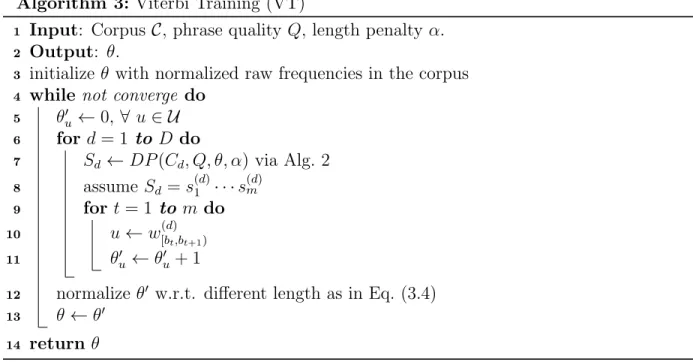
To learnθ, we employ an optimization strategy called Viterbi Training (VT) or Hard-EM in the literature [3]. Generally speaking, VT is an efficient and iterative way of parameter learning for probabilistic models with hidden variables. In our case, given corpus C, it searches for a segmentation that maximizesp(S,C|Q, θ, α) followed by coordinate ascent on parameters θ. Such a procedure is iterated until a stationary point has been reached. The corresponding algorithm is given in Alg. 3.
The hard E-step is performed by DP with θ fixed, and the M-step is based on the segmentation obtained from DP. Once the segmentationS is fixed, the closed-form solution of θu can be derived as:
θu = PD d=1 Pmd t=11s(td)=u PD d=1 Pmd t=11|s(td)|=|u| (3.4) where 1 denotes the identity indicator. We can see that θu is the rectified frequency of u
Algorithm 2: Dynamic Programming (DP)
1 Input: Word sequence C=w1w2. . . wn, phrase qualityQ, normalized frequency θ,
segment length penalty α.
2 Output: Optimal segmentation S. 3 h0 ←1, hi ←0 (0< i≤n)
4 denote ω as the maximum phrase length 5 for i= 1 to n do 6 for δ= 1 to ω do 7 if hi·p(bt+1 =bt+δ,dw[i+1,i+δ+1)c bt)> hi+δ then 8 hi+δ ←hi·p(bt+1 =bt+δ,dw[i+1,i+δ+1)c bt) 9 gi+δ ←i 10 i←n 11 m ←0 12 while i >0 do 13 m ←m+ 1 14 sm ←wgi+1wgi+2. . . wi 15 i←gi 16 return S ←smsm−1. . . s1
name θ normalized rectified frequency.
Note that Soft-EM (i.e., Bawm-Welch algorithm [12]) can also be applied to find a max-imum likelihood estimator ofθ. Nevertheless, VT is more suitable in our case because:
1. VT uses DP for the segmentation step, which is significantly faster than Bawm-Welch using forward-backward algorithm for the E-step;
2. Majority of the phrases get removed as their θ approaches 0 during iterations, which further speeds up our algorithm.
It has also been reported in [3] that VT converges faster and results in sparser and sim-pler models for Hidden Markov Model-like tasks. Meanwhile, VT is capable of correctly recovering most of the parameters.