Tractability through Exchangeability:
A New Perspective on Efficient Probabilistic Inference
Mathias Niepert
∗ Computer Science and EngineeringUniversity of Washington, Seattle [email protected]
Guy Van den Broeck
∗ Computer Science Department University of California, Los AngelesAbstract
Exchangeability is a central notion in statistics and probability theory. The assumption that an infinite se-quence of data points is exchangeable is at the core of Bayesian statistics. However,finiteexchangeability as a statistical property that renders probabilistic infer-ence tractable is less well-understood. We develop a the-ory of finite exchangeability and its relation to tractable probabilistic inference. The theory is complementary to that of independence and conditional independence. We show that tractable inference in probabilistic mod-els with high treewidth and millions of variables can be explained with the notion of finite (partial) exchange-ability. We also show that existing lifted inference al-gorithms implicitly utilize a combination of conditional independence and partial exchangeability.
1
Introduction
Probabilistic graphical models such as Bayesian and Markov networks explicitly represent conditional independencies of a probability distribution with their structure (Pearl 1988; Lauritzen 1996; Koller and Friedman 2009; Darwiche 2009). Their wide-spread use in research and industry can largely be attributed to this structural property and their declarative nature, separating representation and inference algorithms. Conditional independencies often lead to a more concise representation and facilitate efficient algorithms for parameter estimation and probabilistic inference. It is well-known, for instance, that probabilistic graphical models with a tree structure admit efficient inference. In addition to con-ditional independencies, modern inference algorithms ex-ploit contextual independencies (Boutilier et al. 1996) to speed up probabilistic inference.
The time complexity of classical probabilistic inference algorithms is exponential in the treewidth (Robertson and Seymour 1986) of the graphical model. Independence and its various manifestations often reduce treewidth and treewidth has been used in the literature as the decisive factor for as-sessing the tractability of probabilistic inference (cf. Koller and Friedman (2009), Darwiche (2009)). However, recent algorithmic developments have shown that inference in probabilistic graphical models can be highly tractable, even
∗
Both authors contributed equally to the paper. Guy Van den Broeck is also at KU Leuven, Belgium.
in high-treewidth models without any conditional indepen-dencies. For instance, lifted probabilistic inference algo-rithms (Poole 2003; Kersting 2012) often perform efficient inference in densely connected graphical models with mil-lions of random variables. With the success of lifted infer-ence, understanding these algorithms and their tractability on a more fundamental level has become a central challenge. The most pressing question concerns the underlying statisti-cal principle that allows inference to be tractable in the ab-sence of independence.
The present paper contributes to a deeper understanding of the statistical properties that render inference tractable. We consider an inference problem tractable when it is solved by an efficient algorithm, running in time polynomial in the number of random variables. The crucial contribution is a comprehensive theory that relates the notion of finite partial exchangeability(Diaconis and Freedman 1980a) to tractabil-ity. One instance is full exchangeability where the distribu-tion is invariant under variable permutadistribu-tions. We develop a theory of exchangeable decompositions that results in novel tractability conditions. Similar to conditional independence, partial exchangeability decomposes a probabilistic model so as to facilitate efficient inference. Most importantly, the no-tions of conditional independence and partial exchangeabil-ity are complementary, and when combined, define a much larger class of tractable models than the class of models ren-dered tractable by conditional independence alone.
Conditional and contextual independence are such pow-erful concepts because they arestatisticalproperties of the distribution, regardless of the representation used. Partial ex-changeability is such a statistical property that is indepen-dent of any representation, be it a joint probability table, a Bayesian network, or a statistical relational model. We intro-duce novel forms of exchangeability, discuss their sufficient statistics, and efficient inference algorithms. The resulting exchangeability framework allows us to state known liftabil-ity results as corollaries, providing a first statistical charac-terization of exact lifted inference. As an additional contri-bution, we connect the semantic notion of exchangeability tosyntacticnotions of tractability by showing that liftable statistical relational models have the required exchangeabil-ity properties due to their syntactic symmetries. We thereby unify notions of lifting from the exact and approximate in-ference community into a common framework.
2
A Case Study: Markov Logic
The analysis of exchangeability and tractable inference is developed in the context of arbitrary discrete probability dis-tributions, independent of a particular representational for-malism. Nevertheless, for the sake of accessibility, we will provide examples and intuitions for Markov logic, a well-known statistical relational language that exhibits several forms of exchangeability. Hence, after the derivation of the theoretical results in each section, we apply the theory to the problem of inference in Markov logic networks. This also allows us to link the theory to existing results from the lifted probabilistic inference literature.
Markov Logic Networks
We first introduce some standard concepts from function-free first-order logic. Anatom P(t1, . . . , tn)consists of a
predicateP/nof aritynfollowed bynargument termsti,
which are eitherconstants,{A,B, . . .}orlogical variables
{x,y, . . .}. A unary atom has one argument and a binary atomhas two. A formula combines atoms with connectives (e.g.,∧,⇔). A formula is groundif it contains no logical variables. The groundings of a formula are obtained by in-stantiating the variables with particular constants.
Many statistical relational languages have been proposed in recent years (Getoor and Taskar 2007; De Raedt et al. 2008). We will work with one such language, calledMarkov logic networks(MLN) (Richardson and Domingos 2006). An MLN is a set of tuples(w, f), wherewis a real number representing a weight andfis a formula in first-order logic. Let us, for example, consider the following MLN
1.3 Smokes(x)⇒Cancer(x) (1) 1.5 Smokes(x)∧Friends(x,y)⇒Smokes(y) (2) which states that smokers are more likely to (1) get cancer and (2) be friends with other smokers.
Given a domain of constantsD, a first-order MLN∆ in-duces agrounding, which is the MLN obtained by replacing each formula in∆ with all its groundings (using the same weight). Take for example the domain D = {A,B} (e.g., two people, Alice and Bob), the above first-order MLN rep-resents the following grounding.
1.3 Smokes(A)⇒Cancer(A) 1.3 Smokes(B)⇒Cancer(B)
1.5 Smokes(A)∧Friends(A,A)⇒Smokes(A) 1.5 Smokes(A)∧Friends(A,B)⇒Smokes(B) 1.5 Smokes(B)∧Friends(B,A)⇒Smokes(A) 1.5 Smokes(B)∧Friends(B,B)⇒Smokes(B) This ground MLN contains eight different random variables, which correspond to all groundings of atoms Smokes(x), Cancer(x)andFriends(x,y). This leads to a distribution over 28 possible worlds. The weight of each world is the
product of the expressionsexp(w), where(w, f)is a ground MLN formula andfis satisfied by the world. The probabil-ities of worlds are obtained by normalizing their weights. Without loss of generality (Jha et al. 2010), we assume that first-order formulas contain no constants.
Figure 1: An undirected graphical model with9finitely ex-changeable Bernoulli variables. There are no (conditional) independencies that hold among the variables.
Lifted Probabilistic Inference
The advent of statistical relational languages such as Markov logic has motivated a new class of lifted inference algo-rithms (Poole 2003). These algoalgo-rithms exploit the high-level structure and symmetries of the first-order logic formulas to speed up inference (Kersting 2012). Surprisingly, they per-form tractable inference even in the absence of conditional independencies. For example, when interpreting the above MLN as an (undirected) probabilistic graphical model, all pairs of random variables in{Smokes(A),Smokes(B), . . .}
are connected by an edge due to the groundings of For-mula 2. The model has no conditional or contextual indepen-dencies between theSmokesvariables. Nevertheless, lifted inference algorithms exactly compute its single marginal probabilities in time linear in the size of the corresponding graphical model (Van den Broeck et al. 2011), scaling up to millions of random variables.
As lifted inference research makes algorithmic progress, the quest for the source of tractability and its theoretical properties becomes increasingly important. For exact lifted inference, most theoretical results are based on the notion of domain-lifted inference (Van den Broeck 2011).
Definition 1(Domain-lifted). Domain-lifted inference algo-rithms run in time polynomial in|D|.
Note that domain-lifted algorithms can be exponential in other parameters, such as the number of formulas and pred-icates. Our current understanding of exact lifted inference is that syntactic properties of MLN formulas permit domain-lifted inference (Van den Broeck 2011; Jaeger and Van den Broeck 2012; Taghipour et al. 2013). We will review these results where relevant. Moreover, the (fractional) automor-phisms of the graphical model representation have been re-lated to lifted inference (Niepert 2012b; Bui, Huynh, and Riedel 2012; Noessner, Niepert, and Stuckenschmidt 2013; Mladenov and Kersting 2013). While there are deep connec-tions between automorphisms and exchangeability (Niepert 2012b; 2013; Bui, Huynh, and Riedel 2012; Bui, Huynh, and de Salvo Braz 2012), we refer these to future work.
3
Finite Exchangeability
This section provides some background on the concept of finite partial exchangeability. We proceed by showing that particular forms of finite exchangeability permit tractable inference. For the sake of simplicity and to provide links to statistical relational models such as MLNs, we present
the theory forfinitesets of (upper-case)binaryrandom vari-ablesX = {X1, . . . , Xn}. However, the theory applies to
all distributions over finite valued discrete random variables. Lower-casexdenote an assignments toX.
We begin with the most basic form of exchangeability. Definition 2(Full Exchangeability). A set of variablesX=
{X1, ..., Xn}isfully exchangeableif and only ifPr(X1 =
x1, . . . , Xn=xn) = Pr(X1=xπ(1), . . . , Xn=xπ(n))for
all permutationsπof{1, . . . , n}.
Full exchangeability is best understood in the context of a finite sequence of binary random variables such as a number of coin tosses. Here, exchangeability means that it is only the number of heads that matters and not their particular or-der. Figure 1 depicts an undirected graphical model with9 finitely exchangeable dependent Bernoulli variables.
Finite Partial Exchangeability
The assumption that all variables of a probabilistic model are exchangeable is often too strong. Fortunately, ability can be generalized to the concept of partial exchange-ability using the notion of asufficient statistic(Diaconis and Freedman 1980b; Lauritzen et al. 1984; Lauritzen 1988). Particular instances of exchangeability such as full finite ex-changeability correspond to particular statistics.
Definition 3 (Partial Exchangeability). Let Di be the
do-main ofXi, and letT be a finite set. A set of random
vari-ablesXispartially exchangeablewith respect to the statistic T :D1× · · · × Dn→ T if and only if
T(x) =T(x0)implies Pr(x) = Pr(x0).
The following theorem states that the joint distribution of a set of random variables that is partially exchangeable with a statisticT is a unique mixture of uniform distributions. Theorem 1 (Diaconis and Freedman (1980a)). Let T be a finite set and let T : {0,1}n → T be a statistic
of a partially exchangeable set X. Moreover, let St =
{x∈ D1× · · · × Dn|T(x) =t}, letUtbe the uniform
dis-tribution overSt, and letPr(St) = Pr(T(x) =t). Then,
Pr(X) =X
t∈T
Pr(St)Ut(X).
Hence, a distribution that is partially exchangeable with re-spect to a statisticT can be parameterized as a unique mix-ture of uniform distributions. We will see that several in-stances of partial exchangeability render probabilistic infer-ence tractable. Indeed, the major theme of the present paper can be summarized as finding methods for constructing the above representation and exploiting it for tractable proba-bilistic inference for a given probaproba-bilistic model.
Let[[·]]be the indicator function. The uniform distribution of each equivalence classStisUt(X) = [[T(X) =t]]/|St|;
and the probability ofStisPr(St) = Pr(x)|St|for every
x ∈ St. Hence, every value of the statistic T corresponds
to one equivalence classStof joint assignments with
identi-cal probability. We will refer to these equivalence classes as orbits. We writex ∼ ewhen assignmentsx andeagree on the values of their shared variables (Darwiche 2009).
The suborbit St,e ⊆ St for some evidence statee is the
set of those states inStthat are compatible withe, that is,
St,e ={x|T(x) =tandx∼e}.
Partial Exchangeability and Probabilistic Inference
We are now in the position to relate finite partial exchange-ability to tractable probabilistic inference, using notions from Theorem 1. The inference tasks we consider are – MPE inference, i.e., finding arg maxyPr(y,e) for anygiven assignmenteto variablesE⊆X, and
– marginal inference, i.e., computingPr(e)for any givene. For a set of variablesX, we say thatP(x)can be computed efficientlyiff it can be computed in time polynomial in|X|. We make the following complexity claims
Theorem 2. LetXbe partially exchangeable with statistic T. If we can efficiently
– for allx, evaluatePr(x), and
– for alleandt ∈ T decide whether there exists anx ∈
St,e, and if so, construct it,
then the complexity of MPE inferenceis polynomial in|T |. If we can additionally compute |St,e| efficiently, then the complexity of marginal inferenceis also polynomial in|T |. Proof. For MPE inference, we construct anxt ∈ St,e for each t ∈ T, and return the one maximizing Pr(xt). For
marginal inference, we returnP
t∈T Pr(xt)|St,e|.
If the above conditions for tractable inference are fulfilled we say that a distribution istractablypartially exchangeable for MPE or marginal inference. We will present notions of exchangeability and related statisticsT that make distribu-tions tractably partially exchangeable. Please note that The-orem 2 generalizes to situations in which we can only effi-ciently computePr(x)up to a constant factorZ, as is often the case in undirected probabilistic graphical models.
Markov Logic Case Study
Exchangeability and independence are not mutually exclu-sive. Independent and identically distributed (iid) random variables are also exchangeable. Take for example the MLN
1.5 Smokes(x)
The random variablesSmokes(A),Smokes(B), . . . are inde-pendent. Hence, we can compute their marginal probabilities independently as
Pr(Smokes(A)) = Pr(Smokes(B)) = exp(1.5) exp(1.5) + 1 The variables are also finitely exchangeable. For example, the probability that A smokes and B does not is equal to the probability thatBsmokes andAdoes not. The sufficient statisticT(x)countshow manypeople smoke in the statex
and the probability of a state in which nout ofN people smoke isexp(1.5n)/(exp(1.5) + 1)N.
Exchangeability can occur without independence, as in the following Markov logic network
This distribution has neither independencies nor condi-tional independencies. However, its variables are finitely ex-changeable and the probability of a statexis only a func-tion of the sufficient statistic T(x) counting the number of smokers inx. The probability of a state now increases by a factor ofexp(1.5)with every pair of smokers. When n people smoke there are n2 pairs and, hence, Pr(x) =
exp 1.5n2
/Z, where Z is a normalization constant. Let
Yconsist of allSmokes(x)variables except forSmokes(A), and letybe an assignment toYin whichmpeople smoke. The probability thatAsmokes givenyis
Pr (Smokes(A)|y) = exp 1.5(m+ 1)
2
exp (1.5(m+ 1)2) + exp (1.5m2),
which clearly depends on the number of smokers in y. Hence,Smokes(A)is not independent ofYbut the random variables are exchangeable with sufficient statisticn. Fig-ure 1 depicts the graphical representation of the correspond-ing ground Markov logic network.
4
Exchangeable Decompositions
We now present novel instances of partial exchangeabil-ity that render probabilistic inference tractable. These in-stances generalize exchangeability of single variables to ex-changeability of sets of variables. We describe the notion of an exchangeable decomposition and prove that it fulfills the tractability requirements of Theorem 2. We proceed by demonstrating that these forms commonly occur in MLNs.Variable Decompositions
The notions of independent and exchangeable decomposi-tions are at the core of the developed theoretical results. Definition 4(Variable Decomposition). Avariable decom-positionX = {X1, . . . ,Xk}partitionsXinto subsetsXi.
We callw= maxi|Xi|thewidthof the decomposition.
Definition 5(Independent Decomposition). A variable de-composition isindependentif and only ifPrfactorizes as
Pr (X) =
k
Y
i=1
Qi(Xi).
Definition 6(Exchangeable Decomposition). A variable de-composition isexchangeableiff for all permutationsπ,
Pr (X1=x1, . . . ,Xk=xk)
= Pr X1=xπ(1), . . . ,Xk=xπ(k)
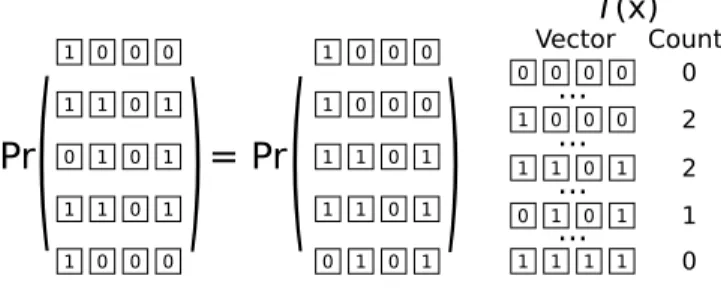
. Figure 2 depicts an example distributionPrwith20 ran-dom variables and a decomposition into5subsets of width4. The joint distribution is invariant under permutations of the 5sequences. The corresponding sufficient statisticT counts the number of occurrences of each binary vector of length4 and returns a tuple of counts.
Please note that the definition of full finite exchangeabil-ity (Definition 2) is the special case when the exchangeable decomposition has width1. Also note that the size of all sub-sets in an exchangeable decomposition equal the width.
1 0 0 0 1 1 0 1 0 1 0 1 1 1 0 1 1 0 0 0
Pr = Pr
1 0 0 0 1 0 0 0 1 1 0 1 1 1 0 1 0 1 0 1 0 0...
0 0 0 1 0...
0 0 2 1 1...
0 1 2 0 1...
0 1 1 1 1 1 1 0T
(x)
(
)
( )
Vector CountFigure 2: An exchangeable decomposition of20binary ran-dom variables (the boxes) into5components of width4(the rows). The statisticTcounts the occurrences of each unique binary vector.
Tractable Variable Decompositions
The core observation of the present work is that variable de-compositions that are exchangeable and/or independent re-sult in tractable probabilistic models. For independent de-compositions, the following tractability guarantee is used in most existing inference algorithms.
Proposition 3. Given an independent decomposition ofX
with bounded width, and a corresponding factorized repre-sentation of the distribution (cf. Definition 5), the complexity of MPE and marginal inference is polynomial in|X|.
While the decomposition into independent components is a well-understood concept, the combination with finite ex-changeability has not been previously investigated as a sta-tistical property that facilitates tractable probabilistic infer-ence. We can now prove the following result.
Theorem 4. Suppose we can computePr(x)in time polyno-mial in|X|. Then, given an exchangeable decomposition of
Xwith bounded width, the complexity of MPE and marginal inference is polynomial in|X|.
Proof. Following Theorem 2, we have to show that there exists a statisticTso that (a)|T |is polynomial in|X|; (b) we can efficiently decide whether anx∈ St,eexists and if so, construct it; and (c) efficiently compute|St,e|for alleand t ∈ T. Statements (b) and (c) ensure that the assumptions of Theorem 2 hold for exchangeable decompositions, which combined with (a) proves the theorem.
To prove (a), let us first construct a sufficient statistic for exchangeable decompositions. A full joint assignmentX=
x decomposes into assignmentsX1 = x1, . . . ,Xk = xk
in accordance with the given variable decomposition. Each
x` is a bit stringb ∈ {0,1}w. Consider a statisticT(x) =
(c1, . . . , c2w), where eachcihas a corresponding unique bit
stringbi∈ {0,1}wandci =P k
`=1[[x`=bi]]. The valueci
of the statistic thus represents the number of components in the decomposition that are assigned bit stringbi. Hence, we
haveP2w
i=1ci=k, and we prove (a) by observing that
|T |= k+ 2w−1 2w−1 ≤k2w−1≤n2w−1.
To prove statements (b) and (c) we have to find, for each partial assignment E = e, an algorithm that generates an
x ∈ St,e and that computes |St,e| in time polynomial in
|X|. To hint at the proof strategy, we give the formula for the orbit without evidence|St|:
S(c1,...,c2w) = k c1 k−c 1 c2 . . . k−P2w−2 i=1 ci c2w−1 . The proof is very technical and deferred to the appendix.
Markov Logic Case Study
Let us consider the following MLN1.3 Smokes(x)⇒Cancer(x) 1.5 Smokes(x)∧Smokes(y)
It models a distribution in which every non-smoker or smoker with cancer, that is, everyxsatisfying the first for-mula, increases the probability by a factor ofexp(1.3). Each pair of smokers increases the probability by a factor of exp(1.5). This model is not fully exchangeable: swapping Smokes(A)andCancer(A)in a state yields a different prob-ability. There are no (conditional) independencies between theSmokes(x)atoms.
The variables in this MLN do have an exchangeable de-composition whose width is two, namely
X ={{Smokes(A),Cancer(A)},
{Smokes(B),Cancer(B)},
{Smokes(C),Cancer(C)}, . . .}.
The sufficient statistic of this decomposition counts the num-ber of people in each of four groups, depending on whether they smoke, and whether they have cancer. The probabil-ity of a state only depends on the number of people in each group and swapping people between groups does not change the probability of a state. For example,
Pr(Smokes(A) = 0,Cancer(A) = 1,
Smokes(B) = 1,Cancer(B) = 0) = Pr(Smokes(A) = 1,Cancer(A) = 0,
Smokes(B) = 0,Cancer(B) = 1). Theorem 4 says that this MLN permits tractable inference.
The fact that this MLN has an exchangeable decomposi-tion is not a coincidence. In general, we can show this for MLNs of unary atoms, which are calledmonadicMLNs. Theorem 5. The variables in a monadic MLN have an ex-changeable decomposition. The width of this decomposition is equal to the number of predicates.
The proof builds on syntactic symmetries of the MLN, called renaming automorphisms (Bui, Huynh, and Riedel 2012; Niepert 2012a). Please see the appendix for further details.
It now follows as a corollary of Theorems 4 and 5 that MPE and marginal inference in monadic MLNs is polyno-mial in|X|, and therefore also in the domain size|D|. Corollary 6. Inference in monadic MLNs is domain-lifted.
5
Marginal and Conditional Exchangeability
Many distributions are not decomposable into independent or exchangeable decompositions. Similar to conditional in-dependence, the notion of exchangeability can be extended to conditional exchangeability. We generalize exchangeabil-ity to conditional distributions, and state the corresponding tractability guarantees.Marginal and Conditional Decomposition
Tractability results for exchangeable decompositions on all variables under consideration also extend to subsets. Definition 7(Marginal Exchangeability). When a subsetY
of the variables under consideration has an exchangeable de-compositionY, we say thatYismarginally exchangeable. This means that Y is still an exchangeable decomposition when considering the distributionPr(Y) =P
X\YPr(X). Theorem 7. Suppose we are given a marginally exchange-able decomposition ofY with bounded width and letZ=
X\Y. If computingPr(y) = P
zPr(y,z)is polynomial in|X|for ally, then the complexity of MPE and marginal inference over variablesYis polynomial in|X|.
Proof. LetT be the statistic associated with the given de-composition, and letebe evidence given onE⊆Y. Then,
P(e) =X t∈T |St,e| · X z Pr(yt,e,z), where yt,e ∈St,e.
By the assumption thatYis marginally exchangeable and the proof of Theorem 4, we can compute |St,e| and an yt,e ∈ St,e in time polynomial in |X|. An analogous ar-gument holds for MPE inference onPr(Y).
We now need to identify distributionsPr(Y,Z)for which we can compute Pr(y) efficiently. This implies tractable probabilistic inference over Y. Given a particular y, we have already seen sufficient conditions: whenZdecomposes exchangeably or independently conditioned ony, Proposi-tion 3 and Theorem 4 guarantee that computing Pr(y) is tractable. This suggests the following general notion. Definition 8(Conditional Decomposability). LetXbe a set of variables with Y ⊆ XandZ = X\Y. We say that
Zisexchangeably (independently) decomposable givenY
if and only if for each assignment ytoY, there exists an exchangeable (independent) decompositionZyofZ. Furthermore, we say thatZis decomposable withbounded widthiff the widthwof eachZyis bounded. When the de-composition can be computed in time polynomial in|X|for ally, we say thatZisefficiently decomposable.
Theorem 8. LetXbe a set of variables withY ⊆Xand
Z=X\Y. Suppose we are given a marginally exchange-able decomposition ofYwith bounded width. Suppose fur-ther thatZis efficiently (exchangeably or independently) de-composable givenYwith bounded width. If we can compute Pr(x)efficiently, then the complexity of MPE and marginal inference over variablesYis polynomial in|X|.
Proof. Following Theorem 7, we only need to show that we can computePr(y) = P
zPr(y,z)in time polynomial in
|X|for ally. WhenZis exchangeably decomposable given
Y, this follows from constructingZyand employing the ar-guments made in the proof of Theorem 4. The case whenZ
is independently decomposable is analogous.
Theorems 7 and 8 are powerful results and allow us to identify numerous probabilistic models for which inference is tractable. For instance, we will prove liftability results for Markov logic networks. However, we are only at the begin-ning of leveraging these tractability results to their fullest extent. Especially Theorem 7 is widely applicable because the computation ofP
zPr(y,z)can be tractable for many reasons. For instance, conditioned on the variablesY, the distributionsPr(y,Z)could be bounded treewidth graphical models, such as tree-structured Markov networks. Tractabil-ity forPr(Y)follows immediately from Theorem 7.
Since Theorem 7 only speaks to the tractability of query-ing variables in Y, there is the question of when we can also efficiently query the variablesZ. Results from the lifted inference literature may provide a solution by bounding or approximating queries and evidence that includesZto main-tain marginal exchangeability (Van den Broeck and Dar-wiche 2013). The next section shows that certain restricted situations permit tractable inference on the variables inZ.
Markov Logic Case Study
Let us again consider the MLN1.3 Smokes(x)⇒Cancer(x)
1.5 Smokes(x)∧Friends(x,y)⇒Smokes(y) having the marginally exchangeable decomposition
Y={{Smokes(A)},{Smokes(B)},{Smokes(C)}, . . .}
whose width is one. To intuitively see why this decomposi-tion is marginally exchangeable, let us consider two states
y and y0 of the Smokes(x) atoms in which only the val-ues of two atoms, for exampleSmokes(A)andSmokes(B), are swapped. There is a symmetry of the MLNs joint dis-tribution that swaps these atoms: the renaming automor-phism (Bui, Huynh, and Riedel 2012; Niepert 2012a) that swaps constants A and B in all atoms. For marginal ex-changeability, we need thatP
zPr(y,z) =
P
zPr(y 0,z). But this holds since the renaming automorphism is an auto-morphism of the set of states{yz|z∈ DZ}– for everyy, y0, andzthere exists an automorphism that mapsyztoy0z0 withPr(y,z) = Pr(y0,z0).
The given MLN has several marginally exchangeable de-compositions, with the most general one being
Y={{Smokes(A),Cancer(A),Friends(A,A)},
{Smokes(B),Cancer(B),Friends(B,B)},
{Smokes(C),Cancer(C),Friends(C,C)}, . . .}. For that decomposition, the remainingZvariables
{Friends(A,B),Friends(B,A),Friends(A,C), . . .}
are independently decomposable givenY. TheZvariables appear at most once in any formula. In a probabilistic graphi-cal model representation, evidence on theYvariables would therefore decompose the graph into independent compo-nents. Thus, it follows from Theorem 8 that we can effi-ciently answer any query over the variables inY.
This insight generalizes to a large class of MLNs, called the two-variable fragment. It consists of all MLNs whose formulas contain at most two logical variables.
Theorem 9. In a two-variable fragment MLN, letYandZ
be the ground atoms with one and two distinct arguments respectively. Then there exists a marginally exchangeable decomposition ofY, andZis efficiently independently de-composable givenY. Each decomposition’s width is at most twice the number of predicates.
The proof of Theorem 9 is rather technical and we re-fer the reader to the appendix for a detailed proof. It now follows from Theorems 8 and 9 that the complexity of in-ference over the unary atoms in the two-variable fragment is polynomial in the domain size|D|.
What happens if our query involves variables from Z– the binary atoms? It is known in the lifted inference liter-ature that we cannot expect efficient inference of general queries that involve the binary atoms. Assignments to the
Zvariables break symmetries and therefore break marginal exchangeability. This causes inference to become #P-hard as a function of the query (Van den Broeck and Davis 2012). Nevertheless, if we bound the number of binary atoms in-volved in the query, we can use the developed theory to show a general liftability result.
Theorem 10. For any MLN in the two-variable fragment, MPE and marginal inference over the unary atoms and a bounded number of binary atoms is domain-lifted.
This corresponds to one of the strongest known theoretical results in the lifted inference literature (Jaeger and Van den Broeck 2012). We refer the interested reader to the appendix for the proof. A consequence of Theorem 10 is that we can efficiently computeall single marginalsin the two-variable fragment, given arbitrary evidence on the unary atoms.
6
Discussion and Conclusion
We conjecture that the concept of (partial) exchangeabil-ity has potential to contribute to a deeper understanding of tractable probabilistic models. The important role con-ditional independence plays in the research field of graphi-cal models is evidence for this hypothesis. Similar to condi-tional independence, it might be possible to develop a the-ory of exchangeability that mirrors that of independence. For instance, there might be a (graphical) structural repre-sentations of particular types of partial exchangeability and corresponding logical axiomatizations (Pearl 1988). More-over, it would be interesting to develop graphical models with exchangeability and independence, and notions like d-separation to detect marginal exchangeability and condi-tional decomposability from a structural representation. The first author has taken steps in this direction by introducing exchangeable variable models, a class of (non-relational)
probabilistic models based on finite partial exchangeabil-ity (Niepert and Domingos 2014).
Recently, there has been considerable interest in comput-ing and exploitcomput-ing the automorphisms of graphical mod-els (Niepert 2012b; Bui, Huynh, and Riedel 2012). There are several interesting connections between automorphisms, exchangeability, and lifted inference (Niepert 2012a). More-over, there are several group theoretical algorithms that one could apply to the automorphism groups to discover the structure of exchangeable variable decompositions from the structure of the graphical models. Since we presently only exploit renaming automorphisms, there is a potential for tractable inference in MLNs that goes beyond what is known in the lifted inference literature.
Partial exchangeability is related to collective graphi-cal models (Sheldon and Dietterich 2011) (CGMs) and cardinality-based potentials (Gupta, Diwan, and Sarawagi 2007) as these models also operate on sufficient statistics. However, probabilistic inference for CGMs is not tractable and there are no theoretical results that identify tractable CGMs models. The presented work may help to identify such situations. The presented theory generalizes the statis-tics of cardinality-based potentials.
Lifted Inference and Exchangeability Our case stud-ies identified a deep connection between lifted probabilis-tic inference and the concepts of partial, marginal and conditional exchangeability. In this new context, it ap-pears that exact lifted inference algorithms (de Salvo Braz, Amir, and Roth 2005; Milch et al. 2008; Jha et al. 2010; Van den Broeck et al. 2011; Gogate and Domingos 2011; Taghipour et al. 2012) can all be understood as perform-ing essentially three steps: (i) construct a sufficient statis-tic T(x), (ii) generate all possible values of the sufficient statistic, and (iii) count suborbit sizes for a given statistic. For an example of (i), we can show that a compiled first-order circuit (Van den Broeck et al. 2011) or the trace of probabilistic theorem proving (Gogate and Domingos 2011) encode a sufficient statistic in their existential quantifier and splitting nodes. Steps (ii) and (iii) are manifested in all these algorithms through summations and binomial coefficients.
Between Corollary 6 and Theorem 10, we have re-proven almost the entire range of liftability results from the lifted in-ference literature (Jaeger and Van den Broeck 2012) within the exchangeability framework, and extended these to MPE inference. There is an essential difference though: liftabil-ity results make assumptions about the syntax (e.g., MLNs), whereas our exchangeability theorems apply to all distribu-tions. We expect Theorem 8 to be used to show liftability, and more general tractability results for many other repre-sentation languages, including but not limited to the large number of statistical relational languages that have been pro-posed (Getoor and Taskar 2007; De Raedt et al. 2008).
Acknowledgments
This work was partially supported by ONR grants #N00014-12-1-0423, #N00014-13-1-0720, and #N00014-12-1-0312; NSF grants #IIS-1118122 and #IIS-0916161; ARO grant #W911NF-08-1-0242; AFRL contract #FA8750-13-2-0019;
the Research Foundation-Flanders (FWO-Vlaanderen); and a Google research award to MN.
A
Continued Proof of Theorem 4
Proof. To prove statements (b) and (c), we need to repre-sent partial assignments E = e withE ⊆ X. The par-tial assignments decompose into parpar-tial assignmentsE1 =e1, . . . ,Ek = ek in accordance with X. Each e`
corre-sponds to a string m ∈ {0,1,∗}w where characters0and
1 encode assignments to variables inE` and∗ encodes an
unassigned variable inX`−E`. In this case, we say thate`
is of typem. Please note that there are2wdistinctband3w
distinctm. We say thatxagrees withe, denoted byx∼e, if and only if their shared variables have identical assignments. Acompletioncof etoxis a bijectionc:{e1, ...,ek} →
{x1, ...,xk}such thatc(ei) = xj impliesei ∼ xj. Every
completion corresponds to a unique way to assign elements in{0,1}to unassigned variables so as to turn the partial as-signmenteinto the full assignmentx.
Lett = (c1, ..., c2w)∈ T, letE ⊆ X, and lete∈ DE.
Moreover, let dj = P k
`=1[[e` = mj]] for each mj ∈
{0,1,∗}w. Consider the set of matrices
At,e= n A∈M(2w,3w) X i ai,j=dj, X j ai,j=ci andai,j= 0ifbi6∼mj o . EveryA∈ At,erepresents a set of completions frometox for whichT(x) =t. The valueai,jindicates that each
com-pletion represented byAmapsai,jelements in{e1, ...,ek}
of type mj toai,j elements in{x1, ...,xk} of typebi. We
writeγ(A)for the set of completions represented byA. We have to prove the following statements
1. For everyA ∈ At,e and everyc ∈ γ(A)there exists an x∈ DXwithT(x) =tandcis a completion ofetox; 2. For everyx∈ DXwithT(x) =tand every completion
cofetoxthere exists anA∈ At,esuch thatc∈γ(A); 3. For allA, A0 ∈ At,e withA 6=A0we have thatγ(A)∩
γ(A0) =∅;
4. For everyA ∈ At,e, we can efficiently compute|γ(A)|, the size of the set of completions represented byA. To prove statement (1), letA ∈ At,eandc ∈ γ(A). By the definition ofAt,e,cmapsai,jelements in {e1, ...,ek}
of type mj toai,j elements in{x1, ...,xk}of type bi. By
the conditionsP
iai,j=djandPjai,j =ciof the
defini-tion ofAt,e we have thatcis a bijection. By the condition ai,j = 0ifbi 6∼mj of the definition ofAt,e we have that c(ei) =xjimpliesei ∼xjand, therefore,e∼x. Hence,
c is a completion. Moreover, c completeseto an xwith Pk
`=1[[x` =bi]] =Pjai,j =ciby the definition ofAt,e. Hence,T(x) =t.
To prove statement (2), letx ∈ DX withT(x) = tand let c be a completion of eto x. We construct anA with c ∈γ(A)as follows. Sincecis a completion we have that c(ei) = xj impliesei ∼ xj and, hence, we set ai,j = 0
c(ej) =xi}|. Sincecis surjective, we have thatPjai,j=
ciand sincecis injective, we have thatPiai,j=dj. Hence,
A∈ At,e.
To prove statement (3), letA, A0 ∈ At,e withA 6= A0. SinceA6=A0we have that there existi, jsuch that, without loss of generality,ai,j < a0i,j. Hence, everyc ∈ Amaps
fewer elements of typemjto elements of typebithan every
c0∈A0. Hence,c6=c0for everyc∈Aand everyc0 ∈A0. To prove statement (4), letA∈ At,e. Everyc∈Amaps ai,jelements in{e1, ...,ek}of typemj toai,j elements in
{x1, ...,xk}of typebi. Hence, the size of the set of
comple-tions represented byAis, for each1≤j≤3w, the number of different ways to placeai,jballs of colori,1 ≤i≤2w,
intodjurns. Hence,
|γ(A)|= 3w Y j=1 2w Y i=1 d j−P i−1 q=1ai,q ai,j .
From the statements (1)-(4) we can conclude that
|St,e|=
X
A∈At,e
|γ(A)|.
This allows us to prove (b) and (c). We can constructAt,e in time polynomial innas follows. There are2w3wentries
in a2w×3w matrix and each entry has at most k
differ-ent values. Hence, we can enumerate allk6w ≤n6w
possi-ble matricesA∈M(2w,3w). We simply select thoseAfor
which the conditions in the definition ofAt,ehold. For one A∈ At,ewe can efficiently construct onecand thexthat it completeseto. This proves (b). Finally, we compute|St,e|. This proves (c).
B
Proof of Theorem 5
Proof. LetP1, ..., PN be theN unary predicates of a given
MLN and letD ={1, ..., k}be the domain. After ground-ing, there arekground atoms per predicate. We writePj(i)
to denote the ground atom that resulted from instantiating predicatePjwith domain elementi. LetX ={X1, ...,Xk}
be a decomposition of the set of ground atoms withXi =
{P1(i), P2(i), ..., PN(i)} for every1 ≤ i ≤ k. A
renam-ing automorphism (Bui, Huynh, and Riedel 2012; Niepert 2012a) is a permutation of the ground atoms that results from a permutation of the domain elements. The joint distri-bution over all ground atoms remains invariant under these permutations. Consider the permutation of ground atoms that results from swapping two domain elements i ↔ i0. This permutation acting on the set of ground atoms permutes the componentsXiandXi0and leaves all other components
invariant. Since this is possible for each pairi, i0∈ {1, ..., k}
it follows that the decompositionX is exchangeable.
C
Proof of Theorem 9
Proof. Let P1, ..., PM be the M unary predicates and let
Q1, ..., QN be theNbinary predicates of a given MLN and
let D = {1, ..., k} be the domain. After grounding, there arekground atoms per unary andk2ground atoms per
bi-nary predicate. We write P`(i)to denote the ground atom
that resulted from instantiating unary predicateP`with
do-main elementiandQ`(i, j)to denote the ground atom that
resulted from instantiating binary predicateQ`with domain
elementsiandj.
LetXbe the set of all ground atoms, letY = {P`(i) |
1 ≤i≤k,1≤`≤M} ∪ {Q`(i, i)|1≤i≤k,1 ≤`≤
N}and letZ=X−Y. Moreover, letY ={Y1, ...,Yk}
withYi ={P`(i) | 1 ≤ ` ≤ M} ∪ {Q`(i, i) | 1 ≤ ` ≤
N}. We can make the same arguments as in the proof of Theorem 5 to show thatYis exchangeable.
Now, we prove that the variables Z are inde-pendently decomposable given Y. Let Zi,j =
{Q1(i, j), ..., QN(i, j), Q1(j, i), ..., QN(j, i)} for all
1 ≤ i < j ≤ k. Now, let f be any ground formula and let Gbe the set of ground atoms occurring in bothf and
Z. Then, either G ⊆ Zi,j or G∩Zi,j = ∅ since every
formula in the MLN has at most two variables. Hence,
{Zi,j | 1 ≤i < j ≤k}is a decomposition ofZwith k2
components, width2N, andPr(Z,y)factorizes as
Pr(Z,y) =Y
i,j i<j
Qi,j(Zi,j,y).
By the properties of MLNs, we have that theQi,j(Zi,j,y)
are computable in time exponential in the width of the de-composition but polynomial ink.
D
Proof of Theorem 10
Proof. Suppose that the queryecontains a bounded num-ber of binary atoms whose arguments are constants from the setK. Consider the set of variablesQconsisting of all unary atoms whose argument comes fromK, and all binary atoms whose arguments both come from K. The unary atoms in
Qare no long marginally exchangeable, because their argu-ments can appear asymmetrically ine. We can now answer the query by simply enumerating all statesqofQand per-forming inference in eachPr(Y,Z,q)separately, were all variables Y have again become marginally exchangeable, and all variablesZhave become independently decompos-able given Y. The construction of Y and Zis similar to the proof of Theorem 9, except that some additional binary atoms are now inYinstead ofZ. These atoms have one ar-gument inK, and one not inK, and are treated as unary. When we bound the number of binary atoms in the query, the size ofQwill not be a function of the domain size, and enumerating over all statesqis domain-lifted.
References
Boutilier, C.; Friedman, N.; Goldszmidt, M.; and Koller, D. 1996. Context-specific independence in Bayesian networks. InProceedings of the 12th Conference on Uncertainty in ar-tificial intelligence (UAI), 115–123.
Bui, H.; Huynh, T.; and de Salvo Braz, R. 2012. Exact lifted inference with distinct soft evidence on every object. InProceedings of the 26th Conference on Artificial Intelli-gence (AAAI).
Bui, H.; Huynh, T.; and Riedel, S. 2012. Automorphism groups of graphical models and lifted variational inference.
Darwiche, A. 2009.Modeling and reasoning with Bayesian networks. Cambridge University Press.
De Raedt, L.; Frasconi, P.; Kersting, K.; and Muggleton, S., eds. 2008. Probabilistic inductive logic programming: the-ory and applications. Berlin, Heidelberg: Springer-Verlag. de Salvo Braz, R.; Amir, E.; and Roth, D. 2005. Lifted first-order probabilistic inference. InProceedings of the Inter-national Joint Conference on Artificial Intelligence (IJCAI), 1319–1325.
Diaconis, P., and Freedman, D. 1980a. De Finetti’s gener-alizations of exchangeability. InStudies in Inductive Logic and Probability, volume II.
Diaconis, P., and Freedman, D. 1980b. Finite exchangeable sequences. The Annals of Probability8(4):745–764. Getoor, L., and Taskar, B. 2007. Introduction to Statistical Relational Learning. The MIT Press.
Gogate, V., and Domingos, P. 2011. Probabilistic theorem proving. InProceedings of the 27th Conference on Uncer-tainty in Artificial Intelligence (UAI), 256–265.
Gupta, R.; Diwan, A. A.; and Sarawagi, S. 2007. Efficient inference with cardinality-based clique potentials. In Pro-ceedings of the 24th International Conference on Machine Learning (ICML), 329–336.
Jaeger, M., and Van den Broeck, G. 2012. Liftability of probabilistic inference: Upper and lower bounds. In Pro-ceedings of the 2nd International Workshop on Statistical Relational AI.
Jha, A.; Gogate, V.; Meliou, A.; and Suciu, D. 2010. Lifted inference seen from the other side: The tractable features. In Proceedings of the 24th Conference on Neural Information Processing Systems (NIPS).
Kersting, K. 2012. Lifted probabilistic inference. In Pro-ceedings of European Conference on Artificial Intelligence (ECAI).
Koller, D., and Friedman, N. 2009.Probabilistic Graphical Models. The MIT Press.
Lauritzen, S. L.; Barndorff-Nielsen, O. E.; Dawid, A. P.; Di-aconis, P.; and Johansen, S. 1984. Extreme point models in statistics. Scandinavian Journal of Statistics11(2).
Lauritzen, S. L. 1988.Extremal families and systems of suf-ficient statistics. Lecture notes in statistics. Springer-Verlag. Lauritzen, S. L. 1996.Graphical Models. Oxford University Press.
Milch, B.; Zettlemoyer, L.; Kersting, K.; Haimes, M.; and Kaelbling, L. 2008. Lifted probabilistic inference with counting formulas. Proceedings of the 23rd AAAI Confer-ence on Artificial IntelligConfer-ence1062–1068.
Mladenov, M., and Kersting, K. 2013. Lifted inference via k-locality. InProceedings of the 3rd International Workshop on Statistical Relational AI.
Niepert, M., and Domingos, P. 2014. Exchangeable variable models. InProceedings of the International Conference on Machine Learning (ICML).
Niepert, M. 2012a. Lifted probabilistic inference: An MCMC perspective. InProceedings of StaRAI.
Niepert, M. 2012b. Markov chains on orbits of permutation groups. InProceedings of the 28th Conference on Uncer-tainty in Artificial Intelligence (UAI).
Niepert, M. 2013. Symmetry-aware marginal density esti-mation. InProceedings of the 27th Conference on Artificial Intelligence (AAAI).
Noessner, J.; Niepert, M.; and Stuckenschmidt, H. 2013. RockIt: Exploiting Parallelism and Symmetry for MAP In-ference in Statistical Relational Models. InProceedings of the 27th Conference on Artificial Intelligence (AAAI). Pearl, J. 1988. Probabilistic reasoning in intelligent sys-tems: networks of plausible inference. Morgan Kaufmann. Poole, D. 2003. First-order probabilistic inference. In Pro-ceedings of the International Joint Conference on Artificial Intelligence (IJCAI), 985–991.
Richardson, M., and Domingos, P. 2006. Markov logic net-works. Machine learning62(1-2):107–136.
Robertson, N., and Seymour, P. 1986. Graph minors. II. Algorithmic aspects of tree-width. Journal of algorithms 7(3):309–322.
Sheldon, D., and Dietterich, T. 2011. Collective graphical models. InAdvances in Neural Information Processing Sys-tems (NIPS). 1161–1169.
Taghipour, N.; Fierens, D.; Davis, J.; and Blockeel, H. 2012. Lifted variable elimination with arbitrary constraints. In Proceedings of the fifteenth international conference on Ar-tificial Intelligence and Statistics, volume 22, 1194–1202. Taghipour, N.; Fierens, D.; Van den Broeck, G.; Davis, J.; and Blockeel, H. 2013. Completeness results for lifted vari-able elimination. InProceedings of the 16th Conference on Artificial Intelligence and Statistics, 572–580.
Van den Broeck, G., and Darwiche, A. 2013. On the com-plexity and approximation of binary evidence in lifted infer-ence. InAdvances in Neural Information Processing Sys-tems 26 (NIPS).
Van den Broeck, G., and Davis, J. 2012. Conditioning in first-order knowledge compilation and lifted probabilistic inference. InProceedings of the 26th Conference on Artifi-cial Intelligence (AAAI).
Van den Broeck, G.; Taghipour, N.; Meert, W.; Davis, J.; and De Raedt, L. 2011. Lifted probabilistic inference by first-order knowledge compilation. InProceedings of the 22nd International Joint Conference on Artificial Intelligence (IJ-CAI), 2178–2185.
Van den Broeck, G. 2011. On the completeness of first-order knowledge compilation for lifted probabilistic infer-ence. InAdvances in Neural Information Processing Sys-tems 24 (NIPS),, 1386–1394.