Visual Prediction of Rover Slip: Learning
Algorithms and Field Experiments
Thesis by
Anelia Angelova
In Partial Fulfillment of the Requirements for the Degree of
Doctor of Philosophy
California Institute of Technology Pasadena, California
2008
Public reporting burden for the collection of information is estimated to average 1 hour per response, including the time for reviewing instructions, searching existing data sources, gathering and maintaining the data needed, and completing and reviewing the collection of information. Send comments regarding this burden estimate or any other aspect of this collection of information, including suggestions for reducing this burden, to Washington Headquarters Services, Directorate for Information Operations and Reports, 1215 Jefferson Davis Highway, Suite 1204, Arlington VA 22202-4302. Respondents should be aware that notwithstanding any other provision of law, no person shall be subject to a penalty for failing to comply with a collection of information if it does not display a currently valid OMB control number.
1. REPORT DATE
2008 2. REPORT TYPE
3. DATES COVERED
00-00-2008 to 00-00-2008
4. TITLE AND SUBTITLE
Visual Prediction of Rover Slip: Learning Algorithms and Field Experiments
5a. CONTRACT NUMBER 5b. GRANT NUMBER
5c. PROGRAM ELEMENT NUMBER
6. AUTHOR(S) 5d. PROJECT NUMBER
5e. TASK NUMBER 5f. WORK UNIT NUMBER 7. PERFORMING ORGANIZATION NAME(S) AND ADDRESS(ES)
California Institute of Technology,Pasadena,CA,91125
8. PERFORMING ORGANIZATION REPORT NUMBER
9. SPONSORING/MONITORING AGENCY NAME(S) AND ADDRESS(ES) 10. SPONSOR/MONITOR’S ACRONYM(S) 11. SPONSOR/MONITOR’S REPORT NUMBER(S)
12. DISTRIBUTION/AVAILABILITY STATEMENT
Approved for public release; distribution unlimited
13. SUPPLEMENTARY NOTES 14. ABSTRACT
Perception of the surrounding environment is an essential tool for intelligent navigation in any autonomous vehicle. In the context of Mars exploration, there is a strong motivation to enhance the perception of the rovers beyond geometry-based obstacle avoidance, so as to be able to predict potential interactions with the terrain. In this thesis we propose to remotely predict the amount of slip, which re?ects the mobility of the vehicle on future terrain. The method is based on learning from experience and uses visual information from stereo imagery as input. We test the algorithm on several robot platforms and in di?erent terrains. We also demonstrate its usefulness in an integrated system, onboard a Mars prototype rover in the JPL Mars Yard. Another desirable capability for an autonomous robot is to be able to learn about its
interactions with the environment in a fully automatic fashion. We propose an algorithm which uses the robot’s sensors as supervision for vision-based learning of di?erent terrain types. This algorithm can work with noisy and ambiguous signals provided from onboard sensors. To be able to cope with rich,
high-dimensional visual representations we propose a novel, nonlinear dimensionality reduction technique which exploits automatic supervision. The method is the ?rst to consider supervised nonlinear
dimensionality reduction in a probabilistic framework using supervision which can be noisy or ambiguous. Finally, we consider the problem of learning to recognize di?erent terrains, which addresses the time constraints of an onboard autonomous system. We propose a method which automatically learns a
variable-length feature representation depending on the complexity of the classi?cation task. The proposed approach achieves a good trade-o? between decrease in computational time and recognition performance.
15. SUBJECT TERMS
16. SECURITY CLASSIFICATION OF: 17. LIMITATION OF ABSTRACT Same as Report (SAR) 18. NUMBER OF PAGES 196 19a. NAME OF RESPONSIBLE PERSON a. REPORT unclassified b. ABSTRACT unclassified c. THIS PAGE unclassified
Standard Form 298 (Rev. 8-98)
c
° 2008
Anelia Angelova All Rights Reserved
iii
Acknowledgements
First and foremost I would like to thank my advisers Dr. Larry Matthies and Professor Pietro Perona. I cannot thank Larry enough for making this whole work possible, for giving me the opportunity, and for providing invaluable advice, guidance, and support. Larry has put enormous efforts into helping me improve every aspect of the thesis, for which I am very grateful. I thank Pietro for his advice throughout the years and for teaching me so many things about both research and life. I would also like to thank my Committee for their input and encouragement on the project: Professors Yaser Abu-Mostafa, Richard Murray, Nadia Lapusta and Joel Burdick.
I am really grateful to Dan Helmick for his help, patience, and encouragement during the work on this project. Dan has been a very good friend and a reliable support throughout. He has also been instrumental in conducting the experiments, data collection and testing with the Mars prototype rovers Rocky8 and Pluto and in the onboard integration of the system.
Many thanks to all the current and former members of the JPL Vision Group and to the members of the JPL Manipulation and Mobility Section I have interacted with. They have provided a very friendly atmosphere and great support. I thank the members of the JPL LAGR team for providing assistance in obtaining the LAGR datasets and in working with the robot: Andrew Howard, Steve Goldberg, Gabe Sibley, Nathan Koenig. Thanks also to Max Bajracharya for his help and discussions on the LAGR vehicle.
I would also like to thank all my colleagues from the Vision Group at Caltech throughout my graduate years and Andrea Boyle, Maria Lopez, and Melissa Slemin for administrative support.
Finally, I thank Dragomir and my family for their love and support.
This work is funded by NASA’s Mars Technology Program, and partially funded by the DARPA LAGR program, whose support is greatly appreciated.
v
Abstract
Perception of the surrounding environment is an essential tool for intelligent naviga-tion in any autonomous vehicle. In the context of Mars exploranaviga-tion, there is a strong motivation to enhance the perception of the rovers beyond geometry-based obstacle avoidance, so as to be able to predict potential interactions with the terrain. In this thesis we propose to remotely predict the amount of slip, which reflects the mobility of the vehicle on future terrain. The method is based on learning from experience and uses visual information from stereo imagery as input. We test the algorithm on several robot platforms and in different terrains. We also demonstrate its usefulness in an integrated system, onboard a Mars prototype rover in the JPL Mars Yard.
Another desirable capability for an autonomous robot is to be able to learn about its interactions with the environment in a fully automatic fashion. We propose an algorithm which uses the robot’s sensors as supervision for vision-based learning of different terrain types. This algorithm can work with noisy and ambiguous signals provided from onboard sensors. To be able to cope with rich, high-dimensional vi-sual representations we propose a novel, nonlinear dimensionality reduction technique which exploits automatic supervision. The method is the first to consider supervised nonlinear dimensionality reduction in a probabilistic framework using supervision which can be noisy or ambiguous.
Finally, we consider the problem of learning to recognize different terrains, which addresses the time constraints of an onboard autonomous system. We propose a method which automatically learns a variable-length feature representation depending on the complexity of the classification task. The proposed approach achieves a good trade-off between decrease in computational time and recognition performance.
Contents
Acknowledgements iii Abstract v 1 Introduction 1 1.1 Slip prediction . . . 2 1.1.1 Problem formulation . . . 41.1.2 Slip prediction utilization . . . 5
1.2 Learning and dimensionality reduction from automatic supervision . . 6
1.2.1 Learning from automatic supervision . . . 6
1.2.2 Dimensionality reduction from automatic supervision . . . 7
1.3 Variable-length terrain classification . . . 7
1.4 Overview of previous work . . . 8
1.5 Contributions . . . 10
2 Slip prediction 12 2.1 Introduction . . . 12
2.2 Definition of slip . . . 15
2.3 Previous work . . . 18
2.4 Experimental rover platforms . . . 20
2.5 Datasets . . . 22
2.5.1 Dataset collected by the LAGR robot . . . 22
2.5.2 Datasets collected by the Mars prototype rovers . . . 23
vii
2.6.1 General framework . . . 26
2.6.2 Architecture . . . 28
2.7 Software architecture . . . 29
2.8 Terrain classification . . . 33
2.8.1 Terrain classification algorithm . . . 34
2.8.2 Terrain classification results . . . 35
2.8.3 Discussion . . . 36
2.9 Learning slip behavior on a fixed terrain . . . 38
2.9.1 Learning algorithm . . . 39
2.9.2 Implementation details . . . 42
2.9.3 Experimental results . . . 43
2.9.3.1 Experimental setup . . . 43
2.9.3.2 Slip in X for the LAGR robot on off-road terrain . . 44
2.9.3.3 Comparison of the LWPR method to a Neural Network 48 2.9.3.4 Slip in Yaw for the LAGR robot on off-road terrain . 49 2.9.3.5 Slip in X for the Rocky8 rover in the Mojave desert . 50 2.10 Slip prediction in the full framework . . . 52
2.10.1 Test procedure . . . 52
2.10.2 Results with LAGR . . . 54
2.10.3 Results with Rocky8 in the Mars Yard . . . 57
2.10.4 Discussion . . . 59
2.11 Onboard demonstration . . . 62
2.11.1 Overall system architecture . . . 62
2.11.2 Slip prediction module . . . 64
2.11.3 Results of testing the integrated system . . . 65
2.12 Summary . . . 68
2.12.1 Limitations and future work . . . 68
3 Learning from automatic supervision 71 3.1 Introduction . . . 72
3.2 Previous work . . . 74
3.3 Problem formulation . . . 75
3.4 Learning from automatic supervision . . . 79
3.4.1 Main idea . . . 79
3.4.2 Approach . . . 79
3.4.3 Algorithm for learning from automatic supervision . . . 83
3.4.4 Discussion . . . 83
3.5 Experimental evaluation . . . 84
3.5.1 Experiment with simulated slip models . . . 85
3.5.2 Field experiment . . . 89
3.5.2.1 Experimental setup . . . 89
3.5.2.2 Experimental results . . . 91
3.6 Summary . . . 92
3.6.1 Limitations and future work . . . 93
4 Dimensionality Reduction from Automatic Supervision 95 4.1 Introduction . . . 96
4.2 Previous work . . . 97
4.3 Dimensionality reduction using Factor Analysis . . . 98
4.4 Nonlinear dimensionality reduction from automatic supervision . . . . 99
4.4.1 Problem formulation . . . 100
4.4.2 Main idea . . . 100
4.4.3 Approach . . . 101
4.4.4 Assumptions . . . 105
4.4.5 EM algorithm . . . 106
4.4.6 Imposing monotonicity and regularization constraints . . . 106
4.4.7 Classification . . . 108
4.4.8 Discussion . . . 108
4.5 Experimental evaluation . . . 109
ix
4.5.2 Visual representation . . . 109
4.5.3 Experimental results . . . 110
4.5.4 Comparison to baseline methods . . . 112
4.5.5 Discussion . . . 116
4.5.6 Conclusions . . . 116
4.6 Summary . . . 117
4.6.1 Limitations and future work . . . 118
5 Variable-length terrain classification 119 5.1 Introduction . . . 120
5.2 Previous work . . . 122
5.3 General idea . . . 124
5.4 Selecting an optimal set of sensors . . . 125
5.4.1 Case study: Terrain recognition . . . 127
5.4.2 Assumptions . . . 129
5.5 Learning a variable-length representation . . . 130
5.5.1 Building the hierarchy . . . 131
5.5.2 Finding confident classifications . . . 133
5.5.3 Discussion . . . 134
5.6 Experimental evaluation . . . 136
5.6.1 Experiment on image patches . . . 137
5.6.2 Experiment on rover sequences . . . 139
5.6.3 Relation to the patch-centered software architecture . . . 142
5.7 Summary . . . 143
5.7.1 Limitations and future work . . . 144
6 Conclusion 145 6.1 Future directions . . . 149
A EM algorithm updates for learning from automatic supervision 151 A.1 EM updates . . . 151
A.1.1 E-step . . . 152
A.1.2 M-step . . . 152
A.1.2.1 M-step for µj, Σj . . . 152
A.1.2.2 M-step for πj . . . 153
A.1.2.3 M-step for θj,σj . . . 154
B EM algorithm updates for dimensionality reduction from automatic supervision 156 B.1 EM updates . . . 156 B.1.1 E-step . . . 157 B.1.1.1 E-step for Lij . . . 157 B.1.1.2 E-step for uij . . . 158 B.1.2 M-step . . . 159 B.1.2.1 M-step for µj, Σj . . . 159 B.1.2.2 M-step for ηj . . . 160 B.1.2.3 M-step for Λj . . . 161 B.1.2.4 M-step for Ψj . . . 162 B.1.2.5 M-step for πj . . . 162 B.1.2.6 M-step for θj,σj . . . 163
B.2 EM updates with monotonic constraints . . . 164
B.2.1 M-step for θj . . . 164
B.3 EM updates with regularization . . . 165
B.3.1 M-step for θj . . . 166
xi
List of Figures
1.1 The Mars Exploration Rover Opportunity trapped in the Purgatory dune 3 1.2 HiRISE Mars Reconnaissance Orbiter image of Nili Fossae Trough and
Holden Crater Fan . . . 3
1.3 A panorama of the Endurance crater obtained by the MER rover Op-portunity . . . 4
2.1 Main idea: Learning of slip output from visual information . . . 15
2.2 Robot platforms . . . 21
2.3 Example images from some of the terrains collected by the LAGR robot 22 2.4 Example patches from each of the classes in the dataset collected by LAGR . . . 24
2.5 Rocky8 rover on sandy slopes in the Mojave desert and in the JPL Mars Yard . . . 24
2.6 The Mars prototype rover Pluto in the JPL Mars Yard . . . 25
2.7 Slip prediction algorithm framework . . . 29
2.8 Schematic of the software design paradigm . . . 31
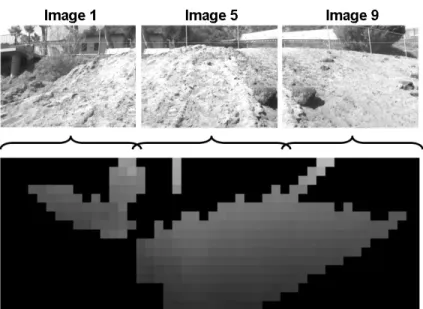
2.9 Example of full coverage of the map by only a third of the images obtained 32 2.10 Schematic of the terrain classification algorithm . . . 34
2.11 Example texture classification results from each of the datasets . . . . 37
2.12 Terrain classification results for different map sizes . . . 38
2.13 Prediction of slip in X on soil, gravel, sand, and asphalt. LAGR robot 46 2.14 Predicted slip and its 1-sigma confidence intervals for the soil dataset . 47 2.15 The learned nonlinear function of slip as dependent on the two terrain slopes. Comparison of LWPR to a Neural Network . . . 48
2.16 Predicted slip in Yaw on a transverse gravelly slope. LAGR robot . . . 50
2.17 Prediction of slip in X based on terrain slope angles. Rocky8 . . . 51
2.18 Slip prediction, terrain classification, and slope estimation errors as a function of the minimum range . . . 53
2.19 Results of slip prediction from stereo imagery on the test dataset. LAGR robot . . . 56
2.20 Expanded results of slip prediction for the areas incurring most error . 57 2.21 Prediction of slip in X on the map . . . 58
2.22 Slip prediction results for Rocky8 rover in the Mars Yard . . . 60
2.23 The Terrain Adaptive Navigation system . . . 63
2.24 A panorama collected by Pluto with the goal waypoint . . . 65
2.25 Demonstration of the integrated system: Results of the selected naviga-tion paths with and without the slip predicnaviga-tion module . . . 67
3.1 Using the rover’s slip measurements as automatic supervision for vision-based learning . . . 73
3.2 A schematic of the main learning setup using automatic supervision . . 76
3.3 Slip measurements plotted as a function of the estimated slope angles retrieved from actual rover traversals . . . 77
3.4 Schematics of the main idea of incorporating automatic ambiguous super-vision into terrain classification . . . 80
3.5 The graphical model for the maximum likelihood density estimation for learning from both vision and automatic mechanical supervision . . . . 81
3.6 EM algorithm updates for learning from automatic supervision . . . . 84
3.7 Experimental setup for learning with simulated slip models . . . 86
3.8 The learned nonlinear models for the three classes superimposed on the training data . . . 87
3.9 Terrain classification in the vision space after learning without super-vision and with automatic supersuper-vision . . . 88
xiii
3.11 The learned nonlinear slip models for each terrain of the field-data test 92
3.12 Missing data problem extension. LAGR vehicle . . . 94
4.1 Terrain patches and their lower-dimensional projections obtained by un-supervised dimensionality reduction . . . 101
4.2 Schematic of the main idea: The supervision signals are incorporated in the system so that they affect the dimensionality reduction process . . 102
4.3 Graphical model of the proposed supervised nonlinear dimensionality reduction in which additional ambiguous and noisy measurements are used as supervision . . . 104
4.4 EM algorithm updates for nonlinear dimensionality reduction from auto-matic supervision . . . 105
4.5 Average test results for terrain recognition and slip prediction . . . 110
4.6 The learned slip models and the classification of the test examples when learning with automatic supervision and with human supervision . . . 111
4.7 Slip prediction with the k-Nearest Neighbor algorithm . . . 113
4.8 Slip prediction with the LWPR algorithm . . . 114
4.9 Direct comparison of the proposed algorithm to k-Nearest Neighbor and LWPR algorithms . . . 115
5.1 Main idea for constructing the variable-length representation . . . 124
5.2 A set of classifiers, ordered by increasing complexity and classification power . . . 126
5.3 Schematic of the proposed variable-length representation . . . 131
5.4 Example patches from each of the classes in the dataset used . . . 137
5.5 Average test results evaluated on best resolution test patches . . . 138
5.6 Confusion matrices for one of the runs of the algorithm . . . 139
5.7 Test results for different values of the parameter g1 . . . 140
5.8 Classification results and time spent superimposed on image sequences: Gravel . . . 142
5.9 Classification results and time spent superimposed on image sequences: Soil . . . 143
xv
List of Tables
3.1 Simulated experiment: Summary of the test performance . . . 85 3.2 Field experiment: Average terrain classification and slip prediction test
error . . . 91
5.1 Classification performance of each of the base algorithms . . . 129 5.2 Average classification rate and time on image sequences . . . 141 5.3 Classification performance on image sequences, evaluating separately
Chapter 1
Introduction
A major challenge for autonomous robots is the perception of the surrounding envi-ronment, so that a more intelligent planning and interaction with the terrain can be achieved. One of the goals of this work is to develop an algorithm with which a rover can perform assessment of forthcoming terrain and estimate the possible rover slip in each location of the future map,before the rover actually traverses the terrain.
To realize that goal we develop an algorithm which enables slip prediction from a distance using visual information from stereo imagery and other onboard remote sensors. We focus on rover slip because it is an important aspect of rover-terrain inter-action and is a key limiting factor for rover mobility [23, 78]. Remote slip prediction will enable safe traversals on large slopes covered with sand, drift material or loose crater ejecta, areas considered to be of significant scientific interest for future plane-tary missions [33]. Rover slip has not been considered previously as a component to traversability, nor have there been attempts to predict it remotely in the autonomous robotics community.
While the goal is to use as many visual features as possible to retrieve the best pos-sible recognition performance, an autonomous system has computational constraints which have to be taken into consideration. To address the problem of the limited computational resources of a real-time system, we propose an algorithm which auto-matically learns avariable-lengthrepresentation for each terrain class. The algorithm takes advantage of fast computation algorithms or representations whenever they are accurate and uses more computationally expensive algorithms for harder recognition
2 tasks.
Another challenge in autonomous robot navigation is to enable true autonomy of the vehicles. That is, it is desired to have vehicles which are programmed to learn on their ownwithoutany human supervision. To that end we develop an algorithm which provides a fully automatic learning of the terrain types and their inherent properties using its own sensors as supervision. We further extend the framework to allow working with high-dimensional inputs, effectively performing an automatic supervised nonlinear dimensionality reduction over the possibly high-dimensional and redundant sensor inputs. This novel method offers a way to take advantage of working with high-dimensional representations and at the same time utilizing noisy and sometimes uncertain supervision signals which are automatically obtained by the robot.
1.1
Slip prediction
Slip is defined as the difference between the commanded rover pose and the actually achieved rover pose and is a quantity which measures the lack of progress of a wheeled ground robot while traversing some terrain. A trivial example of large slip is when the rover is rotating its wheels without actually moving because of lack of traction, e.g., in deep sand or in fine drift material. Areas on the ground surface where a lot of slip occurs need to be avoided as the rover will spend more time and energy, or in the worst case, might get stuck. For example, one of the rovers of the Mars Exploration Rover (MER) mission got trapped in a sand dune for several weeks, experiencing 100% slip (Figure 1.1). Such events pose a threat of mission failure because it might not be possible to recover the rover via only teleoperation commands. Being able to predict slip from a distance and to alert the rover before it traverses such terrains, will have significant impact on future Mars rover missions, because slip has been recognized as one of the key limiting factors in the current MER mission [23, 78, 83]. The science goals of future Mars rover missions will require the rovers to traverse more challenging areas, featuring very steep slopes, loose soil, and rocky terrains [33]. The primary objective of the upcoming 2009 Mars Science Laboratory (MSL) mission
Figure 1.1: The Mars Exploration Rover Opportunity trapped in the Purgatory dune on sol 447. A similar 100% slip condition can lead to mission failure. Image credit: NASA/JPL, Caltech.
is to explore areas which indicate possible aqueous processes, e.g., mineral-rich out-crops which imply exposure to water [92] or putative lake formations or shorelines, layered deposits, etc. [84, 62], in search for conditions conducive to maintenance of life [46]. Figure 1.2 shows examples of two of the possible landing sites for the MSL mission. To be able to access such sites, the rover is likely to encounter steep slopes possibly covered with loose soil, where a lot of slippage is possible. An important engineering requirement on the rover is to be able to predict slip from a distance, so that adequate planning is performed and areas of high slip are avoided and traversing areas of possible slippage is both feasible and safe.
Figure 1.2: HiRISE Mars Reconnaissance Orbiter image of Nili Fossae Trough [92] (left) and of Holden Crater Fan [62] (right) which are two of the sites under consider-ation for the next MSL landing site. Image credit: NASA/JPL, Caltech/University of Arizona.
4
In the context of Earth-based off-road vehicles (traversing cross-country terrain), slip is also an important component. In this scenario, too, an autonomous robot might get stuck in deep sand or mud, so it is necessary to learn to avoid such terrains. Another pertinent issue to off-road vehicles is slip prediction for the purposes of optimizing vehicle speed or energy spent. In this case, it is desirable to utilize the proposed method for learning slippage so that the rover can adapt its behavior to what it has observed or learned from the environment.
1.1.1
Problem formulation
The goal of this work is to develop an algorithm with which the rover can predict slip in each visible location of the map. The input for the algorithm will be only onboard remote sensors, such as stereo imagery and inertial sensors to measure tilt. A panorama of the Endurance Crater collected by the Opportunity rover is shown in Figure 1.3. In this example, it is conceivable that the rover should be able to provide assessment of the forward terrain regarding slip, using visual input in the form of several stereo image pairs of the terrain and other onboard sensors.
To address the problem of driving the MER rovers in the presence of slip, MER navigation engineers have acquired experience about which areas can incur possibly large slip [23, 78]. Slip models have been previously created for a limited number of terrain types by manually recording the amount of slip occurring on different slopes [81]. The main focus of this thesis is to develop algorithms with which the rover can collect slip information and learn the slip models needed automatically.
Figure 1.3: A panorama of the Endurance crater obtained by the MER rover Op-portunity. The crater is about 130 meters in diameter. Image credit: NASA/JPL, Caltech.
A solution to this problem is proposed in Chapter 2. In particular, we propose to learn the functional relationship between information about map cells observed at a distance (appearance and slopes) and the measured slip when the rover drove over these cells, using the experience from previous traversals [4, 7, 9]. Thus, after learning, the expected slip can be predicted from a distance using only stereo imagery as input.
1.1.2
Slip prediction utilization
Slip prediction is intended to be used as a traversability cost handed down to a planner. The planner, whose goal is to select the safest and maximally efficient path by avoiding all obstacles, can also take into consideration the slip cost and optimize with respect to slip as well. A second utilization of the slip prediction algorithms is to assign a set of canonical soil parameters for each soil type, which are passed to a very detailed kinematic and dynamic simulation of the rover on the selected path to determine its safe traversability and evaluate its cost [53]. An onboard demonstration of slip prediction for these two purposes will be described in the thesis (Section 2.11). These uses assume that the rover will follow the predefined path, which can be achieved by applying a path-following algorithm or a slip-compensation algo-rithm [54]. This is important to avoid potentially dangerous scenarios in which the rover steers away from the predefined path due to slip. For example, it may slide downhill and hit a rock which was originally planned to be avoided. Alternatively, predicted slip models can be used in an inverted kinematics/dynamics model of the vehicle so that it follows the predefined path taking into consideration the possible expected slip on it. Howard and Kelly [59] provide a method to utilize slip models in inverse dynamic models, but their work is limited to using very rudimentary slip models and can benefit from more appropriate learned slip models, as proposed in this thesis.
6
1.2
Learning and dimensionality reduction from
automatic supervision
1.2.1
Learning from automatic supervision
Another question to be addressed regarding learning for autonomous vehicles is how to learn fully autonomously. Unsupervised learning is a common machine learning technique, but achieves inferior performance when compared to supervised learn-ing methods. Traditional supervised machine learnlearn-ing approaches use human expert knowledge to provide data labeling. However, regarding autonomous navigation, data labeling is a formidable task, because of the huge amount of data available. More-over, a human expert might not have the best knowledge of how a certain terrain will affect the rover slip behavior. This is particularly true in the context of planetary exploration, where terrains with unknown appearance are likely to be encountered for which there is no prior slip behavior analysis done by scientists.
This problem is addressed in Chapter 3. A novel algorithm in which the robot can use its own sensors as supervision for vision-based learning of terrains, is proposed [8]. The method is called learning from automatic supervision because the supervision is provided by the robot’s sensors automatically. The proposed approach is applied here for learning to recognize terrains automatically from input visual features, when the measured rover slip is used as supervision.
The novelty of the approach is being able to exploit supervision, which can be noisy or ambiguous, in a probabilistic framework in which the input features and the supervision can interact. Although previous approaches have addressed learning when the supervision is obtained by the robot, the so-called self-supervised learning [30, 80], these methods have assumed the robot sensors are reliable, and can be definitively clustered into well-separable classes, which is not applicable when the supervision signals are ambiguous, as is the case with slip. Here, a principled approach to closing the loop in a fully automatic system for vision-based learning with automatic or noisy supervision is considered.
1.2.2
Dimensionality reduction from automatic supervision
We further address the challenges of processing more complex terrain representations. A novel supervised nonlinear dimensionality reduction is proposed in Chapter 4, which can also exploit noisy and ambiguous supervision. The key idea is to let the super-vision also affect the dimensionality reduction process [5]. Previous dimensionality reduction approaches are generally unsupervised [43, 102, 115], with the exception of [112, 131] which rely on known labels or known projections for some of the exam-ples.The importance of this method is that it allows working with better high-dimensional feature representations of the terrain, which is a necessity when complex real-life outdoor environments are considered. Furthermore, the method provides a general mechanism to use partial or uncertain supervision in the dimensionality reduction process, which can be applied to other learning problems. The novelty of this ap-proach is combining dimensionality reduction and reasoning from uncertainty into a unified probabilistic framework.
The impact of learning and dimensionality reduction with automatic, noisy, and uncertain supervision is enabling the robot to learn to recognize terrains visually and predict their potential effects on the robot mobility when the supervision has come from its own mechanical sensors. This work will enable the robot to learn to predict terrain characteristics fully autonomously. Although we develop the algorithms in the context of slip learning and prediction, the methods can apply to various signals collected by the rover to help a vision-based prediction.
1.3
Variable-length terrain classification
Recognizing the robot’s surroundings and predicting its potential interactions with the surface depends heavily on the remote visual classification of the terrain. Accu-rate visual recognition relies on computationally intensive processing of the images to retrieve visual features. On the other hand, a robot navigation system has a
con-8
tradictory goal of efficientlyprocessing the input imagery. We propose an algorithm which can achieve a tradeoff between accuracy and efficiency to meet the constraints of an onboard system.
Previous recognition approaches use a fixed-size representation for each example and class. Here the key observation is that the label of the class can be used actively in selecting its feature representation. This can be exploited to build more efficient variable-length representation and can be incorporated in a faster terrain classification algorithm. The algorithm for variable-length feature representation [6] is presented in Chapter 5. It can have additional applications to using onboard sensors of varying costs in a more efficient manner or to learning of a large number of classes.
1.4
Overview of previous work
Multiple methods are available for detection or measurement of slip occurring while driving [22, 54, 76, 95]. However, providing an estimate of the possible slip at a future location, one which the rover has not yet traversed, has not been not attempted.
So far, slip modeling has been in the realm of terra-mechanical modeling [2, 15, 40, 71, 130] in which a simplified mechanical model of the interaction of the rover and the terrain is created. These methods are complex and computationally intensive, but the most significant disadvantage is that they need to be done at the location traversed by the rover and do not generalize to future locations. In this work, by utilizing stereo imagery as a remote forward looking sensor, we perform analysis of a future location and predict rover slip before the rover enters the terrain.
Autonomous navigation systems use extensively forward looking sensors to avoid obstacles and navigate in the environment [31, 67]. The range data available from radar, laser, and stereo which provide 3D information about the terrain is used to de-tect geometric obstacles, assigning traversability cost to sub-regions of the terrain [45]. Rover slippage, on the other hand, can be considered anon-geometrictype of obstacle and cannot be detected and predicted as a standard geometric obstacle.
rules to discriminate traversable vs. non-traversable regions that generalizes to more complex outdoor scenarios is very hard. Recent methods for autonomous navigation involve learning techniques as a way of adapting the behavior using the data observed from the environment [77, 87, 98, 120, 128, 127]. Along this vein of work, the proposed slip prediction method uses a learning algorithm to learn rover slip from previous experience.
Learning for autonomous navigation has moved one step further, trying to elim-inate the tedious human supervision, traditionally used in supervised learning sce-narios. Inlearning from proprioception [89, 128] the rover uses one sensor to provide supervision for the learning with another sensor. For example, bumper hits on the vehicle can provide ground truth for learning of traversability based on visual fea-tures. A similar idea, called self-supervised learning, has been used for various au-tonomous navigation tasks and has shown much promise [30, 50, 68, 80, 110]. From a learning perspective, the abovementioned self-supervised learning methods can be reduced to supervised learning, since they assume the sensor used as supervision can provide reliable labeling for a subsequent supervised learning task using another sensor [30, 50, 68, 89]. In contrast, we work with supervision signals which can be ambiguous and noisy, so reducing the problem to a supervised learning scenario is not applicable.
Current applications in vision and robotics require working with rich feature rep-resentations that are high dimensional [47, 48]. Nonlinear dimensionality reduction has been very common for obtaining compact lower-dimensional data representa-tions [16, 102, 115] in these cases. Traditional nonlinear dimensionality reduction techniques are unsupervised [43, 102, 115], as they have been intended mostly for data representation. However, in practice, some additional information, regarding which data points are more similar and should cluster together, might be available and could be exploited to obtain better low-dimensional representations. We show how slip-based supervision, which can be noisy or uncertain, can be exploited in ob-taining better lower-dimensional representations and simultaneously in learning to recognize terrains from vision features.
10
The terrain classification algorithms applied in the autonomous navigation domain usually use simple feature representations which are preferred for their speed [19, 30]. This might compromise the final classification performance because of the limited expressiveness of the feature representation. Here we propose an algorithm which matches the feature representation to the complexity of the classification task and achieves a trade-off between speed and accuracy.
Multiple successful texture classification algorithms have been developed [74, 75, 79, 121]. These methods generally apply a fixed, uniform representation for all classes and construct the features without regard to the existence of other classes. The key idea that is exploited here is that the labels can also take active part in building the representation, and using them we obtain more efficient but still accurate represen-tations.
1.5
Contributions
In this thesis we have proposed the following methods. Firstly, we show that it is possible for an autonomous robot to provide information remotely about potential rover-terrain interactions that affect rover mobility on forthcoming terrain. We de-velop a method to predict the amount of rover slip remotely, prior to entering the terrain. As a part of the proposed algorithm we introduce a novel software architec-ture which handles the input data in a more efficient way and is specifically targeted at processing visual data more efficiently.
Secondly, we propose a method in which the robot learns fully automatically to recognize different terrain types from visual and onboard sensors and to predict their inherent rover mobility. We propose a unified framework in which no human supervision is necessary and the rover uses its own mechanical sensors as supervision to vision-based learning of terrains. The supervision signals can be ambiguous and noisy, which is typical of actual robot sensors.
Thirdly, we extend this framework to be able to work with high-dimensional in-puts. We develop a novel supervised nonlinear dimensionality reduction technique,
again using the ambiguous and noisy sensor signals as automatic supervision. This is important as most of the robotics sensor signals are of high dimensions and being able to work with such features makes the proposed approach very suitable for practical applications. This is the first work that proposes automatically supervised dimen-sionality reduction in a probabilistic framework using the supervision coming from the robot’s sensors. The proposed method stands in between methods for reasoning under uncertainty using probabilistic models and methods for learning the underlying structure of the data.
Lastly, we present an approach that enables more efficient processing of the scene for the purposes of terrain recognition, retrieving only features that are necessary to make a sufficiently confident decision. Unlike standard texture recognition methods, which assign the same representation to all examples independently of their class label [74, 79, 121], we propose a method which exploits the labels and the misclassi-fication costs to build a variable-length terrain representation, so that complex and time consuming terrain representations are computed only in uncertain areas, or to discriminate very similar classes, or for classes with large misclassification penalties. The impact of the proposed work is that prediction of slip in terrain ahead will enable the rover to plan safer and more efficient paths by taking into consideration its mobility on future terrain. This thesis also shows how this can be done fully au-tonomously. Furthermore, with the developed methods, rich visual or other sensor descriptions of the terrain can be used, and the surrounding terrain can be analyzed and information important for robot mobility obtained in a more efficient way ei-ther by automatically building a more useful lower-dimensional representation or by selecting the feature representation with respect to the learning task at hand.
12
Chapter 2
Slip prediction
In this chapter we present an approach for slip prediction from a distance for wheeled ground robots using visual information as input. Large amounts of slippage which can occur on certain surfaces, such as sandy slopes, will negatively affect rover mobility. Therefore, obtaining information about slip before entering such terrain can be very useful for better planning and avoiding of these areas.
To address this problem, terrain appearance and geometry information about map cells is correlated to the slip measured by the rover while traversing each cell. This re-lationship is learned from previous experience, so slip can be predicted remotely from visual information only. The proposed method consists of terrain type recognition and nonlinear regression modeling.
The proposed slip prediction from visual information is intended for improved navigation on steep slopes and rough terrain for Mars rovers. The method has been implemented and tested on datasets from several rover platforms and on several off-road terrains. It has also been demonstrated onboard a Mars prototype rover in the JPL Mars Yard.
2.1
Introduction
Slip is a measure of the lack of progress of a wheeled ground robot while driving. Large amounts of slip can be observed on certain terrains, which can lead to significant slowdown of the vehicle, inability to reach its predefined goals, or, in the worst case,
getting stuck—which may pose a threat to the success of the mission (Figure 1.1). The science goals of future Mars rover missions will require the rover to explore areas of the planet which feature very steep and rocky terrain, where a lot of slippage is possible [33]. It will be important to be able to predict slip from a distance, so that adequate planning is performed and areas of high slip are avoided.
The mobility of a vehicle on off-road terrain is known to be strongly influenced by the interaction between the vehicle and the terrain [15]. Slip is the result of this complex interaction and, second to tip-over hazards, it is the most important factor in traversing slopes [23, 78]. However, with a few exceptions [28, 94], slip has not been considered as an aspect of terrain traversability in state-of-the-art autonomous navigation systems so far, mainly because of the highly nonlinear nature of the rover-terrain interactions and the complexity of modeling of these interactions [2, 61]. The most commonly used approach is to represent the surrounding terrain as a geometric elevation map, using range data from sensors, such as stereo cameras, radar, or ladar, in which a binary perception of the terrain, i.e., obstacle vs. non-obstacle, is done [67]. This idea has been extended to detecting compressible grass and foliage, which would otherwise be perceived as an obstacle [73, 82, 87], but this again uses more or less geometric concepts of penetrability of terrain. Regarding slip, a sandy slope might be non-traversable because of large slip, whereas the same slope covered with different material, e.g., compacted soil, could be perfectly traversable. Such areas of large slip are called non-geometric obstacles, as they cannot be detected by software which uses geometrical information only [78], and more advanced perception of the physical terrain properties is needed to detect them.
Visual characteristics of the terrain, in addition to geometry, can give more clues to its mechanical properties and the eventual rover-terrain interaction. Thus, we propose to use stereo pair imagery as the input for slip prediction [4, 7, 9]. The rationale behind this approach is that, from a mechanical point of view, slip depends on physical and geometrical properties of the terrain [15], and stereo imagery provides information about both the geometry from the range data and the visual appearance of the terrain. So, stereo imagery contains much information which can help predict
14
slip on the forthcoming terrain. The main challenge is how to interpret the vision data to infer properties about the terrain or predict slip.
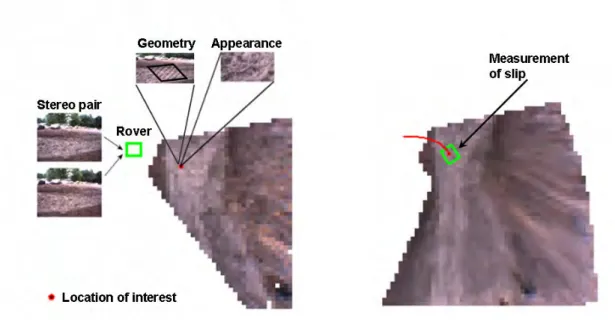
Our approach to this problem is to correlate the visual information and the cor-responding measured slip while the rover is traversing the terrain. In particular, we extract information about the terrain observed from a distance by using information from a stereo pair only, measure the slip of the rover when it traverses this particu-lar region, and create a mapping between visual information and the resultant slip (Figure 2.1). We propose to learn this functional relationship using the experience from previous traversals [4, 7, 9]. Thus, after learning, the expected slip can be pre-dicted from a distance using only stereo imagery as input. A learning approach is chosen, because 1) creating a physical slip model is extremely complicated due to the large number of variables involved; 2) the mapping from visual input to a mechanical terrain property, such as slip, is a complex function which does not have a known analytical form or a physical model, and one possible way to observe it and learn about it is via training examples; and 3) a learning approach promotes adaptability of the vehicle’s behavior.
To address the problem of slip learning and prediction we propose a general frame-work in which the task is subdivided into: 1) learning the terrain type from visual appearance and then, after the terrain type is known, 2) learning slip from the terrain geometry using nonlinear approximation. We term the latter dependence of slip on terrain geometry, when the terrain type is known, slip behavior. The proposed de-composition of the problem is adequate because from a mechanical point of view it is known that different terrains exhibit different slip behavior characteristics [15, 116], and because terrain appearance can be considered approximately independent of ter-rain geometry. This decomposition also introduces some structure in the problem, so that we can solve it with a reasonable amount of training data.
We have proposed to learn the slip behavior, instead of adopting a known physical model, because such a model might be hard or impractical to obtain—as is the case with slip for which significant experimentation is required to adjust the parameters related to soil behavior and vehicle-terrain interaction [15, 130].
Figure 2.1: Main idea: Learning of slip output from visual information. The rover col-lects visual information (appearance and geometry) about a future location of interest in the forward-looking map from its stereo pair images (left). When this location is reached by the rover, a slip measurement is taken using onboard sensors (right). Cor-relating vision information to the corresponding slip measurement and learning this mapping allows for prediction of slip from a distance using visual information only.
This work is the first to attempt predicting slip from a distance. We have proposed an overall solution framework in which the slip is learned and predicted from visual information.
For the purposes of practical realization of the proposed method we also introduce a novel software architecture for navigation which can process data and predict slip in a more efficient way.
2.2
Definition of slip
Slip z is defined as the difference between the velocity measured by the wheel (wr) and the actual velocity v: z = wr−v, where w is angular wheel velocity and r is the wheel radius [130]. It can also be normalized by the commanded wheel velocity:
z = wrwr−v [14, 61, 130]. Similarly, the slip for the whole rover is defined as the difference between the actual vehicle velocity and the velocity estimated from the kinematic model for each degree of freedom (DOF) of the rover per step (i.e. between
16
two consecutive stereo pairs) [54]. It can also be normalized, to receive a unitless slip value or express it in percentage of the step size. In this work we use the normalized version of slip for the whole rover.
For the kinematic estimate, we use the rover’s full kinematic model, which can be a simple differential drive model, a more complex rocker-bogie kinematic model [113, 54], or other model, as appropriate to the specific robot. The actual position (ground truth) can be estimated by visually tracking features [86, 88], a method called Visual Odometry (VO), or measured with some global position estimation device. VO is the preferred method for ground truth estimation because it is a convenient, self-contained sensor on the vehicle. By using VO, data collection and training can be done automatically, onboard the rover, which coincides with the goals of planetary ex-ploration missions. Furthermore, global positioning devices are not always available, especially in planetary missions.
Validation of VO position estimation has been performed by several groups [54, 93, 96]. VO position estimation error has been measured to be less than 2.5% of the distance traveled, compared to ground truth surveyed with a Total Station that has 2 mm precision, for runs of 20–30 meters in outdoor testing [54]. Similar results of 1.2% position error for a 20 m traverse have been achieved by [96] while testing in different circumstances, i.e., using a smaller robot, wide field of view cameras, different image resolution, etc. VO path length errors of about 1%–1.6% for 180–380 m traverses in outdoor environments have been reported by [93] with a different VO algorithm. The results of these tests indicate that VO is a precise position estimation technique and is adequate for use as ground truth both for computing slip per step and for precise localization within short to mid-size (20 m) traverses (i.e., to be able to map correctly the position of the location seen from a distance to the location traversed later on).
We measure slip with respect to the previous rover frame (corresponding to the beginning of the step) which is defined as follows: the X coordinate is along the direction of forward motion, Y is along the wheel axis pointing to the right, and Z is pointing down. We define slip in X and slip in Y as the components of slip along the X and the Y axes, respectively. Slip in Yaw is the rotation angle around the Z axis.
Although some vehicles have additional kinematically observable DOFs [113, 54], these three are the ones which matter most with regards to slip. Slip is normalized by the commanded velocity in X and will be expressed in percent. There will be cases in which the commanded forward velocity is 0, e.g., a purely crabbing motion of the rover, which will make the slip value undefined. As those cases are rare, we remove those steps from our dataset.
We have adopted a macro-level (of the whole rover) modeling of slip, in the spirit of [54, 81]. More specifically, our assumptions are that, between two consecutive steps, the rover will be traversing approximately locally planar and homogeneous regions, and the weight distribution on all its wheels will be the same. These assumptions mean that we consider slip (i.e., predict the terrain type, estimate terrain slopes, etc.) in regions comparable in size to the size of the robot or its wheel and not at the pixel level, for example. Naturally, those assumptions are violated in our field data, which is taken on real-life terrains with all complications, such as uneven and nonhomogeneous terrain, clumps on the ground, or rocks in front of the wheels. For example, when one of the wheels traverses a rock, an unexpected slip in Yaw might occur, because the rock creates different traction compared to the soil or can serve as an additional external force to the vehicle. As similar events are not modeled by our system, there will be some sources of sometimes significant noise in the slip measurements in our data. Nevertheless, this macro-level modeling is justified, as the slip prediction is intended to be used in a first, quick evaluation of terrain traversability to be handed down to a planner. More complex mechanical slip modeling can be applied [63, 65, 71], but to predict slip, information about soil mechanical properties of the forthcoming terrain is still required. These approaches deal better with uneven terrain, e.g., if dynamic simulation of the traverse over detailed terrain elevation models is performed [65], but they will be considerably more computationally expensive.
Slip also depends on the commanded velocity, although for robots driving at rela-tively small speeds, velocity variations do not affect slip significantly. For the datasets for which the commanded velocity varies, we have factored it out by averaging con-secutive steps, by driving at approximately constant velocity, or by normalizing slip
18
stepwise by the commanded velocity. Since Mars rovers are controlled with constant wheel velocity, only averaging of consecutive steps was needed.
2.3
Previous work
Although early work in autonomous navigation and traversability analysis based on forward looking sensors did not use learning [67, 45], learning-based approaches have started to become more and more preferred [19, 68, 87, 89, 98, 120, 127]. The reason is that intelligent autonomous behavior needs to be adaptive to the environment and the more complex the environment is, the less likely it is that predefined rules or heuristics will work well. This is particularly true for outdoor, off-road, unstructured environments which offer a lot of challenges (e.g., variability in terrains and lighting conditions, lack of structure, lack of prior information, etc.), and in which learning approaches have proved to be more appropriate [34, 58, 77, 80, 89, 106, 120, 127, 128]. Related work on vision-based perception of the forthcoming terrain has been con-sidered for the purposes of determining the mobility of Mars rovers [58], or the traversability in tall grass and foliage for off-road [73, 82] and agricultural vehi-cles [128], for detecting the drivable rural road in the context of off-road autonomous navigation [101], or for detecting obstacles in indoor [118] and outdoor environ-ments [13, 68].
Detecting or measuring rover slip occurring while driving can be achieved relatively easily by comparing the commanded velocity to the actual achieved velocity. An estimate of the actual velocity can be obtained from inertial measurements, GPS signals [22], or by visually tracking features, i.e., VO [54]. Alternative methods based on analyzing motor currents have also been used [95]. Providing an estimate of the possible slip at a location not yet traversed has not yet been attempted.
From a mechanical point of view, modeling and estimation of slip has been done at various levels of complexity and for various vehicle architectures [2, 15, 40, 71, 76, 130]. These methods are rather complicated and need to be performed at the traversed lo-cation, as they require local sensor measurements and detailed knowledge of terrain
geometry. They are computationally intensive and impractical in the present setup. As slip depends also on the mechanical soil characteristics [15, 116], additional esti-mation of soil parameters, such as cohesion and friction angle [61, 76], or modeling of the soil behavior [2] needs to be done. Methods for online terrain parameter esti-mation [61], for recognizing terrain types [28], and for characterizing terrain traffica-bility [94] from onboard mechanical sensors have been proposed, but these estimates apply to the present vehicle location. No method, to our best knowledge, is available for predicting terrain parameters from a distance. One way to address this problem is by using forward looking sensors, e.g., vision, as proposed in this work.
Although slip has been acknowledged as an omnipresent problem in localization, especially in rough-terrain mobility [56], very few authors have considered counter-acting slip for improving vehicle mobility. Among them are the slip compensation algorithm of Helmick et al. [54, 55], in which the slip, measured at a particular step, is taken into account to adjust the next step, compensating for the distance which was not traversed; and the algorithm for improving traction control, proposed by Iagnemma et al. [60]. However, those methods, again, work at the traversed rover location and do not allow for planning at a distance, which our method enables.
Previous approaches have used manually created functions of slip as dependent on slopes [81]. Slip measurements were performed on short traverses of the rover on a tilt-table platform set to varying slope angles. These results showed that slip is a very nonlinear function of terrain slopes. For example, in deep sand, slip of about 20% on a 10◦ slope and of about 91% on a 20◦ slope was measured, when
the rover was driving straight upslope. The results of these experiments have been used successfully to teleoperate the Opportunity rover out of Eagle Crater, but the approach is very labor intensive, as it requires manual measurements. It also needs careful selection of the soil type on which the tests are performed to match the target Mars soil. Another limitation is that no slip models were available for angles of attack different from 0◦, 45◦, or 90◦ from the gradient of the terrain slope [29]. The
results are also specific to the vehicle. For example, a small design modification in the pattern of the wheels can change the slip behavior [14], affecting a potential physical
20
model. We believe that learning slip is a more general approach, namely, the same learning algorithm can be applied to another vehicle to learn its particular behavior on different terrains. Moreover, the proposed method enables the vehicle to apply the learned models dependent on what it has sensed from the environment.
The work described above concerns estimating slip from mechanical measure-ments, or, in our case, visual information. Conversely, slip measurements have been used to infer mechanical terrain parameters on the Mars Pathfinder Mission in a controlled one-wheel soil-mechanics experiment [91]. Similar experiments have been done by [10] for MER. This gives us the assertion that slip characteristics are directly correlated to terrain mechanical properties and the intuition that if the terrain soil type could be correctly recognized (which would entail its mechanical properties) then slip behavior is predictable.
2.4
Experimental rover platforms
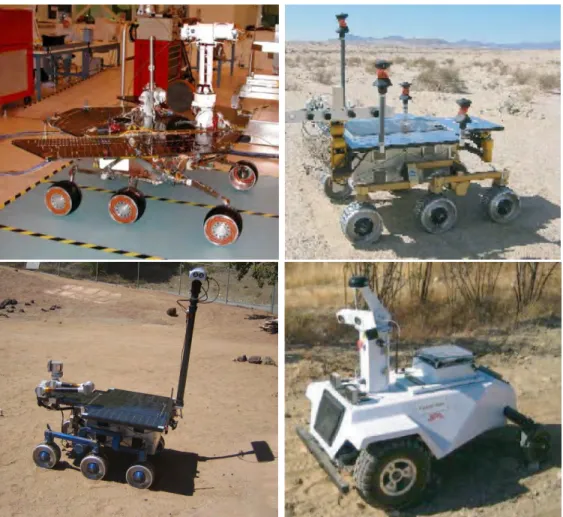
This research is targeted for planetary rovers, such as the Mars Exploration Rover (Figure 2.2, top left). For experimental purposes we tested our algorithm on two Mars research rover testbeds developed by NASA [104]: Rocky8 (Figure 2.2, top right) and Pluto (Figure 2.2, bottom left). We also used extensively the LAGR robot1 (Figure 2.2, right), as it is a more convenient data collection platform.
Rocky8 is a prototype research rover with six wheels in a rocker-bogie configuration which allows for improved mobility on rough terrain [104]. It is one of the series of rovers created by NASA to develop and test technology for the MER mission. In the experiments presented, we have used its hazard detection stereo cameras with 80◦
horizontal field of view (FOV), its wheel encoders, rocker and bogie angle sensors, and IMU. Stereo pair imagery is acquired after each stop of the robot or in a continuous manner. The rover’s nominal speed of operation is 8 cm/s. Rocky8 is about 0.5 m tall.
1
LAGR stands for Learning Applied to Ground Robots and is a research program funded by DARPA.
Figure 2.2: Robot platforms. The Mars Exploration Rover Spirit in the JPL Space-craft Assembly Facility (top left). The Rocky8 rover in the Mojave desert (top right). The Pluto rover in the JPL Mars Yard (bottom left). The LAGR robot on off-road terrain (bottom right).
The Pluto rover (Programmable Logic Rover) is mechanically similar to Rocky8. The significant difference comes from its avionics which are based on a set of dis-tributed processors, or Programmable Logic Devices.2 Pluto has similar hazard
cam-eras as Rocky8 (110◦ FOV). Additionally, a pair of color panoramic cameras (45◦
FOV) are mounted on a ∼1.5 m tall mast with additional pan/tilt DOFs. The im-agery from the panoramic cameras will be used for slip prediction, whereas the hazard cameras are used for VO, which is in turn exploited to compute slip and provide ego-motion estimation.
The LAGR robot has two front differential drive wheels and two rear caster wheels.
2
22
Figure 2.3: Example images from some of the terrains collected by the LAGR vehi-cle: sand, soil, gravel, woodchips, asphalt. The ‘grass’ class will also appear in the sequences, although the rover has not driven on grass terrain in this dataset.
It is equipped with stereo cameras with 70◦ horizontal FOV, wheel encoders, IMU,
and GPS. The robot can run in autonomous mode or be manually joysticked using a radio controller. It can achieve speeds of up to 1.2 m/s, although for some of our experiments it was set to drive at 30 cm/s. Stereo imagery is acquired continuously at 5 Hz. The LAGR robot is about 1 m tall.
2.5
Datasets
In this section we briefly describe the datasets collected and used in the experiments presented in this work.
2.5.1
Dataset collected by the LAGR robot
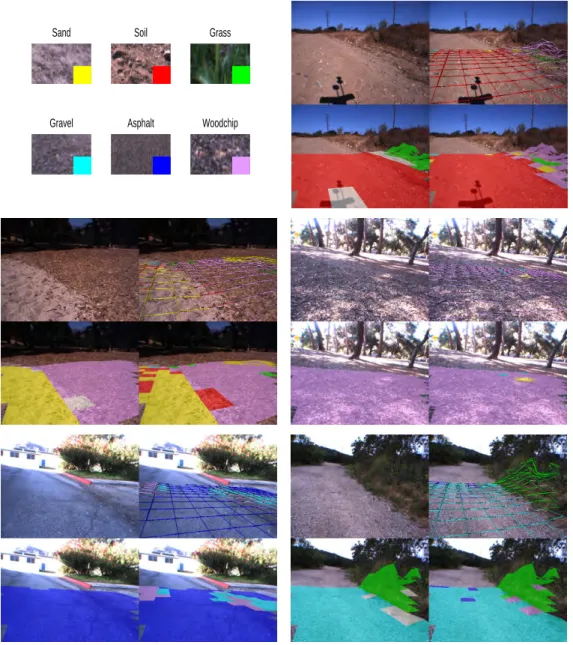
For our slip prediction experiments we have collected several datasets on off-road terrains with the LAGR vehicle. There are five major terrain types which the rover has traversed: soil, sand, gravel, asphalt and woodchips (Figure 2.3). Example patches, collected by the rover at 1–2 m distance, are shown in Figure 2.4. In addition to that, there are two other terrain types which appear in the sequences, such as green and
dry grass, which we considered as a single ‘grass’ class in the terrain classification in Section 2.8.
The terrains contain irregularities, undulations of the surface, small rocks, and grass clumps for off-road terrains or discolorations for asphalt. Although we have good variability in the terrain relief in our dataset (level, upslope, and downslope areas on soil, asphalt, and woodchip terrains; transverse slope on gravelly terrain; flat sandy terrain; etc.), not all possible slip behaviors could be observed in the area of data collection. For example, there was no sloped terrain covered with sand; besides, the LAGR robot showed poor mobility on flat sand, i.e., about 80% slip. The gravelly terrain available could only be traversed sideways for safety reasons; there was no transverse slope for the soil or asphalt datasets. We have collected a total of ∼5000 frames which are split approximately into 3000 for training and 2000 for testing. The distance covered by the rover during the data collection is roughly about 1 km. This data has been used extensively for testing in Sections 2.8, 2.9, and 2.10.
2.5.2
Datasets collected by the Mars prototype rovers
Several datasets have been collected with the Mars prototype rovers Rocky8 and Pluto in the Mojave desert and in the JPL Mars Yard.
One dataset was collected with the Rocky8 rover in the Mojave desert (Figure 2.5, left). It covers a distance of about 30 m. A single ‘sand’ terrain has been traversed in this dataset.
A second dataset was collected with Rocky8 in JPL’s Mars Yard (Figure 2.5, right). There are two terrain types present in this dataset: ‘Mars-like soil’ and ‘sand’. The terrain traversed consists of slopes of various inclinations. Since only two terrains are available, we have used this dataset primarily for evaluation of the slip prediction performance, rather than terrain recognition (Section 2.10.3).
In a subsequent round of experiments, we have collected data again in the Mars Yard with the Pluto rover. In this set of experiments the configuration and the terrain types in the Mars Yard had changed, and we essentially had two types of terrains
24
Figure 2.4: Example patches from each of the classes in the dataset collected by LAGR: sand, soil, gravel, woodchips, asphalt, and grass. The best resolution patches (i.e. taken by the robot at 1–2 m range) are shown. The data are collected at different times of day/year, under various weather conditions. The variability in texture appearance is one of the challenges present in our application domain.
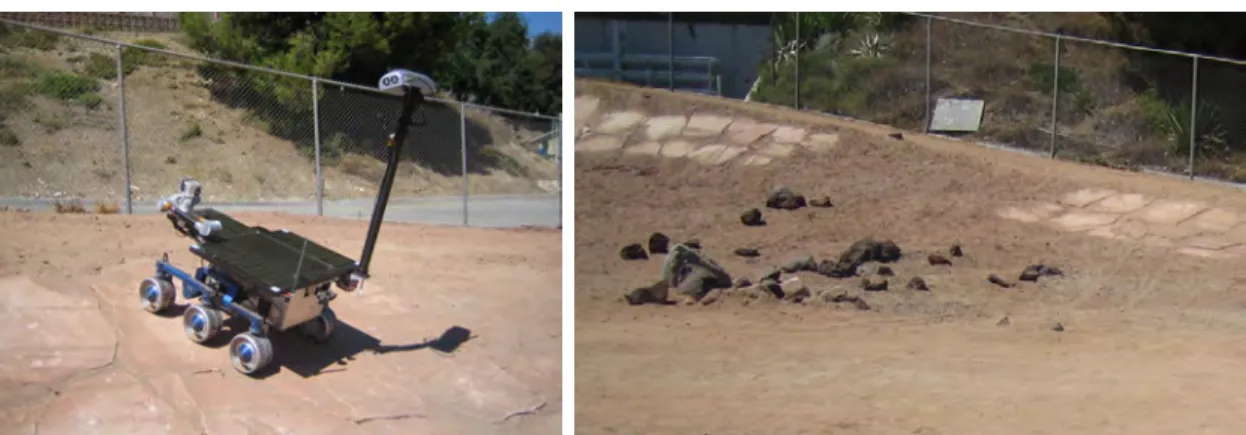
Figure 2.5: Rocky8 rover on sandy slopes in the Mojave desert (left) and in the JPL Mars Yard (right).
which are traversable by the rover: ‘Mars-like soil’ and ‘bedrock’ (Figure 2.6, right). The ‘bedrock’ terrain type had been installed as an analog to the bedrock terrain type encountered by the rovers in the MER mission. A third terrain type, ‘dark
Figure 2.6: The Mars prototype rover Pluto in the JPL Mars Yard (left). An image showing the types of terrains available in this dataset (right).
rock’, is also present in the dataset. The rover did not drive over the rocks during the data collection, since they are obstacles, but it may still be desirable for them to be recognized and avoided.3 This dataset contained a variety of slopes as well.
This setting is used for demonstrating the results of integrating the slip prediction algorithm on the rover in Section 2.11.
2.6
General framework for slip learning and
pre-diction
In this section we propose a general framework to learn the functional relationship between visual information and the measured slip using training examples.
The amount of slippage for a given vehicle depends on the soil type and the terrain’s geometry [15], so both geometry G, captured by the terrain’s slopes, and appearance A, e.g., texture and color, must be considered. At training time, the information about appearance and geometry coming from the stereo imagery is cor-related with the measured slip (in X, Y, or Yaw) as the robot traverses the cell. At query time, geometry and appearance alone are used to predict slip.
3
Since the ‘dark rock’ class constitutes an obstacle, a standard obstacle detection algorithm should be able to recognize it.
26
2.6.1
General framework
The dependence of slip on terrain slopes, called earlier slip behavior, is known to be highly nonlinear [81], but the precise relationship varies with the terrain type [15]. So, we cast the problem into a framework similar to the Mixture of Experts frame-work [64], in which the input space is partitioned into subregions, corresponding to different terrain types, and then several functions, corresponding to different slip be-haviors, are learned for each subregion. That is, in each region one model of slip behavior would be active, i.e., when the terrain type is known, slip will be a function of terrain geometry only.
More formally, let I be all the information available from stereo pair images,
I = (A, G). Let f(Z|I) =E(Z|I) be the regression function of slip Z (Z can be any of the slip in X, in Y, or in Yaw) on the input variables A, G (used interchangeably with the image information I). Now, considering that we have several options for a terrain type T, each one occurring with probability P(T|A, G), given the information from the image in question A, G, we can write f(Z|I) as follows:
f(Z|I) = f(Z|A, G) = X T
P(T|A, G)f(Z|T, A, G), (2.1)
where PT P(T|A, G) = 1. This modeling admits one exclusive terrain type to be selected per image, or a soft partitioning of the space, which allows for uncertainty in the terrain classification. We assume that the terrain type is independent of terrain geometry P(T|A, G) = P(T|A) and that, given the terrain type, slip is independent of appearancef(Z|T, A, G) = f(Z|T, G). Assuming independence of appearance and geometry is quite reasonable because, for example, a sandy terrain in front of the rover, will appear approximately the same, no matter if the rover is traversing a level or tilted surface. So we get:
f(Z|I) = X T
P(T|A)f(Z|T, G). (2.2)
(P(T|A), i.e., the probability of a terrain type, given some appearance information) and a slip prediction part (f(Z|T, G), i.e., the dependence of slip on terrain geometry, given a fixed terrain typeT). For simplicity, instead of the mixing coefficientsP(T|A), we use a single winner-take-all terrain classification output:
T(A) = argmaxTP(T|A). (2.3)
However, using the probabilistic output P(T|A), if available, has more advantages. For example, it can implement smooth transitions between terrains and can provide confidence intervals for the final slip prediction.
The terrain classification output T(A) will be learned and predicted by a terrain classifier (Section 2.8). The regression functions fT(Z|G) = f(Z|T, G) for different terrain typesT will be learned and predicted by a nonlinear regression method (Sec-tion 2.9). More precisely, suppose we are given training data D = {(xi,yi), zi}Ni=1,
where xi is the i-th appearance input vector, yi is the i-th geometry input vector,
zi is the corresponding slip measurement, and N is the number of training examples (x,yare particular representations of the appearanceAand geometryGinformation in the image, respectively). We will independently train a texture classifier T(x) to determine the terrain type, using the appearance information x in Section 2.8 and a nonlinear function approximation ZT(y) = fT(Z|G = y) for a particular terrain type T in Section 2.9. When doing testing we will use the full input vector (x,y), recognize the terrain type T0 = T(x), and then predict slip, as a function of slopes,
from the slip behavior function ZT0(y) learned for the terrainT0.
We believe this approach is adequate for our slip prediction problem because ter-rain types do not represent a continuum in appearance space and, in general, would form separate regions in the input space (experts), each one of potentially different slip behavior. In the case of making a winner-take-all decision (Equation (2.3)), the framework implements this underlying ‘switching’ behavior of slip. The probabilis-tic decision additionally allows several experts to be active at the same time and can make smooth transitions in borderline terrain cases. In both cases, we have
ex-28
ploited information about the structure of the problem, i.e., that the slip behavior can change depending on terrain [15]. The alternative to introducing structure in the problem is pooling appearance and geometry features, which will not only make the problem more complex because of increased dimensionality, but will also require a formidable amount of training data. This framework is general and, in principle, allows for different ways of addressing the problems of learning to recognize terrain types from appearance, and different algorithms for learning of slip behavior from terrain geometry.
2.6.2
Architecture
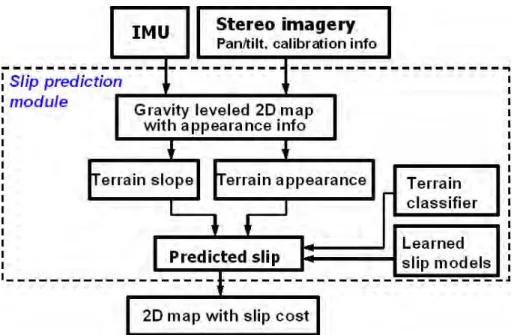
In this section we briefly describe the architecture of our system, summarized in Figure 2.7. We will be using the stereo imagery as input, as well as the IMU of the vehicle and its wheel encoders (the latter is needed only for training). Stereo imagery is used to create a 2D cell map of the environment from its range data. It also provides appearance information for each cell in the map. The 2D map contains geometry information about the terrain (G) and, as we are interested in terrain slopes with respect to gravity, we use the vehicle’s IMU to retrieve an initial gravity-leveled pose. In fact, a filtered IMU signal is used, often in conjunction with other onboard sensors. The appearance information from color imagery (A) will be used to decide which terrain type corresponds to a cell or a neighborhood of cells. This is all the information necessary to perform slip prediction with our algorithm. The advantage of such a system is that it can sense the terrain remotely and that it needs only passive, cheap, and self-contained sensors on the vehicle, such as stereo vision.
In order to learn slip we have added slip feedback. The mechanism to measure slip is as follows. The actual motion between two frames is estimated by VO which only needs two consecutive stereo pairs as input [88]. The motion which the vehicle thinks it has performed is given by the vehicle’s forward kinematics. For example, the LAGR vehicle has a differential drive model, so the wheel encoders are sufficient to compute its full kinematics. A more complex kinematic model, which needs additional angle
![Figure 1.2: HiRISE Mars Reconnaissance Orbiter image of Nili Fossae Trough [92]](https://thumb-us.123doks.com/thumbv2/123dok_us/9042343.2802019/20.918.166.810.737.952/figure-hirise-mars-reconnaissance-orbiter-image-fossae-trough.webp)


![Figure 2.10: Schematic of the terrain classification algorithm [79, 123].](https://thumb-us.123doks.com/thumbv2/123dok_us/9042343.2802019/51.918.189.783.112.484/figure-schematic-terrain-classification-algorithm.webp)