Three-Dimensional Integrated
Circuits and the Future of
System-on-Chip Designs
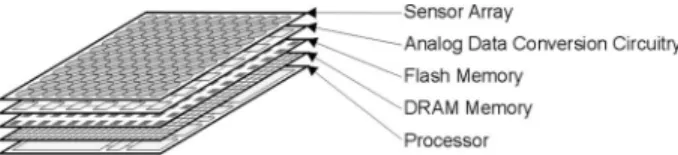
In 3D integrated circuits, analog, digital, flash and DRAM wafers are processed
separately, then brought together in an integrated vertical stack.
By
R o b e r t S . P a t t i ,
Member IEEE
ABSTRACT
|
Three-dimensional integrated circuits (3-D ICs) offer significant improvements over two-dimensional circuits, and promise a solution to the severe problems that are being, and will be, encountered as monolithic process geometries are reduced to below 65 nm. Several methods associated with the fabrication of 3-D ICs are discussed in this paper, and the techniques developed by Tezzaron Semiconductor Corp., are described in detail. Four successful 3-D ICs are described, along with the anticipated benefits of applying 3-D design to future system-on-chip (SoC) devices.KEYWORDS
|
Integrated circuit interconnections; three-dimensional integrated circuits (3-D ICs)I .
I N T R O D U C T I O N
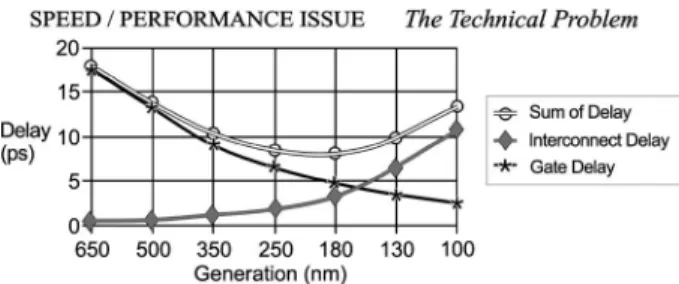
The evolution of the integrated circuit (IC) has begun to slow. In the past, technical difficulties presented real but surmountable barriers; now, perhaps, we are approaching a domain where physics forbids smaller gate technologies. Fig. 1 shows the rapid increase in delay time caused by the interconnect as geometries shrink.
Somewhere between the 130- and 110-nm process nodes, the increased delay of the wires outweighs the increased performance of smaller transistors. Low-K di-electric wiring allows 90-nm performance to improve slightly over 130 nm, but ultralow K will, at best, hold the line for 65-nm designs. Beyond 65 nm, the picture is grim. Even if we can solve the problems of ever-shrinking geometries, will the result justify the cost? Cost issues surrounding reduction of the dielectric constant using
ultralow-K materials are a case in point. Rick Hill, CEO of Novellus, described process geometries smaller than 65 nm as Btechnologically feasible, but not economically feasible[ [2].
Three-dimensional ICs (3-D ICs) offer a promising solution, reducing both footprint and interconnect length without shrinking the transistors at all. Dr. Susan Vitkavage, 3-D IC Project Manager for SEMATECH, commented that B3-D wiring could be a viable replace-ment for 2-D wiring when the continued push to reduce
RCmakes 2-D wiring cost prohibitive, and 3-D IC shows a cost benefit[ [3].
Three-dimensional ICs are perhaps the best hope for carrying ICs further along the path of Moore’s Law. In addition to obvious size benefits and possible cost bene-fits, they can address issues of heterogeneous integration, power and performance, and logical span of control.
A. Heterogeneous Integration
Integrating an entire system onto a single piece of siliconVa system-on-chip (SoC)Voften requires integrat-ing analog with digital, flash, and DRAM. The goal of such Manuscript received October 27, 2005; revised January 6, 2006.
The author is with Tezzaron Semiconductor, Naperville, IL 60563 USA (e-mail: [email protected]).
Digital Object Identifier: 10.1109/JPROC.2006.873612
Fig. 1.Gate and interconnect delays as a function of gate technology [1].
an SoC is to reduce the I/O count, system noise, power, EMI, and cost, and to increase performance. However, integrating such disparate elements leads to enormously complicated processes. In some cases, masking layers have increased from a mere dozen to 50, 60, or more, because the entire wafer must be processed for the needs of each subcircuit. If the circuit could be dis-integrated by process need, and the subcircuits reintegrated in very close proximity, better processing options would be available and the cost would be far lower. This is a promise of 3-D ICs: separate parts of the design can be built in entirely different processes, then brought together in an integrated vertical stack.
B. Power and Performance
Both of these issues hinge on the capacitance of the interconnect. Half of the dynamic power at 90 nm is in the charging and discharging of the interconnect capacitance, and that percentage will increase in each new generation. TheRCdelay of key signals ultimately limits the maximum speed of a circuit. The ITRS roadmap [4] concedes that resistance in metal will increase in coming generations. Even if all the ITRS goals are achieved, theRCtime delay will increase faster than the circuits can shrink.
Wire delay increases as the square of the wire’s length. The experimentally derived formula is
td¼0:35rcl2: (1)
We cannot reduce resistance (r) or capacitance (c)V
indeed, they are increasingVso our only hope for re-ducing propagation delay is to reduce wire length (l). As noted above, wire length impacts performance as a squared factor. In theory, the average wire length in a 3-D circuit changes by the square root of the number of layers [5]. Hence, if two layers of transistors are used, the length is reduced by the square root of two, and this is in turn
squared for calculation of the RC propagation delay,
resulting in a 2improvement in propagation time. For
very localinterconnect, less than perhaps 50m, this will not really be true (there would be little or no improve-ment), but for global interconnect it is very close to actual reality. Similarly, three layers of transistors would give 3
improvement; four layers, 4; etc.
C. Logical Span of Control
In many large processors and SoCs, the propagation delay of data signals, global control signals, and clock signals dictates the minimum clock period [6]. The dis-tance that a signal can travel in one clock period defines the logical span of control that the circuit can govern. Beyond this span, signals must be retimed and pipelined. Today’s 2-D ICs must operate within a circle measured by
the span. In 3-D ICs the circle becomes a sphere. The
sphere of control can encompass perhaps 10 as much
circuitry as the circle. This alone could give a tremendous, albeit one time, boost to system speeds.
I I .
C O N S T R U C T I O N M E T H O D S
F O R 3 - D I C
SThere are four basic methods for creating 3-D ICs: chip stacking, transistor stacking, die-on-wafer stacking, and wafer-level stacking. All four methods are described below. Three of the methods were recently summarized by Scott Pozder of Freescale as shown in Fig. 2.
A. Chip Stacking
This method stacks fully processed and tested stand-alone components to produce a system-in-package (SiP). The components in the vertical stack are connected with traditional wire bonding or flipchip techniques. Research groups have announced functional stacks of as many as eight chips [8].
The only significant benefit offered by chip stacking is the reduction in size. Connecting wires may be somewhat shorter, but the components are not integrated any more tightly than in a normal 2-D system; signals traveling from one layer to another must be pushed off-chip and then brought on-chip, just as before.
Chip stacking is a fairly mainstream technology today, led by companies like Sharp and STATSChipPAC. Chip-stacked SiPs are employed in cell phones and other por-table devices that demand small and light form factors.
B. Transistor Stacking
At the other end of the spectrum, this construction method creates multiple levels of transistors on a single substrate. This is the Bholy grail[ of 3-D circuits, but its success to date has been limited by thermal budget is-sues. The temperatures required to build a layer of high-performance transistors would destroy any copper or aluminum already laid down and would cause migration of transistor implants on previous layers.
Stanford is doing promising research on transistor stacking technologies such as laser annealing and nickel nucleation [9], [10]. Laser annealing circumvents ther-mal budget issues by localizing the high temperatures as each layer is built, but defect densities are a problem. Nickel nucleation builds high quality transistors at lower temperatures, but containment of the nickel ions is a problem.
Matrix Semiconductor produces a highly successful variation on stacked transistors in its one-time pro-grammable (OTP) memories [11]. The Matrix method uses tungsten in place of copper or aluminum and builds low-performance polysilicon diodes rather than
high-performance transistors. This combination presents a balanced thermal budget, and the resulting 3-D structures work very well for OTP memories, but they do not provide the speed or actual transistors required by most other devices.
C. Die-on-Wafer Stacking
In this method, known good dies (KGDs) are bonded on top of a host wafer containing other KGD sites. Dies can be attached to the wafer with organic glues, oxide bonding, or metal bonding. The wafer and its bonded dies are further processed for thinning and formation of inter-connects. Mixed substrates can be combined in a single device if process temperatures are kept low enough to minimize the effects of unequal expansion.
Die-on-wafer stacking can employ interconnect on the edges of the die, on the bonded faces themselves, or through-die. Depending on the type of interconnect, die-on-wafer stacking can produce a much higher level of integration than chip stacking, with better cost per con-nection and higher interconnect density [12], while main-taining much of the advantage of KGD.
The quality of die-on-wafer stacking relies on the capabilities of the pick-and-place equipment that positions each die on its wafer. Placement accuracy is currently about 10m [13], which limits the density of interconnect that can be achieved. Another concern is that the equip-ment was designed to handle fully buffered chips, not naked circuitry, so it does not protect adequately against static discharge. For this reason, dies to be stacked on a wafer must include much of the same I/O buffering as stand-alone chips. This buffering comes with a cost in power, speed, and die size.
At the current time, ZyCube has reported three-layer devices using through-die vias, adhesive bonding, and microbumps [14]; Ziptronix has announced successful two-layer prototypes with its covalent oxide bonding process [15]; and Xan3D (formerly Xanoptix) has cre-ated hybrid ICs with microball bonding [16]. Ziptronix and Xan3D have made their processes commercially available.
D. Wafer-Level Stacking
This final method bonds entire wafers into a stack. Vertical through-wafer connections are made directly through each substrate to the next wafer and its layer of transistors. As in die-on-wafer stacking, the density of interconnect depends strongly on the accuracy of align-ment, which is currently better than that of die-on-wafer stackingVTezzaron’s process consistently achieves align-ment of less than a micrometer. Because of the greater alignment accuracy and higher degree of surface planarity, wafer-level stacking supports a lower cost per connection and better interconnect density than die-on-wafer. Mil-lions of vertical connections can be made at only micro-meters of spacing.
As in die-on-wafer stacking, the use of mixed substrates is limited only by the process temperatures. Although high temperatures can cause misalignment due to un-equal expansion, Tezzaron has successfully bonded mixed-wafer pairs.
In wafer-level stacking, all processing is done at the wafer level. Wafer handling equipment protects against static discharge, so designs do not need I/O buffering between the layers. Another advantage is that wafer stacking lends itself to standard lithography and
processing techniques, so there are fewer unknowns to contend with.
One drawback to wafer-level stacking is the lack of a workable KGD approach. (There will be further discussion of 3-D yield issues later in this paper.) This aside, the wafer-on-wafer stacking process provides a great opportu-nity to launch SoCs into the 3-D realm.
Wafer-level stacking can use the same bonding meth-ods that are available to die-on-wafer methmeth-ods: organic gluing, oxide bonding, and metal bonding. Each of these has achieved varying degrees of success. Rensselaer Polytechnic is well known for working with organic glues [17], Ziptronix has had excellent results with covalent oxide bonding [18], and Tezzaron has used copper metal bonding to produce fully functional devices (discussed later in this paper). Each bonding technique has its plusses and minuses. Organic glue bonding can better deal with particle contamination, but it does not provide a good intrinsic metal interconnect. Oxide bonding allows room temperature prebonding and offers perhaps better align-ment, but again does not have an intrinsic metal con-nection. Metal bonding provides the interconnect, but
bonding is done at 400C, making alignment more
dif-ficult (especially with mixed substrates).
Wafer-level stacking techniques are further differenti-ated by the method used to create vertical through-wafer interconnect: either via-first or via-last. Via-last processes create the interconnect after the wafers are bonded, using a Bdrill and fill[ sequence. Via-first processes build the through-wafer vertical interconnect wire on each wafer prior to the bonding process, which is generally more ef-ficient and cost-effective [19]. Each of the three earlier mentioned bonding techniques can support either via-first or via-last methods, but for the metal bonding process, via-first is obvious and intrinsic.
Although all wafer stacking techniques are envisioned to produce stacks of several layers, most published re-search has described only two-layer stacks [20], [21].
I I I .
T E Z Z A R O N ’ S S T A C K I N G M E T HO D
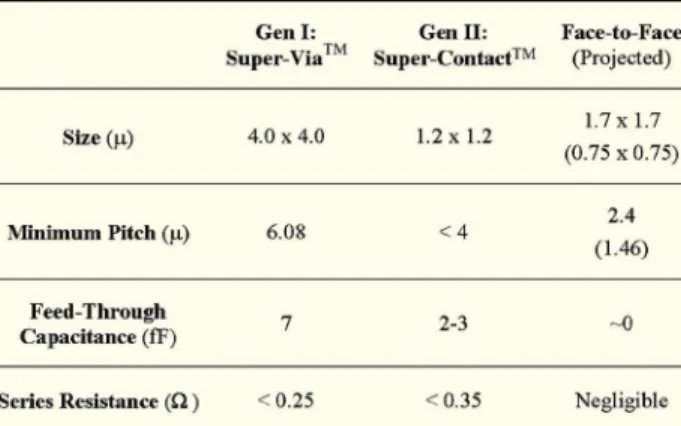
Tezzaron’s stacking method is wafer-level, via-first, with metal-to-metal thermal bonding. This method has pro-duced successful two-level devices, three-wafer stacks with full electrical connectivity, and four-wafer mechanical stacks. Tezzaron has developed two types of vertical inter-connect. The size, pitch, and parasitics of Tezzaron’s ver-tical interconnects are given in Table 1.
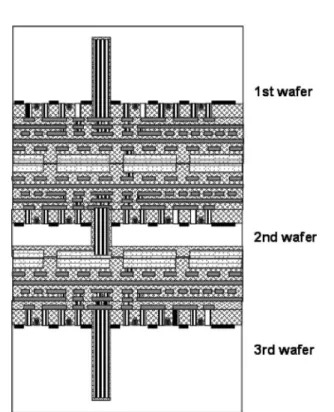
The first-generation Bsuper-via[ process had the
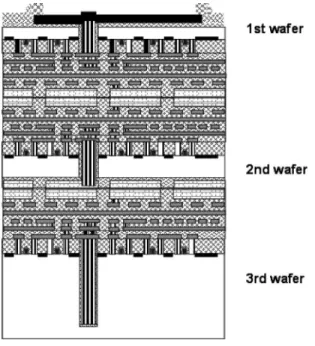
advantage of being applied to wafers after they were completely processed at a vendor fab. The disadvantage was in the required via size and the need for keepout areas in all layers. The second-generation Bsuper-contact[ pro-cess requires a new propro-cess module at the vendor fab. This module has proven relatively easy to add and does not introduce any new materials at the stage where the con-tact is added.
Images of Tezzaron wafer stacks implementing the two types of interconnect are shown in Figs. 3 and 4.
The following sequence, Figs. 5–13, illustrates
Tezzaron’s stacking method with the BSuper-Contact[
interconnect.
After complete processing of each layer, the height of the total stack increases by about 15m per wafer. Thus, even a stack of many layers can be housed in normal packaging. Note that the bottom wafer retains its complete thickness during the stacking process and there is no need to handle the very thin (15 m or less) upper layers as individual pieces. This greatly eases the manufacturing challenges. After the stack is completed, the thick bottom wafer can be thinned as usual and finished with standard wire bonding or flipchip assembly.
Table 1Interconnect Properties
Fig. 3.Three wafers, stacked and connected with Tezzaron’s first-generationBsuper-via[interconnect process.
Tezzaron has created stacks of up to four wafers and intends to manufacture five-layer devices in the next couple of years, but there is no fundamental limit on the number of layers that this method can incorporate.
I V .
Y I E L D I S S U E S I N 3 - D
M A N U F A C T U R I N G
Yield, like thermal dissipation, is a hotly debated issue in 3-D integration. It is important to note that yield in 3-D devices is governed by the same defects as in 2-D devices. With wafer-level stacking, where we cannot apply a KGD strategy, defect density plays an identical role in 3-D as in 2D. Assume that a 2-D 100-mm2die has yield of 80%. If that die is separated into four 25-mm2 dies, the yield for the set of four will still be about 80%. Stacking those four dies into one device does not change the yield; in fact, yield is arguably improved because the smaller dies might increase the number of candidate sites.
The previous argument assumes that the stacking process itself does not significantly contribute to defects. In Tezzaron’s experience, stacking does not change device yields except for the dies along the wafer’s edge. Edge dies currently have a manufacturing issue due to the copper edge exclusion in most wafer foundries. Tezzaron is cur-rently implementing improvements in this area.
Fig. 4.Two wafers, stacked and connected with Tezzaron’s second-generationBsuper-contact[interconnect process.
Fig. 5.This is the cross section of one wafer, immediately after transistors have been created, but before contact metal.
Fig. 6.The verticalBSuper-Contact[is etched through the oxide and into the silicon substrate approximately 6m. The walls are lined with SiO2/SiN.
Fig. 8.The wafer is finished with its normal processing, which can include a combination of aluminum and copper wiring layers. The last layer must be copper.
Fig. 7.The Super-Contact is filled with tungsten and finished with chemical–mechanical polishing (CMP). This completes the unique processing requirements at the wafer level.
The reality is that most people, when considering 3-D integration, are not looking to simply cut up a single
100-mm2 die into multiple layers. Even though such a
device would reap the benefits of shorter wires and het-erogeneous integration, designers generally have larger ideas, such as stacking multiple dies of greater than 100 mm2 each. In this case, yield is a larger issue be-cause each layered device contains far more silicon area, and is therefore far more likely to contain a defect.
There is opportunity for significant yield improvements for some specific types of large stacked devices. Memories, sensor arrays, and FPGAs can be made redundant, and thus reparable, providing significant yield benefits. Tezzaron’s memories use a very advanced and complete test engine and can be remapped at a small grain. The spare rows and columns are shared not only between 2-D adjacent arrays, but also among all of the vertically aligned arrays, vertical adjacency not being required. This makes a much larger pool of repair components available to any single failed region. Another entire paper could be dedicated to the improved reparability that exists in 3-D, but the basic principle is that 3-D devices can have significantly more interconnect in close proximity. This gain in interconnect translates to a much greater ability to reroute around de-fects and to reach spare resources.
V .
T E Z Z A R O N ’ S 3 - D D E V I C E S
Tezzaron has created a number of 3-D devices with its wafer-to-wafer stacking process, include a variety of stand-alone memories, a CMOS sensor, a 3-D FPGA, a mixed signal ASIC, and a processor/memory stack. Each of these devices demonstrates specific benefits gained from 3-D integration. Here we will look at some of the important characteristics of four of these devices. All four of these devices were built in two layers and were processed in 180-nm technology at MagnaChip.
A. Mixed Signal ASIC
The primary objective in constructing this device was to provide a subjective test of the performance changes and effects caused by the stacking process. The analog com-ponents included bandgaps, a DLL, a charge pump, a large heater resistor, and several other test circuits. The digital portion was limited to a very simple register file. This device was designed to fit in a minimal die area so that fine-grained mapping of the wafer could identify any process related systematic issues due to the physical die location on the wafer. A photo of the bonded two-level device is shown in Fig. 14.
Note the lack of any circuit detail on the surface of the device; all of the transistors and wiring are located on the lower side of the top wafer. The ASIC is completely
Fig. 10.After bonding, the top wafer is thinned to the bottom of the super-contacts. This leaves a substrate thickness of about 4m. Thinning is done with a combination of wafer grinding, CMP, and etching. The backside of the thinned wafer is covered by an oxide, then a single damascene copper process creates bonding pads for subsequent stacking.
Fig. 9.The oxide surface is slightly recessed on both wafers. They are then aligned and bonded in a copper thermal diffusion process that takes place at approximately 400 ˚C.
functional and demonstrates no performance difference between the analog circuits on the thick lower wafer and those on the thin upper wafer. Also, the heater resistor allowed 8 W to be dissipated in a mere 0.25-mm2area. The resulting stress did not cause any failure of the bonded interface, nor any permanent failure of adjacent devices. This provides strong evidence that localized hot spots will not be an issue in 3-D. As an aside, our work indicated that 3-D circuits are no worse with regard to heat issues than 2-D circuits. Research presented at the RTI 3-D conference in 2005 [22], as well as our own, shows a temperature delta of only 2C–7C. The underlying issue of heat removal is neither better nor worse in 3-D than in 2-D ICs.
B. CMOS Sensor
This device was created by placing photo diodes on the thin upper layer and amplifiers on the thick lower layer. The primary benefit here is the 100% array efficiency of the diode array. The diodes are also backside illuminated and have an increased quantum efficiency. The amplifiers are the typical 3T type found in many commercial sensor arrays, but they could easily have been made more sophisticated. In fact, other groups have discussed using high performance, high precision A-to-D converters. With this technique, pixels in the CMOS sensor could be addressed individually. This in turn provides a very important and interesting facility: a small, specific area of the pixel field could be read over and over again at the
rate of thousands or even tens of thousands of hertz. This is a key feature requirement for video navigation sensors.
In our CMOS sensor, both the diode layer and the amplifier layer were produced in the same CMOS process to reduce our prototype development costs. However, the sensor diodes could easily have been created in a four-mask process, thus reducing manufacturing cost. Another choice could be to use a different process to create other sensor types or characteristics. The sensor layer no longer needs to be CMOS compatible in its processing. One more benefit from this stacked sensor arrangement is the elimination of the micro lenses, another significant cost reduction. The layout is pictured in Fig. 15.
The main diode array in the center contains about 20 000 photosensors on a 5-m pitch. There are four small subarrays with 2.9- and 2.4-m pitch diodes. Each photo diode has its own connection to an amplifier on the bottom wafer. Thus, of the 40 000 interconnects on this 2.25-mm2 die, about 21 000 carry signals between the layers. Also, given the pitch of the interconnect and its size, the
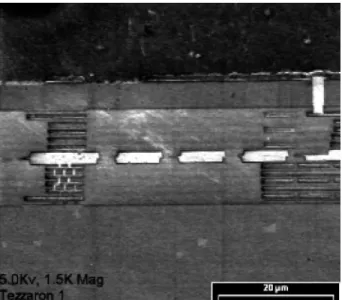
wafer-to-wafer alignment is known to be within 0.7 m. Any
error greater than this would have caused shorts between the diodes. A typical misalignment in Tezzaron’s process is 0.3m. The precision of alignment is shown in Fig. 16.
C. 3-D FPGA
This circuitry was designed to allow the stacking of any number of layers, up to 256. While we have no intention of
Fig. 11.Here a third wafer has been added to the stack, using the same technique by which the second wafer was added.
Fig. 12.Now the stack is inverted. Final processing will be applied to the backside of the first wafer.
stacking that many layers, this device provides a window into the extensibility of 3-D devices. What is of specific interest in this device is the comingling of the 3-D interconnect with the 2-D circuits. Unlike the obvious separation of the 3-D interconnect from the circuitry demonstrated in the processor/memory stack (next section), the FPGA 3-D interconnect is interspersed
throughout the logic area. Each logic array block contains 12 vertical interconnects. As you can see in Fig. 17, the 3-D interconnect requires no great keepout areas or disrup-tions in the logic array.
D. Processor/Memory Stack
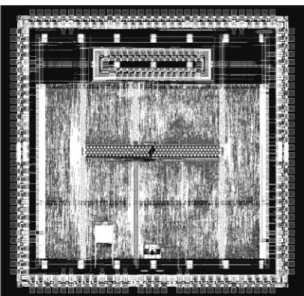
This device is relatively sophisticated, with more than 100 K gates of logic on one layer and 128 Kbytes of memory on the other. The memory, an SRAM, is on the base wafer, and retains the normal wafer thickness. The processor, including all of the I/O, is on the thinned upper wafer. The circuitry for the layers is shown in Figs. 18. and 19.
The processor is an RISC version of the industry stan-dard 8051. It executes most instructions in a single clock cycle. In addition to the main CPU, the design incorporates a full integer coprocessor, a floating point coprocessor, and
Fig. 14.The top of the 3-D mixed-signal ASIC device.
Fig. 13.The first wafer undergoes the same thinning process used before, stopping on the tungsten super-contacts. Instead of a copper damascene process for bonding pads, an aluminum layer is deposited for normal wire bonding.
Fig. 16.A face-to-face wafer bond, showing precise alignment of the vertical interconnect. This shows a pair of first-generation Bsuper-vias.[
a handful of additional special operations for cryptography. The 8051 core itself includes a multilevel interrupt controller, two serial ports, and three counter-timers. The entire memory range for the 8051 is 64 Kbytes for data storage and 64 Kbytes for program space. For further stacking, Tezzaron added a page register that allows up to 4 layers of memory, each containing 128 Kbytes, to be integrated with the processor.
Tezzaron chose an 8051-based design in order to illustrate the performance gains to be achieved by stacking memory on a processor. The 8051 core provides a very simple basis for comparison. With a single clock per in-struction, no caching, no pipelining, and no other advanced techniques to hide memory latency, this device gives a very raw look at the relationship between processor performance and memory speed. The stacked memory was a mere 3 ns away from the processor. That 3 ns in-cludes all latencies. In theory, the CPU could have run at over 300 MHz, but its design actually limited the speed to 140 MHz. The nearest similar processor available in the market is capable of only 33 MHz.
The memory–processor interface was intentionally over-designed. The implemented bus provides more than 4 Gbytes/s of sustained data bandwidth. This is more than an order of magnitude greater than what the 8051 can use, but it amply demonstrates the power of nearby memory. A very notable point can be made here regarding the improvement in power as well as in performance: When running at the same clock rate as the commercial part, the 3-D part consumes only one-tenth the power.
The 3-D device measures about 12.5 mm2and contains approximately 120 000 vertical interconnects. Only about 0.5% of these interconnects actually carry signal. The
device was temperature cycled from65C toþ150C
with 15-min dwell cycles. More than 100 000 device temperature cycles were run on these devices with no failures.
V I .
A D I R E C T I O N F O R T HE
F U T U R E : 3 - D S
OC
SThree-dimensional ICs hold tremendous promise for SoCs. First, consider the impact of putting memory on a separate layer. According to the SIA and the ITRS, most of the area in an SoC is occupied by embedded memory of one form or
Fig. 18.Circuitry for the processor layer of the processor/memory stack.
Fig. 19.Circuitry for the SRAM layer of the processor/memory stack.
another [23]. The drive for ever-increasing system per-formance drives a parallel need for more memory on board. This, in turn, pushes SoC designers to use ever smaller geometries in order to accommodate the vast memory needs. A 65-nm SoC is likely to use that geometry, not due to its need for speed or gate count, but rather due to its appetite for memory. If that memory is moved to a separate layer in a stacked 3-D IC, the rest of the SoC can be fabricated at 130 nm or perhaps even 180 nm. The process complications and costs are drastically reduced.
Consider another benefit of a separate memory layer: the memory can now be built in a true memory process. Perhaps it can be DRAM instead of SRAM, because it does not need to share the process with the high performance transistors of the SoC. It may prove to be cost-effective to make the memory in 65 nm or even smaller. For a sample design, see Fig. 20.
There is one more intriguing 3-D SoC concept to introduce here: generic memory layers. Designers could avoid developing a unique memory for each SoC if the foundry offered a generic memory layer that was adaptable to the needs of many (or perhaps all) of its customers. Tezzaron has discussed with various ASIC foundries the possibility of creatingBgridless[memory that is continu-ous across the whole wafer but partitionable at 100-m intervals. (The memory is thus nearlygridless.) If ASICs were designed to mate with a specific interface and to interconnect with memory on a general interface grid, all custom ASICs could share a single memory wafer design. Further, this memory could be redundant and reparable outside the ASIC. Tezzaron uses this approach in its own
memories, achieving greater than 90% yield on dies measuring multiple square centimeters. For SoCs, generic memory layers would provide higher yield, lower power, better performance, and a much lower cost for develop-ment and production. A 3-D SoC of the future could in-clude a custom ASIC, built at the best and lowest cost process node, combined with generic DRAM, flash, SRAM and perhaps even generic FPGA layers. Generic layers would be picked from the foundry’s standard catalog much as standard packages are today. A design kit would pro-vide and enforce the design rules to ensure a physical and electrical match for the vertical interconnects.
V I I .
C O N C L U S I O N
In this paper, we have discussed several techniques for fabricating 3-D ICs. The techniques developed by Tezzaron Semiconductor Corp., are highlighted, and several exam-ples of 3-D SoC devices are used to explain the concepts. Although 3-D fabrication techniques are currently not mainstream commercial processes, the development of 3-D SoC devices will ultimately depend on the costs and gains associated with the technology. There is ample evi-dence that it is possible to design and fabricate 3-D ICs and that there are benefits to be derived from 3-D integration. There is also mounting evidence that the road to ever deeper submicrometer technology may be simply too costly. In the opinion of the author it is not a matter ofif, but rather of when, 3-D IC technology is applied to SoC devices.h
A c k n o w l e d g m e n t
The author wishes to acknowledge the considerable work and effort of his colleagues at Tezzaron, whose skill and dedication made these results possible. Particular gratitude is extended to Dr. S. Gupta and Dr. S. Hong, who were responsible for the development of the stacking process and for the fabrication of the wafers and stacked devices.
R E F E R E N C E S
[1] G. Metze, M. Khbels, N. Goldsman, and B. Jacob,BHeterogeneous integration,[Tech Trend Notes, vol. 12, no. 2, p. 3, 2003. [2] E. Sperling and J. Chappell. (2005, Nov.).
BRips in the road map,[Electron. News. [Online]. Available: http://www.reed-electronics.com/electronicnews/article/
CA6253270.
[3] S. Vitkavage, personal communication. [4] International Technology Roadmap for
Semiconductors, 2004, update. [5] J. Joyner, P. Zarkesh-Ha, and J. Meindl,
BA global interconnect design window for a three-dimensional system-on-a-chip,[in Proc. IEEE Interconnect Technology Conf., 2001, pp. 154–156.
[6] K. Guarini,B3D IC technology: Capabilities
and applications,[presented at the RTI Int. Technology Venture Forum, Burlingame, CA, 2004.
[7] S. Pozder,BIntegration challenges of 3-D bonded structures,[presented at the TechVenture Preconf. Symp., Tempe, AZ, 2005.
[8] K. Lee, BWafer-stacked package technology
for high-performance system,[presented at theRTI Int. Technology Venture Forum, Tempe, AZ, 2005.
[9] B. Rajendran, D. J. Witte, R. F. W. Pease, R. S. Shenoy, N. S. Chokshi, R. L. DeLeon,
and G. S. Tompa,BCMOS transistor
processing compatible with monolithic 3-D integration,[inProc. VLSI Interconnection Conf. (VMIC),2005, pp. 76–82.
[10] K. Saraswat,B3-dimensional ICs: Motivation, performance analysis and technology,[
pre-sented at the 3D Technology, Modeling, and Process Symp., Burlingame, CA, 2004. [11] V. Dunton, T. Chen, M. Konevecki,
U. Raghuram, and S. Sivaram,BZias: Vertical wires in 3-D memory devices,[inProc. VLSI Interconnection Conf. (VMIC),2005, pp. 480–485.
[12] B. Markunas,B3D architectures for semiconductor integration and packaging,[ presented at theRTI Int. Technology Venture Forum, Burlingame, CA, 2004.
[13] BZiptronix targets vertical scalability,[
Electron. News.(2005, Oct. 17). [Online]. Available: http://reed-electronics.com/ electronicnews/article/CA6274984.html.
[14] M. Koyanagi,BA new super smart stack
technology for 3-D LSIs,[presented at the RTI Int. Technology Venture Forum, Tempe, AZ, 2005.
[15] BZiptronix reports first 3-D SoC,[Solid State Technol.[Online]. Available: http://sst. pennnet.com/articles/article_display. cfm?article_id=237 547.
[16] J. Trezza,BHybrid super systems,[presented at theRTI Int. Technology Venture Forum, Burlingame, CA, 2004.
[17] F. Nicklaus, J. J. McMahon, J. Yu, S. H. Lee, J. Q. Lu, T. S. Cale, and R. J. Gutmann, BWafer-level 3-D integration technology platforms for IC’s and MEMS,[inProc. VLSI Interconnection Conf. (VMIC), 2005, pp. 486–496.
[18] L. Peters. (2003, Nov. 1). BWafer bonding
enables new technologies and applications,[
Semiconductor Int.[Online]. Available: http:// www.reed-electronics.com/semiconductor/ article/CA331034?text=ziptronix.
[19] J. Baliga. (2005, Jun. 1).BThree-dimensional ICs solve the interconnect paradox,[
Semiconductor Int.[Online]. Available: http://www.reed-electronics.com/
semiconductor/article/CA604503.
[20] P. Clarke. (2002, Nov. 28).,B[IEDM late paper: IBM shows how to stack for 3-D circuitry,[
EE Times.[Online]. Available: http://www.
eetimes.com/news/semi/showArticle.jhtml?
articleID=10806078.
[21] H. Huebner,BSolid face-to-face goes productive at Infineon,[presented at the SEMICON Europa 2005, Munich, Germany. [22] B3D architectures for semiconductor
integration and packaging,[inRTI Int. Technology Venture Forum, Tempe, AZ, 2005. [23] F. Ramsay. (2003, Apr. 28).,B[Embedded
memories multiply in SoCs,[EE Times. [Online]. Available: http://www.eetimes.
com/story/OEG20030428S0089.
A B O U T T H E A U T H O R
Robert S. Patti(Member, IEEE) received the B.S. degrees in electrical engineering/computer sci-ence and in physics from Rose-Hulman Institute of Technology, Terra Haute, IN, in 1985.
He was a Member of Technical Staff for Tellabs, Inc. He was the Founder and President of ASIC Designs, Inc. (Tezzaron Semiconductor’s predecessor company). He is currently CTO and VP of Design Engineering for Tezzaron Semi-conductor, Naperville, IL. He is also a Director of
Tezzaron Semiconductor (Singapore) Pte Ltd. He is responsible for management of the company’s U.S. facility and for leading all technical and engineering development aside from process development and engineering. He holds 13 U.S. patents, numerous foreign patents, and more than a dozen pending patent applications in submicrometer semiconductor chip technologies.
Mr. Patti is a member of IEEE Computing Elements and serves as the Vice-Chairman for JEDEC’s DDRIII/Future Memories Task Group.
![Fig. 2. Comparison of three stacking methods [7].](https://thumb-us.123doks.com/thumbv2/123dok_us/1911011.2780280/3.864.183.671.110.421/fig-comparison-of-three-stacking-methods.webp)