Proceeding of International Conference on Electrical Engineering, Computer Science and Informatics (EECSI 2015), Palembang, Indonesia, 19 -20August 2015
The Use of KPI In Group Decision Support Model
of ICT Projects Performance Evaluation
Herri SetiawanDepartment of Computer Science and Electronics, Faculty of
Mathematics and Natural Sciences Gadjah Mada University,
Yogyakarta, Indonesia Email: [email protected]
Jazi Eko Istiyanto Department of Computer Science
and Electronics Faculty of Mathematics and Natural
Sciences Gadjah Mada University,
Yogyakarta, Indonesia
Retantyo Wardoyo Department of Computer Science
and Electronics Faculty of Mathematics and Natural
Sciences Gadjah Mada University,
Yogyakarta, Indonesia
Purwo Santoso Departement Politics and
Government Faculty of Social and Political
Sciences Gadjah Mada University,
Yogyakarta, Indonesia
Abstract-This paper proposes The Use of KPI in Group
Decision Support System Model of ICT Projects Evaluation at Local Government Agency in Indonesia. This study is a part of the attempt to improve local government performance in Indonesia, especially for Local Government Agencies (SKPD) involved in Decision Support System (SPK), which should be optimized through Information Technology. Different from the prior research, in this paper we try to describe how to determine KPI in an ICT project at local government agency and the applicable evaluation model. Generally, this paper will discuss how to make an performance indicator, so that the output of an ICT project product can result the expected outcome, benefit, and impact. Furthermore, it will be explained in regard to the Group Decision Support System (GDSS) evaluation model by considering the applicable legislation aspect, which facilitates decision makers such as: Government Institution Executives, ICT Managers Unit, Business Process Owner Unit, and Society represented by Regional House of Representative, to give assessment or evaluation upon the implementation of ICT Projects at Local Government Agency. As the research support, survey and interview have been conducted to stakeholders in decision-making. The proposed model is expected to be able to give ideas and solutions in evaluating ICT Projects done at local government agencies in Indonesia.
Keywords - IT; SKP; SPKK; KPI; GDSS
1. INTRODUCTION
Information and communications technology (ICT) has been involved in various research in regard to decision-making. The advance of ICT facilitates solutions on several decision-making toward some issues such as political science, economics, and engineering [1]. Indonesian government expense for ICT in 2013 is approximately 14 billion in total, but the effect toward e-government development is still not so [2]. Deregulation and bureaucratization of public services must be conducted immediately by utilizing Information and Communications Technology (ICT). One important part of IT Governance is what the practical and effective way to measure and evaluate ICT performance is, which gives assessment upon ICT performance achievement toward strategic goals of an organization.
At Local Government Agency (SKPD) in Indonesia, evaluation mechanism is conducted by analyzing service performance employing several indicators, such as referring to Minimum Service Standard (SPM) and Key Performance Indicators (KPI) pursuant to Government Regulation Number 6 of 2008. In the Government Regulation of Information and Communications No. 41/PER/MEN.KOMINFO/11/2007 regarding General
Guideline of National Information and Communications Technology Governance only describes the success indicators which are generally made, not yet specifically describes the project indicators that can be used in ICT.
With an assumption that ICT Projects in the government is a part of public policy, then the policy should be public interest-oriented. Practically, a good governance practice requires that the management and public management decision must be open by assuring society’s access in participating, particularly in the decision-making process. With the participation, then the policy made will obtain legitimation for it has obtained assessment from the society through the participation process.
This particular study is a part of attempt to improve the local goverment performance, particularly Local Government Agency (SKPD) involved in Decision Support System, which is optimized through Information Technology. A Group Decision Support System (GDSS) can and need to be developed, especially if supported by IT. Decision Support System as ”interactive computer-based system, assisting the decision-makers to use the data and varios models to solve the unstructured problems”. Decision Support System is intended to be the instrument for the decision-makers to expand their capability, but not to replace their assessment.
Generally, this paper is divided into several parts, the first part describes how to make a performance indicator which can synchronize between technical indicator and project management concept of an ICT project, so that output of an ICT project product can produce the expected outcome, benefit, and impact. The second part describes the concept of evaluation process model regarding the use of a Group Decision Support System (GDSS) concept by considering the applicable legislation aspect, which facilitates the decision makers, such as: Government Institution Executives, ICT Managers Unit, Business Process Owner Unit, and Society represented by Regional House of Representatives, to give assessment and evaluation upon the implementation of ICT Projects at local government institutions. Evaluation can be performed by comparing suitability measurement between administrative or normative indicators and technical indicators of each project stage. The concept of GDSS can overcome the possible inconsistency in a decision-making, for with GDSS, the decision is made based on the mathematical calculation model.
Proceeding of International Conference on Electrical Engineering, Computer Science and Informatics (EECSI 2015), Palembang, Indonesia, 19 -20August 2015 The importance of performance measurement
regarding government agency performance has been launched by Indonesian government since the issue of Presidential Instruction 7/1999. A performance of local government agency cannot be measured (quantitatively in particular) will result many questions and it will be unconvincing [3]. Indeed, the measurements numerically are not everything. However, when we are able to obtain indicators and data from an abstract goal, then we can judge where our current position is and how to improve the position in the future.
At government agency, especially at Local/Regional Government environment known as Government Institution’s Performance Accountability Report (LAKIP), that is an instrument to measure the associated Institution’s Performance how far the success of the programs/activities (projects). Nonetheless, unfortunately this measurement is general with various variables being used, there is no special regarding the IT. In the other research, Ishak [4] conducted a review regarding the performance measurement in each Local Government Agency. By using analysis method from various resources in form of narration, it is concluded that the government’s accountability in Indonesia still focuses on financial management side, whereas in fact the society’s curiosity of government’s accountability cannot be fulfilled by only financial information, therefore the appropriate measuring instrument in the measurement of Local Government Agency.
The problem related to performance measurement and government projects evaluation [3][5][4][6][7] has not been solved. In the prior research, the discussion regarding how to determine KPI [8][9][10][11][12][13] and ICT project evaluation were done separately. Instead, both things are inseparable for they are interrelated.
The importance of KPI as one measuring instrument in performance measurement of an ICT project at Indonesian local government is also considered very important as mentioned by the author [5]. Key Performa Indicator (KPI) is a measurement used to measure and evaluate the organization performance related to the goal and objective [8]. Antolić [9] employed Key Performance Indicators (KPIs) in accordance with standard ISO/IEC 15939 Software Measurement Process and CMMI Process Area Measurement and Analysis to evaluate the efficiency of the process on the projects of CPP software development in Ericsson. There are several standards and best practices in the world used in the process of IT performance measurement, one of them is Information Technology Infrastructure Library (ITIL) [10], Balance Scorecard [11]. On the other side, performance evaluation of ICT Projects is a part of management project to assess and evaluate the achievement upon the determined goal and objective, by collecting and analyzing the data and information systematically, regarding the result, benefit, and impact of planned project. An effective and efficient project selection has an important meaning in each organization, for the decision-making process to assess the feasibility of a very complex project [14].
A number of research in decision-making regarding performance evaluation of ICT Projects use DSS method in Multi-Criteria Decision Making (MCDM) group [14][15][16][17][18]. In the research conducted by Kazemi et al [19], it was offered a project monitoring method to be
suitable with the strategic goal. The initial step in an attempt to reduce the failure risk of the project is choosing an optimal project. The effectiveness of the criteria in choosing the most optimal project is identified and defined by using MCDM approach. The method being employed is
Analytical Hierarchy Process (AHP) and TOPSIS. The use of proposed model can help the company facilitate a systematic approach in decision-making regarding the selection of the appropriate project. DSS can facilitate analysis of the most appropriate multi-criteria method application in the evaluation of information system project. A base of knowledge consisting of IF-THEN Production Rules can be developed to help the most appropriate multi-criteria method adoption systematically, by considering the requirement of efficient decision-making in the project selection [15].
Using other technique, Méndez et al [20], proposed a Critical Success Factors (CSFs) model to evaluate outsourcing of IT project. This model is based on the technology and various aspects which affect the development of IT project outsourcing. Ismaili [16] presented a methodology, technique, and application of
Linear Programming (LP) and Multi-Criteria Decision Making (MCDM) for decision-making in the priority evaluation of project selection, with the funding problem limitation and several criteria defined by the organization. The application of MCDM framework is proposed to measure the performance and to monitor the ongoing project. The analysis result shows that MCDM can be used for resource improvement and project performance evaluation.
The evaluation of the implementation at Local Government level on the level of understanding has shown the adequate development although it is not significant. However, in terms of implementation, it can be said weak, particularly on the identification of performance benchmark making and the goal determination. The process of making and measuring performance still focuses on the magnitude of fund input allocation and the budget realization. Other important processes such as data collection of performance, recording and analyzing data of performance, comparing the data of performance result and the making process has not been adhered to Local Government working culture even to Central Government [6].
Therefore,
e-Government project at government need to be evaluated to identify the cause of the change, deficiency, and the deviation taking place [7].Differ from the prior research, in this paper we try to describe comprehensively how to determine KPI on a certain ICT project at local government agency and the possible evaluation model to be implemented. GDSS modeling concept of ICT performance evaluation offered uses different criteria and preference of each stakeholder based on the specified performance indicator.
3. RESEARCH METHODOLOGY
3.1 Determining KPI on ICT Projects
At the initial stage, the first thing to be studied is how to make a performance indicator of ICT project, so that the output of a ICT project product can result the expected outcome, benefit, and impact. This stage identifies what variables needed in this study, which ones play role in the
Proceeding of International Conference on Electrical Engineering, Computer Science and Informatics (EECSI 2015), Palembang, Indonesia, 19 -20August 2015 determination of performance indicator, and measurement
method.
According to Marimin (2010), a set of rules needed to quantify the data from the one-variable measurement are called measurement scale. The most general base to make a scale has three characteristics (Emory and Cooper, 1997), they are: 1) the number is sequential, 2) The difference between the sequential numbers, and 3) Series of numbers have unique origin characterized by zero. Generally, there are four types of measurement scale (Emory and Cooper, 1997) they are : 1) Nominal Scale, 2) Ordinal Scale, 3) Interval Scale, dan 4) Ratio Scale. Beside the four types of measurement scale above, Marimin and Maghfiroh (2010) added one type of measurement scale, which is pair wise comparison. Pair wise comparison is frequently employed to determine relative importance of the existing elements and criteria. Pair Wise Comparison scale is highly advantageous to obtain ration scale from the things which are hard to be measured (opinion, feeling, behaviour, and trust). The comparison is done based on the assessment of the decision-makers.
3.2 GDSS of ICT Project Performance Evaluation
Furthermore in the evaluation process, Group Decision Support System (GDSS) is used by considering the applicable legislation aspect, which facilitates the decision-makers such as: government institution executives, ICT Managers Unit, Business Process Owner Unit, and Society, to give their assessment and evaluation upon the implementation of ICT Projects at local government agency. The evaluation is conducted by comparing the suitability measurement between administrative or normative indicators and technical indicators of each project stage. The GDSS concept can overcome the possible inconsistency taking place in decision-making, for with GDSS the decision is made based on the mathematical calculation model. The contribution of the decision-makers in the particular model is in form of preference to choose some alternatives of ICT Projects based on the specified criteria, by using Multiple Criteria Decision Making
(MCDM) method.
4. PROPOSED MODEL
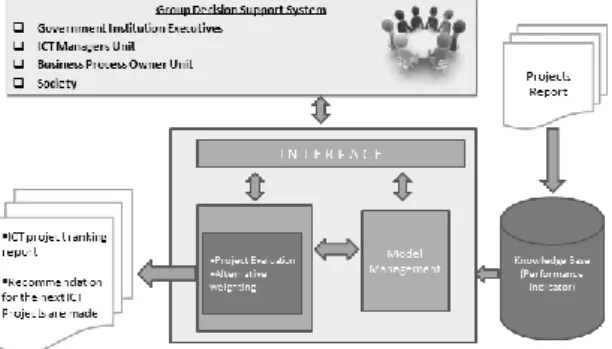
Generally, proposed GDSS model to evaluate the ICT Projects at local government agency can be seen in Figure 1.
Fig 1. Proposed GDSS Model of ICT Projects Evaluation
4.1. Classification of ICT Project Types
The analysis result of identification of ICT project type classification at local government agency can be classified into Projects as follows:
a) Software Establishment/Development b) Hardware Production/Maintenance c) Network Establishment/Maintenance d) Bandwidth Procurement/Lease e) ICT Staff Education/Training
4.2. Performance Indicators and the Measurement
In the ICT Project Component at government agency, it is necessary to determine the performance indicators and achievement plan. The performance indicators implied in the project component are quantitative and qualitative measurements describing the achievement level of a specified project.
The determination of Performance Indicators in each ICT project can be made based on the measurable mathematic measurement. The primary component of project measurement construction includes method, basic steps, measurement function, measurement step, analysis model, and indicators [21].
For instance, for the projects included as “Software Establishment/Development” group are as follows:
Project Name: “Population Application Making”. One indicator made is “Operating Performance” with measureable attributes:
transaction per second
response time
On the other project groups, such as “Bandwidth Procurement/Lease”:
Project Name: “Internet connection lease for Local Government Agency”.
One indicator made is “Bandwidth 100 Mbps”, with measureable attributes:
Throughput (the average data which is successfully transmitted through communication channels)
Package (dedicated, share, IIX, international)
4.3. GDSS Method Employed
The evaluation of designed ICT project is a multi-criteria decision-making (MCDM) model by using methods
Multi Attribute Decision Making (MADM) to determine the best alternative of the number of alternatives based on the several specified criteria. Stakeholders as decision-makers will give preference toward alternative (ICT Projects) based on the criteria possessed. Finally, ICT project ranking report and recommendation for the next ICT Projects are made.
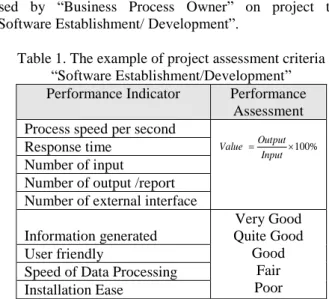
Evaluation of ICT Projects at government agency needs assessment from government Institution Executives, ICT Managers Unit, Business Process Owner Unit, and Society. The stakeholders of ICT Managers as the group of decision-makers have assessment criteria based on the performance indicators in accordance with the responsibility and function. In the providing performance assessment, quantitative and qualitative criteria will be used, linguistic variable will be used on the qualitative criteria. Linguistic variable is a variable of which the value is in form of words and sentences in natural or artificial language [22]. Table 2 is an example of assessment criteria
Proceeding of International Conference on Electrical Engineering, Computer Science and Informatics (EECSI 2015), Palembang, Indonesia, 19 -20August 2015 used by “Business Process Owner” on project type
“Software Establishment/ Development”.
Table 1. The example of project assessment criteria “Software Establishment/Development” Performance Indicator Performance
Assessment Process speed per second
% 100 Input Output Value Response time Number of input Number of output /report Number of external interface Information generated Very Good Quite Good Good Fair Poor User friendly
Speed of Data Processing Installation Ease
Furthermore, to generate the conclusions of the ICT project achievement result, performance measurement scale is employed. Performance measurement scale is made based on the consideration of each stakeholder as ICT project decision-makers. Table 1 is the scale of performance assessment weight which can be used.
Table 2. Performance Assessment Weight Score Assessment Scale
Interval Precentage 5 Very Good 21 up to 25 90 up to 100 4 Quiet Good 16 up to 20 80 up to 89,99 3 Good 11 up to 15 70 up to 79,99 2 Fair 6 up to 10 60 up to 69,99 1 Poor 0 up to 5 < 59,99
Each of them has a performance assessment criteria stated in measurement scale.
Stakeholders as decision-makers will give preferences to the alternatives (ICT Projects) based on the criteria owned. In giving performance assessment, quantitative and qualitative assessment will be used, linguistic criteria will be used on the qualitative variable. Linguistic variable is a variable of which the value is in form of words or sentences both in natural and artificial languages [22].
In the proposed model, hybrid method in MADM in GDSS will be developed based Analytical Hierarchy Process (AHP) method, Technique for Order Preference by Similarity to Ideal Solution (TOPSIS) and Simple Additive Weighting (SAW) as the basic model, which the each method plays their own role. AHP method is used to determine the criteria weighing, and then the result of criteria weighting of AHP method will be the input in the TOPSIS calculation employed in determining the ranking as the project performance evaluation. To aggregate the opinion of the decision-makers based on the preference given, it can use SAW method.
5. CONCLUSION AND FUTURE WORK
In this paper, we offer ICT project evaluation model at Indonesian local government agency using Group Decession Support System (GDSS) concept with different criteria and preference based on the specified performance indicators. The modeling is established by considering the applicable legislation aspect, which facilitates the decision-makers such as: Government Institution Executives, ICT Managers Unit, Business Process Owner Unit, and Society to give assessment and evaluation upon the ICT Projects at local government institution.
GDSS concept can overcome the possible inconsistency taking place in decision-making, for with GDSS the decision is made based on the mathematical calculation model. The contribution of the decision-makers in the model is in form of preference to choose the alternatives of ICT Projects based on the specified criteria, by using Multiple Criteria Decision Making (MCDM) method.
Our next research will focus on the implementation of MADM hybrid method in GDSS used, and also by establishing web-based prototype as the implementation form of the proposed model. The prototype made is an attempt in the response to the issue in ICT project performance evaluation at local government agency.
6. REFERENCES
[1] V. Tundjungsari, J. E. Istiyanto, E. Winarko, and R. Wardoyo, “E-Participation Modeling and Developing with Trust for Decision Making Supplement Purpose,” Int. J. Adv. Comput. Sci. Appl., vol. 3, no. 5, pp. 55–62, 2011.
[2] A. Abubakar, “Reformasi Birokrasi Untuk Meningkatkan Daya Saing Bangsa,” Bandung, pp. 1–15, 2014.
[3] J. B. Maramis, “Pentingnya Sistem Pemantauan (monitoring) dan Evaluasi (evaluation) Berbasis Hasil (outcomes) di Pemerintah Daerah,” Manado, 2012.
[4] M. Ishak, “Kebijkaan Pengukuran Kinerja Pemerintah Daerah,” INOVASI, vol. 6th, pp. 143–151, 2009.
[5] M. N. Usman, “Pengukuran Keberhasilan Penerapan Teknologi Informasi Di Indonesia,” in Konferensi Nasional Teknologi Informasi & Komunikasi untuk Indonesia, 2006, pp. 108–111. [6] J. Edstrom and Irianto, Contoh-contoh Indikator Kinerja untuk
SKPD. USAID-Local Governance Support Program (LGSP), 2009.
[7] G. J. Victor, A. Panikar, and V. K. Kanhere, “E-government Projects – Importance of Post Completion Audits,” in International Conference of e-government (ICEG), 2007, pp. 189–199.
[8] International Telecommunication Union, General specifications and KPIs. Geneva, 2012.
[9] Ž. Antolić, “An Example of Using Key Performance Indicators for Software Development Process Efficiency Evaluation,” Zagreb, 2008.
[10] M. Spremic, Z. Zmirak, and K. Kraljevic, “IT and Business Process Performance Management : Case Study of ITIL Implementation in Finance Service Industry Audit and IT Governance,” in ITI 2008 30th Int. Conf. on Information Technology Interfaces, 2008, pp. 243–250.
[11] C. Barclay and M. Campus, “Towards an Integrated Framework of Project Performance,” in IRMA International Conference, 2007, pp. 1244–1247.
[12] J. Arnoldus and J. Visser, “Mining the Dutch National ICT Dashboard,” Amsterdam, 2011.
[13] A. Candiello and A. Cortesi, “KPI-Supported PDCA Model for Innovation Policy Management in Local Government,” in IFIP International Federation for Information Processing 2011, 2011, pp. 320–331.
[14] T. Bakshi, A. Sinharay, and B. Sarkar, “Exploratory Analysis of Project Selection through MCDM,” in ICOQM-10, 2011, pp. 128–133.
Proceeding of International Conference on Electrical Engineering, Computer Science and Informatics (EECSI 2015), Palembang, Indonesia, 19 -20August 2015 [15] H. Deng and S. Wibowo, “Intelligent Decision Support for
Evaluating and Selecting Information Systems Projects,” Int. Assoc. Eng., no. August, 2008.
[16] H. Ismaili, “Multi-Criteria Decision Support for Strategic Program Prioritization at Defence Research and Development Canada,” University of Ottawa, 2013.
[17] G. Büyüközkan and D. Ruan, “Evaluation of software development projects using a fuzzy multi-criteria decision approach,” Math. Comput. Simul., vol. 77, no. 5–6, pp. 464–475, May 2008.
[18] J. S. Challa, A. Paul, Y. Dada, V. Nerella, P. R. Srivastava, and A. P. Singh, “Integrated Software Quality Evaluation: A Fuzzy Multi-Criteria Approach,” J. Inf. Process. Syst., vol. 7, no. 3, pp. 473–518, Sep. 2011.
[19] S. M. Kazemi, S. M. M. Kazemi, and M. Bahri, “Six Sigma project selections by using a Multi Criteria Decision making approach: a Case study in Poly Acryl Corp.,” in Proceedings of the 41st International Conference on Computers & Industrial Engineering, 2011, pp. 502–507.
[20] E. Méndez, M. Pérez, L. E. Mendoza, and M. Ortega, “Critical Success Factors to Evaluate Information Technology Outsourcing Projects,” in ICEIS (3-2), 2008, pp. 176–181. [21] J. McGarry, “Measurement Information Model,” in Practical
Software Measurement: Objective Information for Decision Makers, Addison Wesley, 2001, pp. 13–29.
[22] L. A. Zadeh, “The Concept of Linguistic Variable and ITs Application to Aprroximate Reasoning-II,” in Information Sciences, vol. 357, 1975, pp. 301–357.