The copyright of this thesis rests with the author and no quotation from it or information derived from it may be published without the prior written consent of the author
For additional information about this publication click this link. http://qmro.qmul.ac.uk/jspui/handle/123456789/3354
Information about this research object was correct at the time of download; we occasionally make corrections to records, please therefore check the published record when citing. For more information contact [email protected]
AND COMPUTER SCIENCE
AUTOMATIC OBJECT
CLASSIFICATION FOR
SURVEILLANCE VIDEOS
Virginia Fernandez Arguedas
Supervisor: Prof. Ebroul Izquierdo
Thesis submitted to University of London in partial fulfilment of the
requirements for the degree of Doctor of Philosophy
PhD Thesis London, 2012.
First of all, I am particularly grateful to my advisor, Prof. Ebroul Izquierdo. This work could not have been done without his great advice and dedication. I would also like to specially thank Dr. Krishna Chan-dramouli, Dr. Tomas Piatrick and Dr. Qianni Zhang for their help, ad-vice and time, their help made a huge difference. During my PhD many colleages have come and gone, each one of them gave something to this thesis, some help, suggestions or just a cup of coffee at the right time, for that I would like to thank Tijana, Prathap, Eduardo, Cristina, Michele, Stefano, Vlado, Ivan, Giuseppe, Navid, Naeem, Xavier, Markus, Sertan, Kostas and Saverio. Moreover, I would like to do a special remark to those who helped proof-reading my thesis, Eduardo and Julie, it took a while but your suggestions were essential, thanks!
As in every story, there were always good people that helped me to go through and cope with more than expected, at work and in my personal life, for those moments.. I would like to thank my friends, there are too many to be mentioned but you know it is you! Amongst them, many thanks to the people that stood by my side at all times Silvia, Alvaro and Emma, I will always be grateful.
Finally, the most special remark is to thank my family. Their en-couragement, confidence, support and advice made me the person I am today.
Muchas gracias a mi madre, mi padre y mi hermana mayor, sin vue-stro apoyo, confianza, consejo y ayuda no habria podido llegar hasta aqui. Vosotros me habeis hecho ser la persona que soy hoy.
“No te rindas que la vida es eso, continuar el viaje, perseguir los sue˜nos, destrabar el tiempo, correr los escombros y destapar el cielo.” No te rindas- Mario Benedetti
Automatic Object Classification for Surveillance
Videos
The recent popularity of surveillance video systems, specially located in urban scenarios, demands the development of visual techniques for monitoring purposes. A primary step towards intelligent surveillance video systems consists on automatic object classification, which still remains an open research problem and the keystone for the development of more specific applications.
Typically, object representation is based on the inherent visual features. How-ever, psychological studies have demonstrated that human beings can routinely cat-egorise objects according to their behaviour. The existing gap in the understanding between the features automatically extracted by a computer, such as appearance-based features, and the concepts unconsciously perceived by human beings but unattainable for machines, or the behaviour features, is most commonly known as semantic gap. Consequently, this thesis proposes to narrow the semantic gap and bring together machine and human understanding towards object classification. Thus, a Surveillance Media Management is proposed to automatically detect and classify objects by analysing the physical properties inherent in their appearance (machine understanding) and the behaviour patterns which require a higher level of understanding (human understanding). Finally, a probabilistic multimodal fusion algorithm bridges the gap performing an automatic classification considering both machine and human understanding.
The performance of the proposed Surveillance Media Management framework has been thoroughly evaluated on outdoor surveillance datasets. The experiments conducted demonstrated that the combination of machine and human understanding substantially enhanced the object classification performance. Finally, the inclusion of human reasoning and understanding provides the essential information to bridge the semantic gap towards smart surveillance video systems.
1 Introduction & Motivation 1
1.1 Research Objectives . . . 2
1.2 Contributions of the Thesis . . . 3
1.3 Structure of the Thesis . . . 4
2 Surveillance Media Management System (SMM) 7 2.1 Literature Review . . . 7 2.1.1 Human events . . . 8 2.1.2 Vehicle events . . . 10 2.1.3 Other events . . . 12 2.2 System overview . . . 13 2.3 Summary . . . 18
3 Motion Analysis and Object Extraction 20 3.1 Literature Review . . . 20
3.1.1 Motion Analysis . . . 21
3.1.2 Object tracking . . . 22
3.2 Motion Analysis and Object Extraction Component . . . 24
3.2.1 Background modelling . . . 24
3.2.2 Object detection . . . 26
3.2.3 Object tracking . . . 27
3.2.4 Motion Analysis and Object Extraction Representation . . . . 30
3.2.5 Motion Analysis and Object Extraction Challenges . . . 30
3.3 Summary . . . 31
4 Appearance-based Object Analysis 33 4.1 Literature Review . . . 34
4.1.1 Visual Analysis . . . 34
4.1.2 Combination of Visual Descriptors . . . 42
4.2 Appearance-based Analysis . . . 43
4.2.1 Visual Feature Analysis . . . 44
4.2.2 Particle Swarm Classifier (PSC) . . . 49
4.2.3 Fusion of the Appearance Descriptor Space . . . 53
4.3 Performance of the Appearance-based Analysis Techniques . . . 57
4.3.1 Visual Analysis . . . 57
4.3.2 Evaluation of the Particle Swarm Classifier (PSC) . . . 63
4.3.3 Evaluation of the Multi-Objective Optimisation Technique . . 64
4.4 Appearance-based Object Classification . . . 65 v
4.4.2 Biologically inspired Appearance-based Object Classifier
(Bi-ologically inspired AOC) . . . 67
4.5 Performance Evaluation of Fused Descriptor Space . . . 69
4.5.1 Evaluation of the Multi-Feature Appearance-based Object Clas-sifier . . . 69
4.5.2 Biologically inspired Appearance-based Object Classifier . . . 71
4.6 Appearance-based Object Classifier Conclusions . . . 73
4.7 Summary . . . 74
5 Behaviour-based Object Classifier 84 5.1 Literature Review . . . 85
5.2 Behaviour-based Object Classifier . . . 89
5.2.1 Extraction & Analysis of Object Trajectories . . . 91
5.2.2 Definition of Behaviour based Descriptor Space . . . 92
5.2.3 Behavioural Fuzzy Classifier . . . 95
5.3 Performance Evaluation of Behaviour-based Object Classifier . . . 100
5.3.1 Quantitative Performance Evaluation . . . 101
5.3.2 Comparison between behaviour and appearance-based object classifiers . . . 103
5.4 Behaviour-based Object Classifier Conclusions . . . 105
5.5 Summary . . . 105
6 Bayesian-based Object Classifier 107 6.1 Bayesian-based Network Classifier . . . 108
6.1.1 Classification-based Fusion Methods . . . 110
6.2 Fusion of Appearance and Behaviour-based Descriptor Spaces . . . . 114
6.2.1 Bayesian-based multimodal fusion . . . 115
6.2.2 Bayesian-based Object Classifier . . . 117
6.3 Performance Evaluation of the Bayesian Classifier . . . 120
6.3.1 Quantitative performance evaluation . . . 120
6.3.2 Comparative evaluation of the Bayesian-based Object Classifier121 6.4 Bayesian-based Object Classifier Conclusions . . . 122
6.5 Summary . . . 123
7 Performance Evaluation of the SMM 124 7.1 Surveillance Datasets . . . 124
7.2 Imagery Library for Intelligent Detection Systems (i-LIDS) . . . 125
7.3 Cambridge-driving Labeled Video Database . . . 127
7.4 Ground Truth . . . 127
8 Conclusions & Future Work 130 8.1 Concluding Summary . . . 131
8.2 Contributions of the Thesis . . . 134
9.2 Background Subtraction Challenges . . . 166
9.3 Appearance-based Image Features . . . 167
9.3.1 MPEG-7 Visual Descriptors . . . 167
2.1 Surveillance Media Management System . . . 16
2.2 Scheme of the Surveillance Media Management System . . . 17
2.3 Motion Analysis and Object Extraction component in the SMM . . . 19
3.1 Motion Analysis and Object Extraction Component . . . 24
3.2 Performance of the proposed MAC . . . 27
3.3 Motion analysis and object extraction challenges . . . 31
3.4 Appearance-based Object Classifier in the SMM . . . 32
4.1 PSC framework . . . 53
4.2 Visual Analysis Evaluation Framework . . . 58
4.3 Performance evaluation of the individual features over i-LIDS Dataset 60 4.4 Average precision-recall across all semantic concepts for i-LIDS Dataset 61 4.5 Individual features performance evaluation over CamVid Dataset - I . 75 4.6 Individual features performance evaluation over CamVid Dataset - II 76 4.7 Individual features performance evaluation over CamVid Dataset - III 77 4.8 Individual features performance evaluation over CamVid Dataset - IV 78 4.9 Average precision-recall across all concepts for the CamVid dataset . 78 4.10 Performance comparison between PSC and SVM for CLD . . . 79
4.11 Performance comparison between PSC and SVM for CSD . . . 79
4.12 Performance comparison between PSC and SVM for DCD . . . 79
4.13 Performance comparison between PSC and SVM for EHD . . . 80
4.14 MOO Average precision-recall curves . . . 80
4.15 Multi-Feature Appearance-based Object Classifier framework . . . 81
4.16 Biologically inspired Appearance-based Object Classifier framework . 81 4.17 Performance evaluation of the Biologically inspired AOC - Vehicle . . 82
4.18 Performance evaluation of the Biologically inspired AOC - Person . . 82
4.19 Average Precision-Recall curve for the Biologically inspired AOC . . 83
4.20 Behaviour-based Object Classifier in the SMM . . . 83
5.1 Behaviour-based Object Classifier framework . . . 90
5.2 Examples of evolving trajectories and their trajectory angles . . . 93
5.3 Velocity calculation scheme based on a 2D-projected space . . . 95
5.4 Type-1 and Type-2 BFC membership functions . . . 98
5.5 Behavioural Fuzzy Classifier framework . . . 99
5.6 Behavioural Fuzzy Classifier retrieval performance . . . 102
5.7 Performance comparison binary classifiers vs BFCs . . . 103
5.8 Performance comparison between appearance and behavioural patterns104 5.9 Bayesian-based Object Classifier in the SMM . . . 106
7.1 Parked Vehicle Detection Dataset . . . 126
7.2 Surveillance scenarios included in CamVid Dataset . . . 128
7.3 Concept distribution in the CamVid Dataset . . . 128
7.4 Unknown examples following the interannotator agreement . . . 129
7.5 Examples of moving objects included in the i-LIDS Dataset . . . 129
2.1 Summary of surveillance event and object detection systems . . . 12 2.2 Summary of surveillance oriented specific tasks . . . 13 4.1 Performance comparison of the four selected MPEG-7 features . . . . 70 4.2 Performance evaluation of the lineally combined multi-feature descriptor 70 4.3 Performance evaluation of the optimally combined multi-feature
de-scriptor . . . 70 5.1 Performance of the proposed BFC: Type-1 vs Type-2 BFC . . . 101 6.1 Performance evaluation of the Bayesian-based Object Classifier . . . . 121 6.2 Performance comparison between the BOC, AOC and BFC . . . 122
Acronym Description
ACC Auto Colour Correlogram
AOC Appearance-based Object Classifier BFC Behavioural Fuzzy Classifier
Biologically in-spired AOC
Biologically inspired Appearance-based Object Classifier
BOC Bayesian-based Object Classifier CBIR Content Based Image Retrieval CCTV Closed Circuit Television surveillance CEDD Colour and Edge Directed Graph CLD Colour Layout Descriptor
CSD Colour Structure Descriptor DBN Dynamic Bayesian Networks DCD Dominant Colour Descriptor EHD Edge Histogram Descriptor EM Estimation Maximisation
FCTH Fuzzy Colour and Texture Histogram GA Genetic Algorithm
Gabor Gabor Filter
GMM Gaussian Mixture Models HMM Hidden Markov Models
ICA Independent Components Analysis LLF Low Level Features
MAC Motion Analysis and Object Extraction Component MF Membership Function
MPEG Moving Picture Experts Group MOO Multi Objective Optimisation Multi-Feature
AOC
Multi-Feature Appearance-based Object Classifier
NN Neural Networks OC Object Classifier
PCA Principal Components Analysis PSC Particle Swarm Classifier PSO Particle Swarm Optimisation SIFT Scale Invariant Feature Transform SOM Self Organising Maps
SMM Surveillance Media Management System SURF Speeded Up Robust Features
SVM Support Vector Machine
Type-1 BFC Type-1 Behavioural Fuzzy Classifier Type-2 BFC Type-2 Behavioural Fuzzy Classifier Type-1 FL Type-1 Fuzzy Logic
Introduction & Motivation
In a world of heightened vandalism and terrorist activity, video surveillance forms an integral part of ensuring safety and security for citizens. Due to the deployment of 24/7 video surveillance systems, evidence prior, during and after an incident are captured and recorded by various surveillance systems, such as traffic control, pub-lic transportation terminals (e.g. bus terminals, train stations, airports, etc) and private surveillance systems (e.g. installed in shops, bank ATMs, stadiums, etc). In many countries, surveillance cameras operate 24/7. For instance, the UK is consid-ered to be one of the countries with the greatest amount of Closed Circuit Television surveillance (CCTV). In 2003, Norris and McCahil [140] estimated the UK accom-modated 4.2 million surveillance cameras. As surveillance systems grow in scale, heterogeneity and utility, there is an increasingly critical need to provide automated and smart surveillance solutions, while combining archived (surveillance video) con-tent from different compression formats, indexing systems and data storage format sources.
The police have been using such systems dating back from the origins of video surveillance, in 1950s. In 1960, the London Metropolitan Police erected two pan-tilt-and-zoom cameras in Trafalgar Square to monitor the crowds [139]. At the beginning, officers were in charge of controlling surveillance cameras at all times. However, this method was a time consuming task and had a high impact on re-sources. At present, CCTV has become ubiquitous and people are being watched by surveillance cameras almost everywhere. In fact, video surveillance systems are one of the main sources of information and security due to their wide spread and increasing presence worldwide.
Due to the extensive usage of surveillance systems, numerous efforts have been dedicated to develop algorithms and techniques for analysis, classification, indexing and search in surveillance applications. However, smart surveillance systems remain a challenging problem for several reasons. First of all, surveillance databases are
usually of enormous sizes and contain a lot of redundancies. Thus, the ability to efficiently and effectively process large volumes of surveillance datasets is needed, without requiring too much human involvement. Secondly, surveillance data of-ten have limited quality because of capturing conditions, compression, data storage format, etc. The semantic analysis of such videos requires intelligent algorithms for indexing and classification based on objects, events or other types of semantic queries. Nowadays, automatic object classification is still an open research problem in the field, and it is a keystone for the development of more specific surveillance applications. These challenges motivated our work on studying the state-of-the-art research and developing new solutions for surveillance video analysis and manage-ment.
Despite the importance of features related to the objects inherent physical prop-erties, psychological studies have demonstrated that human beings can routinely recognise the type of object using motion or behaviour patterns, even with lengthy viewing distances where scene observation is affected by either poor visibility condi-tions or in circumstances where other familiarity cues such as appearance are hard to distinguish [105]. Inspired by these conclusions, our thesis proposes a Surveil-lance Media Management framework for automatic object classification based on the analysis of physical and behavioural characteristics. Our approach proposes to narrow the semantic gap and bring together machine and human understanding
by presenting an automatic object classifier which indexes and classifies semantic objects by analysing (i) the physical properties inherent to their appearance (ma-chine understanding) and (ii) the behaviour patterns which require a higher level of understanding (human understanding). Finally, a probabilistic multimodal fusion algorithm bridges the gap performing an automatic classification considering both human and machine understanding.
1.1
Research Objectives
As a means of achieving smarter surveillance systems, there is a need for the consideration of human understanding as a source of knowledge in order to bridge the semantic gap and enhance automatic object classifiers with a higher level of un-derstanding. Addressing this problem, this thesis focuses on the specific objectives:
• To develop an automatic object classifier build upon the idea of combining machine and human understanding in order to narrow the semantic gap, giving an step forward towards smart surveillance systems.
• To build an integrated Surveillance Media Management framework for the ex-traction of semantic media information and unsupervised object classification
from raw surveillance videos, whilst addressing semantic indexing and classi-fication for forensic applications.
• To perform a review of the literature regarding the existing object classification techniques used in surveillance applications, and more specifically, a survey of the most popular event detection approaches, in an attempt to provide a substantial background capable to frame the proposed research as well as the future work.
• To analyse human perception in order to discover behaviour patterns followed by surveillance semantic moving objects. The representation of semantic ob-jects using human understanding is the first step to bridge the semantic gap between machine and human understanding.
• To design a decision-making process which replicates human inference pro-cedure, to integrate a high flexibility and adaptability in the classification process as well as enabling the conversion of human language rules into their mathematical equivalents.
• To exhaustively study the physical properties inherent in surveillance seman-tic objects in order to provide an optimal representation of semanseman-tic moving objects according to machine understanding.
• To study diverse feature-level fusion methods to optimally combine the visual features while preserving the visual features properties and nature.
• To develop a multimodal fusion technique which will probabilistically merge the knowledge provided by machine and human understanding. Considering both sources of information, this fusion technique would classify semantic ob-jects automatically based on the premise of bridging the semantic gap.
• To study the performance of automatic object classification in real surveillance databases, considering their limitations and challenges.
1.2
Contributions of the Thesis
The research outlined in this thesis represents a substantial contribution to the area of automatic object classification in surveillance videos and forensic applica-tions. The work has been peer reviewed in the form of ten conference papers, one book chapter and has contributed towards the submission of one journal paper (refer to the List of Author Publications in 8.3). The primary technological contributions of the thesis are:
• The design and development of the Surveillance Media Management system to provide semantic object indexing and classification to enhance forensic ap-plications by providing human-like indexing. Such system will build the basis for the development of more sophisticated event detection and classification techniques.
• The integration of an automatic object classification technique within the pro-posed Surveillance Media Management framework based on the premise that the combination of machine and human understanding would enable to bridge the semantic gap towards smart surveillance systems.
• A set of novel behaviour features, extracted based on a set of geometrical algorithms, to imitate the behaviour patterns followed by human beings to automatically classify moving objects according to psychological studies.
• A Behavioural Fuzzy Classifier build to replicate human influence procedure for automatic object classification. The proposed classifier addresses the con-version of human language rules to their mathematical equivalents by the use of fuzzy logics.
• An exhaustive study of the most commonly deployed visual features to deter-mine their viability for surveillance object classification considering the surveil-lance videos limitations.
• A feature-level multimodal fusion technique to build appearance-based surveil-lance object representation preserving the non-linearity and nature of the in-dividual features while increasing its robustness and complexity.
• To exploit the problem solving abilities of biological algorithms in optimisa-tion techniques to enhance the performance of classifiers providing a closer approximation to human cognition.
• A probabilistic multimodal fusion technique to integrate several diverse-nature cues based on Bayesian Networks as the foundation to combine machine and human understanding, integrating human cognition in the classification pro-cess.
1.3
Structure of the Thesis
This thesis addresses the critical issue of automatic object classification for surveillance applications. The central contribution of this thesis resides in the merge
of machine and human understanding in order to bridge the semantic gap and pro-vide a higher level of understanding to automatic object classifiers. The extraction, analysis and classification on the premise of machine and human knowledge are achieved in the Surveillance Media Management framework (SMM). The proposed SMM provides automatic object classification and semantic indexing for surveillance applications not only by analysing the inherent physical properties of the semantic moving objects appearing within surveillance videos, but also analysing their be-haviour patterns. In the following, the general structure of the thesis is presented.
• Chapter 2introduces a literature review of the most prevalent event detection and their associated object classification techniques to provide a substantial background capable to frame the proposed research and future work. Fur-thermore, Chapter 2 outlines the proposed Surveillance Media Management framework which integrates an automatic classifier based on the knowledge provided by human and machine understanding. Finally, Chapter 2 addresses semantic classification and indexing for forensic applications.
• Chapter 3 begins with a review of the most commonly used background subtraction and object tracking approaches. This is followed by a detailed de-scription of the Motion Analysis and Object Extraction Component (MAC). Each stage of the MAC, including the background subtraction, object seg-mentation and object tracking approaches, is further detailed. Finally, this Chapter ends with a description of the challenges encountered in the analysis of surveillance videos.
• Chapter 4introduces the Appearance-based Object Classifier topology. Dur-ing this Chapter, an automatic object classifier based on the analysis of the inherent physical properties of the moving objects is discussed. Previously, this Chapter outlines a literature review of the most popular visual features and combination techniques as a foundation to describe the latent challenges and research objectives to tackle by the Appearance-based Object Classifier. Consequently, an optimal feature-level multimodal fusion technique and a bi-ologically inspired classification technique are proposed. This Chapter con-cludes with the description of the two proposed object classifiers based on the analysis of visual features and exploiting the benefits of (i) multi-feature descriptors and (ii) biologically inspired optimisation techniques.
• Chapter 5outlines the Behaviour-based Object Classifier topology modelling behaviour features significant to humans in an effort to imitate the human in-ference procedure towards object classification. During this Chapter, the geo-metrical algorithms built for the extraction of the behaviour features to depict
a compact representation of the object’s spatio-temporal evolution are detailed. This is followed by a theoretical introduction of Fuzzy Logic and their benefits to handle uncertainty. A hierarchical rule-based fuzzy classifier is presented to categorise the behaviour patterns into a set of pre-defined semantic classes. The Chapter ends with a performance evaluation of the proposed behaviour patterns, the discriminative power of the Behavioural Fuzzy Classifier and the benefits provided by enlarging the flexibility of the classification framework.
• Chapter 6presents the central contribution of the thesis, introducing a prob-abilistic multimodal fusion technique to bring together machine and human understanding in an attempt to narrow the semantic gap towards smart surveil-lance systems. This Chapter ends with a performance evaluation of the plete Surveillance Media Management framework and its performance com-parison with the proposed Appearance and Behaviour-based Object Classifier.
• Chapter 7discusses the surveillance datasets and the developed ground truth for the evaluation of each individual component introduced in the Surveillance Media Management system.
• Chapter 8 presents a conclusion to the thesis where the results and analy-sis of the Appearance, Behaviour and Bayesian-based Object Classifiers are summarised and discussed. This Chapter highlights the contributions made by this research and how they advance the work in this field. Finally, future research directions are proposed.
Surveillance Media Management
System (SMM)
The current awareness for public security motivated the exponential expansion of video surveillance. Consequently, numerous CCTV cameras have been deployed for different applications from traffic monitoring to detection of abnormal behaviour. The growth in the surveillance systems, installed not only in public environments but also in private areas, generated an increase in the recorded surveillance infor-mation. Real-time surveillance as well as forensic applications demand intelligent algorithms for semantic object indexing and classification, as a fundamental prior step to automatic semantic event indexing, in an attempt to address smart surveil-lance systems. In this Chapter, a Surveillance Media Management framework for automatic object classification based on the analysis of inherent visual features and behavioural characteristics is proposed. Our approach provides semantic clas-sification and indexing of surveillance moving objects based on the consideration of machine and human understanding in the video analysis, in an attempt to narrow the semantic gap and providing a solution towards smart surveillance systems.
In this Chapter, a detailed survey of the existing event detection approaches along with their proposed object classification algorithms is presented in Section 2.1. While in Section 2.2, the proposed Surveillance Media Management framework is further detailed along with the thesis structure. This Chapter ends, in Section 2.3, with a summary of the proposed automatic object classification framework and a road map for the thesis.
2.1
Literature Review
Different segmented and tracked moving regions may correspond to different semantic objects in real scenarios. Typically two scenarios are distinguished in
surveillance videos, indoor and outdoor (refer to Appendix 9.1 for their specific characteristics and constraints). Indoor surveillance videos detect a short list of object categories prevailing humans. While, outdoor surveillance videos detect a wider range of objects, such as cars, buses, bicyclists, pedestrians or animals. Ob-ject classification can be considered as a standard pattern recognition issue affected by problems coming from the motion detection stage, including noise, occlusions, scene illumination variations or waving trees. Object classification aims to cate-gorise each moving object segmented in the motion detection stage and eliminate false alarms1. Relevant work in this area includes numerous machine learning
algo-rithms such as boosting [200], decision trees [131], Support Vector Machines (SVMs) [201], co-trained classifiers [234], biologically inspired classifiers [39] and batch-mode SVMs [90]. In surveillance scenarios, the most commonly used machine learning algorithms include Support Vector Machines [155], Naive Bayes Classification [174] and AdaBoost [210].
In surveillance systems, event and activity recognition can be ambiguous and highly dependable on the scene context. The same behaviour might have different meanings depending on the video environment or the task under analysis. In the remainder of this section, an overview of some prevalent and innovative event classi-fication techniques is presented in order to determine their specific application and the applied object classification algorithm. Events are grouped into three categories depending on the nature of the objects involved: human events, vehicle events and
other events. In Section 2.1.1, a review of some popular human event detectors and applications like human loitering, people counting or crowd detection, are presented. Section 2.1.2 describes the different applications and approaches for vehicle event detection. Finally in Section 2.1.3, a summary of innovative applications of event detection is presented.
2.1.1
Human events
At an early stage, event detection dealt with single pedestrians or a very lim-ited number of pedestrians whose main activity consisted on entering, leaving and passing through, in a word, loitering. In [152], a single person event or two people in-teractions, such as altering one’s path to meet another or following another person, were modelled by Hidden Markov Models (HMMs) and Coupled Hidden Markov Models (CHMMs). In this approach, for each moving object an appearance-based
1Eliminate false alarms consists or categorise certain blobs as noise. Sometimes, the Motion
Anal-ysis Component (refer to Chapter 3) segments certain blobs which do not contain any relevant information or moving object but present some motion due to the effect in the image of some external factors such as movement on the camera or shadows in the image
descriptor was generated and a Kalman filter tracks the object’s location, coarse shape, colour pattern and velocity. From this temporally ordered stream of data, an object behavioural description was the input to a stochastic state-based behaviour models to detect interactions between objects. Both HMMs and CHMMs were used to classify the modelled behaviours. In [24], outdoor loitering detection was used as a cue to detect potential drug-dealing operations in bus stations. In this specific scenario, a suspicious activity was defined as individuals loitering for a longer time than the maximum waiting time for the bus. In this approach, the authors used a re-fined Gaussian mixture background subtraction algorithm to detect motion objects in a calibrated scene. A human versus non-human classification was made based on size and shape descriptors using an on-line classification technique that clustered incoming pedestrian images into classes comprised of images of a single pedestrian. Outdoor videos are mainly recorded in crowded scenarios, like in public trans-portation or areas with high congestion. Accurate people detection has been ex-haustively researched because of its many applications. One of the most important applications is crowd detection. Two main research challenges involved in crowd detection are crowd counting and crowd behaviour analysis.
Side-view surveillance cameras find difficulties in performing crowd segmentation, instead aerial cameras base their analysis in head detection and tracking. Since over-head views are prone to tracking errors across several cameras, counting crowds is usually performed in side-view multi-cameras systems. In the case of crowd segmen-tation, solutions based on several appearance-based features, face detection or skin colour have been proposed. As most of these techniques rely on appearance-based features, their accuracy depends on the image quality and frame rate. Shape index-ing and skin colour are considered robust to poor video quality, whereas motion and face detection are most dependent on video quality [36]. As an example of crowd counting, in [65], the authors addressed crowd detection and people counting. Frame differencing was used to spatially segment the moving objects. Crowd segmentation was considered a shape matching problem and addressed using an example-based algorithm which mapped directly the global shape feature by Fourier descriptors to various configurations of humans stored in a look-up table. The authors used Locally Weighted Regression (LWR) over the candidate parameter sets to quickly estimate the one that better explained the extracted shape. In this approach, crowd detection was converted into a shape matching problem and people counting depended on the shape assigned to the image under analysis.
Crowd behaviour analysis has drawn significant interest as a novel procedure to efficiently detect and deal with accidents or to control situations that could poten-tially lead to graver incidents. Recent crowd behaviour analysis methods include
tracking of moving objects, motion models using optical flow and crowd density measurement using background reference images. A recent survey [231] focused on crowd analysis methods. Regarding security, the main application of crowd be-haviour in surveillance scenarios is identifying individual events in crowded areas. In [109], the authors used spatio-temporal shapes combined with Shechtman and Irani’s flow descriptor as moving objects indexing technique. In order to provide robustness against occlusions and actor variability, events were separated in parts. Their action templates were divided into parts and the pictorical structures algo-rithm was extended for recognition. For testing, twenty minutes of video containing 110 events of interest were collected by the authors.
In surveillance applications, multiple-person interaction has gained importance due to the growing demand for recognising suspicious activities. In fact, projects like
Computer-assisted prescreening of video streams or unusual activities (BEHAVE) 2
and Context aware vision using image-based active recognition (CAVIAR) 3 have
produced several publications focusing on multiple-person interactions. Some out-standing approaches are presented in [77, 156]. In [77], the behaviour detection procedure consisted of motion detection and object tracking followed by a semantic description of suspicious human behaviours based on sets of low-level object events, i.e., fights were defined as many moving objects moving together. In [156], multiple free-form moving objects and course models of the human body were used in a two-person interaction, which used a hierarchical Bayesian network to recognise human behaviours based on body part segmentation and motion. This work was extended to track multiple body parts of multiple people in order to detect and distinguish different human actions such as punching, handshaking, pushing and hugging [157].
2.1.2
Vehicle events
In surveillance scenarios, events involving vehicles are conceived for specific appli-cations such as control of traffic congestion or control and elimination of dangerous situations. Consequently, events such as accidents, illegal parking, congestion status or lane driving are considered. In the literature, several approaches have been pre-sented to detect the previous events. Most existing automated vehicle surveillance systems are based on trajectory analysis and are commonly learnt using expectation maximisation or modelled using semantic rules.
A first group of approaches targeted vehicle recognition, classification of different types of vehicles or discrimination between vehicles and other semantic objects. In
2BEHAVE project: http://homepages.inf.ed.ac.uk/rbf/BEHAVE/ 3CAVIAR project: http://homepages.inf.ed.ac.uk/rbf/CAVIAR/
[209], the authors discriminated between pedestrians, bicycles, bus/truck, cars and motorcycles using a naive Bayesian classifier based on a feature vector composed by (i) the semantic object-length, (ii) width, (iii) object’s maximum speed (km/h), (iv) bounding box “filling degree” (distinguishing solid and “open” vehicles) and (v) the fraction of contour pixels. In [32], vehicle detection and classification was outlined using 3D wire frame models. Motion silhouettes were extracted and compared to a projected model silhouette to identify the ground plane position and class of the vehicle. Other existing approaches are [120, 198].
Vehicle detection and recognition is a fundamental task and the basis for vehi-cle event detection. Several approaches analyse the vehivehi-cles’ trajectory in order to detect events. In [118], a traffic event detection based on Gaussian Mixture Hid-den Markov Model (GMHMM) involved a feature vector based on Discrete Cosine Transform (DCT) coefficients and macro-block motion vectors. Six traffic patterns were defined: heavy congestion, high density with low speed, high density with high speed, low density with high speed, low density with low speed and vacancy. Each traffic pattern was modelled by a separate GMHMM that was trained using the EM algorithm. In [208], a multiple cue-based approach combined with a switching Kalman filter for robust estimation of targets was presented. The results of tracking were analysed in an event detection stage, where a domain rule-based algorithm de-tected several predefined events, such as turning, lane changes, slow moving, stopped and speeding vehicles. In [114], the authors performed semantic object classification using Bayesian Networks. Based on the semantic object classification results, an event detector extracted some features, such as shape, motion, position and track, and includes a priori knowledge of the spatial context in order to detect a list of traffic events, i.e., moving towards the checkpost, stopped in front of the checkpost and crossing the checkpost.
Significant research has been done in anomaly behaviour detection. Some ex-amples can be found in [120, 221]. Moreover, a complete review of on-road vehicle detection systems can be found in [195].
Exhaustive research has been devoted to developLicense Plate Recognition(LPR) algorithms as core modules for intelligent infrastructure systems and freeway man-aging systems for traffic surveillance. Generally, LPR algorithms consist of three steps: (i) license plate detection, (ii) segmentation of the characters and (iii) char-acter recognition. Many methods to locate license plates have been proposed in recent years, such as edge detection method, line sensitive filters to extract the plate areas, the window method and morphology methods. Despite their ability to lo-cate license plates, these algorithms are affected by brightness, processing time or variable environments. Once, the license plate is located, character segmentation
algorithms are applied. There have been a large number of character segmentation techniques reported based on projection, morphology and connected components. Finally, numerous character recognition techniques have been reported using model match, Bayes classifier, artificial neural networks or SVMs. Most of the proposed character segmentation techniques are limited by two constraints, only single-line characters can be processed and only English and numeric characters can be recog-nised. Considering these challenges, some recent LPR algorithms proposed: (i) in [37], licence plate localisation was based on Gabor filters followed by thresholding and connected components, while for character recognition Self Organising Maps neural networks were applied, (ii) in [104], authors recognised characters using edge analysis and feed forward neural networks and (iii) in [214], the authors proposed an improved Bernsen algorithm for license plate location while for the character recognition a feature comparison based on SVMs was presented. A complete review of license plate recognition algorithms can be found in [3].
A summary of the presented systems developed for human and vehicle events can be found in Table 2.1.
Table 2.1: Summary of event and object detection systems over surveillance videos
Task Classifier Dataset
Human interaction [25] HMMs and CHMMs 20h outdoor videos Pedestrian loitering [24] On-line cluster classification Outdoor videos Crowd detection Locally weighted regression outdoor videos & people counting [65]
Event recognition [109] Pictorical structures algorithm Outdoor/indoor videos
Event detection [77] Rule-based classifier CAVIAR project dataset
Human interactions[156, 157] Hierarchical Bayesian network Indoor videos Semantic object Naive Bayesian classifier Outdoor videos discrimination [209]
Vehicle classification [32] 3D wire frame models i-LIDS dataset Traffic event detection [118] GMHMM 12h outdoor videos Traffic event detection [208] Kalman filters Outdoor videos Traffic event detection [114] Bayesian networks Outdoor videos License Plate Recognition [37] Self Organising Maps Outdoor videos
neural networks (parking lots
/highways)
2.1.3
Other events
Due to the wide range of surveillance scenarios, from airports to underground video surveillance, a broad spectrum of specific situations is analysed and targeted in dedicated surveillance systems. Among several projects focused on solving specific
surveillance tasks, PETS 2004 and 2006 targeted the detection of dangerous objects. In Table 2.2, a summary of some surveillance oriented specific tasks is presented.
Table 2.2: Summary of surveillance oriented specific tasks
Task References
First Author Year Reference
Black 2005 [25] Intrusion/Trespassing Schwerdt 2005 [178] Seyve 2005 [182] Sacchi 2001 [171] Vandalism Fuentes 2004 [77] Ghazal 2007 [82] Black 2005 [25] Suspicious stationary objects Spagnolo 2006 [189]
Lu 2006 [127] Toreyin 2005 [202] Smoke detection Maruta 2010 [138] Ma 2010 [130]
Every presented event detection technique requires an object classifier. The ac-curacy and robustness procured by their object classifier directly affect their output and, therefore, high relevance and great attention should be paid to the selected object classifier.
2.2
System overview
The recent exponential popularity of surveillance systems, largely attributed to the increased safety concerns of the public, requires constant supervision. The high demand of resources required for the analysis of surveillance data, either for real time applications or for storage and post-processing, pursues solutions for automatic object detection and classification to facilitate surveillance operators’ tasks, reducing the use of human resources and providing efficient techniques for surveillance data storage, indexing and retrieval.
While most of the actual surveillance object classifiers rely on appearance, analysing low level features and considering only machine understanding; a new range of op-portunities opens if human knowledge and reasoning are considered, human under-standing. This thesis aims to increase the efficiency and accuracy of surveillance object classification and indexing systems to overcome some existing limitations such as (i) dependence on a surveillance operator and (ii) limited resources.
Object classifiers, and generally surveillance video applications, can be cate-gorised according to the level of integration of the surveillance operator into three
types: operator-controlled video surveillance, basic automated video surveillance systems or smart video surveillance [180]. While operator-controlled and basic auto-mated video surveillance systems base their output on the performance of a lance operator either in a total or partial degree of supervision; smart video surveil-lance addresses unsupervised object detection, tracking, classification and behaviour interpretation of objects of interest in the environment without human intervention. Gradually, surveillance systems are becoming more independent, upgrading their level of autonomy and steadily reducing the level of human intervention. In this thesis, aSurveillance Media Management framework for automatic object clas-sification from surveillance videos is presented; addressing object detection, tracking, and classification with independence from any kind of supervision and to contextual information. Therefore, our approach pursues automatic object classification for any surveillance scenario.
Despite the huge interest on real-time surveillance applications, there is an increasing need for accurate indexing and classification towards post-processing surveillance applications. The development of an automatic object classifier which indexes surveillance data accordingly, provides a valuable tool for posterior searches and query analysis. Our approach addresses automatic object classification and in-dexing using classification results as keywords in order to facilitate the search, query analysis and retrieval reducing the required processing time and making a better use of the available resources.
Addressing these challenges, in this thesis, we propose aSurveillance Media Man-agement framework for automatic object classification. There are two main contribu-tions introduced by the Surveillance Media Management framework (refer to Figure 2.1). First, the inclusion of cues detected and used by human beings in an object classification process as key-features for modelling semantic object categories. Our system proposes not only to consider appearance to classify semantic objects but also to include human knowledge and reasoning based on behaviour patterns. Despite the fact that behaviour patterns are easily understood by human beings, they are unattainable for machines. Such a gap in the understanding between the features automatically extracted by a computer and the concepts unconsciously perceived by human beings is most commonly known as semantic gap. Due to such machine understanding constraints, the second novelty of the proposed object classifier con-sists on the merge of machine and human understanding in a probabilistic fusion component, to bridge the semantic gap for surveillance object classification.
In the previous Section, some well-known approaches and algorithms for object and event classification have been presented (refer to Section 2.1). In the following paragraphs, the Surveillance Media Management system proposed for automatic
object classification for surveillance videos will be further explained.
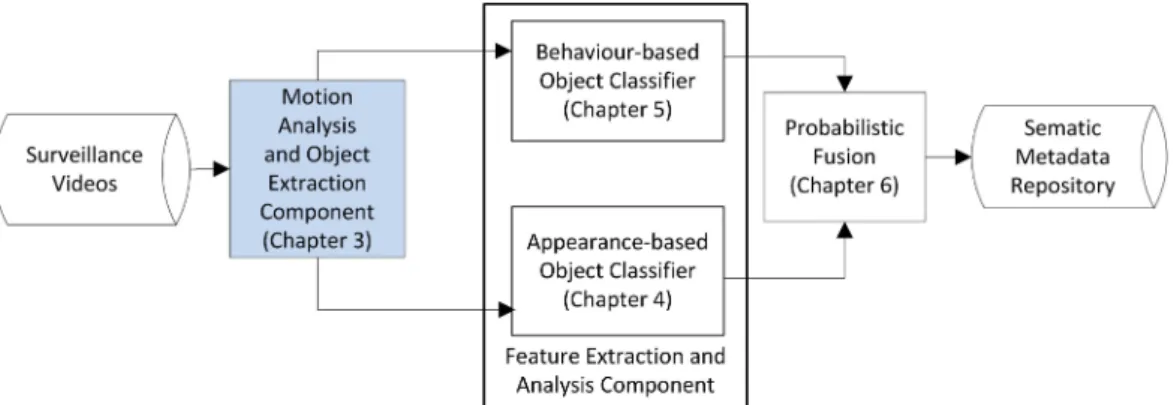
In accordance with the system framework (shown in Figures 2.1 and 2.2)4, the
proposed approach consists of three stages: Motion Analysis and Object Extraction Component 5, Feature Extraction and Analysis and Probabilistic Fusion Method.
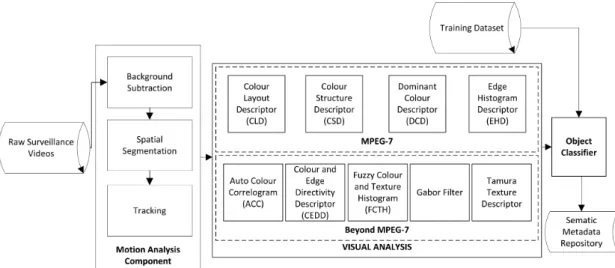
Raw surveillance videos are firstly processed by the Motion Analysis Compo-nent (refer to Chapter 3), in order to reduce the amount of information to analyse, facilitating subsequent stages and enabling a faster procedure. Raw surveillance videos are analysed for the extraction of moving objects6, their physical representa-tion and the spatio-temporal informarepresenta-tion associated to them. Consequently, Morepresenta-tion Analysis Component provides background subtraction, followed by object spatial segmentation and object tracking.
The Feature Extraction and Analysis component presents two parallel pro-cesses. On one hand, the appearance of the moving objects is analysed, extracting a set of low level features, to represent machine understanding; this process is ad-dressed by the Appearance-based Object Classifier. While, on the other hand, the moving objects’ behaviour is modelled using the spatio-temporal information pro-vided by the Motion Analysis Component, to represent human understanding; this process is addressed by the Behaviour-based Object Classifier.
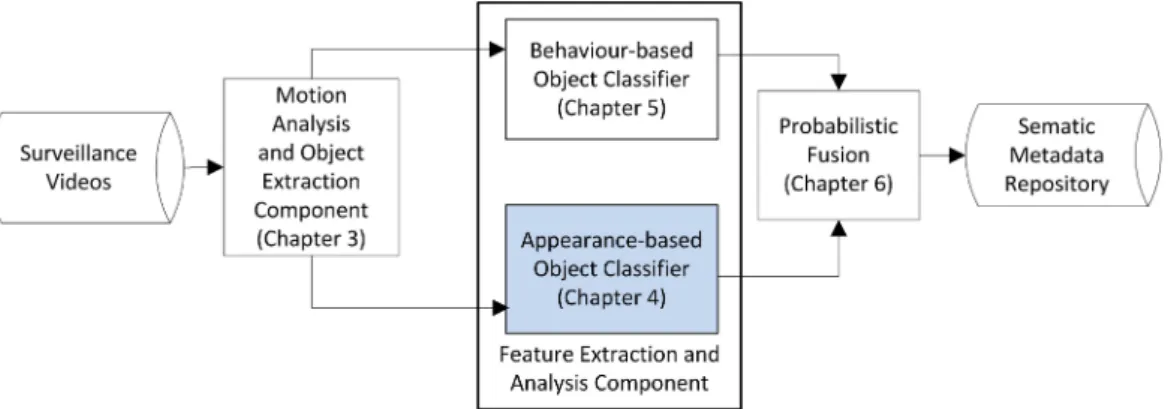
The Appearance-based Object Classifier (refer to Chapter 4) consists of the ex-traction of a set of well-known low level features and their optimal combination in order to obtain a compact, efficient and representative appearance model for each moving object detected within the surveillance video. Different low level features were analysed, including global and local descriptors. However, after an exhaustive analysis only four of them were selected due to their high distinctiveness, compact representation and significance for human perception. Those features are the follow-ing MPEG-7 descriptors 7: Colour Layout Descriptor, Edge Histogram Descriptor, Dominant Colour Descriptor and Colour Structure Descriptor. Each descriptor pro-vides specific information relative to the appearance of the moving object under analysis. In an attempt to generate a more robust and complex representation, different fusion techniques were studied. In our approach, a feature combination
4For the detailed Surveillance Media Management framework refer to Figure 2.1. For clarification
and simplicity, a more schematic framework of the Surveillance Media Management system is shown in Figure 2.2
5For simplicity and brevity along this thesis the Motion Analysis and Object Extraction Component
will be also referred as Motion Analysis Component (MAC)
6Each moving object detected within a surveillance video is represented by a set of samples called
blobs, which are geometrically defined by their bounding boxes.
7MPEG-7, Multimedia Content Description Interface, is an ISO standard which facilitates image
representation by using some image features such as the image dominant colour or its texture [185]. Moreover, MPEG-7 provides a simple and efficient numeric method to represent images through the usage of descriptors.
Figure 2.2: Scheme of the Surveillance Media Management System
technique named Multi-Objective Optimisation Technique is presented to optimally combine low-level features in order to build a multi-descriptor considering the non-linearity of the different descriptor spaces (refer to Section 4.2).
The Behaviour-based Object Classifier (refer to Chapter 5) replicates the human inference procedure generating a behaviour pattern for each moving object detected in the Motion Analysis Component. Our approach is based on the premise that psychological studies have shown that human beings can perform object classifica-tion using behaviour patterns 8, even in large viewing distances or poor visibility conditions where appearance features tend to disappear [73]. Consequently, four behaviour features are extracted in order to build behaviour patterns, namely shape ratio, size ratio, velocity and trajectory. The Behaviour Feature Extraction com-ponent, presented in Section 5.2.2, details the geometrical algorithms created for the extraction of the behaviour patterns. Finally, a scalable hierarchical rule-based fuzzy classifier, namely Behavioural Fuzzy Classifier, is proposed to classify moving objects according to the human inference procedure and human understanding (refer to Section 5.2.3).
A Probabilistic Fusion Method (refer to Chapter 6) based on Bayesian Net-works is proposed to merge the classification results provided by the Appearance-based and Behaviour-Appearance-based Classifiers. Combining the classification results provided by each approach, machine and human understanding are brought together to per-form automatic object classification for surveillance videos. The fusion of both levels of understanding provides a unique approach which benefits from the differences be-tween the knowledge procured by machines and human beings.
Despite the high relevance of each of the stages, the main novelties included in the Surveillance Media Management framework are located in the Feature Extrac-tion and Analysis component and in the Probabilistic Fusion Method. The former
8Behaviour pattern is considered as a description of the spatio-temporal evolution of a moving
object. This evolution would not only enumerate the coordinates of the moving object but would also highlight behaviour details which provide information about the object under analysis
extracts not only appearance features but also behaviour patterns to perform in-dividual classifications. While the latter bridges the semantic gap, combining the knowledge provided by machines and humans in an attempt to increase the object classification confidence and accuracy on surveillance datasets.
2.3
Summary
During this Chapter, the Surveillance Media Management framework was in-troduced to further describe the proposed automatic object classification technique built to provide semantic classification and indexing for forensic applications. The proposed SMM addresses automatic object classification as a fundamental prior step to build the foundation for semantic event detection, classification and index-ing. Furthermore, the SMM intends to increase the robustness and accuracy in the decision-making process by probabilistically combining inherent visual features and behaviour patterns of the detected moving objects. Consequently, the main objective of the SMM is to narrow the semantic gap, bringing together machine and human understanding, in an attempt to give an step forward towards smart surveillance systems.
In the following chapters, each of the stages mentioned in the previous Section are further described. Each module will be explained in an independent chapter, following the structure revealed in Figure 2.2. Each individual chapter presents a more specific literature review, a detailed description of the proposed technique, an evaluation of the conducted experiments, a set of extracted conclusions and a summary of the proposed techniques within the chapter. Moreover, the datasets and ground truth selected for the evaluation of each module is further described in Chapter 7.
In the next Chapter, the Motion Analysis and Object Extraction component is addressed (refer to Figure 2.3). More specifically, the proposed techniques for the detection, segmentation and tracking of the relevant moving objects appearing in raw surveillance videos are further detailed. The objective of this chapter is to reduce the amount of information to process focusing the analysis in the relevant information.
Figure 2.3: Motion Analysis and Object Extraction component in the Surveillance Media Management framework
Motion Analysis and Object
Extraction
Surveillance cameras have become pervasive in various spaces, prominently pub-lic spaces, recording 24/7. A large amount of information is captured daily and must be processed. However, information can be efficiently analysed only if the relevant information is isolated and extracted. Motion Analysis techniques address the segmentation of relevant objects included in surveillance videos based on their motion. However, moving objects include spatio-temporal information. In order to enhance the performance of any surveillance system, temporal information should be considered. Object tracking is performed to extract the spatio-temporal information of each individual moving object.
In this chapter, a detailed survey of the existing Motion Analysis and Object Tracking Techniques is presented (refer to Section 3.1). In Section 3.2, the presented Motion Analysis and Object Tracking techniques used in the Surveillance Media Management System are detailed; introducing the techniques applied to isolate and spatially segment moving objects and also to extract valuable spatio-temporal infor-mation of the detected moving objects for the posterior stages. This Chapter ends with a summary of the presented techniques and the information extracted for the subsequent stages (refer to Section 3.3).
3.1
Literature Review
In this section, a list of techniques commonly encountered in visual surveillance systems is presented. In general these techniques can be categorised into Motion Analysis and Object tracking. The former describes the existing motion detection and spatial segmentation techniques to reduce the amount of information to analyse, reducing the complexity of the posterior steps and procuring a set of blobs considered
relevant due to their motion within the video (refer to Section 3.1.1). While the latter presents recent object tracking techniques to study the temporal evolution of the relevant blobs in order to provide spatio-temporal information to subsequent stages (refer to Section 3.1.2).
In order to facilitate the understanding of this review, several concepts must be clarified. First, all the relevant objects for surveillance analysis which include spatio-temporal information are defined as moving objects. Each moving object appears in several temporally consecutive frames, each representation of the moving object is denominated as blob and its geometrical representation is called bounding box. Finally, when the moving object has been indexed and classified it is defined as a
semantic object.
3.1.1
Motion Analysis
Visual surveillance systems use fixed cameras providing videos with static back-ground. Each surveillance video contains an enormous amount of data, requiring exhaustive analysis. To reduce the analysis complexity, the motion detection stage consists of spatially segmenting the moving objects which contain relevant informa-tion from the rest of the frame. To facilitate subsequent steps, background-related information removal is required, relieving difficulties in the posterior analysis stage. In the literature, motion detection algorithms are commonly categorised into envi-ronmental modelling and motion segmentation. Candamo et. al [36] proposed a motion detection classification which grouped algorithms in three categories, back-ground subtraction, temporal differencing and optical flow.
Background subtraction is the dominant object spatial segmentation strategy. Background subtraction techniques generate a pixel-wise mathematical model to represent the background. Each frame of the video is compared with the simu-lated mathematical model so the foreground can be extracted. Consequently, the extracted foreground is composed of all the pixels or group of pixels with significant differences between the modelled background and the current image, considering them as moving blobs. Several challenges must be faced by background subtraction algorithms to protect the accuracy of the subsequent steps, for instance, changes in illumination, waving trees, camouflage, bootstrapping, sleep/walking person or shadows [204] (for further details related to background subtraction challenges refer to Appendix 9.2). The most well-known background subtraction algorithms include methods by (i) Heikka and Silven [88] where the background model was updated using a recursive filter and monitored the changes in activity during a few consec-utive frames to eliminate pixels with random performance. The use of a recursive
filter enabled the adaptation to slow changes in the lighting whilst monitoring each pixel performance provided robustness against waving trees effects. (ii) Stauffer and Grimson [191] proposed modelling each pixel as a mixture of Gaussians and using an on-line K-means approximation to update the model. Each pixel was classified based on whether its Gaussian distribution suited the background model most ef-fectively or not. Such estimation was robust against changes in illumination, slight sensor movements, noise and long-term scene changes. (iii) Halevy and Weinshall [86] linearly subtracted the temporal average of the previous frames from the new frame adjusting the model to slow changes in the image. (iv) Cutler and Davis [58] calculated a background model based on each pixel 1-D temporal median over N
frames. (v) Toyama et al. [204] segmented foreground objects applying pixel-level Wiener filtering to make probabilistic prediction about the expected background, a frame-level component ensured its accurate performance against global changes and swaps in the image. (vi) Cheung and Kamath [54] presented a slow adapting Kalman filter in conjunction with statistics based on an elliptical moving object mo-del to momo-del the background over time. A detailed review of background subtraction techniques can be found in [158].
Temporal differencingis based on temporally local events. The procedure consists of establishing a sampling period to separate video frames and calculate pixel-wise differences between consecutive sampled frames to locate changed regions. Temporal differencing algorithms adapt to dynamic environments but cannot extract all the relevant pixels [93]. Due to such a disadvantage, few approaches performed motion detection based on temporal differencing [119, 126], instead hybrid approaches based on a combination of temporal differencing and background subtraction have been presented providing more robust segmentation techniques [56].
Optical flow estimates motion in video by matching points on objects over time to detect moving regions in an image sequence. Optical flow based methods provide invariance to camera motion and robustness against simultaneous objects and cam-era movement, enabling the analysis of crowds and dense motion situations [126]. However, most optical flow calculation methods are computationally complex and sensitive to noise. A detailed list of commonly used optical flow-based techniques is presented in [36].
3.1.2
Object tracking
Once spatial segmentation has occurred and several moving blobs per frame have been detected, surveillance video systems require a further step, object tracking, to
establish the segmented blobs temporal evolution and to focus the subsequent analy-sis on the essential information. Tracking blobs over time conanaly-sists of matching such blobs in consecutive frames using representative features such as points, lines or blobs [227]. Object tracking algorithms can be classified depending on the features used to match the blobs within a video sequence. In the following paragraphs, a classification of the different existing tracking algorithms based on their moving ob-ject representation is presented. A detailed survey on this topic can be found in [226].
Tracking algorithms based on point detectionfocus the matching on informa-tion related to the blob posiinforma-tion and movement. In general, point representainforma-tion for tracking is suitable for objects that occupy small regions in an image. Occlusions, misdetections, entries and exits of objects affect point correspondence hindering ob-ject tracking. Numerous approaches use point representation, categorised into two strategies, deterministic and statistical. The former uses qualitative motion heuris-tics to reduce the correspondence constraints [183]. While the latter, considers object measurements such as position, velocity or acceleration rate to create a statistical model. The most well-known model prediction techniques are based on (i) Kalman filters [168], (ii) particles filters [132], (iii) joint probabilistic data association filters [165] and (iv) multiple hypothesis tracking [97].
Kernel-based tracking techniquesassociate different blobs calculating the kernel movement over the frames of the video. Kernel-based techniques are typically classi-fied into model-based and multiview. The former, model-based techniques, achieves blob matching by performing an exhaustive search of a template over a whole frame [177] or modelling the blobs appearance within the frame [57]. Ease of implementa-tion and low computaimplementa-tional cost have enhanced these techniques proliferaimplementa-tion. The latter, multiview techniques, trains algorithms with different views of a blob to dif-ferentiate them. The most well-known approach appliedsupport vector machines to distinguish and track an object [14].
Object trackers based on silhouette represent blobs using models of the shape and density of their appearance. The existing techniques are classified into two types depending on their matching algorithm, silhouettes matching and outline evolution. The former,Silhouette matching techniques, compares all existing shapes in a frame with the query’s shape. Silhouettes are rigid features, however, an objects silhouette evolves over time. In order to facilitate the matching, silhouettes are recalculated at particular time periods. Some examples of these techniques are the algorithms presented by Huttenlocher [98] and Haritaoglu [87]. The latter, Outline evolution
Figure 3.1: Framework of the Motion Analysis and Object Extraction Component
techniques, represents each blob by their outline. Unlike silhouettes matching, out-lines are dynamic and evolve according to the blob’s energy to a range of possible states. Some examples of these techniques are the algorithms suggested by Chen [50], Bertalmio [22] and Yilmaz & Shah [227].
3.2
Motion Analysis and Object Extraction
Com-ponent
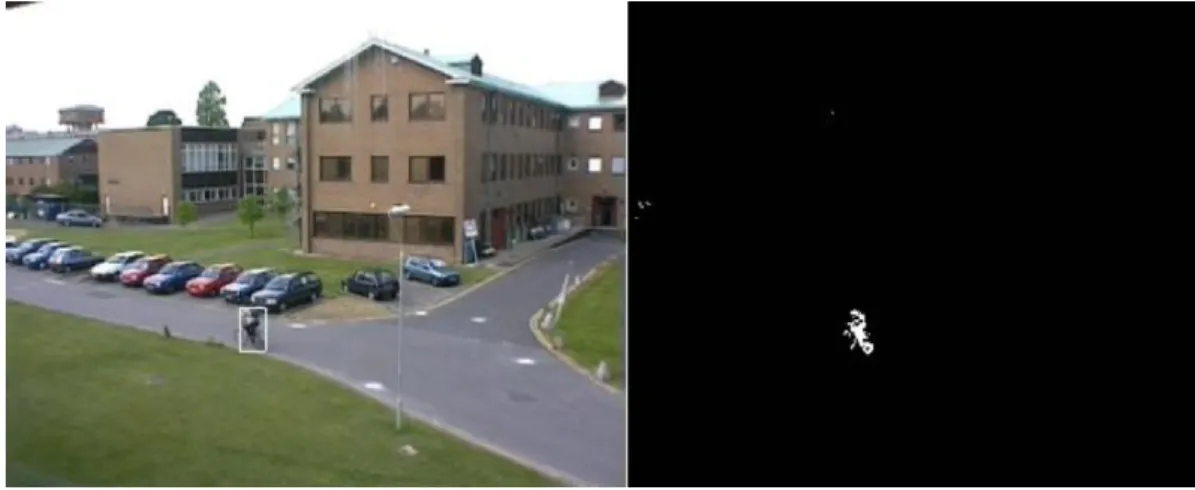
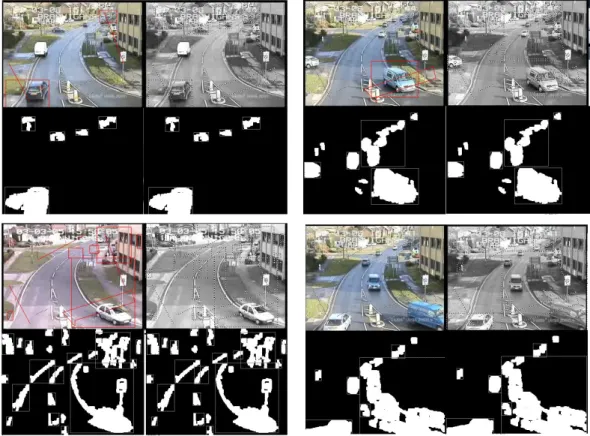
Surveillance videos contain an enormous amount of redundant information, as the scene background remains constant or quasi constant in time. Due to the static back-ground information present in the videos, practical analysis of surveillance videos includes the elimination of background and the extraction of the foreground objects. In order to select the relevant information contained in surveillance videos, our ap-proach removes the irrelevant information belonging to the background, segments the foreground and tracks the moving objects appearing within the surveillance videos following the procedure shown in Figure 3.1.
In the following sections, each stage involved in the Motion Analysis and Ob-ject Extraction Component will be explained in further detail, starting with the generation of an adaptive background model. However, as shown in Figure 3.1, a
pre-processing step, prior to the background modelling, resizes the surveillance raw video to normalise the video analysis.
3.2.1
Background modelling
Stauffer and Grimson [190] presented a segmentation scheme which separates the foreground from the background of an image by modelling the background as a mixture of Gaussians. In fact, this process considers as foreground all the moving objects, while all the stationary objects belong to the background.
Stauffer and Grimson [191] calculated the pixel probability to belong to the foreground or the background, according to the intensity and colour distribution of a pixel in an image. Such a decision was taken due to the direct relation between pixel intensity and colour distribution and the lighting and reflectance properties of the pixels’ object.
Our aim within this stage consists of the calculation of a mathematical back-ground model, based on the Stauffer and Grimson approach [190], in order to pro-vide an adaptive background subtraction technique which propro-vides the necessary robustness against external factors, such as changes in illumination, camouflage or other problems which directly affect to background subtraction techniques (refer to Appendix 9.2). Moreover, modelling each pixel as a mixture of Gaussians is an ef-fective approach to separate the background and foreground which can be used for real-time tracking, providing an enormous advantage for surveillance applications.
Each pixel of the background model is patterned as a weighted mixture of Gaus-sians. Moreover, each pixel is classified into foreground or background, according to the persistence and variance of each of the Gaussians of the mixture. Thus, pixel values that do not fit the background distributions are considered part of foreground. In fact, the recent history of each pixel,Xtis modelled as a mixture ofKGaussian
distributions, and the probability of observing the current pixels value is:
P(Xt) = K
X
i=1
ωi,t·η(Xt, µi,t, i,t) (3.1)
where K is the number of distributions that models each pixel value; ωi,t is an
estimate of the weight that i Gaussian distribution has in the mixture at time t
(these values adjust over time); µi,t is the mean value of the i Gaussian in the
mixture at time t and i,t is the covariance matrix of thei Gaussian in the mixture
at time t. Finally, η is a Gaussian probability density function.
When a new pixel sample is obtained, firstly, the pixel classification procedure searches for the Gaussian mixture distribution that explains its value with the higher accuracy. Subsequently, the Gaussian distribution is compared (and later thresh-olded) against all the existing Gaussian distributions that model the background pixels, until a match is found. In this process, a match is defined as a pixel value within 2.5 standard deviations of the checked distribution1. However, if none of the
available Gaussian distributions match the current pixel value, the model is adapted and the least probable distribution of the model is replaced with the distribution that best explains the current pixel value2.
Once the pixel has been classified as part of the foreground or background, its
12.5 standard deviations was a measure calculated by Stauffer and Grimson in [190]. Moreover,
such a measure directly affects background subtraction. Reducing that measure would make the system less robust against noise, while increasing it could cause some object loss, since they would be considered as noise
2Such distribution replacement consists of substituting mean values, initial high variances and low
model needs to be adjusted as well as all the Gaussian distributions which com-pose its model. In fact, such adjustment would be applied only over the weights that accompany each Gaussian distribution, and depends on the result of the pixel classification:
ωk,t= (1−α)·ωk,t−1+α(Mk,t) (3.2)
where α is the learning rate and Mk,t is the result of the pixel classification. For
instance, Mk,t is 1 when the model is matched and 0 otherwise.
During the model adaptation stage, each Gaussian’s average and variance must be also adjusted. In fact, those parameters remain the same when the distribution is not matched, but when it is matched, the new observation must be considered within their values.
The main advantage of adaptive background modelling is the improvement in the background modelling robustness against external changes. Consequently, the method addresses the inclusion in the background model of new static objects as well as dealing with sleeping/waking objects (refer to Appendix 9.2).
3.2.2
Object detection
Once the pixels have been distinguished as belonging to either background and foreground, another step must be provided in order to segment objects. This step consists of grouping foreground pixels using a technique named connected compo-nents.
Each pixel of every frame has a label assigned. The label is zero when the pixel has been classified as background, and an integer otherwise. Connected components consists of scanning an image’s labels and grouping its pixels into components based on pixel connectivity. Regarding the presented approach, a two-pass connected component analysis algorithm is applied assuming an 8-neighbour connection. In fact, the connected components labelling operator scans the image by moving along a row until it comes to a point where the pixel has been classified as foreground by the adaptive background subtraction (refer to Section 3.2.1). Then, its four neighbours that have been already scanned are examined, and two difference circumstances may take place:
• All the previously scanned neighbour’s label is zero, and therefore, belong to the background. In such case, a new label must be assigned to the current pixel.
• At least one of the neighbours belongs to the foreground, then its same label is assigned to the current pixel.