Addressee
backchannels
steer
narrative
development
Jackson
Tolins
*
,
Jean
E.
Fox
Tree
*
PsychologyDepartment,SocialSciencesII,UniversityofCalifornia,SantaCruz,CA95064,UnitedStates
Received29January2014;receivedinrevisedform10June2014;accepted16June2014
Abstract
Brief addressee responsessuch asuh huh, oh, and wow, which are called backchannels, are typically considered reactive
phenomena--devicesthatrespondinvariouswaystowhatwasjustsaid.Addressees,inprovidingbackchannels,activelyshapestory
tellinginspontaneousdialogue(Bavelasetal.,2000).Wecontrastedgenericbackchannelswithcontext-sensitivespecificbackchannels
withinacollection offace-to-face dialoguesandinanarrativecompletionexperiment.Theanalysisdemonstratesthatstorytellers
respondindistinctpatternstothetwocategoriesofbackchannels.Aftergenericbackchannels,theyprovidediscourse-newevents.After
specificbackchannels,theyprovideelaborativeinformationonpreviouslypresentedevents.Resultsfromanexperimentsupportthis
analysis,indicatingthatpeoplereadingtranscriptsoftheconversationpredictasimilarpatternofstorycontinuationfollowinggeneric
versusspecificbackchannels.Weconcludethataddresseeresponsesarenotonlyreactive,butproactiveandcollaborativeinthe
shapingofnarrative.
©2014TheAuthors.PublishedbyElsevierB.V.ThisisanopenaccessarticleundertheCCBY-NC-NDlicense(http://creativecommons.
org/licenses/by-nc-nd/3.0/).
Keywords:Backchannels; Dialogue; Narrative; Addressee; Collaborative language
1. Introduction
Whenpeopletellstoriestoone another,asiscommonin spontaneousconversation, oneconversationalpartner
frequentlyspeaks forextended periods,duringwhich theother interactantcan,and oftendoes,providea varietyof
commentsonthestory.Thesebackchannelsincludeverbalresponses,such asyeah,oh,okay,ormhm,andvisual
displays,suchasfacialexpressions,nods,andgestures(BavelasandGerwing,2011;Bertrandetal.,2007;Yngve,
1970).Transcript(1)presentsanexamplestorytelling,inwhichastudent,S2,describedacinemacoursethathewas
enrolledin.AsS2describedamovie-watchingeventtohisaddressee,S1,S1activelyparticipatedintheinteraction,
providingthreeinstancesofverbalbackchannels,inlines7,10,and13(alltranscriptsareofspeechcollectedinour
laboratoryandarepresentedinbroadJeffersoniantranscription).
(1)
1 S2: WewatchedamoviecalledChunKingExpresslastnight
2 S1: Ohya:.I’ve-=
3 S2: =Itwascrazyness
4 S1: Didyoulikeit?
5 S2: Itwaski:ndofintensethey-theysetitupi:nlike-howit’slikemeant
www.elsevier.com/locate/pragma
Availableonlineatwww.sciencedirect.com
ScienceDirect
JournalofPragmatics70(2014)152--164
* Corresponding authors. UC, Santa Cruz, 1156 High St., Santa Cruz, CA 95064, United States. Tel.: +1 612 802 9067; fax: +1 831 459 3519.
E-mailaddresses:[email protected](J.Tolins),[email protected](J.E.FoxTree).
http://dx.doi.org/10.1016/j.pragma.2014.06.006
0378-2166/© 2014 The Authors. Published by Elsevier B.V. This is an open access article under the CC BY-NC-ND license (http://
6 tobewatchedsoitwaslike<36millimeter>orsomethinglikethat
7 S1: Mhm
8 S2: Andifyoudoitlikethatyougottadolikeallthedifferentreelsand
9 yougottaconnect.u:m
10 S1: Mhm
11 S2: Ithinktheylikeleftoutareelorsomethingcausethemovielike
12 comple:telydidn’tmakesenseatall[andwasall
like-13 S1: [Really
Fromaunilateralperspectiveonlanguageprocessing,inwhichcomprehensionandproductionareseenasdistinct
andisolatedprocesses,backchannelsarelikelytobeviewedasunnecessary,oratbestsuperfluous.Indeed,anumberof
studiesofbackchannelshaveusedoptionalityasakeydefinitionalcriterion(e.g.WardandTsukahara,2000).Typically,
researchinthisveinhasfocusedonbackchannelsasameansofsignalingturntakinggoals--specifically,asameansto
avoidtakingoverthefloorfromthecurrentspeaker.Thishasleadtoaviewofbackchannelsassupportive,butnotcentral.
Theyare,inessence,asecondarymessage,asthelabelbackchannelimplies.Inthisconceptualization,backchannels
have also been referred to as reactive tokens (Clancy et al., 1996), response tokens (Gardner, 2001), and
accompanimentsignals(Kendon,1967).Addresseesareseenaspassiverecipientsofinformation,withbackchannels
beingusedtodisplayaddressees’acceptanceofspeakers’plannedmulti-turnutterances.Wewillrefertotheoriesof
backchannelswithintheseparadigmsasreactivebackchannellingtheory.
Another conceptualization of backchannels isthat they are central to conversational success,demonstrating the
producer’sactiveparticipationinnotjustturntaking,butinthedevelopmentofthespeaker’stalk.Indialoguefocusedonjoint
activitiessuchasreferentialcardtasksorbuildingmodels,backchannelsserveasprojectmarkersofparticulartypes:
acknowledgementtokens,agreementtokens,orconsenttokens--eachofwhichmakesdifferentcommentsontheongoing talk (Bangerter and Clark, 2003). Acknowledgement tokens such as uh huh recognize what the speaker said as a
contributiontotheconversation,agreementtokenssuchasrightindicatealignmentwiththespeaker’sposition,andconsent
tokenssuchasokayindicateagreementtoajointplanofaction.Byprovidingaparticulartokenataparticularpointinthe
interaction,theaddresseeactivelysteerstheongoingcollaborativetaskinaparticulardirection.Aspeaker’sroleinvolvesnot
onlytalking,butactivelymonitoringaddressee’sbackchannelcommunicationsasameansforalteringhisorherowntalkina
preciselytimedmanner(ClarkandKrych,2004).Inthisconceptualization,addresseesareactiveparticipantsinthejoint
constructionofspontaneouslydevelopingdialogue,whichwewillcalltheproactivebackchannellingtheory.
Fortheproactivebackchannellingtheory,addresseebehaviorsareactivelyinvolvedintheunfoldingactivity.Atthe
same time,speakers actively monitor addresseesfor theseresponsesand adjust theirtalk accordingly (Clarkand
Murphy,1982;ClarkandKrych,2004).Thisholdstruenotonlyforexplicitlytask-orienteddialoguesbutnarrationaswell.
Storytellersmaytakeuptheiraddressees’backchannelsinanumberofways,ratifyingandincorporatingtheseresponses
intothedevelopmentofthenarrative(Norrick,2010a,b,2012).Whenaddresseeresponsesarecontrolledexperimentally,
thetypesofbackchannelsprovidedtothespeakershapethenarrativecontent(Bavelasetal.,2000).Indyadswhere
addressees did not provide context-specific assessments such as wow or nonverbal displays such as grimacing,
speakerstoldqualitativelyworsestorieswithsignificantlylessclimacticendings.Inasimilarstudy,addresseeaffective
displays,suchassmilingorfrowninginresponsetothespeaker,modulatedthelevelofabstractlanguagepresentinthe
speaker’stalk(Beukeboom,2009).Soinbothexplicitlygoal-directed,object-orientedtasksandinnarrativestorytelling,
backchannelsfunctionbeyondsimplyrespondingtoprevioustalkorsignalingacceptanceofaplannedmulti-utterance
speakerturn.Instead,addresseebehaviorsareinvolvedinthemoment-by-momentcollaborativeproductionoftalk.
Thepresentreportextendsthestudyofthe proactiveroleofbackchannelsin co-telling,focusingonspontaneous
narratives occurring in the context of face-to-face conversation. From an inductive and qualitative analysis of
conversation,weestablishspecifichypothesesabouttherelationbetweenbackchanneltypesandspeakers’continuing
talk,whichwethentestusinganexperimentalparadigm.Whiletheinfluenceofbackchannelsonspeakertalkhasbeen
previouslyexploredatamoregloballevelofnarrativeanalysis(Bavelasetal.,2000;Beukeboom,2009),thecurrent
in-depth analysis of conversational sequencescoupled withexperimental findings show howbackchannels affect the
discourse-leveldevelopmentofthedirectlysubsequenttalk.
2. Perspectivesonbackchannels
The studyof backchannel communicationstrategieshasa long history (see e.g.Dittmann and Llewellyn,1986;
DuncanandFiske,1977;Fries,1952;Yngve,1970).Acrossthisliterature,continuedresearchhasbeenmotivatedbyan
interest in what typesof informationbackchannels provide. Research onbackchannel communication hasfocused
primarily on two aspects, functional distinctions between different categories and the organized placement of
2.1. Function
Thefirstveinofresearchspansavarietyofparadigmsinvestigatingdifferencesinwhatbackchannelsdisplay.One
categoricaldistinctionisbetweenspecificandgenericbackchannels(Goodwin,1986;Bavelasetal.,2000),alsocalled
assessmentsandcontinuersrespectively(Goodwin,1986;Stivers,2008).Specificbackchannels,suchasohwow,are
contextsensitiveinthattheyexpressaddressees’responsestothecontentofthepreviousturn.Genericbackchannels,
suchasuhhuhoryeah,respondnottothecontentoftheprevioustalk,butrathertotheneedtodisplayunderstandingand
continuedattentiontothespeaker.
Ofcourse,itispossibletoproducegenericbackchannelssothattheyimplycommentaryontheprecedingutterance:
imagineproducinguhhuhwithanelongatedvowelorriseinpitch(cf.TomlinsonandFoxTree,2011)orsayingyeahwith
atoneofuncertaintyorenactedsurprise.Weproposethatinthesecases,theaddedintonationalinformationchanges
whatisgenerallyconsideredagenericbackchanneltotakeonthemeaningofaspecificbackchannel.Withouttheadded
prosodiccues (orpossiblyother kindsofcues,such asvisualcues)the genericbackchannelswould serveonlyas
groundingdisplaysratherthancommentary.
BangerterandClark(2003)presentedasimilarfunctionaldistinctiontothegeneric/specific,continuer/assessment
distinctions.Theyfocusedon backchannelsasprojectmarkersused tocoordinatetransitionsacross jointactivities.
Throughtheanalysisoftask-orientedcollaborativedialogueinwhichtheinteractantsaccomplishedasetofhierarchically
nestedtasks,theyfoundthatbackchannelslikeuhhuhdidnotdemonstratethattheaddresseedidnotwishtotakeaturn.
Instead,theydisplayedtheaddressee’sacknowledgementofaspeaker’stalkasproposingorcontinuingaparticularjoint
action. This function is contrasted with other backchannels, such as okay and alright, which primarily marked the
completionandtransitionoutofaparticularjointprojectorsubproject.Importantly,theperspectivehereisnotoneof
structuringtheorganizationoftheconversationitself,butratheranalyzingthedialogueasameansthroughwhichjoint
activitiesareaccomplished.
Together,thesestudiesillustratethevarietyoffunctionalperspectivestakentowardbackchannelcommunication,and
thecategorical distinctionsbased onactions achieved,cuttingacrosstypeand modality.Indeed,backchannelsmay
accomplishmanythingsatonce,atdifferentlevelsofanalysis.Brunner(1979)suggeststhreeinhisanalysisofsmilesas
backchannels: (1) backchannels signal involvement and participation in a joint activity, (2) backchannels signal
understanding,orlackthereof,and(3)backchannelssignaltheaddressee’saffectiveorinformationalresponsetothe
speaker’stalkandaffiliationwiththespeaker’spresentedstance.Hefurtherdemonstratedthatsmilesaccomplishactions
atall three levels.Similarly, Clarkand Krych (2004) suggestedthat backchannelswereused to displayaddressee
uptakeatfourlevelsofjointaction(Clark,1996):(a)attending,(b)identifying,(c)understanding,and(d)compliance.
Attendingandidentifyingaresubsumedin comprehension,consisting ofdisplayingattentionand wordidentification.
Understandingand compliancerepresenthigherlevelsbuilt onthefirst,representingintegrationofmeaninginto the
discourseandcontext,andtheacceptanceoftheproposedconversationalactionofthespeaker’stalk.Inlinewithmuch
priorresearch,wetakegenericbackchannelsassignalsofparticipationandunderstanding,andspecificbackchannelsas
signalsoftheaddressee’sstancetowardthecontentofthespeaker’stalk.
2.2. Placement
Thesecondveinofresearchcentersoninvestigationsofwherewithinthespeaker’stalkbackchannelsoccur.This
perspectiveisdrivenbyafocusonturntakingandthestructuralorganizationofinteraction.Whateverthefunctionalroleof
aparticularbackchannel,eachisseenasimportantinthemanagementofselectingwhowillspeaknext(Sacksetal.,
1974).Followingfromthisparadigm,researchhasalsobeenconductedwiththegoalofprovidingananalysisofwhat
cueswithinthespeaker’stalk--whetherprosodic,syntactic,orembodied--actasinvitationsfortheaddresseetoprovide
abackchannel(seee.g.Koisoetal.,1998;Morencyetal.,2010;Bavelasetal.,2002).
Inconsideration ofturn-taking andrelatedphenomena, backchannelshave beenviewedas markersinvolved in
indicatingwhichparticipantswithinaconversationmayholdthefloornext(Duncan,1972,1974;DuncanandFiske,1977;
Sacksetal.,1974).Becauseoftheirinvolvementinthesequentialorganizationofaconversation,backchannelsaresaid
tooccurtypicallyatplaceswhereintransitionfromonespeakertothenextisparticularlyrelevant,transitionrelevance
places(Sackset al.,1974).Here againdifferences between genericand specificbackchannelsare present.In his
analysis comparing the sequential organization surrounding backchannels, Goodwin (1986) presented examples
indicatingthatwhilecontinuersoccurbetweentwounitsoftalk,assessmentsmostcommonlyoccurwithinasingleunit,or
turn,ofspeakertalk.Asdisplaysofcontinuedattention,backchannelssuchasuhhuhandmhmwereviewedasan
addressee’sexplicitagreementthatthecurrentspeakercanengageinamulti-turnutterance(Schegloff,1982).
Anextensionofthisemphasisonturncoordinationhasbeentheanalysisofcueswithinaspeaker’stalkthatinvite
backchannels.DuncanandFiske’s(1977)signal-basedtheoryofturntakingconsideredfeaturesinthespeaker’stalkthat
considerationasrequestsforbackchannelsarethosethatoccursystematicallyattheendsofturns.Forexample,Ward andTsukahara(2000)focusedonaperiodoflowprosodyfoundattheendofutterancespriortoaddresseeresponsesin
bothEnglishandJapanese.Similarly,syntacticcuesthataretakenasinvitationsofbackchannelsaretypicallythosethat
marksyntacticstructuresascompletesuchasthepartofspeechoffinalmorphemes(Koisoetal.,1998).Becauseofthe
focusonfindingparticularlocationswithinspeakertalkinwhichbackchannelsoccur,categoricaldistinctionsacrosstypes
ofbackchannelsinrelationtoparticularspeakercueshavenotbeenemphasized.
Onepotentiallyproblematicaspectoftheturn-managementfunctionisthatwhatmakesabackchannelabackchannel
mayonlybedeterminedin retrospect,oncethe conversationhasconcluded.Logically,whileitisbeingproduced,a
backchannel couldbethe start ofa turn, as illustratedtranscript(2).Transcript (2)wascollected duringa tangram
referentialcard taskin whichtwoparticipantsworkedtogetherto negotiatedescriptionsforabstract shapes(corpus
describedinFoxTree,1999).AsS3describedwhichofthreecatsS4shouldselect,S4respondedwithbackchannelsin
lines17,19,and21.
(2)
14 S3: okIthinkI’vegotthreethatlooklikecatstoou:mlikeone’sacat
15 that’skindalyingdownandoneacatthat’sstandingupandone’s
16 acatthat’s<kindof>threeforty-fivedegreeangle?
17 S4: uhhuh
18 S3: ’stha’right?
19 S4: yup
20 S3: wellthisistheonethat’skindofforty-fivedegreeangle
21 S4: okay
22 S3: sortofsortofstandingupandbendingover?
23 S4: yeah
Withthissnippetoftheconversation,S4’syeahinline23appearsasifitmaybeabackchannel.Thatis,asthetalkis
unfolding,atthemomentS4’syeahisspoken,S3mightreasonablyhearitasabackchannelandcontinuetalking.Had
thishappened,line23wouldbeconsideredabackchannel.Whatactuallyhappened,however,isdisplayedin(3).
(3)
22 S3: sortofsortofstandingupandbendingover?
23 S4: yeah,likelookingatsomething?
24 S3: yeah!exa-witheyeslikeit’slookingatyou
25 S4: nkay
Asimilarargumentwasmadebyotherresearcherswhoobservedthatturn-managementfunctionsfrequentlyascribed
tosomespontaneouslyproducedphenomenamaybeepiphenomenaofotherfunctions.Forexample,FoxTreeand
Schrockwrote,‘‘YouknoworImeanmayfallatthe beginning,middle,orendofaturnforreasonsunrelatedtoturn
management’’ (2002:732).Others gofurther in arguing that turn-taking rulesthemselves have not beensufficiently
substantiated. O’Connell,Kowal,and Kaltenbacherargued,‘‘The retrospectiveassertion thatNpositionsin a given
conversationareTRPs[transitionrelevanceplaces],(i.e.,weresomehowrelevantforturn-taking),where,letussay,
N34havebeenusedfortakingturns,isameaninglesspostfactumintellectualexercise’’(1990:351)andthat‘‘Kinesics,
prosody,content,knowledgeandattitudeoftheinterlocutorsaboutthetopic,aboutoneanother,andaboutthesituation
--allthesesituationalelementscanchangethedirectionandpaceofturn-takingfrommomenttomoment.Neglectofthem
rendersthesimplestsystematicscompletelysterile’’(1990:360).
Inaddition,mostapproachestotheplacementofbackchannelshavefocusedonverbalbackchannels,andparticularly
shortsinglewordtokens,whicharemuchmorelikelytooccurinplacesthatdonotoverlapwiththespeaker’stalk,thus
emphasizingtheirroleinturncoordination.Whenweexpandournotionofbackchannelcommunicationtoincludenon-verbal
behaviorssuchassmiles,nods,oraffectivedisplays,weseethatbackchannelsalongthesemodalitiesdonotadheretothis
strictpattern.Inananalysisofaddresseefacialcontributionsindialogue,suchasraisingeyebrowstoindicatesurpriseor
grimacingtodisplayaresponseappropriateforthespeaker’sdescribedsituation,Bavelasandcolleagues(Bavelasand
Chovil,1997;Bavelasetal.,2002;BavelasandGerwing,2011)demonstratedthatthistypeoffeedbackdidnotfitthe
turn-coordinatingdefinitionofbackchannelsasoccurringtypicallyattransitionrelevanceplaces.Theygosofarastosuggest,
‘‘the fact that addressees’ facialcontributions are usuallysimultaneous with the speaker’s speechraises interesting
questionsabouttheutilityandviabilityoftheconceptof‘turntaking’’’(BavelasandGerwing,2011:190).
Ouranalysisandexperimentwillfocusonfunctionratherthanplacement.Forboththecollectionofexamplesandthe
overlapwithspeakers’talk,allowedforamanipulationofthestimulusmaterialinwhichabackchannelfromonecategory
wasremovedandreplacedwithanotherfromtheothercategory(forexamplewheregenericyeahoccurredinthefirst
condition, the specific wowoccurred in the second). This manipulation allowed us to test the effect of categorical
distinctionsofbackchannelswithinidenticalnarrativecontexts.
2.3. Backchannelslookingforward
Within previous research, of both function and placement, the primary focus has been on relating a particular
backchannel to the speaker’s previous talk. In so doing, researchers have drawn attention away from the role
backchannelsplayinthecontinuing,unfoldingtalkinamulti-turnutterance,orhowthespeakermighttakefeedbackinto
accountastheycontinuetheirtalk.Incontrastwiththeseparadigmsofresearch,anumberofstudieshavedemonstrated
thatspeakersincorporatefeedbackintothedevelopmentoftheirtalk(Norrick,2012).
Bysystematicallyalteringwhichparticularmodalitieswereavailabletopairsengagedinajointactivity,researchershave
shown thatthe types ofbackchannels anaddressee provides, and wherein the course ofthe speaker’s talkthese
backchannelsoccur,isdependentonwhichcommunicationchannelsareavailableinaparticularcontext.Addresseeswho
listenedtoaspeakeronatelephone,forexample,weremuchlesslikelytoproducefacialdisplaysinresponsetospeaker’s
talk,relyinginsteadonverbalbackchannels(Chovil,1991).Similarly,inastudyontasksinvolvingphysicalworkspacesand
strictroleswithdirectorswhodidmostofthespeakingandmatcherswhoprovidedfeedbacktodirectors,matchersprovided
feedbacknotthroughverbalbackchannelsbutthroughtheiractions,andthisfeedbackwaslikelytobeinitiatedduringthe
director’stalkratherthanattheend(ClarkandKrych,2004).Speakersengagedinthisjointtaskactivelymonitoredthese
actionsasameanstoincrementallyadjusttheirspeechastheywouldverbalbackchannelsinothertasks.
Experimentalstudiesthathaveexploredtheroleofbackchannelsinmodulatingspeakers’moment-by-momenttalk
havetypicallydonesobyhavingpairsparticipateinhighlystructuredtasks,involvingclearlydelineatedgoalsandroles
(e.g.ClarkandKrych,2004).Thismethodincreasescontroloverthedialogueandreducesvariation(Bavelas,2005).
Thereareindeedcleardistinctionsinthetypeoflanguageused,includingbackchannels,dependingonthesituational
context.BangerterandClark(2003),forexample,comparedtasksettingswithinformalconversationandfounddistinct
patternsofusefordifferenttypesofbackchannels,includinggenerics.
Withinacollaborativeaccountoflanguage,allcommunicationisajointprojectinwhichthetwointeractantsseekto
accomplishthegoalofsocialsharingtogether(Bavelasetal.,2000).Thisistrueevenofnarrations,suchasstorytellingor
gossip,inwhichonespeakerislikelytoholdsoleaccesstotheinformation.Backchannelsshouldthereforeplayasimilar
roleinstructuringtheongoingactivityandinfluencingthespeaker’stalkastheydoinexplicitlytask-orienteddialogue.
Indeed,fromamoreglobalnarrativeperspectiveithasbeenshownthatthetypeandquantityofbackchanneltokens
provided by the addressee influenced the structure and quality of speakers’ narratives (Bavelas et al., 2000).
Backchannelsdisplayinguptakeofthestorycontent,suchasmarkersofinformationstate(oh;Heritage,1984;Norrick,
2010b)and assessments(wow;Goodwin, 1986),are likelyto berespondedto explicitlyby speakersin the directly
subsequenttalk(Norrick,2010b).Yettobeexploredhoweverishowaddresseebackchannelssystematicallyinfluence
theunfoldingstructureofanarrative.
3. In-depthanalysisofgenericandspecificbackchannelsinspontaneousdialogue
Following a perspective emphasizing the collaborative nature of dialogue as joint action, we analyzed how
backchannelsusedinunstructuredconversationsshapethespeaker’scontinuingtalkinsystematicpatterns,focusingon
discourserelationshipsbetweenturnsbeforeandaftertargetbackchannelsinanaudiocorpusofspontaneousdialogue.
ThecorpusconsistsofconversationsbetweenpairsofundergraduatestudentsattheUniversityofCalifornia,SantaCruz.
Studentsparticipatedin thecollectionofthe conversationsinreturnforcourse credit.Conversationswere12min in
length.Theseunstructuredandlooselytopicaldialoguesbeganwithparticipants’discussingbadroommateexperiences
theymayhavehad,butsubsequentconversationwasnotcontrolled.Participantstypicallytookturnstellingstoriesof
previous experiences with roommates, allowing for the collection of a variety of backchannels in the context of
collaborative narration. Thirty conversations from this corpus were reviewed in total, with 20 one- to two-minute
interactionsselectedforin-depthanalysis,focusingonthemoment-by-momentcollaborativeconstructionofthedialogue
throughtheactiveandovertparticipationofbothspeakersandaddressees.
3.1. Genericbackchannels
Aspreviousliteraturesuggests,genericbackchannelsinthiscorpusweretypicallytakenasdisplaysofcomprehension
andcontinuedattention.Acrossanalyses,genericbackchannelsareviewedasindicationsthattheprevioustalkhasbeen
Goodwin,1986;Schegloff,1982).Importantly,aftergenericbackchannelsspeakerscontinueinasystematicway.In
task-orienteddialogue,inwhichprojectsaredividedintoahierarchyofjointactions,genericbackchannelsareusedintransitions
fromonesubtasktoanotheratthesamelevelofthehierarchy(BangerterandClark,2003).Similarly,Goodwin(1986)
suggestedthatgenericbackchannelsactasbridgesbetweentwounits.Inthecontextofcasualconversation,whichtypically
consistsofsmallerunitsofstorytellingandnarration,suchasgossip,theunitsbeingbridged,orthesubtasksofthejoint
activity, areexpositions of discourse events.Thus, after generic backchannels, speakerscontinue theirnarrative by
presentingnewinformation.Typicallythisconsistsofpresentingthenexteventofthenarrative.Thefollowingtranscript
presentsasinglenarrationinwhichtheaddresseeprovidedaseriesofgenericbackchannels.
(4)
26 S5: Didn’tMissLewisevertellyouaboutlikehernepheworsomething
27 S6: ([noshedid])Iprobablyforgot
28 S5: Inthenavy
29 S6: Mm[mmIdunno
30 S5: [ok-okshehadthisnephewthatwaslike-hewasinthenavy
31 andyouhavetobeshortcausetofitinthesubmarineyouknow
32 S6: Uhhuh
33 S5: likecausetheyonlymakeitlikeacertainheightandhewaslike
34 only50600 or800
35 S6: Uhhuh
36 S5: andthenlikehehadagrowthspurtwhilehewasinthenavy
37 S6: Uhhuh
38 S5: andthisislikebef-whenhewastwentyortwentyoneandhe
39 turnedtolikesixsomething.
Priortothispointintheconversation,thetwoconversationalparticipantswerediscussingwhethergirlsorboysgrow
tallerlaterindevelopment.Inordertoargueherpointthatitisinfactmaleswhogothroughtheirgrowthspurtslater,S5
presents anarrativeshelearnedfrom her teacherwhichsheintroduces in line26 andbegins inearnest inline30.
Followingeachuhhuhfromheraddressee(lines32,35,and37),S5presentsnewinformationthatdevelopsthenarrative
alongitscurrenttrajectory.Forexampleafterdescribingtheheightofthenephewbeginninginline34as‘‘only50600or800,’’
inline36shecontinuesbypresentingadiscourse-newevent,namelythenephew’sgrowthspurtinthenavy.Thisis
respondedtowithanothergenericbackchannel,afterwhichS5againpresentsdiscourse-newinformation,theageat
whichthisoccurred,confirmingherproposalthatmalesdoindeedcontinuetogrowtallerlaterinadolescence.
Withaproactiveperspectiveonbackchannelsindialogue,thetwointerlocutorscanbeseenascreatingthediscourse
together.Ateachpointinwhichnewinformationispresented,theaddresseeacceptedthisinformationanddisplayed
understandingthroughheruseofbackchannelcommunication.WearguethatitwasnotnecessarilyS5’sgoaltoconstructa
multi-turnutterancewhenshebeganhertaleatline30;rather,itwasthejointprocessofpresentingandacceptingdiscourse
eventsandrelevantinformation,throughgenericbackchannels,thatleadtotheconstructionofthespeaker’snarrative.After
eachgenericbackchannel,thespeakercontinuedherstoryalongasteadytrajectory,buildingonthelasteventwitha
discourse-neweventthatdidnotattempttoredefineorembellishontheinformationpresentedinthelastturn.
3.2. Specificbackchannels
Adifferentpatternisfoundwithspecificbackchannels.Likegenericbackchannels,specificbackchannelsdemonstrate
continuedattention.Butspecificbackchannelsalsoprovideadditionalinformation,suchasmarkingthespeaker’stalkas
discourse-new orproviding the addressees’affectiveresponse (Gardner, 2001).Rather thancontinue on withtheir
stories,speakerstakespecificbackchannelsascuesforconfirmingtheinformationofthepreviousturninanelaborative
orexplanativemanner.Thefollowingtranscriptpresentsasinglenarrationinwhichtheaddresseeprovidedaspecific
backchannelsinline45.Inthisconversation,astudent,S7,isexplainingtoanothertherelationshipbetweenhisgirlfriend
andherroommate.Hethendiscussesaparticularnightinwhichhespentaneveningattheirsharedapartmentbefore
returningtodiscussingtheirrelationshipstatus.
(5)
40 S7: Ilookbackandoneofthedudesisfollowingusright,likestraight
41 walkingbehindusandI’mlikelook.Andsheturnsaroundandis
42 likeohmygod.Aswestarthellawa:lkingandlikehellatu:rningand
44 thestairsfromthecollege8stop
45 S8: Ohmygosh
46 S7: A:llthewaydown.Solike-Ihadtospendthenightlastnight
47 becauseshewouldn’tletmewalkbackandlikemykneesmessed
48 upandshewaslikehellascaredandsoIhadtostaythere.Butlike
49 Idon’tknowlike-likeIdon’tknowif-cuztheygetalong,likefor
50 roommatesbutthey’renotbestoffriends,youknow
51 S8: Yeah.
52 S7: sheusuallygoestosleepbutthenwe’llbeupandthenwe’lllike
53 postforliketwentyminutesorsoandthenwe’lljuststarttalking
Theaddresseeprovidedtwobackchannelsduringthespeaker’stalk.Asobservedearlierwithgenericbackchannels,
inline51,theaddressee’sgenericyeahwasrespondedtowithacontinuationofthestory.Thespeakermentionsthatthe
tworoommatesarenotbestfriendsinthepriorline,andinthedirectlysubsequenttalkdescribedadiscourse-newevent,
inwhichtheroommateattemptedtosleepwhileheandhisgirlfriendtalked.
Incontrast,thespecificbackchannelinline45,ohmygosh,wasproducedasanaffectiveorinformationalresponseto
thepriorutterance.Theaddresseeisrespondingtothecontentofthespeaker’stalk,thattheywerebeingfollowed,rather
thansimplyacknowledgingcontinuedattentionorcomprehension.Unlikeresponsestogenericbackchannels,inwhich
speakerscontinueonwiththeirstories,withspecificbackchannels,speakerscontinuewithanelaborationofthecontent
towhichthebackchannelresponded.Inthiscase,intheutterancepriortothebackchannel,thespeakerdescribedbeing
followedandwhere,emphasizingandclarifyingtheinformationinthefollowingturnwith‘‘allthewaydown.’’
Importantly,theresponsestoelaborationsaredistinctfrompatternsassociatedwithother-initiatedrepair(Schegloff,
1997).Byprovidingaffectiveresponsestothecontentofthepreviousturn,addresseesarenotindicatinganytroublein
comprehensionofthetalk.Whilesimilartoother-initiatedrepairinthatthespecificbackchannelsarerespondedtowith
informationabouttheeventpresentedinthelastturn,thedifferenceisthattheinformationisnotmeanttobeareiteration
toaidcomprehension.Rather,theelaborativenextturnsprovidediscourse-newinformationaboutthesamediscourse
event,asameansofimplicitlyacceptingtheaddressee’sstancepresentedintheirbackchannel.Indeed,incontrastwith
thepatternfoundinrespondingtogenericbackchannels,whenaddresseesprovidedspecificbackchannels,speakers
oftenexplicitlycommentedonaddressees’responsesintheirnextturn.
(6)
54 S9: andthenhehadlikejumpercablesright?Andthatwaslikewhat
55 weneeded,andthenhedidit,andIguesshediditwrongor
56 something
57 S10: o:h
58 S9: causeitcauseitjustlikemessedupthe car
59 S10: ohmygo:dsca:ry
60 S9: Yeah!Sothen,whe:n...thecarstarted,butthethingisthatum,
61 the...Itwouldn’taccelerate
Intheprevioustranscript,thestoryteller,S9,isdescribinganeventinwhichhercarhadbrokendown,strandingher
andherfriends.Followingthepreviousanalysisabove,S9providesanelaborativenextturnfollowingtheohproducedin
response to ‘‘I guess he did it wrong or something.’’ In line 59, the addressee, S10, provides a second specific
backchannel,‘‘ohmygodscary.’’Inresponsetothis,thestorytellerprovidestalkindicativeoftherelationshipbetween
specificbackchannelsandelaborativenextutterances.First,sheprovidesanexplicitturn-initialuptakeoftheaddressee’s
response,Yeah!Explicitacknowledgementofthebackchannelwasonlyfoundfollowingspecificbackchannelsinthe
conversations analyzed, indicating thatthey do indeed functiondistinctly from genericcontinuers in the storytelling
activity.TheYeah!isfollowedbyafalsestart:Whatappearstobeacontinuation,startingwiththediscoursemarkersso
then,isabandonedandelaborativeinformationonthemessedup-ednessofthecarisprovided.Thesefeaturesofthe
speaker’snexttalksupportananalysisofelaborativenextturnsasthesequentiallypreferredresponsefollowingspecific
backchannels,withcontinuationsofthenarrativefollowinggenericbackchannels.
Fromtheaboveanalysisofbackchannelsinspontaneouslyproducednarrativedialogues,wederivedtwohypotheses
abouttherelationshipbetweengenericandspecificbackchannelsandtheunfoldingdiscourse.Weproposethatforeach
oftwocategoriesofbackchannel,genericorspecific,differenttypesofspeakertalkwillbemorelikelytofollow.After
genericbackchannels, the next utterance by the speaker ismore likelyto continue the narrative, withthe speaker
introducingsomenexteventorothermaterialthatisnewtothediscourse.Incontrast,afterspecificbackchannels,the
Althoughaddressees’shapingstorytellingisnotsurprisinggiventhecollaborativenatureofthejointactionofdialogue,
thisisthefirstanalysistodemonstratethatbackchannelsinfluencenotjustthegloballevelofstoryquality(e.g.Bavelas
etal.,2000),butaspeaker’sturn-by-turnnarrativedevelopment.
4. Experiment:conversationcompletion
Thehypothesesderivedfromthequalitativeanalysisofthestorytellingcorpusweretestedusinganexperimentalstory
completion paradigm. In the experiment presented below, we provided participants with transcripts of storytelling
interactionscollectedfromthesamecorpususedintheanalysisabove,uptoacriticaltargetbackchannel,andasked
themtomakeupthe nextturnin theconversationintwocounter-balancedconditions.Participantsreadtheseshort
conversations upto a genericor specificbackchannel, and then placed themselves in the role of the speaker, or
storyteller,andprovidedwhattheythoughtwouldbeanexampleofwhatthisspeakerwouldlikelysaynext.Ifthepatternof
responsesfollowingdifferentcategories ofbackchannelsvariesasproposed,participantsshouldbesensitivetothis
relationshipandcorrespondinglyvarythenextturnstheyprovide.Acrossthetwoconditionsoftheexperiment,transcripts
werematchedinallrespectsexceptthecriticalresponse,whichwaseitheragenericorspecificbackchannel,controlling
foranyeffectthepropositionalcontentofthespeaker’sturnmayhavehadonhowthestorieswerecontinued.
4.1. Methodology
Twentyinteractionsweretranscribed,10withnaturallyoccurringgenericbackchannels,eithermhm,uhhuh,oryeah,
and10withnaturallyoccurringspecificbackchannels,eitheroh,really,wow,orwhoa.Fromthese20stimuli,anadditional
20werecreatedwiththenaturallyoccurringbackchannelreplacedwithabackchannelfromtheoppositecategory.Two
listswerecreated,eachcontainingequalnumbersofnaturalandalteredstimuliandequalnumbersofgenericandspecific
backchannelsinthecruciallocation.Theorderofpresentationwasthesameacrosslistsandwaspseudo-randomizedso
thatthebackchannelsofonecategorydidnotfollowoneanother.
Sixtystudentsfromthe UniversityofCaliforniaSantaCruz(42female)participatedinexchangeforcoursecredit.
Participantswererandomlyassignedtoonelist,andsoonlyreadoneversionofeachstimulus.Participantsweretested
individually,witheachsessionlastingabout30min.Eachlistconsistedof20shortdialogues,presentedinplaydialogue
format withrandomized, gender-balancednames.Aftereachdialogue,whichended witheithera specificorgeneric
backchannel,participantsweregiventhenameofthestorytellerandaspacetowriteinwhattheythinkwouldbealikely
nextlineoftalk.
Tworaterstrainedtodistinguishbetweendiscoursecontinuationsandelaborationsjudgedeachexamplenextturn,
categorizingtherelationshipbetweenthelastspeaker’stalkandtheparticipant’sproposedsubsequenttalkaseithera
discoursecontinuation,elaboration,orneither.Continuationswereanynextturnthatprovidedsomeneweventinthe
narrative,whereaselaborationswereanynextturnthatprovidedadditionalinformationofthesamediscourseeventthat
was the focus of the speaker’sturn prior to the critical backchannel. Additional informationincluded explanations,
elaborations, and re-interpretations. The neithercategory was used for anyresponse that was not relevant to the
developmentofthestory,andincludedquestionssuchassowhataboutyou?aswellasone-wordresponsessuchas
Yup.Whereparticipantsprovidedtwosentenceanswers,raterscodedonlythefirst.Raterswereblindtohypothesesand
werenotprovidedthetargetbackchannels.Theinter-raterreliabilityforthetwotrainedraterswasKappa=.51,p<.001,a
moderateagreement.Alldisagreementsoncodingwereresolvedjointlybythetworatersandoneoftheauthors.The
ratersalsocodedtheparticipants’responsesforthepresenceofturn-initialdiscoursemarkers.
4.2. Resultsanddiscussion
Participantnext turnresponseswerecoded ascontinuations, elaborations,orneither(seeFig.1 foranexample
stimulus with responsesfrom each category). Data from participants whohad 25% or more task-irrelevant neither
responseswereremovedfromanalysis(atotalof4 participants).Allotherneitherresponsesweredroppedfromthe
analysis (49 responses, 4% of totalresponses). Percentage ofdiscourse continuation responsesafter genericand
specificbackchannelsfortheremainingparticipantswerecalculated,andtheseweretestedasawithin-subjectsfactor.
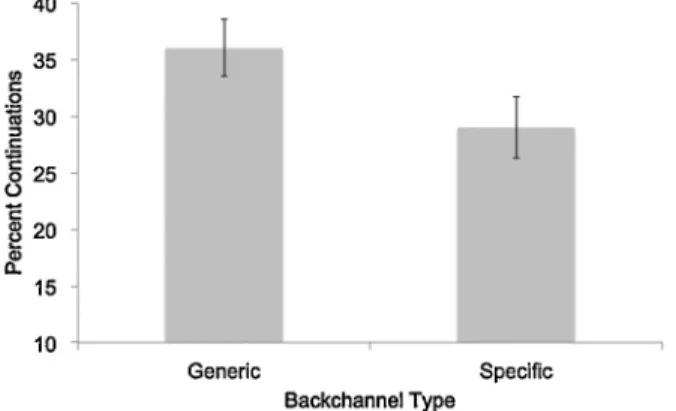
More continuations followed generic backchannels (M=36%, SD=18%) than specific backchannels (M=29%,
SD=20%),meandifference=6.66%,t(55)=2.27,p=.028(seeFig.2).
Inspection of the proposed next turns revealed that manyof the suggesteddialogue developments began with
pragmatic devices. Under the conceptualizationof three-part grounding sequencesproposedby Clarkand Shaefer
(1987),turn-initialpragmaticdevicesdisplaythespeakers’understandingofmutualacceptanceofthespeakers’prior
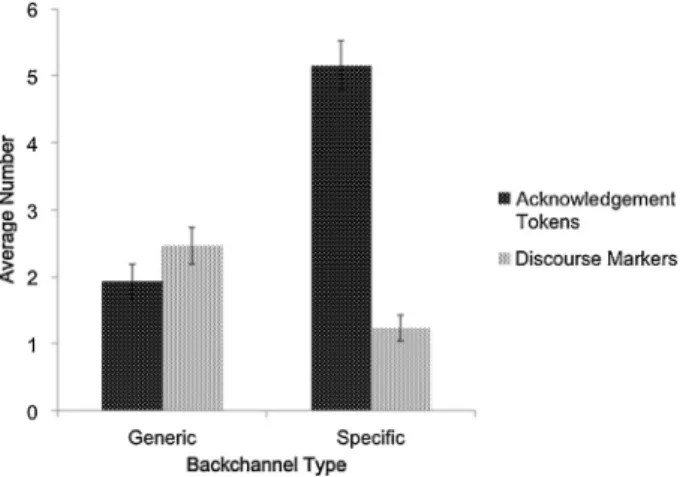
discoursemarkers,whichincludedso,and,well,andbutinourdata.Agreaternumberofacknowledgementtokens
followed specific backchannels (M=5.16 SD=2.7) than genericbackchannels (M=1.93,SD=2.0), t(55)=12.26,
p<.001(seeFig. 3).In contrast,analysis ofthe useofturn-initial discourse markersrevealeda greater numberof
discoursemarkersfollowinggenericbackchannels(M=2.46SD=2.1)thanfollowingspecificbackchannels(M=1.23,
SD=1.44),t(55)=5.30,p<.001.
Responses: Continuation
• I think I have to make some ground rules with my housemates.
• The bathroom was disgusting too. We’ll probably need more than just the steamer.
Elaboration
• Yeah, I heard steam cleaners are like the most effective way to clean carpets.
• They’re expensive though.
• I feel like it’s the only way to get the stains out, y’know?
Neither
• Haha, yup.
Stimulus:
Steven: We had one incident where the room like, smelled pretty bad when we got in there one time.
David: Haha.
Steven: I don’t know, it was kind of an awkward smell but…
David: Dude, after um, after this weekend our whole house, like I woke up Monday morning the whole house just smelled like stale beer.
Steven: No way.
David: Our carpet is just like, so nasty. We’re gonna get like one of those steam cleaners I think.
Steven: [Mhm/Oh]
David:
Fig. 1. Example transcript stimulus with generic backchannel target mhmand specific backchannel target ohpresented across conditions.
Participant responses demonstrate next turns coded as continuations, elaborations, and neither.
Fig. 2. Percentage of continuations after generic and specific backchannels, calculated as number of continuations divided by total number of
Tosummarize,participantsprovidedagreaterproportionofcontinuationsfollowingagenericbackchannelthana
specificbackchannel,matchingthepredictedrelationshipbetweenaddresseeresponseandthesubsequentunfoldingof
thenarrativediscourse.Morespecifically,whenparticipantsreadtranscriptsofconversationuptoagenericbackchannel,
theyweremorelikelytowriteanextturnthatintroducedsomediscourse-neweventcomparedtothesametranscriptwith
aspecificbackchannel.Afterspecificbackchannels,participantsprovidedproportionallyfewercontinuationsandmore
elaborationsofthespeakertalkonwhichthespecificbackchannelcommented.
Overall,elaborativenextturnswereamorecommonresponse.Webelievethatprovidingelaborationsiseasierthan
creativelysuggestinghowastorymightdevelop.Thatis,lesseffortandthoughtisneededtoelaborateoninformation
presentinthetranscriptascomparedtoinventingnewinformation.Thisisparticularlytruegiventhatparticipantshadvery
limitedaccesstothecontentofthestories,insomecasesaslittleasthreeturns.However,evenwithincreasedefforttoward
creatingcontinuationsandlimitedaccesstothecontentofthestories,thetypeofbackchannelprovidedbytheaddresseestill
influencedwhatparticipantsthoughtwouldhappennextinthedevelopmentofthediscourse.Thatis,evenwhentheycould
writewhatevertheywantedassubsequentturns,andevenwhentheymayhavebeenlessableormotivatedtocreate
continuations,participants’suggestednextturnswereinfluencedbytheaddresseebackchannelthattheyread.
Similarly,acknowledgementtokens weremore common thandiscoursemarkers atthe beginningof participants’
responses.However,theprevalenceofbothacknowledgementtokensanddiscoursemarkersdependedonthetypeof
prior backchannel read. More acknowledgement tokens were used after specific than generic backchannels, and
conversely more discourse markers wereused after genericthan specificbackchannels. These contrastive effects
demonstrate that participants treated the backchannels as distinct contributions to the dialogue, requiring distinct
responses, further highlighting the functional distinction between genericand specific backchannelsin shapingthe
contentofdirectlysubsequentspeakerturns.
5. Generaldiscussion
If backchannels simply provided different types of responses to the speaker’s multi-turn utterances, either as
secondarysignalsinaconversationorasreactionstopriorspeech,thereshouldbenosystematicdifferencesineither
naturally-occurring or participant-proposed developments of narratives based on whether a specific or generic
backchannelwasused.However,inbothanin-depthanalysisofbackchannelsproducedinaspontaneousface-to-face
corpusandinastory-completionexperiment,wefoundthatbackchanneladdresseeresponseswereproactive,shaping
theunfoldingnarrativemoment-by-moment.
Both ouranalysis andthe conditionaldistinctionswithin theexperimentrelied onpreviouslydevelopedfunctional
categoriesofbackchannels,thoseofgenericandspecificresponses(Goodwin,1986;Schegloff,1982;Stivers,2008).
Previouslythecategoricaldistinctionbetweenbackchanneltypehasbeenbasedoneitherplacementwithinspeakertalk
(Goodwin, 1986) or type of response displayed (Brunner, 1979; Gardner, 2001). Building on previous literature
demonstratingavarietyofpossiblespeakerresponsestoaddresseebackchannels(Norrick,2010b,2012),weaddtothe
distinctionbetweengenericandspecificbackchannelsevidenceofasystematicdifferenceinhowthesecategoriessteer
unfoldingnarrativediscourse.
Theproactivenatureofbackchannelcommunicationcausedourparticipantstoprovidedifferentexamplesastowhat
thespeakerwouldmostlikelysaynextdependingonthebackchannelused.Iftheyreadaspecificbackchannel,including
tokensrelatedtoinformationalstateoftheaddresseesuchasohandreally,aswellasassessmenttokenssuchaswow
andgee,participantsweremorelikelytoprovideanelaborationofthespeaker’slastturn.Theywerealsomorelikelyto
begintheir proposedtalk withan acknowledgementtoken such as yeah,explicitly acknowledging the addressee’s
specific backchannel, replicating previous findings of speaker acknowledgements to addressee contributions in
spontaneoustalk(Norrick,2010b,2012).Iftheyreadagenericbackchannel,participantsweremorelikelytoprovidea
continuationofthespeaker’slastturn.Theywerealsomorelikelytobegintheirsubsequenttalkwithadiscoursemarker
suchasso,and,but,orwell,explicitlymarkinghowthenexteventinthestoryshouldbeinterpretedwithrespecttothe
priorevent.Forexample,soindicatesthefollowingtalkisnotcontingentontheprecedingtalk(Bolden,2009)andwell
indicates that upcoming information is relevant despite seeming as if it is not (Blakemore, 2002). So the type of
backchannelaffectedboththecontentofthesubsequentproposedturnandthechoiceofturn-initialpragmaticdevice.
Acknowledgementtokensusefully recognizeaspecificbackchannel’sinvitation toelaborate,and discoursemarkers
usefullyhighlighthowthenextstoryeventrelatestothepriorafteragenericbackchannel’ssuggestionforacontinuation.
Previousresearchers havedemonstrated the role of backchannels in narrativedialogues (Bavelaset al., 2000;
Beukeboom, 2009). They systematically modulated the way addressees responded to speakers, either through
distractionorthroughtheuseofconfederatesinstructedtobehaveincertainways.Storiestoldtodistractedaddressees,
whilenotdifferentinlength,werejudgedtobelowerinqualitywithworseendings(Bavelasetal.,2000).Theresearchers
suggestedthat undistractedaddresseeshelpedspeakers finishstoriessmoothlyand effectively.Butdistractionalso
drasticallyreducedthenumberofspecificbackchannelsaddresseesprovided(Bavelasetal.,2000).Basedontheresults
ofthepresentanalysiswesuggestthatbynotprovidingspecificbackchannels,distractedaddresseeslikelyreducedthe
amount ofelaborative informationthat otherwisewould havedeveloped the narratives’ morerelevant or interesting
features, which in turn would have contributed to more climactic endings. Addressees providing only generic
backchannelslefttheirspeakerstosimplytelltheirstoriesasaseriesofevents,withouthighlightingimportantelements.
ThismayhaveledtotherepetitionsandawkwardjustificationsobservedbyBavelasetal.(2000).
Ourparticipants,whilenotactiveparticipantsintheconversations,stillmadesystematicpredictionsastowhatwas
likelytobespokennext,giveneitheragenericorspecificbackchannelfromtheaddressee.Thissuggeststhatinthe
comprehensionofdialogues,overhearers(orreadersofdialoguetext)maymakeuseofpredictiverelationshipsacross
speakerand addresseecontributions.Anumberofmodelsoflanguagecomprehension havefocusedonthe roleof
prediction(see e.g. Pickering and Garrod, 2013). Much work in language comprehension hasfocused on passive
listenerspresented withmonologues; however, comprehension of dialogues likelyinvolves predictions as well.For
example,participantswholistenedtoonlyhalfofadialogue,ahalfalogue,weremoredistractedthanthosewholistenedto
afulldialogue(Embersonetal.,2010).Embersonetal.suggestedthatitwasthereductionofpredictabilitywhenthetalk
fromonlyoneinteractantwasavailablethatleadtothisincreaseddistraction.Similarly,itispossiblethatoverhearers
listeningtonarrativedialogues(orreadersofdialoguetext)maymakeuseoftheproactivenatureofbackchannelsasa
meansofpredictingthetypeofinformationlikelytobepresentednext,leadingtofasterdiscoursecomprehension.
Futurestudiescanexpandonthefindingspresentedhere.Inordertomanipulatethetargetbackchannelwithtexts,we
werelimitedtoverbalbackchannels.Inaddition,thewrittenmodalityleftopenthepossibilitythatparticipantsmayhaveshaded
thebackchannelswithadditionalprosodicorparalinguisticinformationintheirreadingsofthedialogue.Yeah,asdescribed
above(section2.1),couldtakeonthefunctionofaspecificbackchannelgivenaparticularpronunciationandemphasis.While
thepunctuationofthetranscriptionattemptedtoavoidsuchdramaticinterpretationsofgenericbackchannels,replicating
resultswithaudiostimuliwouldbolsterthecurrentfindings.Furthermore,infocusingonspontaneous,looselytopical
face-to-faceconversations,ourfindingsarealsolimitedtothespecificcontextofstorytelling.Intheirexplorationoftask-oriented
discourse,BangerterandClark(2003)foundalmostnospecificbackchannels.Instead,BangerterandClarkcontrasted
genericbackchannelswithtokensofagreementandconsentsuchasrightandokay.Similarly,inananalysisoftheroleof
listenerfeedbackonstorytelling,Norrick(2010b)distinguishedbetweenassessmentsandinformationstateresponses,
categorieswecombinedascontextspecific backchannels.Furtherexplorationwillbeneededtotestthecollaborative,
predictiverelationshipsbetweendifferenttypesofbackchannelsandtheunfoldingspeakertalk.
Thestorycompletiontaskisapromisingmethodforfutureresearch.Wesuspectthateffectsonoriginalconversational
participantsmay belargerthan thosereportedherefor strangers reading conversationaltext. Asdiscussedearlier,
experimentalparticipants may havehad an easiertime comingup withelaborationsthan continuations.This could
potentiallyshrinkthe sizeofthe effect.Foroverhearers orover-readers,longerturns,which providemorenarrative
content, might produce fewer elaborations overall, and thus increase the distinction between specific and generic
backchannelsandtheireffectsonsubsequentspeakertalk.
6. Conclusion
Together,theanalysisofgenericandspecificbackchannelsandtheexperimentontherelationshipbetweenthese
backchannelsinthecollaborativecontextofstorytelling.Whenoverhearerssuggestedlikelynextdevelopmentsofthe
narrative,theirresponsestocontext-genericcontinuerssuchasmhmanduhuhdifferedfromtheirresponsesto
context-specificassessmentssuchasohandwow.Whentheyreadgenericbackchannelstheyweremorelikelytocontinuethe
storywithsomenextevent.Whentheyreadspecificbackchannelstheyweremorelikelytoelaborateontheinformation
providedbeforethebackchannel.
Thenovelfindingofaregularityintheexpectedtalkafterdifferenttypesofbackchannelsbuildsonpreviousresearch
onhowaddresseesco-constructtalk.Addresseescollaboratedirectlyinthemoment-by-momentcreationoftalk,evenin
the contextofnarrative, where thespeaker likelyholdsstrongifnot singularepistemic accesstothe content.More
broadly, wesuggestthata fullydevelopedtheoryofbackchannel communicationincludes notonlytheirfunctionas
responsestospeakertalk,butalsotheirroleinpushingunfoldingspeakers’talkalongparticulartrajectories.
Acknowledgements
ThisresearchwassupportedbyfacultyresearchfundsgrantedbytheUniversityofCalifornia,SantaCruz.Fundingfor
OpenAccesswasprovidedby theUniversityofCalifornia,SantaCruz,OpenAccess Fund.Wethankourresearch
assistants whoaidedin datacollectionand coding,withaspecialthanksto JasperHall,ChristopherManiotes,and
HeatherBach.FundingforOpenAccessprovidedbytheUniversityofCalifornia,SantaCruz,OpenAccessFund.
References
Bangerter,Adrian,Clark,HerbertH.,2003.Navigatingjointprojectswithdialogue.Cogn.Sci.27,195--225.
Bavelas,Janet,2005.Thetwosolitudes:reconcilingsocialpsychologyandlanguageandsocialinteraction.In:Fitch,K.,Sanders,R.(Eds.),
HandbookofLanguageandSocialInteraction.Erlbaum,Mahwah,NJ, pp.179--200.
Bavelas, Janet B., Chovil, Nicole, 1997.Facesindialogue.In:Russell,J.A.,Fernandez-Dols,J.M.(Eds.),ThePsychologyofFacialExpression.
CambridgeUniversityPress,Cambridge,England, pp.334--346.
Bavelas,JanetB.,Gerwing,Jennifer,2011.Thelistenerasaddresseeinface-to-facedialogue.Int.J.Listening25,178--198.
Bavelas,JanetB.,Coates,Linda,Johnson,Trudy,2000.Listenersasco-narrators.J.Pers.Soc.Psychol.79,941--952.
Bavelas,JanetB.,Coates,Linda,Johnson,Trudy,2002.Listenerresponsesasacollaborativeprocess:theroleofgaze.J.Commun.52,
566--580.
Bertrand, Roxane, Ferré, Gaelle, Blache, Phillippe, Espesser, Robert, Rauzy, Stéphane, 2007.Backchannelsrevistedfromamultimodal
perspective. In:ProceedingsofAuditory-VisualSpeechProcessing, Hilvarenbeek,Netherlands.
Beukeboom,Camiel,2009.Whenwordsfeelright:howaffectiveexpressionsoflistenerschangeaspeaker’slanguageuse.Eur.J.Soc.Psychol.
39,747--756.
Blakemore, Diane, 2002.RelevanceandLinguisticMeaning:TheSemanticsandPragmaticsofDiscourseMarkers.CambridgeUniversityPress,
Cambridge.
Bolden,Galina,2009.Implementingincipientactions:thediscoursemarker‘so’inEnglishconversation.J.Pragmatics41,974--998.
Brunner,Lawrence,1979.Smilescanbebackchannels.J.Pers.Soc.Psychol.37(5),728--734.
Chovil,Nicole,1991.Socialdeterminantsoffacialdisplays.J.NonverbalBehav.15,141--153.
Clancy, Patricia, Thompson, Sandra, Suzuki, Ryoko, Tao, Hongyin, 1996.TheconversationaluseofreactiontokensinEnglish,Japanese,and
Mandarin.J.Pragmatics26,355--387.
Clark,HerbertH.,1996.UsingLanguage.CambridgeUniversityPress,NewYork.
Clark,HerbertH.,Krych,MeredythA.,2004.Speakingwhilemonitoringaddresseesforunderstanding.J.Mem.Lang.50,62--81.
Clark,HerbertH.,Murphy,GregoryL.,1982.Audiencedesigninmeaningandreference.Adv.Psychol.9,287--299.
Clark, Herbert H., Shaefer, Edward F., 1987.Collaboratingoncontributionstoconversations.Lang.Cogn.Process.2,19--41.
Dittmann, Allen, Llewellyn, Lynn, 1986.Relationshipbetweenvocalizationsandheadnodsaslistenerresponses.J.Pers.Soc.Psychol.9,79--84.
DuncanJr.,Starkey,1972.Somesignalsandrulesfortakingspeakingturnsinconversations.J.Pers.Soc.Psychol.23,283--292.
DuncanJr.,Starkey,1974.Onthestructureofspeaker--auditorinteractionduringspeakingturns.Lang.Soc.2,161--180.
DuncanJr.,Starkey,Fiske,DonaldW.,1977.Face-to-faceInteraction:Research,Methods,andTheory.Wiley,NewYork.
Emberson, Lauren, Lupyan, Gary, Goldstein, Michael H., Spivey, Michael J., 2010.Overheardcell-phoneconversations:whenlessspeechis
moredistracting.Psychol.Sci.21,1383--1388.
FoxTree,JeanE.,1999.Listeninginonmonologuesanddialogues.DiscourseProcess.27,35--53.
FoxTree,JeanE.,Schrock,JosefC.,2002.BasicmeaningsofyouknowandImean.J.Pragmatics34,727--747.
Fries,CharlesC.,1952.TheStructureofEnglish:AnIntroductiontotheConstructionofEnglishSentences.Brace,Harcourt.
Gardner, Rod, 2001.WhenListenersTalk.Benjamins,Amsterdam.
Goodwin, Charles, 1986.Betweenandwithin:alternativesequentialtreatmentsofcontinuersandassessments.Hum.Stud.9,205--217.
Heritage,John,1984.Achange-of-statetokenandaspectsofitssequentialplacement.In:Atkinson,J.Maxwell,Heritage,John(Eds.),Structures
ofSocialAction.CambridgeUniversityPress,Cambridge, pp.299--347.
Kendon,Adam,1967.Somefunctionsofgazedirectioninsocialinteraction.ActaPsychol.(Amst.)26,22--63.
Koiso,Hanae,Horiuchi,Yasuo,Tutiya,Syun,Ichikawa,Akira,Den,Yasuharu,1998.Ananalysisofturn-takingandbackchannelsbasedon
prosodicandsyntacticfeaturesinJapaneseMapTaskdialogs.Lang.Speech41(3--4),295--321.
Morency, Louis P., de Kok, Iwan, Gratch, Jonathan, 2010.Aprobabilisticmultimodalapproachforpredictinglistenerbackchannels.Auton.Agent
Norrick,NealR.,2010a.Listeningpracticesintelevisioninterviews.J.Pragmatics42,525--543.
Norrick,NealR.,2010b.Incorporatinglistenerevaluationintostories.NarrativeInq.20,183--204.
Norrick, Neal R., 2012.ListeningpracticesinEnglishconversation:theresponsesresponseselicit.J.Pragmatics44,566--576.
O’Connell, Daniel C., Kowal, Sabine, Kaltenbacher, Erika, 1990.Turn-taking:acriticalanalysisoftheresearchtradition.J.Psycholinguist.Res.
19,345--373.
Pickering,Martin,Garrod,Simon,2013.Anintegratedtheoryoflanguageproductionandcomprehension.Behav.BrainSci.36,329--392.
Sacks,Harvey,Schegloff,EmanuelA.,Jefferson,Gail,1974.Asimplestsystematicsfortheorganizationofturn-takinginconversation.Language
50,696--735.
Schegloff, Emanuel A., 1982.Discourseasaninteractionalachievement:someusesof‘uhhuh’andotherthingsthatcomebetweensentences.
In:Tannan,D.(Ed.),AnalyzingDiscourse:TextandTalk.GeorgetownUniversityPress,Washington,DC.
Schegloff,EmanuelA.,1997.Practicesandactions:boundarycasesofother-initiatedrepair.DiscourseProcess.23,499--545.
Stivers,Tanya,2008.Stance,alignmentandaffiliationduringstorytelling:whennoddingisatokenofaffiliation.Res.Lang.Soc.Interact.41(1),
31--57.
Tomlinson, Jack, Fox Tree, Jean E., 2011.Listeners’comprehensionofuptalkinspontaneousspeech.Cognition119,58--69.
Ward,Nigel,Tsukahara,Wataru,2000.Prosodicfeatureswhichcueback-channelresponsesinEnglishandJapanese.J.Pragmatics32,
1177--1207.
Yngve,VictorH.,1970.Ongettingawordinedgewise.In:Campbell,M.A.(Ed.),PapersfromtheSixthRegionalMeeting,ChicagoLinguistics