Digital WPI
Interactive Qualifying Projects (All Years)
Interactive Qualifying Projects
May 2016
Creative Robotics Studio
Graham Fisher Held
Worcester Polytechnic Institute
Harrison Louis Vaporciyan
Worcester Polytechnic InstitutePaul Solomon Raynes
Worcester Polytechnic InstituteWalter T. Ho
Worcester Polytechnic Institute
Follow this and additional works at:
https://digitalcommons.wpi.edu/iqp-all
This Unrestricted is brought to you for free and open access by the Interactive Qualifying Projects at Digital WPI. It has been accepted for inclusion in Interactive Qualifying Projects (All Years) by an authorized administrator of Digital WPI. For more information, please [email protected].
Repository Citation
Held, G. F., Vaporciyan, H. L., Raynes, P. S., & Ho, W. T. (2016).Creative Robotics Studio. Retrieved from https://digitalcommons.wpi.edu/iqp-all/174
Creative Robotics Studio
An Interactive Qualifying Project Report submitted to
the faculty of the
Worcester Polytechnic Institute
in partial fulfillment of the requirements for the degree
of Bachelor of Science.
By:
Graham Held
Walter Ho
Paul Raynes
Harrison Vaporciyan
Project Advisers:
Scott Barton
Craig Putnam
Joshua Rosenstock
Contents Contents ... 2 Abstract... 4 Acknowledgements ... 5 Introduction ... 6 1 Background ... 8
1.1 Relationship between Robots and Humans ... 8
1.1.1 “Human Replacement” ... 8
1.1.2 Humanizing Robots - Anthropomorphism ... 9
1.1.3 Uncanny Valley ...11
1.1.4 Computers and Digital Technologies in Art ...12
1.1.5 Robots in Art ...13
1.2 Gesture ...18
1.2.1 Using Props ...18
1.2.2 Choreography ...19
1.2.3 Movement ...19
1.2.4 Music and Emotion ...20
1.2.5 Audio-visuals ...21
2 Methodology ...22
2.1 Surveys ...23
2.1.1 Questionnaire Design ...23
2.1.2 Background Survey Design ...24
2.1.3 Survey Distribution ...26
2.1.4 Performance Group Discussion and Surveys ...26
2.2 Performance Design ...27
2.2.1 Performance Hardware ...27
2.2.2 Storyboarding and Narrative ...29
2.2.3 Animatics and Animation ...29
2.2.4 Exporting the Performance ...31
2.2.5 Music ...31
2.2.6 Playing Back the Live Performance ...31
3 Data and Discussion ...32
3.1 Background Survey Data ...32
3.1.2 Correlations with Literacy Scores ...38
3.1.3 Changes in Opinion ...41
3.1.4 Open Ended Responses ...48
3.2 Developing an artist’s toolset ...49
3.2.1 Function before Aesthetics...50
3.2.2 Future Endeavors with Our Toolset ...50
3.3 The Live Performance ...52
3.3.1 The Animation Process ...53
3.3.2 Simulation vs. Reality ...53
3.3.3 The Synchronization Software ...55
Conclusion ...55
Works Cited ...57
Appendix 1 – Sync Software Code ...60
Abstract
As robotic systems become more integrated with society, it is important to understand how humans perceive and accept robots. The Creative Robotics Studio (CRS) aims to accomplish four objectives throughout the course of the project:
1) Better understand how robots can be perceived as agents that have emotional and creative capacity.
2) Design a performance consisting of a narrative sequence of robotic gestures that evoke human empathy and emotion.
3) Draft a toolset which allows artists to realize their creative vision using an industrial arm and animation software.
4) Execute a performance using our toolset to display how the robotic arm gives the artist new creative opportunities.
Acknowledgements
This project would not have existed in its current form if not for Andy Flessas’
(andyRobot) insights and perspectives on performance art with industrial arms. Our interview with Andy was pivotal for us and resulted in a new direction for the project. Andy gave us good advice going forward and valuable information regarding how his work functions in a real-world, social context.
WPI’s Computer Operations Manager Randolph Robinson was a last-minute hero for our project, working on short notice to resolve sync software and IRC5 system network issues. If not for Randy we would not have been able to display our live performance.
We would like to thank our three advisors on this project: Scott Barton, Craig Putnam, and Joshua Rosenstock, each of whom contributed insight and offered valuable time to make sure this project kept moving. Professor Barton was instrumental in keeping us considering the higher-level ideas and providing extensive feedback on our writing, surveys, and performance previews. Professor Putnam was a huge help with the robot hardware and design, taking time out of his schedule to supervise our live performance developments, and giving us pointers and resources to take our performance from animation previews to real-world execution. Professor Rosenstock was constantly pushing us to consider new and creative ways to incorporate and modify performance elements given our software, hardware, and time constraints. This project was possible because of their guidance and we are grateful to have worked with them.
Introduction
At first glance, the fields of digital animation and industrial robotics appear to have little in common. Yet, as soon as one asks an animator about inverse kinematics or a roboticist about natural motion, the intersection becomes more evident. Both of these high level concepts
heavily influence the designs and considerations of both fields. However, the abstract high level concepts need to be rationalized into real, physical examples in order to show off the intertwined nature of the two fields and how it might open a new realm of opportunities for artists and
engineers alike.
In general, the presence of robotics in everyday life grows a little more every year. For industrial applications robots are nearly ubiquitous, performing many tasks faster and with more precision than any human worker. The annual supply of industrial robots has nearly tripled in the last fifteen years1 – higher supply and higher demand means that availability is increasing and
cost is decreasing. As a result of this, more artists obtain the opportunity to work with industrial robots. The versatility of industrial robots makes it possible to include them in a variety of unexplored artistic and performance concepts which would previously have been difficult or impossible.
The music scene has soaked up a great deal of technology and novel ideas, so much so that there is a major conference dedicated to novel instruments called NIME: New Interfaces for Musical Expression. The outlandish, unique and inventive musical interfaces coalesce here to create something great. Innovators and creators have always pushed the envelope of their mediums so it was only a matter of time before robots were recruited to act as part of
someone’s artistic vision. Soon enough someone had the idea to use industrial robots as the headlining performers in a fully choreographed audio-visual experience called Box.2
In context, simply the existence of an industrial arm on a performance set is impressive. For the arm alone, costs can run up to $80,000 and a full system may cost up to $150,000.3 In
addition, hours upon hours of training are required in order to operate the robot and its systems safely. To pull off a performance like ours, in which a robotic arm must be animated to move in time with visuals and music, a team needs to draw from versatile individuals who can effectively practice and articulate multiple principles of design and techniques. Animation, robotics,
mathematics, music, and composition hang in a balancing act – a weakness in one area will be evident in the final production. Access to equipment and resources like this are severely limited, which is why performances using industrial robots are few in number. Access to sufficient skill to manage all of these disciplines is even more limited, but not impossible.
Box is a good benchmark of what is possible using unconventional hardware. Its creators, Bot and Dolly, developed a proprietary software called “BDMove”, a plugin for Maya which bridges the gap between animation and industrial robotics.4 Andy Flessas, alias
andyRobot, shook the grounds of performing arts when he used his knowledge of robotics, music, effects design, animation, and programming to back musicians like Deadmau5 and Bon Jovi, and create a unique performance experience for the Oasis of the Seas cruise ship. Much
1“Executive Summary.”
2 The Creators Project, Box. < https://www.youtube.com/watch?v=lX6JcybgDFo >
3 https://www.robots.com/faq/show/how-much-do-industrial-robots-cost
4 The Creators Project, Box by Bot & Dolly | Behind the Scenes. < https://www.youtube.com/watch?v=y4ajXJ3nj1Q
like Box, andyRobot presents visuals on large, robot-mounted screens that move and dance alongside human performers and music. Andy uses his own proprietary software called “RobotAnimator,” a plugin for Maya.5 Software exists to build practical bridges between
disciplines, but it is rare and proprietary, often designed to solve a specific problem in a specific piece rather than provide a general implementation of an adaptable toolset.
While bridges exist, their accessibility and publicity are not exactly in a healthy state. Previous performances and experiments have created amazing works to close the gaps
between composition, performance, and engineering, but they stay inside of a bubble. The tools these artists create are proprietary and the knowledge they cultivate largely stays within their team. It seems as though someone who seeks to engage with these fields would have to attain years of experience with multiple technical and artistic fields and join a very select few in order to realize their vision.
The problem is that these resources are difficult to learn and are still rare – arguably the time investment required to complete a project like this is greater than the monetary investment. More people need access to this new hybrid field to bring life into it. Conferences such as Siggraph and NIME show how experts in the fields of graphics and music are hard at work innovating and bringing something unique every year. Industrial robotics in performance is a novel 21st century concept with huge potential in the coming years. It requires deeper
exploration and additional public awareness to bring it into the forefront of public interest.
Another major factor that influences the direction of this new industry is how society sees robotics. The field is still relatively young and relegated mostly to utilitarian use. Robots,
especially industrial robots, are surrounded by a stereotype that they belong inside a factory, welding pieces of cars together and taking away the jobs of factory workers. As we will discuss, robots are traditionally seen as threatening entities because they perform tasks with no
perceived emotion or rest. At this time, it is difficult to predict how society will collectively adapt to the increasing presence of robots in daily life, but it is extremely important that society eventually sees robotics as a new medium for expression rather than simply a mechanical representation of our destruction.
Industrial robots have the potential to fit into almost any role imaginable - any application in which the human arm or arms create something or solve a problem - art, music, architecture, engineering, medical and biomedical, etc. - the industrial robot can be trained to perform the same tasks with greater accuracy and repeatability. As a tool for human expression, the industrial robot can bring a seemingly fantastical feat into reality.
This project aims to increase society’s awareness of industrial robots as tools of human expression and progress. Industrial robots are advanced but severely limited in real world use. They have the same potential to affect society as the internet did at its inception. We will create a kinetic performance in order to better understand how society perceives robotics as agents with emotional or creative capacity.
1 Background
1.1 Relationship between Robots and Humans
In order to understand the more intricate interactions between humans and robots, the scope of the relationship between humans and robots must be defined beginning with the function of robots and generally how they currently fit into society. This is a broad topic, but it provides a useful framework for the basis of our project - the social climate has everything to do with how humans perceive and process the information from their senses.
The primary use of robots in our society is to tackle the “three Ds:” tasks that are too dull, dirty, or dangerous for humans.6 Examples of these tasks include repetitive industrial,
factory line jobs, sewer pipe inspections, and aerial military surveillance for hours longer than any human could perform in one sitting. These tasks are all undesirable to humans, and as such have been delegated to robots. More recently, as technology has advanced, robots have been used more broadly for human replacement. Robots can now tackle situations that they never could before due to technological restrictions. They fill certain roles that humans cannot for one reason or another, often with the intent to reduce the potential risk to humans.7 Robots can
access locations too dangerous for humans, with more mechanical precision and processing power. In some cases, they can even tackle problems without emotional limitations.
Robots are involved in nearly every area of our lives including labor, military, and entertainment. Examples like the Roomba show how they have even made their way into general labor at the consumer level. The media popularizes robotics as a result of their role in the military and scientific research. Additionally, hospitals and nursing homes use robots for medical and personal care, especially those in more robot accepting countries, such as Japan.
They are on the verge of breaking into the entertainment industry as well. Robots are increasingly being used in the field of “Edutainment:" educational entertainment. For example, a KUKA industrial arm was programmed to "simulate" surfing by moving a surfboard around as a surfer rode it. The robot is necessary in these applications to hold the body weight of a person and react to the person’s movements, providing valuable interaction not available in, for instance, an arcade game. It can be used for amusement as well as for learning purposes. In the near future, robots could easily be used for tasks uncommon today8
In general, however, jobs involving labor seem to be the primary examples of how robots can perform human tasks, which often works against the notion that robots are designed to improve workplace safety and remove the need for humans to perform machine-like tasks. The industrial arm has the potential for more than work for work’s sake - as an artistic tool it can bring an entirely new realm of rapidly prototyped creativity and expression under the control of the artist, the musician, the scientist, or the architect.
1.1.1 “Human Replacement”
As much as robots may improve the standards of living by working efficiently, safely, and inexpensively, many people have an inherent fear of robots or robotic technology. Littered throughout history there are examples of artists’ and mechanics’ attempts to animate humanoid figures, as well as examples in fictitious literature of biomimetic creations going horribly wrong or whose existence is outside of our comprehension. Such examples include Da Vinci’s robotic
6 Lin, Abney, and Bekey, Robot Ethics. 7 Ibid.
prototype, marionettes, and automatons. From literature and vernacular legend come the helpers of Hephaistos, clay golems, and the famous Frankenstein’s Monster.9 More recent
works of science fiction like the movies Terminator or The Matrix evenpropose a future in which machines surpass humans and seek to become dominant.
The real world equivalents of such examples are the predator drones employed to watch over and attack almost any target imaginable. The concept of strapping weaponry to an
unmanned aerial vehicle and allowing it to act autonomously brings into question the concept of responsibility as it applies to robotics: who is responsible for the actions of the robot – the human creators and controllers, or the robot itself? Arguments about this topic include the apprehension that drones have “a capacity for insubordination” and a potential that the use of robots may allow human operators to more easily justify morally reprehensible decisions.10
While mimicry like this is classically viewed as a threat to humanity on many levels, a more immediate concern with robots is human replacement. Machines perform their intended task perfectly every time, tirelessly, and often much faster than a human counterpart. Industry workers are already facing replacement issues in higher-skilled craftsmanship positions.
Because the development of robots shows no signs of slowing, and automation in higher-skilled industry is increasing, robotic replacement is more of threat now than ever.11
The 21st century grasp on material sciences, mathematics, and biological processes all
contribute to deeper layers of realism and additional capabilities in robots that were previously impossible. Computer technology makes them even smarter. For instance, the Yaskawa
Bushido Project uses motion capture software to reproduce a sword master’s movements using a Motoman robotic arm. With adjustment, it is able to perform all the tasks the sword master can, and towards the end of the performance its consistency contrasts with the sword master’s fatigue. The use of a weapon in the performance may further the perception of robots as “tireless killing machines.”
However, robots are making their way into fields other than industry and labor and making names for themselves as a creative medium rather than machines with a set, repeating routine. For example, two ABB robots in Berlin and London replicated artist Alex Kiessling’s pen strokes in Vienna during the Long Distance Art event. The artist was not replaced, but enhanced by the robots as precise, extremely useful tools acting as a new medium of communication. However, the tendency humans have to focus heavily on dramatic and tragic occurrences has surrounded the industrial robotics field with skepticism. The divide between what can be considered art created by the robot, and art created using a robot becomes more and more difficult to distinguish and it remains extremely open to interpretation. Hopefully this works to show the benefits of incorporating robotic elements into artworks and adding another dimension to the creative process.
1.1.2 Humanizing Robots - Anthropomorphism
One of the earliest skills that humans learn is that of anthropomorphism: the tendency to ascribe human-like qualities to human-looking objects. As children, we learn that most things that look like humans are in fact humans and have a certain set of qualities attached to them: sentience, emotions, personalities, and so on. A side effect of this psychological shortcut is our tendency to unconsciously ascribe these qualities to anything that displays similarities to the human form, even if we can consciously recognize that the subject in question is non-human (or, indeed, not alive at all). This quirk has been exploited throughout human history in fields as varied as advertising, art, literature, and even religion.
9 Bar-Cohen, Hanson, and Marom, “Introduction,” 7,8. 10 Pasquale, “The Doubtful Ethics of Drone Warfare.”
A robot modelled after human anatomy will ideally appear as humanoid as technology allows; therefore, it follows that these robots are subject to a high degree of anthropomorphism. On the most basic level, this manifests as assumptions as to the functions of its more human-like features: “eyes” are assumed to be used in visual sensing, “hands” for use in tactile manipulation, etc. This phenomenon can be exploited to make robots seem more human than they are. Outfitting a robot with nonfunctional structures resembling eyes, lips, ears, or other sensory structures gives the impression that the robot is capable of processing the associated sense, even if the robot is incapable of these senses or the senses are processed in a separate device.
RoboLounge’s tribute to Kraftwerk12 exploits this to make their robots seem more
human. Their performance focuses on three robotic arms, each with an end effector composed of three lights in a triangle arrangement. The orientation of the robots, with their base grounded to the stage and their end effectors at the top, helps give them the impression of human form - the lights are perceived as eyes and mouths. These perceived facial features, the focus directed at the robots, and their synchronized choreographed movements to the music characterize the robots as dancers, a very human form of expression.
People also respond socially to computers that show social cues, as shown in several studies involving computers giving positive comments, computer tutors, and computer
generated speech. Although people may claim to not humanize computers, they still treat them as social beings in the right context.13 In “The Revenge: Timo Boll vs. KUKA Robot,” Timo Boll
and a KUKA robot face off in a musical competition playing the glass harp. The robot’s only humanoid feature is a robotic hand as the end effector. Throughout the performance, the robot “taunts” and “challenges” Boll with humanlike hand gestures such as the “thumbs down” and the “fist pump.” While these gestures are merely programmed for the sake of the performance, the audience understands their meaning because they are widely used expressions. Since we recognize them as human expressions, the robot seems more human as well.14
Another component of anthropomorphism is the tendency for humans to evaluate humanoid animals or objects as humans in an ethical framework. For example, in a study by Riek et al, participants were mostly indifferent when clearly non-human robots such as a Roomba were kicked and insulted by the survey administrators, but expressed almost twice as much sympathy when the exact same treatment was administered to a humanoid android.15 A
recent example shows how something as simple as balancing and adaptation benchmarks of Boston Dynamics ATLAS2 can easily be interpreted as abuse.
Additionally, anthropomorphism is not purely based on something’s appearance – gestures and communication also play a large role. The way an object moves can influence the way people think about it: for example, a robotic arm moving between two points in a wild, fast arc may be perceived as aggressive and scary, while the same arm moving between the exact same points in a slow, deliberate fashion may be seen as peaceful and non-threatening. Additionally, the recreation of human nonverbal communication methods, like a thumbs-up or waving gesture, can make a clearly non-human robot more palatable to a human audience.
Although humanoid robots such as Atlas and ASIMO are fairly recent developments, the idea of a robot that mimics the form and function of a human is nothing new. In fact, the idea is literally as old as the word "robot" itself, which was coined in 1921 by Czech writer Karel Čapek for his play Rossumovi Univerzální Roboti ("Rossum's Universal Robots"). R.U.R. tells the story of a factory that produces humanoid "robots" (from the Czech robota, meaning “forced labor”)
using synthetic biological materials for use as slaves. These robots eventually overtake the
12 Robolounge, Robot Dance.
13 de Graaf, Allouch, and Klamer, “Sharing a Life with Harvey.” 14 Fussell et al., “How People Anthropomorphize Robots.”
world economy, mount a global rebellion, and exterminate humanity. This view of humanoid robots - that they are inherently dangerous tools intent on destroying and replacing humanity - set the tone for robots in science fiction for decades to come. Furthermore, since actual "robots" as we would recognize them were still almost a full century away, the word had the better part of the 20th century to become associated with genocidal killers in the public mind.
Predictably, this has led to public opinion of humanoid robots being wary at best and outright distrustful at worst. This is partially due to the previously-mentioned fear of human replacement and partially due to the fact that real-life robots have only recently become
advanced enough to approach the same level of anthropomorphism as their fictional, murderous pop-culture depictions. Recent features such as Wall-E and classics like Star Wars feature positive examples of anthropomorphism in robotics, but they are few and far between.
Anthropomorphizing these more recent robots in a positive light is a necessary first step towards changing public opinions about advanced robots and their place in society.
For our project, it is important that we see the robot as a tool controlled by an artist. It takes an artist to create something that appears to live and feel emotion. By anthropomorphizing a robot, the audience can find deeper meaning behind the robot’s actions and interact with the robot on a more human level.
1.1.3 Uncanny Valley
Questions about humanizing or anthropomorphizing robots cannot go without a discussion and understanding of the uncanny valley. Mediums that replicate something about humanity – movements, likeness, and behaviors – are in danger of approaching what is known as the “uncanny valley” to artists and roboticists alike. Roboticist Masahiro Mori coined the term in 1970 to refer to this phenomenon.16 It is difficult to properly describe the uncanny valley
because it refers to an identification process that varies between people.
However, we generally understand it as a point at which humans begin to identify less and less with a depiction of something as it becomes more realistic. Sometimes this
phenomenon can adversely affect the creation, making it unsettling or upsetting to observe. The valley describes how an imitation can actually create a negative impact on the observer.
Prosthetic limbs might produce such a sensation – when the viewer realizes the realistic, fleshy hand they are about to shake is lifeless, they develop an aversion to it.17 Robots that act human
and look human are seen as, essentially, reanimated corpses.
The sensation is at its worst when the doppelgänger is nearly perfect, but just slightly off – “monstrous doubles” according to the anthropologist René Girard.18 This commonly occurs
with appearance alone, but movements and perceived behaviors can also invoke this sensation. This is why robot designers, for the most part, try to diverge from the human form in order to avoid the valley altogether. Industrial robots, while seemingly so different in design from any human forms, are modeled after the six degrees of freedom in the human arm. Even industrial robots, properly orchestrated and characterized in motion, have the potential to mimic any number of human motions and produce the unease described by the uncanny valley.
For our considerations, the uncanny valley either obstructs or helps us accomplish some form of expression. In general we need to minimize the effect of the uncanny valley in our performance because we want to show the robot as a tool for human expression without alienating viewers. However, the uncanny valley does add a dimension to the medium. So, it may be possible to make use of the uncanny valley to invoke a certain response in viewers if
16 Mori, MacDorman, and Kageki, “The Uncanny Valley [From the Field].”
17 Ibid.
the performance calls for it. Otherwise it should be wisely avoided. We do not want the robot to pretend to be human because that defeats the purpose of using the robot in performance.
Instead, we want the robot’s movements to appear natural without turning into a disturbingly mimetic performance. Girard claims that interaction between robots and humans must involve some appearance or transmission of emotion, otherwise the divide between us will always remain.19 This means we have to carefully articulate how we show off our industrial arm
in performance.
The animator mitigates the effect of the uncanny valley by embellishing the movements of the characters and props in such a way that appears fantastical to the viewer. The animation sells itself as intentionally divergent from the human standard which comes across as
nonthreatening to the observer. Examples might be an over-exaggeration of secondary motions as the robot might appear to hold the weight of an item. Dramatic, sweeping motions can keep the arm from triggering aversion in the viewer.
1.1.4 Computers and Digital Technologies in Art
The emergence of the digital era in the mid-20th century with digital transistor-based
computer systems began the digital artistic movement as well. One of the earliest examples of digital art was a vector-based pin-up image programmed by an anonymous IBM worker using a military computer between 1956 and 1958.20 In 1963 Ivan Sutherland invented the first
rudimentary computer-based drawing program which signified the beginning of a more intuitive interface to create digital art.21 Up until that point, images had to be “coded” as sequences of
vectors.
However, the new medium created its fair share of controversy from conservative artists and critics in the same way that prints and photography did when they first appeared in
publications. Critics of the time did not know how to judge this new medium because it was incomparable to classical examples using the “historical or psychological yardsticks”22 employed
to review and understand artwork. Generally, based on unstable or unsupported reasoning, computer-art faced the criticism that it could not be art. Other reviews attempted to reconcile the execution and design choices behind the digital imagery with the traditional elements
exemplified by those images – especially in choices of color and texture in physically based 3D rendering.23
The use of robotics and portrayal of robots as works of art mirrors the state of digital art when it was in its infancy. Just as computers created an entirely new medium that required many years of hard work from artists and programmers to realize greater expressive potentials and remove limitations, so too does robotics. We have to use this to our advantage, but we also have to understand that the medium is still greatly unexplored and therefore foreign to society. Because examples of robotics in art are still relatively few, people do not know to how to react to robotic performances in the same way they "know" how to react to classic examples of art and performance. As with the birth of digital computer art, the current social "yardsticks" for judging and responding to art do not apply.
19 Ibid.
20 Lee, “From a Pin-up Girl to Star Trek’s Holodeck,” 1. 21 Ibid.
22Bentkowska-Kafel, Cashen, and Gardiner, Digital Art History, 153.
1.1.5 Robots in Art
So, with these issues in mind, what have artists and roboticists already accomplished and what do their accomplishments mean in the context of our project? A key starting point was to obtain some insights and perspective from Andy Flessas – the groundbreaking artist in robotics previously mentioned. Andy is an expert animator and roboticist who has brought industrial arms to public attention in performances with Bon Jovi and DeadMau5. He views robots as an important and natural technological advance for artists: “I think robots are as natural as, like, a bee making a honeycomb… robots are this natural progression of humans - blooming out of us; our expression.”24 He cautions, however, that robotic performances are not
about the robot – “A lot of failures happen when people try to make it the robot show. It’s not the robot show.” Robots provide an opportunity for artists to engage with an audience in novel ways. When done well, Andy says “Robots and art unpack a joy...in people” with “young kids and old people just...loving the robot.”
Key to Andy’s performances is Robot Animator – the software he developed that makes it possible to generate more fluid and graceful movements for industrial arms using Maya, an existing software commonly used by animators. He affirmed that “People do not like ballistic motions” and that he wanted to minimize audience fear by reducing such motions. This will be an important consideration as our project focuses on the interaction between the robot and the audience, and portraying the robot naturally and creatively.
We subsequently analyzed performances that have used robots for creative expression. These demonstrations exemplify the larger concepts we examine in our project in an easily understandable and observable manner.
1.1.5.1 Yaskawa Bushido Project25
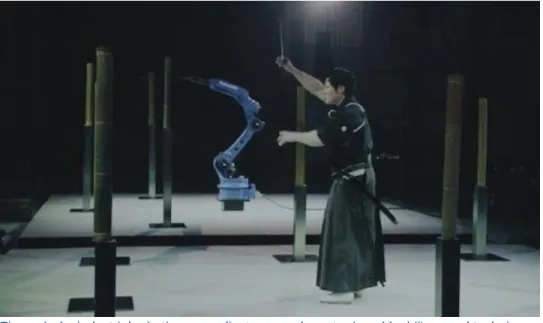
Figure 1. An industrial robotic arm replicates sword master Isao Machii's sword techniques.
As mentioned previously, the Bushido project uses motion capture software to reproduce a sword master’s movements using a Motoman robotic arm. This is a demonstration of how human motion capture can train a robot to perform mimetic actions in a parameterized,
24 Flessas, Interview: Andy Flessas.
adaptable fashion. The resulting robotic movements are smooth and precise, performing exactly as expected, however the lack of stylization and the perfect motionlessness at the end of each movement still appears very mechanical to the watcher. Directly mimicking a human falls into the uncanny valley and appears very stiff without an additional layer of tweaks to bring out the distinct character of the movements themselves – the slight errors and corrections from the human give life to a swing of the sword.
Demonstrations like these, in which the robot faces off against a human opponent, contribute to the perpetuation of the “human replacement” fear that exists in society.26 Andy
Flessas made the point in our interview that showing off a robot which effectively uses a
dangerous weapon instills in the viewer a sense of unease or discomfort regarding replacement - “People are afraid of it.”27
In learning from this we have consciously steered away from the use of any prop which could be considered a violent or lethal weapon, or performance ideas that point out how the robot in some way usurps the humans in its apparent superiority. Replacement is not what this project is about, but rather unique creative utility. The prop itself, the sword in this case, has the unique ability to create a set of associations for the audience which we strive to minimize.
The motion capture is a good prototype for other learning applications such as dancing or painting, which would better demonstrate how an artist might scale up their creations by taking advantage of the unique combination of precision and strength possessed by the robot – imagine a large industrial arm holding fifty gallons of paint, but still laying down the same flowing effortless brush strokes as the artist who taught it.
26 Bar-Cohen, Hanson, and Marom, “Introduction.”
1.1.5.2 Robotic Artist at Long Distance Art event28
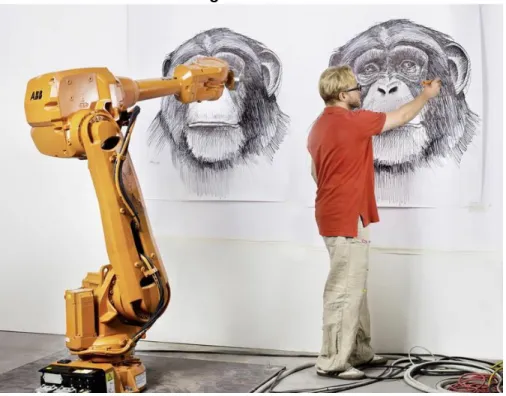
Figure 2. Alex Kiessling creating art while his strokes are sent to remote robots in real time.
The premise of this example is simple yet important: Alex Kiessling draws in Vienna while robots in London and Berlin copy his movements. This performance is a perfect example of how the robot can be applied as part of the artist’s medium of expression. Although the artist is only copied by the robot and not teaching the robot the movements, the resulting image is clearly recognizable as a work by artist Alex Kiessling.
Application of the medium in this way is an extremely positive example of how industrial arms can make the experience of live art accessible to more people. Incorporating the industrial arm into the drawing experience introduces another layer of intrigue as well because even with its precision, the robot does not perfectly copy the artist as a result of errors in placement or delays in the code. The robot itself creates another layer of expression.
1.1.5.3 Robot Surf29
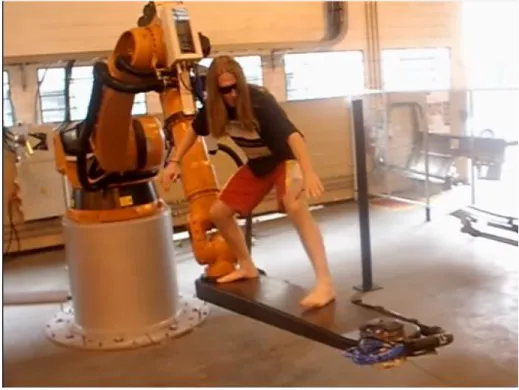
Figure 3. Programmer surfing a KUKA robot.
In its barest form, robot surf is an entertainment-based application for an industrial arm designed as more of a benchmark than a performance. It may not appear to be as important as the previous examples, but this demonstration shows the arm as a stable and safe platform capable of providing an experience the other examples cannot. Direct interaction between the audience and the robot like this is not generally feasible, especially in our case with the limited resources we possess, but it would be one of the fastest ways to change someone’s mind about the robot – assuming nothing goes wrong with the robot.
The demonstration prototypes a performance that requires not only the robot, but the human participant to fully realize it. An exercise like this would very quickly build the audience’s trust in the robot as a readily available and interactive platform. Regardless of what the robot actually is, it is how the audience perceives the arm that matters because ultimately they control how the performance’s influence spreads and reaches out to others.
1.1.5.4 Blue Man Group and KUKA Industrial Robots for Factory Automation30
Figure 4. Blueman group performing with KUKA Industrial Robots.
In this example two automotive industrial arms are literally performers and characters on stage with the widely known and acclaimed Blue Man Group. The scale of this example is much larger than the others, and presents the industrial robots in a completely novel and compelling fashion. There is an irony that the robots begin by appearing next to the chassis of a car, in their intended working environment, but break away from this task and interact with the human performers up front, actively freeing themselves from the implied toil of the industrial setting to interact with the group in a performance setting.
The robots practically disappear as their characters take over and we begin to
anthropomorphize their actions and their appearances. Their “faces” and even the pop-culture reference to Slash, the easily recognizable guitar player for Guns n’ Roses, give the audience a focal point and a set of associations that have nothing to do with robotics, misleading their attention. And because the robotic arms playfully interact with the performers rather than compete for superiority, they come across as almost endearing as they move with the rhythm and contribute to the spectacle by dancing and playing music.
Everything ties together in this performance. The percussive and raw nature of the music adds to the excitement and gives a solid rhythm for the performers and the robots. The gestures brought into the choreography mask the presence of a mechanical entity, but the audience remains aware that these are robots. We strive to achieve the same effect in our performance. In this way we can rearrange the associations the audience makes with regards to what the industrial robot fundamentally is.
We will explore how we can control the perceived relationship between the arm and the performer to see how it affects the data. The level or depth to which the audience
anthropomorphizes the robot is one of the most important aspects we can manipulate to control how the performance impacts the viewers.
1.2 Gesture
Gesture is a conceptual medium that defines the union between form and motif. Any observable element of performance such as poses and movements in dance, or filter sweeps in music become gestures when linked to abstract concepts like emotion or meaning. For example a gesture sketch in art is meant to capture the energy of a figure with as few lines as possible – the more the figure can be abstracted into indications of movement with lines, the easier it becomes to re-construct a rendered piece that emulates the energy of the original figure. In this example the observed elements capture the abstract idea of energy.
One of our objectives in this project is to synthesize the data we gather from feedback on the performances and construct a library of gestures that classifies and organizes
movements based on common themes in audience responses. This task is difficult because interpretation, especially emotion, is nearly impossible to solidify in a tangible form like the movements of the robot.
1.2.1 Using Props
A prop may be used to fit a certain theme, as shown in RoboLounge’s Electrobot.31 The
lightsabers and white-painted robots resemble Stormtroopers in Star Wars, displaying a sci-fi and futuristic theme for their robots and evoking a sense of nostalgia in the viewer. In another case, the Yaskawa Bushido Project uses a robot with a sword to perform several sword
techniques alongside a human sword master.32 The sword as a prop is used to demonstrate the
robot’s precision and shows that a robot may copy a human’s skill accurately. For our
presentation, we want to stress that robots can be used artistically and non-violently, so we will not use weapons as props. The Yaskawa Bushido Project addresses this with the robot’s “bowing” and sheathing of the sword to show that the skill must be used respectfully.
A prop can also be used for personification and movement exaggeration. For instance, the Blue Man Group performance involved industrial robots with a clamp end-effector and red lights above it, resembling eyes and a mouth.33 One of the robots even “wore” a wig and hat at
one point. The performance used the props to present the robots as actors, character and personality, in the show. They playfully hold and move objects just out of the person’s reach. The wig also emphasizes the robot’s movement; you can see its “head” shaking the hair as it moves up and down. A stronger example is a ventriloquist using a puppet, controlling their actions and speech to portray a particular character. In a similar way, a robot controlled by people (not necessarily in real time), should express a certain character if the aim is personification.
In general, props give personality to the robot that would otherwise leave the audience without a familiar object on which to focus. In most cases, stage props provide a cheaper alternative to more expensive implements like monitors or projectors, but might constrain the expressive range of the artist based on the implications associated with the use of the prop. For example, the lightsaber creates a focal point and a set of associations while drawing attention away from the robots themselves. It depends on the artist’s intent, but in our case, we intend to feature the robot rather than the prop.
31 Robolounge, Robot Dance.
32【安川電機】e-メカサイト, YASKAWA BUSHIDO PROJECT / Industrial Robot vs Sword Master.
1.2.2 Choreography
In the performance with one or more robots there exists a question of choreography for both the creator and the viewer: what about the choreography of a system makes the
performance captivating? In conjunction with the audiovisual stimulation, there is also a distinct perception of coordination and rhythm based on natural pattern recognition tendencies in humans.
Two primary principles of dance and movement in performance are synchronicity and divergence between the audio and visual stimuli presented. From a psychological standpoint, synchronicity is relaxing and “proper” to humans. The brain will devise a way to consume the least amount of energy to process incoming information, which means that any patterns
between stimuli which can be recognized, will allow the brain to settle down from an alert state. Continuous and unchanging rhythms and synchronized movements allow the viewer to spend little effort processing the complexities of the music or the dancers moving out of time or sync with each other. We begin to see the unified nature of the performers across the stage rather than the multiplicity of the performers in individual locations.34
RoboLounge fully exploits the effects of synchronicity in their performances. Their choreographers paid close attention to moments at which they want the robots to diverge, holding the viewer’s attention before falling back into perfect synchrony.35 These motifs appear
in modern dance as well, but with the robots it is much simpler to achieve. The designers of a robotic performance have to keep in mind that robots performing in synchrony have a much different effect on viewers than human performers. Human dancers always introduce their own element of chaos to the performance which means that they are never quite in synchrony with one another. To the audience, those little imperfections keep the mind alert to the movements. With robots, the movements are so precisely identical that they could easily become boring. We are used to seeing humans diverge in behavior and robots synchronize like
machines. If we are to show how robots are a form a human expression then there needs to be some level of divergence involved. The accidents and mistakes from the artists and performers connect with their human audience more than the perfection of robots.
From a choreographic standpoint, we should expect to see some kind of human choice behind each movement. In the same way that industrial arms in the factory have intent behind every maneuver, so does the dancer and the musician, and therefore so should the industrial arm in art. Beyond art, however, the choreography applies to other applications of the arms like architecture or medicine. We need to show that the robot works with humanity rather than against it or as its replacement.
1.2.3 Movement
In general, smooth movements appear more familiar to people, so the bridge between the audience and the robot can be dynamically controlled to match a performance aspect.36 If
the performance calls for audience participation, then its movements will be smooth and
graceful; non-threatening. Conversely if the performance needs to portray distance or alienation, the robot’s movements may be made jerky and sporadic. This effect may be amplified if any of the audience has not had a lot of time to interact with robot(s)37. How “sociable” or “familiar” the
robot appears in performance could be an interesting experiment to include in this project, and may affect how the performance evolves during development.
34 Haas, “Synchronicity in the Performing Arts.” 35 Robolounge, Robot Dance.
36 Baddoura and Venture, “This Robot Is Sociable.” 37 Ibid.
The “posture” of the robot must be taken into consideration for every movement after considering the quality of the movement itself. The jittery movements and the smooth
movements can invoke one dimension of emotion, but the additional layer of posture reveals more dimensions for emotional expression. It is understood that closed-in hunching poses are a sign of sadness and that open and outstretched poses show happiness38. It is important,
however, to make a choice about posture in performance: are there sections in which any emotion at all is to be invoked, thus humanizing the robot, or does the robot perform
mechanically or neutral? This choice matters because it is perhaps the only way the robot can “communicate” with the audience.
The robot and the music will “communicate” with each other much in the way that a
conductor and an orchestra communicate. In this case, the robot’s movements and posture will be determined based on the music rather than directing the dynamics of the music as the conductor. However, the importance is in the exchange that occurs between the music and the robot – the effect of forte phrases may be amplified with quick, sweeping, and even angry movements as a visual metaphor for the increase in amplitude. Likewise softer phrases can be conveyed with lilting and calm movement39. By breaking out of one gesture suddenly or ceasing
movement altogether the robot can create a visual distinction that the sound cannot.
Intuitively, it is possible to describe sounds with identifiers used for visuals or movement. For example, saw waves and square waves sound “sharp”, and sine waves sound “smooth.” Likewise, music can be abstracted in the same way - techno is commonly “aggressive” where classical is more “lilting.” In the performance, the motions of our end effector and the robot itself have to match the way the audience expects to see movement based on what they hear. The viewer needs to see the artist behind the robot rather than fixate on the robot itself - gestures that appear natural can accomplish this.
1.2.4 Music and Emotion
Music can have a massive effect on our emotions. How can sound bring about these feelings in us? It cannot be that we are subconsciously associating the music with events; otherwise each person would have a unique reaction to a piece. It is very apparent that pieces tend to evoke the same or similar emotions in many different people. It could be that the words of the songs are bringing about certain feelings, but that would not explain how we react to songs in other languages, or even more oddly, songs without lyrics.40 Why music can bring
about emotions in us is still relatively unknown. What can be explained is how the music creates the emotions.
The main factors contributing to emotion elicited from a piece of music are the piece's tonal and rhythmic structure. This includes the piece's tempo, key, and pitch. In addition, a piece's timbre has a large impact on the emotions elicited. Dissonance, which is much harder to quantify, is the amount of disagreement, both rhythmic and tonal, between various parts of a piece, both rhythmic and tonal. Each of these factors can be linked to a specific feeling or set of emotions. For example, higher pitches, major keys, a soft timbre, faster tempos, and a lack of dissonance are associated with being happy. Lower pitches, minor keys, a soft timbre, slower tempos, and a slight presence of dissonance are generally associated with being sad. Different combinations of these qualities can result in different feelings.41 Having more dissonance, and
lower pitches, for example, tend to lead to a more uneasy feeling. This can be sadness, as
38 Han et al., “Emotion Gesture Art.”
39 Stam and Ishino, Integrating Gestures : The Interdisciplinary Nature of Gesture, 350. 40 Krumhansl, “Music.”
mentioned earlier, or fear if there is a harsher timbre and a faster tempo. These factors are important to take into account when composing a piece or selecting one for use. What the intended emotion is should be a large determining factor in the creation or selection of a piece.42
For our presentation, techno or electronic dance music seems most appropriate. The reasons for this are twofold: first, the community of people interested in robotics and the community of people who are fans of techno have an extremely large overlap.43 The two
communities tend to share an interest in the cutting edge of technology and how this technology can be applied in interesting ways. The second, and larger reason, is that as a genre techno does an excellent job of invoking a sense of excitement in the listener. One of the large goals of our project is to get people excited over the applications of an industrial robotics arm. Techno tends to have a large presence of both high and low pitches, a much faster tempo, a balance of soft and harsh timbres, and a decent amount of dissonance. These qualities all add up to produce excitement. The higher tempo leads to increased heart rate, a common sign of
excitement. The high and low pitches as well as the balance of soft and harsh timbres appeal to people and can draw people in. The amount of dissonance keeps people engaged in the music, keeping the mind active.44 All of these qualities are key to helping the audience of our
performance absorb as much of it as possible.
While designing a robotic performance, the artist must stay constantly aware of how the robot “speaks” as it moves. This voice can characterize the robot as much as the movements themselves. The sounds created are unique and can be incredible assets to an entrepreneurial musician. The servos make a very whiny and mechanical sound that can be harnessed, as seen in Machine Yearning.45 These sounds provide a unique platform directly linked with specific
actions for the viewer to see and hear. The audio accompaniment to any visual, or visual accompaniment to any audio should be coherently linked in the way one would expect to see from a musician. In the context of our performance and the purpose of this project, any emotion in the viewer from the experience has an effect on their perception of the robot itself.
1.2.5 Audio-visuals
The musical accompaniment to a video has a larger influence on the viewer’s emotions than the video itself. In addition, studies have shown that people prefer audio-video segments where the audio “matches” the video.46 This shows the importance of getting the
music right for a performance. If the music doesn’t match, the audience will notice. This
emphasizes the importance of correctly choosing a musical accompaniment. Mismatched music is distracting and, as a result, can easily detract from the visual aspect of a performance.
The viewer’s interpretation is entirely dependent on how they perceive contextual
elements of the performance. Juslin’s lens model portrays how the individual analyzes a number of “expressive cues” in a performance piece and combines them based on personal importance to come up with their own interpretation.47
In the interest of keeping our process as open-ended and adaptable as possible, we will not make any assumptions about the viewer’s reaction nor will we create a performance
expecting to see a particular reaction. This is an iterative, data-driven process – for all intents
42 Evans and Schubert, “Relationships between Expressed and Felt Emotions in Music.”
43 Skelton and Valentine, Cool Places.
44 Eerola, “Are the Emotions Expressed in Music Genrespecific? An Audio-Based Evaluation of Datasets Spanning
Classical, Film, Pop and Mixed Genres.” 45 Snyder et al., “Machine Yearning.”
46 Lipscomb, “Perceptual Measures of Visual and Auditory Cues in Film Music.”
and purposes we are as naïve as the audience when creating and displaying these performances.
The aforementioned demonstrations and performances illustrate how industrial robots can exist within the context of human creative expression. Each performance has a different goal, ranging from sending a particular message about the robot and how it interacts with humans or society to simply showing a novel creative application for the robot that enables previously impractical or unachievable opportunities. For example, an experience like robot surf is entertainment-based, but could provide solutions to problems that no one can predict.
Unfortunately, due to society’s inherent fear of robots, many of these solutions and opportunities will go unrealized. The goal of this project is to change that by using a robot-performed artistic display to show the public that industrial arms have creative potential rather than simply industrial. To facilitate this goal, we will develop an organized library of gestures for general use in future performances and demonstrations, constructed based on iterative
audience feedback, allowing the robot to appear more human-like and accessible to the audience.
Our project will address the lack of research regarding the interactions between humans and specifically industrial robots in a performance setting with a robotic performer. This Robot is Sociable examines the interaction between humans and a robot pretending to be a human.48
Machine Yearning addresses audience reaction briefly in its closing statements and Andy Flessas addressed this in his interview,49 but we need to know more from the audience itself.
Machine Yearning gained the empathy of the audience, but the audience reaction was more negative – as if the robot was trapped.50 Andy’s artistic work does not involve robots as the
performers themselves. We want to know how the audience sees gesture as expressed by the industrial arm in the hopes of creating new, unique opportunities where none existed.
2 Methodology
The overarching theme of this project, outlined above, is to positively bring the industrial robot into the public eye by displaying its artistic potential and by analyzing how audiences’ opinions change as a result. We decided to achieve this goal by designing a live, gesture-based and narrative-driven audiovisual performance for an industrial arm, showing our performance to an audience, and then analyzing their reactions and comments in relation to broader
demographics.
When designing the performance, we set out to not only demonstrate the visual and artistic potential of the robot, but also to convey as coherent of a narrative as possible. We wanted the robot to become a character with emotions and creativity. The more empathy the robot could gain from the audience, the clearer our message would become. As a character the robot has a better chance to cause our audience to begin to perceive the robot differently – and if we could accomplish this with our demonstration, then it could be possible for other artists with other audiences as well.
48 Baddoura and Venture, “This Robot Is Sociable.” 49 Flessas, Interview: Andy Flessas.
Our objectives for this project are the following:
1. Better understand how robots can be perceived as agents that have emotional and creative capacity.
2. Design a performance consisting of a narrative sequence of robotic gestures that evoke human empathy and emotion.
3. Draft a toolset which allows artists to realize their creative vision using an industrial arm and animation software.
4. Execute a performance using our toolset to display how the robotic arm gives the artist new creative opportunities.
2.1 Surveys
Our live audience was specific and local, consisting entirely of WPI faculty and students. Given the prevalence of both robotics and engineering here, we anticipated that this audience might have some biases regarding the performance that would affect how well our data would extrapolate into general society. The first step, then, was to gather baseline data from people outside and inside WPI and compare the differences between the results. We hypothesized that WPI students are more comfortable with robots and robotics, so the background surveys should reflect that. Importantly, we needed a standard structure by which to evaluate or classify the responses of our audience members so that we could reasonably compare them with society as a whole. The three core questions we investigated through these performances and audience surveys were:
1. How does the audience perceive the creative potential of the robot?
2. How does the audience perceive the emotional expressiveness or emotional capacity of the robot?
3. How much does the audience trust the robot?
2.1.1 Questionnaire Design
We planned to use a questionnaire before and after our performance as one method to gauge the audience’s reaction. In the questionnaire we aimed to measure changes in the robot’s perceived danger and artistry. The questionnaire had to be designed to accurately and quantifiably determine an audience’s perception.
We followed good design principles in our background survey to ensure that our
participants have consistent interpretations of the questions. Questions needed to be clear and specific. The choice answers for closed-ended questions should be distinct and not overlap in any way. If possible, complex questions should be broken down into several simpler questions. The education level of the audience should be considered so that the questions are not difficult to understand.51 Double negatives, unfamiliar abbreviations, and slang should be avoided52. The
connotations of the words can also have an effect (e.g. “welfare” vs. “assistance to the poor”).
51 Street et al., “Questionnaire Design.” 52 Ibid.
Questions asked with the “agree-disagree” format (e.g. Do you agree or disagree with X?) should be reworded into a forced choice question (X or Y?). Less educated and less informed people, when given an “agree-disagree” question, are more likely to select “agree” (acquiescent bias).53
According to “social desirability bias”, people will answer questions in a way that makes them feel likable and accepted, making the answers inaccurate (e.g. How often do you go to class?)54. The effect is greater when an interviewer is present. Additional questions with choice
answers reflecting the negative side (e.g. Have you ever missed class because of …?) should be asked to help the person give a more honest answer.
Closed-ended questions should be answered after open-ended questions on the same topic are answered (to avoid “order effects”). If the closed-ended question is asked first, the person is more likely to bring up the topics in that question when responding to the open ended questions55. When a specific question is asked before a more general question a different
response may occur (contrast effect). When responses in a questionnaire are conceptually connected because of the order of the questions in the survey, an assimilation effect occurs. The survey questions should be organized by topic and asked in a logical order that keeps the audience interested. Demographic questions should not be placed in the beginning unless they are used to determine eligibility for the survey or directing the person to certain parts of the survey.56
2.1.2 Background Survey Design
The background survey was designed to compare the demographic of our audience and the broader social demographic outside of WPI. In order to come to more accurate conclusions about the general opinion held by society regarding robotics based on our specific audience, we needed a background comparison between the WPI audience and the demographic outside WPI. In addition, by sending out a survey with questions related to the three core themes of our performance, we were able to become familiar with our limitations. For example, if our audience was more comfortable with robotic performances we would be able to take our performance in a different direction than previously imagined. We created a background survey with our three essential questions in mind, considering how each question would illuminate how a participant views robotics in varying contexts.
The survey opened with some general literacy questions about technology, to associate whether or not individuals who have more experience with programming, social media, or modern personal computers are more likely to empathize with the robot. We extrapolated this data to show how the presence of technology in society has also increased the individual’s awareness and comfort with the concept of robots as an integral part of society.
The body of the survey contained questions about hypothetical scenarios, and in some case very real scenarios, in which the robot assumes a role ordinarily foreign to it, such as the role of a musician or an artist. These are associative questions – creating an entire scenario with associated cultural and contextual expectations. The responses to these questions mostly test how much the participant views the creative potential and emotional expressiveness of the robot. In some cases we asked about trust, specifically for cases which require contact with the
53 Ibid. 54 Ibid. 55 Ibid.
machine itself – we predicted that most people would be uncomfortable with this. Empathy and emotional expressiveness may be observed from a distance, but physical contact requires a level of trust we did not expect to find in general society.
To start the survey design, we identified the key topics to address in the survey. We wanted to understand: how people perceive the creative potential of robots, how people
perceive the emotional capacity of robots, how much people trust robots, and in what context(s) people typically imagine a robot.
As an introduction, we asked the participant to name his or her favorite robot. This was used to get the participant thinking about robots and to check for a correlation with other responses in the survey. Then with a "technology literacy" test, we gauged the participant's grasp on the technological situation today. The General Technological Literacy questions test the participant on his or her involvement with current technology. The literacy questions show how willing the person accepts new technology and how "up-to-date" the person is with it.
Next we asked the participant to estimate when certain technologies would become possible. The questions test the participant's estimate of technological progression. Some of these technologies – the robotic surgeon, autonomous industrial robots, and robotic artists and musicians – already exist today, and were used in the survey to further test the participant's awareness of robots in society. Since artistic robotics is a new concept, we needed to take into account the participant's biases toward new technologies.
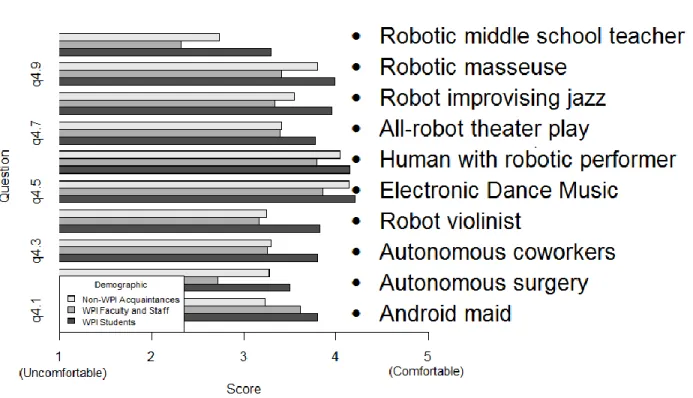
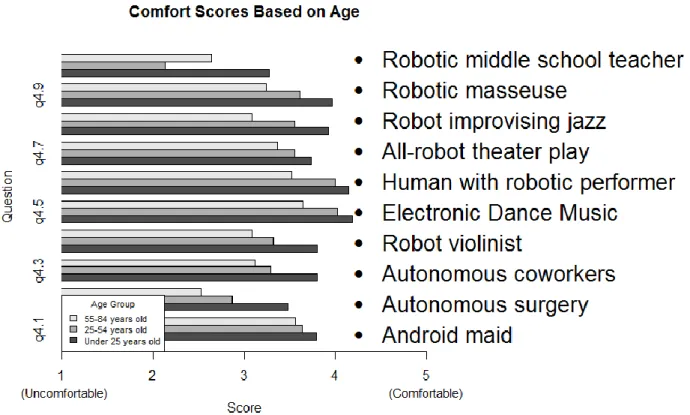
Afterwards, we presented the "how comfortable" questions, which ask the participant to rate their comfort in several situations. The first few questions in this area ask how much one might trust a robot with human tasks in a typically human context (as a maid, surgeon, or coworker).The responses indicate whether people are comfortable with the robot performing actions in contexts other than the stereotypical industrial setting. Next are situations that involve the expressive and creative capacity of robots – robotic performances in orchestra, electronic dance music, and plays. Positive answers to these questions would indicate that our audience could be more receptive to our robot performance.
Then we presented the "robots and emotions" questions, which ask about the ability for a robot to express emotion. Answers to these questions may determine how difficult it is for an audience to empathize with the "emotions" portrayed by the robot. If it is difficult for the
audience to empathize, the robot may take a less emotional role and the other characters will have to compensate for it through exaggerated elements in our narrative.
The "robots in art" questions ask about the artistic capabilities of robots. Answers to these questions would reveal information about how people might perceive the robot as capable of producing genuine musical pieces or works of art rather than seeing the robot as a machine programmed to do so. They could reveal whether or not the autonomous nature of the robot causes its autonomously-created art to be considered of the same value as human-created art. We assumed based on our background research that this question might include some varied responses – some people may imagine that the robot is not an agent, because in reality the robot is not. Some, however, might subscribe to the idea that autonomous and procedurally-generated movements can literally make the robot into the artist, even though its behavior follows preset rules.
The "technology in art" questions ask about the value of art made with more recent technology. Answers to these questions would reveal how people perceive the role of digital technology in the creation of art. There is controversy among people regarding the nature of creating art using digital mediums - and because we were using a primarily digital medium for our performance we needed to know how that may affect the audience's willingness to see the
artwork produced by the unity of a number of digital mediums. Electronic music, especially, and digitally-generated animations were huge parts of this performance, so understanding whether or not people view digital mediums as obstacles to true artistic expression would greatly affect how they interpret the performance.
2.1.3 Survey Distribution
We made use of two online survey platforms in our outreach endeavors: SurveyMonkey and WPI Qualtrics. Both surveys were identical – the reason we separated the two platforms was to distinctly separate results from both platforms to make it simpler to compare. The Qualtrics version was sent just to WPI Students and faculty in order to gauge what kinds of opinions our audience members have. The SurveyMonkey version was given out to friends, acquaintances, and family outside of WPI who may not have been exposed to robotics to the same extent.
Two different result sets allowed us to analyze the differences between them in order to extrapolate responses from our audience members, who could only be WPI students and faculty. If someone in our audience did have something different to say after they experienced the performance we might assume then, that someone more unfamiliar with robotics might also change their minds.
A third survey was also created and sent out to WPI faculty through Qualtrics, giving us a different perspective from a generally different age group and a different WPI experience. Specific demographic data here, which we did not include in our survey to the students, could help us show connections between how age, department, and educational background might affect how someone perceives robotics. We hoped that our focus group audience would include at least one faculty member in addition to other students.
Once we created the surveys, we sent them out to our target demographics and left them open for a week to give ample time for participants to take the survey.
2.1.4 Performance Group Discussion and Surveys
We considered a couple of different approaches to handling our live performance in terms of gathering research data for discussion. We had planned to conduct interviews personally, because we assumed that we would have a rather small audience. We eventually decided that this was out of scope and chose instead to hand out physical surveys to our audience members and facilitate a discussion with some post-performance questions. In the interest of keeping some responses unbiased by group opinion, we chose to have a group discussion for only one of the groups.
Our performances were filmed in order to document, analyze, and distribute the performance outside of WPI. However, truly experiencing a performance first hand is much different than watching a video recording. A live performance gives the audience feedback to all five senses and allows them to interact with it without any limitations. A video has a limited angle and presents just audio and visual information without allowing the user to explore the space. Audience reactions to the performance count as points of discussion even though we could not quantify reactions specifically. Clear emotions like surprise or happiness are simpler to observe and we can talk about these reactions in the context of certain narrative elements.
We did not expect all of our audience members to talk extensively about their reactions, but some data is better than no data. For this reason we chose to issue more concrete,