Utilization of Smartphones in Science Teaching and Learning in
Selected Universities in Ghana
Rosemary Twum
College of Education Studies, University of Cape Coast, University Post Office, Cape Coast, Ghana Abstract
This study was designed to examine the use of mobile phone, a widespread technology, and determined how this technology influences science students’ learning. The study intended to examine the use of smartphones in
science teaching and learning and propose of model in the use of smartphones for teaching and learning. The research design employed was a descriptive survey. The target population for the study was science students and lecturers from three selected public universities in Ghana. Five hundred and three students and 71 lecturers were selected for the sample size. Purposive and convenience sampling techniques were used in selecting the sample size. The data was collected using questionnaires from lecturers and students. Data was analyzed using descriptive statistics. Qualitative analysis from open ended items from the questionnaires were considered and inferences drawn from the opinions of the respondents. The findings revealed that the mobile phone had great potential as a learning tool and it could positively be used for teaching and learning purposes in science areas. After analyses the results were presented in the form of tables and bar charts. Discussion and conclusions were drawn. The study generated some useful data for lecturers and students to use for recommendations for policy. Keywords: smartphone, science learning, science teaching, mobile learning
1. Introduction
Mobile learning (m-learning) can be defined as using mobile technologies for educational purposes (Rodríguez-Arancón, Arús & Calle, 2013). There is no doubt that the booming of smartphones currently gives numerous opportunities for students to utilize mobile application in supporting learning activities (Wendeson et al, 2010). In this line, in a research conducted by Gaskell & Mills (2010) proved that smartphones play a very important role in education, in that it offered a major chance in enhancing access to learning resources. This enables many institutions, especially in higher education, to develop learner support as well as learning opportunities in ways which would build on current methods. In a research, Shuler (2009) points out that smartphones offer students opportunities to gather, access, and process information outside the classroom as well as support learning in a real-world context. He continues to point out further that smartphones promote collaboration, communication (as these are considered vital for 21st-century academic success) and can also help encourage instruction that is adaptable to individual and diverse learners.
It is true that science learning can be quite difficult to understand and also a demanding area, since it entails creating knowledge about abstract and complex concepts; consequently, there is a need to involve collaboration and co-construction of knowledege and ideas, which stresses on change in educational practices (Khoo et al, 2012). This is necessary to allow students to learn how to utilize mobile learning devices such as the smartphone. Since, these technologies can support learning by increasing the possibilities for student participation and collaboration in the learning process (Khoo et al, 2012), it is therefore necessary that students realize the many possibilities that these tools can have on their learning. Science educationists especially in the Western world have become more informed of the vast possibilities that smartphones are having in teaching and learning science. Therefore, these technologies could supplement a new dimension to science education which include content and scientific processes that are presently considered as difficult (Taber, 2005). In Ghana, among the mobile technologies mostly owned and used among young people is the smartphone. The smartphone can present students with an appropriate learning environment as there are a variety of mobile applications that students can use to support their learning experiences in science.
Vavoula et al (2007) affirms that students in higher education institutions when engaged in real-world activities that can represent the abstract concepts they are learning about, it can actually present a means of modifying and simplifying learning for them. This is especially crucial for science learning, in the sense that it involves increasing knowledge about complicated abstract concepts, which in turn can be more significant if students are able to build a relationship between their formal knowledge and their personal experiences (Vavoula et al, 2007). Technology can make students hopeful in reflecting their learning and considering its relation to the world around them (Waycott & Kennedy, 2009). This is especially crucial for science learning, in the sense that mobile phone technologies can also assist science students to construct a connection between learning science in the classroom and their personal experiences in the outside world (Waycott & Kennedy, 2009).
Trinder (2005) stresses that smartphones can be used in presenting documents, writing notes, playing educational games, listening to audio recordings and other sound files, viewing pictures and watching video clips, plus taking photographs. Some universities have recently started utilizing smartphones in order to store and
retrieve information such as e-books, courseware and timetables (Ferry, 2009). There was a study that focused on actual use in classrooms in secondary schools, and the results from the research revealed that Smartphones had numerous benefits to support learning in and out of class (Hartnell-Young & Heym, 2008). Additionally, according to Huang et al (2010), smartphone applications can enhance students learning content conveniently plus the opportunity to interact with others collaboratively anytime and anywhere. Williams and Pence’s study
(2011) indicates smartphones as an influential tool that can be used in a chemistry classroom. In chemistry,
reference applications assist students’ learning chemical formulae, presenting detailed information on the elements permitting them to review and take notes on what they learn and then test their understanding.
Hence, smartphones can improve students’ understanding of abstract concepts in science and this helps
to facilitate appropriate and relevant social relationships with learners through collaboration, exchange and sharing of information at any time and in any case as to meet the needs and interests of learners while increasing their critical thinking abilities (Karim, 2012). Therefore, the smartphone, a technology that many students today in higher education already personally own should be exploited as an appropriate learning tool. Ghanaian students need to discover the numerous possibilities of using this technology in and out of the lecture room for learning purposes.
1.1Statement of the problem
The smartphone is an effective technology that Ghanaian students already own, and their potential is continuously growing (Bright Hub Education, 2012). But, many science students were likely not using smartphones to its maximum potential in their learning. Since, science is considered to be a difficult and demanding discipline especially since it is mainly about complex and complicated concept, theories, laws and models, mobile technologies could be seen as tools that can be used to enhance students’ learning. Science
educationists are already becoming more aware of the enormous prospects that smartphones can have in science education in the developed countries. But, as far as literature review is concerned there has not been much empirical study done in Sub-Saharan Africa, especially Ghana. Therefore, it is necessary that one looks at the full potential of smartphones in science learning.
1.2 Objectives of the study
This study seeks to investigate how students were using their smartphones to learn science and propose a model in the use of this technology in science learning.
2. Literature Review
Kulik (1994) study showed that averagely students who used ICT-based instruction were expected to score higher than students who did not use ICT. In a study conducted by Project K-Nect (2010), it was seen that those students that used mobile devices achieved higher mathematics test scores than those who did not use these technologies. Also, interestingly enough those same students were observed to utilize social networking facilities effectively in order to help one another. Additionally, when undergraduate students were engaged in real-world activities that actually represented the concepts they were learning about it actually presented them with a means of modifying and simplifying learning. In another research, Zurita and Nussbaum (2007) researched on how computer technologies could assist in supporting the teaching of mathematics. In this study, the results revealed that students realized cooperation and collaboration were very essential in achieving their goal and therefore
showed the positive influence these technologies have on students’ social interaction, motivation as well as
learning.
Fozdar and Kumar (2007) conducted a research to appreciate students’ attitudes and perceptions
towards the effectiveness of mobile learning. In this study, the results showed that adopting mobile phone into the learning environment can effectively improve retention of science students. Improving retention was done by
supplementing and supporting teaching as well as enhancing students’ learning experiences. In South Africa,
Motiwilla (2007) found mobile phone technologies effective as a useful supplementary tool for learning. This technology provided interaction, flexible access, convenient use and efficiency in delivering individualized content. Students, therefore, found these interaction tools simple to use for discussing educational materials with
had significantly higher test scores on constructing words than those from the group who used printed cards. It was also revealed that PDAs took less time on the task and used less teacher support than using printed cards.
According to (Cavus & Huseyin, 2009), there were many different studies on whether there was a positive influence in sending educational text messages through mobile phones in education. In these studies, it was revealed that mobile phones improved learning and increased understanding of difficult concepts; satisfied the needs, abilities and interests of learners; improved critical thinking skills; and time was used productively. In another study, according to Evans (2008), he asserted that students were more interested in learning materials through audio or video podcasts than lecture notes or textbooks. Students observed these podcasts to be helpful especially as a tool that was used to review content material on their own time after a lecture was conducted. Also, Sivin-Kachala and Bialo (1998) reviewed 219 studies from 1990 to 1997 on the effect of technology on the academic performance across all learning domains and different ages of learners. It was found that students in a technology rich environment experienced positive effects on their academic performance. Since, we are in now in an era where mobile technology is prominent than the usage of mobile phones in tertiary education can have a
significant positive impact on students’ academic performance.
3. Methods
The research design adopted for this study was a descriptive survey. The researcher was interested in examining information efficiently and logically in order to emerge with useful data. The design allowed for both qualitative and quantitative techniques to be collected and data analyzed for this study. This was considered appropriate by the researcher to give a wider information and systematic description of the use of smartphones to support science learning of university students in Ghana. The population of interest in this study was generalized to all fourth-year science university students from selected departments in three public universities. The population also consisted of lecturers in the Sciences. Convenience sampling was the technique selected for both student and lecturer-sample size since it involved randomly selecting those people from a population that are the easiest
to obtain for the researcher’s sample. Purposive sampling was also deployed to chose 75 students out of 503 (five students from each department) because the researcher was interested in those students who had special knowledge about learning science using smartphones. The sample size consisted of 503 students and 71 lecturers
was seen as relevant and sufficient for a descriptive research and presented an overview of participant’s opinion
at the time of collecting data. Students and lecturers included in the pilot study were a representative of the population studied and the pretest was administered in conditions comparable to the final study. The characteristics of the students and lecturers used in the pilot study were also used in the main study. Validity and reliability was ensured.
4. Results and Discussion 4.1Data Analysis
The completed questionnaires were serially numbered, coded and tabulated with the aid of SPSS-version 17 computer programme. The analysis involved coding, organizing, describing, interpreting and drawing conclusions. The analysis was done in two stages. The first stage of analysis involved descriptive statistics through computing of frequencies, percentages, means and standard deviation. The data was synthesized and transformed into tabular form and histograms to illustrate the relative proportions where applicable. The second stage involved content analysis of all open-ended items in the questionnaires, which was undertaken so as to provide qualitative support to data. This data was transcribed, put into categories, themes identified, recorded and descriptive analyses run. The data was transformed into tabular form to illustrate the relative proportions where applicable (Creswell, 2009). Trends that merged from all the data were highlighted and comments were passed on them in relation to the literature that was reviewed (Creswell, 2009). Figure 1 shows how students use smartphones in their learning.
N = 75 Figure 1. The use of smartphones in learning science
The data presented in Figure 1 indicated that a substantial number of respondents 20 (26.7%) use smartphones in science learning by browsing/research and reading scientific information online. A few students 4 (5.3%) used mobile phone to watch science videos on YouTube and social network collaboration. The remaining students 8 (10.7%) had used their phones for calculating figures, downloading information, office
applications, conference calling via Skype and capturing information through ‘screen munches to read
information anytime.’ The future role of smartphones in science learning is outlined in Figure 2.
N = 75
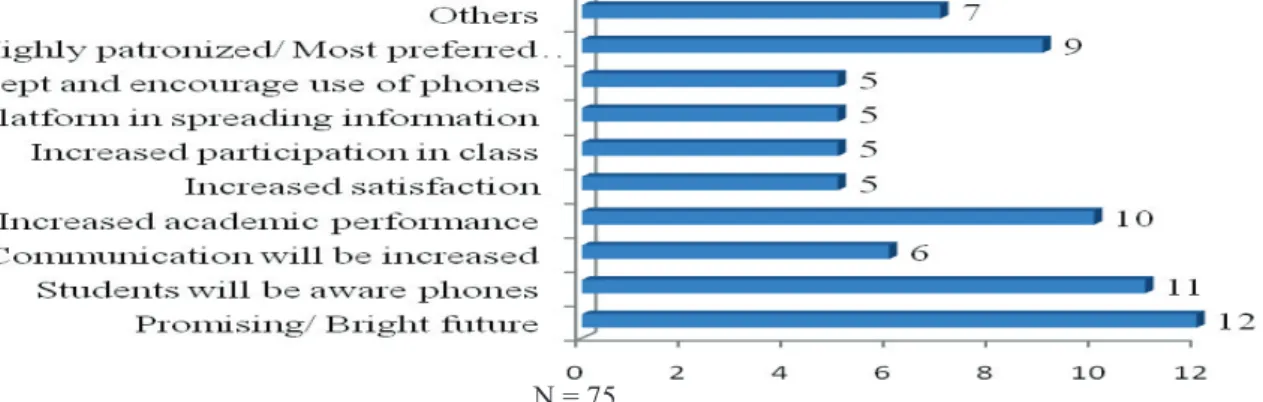
Figure 2. Future of smartphones in learning science
The results drawn from the data presented in Figure 2 depicted that quite a number of students 12 (16.0%) felt that smartphones had a promising future. A few respondents 5 (6.7%) believed that in the future, smartphones would be accepted and encouraged, increase participation and satisfaction and would be a platform for spreading information. Other students 7 (9.3%) found that smartphones would increase collaboration and awareness of their learning styles, video and teleconferencing, envisioning more advance smartphones and increase in lecturer-student and interaction. Table 1 shows the perception of students on the use of smartphones in learning.
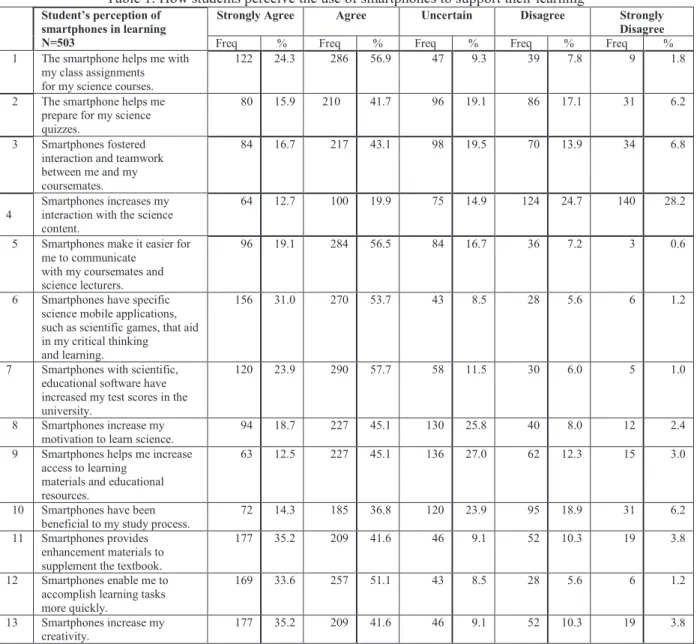
Table 1. How students perceive the use of smartphones to support their learning Student’s perception of
smartphones in learning N=503
Strongly Agree Agree Uncertain Disagree Strongly
Disagree
Freq % Freq % Freq % Freq % Freq %
1 The smartphone helps me with my class assignments for my science courses.
122 24.3 286 56.9 47 9.3 39 7.8 9 1.8
2 The smartphone helps me prepare for my science quizzes.
80 15.9 210 41.7 96 19.1 86 17.1 31 6.2
3 Smartphones fostered interaction and teamwork between me and my coursemates.
84 16.7 217 43.1 98 19.5 70 13.9 34 6.8
4
Smartphones increases my interaction with the science content.
64 12.7 100 19.9 75 14.9 124 24.7 140 28.2
5 Smartphones make it easier for me to communicate
with my coursemates and science lecturers.
96 19.1 284 56.5 84 16.7 36 7.2 3 0.6
6 Smartphones have specific science mobile applications, such as scientific games, that aid in my critical thinking and learning.
156 31.0 270 53.7 43 8.5 28 5.6 6 1.2
7 Smartphones with scientific, educational software have increased my test scores in the university.
120 23.9 290 57.7 58 11.5 30 6.0 5 1.0
8 Smartphones increase my motivation to learn science.
94 18.7 227 45.1 130 25.8 40 8.0 12 2.4
9 Smartphones helps me increase access to learning
materials and educational resources.
63 12.5 227 45.1 136 27.0 62 12.3 15 3.0
10 Smartphones have been beneficial to my study process.
72 14.3 185 36.8 120 23.9 95 18.9 31 6.2 11 Smartphones provides
enhancement materials to supplement the textbook.
177 35.2 209 41.6 46 9.1 52 10.3 19 3.8
12 Smartphones enable me to accomplish learning tasks more quickly.
169 33.6 257 51.1 43 8.5 28 5.6 6 1.2
13 Smartphones increase my creativity.
177 35.2 209 41.6 46 9.1 52 10.3 19 3.8
From Table 1, it could be clearly seen that 122 (24.3%) and 286 (56.9%) students believed that smartphones helped them with their science homework as they ticked strongly agree and agree respectively. Many students 156 (31.0%) and 270 (53.7%) strongly agree and agree respectively that smartphones aids in critical thinking and 120 (23.9%) and 290 (57.7%) strongly agree and agree respectively that smartphones increase their test scores. One hundred and seventy-seven (35.2%) and 209 (41.6%) students strongly agree and agree respectively that smartphones supplement textbooks and that this technology can be used to increase creativity while 169 (33.6%) and 257 (51.1%) students believed that smartphones allowed them to complete their tasks more quickly.
The data showed that more than ¾ of students believe that smartphones would improve learning, if used properly. Woodcock, Middleton and Nortcliffe (2012) data study supports the idea that smartphones being used to improve learning, especially if most students used these technologies for either managing their learning through group work, timetabling, searching for information and reference. Therefore, smartphones can be used to support science learning. Ways students use smartphones to improve learning is presented in Figure 3.
Figure 3. Ways smartphonescan improve learning
The analysis of data in Figure 3 indicated that a good number of students 26 (34.7%) and 15 (20.0%) believed that searching for information as well as getting easier access to notes respectively enhances academic performance. Only a few students, 2 (2.7%) think that sharing notes via DropBox whilst other students 3 (4.0%) believe discussion groups through skyping and audio recording lectures also enhances learning. Other students 5 (6.7%) also believed that distribution of course content, scheduling and emailing to lecturers enhanced learning. Students reported that they did the following activities on their phones: texting (98%), web browsing (62%), checking personal calendar (61%), checking e-mail (58%), social networking (57%), playing games (51%), map software (47%), listening to audio (46%), and watching video (42%) and read books (11%) (JMU Technology, 2012). Thus, students can use smartphones to support their learning, which will also improve their academic
performance. Students’ opinions on what they think smartphones usage should be used for at their university are
shown in Figure 4.
N = 75
Figure 4. Students’ opinions on what smartphonesshould be used for at their universities
Figure 4 shows an illustration that respondents 28 (37.3%) would like to see smartphones being used to get information on their courses and other students 18 (24.0%) preferred that their smartphones be used for discussing information with coursemates. A few respondents 3 (4.0%) felt that receiving email notifications of their results is what they would like smartphones to be used for at their universities. Students, therefore, think that their smartphones should be used for deciding what they need to do in order to be successful in the course. According to research from a national survey conducted by Project Tomorrow (2009), students in grades 6–12 shared their views on how smartphones should be used in their schoolwork. If students were given the chance to use smartphones they would use it in: communicating with their classmates (53%) or teachers (34%) through e-mail, instant messaging or SMS; working on projects with classmates (48 percent) at home or school; playing games for educational purposes (32 percent); looking up information on the internet (53%); taking notes or recording lectures for review and revision (32%); receiving alerts or reminders about upcoming homework and tests (51%); having access to their school’s portal (24%) to upload or download information and online textbooks.
Table 2. How lecturers use smartphones to support their teaching Smartphones used by lecturers
N=71
Very Often Often Occasionally Rarely Never Freq % Freq % Freq % Freq % Freq % 1 I send emails to my science students to discuss subject
content and attach course outline and other important information from my phone.
8 11.3 3 4.2 20 28.2 10 14.1 30 42.3
2 I access and download textual materials, audio and video clips for my class directly from my phone.
6 8.5 7 9.9 12 16.9 13 18.3 33 46.5 3 I use my smartphone to contact my students for
important information.
28 39.4 16 22.5 15 21.1 3 4.2 9 12.7 4 I use text messages to send notifications (class
cancellations, change of lecture venue, change in time of lectures and other administrative duties).
18 25.4 15 21.1 16 22.5 8 11.3 14 19.7
5 I encourage students submit their assignments online from their smartphone.
1 1.4 8 11.3 14 19.7 17 23.9 31 43.7 6 I have course materials such as slides, lecture notes and
practice quizzes available on my smartphone.
6 8.5 3 4.2 4 5.6 11 15.5 47 66.2 7 I download materials onto my smartphone to
store up-to-date information for my class.
6 8.5 3 4.2 4 5.6 11 15.5 47 66.2 8 I read news, books and articles online directly from my
smartphone in order to gather more information on topics treated in class.
30 42.3 16 22.5 5 7.0 7 9.9 13 18.3
9 I use online science dictionaries on my smartphone to get definitions for my class.
18 25.4 18 25.4 12 16.9 8 11.3 15 21.1 10 I use Bluetooth from my smartphone to share materials
with my students, since it is a quicker way to send information to my students.
1 1.4 1 1.4 5 7.0 9 12.7 55 77.5
Many lecturers, 28 (39.4.9%) and 16 (22.5%) used their smartphones to contact their students very often and often respectively. Thirty (42.3%) and 17 (23.9%) get current information from the internet very often and often respectively. While 30 (42.3%) and 16 (22.5) of them read materials online. Most lecturers, 11 (15.5%) and 47 (66.2%) did not download materials using their smartphones rarely and never respectively. Only 1 (1.4%) and 8 (11.3%) encouraged submissions of assignments online very often and often respectively while 11 (15.5%) and 47 (66.2%) of them did not have course materials on their smartphones. A good number of lecturers, 10 (14.1%) and 30 (42.3%) did not use their mobile phones to send emails since they rarely or never did respectively. Only a few lecturers 1 (1.4%) and 1 (1.4%) used Bluetooth for academic purposes very often and often respectively. Lecturers patronized the use of smartphones to support their teaching on average. At least some lecturers were aware of the possibilities that come with using smartphones in education.
In another study, Mtega et al (2012) found that all of the lecturers made calls and sent text messages so as to alert students and communicate with colleagues on academic issues. Lecturers used the Internet through their smartphones to download and read scholarly materials or articles, to access and read textbooks online and to support teaching and learning. The majority of lecturers used the Internet from their smartphones in accessing online dictionaries, searching library catalogues and sharing information resources with others (Mtega et al, 2012). These lecturers were observed to have a high patronage in the use of technologies to supplement educational experiences.
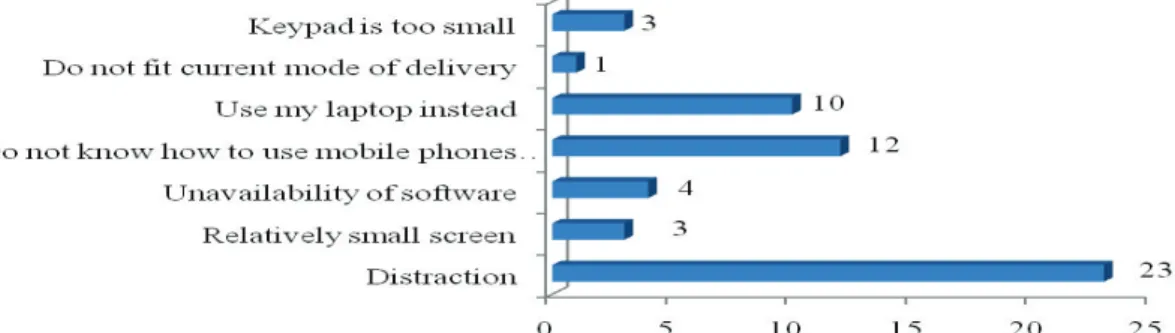
But in this study, lecturers were not using mobile phone technologies as much as one would expect given that the technology was readily available and accessible. This could be due to the fact that most of the lecturers were still not comfortable with the use of these technologies and therefore prefer not to use these types of technologies when teaching their students. This is indeed serious because the single biggest problem facing education today is the unwillingness of lecturers to use new technologies in education. Lecturers, therefore, are struggling to teach students who are already conversant and using these technologies in learning (Prensky, 2001). The reasons why lecturers did not like using smartphones for educational purposes are shown in Figure 5.
The results drawn from the data presented in Figure 5 depicted that out of 54 respondents, most lecturers 23 (42.6%) believed that mobile phones caused a distraction while other lecturers 12 (22.2%) and 10 (18.5%) did not know how to use mobile phones to support teaching while others used laptops instead. A few lecturers 1 (1.9%) and 3 (5.6%) believed that mobile phones do not fit current mode of teaching and expressed concern that the screen was relatively small making it difficult for them to see information. Most lecturers believed that mobile phone technologies could affect the mental focus and concentration ability in students' academic life (Pandey, 2011). Lecturers, who for centuries have been the core of learning in the classroom, are increasingly seeing students who are distracted and not able to stay focused (Bouchard, 2011). How lecturers perceive the use of smartphones to support teaching is presented in the next table.
Table 3. How lecturers perceive the use of smartphones to support teaching Lecturer’s perception of smartphones in teaching Strongly
Agree
Agree Uncertain Disagree Strongly Disagree Freq % Freq % Freq % Freq % Freq %
1
Smartphone is useful as a supplementary to teaching. 9 12.7 27 38.0 20 28.2 10 14.1 5 7.0
2
Smartphone is better than traditional instruction since it allows teaching suited to the students’ learning style.
3 4.2 16 22.5 26 36.6 19 26.8 7 9.9
3
Smartphones help me organize my work better. 3 4.2 15 21.1 25 35.2 20 28.2 8 11.3
4
Smartphones enhances easier access to information anywhere and anytime.
33 46.5 22 31.8 13 18.3 2 2.8 1 1.4
5
Text messaging is useful as an instructional tool in class.
9 12.7 13 18.3 27 38.0 16 22.5 6 8.5
6
Text messaging increases understanding of difficult concepts, by putting information in bits for easier assimilation.
4 5.6 21 29.6 24 34.8 14 19.7 8 11.3
7
Smartphones can increase participation in class.
13 18.3 31 43.7 17 23.9 9 12.7 1 1.4
8
Smartphones increase collaboration between students.
22 31.0 34 47.9 9 12.7 5 7.0 1 1.4
9
Smartphones increases communication between the lecturer and the student.
17 23.9 21 29.6 24 33.8 4 5.6 5 7.0
10
Smartphones can help students be more prepared for class by easily accessing information before class.
10 14.1 19 26.8 27 38.0 9 12.7 6 8.5
11
Smartphones provides students with the opportunity to work at their own pace.
22 31.0 27 38.0 18 25.4 4 5.6 0 0 12 Smartphones allow students to get access to
up-to-date information through the Web.
2 2.8 14 19.7 29 40.8 17 23.9 9 12.7 13 Smartphones can increase motivation in class. 6 8.5 23 32.4 28 39.4 9 12.7 5 7.0 From the results in the table above, quite a number of lecturers, 33 (46.5%) and 22 (31.8%) strongly agreed and agreed respectively that smartphones could be used for accessing information. The results showed that most lecturers were uncertain of perception about how the smartphone can be used in education. Thus, lecturers were not aware of the full potential of using these technologies in education. This may be one of reasons they did not want to use these technologies in supporting teaching. It is vital that lecturers play their role in supporting education by utilizing smartphones in teaching and learning science (Daniel, 2008).
The model representations of mobile phone technologies by students to support their learning
Out of the useful data, the researcher was able to come up with a model for effective smartphone instructional use for learning science in universities, which is presented in the next section. It starts with the mainstream section which outlines the relationship or links with the key variables.
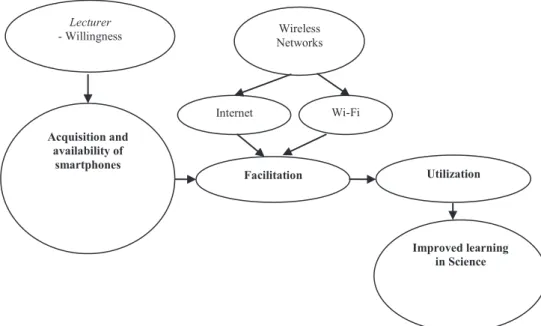
Figure 5. Mainstream step to a model for utilizing smartphones to support science learning
In the initial step, it is ideal for both lecturers and students to have access to smartphones. The results of this study have shown that indeed many students have acquired and put to use a variety of smartphones. It is also noted that the more sophisticated the phone the better the facilitation and utilization in bringing improved learning. Therefore, once these phones are available, lecturers should be willing to use these technologies to support their teaching.
Step Two
Figure 6. Step two to a model for utilizing smartphones to support science learning
In the second step, when students and lecturers have internet-compatible smartphones, they are able to access it through wireless networks or hotspots available on campus. With internet access, the student and lecturer are able to retrieve information in the form of ebooks, audio, video as well as Multimedia Messaging Service. It is known that some technologies such as smartphones, lecturers are neither conversant nor comfortable with their use to support their teaching. This could be due to the small keypad, small screens and so on. But all the same, students are already using it and this technology is assisting most of them in improving their learning. Therefore, lecturers need to realize and concentrate on the positive effects that this technology
would have on students’ learning and stop concentrating on the negative aspects. Students need to also be ready to properly utilize these technologies in order for their learning to be more effective. This technology can help students to improve their learning, especially when used appropriately. When these technologies are utilized it increases collaboration and interaction among lecturers, students and content. The content stored by more sophisticated phones can be enormous, such as emails, ebooks, video demonstrations, tutorials, audio and so on.
Internet Wireless Networks Wi-Fi Lecturer - Willingness Acquisition and availability of smartphones Facilitation Utilization Improved learning in Science Acquisition and availability of
smartphones Facilitation Utilization
Improved learning in
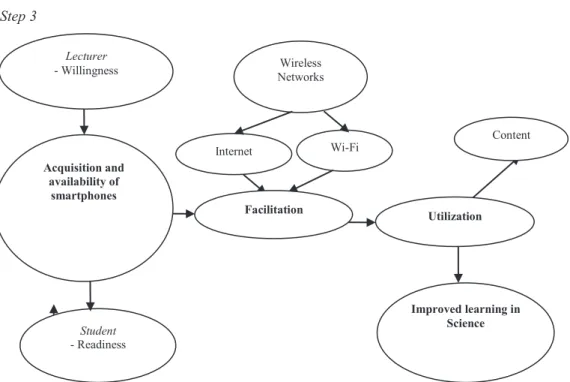
Step 3
Figure 7. Step three to a model for utilizing smartphones to support science learning
In this step, it is observed on how students and lecturers use the smartphones in science learning. Most students use these technologies before or after lectures, since most lecturers do not allow students to use their phones during lectures. Some lecturers use smartphones to support their teaching, and they do so before class in preparation for treating a science topics for lectures.
Final Step Improved learning in Science Wi-Fi Content Student - Readiness Internet Wireless Networks Lecturer - Willingness Acquisition and availability of smartphones Facilitation Utilization Content Improved Increased Collaboration Independent Study Internet Utilization Facilitation Teaching Styles University Policy Self- initiation Wi-Fi Wireless Networks Acquisition and availability of smartphones Lecturer - Willingness
instead of paying attention they are busily browsing on their phones, text messaging their friends or updating their Facebook status, in this case students are using this technology inappropriately. Furthermore, there needs to be a policy in order for students to use these technologies in during lecturers and there must be measures taken when students are caught using this technology inappropriately. With these policies in place, lecturers would not need to worry about using smartphones during lecturers. Therefore, lecturers should support their students in bringing their smartphones and allow them to use them openly and freely in during lectures in order to enhance
students’ participation and collaboration. Students need to be taught on how to properly utilize and navigate the Mobile Age from an educational perspective. They also need to know the etiquette of using smartphones in lecture rooms. They should also abide by the rules and regulations enforced by the use of smartphone during lecture time. Students must initiate learning and lecturers should give students opportunities to use the smartphone in class. Students can get information from lecturers or other students more easily and quickly through collaborative learning. Students can also work on tasks through independent study or individualized learning.
Summary of findings
When students were asked how smartphones affect their science learning, majority of students believed this technology had a positive impact on their academic lives. Some students listened to audio clips and watched video clips to support learning science. Majority of students, who used smartphones in learning, mostly used it in conducting research. Some students used their phones in reading science news, books and articles online. Majority of students utilized science dictionaries and calculators available on their phone. Only a very few students utilized office applications on their phones.
5. Conclusion
Based on the findings of the study, the following conclusions were made:
a. Majority of students were observed to be using smartphones to improve their learning. This could be because this technology made it easier to have access to information that can be read every time and everywhere. Therefore, students have information at the tip of their finger with just the click of a button. Hence, the more the student used these technologies to support their science learning, the more their learning experiences were likely improved. There were some technologies that were not patronized by most students, such as YouTube videos.
b. Secondly, some lecturers use smartphones to support science teaching in order to access up-to-date information and reading materials online. Only a few lecturers were aware of the instructional importance of the smartphones. Most lecturers were not aware of the numerous possibilities that smartphones have on education.
Therefore, this research gave a better understanding of students’ practice and perception towards
learning through smartphones and therefore will help to enhance educational activities and aid in engaging students to contribute to their learning. It also offers an insight into the type of smartphones that students have and what they can do with them. This means that activities can be designed so that a larger number of students can support their learning through these technologies. Three aspects stand out for effective use of smartphone for instruction. First, is the availability of the sophisticated phones. Second, is the guidance from the lecturers and third, the initiative of the student. With the rapid development of the phone industry, more affordable and flexible smartphones for learning are on the way and it is important if both lecturers and students can orientate themselves to take full advantage of this technology.
Recommendations
Based on the results and conclusions of the study, the following recommendations were made.
1. Students should be aware and take an interest in using smartphones to support their learning experiences. Science students should be more encouraged by their lecturers to use chat room, such as viber and whatsapp for group discussions, share images through Bluetooth for explaining scientific concepts and processes, read eBooks and download scientific materials from the internet. Therefore, there should be seminars for students as to make them more aware of the full potential the smartphone can be used to enhance their learning. 2. Lecturers are encouraged to design activities that allow students to appropriately use their smartphones
during lectures (through a university mobile policy- such as rules around usage and etiquette). These technologies can provoke the interest of the students and make science learning more interactive. As a result, science lecturers should explore different ways mobile phone technologies can be used to support learning. Lecturers can also formulate automatic alerts to their students on important information, such as quiz dates, additional required readings as well as links to helpful websites. Therefore, there should be seminars for lecturers to be made more aware on how effectively the smartphone could be used to enhance or support teaching science.
References
Bouchard, K. (2011). Technology brings positive and negative effects in the classroom: Cell phones prove distracting and hard to police. Retrieved on May 23th, 2012 from http://Technology_brings_positive_and_negative_effects_in_classroom/The_ Kennebec_Journal, Augusta,_ME.htm.
Bright Hub Education. (2012). How Cell Phones Can Be Classroom Learning Tools. iVillage Family: Bright
Hub Inc. Retrieved on January 12th, 2014 from
http//:www.teachhub.com.how_use_Cell_Phones_in_the_Classroom _Ideas_for_ How_ to_ Make_ it_ Work.htm
Cavus, N., & Huseyin, U. (2009). Improving critical thinking skills in mobile learning. Procedia social & Behavioral Sciences, 1, 434-438.
Creswell, J.W. (2009). Research Design: Qualitative, quantitative and mixed methods approach. (3rd ed.).Thousand Oaks, CA: Sage.
Daniel, E.G.S. (2008). An Emergent Scaffolding Model Of Tertiary M-Learning: A Case Study Of Science Teacher Education. In: 2nd International Mobile Learning and Edutainment Conference, Kuala Lumpur.
Ferry, B. (2009). Using Smartphones to enhance teacher learning in environmental education. In J. Herrington, A. Herrington, J. Mantei, I. Olney, & Ferry, B. (Eds.), New technologies, new pedagogies: Mobile learning in higher education (pp. 45-55). Wollongong: University of Wollongong. Retrieved on October 15th, 2013 from http://ro.uow.edu.au/
Fozder, B. F., & Kumar, L. S. (2007). Mobile Learning and Student Retention.
International Review of Research in Open and Distance Learning, 8(2). Retrieved from http://www.eric.ed.gov/ERICWebPortal/Home.portal?_nfpb=true&ERICE xtSearch.
Gaskell, A., & Mills, R. (2010). Can we really learn from mobile handheld devices? Theme: Social Justice. Sub-theme: Scaling up Quality Education for all.
Hartnell-Young, E. & Heym, N. (2008). How Smartphones help learning in secondary schools. A Becta report. Nottingham, UK: Learning Sciences Research Institute. Retrieved on October 15th, 2013 from http://research.becta.org.uk/index.php?catcode=_re_rp_02&rid=15482§ion=rh
Huang, Y-M., Hwang W-Y., and Chang, K. -E. (2010). Innovations in designing mobile learning applications. Educational Technologies and societies, Vol. 13. No. 3. pp. 1–2. Retrieved on August 12th, 2013 from www.ifets.info/download_pdf
JMU. (2012). Technology Satisfaction Survey. Retrieved on November 26th, 2013 from http://www.jmu.edu/computing/af/wm_library/FinalStudentReport _12_18_12.pdf
Karim, S. (2012). The Role of Smartphones in Education and Instruction of Classroom Materials. Advances in education. 1(1), 19. Department of Educational Psychology. University of Nour Payam, Ahwaz, Iran. Khoo, E., Williams, J., Otrel-Cass, K., Cutler, D., Ballard, M., & Critchley, J. (2012). Observing, recording, and
reviewing: Using Smartphones in support of science inquiry. I Heck, D. (red.), 43rd Annual ASERA Conference. University of the Sunshine Coast, Sippy Downs, Queensland, Australia.
Kulik, C.L., & Kulik, J.A. (1991). Effectiveness of computer-based Instruction: An updated analysis. Computers in Human Behavior, 7, 75-94.
Motiwalla, L. F. (2007). Mobile Learning: A framework and evaluation. Computers & Education. 49(3), 581-596.
Mtega, W. P., Bernard R., Msungu, A. C., & Sanare, R. (2012). Using Mobile Phones for Teaching and Learning Purposes in Higher Learning Institutions: the Case of Sokoine University of Agriculture in Tanzania. Sokoine University of Agriculture, Tanzania. Proceedings and report of the 5th Ubuntu Net alliance annual conference, 118-129.
Pandey, K. (2011). How has technology changed education? Retrieved from http://www.buzzle.com. Prensky, M. (2001). Digital natives, digital immigrants. On the Horizon, 9(5), 2-4.
Retrieved from http://www.marcprensky.com/writing/Prensky-DigitalNatives, Digital ImmigrantsPart1.pdf. Project Nect Evaluation Report. (2010). Students leverage the power of mobile devices through the Project
K-Washington, DC: Software Publishers Association.
Taber, K. S. (2005). Conceptual development. In Alsop, S., Bencze, l., & Pedretti, E. (Eds.). Analysing exemplary science teaching. Buckingham, UK: Open University Press. 127-136.
Trinder, J. (2005). Mobile technologies and systems. In Kukulska-Hulme, A. & Traxler, J. (Eds), Mobile learning: A handbook for educators and trainers. London: Routledge.
Vavoula, G., Sharples, M., Rudman, P., Lonsdale, P. & Meek, J. (2007). Learning Bridges: A role for mobile technologies in education. Educational Technology, 47, 33-36.
Vihavainen, S., Kuula, T., & Federley, M. (2010). Cross-use of smart phones and printed books in primary school education. Proceedings of the 12th International Conference on Human Computer Interaction with Mobile Devices and Services. pp. 279–282. Retrievable from http://delivery.acm.org.
Wendeson, S., Fatimah, W. Bt., Ahmad, W. & Nazleeni S. Bt. H. (2010). University Students Awareness on M-Learning. World Academy of Science, Engineering and Technology 62 (2010), 787-791
Williams, A., & Pence, H. (2011). Smart phones: A powerful tool in the chemistry classroom. Journal of Chemistry Education, 88(6), 683-686.
Woodcock, B., Middleton, A., & Nortcliffe, A. (2012). Case Study- Considering the smartphone learner: An investigation into student interest in the use of personal technology to enhance their learning. Student Engagement and Experience Journal, Vol (1), Issue (1). Retrieved on August 15th, 2013 from http://research.shu.ac.uk/SEEJ/index.php/seej/article/view/38/Wood cock
Zurita, G., & Nussbaum, M. (2004). Computer supported collaborative learning using wirelessly interconnected handheld computers. Computers and Education, 42(3), 289-314.
Zurita, G., & Nussbaum, M. (2004). A constructivist mobile learning environment supported by a wireless handheld network. Journal of Computer Assisted Learning, 20, 235–243.
Rosemary Twum This author became a Senior Member (SM) in 2015. She pursued a Doctor of Philosophy degree in ICT Education at Kenyatta University, Nairobi, Kenya and completed in 2014. The areas that she has an interest are ICT in Education, Educational Technology, Mobile learning and Computer applications in Education.