This is a repository copy of
Investigating bidirectional recurrent neural network language
models for speech recognition
.
White Rose Research Online URL for this paper:
http://eprints.whiterose.ac.uk/152811/
Version: Published Version
Proceedings Paper:
Chen, X., Ragni, A., Liu, X. et al. (1 more author) (2017) Investigating bidirectional
recurrent neural network language models for speech recognition. In: Proceedings of
Interspeech 2017. Interspeech 2017, 20-24 Aug 2017, Stockholm, Sweden. International
Speech Communication Association (ISCA) , pp. 269-273.
10.21437/interspeech.2017-513
© 2017 International Speech Communication Association (ISCA). Reproduced in
accordance with the publisher's self-archiving policy.
[email protected]
https://eprints.whiterose.ac.uk/
Reuse
Items deposited in White Rose Research Online are protected by copyright, with all rights reserved unless
indicated otherwise. They may be downloaded and/or printed for private study, or other acts as permitted by
national copyright laws. The publisher or other rights holders may allow further reproduction and re-use of
the full text version. This is indicated by the licence information on the White Rose Research Online record
for the item.
Takedown
If you consider content in White Rose Research Online to be in breach of UK law, please notify us by
Investigating Bidirectional Recurrent Neural Network
Language Models for Speech Recognition
X. Chen
1, A. Ragni
1, X. Liu
2, M.J.F. Gales
1University of Cambridge Engineering Department
1
Chinese University of Hong Kong
2
{xc257,ar527,xl207,mjfg}@eng.cam.ac.uk
Abstract
Recurrent neural network language models (RNNLMs) are powerful language modeling techniques. Significant perfor-mance improvements have been reported in a range of tasks in-cluding speech recognition compared ton-gram language mod-els. Conventionaln-gram and neural network language mod-els are trained to predict the probability of the next word given its preceding context history. In contrast, bidirectional recur-rent neural network based language models consider the context from future words as well. This complicates the inference pro-cess, but has theoretical benefits for tasks such as speech recog-nition as additional context information can be used. However to date, very limited or no gains in speech recognition perfor-mance have been reported with this form of model. This pa-per examines the issues of training bidirectional recurrent neu-ral network language models (bi-RNNLMs) for speech recog-nition. A bi-RNNLM probability smoothing technique is pro-posed, that addresses the very sharp posteriors that are often observed in these models. The performance of the bi-RNNLMs is evaluated on three speech recognition tasks: broadcast news; meeting transcription (AMI); and low-resource systems (Babel data). On all tasks gains are observed by applying the smooth-ing technique to the bi-RNNLM. In addition consistent perfor-mance gains can be obtained by combining bi-RNNLMs with n-gram and uni-directional RNNLMs.
Index Terms: language model, bidirectional recurrent neural network, speech recognition, interpolation
1. Introduction
Language models (LM) are crucial components in many ap-plication areas including speech recognition. They aim to es-timate the probability of any given word sequence W =< w1, w2, ..., wL>. The sequence probability can be computed
using P(W) =P(w1, w2, ..., wL) = L t=1 P(wt|wt−1, ..., w1) (1)
This research was partly funded under the ALTA Institute, Univer-sity of Cambridge. Thanks to Cambridge English, UniverUniver-sity of Cam-bridge, for supporting this research. This work was also supported by the Intelligence Advanced Research Projects Activity (IARPA) via De-partment of Defense U. S. Army Research Laboratory (DoD/ARL) con-tract number W911NF-12-C-0012. The U. S. Government is authorized to reproduce and distribute reprints for Governmental purposes notwith-standing any copyright annotation thereon. Disclaimer: The views and conclusions contained herein are those of the authors and should not be interpreted as necessarily representing the official policies or endorse-ments, either expressed or implied, of IARPA, DoD/ARL, or the U. S. Government. Xunying Liu is funded by MSRA grant no. 6904412 and CUHK grant no. 4055065
The task of language model then becomes that of calculating the probability of wordwtgiven its previous wordswt1−1 =<
w1, ..., wt−1 >. A variety of statistical language models have
been proposed to computeP(wt|w1t−1), includingn-gram LMs
[1] and neural network LMs [2, 3]. n-gram LMs have been the dominant language modeling approach for several decades due to good performance and efficient implementation. Re-cently, significant improvements have been reported with re-current neural network (RNN) LMs over standardn-gram LMs in many fields including speech recognition [4, 5, 6, 7]. Long short-term memory (LSTM) based LMs [8] can further improve performance by handling gradient vanishing issue existed in sigmoid activation RNNLMs.
More recently, bidirectional RNNs (bi-RNNs) [9] have out-performed unidirectional RNNs (uni-RNNs) in application ar-eas ranging from acoustic modeling [10] to machine transla-tion [11]. Bi-RNNs incorporate both the previous and future information to improve prediction. However to date, in the field of language modeling, very limited or no gains in speech recog-nition performance have been reported with bi-RNNLMs over uni-RNNLMs. Several alternative approaches have attempted to use succeeding words for language modeling [12, 13, 14, 15]. The backward RNNLMs were interpolated with the forward RNNLMs for speech recognition in [12] and [15]. [14] invtigated the training of bi-RNNLMs using noise contrastive es-timation for NLP tasks. [13] applied bi-RNNLMs on a broad-cast news transcription task and it was reported that sigmoid bi-RNNLMs gave small gains, while no improvements were ob-tained from bi-LSTM LMs. This paper investigates the use of bi-RNNLMs for speech recognition, following the work in [13]. The issues in training these bidirectional models is discussed, and possible combination approaches. This paper further inves-tigates the use of these bi-directional RNNLMs, showing that by appropriately normalising the language posteriors of these mod-els and combining them with other state-of-art language modmod-els consistent gains can be obtained.
This paper is organised as: Section 2 gives a brief re-view of RNNLMs, including unidirectional and bidirectional RNNLMs. The interpolation of RNNLMs and n-gram LMs is discussed in Section 3, followed by the proposed smoothing method for bidirectional RNNLMs in Section 4. Experimen-tal results are presented in Section 5 and conclusion drawn in Section 6.
2. Recurrent Neural Network LMs
Traditionally, language models are trained to predict the word probability based on the current history,P(wt|w1t−1). For these
form of model, whether ann-gram or uni-directional RNNLM, the probability of word sequenceWcan then be computed us-ing Equation (1). This form of language model will be referred
INTERSPEECH 2017
to as unidirectional LMs (uni-LMs).
Incorporating future information into the prediction of the current word complicates the calculation of the sentence proba-bility. The simple decomposition shown in Equation (1) cannot be used with these bidirectional LMs (bi-LMs). The probabil-ity of a word now takes the formP(wt|wt1−1, w
L
t+1). To
ad-dress this issues, the individual word probabilities are combined within a Product of Experts (PoE) framework to yield the total sentence probability. Thus
Pbi(W) = 1 Zbi L i=1 P(wt|wt −1 1 , w L t+1) = 1 Zbi ˆ Pbi(W) (2)
wherePˆbi(W) is the product of word probabilities from
bi-RNNLMs over sequenceW andZbi is a sentence-level
nor-malisation term, Zbi= W ∈Θ ˆ Pbi(W) (3)
whereΘdenotes the set of all possible word sequences. Un-fortunately, it is impractical to calculateZbi, complicating the
calculation of perplexity for bi-LMs.
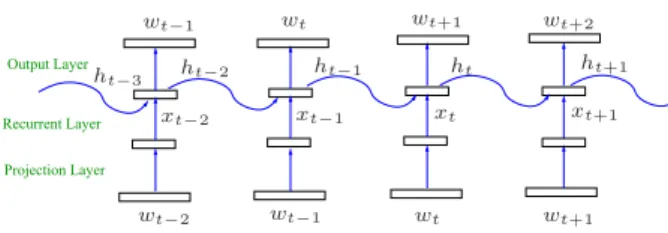
2.1. Unidirectional RNNLMs Projection Layer Recurrent Layer Output Layer wt−1 wt−1 wt−2 wt wt wt+1 wt+1 wt+2 xt−2 xt−1 xt xt+1 ht−3 ht−2 ht−1 ht ht+1
Figure 1:An example unidirectional RNNLM. Figure 1 shows a typical unidirectional RNNLM. The oper-ation of this model is as follows. First, each word in the input layer is projected to a low-dimensional, continuous, space via a linear projection layer. This projected, word vectorxt−1is then
combined with the history vectorht−2, which represents the
word historywt1−2to form a new history vectorht−2. This is
then fed to a softmax function to yield the probability distribu-tion over the word at timet. Thus the prediction of the current word,wt, is dependent on a representation of the complete
his-tory of wordswt−1
1 . A range of non-linear functions have been
used in the recurrent layer. Sigmoid [3] and long short-term memory (LSTM) [16] activations are two popular choices for language modeling.
2.2. Bidirectional RNNLMs
To incorporate future information into the word prediction an additional hidden unit is incorporated into the model. This topology is shown in Figure 2. This second history vector en-codes the complete future historywLt+1, and allows the
bidirec-tional RNNLM,wt,P(wt|w1t−1, w L
t+1), to be computed.
The training of bi-RNNLMs is more complicated than uni-RNNLMs as the future information must be taken into account. In [13], all sentences in the training corpus were concatenated to form a single sequence. This sequence was then “chopped” into sub-sequences with the averaged sentence length. Bi-RNNLMs were trained with minibatch mode on GPU by processing mul-tiple sequences. This allows bi-RNNLMs to be efficiently trained. However, consistency issues can arise when not cutting at sentence boundaries as history vectors are reset in the middle
Projection Layer Recurrent Layer Output Layer wt−1 wt−1 wt−2 wt wt wt wt+1 wt+1 wt+1 wt+2 wt+2 wt+3
Figure 2:An example bidirectional RNNLMs. of a sentence. In this paper, the bi-RNNLMs are trained in a more consistent fashion. Multiple sentences are aligned from left to right to form minibatches during bi-RNNLM training. In order to handle issues caused by variable sentence lengths,
NULLtokens are appended to the end of sentences to ensure that the aligned sentences have the same length. TheseNULL
tokens are not used for parameter update.
Although the perplexity of bi-RNNLMs is difficult to obtain, the log-likelihood of P(wt|w1t−1, w
L
t+1) can still
be used as objective function during training. An unnor-malised, “pseudo”, PPL can also be calculated by using P(wt|wt1−1, w
L
t+1)in a similar fashion to the uni-LMs.
How-ever, the pseudo PPL of bi-RNNLMs cannot be directly com-pared with PPL of uni-LMs as the unnormalised probability is used in bi-RNNLMs. Note, in this paper, (uni- and bi-) RNNLMs with an unclustered, full output layer are trained ef-ficiently on GPU [17] with a modified version of the CUED-RNNLM toolkit [18].
3. Interpolation of RNNLMs and
n
-gram
LMs
n-gram and uni-RNN LMs have different, complementary, modeling ability [19]. Improved performance is possible by in-terpolating these two models together. The same should be true for bi-LMs. In this section, two possible interpolation methods for bi-LMs are briefly described.
3.1. Linear Interpolation
linear interpolation of two uni-LMs (e.g. n-gram and RNN LMs) is commonly used. Here
P(wt|wt1−1) =λPrnn(wt|w1t−1) + (1−λ)Png(wt|wt1−1)
(4) where λis the interpolation weight of RNNLM. The result-ing interpolated probability is a valid probability mass function (PMF) and can be to calculate sequence, sentence, probabilities. Applying the same approach to bi-LMs would yield
P(wt|wt −1 1 , w L t+1) = (5) λPuni(wt|wt1−1) + 1 Zbi (1−λ)Pbi(wt|wt1−1, w L t+1)
As previously discussed it is not practical to compute the nor-malisation termZbi. Thus linear interpolation is challenging for
bi-LMs.
3.2. Log-linear Interpolation
An alternative approach is to apply linear interpolation in the log domain, log-linear interpolation [20]. For two uni-LMs this yields P(wt|wt −1 1 ) = (6) 1 Z(wt1−1) Prnn(wt|wt −1 1 ) λ Png(wt|wt −1 1 ) 1−λ
270
whereZ(w1t−1)is the history-dependent normalisation term. It
can be computed by summing over the vocabularyV, Z(wt1−1) = w∈V Prnn(w|wt −1 1 ) λ Png(w|wt −1 1 ) 1−λ (7) Log-linear model combination with bi-LMs is again more complicated due to the need to compute normalisation terms with future words. To address this the models can be combined at the word sequenceWˆ level.Thus considering a uni-LM and bi-LM P(W) = 1 ZPuni(W) λ Pbi(W)1 −λ = 1¯ ZPuni(W) λˆ Pbi(W)1 −λ (8) whereZ¯is the sentence-level normalisation term andPˆbi(W)
is defined in Equation (2). The log of LM probabilities are nor-mally used in speech recognition, thus Equation 8 becomes
logP(W) =C+λlogPuni(W) + (1−λ) log ˆPbi(W) (9)
whereCis a constant and does not alter the rank ordering of hypotheses. Thus, sentence level log-linear interpolation of uni-LMs and bi-uni-LMs is valid, and the unnormalised form (withC) used for speech recognition. Hence, though the performance of bi-RNNLMs cannot be evaluated using perplexity, it can be evaluated with WER. It is also worth noting that the sentence level log-linear interpolation can be re-expressed as word level log-linear interpolation of the two models.
4. Bidirectional RNNLMs probability
Smoothing
To investigate the performance of bi-RNNLMs, an initial con-trast of the pseudo-perplexity of the bi-RNNLM was compared to the perplexity of a uni-RNNLM, both trained on the AMI data. Table 1 shows the results. Though the two numbers are not directly comparable, the dramatically lower pseudo-perplexity of the bi-RNNLM indicates that the individual predicted word probabilities of the bi-RNNLM are much higher than that of uni-RNNLM. Thus the predicted word probability distribution of bi-RNNLMs is expected to much sharper (lower entropy) than that of uni-RNNLMs. A similar trend was also observed on other tasks.
RNNLM Dir. (Pseudo) PPL
sigm uni 85.2
bi 27.8
Table 1:(Pseudo) PPLs of uni-RNN and bi-RNN LMs on AMI
It is interesting to consider the impact of having a signifi-cantly lower entropy on the word predictions of the bi-RNNLM. The held-out evaluation data will not have exactly the same form as the training data. Furthermore, speech recognition sys-tems will make errors, for example due to unusual acoustic data or word sequence. The bi-RNLLM will give low probability to these error-full, unusual, words sequences. In standard systems this issue would be addressed by optimising the language model scale factor. An alternative approach adopted here is to intro-duce an additional tunable parameter,αto smooth the probabil-ity distribution. Thus word probabilprobabil-ity is
P(wi|wt −1 1 , w L t+1) = exp(αyi) V j exp(αyj) (10)
whereyiis the activation before softmax function in the
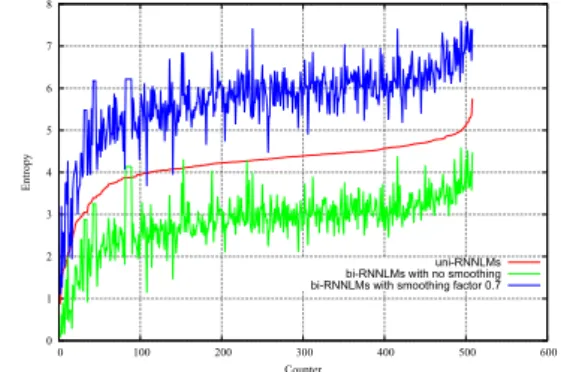
out-put layer. αis set empirically set after training the bi-RNNLM as previously The output distribution is smoothed and flattened whenαis less than 1. In this paper,αwas set to 0.7 for all tasks. 0 1 2 3 4 5 6 7 8 0 100 200 300 400 500 600 Entropy Counter uni-RNNLMs bi-RNNLMs with no smoothing bi-RNNLMs with smoothing factor 0.7
Figure 3: Entropy of uni-RNN, bi-RNN and smoothed bi-RNN LMs on AMI. The counter is ordered by the entropy values of uni-RNNLM.
To further illustrate the sharpness, low entropy, of the indi-vidual word probabilities, the average sentence word-prediction entropy was computed for the for uni-RNNLM, bi-RNNLM and smoothed bi-RNNLM (α= 0.7) on held out data from the AMI corpus. These averages are shown in Figure 3. To help in-terpretability the sentences are ordered by the average entropy of the uni-RNNLM. All plots follow the same general trend. The unsmoothed bi-RNNLM has a significantly lower average entropy than the other systems. It is interesting that the oper-ating point (α = 0.7) has a higher average entropy than the uni-RNNLM. This is not unsurprising as combining models in a PoE framework (to yield the bi-RNNLM sentence probabili-ties) is known to “over-sharpen” the distributions.
5. Experiments
The performance of the bi-RNNLMs was evaluated on three corpora: broadcast news (BN); AMI meeting data (multiple dis-tant microphone (MDM) configuration); and Dholuo ( IARPA-babel403b-v1.0b) from the Babel project. A DNN-based hy-brid system with sequence training [21] was built for BN; joint decoding of Tandem and DNN-HMM systems [22] were used on the AMI and Babel tasks. CMLLR-based speaker adapta-tion were applied for all tasks. The vocabularies of BN, AMI and Babel are 59K, 41K and 18K respectively. The sizes of words forn-gram LM training in BN, AMI and Babel are 1.5G, 2G and 467K; the number of word for RNNLMs training are 15M, 2.4M and 467K. A 4-gram LM was trained for AMI and 3-gram LMs for BN and Babel. All RNNLMs were trained with a modified version of CUED-RNNLM Toolkit [18]. For uni-RNNLMs, the hidden layer sizes of BN, AMI and Babel corpora were 512, 256 and 100 hidden, while for bi-RNNLMs, 256, 128 and 50 hidden nodes were used for each direction. In this paper, linear interpolation was used betweenn-gram LMs and uni-RNNLMs1, and log-linear interpolation between
uni-LMs and bi-uni-LMs.
It is not easy to do lattice rescoring for bi-RNNLMs, though it is feasible for uni-RNNLMs as shown in [23]. For simplic-ity, 100-best rescoring was used for speech recognition for all
1log-linear interpolation did not outperform linear interpolation ac-cording to our experiments for uni-LMs
WER BN AMI Babel dev eval dev eval
1-best 12.8 11.8 30.4 31.0 47.9
100-best oracle 10.0 9.5 17.7 17.7 32.6 Table 2:Oracle WERs of 100-best list on three corpora
RNNLMs. The oracle WERs of 100-best list for the tasks are shown in Table 2. Task RNNLM PPL WER dev eval BN — 151.9 12.8 11.8 sigm 112.8 12.1 11.2 LSTM 104.4 11.9 11.0 AMI — 182.1 30.4 31.0 sigm 143.3 29.1 29.6 Babel — 115.3 47.9 — sigm 81.0 46.6 —
Table 3:PPL and WER results of uni-RNNLMs on three tasks
Table 3 shows the PPL and WER results forn-gram LMs and uni-RNNLMs on the tasks. In addition to the baseline sigmoid-based RNNLMs, the performance of an LSTM-based system on the BN task is shown. Note more training data was available for BN compared to AMI and Babel where no gains over the sigmoid-based baseline were obtained. For these base-line, uni-LM, systems, linear interpolation was used (λ= 0.5). The uni-RNNLMs shows significant gains in terms of both PPLs and WERs. The LSTM LM yields moderate additional gains over the sigmoid RNNLM on BN.
Task RNNLM Dir. WER
dev eval BN sigm uni 12.1 11.2 bi 12.3 11.3 uni+bi 11.7 10.8 LSTM uni 11.9 11.0 bi 11.8 11.0 uni+bi 11.5 10.5 AMI sigm uni 29.1 29.6 bi 29.7 30.2 uni+bi 29.0 29.6 Babel sigm uni 46.6 — bi 47.5 — uni+bi 46.5 — Table 4:WERs of bi-RNNLM on three tasks
Table 4 shows WER results of bi-RNNLMs, compared to the uni-RNNLM: “uni” is the baseline for linear interpolation ofn-gram and uni-RNN LMs from Table 3; “bi” indicates log-linear interpolation ofn-gram and bi-RNN LMs (λ = 0.5)); and “uni+bi” indicatesn-gram LM is linearly interpolated with the uni-RNNLM followed by log-linearly interpolated with the bi-RNNLM (the interpolation weights ofn-gram, uni-RNN, bi-RNN were 0.35, 0.35 and 0.3 respectively). From Table 4, bi-RNNLMs yield comparable performance to uni-RNNLMs on the BN data. This is consistent with the observations in [13]. The combination ofn-gram LMs, uni-RNNLMs and bi-RNNLMs yields 0.4%-0.5% WER reduction over the baseline uni-RNNLMs. However, for the other tasks, AMI and Babel, which have higher WERs, only marginal improvements were
obtained. One possible reason is the sensitivity of the word probability predictions to errors when no bi-RNNLM smooth-ing is applied.
Task RNNLM Dir. WER
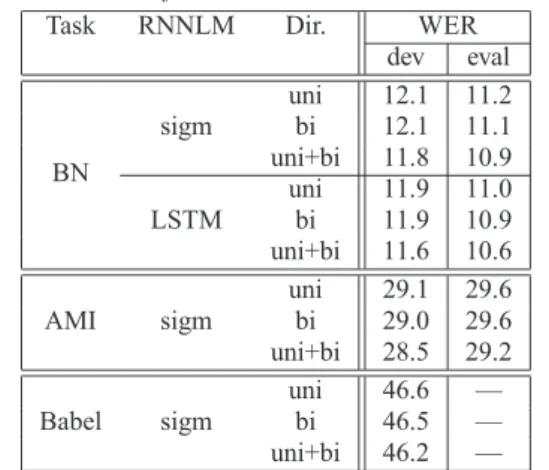
dev eval BN sigm uni 12.1 11.2 bi 12.1 11.1 uni+bi 11.8 10.9 LSTM uni 11.9 11.0 bi 11.9 10.9 uni+bi 11.6 10.6 AMI sigm uni 29.1 29.6 bi 29.0 29.6 uni+bi 28.5 29.2 Babel sigm uni 46.6 — bi 46.5 — uni+bi 46.2 — Table 5:WERs of smoothed bi-RNNLM on three tasks
The final experiments examine the impact of bi-RNNLM smoothing (α= 0.7), discussed in Section 4, on performance. The results can be found in Table 5. Using this simple smooth-ing approach, consistent and significant performance gain can be achieved on all three tasks by using bi-RNNLMs. Compared to the baseline system (n-gram + uni-RNN LMs), bi-RNNLMs provide an additional 0.4% to 0.6% WER reduction. It is also worth noting that a fixed language model scale was used for each task in all experiments. Tuning the language model scale factor did not alter the performance. Note the use of smooth-ing with uni-RNNLMs, despite optimissmooth-ingα, yielded no per-formance gains.
6. Conclusion
In this paper, bidirectional RNNLMs are investigated for speech recognition. Compared to previous work [13], where the bi-RNNLMs were examined on a broadcast news transcription task with a low word error rate and combined withn-gram LMs only, a more complete study was performed: three corpora with different WERs were investigated; and the combination of bi-RNNLMs, n-gram and uni-RNN LMs was investigated. Bi-RNNLMs yielded good performance improvements on broad-cast data, which has a relatively low WER. However, for the other two corpora which have higher WERs, only marginal im-provements were obtained. In order to overcome the sensitivity issue of bi-RNNLMs to recognition errors, a simple smooth-ing method was proposed. Consistent and significant WER im-provements can be obtained on the all three tasks.
It is clear that succeeding words are helpful to improve speech recognition performance. However, there are issues that need to be addressed to make these forms of bi-directional models generally applicable: better distribution smoothing ap-proaches; improved combination schemes; more efficient train-ing approaches; and lattice rescortrain-ing techniques. These will be explored in future work.
7. Acknowledgement
The authors would like to thank Ebru Arisoy, Abhinav Sethy and Bhuvana Ramabhadran from IBM for discussions and valu-able suggestions on bidirectional RNNLMs.
8. References
[1] R. Rosenfield, “Two decades of statistical language modeling: Where do we go from here?”Proceedings of the IEEE, 2000. [2] Y. Bengio, R. Ducharme, P. Vincent, and C. Jauvin, “A neural
probabilistic language model,” Journal of Machine Learning Re-search, vol. 3, pp. 1137–1155, 2003.
[3] T. Mikolov, M. Karafi´at, L. Burget, J. Cernock`y, and S. Khudan-pur, “Recurrent neural network based language model.” inProc. ISCA INTERSPEECH, 2010.
[4] T. Mikolov, S. Kombrink, L. Burget, J. Cernocky, and S. Khudan-pur, “Extensions of recurrent neural network language model,” in Proc. ICASSP. IEEE, 2011.
[5] J. Devlin, R. Zbib, Z. Huang, T. Lamar, R. Schwartz, and J. Makhoul, “Fast and robust neural network joint models for sta-tistical machine translation,” inProc. ACL, 2014.
[6] W. De Mulder, S. Bethard, and M.-F. Moens, “A survey on the ap-plication of recurrent neural networks to statistical language mod-eling,”Computer Speech & Language, vol. 30, no. 1, pp. 61–98, 2015.
[7] S. Kombrink, T. Mikolov, M. Karafiat, and L. Burget, “Recurrent neural network based language modeling in meeting recognition.” inProc. ISCA INTERSPEECH, 2011.
[8] M. Sundermeyer, R. Schl¨uter, and H. Ney, “LSTM neural net-works for language modeling,” inProc. ISCA INTERSPEECH, 2012.
[9] M. Schuster and K. K. Paliwal, “Bidirectional recurrent neural networks,” Signal Processing, IEEE Transactions on, vol. 45, no. 11, pp. 2673–2681, 1997.
[10] H. Sak, A. Senior, and F. Beaufays, “Long short-term memory re-current neural network architectures for large scale acoustic mod-eling,” inProc. ICSA INTERSPEECH, 2014.
[11] D. Bahdanau, K. Cho, and Y. Bengio, “Neural machine trans-lation by jointly learning to align and translate,”arXiv preprint arXiv:1409.0473, 2014.
[12] Y. Shi, M. Larson, P. Wiggers, and C. Jonker, “Exploiting the suc-ceeding words in recurrent neural network language models.” in Proc. ICSA INTERSPEECH, 2013.
[13] E. Arisoy, A. Sethy, B. Ramabhadran, and S. Chen, “Bidirectional recurrent neural network language models for automatic speech recognition,” inProc. ICASSP. IEEE, 2015, pp. 5421–5425. [14] T. He, Y. Zhang, J. Droppo, and K. Yu, “On training bi-directional
neural network language model with noise contrastive estima-tion,”arXiv preprint arXiv:1602.06064, 2016.
[15] W. Xiong, J. Droppo, X. Huang, F. Seide, M. Seltzer, A. Stolcke, D. Yu, and G. Zweig, “The Microsoft 2016 conversational speech recognition system,”Proc. ICASSP, 2017.
[16] S. Hochreiter and J. Schmidhuber, “Long short-term memory,” Neural computation, vol. 9, no. 8, pp. 1735–1780, 1997. [17] X. Chen, X. Liu, Y. Wang, M. Gales, and P. Woodland, “Efficient
training and evaluation of recurrent neural network language mod-els for automatic speech recognition,”IEEE/ACM Transactions on Audio, Speech, and Language Processing, 2016.
[18] X. Chen, X. Liu, M. Gales, and P. Woodland, “CUED-RNNLM an open-source toolkit for efficient training and evaluation of recurrent neural network language models,” in Proc. ICASSP. IEEE, 2015.
[19] X. Chen, X. Liu, G. Mark, and P. Woodland, “Investigation of back-off based interpolation between recurrent neural network and n-gram language models.” in ASRU, IEEE Workshop on, 2015.
[20] A. Gutkin, “Log-linear interpolation of language models,” M´emoire de DEA, University of Cambridge, 2000.
[21] B. Kingsbury, “Lattice-based optimization of sequence classifi-cation criteria for neural-network acoustic modeling,” inProc. ICASSP. IEEE, 2009, pp. 3761–3764.
[22] H. Wang, A. Ragni, M. Gales, K. Knill, P. Woodland, and C. Zhang, “Joint decoding of tandem and hybrid systems for im-proved keyword spotting on low resource languages,” inProc. ISCA INTERSPEECH, 2015.
[23] X. Liu, X. Chen, Y. Wang, M. Gales, and P. Woodland, “Two effi-cient lattice rescoring methods using recurrent neural network lan-guage models,”IEEE/ACM Transactions on Audio, Speech, and Language Processing, vol. 24, no. 8, pp. 1438–1449, 2016.