Evaluation Problems
Dušan Knop
Algorithmics and Computational Complexity, Faculty IV, TU Berlin
Department of Theoretical Computer Science, Faculty of Information Technology, Czech Technical University in Prague, Prague, Czech Republic
Tomáš Masařík
Department of Applied Mathematics, Charles University, Prague, Czech Republic Faculty of Mathematics, Informatics and Mechanics, University of Warsaw, Poland [email protected]
Tomáš Toufar
Computer Science Institute, Charles University, Prague, Czech Republic [email protected]
Abstract
A prototypical graph problem is centered around a graph-theoretic property for a set of vertices and a solution to it is a set of vertices for which the desired property holds. The task is to decide whether, in the given graph, there exists a solution of a certain quality, where we use size as a quality measure. In this work, we are changing the measure to the fair measure (cf. Lin and Sahni [27]). The fair measure of a set of verticesS is (at most)k if the number of neighbors in the setS of any vertex (in the input graph) does not exceedk. One possible way to study graph problems is by defining the property in a certain logic. For a given objective, an evaluation problem is to find a set (of vertices) that simultaneously minimizes the assumed measure and satisfies an appropriate formula. More formally, we study theMSOFair Vertex Evaluation, where the graph-theoretic property is described by anMSOformula.
In the presented paper we show that there is an FPTalgorithm for the MSOFair Vertex Evaluationproblem for formulas with one free variable parameterized by the twin cover number of the input graph and the size of the formula. One may define an extended variant of MSOFair Vertex Evaluationfor formulas with`free variables; here we measure a maximum number of neighbors in each of the`sets. However, such variant isW[1]-hard for parameter`even on graphs with twin cover one.
Furthermore, we study theFair Vertex Cover(Fair VC) problem.Fair VCis among the simplest problems with respect to the demanded property (i.e., the rest forms an edgeless graph). On the negative side,Fair VCisW[1]-hard when parameterized by both treedepth and feedback vertex set of the input graph. On the positive side, we provide anFPTalgorithm for the parameter modular width.
2012 ACM Subject Classification Theory of computation→Parameterized complexity and exact algorithms; Theory of computation→Logic; Theory of computation→Graph algorithms analysis
Keywords and phrases Fair objective, metatheorem, fair vertex cover, twin cover, modular width
Digital Object Identifier 10.4230/LIPIcs.MFCS.2019.33
Related Version http://arxiv.org/abs/1803.06878
Funding Dušan Knop: Supported by DFG under project “MaMu”, NI 369/19 and partly supported by the OP VVV MEYS funded project CZ.02.1.01/0.0/0.0/16 019/0000765 “Research Center for Informatics”.
Tomáš Masařík: Author was supported by SVV–2017–260452 and by GAUK 1514217 of Charles University and by the CE-ITI grant project P202/12/G061 of GA ČR.
© Dušan Knop,Tomáš Masařík, and Tomáš Toufar; licensed under Creative Commons License CC-BY
1
Introduction
A prototypical graph problem is centered around a fixed property for a set of vertices. A solution is any set of vertices for which the given property holds. In a similar manner, one can define the solution as a set of vertices such that the given property holds when we remove this set of vertices from the input graph. This leads to the introduction of deletion problems – a standard reformulation of some classical problems in combinatorial optimization introduced by Yannakakis [37]. Formally, for a graph propertyπwe formulate avertex deletion problem. That is, given a graphG= (V, E), find a smallest possible set of verticesW such thatG\W satisfies the propertyπ. Many classical problems can be formulated in this way such as Minimum Vertex Cover(πdescribes an edgeless graph) orMinimum Feedback Vertex Set(πis valid for forests).
Clearly, the complexity of a graph problem is governed by the associated propertyπ. We can either study one particular problem or a broader class of problems with related graph-theoretic properties. One such relation comes from logic, for example, two properties are related if it is possible to express both by a first order (FO) formula. Then, it is possible to design amodel checking algorithmthat for any propertyπexpressible in the fixed logic decides whether the input graph with the vertices fromW removed satisfiesπor not.
Undoubtedly, Courcelle’s Theorem [4] for graph properties expressible in the monadic second-order logic (MSO) on graphs of bounded treewidth plays a prime role among model checking algorithms. In particular, Courcelle’s Theorem provides for anMSO sentenceϕan algorithm that given ann-vertex graphGwith treewidthkdecides whetherϕholds inGin timef(k,|ϕ|)n, wheref is some computable function and|ϕ|is the quantifier depth ofϕ. In terms of parameterized complexity, such an algorithm is calledfixed-parameter tractable(the problem belongs to the classFPTfor the combined parameterk+|ϕ|). We refer the reader to monographs [7, 8] for background on parameterized complexity theory and algorithm design. There are many more FPT model-checking algorithms, e.g., an algorithm for (existential counting) modal logic model checking on graphs of bounded treewidth [33],MSO model checking on graphs of bounded neighborhood diversity [24], or MSO model checking on graphs of bounded shrubdepth [14] (generalizing the previous result). First order logic (FO) model checking received recently quite some attention as well and algorithms for graphs with bounded degree [34], nowhere dense graphs [16], and some dense graph classes [11] were given.
Fair Objective. Fair deletion problems, introduced by Lin and Sahni [27], are such modific-ations of deletion problems where instead of minimizing the size of the deleted set we change the objective. TheFair Vertex Deletionproblem is defined as follows. For a given graph G= (V, E) and a propertyπ, the task is to find a setW ⊆V which minimizes the maximum number of neighbors in the setW over all vertices, such that the propertyπholds inG\W. Intuitively, the solution should not be concentrated in a neighborhood of any vertex. In order to classify (fair) vertex deletion problems we study the associated decision version, that is, we are interested in finding a setW of size at mostk, for a given number k. Note that this can introduce only polynomial slowdown, as the value of our objective is bounded by 0 from below and by the number of vertices of the input graph from above (provided a solution exists). Since we are about to use a formula with a free variableX to express the desired propertyπ, we naturally useX to represent the set of deleted vertices in the formula. The
fair cost of a set W ⊆V is defined as maxv∈V |N(v)∩W|. We refer to the function that assigns each setW ⊆V its fair cost as to thefair objective function. Here, we give a formal definition of the computational problem when the propertyπis defined in some logicL.
FairLVertex Deletion
Input: An undirected graphG= (V, E), anLsentenceϕ, and a positive integerk.
Question: Is there a setW ⊆V of fair cost at mostk such thatG\W|=ϕ?
Let ϕ(X) be a formula with one free variable and let G = (V, E) be a graph. For a set W ⊆V byϕ(W) we mean that we substituteW forX inϕ. The definition below can be naturally generalized to contain ` free variables. We would like to point out one crucial difference between deletion and evaluation problems, namely that in evaluation problems we have access to the variable that represents the solution. This enables evaluation problems to impose some conditions on the solution, e.g., we can ensure that the graph induced by the solution has diameter at most 2 or is triangle-free.
FairLVertex Evaluation1
Input: An undirected graphG= (V, E), anLformulaϕ(X) with one free variable, and a positive integerk.
Question: Is there a setW ⊆V of fair cost at mostk such thatG|=ϕ(W)?
Minimizing the fair cost arises naturally for edge problems in many situations as well, e.g., in defective coloring [6], which has been substantialy studied from the practical network communication point of view [17, 19]. A graphG= (V, E) is (k, d)-colorable if every vertex can be assigned a color from the set [k] in such a way that every vertex has at most d neighbors of the same color. This problem can be reformulated in terms of fair deletion; we aim to find a set of edgesF such that graphG0= (V, F) has maximum degreedandG\F can be partitioned intok independent sets.
Related Results. There are several possible research directions once a model checking algorithm is known. One possibility is to broaden the result either by enlarging the class of graphs it works for or by extending the expressive power of the concerned logic, e.g., by introducing a new predicate [23]. Another obvious possibility is to find the exact complexity of the general model checking problem by providing better algorithms (e.g., for subclasses [24]) and/or lower-bounds for the problem [9, 25]. Finally, one may instead of deciding a sentence turn attention to finding a set satisfying a formula with a free variable that is optimal with respect to some objective function [1, 5, 15]. In this work, we take the last presented approach – extending a previous work onMSO model checking for the fair objective function.
When extending a model checking result to incorporate an objective function or a predicate, we face two substantial difficulties. On the one hand, we are trying to introduce as strong extension as possible, while on the other, we try not to worsen the running time too much. Of course, these two are in a clash. One evident possibility is to sacrifice the running time and obtain anXPalgorithm, that is, an algorithm running in timef(k)|G|g(k). For example there is anXPalgorithm for theFair MSO2 Vertex Evaluationproblems parameterized by treewidth (and the size of the formula) by Kolman et al. [21] running in time f(|ϕ|,tw(G))|G|g(tw(G)). An orthogonal extension is due to Szeider [35] for the so-called local cardinality constraints (MSO-LCC) who gave an XPalgorithm parameterized by treewidth. If we decide to keep theFPT running time, such a result is not possible for treedepth (consequently for treewidth), as we give W[1]-hardness result for a very basic
1 This problem is called
Generalized FairLVertex-Deletionin [29] and in the respective conference version [28]. However, we believe that evaluation is a more suitable expression and coincides with standard terminology in logic.
Fair L∅ Vertex Deletion problem2 in this paper. A weaker form of this hardness
was already known for FO logic [29]. Ganian and Obdržálek [15] study CardMSO and provide an FPT algorithm parameterized by neighborhood diversity. Recently, Masařík and Toufar [29] examined fair objective and provide anFPT algorithm for theFair MSO1 Vertex Evaluationproblem parameterized by neighborhood diversity. See also [20] for a discussion of various extensions of theMSO.
We want to turn a particular attention to theFair Vertex Cover(Fair VC) problem which, besides its natural connection with Vertex Cover, has some further interesting properties. For example, we can think about classical vertex cover as having several crossroads (vertices) and roads (edges) that we need to monitor. However, people could get uneasy if they will see too many policemen from one single crossroad. In contrast, if the vertex cover has low fair cost, it covers all roads while keeping a low number of policemen in the neighborhood of every single crossroad.
1.1
Our Results
We give a metatheorem for graphs having bounded twin cover. Twin cover (introduced by Ganian [12]; see also [13]) is one possible generalization of the vertex cover number. Here, we measure the number of vertices needed to cover all edges that are not twin-edges; an edge {u, v}is a twin-edgeifN(u)\ {v}=N(v)\ {u}. Ganian introduced twin cover in the hope that it should be possible to extend algorithms designed for parameterization by the vertex cover number to a broader class of graphs.
ITheorem 1. TheFair MSO1 Vertex Evaluationproblem parameterized by the twin
cover number and the quantifier depth of the formula admits an FPT algorithm.
We want to point out here that in order to obtain this result we have to reprove the original result of Ganian [12] forMSO1 model checking on graphs of bounded twin cover. For this, we extend arguments given by Lampis [24] in the design of anFPTalgorithm for MSO1 model checking on graphs of bounded neighborhood diversity. We do this to obtain better insight into the structure of the graph (a kernel) on which model checking is performed (its size is bounded by a function of the parameter). This, in turn, allows us to find a solution minimizing the fair cost and satisfying theMSO1 formula. The result by Ganian in version [12] is based on the fact that graphs of bounded twin cover have bounded shrubdepth and soMSO1 model checking algorithm on shrubdepth ([14, 10]) can be used.
When proving hardness results it is convenient to show the hardness result for a concrete problem that is expressible by anMSO1formula, yet as simple as possible. Therefore, we introduce a key problem for Fair Vertex Deletion – theFair VCproblem.
Fair Vertex Cover (Fair VC)
Input: An undirected graphG= (V, E), and a positive integerk.
Question: Is there a setW ⊆V of fair cost at mostksuch thatG\W is an edgeless graph? The Fair VC problem can be expressed in any logic that can express an edgeless graph (we denote such logicL∅) which is way weaker thanFO. Therefore, we propose a systematic
study of theFair VCproblem which, up to our knowledge, have not been considered before. ITheorem 2. The Fair VCproblem parameterized by treedepth td(G)and feedback vertex setfvs(G)combined isW[1]-hard.
2 Here,L
Table 1 The table summarize some related (with a citation) and all the presented (with a reference) results on the studied parameters. Green cells denoteFPTresults, and red cells represent hardness results. LogicLin metatheorems is specified by a logic used in the respective theorem. Symbol∗denotes implied results from previous research and symbolXdenotes new implied results. A question mark (?) indicates that the complexity is unknown.
vc fvs+td tc nd cvd mw
Fair VC ∗ T2 ∗ ? T3
FVLDel MSO2 ∗ L∅ MSO1 MSO1 ∗ ? ?
FVLEval MSO2 [29] L∅ MSO1 T1 MSO1 ∗ ? ?
`-FVLEval MSO1 ∗ L∅ MSO1 T5 MSO1 [20] MSO1 MSO1
Note that this immediately yieldsW[1]-hardness andf(w)no(
√
w) lower bound for
FairL∅
Vertex Evaluation. Previously, anf(w)no(w
1/3)
lower bound was given forFOlogic by Masařík and Toufar [29]. Thus our result is stronger in both directions, i.e., the lower bound is stronger, and the logic is less powerful. On the other hand, we show thatFair VCcan be solved efficiently in dense graph models.
ITheorem 3. TheFair VCproblem parameterized by modular widthmw(G)admits anFPT
algorithm with running time 2mw(G)·mw(G)·n3, wheren is the number of vertices inG.
We point out that theFair VCproblem is (rather trivially) AND-compositional and thus it does not admit a polynomial kernel for parameterization by modular width.
ILemma 4. TheFair VC problem parameterized by the modular width of the input graph does not admit a polynomial kernel, unlessNP⊆coNP/poly.
Moreover, an analog to Theorem 3 cannot hold for parameterization by shrubdepth of the input graph. This is a consequence of Theorem 2 and the fact that if a class of graphs has bounded treedepth, then it has bounded shrubdepth (cf. [14, Proposition 3.4]).
Another limitation in a rush for extensions of Theorem 1 is given when aiming for more free variables. More formally, the problem `-Fair L Vertex Evaluationhas formula ϕ(X1, . . . , X`) with`free variables as an input andW1, . . . , W`are the corresponding sets inG of fair cost at mostk. Thefair costofW1, . . . , W`is defined as maxv∈V maxi∈[`]|N(v)∩Wi|. It is very surprising that such a generalization is not possible for parameterization by twin cover, since the same extension is possible for parameterization by neighborhood diversity [20]. In fact, they prove something even stronger, i.e., an FPT algorithm parameterized by neighborhood diversity in the context of MSOL
lin is given in [20]. InMSOLlin one can specify both lower- and upper-bound for each vertex and each free variable (i.e., a feasibility interval is given for every vertex).
ITheorem 5(F3). The `-Fair FOVertex Evaluation problem isW[1]-hard for para-meter `even on graphs with twin cover of size one.
The reduction is done from the Unary `-Bin Packing problem; the lower-bound and W[1]-hardness of Unary `-Bin Packingwas given by Jansen et al. [18].
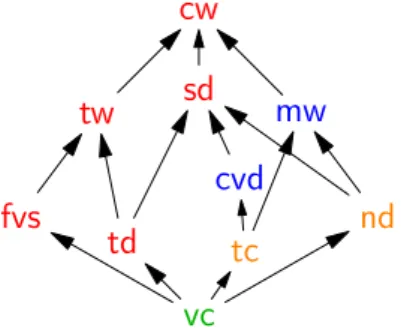
For an overview of the results, please refer to Table 1 and to Figure 1 for the hierarchy of classes.
3 We mark a result by
cw
tw
mw
cvd
sd
nd
tc
fvs
td
vc
Figure 1 Hierarchy of graph parameters with depicted complexity of the Fair L Vertex Evaluationproblem. An arrow indicates that a graph parameter upper-bounds the other. Thus, hardness results are implied in the direction of arrows, andFPTalgorithms are implied in the reverse direction. Green colors indicateFPTresults forMSO2, orange areFPT forMSO1, blue are open, and red are hardness results. We denote treewidth by tw, shrubdepth by sd, and clique width by cw. We refer to book [7] for definitions. Other parameters and their respective abbreviations are defined in Subsection 1.2.
1.2
Preliminaries
For a positive integernwe denote [n] the set{1, . . . , n}. We deal with simple undirected graphs, for further standard notation we refer to monographs: graph theory [30] and parameterized complexity [7]. For a vertexvbyN(v) we denote the neighborhood ofv and byN[v] we denote the closed neighborhood of vertexv, i.e.,N(v)∪ {v}.
A parameter closely related to twin cover is cluster vertex deletion (cvd(G)), that is, the smallest number of vertices one has to delete from a graph in order to get a collection of (disjoint) cliques. Treedepth of a graphG (td(G)) is the minimum height of a rooted forest whose transitive closure contains the graphG[31]. Feedback vertex set (fvs(G)) is the minimum number of vertices of a graphGwhose removal leaves the graph without cycles.
Neighborhood diversity (nd(G)) is the smallest integerrsuch that the the vertex set ofGcan be partitioned intorsetsV1, . . . , Vrin such a way that the graphG[Vi] is either a clique or an edgeless graph for alli∈[r] and the bipartite graphG[Vi, Vj] is either a complete bipartite graph or an edgeless graph for all distincti, j∈[r]. Modular widthof a graphG(mw(G)), is the smallest positive integerr such thatGcan be obtained from an algebraic expression of width at mostr, defined as follows. Thewidth of an expressionAis the maximum number of operands used by any occurrence of the substitution operation inA, whereA is an algebraic expression that uses the following operations:
1. Create an isolated vertex.
2. Thesubstitution operation with respect to a template graphT with vertex set [r] and graphsG1, . . . , Grcreated by algebraic expression. The substitution operation, denoted by T(G1, . . . , Gr), results in the graph on vertex set V =V1∪ · · · ∪Vr and edge set E = E1∪ · · · ∪Er∪S{i,j}∈E(T)
{u, v} : u∈ Vi, v ∈ Vj , where Gi = (Vi, Ei) for all i∈[r].
An algebraic expression of width mw(G) can be computed in linear time [36].
We stick with standard definitions and notation in logic. For a comprehensive summary, please consult a book by Libkin [26].
2
Metatheorems for Fair Evaluation
We show an FPTalgorithm as it is stated in Theorem 1. We give a more detailed statement that implies the promised result straigthforwardly.
We split the proof into two parts. First, we show an algorithm forMSO1 model checking parameterized by twin cover of the graph (Proposition 8). In the second part, we prove that we can even compute the optimal fair cost (Proposition 12) and so derive the promised result. Overview of the Algorithm. For the model checking algorithm, we closely follow the approach of Lampis [24]. The idea is that if there is a large set of vertices with the same closed neighborhood, then some of them are irrelevant, i.e., we can delete them without affecting the truthfulness of the given formula ϕ. For graphs of bounded neighborhood diversity using this rule alone can reduce the number of vertices below a bound that depends on nd(G) and|ϕ|only, thus providing anFPT model checking algorithm. For the graphs of bounded twin cover, this approach can be used to reduce the size of all (twin) cliques, yet their number can still be large. We take the approach one step further and describe the deletion of irrelevant cliques in a similar manner; these rules together yield a model checking algorithm for graphs of bounded twin cover.
The reduction rules also lead to a notion ofshapeof a setW ⊆V. The motivation behind shapes is to partition all subsets ofV such that if two setsW, W0 have the same shape, then G|=ϕ(W) if and only ifG|=ϕ(W0). This allows us to consider only one set of each shape for the purposes of model checking. Since the number of all distinct shapes is bounded by some function of parameters, we can essentially brute force through all possible shapes.
A final ingredient is an algorithm that for a given shape outputs a subset of vertices with this shape that minimizes the fair cost. This algorithm uses ILP techniques, in particular minimizing quasiconvex function subject to linear constraints.
Notation. In what followsG = (V, E) is a graph andK is its twin cover of size k. An MSO1 formulaϕcontainsqS set quantifiers and qv element (vertex) quantifiers. Given a twin coverK andA⊆K, we say thatA is thecover setof a set S⊆V \K if everyv∈S has N(v)∩K =A. Note that, by the definition of twin cover, for all u, v ∈V \K with {u, v} ∈ E we have that A is a cover set for u if and only ifA is a cover set for v. We say that two cliques have the sametype if they have the same size and the same cover set. Clearly, if the cover set is fixed, two cliques agree on type if and only if their sizes are the same. We define alabeled graph, that is, a graph and a collection of labels on the vertices. We say that two cliques have the same labeled type if all of them have the same size, the same cover set and the same labels on vertices.
2.1
Model checking
I Proposition 6 ([24, Lemma 5 and Theorem 4]). Let φ be an MSO1 formula and let G
be a labeled graph. If there is a set S of more than 2qSqv vertices having the same closed
neighborhood and the same labels, then for anyv∈Swe haveG|=ϕif and only ifG\v|=ϕ. In particular, if Gis a graph with just one label, then for any cliqueC where each vertex has exactly the same closed neighborhood in Gthe following holds. Either there is a vertex
v∈C such that G|=φif and only if G\v|=φor the size of C is bounded by 2qS+1qv. Proposition 6 bounds the size of a maximum clique inG\K because we can apply it repeatedly for each clique that is bigger than the threshold 2qS+1qv. Now, we need to bound the number of cliques of each type. For this, we establish the following technical lemma.
ILemma 7(F). LetGbe a labeled graph with twin cover K. Letϕbe an MSO1 formula
withqv element quantifiers andqS set quantifiers. Suppose the size of a maximum clique in
G\K is bounded byr. If there are strictly more than
α(qS, qv) = 2rqS(qv+ 1)
cliques of the same labeled type T, then there exists a clique C of the labeled type T such that G|=ϕif and only if G\C|=ϕ.
From this, we can derive a model checking algorithm.
IProposition 8 (FModel checking on graphs of bounded twin cover). LetGbe a graph with twin coverK of size kand the size of the maximum clique inG\K bounded by2qSqv andϕ
is anMSO1 sentence then either there exists a cliqueC∈G\K such thatG|=φif and only
ifG\C|=ϕor the size of Gis bounded by
k+ (qv+ 1)qv22k+2qS+2qSqSqv = 2O(k+2qSqSqv).
2.2
Finding a Fair Solution
In the upcoming proof we follow the ideas of Masařík and Toufar [29]. They define, for a given formulaϕ(X), a so-called shape of a setW ⊆V inG. The idea behind a shape is that in order to do the model checking we have deleted some vertices fromGthat cannot change the outcome ofϕ(X), however, we have to derive a solution of minimal cost in the whole graphG. Thus the shape characterizes a set under whichϕ(X) holds and we have to be able to find a setW ⊆V(G) for whichϕ(W) holds andW minimizes the fair cost among sets having this shape.
Shape. LetG= (V, E) be a graph,ϕ(X) anMSOformula,K⊆V a twin cover ofG,A⊆K, and letr= 2qS+2qvandα= 2r(qS+1)(qv+ 1). LetCbe the collection of all cliques inGsuch thatAis their cover set. We define an A-shape. AnA-shape of sizeris a two dimensional tableSA of dimension (r+ 2)×(r+ 2) indexed by{0,1, . . . , r+ 1} × {0,1, . . . , r+ 1}. Each entrySA(i, j)∈ {0, . . . , α+ 1}. The interpretation ofSA(i, j) is the minimum ofα+ 1 and of the number of cliquesC withN(C) =Asuch that
min(α+ 1,|C∩W|) =i and min(α+ 1,|C\W|) =j.
Finally, the shape ofX inGis a collection ofA-shapes for allA⊆K.
A solution forCwith cover setAcan be formally described by a function sol :C →N×N. The solution sol isvalid if for everyC∈ C with sol(C) = (i, j) eitheri+j =|C|or |C| ≥r, i=r+ 1 (or equivalentlyj =r+ 1), andi+j <|C|. For an illustration of a valid assignment please refer to Figure 2. We say that a valid solution sol iscompatible with the shapeSA ifS(i, j) = sol− 1 (i, j), whenever S(i, j)≤α and sol− 1 (i, j) ≥α+ 1 if S(i, j) = α+ 1.
TheA-shapeSA is said to be valid if there exists a valid solution forSA. Note that such a solution does not exist if the shape specifies too many (or too few) cliques of certain sizes. The shapeS isvalidif all its A-shapes are valid.
The following lemma is a key observation about shapes.
ILemma 9. Letϕbe anMSO1 formula with one free variable,Ga graph and W, W0 two
0 0 1 2 3 4 5 ≥6 1 2 3 4 5 ≥6 n um b er of v ertices in W
number of vertices outsideW
Figure 2Example of a 7×7A-shape. All cliques of size 3 will be assigned to yellow (light gray) fields, while cliques of size 8 will be assigned to orange (darker gray) fields.
0 0 0 0 1 0 2 0 3 0 4 0 5 0 ≥6 1 1 2 2 3 3 4 4 5 5 1 1 1 1 1 1 2 2 2 2 2 2 3 3 3 3 3 3 4 4 4 4 4 4 5 5 5 5 5 5 ? ≥6 ? ? ? ? ? 6 n um b er of v ertices in W
number of vertices outsideW
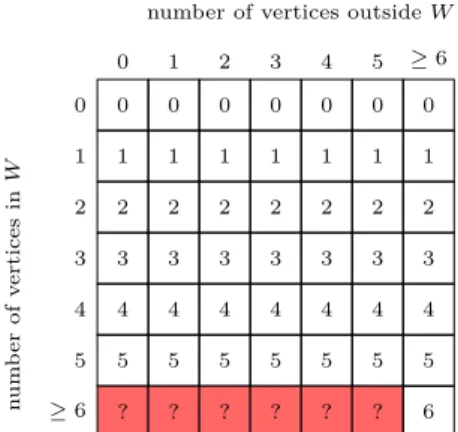
Figure 3An example of uncertainty in computation of objective function. The value in the last row depends on the size of the clique we are assigning to those cells. The value in the cell is how much we pay for any compatible clique assigned to this cell.
Proof. The proof follows using Proposition 6 and Lemma 7. Indeed, if we take the graphG with one label corresponding to setW and apply the reduction rules given by Proposition 6 and Lemma 7 and repeat the same process with W0, we obtain two isomorphic labeled
graphs. J
Lemma 9 allows us to say that a formula with one free variable holds under a shape since it is irrelevant which subset of vertices of this particular shape is assigned to the free variable. Also note that deciding whether the formula holds under the shape can be done inFPTtime by simply picking arbitrary assignment of the given shape and running a model checking algorithm.
Lemma 11 computes a solution of minimal cost for an A-shape. We do this by reducing the task to integer linear programming (ILP) while using non-linear objective. A fuction f:Rp→
Risseparable convex if there exist convex functionsfi:R→Rfori∈[p] such that f(x1, . . . , xp) =P
p
i=1fi(xi).
ITheorem 10([32] – simplified). Integer linear programming with objective minimization of a separable convex function in dimension pis FPT with respect topand space exponential inL the length of encoding of the ILP instance.
ILemma 11. LetG= (V, E)be a graph,K be a twin cover ofG, and∅ 6=A⊆K. There is an algorithm that given anA-shapeSA of sizer computes a valid solution forSAof minimal
cost in timef(|K|, r)· |G|O(1) or reports that SA is not valid.
Proof. Let Cbe the collection of all cliques such thatAis their cover set. We split the task of finding a minimal solution to SA into two independent parts depending on the size of cliques assigned in the phase.
The first phase is for cliques inC with sizes at mostr. Observe that these can be assigned deterministically in a greedy way. This is because no cell ofSA is shared by two sizes and we can see that if there are more cells with valueαon the corresponding diagonal we can always prefer the top one as this minimizes the cost (see Figure 3). However, this is not possible for larger cliques as they may in general share some cells of SAand thus we defer them to the second phase.
Now observe that the most important vertices for computing the cost are the vertices constituting the setA. To see this just note that all other vertices see onlyA and their neighborhood (a clique) which is at least as large as for the vertices inA. It follows that we should only care about the number of selected vertices such thatAis their cover set. Thus if the size of all cliques inC is bounded in terms ofk we are done. Alas, this is not the case.
We split the set C into sets C1, . . . ,C2r, and Cmax. A clique C ∈ C belongs to C|C| if
1≤ |C| ≤2rand belongs toCmax otherwise. Note that cliques fromCmax may be assigned only to cells having at least one indexr+ 1. As mentioned we are about to design an ILP with a non-linear objective function. This ILP has variables xqi,j that express the number of cliques from the set Cq assigned to the cell (i, j) of SA (that is, 1 ≤ i, j ≤r+ 1 and q ∈ Q= {1, . . . ,2r} ∪ {max}). The obvious conditions are the following (the D symbol translates to = ifS(i, j)≤αwhile it translates to≥ifS(i, j) =α+ 1).
X q∈Q xqi,jDSA(i, j) 0≤i, j≤r+ 1 X 0≤i,j≤r+1 xqi,j=|Cq| ∀q∈Q xqi,j≥0 0≤i, j≤r+ 1,∀q∈Q We are about to minimize the following objective
X 0≤i≤r+1;0≤j≤r X 1≤q≤2r (q−j)xqi,j+ X 0≤i≤r+1 X ∀q
i·xqi,r+1+g xrmax+1,0, . . . , xmaxr+1,r
,
whereg:Nr→
Nis a function that has access to sizes of all cliques inCmaxand computes the minimum possible assignment. We claim that the functiong is a separable convex function in variablesxmax
r+1,0, . . . , xmaxr+1,r. The first summand of the objective function describes the cliques of size at most 2r. Their price corresponds to the number of vertices in the cliqueq minus the number of vertices that are not selectedj. The second summand corresponds to the last row, where the cheapest price is always the number of selected verticesi. The last summand, discussed in the following paragraph, describes the assignment to the last row. The result then follows from Theorem 10 as the number of integral variables isO(r3).
Observe that the value ofg xmaxr+1,0, . . . , x max r+1,r
is equal to sum of sizes of cliques “assigned to the last row” minus Pr
j=0j·x max
r+1,j. Now, g xmaxr+1,0, . . . , xmaxr+1,r
=g0Pr j=0x max r+1,j − Pr j=0j·x max
r+1,j. Since all cliques inCmax are eligible candidates to be assigned to the last row and since it is always cheaper to assign there those of the smallest size among them, we can defineg0 based only on the number of cliques that are assigned to the last row. This finishes the proof sinceg0 is a convex function. We defer the details on polynomial space to
the full version of the paper. J
Now we are ready to prove the main result of this section. It essentially follows by the exhaustive search among all possible shapesS such thatϕis true underS and application of Lemma 11.
IProposition 12. Let G= (V, E) be a graph with twin coverK of size k. For an MSO1
formulaϕ(X)with one free variable that represents the set to be deleted it is possible to find a set W ⊆V such that
ϕ(W)holds inG and
the cost of W is minimized among all subset of V satisfying ϕ(X)
1 2 i n .. . Va guard n−1 i lower .. . n−i upper c1 ab c2 ab n .. . n−i a-upper i a-lower 1 2 3 4 q m .. . E{a,b} guard m−1 j n−j
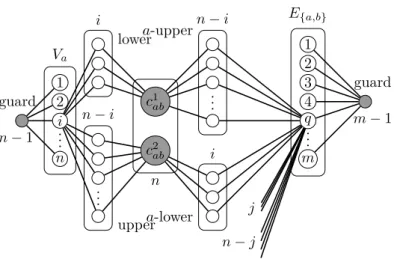
Figure 4An overview of the reduction in the proof of Theorem 2. The gray vertices are enforced to be a part the fair vertex cover. If a vertex fair objective was lowered, then the resulting threshold is beneath the vertex (the group of vertices).
Proof sketch. We proceed as follows. For every possible selection ofK∩W we generate all possible shapes and check whetherϕ(X) evaluates to true under shapeS and if so, we
computeW forS having the minimal fair-cost. J
3
The Fair VC problem
3.1
Hardness for Treedepth and Feedback Vertex Set
We observe substantial connection between Fair VCand Target Set Selection(TSS). It is worth mentioning that Vertex Covercan be formulated in the language of TSS by setting the threshold to deg(v) for every vertexv. As a result, our reduction given here is, in certain sense, dual to the one given by Chopin et al. [3] for the TSS problem. However, we will show that the structure of the solution forFair VCis, in fact, the complement of the structure of the solution for TSS given therein. The archetypalW[1]-hard problem is the `-Multicolored Clique problem [7]:
`-Multicolored Clique Parameter: `
Input: An `-partite graph G= (V1∪ · · · ∪V`, E), whereVc is an independent set for everyc∈[`] and they are pairwise disjoint.
Question: Is there a clique of the size`inG?
Proof sketch of Theorem 2. Refer to figure 4. Observe that we can enforce a vertexv to be a part of the fair vertex cover by attachingk+ 1 degree 1 vertices tov. Notice further that we may adjust (lower) the global budgetkfor individual vertexv by attaching vertices tov and then attachingknew leaves to the newly added vertices.
There are three types of gadgets in our reduction, namely the vertex selection gadget, the edge selection gadget, and the incidence check gadget. We start by enumerating the vertices in each color class by numbers from [n] and edges by numbers in [m]. Now, we construct a graphH in which we are going to look for a vertex cover of small fair cost. Throughout the proofa, bare distinct numbers from [`].
A selection gadget consists of z choice vertices (representing either the color class Va withz=norE{a,b} in which casez=m), a special vertex calledguard, and a group ofn2
enumerationvertices. The guard vertex is connected to all choice vertices, it is enforced to be a part of the fair vertex cover, and its budget is lowered so that at mostz−1 choice vertices can be in any fair vertex cover. Thei-th choice vertex is connected to nprivate enumeration vertices. We further divide these vertices into two parts – thelower part consists ofqvertices and theupper part consists ofn−qvertices, whereqrefers to the vertex number. That is, q=i in case of a vertex choice gadget and for an edge choice gadget, we letq=vi, wherevi is the number of the vertex incident toi-th edge in the corresponding colorclass.
Theab-incidence check gadget consist of two verticesc1ab andcab2 . Bothc1aband c2ab are enforced to be a part of the solution and with a lowered budget in a way that at mostn vertices in the neighborhood of each of them can be part of any fair vertex cover. The vertex c1
ab is connected to every lower part vertex in the selection gadget forVa and to every upper a-part vertex in the selection gadget for E{a,b}. Forc2ab we exchange the role of upper- and lower- parts.
BClaim 13. Suppose (G, `) is a yes-instance then there is a vertex cover inH with fair cost at mostk= max(m−1,2n).
LetK⊆V1× · · · ×V` be a clique inG. We now construct a vertex coverCK ofH having |N(w)∩CK| ≤kfor allw∈W. The setCK contains the following:
1. all enforced vertices (including all guard and check vertices),
2. ifv∈Va∩K is thei-th vertex ofVa, then all selection vertices ofVa but the vertexiare inCK and lower and upper enumeration vertices ofiare inCK, and
3. ifv∈Va∩K andu∈Vb∩K are adjacent throughq-th edge ofE{a,b}, then all selection
vertices ofE{a,b} but the vertexq are inCK andq’s enumeration vertices are in CK.
The proof of the reverse direction is deferred to the full version due to space limitations. It remains to discuss the ETH based lower-bound. This follows immediately from our reduction and the result of Chen et al. [2] who proved that there is nof(k)no(`)algorithm for`-Multicolored Cliqueunless ETH fails. Since we have td(G) + fvs(G) =O(`2) in
our reduction, the lower-bound follows. J
3.2
FPT algorithm for Modular Width
Since an algebraic expressionAof width mw(G) can be computed in linear time [36], we can assume that we haveAon the input. We construct the rooted ordered treeT corresponding toA. Each node t∈ T is assigned a graphGt⊆G, that is, the graph constructed by the subexpression ofA rooted att. Suppose we are performing substitution operation at node twith respect to template graphT and graphsG1, . . . , Gr. Denote the resulting graphGt and denote bynithe size of V(Gi).
Proof sketch of Theorem 3. The computation will be carried out recursively from the bottom of the treeT. We first describe the structure of all vertex coversC in Gt. Observe that ifij∈E(T), then at least one ofV(Gi), V(Gj) must be a subset of C. Thus, the set CT :={i:V(Gi)⊆C} is a vertex cover of the template graphT. We call theCT thetype
of the vertex coverC. Furthermore, every setC∩V(Gi) must be a vertex cover ofGi. Since there are at most 2rvertex covers ofT, we try all of these. Furthermore, every setC∩V(Gi) must be a vertex cover ofGi.
We now describe the fair cost of the coverC in terms of fair costs and sizes of the sets C∩V(Gi). Let ci =|C∩V(Gi)|and let fi denote the fair cost ofC∩V(Gi) inGi. The
fair cost of C in W ⊆V(G) is defined as maxv∈W|C∩N(v)|. Fori∈[r] the fair cost of C inV(Gi) can be expressed asfi+P
j:ij∈E(T)cj.If we know the typeCT of the coverC, this expression can be simplified based on whetherilies inCT or not. Ifi∈CT, thenfi is ∆(Gi) (the maximal degree ofGi). If, on the other hand,i /∈CT, then all its neighborsj are inCT and in this casecj =nj. Combining these observations together we get
fair cost ofC inGi= ( ∆(Gi) +Pj /∈CT:ij∈E(T)cj+ P j∈CT:ij∈E(T)nj i∈CT, fi+P j:ij∈E(T)nj i /∈CT.
From this we can design a dynamic program that computes the solution. J
4
Conclusions
Fair Edge L Deletion problems. One can defineedge deletion problemsin a similar way as vertex deletion problems.
FairLedge deletion
Input: An undirected graphG= (V, E), anLsentenceϕ, and a positive integerk.
Question: Is there a setF ⊆E such thatG\F |=ϕand for every vertexvofG, it holds that|{e∈F:e3v}| ≤k?
Recall, in dense graph classes one cannot obtain anMSO2 model checking algorithm running inFPT-time [25]. This is the reason why evaluation problems do not make sense in this context. In sparse graph classes, this problem was studied in [29] whereW[1]-hardness was obtained for FairFOEdge Deletion on graphs of bounded treedepth andFPTalgorithm was derived for FairMSO2Edge Evaluation on graphs of bounded vertex cover.
The crucial open problem is to resolve the parameterized complexity of the Fair FO Edge Deletionproblems for parameterization by neighborhood diversity and twin cover. To motivate the study we prove the following hardness result for parameterization by the cluster vertex deletion number. Recall that for any graph its cluster vertex deletion number is upper-bounded by the size of its twin cover.
ITheorem 14(F).TheFairFOEdge Deletionproblem isW[1]-hard when parameterized by the cluster vertex deletion number of the input graph.
Generalization of parameters. Another open problem is to resolve the parameterized com-plexity of theFair MSO1 Vertex Evaluationproblems with respect to graph parameters generalizing neighborhood diversity or twin cover (e.g., modular width or cluster vertex deletion number respectively).
MSO with Local Linear Constraints. Previously, an FPT algorithm for evaluation of a fair objective was given for parameter neighborhood diversity [29]. That algorithm was extended [20] to a so-called local linear constraintsagain for a formula ϕ(·) with one free variable that is defined as follows. Every vertexv∈V(G) is accompanied with two positive integers`(v), u(v), the lower and the upper bound, and the task is to find a setX that not only G|=ϕ(X) but for eachv∈V(G) it holds that`(v)≤ |N(v)∩X| ≤u(v). Note that this is a generalization as fair objective of valuetcan be tested in this framework by setting `(v) = 0 andu(v) =tfor everyv∈V(G). Is this extension possible for parameterization by the twin cover number?
Towards new fair problems. As we proposed the examination of Fair VC already, we would like to turn an attention to exploring fair versions of other classical and well-studied Vertex Deletionproblems. In contrast, certain Fair Edge Deletionproblems have got some attention before, namelyFair Feedback Edge Set[27] orFair Edge Odd Cycle Transversal[22]. Besides Fair VCwe propose a study of Fair Dominating Setand Fair Feedback Vertex Set. In particular, it would be really interesting to know whether fair variants of Vertex Coverand Dominating Setadmit a similar behavior as in the classical setting.
Furthemore, We would like to ask whether there is an NP-hard Fair Vertex Deletion problem that admits anFPT algorithm for parameterization by treedepth (and feedback vertex set) of the input graph.
References
1 Stefan Arnborg, Jens Lagergren, and Detlef Seese. Easy Problems for Tree-Decomposable Graphs. Journal of Algorithms, 12(2):308–340, June 1991. doi:10.1016/0196-6774(91) 90006-k.
2 Jianer Chen, Benny Chor, Michael R. Fellows, Xiuzhen Huang, David Juedes, Iyad A. Kanj, and Ge Xia. Tight lower bounds for certain parameterized NP-hard problems. Information and Computation, 201(2):216–231, 2005. doi:10.1016/j.ic.2005.05.001.
3 Morgan Chopin, André Nichterlein, Rolf Niedermeier, and Mathias Weller. Constant Thresholds Can Make Target Set Selection Tractable. Theory Comput. Syst., 55(1):61–83, 2014. doi: 10.1007/s00224-013-9499-3.
4 Bruno Courcelle. The Monadic Second-order Logic of Graphs. I. Recognizable Sets of Finite Graphs. Information and Computation, 85(1):12–75, March 1990. doi:10.1016/ 0890-5401(90)90043-h.
5 Bruno Courcelle and Mohamed Mosbah. Monadic Second-Order Evaluations on Tree-Decomposable Graphs. Theor. Comput. Sci., 109(1&2):49–82, 1993. doi:10.1016/ 0304-3975(93)90064-z.
6 Lenore J. Cowen, Robert Cowen, and Douglas R. Woodall. Defective colorings of graphs in surfaces: Partitions into subgraphs of bounded valency. Journal of Graph Theory, 10(2):187– 195, 1986. doi:10.1002/jgt.3190100207.
7 Marek Cygan, Fedor V. Fomin, Lukasz Kowalik, Daniel Lokshtanov, Dániel Marx, Marcin Pilipczuk, Michał Pilipczuk, and Saket Saurabh.Parameterized Algorithms. Springer, 2015. doi:10.1007/978-3-319-21275-3.
8 Rodney G. Downey and Michael R. Fellows. Fundamentals of Parameterized Complexity. Texts in Computer Science. Springer, 2013.
9 Markus Frick and Martin Grohe. The complexity of first-order and monadic second-order logic revisited. Annals of Pure and Applied Logic, 130(1):3–31, 2004. Papers presented at the 2002 IEEE Symposium on Logic in Computer Science (LICS). doi:10.1016/j.apal.2004.01.007.
10 Jakub Gajarský and Petr Hliněný. Kernelizing MSO Properties of Trees of Fixed Height, and Some Consequences. Logical Methods in Computer Science, Volume 11, Issue 1, April 2015. doi:10.2168/LMCS-11(1:19)2015.
11 Jakub Gajarský, Petr Hliněný, Jan Obdržálek, Daniel Lokshtanov, and M. S. Ramanujan. A New Perspective on FO Model Checking of Dense Graph Classes. In Martin Grohe, Eric Koskinen, and Natarajan Shankar, editors,Proceedings of the 31st Annual ACM/IEEE Symposium on Logic in Computer Science, LICS ’16, New York, NY, USA, July 5–8, 2016, pages 176–184. ACM, 2016. doi:10.1145/2933575.2935314.
12 Robert Ganian. Twin-Cover: Beyond Vertex Cover in Parameterized Algorithmics. In Dániel Marx and Peter Rossmanith, editors, Parameterized and Exact Computation - 6th International Symposium IPEC 2011, Saarbrücken, Germany, September 6-8, 2011. Revised
Selected Papers, volume 7112 ofLecture Notes in Computer Science, pages 259–271. Springer, 2011. doi:10.1007/978-3-642-28050-4_21.
13 Robert Ganian. Improving Vertex Cover as a Graph Parameter. Discrete Mathematics & Theoretical Computer Science, 17(2):77–100, 2015. URL:http://dmtcs.episciences.org/
2136.
14 Robert Ganian, Petr Hliněný, Jaroslav Nešetřil, Jan Obdržálek, and Patrice Ossona de Mendez. Shrub-depth: Capturing Height of Dense Graphs.Logical Methods in Computer Science, 15(1), 2019. URL:https://lmcs.episciences.org/5149.
15 Robert Ganian and Jan Obdržálek. Expanding the Expressive Power of Monadic Second-Order Logic on Restricted Graph Classes. In Thierry Lecroq and Laurent Mouchard, editors, Combinatorial Algorithms—24th International Workshop, IWOCA 2013, Revised Selected Papers, volume 8288 ofLecture Notes in Computer Science, pages 164–177. Springer, 2013. doi:10.1007/978-3-642-45278-9_15.
16 Martin Grohe, Stephan Kreutzer, and Sebastian Siebertz. Deciding First-Order Properties of Nowhere Dense Graphs. J. ACM, 64(3):17:1–17:32, 2017. doi:10.1145/3051095.
17 Frédéric Havet, Ross J. Kang, and Jean-Sébastien Sereni. Improper coloring of unit disk graphs. Networks, 54(3):150–164, 2009. doi:10.1002/net.20318.
18 Klaus Jansen, Stefan Kratsch, Dániel Marx, and Ildikó Schlotter. Bin packing with fixed number of bins revisited.J. Comput. Syst. Sci., 79(1):39–49, 2013.doi:10.1016/j.jcss.2012.04.004.
19 Ross J. Kang, Tobias Müller, and Jean-Sébastien Sereni. Improper colouring of (random) unit disk graphs. Discrete Mathematics, 308(8):1438–1454, 2008. Third European Conference on Combinatorics. doi:10.1016/j.disc.2007.07.070.
20 Dušan Knop, Martin Koutecký, Tomáš Masařík, and Tomáš Toufar. Simplified Algorithmic Metatheorems Beyond MSO: Treewidth and Neighborhood Diversity. In Hans L. Bodlaender and Gerhard J. Woeginger, editors,Graph-Theoretic Concepts in Computer Science: 43rd International Workshop, WG 2017, Eindhoven, The Netherlands, June 21-23, 2017, Revised Selected Papers, pages 344–357, Cham, 2017. Springer International Publishing.doi:10.1007/ 978-3-319-68705-6_26.
21 Petr Kolman, Bernard Lidický, and Jean-Sébastien Sereni. Fair Edge Deletion Problems on TreeDecomposable Graphs and Improper Colorings, 2010. URL:http://orion.math.iastate. edu/lidicky/pub/kls10.pdf.
22 Petr Kolman, Bernard Lidický, and Jean-Sébastien Sereni. On Fair Edge Deletion Problems, 2009. URL:https://kam.mff.cuni.cz/~kolman/papers/kls09.pdf.
23 Juha Kontinen and Hannu Niemistö. Extensions of MSO and the monadic counting hierarchy. Information and Computation, 209(1):1–19, 2011. doi:10.1016/j.ic.2010.09.002.
24 Michael Lampis. Algorithmic Meta-theorems for Restrictions of Treewidth. Algorithmica, 64(1):19–37, 2012. doi:10.1007/s00453-011-9554-x.
25 Michael Lampis. Model Checking Lower Bounds for Simple Graphs. Logical Methods in Computer Science, 10(1):1–21, 2014. doi:10.2168/LMCS-10(1:18)2014.
26 Leonid Libkin. Elements of Finite Model Theory. Texts in Theoretical Computer Science. An EATCS Series. Springer, 2004.
27 Li-Shin Lin and Sartaj Sahni. Fair Edge Deletion Problems. IEEE Trans. Comput., 38(5):756– 761, 1989. doi:10.1109/12.24280.
28 Tomáš Masařík and Tomáš Toufar. Parameterized Complexity of Fair Deletion Problems. In T.V. Gopal, Gerhard Jäger, and Silvia Steila, editors,Theory and Applications of Models of Computation: 14th Annual Conference, TAMC 2017, Bern, Switzerland, April 20-22, 2017, Proceedings, pages 628–642, Cham, 2017. Springer International Publishing. doi: 10.1007/978-3-319-55911-7_45.
29 Tomáš Masařík and Tomáš Toufar. Parameterized complexity of fair deletion problems. Discrete Applied Mathematics, 2019. doi:10.1016/j.dam.2019.06.001.
30 Jiří Matoušek and Jaroslav Nešetřil. Invitation to Discrete Mathematics (2. ed.). Oxford University Press, 2009.
31 Jaroslav Nešetřil and Patrice Ossona De Mendez.Sparsity: graphs, structures, and algorithms, volume 28. Springer Science & Business Media, 2012. doi:10.1007/978-3-642-27875-4.
32 Timm Oertel, Christian Wagner, and Robert Weismantel. Integer convex minimization by mixed integer linear optimization. Operations Research Letters, 42(6):424–428, 2014. doi:10.1016/j.orl.2014.07.005.
33 Michał Pilipczuk. Problems Parameterized by Treewidth Tractable in Single Exponential Time: A Logical Approach. In Filip Murlak and Piotr Sankowski, editors, Mathematical Foundations of Computer Science 2011 - 36th International Symposium, MFCS 2011, Warsaw, Poland, August 22-26, 2011. Proceedings, volume 6907 ofLecture Notes in Computer Science, pages 520–531. Springer, 2011. doi:10.1007/978-3-642-22993-0_47.
34 Detlef Seese. Linear Time Computable Problems and First-Order Descriptions. Mathematical Structures in Computer Science, 6(6):505–526, 1996.
35 Stefan Szeider. Monadic second order logic on graphs with local cardinality constraints. ACM Trans. Comput. Log, 12(2):1–21, 2011. doi:10.1145/1877714.1877718.
36 Marc Tedder, Dereck G. Corneil, Michel Habib, and Christophe Paul. Simpler Linear-Time Modular Decomposition Via Recursive Factorizing Permutations. In ICALP 2008, pages 634–645, 2008. doi:10.1007/978-3-540-70575-8_52.
37 Mihalis Yannakakis. Edge-Deletion Problems. SIAM J. Comput., 10(2):297–309, 1981. doi:10.1137/0210021.