March 2012 Martha Premm arge Waste Prevention, Resource Protection and Sustainable Development Ltd.
Report on implementation models
for repair and re-use networks
WP 4.1.1 Needs assessment and model development
of the Central Europe project
CERREC
TABLE OF CONTENTS
1.) Introduction... 3
1.1 Why establish repair and re-use networks? ... 3
1.2 Main challenges: from knowledge to action ... 5
2.) Legal background and requirements... 8
3.) Re-use network: definition and criteria... 12
4.) Specific needs and interests of relevant stakeholders... 15
5.) Requirements for a repair and re-use network along the process chain... 18
5.1 Introduction... 18
5.2 Requirements in the fields of collection and storage ... 18
5.3 Requirements in the fields of transport and logistics... 20
5.4 Requirements in the fields of refurbishment and repair ... 20
5.5 Requirements in the fields of retail ... 23
5.6 Quality management ... 24
6.) Implementation models for re-use networks: Case studies... 26
Case study: KOMOSIE, Flanders ... 26
Case study: The Furniture Re-use Network... 28
Case study: ReVital – a re-use label in Austria ... 30
Case study: Repair network Vienna... 31
7.) Prospects and barriers for repair and re-use networks... 32
8.) Literature... 34
1.
INTRODUCTION
Aim and Content of this report
This report serves as a foundation / basis for the development of an implementation handbook (WP 4.1.3) that is applicable and adaptive for all the participating countries. The implementation handbook will contain a detailed guideline for the whole value chain from collection to retail for the different product categories for interested institutions, organisations and authorities. To be able to create those detailed instructions and guidelines it is necessary to know the requirements and needs. So this report intends to show the main requirements for repair and re-use networks in all areas of the process chain. It aims to define organizations and players that are relevant for the practical implementation of repair and re-use actions as well as their interests and needs. Furthermore it wants to present possibilities and models for the practical implementation on the basis of case studies which shall be discussed within the CERREC partnership, national working groups and the Expert Advisory Board concerning their usability and feasibility in each country. Although the structures and conditions in the participating countries of the CERREC project differ in many aspects, there can be determined common and general needs and requirements for such networks to be established.
1.1. Why establish repair and re-use networks?
Why repair and re-use products?
In regard to resource utilization in the last decades the industrial countries have become a “throw-away-society”. Growing business volume and rising standards of living are coupled to an increase in resource consumption and to larger amounts of waste. If the consumer feels a need, he covers it in many cases through the purchase of a new product. As a throw-away product, it quickly finds its way into the trash. As a higher quality product, it often goes unused for a long time after one use. The re-use of products compared to the production of new ones leads in many cases to a reduction in resource and energy consumption. It contributes to the protection of valuable natural resources, reduces water and air pollution, contributes to a reduction in greenhouse gas emissions and waste generation and is a means to provide affordable second hand products for people with a low income. Today's usual patterns of consumption, high repair costs and the increasing number of products with low quality and short lifespan make it difficult to re-use products. Re-use is not supported by producers but seen as a competition.
But, as we committed to the targets of the Thematic Strategy on Waste Prevention and Recycling and the Waste Framework Directive, we have to act immediately and promote and support re-use and the preparation for re-use. One way of reaching this goal is to launch a network of repair and re-use centres. The idea of this centres and networks is, that consumers have the possibility to bring to these places all types of repairable or re-usable goods they want to discard – such as furniture, clothing, electrical appliances, toys, sports equipment, etc. – with as little effort as possible. Refurbishment, repair and re-use extend the lifespan of used products and components so that they can be put back into the market. Unlike recycling, which requires the breaking down of technical components that have often been carefully and expensively machined into lower value raw materials, reconditioning, repair and re-use keep units or components in their entire state (therefore retaining higher value with a lower expenditure of efforts). It allows to save recycling and treatment
of re-usable goods, they are especially suitable for social enterprises engaged in re-use activities, offering work, training and skills to long-term unemployed or disabled people.24)
Thesocial benefitsassociated to re-use are important on two grounds1):
these activities offer interesting work as well as the training of low-skilled workers or those with few employment prospects
re-used goods being significantly cheaper than new ones allows households with lower incomes to access goods they would otherwise not be able to afford - thereby reducing social exclusion.
According to ACRR1)throughout the EU re-use and recycling activities provide work to around 40.000
people in social economy organisations. The largest sectors are WEEE (waste electrical and electronic equipment), bulky furniture and textiles. The number of jobs and amount of waste treated are estimated as follows:1)
Theeconomic and environmental benefitsof waste reduction are4):
prevent pollution created by manufacturing new products or products made from virgin materials
save energy in manufacturing, transportation, and disposal of products
decrease greenhouse gas emissions, which contribute to global climate change
conserve natural resources such as timber, water, metals, and fossil fuels
reduce the need for landfilling and incineration, which are expensive to operate and maintain
protect and expand manufacturing jobs and increase competitiveness help sustain the environment for future generations
Why do we need a network?
Apart from the aspect of inter-regional marketing the establishment of supra-regional cooperation and networks is necessary for another reason; currently, only very few re-use facilities and organisations are able to manage the entire re-use process chain and logistics within their company. The majority relies on the cooperation with other companies, on the one hand to ensure the input of re-usable devices, on the other hand for distribution, inspection or repair activities.14)
Since re-usable wastes need to be repaired in very different specialized companies (mechanical engineers, carpenters, computer technicians, electricians, mechanics, decorators, upholsterers, shoemakers, watchmakers, precision mechanics, restorers, instrument makers, etc.), and the market underlies regional and temporal variations, it is necessary to either organise an appropriate logistical The "ecological rucksack"1)
(the amount of waste generated in producing one unit of a good) of a: - acomputeris nearly:1.500 kg
- alaptop:400 kg
and organizational network of actors (re-use networks) or to establish new, large, central operating units, which cover all tasks (re-use centres).25)
1.2. Main challenges: from knowledge to action
A sufficient state of knowledge is prerequisite to the establishment of repair and re-use networks. Generating this knowledge through research and development activities as well as practical experiences and projects often depends on funding, which requires the political willingness and will of the general public. Therefore it is necessary to create or maintain a favourable image, reputation and a good will and to educate certain audiences.
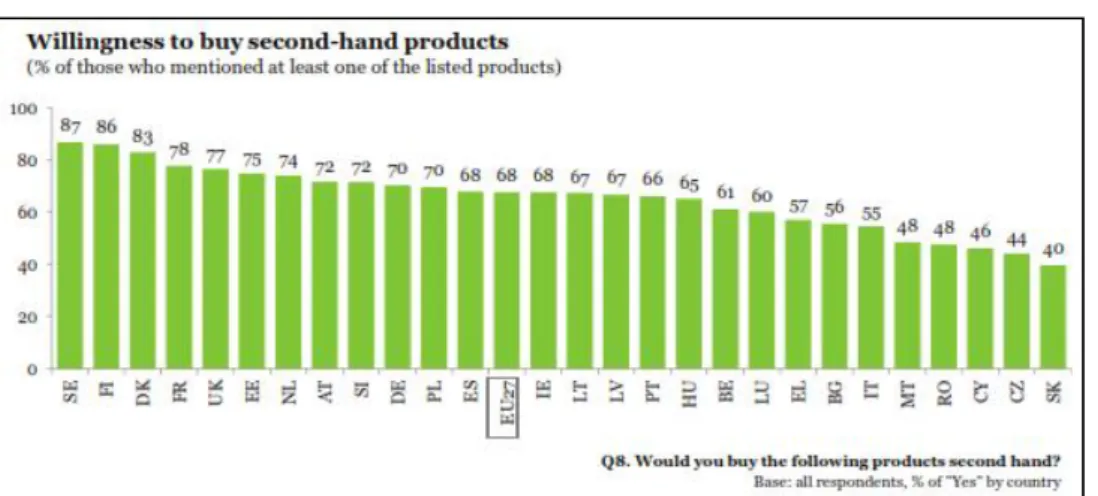
So, one of the prerequisites for the establishment of re-use centres and networks is the willingness of people to buy re-use products. According to a survey of the EU7) 68 % of people are willing to buy
second hand products; a majority (56%) of EU citizens said they would buy second-hand furniture, 45% said they would buy electronic equipment on a second-hand basis, 36% of EU citizens said they were willing to buy second-hand textiles (e.g. clothing, bedding or curtains).
Table 1: Willingness to buy second-hand products 1
Source: Eurobarometer7)
Table 2: Willingness to buy second-hand products 2
According to the same survey 8 in 10 EU citizens felt that a product’s environmental impact (such as whether it was re-usable or recyclable) was an important element when deciding which products to buy (39% “very important” and 41% “rather important”). More than half of the interviewees in Italy or Austria said that this aspect was a very important factor in purchasing decisions.
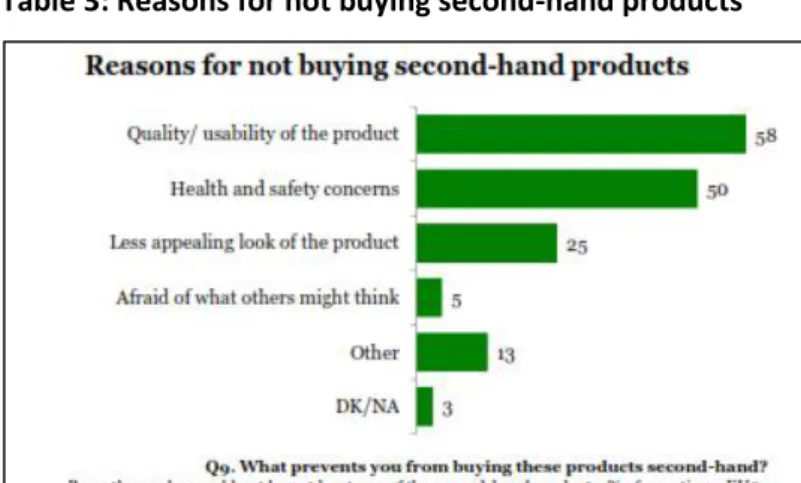
Among those interviewees who said that they would not buy second hand products, themain reasons for not buyingwere:
- quality and usability of the product - health and safety concerns and - a less appealing look of the product.
Table 3: Reasons for not buying second-hand products
Source: Eurobarometer7)
The challenge now is to bring the people from knowledge to action. Therefore it will be necessary to not only focus on awareness raising and PR work but at the same time create a fast, easy and convenient access to re-use products, while guaranteeing their quality and safety.
The main idea is to establish services and infrastructure, that24):
provide users an easy access to valuable products,
make it possible to repair the used products, so that they are fully functioning and possibly bring them on the cutting edge of technology (remanufacturing),
make it possible to label the used products with a quality brand,
make it possible to sell used products with high quality at low prices and guarantee an efficient use of second hand products.
To establish a strong and growing market for re-usable products a number of measures at national, regional and enterprise level are necessary to consolidate and professionalize the new "re-use sector", to create a better market penetration for re-use products and to develop a practicable quality assurance system for collection points, re-use shops and products.25)
Financial challenges
In order to enable small and medium social or private enterprises to set up repair and re-use businesses, the profitability (or at least financial viability) must be guaranteed. This means that there
has to be a market with sufficient demand. At the moment, the establishment of repair and re-use centres and networks is in many cases dependent on funding.
For non-profit and charity organisations there are in different countries direct or indirect subsidies available linked to defined conditions which vary in each country. These conditions can be for example for the employment of disadvantaged people (long-term unemployed or disabled persons). Another kind of subsidizing is the tax exemption of the enterprises (completely or partially, reduced VAT - value added tax - rates). The operation of these enterprises is often mainly financed via membership fees, donations, subsidies or other fees. For private enterprises there exist in most cases loans for business start-ups.11)
It is crucial that producers and distributors of high quality products do not derail re-use centers as competition but perceive them as a service system to support their products, through which the products have also an added value for the first-time users.
According to an Austrian study on “innovative services from the perspective of waste prevention”24)
the followingfactors for successare crucial: - nationwide, unified organisation
- attainment of the entire potentially re-useable goods - centralized logistics
- decentralized sales shops (important for reasons of “image” is the spatial separation of the sale of products and the waste treatment)
- clear regulations of collecting systems and communities - professional quality management and marketing.
Article 4: Waste hierarchy
(a) prevention;
(b) preparing for re-use; (c) recycling;
(d) other recovery, e.g. energy recovery;
(e) disposal
2.
LEGAL BACKGROUND AND REQUIREMENTS
The implementation of repair and re-use activities and the establishment of re-use networks is necessary to comply several legal obligations within the Central Europe area. The most important of these are the Waste Framework Directive (Directive 2008/98/EC on waste) and the Directive on Waste Electrical and Electronic Equipment (WEEE).
1.) Waste Framework Directive (Directive 2008/98/EC on waste)
“Preparation for reuse” – as a new form of waste treatment - was introduced within the revised Waste Framework Directive (WFD) with the aim to produce
second hand products out of waste. The WFD had to be implemented into national law of EU member states until the 12th of December 2010. After this, practical implementation within local waste management structures has to be accomplished.
Definitions according to the WFD:
o ‘re-use’ means any operation by which products or components that are not waste are used
again for the same purpose for which they were conceived; (Art. 3 / 13)
o ‘preparing for re-use’ means checking, cleaning or repairing recovery operations, by which
products or components of products that have become waste are prepared so that they can be re-used without any other pre-processing; (Art. 3 / 16)
According to the Waste Framework Directive re-use activities can be considered as waste prevention (e. g. donations, flea markets, online platforms, second hand shops,…) or as waste treatment (preparation for re-use).
According to the WFD
„…Member States shall take measures, as appropriate, to promote the re-use of products and preparing for re-use activities, notablyby encouraging the establishment and support of re-use and repair networks, the use of economic instruments, procurement criteria, quantitative objectives or other measures.“ (Art. 11, 1).
They also are asked to implement a “…sound preparing for re-use” in their waste management plans Art: 28.
2.) Directive on waste electrical and electronic equipment (WEEE); Proposal for a revised directive, Dec. 2008
According to the proposal for a revised Directive on WEEE, there are several obligations concerning product design, disposal and transport of collected WEEE as well as information on WEEE to ensure the re-usability of waste products:
o Art. 4,Product design: EU member states shall „…, in line with Community product legislation
including Directive 2005/32/EC on eco-design, encourage measures topromote the design and productionof electrical and electronic equipment notablyin view of facilitating re-use, dismantling and recovery in particular the reuse and recycling of WEEE, its components and materials
o Article 6:Disposal and transport of collected WEEE
(2) Member States shall ensure that thecollection and transportof separately collected WEEE is carried out in a way whichoptimises re-useand recycling and the confinement of hazardous substances.
o Article 14:Information for users
(2) Member States shall ensure that users of electrical and electronic equipment in private households are given the necessary information about:
(c)their role in contributing to re-use, recycling and other forms of recovery of WEEE;
(3) Member States shall adopt appropriate measures so that consumers participate in the collection of WEEE and to encourage them to facilitate the process of re-use,treatment and recovery.
o Article 15: Information for treatment facilities
1. In orderto facilitate the preparation for re-useand the correct and environmentally sound treatment of WEEE, including maintenance, upgrade, refurbishment and recycling, Member States shall take the necessary measures toensure that producers provide re-use and treatment informationfor each type of new EEE placed on the market within one year after the equipment is placed on the market. This information shall identify, as far as it is needed by re-use centres, treatment and recycling facilities in order to comply with the provisions of this Directive, the different EEE components and materials, as well as the
location of dangerous substances and preparations in EEE. It shall be made available to re-use centres, treatment and recycling facilities by producers of EEE in the form of manuals or by means of electronic media (e.g. CD-ROM, online services).
Also the proposal contains specific „recovery targets“ concerning the preparation for re-use and recycling:
1. Regarding all WEEE separately collected and sent for treatment in accordance with Articles 8, 9 and 10 or for preparation for re-use, Member States shall ensure that, by 31 December 2011, producers meet the following minimum targets:
(a) for WEEE falling under categories 1 and 10 of Annex I to Directive 20xx/xx/EC (RoHS), > 80% shall be prepared for re-use and recycled;
(b) for WEEE falling under categories 3 and 4 of Annex I > 70% shall be prepared for re-use and recycled;
(c) for WEEE falling under categories 2, 5, 6, 7, 8 and 9 of Annex I > 55% shall be prepared for re-use and recycled;
(d) for gas discharge lamps,
> 85% shall be prepared for re-use and recycled.
Legal obligations for organisations dealing with repair and re-use
Enterprises and organisations in the field of repair and re-use have to insure that all policies, regulations and standards of operation, including the health and safety of all, are complied with and managed. Although the laws and regulations differ from country to country it can be stated that there are generally several obligations that arise from waste management regulations on the one hand and commercial law on the other hand.
For all EU member states there are legislations and regulations concerning waste management
when dealing with waste considered products, for:
the authorisation of collecting, disposing, recovering or depositing of waste transport of wastes
reporting and record keeping
EU – obligationsconcerning reporting and record keeping include i.a. the
-Regulation on Waste Statistics (EG 2150/2002:statistics on the generation, recovery and disposal of waste and the transmission of results to Eurostat),
- the Waste Framework Directive (2008/98/EC Art.11/5 Re-use and recycling: Every three years Member States shall report to the Commission on their record with regard to meeting the targets), - theDirective on end-of life vehicles(2000/53/EG: Art. 7/2: ensure that targets concerning re-use and recovery are attained by economic operators) or
- the Directive on waste electrical and electronic equipment (WEEE) (2002/96/EC: Art. 12 information and reporting).
2002/96/EC: Art. 12 (1) „Member States shall draw up a register of producers and collect information, including substantiated estimates, on an annual basis on the quantities and categories of electrical and electronic equipment put on their market, collected through all routes, re-used, recycled and recovered within the Member States, and on collected waste exported, by weight or, if this is not possible, by numbers.“
Also, for running a company, there are in all countries regulations concerningcommercial laws(e. g. for the permits for plants), as well as The European General Product Safety, Product Liability & Product Warranty Directivesdesigned to protect consumers and users in Europe.
Product Liability Directive 85/374/EEC
Its purpose is to impose strict liability on all parties who are involved in producing a product containing a defect that causes personal injury or property damage. The producer is liable for damage caused by a defect in their product. Producers can include the maker of any raw material or the manufacturer of a component part but also private labelers, importers or any person supplying a product whose producer cannot be identified.
Product Safety Directive 01/95/EC
Suppliers of consumer goods are responsible to make sure their products are safe for normal and foreseeable use. The directive furthermore requires producers to provide consumers with relevant information that enables them to assess the risks inherent in that product.
Product Warranty Directive 99/44/EC
This directive specifies that the seller of a product is liable to the consumer for any lack of conformity which exists when the goods are delivered to the consumer and which becomes apparent within a period of two years, unless, at the moment of conclusion of the contract of sale, the consumer knew or could not reasonably be unaware of the lack of conformity.
3.
RE-USE NETWORK: DEFINITION AND CRITERIA
The term network has many different definitions and meanings and is used in various ways.
In this report, when speaking of networks (or re-use networks) we use the definition of (social) networks in the business studies:
A network is a focused, deliberate form of organisation (in the form of a cooperation, association, organisation or informal grouping) that joins a number of organizations, enterprises or individuals who have the same goal and hope to have an advantage through the network.30)
In the case of re-use networks this goals are to create uniform structures in order to ensure product quality, to build up collective marketing channels and to enable an outward representation of the sector12).
A network consists of more than 3 partners. In formal networks there exist contracts between the partners/members.
Tasks of the networks according to a European study 2008 on network design in the second-hand sector are, to:12)
- present the member enterprises
- establish the same quality standards for the member enterprises - organise training measures for the employees
- promote the exchange of experiences - organise special sale events
- assure a quality management
- develop common business structures for the member enterprises - represent the enterprises to local authorities and
- arrange advertisement activities
In an Austrian study on the implementation of the requirements concerning re-use in line with the waste management law (2010)25)are-use networkis characterized as follows:
In re-use networks the collection, repair and retail are processed in different organizations / from different network partners. Ideally, municipal and regional waste management authorities are part of the network or even coordinate the network`s activities. Aim of the networks is to gain the highest possible quotes of re-use not only in urban regions but at a region- or nationwide coverage.
Whereas are-use centre(in metropolitan areas ) is…
…a large re-use organization (50 employees) that is active in the fields of collection, refurbishment and repair, corresponding logistics as well as retail and that treats most or all concerned product groups for re-use. Role models for such re-use centres are socio-economically managed centres in Belgium (Kringloopcentrum), France (ENVIE) and Germany (Stilbruch).
Forms of networks
The formal character of networks can vary strongly depending on the targets and members of the networks. The most common forms of existing networks in the re-use sector are:
- associations/federations - cooperations or
- franchising networks
Association or federation
Associations are all kind of groups of individuals (natural person) or statutory corporations (entity) that pool together in a legal form of a voluntary association to pursuit of common purposes and usually have a fixed internal organisational structure.31)
Members of associations or federations in many cases have to pay membership fees but in return can profit from the association as it operates as a kind of forum for its members (a platform for exchange, discussions and promotion of common ideas) and offers a privileged access to sector specific information. Between the members of an association and the association a formal contract exists.12)An example for a re-use federation is KOMOSIE in Flanders.
Cooperation
In the business studies a cooperation is defined as a voluntary cooperation of businesses that remain legally independent but give up some of their economic sovereignty.32) A cooperation is mostly a
consortium of two or more enterprises that have fixed a formal contract or agreement for a particular purpose. Usually the partners don`t have to pay annual fees. Reasons for the formation of contracts within the cooperation could be for example for the purchase, sale or exchange of goods.12)
Franchising network
A franchising network (enterprise) is characterized through the close cooperation between the franchisor and the franchisees (which both remain independent enterprises) within a clearly defined contractual framework. The franchisee pays fees for the use of uniform equipment, a common name, the common appearance to the outside, the use of a trademark (e.g. logo), a uniform distribution system as well as often for common book keeping and sells its goods or services legally independently. The franchisor trains the franchisee, controls the implementation of the franchising concept and may give instructions.12)
According to a study of ITB (2008) a franchise system is generally characterised by four criteria: - Self-employed entrepreneurs agree on a contract a cooperation for the length of time.
- Against a single sum payment and/or ongoing amounts the franchisee gets the permission to have clearly defined rights to the franchisor.
- These rights include: The use of brand names or company names, application of a business concept/ system, production and/or sale of product group.
- Support from the franchisor in the development and the ongoing management of the enterprise.
Re-Use Networks
Which partners are included in a re-use network and the network forms may differ strongly depending on the regional framework conditions (legal background, funding possibilities, available network partners in the region, …).
The table below shows the process chain / fields of action in a re-use network (procurement, preparation for re-use and retail) as well as possible network partners in those fields.
Source: changed, after RepaNet, 201025)
Concerning the network partners in the field of retail alone a variety of company sizes, business field orientations and forms of organization can be found. Apart from this variety of operational profit-oriented companies (enterprises operating in a free economy with the main aim of profit maximization) there are also non-profit companies active in the field. These are in many cases assigned to the socio-economic sector and often organized in networks and/or belong to big and partly international organizations. There are also individual non-profit enterprises operating with second-hand goods for charitable reasons.11)
4.
SPECIFIC NEEDS AND INTERESTS OF RELEVANT STAKEHOLDERS
It is necessary to know all relevant stakeholders in the field of repair and re-use and their interests for developing the right strategies for future procedure. Crucial for the success of the establishment of re-use networks is to jointly develop it within the existing structures, so the will and commitment of all partners involved is guaranteed. The establishment of parallel structures is not effective. In this report we refer to “stakeholder” as a person or organization with an interest (or ‘stake’) in the success or failure of a particular issue;According to the CERREC Communication Strategy the following groups of stakeholders are identified:
General public(citizens/households, end users/consumers) Official stakeholders:
o private (and public private) waste management enterprises and companies (SMEs - Small
and Medium Enterprise) in the fields of repair, second hand, (small) trade, waste collection and –treatment
o disposal and treatment companies (waste treatment centres) o social repair and re-use enterprises (with waste treatment licence)
o national, regional and local (municipal) waste management authorities (decision makers,
policy makers and leading officials - Ministries, federal governments, municipalities)
o waste management associations (Professional Associations/ NGOs – representing
interest, lobbying)
o other NGOs (environment, social, health and other organizations) o producers (enterprises and companies that produce products) o waste collection centres
o waste dump keepers (operators of landfill sites)
The knowledge, interests and influence of these stakeholders are very diverging, as well are their roles within a repair and re-use network (on strategic, tactical and operative level). See also the document „Stakeholder participation process“, WP 3 of CERREC, Bay Logi, 2011 – where you can find a detailed description of the various stakeholders and their interests.
Stakeholders currently active in the field of re-use
Initially, organised collection, sorting and resale of used products were often undertaken by charitable organisations such as the Salvation Army. In the last years, recycling, refurbishing and re-use have become important fields of action for social enterprises. Many of these enterprises emerged from labour market integration projects, traditionally focusing on the social aspects of their enterprises.1)
Actors currently active in the field of retail of re-use products
- Work Integration Social Enterprises (WISE) - Charity organisations
- Waste management/collection organisations
The size and structure of enterprises, organizations and other actors involved as well as the business forms in the Re-Use / Second-Hand-Sector vary strongly between the different CERREC partner countries. In principle there has to be made the distinction between individuals and companies and within the companies the differentiation between profit and non-profit enterprises.
Industries and businessesthat arerelevant forthepreparation for re-useaccording to RepaNet25)
are:
Craft businesses (mechanical engineers, computer technicians, mechanics, carpenters, shoemakers, tailors, upholsterers, restorers, instrument engineers, electrical engineers, etc.) Commercial businesses (various trade industries, especially in the fields of electrical goods,
antiques, furniture, toys, tool, etc.)
Businesses active in the fields of waste collection and treatment with corresponding workshops and trained personnel
Work Integration Social Enterprises and charity organisations with workshops and qualified personnel
Local businesses or community facilities with workshops and qualified personnel
Role / tasks of different stakeholders and interest groups
Based on the recommendation of the guideline on re-use of WEEE developed by KERP (2009), for the establishment of re-use activities, different interest groups / stakeholders have to fulfil different tasks:
National, regional and local authorities
- optimize the legal framework, guaranteeing the priority of re-use over recycling, recovery and disposal
- encourage re-use both in the context of waste prevention as well as waste management (preparation for re-use)
- support public relations on repair and re-use
- establish a permit system and random-like control over the work of re-use operations (organisation, technical test equipment, test results, standardisation of testing procedures for waste products)
Producers
- provide relevant information on products for re-use and treatment
- change their attitude towards re-use centres; to see them not as competitors but as a service system to support their products
Municipalities and waste collection organisations
- ensure that collection points facilitate collection of re-usable items
- cooperate with re-use enterprises (if necessary contracts with producer responsibility organizations and re-use plants)
Collection and treatment enterprises
- ensure careful transport and storage
Re-use enterprises
- cooperate with municipalities and collection centres for the acquisition of re-usable items (through their own transportation or suitable cooperation)
- ensure compliance with the appropriate quality criteria (for example with existing re-use-labels criteria)
- concerning WEEE: develop appropriate testing infrastructure (technical and organizational), store test reports
- document the donated re-usable equipment, store gift certificates / directories etc. - meet reporting and record keeping obligations
Producer responsibility organisations (PRO), compliance schemes, collective systems
- contractual arrangements with waste collection and treatment companies (equality concerning re-use of “whole appliances” and recovery in contractual agreements of compliance schemes with waste treatment and collection centres taking into account the higher costs for collection)
- establish necessary contractual relationships with the re-use enterprises
- practical implementation of operational guidelines for the careful collection/storage/ transport of re-usable devices
- consider the re-use of “whole appliances" in the reporting obligations concerning amounts of recovered wastes
All interest groups
- support the formation of networks for the re-use sector
Network coordinators
- construct network and umbrella structures for the repair and re-use sector (monitoring underlying criteria, membership management, coordination and representation of the interests of member companies to the public and to collection and recovery systems, etc.) - support public relations on re-use and develop a re-use-brand mark or labels (which includes
criteria for: testing, documentation, information to end users)
- draw up practical proposals for collection / storage / transport equipment for collection of different product categories, develop templates for documentation of test results and the acquisition within donations
- inform member companies on latest developments (e. g. studies about devices that are recommended for re-use and those that should be excluded)
- establish minimum requirements on testing facilities, participate in the standardisation of testing methods
5.
REQUIREMENTS FOR A REPAIR AND RE-USE NETWORK ALONG
THE VALUE-ADDED CHAIN
5.1. Introduction
As already mentioned in the introduction and the previous chapter, to ensure the establishment of an efficient working repair and re-use network with optimised procedures (in the fields of collection, logistics, refurbishment and retail), a network coordination has to be installed to define the roles and tasks of the network partners. The network coordination is also in charge of defining common goals and targets and to support public relations and communication in the whole network region.
Core tasksof the network partners are16):
collection of goods/procurement (collection from households and from collection centres, clearing out, direct delivery, sorting,…)
transport, logistics and other services repair and refurbishment
fractionation, demolition and removal of pollutants sales / promotion
consultancy and training
To be able to meet this requirements, the followingcore competences have to be available within the network16):
o know-how on procurement: a central information platform for the type, quantity, quality,
price, and regional availability of used products
o know-how on preparation/refurbishment/repair: development of uniform quality
guidelines and joint planning capacity for the processing and sale of used products
o know-how on marketing: development of a common marketing concept, public relations …
In the following chapters the requirements concerning the tasks of the network partners described above are lined out more detailed.
5.2. Requirements in the fields of collection and storage
When organizing an efficient collection system, accessible and efficient collection facilities as well as adequate and consistent information to the users are crucial. To avoid damaging or breaking the components and to preserve re-use opportunities, transport, handling, but also sorting and storage issues are most important. It is very recommendable to have defined standard procedures ensuring that everything is operated in an efficient and safe manner. Hazardous substances should be removed and re-usable appliances separated as early as possible in the process.1)
5.2.1 Collection
According to ACRR und RREUSE1)there are the following differentcollection schemes:
Municipal collection schemes
Local authorities are responsible for municipal waste management in general, they already collect goods in the form of:
- kerbside collection (separated or not, scheduled or on request) - bring systems (recycling parks and collection points)
- mobile collection points - others
Take back by retailers
Retailers offer to take back goods in store or via other arrangements as an extra service for the consumer. They use the old appliance to recover spare parts, sell it as second hand goods or sell it to a scrap merchant for its residual value.
Take back by social economy enterprises
Social economy enterprises offer citizens to bring their discarded appliances to a re-use centre, donate them to a charity organisation or community recycling shop with re-use activities or make a call to have their appliances collected at home.
Other channels
Serviceable old appliances can also be
- sold privately to second hand shops or dealers,
- sold consumer to consumer (through advertising in newspapers and magazines …) - or donated free to family and friends or charitable organisations.
Criteria for the selection of productsfor re-use are (according to KERP14)):
economic criteria:
- there is a market for these goods existing - longevity and quality of the product - age of the product (except antiques ...) ecological criteria:
- no harmful substances technical criteria:
- technical condition
- degree of defilement, damage
- not a security risk(functional and safety testing)
5.2.2 Storage
The storage of re-usable goods at collection points requires a sufficient storage capacity and a
covered and closed area, with adequate flooring and storage boxes in order to preserve the goods, prevent the theft of appliances or components with a commercial value and prevent leakages and pollutions. Also the storage time should be limited. After a first selection and identification whether the appliance can profitably be repaired or refurbished, the appliances have to be sorted (e. g. by condition) and labelled with their destination (re-use of whole appliances, re-use of components, recycling, recovery, disposal).1) 14)
Concerning the storage of WEEE there are technical requirements set out in Annex III / 1 of the Europ. WEEE Directive:
“Sites for storage (including temporary storage) of WEEE prior to their treatment (without prejudice to the requirements of Council Directive 1999/31/EC):
- impermeable surfaces for appropriate areas with the provision of spillage collection facilities and, where appropriate, decanters and cleanser-degreasers,
- weatherproof covering for appropriate areas.”
5.3. Requirements in the fields of transport and logistics
To even out the unequal distribution of demand, processing capacities and to optimally exploit the potential amounts of re-usable goods it is necessary to build efficient logistic structures. These should ensure that the re-usable items are transported quickly and inexpensively from the collection points to the appropriate processing plants and from there to the retail shops.25)
It is crucial to ensure that the handling and loading of the items do not affect their re-usability. Therefore, firstly theemployeesshould betrainedregarding:
handling aspects (ex: fridges and freezers should be transported upright) and proper organisation of the transport.
Secondly, there also has to be a transport and logistics system installedthat guarantees a careful handling, including:
appropriate vehicles (with tail lifts for heavy items)
equipment to fasten the appliances to the transport vehicle in order to prevent damage or the release of liquid pollutants
re-usable protective wrapping boxes for smaller items 1)
When transporting products considered as “hazardous wastes” (e. g. WEEE) the obligations considering reporting and record keeping (see chapter 2) have to be taken into account (see regulation on waste statistics).
5.4. Requirements in the fields of refurbishment and repair
The requirements concerning refurbishment and repair differ very much depending on the effected product categories. When dealing with small household appliances or clothes, in most cases there is just (cosmetic) cleaning necessary for which no trained personnel is required. Whereas when dealing with WEEE – which are considered as “hazardous wastes” - there are strict regulations and obligations concerning functionality and safety as well as reporting and record keeping to consider. Furthermore it requires highly trained personnel and adequate equipment and infrastructure.
IfWEEEare affected the first step has to be atesting procedure, including:14) 26)
- visual inspection
to judge whether the device is basically suitable for further use. Primarily visible damages may be identified (small errors such as scratches on the casing don`t disqualify potential re-use). This test step can be done already in the course of the takeover. In some cases it may also be useful to complement this test step also with a short “power-on” test.
- functionality test
in this testing step the functionality of the device (“fit for purpose”) is checked for all relevant product features. If available the process should follow the original equipment manufacturer user manual for the item.
-security/safety test
testing step to guarantee that the tested devices fulfil the electrical safety requirements. The test process has to comply with the tests for safety as specified in the International Electrotechnical Commission (IEC) “Code of Practice for In-Service Inspection and Testing of Electrical Equipment” (ISBN: 978-0-86341-833-4). The test equipment should be calibrated in accordance with the manufacturers’ guidance.
After on of the above mentioned testing steps the items may be identified as “in need of repair”. If they pass all testing steps, the “end of waste” may be declared (in accordance with the WFD) and the product can be put on the market again. But in any case the test results have to be documented and stored (traceability).
End of Waste
A certain waste may only cease to be a waste if:
- the substance or object is commonly used for specific purposes; - a market or demand exists for such a substance or object;
- the substance or object fulfils the technical requirements for the specific purposes and meets the existing legislation and standards applicable to products; and
- the use of the substance or object will not lead to overall adverse environmental or human health impacts.
Criteriaconcerning therepair process of WEEE26):
- if the costs for repair may be greater than the revenue from resale (even if the item is repairable technically) you have to decide whether it pays off to repair it
- the working environment has to be safe and adequate for the welfare of all people engaged in the repair activities
- hazards and risks associated with the process have to be identified (such risks may include residual electrical charge stored in equipment that could lead to electric shock, sharp edges in internal parts that may cut or puncture, the weight of items with risks in lifting & handling and risk of harm from falling / dropped items, chemicals and materials that may be
- used cleaning materials may not be harmful to the people involved in the refurbishing process, the potential new user or the environment (material safety data sheets
should be obtained for all cleaning materials to identify any hazardous components and advise on the safe disposal of empty containers)
- prolonging the life of a product must not result in exceeding the expected life of some of its components (which may result in safety or system critical functions being compromised) - the product has to meet all relevant regulatory requirements relating to the market into
which the product is to be resold
- parts used in the repair / refurbishment process need to comply with the rated operational characteristics specified by the original equipment manufacturer (if safety and system critical parts have been changed from those specified by the original equipment manufacturer, electromagnetic compatibility testing may be required).
- repair and re-use enterprises have to take responsibility for the quality of the introduced components (if you have to change any part, component, software or accessory)
- where products are still under the manufacturer’s warranty, repair or refurbishment activities should only be carried out in accordance with the manufacturer’s warranty conditions (they may be invalidated if the work is carried out by unauthorized persons or service facilities, if parts or software / firmware is used other than that approved by the manufacturer, if the product type or serial numbers have been removed, altered or damaged or if the equipment has been damaged by unapproved ancillary equipment)
- all people engaged in repair operations have to be trained to carry out their responsibilities in a safe manner (including the use of test equipment, handling of hazardous materials and dealing with foreseeable emergencies that may arise)
- any item that is repaired shall be subject to the same testing / re-testing for electrical safety and functionality referred to above.
Concerning thetreatment sites of WEEEthere are technical requirements set out in Annex III / 2 of the European WEEE Directive:
“Sites for treatment of WEEE:
- balances to measure the weight of the treated waste,
- impermeable surfaces and waterproof covering for appropriate areas with the provision of spillage collection facilities and, where appropriate, decanters and cleanser-degreasers,
- appropriate storage for disassembled spare parts,
- appropriate containers for storage of batteries, PCBs/PCTs containing capacitors and other hazardous waste such as radioactive waste,
- equipment for the treatment of water in compliance with health and environmental regulations. There also are defined minimum technical requirements for the sites for the treatment ofend-of life vehicleswhich are set in the Directive 2000/53/EC ,Annex I /2 (very similar to the above described requirements concerning WEEE).
5.5. Requirements in the fields of retail
The success of re-use activities strongly depends on the trust of customers in the quality and safety of the re-use products. At the moment, the re-use market is mainly focused on online-platforms (such as e-bay), flea markets and second hand dealers. For reaching the set targets of the WFD to have the highest possible rates of re-use we have to boost the demand and gain as many companies as possible to get active in the business field of re-use.
As already mentioned in the introduction, the main reasons for citizens not to buy second hand products are concerns regarding the quality and safety - re-use products have to battle with their bad reputation. These are of course grave challenges to deal with.7) 27)
In the case of WEEE, essential criteria for facilitating repair and re-use activities are:1)
1) re-usability / saleability
depending on:
the age of the machine (this will determine notably its energy/water consumption and its intrinsic hazardousness)
the type and model of the machine: determine whether the product has not been made obsolete by alternative technology
the demand for such appliances as regards capacity, function, utilities: the appliances for which there is the most important demand from the social economy are fridges, ovens, washing machines, and ICT products
the goods’ overall conditions
2) attractiveness of repair
which is linked to:
the presence of valuable spare parts the type of main fault occurrence
the feasibility of repair (notably – availability of spare parts…) the costs of repair versus sale
the price of a new machine.
The requirements concerning retail of re-use products depend strongly on the customer group that you want to acquire. Main customer groups for re-use products at the moment are on the one hand people with low income (for them the price plays a crucial role) and on the other hand people with an environmentally friendly attitude (resource efficiency…) while the goal has to be mainstreaming re-use and making it an attractive alternative for buying new products to all customers. Therefore not only the reputation of re-use products has to change but also a broad coverage of shopping possibilities has to be created.
When creating amarketing conceptthe following aspects have to be considered: 16)
> sales policy (price segment, quality, broad product range)
> product policy (to bring the products/the offer in line with the needs of the customers) > pricing policy (price formation, incentives to buy)
> communication policy (message...)
Based onexperiences made in the “Kringwinkel” shops in Flanders, Belgium, the following criteria for the design of re-use shops are recommended25)
- sales area strictly separated from the workshops and processing area - attractive window display,
- cash desk with modern information desk, - all items are priced,
- no price negotiation is possible, - small WEEE with option to return,
- large WEEE with testing certificates, quality label and warranty, - arrangement of products in the shop by product categories and - design of the interior after clear design guidelines
According to a survey on the attitude towards re-use products, that was performed by “Zweirad” in Carinthia 200727), thefactors for successful salesare:
- low prices - good quality - warranties - appealing shops
- broad range customer groups addressed and - broad range of products
The re-use shops have to be the same as other shops regarding cleanliness, neatness and facilities. Also the service (e.g. competent professional advice) is very important.
5.6. Quality management
The definition of quality standards for all steps of the re-use process chain is crucial to minimize negative consequences on health, safety and the environment, and to gain professionalism as well as a good reputation of and trust in the re-use sector. To ensure that enterprises and networks that are active in the field of re-use stick to those standards, a set of regulations with appropriate control has to be introduced. At the same time it is important to prevent an “over-regulation” that scares off enterprises (esp. small and medium enterprises with limited capacities and resources). The Waste Framework Directive recommends to create “accredited” centres and networks for repair and re-use which means that those centres and networks should have some kind of authentication by their national authorities.25)
In Flanders, Belgium, KVK (now KOMOSIE) has created standard business plans and established the common trademark "Revisie©" which binds it`s re-use centres to fulfil a list of criteria (test and refurbish standard procedures, guarantees, monitoring...). It also organises trainings for their instructors and informs them on safety, quality and juridical responsibility.1)
Source: WAB, 201026)
The definition of quality standards for every part of the re-use process chain as well as the development of models for accreditation systems will be a big part of the CERREC project (WP 5). A core task within this process will be to develop training programs for the employees of collection points, refurbishment and repair companies and shops that sell re-use products (selection criteria, record keeping, storage and transport criteria, test standards…).
6.
IMPLEMENTATION MODELS FOR RE-USE NETWORKS: CASE
STUDIES
Case study:
KOMOSIE, Flanders
Short description
KOMOSIE - the federation of Flemish re-use centres – is a network of over 30 re-use centres called “Kringloopcentrum” - companies that collect, sort and resell discarded products (WCP) - that supply more than 100 shops (most of which under the „De Kringwinkel“ trademark).
Product groups covered are: clothes, electr(on)ical appliances, furniture, houseware, books and records, bicycles and more.
KOMOSIE has a quality policy for its members on three levels:
• a branding system for the shops which are then recognized as “De Kringwinkel” • a quality label for the revision of WEEE: “Revisie” and
• an overall management approach based on the EFQM model, called K2, to create the optimal conditions to satisfy the needs of all stakeholders.
Network partners and structure
KOMOSIE is a non-profit network. The members are active in WEEE repair and/or retail, the Kringloop-centres have their own legal status. 100% of the staff is paid, no volunteers, no trainees. But over 80% of the more than 4.500 people working in the network are long time unemployed or have a limited education level.
The general criteria for admission for the members are: 23)
• dispose of a collecting service and a shop that is accessible to all. Re-use must be one of the objectives and the collection is free of charge,
• a minimum of five different types of goods must be for sale in the shop
• the centre must work professionally, contribute to the re-use and recycling of household waste, and contribute to sustainable development,
• re-use has priority over recycling,
• create employment for underprivileged groups, • work complementary with other actors,
• collaborate on a structural basis with the governments, • recognize the role of the federation in case of conflict.
Financing
KOMOSIE and its members are non-profit organisations, they are not self –financing. Most revenues come from sales and contracts with local authorities. For the “losses” generated by the people they re-employ, they are compensated by the regional authority.
- 40-50% of income is from payment of wages to redeployed people and subsidies for providing training for unemployed
- 40-50% of income is from profits from re-use shops
KOMOSIE itself is financed:
annual membership fee (in return for basic support to all members)
Membership fees are € 0.005 per capita, 0.5 % of shop turnover and 5 % of additional annual Flemish subvention
yearly financial subventions/subsidies
a reduced VAT (tax rate) of 6 % (down from 21 %)
Ways of collection
– At home after phone call (+/- 70%) – Delivery to the re-use shop (+/- 15%)
– Delivery to the collection point of municipal waste (+/- 15%) The collection is free of charge.
Facts and figures:
- customers: 2,6 mio in 2005 > 3,8 mio in 2011
- turnover in shops: € 18.8 mio in 2005, € 33 mio. in 2011 - social workplaces, trainees
- waste collection in tons: 37,500 tons in 2005 (=6 kg / inhabitant); re-usable part: 50%, recyclable part: 35-40%, to incinerate or to dispose: 10-15%
- 90% of all social reuse enterprises in Flanders are members of KOMOSIE
“De Kringwinkel” brand23)
The brand Kringwinkel was created to distinguish the shops from other second hand shops. Common communication instruments, a logo, norms of shop organization and product presentation and house style have been developed. An internal audit system had been organized at the same time in order to guarantee minimum quality standards to the customers. About 70% of the KOMOSIE members use this audit system and the communication instruments. Members pay a membership fee.
„Revisie“ label
Revisie is a quality label with the aim to offer/guarantee the customers safe and reliable second hand electric appliances. Revisie appliances are thoroughly tested and if necessary repaired according to well-defined technical procedures. Those appliances who pass successfully all steps receive a Revisie-label and are sold with a 6 months guarantee. Since 2001 the producers are obliged to take back used electrical and electronic equipment. The organization that organizes the collection and works with subcontractors for the re-use and recycling is called Recupel.
EFQM – K2
The “Kringwinkels” receive a label if they meet a minimum set of quality standards. This led to the need for a more global approach to organize and realize these standards. Departing from this need the federation has developed a support strategy for its members independently from the label itself but in order to create the conditions to satisfy the needs of different stakeholders such as the client, the government.
Web address: www.kringloop.net
Case study:
The Furniture Re-use Network
Short description
FRN is a national network of Furniture Re-Use Organizations (FROs) that are working in cooperation with housing associations in the United Kingdom. The main aim of FRN is to reduce poverty by helping households in need by providing furniture, electronic equipment and other household items at affordable prices. In addition, FRN supports re-use organizations in providing training and work placement opportunities for people who are socially excluded. Most re-use projects rely on volunteers (often tenants).
Network partners
Member organizations vary from small local charities to large social enterprises, some are attached to housing associations and councils for voluntary service. All have charitable objectives. Furniture re-use charities collect unwanted but good quality items from households who no longer need them and distribute these items to families who desperately do.
According to the big demand, FRN has built up asub-regional networkof specialist centres for testing and repairingelectrical items (Appliance Re-use CentresorARCs). These goods carry guarantees - usually 3-6 months - and comply with high standards.
Different forms of partnerships (between FROs and Housing Associations):
HA (Housing Association) implements referral system to increase supply of low cot furniture to tenant (e. g. Peabody Trust)
HA offers in-kind support to FRO (e.g. Broadacres Housing Association)
HA pays grant to FRO (= financial support, e.g. Souvereign Housing Association) HA contracts services to FRO (Service level agreement, e.g. Procurement for Housing) HA incorporates FRO into activities (e.g. Testway Housing Association)
FRO is established by HA to meet the needs of the tenants (HA managed, e.g. West Kent Extra)
Number of active members in network: 350 (160 organisations within the FRN that refurbish and re-use domestic appliances).
Number of staff employed by members (2006): 2.500 full time permanently/ 1.000 part time permanently / 6.600 trainees / 10.000 volunteers
Most re-use projects rely on the invaluable input of volunteers. This means a combination of paid staff and volunteers run the service (often tenants). Volunteers receive an induction, health & safety, and manual handling training, if necessary (currently the project supports almost 80 volunteers, helping to improve their employability).
Financing
Members of the network pay member fees (yearly subscription fee + fee per number of items according to the size of the member)
WEEE centres of repair: local collection centres CBROs: they aim to be self-financing via fees from retailers and producers and local authority grants and contracts.
Pricing:
Furniture re-use projects keep prices as low as reasonably possible for the benefit of service users. On average, the cost of buying household goods from a furniture re-use project is 10-50% of the price on the high street.
Ways of collection:
• Household doorstep collections: in response to calls from the public who wish to donate furniture. This route yields around a 75% return of good quality items.
• Local authority partnerships: FROs work with the local authority bulk collection service to collect re-usable bulky waste from households. This produces about a 30% return of good quality items. • Collections from civic amenity sites – Civic amenity sites may have storage facilities on site for re-usable items, which FROs clear as required. The quality can be an issue. Sometimes only 10% of the furniture collected in this way may be used.
• Business collections - FROs are increasingly offering a business collection service for furniture and appliances from offices, retailers, manufacturers, hotels, offices and student premises. There is a collection fee for this service.
• Graded stock - Manufacturers are now offering deals for FROs to buy quantities of graded, end of line, or shop damaged stock. These items are unused and in 'as new' condition.10)
Facts and figures:
WEEE: FRN members operate the largest fridge collection service in the UK. Collecting over 300.000 fridges per year. Up to 15% are re-useable and are passed onto low income families. 35+ regional centres are under development offering a full audit trail and will use fit for re-use a WEEE compliant national standard for appliance re-use and recycling published by the FRN.
Furniture Matters
Furniture Matters offers a range of accredited qualifications, recognized by employers everywhere as a basis for employment and interview. The project has an excellent record of trainees gaining employment and qualifications. (qualifications: health and safety, furniture resoration,…).
Appliance Re-use Centres provide specific training opportunities to tackle unemployment by equipping trainees with skills in fault finding and re-conditioning of electrical appliances.
Starter packs
A starter pack is a package of smaller domestic essentials provided to support the settlement of a new tenant. Typically, this might consist of pots, pans, duvets and bed sheets, cutlery and crockery, towels and toilet roll.
IKEA – Commercial Partnerships
FRN started a partnership with IKEA to encourage furniture re-use 3 steps:
Point 1: Leaflets placed at point of sale points to communicate to customers charities that will take their old furniture for reuse
Point 2: Links on the Website
Phase 3: Closing the loop: How to bring the old product into the re-use and recycling system?
It is the customers` decision if or if not he/she is willing to donate the old products. At the moment there are different options with different costs. A Recommendation within the partnership is to establish a take-back scheme (significant environmental benefits, self-financing or cost neutral). A pilot scheme has to be set-up to answer the question marks.
Web address: http://www.frn.org.uk
Case study:
ReVital – a re-use label in Austria
Short description
ReVital is abrandfor re-use products that fulfil strictly defined quality standards. Owner of the trade mark is the association for waste management of Upper Austria (Landesabfallverband Oberösterreich) which at the same time also coordinates, controls and evaluates the ReVital network activities (network coordination, public relations, compliance with quality standards, documentation of amounts of re-used products…).
The association`s main aim is to establish a network of drop off centres, processing plants and retail shops. Activities range from running "Umweltprofis" recycling centres to job-creation-measures in the outlets.
Productslabeled with the "ReVital" logo havehigh quality standards:
• complete and undamaged • attractive in appearance
• in working order (certificate for large waste electrical appliances) • tested for safety (for electrical appliances only)
• hygienically safe
All ReVital sales partners agree to abide by these quality standards. The following product categories are collected:
• electrical appliances (small & large), but no refrigerators • furniture and contents
• sports and leisure equipment
Network partners
- collection: in selected Upper Austrian waste collection points
preparation for reuse: the treatment is carried out either by the shop partners themselves or -especially in the field of electrical equipment - from qualified socioeconomic businesses in Upper Austria
- retail: The new product line is already available in 9 shops which are run as non-profit employment projects.
- network coordination: association for waste management of Upper Austria
Financing
The network coordination is financed via membership/licence fees.
The shops are self-financed (returns from shops and subsidies for employment of disadvantaged people).
Ways of collection
- waste collection centres
- collection on demand (from households) - donations
Web address:
Repair network:
Repair network Vienna
Short description
The repair network Vienna was founded in 1999 with the aim to foster repair services and thus create an alternative to a throw-away-society. Clients should get the possibility to find fast and easy qualified repair companies. The repair network started in 1999 with 23 partner organisations, in the meanwhile there are more than 50 members active in the network.
Network partners
There are at the moment 53 members in the network – most of them are small private companies with 1 to 5 employees. Several companies of the network also offer second-hand products for sale. Network coordination: "die umweltberatung" Vienna (environmental advice service) base funded by the department for environmental protection of the City of Vienna (MA22).
Promoter of the network is „Die Wiener Volkshochschulen GmbH”, the biggest adult education provider in Austria.
Financing
Funding of the project repair network Vienna ("ReparaturNetzwerk Wien") in context with the initiative "Natürlich weniger Mist" (naturally less waste) by the City of Vienna.
The enterprises within the network are self-financing.
Facts and figures
The repair network Vienna offers also a low priced transport service to collect damaged items and also deliver them after repair. The transports are carried out by the dismantling and recycling centre DRZ (Demontage und Recycling Zentrum). The routes are for economic and ecological reasons -scheduled so that the distances covered are as short as possible. The network has a Website and also a “repair-guide” where you can find easily all member enterprises as well as their fields of action (product categories they repair).
Web address