Intermediate Evaluation 2015
of the ETH Domain
Intermediate Evaluation 2015
of the ETH Domain
Self-Assessment Report
Eidg. Forschungsanstalt für Wald, Schnee und Landschaft WSL
Intermediate Evaluation 2015 Self-Assessment Report of the ETH Board 4
Foreword by the President of the ETH Board 7
Introduction
Evaluation Mandate and Structure of the Self-Assessment Report 11
Perspectives of the ETH Domain 12
Strengths 12
Weaknesses 14
Opportunities 15
Challenges and Threats 16
A The ETH Domain as a Driving Force for Innovation
Introduction 21
Teaching 21
Research 22
Knowledge and Technology Transfer 22
A.1 Contribution to Innovation Performance 27
Assessment by the ETH Board 27
A.1.1 Background 28
A.1.2 Collaboration with Industry 28
A.1.3 Knowledge Transfer to the Public Sector and In-house Innovation 33 A.1.4 Fostering of Entrepreneurship and the Foundation of Spin-offs 35
A.1.5 Exploitation of Research Results 37
A.2 Freedom and Incentives for Curiosity-Driven Research 41
Assessment by the ETH Board 41
A.2.1 Funding for Curiosity-Driven Research at the ETH Domain Institutions 42
A.2.2 Funding Agencies 43
A.3 Contribution to the Creation of the Swiss Innovation Park 47
Assessment by the ETH Board 47
A.3.1 Background 48
A.3.2 Involvement of the ETH Domain 49
B National Position and International Competitiveness
Introduction 53
Core Prerequisites 53
Science Policy 54
B.1 Impact of Science Policy 57
Assessment by the ETH Board 57
B.1.1 Academic Autonomy 58
B.1.2 Openness and Diversity 58
B.2 Cost-Intensive Research Infrastructures 63
Assessment by the ETH Board 63
B.2.1 Examples 64
B.2.2 Success Factors 66
B.3 Benefits for Switzerland 69
Assessment by the ETH Board 69
B.3.1 Social and Economic Benefit 70
B.3.2 Added Value of Existing ETH Domain Locations 71
Table of Contents
Intermediate Evaluation 2015 Self-Assessment Report of the ETH Board 5 C Federal and Higher Education Policy
Introduction 75
C.1 Geographic Developments 79
Assessment by the ETH Board 79
C.1.1 Strengthening Existing Locations 81
C.1.2 EPFL Antennae Strategy 83
C.2 Long-term Development 89
Assessment by the ETH Board 89
C.2.1 Reasons for and Limits to Growth 90
C.2.2 Requirements 91
C.2.3 Novelty 91
C.3 Contributions to the Improvement of the Swiss Higher Education System 95
Assessment by the ETH Board 95
C.3.1 Core Contribution: World-class Research 96
C.3.2 Pioneering the Development of the Swiss Higher Education System 97
C.3.3 Other Contributions 97
C.4 Structure of Study Programs 101
Assessment by the ETH Board 101
C.4.1 Adequacy of Study Programs 102
C.4.2 Development and Evaluation of Curricula 102
C.4.3 Stakeholder Involvement 103
C.4.4 Collaboration within Curricula 104
C.5 Cooperation 107
Assessment by the ETH Board 107
C.5.1 Individual Level 108
C.5.2 Institutional Level 108
C.5.3 Extent of Cooperation 109
D Medical Science and Medical Technology
Introduction 113
D.1 Strategy in Medical Science and Technology 117
Assessment by the ETH Board 117
D.1.1 Translational Medical Research 118
D.1.2 Medical Technology 122
D.1.3 Cost-Intensive Research Infrastructures 123
D.2 Contribution to the Alleviation of Shortage of Medical Staff 127
Assessment by the ETH Board 127
D.2.1 Educational Efforts 128
D.2.2 Staff Shortage: The ETH Domain’s Possible Role 129
E Bibliometric Analysis
E.1 Background and methodology 133
E.2 Results 134
E.2.1 Results for ETH Zurich 136
E.2.2 Results for EPFL 138
E.2.3 Results for PSI 140
E.2.4 Results for WSL 142
E.2.5 Results for Empa 144
E.2.6 Results for Eawag 146
E.3 Conclusions 148
Intermediate Evaluation 2015 Self-Assessment Report of the ETH Board 6
F Retrospective and Outlook
F.1 Implementation of the Experts’ Recommendations of the 2010 Intermediate Evaluation 151 F.2 Executive Summary of the Strategic Planning 2017-2020 153 Appendices
Appendix 1: Unique Features and Governance of the ETH Domain 159 The Unique Features of the ETH Domain (Alleinstellungsmerkmale) 159
Organisation and Governance of the ETH Domain 161
Appendix 2: Additional Material to Chapter A 165
Appendix 3: Additional Material to Chapter F.1 169
Statement of the ETH Board on the Implementation of the Experts’ Recommendations
of the 2010 Intermediate Evaluation 169
Intermediate Evaluation 2015 Self-Assessment Report of the ETH Board 7
“As a driving force for innovation, the ETH Domain wishes to strengthen Switzerland's long-term competitiveness through excellence in research, teaching and knowledge and technology transfer, and to contribute to the development of society. Acting as a beacon, it will seek to assume its share of global responsibility for tackling urgent social challenges, for improving quality of life and for the long-term preservation of the resources our lives depend on.”
This is the Vision Statement of the ETH Domain, which has guided our two Federal Institutes of Technology and the four Research Institutes in the recent past and which has been redeter-mined by the ETH Board in the context of its Strategic Planning 2017-2020. It is precisely the key elements of this vision which are at the core of the mandate attributed to the international expert committee for the intermediate evaluation 2015 of the ETH Domain: its Terms of Reference deal with the role played by the ETH Domain institutions in higher education policy as well as in economic and innovation policy in Switzerland. They thus focus on the contributions of the ETH Domain to several crucial areas with regard to Switzerland’s prosperity and its sustainable development, namely their contributions to our country’s innovation capacity and to its world-class higher education system.
In previous years, the intermediate evaluation focused primarily on scientific achievements. Evaluating the ETH Domain’s academic performance means moving on safe grounds: it is commonly recognized that the institutions of the ETH Domain have achieved a world-leading level both in research and in teaching. With its adapted focus, however, we see the current intermediate evaluation both as a challenge and as an opportunity. The challenge is to leave the above-mentioned safe grounds of a scientific evaluation with its proven methodology and its well-established criteria, and to take position, for instance, on various topics which are subject to discussions not only within the scientific community, but also in politics, the economy and the society as a whole. At the same time, this evaluation offers the opportunity to reflect on the manifold direct and indirect ways in which our institutions contribute to and strengthen the Swiss economy, the country's (higher) education system and its attractiveness as a center for science, innovation and technology. This entails the opportunity to benefit from the expert group’s recommendations upon which the ETH Domain will be able to further develop and to foster the leading role it intends to play.
Recognizing these opportunities, the ETH Board has tackled the challenge most seriously. Together with the institutions of the ETH Domain and in a self-critical attitude, we identified and assessed for each of the Terms of Reference the relevant strengths and weaknesses, from which we derived a comprehensive analysis of middle- and long-term perspectives of the ETH Domain.
Doing so, we are able to draw a differentiated picture of the ETH Domain’s successful work in the various fields addressed by the performance mandate of the Federal Council and of the ETH Domain’s contributions to the sciences, the economy and the society as a whole. The present Self-assessment report of the ETH Board has been established with this aim. In the name of the entire ETH Board I hope it will contribute to a thorough examination and critical review of the ETH Domain. We look forward to receiving the expert committee’s most valuable recommendations.
Dr. iur. Fritz Schiesser
Foreword
Foreword by the President
of the ETH Board
Evaluation Mandate and Structure of the Self-Assessment Report 11
Perspectives of the ETH Domain 12
Strengths 12
Weaknesses 14
Opportunities 15
Challenges and Threats 16
Intermediate Evaluation 2015 Self-Assessment Report of the ETH Board 11
Introduction
Evaluation Mandate and Structure of the Self-Assessment Report
Evaluation Mandate
The intermediate evaluation of the ETH Domain is part of the performance mandate of the Federal Council to the ETH Domain for the period 2013-2016. The performance mandate states: “The department will carry out an evaluation of the performance of the ETH Domain in mid-2015 for which it will draw on external experts. The ETH Board will state its position on the evaluation report. The evaluation report and the position of the ETH Board will form the interim report, which will be forwarded to the Federal Assembly together with the proposal for the next performance period (Art. 34a ETH Law).”
Unlike in previous years, the 2015 intermediate evaluation shall not focus on the scientific achievements of the ETH Domain institutions. Rather, the evaluation mandate attributed to the expert group in charge states: “The expert report to be drawn up here should, in contrast, focus in particular on the role played by the ETH Domain institutions in higher education policy and economic and innovation policy in Switzerland. The experts are invited to assess perfor-mance in the current period (2013-2016) and, in addition, to consider how the ETH Domain can position itself and develop in the context of the coming changes. They should take account of the potential tension between the ETH Domain’s competitiveness on the international stage and its position and role in Switzerland across the range of ETH Domain activities.”
Structure of the Self-Assessment Report
Correspondingly, the evaluation mandate contains 13 Terms of Reference to be addressed by the expert group. As a first step, the ETH Board has elaborated a Self-Assessment Report, presenting the ETH Board’s view on each of these Terms of Reference. As the performance mandate requires, the Self-Assessment Report shall also supply bibliometric data that it is not possible to collect annually. Therefore, the Self-Assessment Report of the ETH Board is structured as follows: – The Introduction presents an analysis of current strengths as well as future opportunities
and challenges which aims at systematizing, on a comprehensive level, important aspects regarding the mid- to longer-term development perspectives for the ETH Domain and the individual institutions, as set out below with regard to the individual Terms of Refer-ence of the evaluation mandate.
– The main part of the present report (chapters A-D), answers each term of the Terms of Reference (ToR) separately (following the structure of the ToR, subdivided in sections A.1-D.2). Each section is preceded by an assessment statement of the ETH Board, presenting assets as well as challenges and opportunities with regard to the particular question(s) raised. Following the assessment statement, the section discusses the position put forward in the statement and presents the evidence for the view expressed by the ETH Board.
– Chapter E summarizes the bibliometric analysis that has been executed
in the context of the present intermediate evaluation. For the reporting on the fulfillment of the performance mandate, the ETH Board suggests referring to the Annual Reports on the ETH Domain, and in particular to the “insight” section of the 2013 Annual Report, which is reproduced as an appendix to the present Self-Assessment Report, as well as to the
Introduction
Intermediate Evaluation 2015 Self-Assessment Report of the ETH Board 12
corresponding section of the 2014 Annual Report, which will be submitted to the expert committee after its adoption by the ETH Board on March 5, 2015.
– Chapter F presents the statement of the ETH Board on the follow-up of the experts’ recommendations of the 2010 intermediate evaluation and the Executive Summary of the ETH Board’s Strategic Planning 2017-2020 for the ETH Domain. The Strategic Planning is being elaborated simultaneously with the Self-Assessment Report and represents an important additional source of information for the experts’ evaluation.
Perspectives of the ETH Domain
As mentioned above, the Terms of Reference (ToR) seek not only to evaluate the ETH Domain’s role in higher education policy and economic and innovation policy in Switzerland. They also raise the question as to how the ETH Domain can and will develop in light of the changes to be implemented in the Swiss political framework, but also with regard to the development of the global environment.
In the present report, the ETH Board summarizes its answers to each of the ToR (chapters A-D below). In the context of and with reference to these ToR, the following chapter provides a comprehensive view of the issues most relevant for the development of the ETH Domain and its institutions in the medium and longer term, by addressing the core current strengths and weaknesses as well as the primary opportunities and challenges/threats for the future of the ETH Domain.
The elaboration processes of the present Self-Assessment Report and the ETH Domain’s Strategic Planning for 2017-2020 run concurrently. In the Strategic Planning, the ETH Board presents its vision for the development of the ETH Domain. It addresses the framework condi-tions and the resources the ETH Domain requires if, within the framework of the mission assigned to the ETH Domain by the Confederation, it is to fulfill the ambition laid down in the vision statement. The vision statement and the corresponding outlook formulated in the Strategic Planning are therefore part of the background upon which the following assessment of strengths, weaknesses, opportunities and challenges/threats is produced.
In the Strategic Planning 2017-2020, the ETH Board has formulated the following vision statement: “As a driving force for innovation, the ETH Domain wishes to strengthen Switzer-land's long-term competitiveness through excellence in research, teaching and knowledge and technology transfer, and to contribute to the development of society. Acting as a beacon, it will seek to assume its share of global responsibility for tackling urgent social challenges, for im-proving quality of life and for the long-term preservation of the resources our lives depend on.”1
Strengths
The following characteristics represent particular strengths of the ETH Domain and its institutions: – Unique features: The ETH Domain is characterized by powerful unique features
(Alleinstel-lungsmerkmale), allowing a world-class positioning of all six institutions while maintaining distinct profiles. The domain structure has had a positive impact on the institutions’ fun-damental interdisciplinary orientation and allows the ETH Domain to perform funfun-damental research at the highest possible level and application-oriented research driven by the demands of industry and society, as well as to provide world-class teaching based on the research performed. The unique features of the ETH Domain are the following:
Introduction
Intermediate Evaluation 2015 Self-Assessment Report of the ETH Board 13 – The combination of exact, natural and engineering sciences and their association
with social science and humanities (including economics): The ETH Domain is the only actor in Switzerland capable of offering such a wide range of specialization with the corresponding research and teaching activities. The resulting interdisciplinary network of competencies is key for the ETH Domain’s capacity to provide solutions – in its areas of research – to the complex social, political and economic challenges of our time. – The complementary relationship between the two Federal Institutes of Technology and
the four Research Institutes: The complementary character of the ETH Domain institu-tions and their areas of specialization yields powerful internal synergies, these being an important part of the ETH Domain’s strong current and future position. While the two Federal Institutes of Technology, i.e. ETH Zurich and EPFL, are engaged in teaching based on the world-class (and mostly fundamental) research they perform, as well as in intense Knowledge and Technology Transfer (KTT) activities, the four Research Institutes, i.e. the PSI, WSL, Empa and Eawag, specialize in top-level thematic research as well as applied research in their focal areas, and in technology development. Together, the six institutions cover the entire value-added chain from basic research and teaching to applications of new knowledge.
– The internationally renowned research infrastructures of national importance hosted by the ETH Domain institutions: The portfolio of the major research facilities in the ETH Domain is of exceptional importance to the innovative, solution-related advance-ment of cutting-edge research. Many of its highest-standard and state-of-the-art (large-scale) research infrastructures are operated as user labs, allowing researchers from Switzerland and abroad to use this unique infrastructure, which is made accessible by the Confederation through the ETH Domain institutions (→ for further information on these unique features, see Appendix 1).
– Innovation ecosystem: Together, the six institutions of the ETH Domain are able to offer a genuine innovation ecosystem. This covers the entire range of activities from education and science-based training of future specialists to intensive collaboration with industry partners, political authorities and the public administration. It is by offering such an innovation ecosystem that the ETH Domain delivers its most important contributions to the Swiss economy and Swiss society (→ see parts A.1 and A.2 for details).
– Attractiveness: Thanks to the high degree of autonomy the institutions enjoy, the attractive work conditions they are able to offer and the general support for the globally oriented scientific research and development that has characterized Switzerland up to now, the institutions of the ETH Domain are capable of attracting the best researchers and (young) academics worldwide, irrespective of their origin, gender or age. This has allowed the institutions of the ETH Domain and their researchers to develop an outstanding global com-petitiveness – as measured, for instance, by the ETH Domain’s success in obtaining a large number of the prestigious grants of the European Research Council (ERC grants). The institutions thereby contribute to the overall strengthening and development of the Swiss higher education system (→ see parts B.1., B.3, and C.3 for details).
– Trendsetter role: In many fields, the ETH Domain institutions have seized the opportunity to play a trendsetter role. This applies to topics that are investigated before they become a central focus of politics and society as well as within the scientific community (e.g. in energy research). It holds also with regard to organizational or infrastructural aspects through which the institutions of the ETH Domain contribute to shaping the academic landscape of the future within and outside Switzerland (e.g. in the development and training of young academics, teaching, or large-scale research infrastructures). This applies also to the institutions’ activities in the field of KTT – as can be seen, for instance, in the best practices developed by the ETH Domain institutions in the area of KTT (e.g. with regard to the successful
Intermediate Evaluation 2015 Self-Assessment Report of the ETH Board 14
positioning of the ETH Domain spin-offs, their above-average survival rate, the many prizes they are awarded, and their attractiveness as highly sought-after acquisition targets for big corporates [→ see parts A.1, A.3, B.2 and C.2 for details]).
– Sustainable growth: The growth of the ETH Domain institutions is a clear answer to the needs of Switzerland in terms of graduates, professionals and leaders in science and tech-nology. Access to both ETH Zurich and EPFL is granted to Swiss students – having obtained the Matura school-leaving qualification – on the one hand, while on the other hand the increase in the number of foreign candidates is controlled by the institutions through the current legal framework. In this sense, growth can represent a way of responding to the demands of the dynamic and globally oriented environment within which the institutions of the ETH Domain evolve. The ETH Board must therefore constantly pay attention to the governance of the ETH Domain so that it allows the institutions to grasp opportunities for growth while also exerting an adequate degree of strategic control and effectively assessing the risks of the institutions’ corresponding activities (→ see parts C.1 and C.2 for details). – Collaboration within academia: The ETH Domain institutions have engaged in intensive collaboration with partners not only from industry but particularly from other academic institutions within and outside the ETH Domain (in particular universities, but also Univer-sities of Applied Sciences, in Switzerland and worldwide). The (large-scale) research infrastructures hosted by the ETH Domain institutions, many of them unique in Switzerland, represent a particular asset in this regard. These infrastructures, however, not only attract scientists from public and private research institutions but act also as a driver for innova-tion and the generainnova-tion of specialized knowledge. The fact that the ETH Domain instituinnova-tions have acquired a strong reputation as attractive cooperation partners for excellent scholars worldwide increases the benefit they can offer to collaboration partners in Switzerland (→ see parts B.2, C.3, C.4, C.5 and D.1 for details).
– Collaboration with the private sector: The ETH Domain institutions have been able to engage in fruitful and trustful relationships with actors from the private sector. This has not only enabled them to attract companies to the campus and to increase their outreach in terms of KTT. They also attract funding and in-kind contributions from these partners, both with regard to scientific and to infrastructure projects (funding of research activities and chairs, PPP arrangements in real estate projects). And, most importantly, they can mutually benefit from the exchange between industry and academia, which proves to be very fruitful for both sides. Encouraged by the Confederation, these third-party funds have become an important source of income for the ETH Domain and a valuable means of enhancing the institutions’ capacity to flexibly set research priorities (→ see part B.1 for further development).
Weaknesses
The ETH Board identifies the following weaknesses:
– Internal acceptance of professionalization: The institutions of the ETH Domain benefit from the great commitment of all employees to serving their strategic objectives. Increased specialization and professionalization in all areas, including the administrative, supportive and technical services enabling top-level research, also takes place within higher education and research institutions. However, the value of such enabling work and, in particular, the level of professionalization achieved are not always sufficiently acknowledged within the institutions. All their affiliates must adequately value such professionalization and see it as adding value to their core activities and interests.
Intermediate Evaluation 2015 Self-Assessment Report of the ETH Board 15 – Communication: The ETH Board and the ETH Domain institutions are still failing to sufficiently
communicate the role they play for innovation and economy in Switzerland – as well as their strategic objectives in serving society as a whole – to their stakeholders, the general public and the political actors who determine the framework within which the ETH Domain institutions operate. Instruments must be used – or, where relevant, developed – for proactively sensitizing public opinion to the importance of the ETH Domain’s role in ensuring the prosperity of Switzerland and its economy. This will help to create additional awareness for the importance of success factors such as openness and international embedding and will build trust toward the institutions that public funding, from which they benefit, is effectively used.
Opportunities
The following aspects represent particular opportunities for the ETH Domain, resulting at least in part from the above-mentioned strengths and the current successful positioning of the ETH Domain institutions:
– Autonomy: Rooted in the Federal Act on Federal Institutes of Technolgy (FIT or ETH Act)2, the autonomy granted to the institutions of the ETH Domain – which entails the freedom to allocate their resources independently – is fundamental to the definition and implementation of new strategic projects which will be relevant tomorrow for the ETH Domain and for Switzerland as an academic and economic focal point in Europe. Autonomy, in this regard, entails the freedom to explore novel and innovative scientific fields. Their capacity to act autonomously in a strategic and entrepreneurial spirit is clearly a strength of the ETH Domain’s institutions and must be preserved for the future (→ see part B.1 for further development). – Framework conditions: Many of the ETH Domain’s opportunities, but also the challenges
with which the institutions will be confronted, are not specific to these institutions but affect all higher education and research institutions in Switzerland. All actors in higher education and research in Switzerland must therefore make a joint effort to defend and secure the favorable framework conditions, such as the current extent of autonomy, from which research, science, and innovation benefit. Thanks to these excellent framework conditions, the institutions of the ETH Domain and the ETH Board are in a position to further grasp the competitive advantage these conditions confer, in particular in comparison with both European and non-European countries. This competitive advantage results, for instance, from Switzerland’s present economic situation and from its stable legal and political environment (→ see part B.1 and C.3 for details).
– Role of the ETH Domain in biomedical research and technology: Translational medical research is set to represent an increasingly important part of medicine as a whole this century. With their world-leading research infrastructures and the associated experience, and with their powerful partnerships with (university) clinics both at Zurich (as well as Basel) and Lausanne/Geneva, the institutions of the ETH Domain have the capacity to develop and support innovative medical technology and to educate and train research-oriented medical scientists. They are thus justified in their ambition to play a major role in the future development of medicine, biomedical research, medical technology and the healthcare system in Switzerland. As many of these developments are determined by political decisions on various levels, the ETH Board must continue to demonstrate the added value that is generated by an increasing involvement of the ETH Domain institutions in the medical field (→ see parts D.1 and D.2 for details).
Introduction
Intermediate Evaluation 2015 Self-Assessment Report of the ETH Board 16
Challenges and Threats
The following aspects represent particular challenges with which the ETH Board, as well as the individual institutions of the ETH Domain, will be confronted in the near future.
– HEdA governance: Under the new governance of the Higher Education Funding and Coordination Act (HEdA)3, taking effect as of January 1, 2015, the working relationships with the Federal Council and the Federal Administration will become all the more important. It will be essential for the entire ETH Domain that the ETH Board interacts fruitfully with the member of the Federal Council that represents the Confederation – including the ETH Domain – in the Conference, as well as with the other full members of the Conference. The aim must not only be to ensure that the ETH Domain’s interests are taken into account in the decisions taken within the HEdA governing bodies, but also to offer the corresponding bodies the opportunity to benefit from insight and expertise available within the ETH Domain. Particular attention must also be paid, in the context of the new HEdA governance, to increasing requirements for coordination among the institutions and to maintaining distinct profiles between universities and Universities of Applied Science (→ see part B.1 and C.4 for further development).
– Access to international networks and openness: Internationality and openness represent core success factors of the Swiss academic system and are realized prominently within the ETH Domain. An important element of the world-class positioning achieved by the ETH Domain institutions is that they are able to recruit the best researchers worldwide. As a scientific location, Switzerland has always been characterized by a culture of openness and accessibility, enabling scientists from Switzerland, in turn, to gain work experiences abroad, to compete in the international academic environment, and to participate in international networks, which are of increasing academic importance. This is why there will always be a tense relationship between the institutions’ fundamental international orientation and the assignment of roles and tasks on the national level. At present, however, there are uncertainties as to whether this culture of openness – and hence the links to international (and especially European) research collaboration initiatives as well as the at-tractiveness of Switzerland for top-level scientists from around the globe – can be main-tained at the current level. This seriously affects the outlook for the country and its scientific community. Therefore, the ETH Board and the institutions must seek all the more to sensitize the population and the authorities to the value of openness and, in particular, to the crucial importance of Switzerland’s full participation in the Horizon 2020 framework program of the European Union. Again, this represents a field in which all actors involved must join forces in order to defend Switzerland’s scientific and economic interests (→ see parts B.1 and C.5 for further development).
– Student numbers and quality of students: Although demographic trends currently point to slower growth in the ETH Domain institutions, in particular the two Federal Institutes of Technology, growth in student numbers and the quality of the students remain a challenge to be carefully addressed. The recent decision of the Swiss High Court regarding the imple-mentation of the Lisbon Agreement4 has raised the question as to whether the ETH Domain institutions need additional legal instruments allowing them to control student numbers at bachelor entry level. Having decided to propose a corresponding amendment of the ETH Act to Parliament in the context of the next ERI Message, the ETH Board will have to prepare for the necessary political debate and the potential implementation of the new legal provisions. The main purpose of this measure will be to ensure that the two Federal Institutes
Introduction
3 See SR 414.20, http://www.admin.ch/opc/fr/classified-compilation/20070429/index.html.
4 See the Convention on the Recognition of Qualifications concerning Higher Education in the European Region:
Intermediate Evaluation 2015 Self-Assessment Report of the ETH Board 17 of Technology remain in a position to select the best foreign students, which represents
an important aspect of their ambition to be among the world’s leading universities. With regard to the quality of the students, and in particular concerning their competencies in the MINT disciplines (mainly mathematics) at bachelor entry level, attention must also be directed towards Swiss students. The two Federal Institutes of Technology have set up instruments helping prospective students to assess their level of competence on a voluntary basis and to choose from a number of supportive offers (including online tools and MOOCs5) before or during their first year of study. Nevertheless, further efforts will also need to be deployed to ensure that the Matura school-leaving qualification will continue to guarantee that students have a solid grounding in mathematics and other MINT disciplines, allowing them to succeed in a competitive environment such as the two Federal Institutes of Technology. This is all the more important in the context of the current joint efforts, which the ETH Domain fully endorses and supports, to tackle the lack of qualified MINT personnel (Fachkräftemangel) in Switzerland (→ see part C.2 for further development).
– Maintaining favorable framework conditions: In order to sustain and defend the favorable framework conditions from which the ETH Domain institutions and the Swiss higher edu-cation and research system benefit, the ETH Board will emphasize the crucial importance of the institutions’ autonomy (academic and financial) as one of their key success factors and will play an active role in the corresponding political debates. On the other hand, it must ensure that the institutions act upon solid principles of good governance. This will be of key relevance in order to avoid increasing regulation of matters concerning the ETH Domain and the scientific community as a whole. Similarly, the good working relationship that the ETH Board and the ETH Domain institutions enjoy with their owner – the Federal Council, Federal Parliament and Federal Administration – must be maintained and further
cultivated (→ see part B.1 and C.3 for further development).
– Lack of predictability: The fast-moving dynamic of the sciences and of the (scientific) environment in which higher education and research institutions evolve, as well as changing demands from society and politics, make it inherently difficult to project and thus strategi-cally orient the focal points of the institutions’ development on a mid-term view. The ETH Board and the institutions must therefore ensure that their strategic planning and strategic controlling instruments create the necessary freedom with regard to the unpredictability by which science is inherently characterized (→ see part A.2 and C.2 for further development). – Geographic expansion: Concerning the geographic expansion of the ETH Domain, the
ETH Board estimates that the current processes of regional expansion at the national and international levels – which are limited both in scope and number – present opportunities that clearly outweigh the risks. However, both the ETH Domain institutions and the ETH Board must apply consistent strategic criteria for assessing and controlling expansion pro-jects. This will balance the opportunities and risks in a way that ensures the sustainability of such expansion endeavors (→ see part C.1 for in-depth development).
– Reliable basic funding: With regard to the size of the institutions, the ETH Board and the institutions will also have to insist on the crucial importance of the reliable and compre-hensive basic funding which is granted to the ETH Domain and thereby ensure its continued existence. This challenge is clearly important in the context of the HEdA governance and the current efforts to further strengthen the dual education system in Switzerland – efforts that are fully supported by the ETH Domain (→ see part C.4 for further development).
Introduction
Intermediate Evaluation 2015 Self-Assessment Report of the ETH Board 18
– Balance between funding sources: Attention must also be paid to the balance between funding sources. The appropriate proportion of second- and third-party funding6 may vary from one institution to the other and from one research field to the other. Both the institutions and the ETH Board must make sure that a healthy and sustainable balance between funding sources is maintained. Adverse effects of imbalances may on the one hand mean that first-party funds are increasingly tied up by insufficient overheads allocated in second-party funded projects (= indirect costs) or by the need to make up missing funds in a matching funds scheme. This would clearly impair flexibility for curiosity-driven fundamental research, which is of prime importance in the promotion of innovation. On the other hand, such an imbalance would heighten the risk of external actors increasingly determining the strategy of the institutions through the orientation of the research projects they fund (→ see part A.2 for further development).
– Funding from the private sector: Particular attention must be given to potential risks associated with private funds, for instance with regard to a potential loss of autonomy. However, both the ETH Board and the institutions are convinced that the existing internal regulation as well as incentives inherently set by the academic system sufficiently govern these matters within the ETH Domain. Over the last two decades or longer, the institutions of the ETH Domain have shown that they can engage in strong interactions with the private sector while at the same time maintaining true independence and sticking to their genuine mission as public institutions. To be able to benefit from the opportunities associated with this kind of collaboration with private actors, the ETH Board must therefore insist on maintaining, both internally and externally, the current culture of mutual trust and the corresponding innovation-friendly regulation of these matters (→ see part B.1 for details).
Introduction
6 As requested, the ETH Board will not continue to use the term “second-party funds” in the future. However, for the
purposes of the present report, this terminology (i.e. the distinction between “second-party funds” describing competitively granted funds from governmental bodies, e.g. SNSF or ERC, and “third-party funds”) was maintained, as the corresponding explanations are mainly retrospective and as it allows to link the challenges described in this report more easily to the previous evaluation reports on the ETH Domain.
A
The ETH Domain as a Driving Force
for Innovation
Introduction 21
Teaching 21
Research 22
Knowledge and Technology Transfer 22
A.1 Contribution to Innovation Performance 27
Assessment by the ETH Board 27
A.1.1 Background 28
A.1.2 Collaboration with Industry 28
A.1.3 Knowledge Transfer to the Public Sector and In-house Innovation 33 A.1.4 Fostering of Entrepreneurship and the Foundation of Spin-offs 35
A.1.5 Exploitation of Research Results 37
A.2 Freedom and Incentives for Curiosity-Driven Research 41
Assessment by the ETH Board 41
A.2.1 Funding for Curiosity-Driven Research at the ETH Domain Institutions 42
A.2.2 Funding Agencies 43
A.3 Contribution to the Creation of the Swiss Innovation Park 47
Assessment by the ETH Board 47
A.3.1 Background 48
Intermediate Evaluation 2015 Self-Assessment Report of the ETH Board 21
A
The ETH Domain as a Driving Force
for Innovation
Introduction
Under the performance mandate assigned to them by the Federal Council, the institutions of the ETH Domain play a key role in promoting Switzerland’s innovative capacity. The entire ETH Domain is thoroughly committed to this role, as Switzerland’s innovative capacity is para-mount for the country as a whole. The ETH Domain institutions have continuously increased their KTT activities. Their ambition is to be a key player in strengthening and sustainably fostering Switzerland’s innovative capacity. However, the institutions’ ability to develop successful KTT activities depends on and derives immediately from the two additional main roles assigned to the ETH Domain under its performance mandate, namely teaching and research. These two roles, closely linked within the ETH Domain institutions, are therefore the most important com-ponents of their capacity to act as a driving force for innovation in Switzerland.
Teaching
As specified by the performance mandate, the institutions provide first-class teaching that is of the highest quality on an international comparison. In this way, knowledge and know-how are transferred into the economy as well as into public administration by the highly qualified students who leave the ETH Domain institutions every year (“KTT through people”).
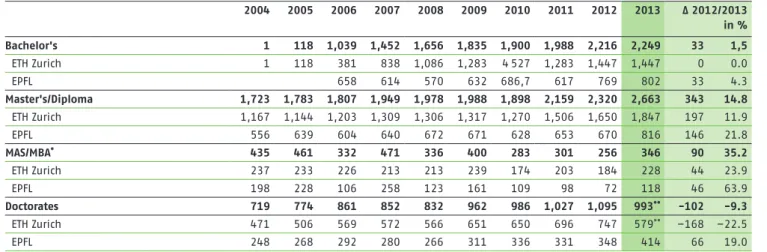
– In 2013, the institutions awarded 2,248 Bachelor’s, 2,663 Master’s and 993 Doctoral degrees. The detailed figures are shown in the following table:
The ETH Domain as a Driving Force for Innovation
Figure 1: Degrees awarded according to academic level
2004 2005 2006 2007 2008 2009 2010 2011 2012 2013 ∆ 2012/2013 in % Bachelor's 1 118 1,039 1,452 1,656 1,835 1,900 1,988 2,216 2,249 33 1,5 ETH Zurich 1 118 381 838 1,086 1,283 4 527 1,283 1,447 1,447 0 0.0 EPFL 658 614 570 632 686,7 617 769 802 33 4.3 Master's/Diploma 1,723 1,783 1,807 1,949 1,978 1,988 1,898 2,159 2,320 2,663 343 14.8 ETH Zurich 1,167 1,144 1,203 1,309 1,306 1,317 1,270 1,506 1,650 1,847 197 11.9 EPFL 556 639 604 640 672 671 628 653 670 816 146 21.8 MAS/MBA* 435 461 332 471 336 400 283 301 256 346 90 35.2 ETH Zurich 237 233 226 213 213 239 174 203 184 228 44 23.9 EPFL 198 228 106 258 123 161 109 98 72 118 46 63.9 Doctorates 719 774 861 852 832 962 986 1,027 1,095 993** -102 -9.3 ETH Zurich 471 506 569 572 566 651 650 696 747 579** –168 –22.5 EPFL 248 268 292 280 266 311 336 331 348 414 66 19.0
* Continuing education programmes MAS/MBA: Master of Advanced Studies/Master of Business Administration
** In the context of the revision of ETH Zurich doctoral regulations, the last doctoral graduation deadline of 2013 was postponed from December 2013
to January 2014. This explains the reduction in completed doctorates to 993 resp. 579; without this change, 1,168 resp. 754 doctoral students would have graduated in 2013.
Intermediate Evaluation 2015 Self-Assessment Report of the ETH Board 22
– ETH Domain graduates are able to find qualified employment within a few months.7 This coincides with the high demand in Swiss industry for specialists trained within the ETH Domain.
– Many of the top management positions in industry are occupied by alumni of ETH Zurich and EPFL or by people closely linked to one of the ETH Domain institutions.8 For instance, in many of the SMI companies (incl. ABB, Sika, Lonza, SwissRe, Nestlé, Clariant, Swisscom, Roche and Novartis), one or more top executives or directors are associated with the ETH Domain. – All ETH Domain institutions offer a wide range of practice-oriented programs in the field
of academic continuing education. Thus, they provide valuable opportunities for life-long learning for practitioners in charge of promoting innovation within industry and society or responsible for the commercialization of scientific findings.
Research
As shown by academic indicators (e.g. rankings, bibliometric analyses9) and by the regular evaluations of individual institutions and departments, the ETH Domain institutions perform (fundamental) research on a world-class level. This capacity is essential for the ETH Domain’s contribution to Switzerland’s innovativeness, as fundamental research has always been the most powerful source of groundbreaking innovation and is therefore crucial for fostering the country’s innovative capacity in the long term. This concerns at least three levels: – Innovation can result directly from scientific findings and from the methods explored in
research, which lead to applications inside and outside the scientific realm.
– Innovation results also from the process of designing, planning and implementing research endeavors. In particular, the realization of complex and/or large research infrastructures fosters innovation, as it requires that solutions be developed that can be successfully installed and operated.
– The transfer of staff and graduates, experienced in research, from the ETH Domain into the private and public sector acts an important driver for innovation, too.
Knowledge and Technology Transfer
In order to present a comprehensive picture of the ETH Domain institutions’ contribution to innovation in Switzerland, it is important to adopt a broad concept of KTT. Most institutions produce knowledge about public goods. Such knowledge cannot be commercialized directly, but represents important background information for public and private actors in Switzerland. It thereby indirectly supports economic welfare and directly benefits society as a whole. The avalanche forecasts by WSL are a typical example: In mountainous regions, it is essential that avalanche hazard information reaches as many people as possible (both public and private
7 See, for instance, the graduate survey of the Federal Statistical Office (FSO), http://www.bfs.admin.ch/bfs/portal/de/index/
themen/15/06/data/blank/05.html#parsys_13494 (last accessed: November 24, 2014) or the brochure “MINT-Fachkräfte auf dem Arbeitsmarkt”, Federal Statistical Office 2013 (http://www.bfs.admin.ch/bfs/portal/de/index/themen/15/22/publ. html?publicationID=5018; last accessed: November 24, 2014). See also the article “Ist die Volluniversität überholt?”, Neue Zürcher Zeitung, September 11, 2013 (http://www.nzz.ch/aktuell/startseite/ist-die-volluniversitaet-ueber-holt-1.18147876: last accessed: November 24, 2014).
8 See, for instance, Umbach-Daniel, Anja (2008): Ingenieure im Top-Management der Schweizer Wirtschaft – Präsenz in
Geschäftsleitungen und Verwaltungsräten. Karrieren und Karrierechancen, Rütter + Partner, im Auftrag von IngCH Engineers Shape our Future und dem ETH-Rat.
9 See chapter E for the bibliometric analysis executed as part of the present intermediate evaluation.
The ETH Domain as a Driving Force for Innovation
Intermediate Evaluation 2015 Self-Assessment Report of the ETH Board 23 actors). Therefore, selling this information on a market is not appropriate. While traditional KTT
concepts may not include such aspects, it is suggested that the present evaluation should work with an extended view of KTT, including knowledge transfer to public and private actors about public goods as well as knowledge and technology transfer to companies.
In general terms, the ETH Domain institutions’ involvement in the promotion of KTT in the higher education area can be summarized as follows:
– The institutions of the ETH Domain have been spearheading KTT at the Swiss universities and are acting as role models and as a reference for best practice, both on a national and an international level.
– Representatives of the ETH Domain institutions share their know-how and expertise in governmental bodies such as the “KTT-Support”10 section of the Commission for Technology and Innovation (CTI) where, for instance, they are co-coaching National Thematic Networks. – Representatives of the ETH Domain are also frequently founders, initiators or key academic
partners in private initiatives such as the Venture Businessplan Competition, or are to be found in various committees and juries.
– Representatives of the ETH Domain institutions were key drivers and founders of swiTT, the Swiss Technology Transfer Association. SwiTT is the national platform for best practice exchange (through courses, training events, conferences etc.) and maintains the only national academic licensing opportunity list (swiTTlist)11.
– Additionally, KTT representatives of the ETH Domain are frequently requested speakers, experts and consultants to universities and governments around the globe.
10 See http://www.kti.admin.ch/netzwerke/00194/index.html?lang=de (last accessed: November 24, 2014). 11 See http://www.switt.ch/www/adminall2/index.php?id=89825 (last accessed: November 24, 2014).
A.1
Contribution to Innovation
Performance
“To what extent do the ETH Domain
institutions contribute to innovation
performance in Switzerland and to
knowledge and technology transfer
to Swiss industry and society? Where
can improvements be made?”
Intermediate Evaluation 2015 Self-Assessment Report of the ETH-Board 27
Contribution to Innovation Performance
A.1 Contribution to Innovation Performance
“To what extent do the ETH Domain institutions contribute to innovation performance in Switzerland and to knowledge and technology transfer to Swiss industry and society? Where can improvements be made?”
Assessment by the ETH Board
Assets
In Switzerland, the ETH Domain offers a unique innovation ecosystem covering all
key stages, including education and science-based training of future specialists, high-level fundamental research, continuing education, implementation of technologies and discoveries in new applications, research collaborations with industry partners, and the creation of spin-offs.
As most groundbreaking innovations are rooted in discoveries generated through fundamental research and as they often involve interacting disciplines, the ETH Board is convinced that
– the core contribution of the ETH Domain institutions to innovation in Switzerland, but also worldwide, lies in their excellent performance in terms of research and teaching;
– this performance track record forms the basis for any transfer of knowledge, know-how and innovation into the economy (in particular industry) and society at large;
– the institutions of the ETH Domain effectively promote innovation by internalizing and fostering a comprehensive entrepreneurial spirit in education and research;
– the institutions of the ETH Domain have set up numerous instruments aimed at linking research and innovation in an effective way.
Challenges and Opportunities
Fundamental research is the core driver of innovation. Accordingly, innovation is generated through the advancement of knowledge and skills over longer time periods. Therefore, it is inherently difficultto measure the direct impact of many knowledge and technology transfer activities. This basic fact about the relationship between fundamental research and innovation produces challenges on five levels:
a) It makes it more difficult to assess and attribute the impact of contributions by individuals or particular institutions. Nevertheless, the ETH Board acknowledges the necessity to
further develop instruments for assessing the ETH Domain’s contributions to innovation
in Switzerland, going beyond the instruments usually referred to.12
b) The ETH Board must stress the overriding importance of the long-term orientation and the continuity of research and innovation practiced within the ETH Domain. Currently, however, application-oriented research often seems to be more highly rated by the public for its more immediate results. As application- and short-term-oriented research mostly favor incremental innovation, long-term orientation and continuity of fundamen-tal research must thus be defended as necessary prerequisites for higher education and research institutions to be able to contribute effectively to innovation – and specifically radical innovation – in the long run. This means that the institutions must be able to allocate funds to research areas or research projects with substantial failure risks and uncertain prospects of success: such “high-risk” research often yields the most ground-breaking innovative results.
12 As shown below (see e.g. fig. 2), contributions to innovation are usually measured through the number of start-ups and
spin-offs (and corresponding jobs) created, intellectual property rights (related to inventions [patents], software, etc.) and resulting licenses, as well as collaboration with industry or public actors.
Intermediate Evaluation 2015 Self-Assessment Report of the ETH-Board 28
A.1.1 Background
With regard to the classic KTT activities, all ETH Domain institutions have set up local tech transfer offices (TTO). Although they are organized differently according to the institutions’ specific requirements, they all provide professional legal services regarding the setup of project-based collaborations with industrial partners. Furthermore, they drive the process of exploiting the institutions’ intellectual property (technology assessment and protection, technology marketing, licensing and sale, support of spin-offs). They are well connected among each other and frequently meet to exchange information.
It is important to note that the ETH Domain institutions’ overall KTT philosophy is that KTT is not profit oriented, but aims at making as many technologies as possible available for the Swiss economy and for society at large. Although commercial and financial aspects are considered, maximization of the socio-economic benefit, contributions to the strength of the economy in Switzerland and worldwide, and continuous improvement in the quality of life are far more important objectives. Therefore, the institutions have launched various initiatives to set up a seamless innovation value chain which allows for an efficient and effective KTT, both from the individual institutions and in collaboration with each other. Activities can be sub-divided in the fields of collaboration with industry (A.1.2), knowledge transfer to the public sector and in-house innovation (A.1.3), fostering of entrepreneurship and the foundation of spin-offs (A.1.4), and the exploitation of research results (A.1.5). In what follows, each of these fields is addressed separately. To give an overview of the activities and initiatives realized at the individual institu-tions, the most important examples have been assembled for each of these fields.
A.1.2 Collaboration with Industry
Collaboration with business, and in particular with industry, represents an important aspect of KTT at all institutions of the ETH Domain. On the level of the individual institutions, the activities and achievements described below are considered to be most relevant. Table 1a and 1b in Appendix 2 below present a success story from each institution, illustrating the particular aspects of collaboration with industry mentioned in this chapter.
c) Collaboration between the ETH Domain institutions and private companies can contribute to promoting Switzerland’s innovative capacity. However, such collaboration is increasingly subject to critical scrutiny. The ETH Board must therefore proactively communicate the rules and regulations governing such collaboration and the transparency that is achieved
in the ETH Domain. It must aim to make the public take a more positive view of collabo-ration with private companies.
d) The ETH Domain institutions must be able to retain their lead in the future development of best practices in the field of KTT.
e) Currently, the institutions of the ETH Domain experience a funding gap between the Swiss National Science Foundation (SNSF) and the CTI. Thus, some projects in the pre-competitive phase lack adequate funding from the funding agencies, although new funding instruments (such as precoR, which was launched on the initiative of Empa, among others) have been established.
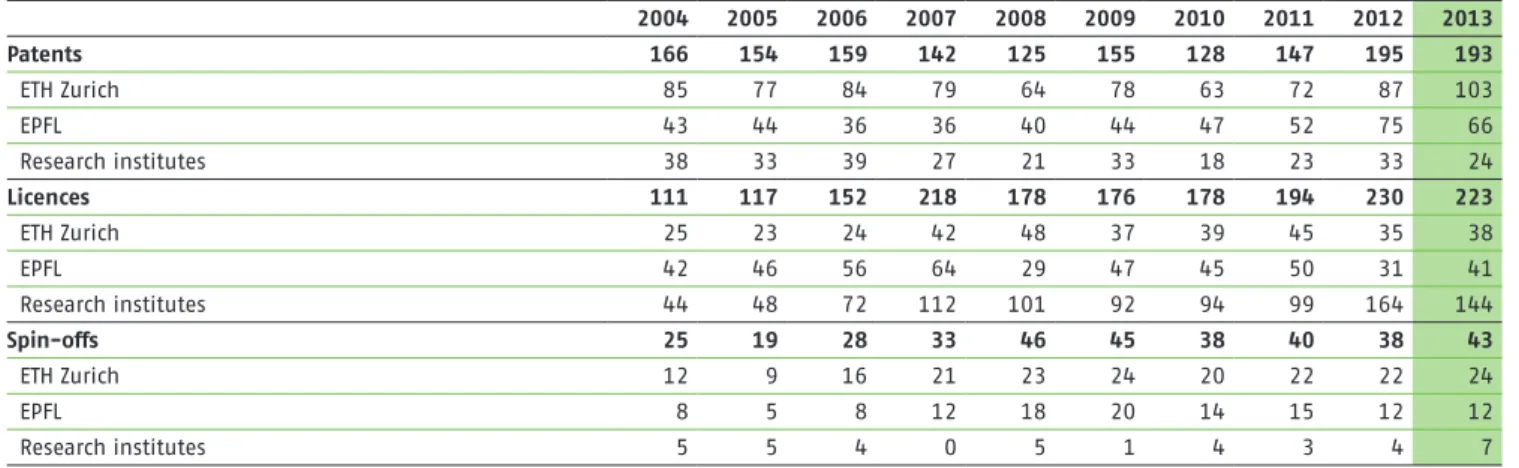
As a general overview, the following figure shows that
– between 125 and 200 patents are filed every year thanks to the research performed within the ETH Domain institutions. The corresponding know-how is thus transferred into economy; – the Research Institutes play an important role with regard to the licenses granted every year
(in many cases spin-offs). These licenses contribute in large part to the commercialization of newly generated knowledge.
2004 2005 2006 2007 2008 2009 2010 2011 2012 2013 Patents 166 154 159 142 125 155 128 147 195 193 ETH Zurich 85 77 84 79 64 78 63 72 87 103 EPFL 43 44 36 36 40 44 47 52 75 66 Research institutes 38 33 39 27 21 33 18 23 33 24 Licences 111 117 152 218 178 176 178 194 230 223 ETH Zurich 25 23 24 42 48 37 39 45 35 38 EPFL 42 46 56 64 29 47 45 50 31 41 Research institutes 44 48 72 112 101 92 94 99 164 144 Spin-offs 25 19 28 33 46 45 38 40 38 43 ETH Zurich 12 9 16 21 23 24 20 22 22 24 EPFL 8 5 8 12 18 20 14 15 12 12 Research institutes 5 5 4 0 5 1 4 3 4 7 Source: Annual Report 2013, p. 125.
– In addition, representatives of the ETH Domain frequently participate in bodies such as advisory boards, boards of directors, etc. both in the private and in the public sector, which represents an important aspect of networking and know-how transfer.
On the level of their additional priorities and activities deployed in the field of KTT, the institu-tions highlight the following aspects and non-exhaustive examples:
ETH Zurich
ETH Zurich has established a seamless line of activities and platforms to interact with industry on a frequent basis, to exchange views and ideas, to learn about latest trends and to eventually find common interests to enter into seed projects, extensive research collaborations or strategic partnerships. Central entities were put in place to help to make the wealth of know-how and technologies produced within ETH Zurich available to its industrial partners in an efficient and effective way. In particular, this role is assumed by ETH transfer, the TTO of ETH Zurich, the Industry Relations Group as the main entrance for industry, and the ETH Zurich Foundation. They encourage exchange with individual companies and industry associations, and perform or provide support in the activities mentioned below.
– Every year, ETH Zurich invites the Swiss Industry to the ETH Industry Day to present and discuss research fields and newest technologies from the institution’s 16 departments. More than 300 persons attend this half-day event on campus, structured around short presentations across ETH Zurich’s research activities, discussion panels, and informal meetings.
– The university maintains strategic partnerships with industry in a large range of areas, including world food supply, risk management, sustainable construction, integrative risk research, information security, electrical energy or manufacturing across scales. Such partnerships quicken the process of establishing strategic research areas through endowed
Intermediate Evaluation 2015 Self-Assessment Report of the ETH-Board 29
Contribution to Innovation Performance
Figure 2: Knowledge and technology transfer activities of the ETH Domain institutions as reflected in patents (priority applications only) and licenses (including technology transfer agreements as well as newly founded companies (spin-offs)
Intermediate Evaluation 2015 Self-Assessment Report of the ETH Board 30
Contribution to Innovation Performance
professorships and interdisciplinary research projects and allow for open discussion in common Partnership Councils on new visions and approaches.
– ETH Zurich also contributes to and maintains strong ties with the “younger” players of the industry, i.e. its spin-offs. The institution has set up a community network with its more than 350 spin-offs (of which more than 110 founded in the last 5 years), to meet and exchange experiences, to help the younger generation on their journey and keep a close contact with ETH Zurich.
– In the last two years (2012-2013), ETH Zurich has entered more than 1,400 new formal research agreements with third parties – whereof more than 500 with Swiss companies – with a total volume of more than 300 MCHF.
– In the same time, the tech transfer office has handled more than 4,400 new contracts between ETH Zurich and third parties.
– Interactions between ETH researchers and industry have increased by 40 % over the past five years, or nearly quadrupled over the past ten years.
– As ETH Zurich has an international outreach, the institution maintains collaborations with companies across the planet, making sure that it has access to latest developments and needs in industry from around the globe.
While intensifying the interaction with industry, ETH Zurich has set up clear and transparent regulations and processes to ensure independence and compliance. The institution and its faculty make sure that projects are scientifically or technically relevant, the results can be freely used afterwards for further research and educational purposes, publication rights are granted to ETH Zurich, a reasonable agreement with regard to ownership of IP and rights for commercial use can be found (including dequate financial compensation) and the freedom with regard to future collaborations with other third parties is guaranteed.
Another prominent example of a collaborative partnership between ETH Zurich and industry is the Binnig and Rohrer Nanotechnology Center (BRNC) in Rüschlikon. Through this joint in-vestment with IBM, among the biggest public-private partnerships of their kind in Switzerland, a clean-room laboratory was built, enabling premier research at an international level.
As an example of successful collaboration with industry, ETH Zurich presents the “Lablet” concept in Table 1a, Appendix 2, p. 165.
EPFL
Over the past five years (2009-2013), EPFL has collaborated primarily with Swiss companies, many of which are small and medium enterprises (SME). For instance,
– 70 % of the contracts dealt with by the TTO of EPFL had a Swiss company as a principal partner (100 % = 817 contracts);
– 74 % of the monetary value represented by these contracts is raised in contracts with a Swiss company as a principal partner (100 % = 162 MCHF);
– 41 % of these contracts with Swiss companies are concluded with SMEs and start-ups with fewer than 250 employees.
To foster collaboration with partners from industry, EPFL offers a variety of collaboration agreements, which range from research-specific contracts to general frameworks, up to the association of Research and Development (R&D) teams on the EPFL campus. In order to facilitate the conclusion of cooperation agreements with industrial partners, standard agreements are 13 See http://tto.epfl.ch/collaboration_with_the_economy (last accessed: November 24, 2014).
Intermediate Evaluation 2015 Self-Assessment Report of the ETH Board 31
Contribution to Innovation Performance
14 Examples of industry collaborations can be found under www.psi.ch/industry/companies (last accessed: November 24, 2014). 15 See chapter A.3 below.
16 According to the ERID-Watch project, project number 043004, final prospective report, 2009 (see http://cordis.europa.eu/
documents/documentlibrary/125670151EN6.pdf; last accessed: November 24, 2014).
published online (with summaries for non-legal persons).13 Representatives of EPFL, in particular its Vice-president for Innovation and Technology Transfer (VIPV), proactively meet with over sixty national and international companies per year in order to identify their needs and the potential for collaboration.
With regard to the licenses granted by EPFL to commercial companies between 2009 and 2013, the involvement of Swiss companies was as follows:
– 73 % of the licenses were attributed to Swiss companies (100 % = 176);
– 80 % of the licenses attributed to Swiss companies were attributed to SMEs or start-ups with fewer than 250 employees.
As an example of successful collaboration with industry, EPFL presents its “Innovation Park” in Table 1a, Appendix 2, p. 165.
PSI
Thanks to its highly sought-after role as a user lab facilitator, the PSI engages in a particularly intensive collaboration with industry.14 In order to support and promote such collaboration, the PSI TTO acts as link between a potentially interested company with a particular technical or scientific problem and the corresponding experts at the PSI. In the context of the creation and implementation of the PARK innovAARE concept15, the TTO’s strategic focus was shifted towards an internal business development unit supporting the settlement of industrial partners in the immediate vicinity of the PSI. Compared to former collaborations, this ongoing process generates a new level of linkage between the PSI and industry, particularly if both partners share common interests in selected innovation focal points and if the activities are highly complementary.
The following points summarize important aspects of cooperation between industrial partners and the PSI:
– PSI has a proven record in attracting a large amount of direct industry use of its large-scale research facilities (>10 % vs. an international average of 5-7 % in the case of synchrotrons).16 – Cooperation takes the form of licensing and technology transfer, R&D services, research
contracts, or joint research cooperation projects.
– A large number of highly trained scientific and technical staff leave the PSI for Swiss industry every year.
– The PSI strives to make new findings from in-house development of technologies or measurement methods at the large-scale research facilities accessible to industry, thereby strengthening the competitiveness of Swiss industrial companies. About 40 patents are filed every year at the PSI with typically 10-15 initial applications.
The PSI’s collaboration with industry also enables the kind of innovation that derives from the very fact that research infrastructures need to be designed, developed and realized: – During the development phase of new research infrastructures, technological innovations
with considerable market potential are created.
– A typical example of this kind of cooperation and technology transfer is the development and production of key components for the PSI’s next large-scale research facility, SwissFEL, by partnerships with companies in Switzerland such as TEL Mechatronics (Trübbach), MDC Max Daetwyler AG (Bleienbach), and Ampegon (Turgi).
Intermediate Evaluation 2015 Self-Assessment Report of the ETH Board 32
– Based on in-house PSI developments, the industrial partner takes over responsibility for manufacturing, assembly and qualification of the respective accelerator structures. – This cooperation enables the company to expand its skills in the field of ultra-precision
machining and metrology, to access and establish itself in highly complex markets and to present its competencies to other research institutions as potential future partners. As an example of successful collaboration with industry, the PSI presents the start-up story of “Ampegon” in Table 1b, Appendix 2, p. 166.
Empa
Collaboration with industry has always been a high priority for Empa. This is demonstrated by the following aspects:
– On average, more than 100 new joint research projects are launched every year. – Besides the intensive exchange with industrial partners within research projects, the
development of joint platforms is a key focus for Empa: With NEST, for instance, Empa is developing a research and technology platform for future building technologies supported by the entire ETH Domain. The project involves leading partners from industry and several national and international universities. Construction of this multi-million project is set to start in late 2014.
– Switzerland is one of the world’s leading players in coating technology, with 80 % of hard coatings being produced by Swiss companies. Empa is therefore teaming up with partners from industry and academia to set up the Coating Competence Center (CCC) on its campus in Dübendorf.
– With about 100 events and seminars annually, the Empa Academy at Dübendorf provides an appealing platform for knowledge dissemination and networking; nearly two thirds of the 5,000-plus attendees come from industry.
As an example of successful collaboration with industry, Empa presents the invention of “Clothing that doesn’t absorb odor” in Table 1b, Appendix 2, p. 166.
WSL and Eawag: Focus on public goods
Industry collaboration is at a lower level at WSL and Eawag, as these two institutions mainly deal with public goods. By its very nature, this provides fewer opportunities for collaborating closely with the private sector.
Many collaboration activities of the ETH Domain institutions, in particular WSL and Eawag, involve partners situated between industry and the public sector. In the case of Eawag, for example, collaboration with operators of wastewater treatment plants, including the related associations and planners involved, represents such a type of interaction at the interface between industry and public authorities. It entails innovation with direct practical relevance, although such innovation has limited potential for commercialization.
As the example of Eawag shows, foundations which, in a particular field, fund the development of new inventions from research to practical application are another important type of private-sector collaboration partners.
As successful examples of collaboration with industry on public goods and involving a foundation, WSL and Eawag, respectively, present the “NESSy” project and the “toilet for developing countries” case in Table 1b, Appendix 2, p. 166.