CHAPTER 10: DESIGN AND THE DISTRIBUTED WORKPLACE
SANE IST-2000-25257 241
10 Design and the distributed
workplace
INTRODUCTION
If the design of work environments is aimed at supporting knowledge workers performance in order to contribute to the achievement of business goals such as effectiveness or efficiency, it is necessary to balance the impact of different elements in an integrated approach including spatial, technological and organisational issues. The requirements of the knowledge economy are examined in more detail below, but before addressing these the following section places the discussion in the context of broader concerns for issues of sustainability in the provision of workplace accommodation.
The delivery of effective sustainable accommodation for the new economy is rooted within a broader context consisting of four parallel trends:
• Intensification of the use of space and time; • Reduction of waste;
• Ensuring energy efficiency; and,
• Demands for business organisations to act more responsibly towards their employees, society and the environment.
The changing perception of the function of the office building, as well as new working methods, are driving increasing intensification of space and time. As the working day is extended over a longer time frame, and
office workers become more mobile, space is being driven harder to allow greater numbers of people to be serviced by the same amount of space, and to be more productive within it (these trends are discussed in more detail below). To achieve this has resulted in a reduction in the percentage of traditional specialised office space; instead the functional character of buildings for work is broadened, increasing both the accessibility and flexibility of buildings for work. One aspect of this trend is the mix of public and private space provision described in the SANE Space Environment Model, and facilitation in buildings of the shifting boundaries between the two.
Urban environments have enormous ‘ecological footprints’, defined by their overall consumption of material and production of waste1. One of
the key aspects of waste is the inefficient utilisation of resources within the city, and within buildings. As well as the intensification of the use of space internally as described above, intensifying the use of spaces within the city will assist in the reduction of the colossal waste associated with working and living in cities. This will be accomplished through introducing overlapping functions, increasing access to a variety of spaces, enabling the use of public space for private activities and increasing the potential for re -use of previously redundant space. Energy use is the factor that tends to receive most attention in any discussion around sustainability, and is the focus of most research into building sustainability. Energy use needs to be seen in broader terms than those that focus simply on the building envelope, although the efficiency of the envelope in terms of embodied energy, or energy
1 Waste covers a range of issues ranging from the production of material waste requiring disposal, through to the inefficient use of resources – such as land or energy.
CHAPTER 10: DESIGN AND THE DISTRIBUTED WORKPLACE
242 SANE IST-2000-25257
consumed over the life of the building, is of course important. A more holistic view of energy efficiency considers the consumption of energy per building user, rather than in terms of units of space. This view takes into account the factor of energy consumed through travel to and from buildings, as well as the effectiveness of a building in terms of the number of people supported per unit of space. It also examines the potential for the adaptability of a building, which reduces the need for expenditure of energy in demolition and new construction by ensuring that a building may be recycled over decades or centuries through a number of uses.
The last trend discussed here is less tangible than those discussed above, and incorporates aspects of all of these. Employer organisations, particularly in Europe, are being encouraged to become increasingly responsible towards their employees, society as a whole and the physical environment. There is an apparent conflict here between the responsibility of publicly traded organisations to produce profits for shareholders, and wide r interests. However, the trend is being driven by three factors:
• Increasing empowerment of employees through increased mobility, independence, and redefinition of value from skills to knowledge; • Increasing ethical awareness amongst customers who are realising
the value of their purchasing power, and a corresponding demand that organisations be held to a greater level of accountability, resulting in a shift from single index company reporting to ‘triple bottom line’ based indicators, already voluntarily applied by many organisations but likely to be required statutorily and,
• The interventionist state is in retreat and rather than abandon the social objectives and goods that it previously guaranteed, it is increasingly relying on corporations to fill the vacuum –a form of back door privatisation.
In addition to these broad drivers towards a more sustainable provision of workplace accommodation, the knowledge economy has particular business requirements that have implications for the supply of space to accommodate knowledge workers.
THE REQUIREMENTS OF THE KNOWLEDGE ECONOMY
Chapter 1 demonstrated how the knowledge economy has seen a shift in emphasis from tangible to intangible assets, where a defined brand and customer ownership have become increasingly valuable and physical assets can be seen to be a liability2. In this new business
environment the key to organisational success lies in the people that make it happen. Communication is vital, facilitated by the formation of communities and networks. The global outlook of many businesses and the increasing requirement on the part of employees for flexibility of time is extending the business day beyond the traditional 9 to 5, to a
24 hour / 7 day business week.
Globalisation and the tendency to concentrate on core business while outsourcing non-core functions, as well as the added value and synergy created by the exchange of information both formally and informally, is leading to increasing physical clustering of communities of interest.
2 A key proposition of SANE is that by redefining the manner in which space is occupied and leased, it will retain its value as a core asset rather than become a balance sheet liability.
CHAPTER 10: DESIGN AND THE DISTRIBUTED WORKPLACE
SANE IST-2000-25257 243
These consist of similar organisations of various levels of maturity and the secondary functions that service them. This has increasing
implications for the supply of space, with the principle requirement being for organisational flexibility through reconfigurable buildings or flexibility of tenure. With the development of information technologies and virtual space, the logical extension is the rise of the virtual organisation, with little or no demand for physical space to house the organisation’s functions.
This knowledge economy world is peopled by knowledge workers, defined as both highly interactive and highly autonomous, where autonomy is independence of process, time and place. However, in terms of occupation of space, there is a potential conflict between these requirements for autonomy and interaction – if interaction is required to be physical, especially informal, and autonomy should allow knowledge workers independence of time and location for work. Knowledge work involves analysis and exploitation of information, where value is added through teamwork and collaboration. The need for interaction between team workers will vary on an hourly, daily or less frequent basis, yet the greater the need for interaction, especially unstructured informal
interaction, the lower will be the autonomy of time and place. However, if this interaction can take place in the virtual world (e.g. through web -based projects or via email), the knowledge worker will have autonomy over choice of place. In addition, if interaction is not required to be synchronous (i.e. if interaction can take place at different times, such as via email), knowledge workers have autonomy over choice of time. The Space Environment Model developed in SANE reflects the need to accommodate the knowledge worker’s requirements for both interaction
and autonomy. The model is a response to the business trends of the knowledge economy, it describes these and enables the derivation of implications for the supply of space. The Space Environment Model takes workplace accommodation beyond the traditional container. Accommodation may be dispersed around a range of sites (around the city and/or around the globe). Space used by an organisation will vary in terms of ownership, across the categories of ‘owned’ (literally or on long lease), ‘flexi’ (short term lease) and ‘on demand’ (space taken up on a daily or hourly basis as and when needed). Space will also vary according to the extent to which it is private (restricted access), privileged (access by invitation) or public space (unrestricted access). Accommodation exists also in both physical and virtual space, creating hybrid space where interaction takes place in both physical and virtual worlds, both synchronously and asynchronously. The emphasis on interaction and intensification results in increasing use of shared space, specialised workspace with value-added facilities and support services, purchased on demand. Increasing employee mobility and autonomy results in the development of ‘spongy space’ – space ostensibly supporting one type of function (coffee drinking, children’s play, etc.) while actually acting as support space for work (meetings, phone-calls, document reading, mobile computer work etc). In the world of
knowledge work where the demand for increasing autonomy means that work can take place at any time and in any place, in both physical and virtual space, the critical criteria are those that measure the quality of place.
CHAPTER 10: DESIGN AND THE DISTRIBUTED WORKPLACE
244 SANE IST-2000-25257
SPATIAL IMPLICATIONS OF THE KNOWLEDGE ECONOMY Following the discussion above, this section prese nts four generic business requirements of space in the knowledge economy, derived from extensive user research conducted in part for this study. These are that space should provide:
• Interaction – space should allow visual, physical and virtual interaction;
• Agility – space should be sufficiently flexible / adaptable to accommodate a range of tasks and activity settings, and be responsive to change;
• Diversity – space must provide for a range of activities, functions and business sizes and types; and,
• Capacity – space must be able to effectively service user’s physical and virtual requirements, e.g. in terms of information technology and amenities, creating robustness through providing redundancy and overlap.
Each of these factors has particular implications for the provision of space across a range of levels – at the worksetting, the building container and the urban context. These are elaborated below.
Interaction
The knowledge economy is driven by the value created through working creatively with information in an interactive way. Interaction takes place virtually and physically (face to face), synchronously and
asynchronously, formally and informally. This implies that worksettings are open and informal, and arranged to allow freedom of movement and
visual contact. Settings should also be varied and different types intermingled, to facilitate ad hoc meetings and informal conversations. Provision of social spaces within the work space is also important. Building arrangement should allow ease of movement around and between floors, potentially through an atrium, allowing visual
connections between different parts of the building at different levels. The provision of local amenity, especially public spaces, and social spaces such as restaurants and bars, both inside and outside the building, will facilitate ad hoc or spontaneous interaction, especially where different organisations within the same business sector are co-located within a building or local area.
Agility
The intensification of use of space through a concentration of functions and people will maximise the potential of high value locations, increasing activity and interaction. It will facilitate economic clustering, enable effective access to goods and services and optimise provision of infrastructure. An individual, organisation or city will thrive on a
concentration of activity – mixing use and optimising spatial density. But to achieve this requires that space is flexible – capable of swift
adaptation to accommodate changing and overlapping functions. This requires that space can easily be reconfigured for different activities or functions, or even for different organisations, on a monthly, weekly or even hourly basis.
Adaptability of space should function on the level of the individual user, allowing 24 hour access to workspace and local control over
CHAPTER 10: DESIGN AND THE DISTRIBUTED WORKPLACE
SANE IST-2000-25257 245
environmental control (over lighting, temperature, ventilation and furnishings) will also facilitate personal comfort, increasing the individual’s satisfaction and autonomy.
Diversity
The factors of worker autonomy, business outsourcing and economic clustering require that space is able to provide for a diversity of needs, at a range of scales and levels. The need for economic diversity is a response to the business trend to downsize and concentrate on core functions. Support functions are outsourced to businesses that may need to be co-located, either in the same building or nearby. Buildings and/or building contexts therefore need to provide for a range of organisational types and to cater for organisations at different levels of maturity (size and structural complexity). This requires differentiation of space within buildings in terms of space type (variable floorplate depths and sectional heights), as well as from one building to the next, and requires that building floorplates are highly sub -divisible.
An effective work environment will in addition provide a range of public to private space, and a mix of use types, to allow for a range of work settings and support functions within the broader building context. Providing diversity increases the potential agility of the workplace, building, development or city – achieving flexibility in the face of change.
Capacity
With the extension of the workplace, work taking place anywhere, anytime, the meaning of capacity has broadened, and must be measured in terms of both building and context. The need for the workplace to support strategic business goals of efficiency and
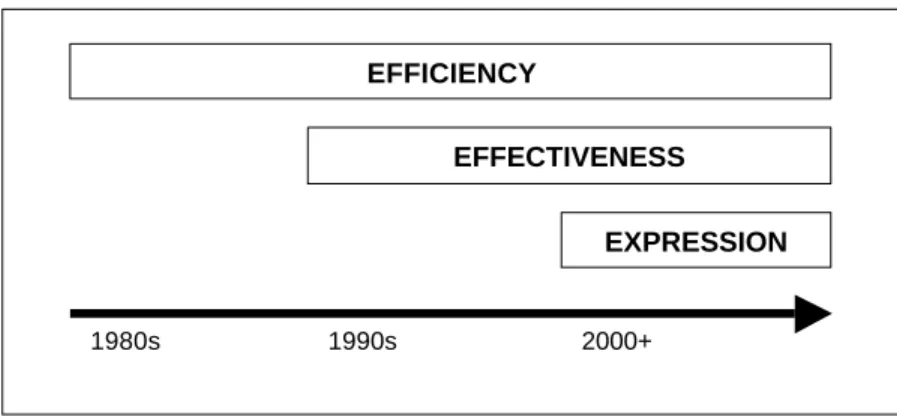
effectiveness was discussed above. Traditional measures of the capacity of a particular space to support work activities have expressed capacity in terms of the efficiency of the space (a measure of how many people can use the space). In the 1990s the effectiveness of space (how well does a particular space improve productivity, through supporting the wellbeing of the people that work there) became an important aspect of capacity.
Latterly the measure of expression (what does the space and place communicate about the organisation to employees and to potential clients) has been recognised as a further factor affecting the capacity of a particular space to support the business requirements of an
organisation. These trends are summarised in figure 10.1 below.
EFFICIENCY
EFFECTIVENESS EXPRESSION
1980s 1990s 2000+
FIGURE 10.1 THE SHIFTING FOCUS OF SPACE CAPACITY MEASURES
The changing measures of workplace capacity, the extension of the business day and the increasing mobility of knowledge workers highlight
CHAPTER 10: DESIGN AND THE DISTRIBUTED WORKPLACE
246 SANE IST-2000-25257
the importance of place. The location of a workplace, in terms of its accessibility, security, and provision of local amenity, is critical. The building context therefore requires sufficient density to support a wide range of amenities as well as multi-modal transport access, with a permeable fine built-form grain3.
One other factor that will affect the potential capacity of physical space is the extent to which an organisation has invested in virtual space (and has the appropriate organisational culture and structure to use it). The greater the extent to which an organisation is able to transfer functions and activities from physical to virtual space, the lower will be their requirement for physical space, particularly in terms of the efficiency of physical space.
RESPONSE OF THE SUPPLY SIDE
The changing demands of the knowledge economy have already influenced the way accommodation is procured and delivered. No longer simply seen as space, the accommodation offer now includes the tenure type, a level of amenity and additional value added services, so that the workplace is provided as a serviced package (management, business and support services).
The key driver for this change is the increasing need amongst
organisations for flexibility – in terms of finance, function and the space itself. This requirement exists across a range of scales, from a freelance individual who requires space on demand for variable amounts of time, to large corporate organisations divesting themselves of property assets
3 Grain refers to the layout of streets and to the subdivision of functional building units
and leasing back their previously owned buildings as managed and fitted out space from serviced business space suppliers. This trend is resulting in a reduction of the amount of directly owned (long lease) space, with diversification of real estate portfolio into owned, flexi and on-demand space.
Additionally the conventional issues of s ustainability, reduction of embodied energy and consumption are impacting on the type of buildings that are being delivered. These issues are reviewed in detail elsewhere, but those that are of importance here are the potential for a building to be naturally lit and ventilated – both of which are a function of building depth and sectional height, as well as façade detailing.
Although the supply side is beginning to respond to the needs of the knowledge economy, there are currently no specific measures for testing the appropriateness of particular building types. Because of the
increasing complexity of workplace provision, these measures need to be both quantitative and qualitative. Qualitative measures will test such issues as:
• The quality of place – in terms of building location, accessibility, amenity and context;
• Quality of space – in terms of fit out (space plan, furniture etc), sectional height and floor width ratio, ventilation and lighting, and potential for expression of organisational values; and,
• The capacity and extent of the provision of services, and flexibility of tenure.
These aspects are examined further in relation to the distributed workplace model below.
CHAPTER 10: DESIGN AND THE DISTRIBUTED WORKPLACE SANE IST-2000-25257 247 Locations Key: + Appropriate location 0 Possible location − Inappropriate location
City Centre Major Transport Node (central – Railhead) Major Transport Node (out of town
–
airport)
Business nodes (business park) Secondary town centre Accessible suburban location
Personal Centre Anywhere
Neighbourhood centre + + + + + +
Corporate Centre + + + + − −
Workplace types Operations Centre − − 0 + + +
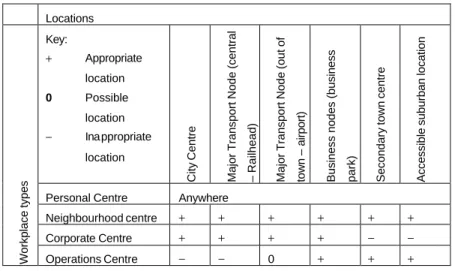
FIGURE 10.2. LOCATIONAL CHARACTERISTICS OF EACH WORKPLACE TYPE
10.2 QUANTITATIVE BUILDING MEASURES
The SANE distributed workplace model identifies four generic workplace types in the physical sphere, differentiating these according to the level of public and private access and their relative location. The four generic workplace types are the personal centre, the neighbourhood centre, corporate centre, and the operations centre. Each of these types has different functional, tenure and locational characteristics.
The personal centre is private and localised. It refers to the provision of effective mobile support for the knowledge worker, enabling work to take place anywhere, including the home. There is no tenure implication for the employer organisation, nor is there a spatial implication. The personal centre can be set up anywhere the knowledge worker can set up a laptop (or whichever device is to used) and work in a concentrated manner while remaining in touch with colleagues through via telephonic and digital media.
The neighbourhood centre is more public, although still localised. Its location is chosen to suit knowledge workers who wish to access specialised facilities, and/or interact synchronously in physical space with colleagues or communities of interest. These locations may be found all over the city, but the facilities will vary size and/or composition according to the particular location. Appropriate locations are
summarised in figure 10.2. Accommodation in the neighbourhood centre will largely be available ‘on demand’, on an hourly, daily or monthly basis. This is the primary defining characteristic of the neighbourhood centre, especially where this typology is found in the city centre. In these prime locations the neighbourhood centre is likely to be more
CHAPTER 10: DESIGN AND THE DISTRIBUTED WORKPLACE
248 SANE IST-2000-25257
specialised than in suburban locations. In the latter the ‘neighbourhood’ has a physical definition, whereas in the former the centre is likely to appeal to a particular community of interest, for example defined according to business sector.
The corporate centre is both public and centralised. Access to clients, colleagues and external professionals / consultants is the defining functional characteristic of the corporate centre. Knowledge workers will use the corporate centre for most of their team based work, as well as to facilitate informal interaction. Space in the corporate centre is likely to be leased on a flexible basis, with core space taken on short leases, and support spaces shared with other organisations and leased on demand. The requirement for high levels of access to the corporate centre means that it will have limited central locations, such as the city centre and at primary central transport nodes.
The operations centre houses an organisation’s administrative and support staff. The mobility of knowledge workers and the use of virtual space to carry out support functions, enables the operations centre to be physically decoupled from the corporate centre. As support work requires less mobility or autonomy of time and place than does
knowledge work, the location characteristics of the operations centre are accessibility for staff and economy of space cost. The operations centre is the one aspect of the distributed workplace that is likely to remain as an organisation’s ‘owned space’, either in direct ownership or on a long term lease, unless this aspect of the organisation can be entirely outsourced (assuming this is desirable).
Each of the three group work environments will have a different composition of workspace elements, each requiring particular space types within a building. By measuring the proportion of various space types it is possible to determine an appropriate range of floorplate depths and associated sectional heights. Although detailed analysis of this aspect remains to be carried out, this section puts forward two hypotheses:
1. The distributed workplace model, with its implication of the dispersal of the workplace according to functional requirements, locational characteristics and related issues of accessibility and scale, will allow a much greater range of buildings to be brought into service as work environments, in a greater range of locations.
2. The distribution of worksetting types is changing, because of: redefinition of support space (usually characterised as meeting spaces, project areas, catering, copier and printing space, etc) as core space (meeting rooms become team workspaces);
distribution of business functions (admin and support functions are located away from client orientated business functions);
sharing of support space between different organisations occupying the same building (such as a corporate centre);
increasing empowerment of administrative and support staff, and recognition of their greater requirements for aspect, natural ventilation and natural light; and,
CHAPTER 10: DESIGN AND THE DISTRIBUTED WORKPLACE
SANE IST-2000-25257 249
This will increase the amount of space provision in primary building areas (A and B type space), and reduce C type space4. This will have implications for appropriate and/or acceptable building depths.
These hypotheses and the previous discussion imply that in future there will be far more diversity in workspace provision. Although we are likely to see continuing use of conventional office buildings, and a
harmonisation across Europe towards more uniform floorplate and section size and configuration in this type, it is likely that new workspace typologies will emerge. These may include small units of space acting as club type spaces or organisation ‘shopfronts’, or hybrid buildings that combine, for example, workplace and hotel. In addition the greater diversity of requirements, the influence of ICT and virtual space provision, and the trend towards ‘expression’ being a defining facto r of building capacity, will see the re-use of a wide variety of existing buildings. Four potential building solutions are examined in the case studies below.
10.3 BUILDING INNOVATION
The final section of this chapter examines four current innovative building solutions. Two are building concepts, while the other two have been formally planned and will be constructed in the near future. They represent concepts for quite different locations. Dawleywood is planned for construction at a business park on London’s outskirts, while the Heron Tower will be built in the heart of the City of London. The two
4 A and B type space is space that is close enough to a window wall to be defined as naturally lit and ventilated, while C type space requires artificial lighting and ventilation. A = 0 – 6m; B = 6 – 12m; C = 12m+
conceptual schemes at Battersea in London and on the South Bank in Dublin’s docklands, are both on centre -periphery sites.
STOCKLEY PARK – PHASE 3: DAWLEYWOOD
Dawleywood is the third phase of a development first begun in the late 1980s at Stockley Park, near Heathrow Airport in London. As a location it has matured to become a business node in its own right, as well as being adjacent to a major out of town transport node. The location is characterised by extremely good global transport links, via the airport, and good local private transport links via the M25 motorway nearby. Its local public transport links are not as good, although it now has a bus link to Heathrow and nearby metro rail lines.
Since inception in the 1980s the development has aimed to attract companies with high international travel and/or trade requirements, particularly those in the IT sector. Recognising that quality of place is an important factor in attracting potential employees to these companies, and therefore important to the companies in terms of their locational choices, the development prides itself on landscaping and amenity levels. Buildings are integrated into the surrounding landscape, including a large golf course. Other amenities include shops, a health and fitness club, wine bars, and a day care centre.
The first phase of the development, completed in the late 1980s, was aimed at tech driven knowledge-based industries. In the 1990s the second phase buildings were completed with increased floor to ceiling heights for to allow greater daylight penetration and aspect, as well as some natural ventilation. Dawleywood, designed by architects Kohn
CHAPTER 10: DESIGN AND THE DISTRIBUTED WORKPLACE
250 SANE IST-2000-25257
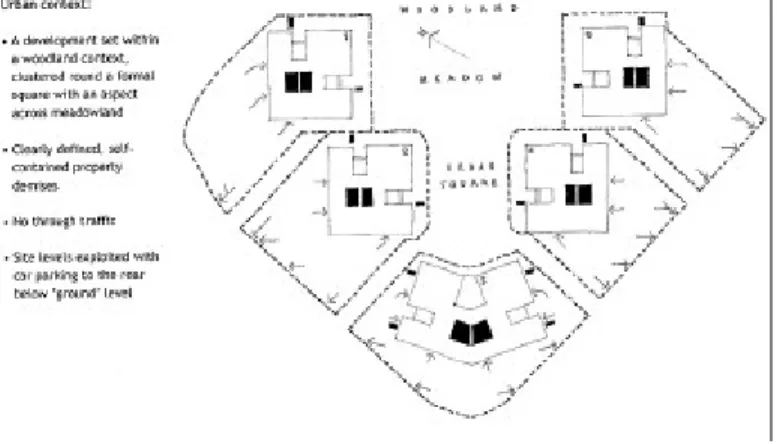
Pedersen Fox (KPF), is the final phase, and aims to provide highly flexible and sub-divisible space. Unlike previous phases, where buildings are arranged on ‘streets’ (really just access roads), with rear aspect over green landscaping, the development concept of Dawley wood is an urban village of five buildings around a square, with aspect out across a meadow. Vehicular access is to the rear of the buildings, with the major entries from the square.
FIGURE 10.3 DAWLEYWOOD DEVELOPMENT CONCEPT (© KPF, 2002)
Although it is presented as urban in context, it is likely that Dawleywood, or even Stockley Park as a whole, will require even higher density, combined with multi-modal transport links and increased economic diversity before it will be able to offer the level or choice of amenity, particularly retail or leisure facilities, that will enable employees to take advantage of autonomy of time and the corresponding extended working day.
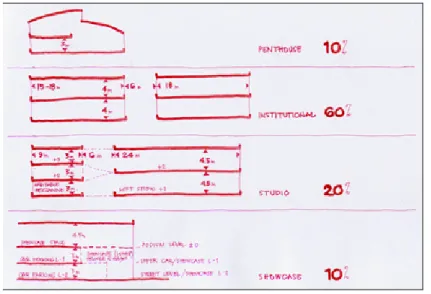
The building configurations offer a high level of flexibility. They are on a contiguous 1.5m planning grid, and sit within an integrated site grid allowing linkages to be made between buildings. The buildings provide a range of sizes, from 6600m2 to 12500m2 totals, over 3 to 4 storeys. Floorplates are medium sized with either 2250m2 or 3200m2 per floor, and are arranged across three depths – a 27m square pavilion, with two wings of 18m and 13.5m depth respectively, connected to the pavilion by two atria (see figure 10.3). One of the atria acts as the main entrance, the second may act as a secondary entrance or by filling in at first floor level may provide a single deep floor plate across the pavilion and 13.5m wing. The core is off-centre (asymmetric), and located at the junction of the two wings. Floor to ceiling heights are 3m, with full glazing on pavilion façades. The arrangement of core and atria allows a great deal of flexibility in layout and a high potential for sub-division. This development is aiming to offer a significant amount of flexibility to potential user organisations. The range of building sizes, the potential to link buildings, and the sub-divisibility of floors allows for a wide range of organisational sizes to take up space. This and the organisation of the buildings around a square aims to increase the potential for clustering of different organisations within a similar industry. The range of floorplate depths offers the potential for a diversity of workplace settings across any particular floor (figure 10.4). The relatively high floor to ceiling heights allow aspect and daylight penetration to deeper space, which is assisted by the full glazing to pavilion façades. Two atria increase the potential for visual interaction throughout building as well as buildings and work setting flexibility.
CHAPTER 10: DESIGN AND THE DISTRIBUTED WORKPLACE
SANE IST-2000-25257 251
FIGURE 10.4 DAWLEYWOOD FLOORPLATE CONFIGURATIONS (© KPF, 2002)
HERON TOWER
The Heron Tower proposed for 110 Bishopsgate in London, also by KPF, is designed to provide high quality flexible space for organisations operating in Financial Services, Law, Advertising and Media. The building differs from the standard high building offer, aiming to provide highly flexible and diverse space, to accommodate tenants requiring relatively small units of high quality space (from 300m2) with high image value.
The building is situated at a landmark location, aiming to provide an iconic address in the heart of the City of London, contributing to the expression of a tenant organisation’s image and identity. It is positioned near a major transport node at Liverpool Street Station, as well as several underground stations, ensuring high multi-modal access. In response to its location the building will offer public facilities at its base, contributing to the provision of retail amenity in the area, and in addition will have a public restaurant at the top of the building. At ground floor level a public concourse runs between Bishopsgate and Houndsditch to the north of the building, which is proposed for pedestrianisation to create a new public plaza alongside.
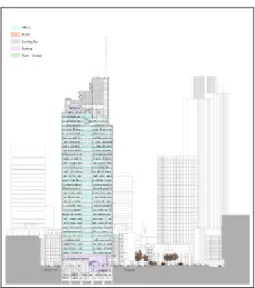
The concept behind the building is of a series of vertically stacked ‘working villages’. The building core is offset, with lifts, stairs and services grouped on the south façade. This created expansive flexible working areas, while retaining the potential for each floor to be subdivided in two. Floors are arranged around a series of three storey atria that are side lit by north facing triple height windows. The Atrium floor would be the focus for any organisation that occupied an entire three storey ‘village’ unit, and might be used as a trading floor, library space, exhibition, cafe or meeting space. The atrium floors offer approximately 850m2 contiguous deep plan space (21m glass to core), while other floors offer approximately 740m2 medium depth space (18m glass to glass). The subdivisibility of the floors enables organisations to take up single units ranging from 300m2 to 2400m2 around any single atrium space.
The atria and glazed façades bring light deep into the building, enabling a high proportion of the deep floors to function as A class space, with
CHAPTER 10: DESIGN AND THE DISTRIBUTED WORKPLACE
252 SANE IST-2000-25257
natural light and aspect. The building’s mechanical plant is localised, so that different organisations within the building may run ventilation, heating and cooling requirements independently to suit varying times and densities of occupation.
By stacking atria, varying floorplate dimensions, off-setting the building core and localising servicing plant, the Heron Tower aims to provide high image value flexible space that will suit the requirements of knowledge economy organisations for interaction, agility, diversity and capacity.
FIGURE 10.5 HERON TOWER PERSPECTIVE. © KPF, 2002
FIGURE 10.6 HERON TOWER SECTION. © KPF, 2002
CHAPTER 10: DESIGN AND THE DISTRIBUTED WORKPLACE
SANE IST-2000-25257 253
BATTERSEA POWER STATION
The Battersea Power Station site is a large brownfield area located in central London. It is has been the subject of several development proposals over the last few decades, without success. The latest, although still at conceptual stage only5, is reviewed here. It has
significant advantages over previous attempts, in that it aims to provide space suitable for the demands of 21st century knowledge based organisations, rather than the standard developer offer. The location is served by buses and overland rail, and is reasonably close to the major transport node of Victoria Station (approximately 1.5 kilometres). From its inception the development aims to incorporate principles of
interaction, layered and flexible ownership, and flexibility of tenure. It aims to create a business community through incorporating a range of functions – retail, leisure, hotel, health and business services, and is surrounded by established dense residential functions. It also provides a recognisable address and a powerful brand in the form of the remaining bulk of the Battersea Power Station, which with its four tapering white chimneys is an established icon on the London skyline.
The office component on the site aims to provide as diverse and flexible a series of spaces as possible. To achieve this the development incorporates a number of innova tions. The site layout is of buildings around courts along streets, buildings are arranged on a contiguous site grid to enable linking between buildings, increasing the potential size of a single organisational unit size. The streets and courts create spaces and places along their routes, with recognisable front doors and
5 DEGW 2002 (b)
‘addresses’ to increase image value. Buildings will offer a range of shell types, with variable floor to ceiling heights and floorplate depths. Buildings are also arranged around various atria typologies, to allow for interaction and high levels of sub -divisibility.
CHAPTER 10: DESIGN AND THE DISTRIBUTED WORKPLACE
254 SANE IST-2000-25257
FIGURE 10.9 CONCEPTUAL SECTIONS AND PLAN. © DEGW 2002
FIGURE 10.10 LINEAR AND CONVERSE CORE ATRIA CONCEPT OPTIONS (ALL SKETCHES © DEGW, 2002)
CHAPTER 10: DESIGN AND THE DISTRIBUTED WORKPLACE
SANE IST-2000-25257 255
FIGURE 10.11 OFFICE SHELL - RANGE OF SPACE TYPES (© DEGW, 2002)
DUBLIN SOUTH DOCKS
The last example reviewed here was developed as a building concept only, by O’Mahoney Pike Architects in Dublin, for a commercial client in 2000. The concept was not developed in any great detail, but is reviewed here as it provides a very different example of building innovation. The site is in Dublin docklands South Bank, currently the subject of a master plan framework study to determine a future use for the area. Although the area is currently disconnected and relatively
inaccessible, with little or no amenity, the framework is expected to address these issues.
The concept developed by OMP aimed to provide a large building, with extremely flexible space, in what may become a premium location. Due to the risks involved in developing in an unproven location, the building needed to be relatively low cost. OMP’s solution is a large
‘groundscraper’ building over 8 floors, with multiple atria. Each atrium provides a building entrance and ‘address’ at ground floor level. Spatially the building acts as a series of adjacent, ‘terraced’ office buildings, but with the advantage of being able to relocate the party wall that separates one terrace from the next, according to requirements at fit out, thus increasing the adaptability of the spaces within the building. The structure of the building also allows each atrium to be enlarged or reduced, creating different potential floorplate depths. The building core is dispersed, to increase flexibility of layout and floorplate subdivisibility. This concept demonstrates the potential for intensification of a site, while retaining a high level of flexibility for occupiers. The location, though at present inaccessible is likely to become a landmark location within Dublin, with good access, a high level of amenity and strong image value.
CHAPTER 10: DESIGN AND THE DISTRIBUTED WORKPLACE
256 SANE IST-2000-25257
FIGURE 10.12 GROUND FLOOR PLAN SHOWING TERRACED BUILDINGS AROUND SERIES OF ATRIA (© O’MAHONEY PIKE 2000)
FIGURE 10.13 SECTION THROUGH OFFICES AND ATRIA (© O’MAHONEY PIKE 2000)
CHAPTER 11: THE SHARED WORKPLACE
SANE IST-2000-25257 259
11 The shared workplace
INTRODUCTION
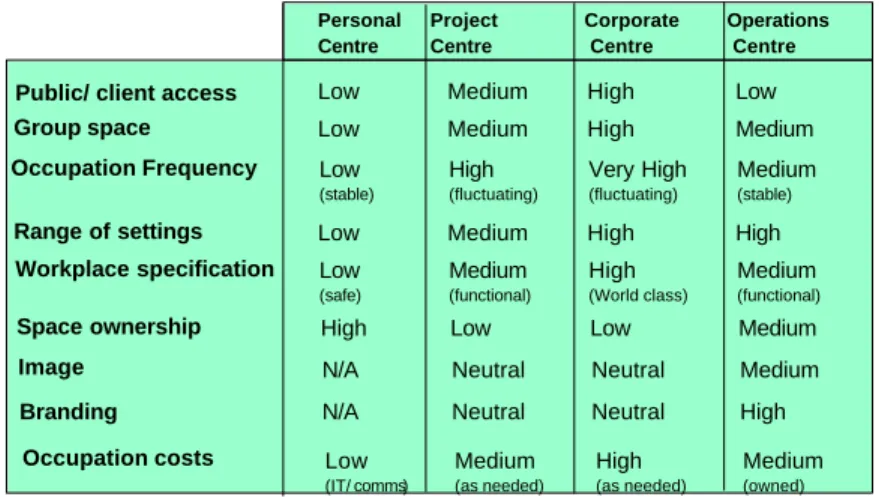
The distributed workplace model described in Chapter 4 suggests that many organisations in the future will utilise a wider range of workplace components including the homes of the workers, shared neighbourhood work centres located in the communities close to where people live or in central business districts as well as more the more conventional office space that is typically provided today (see figure 4.8: distributed space). This chapter looks in more detail at the requirements for these new workplace components and discusses the types of spaces, services and technologies that will be necessary to make these workplaces a reality. The hybrid workscape model (Chapter 4, figure 4.6: the space
environment model – hybrid workscapes) can be used as the basis for a conceptual brief for both the neighbourhood and central shared
workplaces. The characteristics of each component will vary in terms of the types of work arenas and settings provided, the level of specification of the workscapes, image, branding and occupation cost (figure 11.1).
Personal Centre Project Centre Corporate Centre Operations Centre
Public/ client access Low Medium High Low
Low Medium High Medium
Group space Low (stable) High (fluctuating) Very High (fluctuating) Medium (stable) Occupation Frequency
Low Medium High High
Range of settings Low (safe) Medium (functional) High (World class) Medium (functional) Workplace specification
High Low Low Medium
Space ownership
N/A Neutral Neutral Medium Image Low (IT/ comms) Medium (as needed) High (as needed) Medium (owned) Occupation costs ©DEGW 2001
Branding N/A Neutral Neutral High
FIGURE 11.1. GENERIC REAL ESTATE COMPONENTS DESIGN CHARACTERISTICS
As the space environment model makes clear, the amount of public, privileged and private spaces within each of the components is also likely to vary significantly. The exact proportions will vary from organisation to organisation, from one supplier of the distributed components to another. Figure 11.2, below, shows a possible
distribution of spaces within each centre - including the addition, in this example, of specialist client space in the corporate centre and call centre space within an operations centre.
CHAPTER 11: THE SHARED WORKPLACE
260 SANE IST-2000 -25257
Project Centre Corporate Centre
Personal Centre Operations Centre
Localised
Centralised
Private
Public
Private Privileged Public Private Private Private Public Privileged Privileged Public Client Call Centre ©DEGW 2001FIGURE 11.2 POSSIBLE DISTRIBUTION OF SPACE TYPES WITHIN THE GENERIC REAL ESTATE COMPONENTS (% OF TOTAL AREA)
The remaining sections of this chapter will explore the design and operation of the Project Centre and the Corporate Centre in more detail.
THE NEIGHBOURHOOD OR PROJECT WORK CENTRE
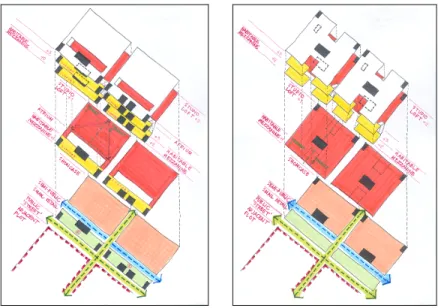
It is envisaged that a typical neighbourhood or project centre will be relatively small (500 sqm – 1500 sqm) and could be part of mixed use housing and business developments or located in suburban shopping centres, railway stations or community amenities such as libraries or health clubs.
The neighbourhood work centre will consist of a range of work setting modules that can be applied in different ways depending on the amount of space available and the requirements of the target market sectors. Consistent branding elements could be used across the work centres provided by an individual supplier to clearly signpost the facilities whatever the size or design aesthetic selected.
At the most public level the coffee bar provides a public meeting place, touchdown workspace and support services for anyone who walks in off the street.
Individuals who are members of the ‘privileged’ or club area may proceed to this area where they can use a range of work settings including quiet work areas, meeting rooms and soft seating areas. Video conferencing, other technical services and secretarial support can be booked on an as-needed basis. The club may be open to anyone or it may be themed to meet the needs of a particular market sector.
CHAPTER 11: THE SHARED WORKPLACE
SANE IST-2000-25257 261
Beyond the club area is the ‘private’ work area, a number of office suites that can be booked on a weekly or monthly basis to provide a temporary home for an individual, a start -up or a project team. IT and other
services are combined with privacy and security for teams developing new businesses. Residents of this area will be able to use the break out spaces in this zone or get away from it all for a while in either the club or coffee bar area.
A location awareness based positioning system will ensure that access to the different zones and individual rooms is discretely controlled and concierge staff in each area will also help to ensure that zone
boundaries are respected.
These centres will provide work places that can support both individual knowledge workers and project teams whether they are using it as touchdown workspace between meetings or whether they are based there for six months undertaking a project or setting up a new business.
FIGURE 11.3 INFORMAL MEETING/ CAFÉ WORK SPACE. BOOTS THE CHEMIST. SOURCE: DEGW.
There are many historical precedents for this type of workplace, centred around informal meeting and interaction places. During the last three hundred years the form of the coffee house, and the functions that have taken place within them, have changed radically but they have remained a key business environment in many cultures.
The coffeeshop today is one of a range of urban work settings that nomadic workers use. Business lounges at airports, internet cafes, business clubs, hotel lobbies and restaurants are also used to provide informal work and meeting settings. It is important to note, however, that
CHAPTER 11: THE SHARED WORKPLACE
262 SANE IST-2000 -25257
today’s coffeeshop no longer has the direct knowledge community aspect that is described in the quotation above. Today’s café workplace typically is open to everyone and the community building aspects are more likely to be due to location (e.g. a café next to a university is likely to attract students who may start to use it as an informal meeting/ group working location) rather than specific identity
The cyber or internet café is a transition space that is likely to only have a limited life-span while access to the internet is not universal. By 2003 third generation mobile technologies will have increased the rate data transmission over mobile devices by 200 times and 75% of all mobile phones will be internet enabled which is likely to substantially reduce the need for cyber cafes in their current form.
In the future some neighbourhood centres may be themed or branded to meet the needs and aspirations of particular market sectors such as internet, financial services, media and creative companies. Within the centres it will also be possible to use the brands of the individual
partners to identify particular services such as reprographics or catering. Neighbourhood centres may also be attached to existing clubs, social or sports facilities such as health clubs or golf clubs that have traditionally combined networking and informal business activities alongside their core activities.
NEIGHBOURHOOD CENTRE ELEMENTS
Public or coffee bar level
Reception/ concierge/ office services Café/ bookshop
Food preparation area
Exhibition area/ breakout space Meeting rooms
Central administration
Storage (catering/ chairs/ office services)
Privileged or club level Club workstations Quiet booths Team rooms Concierge/ services Pantry/ servery
Showers/ crash out room Private level
Project Office suites Store
Pantry
Team rooms
Touchdown work space
CHAPTER 11: THE SHARED WORKPLACE
SANE IST-2000-25257 263
Area Number Area required No. of worksettings Public (Café) level
Reception/ concierge/ office services 50 1 50
Café/ bookshop 120 1 120 60
Food preparation area 30 1 30
Exhibition area/ breakout space 50 1 50
Meeting rooms 35 2 70 60
Central administration 13.5 1 13.5
Storage (catering/ chairs/ office services) 30 1 30 363.5 Privileged (Club) level
Club workstations 5 40 200 40
Quiet booths 4 10 40 10
Team rooms 20 5 100 30
Concierge/ services 13.5 1 13.5
Pantry/ servery 13.5 1 13.5
Showers/ crash out room 30 1 30
397 Private (Cloister) level
Office suites 30 10 300 40 Store 1 30 30 Pantry 13.5 1 13.5 330 240 NUA 1091 +15% primary circulation 164 NLA 1254 + 15% core 188 GFA 1442
FIGURE 11.4. NOTIONAL SPACE BUDGET FOR A NEIGHBOURHOOD WORK CENTRE
CHAPTER 11: THE SHARED WORKPLACE
264 SANE IST-2000 -25257
FIGURE 11.5. AXONOMETRICS SHOWING PUBLIC, PRIVILEGED AND PRIVATE ZONES OF A NEIGHBOURHOOD CENTRE. SOURCE DEGW 2001.
The neighbourhood centres will generate a number of different income streams and it is likely that sites will vary considerably in where the bulk of their income derives from because of size, location and target market sectors. These include the following:
Public area (Café) customers
food/ beverages Internet access
Retail sales (books/ office supplies) Meeting room/ exhibition space charges
Franchise rentals (e.g. travel desk, rental cars, IT service centre)
Privileged (Club) customers
Food/ beverages Day memberships
Annual memberships (individual/ corporate) Room/ technology hire
Private area (Cloister) customers
Food/ beverages Serviced office rental Room/ technology hire
There may also be benefits in linking the Centre to an ‘anchor’ office tenant who takes additional space above the office as core space and uses the Centre for supplementary meeting and project space and office space. This would provide a stable cash flow for the Centre and could assist with the theming of the centre e.g. Centre based around a leading design or creative company is likely to attract other companies who work with the anchor tenant or who would like to be associated with them.
Public
Privilege
Privileged
Private
CHAPTER 11: THE SHARED WORKPLACE
SANE IST-2000-25257 265
TECHNOLOGY AND SERVICES IN A NEIGHBOURHOOD CENTRE As well as providing a range of work settings, the neighbourhood centre is also likely to provide a range of other service and technology offerings and these are likely to contribute significantly to the overall income of the Centre.
Figure 11.6, below, suggests that the centres will incorporate some of the characteristics and service offerings of existing work locations such as serviced offices, cafes and copy shops. In other words the centres will provide a range of food and beverage options, technology support in terms of provision of workstations, specialist peripheral devices such as high specification colour printers, copiers and scanners, telephone and video conferencing and communications support.
S e r v i c e d o f f i c e C a f é C o p y s h o p • F l e x i b l e l e a s i n g • I n d i v i d u a l a n d g r o u p s p a c e s • G e n e r i c o f f i c e s p a c e • O f f i c e s e r v i c e s s u p p o r t • 2 4 x 7 ? • B r a n d e d s p a c e • T o u c h d o w n s p a c e • I n f o r m a l m e e t i n g s p a c e • F o o d / b e v e r a g e s • W o r k p l a c e s u p p o r t • T e c h n o l o g y a n d c o m m u n i c a t i o n s • 2 4 x 7
?
E x i s t i n g d i s t r i b u t e d w o r k p l a c e p r o v i d e r s
N e i g h b o u r h o o d a n d C o r p o r a t e C e n t r e sFIGURE 11.6. SERVICE OFFERINGS IN A NEIGHBOURHOOD CENTRE
USE OF THE NEIGHBOURHOOD CENTRE
Five metaphors are used to conceptualise how individuals and groups are likely to use the centre spaces and services. centre as:
• fort
• mission control • camp site • village store • club house.
CHAPTER 11: THE SHARED WORKPLACE
266 SANE IST-2000 -25257
Public Private
Fortress
Mission control
Camp site
• Home base in new locations
• Flexibility
• Support
• Connectivity
• Project team space
• Privacy
• Project support
• Flexibility
• Connectivity
• Work space while travelling
• Meeting/ social space
• Convenience
• Concierge services
• Connectivity
• Meeting/ social space
• Community
• Networking venue
• Learning environment
• Innovation catalyst
Village store
Club house
• Drop-in resource centre
• Touch down space
• Meeting/ social space
• Information display
• ‘Business convenience store’
• Connectivity
FIGURE 11.7 CONCEPTUALISATION OF NEIGHBOURHOOD CENTRE SPACES AND SERVICES
Centre users will have very different needs and expectations in terms of image, cost, service and speed. They are also likely to use the Centres in very different ways over time and space. Centres close to the user’s ‘homebase’ are likely to be used in a very different way to those on the other side of the world where the needs are likely to be more intensive and the priorities are different. For example the level of service may become more important than the cost when time is precious during a business trip.
CHAPTER 11: THE SHARED WORKPLACE
SANE IST-2000-25257 267
Fortress
An insurance company is interested in expanding into a new geographic area. Initially a small presence will be established in the capital city as a base for market research and initial sales and marketing activity. A suite in the Private area of the Centre will be home for the company for six months with all business and IT services provided by the Centre staff. Additional space for meetings and presentations will be booked in the café or public areas on an as-needed basis.Mission
control
An internet start-up is a joint venture between three companies. Until the new business is up and running the business needs space to work together to develop the web site and plan the business. Secure space in the Private area is used to house the team but the club and coffee bar are used to hold meetings and for individual quiet work. After three months the team has expanded and they are able to move into longer term office space nearby. The club and coffee area continue to be used as flexi-space for the growing business.
Camp site
A product manager visits the city every three months to visit clients and do several marketing presentations to potential clients. The manager has a global membership to the Centres and uses them as a base, for catching up on emails, writing reports and meeting with sales representatives who handle the product in that area. When new versions of the product are released the large meeting rooms are used to hold training seminars. The club area also provides an opportunity to meet with other professionals and relax after intensive days working.Club
house
The Centre is located near a major centre of film and post production facilities. The café acts as a regular meeting place for people working in this sector and as a base for freelancers working on script ideas or putting together production and distribution deals. The normal PC workstations in the café are supplemented with digital editing facilities and the meeting rooms can be joined together to be used for screenings of films. The bookshop in the café has a range of film-related materials and papers for sale.
Village
store
A freelance consultants pops into the Centre after seeing a client for a cup of coffee, to use a DTP workstation for an hour and to purchase some urgently needed office supplies – if they are not in the shop the concierge will get them biked over from a major office supplies shop nearby. Later in the day the consultant has booked a meeting room for several hours to meet with the rest of the project team on one of his/her projects.
CHAPTER 11: THE SHARED WORKPLACE
268 SANE IST-2000 -25257
SUPPORTING MAJOR CORPORATE USERS.
The neighbourhood centres described above support individual knowledge workers or small groups of workers from larger companies who are undertaking a joint project or setting up in a new location. A key issue for the implementation of a distributed workplace strategy is the support offered to large organisations by these shared workplaces. Many large corporations are currently rethinking the ways in which their workspace is being provided and funded and are looking for more flexible and cost effective solutions. One expression of this has been the increased use of serviced offices, also called ‘executive suites’ in the United States. In the industry’s early stages the major clients at these centres were entrepeneurs, small business start -ups and small corporations, but today many leasing space in business centres are large corporations who want to expand their physical presence or who want to test other markets before entering them. Other businesses benefiting from the use of executive suites include high-tech and dot-com dot-companies; sole practitioners, such as lawyers, therapists and financial planners; staffing agencies; mortgage companies; stock brokers; and corporations who are downsizing.6
Partnering with serviced office providers
Partnerships are also being formed between serviced office providers and large corporations whereby the service office provider takes over the leases of some or all of their real estate and provides space on an as-needed basis as well as office and technology services.
6 Haner-Dorr, 2000
The Financial Times suggested in 2001 that users are now using serviced offices in a different way. Instead of being used as overflow space they have become an alternative to medium term occupancy in an office. 7 In 2002, for example, Nokia reached an agreement to transfer
20% of its world-wide space to Regus Centres in a five year contract worth $142.5 million. Nokia’s goal is improved operational flexibility and increased efficiency which they feel will result in substantial cost savings.
The concept of serviced offices was established in the US. A recent research report by Market and Business Development (MBD) estimated that the penetration of the serviced office sector in the US commercial property market is in the region of between 2% and 3%. The penetration of serviced offices in the UK remains below this level at nearer 1% of the total commercial property market. Nevertheless, the UK market is significantly more developed than that in the rest of Europe where penetration is reported to be nearer 0.2%.8
MBD estimate that the total number of serviced office workstations in the UK number some 125,000 in 590 sites, with approximately 35,000 of these being in London. MBD also believe that up to 10% of these workstations are unoccupied indicating that serviced office providers are still ahead of demand. During the 1996 to 2000 period the annual growth in the market has exceeded 10% which is considerably more than other commercial property sectors.9
7 Financial Times, May 25 2001, p 33 8 MBD 2001
CHAPTER 11: THE SHARED WORKPLACE
SANE IST-2000-25257 269
In an article in March 2000 the Estates Gazette stated that changing business needs have lead to the growth of serviced offices and peripheral working space facilities which often rely on the flexibility and location of services. They also noted that the serviced offices could not be valued in the same way as conventional office buildings – the traditional role of landlord and tenant is being replaced by service user and service provider, changing significantly the way that business is carried out and making standard real estate concepts such as return on investment much less relevant.10
There is considerable variation in the costs and type of accommodation provided in serviced office centres. In London, for example, the more than 100 centres break down into three broad categories: new or quality refurbished accommodation in prime locations such as Mayfair;
buildings in slightly ‘out of centre’ locations such as Southwark, Lambeth and Islington and second hand centres on the fringe of the capital. Occupancy rates across London average 75% and clients remain in a centre for an average of nine months.11
The serviced office market remains relatively fragmented with many operators owning a small number, often single office blocks, of unbranded serviced facilities. There are also, however, a number of large, multi-site operators who offer branded facilities often with the advantage of varying degrees of co-operation between sites allowing client companies to utilise services away from their main location.
10 Estates Gazette, Feb 19 2002, p 124. ‘Flexibility has the edge’
11 David Spittles, Serviced Offices and Business Centres: Uncertain times ahead. Evening Standard, November 19,2001
MBD have also suggested that the branding of serviced centres has been a clear attempt to increase the barriers to market entry in a sector where the barriers are few and low.12
Regus is the leading supplier of serviced offices in the UK with an estimated 340 business centres containing as many as 66,000 workstations in the UK and internationally. Regus’s monthly package fees vary according to location, up to £2000 per workstation including services such as furnished and equipped private offices, reception area, mail handling, cyber-cafes, voicemail, refreshment points, professional service team support, telephone answering in the client’s name, multilingual services, digital communications as well as other office services, although the exact nature of the provision varies according to location.
Each business centre opened by Regus tends to reach profit before interest and tax within six months of opening and the break-even point is often as low as 50% occupancy. Regus claims that in its established centres (those that have been in operation for 18 months or more) average occupancy levels are around 80% and gross profit margins before central overheads reach an average of 30%. 13
Annual revenues for Regus reached £421 million in 2000 and recorded an operating profit of £12 million that year against a loss of £43 million in the previous year.
12 MBD 2001. The UK Serviced Offices Market Development Quarter Four 2001, p 18 13 MBD 2001. The UK Serviced Offices Market Development Quarter Four 2001, p 24
CHAPTER 11: THE SHARED WORKPLACE
270 SANE IST-2000 -25257
Regus was established in 1989 and by 1999 the company planned an initial public offering. This was subsequently withdrawn due to a reluctance on the part of the market to fund revenue growth rather than profit generation. The offer was resurrected in 2000 raising $250 million through the sale of 25% of the company.14
Performance in the serviced office sector during the last year has been tumultuous. In July Regus issued a profits warning about the extent of the slowdown the company is experiencing in its continental operations and the company said it had also been hit by price competition and softening demand in the US and other companies. Germany, one of the company’s largest markets, was singled out as particularly difficult. The price of Regus shares finally settled in November 2001 at a tenth of their market high15. In September 2001 MWB Business Exchanges’s share
price fell after their occupancy rates dipped from more than 80% in the previous year to 69% in August. Also in November, HQ Global
Workplaces, another major international serviced office provider, posted a third quarter loss of £224 million. Despite the downturn for the larger serviced office providers, the smaller providers are expanding to service the small to medium enterprise market who are not as hurt by the economic down turn as the bigger companies as well as expanding to take advantage of the lower real estate costs. 16
The recent MBD research on the UK serviced office market found that while, in theory at least, serviced offices compete with conventional
14 MBD 2001. The UK Serviced Offices Market Development Quarter Four 2001, p 24 15 Financial Times, October 18 2001. ‘Booking rates halve at Regus in Germany’ 16 David Spittles, Serviced Offices and Business Centres: Uncertain times ahead. Evening
Standard, November 19,2001
office leases and to a lesser extent owner-occupied commercial properties, in practice this degree of competition is less apparent than might be anticipated. Few of the companies MBD spoke to have undertaken detailed cost comparisons between serviced office and conventional real estate solutions. Instead the critical factor is perceived to be the short and flexible lease arrangements which provide the flexibility required by start-up companies who are unable to commit to even five year leases.17
Future growth in the serviced office sector in the UK is estimated to be between five and six percent, taking the total market size to around 162,000 workstations by 2005.18 MBD believes that the critical success
factor for serviced providers in the future will be will be the conventional real estate factor of location rather than by significant differentiation of service offering.19
Partnering with alternative workplace providers
Other corporations are transferring the risk of owning and managing property entirely to new types of property and service partners. In the United Kingdom, for example, Trillium was created in 1997 with the transfer of portfolio of Department of Works and Pensions. In 2001 Land SecuritiesTrillium took over 6,700 BT (British Telecom) properties with a total floor space of 5.5 million m². This released some £2.4 billion of capital value to British Telecom and it is also hoped that this will allow them to achieve accommodation flexibility to meet rapidly changing
17 MBD 2001. The UK Serviced Offices Market Development Quarter Four 2001, p 10-11 18 MBD 2001. The UK Serviced Offices Market Development Quarter Four 2001, p 5 19 MBD 2001. The UK Serviced Offices Market Development Quarter Four 2001, p 27
CHAPTER 11: THE SHARED WORKPLACE
SANE IST-2000-25257 271
business needs. Most recently in 2002 the BBC transferred 400,000 sqm of space to Trillium and, following the development of 50,000 sqm of new space, they will pay a £70million annual charge for their total work place requirements for the next thirty years.
The challenge for the real estate partners is to provide for the changing levels of demand across their expanding portfolio – to create short term uses for unneeded space and to rapidly respond to demands for additional space by their end user organisations. Additional revenue can be earned by the provision of office and technology services so it is likely that the service component of these contracts will expand beyond those of building and facilities management into these areas, increasing the similarity between these major workplace providers and the offerings provided in the smaller Neighbourhood centres described previously in this chapter.
While wholesale handing over of the real estate portfolio to an external partner may be too bigger step for many organisations it is likely that future workplace strategies will be much more diverse, incorporating owned space alongside short term flexible space and ‘on demand’ space that can instantly be acquired and disposed of.
FIGURE 11.9. DEGW MODEL OF CORE, FLEXI AND ON DEMAND SPACE. SOURCE DEGW 2001.
core space lLong lease/freehold
lMarket rents
lHigh quality tenant fit out
lPrime location
lPrelet development
lInstitutional funded
lFew landlord services
flexi space
•
Short lease•
Higher rents•
Tenant brand•
New or refurb spacel Tenant fit out
l Some landlord services
l Outsourced ownership
just-in-time space l Licensed
l Premium rents
l Service provider brand
l Global location options
l Ready to use
l Full landlord services
core space lLong lease/freehold
lMarket rents
lHigh quality tenant fit out
lPrime location
lPrelet development
lInstitutional funded
lFew landlord services
flexi space
•
Short lease•
Higher rents•
Tenant brand•
New or refurb spacel Tenant fit out
l Some landlord services
l Outsourced ownership
just-in-time space l Licensed
l Premium rents
l Service provider brand
l Global location options
l Ready to use
CHAPTER 11: THE SHARED WORKPLACE
272 SANE IST-2000 -25257
Partnering with academic institutions
Many organisations now see innovation, learning and knowledge creation as being essential for survival in the New Economy. Association with an academic institution is an effective way of signalling these values to employees, clients and the business community in general. Proximity to the university may also provide better access to potential recruits and the knowledge of the academic staff. The rise of the distributed
workplace offers major opportunities for academic institutions to
capitalise on their existing estates, earn additional revenue and enhance the quality of the student and staff experience by providing mixed-use academic and business campuses that will allow these organisations to achieve their objectives and potentially provide a significant revenue stream for the institution concerned The management of the shorter-tenure shared spaces may also provide a mechanism for the academic institutions to procure short term research or administrative space when it is needed.
Many academic institutions are also either investigating ‘e -learning’ or have implemented pilot programmes already. The use of IT-based teaching is both a way of increasing student catchment area and overall income for the institution. While electronic delivery of course work etc is feasible it does not provide the students with a comparable university ‘experience’ to being physically present at the campus.
It is likely that academic institutions with major e-learning programmes will differentiate themselves by providing high quality physical places at international or regional centres where students can meet for seminars, gain access to specialist resources or advice and interact socially.
These centres may not be needed continuously so there will be opportunities for partnerships with corporate training providers for shared facilities or utilisation could be improved by a number of institutions sharing a centre.
There are opportunities for academic institutions with either suburban or urban campuses to partner with a workplace provider to develop branded work centres. These centres could also serve as an amenity or club for alumni which allows them to continue the experience of being ‘at university’ into their working careers, generating income and
opportunities for alumni fundraising initiatives.
Academic and commercial workplace partnerships have long existed in the form of the development of university linked business or science parks but the integration of business buildings and facilities into the core campus has been less common. One example of a university that is planning to do this is San Jose University in California which is planning to fund the redevelopment of significant parts of its main campus through the provision of corporate workspace.
San José University has 28,000 students based in 500,000 sqm of space in 61 buildings on an 88 acre site. Much of the student housing, teaching and research space is obsolete and needs to be replaced. As part of this redevelopment a $400 million commercial office development is planned adjacent to San José commercial centre. This development will consist of 180,000 sqm in five buildings in a phased development with pre-lets required at each stage. The development will be an office campus designed to optimise university links including the mixing of