Intelligence
Analysis for
Problem
Solvers
John E. Eck and Ronald V. Clarke
This project was supported by cooperative agreement # 2008CK-WX-K004 awarded by the Office of Community Oriented Policing Services, U.S. Department of Justice. The opinions contained herein are those of the author(s) and do not necessarily represent the official position or policies of the U.S. Department of Justice. References to specific agencies, companies, products, or services should not be considered an endorsement of the product by the author(s) or the U.S. Department of Justice. Rather, the references are illustrations to supplement discussion of the issues.
The Internet references cited in this publication were valid as of the date of this publication. Given that URLs and websites are in constant flux, neither the author(s) nor the COPS Office can vouch for their current validity.
© 2013 Center for Problem-Oriented Policing, Inc. The U.S. Department of Justice reserves a royalty-free, nonexclusive, and irrevocable license to reproduce, publish, or otherwise use, and authorize others to use, this publication for Federal Government purposes. This publication may be freely distributed and used for noncommercial and educational purposes.
ISBN: 978-1-935676-55-3 September 2013
Intelligence
Analysis for
Problem
Solvers
John E. Eck and Ronald V. Clarke
Know the Fundamentals of Criminal Groups Know the Fundamentals of Criminal Groups
Acknowledgments
We are grateful to the Office of Community Oriented Policing Services (COPS Office) for commissioning this manual, which is intended to be a companion volume to our earlier publication, Crime Analysis for Problem Solvers: In 60 Small Steps, which was also commissioned and published by the COPS Office. We thank our many colleagues and friends on whose work we have drawn. Special thanks are due to those who supplied material for inclusion: Christopher Bruce (Step 41), Mangai Natarajan (Step 20), Jerry Ratcliffe (Step 4), and Rashi Shuhkla (Step 43). Daryn Beauchesne, Leonard Miranda, Kristen Miggins, Andy Mills, Nanci Plouffe, Karin Schmerler, John Stedman, and Julie Wartell took part in a meeting, graciously hosted by the Chula Vista Police Department, to discuss our plans for the manual. Finally, we are grateful to Christopher Bruce and Andy Mills for their detailed commentary on the first draft of the manual.
John E. Eck Ronald V. Clarke
Contents
Acknowledgments
. . . .1
Read This First
. . . .5
What is this manual about and who is it for?
. . . .5
How is the manual organized?
. . . .6
Part 1: Intelligence Analysis for Solving Problems
. . . .9
Understand the Role of Intelligence Analysis
. . . .10
1 . Know What Intelligence Analysis Comprises . . . .10
2 . Know That Intelligence Analysis Must Look Beyond Enforcement . . . .12
3 . Understand the Intelligence Analysis Process . . . .14
4 . Recognize How Intelligence Analysis Fits Into Crime Analysis . . . .16
5 . Appreciate How Intelligence Fits in Policing Strategies . . . .19
Know the Fundamentals of Criminal Groups
. . . .22
6 . Recognize that Offenders Choose to Commit Crime . . . .22
7 . Pay Attention to How Crime Opportunities Arise . . . .24
8 . Distinguish between Criminal Groups and Problem Gatherings . . . .26
9 . Tell Apart Organized Crime and Organized Criminals . . . .28
10 . Modify the Conditions that Facilitate Organized Crimes . . . .30
11 . Study the Modus Operandi Step-by-Step . . . .32
12 . Look for Convergent Settings . . . .35
13 . Disrupt Recruitment and Replacement . . . .37
Assemble the Key Information
. . . .40
14 . Interview Offenders . . . .40
15 . Tap the Knowledge of Officers . . . .43
16 . Work with Businesses, Private Security, and the City . . . .45
17 . Work the Community . . . .47
Produce Intelligence
. . . .49
18 . Create Intelligent Maps . . . .49
19 . Use Network Analysis to Connect the Players . . . .52
20 . Undertake Conversational Analysis of Wire Tap Data . . . .56
21 . Compare Competing Hypotheses . . . .59
4 Intelligence Analysis for Problem Solvers
4 Intelligence Analysis for Problem Solvers
Create Effective Actions
. . . .63
23 . Diagram the Crime Process . . . .63
24 . Apply Situational Prevention to Each Stage of The Crime . . . .66
25 . Work with Gatherings and Crowds . . . .69
26 . Pull Levers . . . .72
Never Compromise Ethics and Integrity
. . . .74
27 . Be Accountable . . . .74
28 . Do Not Delude Yourself . . . .77
29 . Be Principled in Your Work . . . .80
30 . Don’t Unnecessarily Beat Yourself Up . . . .82
Part 2: Case Studies of Criminal Groups and Problem Gatherings
. . . .85
31 . How to Read the Case Studies . . . .86
Criminal Groups
. . . .88
32 . Retail Drug Dealers . . . .88
33 . Terrorists . . . .91
34 . White Supremacists . . . .93
35 . Animal Rights Extremists . . . .96
36 . Internet Pedophile Rings . . . .99
37 . Graffiti Crews . . . .102
38 . Outlaw Motorcycle Gangs . . . .105
39 . Street Gangs . . . .108
40 . Auto-Accident Fraud Rings . . . .111
41 . Organized Shoplifters . . . .114
42 . Organized Car Thieves . . . .117
43 . Clandestine Methamphetamine Labs . . . .121
Problem Gatherings
. . . .124
44 . Cruising . . . .124
45 . Illegal Street Racing . . . .126
46 . Spring Breaks . . . .129
47 . Political Demonstrations . . . .131
48 . Student Party Riots . . . .134
Read This First
Read This First
The 9/11 Commission famously criticized the country’s intelligence agencies for failing to “connect the dots” before the attack—that is, for failing to detect a pattern in the scattered items of information about the hijackers that had come to the attention of various federal and state agencies. The resulting calls for intelligence reform were at first confined to the nation’s security agencies, the FBI and the CIA. Soon police leaders began to argue that their agencies, too, had a vital role in addressing terrorism and that they must be included in the loop. Terrorism may have raised the profile of police intelligence, but it is not the main reason for improving its use. Police intelligence has a far wider role in public safety, crime reduction, and order maintenance. This wider role is explored throughout this manual. Unfortunately, the word “intelligence” also raises public fears that secretly collected police information will be used to subvert individual liberties and democratic institutions. We will touch on these concerns later; here, we should explain why we wrote the manual, who it is for, and what it covers.
What is this manual about and who is it for?
As we discuss in Step 1, intelligence analysis is “a process for making sense of a diverse array of information about crime problems created by offender groups, with the goal of reducing crime.” Numerous books and manuals for crime analysts are available that describe how to process data to guide police anti-crime tactics and strategies. In contrast, most writing on police intelligence focuses on data gathering and sharing, administration, and legal requirements. These are all important topics, but they do not help the analyst analyze, i.e., make sense of the data in order to glimpse behind the veil of a criminal enterprise.
Our manual fills this gap by providing a practical guide to intelligence analysis, much like our earlier manual on crime analysis written for the Center for Problem-Oriented Policing. In writing this manual, it soon became clear that police intelligence has a much larger mission than simply finding out who is up to no good, who they hang out with, what they are about to do, and where they can be found. These are the sorts of questions we normally expect police intelligence to address. However, there are other questions that intelligence analysis can effectively address, such as: How do offenders commit their crimes? What circumstances help them commit their crimes? And, what countermeasures might prevent them from doing so? In short, we look beyond the “who” to address “how,” “when,” “where,” and “what.”
This manual fuses aspects of intelligence analysis with Problem-OrientedPolicing. The links between the two have been ignored in the past, with the exception of Jerry Ratcliffe’s book referenced below. However, knowing how intelligence analysis can help solve problems and how problem solving can improve the effectiveness of intelligence analysis will aid any police practitioner interested in reducing crime or disorder.
This manual is not intended to serve the entire law enforcement community. Nor does it describe all facets of intelligence. Rather it focuses on the analysis of intelligence, and we wrote it for three groups in local policing agencies: (1) intelligence officers and analysts, (2) crime analysts who might need to use intelligence information and, (3) police managers who supervise crime and intelligence analysts. If you are such a manager, and you find that the work of analysts is something of a mystery, then we hope this manual can demystify their work and help you make better use of your analysts.
6 Intelligence Analysis for Problem Solvers
6 Intelligence Analysis for Problem Solvers
Read This First
The coverage of this manual
The central focus of this manual is the analysis of data: making sense of the variety of bits of information describing
criminal groups or problem gatherings . This manual does not cover:
◾
Federal, state and local intelligence organizations, groups, and networks
◾
How to set up or manage an intelligence unit within a police organization
◾
All the sources of data and information available
◾
Security requirements for those with access to intelligence data
◾
Legal requirements for obtaining and sharing intelligence information
There are other documents, books, and resources that cover these topics .
Three key assumptions
1. In preparing to write this manual, it quickly became apparent that (1) there is considerable overlap in the analytic techniques employed and the skills needed by intelligence analysts and crime analysts and, (2) most police agencies would have insufficient resources to employ separate groups of both specialists. We have therefore assumed that intelligence analysis and crime analysis are broadly similar and will generally be undertaken by the same group of analysts.
2. In our early discussions with crime and intelligence analysts, they were able to identify only one important difference between their roles: That intelligence analysis focuses mainly on criminal groups and problem gatherings. Examples of the former would be terrorists, street gangs, outlaw motorcycle gangs, and organized shoplifters, and of the latter would be illegal street races, political demonstrations by extremist groups, and student crowds at spring break. Consequently, this manual focuses on analyzing information about criminal groups and problem gatherings.
3. The third assumption derives from our backgrounds in community policing and problem-oriented policing. The purpose of intelligence analysis should be to find ways of altering the “facilitating conditions” that permit these groups and gatherings to create harm. In other words, intelligence analysis can contribute both to long-term and immediate reductions in crime.
How is the manual organized?
The first part of the manual consists of 30 “Steps” organized under six sections. Each step covers a discrete topic and each one stands on its own. So there is no need to read the manual straight through from beginning to end; you can dip into it at any point. Nevertheless, topics do connect with each other and follow a logical order. Where these connections are vital, we reference other steps. At the end of most steps, we include some references to written materials that give more details about the topic.
The second part of the manual contains case studies of various criminal groups and problem gatherings that we undertook in order to assist our thinking about the uses of intelligence analysis. These case studies provide useful examples of the kinds of information that might be collected and ways in which it might be used.
Read this First
Policing agencies and law enforcement
◾
Throughout this manual, we use the term “police agencies” to refer to agencies of local government whose
primary business is policing . As well as municipal and town agencies, this includes sheriff agencies that
provide police services to county residents and businesses, but not those that only provide correctional,
warrant, or court services . We do not include federal agencies, such as the Federal Bureau of Investigation
(FBI), Drug Enforcement Administration (DEA), and Bureau of Alcohol, Tobacco, Firearms and Explosives
(BATF) .
◾
We use the term “law enforcement” to refer to a procedure or tactic that police agencies can use, but we
do not use the term “law enforcement agency” because law enforcement is only one of many tools police
can use . Intelligence analysis should help police decision makers choose among the available tools .
READ MORE:
Jerry Ratcliffe . 2008 .
Intelligence-Led Policing.
Cullompton, Devon: Willan Publishing .
Ronald V . Clarke and John E . Eck . 2005 .
Crime Analysis
for Problem Solvers. In 60 Small Steps.
Washington, D .C .;
U .S . Department of Justice, Office of Community Oriented
Policing Services .
Intelligence
Analysis
for Solving
Problems
P
a
rt 1
10 Intelligence Analysis for Problem Solvers
National intelligence and criminal intelligence
While there are substantial differences between national intelligence (as conducted by federal agencies involved in international affairs) and criminalintelligence, we found Robert Clark’s book (referenced below) on national intelligence helpful in defining the scope and objectives of police intelligence analysis. Clark asserts that intelligence analysis has five characteristics: orientation, target, goals, inputs, and methods. For policing, the first three characteristics are far more important and we discuss orientation, targets, and goals below.
Orientation – proactive
Intelligence analysis has a future orientation. It tries to determine what criminal activity is likely to happen if police do nothing to prevent it. In short, intelligence analysis is proactive. Consequently, reactive uses of information, such as to solve crimes that have already occurred, are not generally included in intelligence analysis. Solving crimes helps to redress past events, and though vital, this is not designed principally to prevent future incidents. Investigative information can be converted to intelligence when it is analyzed for the purpose of preventing future crimes.
Targets – groups
Intelligence analysis is directed against offenders operating in groups. Groups may facilitate offending, thus making them more serious than individual offenders acting alone. More importantly, intelligence can exploit the special vulnerabilities of groups, which are as follows:
◾ Keeping Secrets. Benjamin Franklin said, “Three
can keep a secret if two are dead.” While this is rather extreme, it illustrates an important point:
the more people who need to keep a secret, the less likely it is that the secret will be kept. This is why criminal groups often enforce secrecy with threats, and perhaps it is also the reason the Hell’s Angels quote Benjamin Franklin. But, offender groups are not necessarily good at keeping their members compliant.
◾ Visibility. A related vulnerability is that the larger
the group of offenders, the greater the difficulty of keeping a low profile. The danger is especially great when group members gather. Establishing secret meeting places helps them overcome this difficulty. But establishing such a place often requires group members to work with non-offenders (e.g., landlords) and this also increases their risk of detection. Groups that ostentatiously promote themselves create more information that intelligence analysis can exploit.
◾ Coordination. Unlike individual offenders
operating alone, groups of offenders have to coordinate their activities with one another. Coordination difficulties rise as the group increases in size. Consequently, while groups have greater capacities than individuals, they are also less flexible, which, at least in the short run, makes them more predictable. In the long run, groups may have a greater chance to innovate than individuals, but this takes time.
In short, groups leak information that can be gathered and analyzed and, as we note below, the variety of information sources makes analysis mandatory.
Goal – prevention
The fundamental purpose of intelligence analysis is to prevent group crimes from occurring. This is consistent with the first two elements: a future orientation and
TERRORIST THREATS HAVE DRAWN ATTENTION TO THE VITAL ROLE OF INTELLIGENCE. However, the threats have also promoted inflated expectations and confusion regarding this role. This is particularly true in local policing. One source of confusion is that “intelligence” is used to refer both to raw information collected from some source and to the result of systematically analyzing this information. Many writings on intelligence analysis do little to clarify the term because they provide limited guidance as to what actions comprise analysis and the purposes these actions are supposed to serve.
group offending. Intelligence analysis targets groups in order to reduce crime. To serve this purpose, the detection, arrest, and prosecution of group offenders are important, but intelligence analysis is not limited to these actions. Going beyond law enforcement is critical to achieving crime reduction goals. Consistent with community and problem-oriented policing strategies, intelligence analysis can serve a wide range of preventive activities. In subsequent steps, we describe how intelligence analysis can expand the range of prevention activities by applying principles derived from environmental criminology.
Inputs – many
Intelligence analysis uses information from a wide variety of sources. It is not restricted to covert sources. Standard police records, available to the public, and other data collected by private and public agencies are often extremely useful. We examine some of the most obvious sources in this manual, but the sources available are only limited by imagination, resources, and technology. If intelligence analysis were restricted to a single source, the need for analysis would be much reduced. It is the need to make sense of multiple information sources, including data from other jurisdictions (see Step 22), each with its own strengths and weaknesses, that makes analysis important. Consequently, we do not define intelligence analysis by the type of information used: variety is what is important.
Methods – varied
Intelligence analysis methods involve processes to sort, interpret, and compare information from multiple sources in order to determine what offending groups are likely to be operating, how they commit crimes, and what can be done to keep these groups from being successful. Just as there are many sources of information, police can use many analytical
methods. We will discuss some of the most important. We do not define intelligence analysis by the use of any particular method; any systematic approach that helps provide an accurate assessment can be part of intelligence analysis.
Understand the Role of Intelligence Analysis
Lone wolves
What about the threat of “lone wolf” terrorists? Are
their actions not susceptible to intelligence analysis?
Practically speaking, no . Although the harm they can do
is extreme, this does not mean that intelligence analysis
can do any more for the lone wolf terrorist than it could
do for the lone wolf bank robber, the isolated drug dealer,
or the stand alone fraudster . If individual offending
creates patterns, crime analysis can help . Controlling
access to explosive materials, for example, helps thwart
isolated terrorists as well as organized ones . However,
without a group or a pattern of behavior, police have to
rely on isolated and unpredictable reports of community
members, chance encounters, and investigative work .
This might happen when lone wolves “reach out”
to others for assistance (e .g ., obtaining weapons,
information, or other support) . When they mistakenly
reach out to individuals with connections to police, this
presents the police with an opportunity to identify and
remove them .
In summary, intelligence analysis is just a specialized form of crime analysis that focuses on problems created by groups of offenders. It is a process for making sense of a diverse array of information about crime problems created by offender groups, with the goal of reducing crime. Intelligence is just a form of information that describes groups. Sources and methods do not define it.
READ MORE:
Robert M . Clark . 2007 .
Intelligence Analysis: A
Target-Centric Approach.
2nd Edition . Washington, D .C .: CQ
Press .
12 Intelligence Analysis for Problem Solvers
For example, breaking up a group that steals catalytic converters may not be productive, under the following circumstances:
1. The group was never responsible for an important proportion of the problem
2. The wrong members of the group are removed 3. Those arrested are quickly replaced by others, thus
reestablishing the group
4. Other groups move in to take advantage of the now vacant opportunity
Unless there is a reduction of theft of catalytic converters, the actions were not effective. To ensure that they are effective, intelligence analysis should focus on the complete problem. In our example, the analysis should examine the catalytic converter theft process from beginning to end—from the characteristics of vehicles and victims to the reentry of the stolen converters into the legitimate market. In short, the problem is not the group stealing the catalytic converters, but the entire theft process, of which the group is an integral part.
These points can be illustrated by police attempts to disrupt street drug dealing, particularly in the late 1980s through the early 1990s when police targeted the most highly visible drug groups. Unfortunately, the most visible were not necessarily the most active in dealing or the most violent. In addition, informants sometimes directed police operations to serve their own needs; a difficulty that is made worse when there is little or no effort to gather systematic information on the problem so the informant’s data can be evaluated in a larger context. Even when the group was a major contributor to the problem, the enforcement sometimes focused on those most easily replaced—retail dealers. Such easily replaced individuals are not critical to the functioning of the organizations.
Several randomized experiments conducted in the 1990s show the difference between an enforcement approach and an intelligence, problem-focused approach. (All these studies are reviewed in the National Research Council book referred to below.) First, let us consider Sherman and Rogan’s experiment to determine the effectiveness of crack house raids in Kansas City. Possible raid targets were randomly allocated to receiving a raid and not receiving a raid. Though some crime reductions were observed at the raided houses relative to the other houses, these reductions were relatively minor.
Now, consider another experiment designed to look at the effectiveness of going beyond enforcement. In San Diego, Eck and Wartell looked at what happens if, after a raid, the landlord was compelled to improve apartment management practices. Raided addresses were randomly assigned to three groups: those that received no further treatment (control group); addresses where police sent the landlord a letter describing the raid and offering assistance (letter group); and addresses where police compelled the landlord to meet with narcotics detectives and city code inspectors and form a plan to improve the property (meeting group). All places had less drug dealing after the raid than before, but the meeting group places had a 60 percent reduction in crime relative to the control group (the letter group had outcomes between the control and meeting groups). Finally, let us consider another drug experiment comparing problem-solving efforts at drug hot spots with enforcement crackdowns. Weisburd and Green randomly assigned street drug markets hot spots in Jersey City to either of these conditions. The problem solving approach showed far greater reductions in drug dealing and other forms of disorder than the standard enforcement approach.
WE HAVE SAID THE GOAL OF INTELLIGENCE ANALYSIS IS TO REDUCE THE PROBLEMS CREATED BY OFFENDER GROUPS. Gathering, analyzing, and sharing data might assist in making arrests and prosecutions and could result in breaking up a group. However, this can only be considered effective action if the problems created by the group decline.
Understand the Role of Intelligence Analysis
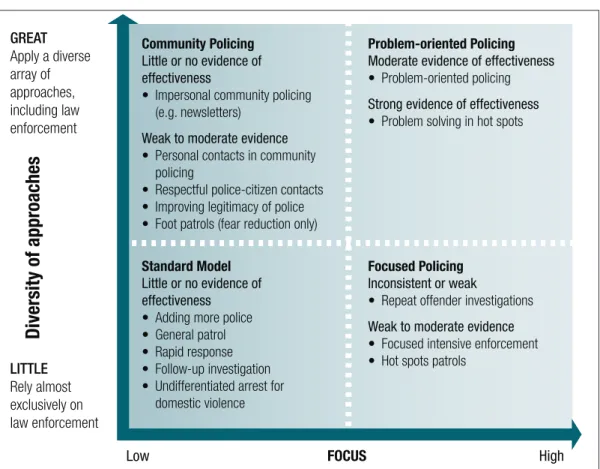
These and other studies point to a consistent picture of the kinds of police strategies that work to reduce crime. In 2004, a National Research Council report described four policing strategies and their relative effectiveness (see Figure 1). The more focused the strategy and the wider array of tactics used, the more effective the strategy. In the lower left of Figure 1, the standard model of policing (relying predominately on random patrol, follow-up investigations, and rapid response) is the least effective strategy. It does not focus on specific places, people, or times and uses a predominately law enforcement approach.
Somewhat more effective is community policing (in the absence of problem solving). Community policing gains effectiveness by adding considerably more tactics, but it is still relatively unfocused. Focused policing, on the lower right in Figure 1, is far more effective than standard policing, because it narrows policing efforts to “hot” people, places, or times. Instead of spreading resources thinly, like standard policing, it concentrates resources. Intelligence analysis fits very well into this strategy. Evidence and theory suggest that combining the focus with a
wider array of tactics improves police effectiveness more. That is the form of policing in the upper right part of Figure 1. The three experiments described above illustrate this point. All experiments involved focusing on hot places, but when police coupled law enforcement with other tactics they further increased their effectiveness at reducing crime and disorder. The role of intelligence analysis in addressing problems is to shed light on how offenders behave so police can craft a solution. In short, intelligence analysis is an integral part of Problem-Oriented Policing. Often this will involve some sort of enforcement, but the enforcement will be highly targeted to have the greatest impact on the problem, and will often be part of a larger set of actions designed to make it harder for any remaining or new offenders to perpetuate the problem.
READ MORE:
National Research Council . 2004 .
Fairness and
Effectiveness in Policing.
Washington, D .C .: National
Academies Press .
14 Intelligence Analysis for Problem Solvers
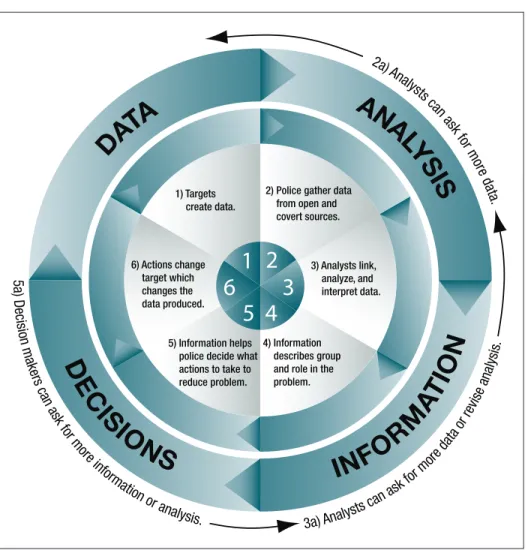
1. Targets create data. Offender groups are the targets. Citizens might see them. They might act in ways that provoke police stops and arrests. They might write graffiti or create social network pages. They may have bank accounts. They may be recorded by closed circuit television (CCTV). In each of these examples, a person or machine captures data describing group members. In isolation and in these raw forms, these data are relatively meaningless.
2. Police gather data. Data from an informant, or on a digital recording device, or in a database needs to be collected to be analyzed. There are data capture processes that are obvious (e.g., police databases of offenders or CCTV footage from cameras near a crime site, confederates of members of an offender group) while other data capture processes require some creative thinking to recognize (see Steps 6–13).
3. Analysts interpret data and 4. Analysts produce information. Once police or others collect the data, analysts need to combine it with other data and interpret it to produce useful information. An important part of the analysis is determining the validity of the data (for example, is one piece of data consistent with other pieces of data from other sources). Another important aspect of analysis is organizing valid data into a coherent story. Organizing data requires analysts to use two sets of tools. One set of tools comprise analytical techniques: maps, network charts, statistical programs, and so forth. However, theories of groups and how they produce crime are more important than analytical techniques. Theories suggest what data is important and how it should fit with other data. Theories also provide hypotheses that you can test with the data (see Step 21). All good analysts have one
or more theories of how they can organize the data to produce a meaningful and valid story. We will discuss several such theories in later Steps 6 through 13. This analysis—with techniques and theories—creates information.
5. Information helps police to decide what to do. Information assists decision makers who choose actions. Decisions based on this information create actions whose purpose is to alter that target (for example, arresting members of the group) or the environment in which the target operates (for example, preventing group members from having access to key places, denying them weapons or other tools, or freezing their assets).
6. Actions change the target and produce new data. If your analysis has accurately described the offending group and its behaviors, and if the decision maker has used this information, then the actions will change the target. They may remove members of the group, or force the group to alter its behaviors. Ideally, this results in less crime or disorder. Such outcomes are known because the data emitted by the group changes— there are fewer attacks, less graffiti, less drug dealing, and so forth. The new data enters the cycle and helps police adjust their understanding of the group.
In fact, the cycle is more complex than just these six stages described. An intelligence process also consists of a series of feedback loops (2a, 3a, 5a) dependent on the target, information, and the decisions being considered.
◾ 2a. Analysts can seek more data and 3a. Analysts
can revise their initial analysis. As an analyst, you should not passively accept any data that comes your way. You can request the collection of additional data—for example asking that
INTELLIGENCE ANALYSIS IS NOT SIMPLY THE COLLECTION OF COVERT DATA, nor is it making sure it is shared
appropriately. Although collection and sharing receive considerable attention, and for very good reasons, this attention has obscured the simple fact that they are merely parts of a larger process illustrated by Figure 2. Our discussion of the process follows the numbered stages in the diagram.
Understand the Role of Intelligence Analysis
new questions be put to an informant. This new data might help test the reliability of previously collected data. It might fill in critical gaps about a group; it might be used to determine how the group makes use of its environment; or the new data may be needed to help determine which of several alternative hypotheses is more likely to be true (see Step 21). New data might require further analysis or the original analysis may have produced contradictory results so further analysis is needed, for example. The additional data would then have to be analyzed in light of the earlier information.
◾ 5a. Decision makers can ask for more
information or analysis. While decisions are being formulated you might be asked for additional information that could help refine the choice of actions. If the information is readily
makers. This might require going back further and conducting additional analysis. Or it might even require obtaining additional data.
The analysis process does not end with action against a target. You still need to determine if the actions had the desired effect. Does the group still exist? Have the group’s criminal activities slowed down or stopped? Has the group changed its tactics to circumvent police actions? Have other groups moved in to replace the original group? Were there unintended consequences from the actions? Evaluating actions helps decision makers decide whether they should move on to other targets, make adjustments in how they handle this target, or whether their actions failed and they need to start over.
Figure 2.
Intelligence analysis process
1
5
2
3
6
4
16 Intelligence Analysis for Problem Solvers
Perhaps the commonest use of the term by police relates to the type of decision it serves. Strategic analysis typically describes enquiries conducted to help long-term broad decisions—such as determining the appropriate approach for addressing repeat offenders. Tactical analysis serves shorter term decisions, having a narrower scope. So patrol commanders might ask for a tactical analysis of how best to allocate officers to handle a political demonstration. Intelligence analysis can be used at either level.
Analysis is also sometimes used by police to describe the “customers” for the analytical work, as in the following:
◾ Investigative analysis helps investigators solve particular crimes, or a pattern of crimes. ◾ Patrol analysis is designed to serve the needs of
patrol officers and supervisors.
◾ Traffic analysis helps police focus resources on vehicle traffic (though sometimes the term is used to describe drug trafficking or communications traffic).
◾ Problem analysis is used by police and others involved in problem-oriented policing projects to reduce specific forms of crime and disorder. A crime analysis unit may conduct any combination of these forms of analysis. As we will describe below, intelligence analysis overlaps investigative analysis and problem analysis.
Since crimes involve offenders, targets, and places, there can be analysis that focuses on all three of these elements. Offender analysis focuses on offenders, and is closely related to investigative analysis. In contrast, place and geographic analysis focuses on various geographic concentrations of crime—such as crime hot spots, repeat crime places, and risky facilities
(see the POP Center’s Risky Facilities Guide for more details). And target analysis focuses on the people or things offenders attack. Forms of target analysis include repeat victim analysis, virtual repeat victim analysis, and hot product analysis. These and other forms of target analysis are used in problem analysis. As shown in Figure 3 on page 17, target, place, and offender analysis overlap and all are forms of crime analysis (the examination of information to help prevent crime). For example, Joe Combs, a detective for the Cincinnati Police Department, discovered that a single apartment complex had an extraordinarily high number of burglaries (both compared to its previous history, and compared to other apartment complexes). Within the complex, several households were burgled multiple times, and most burglaries during this spike in crimes were committed by a small group of offenders (the burglaries declined following their arrest). He had discovered a combination of repeat places, repeat victimization, and repeat group offending. It is useful to link forms of analysis to the types of problems the analysis is supposed to examine. That is why we define police intelligence analysis as focused on problems created by groups of offenders. Intelligence analysis is related to offender analysis (and investigative analysis) because of its focus on offender groups. Intelligence analysis also overlaps both place and target analysis. Consequently, intelligence analysis is a form of crime analysis as well.
Another way to see how intelligence analysis fits within crime analysis is to compare analysis used in reacting to crime patterns and those forms of analysis that attempt to understand the causes of crime patterns and to develop prevention initiatives. The first we will call reactive and the second proactive. We can also distinguish between analysis focusing on offenders and
CRIME ANALYSTS USE THE TERM “ANALYSIS” TO REFER TO SPECIFIC TECHNIQUES THEY USE, SUCH AS GEOGRAPHIC analysis (i.e., crime mapping) or statistical analysis (to explore relationships among the variables in a data set). But the police use “analysis” in many other ways as well. This creates confusion about the meaning of the term and how “intelligence analysis” fits with other forms of analysis. Here we describe how intelligence analysis is related to other kinds of analysis used by local police agencies.
Understand the Role of Intelligence Analysis
those focusing on crime patterns (such as geographic analysis). This gives us a simple way of organizing some of the most important forms of analysis (see Table 1). Intelligence analysis is a proactive form of offender analysis. It shares this proactive status with place analysis. Both place analysis and intelligence analysis are forms of problem analysis. Also, they stand in contrast to reactive analysis of crime patterns, such as simple hot spot detection and other forms of geographic analysis. This view of intelligence analysis underpins Jerry Ratcliffe’s 3-i model, which portrays the role of intelligence analysis as an essential, action-oriented, decision support function (see The 3-i Model on page 18).
In conclusion, there is no standard way of classifying analysis types and many forms of analysis overlap. Intelligence analysis shares many features with many types of crime analysis. We believe that the distinguishing feature of intelligence analysis concerns not techniques but the fact that intelligence analysis focuses attention on offender groups.
Table 1.
Reactive and proactive forms of crime analysis
REACTIVE AND PROACTIVE FORMS OF CRIME ANALYSIS
Reactive
Proactive
Offenders
Investigative analysis – the analyst examines databases to assist investigators solve a crime or crime series.Intelligence analysis – the analyst pulls together information on problems created by offender groups to help craft methods for reducing that problem.
Locations
Patrol analysis – the analyst examines databases to help determine when and where police should allocate patrol resources.Place-analysis – the analyst pulls together information from databases, targeted information gathering and other sources to
Figure 3.
Overlapping forms of crime analysis
18 Intelligence Analysis for Problem Solvers Understand the Role of Intelligence Analysis
Jerry Ratcliffe’s
3-i model
redefines the role of analysis in an intelligence-led policing environment .
Instead of viewing intelligence analysis as simply understanding the criminal environment, the
3-i
model
demands that intelligence analysts also identify decision-makers and influence their thinking .
Decision-makers are people who have the power and resources to have an impact on the criminal
environment . Thus, intelligence analysts have a leadership role within policing, guiding priorities and
resource decisions .
Ratcliffe’s
3-i model
begins with an arrow from analysis to the criminal environment . This emphasis
is deliberate . Analysts can’t wait for data to come to them: they have to actively seek out the
information they need . Creating and disseminating an intelligence product is not a sufficient
outcome in the
3-i model
. Instead analysts must identify a decision-making framework they
can influence and actively work to help decision-makers have a direct impact on the criminal
environment . Making recommendations to guide decision-makers (both inside and outside policing)
to prevent, disrupt or reduce criminal activity is a vital role of the analyst . Learning the theory and
practice of what works to reduce crime is crucial .
Ratcliffe’s
3-i model
challenges analysts and decision-makers to work closely together . It rethinks
the role of intelligence analysis as an essential, action-oriented, decision support function .
Source: Ratcliffe, J. H. (2008) Intelligence-Led Policing, Willan Publishing. For further information see www.jratcliffe.net.
Table 2.
Intelligence in policing strategies
LOW FOCUS
HIGH FOCUS
Limited tactics
Mostly Law Enforcement
Standard policing
Very little influence on crime Very little use of intelligence analysis
Focused policing
Strong influence on crime
Intelligence data from limited sources which is used to target enforcement on crime groups
Wide variety of tactics
Including Some Law Enforcement
Community policing
Modest influence on crime Improves the flow of intelligence data from community members
Problem-Oriented Policing
Highly effective against crime
Intelligence from variety of sources is used to craft interventions that curtail crime group activities
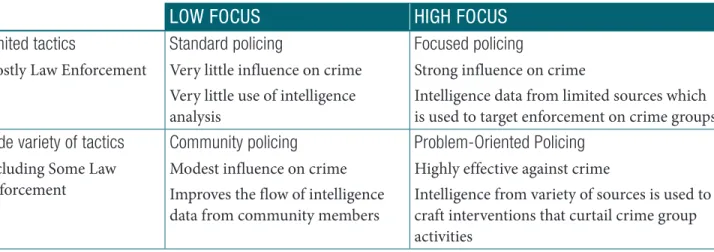
AS MENTIONED IN STEP 2, IN 2004 THE NATIONAL RESEARCH COUNCIL PUBLISHED A COMPREHENSIVE ASSESSMENT of police research and policy. It showed how all policing strategies fall into four groups, depending on the degree to which they focus on specific crime problems and the range of tactics they employ. These four groups are standard policing, community policing, focused policing, and problem-oriented policing (see Table 2). Intelligence analysis plays somewhat different roles in each strategy.
APPRECIATE HOW INTELLIGENCE FITS IN POLICING STRATEGIES
Standard Policing makes the least use of intelligence analysis. Standard policing is relatively unfocused and employs a limited number of law enforcement tactics generically across a wide variety of circumstances. The principal tactics are patrolling, reactive follow-up investigations, and rapid response to calls. To improve effectiveness, the main approach is to add more police and do more of the same. Research has shown that at best this has very limited effects on crime, fear of crime, or disorder. Standard policing uses very little information and makes little use of crime analysis to assist in making critical decisions. Intelligence analysis, when used, is the province of highly
specialized units that often communicate poorly with standard patrol operations.
Standard policing is ineffective for several reasons. First, it does not use information to focus resources on the relatively few people, places, and circumstances that need the most attention. Consequently, it spreads its resources too thin where they are most needed. Further, the lack of information makes it difficult to develop
innovative tactics that exploit the vulnerabilities of offenders. Finally, standard policing puts more emphasis on following routine law enforcement and arrest practices than on preventing crime.
Community policing seeks to bridge the gap between police and community. It places far less emphasis on law enforcement and uses a wider repertoire of policing tactics. However, community policing is relatively unfocused unless it includes a strong component of problem solving. Research evidence suggests that it can be somewhat more effective at reducing crime than standard policing, but the results are ambiguous. Like standard policing, most community policing makes limited use of information technology, crime analysis, and intelligence.
The strength of community policing is that it
provides the foundation for the two-way exchange of information between members of the public and the police. This is particularly critical in neighborhoods suffering from high levels of crime and when dealing with crime groups hidden within communities, or
20 Intelligence Analysis for Problem Solvers Understand the Role of Intelligence Analysis
intimidating community members. In the absence of community policing, developing intelligence on these groups can be extremely difficult. For these reasons community policing is a necessary condition for effective intelligence analysis. It is a foundation strategy on which other strategies can be built. Focused policing strategies are a collection of approaches that build on the law enforcement tactics used in standard policing by making much greater use of information. Information is used to identify offenders and places that are disproportionately involved in crime. There is strong evidence that targeting very high crime places can reduce crime considerably, but evidence about the usefulness of targeting persistent offenders is much less clear. This can increase the chances of arresting the most prolific offenders, but existing studies have failed to examine whether crime declined as a result of such targeting. Because focused policing places information analysis at the forefront of policing, intelligence is more important for this strategy than for the standard policing or community policing. However, in the absence of community support, only limited intelligence is available. Furthermore, when limited to law enforcement tactics, focused policing does not address the facilitating conditions that allow criminal groups to operate. So focused policing, like community policing, is a foundation for effective use of intelligence. But neither is sufficient on its own and we need to combine community and focus.
Problem-Oriented Policing, which wasdeveloped to address the limitations of standard policing, succeeds in combing community and focus.
It was specifically designed to be highly focused— thus capturing the advantages of focused policing— and to use a variety of tactics with the community— thus building on community policing. It addresses any and all aspects of crimes, including the places involved, the targets and victims affected, and the offenders.
Research into problem-oriented policing practices has shown that it is highly effective at reducing crime and disorder. Though there are few head-to-head comparisons between focused policing and problem-oriented policing, the research that is available shows that following a problem-oriented approach has greater benefits than simply focusing on crime hotspots.
The basic principles of problem-oriented policing are simple to state. First, problem-oriented policing places far greater emphasis on what the police are to accomplish—the ends of policing—than on the means of policing. As long as the policing practices are constitutional and legal, are acceptable to the community, are affordable, and have a high likelihood of being effective, problem-oriented policing does not specify what should be done. Instead, problem-oriented policing states that the goals of police are to reduce community problems. Second, problem-oriented policing claims that information needs to be examined to determine how specific problems arise and to determine what sorts of actions can be done to reduce or eliminate these problems. Third, problem-oriented policing calls for a thorough search for solutions to the problem, not limited to law enforcement options. Finally, since the goal of problem solving is to solve the problem, problem-oriented policing requires evaluation of the outcomes of the intervention.
Understand the Role of Intelligence Analysis
These principles have been codified in the well-known SARA process (see Figure 4). SARA stands for Scanning, Analysis, Response, and Assessment. This is a cyclical model that starts with the identification and definition of a problem (Scanning), followed by detailed analysis (Analysis). Intelligence analysts can play important roles at these initial stages by helping to identify groups that are generating serious crime problems and producing information that describes how they operate. Response is the third stage, where solutions are developed and implemented. Intelligence analysis can help identify possible interventions based on information describing group vulnerabilities.
The last stage (Assessment) is the evaluation of the intervention. Again, intelligence analysis can help determine if the interventions worked by looking at the impact on the targeted group and whether their crimes have declined. In Figure 4, the large clockwise arrows show the standard cycle. The smaller, inner arrows indicate that often a problem-solving process needs to revisit earlier stages as new questions arise or evidence suggests that interventions are not working as expected.
READ MORE:
David Weisburd and John Eck . 2004 . “What Can Police
Do to Reduce Crime, Disorder and Fear?”
The Annals of
the American Academy of Political and Social Science.
593:42–65 .
22 Intelligence Analysis for Problem Solvers
“Choice” means that offenders select actions they think will help them achieve their purposes. In making these choices, offenders have limited and sometimes confusing information. They also often have limited time and competing objectives. To address these limits, they use rules of thumb and habit to reduce the information they need and to increase the speed of their decisions. “Do what others in my group do,” is one such rule of thumb. “Do what worked before,” is another such rule.
Understanding offender choice is critical to intelligence analysis. This is because the principle method of reducing crime is to change these choices. We do this by manipulating the physical and social environment surrounding offenders. There are five choice criteria offenders use: effort, risk, reward, excuses, and provocations. The less effort or risk, the greater the likelihood the offender will commit a crime. The more reward, greater the excuses, or higher the provocations, the more likely the offender will choose crime.
These five criteria influence all people—not just offenders—in all choices—not just offending. Features of the immediate environment signal the individual as to whether a particular set of actions will be useful or counterproductive. The individual then makes a choice. This environment includes the physical setting and the social arrangements. One very important social environment for intelligence is the offenders’ group.
An offender in a group may make a very different choice than the same offender outside a group but facing the same circumstances. Groups provide a context that influences individual choice (see Table 3 on page 23):
1. Group members can make crime easier by supplying tools, providing transportation, sharing information, and taking on some of the work. A crime that one person cannot do, may be feasible with a group.
2. Groups can make it safer (fewer risks) by mutual protection and sharing information about possible risks. Identifying suspects may become harder if witnesses cannot distinguish among several confederates.
3. Groups also make crime excusable for their members by justifying the behavior and providing stories as to why the crime is “really necessary.” 4. Groups make crime enticing to their members
through peer pressure, and by providing examples to follow.
5. Groups make crime rewarding by giving individual members a sense of belonging, providing an audience to celebrate successful crimes, and other intangible, but important, psychological rewards, in addition to the more familiar tangible rewards of crime.
These attributes, which we collectively call ESEER, correspond to standard choice criteria we all use when selecting actions: effort, risk, excuses, provocations, and rewards. These are so critical to understanding crime and its prevention, we will return to them repeatedly throughout this manual.
A USEFUL STARTING POINT FOR APPROACHING INTELLIGENCE ANALYSIS is to assume that offenders choose to take advantage of limited crime opportunities. They take advantage of situations where crime is easy, low risk, rewarding, socially encouraged, or provoked. There is considerable evidence that focusing on offender choices can reduce crime, and there are many ways to address crime by blocking opportunities.
Know the Fundamentals of Criminal Groups
To an outsider, considering the individual offender in the abstract, the choice may seem inexplicable and even irrational. When examined in the context of a group of offenders, the same choice appears reasonable (even though objectionable). However, groups do not inevitably increase crime. Offender groups can control their members’ behaviors so that individuals only choose crimes when it is more likely to aid the group. As we will discuss later (Step 26), it is sometimes possible to exploit the group to reduce offending. Because individuals seldom have complete knowledge about other members of their group, they may misinterpret the circumstances. One example is called “pluralistic ignorance.” This describes circumstances where each member of a group believes other members value something when in fact few if any other members actually value it. However, to please the others, each group member professes that they too hold that value, thus justifying what the others believed. As a result, the group members express a preference that no individual alone would prefer. Within an offender group, no individual may want to get involved in a fight with another group, but thinking that the other members do want to get into a fight, and believing they will lose face if they refuse, all members of the group jump into the fight.
A commonly held misconception is that people in large crowds lose their self-identity and become “irrational.” However, considerable research on crowds shows that this is not the case. People make choices in crowds just as they do outside of crowds. The difference is that within a crowd, an individual will
also take into account what other people are doing and what is happening to them. From an outsider’s perspective, the crowd may seem as a single entity that transcends the individuals that make it up. However, from inside it is clear that a crowd, of any size, comprises individuals and small groups, often with very different interests. Intelligence analysis can play an important role in helping to maintain orderly crowds by providing information on the diversity of interests within a crowd and helping to separate the few troublemakers from the many other individuals. While offenders take advantage of existing
opportunities for crime, they can also manipulate situations to extend opportunities and make new ones. An organized crime group that bribes a local politician creates opportunities for taking public funds. A terrorist group that infiltrates a member into security forces opens up opportunities for further terrorist activities that did not exist before. Street gang intimidation of witnesses expands the ability of the gang to engage in criminal activity. Intelligence analysis should look at how offending groups manipulate their environments to extend their opportunities.
READ MORE:
Ronald Clarke . 2008 . “Situational Crime Prevention .”
In
Environmental Criminology and Crime Analysis
, ed .
Richard Wortley and Lorraine Mazerolle . Cullompton,
Devon: Willan Publishing .
Table 3.
How groups influence choices
CHOICE CRITERIA INFLUENCE OF GROUP
EXAMPLES
Effort
Makes crime easier Dividing a complex task or spreading effort among several offendersRisks
Makes crime safer Providing protection, sharing information, or intimidating witnessesExcuses
Makes crime more excusable Claiming crimes are permissible or desirable, and denigrating victimsProvocations
Makes crime more enticing Pressuring, encouraging, or guiding members24 Intelligence Analysis for Problem Solvers
Opportunities are situations that offenders can exploit for their gain (e.g., material reward, social dominance, revenge, relief from threat, and so forth). The basic structure of opportunities is often depicted by the problem analysis triangles (see Figure 5). The inner triangle shows the three elements required for a crime to occur: a ready offender or group of offenders, a desirable target (person, animal, or thing), and a place for the two to interact. At minimum, crime opportunities occur when offenders are at places with desirable targets. Removing any one of these three required elements can eliminate the opportunity. Standard law enforcement focuses on offender removal. This can be useful, if the offenders are not easily replaced (Step 13), but there are other ways to reduce crime that also must be considered, either for use with enforcement or as stand-alone options.
There is more to crime opportunities than these three basic elements: a crime opportunity also requires absence or ineffectiveness of any of the three outer elements of the triangle.
◾ Guardians are people who protect the target— owners of things the offender wants to take or damage, friends of people the offender would like to attack, security guards hired to protect buildings from terrorist attack.
◾ Handlers are people who try to keep the potential offender out of trouble. They can be parents, siblings, spouses, friends, coworkers, teachers, clergy, and others with whom the potential offender is positively socially connected. They can even be other offenders.
◾ Finally, managers are people who control spaces: owners of locations (private or public), hired employees who work at the location, or others to whom the owner has delegated authority to regulate conduct at the place.
Collectively, we call handlers, guardians, and managers controllers, as they control their corresponding elements on the inner triangle. Consequently, in addition to removing one or more of the inner elements, adding one or more controllers helps to reduce crime.
The convergence of offenders with targets at accessible places, in the absence of controllers, makes crime possible. When this happens repeatedly, a crime pattern emerges. Why does this occur? The normal routines of everyday life create most crime opportunities. These include commuting and school schedules. Street drug dealers often locate near commuter routes and when they do so their daily activity patterns follow the routines of commuters
Figure 5.
The problem analysis triangles
THE MOST ESSENTIAL REQUIREMENT FOR CRIME IS OPPORTUNITY. Regardless of a person’s motivations, if there is no opportunity there can be no crime. Further, a tempting opportunity may entice a person to commit a crime they would not ordinarily consider. Offender groups can develop to exploit specific opportunities. Human traffickers and smugglers take advantage of two opportunities: the desire of people to leave impoverished countries and the demand for cheap human labor in other countries. Internet commerce created the opportunities that cyber gangs exploit. Drunken bar patrons provide opportunities for youth groups to commit robberies.
Know the Fundamentals of Criminal Groups
and students. Armed robbery groups can exploit the regular patrons of entertainment districts and drinking routines. The routines of the internet allow fraudsters to exploit users. Natural disasters disrupt some routines, but create other routines that offenders can exploit, including the routines of insurance companies and government aid agencies. Car and suicide bombings by terrorist groups are feasible because people routinely gather at particular places: markets, hotels, and transportation hubs, for example. A peaceful political march creates a routine that small groups of offenders can exploit to create disturbances. Driving routines leave some stretches of highway largely vacant for periods, thus allowing street racing groups to use them. Knowing the spatial and temporal patterns of crime is not just important for allocating law enforcement, it is critical for identifying the routines the crime group is exploiting so that sustainable prevention can be introduced.
Opportunity is in the eye of the offender. Offenders, singly or in groups, judge reward, effort, risk, excuses, and provocations (see ESEER in Step 6) by the presence and absence of the six elements described by the problem triangle. The presence of a target at a place reduces effort while suggesting reward and perhaps providing a provocation. Guardians and managers influence risk and effort. Other offenders can increase excuses and provocations as well as reduce effort and risk. Handlers reduce excuses and provocations, and sometimes rewards.
Offenders, however, can manipulate situations to increase the crime opportunities. Manipulation of opportunities—creating new ones or improving existing ones—is easier for offenders in groups than those operating singly.
Targets and their guardians
Groups enhance the ability of offenders to manipulate targets. A group of offenders has an easier time finding targets because they have more people looking. Sheer numbers can overwhelm a target’s defenses and overcome guardians. A group of
offenders has greater ability to intimidate victims, thus reducing the chances of effective police involvement. Specialization within a group allows it to undertake complex offenses, from con games to terrorist attacks. A large group, with sufficient resources, can bribe guardians to gain access to targets. Similarly, it can
Offenders and their handlers
Groups promote offending through recruitment of members and allies. A large group can isolate its members, thus reducing outside influences—such as from parents—and increasing the influence of other group members. In this way, they replace outside handlers with inside handlers. Groups can also promote offender learning. Members of the group learn about what works and what does not to successfully pull off a crime. This information can be disseminated throughout the group and passed down to future members. Importantly, groups produce both excuses and provocations for committing crimes. However, in some circumstances you may be able to take advantage of how offenders in groups handle each other to reduce group violence (Step 26).
Places and their managers
Offender groups can seize control of places that an individual offender cannot. A drug-dealing group can hold a street corner against other dealers more easily than a dealer can on his own, for example. Terrorist organizations in some countries hold large swaths of territory. Offender groups can use places for meetings; for stashing weapons, drugs, and other goods; for prostitution and other human exploitation; for safe houses; and other purposes. Whether seized or purchased, once a place is controlled by the group it can organize the physical space to facilitate its activities. These methods can result in reduced risk or effort, or increased rewards.
Even if the group does not completely take over a location, they can bribe, intimidate, or replace managers so that the group can be sure that the place operates in a manner that helps their activities.
READ MORE:
Marcus Felson . 2008 . “Routine Activity Theory .” In
Environmental Criminology and Crime Analysis,
ed .
Richard Wortley and Lorraine Mazerolle . Cullompton,
Devon: Willan Publishing .
Marcus Felson and Ronald V . Clarke . 1998 .
Opportunity
Makes the Thief.
Police Research Series Paper 98 .
London: Home Office .
26 Intelligence Analysis for Problem Solvers
DISTINGUISH BETWEEN CRIMINAL GROUPS AND PROBLEM GATHERINGS
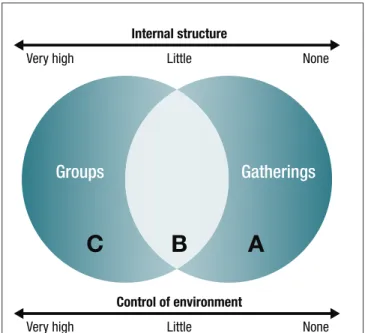
◾ Groups are composed of offenders connected by some form of internal structure. Examples of structure include routine communications links, hierarchy, chains of command, and recruitment and expulsion practices. These and other forms of structure can be clear, strong, and enduring (area C in Figure 6), but often they are vague, weak, and transitory (Step 9).
◾ Gatherings are collections of individuals at particular places and time. Gatherings have little or no structure. Many gatherings are only collections at a place and time of separate individuals with no other connections (area A), but some gatherings have weak internal structures, thus overlapping with groups (area B). Typically, many participants have no intent to offend. Here are three examples illustrating these distinctions: 1. A local bus system efficiently transports students
to and from their schools by routing busses through a downtown hub where passengers can transfer. Students from many different schools congregate at the transit hub. If there are no other connections among the students, this is an example of a gathering. Within this gathering, a few individual students may bully and steal from other students, but they do not coordinate their activities in any way. Some of the non-offending students, nevertheless, may provide cover for the offenders. Here, the environment (the school, bus systems, the transit hub, gathering of students) provides an external structure and a set of crime opportunities for individual offenders.
2. Some youths from the same school may travel together so they can intimidate and steal from other students at the transit hub. They target students from a rival school waiting for particular busses at particular times. Here we see the
overlap of gathering and group: the offending students have a rudimentary internal structure that helps them exploit their environment, but the environment is still providing most of the structure.
3. A neighborhood street gang robs pedestrians and runs a protection racket for merchants. It has a leader, rules for entry and conduct, and a hierarchy. Members use vehicles to get around and find likely targets. The internal structure here is strong, and allows the group to make use of the environment. Further, the group members can manipulate the environment to further their criminal activities. For example, they may alter the physical environment by using a meeting place and adapting it to their use (e.g., destroying streetlights). Intimidation alters the social
environment to reduce their risks of apprehension.
YOU SHOULD DISTINGUISH CRIMINAL GROUPS (such as pedophile rings and outlaw motorcycle gangs) from problem gatherings (such as juveniles involved in cruising or who meet for street racing). In both cases, you need to analyze the conditions that permit them to operate in your jurisdiction and ultimately work to remove these conditions. An important distinction between groups and gatherings concerns their internal structure: