Moderating Effect of Efficacy in the Mediating Effect of
Self-Regulation on Students’ Academic Performance
Temidayo Iheanyichukwu1† Emily O. Ademiji2 Friday O. Omonuwai3
1Department of Educational Foundations and Counselling, Faculty of Education,
Olabisi Onabanjo University, Ago-Iwoye
2Department of Psychology, Guidance and Counselling, School of Education,
Federal College of Education, Abeokuta.
3Department of Educational Psychology, College of Education,
Ekiadolor-Benin. Abstract
In this study, the mediating effect of self regulation on self-efficacy – academic performance relationship was proposed to be further moderated by self-efficacy. Four hundred and sixty seven secondary school students drawn from schools in an education zone of Ogun State, Nigeria took part in the study. Data were collected using three validated scales and academic records of students. Analysis was carried out on SPSS version 21 using the moderated mediation macro (model 1) developed by Hayes (2013). Results indicated that there were significant and positive relationships between self-efficacy, self-regulation and academic performance. Results indicated that the indirect effect of efficacy on academic performance through regulation is conditioned on self-efficacy. Implications for theory, research and intervention programmes were stressed.
Key Words: Self regulation; Self-efficacy; Academic performance; Students; Moderated mediation effects
Introduction
Improving on students’ academic performance has been a major concern of stakeholders of education. The huge cost of education cannot permit any form of neglect in the improvement of students’ academic performance. Constructive interest in programmes and projects that would enhance students’ academic performance has always been applauded.
Academic performance has been found to be influenced by factors within the family (Clark, Novak, & Dupree, 2002; Folorunso, Aremo, & Abogan, 2010), the school (Akinsolu, 2010; Lee & Shute, 2010; Midgley, Anderman & Hicks, 1995) as well as the students (Adeyemo & Torubeli, 2008; Onyeizugbo, 2010). Distinctively, family and home-related factors as parental educational level (Folorunso, Aremo, & Abogan, 2010) and parenting practices (Chapman & Mullis, 1999; Clark, Novak, & Dupree, 2002; Pomerants, Gronick, & Pricfe, 2005; Spera, 2005) have been identified. School and teacher-related factors like teachers' qualifications, experience and teacher-student ratio (Akinsolu, 2010) and teachers’ sense of efficacy (Tschannen-Moran & Hoy, 2001) have also been noted. Finally, student-related factors like test anxiety (Onyeizugbo, 2010) and peer influence (Adeyemo & Torubeli, 2008) have been observed to influence students’ academic performance. The influences of family, school and students’ personal factors on academic performance remain extensive.
Research persists to investigate the intricacy of the numerous factors impacting on academic performance not only as univariate predictors with one independent variable, but also at the multivariate level with multiple predictor variables. Whereas, the contextual factors seem uncontrollable by the students, some researchers have focused on multiple students’ related factors of academic performance (Pajares & Schunk, 2001; Onyeizugbo, 2010, Edun & Akanji, 2008).
Self-efficacy refers to beliefs about one’s capabilities to learn or perform behaviours at designated levels. This is the capacity to organize and execute the courses of action required to manage prospective situation (Bandura, 1977; 1986; 1997). Self-efficacy is entrenched in a larger theoretical framework of the social cognitive theory, which suggests that human achievement depends on interactions between one’s behaviours, personal factors (e.g., thoughts, beliefs), and environmental conditions (Bandura, 1986; 1997). Students gather information to assess their self-efficacy from their actual performances, their vicarious experiences, the persuasions they receive from others, and their physiological reactions (Bandura, 1997). Much research shows that self-efficacy affects task choice, effort, persistence, resilience, academic motivation, learning, and achievement (Pajares, 1996; Schunk, 1995).
Research findings indicate that self-efficacy correlates with achievement outcomes (Bandura, 1997; Pajares, 1996; Schunk, 1995), self-oriented perfectionism (Bandura, 1989; Mills & Blankstein, 2000), and indexes of self-regulation, especially use of effective learning strategies. Self-efficacy, self-regulation, and cognitive strategy use are positively inter-correlated and predict achievement (Pintrich & De Groot, 1990). Self-efficacy beliefs have been found to be sensitive to subtle changes in students’ performance context, to interact
with self-regulated learning processes, and to mediate students’ academic achievement (Pintrich, 1999; Zimmerman, 2000). Study findings have persistently revealed that self-efficacy is positively related to academic performance (Caprara, Barbaranelli, Steca, & Malone, 2006; Ferla, Valcke, & Schuyten, 2008; Griffin & Griffin, 1998; Jackson, 2002; Lane & Lane, 2001; Lane, Lane, & Kyprianou, 2004; Pajares, 1996; Pajares & Kranzler, 1995; Pintrich & De Groot, 1990).
Self-regulation is defined as the process by which learners set and maintain cognitions, affects, and behaviours in motion, which are thoroughly geared towards achieving their goals (Zimmerman, 1989). Great evidence exists in support of self-regulation as the systematic efforts to direct thoughts, feelings, and actions, toward the attainment of one's goals (Zimmerman, 2000).
Self-regulation involves the ability to both control one's impulses and engage in a particular behaviour on demand (Bodrova & Leong 2008; Zimmerman, 1990). It is a skill used not just in social interactions (emotional self-regulation) but in thinking (cognitive self-regulation) as well. Self-regulation of learning is a process that required students to get involved in their personal, behavioural, motivational, and cognitive learning tasks in order to accomplish important and valuable academic goals (Bembenutty, 2007).
Self-regulation has assumed increasing importance in the psychological and educational literatures in enhancing academic outcomes such as effort, quality of conceptual learning, school performance, and intention to persist in school (Bembenutty, 2007; Bodrova & Leong 2008; Cleary & Chen, 2009; Fortier, Vallerand, & Guay, 1995; Vallerand, 1997; Winters, Greene & Costich, 2008). Research (Bodrova & Leong 2008) shows that children's self-regulation behaviours in the early years predict their school achievement in reading and mathematics better than IQ scores. Even stronger evidence exists to show that self-regulation is positively related with self-efficacy (Hodges, Stackpole-Hodges, & Cox, 2008; Scott, Dearing, Reynolds, Lindsay, Baird, & Hamill, 2008; Schunk & Zimmerman, 2007) and to a larger extent academic performance (Nota, Soresi, & Zimmerman, 2004).
Studies have also indicated that perceived self-efficacy moderated the relation between performance-avoidance goals and reported use of self-regulatory strategies for students in a competitive, performance-oriented context (Braten, Samuelstuen, & Stromso, 2004), and effect of child behaviour problems on fathers' anxiety (Hastings & Brown, 2002). Several moderated mediation studies have been conducted with academic performance as outcome variable (e.g. Tabakr, Nguyena, Basuraya, & Darrowa, 2009)
Literature (D’Lima, Pearson, & Kelley, 2012; MacNeil, Kosberg, Durkin, Dooley, DeCoster, & Williamson, 2010; Moneta, 2011) exists on this modelling wherein the independent variable in a mediation model also function as a moderator of its own indirect effect on a dependent variable through a moderator. This, according to Hayes (2013), is “an intriguing form of conditional process” (p. 332).
The moderating effect of self-efficacy in a moderated mediation study involving self-regulation and academic performance has not been tested. Pajares (1995; 1996) demonstrated that, when self-efficacy is included in statistical models with other, more global, self-beliefs (such as self-concept, anxiety, and attributions), and with variables such as academic background, gender, ethnicity, ability, and socioeconomic status, self-efficacy is a strong predictor of academic performance and mediates the influence of other determinants. If the assertion that efficacy is a strong factor in any model would be taken seriously, self-efficacy would be expected to further moderate, the mediating effect of self-regulation in the relationship between self-efficacy and academic performance.
The present study therefore sought to determine whether self-efficacy would further moderate the mediating effect of self-regulation on the self-efficacy and students’ academic performance relationship. Hence, the model (Figure 1) was built for the study.
It was hypothesized that (i) there are significant positive relationships among efficacy, self-regulation and academic performance, and (ii) self-efficacy will significantly moderate the mediating effect of self-regulation on self-efficacy and students’ academic performance relationship.
Academic Performance Self-Regulation
Self-efficacy
Fig. 1. Conceptual model for the relationships among study
Method Participants
The sample for this study consisted of 467 school-going adolescents randomly sampled from senior secondary class one in ten secondary schools in Ijebu North Education Zone of Ogun State, Nigeria through stratified random and purposive sampling techniques. First, ten senior secondary schools were selected randomly from the existing nineteen schools in the education zone. Five each were selected from Ago-Iwoye and Ijebu Igbo axes of the zone. From the selected schools, one of the classes in senior class one was selected by random sampling while all students in the selected classes constituted the participants for the study. The sample was made up of 230 males (49.3%) and 237 female (50.7%) students with a mean age of 14.96 and a standard deviation of 3.56. Data were collected at the beginning of the second Term of the three-term school academic year. Participants at this period are just adjusting toi the transition to the higher school from the Upper Basic School
Instruments
The following instruments were used to collect data for the study. Academic Performance
To asses the academic performance of the participants, scores in English language, Mathematics, and Biology for the terminal examination prior to data collection were collected from the school records. Transformation to standard T-score was done for each of the subjects for the classes selected. Aggregates of the scores were recorded for the participants and used as their academic performance scores.
Self Regulation Questionnaire- Academic
Self-Regulation was assessed using the 26-itemAcademic Self-Regulation Questionnaire (SRQ-A: Ryan & Connell, 1989) developed to measure student's styles of self-regulation in the academic domain. The SRQ-A uses four subscales: external regulation, introjected regulation, identified regulation, and intrinsic motivation. External Regulation items (nine items, α = .81) assess the degree to which initiation of a behaviour is external to a person, such as a reward or threat of punishment (e.g., “Because that’s what I’m supposed to do”). Introjected regulation items (nine items, α = .87) assess the degree to which a person adopts, but does not accept, a regulation as one’s own. These items were designed to get at perceived pressures to do things (e.g., “Because I want the instructor to think I’m a good student”). Identified regulation items (seven items, α = .78) assess the degree to which one has come to value a behaviour, identify with it, and accept it as one’s own (e.g., “Because it’s important to me to work on my class work”). Intrinsic motivation items (seven items, α = .91) assess the degree to which a person initiates and engages in activities because they are genuinely interested or satisfied by the activity itself (e.g, “Because I enjoy each question used a 4-point Likert scale from Very True = 4; Sort of True = 3; Not Very True = 2; and Not at All True = 1. A higher score will indicate a higher level of endorsement of that regulatory style.
General Self Efficacy Scale
Self-efficacy was measured using the General Self-efficacy Scale developed by Schwarzer and Jerusalem (1995). The instrument is a 10-item scale that assesses self- efficacy based on Bandura’s (1977) definition of self-efficacy. Examples of items on the scale include ‘‘It is easy for me to stick to my aims and accomplish my goals’’ and ‘‘If I am in trouble, I can usually think of a solution.’’ The scale was measured on a 4-point Likert scaling model with options ranging from 1 = not at all true, to 4 = exactly true. Higher scores on the self-efficacy scale indicate high self-efficacy. The original version of this scale which has been used in numerous research projects yielded internal consistencies ranging between alpha = .75 and .90 (Schwarzer & Jerusalem, 1995). The scale is parsimonious, reliable and culture fair. It has also proven valid in terms of convergent and discriminant validity.
Procedure
The instruments were administered on the sample in their various schools. The instruments were collected back immediately and later scored. Scores of students in each of the sampled schools in English language, Mathematics and Biology were collected and standardised to T-score. The data obtained from the instruments were analysed using descriptive statistics (mean and standard deviation), Pearson Product Moment Correlation, and to test the moderated mediation effects hypothesis, the modmed macro (Hayes, 2013) for exploring the moderation mediation effects was used to determine the interaction between self-efficacy
(independent and moderator variable) and self-regulation (mediator variable) in predicting students’ academic performance (dependent variable). The results were tested for significance at the .05 level.
Results Preliminary Analysis of data
Table 1: Descriptive Statistics of the Dependent, Independent and Moderator variables of the Study (N = 467)
Min. Max. Mean SD. Skew SE Kurt SE
Self-efficacy 11.00 40.00 29.486 4.897 -.394 .113 .124 .225
Academic self-regulation 53.00 128.00 107.936 12.822 -.701 .113 .557 .225 Academic achievement 34.00 76.00 56.512 7.903 -.413 .113 -.304 .225
Table 2: Correlation Matrix of the Dependent, Independent and Moderator variables of the Study
Self-efficacy Self-Regulation Academic Performance
Self-efficacy 1
Self-regulation .202*** 1
Academic Performance .581*** .655*** 1
*p < .05; **p < .01; ***p < .001
The results in Table 2 revealed that there are significant and positive relationships between self-efficacy and self-regulation (r = .202; p < .05); self-efficacy and academic performance (r = .581; p < .05); as well as between self-regulation and academic performance (r = .655; p < .05).
Table 3: Descriptive Statistics and T-statistics of the Dependent, Independent and Moderator variables of the Study
Male (n = 230)
Female (n = 237)
Mean Std. Dev. Mean Std. Dev. Statistics
Self-efficacy 29.491 4.750 29.481 5.045 t (465) = .023; p =.982
Academic self-regulation 106.774 13.474 109.063 12.078 t (465) = -1.935; p =.054
Academic achievement 55.957 8.198 57.051 7.585 t (465) = -1.498; p =.135
Conditional Process Analysis
Table 4: Regression Results for the Moderated Mediation Analysis
M (Self-regulation) Y (Academic Performance)
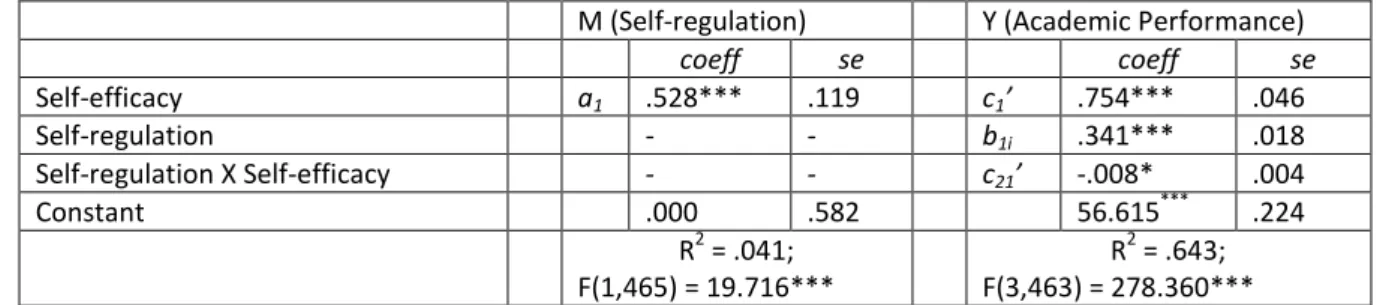
coeff se coeff se Self-efficacy a1 .528*** .119 c1’ .754*** .046 Self-regulation - - b1i .341*** .018 Self-regulation X Self-efficacy - - c21’ -.008* .004 Constant .000 .582 56.615*** .224 R2 = .041; F(1,465) = 19.716*** R2 = .643; F(3,463) = 278.360*** * p < .05; ** p < .01; *** p < .01;
The results presented in Table 4 showed an evidence of direct effect of self-efficacy on students’ academic performance, independent of self-regulation (coeff = .754; se = .046; p < .001). The result also
and academic performance (coeff = .341; se = .018; p < .001). This implies that students who differ in one unit of self-efficacy are estimated to differ by 0.34 units in their level of academic performance as a result of the tendency for students under relatively more self-efficacy to feel more in academic self-regulation which in turns translate to greater academic performance.
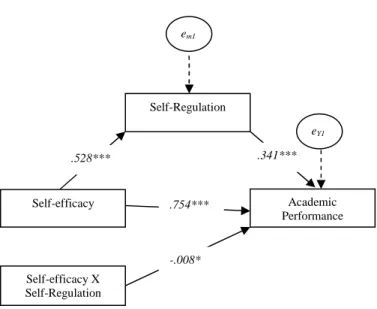
The results also showed that the self-efficacy and self-regulation interaction was significant on academic performance (coeff = -.008; se = .004; p < .05). This suggests that a moderated mediation effect emerged as indicated by the interaction between self-efficacy and self-regulation according to model 74 of Hayes (2013). So, the conditional indirect effect of self-efficacy on academic performance through self-regulation is conditioned on self-efficacy. Bootstrap statistics were calculated to advance the understanding of the relationship. The results are presented in Table 5.
Table 5: Conditional indirect effect of self-efficacy on academic performance through self-regulation at specific value(s) of self-efficacy
Self-efficacy Effect Boot SE Boot LLCI Boot ULCI
-4.896 .201 .047 .115 .302
.000 .180 .043 .102 .270
4.896 .159 .042 .090 .254
*p < .05; **p < .01; ***p < .001
Values for quantitative moderators are the mean and plus/minus one SD from mean.
Bootstrapping analysis (bootstrap sample = 1,000) indicated that self-efficacy moderated the indirect effect of regulation on academic performance. Results in Table 3 indicated that the mediating effect of self-regulation between self-efficacy and academic performance occurred at all levels of self-efficacy. At one standard deviation below the mean score (self-efficacy = 24.590), there was a significant mediating effect (p < .05). Also, at the mean score efficacy = 29.486), and at one standard deviation above the mean (self-efficacy = 34.383), significant mediating effects (p < .05) and (p < .05) were respectively observed. Consequently, students are most vulnerable in the translation of their self-efficacy into self-regulation and subsequently academic performance when they have average self-efficacy.
Academic Performance Self-Regulation Self-efficacy Self-efficacy X Self-Regulation .528***
Fig. 2. Coefficients of relationships among study
variables em1 .341*** eY1 .754*** -.008*
Discussion
This study undertook an exploration of the relationships among self-efficacy, self-regulation and academic performance. In addition to this, an extension of the relationship between self-efficacy and academic performance through self-regulation as moderated by self-efficacy was undertaken.
As predicted, self-efficacy was positively related to self-regulation. Self-efficacy was also positively related and academic performance. Self-regulation was also found, as posited to be positively related to academic performance. These results are supported by previous findings for the relationship between self-efficacy and self-regulation (Seo & Ilies, 2009), self-self-efficacy and academic performance (Carroll et al, 2009; Weiser & Riggio, 2010), and self-regulation and academic performance (Nota et al, 2004). In fact, the results further corroborate and extended the literature on these variables.
The mediating role of self-regulation on the relationship between self-efficacy and academic performance was also established by this study. This indicates that for students’ academic performance, the manifestation of self efficacy would not suffice but the ability to self-regulate. The observed moderating effect of self-efficacy in the mediation of self-regulation on the relationship between self-efficacy and academic performance was not amazing. Rather, it was revealing as it further establishes the strength of self-efficacy in theoretical models as proposed by Pajares (1996). Students with high self-efficacy for successful problem solving have been found to display greater performance monitoring and persist longer than do students with lower self-efficacy (Bouffard-Bouchard, Parent, & Larivee, 1991).
Conclusions
From the findings of this study, it would be concluded that self-efficacy, self-regulation and academic performance are severally related and that self-regulation slightly mediates the relationship between self-efficacy and academic performance. Further, the mediation effect of self-regulation on students’ academic performance is further moderated by self-efficacy in that the vulnerability of students’ self-efficacy to translate to academic performance through self-regulation is most effective with students who possess average self-efficacy.
Implications and Recommendations
The study findings have implications for theory, research and intervention. Foremost, the findings justified the claim that self-efficacy is a strong variable when included in models with theoretically related constructs. The declaration by Pajares (1996) was therefore sustained. The findings also portends serious implications for research as intricate models would be required to further extend the literature on self-efficacy, especially as it affects students’ academic performance.
Intervention programmes involving the enhancement of self-efficacy should be done with caution for the fact that though the moderating effect of efficacy in the mediating effect of regulation on self-efficacy and academic performance relationships was significant for all levels of self-self-efficacy, the average level presents the most momentous effect in the moderating effect of self-efficacy on academic performance through self-regulation. Experiences should be provided both with the home and school to provide students with cues that can make them develop the required sense of efficacy.
References
Adeyemo, D.A. & Torubeli, V.A. (2008). Self-efficacy, self-concept and peer influence as correlates of academic achievement among secondary school students in transition. Pakistan Journal of Social Sciences, 5, 10-16.
Akinsolu, A. O. (2010). Teachers and students' academic performance in Nigerian secondary schools: Implications for planning. Florida Journal of Educational Administration & Policy, 3 (2), 86-103. Bandura, A. (1977). Self-efficacy: towards a unifying theory of behavioural change. Psychological Review, 84,
191-215.
Bandura, A. (1986). Social foundations of thought and action: A social cognitive theory. Englewood Cliffs, NJ: Prentice Hall.
Bandura, A. (1997). Self-efficacy: The exercise of control. New York: Freeman.
Bembenutty, H. (2007). Self-regulation of learning and academic delay of gratification among Korean college students. Paper presented at the Annual Meeting of the American Educational Research Association (Chicago, IL, Apr 2007)
Bodrova, E. & Leong, D. (2008). Developing Self-Regulation in Kindergarten: Can We Keep All the Crickets in the Basket? Young Children, 63 (2), 56-58.
Bouffard-Bouchard, T., Parent, S., & Parivee, S. (1991). Influence of self-efficacy on self-regulation and performance among junior and senior high-school age students. International Journal of Behavioral
Braten, I., Samuelstuen, M. S., & Stromso, H. I. (2004). Do students' self-efficacy beliefs moderate the effects of performance goals on self-regulatory strategy use? Educational Psychology, 24 (2), 231-247
Brody, G. H. & Flor, D. L. (1997). Maternal psychological functioning, family processes, and child adjustment in rural, single-parent, african american families. Developmental Psychology, 33 (6), 1000-1011
Caprara, G. V., Barbaranelli, C., Steca, P. & Malone, P. S.(2006). Teachers' self-efficacy beliefs as determinants of job satisfaction and students' academic achievement: A study at the school level, Journal of School Psychology, 44 ,473–490.
Carroll, A., Houghton, S., Wood, R., Unsworth, K., Hattie, J. Gordon, L., & Bower, J. (2009). Self-efficacy and academic achievement in Australian high school students: the mediating effects of academic aspirations and delinquency. Journal of Adolescence, 32 (4), 797-817
Chapman, P. L. & Mullis, R L. (1999). Adolescent coping strategies and self-esteem. Child Study Journal, 29, 69-77.
Clark, R, Novak, J. D., & Dupree, D. (2002). Relationship of perceived parenting practices to anger regulation and coping strategies in African-American adolescents. Journal of Adolescence, 25, 373-384.
Cleary, T. J. & Chen, P. P. (2009). Self-regulation, motivation, and Math achievement in middle school: Variations across grade level and Math context. Journal of School Psychology, 47 (5), 291-314.
Edun, T. & Akanji, S. O. (2008). Perceived self-efficacy, academic self-regulation and emotional intelligence as predictors of academic performance in junior secondary schools International Journal of Educational Research, 4 (1), 81-89
Ferla, J., Valcke, M., & Schuyten, G. (2008). Relationships between student cognitions and their effects on study strategies. Learning and Individual Differences, 18 (2), 271-278.
Folorunso, B. A., Aremo, A. G., & Abogan, P. O. (2010). Family characteristics, students' reading habits, environment and students' academic performance in Nigeria. International Journal of Education Economics and Development 1(4), 366 - 383
Fortier, M. S., Vallerand, R. J., & Guay, F. (1995). Academic motivation and school performance: Toward a structural model. Contemporary Educational Psychology, 20, 257–274.
\Griffin, M. M., & Griffin, B. W. (1998). An investigation of the effects of reciprocal peer tutoring on achievement, self-efficacy, and test anxiety. Contemporary Educational Psychology, 23 (3), 298-311. Hastings, R. P. & Brown, T. (2002). Behavioral problems of children with autism, parental self-efficacy, and
mental health. American Journal on Mental Retardation, 107 (3), 222-32
Hodges, C. B., Stackpole-Hodges, C. L. & Cox, K.M. (2008). Self-efficacy, self-regulation, and cognitive style as predictors of achievement with podcast instruction. Journal of Educational Computing Research, 38 (2), 139-153.
Jackson, J. W. (2002). Enhancing self-efficacy and learning performance. The Journal of Experimental Education, 70 (3), 243-255.
Lane, J., & Lane, A. (2001). Self-efficacy and academic performance. Social Behavior and Personality: An International Journal, 29 (7), 687-694.
Lane, J., Lane, A. M., & Kyprianou, A. (2004). Self-efficacy, self-esteem and their impact on academic performance. Social Behavior and Personality: An International Journal, 32 (3), 247-256.
Mabekoje, S. O. (2008). Emotional intelligence and self-regulation among school-going adolescents: Self-efficacy as a mediator. Contemporary Humanity,
Midgley, C., Anderman, E. M., & Hicks, L. (1995). Differences between elementary and middle school teachers and students: A goal theory approach. Journal of Early Adolescence, 15, 90-113.
Mills, J., & Blankstein, K.R. (2000). Perfectionism, intrinsic vs. extrinsic motivation, and motivated strategies for learning: A multidimensional analysis of university students. Personality and Individual Differences, 29, 1191-1204.
Nota, L., Soresi, S. & Zimmerman, B. J. (2004). Self-regulation and academic achievement and resilience: A longitudinal study. International Journal of Educational Research, 41 (3), 198-215
Onyeizugbo, E. U. (2010). Self-Efficacy and test anxiety as correlates of academic performance Educational Research 1(10), 477-480
Pajares, F. & Kranzler, J. (1995). Self-efficacy beliefs and general mental ability in mathematical problem solving. Contemporary Educational Psychology, 20(4), 426-443.
Pajares, F. & Shunk, D. H. (2001). Self-beliefs and school success: self–efficacy, self-concept and school achievement. In R. Riding & S. Rayner (Eds.) Perception (pp.239-266). London: Abex publishing. Pajares, F. (1995). Self-Efficacy in Academic Settings. Paper presented at the Ametrican Educational Research
Association (San Fransisco, CA, April 18-22)
, F. (1996). Self-efficacy beliefs in achievement settings. Review of Educational Research, 66, 543-578.
Pintrich, P. R. (1999). The role of motivation in promoting and sustaining self-regulated learning. International Journal of Educational Research, 31, 459-470.
Pintrich, P. R., & De Groot, E. V. (1990). Motivational and self-regulated learning components of classroom academic performance. Journal of Educational Psychology, 82, 33-40.
Pintrich, P. R., & Schunk, D. H. (1995). Motivation in education: Theory, research, and applications. Englewood Cliffs, NJ: Prentice Hall.
Ryan, R. & Connell, J. (1989). Perceived locus of causality and internalization: Examining reasons for acting in two domains. Journal of Personality and Social Psychology, 57, 749–761.
Schunk, D. H. & Zimmerman, B. J. (2007). Influencing children's self-efficacy and self-regulation of reading and writing through modeling. Reading & Writing Quarterly, 23 (1), 7-25.
Schunk, D. H. (1995). Self-efficacy and education and instruction. In J. E. Maddux (Ed.), Self-efficacy, adaptation, and adjustment: Theory, research, and application (pp. 281-303). New York: Plenum Press. Schwarzer, R., & Jerusalem, M. (1995). Generalized self-efficacy scale. In J. Weinman, S. Wright & M.
Johnston (Eds.), Measures in Health Psychology: A User’s Portfolio. Causal and Control Beliefs (pp. 35-37). Windsor, UK: Nfer-Nelson.
Scott, W. D., Dearing, E., Reynolds, W. R., Lindsay, J. E., Baird, & G. L., Hamill, S. (2008). Cognitive self-regulation and depression: Examining academic self-efficacy and goal characteristics in youth of a Northern Plains Tribe. Journal of Research on Adolescence, 18 (2), 379-394.
Seo, M. & Ilies, R. (2009). The role of self-efficacy, goal, and affect in dynamic motivational self-regulation. Organizational Behavior and Human Decision Processes, 109 (2), 120-133
Tabakr, F., Nguyena, N., Basuraya, T. & Darrowa, W. (2009). Exploring the impact of personality on performance: How time-on-task moderates the mediation by self-efficacy. Personality and Individual Differences, 47 ( 8), 823-828
Tschannen-Moran, M. & Woolfolk Hoy, A. (2001). Teacher efficacy: Capturing an elusive concept. Teaching and Teacher Education 17, 783-805.
Vallerand, J. R. (1997). Toward a hierarchical model of intrinsic and extrinsic motivation. In M. P. Zanna (Ed.), Advances in experimental social psychology (Vol. 29, pp. 271–360). New York: Academic Press. Weed, K., Keogh, D., Borkowski, J. G., Whitman, T. & Noria, C. W. (2011). Self-regulation mediates the
relationship between learner typology and achievement in at-risk children Learning and Individual Differences, 21 (1), 96-108
Weiser, D. A. & Riggio, H. R. (2010). Family background and academic achievement: does self-efficacy mediate outcomes? Social Psychology of Education: An International Journal,13 (3), 367-383
Winters, F. I., Greene, J. A., & Costich, C. M. (2008). Self-regulation of learning within computer-based learning environments: a critical analysis. Educational Psychology Review, 20 (4), 429-444.
Zimmerman, B. J. (1989). A social cognitive view of self-regulated academic learning. Journal of Educational Psychology, 81, 329–339.
Zimmerman, B. J. (2000). Self-Efficacy: An essential motive to learn. Contemporary Educational Psychology 25, 82–91.
D’Lima, G. M., Pearson, M. R., & Kelley, M. L. (2012). Protective behavioural strategies as a mediator and moderator of the relationship between selfregulation and alcohol-related consequences in first-year college students. Psychology of Addictive Behaviors, 26, 330–337.
MacNeil, G., Kosberg, J. I., Durkin, D.W., Dooley, W.K., DeCoster, J.,&Williamson, G. M. (2010). Caregiver mental health and potentially caregiving behavior: The central role of caregiver anger. The Gerontologist, 50, 76–86.
Moneta, G. B. (2011). Metacognition, emotion, and alcohol dependence in college students: A moderated mediation model. Addictive Behbnnmnmnmnmnm,mkaviors, 36, 781–784.