1
GENERAL INTRODUCTION
NOM ENCLATURE
The termsironandsteelare often confusing to the general public.Iron is an element (26 on the periodic table). The wordironcomes from the Scandinavian wordiarn. The chemical symbolFecomes from the Latin word for iron,ferrum. The French word for iron isfer, the Ger-man word,Eisen. The Dutch word isijzeret, and the Spanish ishierro. The word steelis used to describe almost all alloys of iron. It is often said that steel is an alloy of iron and carbon. However, many steels contain almost no carbon. Carbon contents of some steels are as low as 0.002% by weight. The most widely used steels are low-carbon steels that have less than 0.06% carbon. Low-carbon steels are used for automobile bodies, appliances, cans, and cabinets. Higher carbon contents are used in steel with higher strengths. Tools are made from steels containing up to about 1.2% carbon.
The Sanskrit word for steel isstakati. The German word isStahl; the Russian, stalin; the French, acier; the Spanish, acero; and the Dutch,staal.Chalybsis the Latin word for steel.
Wrought iron was an iron-based product with entrapped slag stringers that contained very little carbon. It is no longer produced, having been replaced by much cheaper low-carbon steel. The term wrought ironis still applied to garden furniture and similar products that are made today from low-carbon steel.
2 Iron and Steel
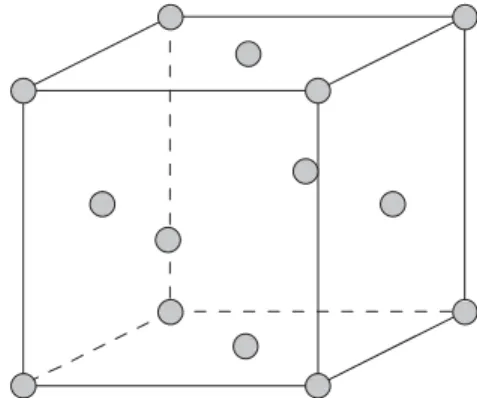
Figure 1.1. Unit cell of a body-centered cubic crystal.
Cast ironsare iron-based alloys that contain 2.5 to 4% carbon and 2 to 3% silicon. In white cast iron, the carbon is present as iron car-bide, whereas in gray and ductile cast irons, most of the carbon is present as graphite.
PHASES
Pure iron undergoes several phase changes. Above 1538◦C, it is liquid. On cooling below 1538◦C, it transforms to a body-centered cubic (bcc) structure, delta (␦)-ferrite, as shown inFigure 1.1.
On further cooling, it transforms to a denser face-centered cubic (fcc) structure, gamma (␥)-austenite, at 1400◦C (Figure 1.2).
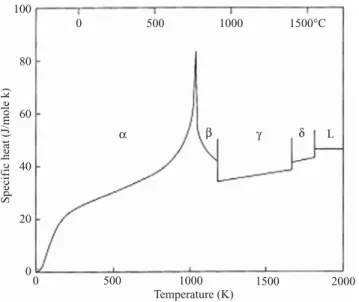
General Introduction 3 0 500 100 80 60 α β γ δ L 1500°C 1000 500 0 40 20 0 1000 1500 2000 Temperature (K) Specif ic heat (J/mole k)
Figure 1.3. Temperature dependence of the specific heat of iron.
Below 911◦C, it transforms back to bcc ␣-ferrite (which is the same as ␦-ferrite). There is a paramagnetic-to-ferromagnetic trans-formation at the Curie temperature (770◦C). Early researchers mis-took a peak in the specific heat as a latent heat of transformation (Figure 1.3) and designated the structure between 770◦C and 911◦C as-iron.
Physical properties of iron are listed in Appendix I.
PRODUCTION
The production of iron is very much greater than other metals. In the U.S. the annual tonnage of iron and steel is almost 40 times as great as that of aluminum and almost 65 times greater than the production of copper. Recycling accounts for over 80% of the steel.
2
EARLY HISTORY OF IRON
AND STEEL
NATIVE IRON
The only sources of iron available to early humans were meteoric iron and native (telluric) iron. Both were scarce. Most meteorites are non-metallic; only about 6% are iron, and these contain about 7 to 15% nickel. In 1808, William Thomson sectioned and etched a meteorite, noting the remarkable patterns. Although he published his findings in 1808, they attracted little interest. Also in 1808, an Austrian, Alois von Widmannst ¨atten, also etched a meteorite and observed the structure that is now known by his name. In 1820, he and Carl von Schreibers published a book on meteorites, which contained a print from a heav-ily etched meteorite (Figure 2.1). Native iron is even scarcer, being limited to small particles in western Greenland. Archeological finds of iron with considerable amounts of nickel suggest that they were made from meteorites.
The first production of iron dates back to at least 2000bcin India and Sri Lanka. By 1200 bc, production of iron was widespread in China and the Near East. The most common iron ores are hematite (Fe2O3) and magnetite (Fe3O4). Smelting of iron involved heating iron ore (oxides of iron) with charcoal. The reaction of iron oxide with carbon produced carbon monoxide and carbon dioxide. The air was supplied by either a natural draft or some means of blowing. Early furnaces were of various types. An open-pit furnace is shown
Early History of Iron and Steel 5
Figure 2.1. The imprint from an iron meteorite heavily etched by Widmannst ¨atten. inFigure 2.2. The carbon content of iron produced in pit furnaces was usually low because of the low temperatures achieved and resulted in semisolid sponge.
With shaft furnaces (Figure 2.3), the higher temperatures resulted in higher carbon contents. In the furnaces, charcoal reacted with the air to form carbon monoxide, which reduced some of the ore. The resulting carbon dioxide reacted with charcoal to form more carbon monoxide.
The product of the lower-temperature furnaces was low in carbon and much like wrought iron. It was soft and formable. If heated in
Figure 2.2. An early open-pit iron furnace. FromThe Making, Shaping and Treating of Steel, 9th ed. U.S. Steel Co. (1971).
6 Iron and Steel
Figure 2.3. An early shaft-type iron furnace. FromThe Making, Shaping and Treating of Steel, ibid.
charcoal, it would absorb more carbon and could be made into useful steel tools. The higher-temperature furnaces produced molten iron that contained up to 4% carbon. After it solidified, it formed a brit-tle material that was at first discarded. Later it was learned that the carbon content could be reduced by remelting in contact with air. By 200bc, the Chinese had started casting the high-carbon material into useful objects.
WROUGHT IRON
There is a wrought-iron pillar in Delhi, India, that dates back to at least the late fourth century. It is more than 7 m in height and has resisted corrosion over the many centuries. Wrought iron is the prin-cipal material in the Eiffel Tower, constructed in 1887.
After aboutad1300, wrought iron was produced in a Catalan fur-nace (Figure 2.4). The resulting semisolid product was pried out and hammered into bars. The American bloomery was a modification of this process, differing in that the charge of ore and charcoal were mixed together, and waterpower was used to create the blast.
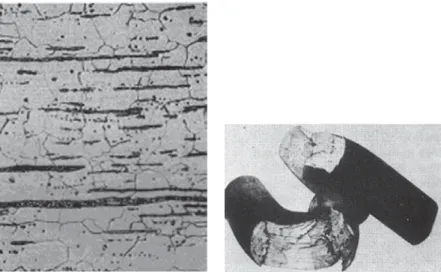
The microstructure of wrought iron is shown in Figure 2.5, together with a typical fracture. Before the introduction of cheap
Early History of Iron and Steel 7
Figure 2.4. The Catalan furnace for producing wrought iron. FromThe Making, Shap-ing and TreatShap-ing of Steel, ibid.
steel, made possible by the Bessemer process (see Chapter 3), wrought iron was used for railroad rails, locks, and about all of today’s use of low-carbon steel. With the advent of cheap steel, the use of wrought iron decreased, and its last production was in the 1940s.
Figure 2.5. The microstructure of wrought iron (left) consists of elongated glassy sili-cate inclusions from slag, strung out by cold working. Fractures of wrought iron (right) occur along the silicate stringers and appear woody. From J. Aston and E. B. Stong, Wrought Iron and Its Manufacture, Byer Co. (1939).
8 Iron and Steel
STEEL
Early carbon steel was made by several methods. Some was made by carburizing wrought iron without melting by having it in contact with charcoal or by melting wrought iron and adding carbon. It was also made by decreasing the carbon content of high-carbon material by oxidation. In India and Ceylon,wootz steel was produced by heat-ing iron ore in closed crucibles with charcoal and glass. This formed small buttons of high-carbon iron (typically 1.5% C). These buttons were then consolidated by forging into ingots. The technique died out about 1700 when the necessary ores containing tungsten and vana-dium had been depleted. The high carbon content meant that Fe3C was present, and this resulted in a very hard material with a character-istic surface pattern. Five-pound cakes ofwootzsteel were shipped to Persia, where they were beaten into swords. The termDamascus steel was given to the swords by Europeans, who first encountered their use by the Saracens in Damascus during the Crusades. The steel had 1.5% to 2.0% carbon, so it had large amounts of iron carbide, which made it very hard.
These swords were characterized by wavy patterns resembling the surface of water, the result of bands of carbide particles, which etched white, and a steel matrix, which etched black. The bands resulted from the segregation of carbide-forming elements (principally vanadium and molybdenum) during freezing. These bands attracted carbon.
An example is shown inFigure 2.6. Damascus steel sword blades were both resistant to fracture and capable of holding a very sharp edge. They were made from about ad 1100 to 1700. European attempts to reproduce these steels by forging together layers of high-and low-carbon steel were unsuccessful. It is believed that the art of producing Damascus steel involved three important factors. One was that the ore deposit contained crucial amounts of carbide-forming ele-ments. The fact that the steels from these deposits also contained high levels of phosphorus meant that they would crack on forging
Early History of Iron and Steel 9
Figure 2.6. Surface of a Damascus steel sword.
unless the surface had been decarburized first. A blacksmith must also have been taught how to produce the characteristic patterns, because they would not be visible until after the decarburized surface was ground off. The secrets of making such blades were carefully guarded. Verhoeven suggested that the source of ores containing the proper impurities became unavailable, and thus the techniques stopped working.
Other ancient steel dating back to 1400 bc, comes from Africa. The people of East Africa invented a type of high-heat blast furnace that allowed them to produce carbon steel at 3275◦F (1800◦C) nearly 2000 years ago. This ability was not duplicated until centuries later in Europe during the Industrial Revolution.
In the fourth centurybc, steel weapons were produced in Spain, The earliest production of high-carbon steel was found in Ceylon (Sri Lanka). Early steel making employed the unique use of a wind fur-nace, blown by the monsoon winds. This made possible the produc-tion of high-carbon steel.
Crucible steel, formed by slowly heating and cooling pure iron oxide and carbon (typically in the form of charcoal) in a crucible, was produced in central Asia by the 9th to 10th centuryad.
10 Iron and Steel
The development of the modern blast furnace from early shaft furnaces was a gradual process. Furnaces evolved to become large and taller. The use of coke instead of charcoal was first introduced in England in 1619 but did not become common until the early 1700s. The preheated blast was first used in England in the early 1870s.
Modern steel making (Chapter 3) began with the introduction of the Bessemer process in 1856 and the open-hearth process shortly afterward.
REFERENCES
J. Aston and E. B. Stong,Wrought Iron and Its Manufacture, Byer Co. (1939). The Making, Shaping and Treating of Steel, 9th ed. U.S. Steel Corp. (1971). C. S. Smith,A History of Metallography, University of Chicago Press (1960). J. D. Verhoeven,Steel Metallurgy for the Non-Metallurgist, ASM