Research Article
A New Generalization of the Lomax Distribution with
Increasing, Decreasing, and Constant Failure Rate
Pelumi E. Oguntunde,
1Mundher A. Khaleel,
2Mohammed T. Ahmed,
3Adebowale O. Adejumo,
1,4and Oluwole A. Odetunmibi
11Department of Mathematics, Covenant University, Ota, Ogun State, Nigeria
2Department of Mathematics, Faculty of Computer Science and Mathematics, University of Tikrit, Tikrit, Iraq 3Department of Finance and Banking, University of Tikrit, Tikrit, Iraq
4Department of Statistics, University of Ilorin, Ilorin, Kwara State, Nigeria
Correspondence should be addressed to Pelumi E. Oguntunde; [email protected]
Received 20 April 2017; Accepted 1 June 2017; Published 19 July 2017
Academic Editor: Ricardo Perera
Copyright © 2017 Pelumi E. Oguntunde et al. This is an open access article distributed under the Creative Commons Attribution License, which permits unrestricted use, distribution, and reproduction in any medium, provided the original work is properly cited.
Developing new compound distributions which are more flexible than the existing distributions have become the new trend in distribution theory. In this present study, the Lomax distribution was extended using the Gompertz family of distribution, its resulting densities and statistical properties were carefully derived, and the method of maximum likelihood estimation was proposed in estimating the model parameters. A simulation study to assess the performance of the parameters of Gompertz Lomax distribution was provided and an application to real life data was provided to assess the potentials of the newly derived distribution. Excerpt from the analysis indicates that the Gompertz Lomax distribution performed better than the Beta Lomax distribution, Weibull Lomax distribution, and Kumaraswamy Lomax distribution.
1. Introduction
The Lomax distribution can also be called Pareto Type II dis-tribution and its application can be found in many fields like actuarial science, economics, and so on [1]. The distribution was defined by Lomax [2] and it is a heavy-tailed distribution. It has also been considered to be useful in reliability and life testing problems in engineering and in survival analysis as an alternative distribution [3, 4].
Modified and extended versions of the Lomax distribu-tion have been studied; examples include the weighted Lomax distribution [4], exponential Lomax distribution [5], expo-nentiated Lomax distribution [6], gamma Lomax distribution [7], transmuted Lomax distribution [8], Poisson Lomax dis-tribution [9], McDonald Lomax disdis-tribution [10], Weibull Lomax distribution [11], and power Lomax distribution [12]. Besides, estimation of the parameters of Lomax distribution under general progressive censoring has also been considered by Al-Zahrani and Al-Sobhi [1].
In addition to the generalized families of distributions mentioned earlier, there are several other generalized families of distributions in the literature and these are contained in Owoloko et al. [13], Oguntunde et al. [14], Cordeiro et al. [15], and Alizadeh et al. [16]. Meanwhile, of interest to us in this research is to extend the Lomax distribution using the Gompertz generalized family of distributions due to Alizadeh et al. [16] because it is relatively new; it has not yet been rigorously explored, and it has some potentials which would be revealed in the later part of this article.
The rest of this article is therefore organized as follows: in Section 2, the densities of the Gompertz Lomax distribution (henceforth, it is referred to as GoLom distribution) are derived; its statistical properties are established including estimation of the unknown parameters; in Section 3, a simulation study was provided to investigate the perfor-mances of the unknown parameters; then an application to a real life data was provided, followed by a concluding re-mark.
Volume 2017, Article ID 6043169, 6 pages https://doi.org/10.1155/2017/6043169
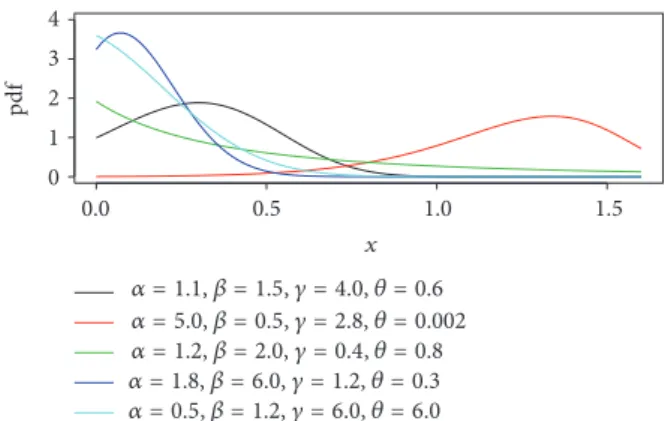
0.0 0.5 1.0 1.5 0 1 2 3 4 x pd f 𝛼 = 1.1, 𝛽 = 1.5, 𝛾 = 4.0, 𝜃 = 0.6 𝛼 = 5.0, 𝛽 = 0.5, 𝛾 = 2.8, 𝜃 = 0.002 𝛼 = 1.2, 𝛽 = 2.0, 𝛾 = 0.4, 𝜃 = 0.8 𝛼 = 1.8, 𝛽 = 6.0, 𝛾 = 1.2, 𝜃 = 0.3 𝛼 = 0.5, 𝛽 = 1.2, 𝛾 = 6.0, 𝜃 = 6.0
Figure 1: Plot for the pdf of GoLom distribution.
2. The Gompertz Lomax Distribution
To start with, the cumulative distribution function (cdf) and probability density function (pdf) of the Lomax distribution
with parameters𝛼and𝛽are given by
𝐺 (𝑥) = [1 − (1 + 𝛽𝑥)−𝛼] ; 𝛼 > 0, 𝛽 > 0, (1)
𝑔 (𝑥) = 𝛼𝛽 (1 + 𝛽𝑥)−(𝛼+1); 𝛼 > 0, 𝛽 > 0, (2)
respectively, where𝛼and𝛽are the shape and scale
parame-ters, respectively.
According to Alizadeh et al. [16], the cdf and pdf of the Gompertz generalized family of distribution are given by
𝐹 (𝑥) = 1 − 𝑒(𝜃/𝛾){1−[1−𝐺(𝑥)]−𝛾}; 𝜃 > 0, 𝛾 > 0, (3)
𝑓 (𝑥) = 𝜃𝑔 (𝑥) [1 − 𝐺 (𝑥)]−𝛾−1𝑒(𝜃/𝛾){1−[1−𝐺(𝑥)]−𝛾};
𝜃 > 0, 𝛾 > 0, (4)
where𝜃and𝛾are additional shape parameters and their role
is to vary tail weights.
𝐺(𝑥) and 𝑔(𝑥) are the cdf and pdf of the parent (or
baseline) distribution, respectively.
Now, if the density in (1) in inserted into (3), then the cdf of the GoLom distribution is given by
𝐹 (𝑥) = 1 − 𝑒(𝜃/𝛾){1−[1+𝛽𝑥]𝛼𝛾};
𝜃 > 0, 𝛾 > 0, 𝛼 > 0, 𝛽 > 0. (5)
Its associated pdf is derived by inserting the densities in (1) and (2) into (4) as follows:
𝑓 (𝑥) = 𝜃𝛼𝛽 (1 + 𝛽𝑥)𝛼𝛾−1𝑒(𝜃/𝛾){1−[1+𝛽𝑥]𝛼𝛾};
𝜃 > 0, 𝛾 > 0, 𝛼 > 0, 𝛽 > 0, (6)
where𝛼,𝜃, and𝛾are shape parameters;𝛽is the scale
param-eter.
Plots for the pdf of the GoLom distribution at various selected values are displayed in Figure 1.
Remark 1. It is clear in Figure 1 that the shape of the GoLom
distribution could be decreasing or inverted bathtub (de-pending on the value of the parameters). Also, it could be positively skewed or negatively skewed. Studying the tail behaviour of the GoLom distribution, it can be deduced that the distribution is heavy-tailed.
2.1. Expansion for the Densities of GoLom Distribution.
Fol-lowing Alizadeh et al. [16], the density of the GoLom distri-bution in (5) can be expanded as follows:
𝐹 (𝑥) = 1 −∑∞ 𝑖=0 𝑖 ∑ 𝑗=0 ∞ ∑ 𝑘=0 𝑤𝑖,𝑗,𝑘𝐻𝑘(𝑥) = 1 −∑∞ 𝑘=0 𝑎𝑘𝐻𝑘(𝑥) , (7) where 𝑤𝑖,𝑗,𝑘 = ((−1)𝑖+𝑘/𝑖!) (𝑗𝑖) (−𝑗𝛾𝑘 ) (𝜃/𝛾)𝑖, 𝑎𝑘 =
∑∞𝑖=0∑𝑖𝑗=0𝑤𝑖,𝑗,𝑘, and 𝐻𝑘(𝑥) is the cdf of the exponentiated
Lomax distribution with power𝑘 > 0.
The associated pdf can be expressed as a linear mixture of the exponentiated Lomax function as follows:
𝑓 (𝑥) =∑∞
𝑘=0
𝑏𝑘+1ℎ𝑘+1(𝑥) , (8)
whereℎ𝑘+1 = (𝑘 + 1)𝑔(𝑥)𝐺(𝑥)𝑘and𝑏𝑘 = −𝑎𝑘and𝐺(𝑥)and
𝑔(𝑥)are the cdf and pdf of the Lomax distribution as defined
in (1) and (2), respectively.
2.2. Reliability Analysis. The expressions for the reliability
function, hazard function (or failure rate), reversed hazard function, and odds function are all derived and established in this subsection.
Reliability Function. Reliability or survival function can be obtained from
𝑆 (𝑥) = 1 − 𝐹 (𝑥) . (9)
Therefore, the reliability function of the GoLom distribution is given by
𝑆 (𝑥) = 𝑒(𝜃/𝛾){1−[1+𝛽𝑥]𝛼𝛾};
𝜃 > 0, 𝛾 > 0, 𝛼 > 0, 𝛽 > 0. (10)
It is good to note that the shape of the reliability function of GoLom distribution would be a constant when the value of
parameter𝛽 = 0and𝛼 = 𝜃 = 𝛾 = 1. An illustration to this is
as shown in Figure 2.
Hazard Function. Hazard function can be obtained from
ℎ (𝑥) = 𝑓 (𝑥)
𝑆 (𝑥). (11)
Therefore, the hazard function of the GoLom distribution is given by
ℎ (𝑥) = 𝜃𝛼𝛽 (1 + 𝛽𝑥)𝛼𝛾−1;
𝜃 > 0, 𝛾 > 0, 𝛼 > 0, 𝛽 > 0. (12)
Plots for the hazard function of the GoLom distribution at various selected values are displayed in Figure 3.
0 5 10 15 0.6
0.8 1.0 1.2
1.4 Plot for survival function
x
SF
= = = 1 = 0
Figure 2: Survival function of GoLom distribution at𝛽 = 0and
𝛼 = 𝜃 = 𝛾 = 1. 0.0 0.5 1.0 1.5 0 1 2 3 4 x hf 𝛼 = 0.5, 𝛽 = 3.50, 𝛾 = 0.3, 𝜃 = 3.0 𝛼 = 4.5, 𝛽 = 0.05, 𝛾 = 4.0, 𝜃 = 2.5 𝛼 = 0.1, 𝛽 = 4.50, 𝛾 = 5.5, 𝜃 = 5.5 𝛼 = 1.0, 𝛽 = 5.50, 𝛾 = 2.0, 𝜃 = 0.08 𝛼 = 1.0, 𝛽 = 1.00, 𝛾 = 1.0, 𝜃 = 1.0
Figure 3: Plot for the hazard function of GoLom distribution.
Remark 2. It can be deduced from Figure 3 that the shape
of the hazard function of the GoLom distribution could be constant, increasing, or decreasing (depending on the value of the parameters).
Reversed Hazard Function. Reversed hazard function can be derived from
𝑟 (𝑥) = 𝑓 (𝑥)𝐹 (𝑥). (13)
Therefore, the reversed hazard function for the GoLom dis-tribution is given by 𝑟 (𝑥) = 𝜃𝛼𝛽 (1 + 𝛽𝑥) 𝛼𝛾−1𝑒(𝜃/𝛾){1−[1+𝛽𝑥]𝛼𝛾} 1 − 𝑒(𝜃/𝛾){1−[1+𝛽𝑥]𝛼𝛾} ; 𝜃 > 0, 𝛾 > 0, 𝛼 > 0, 𝛽 > 0. (14)
Odds Function. Odds function can be derived from
𝑂 (𝑥) = 𝐹 (𝑥)
𝑆 (𝑥). (15)
Therefore, the odds function for the GoLom distribution is given by 𝑂 (𝑥) = 1 − 𝑒(𝜃/𝛾){1−[1+𝛽𝑥] 𝛼𝛾} 𝑒(𝜃/𝛾){1−[1+𝛽𝑥]𝛼𝛾} ; 𝜃 > 0, 𝛾 > 0, 𝛼 > 0, 𝛽 > 0. (16)
2.3. Quantile Function and Median. Quantile function can be
derived from
𝑄 (𝑢) = 𝐹−1(𝑢) . (17)
Therefore, the quantile function of the GoLom distribution is given by 𝑄 (𝑢) = 𝛽−1{[1 −𝛾 𝜃log(1 − 𝑢)] 1/𝛼𝛾 − 1} , (18) where𝑢 ∼Uniform(0, 1).
Random numbers can be generated from the GoLom distribution using
𝑥 = 𝛽−1{[1 −𝛾
𝜃log(1 − 𝑢)]
1/𝛼𝛾
− 1} . (19)
The median of the GoLom distribution can be derived by
substituting𝑢 = 0.5into (18) as follows:
Median= 𝛽−1{[1 −𝛾
𝜃log(0.5)]
1/𝛼𝛾
− 1} . (20)
Other quartiles can also be derived from (18) by substituting
the appropriate value of “𝑢.”
2.4. Distribution of Order Statistics. Let 𝑥1, 𝑥2, . . . , 𝑥𝑛 be a
random sample from a cdf and pdf of a Gompertz Lomax distribution as defined in (5) and (6), respectively; the pdf of
the𝑗th order statistics of the GoLom distribution is obtained
from
𝑓𝑗:𝑛(𝑥)
= 𝑛!
(𝑗 − 1)! (𝑛 − 𝑗)!𝑓 (𝑥) 𝐹 (𝑥)𝑗−1[1 − 𝐹 (𝑥)]𝑛−𝑗.
(21)
Then, the pdf of𝑗th order statistics for the GoLom
distribu-tion is 𝑓𝑗:𝑛(𝑥) = 𝑛! (𝑗 − 1)! (𝑛 − 𝑗)!𝜃𝛼𝛽 (1 + 𝛽𝑥) 𝛼𝛾−1 ⋅ 𝑒(𝜃/𝛾){1−[1+𝛽𝑥]𝛼𝛾}[1 − 𝑒(𝜃/𝛾){1−[1+𝛽𝑥]𝛼𝛾}]𝑗−1 ⋅ [𝑒(𝜃/𝛾){1−[1+𝛽𝑥]𝛼𝛾}]𝑛−𝑗. (22)
Therefore, the distribution of minimum and maximum order statistics for the GoLom distribution is given by
𝑓1:𝑛(𝑥) = 𝑛𝜃𝛼𝛽 (1 + 𝛽𝑥)𝛼𝛾−1
⋅ 𝑒(𝜃/𝛾){1−[1+𝛽𝑥]𝛼𝛾}[𝑒(𝜃/𝛾){1−[1+𝛽𝑥]𝛼𝛾}]𝑛−1, 𝑓𝑛:𝑛(𝑥) = 𝑛𝜃𝛼𝛽 (1 + 𝛽𝑥)𝛼𝛾−1
⋅ 𝑒(𝜃/𝛾){1−[1+𝛽𝑥]𝛼𝛾}[1 − 𝑒(𝜃/𝛾){1−[1+𝛽𝑥]𝛼𝛾}]𝑛−1.
2.5. Parameter Estimation. The parameters of the GoLom distribution can be estimated using the method of maximum
likelihood (MLE) as follows: let𝑥1, 𝑥2, . . . , 𝑥𝑛denote random
samples each having the pdf of the GoLom distribution; then the likelihood function is given by
𝑓 (𝑥1, 𝑥2, . . . , 𝑥𝑛; 𝛼, 𝛽, 𝛾, 𝜃)
=∏𝑛
𝑖=1
[𝜃𝛼𝛽 (1 + 𝛽𝑥𝑖)𝛼𝛾−1𝑒(𝜃/𝛾){1−[1+𝛽𝑥𝑖]𝛼𝛾}] . (24)
Let 𝑙 denote the log-likelihood function; that is, let 𝑙 =
log𝑓(𝑥1, 𝑥2, . . . , 𝑥𝑛; 𝛼, 𝛽, 𝛾, 𝜃); then
𝑙 = 𝑛log(𝜃) + 𝑛log(𝛼) + 𝑛log(𝛽)
+ (𝛼𝛾 − 1)∑𝑛 𝑖=1 log(1 + 𝛽𝑥𝑖) +𝜃𝛾∑𝑛 𝑖=1 {1 − (1 + 𝛽𝑥𝑖)𝛼𝛾} . (25) Solving𝑑𝑙/𝑑𝛼 = 0,𝑑𝑙/𝑑𝛽 = 0,𝑑𝑙/𝑑𝛾 = 0, and𝑑𝑙/𝑑𝜃 = 0
simultaneously gives the maximum likelihood estimates of
parameters𝛼, 𝛽,𝛾, and𝜃. Meanwhile, the solution cannot
be gotten analytically except numerically when data sets are available. Software like R, MATLAB, MAPLE, and so on could be used to get the estimates.
3. Simulation
The behaviour of the parameters of the GoLom distribution was investigated by conducting simulation studies with the aid of R software. Data sets were generated from the GoLom
distribution with a replication number𝑚 = 1000; random
samples of sizes𝑛 = 25, 50, and 100 were further selected. The
simulation was conducted for three (3) different cases using
varying true parameter values. The selected true parameter
values are𝛼 = 0.5,𝛽 = 0.5,𝛾 = 0.5, and𝜃 = 0.5;𝛼 = 1,𝛽 = 1,
𝛾 = 1, and𝜃 = 1; and𝛼 = 2,𝛽 = 2,𝛾 = 2, and𝜃 = 2for the first, second, and third cases, respectively.
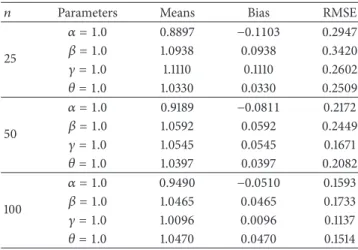
The MLE of the true parameters were obtained including the Bias and the Root Mean Square Error (RMSE). The result for the simulation studies is as shown in Tables 1, 2, and 3.
Remark 3. It can be deduced from Tables 1, 2, and 3 that the
root mean square error (RMSE) reduces for all the selected parameter values as the sample size increases. Also, the bias posed by the estimates is closer to the true parameter values and the absolute bias reduces as the sample size increases. Hence, as sample size increases, the estimates tend towards (or approaches) the true parameter values.
4. Application
To demonstrate the potentials of the GoLom distribution, a comparison was made using the GoLom distribution and some other compound distributions like Beta Lomax distribution, Weibull Lomax distribution, and Kumaraswamy
Table 1: Simulation study at𝛼 = 0.5,𝛽 = 0.5,𝛾 = 0.5, and𝜃 = 0.5.
𝑛 Parameters Means Bias RMSE
25 𝛼 = 0.5 0.4849 −0.0151 0.1974 𝛽 = 0.5 0.5379 0.0379 0.2012 𝛾 = 0.5 0.5469 0.0469 0.1134 𝜃 = 0.5 0.5552 0.0552 0.3301 50 𝛼 = 0.5 0.4913 −0.0087 0.1763 𝛽 = 0.5 0.5204 0.0204 0.1655 𝛾 = 0.5 0.5284 0.0284 0.0861 𝜃 = 0.5 0.5544 0.0544 0.2889 100 𝛼 = 0.5 0.5080 0.0080 0.1603 𝛽 = 0.5 0.5131 0.0131 0.1334 𝛾 = 0.5 0.5100 0.0100 0.0658 𝜃 = 0.5 0.5394 0.0394 0.2355
Table 2: Simulation study at𝛼 = 1.0,𝛽 = 1.0,𝛾 = 1.0, and𝜃 = 1.0.
𝑛 Parameters Means Bias RMSE
25 𝛼 = 1.0 0.8897 −0.1103 0.2947 𝛽 = 1.0 1.0938 0.0938 0.3420 𝛾 = 1.0 1.1110 0.1110 0.2602 𝜃 = 1.0 1.0330 0.0330 0.2509 50 𝛼 = 1.0 0.9189 −0.0811 0.2172 𝛽 = 1.0 1.0592 0.0592 0.2449 𝛾 = 1.0 1.0545 0.0545 0.1671 𝜃 = 1.0 1.0397 0.0397 0.2082 100 𝛼 = 1.0 0.9490 −0.0510 0.1593 𝛽 = 1.0 1.0465 0.0465 0.1733 𝛾 = 1.0 1.0096 0.0096 0.1137 𝜃 = 1.0 1.0470 0.0470 0.1514
Table 3: Simulation study at𝛼 = 2.0,𝛽 = 2.0,𝛾 = 2.0, and𝜃 = 2.0.
𝑛 Parameters Means Bias RMSE
25 𝛼 = 2.0 1.8415 −0.1585 0.7105 𝛽 = 2.0 2.1605 0.1605 0.7190 𝛾 = 2.0 2.2196 0.2196 0.4790 𝜃 = 2.0 2.0191 0.0191 0.3825 50 𝛼 = 2.0 1.9171 −0.0829 0.5363 𝛽 = 2.0 2.1175 0.1175 0.5653 𝛾 = 2.0 2.1155 0.1155 0.3550 𝜃 = 2.0 2.0055 0.0055 0.3407 100 𝛼 = 2.0 1.9881 −0.0119 0.3892 𝛽 = 2.0 2.0890 0.0890 0.4110 𝛾 = 2.0 2.0507 0.0507 0.2777 𝜃 = 2.0 1.9862 −0.0138 0.2962
Lomax distribution. The following criteria were used to select the distribution with the best fit: Negative Log-Likelihood
(−LL) value, Akaike Information Criteria (AIC), Bayesian
Table 4: Performance rating of the GoLom distribution.
Distributions Estimates −LL AIC CAIC BIC HQIC
Gompertz Lomax ̂𝛼 = 0.0046 14.5027 37.0055 37.6951 45.5780 40.3771 ̂ 𝛽 = 8.1791 ̂𝛾 = 1.5158 ̂𝜃 = 0.5069 Weibull Lomax ̂𝛼 = 6.0947 15.3399 38.6798 39.3695 47.2524 42.0514 ̂ 𝛽 = 0.1069 ̂𝑎 = 1.0629 ̂𝑏 = 0.0649 Beta Lomax ̂𝛼 = 18.1737 24.4034 56.8068 57.4964 65.3793 60.1784 ̂ 𝛽 = 26.7645 ̂𝑎 = 10.8769 ̂𝑏 = 0.0329 Kumaraswamy Lomax ̂𝛼 = 9.8352 18.1027 44.2055 44.8951 52.7779 47.5771 ̂ 𝛽 = 45.3107 ̂𝑎 = 15.1182 ̂𝑏 = 0.0483
Table 5: Table of test statistic.
Distributions KS 𝐴 𝑝value
Gompertz Lomax 0.1542 0.9462 0.0998
Weibull Lomax 0.1517 1.3315 0.1100
Beta Lomax 0.2182 3.1986 0.0049
Kumaraswamy Lomax 0.1854 1.9915 0.0263
Criteria (CAIC), and Hannan and Quinn Information Cri-teria (HQIC). The value for the Kolmogorov Smirnov (KS)
statistic, Anderson Darling (A) statistic, and the𝑝value are
also provided.
The data relating to the strengths of 1.5 cm glass fibres which was obtained by workers at the UK National Physical Laboratory was used. The data has previously been used by Smith and Naylor [17], Bourguinon et al. [18], and Merovci et al. [19]. The observations are as follows:
0.55, 0.74, 0.77, 0.81, 0.84, 1.24, 0.93, 1.04, 1.11, 1.13, 1.30, 1.25, 1.27, 1.28, 1.29, 1.48, 1.36, 1.39, 1.42, 1.48, 1.51, 1.49, 1.49, 1.50, 1.50, 1.55, 1.52, 1.53, 1.54, 1.55, 1.61, 1.58, 1.59, 1.60, 1.61, 1.63, 1.61, 1.61, 1.62, 1.62, 1.67, 1.64, 1.66, 1.66, 1.66, 1.70, 1.68, 1.68, 1.69, 1.70, 1.78, 1.73, 1.76, 1.76, 1.77, 1.89, 1.81, 1.82, 1.84, 1.84, 2.00, 2.01, 2.24.
The performances of the GoLom distribution with the other competing distributions are shown in Table 4.
Remark 4. The distribution that corresponds to the lowest
−LL, AIC, CAIC, BIC, and HQIC is judged to be the best out
of the competing distributions. With this regard, the compet-ing distributions can be ranked in the followcompet-ing order (best to the least): Gompertz Lomax distribution, Weibull Lomax distribution, Kumaraswamy Lomax distribution, and Beta Lomax distribution.
The values for the Kolmogorov Smirnov statistic,
Ander-son Darling statistic, and the𝑝value are as shown in Table 5.
x f(x) 0.5 1.0 1.5 2.0 2.5 0.0 0.5 1.0 1.5 GoL WeL BeL KwL
Figure 4: Plot showing the competing distributions with the empirical histogram of the observed data.
A plot showing all the competing distributions against the empirical histogram of the observed data is as shown in Figure 4.
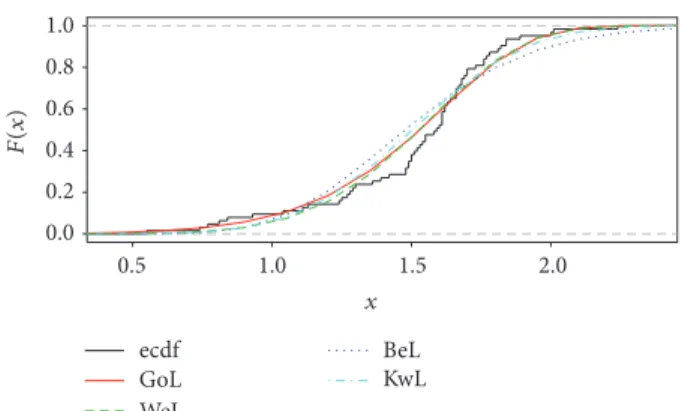
A plot for the empirical cdf of the competing distributions with the empirical cdf of the observed data is as shown in Figure 5.
The plots in Figures 4 and 5 affirm the results of the anal-ysis that the Gompertz Lomax distribution is more suitable for the data than the other competing distributions.
5. Conclusion
The Gompertz Lomax distribution has been successfully derived; expressions for its basic statistical properties which include the reliability function, hazard function, odds func-tion, reversed hazard funcfunc-tion, and quantile, median, and distribution of order statistics have been successfully estab-lished. The shape of the distribution could be decreasing or inverted bathtub (depending on the value of the parameters). Meanwhile, the shape of its hazard function could be con-stant, increasing, or decreasing (depending on the value of the
0.5 1.0 1.5 2.0 0.0 0.2 0.4 0.6 0.8 1.0 x F(x) ecdf GoL WeL BeL KwL
Figure 5: Plot for the empirical cdf of the competing distributions.
parameters). The simulation study that was conducted shows that the parameters of the Gompertz Lomax distribution are stable; though values for biasedness were generated, these values are small, indicating that the maximum likelihood estimates of the GoLom distribution are not too far from the true parameter values; the absolute bias and the root mean square values also decreases as the sample size increases. An application to a real life data shows that the Gompertz Lomax distribution is a strong and better competitor for the Weibull Lomax distribution, Beta Lomax distribution, and Kumaraswamy Lomax distribution.
Conflicts of Interest
The authors declare that there are no conflicts of interest.
Acknowledgments
The authors are grateful to Covenant University for providing funding and an enabling environment for this research.
References
[1] B. Al-Zahrani and M. Al-Sobhi, “On parameters estimation of Lomax distribution under general progressive censoring,”
Journal of Quality and Reliability Engineering, vol. 2013, Article ID 431541, 7 pages, 2013.
[2] K. S. Lomax, “Business failures: another example of the analysis of failure data,”Journal of the American Statistical Association, vol. 49, no. 268, pp. 847–852, 1954.
[3] A. Hassan and A. Al-Ghamdi, “Optimum step stress accelerated life testing for Lomax distribution,”Journal of Applied Sciences Research, vol. 5, pp. 2153–2164, 2009.
[4] N. M. Kilany, “Weighted Lomax distribution,”SpringerPlus, vol. 5, no. 1, article no. 1862, 2016.
[5] A. H. El-Bassiouny, N. F. Abdo, and H. S. Shahen, “Exponential lomax distribution,”International Journal of Computer Applica-tions, vol. 121, no. 13, pp. 24–29, 2015.
[6] H. M. Salem, “The exponentiated lomax distribution: different estimation methods,”American Journal of Applied Mathematics and Statistics, vol. 2, no. 6, pp. 364–368, 2014.
[7] G. M. Cordeiro, E. M. M. Ortega, and B. V. Popovi´c, “The gamma-Lomax distribution,”Journal of Statistical Computation and Simulation, vol. 85, no. 2, pp. 305–319, 2015.
[8] S. K. Ashour and M. A. Eltehiwy, “Transmuted lomax distribu-tion,”American Journal of Applied Mathematics and Statistics, vol. 1, no. 6, pp. 121–127, 2013.
[9] B. Al-Zahrani and H. Sagor, “The Poisson-Lomax distribution,”
Revista Colombiana de Estad´ıstica, vol. 37, no. 1, pp. 225–245, 2014.
[10] A. J. Lemonte and G. M. Cordeiro, “An extended Lomax distri-bution,”A Journal of Theoretical and Applied Statistics, vol. 47, no. 4, pp. 800–816, 2013.
[11] M. H. Tahir, G. M. Cordeiro, M. Mansoor, and M. Zubair, “The weibull-lomax distribution: properties and applications,”
Hacettepe Journal of Mathematics and Statistics, vol. 44, no. 2, pp. 461–480, 2015.
[12] E.-H. A. Rady, W. A. Hassanein, and T. A. Elhaddad, “The power Lomax distribution with an application to bladder cancer data,”
SpringerPlus, vol. 5, 1838 pages, 2016.
[13] E. A. Owoloko, P. E. Oguntunde, and A. O. Adejumo, “Per-formance rating of the transmuted exponential distribution: an analytical approach,”SpringerPlus, vol. 4, 818 pages, 2015. [14] P. E. Oguntunde, A. O. Adejumo, H. I. Okagbue, and M. K.
Rastogi, “Statistical properties and applications of a new lindley exponential distribution,”Gazi University Journal of Science, vol. 29, no. 4, pp. 831–838, 2016.
[15] G. M. Cordeiro, M. Alizadeh, A. D. C. Nascimento, and M. Rasekhi, “The exponentiated Gompertz generated family of distributions: properties and applications,”Chilean Journal of Statistics, vol. 7, no. 2, pp. 29–50, 2016.
[16] M. Alizadeh, G. M. Cordeiro, L. G. Bastos Pinho, and I. Ghosh, “The Gompertz-G Family of distributions,”Journal of Statistical Theory and Practice, vol. 11, no. 1, pp. 179–207, 2017.
[17] R. L. Smith and J. C. Naylor, “A comparison of maximum likelihood and bayesian estimators for the three-parameter weibull distribution,”Applied Statistics, vol. 36, pp. 258–369, 1987.
[18] M. Bourguignon, R. B. Silva, and G. M. Cordeiro, “The weibull-G family of probability distributions,”Journal of Data Science, vol. 12, pp. 53–68, 2014.
[19] F. Merovci, M. A. Khaleel, N. A. Ibrahim, and M. Shitan, “The beta type X distribution: properties with application,” Springer-Plus, vol. 5, 697 pages, 2016.
,QWHUQDWLRQDO-RXUQDORI
$HURVSDFH
(QJLQHHULQJ
+LQGDZL3XEOLVKLQJ&RUSRUDWLRQ KWWSZZZKLQGDZLFRP 9ROXPHRobotics
Journal ofHindawi Publishing Corporation
http://www.hindawi.com Volume 2014
Hindawi Publishing Corporation
http://www.hindawi.com Volume 2014
Active and Passive Electronic Components
Control Science and Engineering
Journal of
Hindawi Publishing Corporation
http://www.hindawi.com Volume 2014 Machinery
Hindawi Publishing Corporation
http://www.hindawi.com Volume 2014 Hindawi Publishing Corporation
http://www.hindawi.com
Journal of
(QJLQHHULQJ
Volume 201
Submit your manuscripts at
https://www.hindawi.com
VLSI Design
Hindawi Publishing Corporation
http://www.hindawi.com Volume 201
-Hindawi Publishing Corporation
http://www.hindawi.com Volume 2014
Shock and Vibration
Hindawi Publishing Corporation
http://www.hindawi.com Volume 2014
Civil Engineering
Advances inAcoustics and VibrationAdvances in
Hindawi Publishing Corporation
http://www.hindawi.com Volume 2014
Hindawi Publishing Corporation
http://www.hindawi.com Volume 2014
Electrical and Computer Engineering
Journal of
Advances in OptoElectronics
Hindawi Publishing Corporation
http://www.hindawi.com Volume 2014
The Scientific
World Journal
Hindawi Publishing Corporationhttp://www.hindawi.com Volume 2014
Sensors
Journal ofHindawi Publishing Corporation
http://www.hindawi.com Volume 2014
Modelling & Simulation in Engineering
Hindawi Publishing Corporation
http://www.hindawi.com Volume 2014
Hindawi Publishing Corporation
http://www.hindawi.com Volume 2014
Chemical Engineering
International Journal of Antennas and
Propagation International Journal of
Hindawi Publishing Corporation
http://www.hindawi.com Volume 2014
Hindawi Publishing Corporation
http://www.hindawi.com Volume 2014
Navigation and Observation International Journal of
Hindawi Publishing Corporation
http://www.hindawi.com Volume 2014