Arkansas
University of Arkansas
AG1282
Illinois
University of Illinois Extension
ICSG4-12
Indiana
Purdue Extension
ID-168
Iowa
Iowa State University Extension
PM 1282
Kansas
Kansas State University Agricultural Experiment
Station and Cooperative Extension Service
S-146
Midwest Tree
Fruit Spray Guide
2014
Kentucky
University of Kentucky Cooperative Extension Service
ID-92
Missouri
University of Missouri and Missouri State University
MP651
Ohio
Ohio State University Extension
506A2
Wisconsin
University of Wisconsin Cooperative Extension Service
A3314
2014 Midwest Tree Fruit Spray Guide
This publication is one of a series of publications for fruit growers in the Midwest developed by the Midwest Fruit Workers Group. Other publications include the Midwest Small Fruit Pest Management Handbook, Midwest Commercial Small Fruit and Grape Spray Guide, and Midwest Tree Fruit Pest Management Handbook. Contact your local Cooperative Extension office for information on these publications.DISCLAIMER
References to products in this publication are not intended to be an endorsement to the exclusion of others that may be similar. Any person using products listed in this publication assumes full responsibility for their use in accordance with current directions of the manufacturer.
Non-Discrimination Statement
The U.S. Department of Agriculture (USDA) prohibits discrimination in all its programs and activities on the basis of race, color, national origin, sex, religion, age, disability, political beliefs, sexual orientation, and marital or family status. (Not all prohibited bases apply to all programs.) Persons with disabilities who require alternative means for communication of program information (Braille, large print, audiotape, etc.) should contact USDA’s TARGET Center at (202) 720-2600 (voice and TDD). To file a complaint of discrimi-nation write USDA, Director, Office of Civil Rights, Room 326-W, Whitten Building, 14th and Independence Avenue, SW, Washington,
University of Arkansas
Entomology * Donn T. Johnson Horticulture Elena Garcia
University of Illinois
Entomology * Rick Weinzierl Horticulture Mosbah M. Kushad
John Masiunas * Elizabeth Wahle Plant Pathology * Mohammad Babadoost
Iowa State University
Entomology * Donald R. Lewis * Laura C.H. Jesse Horticulture * Joe Hannan
Patrick O’Malley Mike White Plant Pathology * Mark L. Gleason
Erika Saalau-Rojas
Kansas State University
Entomology Raymond Cloyd Horticulture Ted Carey Plant Pathology Megan Kennelly
University of Kentucky
Entomology * Ricardo T. Bessin Horticulture * John G. Strang
* Shawn Wright Plant Pathology * Nicole Ward Gauthier
University of Missouri
Entomology Bruce Barrett
Missouri State University
Integrated Pest Management Maciej Psczcolkowski Horticulture John Avery
Martin Kaps Plant Pathology Laslo Kovacs
The Ohio State University
Entomology * Celeste Welty Horticulture Diane Miller Plant Pathology * Michael A. Ellis Weed Science Douglas Doohan
Purdue University
Entomology * Rick E. Foster Horticulture * Peter M. Hirst
Steve C. Weller Plant Pathology * Janna Beckerman
University of Wisconsin
Agronomy Roger A. Flashinski Entomology Christelle Guedot Plant Pathology * Patricia S. McManus
The Midwest Tree Fruit Pest Management Handbook is a companion publication
to this spray guide that contains further information on pesticide safety, sprayer
calibration, tree fruit diseases and insect pests, pesticide characteristics, growth
regulators and spray adjuvants, and other related topics. Copies of this publication
are available from your state extension service.
CONTENTS
Apple Spray Schedule ...7
Efficacy of Selected Insecticides and Acaricides Against Apple Insects and Mites ...19
Special Problems and Pests of Apple ...20
Pear Spray Schedule ...24
Cherry Spray Schedule ...28
Peach Spray Schedule ...33
Plum Spray Schedule ...38
Special Problems and Pests of Peach and Other Stone Fruit ...41
Insecticides Used to Manage Borers of Peach, Cherry, and Plum Trees ...43
Pre-harvest Intervals and Restricted-Entry Intervals (REI) for Common Fungicides ...44
Efficacy of Selected Fungicides Against Apple Diseases ...45
Efficacy of Selected Fungicides Against Stone Fruit Diseases ...45
Pre-harvest Intervals and Restricted-Entry Intervals (REI) for Insecticides and Miticides ..46
Pre-harvest Intervals and Restricted-Entry Intervals (REI) for Growth Regulators ...47
Pre-harvest Intervals and Restricted-Entry Intervals (REI) for Herbicides ...48
Generic Insecticides ...49
Orchard Vole Control ...50
Suggestions for Growth Regulators ...52
Chemical Thinning of Apples ...54
Chemical Weed Control ...56
Herbicide Recommendations for Apple and Pear ...57
Herbicide Recommendations for Peach, Nectarine, Plum and Cherry ...61
Herbicide Recommendations for Non-Bearing Fruit Trees Only ...64
Floral Development Stages for Fruit Crops ...65
Record Keeping Requirements for Production Chemicals ...66
Foreword
Commercial fruit production has become a highly skilled technological profession. Concerns for residues, operator risks, and the environment dictate that all fruit growers exercise extreme caution in the use of all pesticides and, indeed, all chemicals. The EPA has designated a number of fruit pesticides as
“restricted-use.” Record-keeping and worker protection requirements have changed dramatically since 1994. Consult the Pesticide Applicator Training program or local extension office for more information.
Growers who wish to use restricted-use materials must be certified as “private applicators.” Certification requires that applicators understand: labels and labeling; safety factors; potential environmental concerns, identification of common pests; knowledge of pesticides and their usage; proper equipment use; and applicable state and federal regulations. Contact your local
extension office for information about certification training programs.
Pest management recommendations provide up-to-date information on pesticides and their applicability to your problem. We suggest that you use this information to set up your own spray program. You should include space for records in the program, such as materials used; date of application; stage of growth; and weather. In case of questions, nothing beats a good set of records, and records are required for restricted-use pesticides.
Fruit Grower Newsletters
ILLINOIS
University of Illinois Extension publishes The Illinois Fruit & Vegetable News. This newsletter covers production practices and insect and disease
management. It is available at www.ipm.illinois.edu/ifvn. For information, or to order, contact Rick Weinzierl, Department of Crop Sciences, University of Illinois, AW-101 Turner Hall, 1102 S. Goodwin Avenue, Urbana, IL 61801; phone: 217) 244-2126; email: [email protected].
INDIANA
Purdue Extension offers Fact for Fancy Fruit, a fruit grower newsletter issued at frequent intervals during the fruit season to Indiana growers by first class mail for $15 a year. This service supplies timely information on disease and insect activity throughout the state, cultural information, and announcements of upcoming meetings. The newsletter also is available free at www.hort.purdue.edu/fff and through email.
To receive the paper copy, send your name, address, and present fruit interests along with a check for $15 made out to Purdue University, to Facts for Fancy Fruit, Department of Horticulture and Landscape Architecture, 625 Agricultural Mall Drive, Purdue University,
West Lafayette, IN 47907-2010. IOWA
Iowa State University Extension and Outreach publishes a free monthly small fruit and vegetable newsletter. Topics covered include production practices, seasonal issues including weather, insect, disease, and weed management strategies, as well as upcoming events. For more information, contact Joe Hannan, Commercial Horticulture Field Specialist, at (515) 993-4281 or [email protected].
KENTUCKY
A Cooperative Extension newsletter, Kentucky Fruit Facts, is issued monthly to all Kentucky growers at no cost. This service supplies timely information on disease and insect activity throughout the state, as well as cultural information. To obtain this service, send your name and address to: Kentucky Fruit Facts, c/o John Strang, Department of Horticulture, N-318 Ag Sci Building North, University of Kentucky, Lexington, KY 40546-0091; phone (859)257-5685; fax: (859) 257-2859; email: [email protected]. Kentucky Fruit Facts is also available at www.uky.edu/hort/documents-list-fruit-facts.
Management Tips for Safety
1. Maintain accurate spray records. Show application rates, pesticides used, total gallonage, stage of plant development, and weather data.
2. Be prepared to show your records to the EPA or state agency inspectors.
3. Do not contaminate forage crops or pastures. 4. Prevent excess drift.
5. Do not allow animals to graze in orchards. 6. Maintain equipment in top condition. 7. Protect children, pets, livestock, and your
environment from pesticides in any form.
8. Inform all workers of re-entry restrictions and other safety information.
9. Comply with the Right-To-Know Law. Have complete product labels readily available for workers. Have the Material Safety Data Sheet for each product available for workers to see, and for rescue or fire personnel to use in case of emergency.
10. Provide pesticide safety training for pesticide handlers and other workers to comply with Worker Protection Standards.
11. Regularly inspect and maintain personal protective equipment used when applying pesticides.
Handling Pesticides
1. Know the pesticide toxicity and act accordingly. 2. When mixing pesticides, do not breathe the dust,
powder, or vapor. Always mix outdoors.
3. Use an adequate respirator and protective clothing, especially when mixing pesticides. The necessary protective equipment is listed on the pesticide label. Suitable respirators should be available from your pesticide dealer.
4. Do not smoke, eat, or drink when handling or applying pesticides.
5. Stay out of drift from spray or dust.
6. Rinse out liquid containers with water at least three times, and pour into spray tank as it is being filled. Punch holes in metal and plastic containers and crush. Dispose of all pesticide containers in accordance with the pesticide label directions and as allowed by state and local authorities. Do not re-use pesticide containers.
7. Have a “buddy” around when using toxic organophosphates or carbamates, just in case. 8. For maximum safety, get a blood test to determine
the cholinesterase level for each worker before the spraying season and periodically during the season. This will allow you to monitor the cholinesterase level in those people using insecticides and can help prevent overexposure.
9. Consult a doctor immediately if the following symptoms develop while spraying: blurred vision, nausea, headache, chest pain, weakness, diarrhea, or cramps.
10. Wash hands thoroughly before eating or smoking. 11. Bathe and change clothes daily.
12. Always store pesticides in their original marked container.
13. Always store pesticides under lock and key. Keep children away.
14. Follow all label instructions carefully.
15. Always use an anti-siphon device when filling spray tank from a domestic water source.
The label is the law: Read and follow all label instructions carefully.
Dilute Spraying
The object of spraying is to uniformly distribute a fungicide, insecticide, miticide, or growth regulator over all parts of the tree. Pesticide recommendations are based on the amount of dilute spray needed to wet trees thoroughly. In a standard apple or pear orchard, with trees approximately 20 ft tall, 22 ft wide, and set on rows 35 ft apart, 400 gal water/acre is a standard dilute spray for fungicide and insecticide application. Recommendations are made per 100 gal or per acre. Dilute is considered 1x concentration. For cherry, peach, and plum, 300 gal water/acre is the standard dilute spray volume for full-size trees.
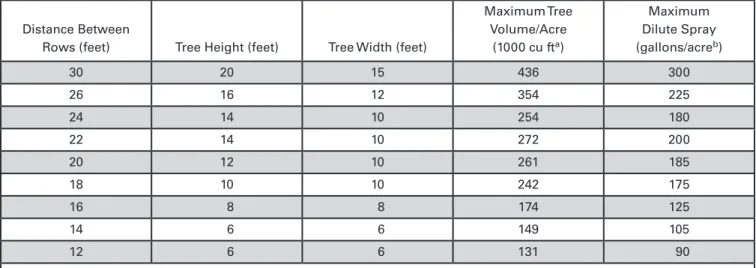
Table 1 lists the gallons of dilute spray per acre required to provide equivalent coverage for mature trees of different sizes and spacings.
Growth regulators may be applied by high-volume hand-gun or air-blast sprayers, in either dilute or
low-volume applications. Low-volume application may be more risky because any mistakes in concentration are magnified.
Read the growth regulator label for suggestions on application methods. Some labels suggest dilute sprays with full coverage and others suggest a specific amount of chemical in a specific amount of water per acre.
Table 1.
Gallonage of dilute spray per acre required to provide equivalent coverage for mature trees of different sizes and spacing. Distance Between
Rows (feet) Tree Height (feet) Tree Width (feet)
Maximum Tree Volume/Acre (1000 cu fta) Maximum Dilute Spray (gallons/acreb) 30 20 15 436 300 26 16 12 354 225 24 14 10 254 180 22 14 10 272 200 20 12 10 261 185 18 10 10 242 175 16 8 8 174 125 14 6 6 149 105 12 6 6 131 90
a Maximum tree volume/acre = tree width x tree height x running feet or row per acre.
Running feet of row per acre = 43560 divided by the distance between rows.
b Minimum dilute gallons per acre = approximately 0.7 gallon /1,000 cubic feet of tree volume.
Low-volume Spraying
Low-volume, or concentrate, spraying refers to the use of less water per acre to apply pesticides. In low-volume spraying, the low-volume of water applied per acre is reduced in proportion to the increased concentration used. So, if a 3x concentration is used, apply only one-third the water per acre that would be used in dilute spraying.
Low-volume sprays must be applied with air-blast sprayers that use high-velocity airstream to distribute the spray mixture. Most conventional air-blast
sprayers can be used to apply spray mixtures up to 6x concentration. Sprayers specifically designed for ultra low-volume applications should be used for applications at 10x or greater.
Using low-volume sprays requires less labor, less water, less time, and fewer refills than 1x or dilute mixtures. However, savings in gallonage and application costs decrease most rapidly down to about 50 gallons of water per acre. Below that, the savings may not be worth the additional risk of improper application and problems with wind.
Fungicide Resistance Alert
The development of strains of the apple scab fungus with resistance to the sterol inhibiting or DMI fungicides (Rally, Indar, Inspire Super, Bayleton, Elite, Orbit, Procure, and Vintage) has become a serious problem in the last few years in several regions of the Midwest. Five orchards tested for resistance in Ohio in 2005 and two orchards in Wisconsin all had very high levels of resistance (DMIs would not provide adequate scab control).
There is no reason to assume that the situation is different across the Midwest where these fungicides have been used for the past several years. In orchards where resistance is a problem, growers have been forced to go back to using a standard protectant program for scab control.
If you have not been achieving good scab control in your orchard, or you suspect that you may have resistance, you should use a standard protectant program for scab control.
Table 2. Gallons of spray per acre (approximate) for various concentrates.
1x 2x 3x 4x 5x 6x 7x 8x 9x 10x
Apples 400 200 132 100 80 64 56 48 44 40
Peaches 300 150 100 75 60 50 45 38 33 30
Percent water savings over dilute 50% 67% 75% 80% 84% 86% 88% 89% 90% Greatest savings Diminished savings
Table 2 illustrates an 80 percent savings of water at 5x, but only an additional 10 percent savings by increasing the concentrate to 10x. At concentrations of 5x or higher, one can reduce the mixing rate by 20 to 25 percent and achieve the same control. This is because sprays are no longer being applied to run-off.
Following are some precautions in the use of low-volume pesticide or growth regulator applications: 1. Use extreme care in calibrating the sprayer and maintaining a constant sprayer speed. As gallonage is decreased, errors become much more critical.
2. Choose calm, yet good drying conditions for spraying. This may mean spraying at night or early in the morning. Good coverage cannot be achieved when winds are over 5 miles per hour.
3. Prune trees to a very open canopy for spray penetration. Spray droplets will not penetrate large, thick trees.
4. Choose pesticide formulations that will mix satisfactorily. Pay careful attention to increased operator hazards and drift problems.
Tree Row Volume Spraying
Tree row volume (TRV) is a method of determining the dilute (1x) volume of a spray solution necessary to cover the entire tree surface. This is an objective method of determining the differences in spray volume required for different tree sizes and ages.
With the TRV method, the volume of dilute spray needed per acre can be easily calculated for each orchard based on tree age, size, amount of pruning, and row spacing. To determine the TRV, the between-row spacing, maximum tree height, and cross-row limb spread of trees must be accurately measured. See the step-by-step procedure below.
The TRV method also can be used to determine the pesticide rate for an orchard. Calculate the TRV gallonage for the orchard. Multiply this gallonage by the recommended dilute pesticide rate for dilute application. For example, a fungicide is recommended at 2 lb/100 gal and is to be applied in an orchard with a TRV gallonage base of 400 gal/acre. Therefore, the per acre rate for this pesticide is:
2 lb/100 gal x 400 gal/acre = 8 lb/acre.
To determine the rate of fungicide or insecticide per acre when using the low-volume spraying method (3x or greater), first calculate the dilute TRV gallonage. Multiply this concentrate gallonage by 0.75 to obtain a concentrate TRV gallonage. Multiply this concentrate gallonage by the recommended dilute pesticide rate per 100 gallons to determine the rate of pesticide per acre for concentration application.
For example, a fungicide is recommended at 2 lb/100 gal and is to be applied at 5x in an orchard with a TRV gallonage base of 400 gal/acre. The rate of pesticide per acre is calculated as:
(TRV gallonage) x (0.75)
x dilute pesticide rate/100 gal
= concentrate pesticide application rate/acre 400 gal/acre x 0.75 x 2 lb/100 gal = 6.0 lb/acre
If the TRV base gallonage is less than 200 gal/acre, use 200 gal to compute the pesticide application rate.
or oil products are used in a mix. Be aware of spray tank pH as noted above.
Read the comments section in this spray guide for notes on compatibility problems and read the pesticide label before tank mixing products.
Standard Protectant Program versus Extended Protectant Program
The standard protectant program requires that fungicide application begin at green tip and the interval between sprays should not exceed 7 days through primary scab season (green tip through first or second cover). This is in contrast to the extended protectant program (see page 8) that could be used when a sterol inhibiting fungicide in combination with an effective protectant fungicide could be applied on a 10-day or longer interval. The loss of the curative activity from the sterol inhibitors means we must rely primarily on fungicides with protectant activity. The strobilurin fungicides (Sovran and Flint) have limited curative activity (possibly 48 hr) and cannot be used effectively in an extended protectant program. In addition, we may be experiencing reduced sensitivity and eventual
Table 3. Determining density factors using tree density estimates.
0.70 gal/1,000 cubic feet Trees extremely open light visible through entire tree, less than 15 scaffold limbs per tree, young trees
0.75 gal/1,000 cubic feet Trees very open 18 to 21 scaffold limbs per tree, light penetration throughout the tree, healthy spurs within the tree canopy
0.80 gal/1,000 cubic feet Trees well pruned adequate light in trees for healthy spurs throughout trunk and scaffold limbs, many holes in foliage where light can be seen through tree 0.85 gal/1,000 cubic feet Trees moderately
well pruned reasonable spur population within canopy, tree thick enough that light cannot be seen through the tree 0.90 gal/1,000 cubic feet Trees minimally pruned spurs inside canopy are weak due to limited light, very few holes
where light can be seen through the tree
1.00 gal/1,000 cubic feet Trees unpruned extremely thick, no light visible anywhere through tree canopy, trees more than 20 feet high
Step 1
Calculate feet row/acre
43,560 sq ft/acre = feet of row/acre between row spacing (ft)
Step 2
Calculate cubic feet of TRV/acre. Feet of row/acre (from Step 1) x tree height (ft)
x cross-row limb spread (ft) = cu ft of TRV/acre
Step 3
Select density factors from Table 3.
Select the density factor that best indicates the canopy density of each separate orchard or block.
Step 4
Calculate TRV gallonage/acre cu ft of TRV/acre tree density
(from Step 2) x (from Step 3)
1,000
= gallons of dilute solution applied per acre = TRV gal/acre
EXAMPLE
An orchard has rows spaced 20 feet apart, tree height is 14 ft and the cross-row limb spread is 12 ft. The tree density is 0.85. Step 1 43,560 square ft/acre / 20 ft = 2,178 feet of row/acre Step 2 2,178 x 14 ft x 12 ft
= 365,904 cubic feet of TRV/acre
Step 3
Density has been given as 0.85.
Step 4
(365,904 x 0.85) /1,000 = 311 TRV gallons/acre
For additional information on calculating TRV gal/acre refer to the Ohio State Extension Bulletin 892 Orchard Spray Rates: How to Determine the Amount of Pesticide and Water to Use in Your Orchard by C. Welty.
Spray Tank pH
Several pesticides break down rapidly in alkaline water. In a matter of hours (or in extreme instances only minutes), 50 percent or more of the active ingredient may be hydrolyzed to yield a less active compound. Captan, Carzol, Dimethoate, Imidan, Kelthane, and Malathion are examples of compounds that are especially vulnerable to alkaline hydrolysis. To ensure the maximum effectiveness of pesticide applications, check the pH of spray mixes in the spray tank and add buffering agents, if necessary, to adjust the pH to neutral (7). Buffercide, Buffer-X, Unifilm B, and LI 700 Acidiphactant are examples of such buffering agents.
Pesticide Compatibility
Pesticide compatibility in the spray tank is usually not a problem with newer pesticides. Compatibility of some materials may depend upon solvents and emulsifiers used by the manufacturer. Emulsifiable concentrate formulations are more likely to cause compatibility problems than wettable powders. If
APPLE
APPLE DORMANT TO SILVER TIP
Apply before growth starts in spring and when temperatures are above 45°F. PEST/PROBLEM MATERIAL RATE/ACRE COMMENTSFire blight
Crown rot (collar rot)
Fixed copper fungicides (Copper hydroxide) (Copper oxychloride) (Basic copper sulfate) (Bordeaux mixture)
Ridomil Gold SL Aliette 80 WP Phosphorous Acid
If fire blight was severe last year, fixed copper spray at silver tip is suggested. Do not apply copper after ¼-inch green leaf stage or when drying conditions are cool and slow because severe injury can occur. Many fixed copper fungicides are registered for use on apple. Fixed coppers can be mixed with oil. However,
never combine copper sulfate alone with dormant oil.
Refer to crown rot section on page 20 for fungicide use recommendations.
APPLE GREEN TIP
If using a protectant fungicide program, begin sprays at green tip and repeat every seven days through second cover. PEST/PROBLEM MATERIAL RATE/ACRE COMMENTS
1Primary scab
Protectant program 2Captan 50 WP 3Syllit 3.4 F Ziram 76 DF 4Mancozeb 75 DF 4Polyram 80 DF 5Vangard 75 WG 5Scala 5 SC 6Sanitation methods
for apple scab
6 lb 1.5–3 pt 6–8 lb 6 lb 6 lb 5 oz 7–10 fl oz
1See note on page 5 on fungicide resistance. 2See note on Captan on page 23.
3If Syllit (Cyprex) has a long history of use in your
orchard, fungicide resistance may be a problem.
4See note on Mancozeb and Polyram on (Restrictions
on EBDC Products) page 20.
5Vangard and Scala are most effective at temperatures
below 70°F.
6See note on important sanitation methods to aid in
control of apple scab on page 22.
Fungicide Resistance Management: The strobiliurin
fungicides (Sovran, Cabrio, Pristine, and Flint); the sterol inhibiting fungicides (Rally, Vintage, Indar, Inspire Super MP, Topguard, and Procure); and the new succinate dehydrogenase inhibiting fungicides (Fontelis, Luna Sensation, Luna Tranquility, and Merivon) all are at high risk for the development of resistance in fungi that cause many of the major fruit diseases, such as apple scab, powdery mildews, and brown rot. Each of these groups of fungicide has a different chemical mode of action for controlling fungi. To aid in limiting the potential for fungicide resistance development, do not make more than four applica-tions of any fungicide within each group per season. In addition, do not make more than two sequential applications of any fungicide within each group with-out alternating to a fungicide within a different group of chemistry. Many plant pathologists in the Midwest recommend alternating to a group of different chem-istry after one application of a fungicide within each group of chemistry. For example: two applications of Sovan (a strobliurin fungicide) alternated with two applications of Inspire Super MP (a sterol inhibiting fungicide) alternated with two applications of Fontelis (a succinase dehydrogenase inhibiting fungicide). See note on fungicide resistance management on page 23.
APPLE GREEN TIP
CONTINUEDPEST/PROBLEM MATERIAL RATE/ACRE COMMENTS
San Jose scale,
European red mite eggs, aphid eggs
Superior oil
plus one of the following
Lorsban Advanced 4 E Lorsban 50W Lorsban 75 WG Supracide 25 WP Supracide 2 E Diazinon AG 600 WBC 2% 0.5–4 pt 3 lb 2–2.67 lb 4–12 lb 8–12 pt See label.
Apply oil when temperature is above 40°F; never during freezing weather. Check label for
fungi-cide/oil compatibility. Oil is most effective when sprayed dilute under calm conditions to assure thorough coverage of all woody tissue. Where San Jose scale is a main target of oil sprays, the best timing for application is at green tip. Wait until half-inch green or pink if European red mite or rosy apple aphid is the primary target. Although Lorsban, Supracide, and Diazinon are labeled for use with oil to increase scale control, trials have shown that oil alone results in greater than 98 percent control of scales if coverage is thorough. Adding an insecticide does improve aphid control. Put pheromone traps in place now to monitor adult leafminer activity.
APPLE HALF-INCH GREEN
PEST/PROBLEM MATERIAL RATE/ACRE COMMENTS
Primary scab San Jose scale Rosy apple aphid European red mite eggs Spotted tentiform leafminer, adults
Same as for green tip Same as for green tip
or Esteem 35 WP Centaur 70 WDG Superior oil Vydate L Endosulfan 3 EC 4–5 oz 34.5 oz 2% 2–4 pt 3.33 qt
Esteem controls scale anytime between half-inch green and second cover. When used at half-inch green it also controls rosy apple aphid. When used at pink it also controls leafminer. The minimum rate is effective when used pre-bloom, but the maximum rate is needed if application is delayed until the crawler stage in early summer. Delaying oil application until this time will give better control of mites than earlier applications. Control of spotted tentiform leafminer adults at half-inch green may be improved by spraying in the evening when moths are most active, but killing spotted tentiform leafminer adults at half-inch green is not as effective as killing hatching eggs at petal fall. The pyrethroids Ambush, Asana, Baythroid, Danitol, Mustang Max, Pounce, Proaxis, Renounce, Voliam Xpress, and Warrior also are labeled for control of adult spotted tentiform leafminers but are not recom-mended because they kill predaceous mites that feed on European red mite and twospotted spider mite, thereby triggering outbreaks of these pests.
PEST/PROBLEM MATERIAL RATE/ACRE COMMENTS
1Scab only
Protectant program 7-day interval
Scab, rust, and powdery mildew
1Protectant program
7-day interval
2Extended Protectant
program 10-day interval
3Captan 50 WP Ziram 76 DF 4Mancozeb 75 DF 4Polyram 80 DF Vangard 75 WG Scala 5 SC Bayleton 50WP 5Rally WSP Procure 50 WP 6Indar 2 F 8Topguard Sovran 50 WG 7Flint 50 WG 7Cabrio 20 EC Pristine 38 WG 9Inspire Super Fontelis 10Luna Sensation 11Luna Tranquility 12Merivon plus 3Captan 50 WP 4Mancozeb 75 DF 4Polyram 80 Ziram 76 DF 6 lb 6–8 lb 6 lb 6 lb 5 oz 7–10 fl oz 2–8 oz 5–8 oz 12–16 oz 6–8 fl oz 8–13 oz 4–6.4 oz 2–2.5 oz 12 oz 14.5–18.5 oz 12 fl oz 16–20 fl oz 4–5.8 fl oz 11.2–16 fl oz 4–5.5 fl oz 6 lb 3 lb 3 lb 6–8 lb
1See comments on fungicide resistance on page 5. 2Growers using an Extended Protectant program should
use an SI fungicide (Rally, Rubigan, Indar, Inspire Super, or Procure) in combination (tank-mixed) with a protectant fungicide such as Captan, Mancozeb, Polyram, or Ziram through the period from at least tight cluster to second cover. With a 10-day spray interval, this should result in no more than four applications during this period.
The strobilurin fungicides (Sovran, Cabrio, Flint, and Pristine) and the succinate dehydrogenase inhibiting fungicides (Fontelis, Luna Sensation, Luna Tranquility, and Merivon) are sometimes recommended for use alone. However, due to the risks of resistance development in the scab fungus, they should be tank-mixed with a protectant fungicide as well.
3See note on Captan on page 23.
4See note on Mancozeb and Polyram on page 16. 5Nova fungicide has been renamed Rally. 6Indar also is available as a 75 WSP.
7To avoid damage on leaves and fruit, do not apply Flint
with an organo-silicate surfactant. Cabrio is not registered for rust control.
8Topguard is a sterol-inhibiting fungicide and should not
be used alone in orchards with scab resistance to the sterol inhibiting fungicides. The label states use 13 oz for scab and 8–12 oz for powdery mildew and rusts.
9Inspire Super is a package mix of cyprodinil (Vanguard)
and difenoconazole. Inspire Super has replaced Inspire Super MP.
10Luna Sensation is a mixture of two fungicides (fluopyram
and trifloxystrobin [Flint]). For powdery mildew control, it should be used at 5–5.8 fl oz per acre.
11Luna Tranquility is a combination of two fungicides
(fluopyram and pyrimethanil).
12Merivon is a combination of two fungicides
(fluxapyroxad and pyraclostrobin [Cabrio]).
Fungicide Resistance Management:
See notes on pages 5 and 23.
PEST/PROBLEM MATERIAL RATE/ACRE COMMENTS
1Scab, rust, and powdery mildew 2Rosy apple aphid
Spotted tentiform leafminer
Tarnished plant bug and stink bugs
San Jose scale
Nutrient level
Same as for tight cluster Lorsban 4E Lorsban 50 W Lorsban 75 WG Endosulfan 3 EC Assail 30 SG Calypso 4 F Vydate 2 L Beleaf 50 SG Belay 2.13 SC Closer 2SC
Same as half inch green or Carzol SP Calypso 4 F Assail 30SG Intrepid 2F Altacor 35 WDG Esteem 35WP
Endosulfan as listed for tentiform leafminer at half-inch green or Avaunt 30 WDG Calypso 4 F Lannate SP Lannate LV Beleaf 50 SG Belay 2.13 SC Ambush Asana XL 0.66 EC Baythroid XL 1 EC Danitol 2.4 EC Mustang Max 0.8 EC Pounce 25 WP Proaxis 0.5 EC Renounce 20 WP Warrior 1 CS Closer 2 SC Solubor (boron) and/or
Feed grade urea (nitrogen) 1.5–4 pt 3 lb 2–2.67 lb 3.33 qt 2.5–4 oz 2–4 fl oz 4–8 pt 2–2.8 fl oz 4–6 fl oz 1.5–2.75 fl oz 1–1.25 lb 2–4 fl oz 2.5 oz 8–12 fl oz 2.5–4.0 oz 3–5 oz 5–6 oz 2–4 fl oz 0.5–1 lb 1.5–3 pt 2–2.8 fl oz 6–12 fl oz 6.4–25.6 oz 4.8–14.5 fl oz 2–2.4 fl oz 10.7–21.3 fl oz 1.28–4 fl oz 6.4–16 oz 2.6– 5.1 fl oz 2.5–3 oz 2.6–5.1 fl oz 2.75–5.75 fl oz 2 lb 3 lb
1A critical time for control for scab, rust,
and powdery mildew.
1Rust diseases need to be controlled with
sprays at regular intervals from pink through the second cover spray. Rally, Bayleton, Rubigan, Indar, Inspire Super, Procure, Mancozeb, Polyram, Ziram, Flint, Sovran, and Pristine will control rust; Topsin-M and Captan will not. See green tip comments regarding primary scab fungicides.
2Scout for curled leaves at early pink.
Apply aphicide at pink if any curled leaves with rosy apple aphid inside are found.
Use of the pyrethroids Ambush, Asana, Baythroid, Danitol, Mustang Max, Pounce, Proaxis, Renounce, and Warrior will kill predaceous mites that feed on European red mite and twospotted spider mite, thereby triggering outbreaks of these pests. Use these pyrethroid insecticides only if the potential for plant bug and stink bug damage is high.
Closer for plant bugs only.
Put pheromone traps in place now to monitor adult scale activity; crawlers are expected 4 to 6 weeks after adult emergence.
Add Solubor to pesticide spray; check compatibility before adding. Urea can be added to pesticide sprays when needed.
PEST/PROBLEM MATERIAL RATE/ACRE COMMENTS Scab, rust,
and powdery mildew Fire blight (blossom blight)
Fire blight (shoot blight)
Insects or mites
Codling moth (monitoring)
Codling moth (control)
Red Delicious shape
Same as for tight cluster Streptomycin 17 WP
OR Streptomycin 17 WP plus
*Regulaid
**See note on Mycoshield
Growth regulator
Apogee 27.5 W
plus
*Regulaid SAVE THE BEES! Do not use insecticides or miticides. Pheromone traps Isomate-C Plus Isomate-CM Flex Isomate-CM/OFM TT Promalin 1.5 lb 1 lb 1 pt 1 per 10 acres, minimum of 2 per block 400 dispensers/acre 200–400 dispensers/acre 200–400 dispensers/acre
Start fire blight sprays at the first sign of open blossoms. Repeat sprays at 4- to 5-day intervals through bloom and petal fall on susceptible varieties. A minimum of two applications is necessary to provide control. If warm, wet weather occurs, it is critical that sprays are applied on a tight schedule using a maximum strength of 100 ppm (8 oz per 100 gal) of streptomycin. Growers can improve timing and confidence in using streptomycin with assis-tance from a disease warning system such as MARYBLYT. Streptomycin is not recommended for use after petal fall.
*Do not concentrate Regulaid.
**Mycoshield (oxytetracycline) is now labeled for use on apple, but it is not as effective for fire blight control as streptomycin. Unless streptomycin resistance has been confirmed in your orchard, streptomycin is the material of choice for fire blight control.
Consider using Apogee to reduce the threat of shoot blight on vigorous trees of susceptible varieties that have nearly filled their space. See comments on pages 20–21.
Put out pheromone traps now to monitor adult codling moth activity. See page 21 for informa-tion on how to use traps to determine optimal timing of insecticides.
See section on mating disruption on page 21. Additional products and formulations also are available.
Isomate CM/OFM TT also controls Oriental fruit moth.
Apply in early bloom when most of the king flowers are open and before petals fall from the king flowers. Promalin can cause fruit thinning if guidelines for time of application are not followed.
PEST/PROBLEM MATERIAL RATE/ACRE COMMENTS Scab, rust,
and powdery mildew Fire blight
Plum curculio, leafrollers, oriental fruit moth Leafrollers
Plum curculio
Oriental fruit moth
Same as for tight cluster (page 9)
Same for bloom (page 10) Imidan 70 W
Avaunt 30 WDG
Products listed above for three species combined or Intrepid 2 F Confirm 2 F Entrust 80 WP Entrust 2 SC Proclaim 5SG Rimon 0.83 EC Altacor 35 WDG Delegate 25 WG Belt 4 SC
Products listed above for three species combined or Calypso 4 F
Assail 30 SG Actara 25 WDG Surround Belay 2.13 SC
Products listed above for three species combined or Assail 30 SG Calypso 4 F Intrepid 2 F Entrust 80 WP Entrust 2 SC Rimon 0.83 EC Altacor 35 WDG Delegate 25 WG Belt 4 SC Belay 2.13 SC 2.1 –5.3 lb 5–6 oz 8–16 fl oz 20 fl oz 2–3 oz 6–10 fl oz 3.2–4.8 oz 20–50 fl oz 2.5–4.5 oz 4.5–7 oz 3–5 fl oz 4–8 fl oz 8 oz 4.5–5.5 oz 25–50 lb 6 fl oz 5–8 oz 4–8 fl oz 12–16 fl oz 2–3 oz 6–10 fl oz 20–40 fl oz 2.5–4.5 oz 4.5–7 oz 3–5 oz 6–12 fl oz
Continue sprays on susceptible varieties until all petals have fallen.
Peak hatch of redbanded leafroller usually coincides with petal fall. Control at this time helps prevent late-season problems. If plum curculio pressure has been severe and Imidan is applied to control it, use 5.3 lb per acre. The pyrethroids Asana, Baythroid, Danitol, Leverage, Mustang Max, Pounce, Proaxis, Renounce, and Warrior also are labeled for con-trol of these insects but are not recommended because they kill predaceous mites that feed on European red mite and twospotted spider mite, thereby triggering outbreaks of these
pest mites.
Oriental fruit moth is not present in many Midwestern apple orchards.
PEST/PROBLEM MATERIAL RATE/ACRE COMMENTS Spotted tentiform leafminer
(larvae), white apple leafhopper, aphids
Spotted tentiform leafminer (larvae)
White apple leafhopper
Aphids Admire Pro 4.6 EC Assail 30 SG Calypso 4 F Actara 25 WDG Endosulfan 3 EC Lannate LV Lannate 90 SP Belay 2.13SC
Products listed above for three pests combined or Agri-Mek 0.15 EC Entrust 80 WP Entrust 2 SC Esteem 35 WP Carzol 92 SP Rimon 0.83EC Altacor 35 WDG Delegate 25 WG Belt 4SC
Products listed above for three pests combined or Carzol SP
Portal 0.4 EC Agri-Mek 0.15 EC Centaur 70 WDG Closer 2 SC
Products listed above for three pests combined or Esteem 35 WP Beleaf 50 SG Movento 2 SC Closer 2 SC 1.4–2.8 fl oz 2.5–4 oz 2–4 fl oz 4.5–5.5 oz 3.33 qt 3 pt 1 lb 4–6 fl oz 10–20 fl oz 1.5–3 oz 4–10 fl oz 3–5 oz 1–1.25 lb 15–40 fl oz 2.5–4.5 oz 4.5–7 oz 3–5 oz 0.5–1 lb 1–2 pt 10–20 fl oz 9–12 oz 1.5–2.75 fl oz 3–5 oz 2–2.8 oz 6–9 fl oz 1.5–2.75 fl oz
Use Admire as soon as pollination is complete but after bees are no longer foraging. The pyrethroids Asana, Baythroid, Danitol, Leverage, Mustang Max, Proaxis, Renounce, and Warrior also are labeled for control of these insects at petal fall but are not recom-mended because they kill predaceous mites that feed on European red mite and twospotted spider mite, thereby triggering outbreaks of these pest mites. Lannate also kills predaceous mites and can trigger pest mite out-breaks.
Treat if mines average two or more per leaf and larvae are still in the initial sap-feeding stage on the underside of the leaves. Apply Agri-Mek with horticultural oil or a penetrating surfactant.
White apple leafhopper nymphs begin hatching at tight cluster and feed on the underside of apple leaves. The presence of leafhopper nymphs, their cast skins, and the white feeding marks (stippling) on leaves indicate possible need for control. Manage-ment is needed at petal fall if the average number of nymphs is one or more per leaf.
Rosy apple aphid is best treated at pink, but there is some chance to control it at petal fall if infestations develop.
Movento is toxic to honey bees and can be used only after petal fall.
PEST/PROBLEM MATERIAL RATE/ACRE COMMENTS Mites For thinning summer varieties Nutrient level Apollo 4 SC Savey 50 DF Agri-Mek 0.15 EC Nexter 75 WP Portal 0.4 EC Carzol 92 SP Acramite 50 WS Zeal 72 WP Envidor 2 SC Kanemite 15 SC Onager 1 EC Oil Refer to section on thinning (p. 52) Solubor (boron) and/or
Feed grade urea
4–8 fl oz 3–6 oz 10 fl oz 4.4–5.2 oz 1–2 pt 1–1.25 lb 0.75–1 lb 2–3 oz 16–18 fl oz 21–31 fl oz 12–24 fl oz 0.5–1% 4 lb 8 lb
For Nexter, use low rate for European red mite or high rate for twospotted mite. For Acramite use low rate for twospotted mite or high rate for European red mite. AgriMek is most effective if applied before leaves harden off. Do not use oil if Captan is used for
disease control or if temperature exceeds 90oF. See comments on oil
on page 23.
May be added to insecticide/ fungicide spray solutions, but check for compatibility, order of mixing, etc.
APPLE PETAL FALL
continuedPEST/PROBLEM MATERIAL RATE/ACRE COMMENTS
Scab and fruit rots
Scab, rust, powdery mildew, fruit rots, sooty blotch, and flyspeck
1Captan 50 WP or Ziram 76 DF or Mancozeb 75 DF or Polyram 80 DF or 2Topsin-M 70 WSB plus Captan 50 WP or Mancozeb 75 DF or Polyram 80 DF or Ziram 76 DF 3Bayleton 50 WP 4Rally 40 WP 4Procure 50 WP 5Inspire Super Indar 2F Topguard Sovran 50 WG Flint 50 WG Pristine 38 WG Fontelis Luna Sensation Luna Tranquility Merivon plus Captan 50 WP or 6Mancozeb 75 DF or 6Polyram 80 DF or Ziram 76 DF 6 lb 6–8 lb 3 lb 3 lb 1–1.5 lb 4 lb 3 lb 3 lb 6–8 lb 2–8 oz 5–8 oz 12–16 oz 12 fl oz 6–8 lb 8–13 oz 4–6.4 oz 2–2.5 oz 14.5–18.5 oz 16–20 fl oz 4–5.8 fl oz 11.2–16 fl oz 4–5.5 fl oz 6 lb 3 lb 3 lb 6–8 lb
1See note on Captan on page 23.
2Topsin-M 70 WSB may cause scarf skin on
Rome apples, if applied within a 4-week period following petal fall. Topsin-M should not be used for scab control due to the development of resistance. Topsin-M is excellent for control of some fruit rots.
3Bayleton is not effective for scab control. 4The sterol inhibiting fungicides do not provide
adequate control of fruit scab when applied alone. They should be combined with a protectant fungicide.
5See note on Inspire Super MP on page 9. 6See note on Mancozeb and Polyram on
page 16.
Sprays after second cover for powdery mildew control should be based on previous field history and orchard scouting.
Fungicide Resistance Management: See comments on page 23.
PEST/PROBLEM MATERIAL RATE/ACRE COMMENTS Codling moth,
oriental fruit moth
Plum curculio
Leafrollers
Mites
San Jose scale (crawlers)
Imidan, Assail, or Calypso as listed at petal fall for plum curculio (page 12) or Rimon 0.83 EC Cyd-X Cyd-X HP Madex HP Virosoft CP4 Carpovirusine Confirm 2F Intrepid 2F Altacor 35 WDG Belt 4 SC Delegate 25 WG Imidan, Avaunt, Actara, Calypso, or Surround as listed at petal fall (page 12) Imidan, Altacor, Delegate, Entrust, Confirm, Intrepid, or Rimon as listed at petal fall (page 12)
Same as for mites at petal fall (page 14) except do not use Carzol.
Diazinon AG 600 WBC Esteem 35W Admire Pro 4.6 F Assail 30 SG Centaur 70 WDG Movento 2 SC 20–40 fl oz 1–6 fl oz 0.5–3 fl oz 0.5–3 fl oz 3.2 fl oz 6.8–13.5 fl oz 20 fl oz 12–16 fl oz 2.5–4.5 oz 3–5 fl oz 4.5–7 fl oz 12.75 fl oz/ 100 gallons 4–5 oz 2.8 fl oz 8 oz 34.5 oz 6–9 fl oz
Codling moth control should be initiated at first or second cover based on timing of capture in pheromone traps. See product labels for specific recommendations; timing ranges from 50–250 degree days after biofix; see summary on page 21. Virus products (Cyd-X, Virosoft, Carpovirusine) are for codling moth only. Madex is also for Oriental fruit moth. Virus products should be applied at weekly intervals.
Confirm is not labeled for oriental fruit moth.
Timing for plum curculio usually extends through first cover.
See miticide section on page 46.
San Jose scale “crawlers” may be present by second or third cover. Esteem controls scale anytime
between half-inch green and second cover. When used at half-inch green it also controls rosy apple aphid. When used at pink it also controls leafminer. The minimum rate is effec-tive when used pre-bloom, but the maximum rate is needed if application is delayed until the crawler stage in early summer.
PEST/PROBLEM MATERIAL RATE/ACRE COMMENTS Green apple aphid
Excess crop Cork spot, bitter pit, and Jonathan spot
Same as for aphids at petal fall (page 13) Refer to section on chemi-cal thinning (page 54)
Calcium chloride 8 lb
Do not use the AG 600 formulation of Diazinon after petal fall. Treat green apple aphid when numerous, but before excessive terminal leaf curling and honeydew deposits are observed.
Start calcium chloride sprays in the first or second cover. Do not reapply calcium chloride anytime during the growing season if rain has not washed off residue from previous calcium spray. Do not exceed 4 pounds per acre for low volume spray.
APPLE FIRST AND SECOND COVER
CONTINUEDPEST/PROBLEM MATERIAL RATE/ACRE COMMENTS Scab, fruit rots,
sooty blotch, and flyspeck
Sooty blotch and flyspeck only Codling moth, leafrollers, oriental fruit moth White apple leafhopper 1Captan 50 WP Ziram 76 DF Topsin-M 70 WSB plus 1Captan 50 WP or Ziram 76 DF Sovran 50 WG Flint 50 WG Pristine 38 WG Luna Sensation Merivon 2ProPhyt
(phosphorous acid) plus Captan 50 W
Same as for first and second cover (page 15) Same as for petal fall (page 13) 6 lb 6–8 lb 1–1.5 lb 6 lb 6–8 lb 4–6.4 oz 2–2.5 oz 14.5–18.5 oz 4–5.8 fl oz 4–5.5 fl oz 4–6 pt 6 lb
1See note on Captan on page 23.
The strobilurin fungicides (Sovran, Flint and Pristine) are very effective for control of most summer fruit rots as well as sooty blotch and flyspeck. Topsin-M is also highly effective for prevention of sooty blotch and flyspeck. However, excessive use of Topsin-M may result in a buildup of resistant strains of the apple scab fungus and/or increased mite injury due to the adverse effect of this fungicide on predatory mites.
2In recent research, ProPhyt plus Captan has
provided control of sooty blotch and flyspeck equal to that of Captan plus Topsin-M.
APPLE THIRD COVER
10 days after second coverNote on Mancozeb and Polyram
(EBDC Products)Mancozeb and Polyram cannot be used past bloom at the 6 lb per acre rate; however, the permissible 3 lb per acre rate may not be sufficient under heavy scab pressure. If sterol inhibiting (SI) fungicides (Nova, Rubigan, Indar, Inspire Super, or Pro-cure) are used in an extended protectant program for primary scab control (tight cluster to second cover), the last spray con-taining the SI fungicide is a “transition spray,” where you are moving from the use of the SI fungicide to protectant fungicides for control of summer diseases and secondary scab. This “transition spray” should contain the full label rate of a protectant fungicide in combination with the SI fungicide. If growers choose to use Mancozeb or Polyram, no more than 3 lb per acre can be used at this time. This rate may be too low, especially under heavy scab disease pressure. In situations such as this, growers should consider the use of Captan, which can be applied at higher rates in the “transition spray.” Do not
PEST/PROBLEM MATERIAL RATE/ACRE COMMENTS Apple maggot Aphids Mites San Jose scale crawlers (if present)
Cork spot, bitter pit, and Jonathan spot
Imidan 70 WP Sevin XLR(4L) Calypso 4 F Assail 30 SG Entrust 80 WP Entrust 2 SC Admire Pro 4.6 EC Altacor 35 WDG Belay 2.13 SC
Same as for petal fall (page 13) Same as for first cover (page 15) or Vydate L
Same as for first cover (page 15)
Same as for first cover (page 16)
2.1–5.3 lb 1.5–3 qt 4–8 fl oz 8 oz 2–3 oz 6–10 fl oz 2.8 fl oz 2.5–4.5 oz 6 fl oz 2–4 pt
Apple maggot flies generally begin emerging from the soil about mid-June. Monitor for the first appearance of flies each year with a detailed examination of fruit and leaves in the center of trees, the use of yellow sticky board traps baited with an attractant, by hanging red or green spheres coated with a sticky substance in trees, or with a combination of all three methods. Continue applications until late September or as long as flies are present. The pyrethroids Asana, Baythroid, Danitol, Leverage, Mustang Max, Proaxis, Renounce, and Warrior also are labeled for control of these insects at petal fall but are not recommended because they kill predaceous mites that feed on European red mite and twospotted spider mite, thereby triggering outbreaks of these pest mites. Sevin also kills predaceous mites and can trigger pest mite outbreaks.
Refer to miticide section on page 22. Vydate can cause fruit thinning if used within 30 days of bloom. Agri-Mek is not as effective once leaves harden off.
APPLE SUMMER COVER SPRAYS
Depending on rainfall, apply at intervals of 10 to 14 days.PEST/PROBLEM MATERIAL RATE/ACRE COMMENTS
Scab, fruit rots,
*sooty blotch, and flyspeck
Codling moth Apple maggot Mites
Leafhoppers
Spotted tentiform leafminer
Leafrollers
Japanese beetle
Woolly apple aphid
Aphids
Cork spot, bitter pit, and Jonathan spot
Same as third cover (page 16)
Same as first and second cover (page 15)
Same as third cover (page 17)
Same as third cover (page 17)
Same as third cover (page 16)
Same as petal fall (page 13) except do not use Ambush or Pounce or Vydate 2L
Same as for first and second cover (page 14)
or Bacillus thuringiensis
(Agree, Dipel, Deliver, and others) Imidan 70 WP Sevin XLR (4 L) Neemix 4.5 Assail 30 SG Danitol 2.4 EC Warrior 1 CS Proaxis 0.5 EC Mustang Max 0.8 EC Diazinon AG 600 WBC Endosulfan 3 EC Admire Pro 4.6 F Movento 2 SC Beleaf 50 SG Closer 2 SC Same as petal fall (page 13)
Same as first cover (page 16) 2–4 pt 2.1–5.3 lb 1.5–3 qt 7–16 fl oz 5–8 oz 16–21.3 fl oz 2.5–5.1 fl oz 2.5–5.1 fl oz 1.28–4 fl oz See label. 3.33 qt 7–10.5 fl oz 6–9 fl oz 2–2.8 fl oz 2.75–5.75 fl oz
See comments under third cover regarding late season use of Topsin-M. Check preharvest inter-val and re-entry restrictions of various materials before making the final application. *The use of a spreader-sticker adjuvant in the last one or two sprays for sooty blotch and flyspeck may improve the level of control. Do not use Flint in combination with organosilicate surfactants.
Apply Intrepid or Confirm at the initiation of egg hatch for the second generation, 1200 degree days after biofix.
Refer to the miticides on page 21.
Treatment is recommended if there is an average of more than two miners per leaf from petal fall to mid-summer, and more than three miners per leaf for the late-summer third generation. Vydate may cause fruit thinning if used within 30 days of bloom.
Bacillus thuringiensis sprays will kill only caterpillar larvae that ingest residues. Reapply at 4- to 5-day intervals; thorough coverage is essential.
Sevin and the pyrethroids Danitol, Warrior, Proaxis, and Mustang Max kill predaceous mites that feed on European red mite and twospotted spider mite, thereby triggering outbreaks of these pest mites.
To control woolly apple aphid, apply Admire Pro 4.6 F through drip, trickle, or similar irrigation method into the root zone.
During August and September, the rate for calcium chloride may be increased to 3 lb/100 gal or 12 lb/acre.
– = unknown or doesn’t apply P = poor F = fair G = good E = excellent ST = slightly toxic MT = moderately toxic HT = highly toxic NT = not toxic
1See list of generic products on page 49.
Efficacy of Selected Insecticides and Acaricides Against Apple Insects and Mites
Products
1 Organophosphates Diazinon 1 B ST F F G G G F P – F G G F – F – G – – – Imidan 1 B ST G G E E G G F P P F P F P – G F – – – Lorsban 1 B MT – – – – G – G – G P – – – – – E – – – Supracide 1 B MT – – – – E – F – E F – – – – – E – – – Neonicotinoids Actara 4 A MT – G – – – – G – E E – E – G – – – – – Admire 4 A MT – – – – – – – – E E G E – E F F – – – Assail 4 A ST E G G E – – G G E E – E – E G F – – – Belay 4 A MT G G – – – – – – E E – E – E – – – – – Calypso 4 A MT E E G G – – G – E E – E – E – – – – – Closer 4 C – – – – – – – – – E E – – – – – – – – – Insect Growth Regulators Centaur 16 ST – – – – – – – – – – – – – – – E – – – Confirm 18 A ST F – – P E F – – – – – – – F – – – – – Esteem 7 C ST F – – – – – – – E – – – – G – E – – – Intrepid 18 A ST G – – G E E – – – – – – – G – – – – – Neemix, AzaDirect 18 B ST – – – – – – – – – G – – – – G – – – – Rimon 15 ST E – – G – – – – – – – – – – – – – – – Pyrethroids Asana 3 HT E G G E E G E E G F P G E P E P – – – Baythroid 3 HT – – – – – – – – – – – – – – – – – – – Danitol 3 HT E G G E E G E E F F P G E P E P F F – Permethrin 3 HT – G – E E G E – G G P G E P – P – – – Proaxis 3 HT E G G G E G E – G G E E E P – – – Warrior 3 HT E E F E E F E – G G P E E P E P – – – Carbamates Carzol 1 A HT – – – – – – G – – – – E G – – – G G – Lannate 1 A HT G F F G E E G G G P E G E F F – – – Sevin 1 A HT G G G G F F – G F G P G – F E F – – – Vydate 1 A HT – – – – – – G G G G P G – G – – G G – Other Altacor 28 ST E – – E E E – – – – – – – – – – – – – Avaunt 22 MT F G F G G F G – – – – G – P – – – – – Belt 28 ST E – – E E E – – – – – – – – – – – – – B.T. (Dipel, etc.) 11 B2 NT F – – F – G – – – – – – – – – – – – – Cyd–X, Virosoft – NT F – – F – G – – – – – – – – – – – – – Delegate 5 MT E F E E E E Endosulfan, Thionex 2 A ST F F F E G F G – G G F F G P – F – – – Movento 23 – – – – – – – – – G G G – – – – G – – – Proclaim 6 – F – – F E E – – – – – – – – – – – – – Entrust 5 ST G P F F G G – – – – – – – E – – – – – Surround – MT P F P – – – – – – – – G – – – – – – – Miticides Acramite 25 ST – – – – – – – – – – – – – – – – F G G Agri–Mek 6 MT – – – – – – – – – – – G – E – – G F G Apollo 10 A ST – – – – – – – – – – – – – – – – E E P Dicofol – HT – – – – – – – – – – – – – – – – F F – Envidor 23 MT – – – – – – – – – – – – – – – – E E G Kanemite 20 B ST – – – – – – – – – – – – – – – – E G G Nexter 21 HT – – – – – – – – – – – G – – – – G F E Portal 21 MT – – – – – – – – – – – E – – – – E G G Savey 10 A ST – – – – – – – – – – – – – – – – E E P Vendex 12 B ST – – – – – – – – – – – – – – – – F F Zeal 10 B MT – – – – – – – – – – – – – – – – E E FMode of Action Group (IRA
C)
Predator Mites Codling Moth Plum Curculio Apple Maggot Oriental F
ruit Moth
R
edbanded Leafroller Oblique Banded Leafroller Plant Bugs Periodical Cicada Rosy
Apple Aphid Green Aphids W oolly Apple Aphids Leafhopper s Spot ted Tentiform Leafminer Adults Spot ted Tentiform
Leafminer Larvae Japanese Beetle San J
ose S cale European R ed Mite Twospot ted Mite Apple R ust Mite
Special Problems and Pests of Apple
For more detailed information on disease and insect control and integrated pest management (IPM), grow-ers should obtain a copy of the Midwest Tree Fruit Pest Management Handbook. The handbook should be used in conjunction with this spray guide and can be obtained from your state cooperative extension service.
Crown Rot (Collar Rot) of Apple
Ridomil Gold SL is labeled for use on bearing apple trees. Applications should be made before symptoms appear, especially in areas of the orchard where water drainage is poor. Ridomil Gold SL will not revitalize trees showing moderate to severe crown rot symptoms. Mix 0.5 pint of Ridomil Gold SL with 100 gal of water. Apply the amount of diluted mixture indicated in the table below, around the trunk of each tree. Applications should be made in early spring before growth starts, and in the fall after harvest and before the ground freezes. On new plantings, delay the first application until 2 weeks after planting. To determine trunk diameter, measure the trunk 12 inches above soil line.
Trunk Diameter Quarts of Diluted Mixture/Tree
< 1 inch 1 quart
1–3 inches 2 quarts
3–5 inches 3 quarts
> 5 inches 4 quarts
Notes
(1) Do not dip roots of trees; spray bare roots with solutions containing Ridomil Gold SL.
(2) Do not graze in or feed cover crops from treated orchards. Illegal residues may occur.
Aliette 80 WDG (Fosetyl-Al) is registered as a foliar spray for control of collar and root rot on apples and pears. Under moderate disease pressure, apply Aliette three or four times at 5 lb/100 gal on a 60-day spray interval, or six to eight times at 2.5 lb/100 gal on a 30-day schedule. Make the first application in the spring after sufficient foliage is present to absorb the chemical. Do not apply more than 5 lb of Aliette per acre per application. Do not exceed 20 lb of Aliette per acre per season. Nursery tree resets and new plantings should be treated after leaf emergence. Do not apply within 2–3 weeks of leaf color change in the fall. Foliage must be green and living for Aliette to be taken up and transported to the roots. Read the label.
Phosphorous Acid (Phosphonates and Phosphites)
Several products containing phosphorous acid have been registered for use as nutritional supplements and “plant conditioners.” Several of these products also are registered for use as fungicides for control of root and collar rot, caused by Phytophthora spp., on apple, pear, and stone fruit. Some of these products are currently labeled for control of apple scab and sooty blotch and flyspeck. Brand names for these products include
products also may be available or introduced in the near future. Phosphorous acid is the active ingredient for these products and this is essentially the same active ingredient as in the fungicide Aliette, which has been registered for use on tree fruit for many years. These materials are applied as a foliar spray. The active ingredient is highly systemic and moves down the tree from the leaves into the crown and roots. See the label for current use recommendations.
Restrictions on EBDC Products
Users should carefully read, understand, and follow all restrictions prior to using EBDC products. EBDC products have two rate recommendations, depending upon how you choose to use the fungicides. Label recommenda-tions for Mancozeb are identical for apples and pears. The following information is taken from the label:
1. Pre-Bloom Use. Begin applications at 1⁄4- to 1⁄2-inch green tip and continue on a 7- to 10-day schedule through bloom. DO NOT: (1) apply more than 6 lb Mancozeb per acre per application; (2) apply more than 24 lb of Mancozeb or Polyram per acre, per year; (3) apply after bloom.
2. Extended Application Schedule or Use in Tank Mixtures. Begin applications at 1⁄4- to 1⁄2-inch green tip and continue applications on a 7- to 10-day schedule through the second cover spray. DO NOT: (1) apply more than 3 lb per acre per application; (2) apply within 77 days of harvest; (3) apply more than 21 lb of Mancozeb or Polyram per acre per year. DO NOT
combine or integrate the two treatment schedules. Management of Shoot Blight Phase of Fire Blight with Apogee. Apogee (prohexadione calcium) inhibits
gibberellin biosynthesis, resulting in an early cessation of terminal growth. Shoots with inhibited growth are less susceptible to fire blight. Consider using Apogee to reduce the threat of shoot blight on vigorous trees of susceptible varieties that have nearly filled their tree space. Apogee only decreases host susceptibility; it does not affect the pathogen directly. Apogee is not a substitute for streptomycin for blossom blight control during bloom. If needed, Apogee can be combined with streptomycin in one of the bloom sprays.
Timing. Apogee 27.5 W should be applied at full bloom
to early petal fall on the king blooms for maximum effectiveness. Apogee is considerably less effective if applied too late. The decrease in blight susceptibility will not occur until about 10 to 14 days after application.
Application rate and number. A rate of 36 to 48 oz
of Apogee 27.5 W per acre is recommended for trees that require 300 to 400 gallons of dilute spray per acre, respectively, or 12 oz per 100 gallons of dilute spray. The effectiveness of lower per acre rates for blight
In the Midwest, two applications of Apogee at 10 to 12 oz per 100 gal should be sufficient for preventing fire blight spread in the summer, but overly vigorous trees may need a third application (see label).
Additives. The nonionic surfactant Regulaid should be
used with Apogee. Follow the manufacturer’s rate recommendations. If Apogee is applied in hard water (water that contains high levels of calcium carbonate), 1 lb of spray-grade ammonium sulfate should be used for each pound of Apogee.
Comments. Growth control with Apogee is not
concen-tration dependent. There is no difference in shoot growth control between dilute and concentrate sprays, provided the total amount of chemical per acre is the same. The level of growth control with Apogee is rate dependent. The greatest and quickest reduction is obtained at the recommended rate, and the effect on growth declines as the rate is reduced.
Insecticide Resistance in Codling Moth Populations
Codling moth populations that are suspected or confirmed to be resistant to certain insecticides have been reported from several states, including those covered by this spray guide. The resistance traits of populations differ among orchards and regions, so resistance may account for control failures in some orchards even though the same insecticides may provide effective control at another location.
Resistance is not the only cause for control failures, so growers are always urged to consider whether or not inadequate rates, inadequate spray volume, spray timing, or wash-off due to rainfall may have contributed to poor control. Where these factors do not appear to provide an explanation for control failures, then resistance, particularly to the organophosphates (Guthion, Imidan, Diazinon), may be the reason, and switching to other insecticides is recommended. Where control programs have been effective and resistance does not seem to be a problem, rotating among insecticides with different modes of action is recommended to delay development of resistance. (See mode of action groups on page 19.)
Populations that are resistant to the organophosphates exhibit resistance to all the organophosphates that are labeled for codling moth control in apples (Diazinon, Imidan, and Guthion), so switching among these insecticides offers no benefit. Laboratory research and field observations have shown that organophosphate-resistant codling moth populations also are less
susceptible to some pyrethroids, so switching to Pounce (or other permethrin formulations), Asana, Warrior, Dantol, Baythroid, or Proaxis may not provide adequate control. The neonicotinoids Assail, Calypso, and Clutch, as well as the insect growth regulator Rimon, are effective against organophosphate-resistant codling moth populations. Growers are urged to consult with their state extension specialists in entomology to plan
effective season-long programs that make the best use of available products within the label-specified limits and restrictions for each.
Mating Disruption for Codling Moth Control
Isomate C-Plus, No-Mate CM, and CheckMate CM dispensers are registered for control of codling moth. They dispense the sex attractant of the codling moth and are designed to prevent male moths from locating females for mating. Sprayable formulations also are available. This strategy, termed mating disruption, is most likely to succeed in blocks of at least 5 acres where initial populations of codling moth are low. If mating dis-ruption is used for codling moth control in smaller blocks or where infestations are greater, border sprays, or at least one or two cover sprays, also will be necessary. Controlling codling moth by mating disruption will not control other insect pests that are controlled by cover sprays (plum curculio and apple maggots, for example).
Apple Borers
The dogwood borer and American plum borer are caterpillars that attack burrknot tissue on apple trunks. Flat-headed and round-headed apple borers are beetle larvae that attack tree trunks, often in association with mechanical or other injury or generally weakened trees. Any of these borers can be treated with Lorsban Advanced at a rate of 1.5 qt per 100 gallons of spray, Lorsban 50 W at a rate of 3 lb per acre or Lorsban 4E at a rate of 1.5 qt per 100 gallons of spray no later than 28 days before harvest. For dogwood borer, the best insecticide timing is at peak egg hatch, which is in late June in the central Midwest. For American plum borer, the best timing is at petal fall. For flat-headed and round-headed apple borers, apply insecticide in the spring. Apply borer sprays to the lower 4 feet of the trunk and lower branches, soaking the bark. DO NOT apply Lorsban to the fruit or foliage. Only one application of Lorsban of any formulation is allowed each year. Do not use for borers if already used pre-bloom.
Periodical Cicadas
Periodical cicadas are orange to black, about 11⁄2 inches long, with black transparent wings, and appear from May to July. Annual or dog-day cicadas are larger, green to black, and appear each year from July to September. Ordinarily, annual cicadas do not cause much damage. Cicada males announce their presence to the voiceless females by making a continuous, high-pitched shrill sound. Vibrating membranes on the underside of the first abdominal segment produce the sound.
The total life cycle of the periodical cicada takes either 13 or 17 years. Otherwise, the two types have similar habits. The adult females lay eggs in rows in pockets that they cut in small branches and twigs of trees with their long, knife-like egg layer. Each female will make five to 20 of these pockets, laying 24 to 28 eggs in two rows in each pocket. The eggs hatch in six or seven weeks; the