Munich Personal RePEc Archive
Efficient Public-Private Capital
Structures
Moszoro, Marian
SGH Warsaw School of Economics
March 2014
Online at
https://mpra.ub.uni-muenchen.de/102713/
Efficient Public-Private Capital Structures
Marian W. Moszoro
∗March 2014
Annals of Public and Cooperative Economics 85(1): 103–126
Abstract
This paper presents a rationale for hybrid public-private capital structures in public utilities. The public sector can borrow money cheaper, while private investors can spawn life-cycle cost savings. When investment vehicles enable the internalization of the financial advantage of the public sector and the managerial advantage of the private sector, a Pareto-efficient capital structure is achieved with both the public and private parties as shareholders. I show how different knowledge transfer schemes determine the optimal shareholding structure for the utility company.
JEL Classification: G32, H43, H54, L32, L95
Keywords: Public-Private Partnerships, Ownership Structures, Public Investment Policy, Knowledge Transfer, Water Utilities
∗IESE Business School, Barcelona, Spain and Kozminski University, Warsaw, Poland. This is an extensively
revised version during my visit at the Haas School of Business, University of California, Berkeley in 20092011, of an earlier paper that circulated as Optimal Capital Structure of Public-Private Partnerships, IMF Working Paper WP/08/1. It benefited from the participants in the presentations made at the World Bank (Washington, DC), Universidad Austral (Rosario, Argentina), World Finance Conference (Rio de Janeiro, Brazil), and KNF – Financial Supervision Authority (Warsaw, Poland). I particularly thank Andrew Feltenstein, Pawel Gasiorowski, Thomas Moser, and Ren´e Weber from the IMF for their comments and Paul Soto for research assistance. E-mail: [email protected].
Public agents have limited financial resources to face large (and increasing) quality stan-dards. A key justification for pursuing public-private partnerships (PPP) are lower costs than in solely private investments and higher quality than in the solely public provision of public goods (Vaillancourt-Rosenau 2000), due to the public agent’s lower cost of capital (London Energy Partnership, 2007; (Grout 2003), and the investor’s managerial skills (Linder 1999) and industry-specific know-how (Hennart 1988), particularly with complex goods (Saussier, Staropoli, and Yvrande-Billon 2009). PPPs can increase quality to meet higher standards at the same level of capital expenditures or - keeping quality standards constant - free resources for the provision of other public goods.
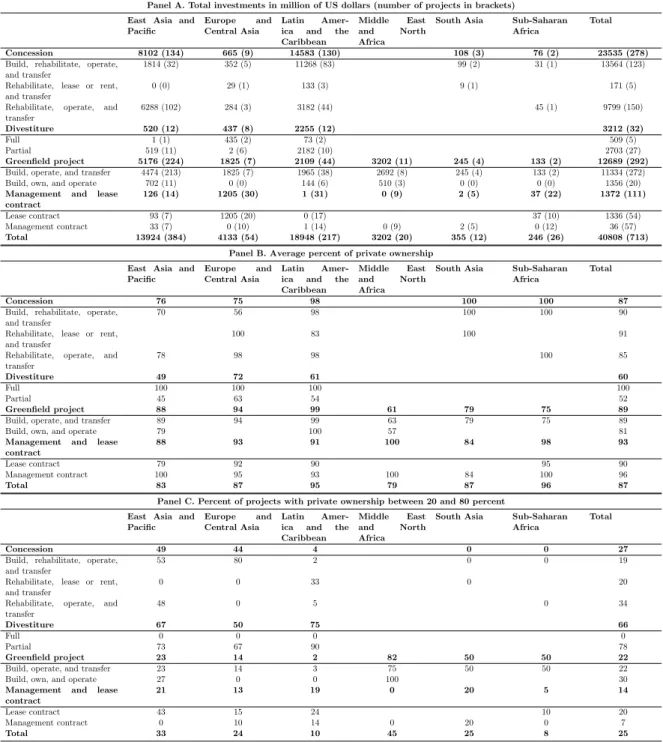
The World Bank’s Private Participation in Infrastructure Projects Database provides information on more than 4,000 infrastructure projects in developing countries dating from 1984 to 2010. In 713 PPP water projects amounting total investments of 41 billion US dollars, prevailingly in East Asia-Pacific and Latin America-Caribbean regions (see Table 1, Panel A), private ownership averages 87% (see Panel B). Interestingly, one quarter of all PPPs present hybrid public-private capital structures with private ownership between 20% and 80% (see Panel C).
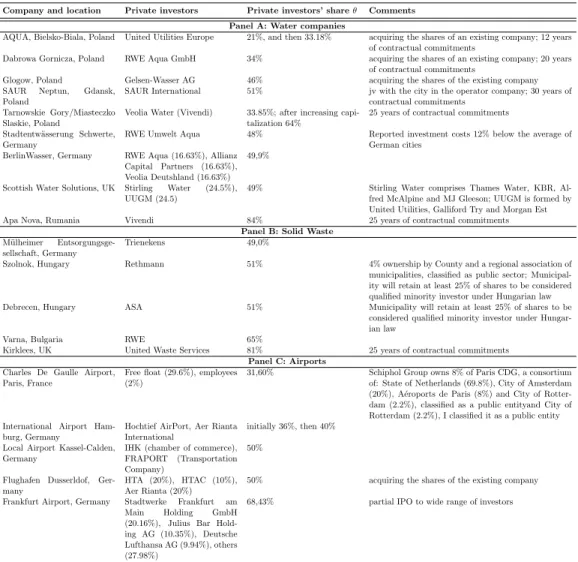
Public-private hybrids are a common governance practice in Western countries. Table 2 depicts examples of PPPs with mixed public-private capital structures in the utilities sector in various European countries 1
. Referring to government-sponsored enterprises, Jaffee and Quigley (2009) sustain that “there is little reason to presume that the evolution of these enterprises represented the best method of providing services”. Thus the question is under which conditions PPPs with mixed public-private capital can provide a more efficient gover-nance structure than solely public or entirely private. This paper presents a simple model to assess the efficiency of public-private capital structures.
PPPs are often undertaken by joint venture companies or special purpose vehicles (SPV) with equity contributed by private investors and the public sector(European Commission and Others 2004; Corbacho and Schwartz 2008; Weber and Alfen 2010; Schaeffer and Loveridge 2002. The share in equity of the SPV is reflected in the shareholders’ voting power and management involvement. To be compelling, the shareholding structure of the PPP-SPV
1Weber and Alfen (2010) show that two out of the ten largest international airports by passengers
world-wide (Paris CDG and Frankfurt) have a mixed public-private ownership structure. See also, e.g., European Commission and Others (2004) and PricewaterhouseCoopers (2006).
should secure the interest of both types of shareholders by providing room for public financing and private sector managerial discretion.
The rationale for hybrid solutions presented in this paper is similar to Rangan, Samii, and Van Wassenhove’s (2006), but differs in the drivers. Efficient financing of public investments by the private sector requires that the higher financing cost of the private sector be offset by life-cycle cost savings due to the transfer of skills and know-how from the private sector.
The main thrust of the paper is that it may be optimal for the public agent to become a shareholder in public utilities SPV. In markets with a long and reliable tradition of public procurement, such a statement sounds counterintuitive2
. The existence of market failures, however, especially in the case of transition and emerging economies, justifies the govern-ment’s involvement in the SPV to correct market failures which result in the inability of the marketplace to provide public goods (Jevˇc´ak and Keereman 2008; Tandberg 2008).
The remaining of the paper is organized as follows. Section 1 presents the literature related to mixed public-private partnerships. Section 2 introduces the premises on the public sector’s financial advantage and private sector’s managerial advantage. Section 3 outlines the relationships between expected quality, required investments in infrastructure, and life-cycle costs. Section 4 presents a discrete and a continuous model of skills transfer to describe the optimal public-private capital structure in PPPs for the provision of public utilities infras-tructure. Section 5 concludes with policy advice.
1
Related Literature
The first public-private cooperation sets were concessions. Mixed public-private ownership is rather a novel concept.3
In Linder’s (1999) taxonomy of public-private partnerships, hybrid governance structures are defined as ‘risk-shifting’ and ‘power-sharing’ PPPs. Weber and Alfen (2010) refer to these solutions as ‘horizontal’ or ‘institutional’ PPPs (as opposed to ‘vertical’ or ‘contractual’ PPPs). Schaeffer and Loveridge (2002) state that public and the private sectors have complementary powers and thus each can help the other accomplish things that may otherwise not be feasible.
2 This paper is not intended to advocate government intervention in private companies. Nonetheless,
recent bailouts by governments worldwide during the period 2008-2010 have made the idea of governments taking a stake in private businesses less outrageous.
The literature on financing public investments by private capital compares higher capital expenditures for public financing with the higher availability payments for private financing (Irwin 2008)4
. Most scholars (Grout 1997, 2003; Hart 2003; Hart, Shleifer, and Vishny 1997) focus on the dichotomy whether a public agency should provide a service in-house or contract out provision.
The European Commission and Others (2004) provides examples of mixed public-private ownership and risk sharing. Very few scholars have taken account of cost drivers continuum between the public and private sectors and implications for the governance structure. Beato and Vives (1996) acknowledge that “mixed cases share features of the pure cases”, and there-fore “they may be evaluated by using the relative participation of final consumers and the public agency in the private firm’s revenues”. Gerrard (2001) points out mixed public and pri-vate ownership in water supply utilities, and Hammami, Ruhashyankiko, and Yehoue (2006) give two examples of ‘semi-private’ ownership of public utilities. Schwartz, Corbacho, and Funke (2008) describe the pros and cons of mixed public-private structures. Rangan, Samii, and Van Wassenhove (2006) set the necessary conditions for economic opportunity realization of mixed public-private partnerships based on transaction cost economics and externalities theory. Gazley, Chang, and Bingham (2010) underline the relevancy of a stakeholder outlook on governance to the context of public-private partnerships because of its ‘systems-centered’ perspective on how constituent interests are represented. Ruf´ın and Rivera-Santos (2012) compare PPPs with business-to-business alliances. They predict that PPPs will avoid equity structures and will rely, instead, on less complete and more complex alliance contracts, which contrasts with substantial empirical evidence. Cruz and Marques (2012) discuss the practi-calities of governance of mixed ownership structures and, on the basis of in-depth cross-sector case studies, argue that mixed companies lead to poor welfare outcomes due to complex whole life-cycle management. Gautier and Yvrande-Billon (2013) present regulation type (cost-plus vs. fixed price) and ownership structure (private vs. mixed) efficiency outcomes in French urban public transportation and show that a mixed firm regulated by a cost-plus contract is the least efficient modality.
4 For the so-called Public Sector Comparator (PSC) and Value for Money (VfM) methodologies, see
2
Public Financial Advantage and Private Managerial
Advan-tage
In this section I analyze the conditions for Pareto-efficient public-private financing of infras-tructure. Pareto efficiency refers here to achieving the same quality of service at a lower cost or better quality at the same cost for a PPP compared to solely government and solely private investments.
Domestic financial markets of emerging economies are not deep and efficient enough to provide reasonably priced capital to finance large public projects. On the one hand, governments aiming at infrastructure development have to use savings from the external sector. Current account deficits of Central and Eastern European countries in the last decade confirm this observation. On the other hand, the conservative approach to risk evaluation by foreign investors leads to an additional premium to cover an excess risk for uncertainty. The public sector’s participation provides the necessary certainty to attract foreign capital and offset the additional premium, and can make investment in infrastructure an interesting business case. Public participation does not correct all market failures, but it reduces their impact.
The rationale behind public shareholding in the SPV points also to the principal-agent theory. In a PPP, the public and private sectors have conflicting interests regarding the project’s cost and the quality of the public good delivered. Under most legislative systems, shareholders have more control over the company’s activities than its contractors. Therefore, governments seeking high-quality and fairly-priced public goods would have better control over the project as shareholders. Again, the need for better internal control of quality and prices is more important in emerging and transition markets, where legal regulations are not entrenched strongly enough.
Cost of Public Capital
Prestigious economists (Samuelson 1964; Vickrey 1964; Solow 1965; Baumol 1968; Arrow and Lind 1970), analyzing the social discount rate in the 1960’s and 1970’s, claimed that the discount rate for public entities should be lower than for the private sector. Other leading scholars (Hirshleifer 1964; Diamond 1967; Bailey and Jensen 1972; Dreze 1974; Kay 1993; Brealey, Cooper, and Habib 1997; Klein 1997) held that the social discount rate should be higher than the plain public borrowing cost, equaling both public and private discount rates.
They argued that the public sector’s lower borrowing cost does not reflect a more efficient management of risk, but the fact that the public sector does not default and that it can levy taxes to repay debt. These arguments are applicable to the general case of public borrowing in a closed economy; they, however, should not apply to the PPPs in emerging and transition markets for the following reasons:
• The effective PPP scheme assumes the transfer of risks from the public sector to the private sector (Bondal 2005). Therefore, the public sector’s cost of borrowing does not reflect the project’s risks, as these risks are transferred out of the public sector. As the International Monetary Fund (2004) states, it is difficult to establish whether the transfer of risk out of the public sector is proportional to the difference in funding cost, but the public cost of lending is definitely lower.
• In case of investments which are not significant to the economy (low share in GDP), the discount rate for the public sector should be lower than for the private sector, because the public sector can better absorb and spread risks among a greater number of individuals (Arrow and Lind 1970; Fisher 1973).
• Private companies cannot internalize all externalities and their return on investment comes only from the project’s cash flows. Flemming and Mayer (1997) show that private sector investments in public utilities depend on the policy applied in other sectors of the economy and create externalities leading to inefficient piece-meal decision making, when only the perspective of a single sector of the economy is taken into account.
• In the case of incomplete capital markets, investors and lenders are not able to protect themselves in these markets against the risk connected with securities that are financing the public or private investments and therefore apply various discount rates (Hirshleifer 1964; Bailey and Jensen 1972).
• Grout (2003) proved that even in a world without incomplete markets and distorting taxation, it is appropriate to apply a higher discount rate for private entities than for public ones. The argument is based on the differential in the beta (risk) for government payments under a PPP and the beta of government expenditures under the normal public provision of goods.
• Lind (1990) suggests that the government’s long-term borrowing rate is a “good first candidate” for long-run intergenerational problems and that “for most government projects we should compute net benefits (from the project) using the government bor-rowing rate as the discount rate” (Spackman 2004).
Moreover, the concept of the social discount rate is based on the social time preference. It is justified to take into account a common social discount rate for projects financed in the domestic market. It would be difficult for any government, however, to consider the social discount rate of the external sector, which theoretically should be applied if projects are financed from the savings of the external sector.
The two concepts: the cost of capital (i.e., a financial approach) and the social discount rate (i.e., a general equilibrium approach) should not be equaled. I base my proposition regarding the cost of capital on direct market evidence that the public sector can raise capital cheaper than the private sector5
and, from these funds, it can finance different projects. I concentrate on the cost of resources engaged and did not discuss the social cost of capital. Whether public sector projects should be discounted at a lower rate than private sector projects is a highly contentious issue.
The amount of literature supporting the lower cost of capital for the public sector (start-ing from the Arrow-Lind theorem in 1970) is as large and strong as that support(start-ing the approach according to which public projects should be discounted at the same rate (see for example: HM Treasury 2003; Engel, Fischer, and Galetovic 2008), irrespective of the source of financing (see discussion in section 2.4 in Grout 2005). Writing in the 1980s on public sector discount rates and their relation to private sector discount rates, Lind (1982) pointed out that “the profession was no closer to agreement on the theory, on a procedure for com-puting the discount rate, or on the rate itself than it was in 1966.” The evidence is that the difference between the interest rates for governments and private investors is statistically significant; however, whether public projects should be discounted at the same or a different rate is not a positive, but a normative question.
5See Table 3. Kosar (2008) and Jaffee and Quigley (2009) state that GSEs borrow money at significantly
lower interest rates than solely private peers because of the inferred government guarantee. In emerging economies, the bond market is not liquid enough to provide continuous data. Moreover, most of municipal and corporate bonds there are privately placed and their yields are not published. Moszoro (2005) support the hypothesis of lower interest rates for public entities than for private corporations based on listed municipal and corporate bonds in Poland.
Life-Cycle Cost Savings
Empirical research carried out in the United Kingdom and in the United States shows that the private sector can develop infrastructure cheaper than the public sector (Wright 1987; Viscusi, Vernon, and Harrington 2000). Wallace and Junk (1970) even claim that the investment costs of public enterprises are 40% higher than those of private enterprises.
On one hand, PPPs involve sizable structuring and transaction costs, and force gov-ernments to develop expensive internal capacities: lawyers, engineers, and financial advisers (Tandberg 2008; Corbacho and Schwartz 2008). Conversely, savings can be attributed to more efficient project management by the private investor (Linder 1999), shortened construction and development times (Ward and Chapman 1995; Saussier, Staropoli, and Yvrande-Billon 2009), higher cost of innovation efforts under private ownership of assets (Hart, Shleifer, and Vishny 1997), and lower administrative expenditures and less bureaucracy (Starr 1988; Goldsmith 1997). United Kingdom’s National Audit Office (NAO) reports on PPPs (Euro-pean Investment Bank 2004; Bondal 2005) presented the following statistics confirming the above-mentioned sources of savings:
(a) A report commissioned by the Treasury Taskforce found that the average percentage estimated saving against the Public Sector Comparator in PFI projects was 17%. (b) HM Treasury research of 61 Private Finance Initiative (PFI) projects:
• 89% of projects were delivered on time or early;
• All PFI projects in the HM Treasury sample were delivered within public sector budgets;
• No PFI project was found where the unitary charge had changed following contract signature other than where user requirements changed;
• 77% of public sector managers stated that their project was meeting their initial expectations.
(c) Four Design-Build-Finance-Operate (DBFO) road contracts appear likely to generate net quantifiable savings of around£100 million (13%)
(d) Out of 98 projects surveyed by the NAO in 2001 on public authorities’ perceptions of Value For Money:
• 81% believed that PFI projects are achieving satisfactory or better Value For Money— only 4% described Value For Money as ‘poor’;
• 75% of PFI projects were delivered on time or early, and in no case did the public sector bear the cost of construction overruns, a significant improvement on previous non-PFI experience.
(e) The contract for the Private sector Resource Initiative for the Management of the Estate, a project comprising transfer of the Department of Social Security estate to the private sector, is estimated to deliver savings of£560 million, 22%, over 20 years.
Capital expenditures are not always higher under the public sector’s governance (Ahadzi and Bowles 2004). Vast evidence of cases of lower capital expenditures under private gover-nance, however, deserves analysis for its implications in the organization of PPPs.
The mainstream PPP literature suggests that the key issues involved in the governance structure are the bundling of the project’s construction and operation and efficient risk allo-cation between the public agent and private investors (Rangan, Samii, and Van Wassenhove 2006), regardless of the capital structure. Contract bundling is not in contradiction to the proposition of lower capital expenditures due to the private sector’s participation in the SPV—it reinforces it. What the private sector does when bundling is a ‘package selling’ of: construction, insurance, and financing for a lower price than when contracted independently by the public sector. I sustain that when the private capital’s share is large enough, the ad-vantages of this bundling may be realized because of the economic incentives for the private investor (Hennart 1988).
When the private contractor only constructs the infrastructure without residual claims (i.e., no shares in the SPV), it has no incentives to build cheaply, but to bid low to win the tender. Where competition is low and the public sector does not have the resources to organize repetitive tenders, it may happen that:
(a) There is price collusion or bid rigging (Buccirossi 2008; Laffont and Tirole 1993)
(b) After bidding low and winning the tender, the private contractor renegotiates the con-tracts (see asymmetric collusion in Laffont and Tirole 1993).
(c) When public-private relations are ex ante less flexible and subject to ex post higher accountability (Wang and Bunn 2004), the private contractor charges a higher price than
in a private-to-private relational contract (Moszoro and Spiller 2014).
(d) While the question on the appropriate discount rate is normative, why knowledge transfer requires private sector’s (partial) equity ownership in the project is a positive question subject to the institutional and judicial environment. The corollary is that when a private investor has an equity stake in the project, residual control rights are more properly protected and the private investor has economic incentives to transfer managerial skills and know-how to innovate in cost and quality (Hart, Shleifer, and Vishny 1997).
Hybrids public-private structures unveil severe governance problems. Cruz and Marques (2012) present empirical evidence on mixed companies from Portugal and discuss the hin-drances to achieve internal regulation and relational agreement along the life-cycle. Gautier and Yvrande-Billon (2013) observe that, although mixed companies have a higher probability of contract renewal, they present the least efficient outcome.
This paper presents first-best comparative statics and is not intended to vindicate mixed ownership PPP. At the risk of oversimplifying, I model specific key drivers of PPP, namely: cost of capital and managerial expertise as functions of continuous public-private ownership. In particular institutional settings, the relevance of these drivers is subdued to governance, contractual, and political constraints. In general, however, they do matter and hence should be factored in.
3
Model Setup
Consider a partial equilibrium setup with a monopoly utilities provider - public, private, or mixed - and a representative consumer.
The amount of capital expenditures on the utilities infrastructure is determined by the required quality of the public goods or service supplied. Consider a newly formed SPV that invests during the development phase and then operates the infrastructure based on a two-part tariff: a fixed fee that covers investment outlays and a variable fee that covers the variable cost of service (Coase 1946). This proposition requires that capital expendituresI(q) necessary to satisfy demand at quality level q should be equal to the present value of fixed feesf(q) paid to the SPV over the lifetime t of the infrastructure:
I(q) =f(q)1−(1 +r)
−t
For a sufficiently long life of the project, this can be expressed as:
I(q) = f(q)
r (2)
The public sector’s discount rate rpu is lower than the private sector’s discount raterpr.
Capital expenditures (without financial costs) for publicly executed projects are higher byJ(q)than capital expenditures for privately executed ones.
Finally, θ∈[0,1] is the private investor’s share in the SPV.
4
Optimal Public-Private Capital Structures
In this section, I show how different know-how transfer schemes determine the optimal cap-ital structure of the SPV. When the cost of capcap-ital is lower for public entities and capcap-ital expenditures are lower for investment carried by private investors, it is possible to reach the lowest total financial and development cost with mixed public and private shareholding that enables the internalization of both the public sector’s cost of capital advantage and the private sector’s managerial advantage.
Discrete Knowledge Transfer Scheme
Let us assume that the transfer of the private investor’s know-how - i.e., idiosyncratic industry-specific knowledge and skills in infrastructure engineering, capital allocation, and risk management (Rangan, Samii, and Van Wassenhove 2006) - to the SPV materializes when the private share in the SPV achieves a minimum θ ≥ e6
. From equation 2, fixed fees for mixed public-private financing is given by:
f(n) =
(
θ·I(q)·rpr+ (1−θ)·[I(q) +J(q)]·rpu f or θ < e
θ·I(q)·rpr+ (1−θ)·I(q)·rpu f or θ≥e
(3) It remains discussable the extent to which cost saving and quality innovation effort is intrinsic and exclusive to the private sector (Hart, Shleifer, and Vishny 1997). In the discrete model, I assume that if the private investor holds residual control rights greater or equal to a certain thresholde∈ (0,1), then cost-saving know-how transfer to the SPV is realized as described by Eaton, Akbiyikli, Akintoye, and Beck (2009).
6As Hennart (1988) points out, some knowledge types are firm-specific assets, i.e., they cannot be acquired
Forθ≥e, mixed public-private ownership is superior to public ownership when:
θ·I(q)·rpr+ (1−θ)·I(q)·rpu<[I(q) +J(q)]·rpu (4)
Solving forθ we obtain:
θ < J(q) I(q) rpr rpu −1 (5) Condition 5 shows that the project should be fully realized by the public sector if either there are no savings from private know-how (i.e., J(q) = 0) or savings are relatively small compared with the difference in financial costs.
Provided there is know-how transfer from the private to the public sector (θ≥e), PPP (interior solution of inequality 5) is more efficient than entirely public or private financing (boundary solutions) when:
θ·I(q)·rpr+ (1−θ)·I(q)·rpu< min{I(q)·rpr; [I(q) +J(q)]·rpu} (6)
ForI(q)·rpr <[I(q) +J(q)]·rpu:
θ·rpr+ (1−θ)·rpu< rpr (7)
(1−θ)(rpu−rpr)<0 (8)
with inequality 8 holding for everyθ∈[e,1). ForI(q)·rpr>[I(q) +J(q)]·rpu:
θ·I(q)·rpr+ (1−θ)·I(q)·rpu<[I(q) +J(q)]·rpu
can be simplified to:
θ·rpr+ (1−θ)·rpu−rpu< J(q) I(q)rpu (9) θ < J(q) I(q) rpu rpr−rpu (10) Condition 10 implies that the private investor’s share in the SPV is determined by the relative savings from private know-how and the interest rate spread between the public and private sectors.
Setting θ = 1, we obtain (rpr−rpu)/rpu < J(q)/I(q). Therefore, the private investor
should be the sole shareholder if relative savings on capital expenditures are bigger than the relative spread between discount rates.
Example 1:
The relationship presented in condition 10 can be used to present the following stylized example. Let us assume savings J(q)/I(q) to equal 20%7
, private sector interest rate at 8.50% and interest rate of long-term loans for public sector entities at 7%. PPPs would be efficient (in terms of a tradeoff between financial and development cost) when
θ < .2(.07/.015), i.e., whene≤θ <93%. Assuming an increase in the spread between the rates to 300 basis points would reduce private shareholding in the PPP to a maximum of 47% of the capital. Therefore, the bigger the spread between interest rates for the public agent and private investors, the less room there is for negotiation on capital participation between the parties.
In Apa Nova, Romania, Vivendi holds 84% of the shares (see Table 2). A large participation of the private sector responded to a lower capital advantage of the public sector, i.e., the spread between public and private interest rates was smaller than in other countries.
Figure 1 shows the level of the fixed fee as a function of the public-private capital structure and the interval of efficient public-private financing for the case where rpr/rpu >
1 +J(q)/I(q).
Starting from sole public financing (θ= 0), the fixed feef(q, θ) increases inθas a result of the larger share of the more expensive private capital. Forθ < e, the marginal increase of f(q, θ) equals I(q)·(rprrpu)−J(q)·rpu. At0theta = e, know-how transfer takes place
and f(q,) dropsby (1e)·J ·rpu. For θ ≥ e, f(q, θ) increases at the rate of I(q)·(rprrpu).
Atθa,f(q, θ) equals the fixed fee in a publicly financed project; and at = 1 with private-only
shareholding, the fixed fee equals I(q)·rpr. Therefore, the larger the private share that is
needed for know-how transfer to take place, the smaller the potential savings from private sector participation.
If the parameter space [e, θa) is not empty, then mixed public-private ownership
domi-nates.
Continuous Knowledge Transfer Scheme
Consider know-how transfer as a continuous, monotonically increasing, and differentiable function of private shareθ, i.e., private effort increases in private ownership and control rights. For simplicity, consider the case of linear know-how transfer. Equation 3 can be re-expressed as:
Figure 1: Interval of efficient public-private financing (discrete model)
where (1θ)·J(q) shows the linear decrease in capital expenditures resulting from know-how transfer proportional to the private investor’s share.
The first-order condition for an extremum of function 11 with respect toθ is:
δf
δθ =I(q)·rpr−[I(q) + 2(1−θ)·J(q)]·rpu= 0 (12)
Therefore,f(q, θ) has an extremum at such θ∗ that:
[I(q) + 2(1−θ∗)·J(q)]·r pu =I(q)·rpr (13) 2(1−θ∗)·J(q) = I(q)·rpr rpu −I(q) (14) θ∗= 1− I(q) 2J(q) rpr rpu −1 (15) Since the second derivative of equation 11 with respect to θ is positive for each J(q) > 0, then equation 15 determines the minimum of function 11.
As θranges from zero to one, the condition for θ∗ to be an interior minimum holds for rpr−rpu>0 andrpr/rpu−1<2J(q)/I(q).
Example 2:
Equation 15 can be used to determine the private investor’s optimal shareholding given expected savings and interest spreads. Assuming the same ratio of expected savingsJ/I=
.2 as in Example 4 and interest rates applicable to the private sector on average 25% higher than to the public sector(rpr/rpu= 1.25)
8
, functionf(q, θ) reaches its minimum at
θ∗ = 0.375. The optimal capital structure would then be a 62.5% capital share owned by
the public agent and 37.5% by the private investor. Mixed PPP is Pareto-efficient if:
θ∗·I(q)·r
pr+ (1−θ∗)[I(q) + (1−θ∗)·J(q)]·rpu< min{I(q)·rpr; [I(q) +J(q)]·rpu} (16)
ForI(q)·rpr<[I(q) +J(q)]·rpu, the private investor’s shareθ∗ results from solving:
θ∗·I(q)·r pr+ (1−θ∗)[I(q) + (1−θ∗)·J(q)]·rpu< I(q)·rpr (17) I(q)·rpr−(1−θ∗)·I(q)·rpr+ (1−θ∗)·I(q)·rpu+ (1−∗) 2 ·J(q)·rpu< I(q)·rpr (18) (1−θ∗)·I(q)·(r pr−rpu) + (1−θ∗) 2 ·J(q)·rpu<0 (19)
This condition is met for:
1− I(q) J(q) rpr rpu −1 < θ∗ <1 (20)
For I(q)·rpr ≥[I(q) +J(q)]·rpu, the private investor’s shareθ∗ must meet the following
condition: I(q)·rpr−(1−θ∗)·I(q)·rpr+ (1−θ∗)·I(q)·rpu+ (1−θ∗) 2 ·J(q)·rpu<[I(q) +J(q)]·rpu (21) −I(q)·(rpu−rpr)−J(q)·rpu+ (1−θ∗)·I(q)·(rpu−rpr) + (1−θ∗) 2 ·J(q)·rpu<0 (22)
This condition is met for:
0< θ∗ <2− I(q) J(q) rpr rpu −1 (23) ForI(q)·rpr ≥[I(q) +J(q)]·rpu, the private investor’s shareθ∗ must meet the following
condition: max 0; 1− I(q) J(q) rpr rpu −1 < θ∗ < min 2− I(q) J(q) rpr rpu −1 ; 1 (24)
Figure 2: Interval of efficient public-private financing (continuous model)
Example 3:
Expected savings in capital expenditures due to the private sector’s managerial advantage in existing joint venture partnerships can be inferred from condition (31) colorredesta mal la ref. In a sample of five public-private water supply and sewage companies in Poland (see Table 2),θranged between .33 and .64. For interest rates 20% higher for the private sector than for the public sector and assuming that the existing capital structures were optimal, expected savings in capital expenditures J/(I+J) ranged 12.8 - 23.0%. On average, these results are similar to savings of 17% in capital expenditures found in British PFI (European Investment Bank 2004; Bondal 2005).
Figure 2 shows the space for Pareto-efficient public-private partnerships, assuming a linear decrease in development costs due to private know-how transfer.
Knowledge transfer begins even with a small private share in the shareholding. An efficient public-private capital structure is achieved in the intervalθ∈(0,a), where the fixed
feef(q, θ) is lower than in the cases of solely public or solely private investments. The fixed feef(q, θ) achieves its minimum at θ∗. Further increase of θ leads to an increase in f(q, θ)
as a result of the higher share of more expensive private capital. As in Figure 1, at = 1 the fixed fee equalsI(q)·rpr.
5
Concluding Remarks
Efficiency considerations suggest that the ownership of utilities does not have to be dichotom-ically public or private. In particular cases, efficient investment in public infrastructure
re-quires mixed public and private ownership and governance of the project. Given very likely parameters of interest rate spreads between the public and private sectors and potential sav-ings from private management, the optimum share of private ownership θ∗ is interior and
a public-private capital structure will be more Pareto-efficient - i.e., provide higher quality for the same fee or lower fee for the same quality - than the solely public or solely private ownership. Furthermore, the smaller the difference between the interest rate spreads be-tween the public and private sectors and the larger the savings resulting from private sector participation, the larger the room for negotiation of capital participation between the parties. These conclusions have important policy implications. The economic motivations of the public agent and private investors differ and PPP contracts must be correspondingly designed. From the public sector’s point of view, the transfer of managerial skills and knowledge that justifies the private investor’s participation in the SPV should be well defined and secured in properly drafted and executable legal documents. From the private investor’s point of view, the lower cost derived from public financing should be secured for the project’s entire lifespan. This might not be problematic if the project’s funding is provided upfront. However, if funding is required over the project’s lifetime, the availability of cheaper financing would imply that the government involved maintains its creditworthiness and, accordingly, follows sound macroeconomic policies.
Therefore, PPPs may be most efficient in countries whose governments follow stability-oriented and predictable economic policies that are conducive to securing cheaper financing. An equally important advantage is a reliable legal system that provides the instruments to secure the interest of the public agent vis-`a-vis the private investor. A lack of confidence between the partners, an insufficient legal framework, and the pursuit of other than stability-oriented macroeconomic policies would undermine the Pareto-efficient solution derived from the model. If any or all of these conditions are violated, the possible savings achieved with public-private mixed ownership diminish.
Table 1: Private participation water and sewerage projects in developing countries by types of contract and regions
Panel A. Total investments in million of US dollars (number of projects in brackets) East Asia and
Pacific
Europe and Central Asia
Latin Amer-ica and the Caribbean
Middle East and North Africa
South Asia Sub-Saharan Africa
Total
Concession 8102 (134) 665 (9) 14583 (130) 108 (3) 76 (2) 23535 (278)
Build, rehabilitate, operate, and transfer
1814 (32) 352 (5) 11268 (83) 99 (2) 31 (1) 13564 (123) Rehabilitate, lease or rent,
and transfer
0 (0) 29 (1) 133 (3) 9 (1) 171 (5)
Rehabilitate, operate, and transfer 6288 (102) 284 (3) 3182 (44) 45 (1) 9799 (150) Divestiture 520 (12) 437 (8) 2255 (12) 3212 (32) Full 1 (1) 435 (2) 73 (2) 509 (5) Partial 519 (11) 2 (6) 2182 (10) 2703 (27) Greenfield project 5176 (224) 1825 (7) 2109 (44) 3202 (11) 245 (4) 133 (2) 12689 (292)
Build, operate, and transfer 4474 (213) 1825 (7) 1965 (38) 2692 (8) 245 (4) 133 (2) 11334 (272) Build, own, and operate 702 (11) 0 (0) 144 (6) 510 (3) 0 (0) 0 (0) 1356 (20)
Management and lease contract
126 (14) 1205 (30) 1 (31) 0 (9) 2 (5) 37 (22) 1372 (111)
Lease contract 93 (7) 1205 (20) 0 (17) 37 (10) 1336 (54) Management contract 33 (7) 0 (10) 1 (14) 0 (9) 2 (5) 0 (12) 36 (57)
Total 13924 (384) 4133 (54) 18948 (217) 3202 (20) 355 (12) 246 (26) 40808 (713) Panel B. Average percent of private ownership
East Asia and Pacific
Europe and Central Asia
Latin Amer-ica and the Caribbean
Middle East and North Africa
South Asia Sub-Saharan Africa
Total
Concession 76 75 98 100 100 87
Build, rehabilitate, operate, and transfer
70 56 98 100 100 90
Rehabilitate, lease or rent, and transfer
100 83 100 91
Rehabilitate, operate, and transfer 78 98 98 100 85 Divestiture 49 72 61 60 Full 100 100 100 100 Partial 45 63 54 52 Greenfield project 88 94 99 61 79 75 89
Build, operate, and transfer 89 94 99 63 79 75 89
Build, own, and operate 79 100 57 81
Management and lease contract
88 93 91 100 84 98 93
Lease contract 79 92 90 95 90
Management contract 100 95 93 100 84 100 96
Total 83 87 95 79 87 96 87
Panel C. Percent of projects with private ownership between 20 and 80 percent East Asia and
Pacific
Europe and Central Asia
Latin Amer-ica and the Caribbean
Middle East and North Africa
South Asia Sub-Saharan Africa
Total
Concession 49 44 4 0 0 27
Build, rehabilitate, operate, and transfer
53 80 2 0 0 19
Rehabilitate, lease or rent, and transfer
0 0 33 0 20
Rehabilitate, operate, and transfer 48 0 5 0 34 Divestiture 67 50 75 66 Full 0 0 0 0 Partial 73 67 90 78 Greenfield project 23 14 2 82 50 50 22
Build, operate, and transfer 23 14 3 75 50 50 22
Build, own, and operate 27 0 0 100 30
Management and lease contract
21 13 19 0 20 5 14
Lease contract 43 15 24 10 20
Management contract 0 10 14 0 20 0 7
Total 33 24 10 45 25 8 25
Table 2: Examples of PPPs with joint public-private capital structures
Company and location Private investors Private investors’ shareθ Comments Panel A: Water companies
AQUA, Bielsko-Biala, Poland United Utilities Europe 21%, and then 33.18% acquiring the shares of an existing company; 12 years of contractual commitments
Dabrowa Gornicza, Poland RWE Aqua GmbH 34% acquiring the shares of an existing company; 20 years of contractual commitments
Glogow, Poland Gelsen-Wasser AG 46% acquiring the shares of the existing company SAUR Neptun, Gdansk,
Poland
SAUR International 51% jv with the city in the operator company; 30 years of contractual commitments
Tarnowskie Gory/Miasteczko Slaskie, Poland
Veolia Water (Vivendi) 33.85%; after increasing capi-talization 64%
25 years of contractual commitments Stadtentw¨asserung Schwerte,
Germany
RWE Umwelt Aqua 48% Reported investment costs 12% below the average of German cities
BerlinWasser, Germany RWE Aqua (16.63%), Allianz Capital Partners (16.63%), Veolia Deutshland (16.63%)
49,9%
Scottish Water Solutions, UK Stirling Water (24.5%), UUGM (24.5)
49% Stirling Water comprises Thames Water, KBR, Al-fred McAlpine and MJ Gleeson; UUGM is formed by United Utilities, Galliford Try and Morgan Est Apa Nova, Rumania Vivendi 84% 25 years of contractual commitments
Panel B: Solid Waste
M¨ulheimer Entsorgungsge-sellschaft, Germany
Trienekens 49,0%
Szolnok, Hungary Rethmann 51% 4% ownership by County and a regional association of municipalities, classified as public sector; Municipal-ity will retain at least 25% of shares to be considered qualified minority investor under Hungarian law Debrecen, Hungary ASA 51% Municipality will retain at least 25% of shares to be
considered qualified minority investor under Hungar-ian law
Varna, Bulgaria RWE 65%
Kirklees, UK United Waste Services 81% 25 years of contractual commitments
Panel C: Airports
Charles De Gaulle Airport, Paris, France
Free float (29.6%), employees (2%)
31,60% Schiphol Group owns 8% of Paris CDG, a consortium of: State of Netherlands (69.8%), City of Amsterdam (20%), A´eroports de Paris (8%) and City of Rotter-dam (2.2%), classified as a public entityand City of Rotterdam (2.2%), I classified it as a public entity International Airport
Ham-burg, Germany
Hochtief AirPort, Aer Rianta International
initially 36%, then 40% Local Airport Kassel-Calden,
Germany
IHK (chamber of commerce), FRAPORT (Transportation Company)
50%
Flughafen Dusserldof, Ger-many
HTA (20%), HTAC (10%), Aer Rianta (20%)
50% acquiring the shares of the existing company Frankfurt Airport, Germany Stadtwerke Frankfurt am
Main Holding GmbH (20.16%), Julius Bar Hold-ing AG (10.35%), Deutsche Lufthansa AG (9.94%), others (27.98%)
68,43% partial IPO to wide range of investors
Source: Moszoro (2005), European Commission and Others (2004), Weber and Alfen (2010).
Table 3: Add caption
Statistic Corporate Bonds (%) Municipal Bonds (%) Treasury Bonds (%) C-M Bond Yields Spread (%) C/M Bond Yields Ratio C-T Bond Yields Spread (%) C/T Bond Yields Ratio [1] [2] [3] [4] [5]=[2]-[3] [6]=[2]/[3] [7]=[2]-[4] [8]=[2]/[4] Minimum 4,44 3,15 2,22 0,62 1,16 0,25 1,05 Maximum 6,82 4,40 5,03 2,42 1,72 2,85 2,15 Mean 5,18 3,74 3,93 1,44 1,39 1,25 1,37 Median 5,15 3,80 3,96 1,34 1,36 1,13 1,29 Std. Deviation 0,41 0,30 0,70 0,41 0,13 0,80 0,30 Source: Reuters.
References
Ahadzi, M. and G. Bowles (2004). Public-private partnerships and contract negotiations: an empirical study. Construction Management and economics 22(9), 967–978.
Arrow, K. J. and R. C. Lind (1970). Uncertainty and the evaluation of public investment decisions. American Economic Review 60(3), 364–378.
Bailey, M. J. and M. C. Jensen (1972). Risk and the discount rate for public investment. In M. C. Jensen (Ed.), Studies in the Theory of Capital Markets. Praeger Publishers. Baumol, W. J. (1968). On the social rate of discount. American Economic Review 58(4),
788–802.
Beato, P. and A. Vives (1996). Private sector participation in infrastructure: risk, fiscal,
and efficiency issues in public-private arrangements for the provision of services.
Inter-American Development Bank, Social Programs and Sustainable Development Dept. Bondal, J. R. (2005). Market-type mechanisms and the provision of public services.OECD
Journal on Budgeting 5(1), 79–106.
Brealey, R. A., I. A. Cooper, and M. A. Habib (1997). Investment appraisal in the public sector. Oxford Review of Economic Policy 13(4), 12–28.
Broadbent, J. and R. Laughlin (2003). Public private partnerships: an introduction.
Ac-counting, Auditing & Accountability Journal 16(3), 332–341.
Buccirossi, P. (2008).Handbook of antitrust economics, Volume 1. The MIT Press. Coase, R. H. (1946). The marginal cost controversy.Economica 13(51), 169–182.
Corbacho, A. and G. Schwartz (2008). PPPs and fiscal risks: Should governments worry? In G. Schwartz, A. Corbacho, and K. Funke (Eds.), Public Investment and Public-Private Partnerships — Addressing Infrastructure Challenges and Managing Fiscal
Risks. Washington, DC: International Monetary Fund.
Cruz, N. F. and R. C. Marques (2012). Mixed companies and local governance: no man can serve two masters. Public Administration 90(3), 737–758.
Diamond, P. A. (1967). The role of a stock market in a general equilibrium model with technological uncertainty. American Economic Review 57(4), 759–776.
Dreze, J. H. (1974). Discount rates and public investment: A post-scriptum.
Econom-ica 41(161), 52–61.
Eaton, D., R. Akbiyikli, A. Akintoye, and M. Beck (2009). Innovation in ppp. Policy,
Finance and Management for Public–Private Partnerships, 303–26.
Engel, E., R. Fischer, and A. Galetovic (2008). The basic public finance of public-private partnerships. In University of Yale Working Papers. New Haven.
European Commission and Others (2004). Resource book on PPP case studies. Technical report, Directorate General Regional Policy.
European Investment Bank (2004). The EIB’s role in public-private partnerships. Technical report, European Investment Bank.
Fisher, A. C. (1973). Environmental externalities and the Arrow-Lind public investment theorem. American Economic Review 63(4), 722–725.
Flemming, J. and C. Mayer (1997). The assessment: public-sector investment. Oxford
Review of Economic Policy 13(4), 1–11.
Gautier, A. and A. Yvrande-Billon (2013). Contract renewal as an incentive device. an application to the French urban public transport sector. Review of Economics and
Institutions 4(Winter), Art 2.
Gazley, B., W. K. Chang, and L. B. Bingham (2010). Board diversity, stakeholder rep-resentation, and collaborative performance in community mediation centers. Public
Administration Review 70(4), 610–620.
Gerrard, M. (2001). Public-private partnerships. Finance and Development 38(3).
Goldsmith, A. A. (1997). Economic rights and government in developing countries: cross-national evidence on growth and development. Studies in Comparative International
Development 32(2), 29–44.
Grimsey, D. and M. K. Lewis (2004). The governance of contractual relationships in public-private partnerships. Journal of Corporate Citizenship 15, 91–109.
Grimsey, D. and M. K. Lewis (2005). The Economics of Public Private Partnerships. Cheltenham, UK; Northampton, MA: Elgar.
Grout, P. A. (1997). The economics of private finance initiatives. Oxford Review of
Grout, P. A. (2003). Public and private sector discount rates in public-private partnerships.
Economic Journal 113(486), C62–C68.
Grout, P. A. (2005). Value-for-Money measurement in public–private partnerships. EIB
Papers 10(2), 33–56.
Hammami, M., J.-F. Ruhashyankiko, and E. B. Yehoue (2006). Determinants of public-private partnerships in infrastructure. IMF Working Paper WP/06/99, International Monetary Fund.
Hart, O. (2003). Incomplete contracts and public ownership: Remarks, and an application to public-private partnerships. The Economic Journal 113(486), C69—C76.
Hart, O., A. Shleifer, and R. W. Vishny (1997). The proper scope of government: Theory and an application to prisons. Quarterly Journal of Economics 112(4), 1127–1161. Hennart, J.-F. (1988). A transaction costs theory of equity joint ventures.Strategic
Man-agement Journal 9(4), 361–374.
Hirshleifer, J. (1964). Efficient allocation of capital in an uncertain world. American
Eco-nomic Review 54(3), 77–85.
HM Treasury (2003). The green book—Appraisal and evaluation in central government. Technical report, HM Treasury, London, UK.
International Monetary Fund (2004). Public-private partnerships. Technical report, Wash-ington, DC: IMF.
Irwin, T. (2008). Controlling spending commitments in PPPs. In G. Schwartz, A. Corbacho, and K. Funke (Eds.), Public Investment and Public–Private Partnerships: Addressing
Infrastructure Challenges and Managing Fiscal Risks. Washington, DC: International
Monetary Fund.
Jaffee, D. M. and J. M. Quigley (2009). The government sponsored enterprises: Recov-ering from a failed experiment. Technical report, Institute of Business and Economic Research, Fisher Center for Real Estate and Urban Economics, University of California, Berkeley.
Jevˇc´ak, A. and F. Keereman (2008). Challenges for public investment in new EU mem-ber states. In G. Schwartz, A. Corbacho, and K. Funke (Eds.), Public Investment and
Public-Private Partnerships: Addressing Infrastructure Challenges and Managing
Fis-cal Risks, pp. 36–60. Washington, DC: International Monetary Fund.
Kay, J. (1993). Efficiency and Private Capital in the Provision of Infrastructure. Paris: OECD.
Klein, M. (1997). The risk premium for evaluating public projects.Oxford Review of
Eco-nomic Policy 13(4), 29–42.
Kosar, K. R. (2008). Government-Sponsored Enterprises (GSEs): An Institutional Overview. CRS Report for Congress Order Code RS21663, Congressional Research Service, The Library of Congress.
Laffont, J.-J. and J. Tirole (1993).A Theory of Incentives in Procurement and Regulation. Cambridge, MA: MIT Press.
Lind, R. C. (1982). Discounting for Time and Risk in Energy Policy, Resources for the
Future. Baltimore: Johns Hopkins University Press.
Lind, R. C. (1990). Reassessing the government’s discount rate policy in light of new theory and data in a world economy with a high degree of capital mobility. Journal of
Environmental Economics & Management 18(2), S8–S28.
Linder, S. H. (1999). Coming to terms with the public-private partnership a grammar of multiple meanings. American Behavioral Scientist 43(1), 35–51.
Moszoro, M. W. (2005). Partnerstwo publiczno-prywatne w monopolach naturalnych w sferze u˙zyteczno´sci publicznej [Public-Private Partnerships in Natural Monopolies in
the Utilities Sector]. Szko la G l´owna Handlowa w Warszawie.
Moszoro, M. W. and P. T. Spiller (2014). Third-party opportunism and the theory of pub-lic contracts: Operationalization and apppub-lications. In E. Brousseau and J.-M. Glachant (Eds.),The Manufacturing of Markets: Legal, Political and Economic Dynamics, Chap-ter 11, pp. 229–252. Florence: Cambridge University Press.
PricewaterhouseCoopers (2006). Hybrid PPPs: levering EU funds and private capital. In
Infrastructure and Government. PPIAF and the World Bank.
Rangan, S., R. Samii, and L. N. Van Wassenhove (2006). Constructive partnerships: When alliances between private firms and public actors can enable creative strategies.
Ruf´ın, C. and M. Rivera-Santos (2012). Between commonweal and competition under-standing the governance of public–private partnerships.Journal of Management 38(5), 1634–1654.
Samuelson, P. A. (1964, May). Principles of efficiency: Discussion. American Economic
Review, Papers & Proceedings 81, 191–209.
Saussier, S., C. Staropoli, and A. Yvrande-Billon (2009). Public-private agreements, in-stitutions, and competition: When economic theory meets facts. Review of Industrial
Organization 35(1-2), 1–18.
Schaeffer, P. V. and S. Loveridge (2002). Toward an understanding of types of public-private cooperation. Public Performance & Management Review, 169–189.
Schwartz, G., A. Corbacho, and K. Funke (Eds.) (2008). Public Investment and Public–
Private Partnerships: Addressing Infrastructure Challenges and Managing Fiscal Risks.
Washington, DC: International Monetary Fund.
Solow, R. M. (1965). Capital Theory and the Rate of Return. Chicago: Rand McNally. Spackman, M. (2004). Time discounting and of the cost of capital in government. Fiscal
Studies 25(4), 467–518.
Starr, P. (1988). The meaning of privatization. Yale Law & Policy Review 6(1), 6–41. Tandberg, E. (2008). Budgeting of public investments. In G. Schwartz, A. Corbacho, and
K. Funke (Eds.), Public Investment and Public-Private Partnerships — Addressing
Infrastructure Challenges and Managing Fiscal Risks. Washington, DC: International
Monetary Fund.
Vaillancourt-Rosenau, P. (2000).Public-Private Policy Partnerships. The MIT Press. Vickrey, W. (1964, May). Principles of efficiency: Discussion.American Economic Review,
Papers & Proceedings 54, 88–92.
Viscusi, W. K., J. M. Vernon, and J. E. Harrington (2000). Economics of Regulation and
Antitrust (3rd ed.). Cambridge, MA: The MIT Press.
Wallace, R. L. and P. E. Junk (1970). Economic inefficiency of small municipal electric generating systems. Land Economics 46(1), 98–104.
Wang, S. and M. D. Bunn (2004). Government/business relationships: Insights into con-tract implementation. Journal of Public Procurement 4, 84–115.
Ward, S. C. and C. B. Chapman (1995). Risk-management perspective on the project lifecycle. International Journal of Project Management 13(3), 145–149.
Weber, B. and H. W. Alfen (2010).Infrastructure as an asset class: Investment Strategies,
Project Finance and PPP. Wiley.
Wright, M. (1987). Government divestments and the regulation of natural monopolies in the UK: The case of British gas. Energy Policy 15(3), 193–216.