Application of Transfer Learning to Deep CNN
for Facial Expression Recognition
著者
Yu Shicheng
出版者
法政大学大学院情報科学研究科
journal or
publication title
法政大学大学院紀要. 情報科学研究科編
volume
13
page range
1-6
year
2017-03-31
URL
http://doi.org/10.15002/00021514
Supervisor: Professor Kaoru Uchida
Application of Transfer Learning to Deep CNN
for Facial Expression Recognition
Shicheng Yu
Graduate School of Computer and Information Science
Hosei University Tokyo 184-8584, Japan Shicheng.yu.74@stu. hosei.ac.jp
Abstract—We present a web-based application based on facial expression recognition. We investigated five classifiers which include three statistical linear classifiers and two neural network classifiers using three databases (Extended Cohn Kanade (CK+), JAFFE, SFEW), in order to find out the most suitable module for the web application. Based on our initial considerations on the neural networks applied in facial expression recognition, we chose several convolution neural network (CNN) structures investigated by Audre Teixeira Lopes and Minchul Shin. We conducted experiments with detailed training procedures with different classifiers on different datasets to gain comparative results. We chose flask as the web application’s framework because it provides us with a convenient interface for embedding existing python code such as our expression recognition classifier.
Keywords— Facial Expression; Web; Neural Network; flask
I. INTRODUCTION
A. Research background
Facial expression is some connection to connect human and society, for the automatic future world, facial expression is the fatal field to conquer. With the facial expression recognition, it can be used in so many applications, such like the house keeping robot, based the users’ emotion, it can improve its service automatically; A satisfaction detector, to analyze audience’s facial expression.
Indeed, there is a plenty of works and researches about the facial expression recognition. The traditional approaches for facial expression recognition consist of two main parts : feature extraction, and classification. The earlier facial expression methods were using simple classifier [1] , and various methods of preprocessing like face clipping, normalization, and rotation. Feature extraction also plays an important role in recognition, because the classifier makes the decision based on the combination of extracted features.
With more and more attention on deep learning, it gives the facial expression recognition field a new hint as well. There is a lot of studies in expression recognition using neural network, and the discussions about CNN structure are especially fiery [3] . Convolutional neural network (CNN) is a common deep learning architecture which is inspired by the biological natural visual cognitive mechanism, it will be applied into the classification. These networks use a special
architecture which is particularly well-adapted to classify images. Using this architecture makes convolutional networks fast to train. This, in turn, helps us train deep, many-layer networks, which are very good at classifying images. Today, deep convolutional networks or some close variant are used in most neural networks for image recognition[10].
B. Research purpose
In this research, our main contributions can be summarized as follows: 1. We do the comparative study on conventional machine learning and deep neural network machine learning on facial expression recognition. 2. We propose to add transfer learning when we train the network structure, in that, we get 20% improvement beyond the normal network structure. 3. We make a web application which is use the model from the best result we have in our comparative study.
C. Thesis structure arrangement
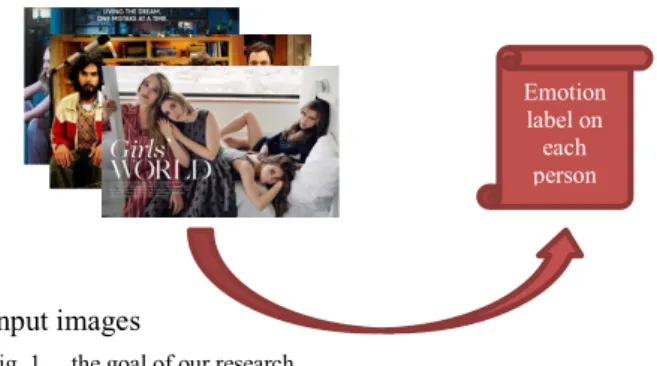
In this paper, we present both traditional methods and neural network for facial expression recognition, and find the most suitable structure and methods for our web application. In the end, we can recognize the facial expression of each face on the image, Figure 1 is the goal of our research.
Input images
Fig. 1. the goal of our research.
The remainder of this paper is organized as follows. Section Ⅱ describes related works that other researchers had done related to the facial expression recognition, Section Ⅲ introduces the base technologies such like the database which we have used in our experiments, and all kinds of methods about image processing which we have used for our emotion recognition. Section Ⅳ introduce the conventional methods of facial emotion recognition, which has a detailed describe about
Emotion label on each person
the results in different preprocessing, feature extraction and classifier. Section Ⅴ describes the results about neural network applied in facial emotion recognition. Section Ⅵ introduce our web application, which shows the structure of web application and the function of it. Section Ⅶ analyze the final model we choose for our web application. The last section concludes this paper.
II. RELATEDWORK
Chun Fui Liew [1] had done the comparative study of feature descriptors in facial expression recognition, they evaluated five feature descriptors on six classifier with four dataset, they do not try the neural network for classifying, their result showed HOG descriptor as the best feature descriptor for facial expression recognition, but only when image resolution of a detected face is higher than 48*48, the case when detected face is smaller than that, the BRIEF descriptor performs the best. Also, they only considered frontal facial expression, in our research, we add more wild images besides the normal imges such as CK+ data set. Another thing is they do not have the comparative study in neural network, only the conventional methods.
Minchul’s [3] research investigated four network structures that are known to show good performance in facial expression recognition, and also effect of input image preprocessing methods, their experiment results give us a structure shows the most efficient.
In [2], the author also researched facial expression recognition using convolutional networks, they use a combination of standard method like convolutional network and specific image pre-processing steps, their results showed that ,in comparison with the state-of-the art methods that use the same facial expression database, their methods achieved a better accuracy and took less training time, as we mentioned before, they do not use the wild images as well, instead the normative images which are all taken in the laboratory.
III. BASETECHNOLOGY
A. Facial Expression Datasets
In our experiments, we use three database, they are CK+ Database [4] , JAFFE, and Static Facial Expressions in the Wild (SFEW)[13], the example images as show in the figure 2.
CK+ JAFEE SFEW Fig. 2. Example image in database.
B. Approach overview
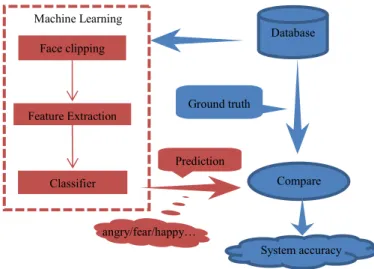
Facial expression database is the material basis for FER, it offers the standard of human emotions, and also is our experiments’, the recognition part consist of image acquisition,
image preprocessing, feature extraction and classifier. The flow is shown as Figure 3.
Machine Learning
Fig. 3. The flow of our experimental system.
IV.FACIAL EMOTION ANALYSIS:STATISTICALML APPROACHES
A. Overview of approaches
We aim to identify the best way for facial expression recognition by empirically evaluating two preprocessing, such as face clipping by Haar and Dlib, and no preprocessing; two feature extraction, such as LBP, and HOG. We examine each combined by considering five classification methods, namely GaussianNB, LinearSVC, LogisticRegression, Multi-Layer Perceptron(MLP) and Convolutional Neural Networks(CNN) with three unique facial expression datasets. For clarity, we summarized the facial expression datasets, preprocessing, feature extraction methods and classification methods in our experiments in Table 1.
After that, we selected the best structure for the Facial Expression Recognition(FER).
We aim to identify the best way for facial expression recognition by empirically evaluating two preprocessing, such as face clipping by Haar and Dlib, and no preprocessing; two feature extraction, such as LBP, and HOG. We examine each combined by considering five classification methods, namely GaussianNB, LinearSVC, LogisticRegression, Multi-Layer Perceptron(MLP) and Convolutional Neural Networks(CNN) with three unique facial expression datasets. For clarity, we summarized the facial expression datasets, preprocessing, feature extraction methods and classification methods in our experiments in Table 1.
After that, we selected the best structure for the Facial Expression Recognition(FER).
TABLE I. FACIAL EXPRESSION DATASETS,PREPROCESSING,FEATURE EXTRACTION METHODS AND CLASSIFICATION METHODS IN OUR EXPERIMENTS
angry/fear/happy… Database Compare Prediction System accuracy Face clipping Feature Extraction Classifier Ground truth
The system we perform our experiments is Windows 7, and the hardware is Intel core i7 CPU with 12 GB ram.
B.Comparative study of conventional approaches
We expect to find the best combination which means has the highest accuracy of the each combination with the different classifier and the way of preprocessing and the feature extraction.
a. three simple classifier
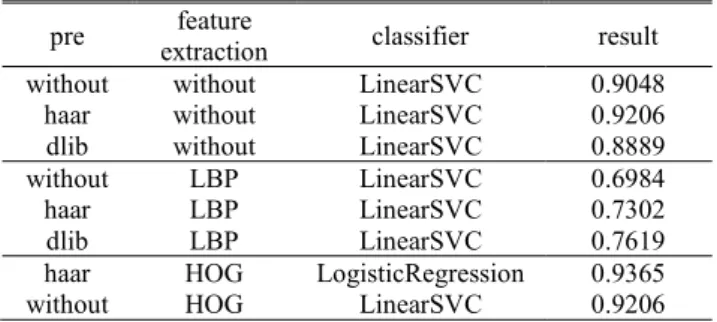
We put the three simple classifier (GaussianNB, LinearSVC, LogisticRegression) together for comparison,and because the MLP and CNN belong to the neural network , we need tuning the parameter inside, as a result, we put their different parameter we have used in the table and compare the result for choosing the best one. Table 2 summarizes the test accuracies of best classifier which is LinearSVC applied to the JAFFE Dataset. We pick up several each person’s each emotion image ,total is 63,for the test sets, others ,total is 150,as for the training sets. From the Table 2, we can draw the conclusion that the LBP feature extractor didn’t give the better result, so for the more complex database, we drop the LBP.
TABLE II. TEST ACCURACIES OF BEST CLASSIFIER WITH DIFFERENT
FEATURE EXTRACTION METHODS(JAFFEDATASET).
Table 3 shows the test accuracies applied to the CK+ Dataset. The CK+ datasets consist by 123 person, and for each person, they have a series of the images which record the change of the each emotions, considered that the beginning of each person’s emotion are all start with the normal face, so we choose the last five images which had the biggest ace emotion for our FER, in these images we picked out, we randomly disorder them first, and then put the fist 1152 images for our training sets, others for the test sets. We read the thesis about the comparison study of feature descriptors[1], found out that the HOG descriptor works the best for FER, so we also tried HOG descriptor on the CK+ datasets. As though, the result seems good enough, but the images from CK+ datasets are all in the laboratory, there is still something we need to improve.
TABLE III. TEST ACCURACIES OF BEST CLASSIFIER WITH DIFFERENT
FEATURE EXTRACTION METHODS(CK+DATASET).
To test it with real life problems, we choose the SFEW dataset for our experiments. But considered that the images from the SFEW are all in the movie scene, so we use the faces after be aligned, then we do not need the preprocessing part, Table 4 indicates the test accuracies of three classifier applied to the SFEW dataset, we chose the first 700 images from SFEW dataset as the training set, and the rest as the test set, as it like CK+, before we put the image, we randomly disordered all of them.
TABLE IV. TEST ACCURACIES OF BEST CLASSIFIER WITH DIFFERENT
FEATURE EXTRACTION METHODS(SFEWDATASET)
V. FACIAL EMOTION ANALYSIS:DEEP NN APPROACHES
A. Overview
Recently, deep models such as Convolutional Neural Networks(CNN) have been proved effective for extracting high-level visual features and are used for face verification[8]. There is some most popular framework of deep learning, like TensorFlow, Theano, Caffe, Keras.
TensorFlow is an open source software library that uses numerical data flow graphs for numerical computation. Here, they do not include TensorFlow in the depth of learning framework, but are included with Theano in the "graph compilers" category, from what I thought, TensorFlow is a very good framework, but it is in the very low layer. Using TensorFlow requires writing a lot of code.
Theano is one of the oldest and most stable libraries, like TensorFlow, Theano is a relatively low-level library. And therefore it is not suitable for depth learning, and more suitable for numerical optimization. But it does not support multi-GPU and horizontal extensions.
Caffe is also in the most oldest framework list, at first it was not a general framework, but only concerned with computer vision, but it has very good versatility. And its drawback is that it is not flexible enough. If you want to give it a little new change, then you need to use C ++ and CUDA programming, but you can also use Python or Matlab interface for some small changes, and its documentation is really less. Keras is a very high-level library that works on Theano and TensorFlow (configurable). In addition, Keras emphasizes minimalism,it means that you can build a neural network with
Datasets Preprocessing Feature
Extraction Classifiers 1.CK+ 1.Haar face
clipping 1.LBP 1.GaussianNB 2.JAFFE 2.dlib face
clipping 2.HOG 2.LinearSVC
3.SFEW 3.LogisticRegression
4.MLP 5.CNN
pre extraction feature classifier result
without without LinearSVC 0.9048
haar without LinearSVC 0.9206
dlib without LinearSVC 0.8889
without LBP LinearSVC 0.6984
haar LBP LinearSVC 0.7302
dlib LBP LinearSVC 0.7619
haar HOG LogisticRegression 0.9365
without HOG LinearSVC 0.9206
pre extraction feature classifier result without without LinearSVC 0.9834
dlib HOG LinearSVC 0.9983
haar HOG LinearSVC 0.9981
haar without LinearSVC 0.9979
dlib without LinearSVC 0.9982
pre extraction feature classifier result without without Regression Logistic 0.2775 without HOG Regression Logistic 0.4098
just a few lines of code, and its syntax is quite clear, its documentation is also very good (although relatively new), plus it was written in Python and capable of running on top of either TensorFlow, CNTK or Theano. Especially, in Keras, it allows for easy and fast prototyping, and supports both convolutional networks and recurrent networks, as well as combinations of the two, which the first one is exactly we want to use. The most important is that it can run seamlessly on CPU and GPU.
So in our experiments, we use Keras framework for our structure of neural network layer.
B. Design issues
We use the Keras for training the convolutional neural networks. Firstly, we choose three kinds of networks structure, VGG-16 network, [2], and our own simple structure only with three layers. We choose the VGG-16 network structure referenced by [3]. The net structure is showed in Figure 4.
Fig. 4. VGG-16 layer structure we used in our experiment.
At the beginning of our experiments[11], we use the CPU for training our neural network, so we need resize our input image instead the original size to 42*42, and the it cost us 639.3623 minutes for once complete training. Later, we use GPU, it cost around 25 minutes when we set the same parameters, and with the better hardware, for the higher accuracy, we try transfer learning [12] on our data sets, it improves nearly 20% compared with our training on directly neural network.
C. Comparative study of DNN
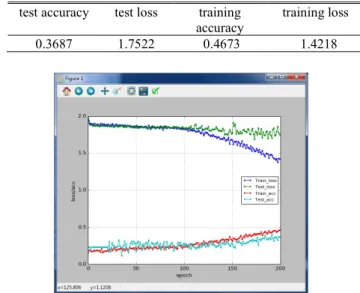
The Table 6 shows the test and training accuracy we put into the Image Net layers structure applied to CK+ Datasets, the images we picked out which are be disordered first, and randomly choose 80% for training and the rest for testing. The line chart Figure 6 shows the changeable of training and lost accuracy, test and lost accuracy while the module is trained. The platform of our experiments is Windows 7 with GPU which is GTX1060 with 6GB memories.
TABLE V. TEST AND TRAINING ACCURACY WITH VGG-16 STRUCTURE
(CK+DATASET).
Fig. 5. Line chart of training accuracy, lost and test accuracy, lost(CK+ Dataset)
For the SFEW database, we do the same steps as the CK+ database. However, it occurred overfitting, so we add dropout with fully layer, the Table 7 shows the test and training accuracy, line chart Figure 7 shows the changeable of training and lost accuracy, test and lost accuracy while the module is trained.
TABLE VI. TEST AND TRAINING ACCURACY WITH VGG-16 STRUCTURE
(SFEWDATASET).
Fig. 6. Line chart of training accuracy, lost and test accuracy, lost(SFEW Dataset).
Which we have to admit is the result is not good enough ,so we use a mix database that we mix the whole CK+ database and part of SFEW database, and the last SFEW datasets are for testing. Table 8 shows the test and training accuracy, line chart Figure 8 shows the changeable of training and lost accuracy, test and lost accuracy, while the module is trained.
TABLE VII. TEST AND TRAINING ACCURACY WITH VGG-16 STRUCTURE
(MIXDATASET) test accuracy test loss training
accuracy
training loss
0.9908 0.0590 1.0 6.3958e-05
test accuracy test loss training accuracy
training loss
0.3687 1.7522 0.4673 1.4218
test accuracy test loss training accuracy
training loss 0.4136 1.9103 0.9269 0.2088
Fig. 7. Line chart of training accuracy, lost and test accuracy, lost(mix Dataset)
So the best we got for SFEW data sets is around 40% trained by the VGG-16 network structure. Meantime, we can see there is overfitting in the image, so we tried much methods for reducing the overfitting, such as data augmentation, full layer dropouts, and batch normalization, unfortunately, there is no significantly effectiveness.
D. Transfer Learning approach
Transfer learning is moving the trained model parameters to the new model, and then to help the new model train the data sets. Considering that the most of data or tasks are relevant, the comparison of traditional machine learning with transfer learning is shown in the Figure 8, the traditional machine learning methods is training the network on their own data sets respectively, with transfer learning, we can share the learned parameters with the new model through the transfer learning, and then we can speed up and optimize the model’s learning without learning from zero as before. In practice, deep neural networks like VGG-16 has a huge number of parameters, often in the range of millions. Training a VGG-16 on a small data set(one that is smaller than the number of parameters) greatly affects the VGG-16’s ability to generalize, often result in overfitting. Therefore, we need fine-tune our existing networks that are trained on a large database by continue training iton the smaller database we have. Provided that our dataset is not drastically different in context to the original dataset, in our case, is Image Net, the pre-trained model will already have learned features that are relevant to our own classification problem.
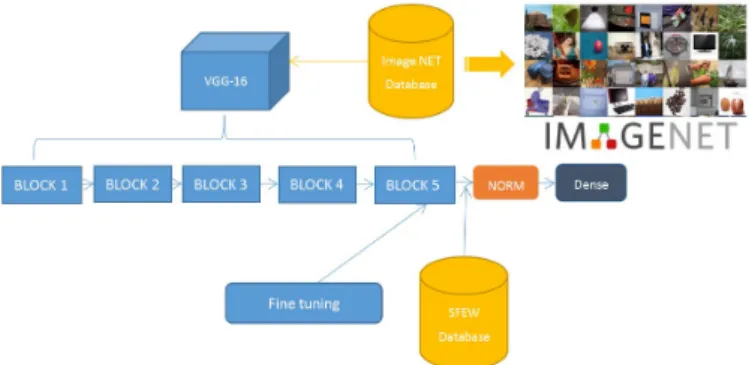
In our experiments, we also use VGG-16 as our pretrained model, Such a network in most of the computer vision problems can get a good feature, the use of such features can let us get a higher accuracy rate. The structure of our experiments is shown in the Figure 9.
Fig. 8. the comparison with traditional machine learning and transfer learning
Fig. 9. The network structure after we apply transfer learning.
The VGG-16 structure is already trained by ImageNet data sets which is an image dataset owned 14 millions images include almost 22,000 separate object categories, we put our SFEW data sets at the last layer, which is before the normalization layer and output layer, then can get our own model. The Table 9 is the accuracy when we apply the transfer learning on the network structure. Line chart Figure 10 shows the changeable of training and lost accuracy, test and lost accuracy.
TABLE VIII. TEST AND TRAINING ACCURACY WITH PRETRAINED NETWORK
STRUCTURE (SFEWDATASET)
Fig. 10.Line chart of training and lost accuracy, test and lost accuracy(SFEW Dataset)
After our experiments with DNN, we finally get the accuracy around 60% with SFEW database.
Ⅵ.WEB-BASED FACIAL EXPRESSION ANALYSIS
A. Architecture
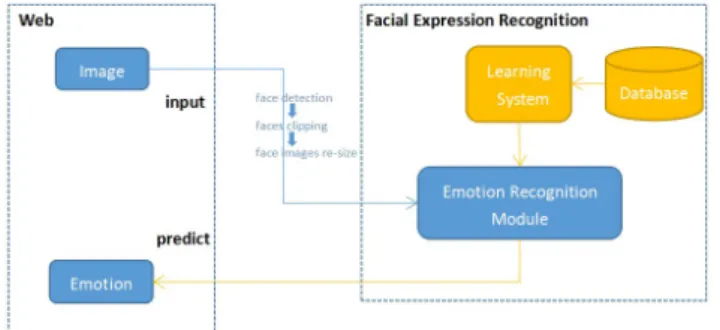
The second part is about the flow of our web application, Figure 11 is the flow of how our application works with the facial expression recognition.
test accuracy test loss training accuracy
training loss 0.5987 1.6309 0.9136 0.2692
Fig. 11.The flow of web application works with the facial expression recognition.
In our web font, we detect the face in the image first, which we use dlib for detecting faces, and cut the face into special size, this step is for our emotion recognition, the input image of emotion recognition must be as same as the training image, and the well normalized face image is as the input of the emotion recognition.
B. Implementation
We use the flask to make our web application, it released by Armin Ronancher in 2010, [9], since it is written in Python, it provides us with a convenient interface for embedding existing python code such as our expression recognition classifier.
Flask is a lightweight web application framework written in Python. It came out of an April Fool's joke but proved popular enough to make into a serious application in its own right. It is easy to install by commanded ‘pip intall Flask’, and it has its own server and debugger.
Ⅶ.DISCUSSIONANDFUTUREWORK
About the simple classifier, the best result is HOG feature extraction using the LinearSVC classifier, with the CK+ data sets, it can get 99%, but for our web application, the face on the input image is not all frontal and bright like in the laboratory, so we also use more raw images like the SFEW data sets, but all the results using simple classifier are not ideal, the best result of accuracy is around 40%.
In case of that, we try the neural network for our emotion recognition, the best neural network structure is which we pretrain the VGG-16 structure using ImageNet data sets, and before the last layer, we input our SFEW data sets for training the new model, the new model result of accuracy is around 60%. With the best accuracy model, we put it in our web application.
Although the network structure we use for training model has been discussed a lot, the accuracy with it is not good enough, still around 60%, the future work is trying more parameters and technologies for improving the accuracy.
Ⅷ.CONCLUSION
In this paper, we compared different feature extraction using different classifier in different database which include three statistical linear classifiers and two neural network classifiers using three databases (Extended Cohn Kanade(CK+), JAFFE, SFEW), and finally, in neural network, we chose several convolution neural network (CNN) structures investigated by Audre Teixeira Lopes and Minchul Shin. We conducted experiments with detailed training procedures with different classifiers on different datasets to gain comparative results. Finally, we chose the DNN for classifier, using a pre-train model first, then input our facial emotion data set, eventually get our facial expression model, we finished the web application of expression recognition which we chose flask as the web application’s framework because it provides us with a convenient interface for embedding existing python code with the model which we make.
REFERENCES
[1] Chun Fui Liew and Takehisa Yairi, “Facial Expression Recognition and Analysis: A Comparison Study of Feature Descriptors”, IPSJ Transactions on Computer Vision and Application, Vol.7 104-120, August, 2015.
[2] Audre Teixeira Lopes, Edilson de Aguiar and Thiago Oliveira-Santos, “A Facial Expression Recognition System Using Convolutional Networks” Graphics, Patterns and Images (SIBGRAPI), 28th 2015. [3] Minchul Shin, Munsang Kim and Dong-Soo Kwin, “Baseline CNN
structure analysis for facial expression recognition” Robot and Human Interactive Communication(RO-MAN) 25th IEEE International Symposium, Columbia University, NY, USA, August 26-31, 2016. [4] Patrick Lucey, Jeffrey F.Cohn, Takeo Kanade, Jason Saragih, Zara
Ambadar and Iain Matthews, “The Extended Cohn-Kanade Dataset(CK+):A complete dataset for action unit and emotion-specified expression”, Computer Vision and Pattern Recognition Workshops (CVPRW), 2010 IEEE, June 2010.
[5] Paul Viola and Michael Jones, “Rapid Object Detection using a Boosted Cascade of Simple Features ”, Computer Vision and Pattern Recognition, CVPR 2001. Proceedings of the 2001 IEEE Computer Society Conference, 8-14 December, 2001.
[6] Ze LU, Xudong Jiang and Alex Kot, "A novel LBP-based Color descriptor for face recognition",Acoustics, Speech and Signal Processing (ICASSP), IEEE, March 2017.
[7] J. Kulandai Josephine Julina and T. Sree Sharmila, "Facial recognition using histogram of gradients and support vector machines", Computer, Communication and Signal Processing (ICCCSP), January 2017. [8] Kuang Liu, Mingmin Zhang and Zhigeng Pan, "Facial Expression
Recognition with CNN Ensemble", Cyberworlds (CW), September, 2016.
[9] Sebastian Raschka, 2015, Python Machine Learning. 257p.
[10] Ian Goodfellow, Yoshua Bengio, and Aaron Courville, “Deep Learning”, MIT Press, CHAPTER 6, 2016.
[11] Pulkit Agrawal, Ross Girshick and Jitendra Malik, “Analyzing the Performance of Multilayer Neural Networks for Object Recognition”, European Conference on Computer Vision 2014 (ECCV-2014), arXiv:1407.1610v2[cs.CV], September 2014.
[12] Andrei A. Rusu, Neil C. Rabinowitz, Guillaume Desjardins, Hubert Soyer, James Kirkpatrick, Koray Kavukcuoglu, Razvan Pascanu and Raia Hadsell,“Progressive Neural Networks”, arXiv:1606.04671v3[cs.LG], September 2016.
[13] Abhinav Dhall, Roland Goecke, Simon Lucey and Tom Gedeon, “Static Facial Expression Analysis in Tough Conditions: Data, Evaluation Protocol and Benchmark”, IEEE International Conference on Computer Vision ICCV2011, November, 2016.