ISSUE BRIEF
for AIDS Research
Preventing HIV and Hepatitis C Among People
Who Inject Drugs: Public Funding for Syringe
Services Programs Makes the Difference
There are approximately 7 million people who have injected drugs (PWID) in the United States.2 The Centers for Disease Control and Prevention (CDC)
also estimates that HIV diagnoses among male and female injection drug users have declined by 70% in the 10-year period, from 2002 to 2011.3 Many
attribute this decline to the provision of comprehensive, science-based HIV prevention programs for PWID, including syringe services programs (SSPs). These programs may also reduce the transmission of hepatitis C.4
However, there are troubling signs that we may begin to lose hard fought gains in preventing disease transmission among PWID. HIV diagnoses among PWID, once concentrated in large urban centers, are shifting to rural localities and are fueled by a growing prescription drug abuse epidemic. These changing demographics have recently taken center stage nationally, with a spike in HIV diagnoses among PWID in Indiana5 and with CDC ranking Kentucky number one in the
nation for high rates of hepatitis C cases.6 Neither Indiana nor Kentucky
• New HIV and Hepatitis C (HCV) diagnoses
among people who inject drugs (PWID)
have spiked in Indiana and Kentucky—two
states where syringe services programs
(SSPs) have not been available. Both
states have implemented SSPs to stem
the outbreaks. One county in Indiana alone
has reported more HIV diagnoses among
PWID in five months than New York City
had recorded for PWID over a full year.
• Many scientific experts believe, and the
preponderance of research studies shows,
that SSPs are a highly effective strategy
to prevent HIV and possibly hepatitis C
among people who inject drugs.
• In spite of the overwhelming scientific
evidence, a federal ban prohibiting the
use of public funds for SSPs remains
in force.
• There are 194 SSPs in the United States,
but private and local funding for these
programs has been floundering and
existing programs are not nearly enough
to meet the need.
• A new study by Bramson et al shows
that public funding for SSPs is associated
with reducing new HIV infections.
1In this issue brief
0 20 40 60 80 100 120 140 160 180
Number of HIV Diagnoses among PWID
Scott County, Indiana (pop 24,000)
PWID HIV diagnoses in 5 months, December 2014- early June 2015
New York City (pop 8 million) PWID HIV diagnoses in
Massachusetts Boston Cambridge Holyoke Northampton Provincetown Worcester Rhode Island Providence New Jersey Atlantic City Camden Jersey City Newark Paterson Delaware Wilmington Maryland Baltimore District of Columbia Washington Georgia Atlanta New York Albany Beacon Buffalo Hempstead Ithaca Johnson City Mt. Vernon Newburgh New York City
Bronx Brooklyn Queens Manhattan Staten Island Poughkeepsie Rochester Schenectady Shirley Syracuse Missouri Kansas City California Arcata Berkeley Eureka Fremont Fresno Inglewood Los Angeles Lower Lake Modesto Oakland Orange Redway Redwood City Reseda Richmond Sacramento Salinas San Diego San Francisco San Jose San Luis – Obispo San Rafael Santa Barbara Santa Cruz Santa Maria Santa Rosa Seaside Ukiah Venice Ventura Colorado Boulder Denver Grand Junction Fort Collins Ohio Cleveland Cincinnati Portsmouth Montana Missoula Indiana Indianapolis Michigan Detroit Flint Grand Rapids Ypsilanti Maine Augusta Bangor Ellsworth Portland Louisiana Baton Rouge New Orleans North Carolina Asheville Durham Greensboro Hendersonville Roxboro Winston-Salem
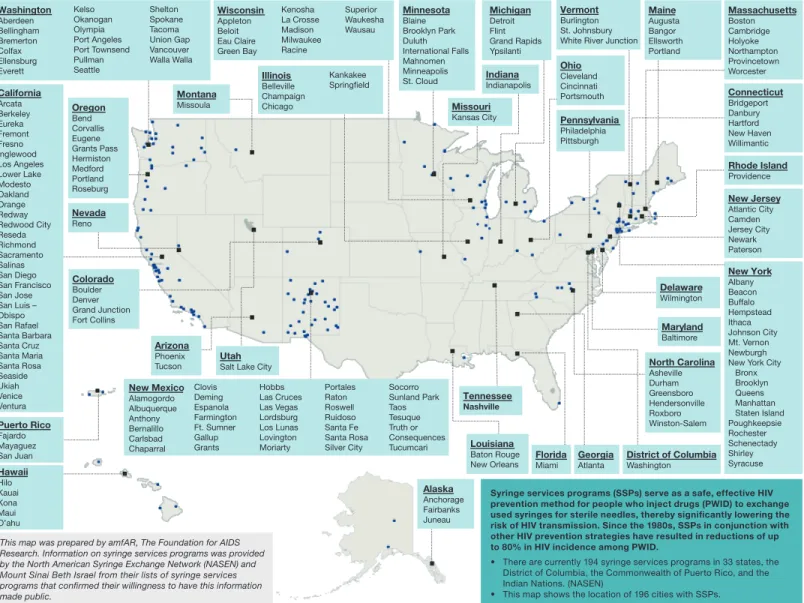
Syringe services programs (SSPs) serve as a safe, effective HIV prevention method for people who inject drugs (PWID) to exchange used syringes for sterile needles, thereby significantly lowering the risk of HIV transmission. Since the 1980s, SSPs in conjunction with other HIV prevention strategies have resulted in reductions of up to 80% in HIV incidence among PWID.
• There are currently 194 syringe services programs in 33 states, the District of Columbia, the Commonwealth of Puerto Rico, and the Indian Nations. (NASEN)
• This map shows the location of 196 cities with SSPs. Nevada Reno Puerto Rico Fajardo Mayaguez San Juan Illinois Belleville Champaign Chicago Kankakee Springfield Florida Miami Arizona Phoenix
Tucson Utah Salt Lake City
This map was prepared by amfAR, The Foundation for AIDS Research. Information on syringe services programs was provided by the North American Syringe Exchange Network (NASEN) and Mount Sinai Beth Israel from their lists of syringe services programs that confirmed their willingness to have this information made public. Alaska Anchorage Fairbanks Juneau Tennessee Nashville Pennsylvania Philadelphia Pittsburgh Connecticut Bridgeport Danbury Hartford New Haven Willimantic Minnesota Blaine Brooklyn Park Duluth International Falls Mahnomen Minneapolis St. Cloud Wisconsin Appleton Beloit Eau Claire Green Bay Kenosha La Crosse Madison Milwaukee Racine Superior Waukesha Wausau Washington Aberdeen Bellingham Bremerton Colfax Ellensburg Everett Kelso Okanogan Olympia Port Angeles Port Townsend Pullman Seattle Shelton Spokane Tacoma Union Gap Vancouver Walla Walla Oregon Bend Corvallis Eugene Grants Pass Hermiston Medford Portland Roseburg New Mexico Alamogordo Albuquerque Anthony Bernalillo Carlsbad Chaparral Clovis Deming Espanola Farmington Ft. Sumner Gallup Grants Hobbs Las Cruces Las Vegas Lordsburg Los Lunas Lovington Moriarty Portales Raton Roswell Ruidoso Santa Fe Santa Rosa Silver City Socorro Sunland Park Taos Tesuque Truth or Consequences Tucumcari Hawaii Hilo Kauai Kona Maui O’ahu Vermont Burlington St. Johnsbury White River Junction
has traditionally supported SSPs in the past; however, the uptick in HIV and hepatitis C diagnoses among PWID has prompted officials in both states to implement SSPs to curb the outbreaks.
The effectiveness of compre- hensive services for PWID,
including SSPs, is best illustrated by differences in public health policies allowing SSPs in New York City versus Scott County, Indiana—the location of the latest HIV infection outbreak among PWID. As of June 5, 166 HIV cases among PWID have been identified in Scott County, Indiana, (population 24,000) since December 2014. Although the
number of PWID alone in NYC (100,000) is four times the total population of Scott County, Indiana, Scott County has experienced more than triple the total number of HIV diagnoses among PWID in just a few months compared to the total number of HIV diagnoses among PWID in New York City during all of 2013 (Figure 1).7 Unfortunately, the ultimate effectiveness
of SSPs in Indiana may be diluted because recently passed legislation allows counties to establish SSPs only if an outbreak of Hepatitis C or HIV is already underway, and only for a 12-month period. Additionally, the legislation prohibits state funding to support these programs.8
Figure 2
.
Syringe Services Program Coverage in the United States, June 2014“ Clearly needle exchange programs work.
There is no doubt about that.”
— Anthony Fauci, M.D., Director, National Institute of Allergy and Infectious Diseases, National Institutes of Health. Testimony before the U.S. House of Representatives Committee on Oversight and Reform, September 16, 2008
who inject drugs with services, SSPs can help people stabilize their lives and sometimes stop injecting drugs.
SSPs are also highly cost-effective, as it is vastly cheaper to prevent than to treat a new HIV infection.20 The lifetime
treatment of an HIV-positive person is estimated to cost $326,500 on average.21 While HIV prevention requires
ongoing efforts, the average per syringe cost of SSPs in 2011 was $0.52.22
At the community level, an abundance of scientific evidence collected over decades has demonstrated that SSPs are effective in reducing HIV prevalence.23 In New York City, where
HIV prevalence among PWID became extremely high early in the epidemic, the large-scale expansion of SSPs coincided with
a dramatic decrease in HIV prevalence among PWID— from 54% in 1990 to 13% in 2001.24 In five cities
where HIV was introduced into the PWID population later in the epidemic, the implementation of SSPs and other HIV prevention interventions has limited HIV transmissions, maintaining HIV prevalence below five percent.25
By providing for the safe disposal of contaminated needles, SSPs also reduce the risk of needlestick injuries among law enforcement officers and the public.26 For example, in a study that systematically
counted discarded syringes in Portland, Oregon, the percentage of days in which discarded syringes were found dropped by more than two-thirds—from 21.2% before to 8.8% after an SSP began operations.27
Similarly, after Connecticut partially repealed needle prescription and drug paraphernalia laws, needlestick injuries among Hartford police officers declined by two-thirds—from 6/1,007 arrests in the six months prior to repeal to 2/1,032 arrests in the six months post-repeal.28
SSPs provide free sterile syringes to PWID, an approach
that reduces the likelihood that users will share injecting
equipment.
13Although the provision of sterile syringes
is their core service, SSPs also safely dispose of used
syringes, and many offer a range of health and supportive
services, including on-site medical care; screening and
counseling for HIV, hepatitis C, and sexually transmitted
infections; distribution of condoms, food, and clothing; and
referrals to substance abuse treatment.
14In addition, many
SSPs help save lives by providing medications to prevent
overdose and support drug treatment.
15By offering services
that are specifically tailored to meet their needs, SSPs help
PWID keep themselves and others safer and healthier. They
are also able to connect PWID to health and supportive
services they would otherwise not have accessed.
16,17,18How SSPs work
The fact is that disease transmission among PWID in Indiana and Kentucky could have been prevented. A longstanding ban has prohibited the use of federal funds for operating SSPs. The ban was briefly lifted in 2010 but immediately re-imposed by Congress as a condition of the FY 2011 budget.9
In this issue brief, we provide a snapshot of the overwhelming scientific evidence supporting SSPs to prevent disease transmission, and present compelling new evidence to continue efforts to align policy with science.
SSPs are highly effective at preventing HIV
infections among people who inject drugs
There are currently 194 SSPs in 33 states, the District of Columbia, the Commonwealth of Puerto Rico, and the Indian Nations (Figure 2). SSPs constitute one of the most effective, cost-efficient means of preventing HIV transmission.10
Research has shown that if PWID have access to sterile syringes, they share syringes less frequently or not at all.11
In terms of individual risk, a meta-analysis combining three studies among PWID in New York City showed that those who did not participate in SSPs were three times more likely to become infected with HIV than those who did.12
Such programs also serve to link people who use drugs to treatment and other services.19 Research has also shown
that SSPs neither encourage nor increase drug use or neighborhood crime. On the contrary, by linking individuals
“ [SSPs] are widely considered to be an
effective way of reducing HIV transmission
among individuals who inject illicit drugs,
and there is ample evidence that [SSPs] also
promote entry and retention into treatment.”
— Regina Benjamin, M.D., Former U.S. Surgeon General, Federal Register, February 2011
Organizational Support for SSPs
is robust and diverse
All major national medical and public health organizations support SSPs, including the American Medical Association,29
the American Public Health Association,30 the National
Academy of Sciences,31 and the American Academy of
Pediatrics.32 So too do leading global bodies such as the
International Red Cross-Red Crescent Society,33 the World
Bank,34 the World Health Organization, the Joint United Nations
Programme on HIV/AIDS (UNAIDS), and the United Nations Office on Drugs and Crime.35 The American Bar Association
strongly supports SSPs,36 as does the U.S. Conference of
Mayors.37 Despite support from reputable organizations
and scientific experts, Congress has lagged far behind the evidence and continues to bar public funding for SSPs.
SSP coverage in the United States is far below
what is needed
“Coverage” refers to the capacity of SSPs to provide one sterile syringe per injection, as recommended by public health authorities. In the United States, SSP coverage is very low, estimated to meet only three percent of the need.38 A recent
analysis calculated that expanding SSP coverage to meet even 10% of injections would avert nearly 500 new HIV infections annually.39 While such an expansion in service coverage would
cost an estimated $64 million, the cost pales in comparision to the estimated $193 million lifetime cost of treating 500 new infections (Figure 3).
In a 2011 national survey of 197 U.S. SSPs, the 144 survey respondents reported operating programs in 117 cities in 32 states.40 Collectively, SSP survey respondents reported
exchanging a total of 36.9 million syringes in 2011; of those, approximately 22.4 million syringes (61%) were distributed by the 18 largest programs.
Many SSPs operate both fixed sites and mobile sites, offering services for an average of 27.4 hours per week. More than half of survey respondents (53%) reported being able to deliver syringes and other risk-reduction supplies to meeting spots. Almost all SSPs (90%) allowed secondary exchange (i.e., exchange of syringes on behalf of another person). In addition to exchanging syringes, SSPs provided various supplies, services, and referrals; for example, virtually all (99%) provided alcohol pads and male condoms, and nearly all (94%) made referrals to substance abuse treatment. Many SSPs provided a range of other services as well, including counseling and testing for HIV (81%), hepatitis C screening (62%), STD screening (47%), and TB screening (26%). Nearly half provided hepatitis A and B vaccinations (40% and 42%, respectively).
SSP syringe coverage
Source: Nguyen, T.Q., Weir, B.W., Pinkerton, S.D., Des Jarlais, D.C., & Holtgrave, D. (July 23, 2012). Increasing investment in syringe exchange is cost-saving HIV prevention: modeling hypothetical syringe coverage levels in the United States (MOAE0204—Oral Abstract). Presented at the XIX International AIDS Conference, Washington D.C. Abstract available online at http://pag.aids2012.org/Abstracts.aspx?SID=198&AID=17268 (date last accessed: December 11, 2012).
Figure 3. Additional investment required & savings in HIV treatment costs (million 2011 USD) for
each SSP syringe coverage level
“ Early in 1998…I assembled the published
studies...and was convinced that there were
strong data favoring reduced transmission of
lethal viruses by needle-exchange programs...”
— Harold Varmus, M.D., Nobel Laureate, Co-Chair, President’s Council of Advisors on Science and Technology, and former Director, National Institutes of Health. From The Art and Politics of Science (2009)
Funding for SSPs has been declining. Among 85 SSPs that responded to the survey in both 2008 and 2011, the total budget for all programs decreased 8.9%, from $16.6 million in 2008 to $15.1 million in 2011. Among the 137 SSPs that reported financial information in the 2011 survey, individual budgets ranged from $0 to $1.1 million, with a median of $45,000. Approximately one-third (36.5%) of SSPs operated with a budget of <$25,000, 31.4% with $25,000–$99,999, and 32.1% with >$100,000. While SSPs reported multiple sources of financial support, including private contributions (from individuals and foundations), the proportion of SSP budgets derived from public sources increased from 62% during 1994/95 to 84% in 2011, when it totaled nearly $16.3 million.
New study demonstrates relationship between
public funding for SSP and lower HIV incidence
In a new study, researchers at New York City’s Beth Israel Medical Center show that laws allowing syringe services programs, permitting OTC sales of syringes, and providing public funding for SSPs are associated with reducing new HIV incidence and maintaining already low levels of incidence among PWID.1
Previous studies have demonstrated a strong relationship between receipt of public funding, the number of syringes distributed, the range and quantity of on-site services provided, and whether the SSP provides voluntary HIV counseling and testing.41 In the new study, there was also
a positive correlation between public funding and the number of syringes distributed by SSPs (R²=0.42). The provision of public funding was also associated with SSPs offering a greater number of other services to PWID (R²=0.52).
Studies have also shown a strong inverse relationship between the number of syringes distributed by SSPs and HIV incidence among PWID. For example, between 1990 and 2002 in New York City, a period during which annual SSP distribution increased from 250,000 to 3 million syringes, HIV incidence declined from 3.55% to 0.77%.42 In the new study, states
were clustered into three groups: 1) states with historically high rates of infection among PWID that remained high; 2) states with historically high rates of infection among PWID that transitioned to low rates of infection; and 3) states with historically low rates of infection among PWID that remained low. All 15 states with SSPs that received public funding were in the high-to-low or low-to-low HIV incidence categories (Figure 4). In contrast, among the four states in the high-to-high HIV incidence category, none had SSPs that received public funding.
The case is clear: Public
funding of SSPs prevents
infection
The case for public support of SSPs has never been stronger. While it has long been understood that SSPs reduce the risk of HIV infection, help link chemically dependent individuals to vital drug treatment services, save money, encourage the safe disposal of syringes, and minimize the risk of needlestick injuries to law enforcement officials, it is now clear that public funding of SSPs is linked more broadly to reducing HIV incidence and maintaining already low levels of incidence among people who inject drugs, benefiting entire communities in turn.
“ I understand there will be questions, but
[syringe exchange] is common sense.”
— Sister Maureen Joyce, CEO of Catholic Charities. In Achieve, a quarterly journal on HIV prevention, treatment, and politics (Winter 2010)
Figure 4. HIV incidence and public funding, 1985–2012
Connecticut District of Columbia Maryland Massachusetts Michigan North Carolina New Jersey New York Oklahoma Pennsylvania Tennessee Virginia Wisconsin
States with high infection rates that declined to low, 1985–2012 Florida Louisiana South Carolina Texas
States with high infection rates that remained high, 1985–2012 Arizona California Colorado Missouri New Mexico Ohio Oregon Utah Washington
States with low infection rates that remained low, 1985–2012 Low new HIV infections yearly (≤2%) High new HIV infections yearly (>2%)
Acknowledgments
The Beth Israel Medical Center research team included Heidi Bramson, Don C. Des Jarlais, Vivian Guardino, Ann Nugent, Karen Eigo, Judith Milliken, Bennett Allen, Benjamin Phillips, and Kamyar Arasteh. Special thanks to the North American
REFERENCES
1 Bramson H, Des Jarlais DC, Arasteh K, Nugent A, Guardino V, Feelemyer J, Hodel D. State laws, syringe exchange, and HIV among persons who inject drugs in the United States: History and effectiveness. J Public Health Policy. 2015 Jan 15. doi: 10.1057/jphp.2014.54. [Epub ahead of print]
2 Lansky A, Finlayson T, Johnson C, Holtzman D, Wejnert C, et al. (2014) Estimating the Number of Persons Who Inject Drugs in the United States by MetaAnalysis to Calculate National Rates of HIV and Hepatitis C Virus Infections. PLoS ONE 9(5): e97596. doi:10.1371/journal.pone.0097596 3 Johnson A, Hall H, Hu X, Lansky A, Holtgrave DR, Mermin J. Trends in
Diagnoses of HIV Infection in the United States, 2002–2011. JAMA. 2014;312(4):432–434. doi:10.1001/jama.2014.8534
4 Hagan H, Jarlais DC, Friedman SR, Purchase D, Alter MJ. Reduced risk of hepatitis B and hepatitis C among injecting drug users participating in the Tacoma syringe-exchange program. Am J Public Health 1995;85:1531-7. 5 CNN. Indiana governor declares public health emergency due to HIV
epidemic. Debra Goldschmidt, March 27, 2015. Available at http://www. cnn.com/2015/03/27/health/indiana-hiv-outbreak/
6 CDC. Division of Viral Hepatitis. Reported Cases of Acute, Hepattits C, by State—2008–2012. Available at http://www.cdc.gov/hepatitis/ Statistics/2012Surveillance/Table4.1.htm
7 New York City Department of Health and Mental Hygiene. HIV Surveillance Annual Report, 2013. Available at http://home.nyc.gov/html/doh/ downloads/pdf/dires/2013-hiv-surveillance-annual-report.pdf
8 New York Times. Indiana Governor to Approve Needle Exchanges to Fight H.I.V. April 30, 2015. Available at http://www.nytimes.com/2015/05/01/ us/indiana-governor-to-approve-needle-exchanges-to-fight-hiv.html 9 amfAR. Hill Backgrounder: Federal Funding for Syringe Exchange. June
2011. Available at http://www.amfar.org/uploadedFiles/On_The_Hill/ SEPbackgrounder.pdf
10 World Health Organization. (2004). Effectiveness of sterile needle and syringe programming in reducing HIV/AIDS among injecting drug users. http://www.unodc.org/documents/balticstates/Library/NSP/ EffectivenessNSP.pdf (accessed September 20, 2013).
11 Bluthental RN, Kral AH, Gee L, Erringer EA, Edlin BR. The effect of syringe exchange use on high-risk injection drug users: a cohort study. AIDS 2000;14:605–611.
12 Des Jarlais DC, Marmor M, Paone D et al. HIV incidence among injecting drug users in New York City syringe exchange programs. Lancet 1996;348:987-91.
13 Bluthenthal, R.N., Kral, A.H., Gee, L., Erringer, E.A., & Edlin, B.R. The effect of syringe exchange use on high-risk injection drug users: a cohort study. AIDS 2000;14(5), 605-11.
14 Des Jarlais DC, Guardino V, Nugent A, Arasteh K, Purchase D. 2011 National survey of syringe exchange programs: summary of results (unpublished slides). http://nasen.org/news/2012/nov/29/2011-beth-israel-survey-results-summary/ (accessed September 12, 2013). 15 Des Jarlais DC, Guardino V, Nugent A, Arasteh A, Purchase D. 2011
National survey of syringe exchange programs: summary of results. Presented at the 9th National Harm Reduction Conference: “From Public Health to Social Justice,” Portland, OR, November, 2012.
16 MacNeil J, Pauly B. Needle exchange as a safe haven in an unsafe world. Drug Alcohol Rev 2011;30(1), 26–32.
17 Des Jarlais DC, McKnight C, Goldblatt C, Purchase D. Doing harm reduction better: syringe exchange in the United States. Addiction 2009;104(9), 1441-6.
18 McNeil R, Guirguis-Younger M, Dilley LB, Aubry TD, Turnbull J, Hwang SW. Harm reduction services as a point-of-entry to and source of end-of-life care and support for homeless and marginally housed persons who use alcohol and/or illicit drugs: a qualitative analysis. BMC Public Health 2012; 12, 312.
19 Hagan H, McGough JP, Thiede H, Hopkins S, Duchin J, Alexander ER. Reduced injection frequency and increased entry and retention in drug treatment associated with needle-exchange participation in Seattle drug injectors. J Subst Abuse Treat 2000;19:247–252.
20 Lurie P, Gorsky R, Jones TS, & Shomphe L. An economic analysis of needle exchange and pharmacy-based programs to increase sterile syringe availability for injection drug users. J Acquir Immune Defic Syndr Hum Retrovirol 1998; 18(Suppl 1), S126–S132.
21 Shackman BR, Fleishman JA, Su AE et al. The Lifetime Medical Cost Savings From Preventing HIV in the United States. Med Care 2015;53(4):293-301.
22 Des Jarlais DC, Guardino V, Nugent A, Arasteh K, Purchase D. 2011 National survey of syringe exchange programs: summary of results (unpublished slides). http://nasen.org/news/2012/nov/29/2011-beth-israel-survey-results-summary/ (accessed September 12, 2013). 23 Gibson DR, Flynn NM, Perales D. Effectiveness of syringe exchange
programs in reducing HIV risk behavior and HIV seroconversion among injecting drug users. AIDS 2001;15:1329–1341.
24 Des Jarlais DC, Perlis T, Arasteh K, Torian LV et al. Reductions in hepatitis C virus and HIV infections among injecting drug users in New York City, 1990–2001. AIDS 2005; 19 (suppl 3);S20–S25.
25 Des Jarlais DC, Hagan H, Friedman SR et al. Maintaining low HIV seroprevalence in populations of injecting drug users. JAMA 1995;274:12726-1231.
Syringe Exchange Network (NASEN), and to Alisa Solberg, Jill Westermark, and Kay Borba for their generous help contacting SSPs and encouraging survey submissions. Derek Hodel wrote this issue brief.
26 Tookes HE, Kral AH, Wenger LD et al. A comparison of syringe disposal practices among injection drug users in a city with versus a city without needle and syringe programs. Drug Alcohol Depend 2012;123(1-3): 255-9.
27 Oliver K, Friedman SR, Maynard H, Magnuson L, Des Jarlais DC. Impact of a needle exchange program on potentially infectious syringes in public places (letter). Journal Acquir Immune Defic Syndr 1992;5/5: 534-5. 28 Groseclose SL, Weinstein B, Jones TS, Valleroy LA, Fehrs LJ, Kassler WJ.
Impact of increased legal access to needles and syringes on practices of injecting-drug users and police officer—Connecticut, 1992–1993. Journal Acquir Immune Defic Syndr Hum Retrovirol 1995;10:82–89. 29 Towey K, Fleming M, eds. Policy and resource guide: Alcohol use and
adolescents (pp. 41). Chicago, IL: American College of Preventive Medicine and American Medical Association National Coalition for Adolescent Health, 2006.
30 American Public Health Association. (November 13, 2002). Syringe prescription to reduce disease related to injection drug use (Policy #2002-12) http://www.apha.org/advocacy/policy/policysearch/default. htm?id=288 (accessed September 21, 2013).
31 Kolata G. Sept. 17–23: the AIDS epidemic; scientists endorse needle exchanges. The New York Times, September 24, 1995. http://www. nytimes.com/1995/09/24/weekinreview/sept-17-23-the-aids-epidemic-scientists-endorse-needle-exchanges.html (accessed September 21, 2013).
32 Provisional Committee on Pediatric AIDS. Reducing the risk of Human Immunodeficiency Virus infection associated with illicit drug use. Pediatrics 1994;94(6), 945–947. http://pediatrics.aappublications.org/ content/94/6/945 (accessed December 12, 2012).
33 International Federation of Red Cross and Red Crescent Societies. (2003). Spreading the light of science: Guidelines on harm reduction related to injecting drug use. http://www.ifrc.org/PageFiles/96733/Red_Cross_ spreading_the_light_of_science.pdf (accessed September 21, 2013). 34 World Bank. Local government responses to HIV/AIDS: A handbook
(2003). http://siteresources.worldbank.org/INTURBANHEALTH/ Resources/1090754-1242053198381/handbook.pdf (accessed September 21, 2013).
35 World Health Organization, Joint United Nations Programme on HIV/AIDS (UNAIDS), United Nations Office on Drugs and Crime (UNODC). Guide to starting and managing needle and syringe programmes (2007). https:// www.unodc.org/documents/hiv-aids/NSP-GUIDE-WHO-UNODC.pdf (accessed September 22, 2013).
36 American Bar Association. ABA Washington letter: ABA urges federal support for syringe exchange programs (April 2011). http://www. americanbar.org/publications/governmental_affairs_periodicals/ washingtonletter/2011/april/syringeexchange.html (accessed September 21, 2013).
37 United States Conference of Mayors, Health and Human Services Committee. (June 2000). Removal of legal barriers to access to sterile syringes by injection drug users. http://www.usmayors.org/ resolutions/68th_conference/2000resolutions.pdf (accessed September 21, 2013).
38 Nguyen TQ, Weir BW, Pinkerton SD, Des Jarlais DC, Holtgrave D. (July 23, 2012). Increasing investment in syringe exchange is cost-saving HIV prevention: modeling hypothetical syringe coverage levels in the United States (MOAE0204). Presented at the XIX International AIDS Conference, Washington, D.C. (accessed September 12, 2013). [NOTE: The model assumes a rate of 2,500 infections per year as a consequence of sharing injecting equipment in the United States.]
39 Ibid.
40 Des Jarlais DC, Guardino V, Nugent A, Arasteh K, Purchase D. 2011 national survey of syringe exchange programs: summary of results (unpublished slides). http://nasen.org/news/2012/nov/29/2011-beth-israel-survey-results-summary/ (accessed September 12, 2013). [NOTE: The number of SSPs in the U.S. is highly fluid and subject to the availability of resources, political backlash, and other factors. Some SSPs also operate somewhat surreptitiously, and there may be additional SSPs that are not known to NASEN. For an updated representation of currently known SEP sites, see: Foundation for AIDS Research (amfAR). Syringe services program Coverage in the United States 2013. http://www.amfar. org/SEPMAP/]
41 Des Jarlais DC, McKnight C, Milliken J. Public funding of US syringe exchange programs. J Urban Health 2004;81/1:118–121.
42 Des Jarlais DC, Perlis T, Arasteh K et al. HIV incidence among injection drug users in New York City, 1990–2002: Use of serologic test algorithm to assess expansion of HIV prevention services. Am J Public Health 2005;95:1439-1444.
Suite 406 Washington, DC 20036
USA +1.202.331.8600