Continuous-time quantum walks on dynamical percolation graphs
Claudia Benedetti1 (a), Matteo A. C. Rossi2 (b) andMatteo G. A. Paris1 (c)1 Quantum Technology Lab, Dipartimento di Fisica ’Aldo Pontremoli’, Universit`a degli Studi di Milano, I-20133 Milano, Italy
2 QTF Centre of Excellence, Turku Centre for Quantum Physics, Department of Physics and Astronomy, University of Turku , FI-20014 Turun Yliopisto, Finland
PACS 03.67.-a– Quantum information PACS 05.40.Fb– Random Walks
PACS 03.65.Yz– Decoherence; open systems; quantum statistical methods PACS 89.75.-k– Complex systems
Abstract– We addresscontinuous-timequantum walks on graphs in the presence of time- and space-dependent noise. Noise is modeled as generalized dynamical percolation, i.e. classical time-dependent fluctuations affecting the tunneling amplitudes of the walker. In order to illustrate the general features of the model, we review recent results on two paradigmatic examples: the dynamics of quantum walks on the line and the effects of noise on the performances of quantum spatial search on the complete and the star graph. We also discuss future perspectives, including extension to many-particle quantum walk, to noise model for on-site energies and to the analysis of different noise spectra. Finally, we address the use of quantum walks as a quantum probe to characterize defects and perturbations occurring in complex, classical and quantum, networks.
Introduction. – Quantum walks (QWs) describe the propagation of a quantum particle over a discrete set of positions. QWs are the quantum counterpart of the clas-sical random walks, i.e. systems where a walker moves on a lattice by hopping through sites according to a certain set of transition probabilities. A well known example is provided by the random walk on the line, where at each time step the walker moves according to the tossing of a coin, e.g., it moves to the left if the outcome is head and to the right if it is tail. In the quantum analogue of the ran-dom walk, the evolution is governed by a quantum coin, which may exist in a superposition of head and tail states, making the propagation of the walkercoherent, i.e. evolv-ing in a superposition of possible positions. The dynamics is discrete in time, each temporal step corresponding to a toss of the quantum coin. For this reason this model is nameddiscrete-time quantum walks(DTQW) [1]. A differ-ent model has been suggested few years later [2], in which the walker moves continuously in time, in a closer analogy with the evolution of classical Markov chains. This model, in which the evolution of the walker is governed by a lat-tice Hamiltonian, is usually referred to ascontinuous-time
(a)E-mail: [email protected] (b)E-mail: [email protected]
(c)E-mail: [email protected]
quantum walk(CTQW).
The concept of QW is naturally connected to the notion of graph. Indeed a QW, both discrete- and continuous-time, evolves on a discrete position space, where the states can be identified with the nodes of a graph. The edges of the graph are then associated with the tunneling ampli-tudes between connected nodes. Different graph topolo-gies then lead to different dynamics for the walker. QWs were proven useful tools for several tasks, ranging from universal quantum computation [3], transport on networks [4, 5], quantum algorithms [6–10], quantum modelling of biological systems, [11, 12], graph matching [13], and as quantum probes for the topology of graphs [14]. QWs have been experimentally implemented on different plat-forms, e.g. trapped ions [15, 16], nuclear spins [17] and optical systems [18–20]. In realistic implementations of QWs, environmental noise and defects may affect the be-havior of the quantum walker [21]. As a consequence, the speed-up observed in certain computational tasks may be lost, and the QW may either transform into a classical random walk, or localize over few sites [22–26].
In this paper, we address the most relevant form of per-turbation that may affect a graph: percolation. In a perco-lation graph links between nodes are created with a certain probability p. A generalization of the static percolation,
where the links can be created and destroyed in time with a certain rate, is called dynamical percolation [28]. If the percolation rate vanishes, the static case is recovered. For CTQW, the absence or presence of a link between two nodes of the underlying graph is identified with the cor-responding tunneling amplitude between the walker sites, which may take a zero or non-zero value, i.e. it can flip between two values. This duality allows us to further gen-eralize the percolation model by assuming that the cou-pling between sites can randomly switch between any two non-zero values, thus mimicking the fact that the weights of the edges are dichotomic random variables. We call this dynamical noise generalized percolation, since it includes dynamical percolation as a special case. In particular, a convenient way to describe generalized percolation is by means of the random telegraph noise (RTN): a stochas-tic process where a certain variable may flip between two values at a certain rate, that from now on we refer to as percolation rate.
The aim of this perspective article is to describe realistic models of quantum walks affected by of noise. In partic-ular, we focus on the CTQW model in the presence of generalized percolation described by RTN. The aim is to provide a general understanding of the role of environmen-tal noise in the dynamics of the walker by reviewing re-cent results concerning the temporal behavior of a CTQW, with particular attention to the propagation properties of the walker and on its ability to search a marked vertex on a graph. The paper is organized as follows: we first establish the notation and we introduce concepts of graph Laplacian and CTQW Hamiltonian; After that, we intro-duce noise in the model. We then review recent results on the propagation properties of the walker in the presence of noise and on its ability to fast searching for a target node on a graph. We close the paper with concluding remarks and future perspectives.
Dynamics of CTQW on graphs. – CTQWs evolve on graphs, i.e. set of N nodes (discrete positions) con-nected by edges. If two nodes are concon-nected by a link, then the walker may jump from one to the other, and viceversa, with a tunnelling amplitude J. The Hilbert space of the walker is thus spanned by the orthonormal position states{|ji}N
j=1,where|jidenotes the state of the the walker localized at site j. The mathematical object that fully characterizes the topology of a graph is its adja-cency matrix, whose elements areAjk= 1 if nodesj and
k are connected, and Ajk = 0 otherwise, i.e. if there is
no edge linkingj andk. From the adjacency matrix it is possible to build the LaplacianLof the graph: Ljk=Ajk
ifj 6=k and Ljk =−dk ifj =k, where dj =PkAjk is
the so-calledvertex degree. The Hamiltonian for a CTQW on a graph is thus defined by
H=−J0L . (1)
An initial state of the walker |ψ0i evolves according to |ψti = e−iHt|ψ0i, where we set ~ = 1. The evolution
through the Laplacian operator L is one possible gener-ator for the CTQW dynamics. But since quantum me-chanics only imposes that the Hamiltonians are Hermi-tian operators, another possible candidate to describe the evolution of the walker is the adjacency matrixA alone, leading to the Hamiltonian H0 = −J0A. In the case of regular graphs, where the vertex degrees are all equal, the two HamiltoniansH andH0 only differ for a term propor-tional to the identity matrix, thus they generate equivalent time evolutions, while this equivalence does not hold true for irregular graphs. The different dynamics generated by these Hamiltonians and the physical systems that they are associated with are thoroughly described in Ref. [29]. In the following, we will focus on the evolution generated by the Laplacian.
In the simple case of the line, i.e. a one-dimensional regular graph, the Hamiltonian reads
HL= 2J0 X j |jihj| −J0 X j |jihj+ 1|+|j+ 1ihj|, (2) which physically corresponds to the propagation of a par-ticle in a periodic potential, e.g. to simulate tight-binding models [30]. Despite the simplicity of the underlying graph, this model allows us to highlight the differences between the quantum and the classical QW. The most striking difference is the limit distribution of the particle for long times: in the case of a classical walk, the tran-sition probability from the site j to the site k may be expressed aspkj(t) =hk|e−Ht|jiand thus, due to the
cen-tral limit theorem, the long-time probability distribution of the walker is Gaussian, while for a CTQW a non-trivial non-Gaussian shape is found [31]. Indeed, the probability of finding the quantum particle at sitekat timetwhen it is initially localized at sitek0= 0 ispk(t) =J|2k|(2J0t), where
Jk(x) is the Bessel function of order k. This probability
distribution has many peaks, with the external larger than the internal ones, and it is symmetric with respect to the central pointk= 0.
An interesting characteristic of CTQW is that it spreads on the infinite line with a varianceσ2
q ∝t2(referred to as
ballistic propagation), while in the classical case the vari-ance is σ2
c ∝ t (diffusive propagation), meaning that a
quantum walker is able to explore the nodes faster that the classical one. This property has sparked research into possible applications of QW for computational and trans-port tasks.
Spatial search. – The ballistic propagation of CTQW has been suggested as a resource to improve the search for a marked node on a graph, a task requiring a time of order O(N) by classical, diffusive, propagation. The corresponding quantum CTQW search algorithm has been introduced in [3] by means of the Hamiltonian
Hs=−J L− |wihw|, (3) which is expected to drive the walker to the target node
co-efficient J is the tunnelling amplitude between any two connected nodes, and it needs to be optimized in order to yield the maximum probability of finding the walker on the target node, given that the walker is initially prepared in a superposition of all sites, i.e. the maximum of
pw(t) = hw|e −iHst |si 2 , (4) where |si = √1 N P
j|ji. For few special regular graphs,
it has been proved [3] that the algorithm finds the target state (i.e. the walker localises on the target) in a time of order of O(√N), quadratically faster than the classi-cal analogue. For the complete graphCN, i.e. a graph
where each of the N nodes is connected to all the other nodes, it was demonstrated that CTQW search is equiva-lent to the Grover algorithm [32], and yields a unit prob-ability of finding the target after a time T = π2√N, for any N. The proof of this result is obtained by setting
J = N1 and by working on the reduced two-dimensional subspace spanned by the vectors {|ri,|wi}, where |ri =
1
√
N−1 X
k6=w
|ki. The reduced search Hamiltonian for the complete graph can thus be written as:
HsCN = 1 N 1 −√N−1 −√N−1 −1 , (5)
and the initial state |si = q N−1 N |ri+ q 1 N|wi, such that Hs CN|si = − 1 √
N|wi. Upon exploiting the fact that
(HCNs )k = Nb1k/2c(HCNs ) 1−(−1)k 2 with (Hs CN) 0 = I, the probability of finding the target node is found to be
pw(t) =|hw|e−iHt|si|2 = N1 cos2 t √ N + sin2√t N , i.e. the algorithm finds |wi with probability one in a time
topt=T = π 2
√
N.
Recently, the same quadratic speedup has been proved also for the star graph [33], i.e. a graph where only a central node is connected to all the other (N−1) nodes. In this case, two different scenarios may be considered: either the target is the central node or an external one. In the first case, it can be shown that the reduced search Hamiltonian has the same form as the one for the complete graph in Eq. (5) in the {|ri,|wi} basis. It follows that, despite the completely different topology, the reduced dy-namics ofpw(t) is the same as in the complete-graph case,
with a maximum equal to one reached in time topt =T. The analogy with the complete graph is broken if the tar-get is an external node. In this case the reduced space is made of the three states{|ci,|wi,|ri}, wherec stands for the central node and|ri=√1
N−2 P
k6=c,w|ki. The reduced
Hamiltonian for the star graph with external target and couplingJ = 1 reads: Hsstar = N−1 −1 −√N−2 −1 0 0 −√N−2 0 1 . (6)
By properly manipulating the expression of the Hamil-tonian and after using perturbation theory [33], one ob-tains that the initial state |si evolves into the state
|wi+O(N−1/2) after a time topt = T. This indicates that for very large values of N the algorithm is optimal even for external target nodes. Moreover, numerical sim-ulations show that the success probability for a smaller number of nodes is proportional to pw(topt) ' 1−N−2
with topt ∝ √N: the algorithm is successful, with high probability, also for smaller values of N.
Noisy CTQW. – In order to address how the dy-namics of CTQW is modified by graph imperfections or by the interaction with the environment, let us consider a graph made of nodes of a physical network, that may be affected by external noise, i.e., turbulences, thermal fluctuations, or imperfections in the fabrication process. As a consequence, links may be weakened or temporary removed from the graph and the values of tunneling am-plitudes between any two nodes may fluctuate in time. We are interested in how this noise modifies the features of the QW.
The Hamiltonian describing this non-ideal CTQW reads: ˜ H(t) = N X j,k=1 h J0dj+νJ S j(t) δjk− J0+νJ T jk(t) Ajk i |jihk|(7) where JjkT(t) and JjS(t) are adimensional stochastic pro-cesses that describe the perturbation of the tunneling and the on-site energies respectively. The matrix JT is sym-metric, whereas ν ∈[0, J0] ia a real parameter which de-termines the strength of the noise. The factors Ajk are
the elements of the adjacency matrix of the graph andδjk
is the Kronecker delta.
The Hamiltonian (7) is the most general expression of QW in the presence of classical noise: it contains pertur-bations on both the diagonal and off-diagonal elements. In general, the coefficientsJT(t) depend on time, and de-scribe random fluctuations in the tunnelling amplitudes (dynamical percolation). The autocorrelation function of the noise dictates the characteristic time of the perturba-tions τc. Two regimes arise: fast noise if τc < 1/ν and
slow noise in the opposite case, τc >1/ν. In the limiting
case τc → ∞we have static noise (ordinary percolation)
which is apt to describe defects in the graph, e.g. due to impurities or imperfections during the implementation of the couplings between nodes.
In order to describe dynamical percolation, we should model a situation where links are created ad destroyed ran-domly in time with a certain percolation rate [34]. This may be obtained assuming that the links are affected by random telegraph noise (RTN), which is a non-Gaussian stochastic process where a random variableX switches in time between two values, e.g. X = ±1, with a certain switching or percolation rate γ. The probability that X
switchesntimes in a timetfollows a Poissonian distribu-tion with mean value ¯n=γt. The autocorrelation function
of the noise is exponentialC(t) =e−2γt, corresponding to
a Lorentzian spectrum. If the couplings{JjkT(t)}in Eq.(7) are independent realizations of RTN with JjkT(t) = ±1, then the tunneling energies (i.e. the links of the graph) jump in time between the valuesJ0±ν. Ifν =J0 we re-cover the true dynamical percolation case, where links are created and destroyed with rate γ. For other values ofν
we have generalized dynamical percolation, in which links, rather than just appearing and disappearing in time, are modulated: the coupling constants switch between a larger and a smaller non-zero value or, in other words, they are weakened and strengthened randomly in time.
The dynamics of the noisy walker is described as an ensemble average over all possible realizations of{JT(t)},
ρ(t) =hU(t)ρ0U†(t)i{JT}, (8) where U(t) = T exph−iRt
0H(s)ds i
with T the time-ordering operator and ρ0 the initial state of the walker. Equation (8) describes a completely positive, trace-preserving quantum map. The evolved density matrixρ(t) cannot be, in general, computed analytically, and numeri-cal techniques are required. For a low number of nodes and noise sources, an exact method using a quasi-Hamiltonian technique is available [46], but for large number of nodes the ensemble average over the noise realizations has to be performed with Montecarlo techniques, possibly using GPUs for efficient parallel computation [35].
Noisy CTQW dynamics. – Let us start by dis-cussing recent results on the effects of classical noise on the dynamics of a CTQW on a simple one-dimensional graph, i.e. a line. At first, we want to understand how the dynamics of the walker is changed if noise is intro-duced in the model. To this aim, we assume a generalized percolation where the links of the graph switch between two values, and focus attention on CTQW on a line with periodic boundary conditions. The noise is introduced as RTN with strengthν to the coupling constants. We also set JS(t) = 0, i.e. we focus to the off-diagonal perturba-tion which describe the phenomenon of percolaperturba-tion. Upon specializing Eq. (7) to the case of a line and settingJ0= 1, i.e. expressing all quantities in unit ofJ0, we obtain
˜ HL= X j 2|jihj|−X j 1+νJT j(t) |jihj+1|+|j+1ihj| . (9)
This model, depicted in Fig. 1 (left), has been studied in [36], where the different perturbationsJT
j(t) are iid
real-izations of RTN, i.e. hJT
j(t)JkT(0)i=δjke−2γt, whereγ is
the process percolation rate.
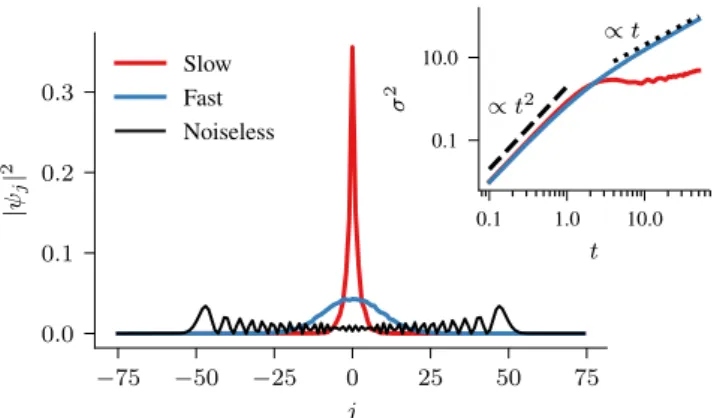
The spread of the particle is analyzed in terms of the variance of the wave function as a function of time. By increasing the value of the percolation rate, one is able to move from a localized regime, where the wave function stays localized over few sites of the chain, to a classical diffusive regime, with a Gaussian-like probability distri-bution over the lattice nodes (see Fig. 2). Specifically,
Fig. 1: Pictorial representation of the lattice described in Eq. (9), with uncorrelated noise sources (left) and spatially corre-lated noise (right)
in the slow noise regime, also called quasi-static since the percolation rate is very small compared toJ0, the larger the strength of the noiseν, the more spatially confined the spatial probability distribution is. Localization in quan-tum walks has been largely addressed in the past years. However those models always considered localization in-duced by static disorder on the on-site energies of the QW [24–27] . Model (9) instead shows that localizations can also be due to quasi-static noise on the tunneling energies, thus defying the common concept that only disorder can confine a quantum particle. When the particle localizes, transport through the lattice is suppressed, thus localiza-tion is often considered a threat to transfer of an excita-tion. However, there are situations where localization is deliberately induced in order to keep the walker confined into few sites, thus viewing disorder as a resource more than a threat [37].
In the opposite regime of fast noise, a small strength of the perturbations leads to quasi-unperturbed proba-bility distribution, while larger values make the walker ’classical’, with a Gaussian-shaped distribution, and the system is driven from a ballistic to a diffusive propaga-tion. A qualitatively similar behavior is obtained if the walker is initially prepared in a Gaussian wave packet with a nonzero velocityp0and standard deviation ∆ i.e.,
|ψ0i= X j 1 2π∆2e −j−2∆2N/2e−ip0j|ji. (10)
This indicates independence of the above results on the initial state of the walker. Moreover, in this case, assuming small strength of the noise, transport through the lattice is possible.
An advantage of the generalized percolation noise model is that it is not specific to the single-particle CTQW. In-deed, it can easily be integrated in an-particle QW model, in order to study the effects of disturbance on the many-body dynamics. For the two-particle case, for instance,
−75 −50 −25 0 25 50 75 j 0.0 0.1 0.2 0.3 | ψj | 2 Slow Fast Noiseless 0.1 1.0 10.0 t 0.1 10.0 σ 2 ∝t2 ∝t
Fig. 2: Probability distribution of the walker att= 50 for slow (γ = 0.01, red) and fast (γ = 1, blue) noise. The noiseless walker is shown in black for comparison. In the inset, the vari-anceσ2 as a function of time. The black lines are visual guides for different propagation regimes: ballistic (dashed) and diffu-sive (dotted). With fast noise we can see a transition from the ballistic to the diffusive propagation, while slow noise causes temporary localization of the walker.
the Hamiltonian is:
H2p(t) =H0(t) +Hint (11)
H0(t) = ˜H(t)⊗I+I⊗H˜(t) (12)
where ˜H(t) is the single particle perturbed Hamiltonian given in Eq. (7) andHint=Hint(|j−k|) is the interaction Hamiltonian, which usually depends on the distance be-tween particles located at sitesjandk. Different dynam-ical behaviors arise depending on the statistdynam-ical nature of the particles, i.e. whether they are bosons or fermions, on their indistinguishability and the noise parameters. Moreover, the initial conditions and the strength of inter-particle interaction are crucial for their time-evolution. Generalized percolation for a two-particle CTQW is an-alyzed in [38, 39] for on-site and nearest-neighbors inter-actions. Numerical evidence shows that fast percolation leads to a faster propagation of the initial wave packet of two interacting particles with respect to the noiseless case thus breaking the localization induced by the inter-particle interaction. This means that some components of the wave function gain a larger momentum because of noise and can travel faster across the lattice introducing a new regime that it is not achievable without noise. This behavior is possible only when the particle are initially localized within the range of interaction. In the slow per-colation regime localization is induced, with the particles unable to propagate though the lattice.
The model described by Eq.(9) can be further improved by assuming that the tunneling amplitudes can be grouped into spatial domains, with the constraint that all edges within the same domain are synchronized in their fluctu-ations [40], as depicted in Fig. 1 (right). These spatial regions are called percolation domains. In this case spa-tial correlations are added to temporal correlations and
the autocorrelation function of the noise becomes
C(t) = (
e−2γt ifj, kbelong to the same domain
0 otherwise . (13)
The spatial domains are created randomly, i.e. if two neighbor edges are correlated with probabilityp, then the probability of creating M domains follows the distribu-tion PM = N−1 M−1 (1−p)M−1pN−M. As a
conse-quence, the average length of the domains L = ppN−−11 moves from the case of independent RTN with L = 1, as described in Eq.(9), to the case of uniform noise where all edges percolate synchronously L = N. The dynami-cal evolution of the walker is computed as ensemble av-erage not only on the realizations of the noise, but also on the realizations of the randomly generated domains
ρ(t) =hU(t)ρ0U†(t)i{JT
1...JTM}.
The dynamics of a Gaussian wavepacket with an ini-tial momentum p0 shows that the average velocity of the packet decreases with decreasing average lengths and thus the quantum walker can travel longer across the lattice thanks to spatial correlations. The smaller the value of
γ, the faster this decay is, leading to a full localization in the case L= 1, while the presence of spatial correlations breaks the localization. For bigger values of γ, on the other side, the effects of large spatial domains is to allow the wavepacket to travel across the graph with an almost unaltered form, i.e. the walker is transfered across the line at fast speed and without losing the information about the initial superposition state. All these results show that spatial correlations can assist the transport of quantum particles over a linear array of nodes.
Noisy spatial search by CTQW. – In the follow-ing, we report recent advancements on the analysis of the robustness of the spatial search algorithm by CTQW [33] against dynamical percolation by RTN. In order to do so, one needs to compare the success probability, i.e., the max-imum of Eq. (4) with respect to time, of finding the target in the noiseless and noisy case. The study has focussed on the complete graph and on the star graph, because they both allow for a quadratic speedup of the search in the noiseless case (as seen above), but have very different topological properties. A pictorial representation of the model is shown in Fig. 3. The scaling of the search time with the numbers of nodesN has been studied for various combinations of noise strengthν and percolation rate γ.
Let us start with the complete graph. Numerical anal-ysis shows that, depending on the noise regime, different behaviors are found. In particular, for fast noise, the suc-cess probability is very close to one even for percolation noise, while slow noise is detrimental for fast search, with a decrease in the success probability. This qualitative result do not depend on N, although pw(topt) is slightly higher
for larger values of N. Moreover, the optimal coupling
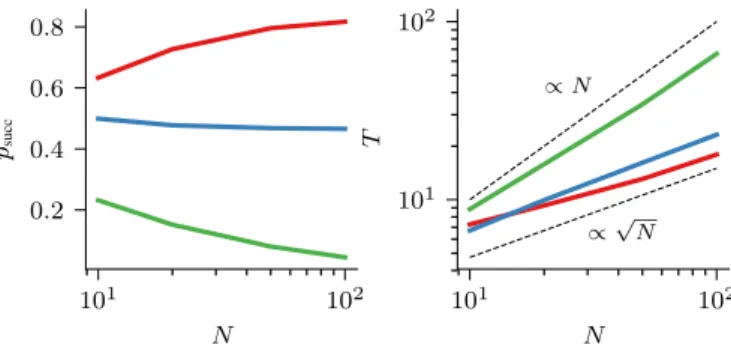
Fig. 3: Pictorial representation of the graphs considered for the quantum spatial algorithm: the complete graph (left), where each node is connected to all the others, and the star graph (right), with a central node connected to the remaining ones. In the case of the star graph, we have different results for a central target (blue) or an external target (green), as shown in Fig. 4.
role of the noise strength is to reduce the success proba-bility, with full percolation being the worst-case scenario. Interestingly, even if the success probability departs from the optimal one, the algorithm still retains an average speedup over the classical one. Indeed, one can assume that the algorithm can be repeated until the correct re-sult is found, and this happens, on average, after 1/psucc times, wherepsucc is the success probability. The average running time of the algorithm is still growing as O(√N) even in presence of percolation, as shown in Fig. 4.
Similar results are obtained in the case of the star graph with the target placed on the central node, but with stronger effects of the noise. Indeed, the optimal coupling isJ = 1/N; the influence of fast noise is almost negligible while slow noise decreases the success probability. The av-erage running time, however, still scales asO(√N), thus the quantum speedup is preserved. This is not the case if the target node is external. The success probability is in general heavily affected by noise, both in the fast and slow percolation regime, as the left panel of Fig. 4 shows. Again, the larger the noise strength, the smaller is the success probability. In this case, the average running time, depending on the strength of the fluctuations, shows a transition from quantum (O(√N)) to classical (O(N)) scaling (see Fig. 4, right panel). These results can be interpreted in terms of the connectivity of the two graph topologies: in the complete graph withN nodes there are
N(N−1)/2 links, while in the star graph there are only
N−1. While the higher connectivity is not necessary for the noiseless spatial search [47], it allows for greater re-dundancy in presence of noise. In the limiting case of the star graph with external target node, which is connected to a single edge, noise can completely break the algorithm.
Conclusions and perspectives. – The concepts of graph and quantum walk are inherently connected, since a CTQW naturally evolves on a graph. In constructing a physical graph, or network, defects and noise may come into play, thus deforming and/or damaging the original structure. The most simple, yet effective, form of
pertur-101 102 N 0.2 0.4 0.6 0.8 psucc 101 102 N 101 102 T ∝√N ∝N
Fig. 4: Left: the success probability of the spatial search algo-rithm as a function ofN for slow percolation noise (γ= 0.01,
ν= 1.0) in the complete graph (red), star graph with central target (blue), star graph with external target node (green). On the right, the scaling of the average running timeT withNfor the same graphs.
bation that might affect the topology of a graph is gener-alized dynamical percolation, where the coupling among the nodes fluctuates in time. A special case of this noise is ordinary dynamical percolation, in which links are cre-ated and removed randomly in time. As a matter of fact, generalized percolation modifies the propagation proper-ties of CTQWs on networks, as well as its performance in certain quantum information tasks.
In this perspective article, we have reviewed recent re-sults about the effects of generalized percolation on tasks such as transport on a lattice and spatial search on graphs. The main results is the observation that noise with higher percolation rate leads to faster propagation of the walker. On the other hand, slow percolation favors localization of the particle. This might be a desired behavior in certain situations, but also a drawback in others, such as in the spatial search algorithm.
Links are not the only part of a graph that can be af-fected by noise. The on-site energies of the nodes may also experience fluctuations, though the corresponding effects are largely unexplored. The presence of diagonal defects has been investigated [41], but a comprehensive study of dynamical noise on the on-site energies is still missing. This is an interesting topic in itself, since it would allow one to understand the role of time-dependent fluctuations compared to static defects, and ultimately shed light on the differences and similarities in the dynamics induced by diagonal and off-diagonal noise. Besides, RTN, i.e. bistable fluctuations, is just one possible model to mimic generalized percolation. Indeed, any stochastic process may be employed to effectively describe noise affecting the coupling constants. Relevant examples are the Gaus-sian version of a Lorenzian-spectrum noise, i.e. the so-called Ornstein-Uhlenbeck noise, and the class ofcolored noises, especially the celebrated 1/fnoise, stemming from a weighted collection of bistable fluctuators.
Generalized percolation is a universal noise model, i.e. it is not specific to a fixed topology, nor to a single-particle
CTQW. Any noisy physical system whose evolution can be mapped into a CTQW on a graph [42] may be described using the noise model discussed in this perspective article. Moreover, the same stochastic description may be applied to multi-particle CTQW. Relevant systems where the ef-fects of both time and spatial correlations are worth to investigation are those described Hubbard or Fermi mod-els. In those systems, besides the study of the role of noise in many-body systems, it would be of interest to under-stand the interplay among particle interaction, statistics and noise in determining the dynamics of the system. As a specific topic of interest, we foresee the possible forma-tion of correlated noisy domains, which would introduce new features in the multi-particle dynamics that are worth exploring.
Another interesting direction for future investigation is the propagation on hypergraphs, i.e. generalization of graphs where hyperlinks connect two or more nodes, in-stead of just pairs of nodes as in standard graphs. Hyper-graphs have been introduced as a more realistic descrip-tion of real networks and, as such, they call for a careful noise analysis. So far, studies have been focused on the dy-namics of discrete-time quantum walks [43] and a question arises on whether CTQW may be defined on hypergraphs, and how generalized percolation affects hyperlinks. Over-all, the investigation about the effects of disturbance on the dynamics of a CTQW on hypergraphs is a promising line of research.
As a final remark, we mention that CTQW, which cor-responds to a quantum particle moving on a random or noisy graph, may be used as a quantum probe to charac-terize the graph and its imperfections. In this framework, the added value of using quantum probes to characterize graphs, and the underlying complex quantum systems, is based on the optimisation of the extractable information, as well as the inherently small disturbance introduced into the system itself. In turn, CTQW has been already proved useful to infer the value of the coupling constant of a lat-tice [44], and of more complex graphs [14].
More generally, being able to characterize properties of networks, including their noise properties, is an essential step in the context of network engineering for quantum in-formation tasks. Indeed, searching for imperfections and defects in a physical network is a crucial step in the im-plementation and correct functioning of the network itself. In particular, it will be of interest in the near future to in-vestigate how to exploit local quantum measurements on a controllable quantum probe [45] to asses the properties of complex networks instead of resorting to global mea-surements on the whole graph. Understanding whether CTQW may be used as reliable probes would imply sav-ing resources, such as energy and time, in order to extract precise information about large complex networks.
∗ ∗ ∗
The authors are grateful to S. Barison, P. Bordone, M.
Cattaneo, S. Daniotti, C. Foti, S. Maniscalco, J. Nokkala, E. Piccinini, J. Piilo, L. Razzoli, I. Siloi, D. Tamascelli, J. Trapani, and P. Verrucchi, for several fruitful discussions about quantum walks, complex networks, and the effects of classical noise on the dynamics of open quantum sys-tems. MGAP is member of INdAM-GNFM. MACR was supported by the Academy of Finland via the Centre of Excellence program (project 312058).
REFERENCES
[1] Y. Aharonov, et al.,Phys. Rev. A,48(1993) 1687.
[2] E. Farhi and S. Gutmann,Phys. Rev. A,58(1998) 915.
[3] A. M. Childs, Phys. Rev. Lett.,102(2009) 180501.
[4] O. M¨ulken and A. Blumen,Phys. Rep., 502(2011) 37.
[5] D. Tamascelli, et al.,Sci. Rep., 6(2016) 26054.
[6] A. M. Childs,et al.,Phys. Rev. A, 70(2004) 022314.
[7] V. Kendon,Phil. Trans. R. Soc. A,364(2006) 3407.
[8] E. Farhi, et al.,Theory Comput., 4(2008) 169.
[9] J. K. Gambleet al.,Phys. Rev. A ,81(2010) 052313.
[10] S. Cottrell,et al.,Phys. Rev. Lett.,112(2014) 030501.
[11] M. Mohseni,et al.,J. Chem. Phys., 129(2008) 174106.
[12] S. Hoyer,et al.,New J. Phys.,12(2010) 065041.
[13] D. Emmset al.,Patt. Recogn.,42(2009) 985.
[14] L. Seveso,et al.,arXiv:1809.09211, (2018) .
[15] H. Schmitz,et al.,Phys. Rev. Lett., 103(2009) 090504.
[16] R Matjeschket al.,New J. Phys.,14 (2012) 035012.
[17] J. Du et al.,Phys. Rev. A,67(2003) 042316.
[18] H.B. Perets,et al.,Phys. Rev. Lett.,100(2008) 170506.
[19] L. Sansoni,et al.,Phys. Rev. Lett.,108(2012) 010502.
[20] Z.-H. Bian,Phys. Rev. A,95(2017) 052338.
[21] A. Schreiber,et al.,Phys. Rev. Lett.,106(2011) 180403.
[22] A. Romanelli, et al.,Physica A,347(2005) 137
[23] Y. Yin,et al.,Phys. Rev. A,77(2008) 022302.
[24] J. P. Keating,et al.,Phys. Rev. A, 76(2007) 012315.
[25] A. Amir,et al.,Phys. Rev. E,79(2009) 050105R.
[26] S. R. Jackson,et al.,Phys. Rev. A,86(2012) 022335.
[27] A. Croy, et al.,Eur. Phys. J. B,82(2011) 107.
[28] S. D. Drugeret al., J. Chem. Phys.,79(1983) 3133.
[29] T. G.Wong,et al.,Quantum Inf. Process.,15(2016) 4029.
[30] F. A. Cuevas, et al.,Ann. Phys.,326(2011) 2834.
[31] N. Konno,Phys. Rev. E,72(2005) 026113.
[32] E. Farhi, et al.,Phys. Rev. A,57(1998) 2403.
[33] M. Cattaneo, et al.,Phys. Rev. A,98(2018) 052347.
[34] Z. Dar´azs, et al.,J. Phys. A,46(2013) 375305.
[35] E. Piccinini,et al.,Comp. Phys. Comm.,215(2017) 235.
[36] C. Benedetti,et al.,Phys. Rev. A,93(2016) 042313.
[37] L. Sapienza,et al.,Science,327(2010) 1352.
[38] I. Siloi,et al.,Phys. Rev. A,95(2017) 022106.
[39] I. Siloiet al.,J. Phys.: Conf. Ser.,906(2017) 012017.
[40] M. A. C. Rossi,et al.,Phys. Rev. A.,96(2017) 040301.
[41] J. A. Izaac,et al.,Phys. Rev. A,88(2013) 042334
[42] A. Hines,et al.,Phys. Rev. A,75(2007) 062321.
[43] Y. Liu,et al.,Sci. Rep,8(2018) 9548.
[44] D. Tamascelli, et al.,Phys. Rev. A,94(2016) 042129.
[45] J. Nokkala, et al.,Sci. Rep.,8(2018) 13010.
[46] M. A. C. Rossi,et al.,arXiv:1811.04780, (2018) .