Submitted: July 05, 2012 Accepted: July 31, 2012 Published: February 01, 2013
Corresponding Author: Agung Setyo Darmawan, Jurusan Teknik Mesin, Universitas Muhammadiyah Surakarta (UMS), Pabelan, Surakarta 57102, Indonesia
Surface Modification of Commercially Pure Titanium by Plasma Nitrocarburizing at
Different Temperatures and Duration Process
1
Agung Setyo Darmawan, 2Waluyo Adi Siswanto and 3Tjipto Sujitno
1
Jurusan Teknik Mesin, Universitas Muhammadiyah Surakarta (UMS), Pabelan, Surakarta 57102, Indonesia
2
Department of Engineering Mechanics, Universiti Tun Hussein Onn Malaysia, 86400 Parit Raja, Batu Pahat, Johor, Malaysia
3
National Nuclear Energy Agency (BATAN), Yogyakarta55281, Indonesia
Abstract: One of potential metals to be used in biomechanical applications is the commercially pure (cp) titanium. This material requires a process to improve the mechanical properties of the surface, because it is relatively soft. The purpose of this study is to determine the effect of plasma nitro carburizing process to cp titanium surface hardness. In this study, cp titanium plasma nitro carburizing process is conducted at different temperatures, i.e., at 350°C for 3, 4, and 5 h, and at 450°C for 2, 3, and 4 h, respectively. Hardness tests are then performed on each specimen. The depth of penetration in the hardness test is also recorded; the microstructure captures are also taken using an optical microscope. The results show that the longer processing time, the higher the hardness value. In higher temperature, the hardness values correspond to the increasing temperature. In terms of the depth direction, there is a reduction in hardness value compared to the raw material.
Keywords: Biomechanics, diffusion, hardness, surface hardening, vickers
INTRODUCTION
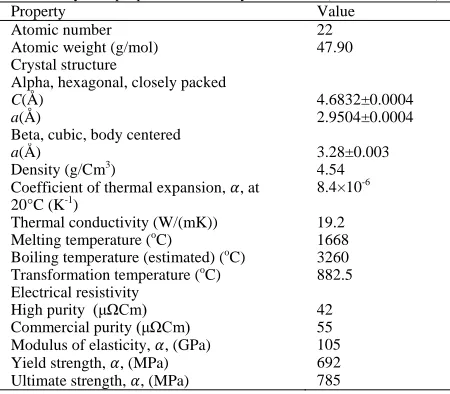
Titanium was first discovered in England by W. Gregor in 1791 and named in 1794 by H. Klaproth (Aladjem, 1973). In Mendeleef’s periodic table, titanium is one of the transition elements in group IV and period 4. The material has low density property relative to other structural metals and alloys, but it has an excellent corrosion resistance (Tan and Zhu, 2007; Yu et al., 2005; Dong and Bell, 2000). Table 1 shows the physical properties of unalloyed titanium. Nowadays, titanium is widely used in industry and medical field (Trtica et al., 2006; Fu and Batchelor, 1998; Luo and Ge, 2009; Hamada et al., 2002).
In industry, about 80% of its usage is in the field of aerospace, besides that, the use of a pretty significant also in the field of chemical and petrochemical (Bloyce et al., 1994).
[image:1.612.315.540.406.603.2]Due to its biocompatibility, titanium is used in medical applications including surgical implement and implants, such as hip balls and sockets (hip joint replacement) that can last up to 20 years (Schank, 2012). Titanium is also used in other several medical fields such as dental implant materials, bone fitting, replacement of the skull, and the retaining structure of the heart valves (Liu et al., 2004a; Liu et al., 2004b; Tian et al., 2005; Shenhar et al., 1999). Because titanium is a non-ferromagnetic material, the implant
Table 1: Physical properties of unalloyed titanium (Liu et al., 2004a)
Property Value
Atomic number 22
Atomic weight (g/mol) 47.90
Crystal structure
Alpha, hexagonal, closely packed
C(Å)
a(Å)
Beta, cubic, body centered
4.6832±0.0004 2.9504±0.0004
a(Å) 3.28±0.003
Density (g/Cm3) 4.54
Coefficient of thermal expansion, 𝛼𝛼, at
20°C (K-1) 8.4×10
-6
Thermal conductivity (W/(mK)) 19.2
Melting temperature (oC) 1668
Boiling temperature (estimated) (oC) 3260
Transformation temperature (oC) 882.5
Electrical resistivity High purity (μΩCm)
Commercial purity (μΩCm) 42 55
Modulus of elasticity, 𝛼𝛼, (GPa) 105
Yield strength, 𝛼𝛼, (MPa) 692
Ultimate strength, 𝛼𝛼, (MPa) 785
to the patient is very safe with magnetic resonance imaging.
reason, the use of cp titanium is a potential metal and safer to replace Ti-6Al-4V Titanium Alloy bearings.
However, when cp titanium is used as a part of which will experience friction with other parts such as that is in hip joint replacement, then the addition of the hardness value will be required (Ali et al., 2011; Darmawan et al., 2010). However when the hardness is increased by a certain treatment to the whole part, there is a possibility the material will become brittle, which is not expected. Any excessive loading applied to the material will damage it easily.
Increasing the hardness at the surface without changing the ductility properties of materials on the inside of the material will increase the toughness properties of material without changing the ductility if the inner part. This process is referred to as surface hardening.
Several surface hardening techniques can be used to increase hardness of titanium and its alloy such as: Ion implantation (Ali et al., 2011; Huang et al., 2004; Jagielski et al., 2006) plasma spraying (Liu et al., 2004b; Miklaszewski et al., 2011), laser beam (Tian et al., 2005; Grenier et al., 1997), vacuum (Kim et al., 2009), and powder immersion reaction (Shenhar et al., 1999).
Diffusion methods of surface hardening modify the chemical composition of the surface with hardening species such as nitrogen, carbon, or boron. These methods allow effective hardening of the entire surface of a part and are generally used when a large number of parts are to be surface hardened. One of the diffusion methods is Nitro carburizing.
Nitro carburizing is a thermo chemical process in which a process of diffusion of nitrogen and carbon atoms toward the surface of metallic materials at certain elevated temperatures. Heat is needed to enhance the diffusion of hardening species into the material’s surface. Nitro carburizing can be applied to liquid, solid, and plasma atmospheres. Nitro carburizing widely used to increase the hardness value in the surface of steel (Krishnaraj et al., 1998; Bell et al., 2000).
Jones (2012) defined that plasma is different with traditional phase of matter such solids, liquids, and gases. Plasma is a collection of charged particles that respond strongly and collectively to electromagnetic fields, taking the form of gas-like clouds or ion beams. Since the particles in plasma are electrically charged (generally by being stripped of electrons), it is frequently described as an ionized gas.
It was Irving Langmuir who assigned the term "plasma". Langmuir and his colleague, Albert W. Hull, contributed a joint paper and used the term plasma on grid-controlled gas tubes to the National Academy of Science in 1929 (Brittain, 2010).
The plasma nitro carburizing produces faster nitrogen and carbon diffusion, more friendly with
environment, more economical, and, lower gas consumption compared to other nitro carburizing techniques (Karakan et al., 2004).
In this study, the influences of plasma nitro carburizing to hardness of cp titanium’s surface are investigated. Hardness, one of mechanical property that important to consider, is a measure of a material’s resistance to localized plastic deformation (e.g., a small dent or a scratch). Hardness is an indicator of wear resistance and ductility. The instrument used to measure the hardness is Micro Vickers. Micro Vickers is referred to as micro indentation-testing method on the basis of indenter size. It is well suited for measuring the hardness of small, selected specimen regions (Callister, 2007). Hardness test is very useful for materials evaluation, quality control of manufacturing processes, and development effort.
MATERIALS AND METHODS
The material used for this work is cp titanium. The chemical composition of cp titanium is as follows: N: 0.04%, C: 0.05%, H: 0.003%, Fe: 0.13%, O: 0.11%, Al: 0.49% S: 0.03, Ti: balance. Micro structure photograph of this material can be seen in Fig. 1 the capture shows that the material consists of 100% α-phase and that there is no β-phase present. α-phase has a unit cell of hexagonal close packed (hcp) and β-phase has body center cubic (bcc).
Regarding to plasma nitro carburizing processes, cp titanium material is cut with the size of 1×1×0.3 Cm. Specimens as many as 6 pieces created for this purpose. Three specimens used in the process of plasma nitro carburizing at 350°C while the other 3 are used at 450°C. Then the material is grinded and polished using polycrystalline diamond until it is clean and shiny.
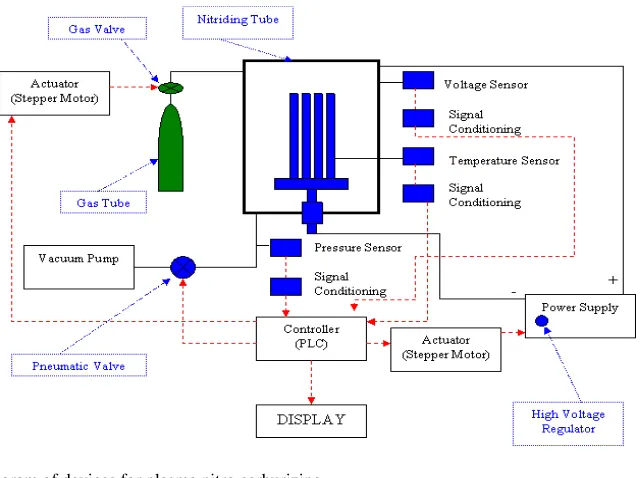
In plasma nitro carburizing process, the plasma is formed in a vacuum by means of high voltage electrical energy in which the positive ions of nitrogen, carbon and hydrogen are accelerated to strike the cathode. The work piece is maintained at a negative dc high voltage source of 250-850 volts in the presence of an electric field. The gases are separated, ionized, and accelerated toward the work piece (cathode). The kinetic energy of ion is converted into heat energy by ion bombardment. This energy not only heating the work piece but also implanting ions directly and resulting the cathode
Fig. 2: Schematic diagram of devices for plasma nitro carburizing
Fig. 3: Photograph of the device arrangement for plasma nitro carburizing
sputtering. The electrons are forced out from the surface of the work piece. Some of the ions implanted into the surface of the specimen, the other led to the cathode sputtering. Furthermore, absorption and diffusion of nitrogen and carbon atoms led to the formation of the compound layer. The schematic of equipment setup and photograph of the device arrangement for plasma nitro carburizing can be seen in Fig. 2 and 3, respectively.
Plasma nitro carburizing processes are carried out in 2 elevated temperature i.e., 350 and 450oC, respectively. In the plasma nitro carburizing at 350°C, 3 work pieces are tested in different duration processes; 3, 4, and 5 h respectively. In another experiment at temperature of 450oC, the nitro carburizing process of 3 samples are hold in different duration; 2, 3, and 4 h, respectively.
For the plasma nitro carburizing process with temperature of 350°C, the pressure condition is maintained at 1.6 mbar. The electrical charge for the process is at 592 volt, with the current on 249 mA. At the temperature of 450°C, the voltage is set higher at 745 volt, with the current 357 mA.
Fig. 4: Vickers hardness test
After the plasma nitro carburizing process completed, each specimen is tested of its hardness using a micro vickers hardness tester.
[image:3.612.123.250.369.451.2]Fig. 5: Karl frank GMBH type 38505 buehler micro hardness tester
with a light microscope. It is assumed that the indentation does not undergo elastic recovery after force removal.
The Vickers hardness number can be determined by the following equation:
𝐻𝐻𝑉𝑉 = 1,854 𝑝𝑝/𝑑𝑑2 (1)
where,
P : The applied force (Kg)
d : Mean diagonal of impression (mm)
[image:4.612.142.229.114.230.2]Karl Frank GMBH Type 38505 micro hardness tester is used for measuring the hardness of the specimen. This micro hardness tester can be seen in Fig. 5.
RESULTS AND DISCUSSION
The results are analyzed and plotted to see the effect of plasma nitro carburizing process time and temperature process to the material hardness and to see the hardness trend in to the variation of depth direction. Effect of process time and temperature to material hardness: Hardness testing is conducted at 3 locations on the surface of the specimen, namely the location A, B and C. Figure 6 shows these locations. After hardness testing, the mean diagonal of impression is obtained and then it is used to calculate the vickers hardness. The result can be seen in Table 2 and 3.
As an example calculation, the data obtained from plasma nitro carburizing process at temperatures of 350oC with a time of 3 h at the location A is calculated according to Eq. (1). Then the hardness, HV, is obtained as follows:
2
/ 854 ,
1 P d
HV =
2
50 . 0 / 01 . 0 854 ,
1 x
=
[image:4.612.316.540.200.414.2]=74.16
Fig. 6: Hardness testing locations
Table 2: Process plasma nitro carburizing at temperature 350 oC Duration
(h) Location d1 (mm) d2 (mm) d (mm) HV HVaverage 3 A 0.50 0.50 0.50 74.16 74.16
B 0.50 0.50 0.50 74.16 C 0.50 0.50 0.50 74.16 4 A 0.45 0.45 0.45 91.56 92.25
B 0.45 0.45 0.45 91.56 C 0.44 0.45 0.45 93.62 5 A 0.45 0.45 0.45 92.93 94.41
B 0.43 0.43 0.43 98.73 C 0.45 0.45 0.45 91.56
Table 3: Process plasma nitro carburizing at temperature 450oC Duration
(h) Location d1 (mm) d2 (mm) d (mm) HV HVaverage 2 A 0.40 0.40 0.40 115.88 103.70
B 0.40 0.40 0.40 115.88 C 0.48 0.48 0.48 79.360 3 A 0.40 0.40 0.40 115.88 121.31
B 0.38 0.38 0.38 126.17 C 0.39 0.39 0.39 121.89 4 A 0.38 0.38 0.38 126.17 126.17
B 0.38 0.38 0.38 126.17 C 0.38 0.38 0.38 126.17
Similarly, the hardness at location B and C is obtained. The hardness at location B is 74.16 and the hardness at location C is 74.16.
Average hardness of locations A, B, and C is the following:
3
C B A average
HV HV HV
HV = + +
3
16 . 74 16 . 74 16 .
74 + +
=
16 . 74
=
Furthermore, the average hardness is used as the hardness property from each specimen.
The hardness values for the plasma specimens nitro carburizing processes at temperatures of 350°C for process duration of 3, 4, and 5 h are 74.16, 92.25 and 94.41 HV, respectively.
There is a significant increased in hardness value when the process duration is extended from 3 h to 4 h. The hardness can be improved as high as 24.4%.
[image:4.612.333.449.494.582.2]Fig. 7: The hardness values in the surface of specimen which is processed plasma nitro carburizing at temperatures 350 and 450°C
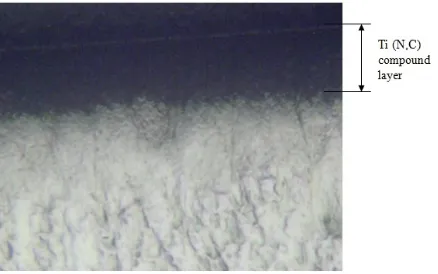
Fig. 8: Ti (N, C) compound layer which is resulted by using plasma nitro carburizing process at temperatures 350oC for 4 h
Fig. 9: Ti (N, C) compound layer which is resulted by using plasma nitro carburizing process at temperatures 450oC for 4 h
[image:5.612.79.291.115.252.2]improvement is not significant when it is compared with that of process time extension from 3 to 4 h. The hardness values are illustrated in Fig. 7.
Figure 7 shows that hardness value of specimens which are resulted from the plasma nitro carburizing process at temperature of 450°C is higher compared with specimens that are processed at temperature of 350°C. Specimens are processed at temperature of 450°C for 3 and 4 h show hardness values of 121.31 and HV 126.17, respectively. While, those are processed at temperature of 350°C have hardness values of 74.16 and 92.25 HV for the process time 3 and 4 h.
The results of hardness test showed that the higher the temperature, the hardness value will be higher, and the longer the test time, the higher the hardness value. This is because the diffusion of carbon and nitrogen atoms depends on the time and temperature. The higher the time and temperature, the more diffusion of carbon and nitrogen atoms and the distance is longer as well. Furthermore, the layer compound Ti (N, C) which is formed also thicker (Fig. 8 and 9) so the hardness become higher.
Hardness analysis in depth direction: Hardness test results in various depth directions are shown in Fig. 10. The hardness of the specimens which is processed by using plasma nitro carburizing at temperatures of 450oC has a value as high as 126.17 HV on the surface. The hardness values in the depth directions of 0.61, 0.92 and 1.5 mm are recorded at the level of 63.49, 53.47 and 54.16 HV, respectively.
The hardness values of the specimens after plasma nitro carburising process at temperature of 350°C are the following: on the surface 92.25 HV, in depth directions of 0.30, 0.6 and 1 mm are as high as 56.29, 54.85, and 53.47 HV, respectively.
For specimens which are processed by using plasma nitro carburizing at temperatures of 450oC, the hardness values at depth of 0.92 and 1.5 mm are recorded at the level of 53.47 and 54.16 HV. After the treatment process at temperature 350oC, hardness values at depth of 0.6 and 1 mm are as high as 54.85, and 53.47 HV. Comparing with the results at higher temperature (450oC), the results do not show a significant difference. The average hardness of the raw material without any treatment is 53.99 HV.
Figure 10 also shows that the surface hardness value of specimen which is processed plasma nitro carburizing at temperatures of 450oC for 4 h increased by 134%. The increase was higher than the hardness value of specimen which is processed plasma nitro carburizing at temperatures of 350oC for 4 h, which only increased by 71%. These results show that the hardness on the surface can be significantly improved from the initial hardness level of untreated material 53.99 HV.
The plasma carburizing treatment at higher temperature does not significantly change the hardness
0 20 40 60 80 100 120 140
0 1 2 3 4 3 4
Time (h)
H
ar
d
n
e
ss
(
H
V
)
Temperature 450 C o
[image:5.612.77.299.307.446.2] [image:5.612.77.296.505.642.2]Fig.10: The hardness values in the depth direction of specimen which is processed plasma nitro carburizing at temperatures 350 and 450oC for 4 h
properties of the material below the surface. The treatment at both temperatures of 350 and 450°C can significantly improve the hardness on the surface, while inside the material the hardness remains unchanged. This indicates that the plasma nitro carburizing has a significant effect on the surface which is favorable. In biomechanical applications it is intended that the surface treatment to increase the surface hardness but maintaining the mechanical properties of the material. Since the hardness of the material below the surface is not change the ductility of the material will not be changed.
CONCLUSION
In this research, the surface hardness of cp titanium is modified and improved by using plasma nit carburizing process. The effects of such processes to hardness value can be concluded as the followings:
• The hardness value of cp titanium can be increased by extending the time during the plasma nitro carburizing process. The increasing hardness rate however does not show a linear behavior as shown at temperature of 350 and 450°C.
• The hardness value resulted from the plasma nitro carburizing process at temperature 450°C is higher compared with that at temperature 350°C.
• The surface hardness value of specimen which is processed plasma nitro carburizing at temperatures of 350oC for 4 h increased by 71% while those processed at temperatures of 450oC for 3 h increased by 125%. However, there is no significant increasing of hardness after extending the processing time.
• The higher the time and temperature of process, the more diffusion of carbon and nitrogen atoms and
the distance is longer as well. Furthermore, the layer compound Ti (N, C) which is formed also thicker so the hardness become higher.
• The plasma nitro carburizing of cp titanium can significantly increase the hardness on the surface but does not have significant effect below the surface. This shows that this treatment is suitable for improving the hardness of the surface while maintaining the original properties of the cp titanium.
ACKNOWLEDGMENT
The authors gratefully acknowledge financial support from Universiti Tun Hussein Onn Malaysia under Fund Scheme GIS Vot 0809. The authors also would like to thank Accelerator Application Group of BATAN-Yogyakarta Indonesia for allowing plasma nitro carburizing processes be conducted in its laboratory; Material Laboratory of Universitas Gajah Mada Indonesia for microvickers hardness test and Mechanical Engineering Laboratory of Universitas Muhammadiyah Surakarta for all specimens preparation.
REFERENCES
Aladjem, A., 1973. Anodic oxidation of titanium and its alloys. J. Mater. Sci., 8(5): 688-704.
Ali, N., H. Samekto, M.I. Ghazali and M. Ridha, 2011. Surface Modification of Pure Titanium by Nitrogen Ion Implantation at Different Beam Energy and Dose. Key Eng. Mater., 462-463: 750-755.
Bell, T., Y. Sun and A. Suhadi, 2000. Environmental and technical aspects of plasma nitrocarburizing. Vacuum, 59(1): 14-23.
Bloyce, A., P.H. Morton and T. Bell, 1994. Surface Engineering of Titanium and Titanium Alloys. ASM Handbook, 5: 2232-2233.
Brittain, J.E., 2010. Electrical engineering hall of fame: Irving Langmuir. Proc. IEEE, 98(12): 2252-2254. Callister, W.D., 2007. Materials Science and
Engineering: An Introduction 7th Edn., John Wiley and Son, Hoboken, pp: 721, ISBN: 0471736961. Darmawan, A.S., W.A. Siswanto and H. Samekto,
2010. Effect of Femoral Head Size to Contact Stress at Pure Titanium Femoral Ball Head Outer Surface of Hip Joint Implant. Proceeding of National Conference on Advanced Manufacturing and Materials, Universiti Tun Hussein Onn Malaysia, Malaysia.
Dong, H. and T. Bell, 2000. Enhanced wear resistance of titanium surfaces by a new thermal oxidation treatment. Wear, 238(2): 131-137.
0 20 40 60 80 100 120 140
0 0.2
Depth (mm)
H
ar
d
n
e
ss
(
H
V
)
Temperature 450 C o
Temperature 350 C o
Fu, Y. and A.W. Batchelor, 1998. Laser nitriding of pure titanium with Ni, Cr for improved wear performance. Wear, 214(1): 83-90
Grenier, M., D. Dube, A. Adnot and M. Fiset, 1997. Microstructure and wear resistance of CP titanium laser alloyed with a mixture of reactive gases. Wear, 210(1-2): 127-135
Hamada, K., M. Kon, T. Hanawa, K. Yokoyama, Y. Miyamoto and K. Asaoka, 2002. Hydrothermal modification of titanium surface in calcium solutions. Biomaterials, 23(10): 2265-2272.
Huang, N., P. Yang, Y.X. Leng, J. Wang, H. Sun, J.Y. Chen and G.J. Wan, 2004. Surface modification of biomaterials by plasma immersion ion implantation. Surf. Coat. Technol., 186(1-2): 218-226.
Jagielski, J., A. Piatkowska, P. Aubert, L. Thome, A. Turos and A.A. Kader, 2006. Ion implantation for surface modification of biomaterials. Surf. Coat. Technol., 200(22-23): 6355-6361.
Jones, A.Z., 2012. Plasma, Retrieved from: http:// physics. about.com/od/glossary/g/ plasma. htm, (Accessed on: June 18, 2012).
Karakan, M., A. Alsaran and A. Celik, 2004. Effect of process time on structural and tribological properties of ferritic plasma nitrocarburized AISI 4140 steel. Mater. Design, 25(4): 349-353.
Kim, Y.Z., T. Konno, T. Murakami, T. Narushima, and C. Ouchi, 2009, Surface hardening treatment for titanium materials using Ar-5%CO gas in combination with post heat treatment under vacuum. Mater. Trans., 50(12): 2763-2771.
Krishnaraj, N., P.B. Srinivasan, K.J.L. Iyer and S. Sundaresan, 1998. Optimization of compound layer thickness for wear resistance of Nitrocarburized H11 steel. Wear, 215(1): 123-130. Liu, X., P.K. Chu and C. Ding, 2004a. Surface
modification of titanium, titanium alloys, and related materials for biomedical applications. Mater. Sci. Eng. R Reports, 47(3-4): 49-121.
Liu, X., R.W.Y. Poon, S.C.H. Kwok, P.K. Chu and C. Ding, 2004b. Plasma surface modification of titanium for hard tissue replacements. Surf. Coat. Technol., 186: 227- 233.
Luo, Y. and G. Ge, 2009. Fretting wear behavior of nitrogen ion implanted titanium alloys in bovine serum lubrication. Tribol. Int., 42(9): 1373-1379. Miklaszewski, A., M.U. Jurczyk, K. Jurczyk and
M. Jurczyk, 2011. Plasma surface modification of titanium by TiB precipitation for biomedical applications. Surf. Coat. Technol., 206(2-3): 330-337.
Schank, C., 2012. Titanium: The Medical Metal of Choice, Retrieved from: http:// www.supraalloys.com/ medical-titanium.php, (Accessed on: June 29, 2012).
Shenhar, A., I. Gotman, E.Y. Gutmanas and P. Ducheyne, 1999. Surface modification of titanium alloy orthopaedic implants via novel powder immersion reaction assisted coating nitriding method. Mater. Sci. Eng. A, 268(1-2): 40-46.
Tan, M.J. and X.J. Zhu, 2007, Microstructure evolution of CP titanium during high temperature deformation. Archives Mater. Sci. Eng., 28(1): 5-11.
Tian, Y.S., C.Z. Chen, S.T. Li and Q.H. Huo, 2005. Research progress on laser surface modification of titanium alloys. Appl. Surf. Sci., 242(1-2): 177-184.
Trtica, M., B. Gakovic, D. Batani, T. Desai, P. Panjan, and B. Radak, 2006, Surface modifications of a titanium implant by a picosecond Nd: YAG laser operating at 1064 and 532 nm. Appl. Surf. Sci., 253(5): 2551-2556.