Journal of Chemical and Pharmaceutical Research, 2014, 6(5):1187-1192
Research Article
CODEN(USA) : JCPRC5
ISSN : 0975-7384
Study of separation and flocculation characteristics of a bioflocculant MBF B31
Hongxia Cui
1,2*and Sha Zhang
11College of Environmental and Chemical Engineering, Yanshan University, Qinhuangdao, Hebei, China 2Hebei Province Key Laboratory of Applied Chemistry, Qinhuangdao, Hebei, China
*College of Environmental and Chemical Engineering, Yanshan University, No. 438, Hebei Avenue, Haigang
District, Qinhuangdao, Hebei, China
________________________________________________________________________________________________
ABSTRACT
A bioflocculant named MBF B31 produced by strains B31 was investigated in this study. The bioflocculant MBF B31 was separated by organic solvent precipitation, the production yield of crude bioflocculant by cold ethanol precipitation was up to 0.7g/L, relatively high. Crude bioflocculant was purified using Sephacryl S-200 gel filtration chromatography, there was only a large single absorption peak at 216,280nm, the flocculating rate of the purified bioflocculant was 90.21% and increased very little compared with the crude bioflocculant. According to UV and IR spectra, colorimetric reaction, chemical composition of the bioflocculant was analyzed, the main ingredient of the bioflocculant was glycoprotein. Four factors influencing flocculating rate including bioflocculant dosage, pH, type and amount of metal ions were investigated, flocculation conditions were 10mg/L bioflocculant dosage, pH 8, CaCl2 as coagulant, 5mL CaCl2.
Keywords: bioflocculant, composition, flocculating rate, flocculation characteristics
________________________________________________________________________________________________
INTRODUCTION
Flocculation is an important means of drinking water and wastewater treatment. The flocculants of inorganic and synthetic organic polymer are used commonly, but both of them have some toxicity and can cause secondary pollution, and will have a serious impact on human health and ecosystems[1-3]. Bioflocculants (microbial flocculant), which are produced by microorganisms during their growth, have received considerable scientific and biotechnological attention in recent years because of their high efficiency, non-toxic, non-secondary pollution of their degradative intermediates[4-7]. A large number of bioflocculants were purified and most of them were indicated to be proteins or polysaccharides[8,9]. Some others were DNA or PHB[10]. At the present time most of research focused on screening for microorganisms, culture conditions, mechanism of flocculation, chemical structre of bioflocculant, and so on. However, low production yield and high production costs limit their practical application. Thus to utilize bioflocculants widely in industrial fields, it is necessary to learn how to extract bioflocculant to enhance bioflocculant production yields and improve the flocculating efficiency of the bioflocculant.
In this study, the preliminary extraction and purification of bioflocculant produced by strains B31 were investigated since the knowledge of its is the basic of purification and composition analysis of the bioflocculant. Through chromogenic reaction, spectral methods, chemical composition of the bioflocculant was studied. Various factors influencing flocculating effect, like concentration, dosage, pH and metal ions were investigated as well.
EXPERIMENTAL SECTION
2.1 Microorganism and culture conditions
The strains B31 was stored in Biological Engineering Lab, Yanshan University.
0.5g l-1, ammonium sulfate 0.2g l-1, NaCl 0.1g l-1, yeast extract 0.5g l-1, and MgSO4 0.2g l-1, with initial pH 7.0 ,and
media was sterilized at 112℃ for 30 min. Distilled water was used to prepare the medium solutions. The bacterial was cultured in 250mL erlenmeyer flsks containing 50ml of medium and incubated in a shaker at 150rmp for 72h at 30℃.
2.2 Distribution of the flocculating activity in the culture
Culture broth of 6ml was centrifuged at 12000rmp for 10min. The supernatant was collected. The precipitated cells were washed twice with distilled water, and resuspended in 6ml distilled water. Flocculanting rate of the culture broth, supernatant and washed cells were measured, respectively.
The flocculating activity was evaluated by measurement of the turbidity of a Kaolin suspension[11]. 5ml of 1% CaCl2 and
2ml bioflocculant were added into 93ml of Kaolin suspension (4.0g/l) in 100ml test tube in turn and the pH was adjusted to 7.0 with 0.1M NaOH or HCl. The mixture was vigorously stirred and allowed to stand for 5 min. The optical density (OD) of the clarifying solution was measured with a spectrophotometer at 550nm. A control experiment was prepared using the same method but the bioflocculant was replaced by the fresh culture medium. The flocculating rate was calculated according to the following equation:
Flocculanting rate = (A-B)/A×100% (1)
where A is the OD550 of control experiment, where B is the OD550 of the sample experiment.
2.3 UV spectra
3ml fermentation broth was added into the special cuvette and scanned with wave range of 200-900nm by a microplate reader.
2.4 Extraction and purification of MBF B31
The fermentation broth was centrifuged at 4000rmp for 1h to remove the cell, and two volumes of coldethanol or acetone were added to the broth to precipitate the bioflocculant at 4℃ for 24h. Then the resultingprecipitate was collected by centrifugation at 4000rmp and 4℃ for 20min. The precipitate was dried for several hours at 40℃ to obtain crude bioflocculant. Further fractionation and purification were achieved using Sephacryl S-200 gel filtration chromatography, followed by elution with deionized water buffer. Polysaccharides and proteins were monitored at 216, 280nm. The fractions of the main peak were collected, flocculating rate was measured.
2.5 Chromogenic reation
The crude bioflocculant was dissolved in distilled water as the test sample. 3ml sample ,2ml concentrated sulfuric acid and phenol were taken into graduated cylinder, observed the change of color ; 4 drops sample and 2 drops 0.5% ninhydrin-ethanol solution were added into a test tube, boiling on low heat for 1-2 minutes, observed the change of color.
2.6 IR spectra
The crude bioflocculant was analyzed using a Fourier transform infrared (FTIR) spectrophotometer. The sample was blended with KBr and pressed into a flake for FTIR analysis. The spectrum of the sample was recorded on the spectrophotometer with a wave-number range of 500-4000cm-1 under ambient conditions.
2.7 Thermo-stability of MBF B31
In order to study the thermal stability of MBF B31, pure MBF B31 was divided into six aliquots and treated at temperatures of 10, 30, 50, 70, 90 and 100℃ for 30min in a water bath, and the flocculating rate of MBF B31 was measured at room temperature.
2.8 Effects of bioflocculant dosage, pH and metalions on flocculating activity
Five factors including bioflocculant dosage, pH, type and amount of metal ions were investigated. To determine the effect of bioflocculant dosage on flocculating activity, the crude bioflocculant was configured to 5, 10, 15, 20 and 25mg/L. pH of flocculation system were adjusted at 5-10. To study the effect of metal ions on flocculating activity, Ca2+ was replaced with Fe2+, Mn2+, Mg2+, K+ at same concentration. The effect of coagulant dosage on flocculation activity was studied by 2-9 mL 1% coagulant.
RESULTS AND ANALYSIS
3.1 Distribution of the flocculating activity in the culture
______________________________________________________________________________
[image:3.595.174.442.237.399.2]the supernatant had flocculanting activity during the process of fermentation. More than 90% of the flocculating activity was released into the fermentation medium, while the remaining bioflocculant appeared to localize to the cell, which showed that MBF B31 was an extracellular product. Therefore, the organic solvent precipitation was used for next step.
Table 1 Distribution of flocculation substances
flocculation substances fermentation broth the supernatant cell
flocculating rate % 88.21 85.9 17.35
3.2 UV spectra
Figure 1 showed that in the range of 200~900nm, there were sharp absorption peak at 201nm,faint absorption peak at 280nm and not absorption peak at 260nm. It proved again the existence of polysaccharide and protein, and inexistence of nucleic acid.
Wavelength (nm )
200 250 300 350 400 450 500 550 600 650 700 750 800 850 900 950
0 0.1 0.2 0.3 0.4 0.5 0.6 0.7 0.8 0.9 1 1.1 1.2 1.3 1.4 1.5 1.6 1.7 1.8 1.9 2
Cuv ette A1 Lambda at Maximum 200.00
Figure 1.UV spectrum of the crude bioflocculant
3.3 Extraction and purification of MBF B31
The supernatant was respectively precipitated with two volumes of cold acetone and ethanol . The production yield of crude bioflocculant by acetone precipitation was up to 0.48g/L, flocculating rate was 81.5%, the production yield by ethanol precipitation was up to 0.7g/L, relatively high, flocculating rate was 89.7%. Therefore, ethanol was selected as a precipitating agent.
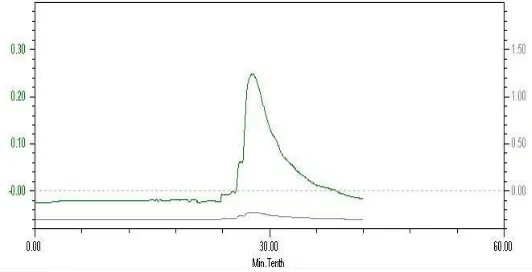
The liquid was collected at 216nm, 280nm, elution curve was shown in Figure 2.Figure 2 showed that there appeared only a large absorption peak, It indicated that this bioflocculant contained large amounts of protein and polysaccharide, and the two combined together. The flocculating rate of the collected liquid was 90.21%. Flocculating rate increased very little compared with the previous.
3.4 Chromogenic reaction
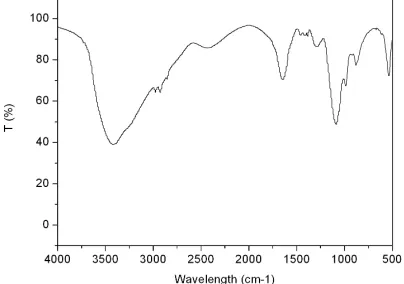
[image:3.595.173.439.613.749.2]Figure 2.Sephacryl S-200 gel chromatography Figure 3.IR spectrum of the crude bioflocculant
3.5 IR spectra
The IR spectrum of the crude bioflocculant displayed a broad stretching peak at around 3422cm-1,which declared that characteristic of hydroxyl groups, and a weak C-H stretching band at 2928cm-1and 2978cm-1, The peak at 1646cm-1 was caused by secondary amide group (-NHC=O-) C=O stretching vibration, 1296cm-1 was a deformation vibration of C-H, The peak at 1088cm-1 was a typical characteristic of sugar derivatives, and the absorption peak at 880cm-1 could be attributed to the outer surface bending vibration of C-H. The IR spectrum showed that the crude bioflocculant contained glycoprotein.
3.6 Thermo-stability of MBF B31
The temeprature dependence of the flocculant was investigated using the purified bioflocculant as test bioflocculant. As shown in Figure 4, flocculating rates were all over 85% at temperatures range of 10-100℃. This suggested that MBF B31 was a higher stability than other bioflocculants. The thermal stability of this bioflocculant might be because the main backbone of MBF B31 was a polysaccharide.
[image:4.595.205.407.78.220.2]
Figure 4 the thermo stability of MBF B31 Figure 5 Effect of bioflocculant dose
3.7 Flocculation characteristics
3.7.1 Effect of bioflocculant dose on flocculating activity
The effect of bioflocculant dose on flocculating activity was investigated. As shown in Figure 5, the flocculating rate over 85% was achieved in the range of 10-20mg/L, and the maximum flocculating rate was observed at an optimum bioflocculant dosage of 10mg/L which was a lower dosage compared with the previously reported. This might be because under suitable concentration, bioflocculant itself as a “polyelectrolyte”reduced the electrostatic repulsion between colloidal ions, while the dose was too high, polymer might be heavily on the gel surface and increased the affinity of media, prevented the settling of flocculants.
3.7.2 Effect of pH on flocculating activity
______________________________________________________________________________
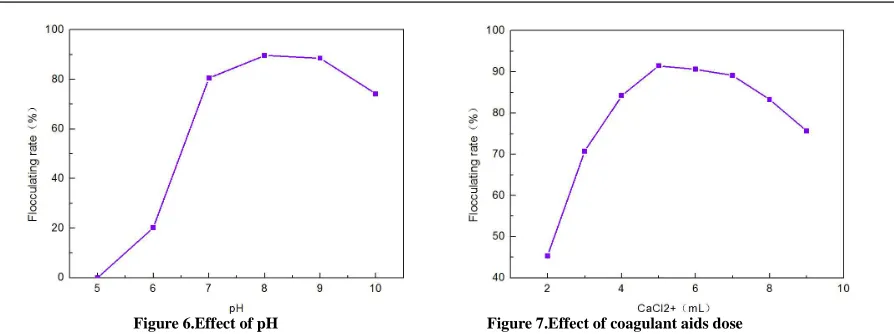
Figure 6.Effect of pH Figure 7.Effect of coagulant aids dose
[image:5.595.87.534.61.228.2]3.7.3 Effect of coagulant aids on flocculating activity
Table 2 showed that different positive ions had different effects on flocculating activity. Cations were important in the process of flocculation. The same amount of Mg2+ and Ca2+ both achieved high flocculating rate over 89%, while Mn2+ and Fe3+ didn’t have good effects, moreover, the color of Mn2+ and Fe3+ caused a secondary pollution. Cations stimulate the flocculating rate by neutralizing and stabilizing the residual negative charge of functional groups and by forming the bridges between particles. Considering economic and flocculating effect, Ca2+ was selected as the coagulant aid.
Table 2.Effect of coagulant aids on flocculating activity
Positive ion Ca2+ K+ Mg2+ Mn2+ Fe2+
flocculation rate(%) 90.02 0 89.73 66.29 41.19
3.7.5 Effect of coagulant aids dose on flocculating activity
The effect of coagulant aids on flocculating activity was also analyzed in this study. As shown in Figure 7, the flocculating effect reached the best at CaCl2 5mL. This might be CaCl2 could affect negative surface charge of the
suspended particles When the CaCl2 dose was too high, suspended particles would be separated from the flocculant
molecular, thus its flocculating rate would be reduced. Therefore, coagulant aids dosage should be controlled within a certain range in the process of flocculation.
Since when PO43+, HPO42+ of the culture medium encountered coagulant aid Ca2+, they would produce a precipitate
and affect the experimental accuracy, so in this study the determination of flocculating rate was used adding fresh medium as the control experiment instead of nothing or distilled water that others added. This study showed that MBF B31 was a promising bioflocculant. Comparing with other bioflocculants, the production yield of crude bioflocculant was relatively high, and crude bioflocculant showed excellent flocculating rate of kaolin suspension. MBF B31 mainly consisted of glycoprotein that explained its thermo stability over wide range of temperatures indicated it storage potential in cold and hot conditions. Its component also showed the crude bioflocculant could be directly applied without purification, thus saving production time and reducing the cost of treatment. These distinctive characteristics of this bioflocculant MBF B31 indicated that the application potential in industry.
CONCLUSION
The purified bioflocculant MBF B31 is obtained by organic solvent precipitation and Sephacryl S-200 gel filtration chromatography. Experiments show that the biofocculant is a glycoprotein. Its optimal flocculation conditions were 10mg/L bioflocculant dosage, pH 8, CaCl2 as coagulant, 5mL CaCl2.
REFERENCES
[1] Su feng, Zhang ji-xiang, Yang liping. Shandong Food Ferment, 2010, 4(159): 3-6.
[2] Zhu dan . The screening and application of microbial flocculant.(M.SThesis). Northwest A &F University,2006 [3] Li ST, Liu BB, Wang LL, Yan YS. Journal of Biotechnology, 2008, 136, 672-673,
[4] Zhang ZQ, Lin B, Xia SQ. J Environ Sci 2007, 19(6): 667-73.
[9] Levy N, Bar-or Y, Magdassi S. Colloids and Surfaces, 1990, 48: 337-349.
[10] Watanabe M, Sasaki K, Nakashimada Y, Kakizono T, Noparatnaraporn N, Nishio N. Applied Microbiology and Biotechnology.1998, 50: 682-691.