Journal of Chemical and Pharmaceutical Research, 2015, 7(12):430-440
Research Article
ISSN : 0975-7384
CODEN(USA) : JCPRC5
Performance and analysis of active noise control system for noise reduction in
hearing aids
1
M. Anto Bennet,
1S. Lokesh,
1T. R. Dinesh Kumar,
1G. Sankar Babu and
2G. Janakiraman
1Department of Electronics and Communication Engineering, VEL TECH, Chennai 2Department of Automobile Engineering, Dr. Mahalingam, College of Engg & Tech., Pollachi
_____________________________________________________________________________________________
ABSTRACT
To reduce the surrounding noise in the hearing aids by using active noise control system. Background noise is particularly damaging the speech intelligibility for people with hearing loss. Background noise reduces the clarity in the speech. So we are able to understand speech in moderately in noise environment even at the sufficient signal to convey the information. There is less redundancy in the speech signal for a person with hearing loss. Since part of the speech is either audible not or distorted because of hearing loss. So people with hearing loss have much greater difficulty than normally hearing people in understanding speech in noise. This problem will be avoided by combination of active noise control and noise reduction algorithm.
Keywords: active noise control (ANC), Multichannel Wiener Filter (MWF), Linearly Constrained Minimum
Variance (LCMV), Generalized Side lobe Canceller (GSC), Filtered-X-Least-Mean-Square (FXLMS) algorithm. _____________________________________________________________________________________________
INTRODUCTION
The usage of hearing aids with an open fitting has become more common over the past years mainly owing to the availability of more efficient feedback control schemes and fast signal processing units. Whereas removing the ear mold reduces the occlusion effect and improves the physical comfort. One major drawback is that the noise leakage through the fitting cannot be neglected anymore. Conventional noise reduction (NR) systems such as the Generalized Side lobe Canceller (GSC) or techniques based on the Multichannel Wiener Filter (MWF) do not take this contribution into account. Combined with the attenuation in the acoustic path between the sound source (hearing aid loudspeaker) and the tympanic membrane (the so-called secondary path), the noise leaking through the fitting can override the action of the processing done in the hearing aid. One efficient way to cancel this undesired noise leakage is to use active noise control (ANC).
control methods (soundproofing) in that a powered system is involved, rather than unpowered methods such as insulation, sound-absorbing ceiling tiles or muffler. Due to recent advances in wireless technology, new applications of ANC have emerged to reduce the environmental acoustic noise and improve the speech and music quality. The most commonly used ANC system is a single channel ANC system in narrow ducts. But to mitigate the effects of multi-modal noise in enclosures and large duct system, there is a need to use multi-channel ANC systems. The complexity of multiple-channel ANC in a multi-dimensional space with many inputs and outputs is significantly higher. To achieve feedforward ANC at the tympanic membrane, it is assumed that, in all the subsequent systems, a microphone is present in the ear canal to provide an error signal.
In the hearing aids framework, ANC then has to be performed together with a NR algorithm. There are different ways of combining ANC and NR. Here, the cascading of both functional blocks will be considered first and then the integration of ANC and NR into one filter set will be described, based on an initial parallel combination of the functional blocks and a Filtered-x version of the MWF algorithm (FxMWF). However, the delay needed to achieve a high NR performance is still added to the system latency. In ANC algorithms, this delay is a critical parameter and can reduce drastically the noise cancellation capabilities. The system is more robust to latency and can almost provide a constant signal-to-noise ratio (SNR) at the tympanic membrane up to the causality bound. Also, the use of a filtered-x algorithm in the integrated approach allows to include the secondary path effect in the NR computation. Acoustic noise problems become more serious as increased numbers of industrial equipment such as engines, blowers, fans, transformers, and compressors are in use in many outdoor installations, planes, and automobiles. ANC systems cancel the unwanted noise based on the principle of superposition. Specifically, an anti-noise of equal amplitude and opposite phase is generated and combined with the primary noise, thus resulting in the cancellation of both noises.
The ANC system efficiently attenuates low frequency noise, where passive methods are ineffective, bulky in size, and tend to be very expensive. ANC is developing rapidly because it permits improvement in noise reduction, which results in potential benefits in weight, volume, and cost. A better approach is to use a combination of passive and ANC technique. The error signal that has to be minimized is the difference between the desired signal and the signal reaching the tympanic membrane rather than the signal fed into the loudspeaker. Therefore, even with higher system latencies, integrating ANC and NR can lead to performance improvements compared to a classic NR scheme where the noise leakage and the secondary path effect are not taken into account. The hearing aid with an open fitting has no earmold to prevent ambient sound from leaking into the ear canal, which results in additional leakage signal reaching the tympanic membrane. No Active Noise Cancellation (ANC) is a method for reducing undesired noise.
GSC affect the robust due to microphone mismatch. Microphone mismatch due to aging (referred to as “drift”) is caused by a parallel shift of the frequency responses between the two microphones. This type of mismatch can be compensated for with a frequency-independent adjustment of the gain for one microphone. Microphone mismatch due to dirt or moisture in the acoustical pathway (e.g. in the microphone port), which causes a frequency-dependent modification of the frequency response (often a reduction in the high frequency region). This second type of mismatch can only be compensated for by a frequency-dependent adjustment of the gain. The most commonly used ANC system is a single channel ANC system in narrow ducts. But to mitigate the effects of multi-modal noise in enclosures and large duct system, there is a need to use multi-channel ANC systems. One is the error between the output of the adaptive filter and the desired signal; the other is the error between the output of the adaptive filter, with a little perturbation, and the desired signal.[4]. In comparison to single-channel ANC systems, the complexity of multiple-channel ANC in a multi-dimensional space with many inputs and outputs is significantly higher [10].
The computational complexity is high in this GSC system. The less gain has been perceived. The array length is limited one. Highly non stationary noise environments complicate to estimation of the speech correlation matrix by the MWF is to affect the performance. The fixed stage of the GSC can be designed to compensate for the differences in microphone characteristics. The matched microphone coherence function also increases the error. Microphone characteristics may drift over time. The positions of the microphones vary slightly from one hearing aid to another. Since microphones are quite accurately positioned in hearing aid, the microphone placement uncertainty is expected to be small. The speech and noise are slightly attenuated, but the amount of noise reduction remains quite constant. On one hand, the impact of phase mismatch is largest for high. To deal with a general case when the secondary path channels are uncertain and changeable, we can take two possible adaptive approaches: One is an indirect adaptive approach based on real-time identification of the secondary path dynamics, in which the secondary path model in the filtered-x algorithms is updated by the identified model or the feed forward controller is also redesigned via the identified model .
For the precise identification of the secondary path channels, dither noises are needed to assure the persistently exciting (PE) condition for the identifiability. The other is a direct adaptive approach which can directly tune the feed forward controller without explicit identification of the channels. Few efficient direct adaptive algorithms have been proposed to treat with a general case in which all the path matrices are unknown [1]. This nonlinear saturation degrades the performance of ANC systems that use adaptive Linear filters with the filtered-X least-mean-square (FXLMS) algorithm. Acoustic noise problems become more and more evident as an increased number of industrial equipment such as engines, blowers, fans, transformers, and compressors are in use.
Passive noise control is based on the absorption and/or reflection properties of materials, and is effective for reducing high frequency noises [2]. However, passive techniques are somewhat expensive, large, and not effective at low frequencies. If there is a sudden and large change in the secondary path, especially, in its phase response, the existing methods may not track the rapid and large variation in the secondary path in time. The instability problem caused by the closed loop as the TD similar method has been greatly alleviated, and consequently, a more robust auxiliary noise scheduling strategy can be attained [3].Noise is usually modeled as being a random process with certain known statistical characteristic. To circumvent this instability problem, which is caused by measurement noise, an indirect technique is proposed. First, the frequency components of the synthesized reference signal representing the harmonic disturbance are estimated [7].
EXPERIMENTAL SECTION
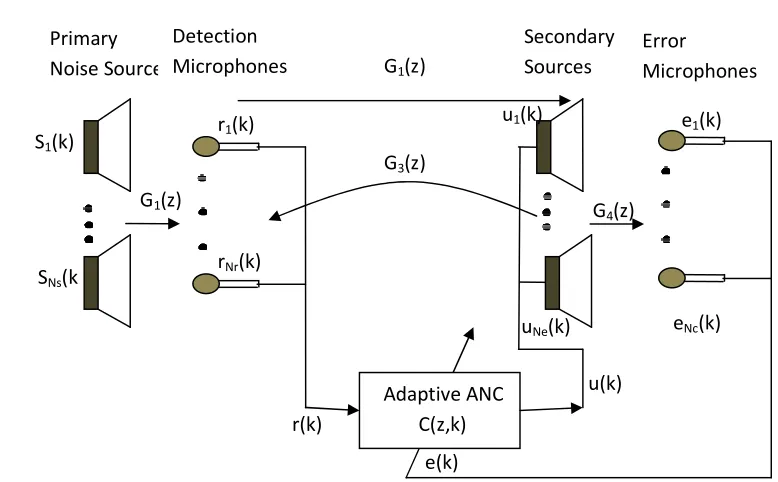
Fig :1 Implementation of multichannel ANC system
The cancelling errors at Nc points are represented by the vector e(k) E RNc. Since all of the signals will interfere each other through different channels, the channel dynamics will be expressed by matrices. Here Gl(z) E ZNcxNs and G(z) E ZNrxNs represent the primary channel dynamics matrices, and G ( z ) E ZNrxNc and G ( z ) E Z N c x N c the secondary channel dynamics matrices, respectively, as shown in Fig.1. Because all of the channels may contain model uncertainty and parameter changeability, the adaptive control approaches are significantly important to deal with the problems. adaptive multi microphone noise reduction techniques is multichannel Wiener Filtering (MWF) These techniques provide a Minimum Mean Square Error (MMSE) estimate of the clean source speech signal [3] , the (reverberant) speech component in one of the microphone signals or a reference signal.
[image:4.595.105.464.492.598.2]MODULE DESCRIPTION
Fig:2 Multichannel active noise control and noise reduction system
Acoustic Domain
Acoustic noise is any sound in the acoustic domain, either deliberate (music, speech, etc.) or unintended. It is important to recognize that the term "noise" is also used to refer to other, non-audible forms, especially in electronics and in the radio/radar spectrum. Acoustics and speech applications operate on data in the audio frequency range (DC to 20 kHz).Acquisition and analysis programs working in this type of environment most commonly use sampling rates between 8 kHz and 48 kHz to fully characterize the audio frequency data is shown in fig 2.
Adaptive ANC
C(z,k)
S
1(k)
S
Ns(k
)
r
1(k)
r
Nr(k)
u
1(k)
u
Ne(k)
e
1(k)
e
Nc(k)
e(k)
u(k)
G
1(z)
G
4(z)
r(k)
Primary
Noise Source
Error
Microphones
Secondary
Sources
G
3(z)
G
1(z)
Optimal wiener filter
The goal of the optimal wiener filter is used to minimize the mean-square error between the output signal. Wiener filters are one of the tools of choice in removing noise from photographic images. The Wiener filter differs from the true optimal filter by an amount that is second order in the precision to which the filter is determined. However, the design of the Wiener filter takes a different approach. One is assumed to have knowledge of the spectral properties of the original signal and the noise, and one seeks the linear time-invariant filter whose output would come as close to the original signal as possible. Wiener filters are characterized by the following:
The Wiener filter separates signals based on their frequency spectra. at some frequencies there is mostly signal, while at others there is mostly noise. It seems logical that the "mostly signal" frequencies should be passed through the filter, while the "mostly noise" frequencies should be blocked. The Wiener filter takes this idea a step further; the gain of the filter at each frequency is determined by the relative amount of signal and noise at that frequency. The Wiener filtering is optimal in terms of the mean square error. In other words, it minimizes the overall mean square error in the process of inverse filtering and noise smoothing. The Wiener filtering is a linear estimation of the original image. The approach is based on a stochastic framework. Wiener filter has two separate part, an inverse filtering part and a noise smoothing part. It not only performs the deconvolution by inverse filtering (high pass filtering) but also removes the noise with a compression operation (low pass filtering).
Gain amplifier
Gain amplifier is used to amplify the weakened signal ,it is the ratio of the output voltage/current to the input voltage/current, in the expression
Av=Vout/Vin (1)
Where, Av= gain, Vout=output voltage, Vin=input voltage
At its most basic form, a toggle switch strapped across the feedback resistor can provide a Hi-LO gain setting. While this is not a computer controlled function, it describes the core function. With eights switches and eight resistors in the feedback loop, each switch can enable a particular resistor to control the feedback of the amplifier. If each switch was converted to a relay, a microcontroller could be used to activate the relays to attain the desired amount of gain. Relays can be replaced with Field Effect Transistors of an appropriate type to reduce the mechanical nature of the design. A programmable-gain amplifier (PGA) is an electronic amplifier (typically an operational amplifier) whose gain can be controlled by external digital or analog signals. The gains can be set from less than 1V/V to over 100V/V.
MODULES
In this integrated active noise control system we can separate the process into three individual modules such as input module, functional module, output module in this modules each process takes place in the identical form of the approach to reduce the surrounding noise
INPUT MODULE
To this integrated system the inputs are given as the multi channel active noise control system such as
X1,X2……XMK. These input signals are passed to the multi channel wiener filter to get the filtered signal from the
surrounding noise. and the same input signals passed through the secondary path to get the filtered reference signal for the tracking of error signal from the acoustic domain block .
FUNCTIONAL MODULE
tradeoff to be done between the NR and the ANC. The aim of the integrated scheme is to improve the speech-to noise ratio, and so the desired signal (at the tympanic membrane) to be used. The algorithm relies on a filtered-x version of the MWF (FxMWF) based on an estimate of the secondary path .The filtered reference signals are ,
ym[k]=c^TXm[k]m (2)
ym[k]=[ym[k]…ym[k-N+1]]T (3)
yT[k]=[y1T[k]…yMT[k]] (4)
The aim of the integrated scheme is to improve the speech-to noise ratio, and so the desired signal (at the tympanic membrane) to be used is
dInt[k]=-ln[k]+G.X1s[k-∆] (5)
dInt[k]=-ln[k]+dNR[k] (6)
The MSE criterion to be minimized is then
JMSE[k]=E{|eInt[k]|2} (7)
Assuming that the secondary path identification error is small and that the filter is adapting slowly, The errors due to limited precision (ie word length) are non linear (hence incalculable) and signal dependent (hence coherent). The non linearity can also lead to instability the error signal can be rewritten as follows:
eInt[k]=wT[k]y[k]+ln[k]-dNR[k] (8)
The optimal filter (FxMWF) can be minimizing as,
W[k]=Ryy-1[k]rydInt[k] (9)
There is Ryy is the correlation matrix of the filtered reference signal y[k] and rydInt[k] is the cross-correlation vector
between the filtered reference signal y[k] and the desired signal dInt[k]. The bandwidth on which it is possible to
achieve good ANC performance reduces with the “degree of causality”.
∆ref+∆HA+∆alg+∆sec≤∆pri (10)
∆=∆pri-(∆ref+∆HA+∆sec) (11)
In case of hearing aids, the delay available for processing is linked to the distance between the microphones and the loudspeaker which is not more than a few centimeters. Delay is thus a critical problem in ANC and many approaches have been developed to try to deal with it In case of hearing aids. In integrated approach the filter minimizing the MSE can split into a sum of two filter,
w[k]=u[k]+v[k] (12)
The filter u[k] describes a NR which also compensates for the secondary path effects and filter v[k] is an ANC system canceling the noise leakage. By this assumption that speech and noise components are uncorrelated.
FXLMS ALGORITHM
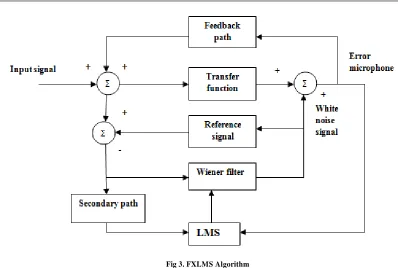
Fig 3. FXLMS Algorithm
Applying LMS algorithm to ANC system needs little modifications on the equations in LMS algorithm. In LMS,
e(n)=d(n)–y(n) (13)
but for ANC system the equation is modified to
e(n) = d (n) + y (n) (14)
This is the combined equation of the desired signal and output signal to get the error signal. From this equation we can calculate the estimation error to determine the impact of noise that reduce the speech clarity by using desired signal and output signal respectively. The summaries of FXLMS algorithm are:
1)Output filter:
y(n)=wh(n)u(n) (15)
2)Estimation Error:
e(n)=d(n)+y(n) (16)
3)Tap-weight adaptation:
w(n+1)=w(n)+mu(n)e(n) (17)
The input signal is x (n) changed to,
w (n+1) = w (n) + m x` (n) e (n) (18)
Since the process needs to filter input X (z) with C (z), this kind of algorithm is called FX- LMS.
TRAINING MODE
1) White noise signal, y (n) is generated by anti-noise speaker
2) Input and error microphone receive y(n) as x(n) and e(n) respectively, then count e`(n) and f(n).
3) Input and error microphone receive y(n) as x(n) and e(n) respectively, then count e`(n) and f(n)
e (n) = e(n) − ∑ c (n). y(n − i) (19)
C (z) and D (z) are updated with LMS algorithm
ci(n+1)=ci(n)+me'(n)y(n-i) (21)
dj(n+1)=dj(n)+mf(n)y(n-j) (22)
Where i, j = 0, 1, 2… M-1
4) This process is repeated for several seconds until C (z) and D (z) become Convergent.
CANCELLATION MODE
Input and error microphone receive u (n) and e (n)
5) Calculate x (n) :
x(n) = u(n) − ∑ dj(n). y(n − j) (23)
6) Calculate y (n):
y(n) = ∑ w (n). x(n − i) (24)
7) y (n) is used to reduce noise level from noise source
8)
9) Calculate x`(n):
x (n) = ∑ c (n). x(n − i) (25)
10)Update W (z) with FXLMS algorithm:
w_i (n + 1) = w_i (n) + m e (n) x^′ (n − i) (26)
i = 0, 1, 2, 3, 4… N-1
10) Repeat all the process for next noise signal.
FEED FORWARD ANC SYSTEM USING FXLMS ALGORITHM
Transfer function of the secondary path has a crucial role in generating anti-noise in ANC applications as it is non-linear and introduces delay causing instability problem to the standard LMS algorithm. The instability problem can be resolved using the FxLMS algorithm as it uses estimation of the secondary path. This algorithm can be applied to both feedback and feedforward structures. Here, P(z) is the primary path, the acoustic response from the reference noise source to the error sensor and S(z) represents the secondary path. In this figure, Sˆ(z) is estimation of S(z). the filtered-x LMS , the modified filtered-x.LMS and the adjoint-LMS [10]. The RLS-based introduced algorithms are thus called multichannel filtered-x RLS, modified filtered-x RLS and adjoint-RLS algorithms
The secondary signal y(n) is generated as:
y(n)=wT(n)x(n) (27)
where w(n) and x(n) are the coefficient and signal vectors of length L, order of the FIR filter W(z), at time n. These coefficients are updated by the FxLMS algorithm as follows:
w(n +1) = w(n)+ µxˆ′(n)e(n) (28)
where µ is the step size. Usually µ is set to a low value. This prevents the system to diverge when power of the
reference signal x(n) is increased. However, once the power decreases the low value of µ reduces the noise
attenuation and convergence rate of the adaptive filter (W(z)). Thus, if µ could be increased when the power
decreases, and vice versa, the system performance would be risen significantly. On the other hand, the step size µ
can be correspondingly changed with power of the generated white noise, as online estimation of the secondary path is used. When power of the generated white noise increases, the secondary path modeling convergence rate raises.
This allows using a bigger µ during the system operation. active noise control (ANC) system using the filtered-x
generated white noise v(n) and the reference signal x(n), respectively. By adding this new term to equation w(n +1)
= w(n) +µw(n) f (n)xˆ′(n) the filter step size adapts with the power variations of the above signals:
w(n+1)=w(n)+{Pv(n)/Px(n)}µw(n)f(n)xˆ′(n) (29)
We estimate power of these signals as,
Pv(n)=γPv(n-1)+(1-γ)v2(n) (30)
Px(n)=γPx(n-1)+(1-γ)x2(n) (31)
In addition to these computational difficulties, the multichannel filtered–X LMS algorithm also suffers from excessive data storage requirements [6]. However, the additional filtering blocks create recent results have presented first and second moment analytical models for the FXLMS algorithm, without invoking the independence theory . In the FxLMS algorithm, the reference signal is filtered so as to compensate for the effect of so-called secondary path inherent in the electro-acoustic adaptation loop[9]. The purpose of estimating the spectral contents of the noise signal is to use it as the reference signal in place of the original primary noise in a feedback ANC system. This technique can be viewed as an adaptive feed forward system that, in effect, synthesizes its own reference signal, based only on the adaptive filter output and error signal, The filtered-X LMS active noise equalizer proposed in minimizes a pseudo-error signal instead of the residual noise [11].
The adaptive feedback ANC method has a similar structure to the feed forward filter-X LMS algorithm. In order to compensate for the effects of the secondary path from the input of the secondary loudspeaker to the output of the error microphone, before being used to adjust the weights of controller, the reference signal is filtered by an estimated impulse response of the secondary path [12]. This leads to the filtered-x LMS (FxLMS) algorithm. The work also proposes a new algorithm to alleviate the effect of measurement noise on feedback ANC system. The proposed algorithm estimates the frequencies of the multi-tonal noise and generates an enhanced version of it. This enhanced signal is used as reference signal in the conventional feed forward ANC configuration. The performance comparison of the feedback system with an equivalent feed forward system is presented. In the context of the present investigation, the discrete cosine transform filter is used in a filter-X LMS implementation of a feedback active noise control system that uses a single error microphone and a single loudspeaker. If the effect of the secondary path is significant, the filtered-X LMS (FXLMS) algorithm is usually employed. The FXLMS algorithm is employed for the case of one real sinusoid, and the effect of the secondary path to the pass band characteristic of the ANC system is analyzed [13].
Computer simulations of the adaptive second-order Volterra filter with the FXLMS algorithm using different filter lengths (L = 16,32, and 64) were conducted to evaluate the performance of the nonlinear ANC systems[7]. As an electro-acoustic path from the secondary loudspeaker to the error microphone, the secondary path typically comprises the D/A converter, smoothing filter, power amplifier, secondary loudspeaker, acoustic path from the loudspeaker to error microphone, error microphone, anti-aliasing filter, and A/D converter.
RESULTS AND DISCUSSION
0 50 100 150 200 250 300 350 400 450 500 -1
-0.5 0 0.5 1 1.5x 10
-3 Input signal
A m p lit u d e
Discrete time k
0 50 100 150 200 250 300 350 400 450 500 -5
0 5 10x 10
-4 A m p li tu d e
Discrete time k error identification
Identification error
0 2 4 6 8 10 12 14 16
0 0.05 0.1 0.15 0.2 0.25 A m p lit u d e
Numbering of filter tap
Coefficients of S(z) Coefficients of Sh(z)
0 50 100 150 200 250 300 350 400 450 500 -5 -4 -3 -2 -1 0 1 2 3 4 A m p lit u d e
Discrete time k noise residue
Noise residue
0 50 100 150 200 250 300 350 400 450 500 -1
-0.5 0 0.5 1 1.5x 10
-3 A m p lit u d e
Discrete time k Single channel ANC with cascade
Noise signal Filtered signal
0 50 100 150 200 250 300 350 400 450 500 -1
-0.5 0 0.5 1 1.5x 10
-3 A m p lit u d e
Discrete time k Multichannal ANC with cascade
output signal Desired signal
0 50 100 150 200 250 300 350 400 450 500 -1
-0.5 0 0.5 1 1.5x 10
-3 A m p lit u d e
Discrete time k
Active Noise Control and Noise Reduction System in parallel
Filtered signal Input Signal
0 50 100 150 200 250 300 350 400 450 500 -1
-0.5 0 0.5 1 1.5x 10
-3 A m p lit u d e
Discrete time k Integrated Active Noise Control System
FIG 4.Output of Noise Control System for Noise Reduction in Hearing Aids
CONCLUSION
Standard NR techniques used in hearing aids ignore leakage and secondary path effects. When open fittings are used these aspects cannot be neglected and are in fact found to seriously degrade the NR performance. In lot of papers did not consider surrounding noise. Background noise is particularly damaging the speech intelligibility for people with hearing loss. Background noise reduces the clarify in the speech. The Multichannel wiener filter in an effective Active Noise Control and Noise Reduction techniques is reduces the surrounding noise in the case of tympanic membrane. The Filtered - X Least Mean Square algorithm provide the less computational complexity and stability system. The integrated approach gives an almost constant SNR improvement as long as the overall system is causal. In this paper we currently reduces the surrounding noise in recorded voice. In Future work it can be implement in real time application.
REFERENCES
[1] Akira Sano; Yuhsuke Gotha, IEEE Trans., 2004, 1, pp-7. [2] Ali A. Milani; Issa M.S. Panahi, IEEE Trans., 2009, 17(5), pp-11 [3] Ann Sprie; Marc Moonen; Jan Wouters, IEEE Trans., 2005, 13(4), pp-7 [4] Boaz Rafaely; Miriam Furst, 1(3), pp-14
[5] Das.D.P; Panda G; Kuo.S.M, IET Signal process, 2007, 1(2), pp-13 [6] Douglas.C, IEEE Trans., 1999, 7(4), pp-38
[7] Hsian-Tsai wu, 2004, IEEE trans on Control applications, pp-39.
[8] Dr. Anto Bennet M; Srinath R; Maragathavalli P; Subhashini B, Journal of Theoretical and Applied Information
Technology, 2014, 68(01), 149-155
[9] Dr. AntoBennet M; Vijayalakshmi G; Maragathavalli P; Lokesh S; Dinesh Kumar.T.R, Middle-East Journal of
Scientific Research, 2014, 21(11), 2194-2202
[10] Anto Bennet M; Mohan Babu G; Rajasekar C; Prakash, P, Journal of Computational and Theoretical
nanoscience, 2015, 12(1), 141-149
[11] Anto Bennet M; Jacob Raglend, Life Science Journal, 2013, 10(2), 102-110
[12] Dr. Anto Bennet M; Sankar Babu G; Natarajan S, Journal of Chemical and Pharmaceutical Sciences, 2015, 08(03), 469-475
[13] Dr. Anto Bennet, M; Sankaranarayanan S; Sankar Babu G, Journal of Chemical and Pharmaceutical Sciences,
2015, 08(03), 571-576
0 2 4 6 8 10 12 14 16 18 20
0 5 10 15 20 25
Performance comparition Graph
G(db)
S
N
R
(
d
b
)