Journal of Chemical and Pharmaceutical Research, 2016, 8(2):750-756
Research Article
CODEN(USA) : JCPRC5
ISSN : 0975-7384
Clarification of differential assay method of four water-soluble vitamins by
reversed-phase high-performance liquid chromatography
Adnane Benmoussa
1, Hakim El Alama
2, Sanae Derfoufi
1and Amal Ait Haj Said
21
Laboratory of Medicinal Chemistry, Faculty of Medicine and Pharmacy of Casablanca, Hassan II University, 19, rue Tarik Ibn Ziad, Casablanca, Morocco
2Laboratory of Pharmacognosy, Faculty of Medicine and Pharmacy of Casablanca, Hassan II University, 19, rue
Tarik Ibn Ziad, Casablanca, Morocco
_____________________________________________________________________________________________
ABSTRACT
Multivitamin preparations are used more and more and one attends a tendency toward a merchandising increased of new products to basis of vitamins and mineral salts. The consumption of these products increases because of the deficit in vitamins generated by the new food habits. Otherwise, this consumption grows in a goal of physical and intellectual performance research. Authors propose in the setting of the product control to basis of vitamins and notably water-soluble, method of analysis for the simultaneous dosage of four vitamins [vitamin B1 (Thiamine), B2 (Riboflavin), B6 (Pyridoxine), and PP (Nicotinamide)] by reversed phase HPLC with a detection in UV by a spectrophotometer to biretta of diodes. The method has been clarified after the survey of the four vitamins separation according to the polarity and the pH of the mobile phase. The separation is optimal on phase silica transplanted in C18 and a phase mobile methanol/water 50/50 and to pH 4.5.
Keywords: Essay, water-soluble vitamins, reversed-phase HPLC.
_____________________________________________________________________________________________
INTRODUCTION
Vitamins are organic substances essential to life without clean energy value, they play many roles in the body and their presence at specific concentrations is imperative for the proper functioning of our system [1]. Vitamins are classified in two groups according to their solubility, the fat-soluble and water-soluble [2]. Among these last, one finds four vitamins of a fundamental importance in most the metabolic and biochemical processes: Vitamin B1 or thiamine, vitamin B2 or riboflavin, vitamin B6 or pyridoxine and the PP vitamin or nicotinamide.
Thus, thiamine intervenes in the necessary energy production to the cellular working (Cycle of krebs, way of pentoseses, synthesis of acetylcholine), riboflavin makes part of flavorproteins forming a link in the respiratory chain, nicotinamide intervenes in the synthesis and the catabolism of carbohydrates, fatty acids and amino acids, whereas the pyridoxine is a coenzyme for very numerous essential enzymes in the metabolism of amino acids [3].
Multivitamin preparations are used more and more and one attends a tendency toward a merchandising increased of new products to basis of vitamins and mineral salts. The consumption of these products increases because of the deficit in vitamins generated by the new food habits. Otherwise, this consumption grows in a goal of physical and intellectual performance research.
Adnane Benmoussa et al
J. Chem. Pharm. Res., 2016, 8(2):750-756
______________________________________________________________________________
The aim of our work is to propose an unique, simple and appreciable technique permitting the simultaneous dosage by HPLC of this four vitamins water-soluble in a pharmaceutical specialty. The dosage of these vitamins in an effervescent tablet without previous extraction, in the setting of an analytic control of a product finished, is proposed like example of application.
EXPERIMENTAL SECTION
Material: Apparatus
Liquid chromatograph is constituted by: • A pump waters M 6000 TO
• An injector U6K
A column in rustproof steel of 25 cm of length and 3.9 mms of full internal diameter of silica transplanted lichrosorb 10 ums RP18, maintained to constant temperature.
• UV spectrophotometer to biretta of diode type Shimadzu DAD. • Recording servotrace.
Reactive
Mobile phase
The mobile phase is a mixture methanol/tampon phosphate. The tampon has been prepared to different pH while using water and monopotassic phosphate (prolabo). pH is adjusted by orthophosphoric acid (Merck, purity: 85%). the methanol is NORMAPUR quality (Merck, purity: 98%).
Standardization and test product
For clarification of the method, the investigation was made on the standards of powdered vitamins: thiamine hydrochloride (99.1%), pyridoxine hydrochloride, riboflavin (99.9%) and nicotinamide (99.9 %). These vitamins are provided by the laboratories Rock (52, Boulevard of the park, 92 000 Neuilly-on Seine - Paris).
METHODS Principle
The method bases itself on the separation of the four vitamins by HPLC and detection by UV to 272 nm. The separation has been optimized previously according to the polarity and the pH. To achieve the different tests of optimization, 20 µls of different vitamin solutions are injected.
Solutions have been gotten while weighing 121 mg of the Nicotinamide, 24 mg of the thiamin chlorhydride and 12mg of pyridoxin chlorhydride and riboflavin precisely. These vitamins are dissolved to the shelter of light then in 100 ml of a mixture containing water (94 v/v), acetonitrile (5 v/v) and acetic acid (1 v/v) and heated in water bath to 65°C with agitation until complete dissolution. The detection is done to 272 nm.
Optimization of separation
Separation has been studied according to the polarity of the mobile phase. The tried mobile phases are: methanol/water, four phases have been studied: 100 % methanol, 25/75 water/methanol, 50/50 water/methanol, 75/25 water/methanol and 100% water.
Separation has been valued for pH: 2.5, 3.5, 4.5 and 5.5.
Test
The method has been applied to measure out the four vitamins in an effervescent tablet of a pharmaceutical specialty. Found values are compared with the indicated values.
RESULTS AND DISCUSSION
Impact of the composition of the mobile phase
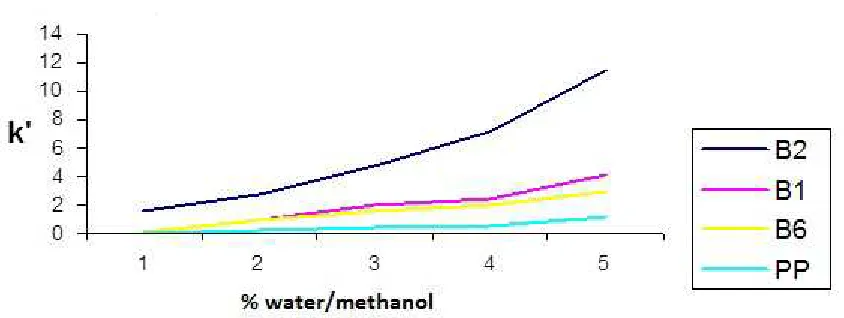
Figure 1: Influence of the composition of the mobile phase on factors of different vitamin capacity k'
Influence of the pH
[image:3.595.112.532.344.525.2]Survey of the k' evolution according to the pH of the mobile phase shows that these last don't vary an important way for values of pH understood between 2.5 and 4.5. The separation is optimal to a pH of 4.5. (figure2).
Figure 2: Effects of the pH of the mobile phase on factors of capacity of the four vitamins
Method optimized
The separation is optimal with a phase mobile 50/50 methanol/water. The pH is 4.5 adjusted with phosphoric acid (H3PO4). The debit is 1ml/min.
Essay
Above, in the operative conditions results gotten for the restrained vitamins in the effervescent tablets are very satisfactory. Table 1 shows the waited values, the found values as well as the accurateness of the method.
Table -1: Result of the four vitamin dosage in an effervescent tablet: assessment of the precision and the accurateness of the method
Vitamins PP B6 B1 B2
Real contents
in mg by tablet 50 10 5 5
Values found in mg by tablet
(10 measures)
49.57±2.7 4.0%
9.88±0.7 9.0%
4.95±1.7 6.5%
Adnane Benmoussa et al
J. Chem. Pharm. Res., 2016, 8(2):750-756
______________________________________________________________________________
Contents in vitamins have been determined while using the fashion of following calculation:
Example: Calculation of the content in PP by tablet.
Area test (AE) Takes witness (PT)
Content in mg/tablet = --- x--- x Purity (P) x PM cp x D Area witness (AT) Takes Test (PE)
With
- AE = Area of the test. - AT = Area of the witness - PE = Takes the test
- PM = Middleweight of the tablet - D = Dilution
7993131 121.2 0.99 100 x 4199.1 Content in mg in PP /cp = --- x---x---x--- 7935515 100 20 511.8
= 49.57 mg/tablet
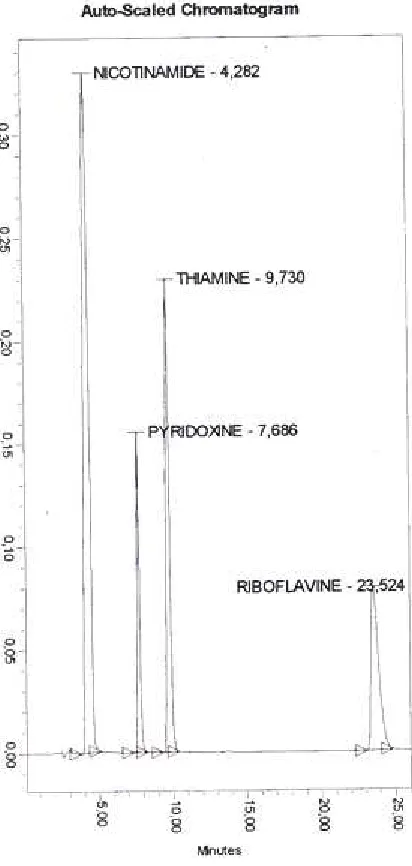
Figure 3: Chromatogram of four vitamins (sample witness)
Adnane Benmoussa et al
J. Chem. Pharm. Res., 2016, 8(2):750-756
______________________________________________________________________________
Figure 4: Chromatogram of four vitamins (sample test: effervescent tablet)
- Column Lichrosorb C18, 10um - 25 xes cm 4.9 DIS mms
- Mobile phase: Methanol / water (50 / 50 v/vs), pH = 4.2 (H3PO4) - Debit: 1 ml/min: UV detection to 272 nm1 6 Hughes
The four vitamins separated by an ethanol/water eluent containing at least 50% water. However, for water contents above 50% in the mobile phase, the retention of vitamin B2 becomes very important, increasing the analysis time significantly (r = 25 mins to 75% in water). Moreover, whatever the composition of the mobile phase, nicotinamide is less retained whereas riboflavin is more retained [7-10].
It is very difficult to establish relations structure - retention involved in the observed elution order (Polarity and pH).
Polarity
Benzopteridnes and methylpyridines cores give back less polar molecules [11] and increase retention (comparison thiamine - riboflavin).
pH
Water-soluble vitamins have generally a weak basic character and are therefore followed by reversed phase chromatography, to acidic pH.
For a mobile phase stamped to 50% and the methanol to 50%, we find that for pH values between 2.5 and 4.5, the capacity factors do not vary significantly (Table II and Figure 2). When the pH is superior to 4.5, Capacity factors increase a lot and times of retention become superior to 25 minutes.
For this reason, a neighboring pH of four is generally chosen and present in addition the advantage to improve the life span of the column [9,10].
CONCLUSION
Proposed method shows therefore that it is possible to achieve quickly, in reversed phase chromatography, the dosage of four water-soluble vitamins (B1, B2, B6 and PP). Survey of the separation according to the polarity of the mobile phase and the pH permitted to define the optimal conditions of the separation.
Method of dosage of vitamins studied allows easy and accurate dosing of these micronutrients; it can be used for the determination of water-soluble vitamins in the various vitamin specialties.
Acknowledgments
We thank MR. Professor Yahia Cherrah former Director of the National Laboratory of Drug Control of Rabat and all of the staff of physicochemical department of same laboratory whose participation was invaluable for the realization of this work.
REFERENCES
[1] El Alama H, Filali H, Rahmoune I, et al. J. Chem. Pharm. Res., 2015, 7(12), 1-4.
[2] Page C, Curtis C, Sutter M et al. Integrated pharmacology, 2nd Mosby, Maryland, 2002; 688. [3] Rafal S. Le guide des vitamines et oligo-éléments, Marabout, Paris, 2014, 288.
[4] Vidal 2014 : Le dictionnaire. 90 ème édition, Vidal, Paris, 2014, 3287.
[5] Ihssane B, Bouchafra H, El Karbane M, et al. Ann. Pharm. Fr., (2015),
http://dx.doi.org/10.1016/j.pharma.2015.10.002.
[6] Bouchafra H, Elkarbane M, Ihssane B, et al. J Chem. Pharm. Res., 2014, 6(6), 2610-23. [7] Paveen C bampen, Lawontanaro D, et al. J. Phrm. Sci., 1999, 75, 1192 - 94. .
[8] Hazlett J R, Kildsig D. J. Pharm. Sci., 2000, 70, 470 - 72. [9] Pelletier OH, Campbell JA. J. Pharm. Sci., 1999, 100, 684 - 89. [10] Moller TO, Jensen K. J. Chromatogr., 2000, 170, 300 - 20. [11] Mader WJ, Frediani HA. Anal. Chem., 1999, 20, 1199 - 200